Updated Charts

1. Geomagnetism – downtrend out to mid-Sept:

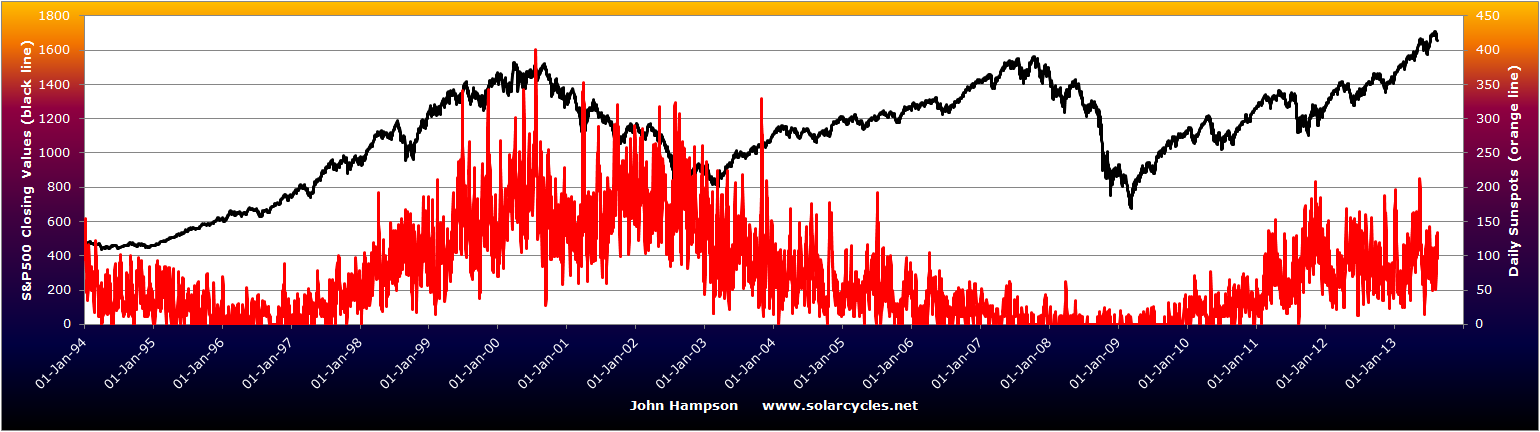
19aug12. Sunspots – up again currently but still no clear trend:

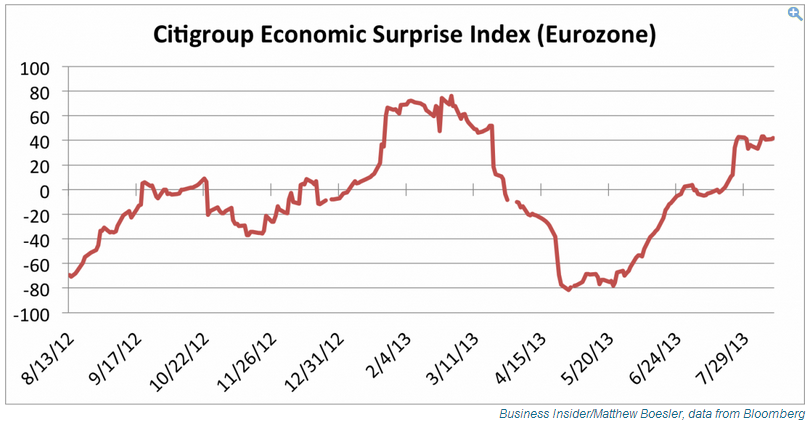
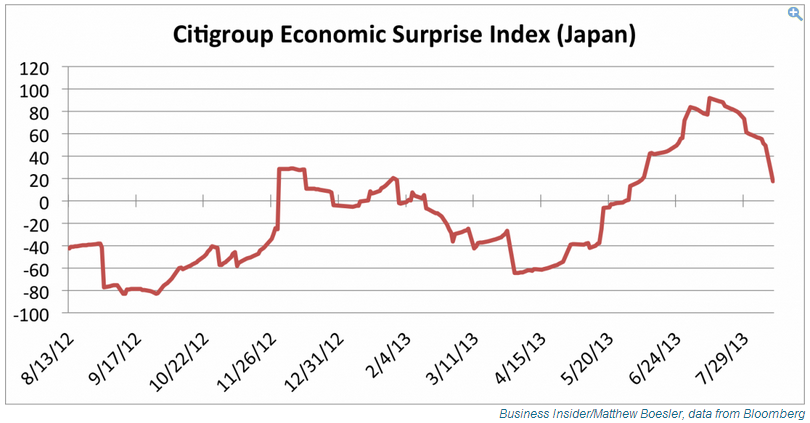
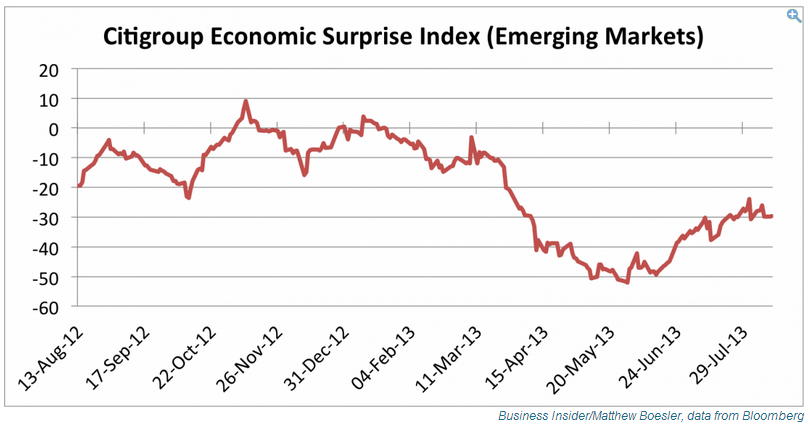
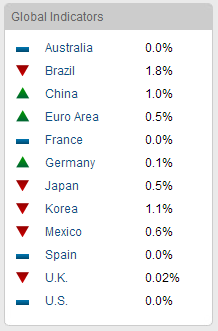
19aug23. Economic surprises – coincident data positive in USA and Europe, improving in China, disappointing in Japan and languishing in emerging markets:

19aug3

19aug4

19aug5

19aug6

19aug74. Leading indicators – weakening of late:

19aug8

Source: Conference Board

19aug9

Source: Dshort

5. Climate – July joint hottest 10th month on record, so not at mega-extreme, but still at levels sufficient to potentially disrupt agri.

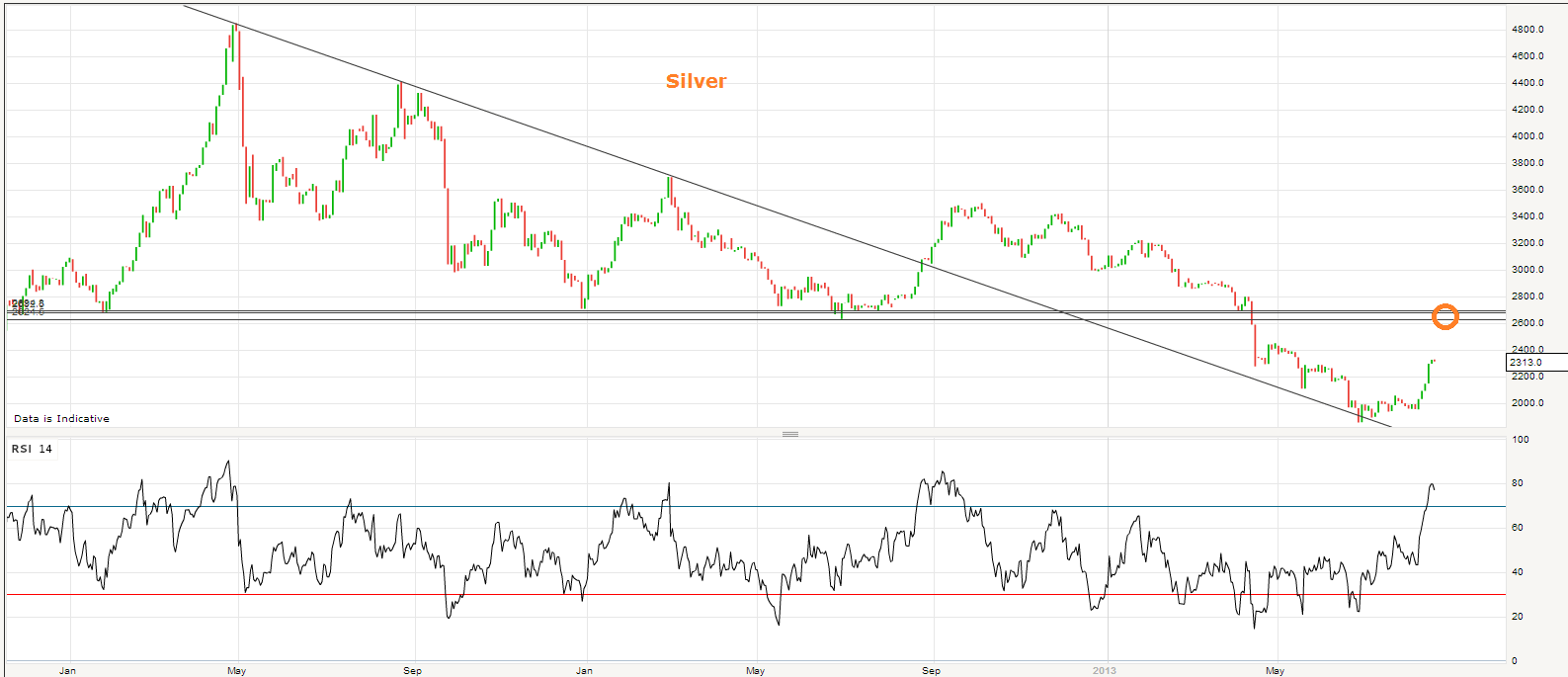
6. Silver – this seems to be the obvious target to me, horizontal resistance and a re-test of the breakdown. If it can get there I will take profits on half my positions.

19aug11

7. Full moon on Wed and end of lunar negative period this coming weekend. My aim is to take half profits on Dow shorts within that period. I have no price target, just that time target. I expect equities will rise again to complete a multi-month topping process so don’t think this is the time to load up short. One more up-move, I suggest.

8. Treasury yields advanced again. Tough to call what the Fed will do at the mid-Sept FOMC, but a month’s developments to go until then.

To sum up, still looks like a topping process in equities. Commodities outperforming currently and USD weak – this looks promising for a late cyclical rally in commodities, whilst equities top out. If the solar max is still ahead at the end of 2013 that whole process would fit, with commodities topping out in early 2014. To further fit, China and emerging markets should improve whilst the developed economies weaken in terms of leading indicators. Let’s see.

Roundup

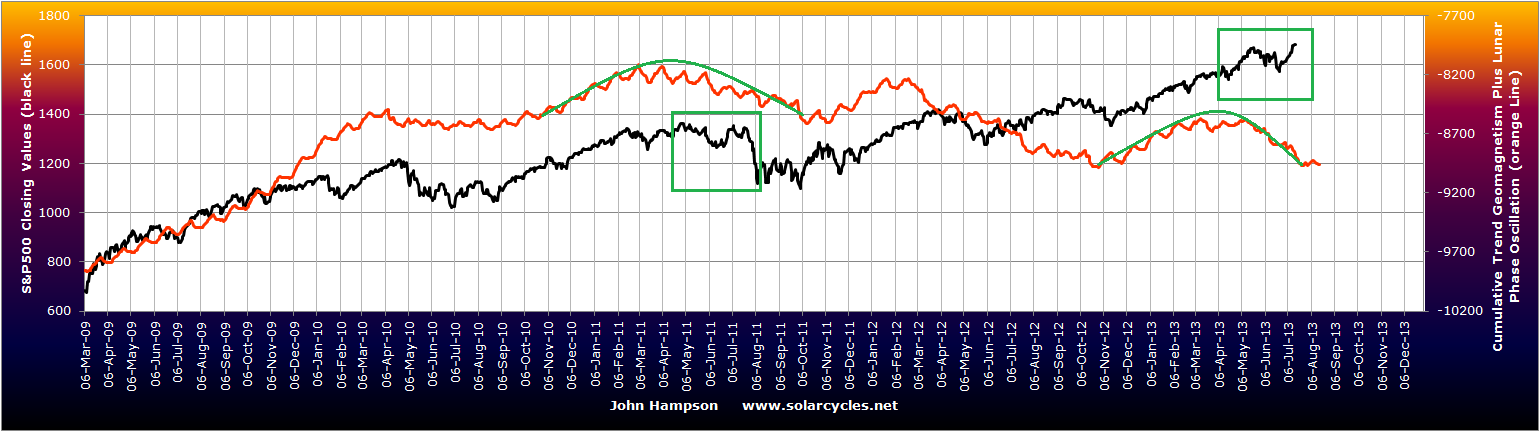
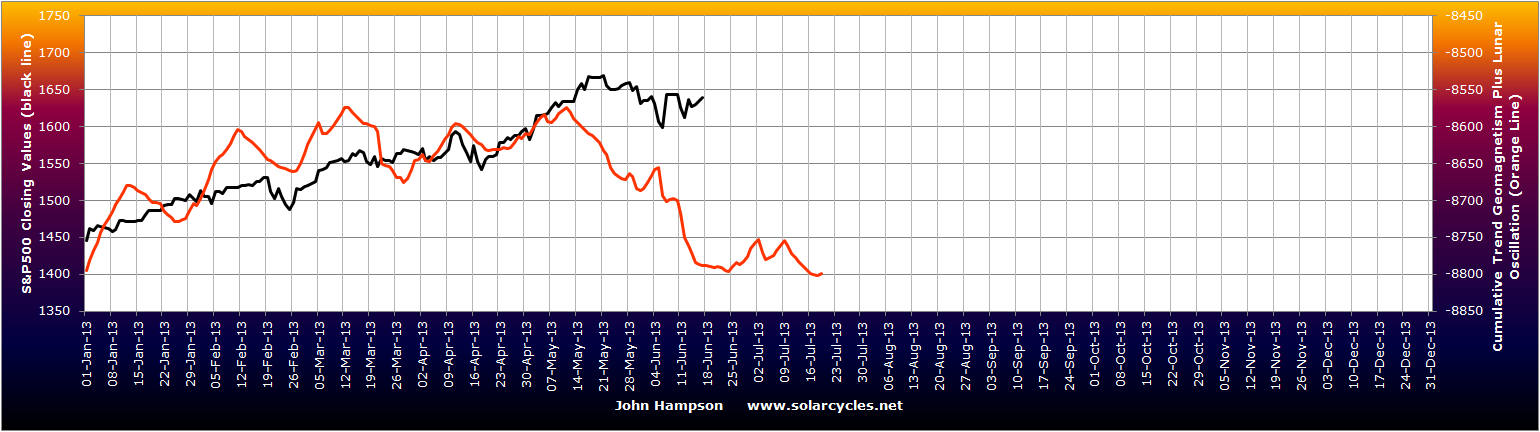
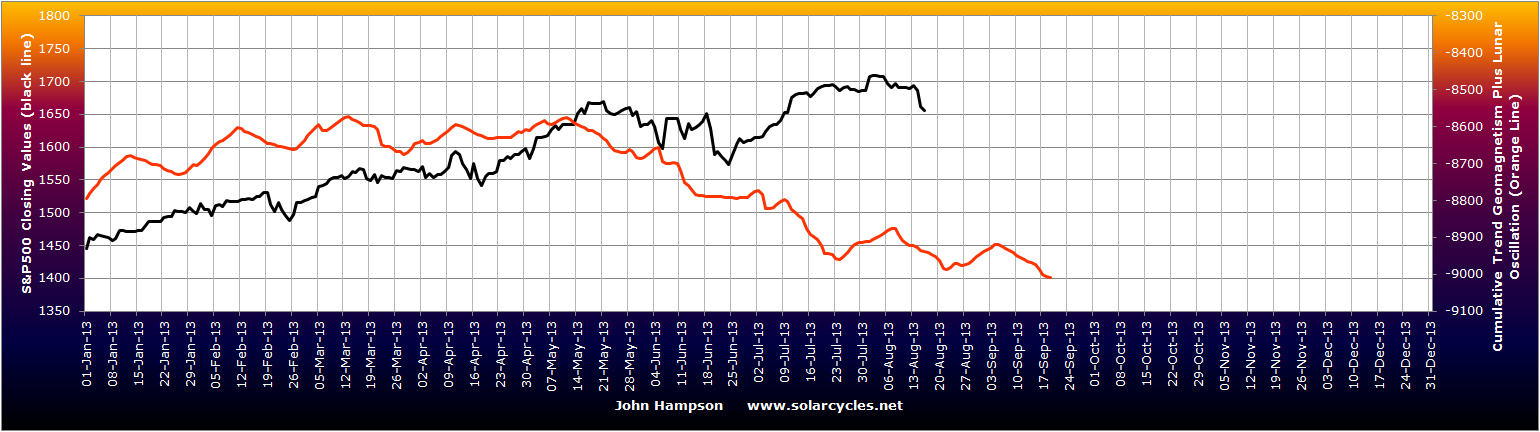
This is the latest geomagnetism forecast versus the SP500. The forecast extends to the beginning of September and as can be seen has further transformed from a downtrend to a sideways/up trend.

5aug1The SP500 notably diverged from the model throughout July, more so than other indices which have more closely tracked the model. The outperformance of the US stock indices has meant p/e valuation has now increased to make the US amongst the world’s more expensive:

5aug4Source: FT

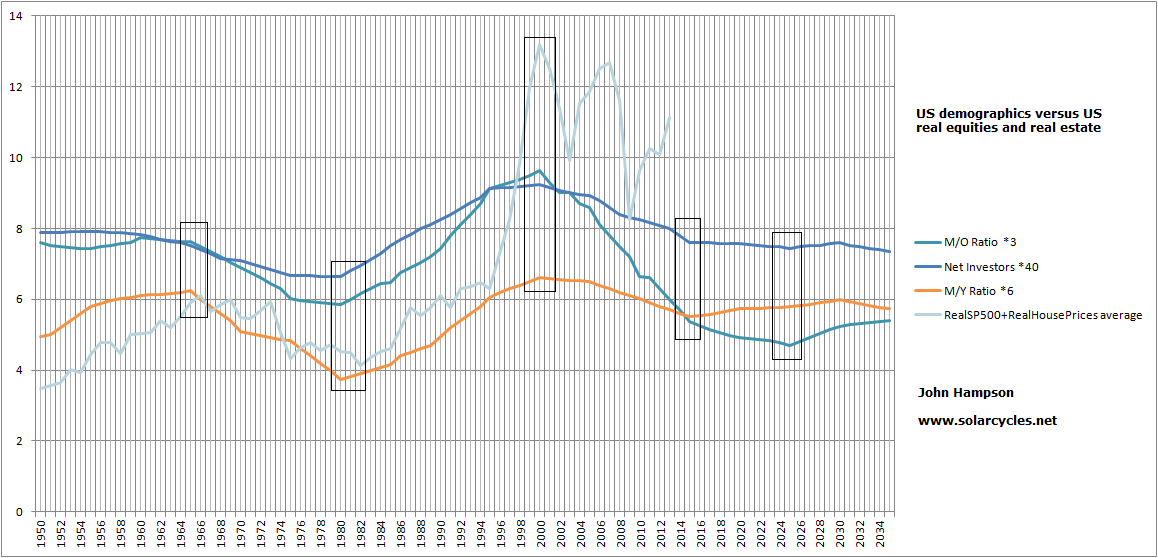
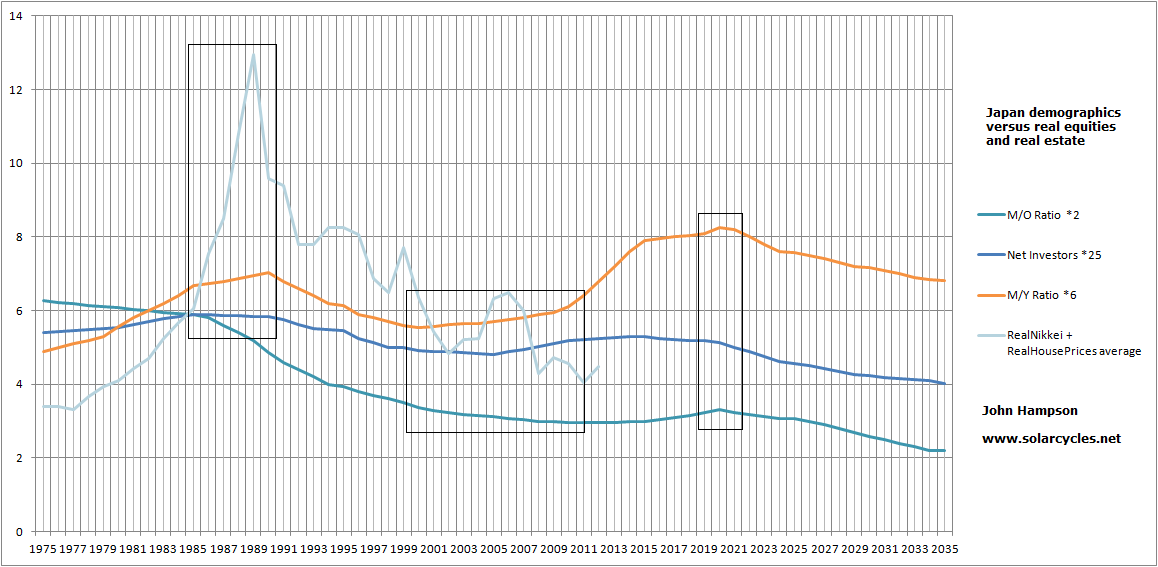
Is this justified? Not by demographics. Here once again is my real US equities plus real US house prices model versus 3 demographic ratios for the US:

X1That model has edged further up now in mid-2013 as real equities are back at 2007 levels and real house prices have edged up a little more (though are still a long way from the real 2007 peak). Yet the 3 demographic trends call for the model to collapse once again, as in 2001 and 2008. What makes demographics more potent this time around is that China has joined Europe and the USA in an unprecedented collective downward demographic pressure.

If we take the best of the three demographic measures, middle to young, only, then this is how it looks:

5aug5Source: PFS Group

Is it possible that the 2014-15 bottom is near enough and that stocks have taken off already? Well that p/e10 now stands at around 25, having bottomed in early 2009. That would mean p/es bottomed out around 5-6 years before the M/Y ratio, whereas in 2000 and 1982 the two peaked and troughed at very similar times. In the  1960s there was more of a gap, with demographics topping out a few years before p/es, but note it was demographics rather than p/es first, and this is echoed in my demographic work on Japan and UK, namely that if there is any lag it is demographics changing course first. In short, another cyclical bear in US stocks still looks the most likely course to me, and this is further cemented when we draw in all demographics measures, demographic pressures in China and Europe, and other US market valuations such as the Q ratio.

However, current leading indicator data is still largely positive for the USA at the moment (e.g. latest Markit PMI), and Europe is showing renewed strength (Markit PMIs, Conference Board). In fact it is the demographic-positive markets such as Brazil which are showing particular weakness. So what’s going on? I suggest commodities have played a key role in this. Lower input prices have boosted the developed economies and stocks. Commodity-economies such as Brazil have suffered. If commodities can rally again and make a historically-normal late-cyclical peak after stocks have peaked then I suggest the demographically-challenged major economies won’t be able to handle the renewed input price pressure. I believe the weak global recovery will topple over if commodities, particularly oil, rise in a meaningful way again.

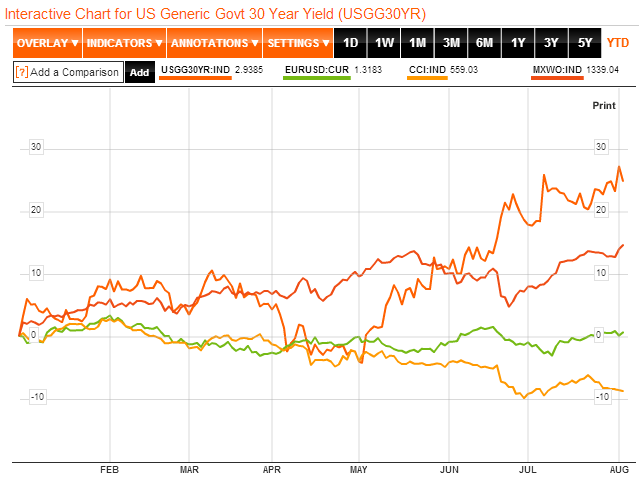
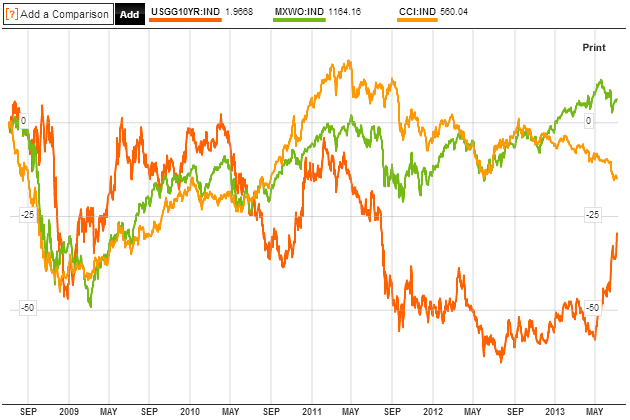
Here is 30 year treasury yields with CCI comodities index, world equities index and Euro-USD. Euro-USD and commodities could be in a new uptrend that began in early July, IF they can make a higher low here.

5aug6Source: Bloomberg

But too early to say anything more. For me, it remains a game of patience, waiting to see if commodities can start to outperform here. Gold and silver had a very up-and-down week last week. Oil has maintained its breakout but appears to be stalling.

I believe the solar cycle still has a key role to play in the fortunes of commodities. Here is the latest SIDC update which continues to show two possibilities. If the solar max was Feb 2012 then I suggest commodities peaked out in 2011. If this were the case then I don’t believe a new secular bull market in stocks is underway because as per my work secular actually is demographic and the major economy demographics don’t support a new secular bull. I rather expect a deflationary recession to come to pass in due course. If the solar max is ahead as per the second SIDC option then I believe we will see the historically normal late outperformance of commodities from here into 2014 and that will tip the world into recession.

5aug3

Source: SIDC

In the near term, I am looking at the window from tomorrow’s new moon through to Friday’s end-of-lunar-positive period to take profits on some equities longs and potentially add more short equities. I would like to see stocks advance further this week to do so.

All Round Update

I’m back. Here’s an updated look at the main pillars of my work.

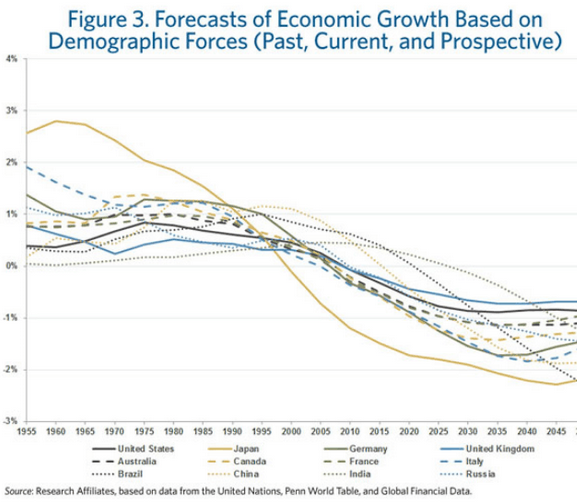
First, demographics. The key overarching macro issue going forward, in my view, is whether the combined price-deflationary and asset-deflationary demographic trends now in place between US, Europe and China will tip the world into recession and deflation despite the best efforts of central banks. Someone else has picked up on the theme and produced this:

1aug1Source: Nakedcapitalism

I continue to look at leading indicators for evidence. There is no doubt central banks have some impact on behaviour in the economy and financial markets by deploying policies to discourage savings, cash and fixed income, and to encourage lending, risk-assets investment and spending. But is it enough to offset the demographics?

The latest data shows Europe strengthening (PMIs, economic surprises), USA possibly having peaked (ECRI, economic surprises), and the overall global economy potentially weakening towards late 2013 but not until then (narrow real money). This week’s US GDP release surprised to the upside for last quarter, however the upside surprise matched the retrospective reduction in the previous quarter’s data. Nonetheless, the overall global picture is still fairly ‘safe’. Europe’s relative strength ahead should bode well for the Euro v USD, and a relatively weakening USD should bode well for commodities, and if we are to see the normal late cyclical outperformance in commodities (once stocks peak) then we need leading indicators to at least hold up a little longer.

If the unprecedented coming together of demographic downtrends in US, China and Europe mean the global economy is heading for recession no matter what (given China has now peaked demographically), then I believe this will mean a severe nominal decline in equities, as central banks will be revealed as impotent, and panic will ensue. If we slip into global recession without the ‘agent’ of commodity price acceleration then I would expect the SP500 to complete an overall megaphone formation since 2000 with a potentially lower low than 2009.

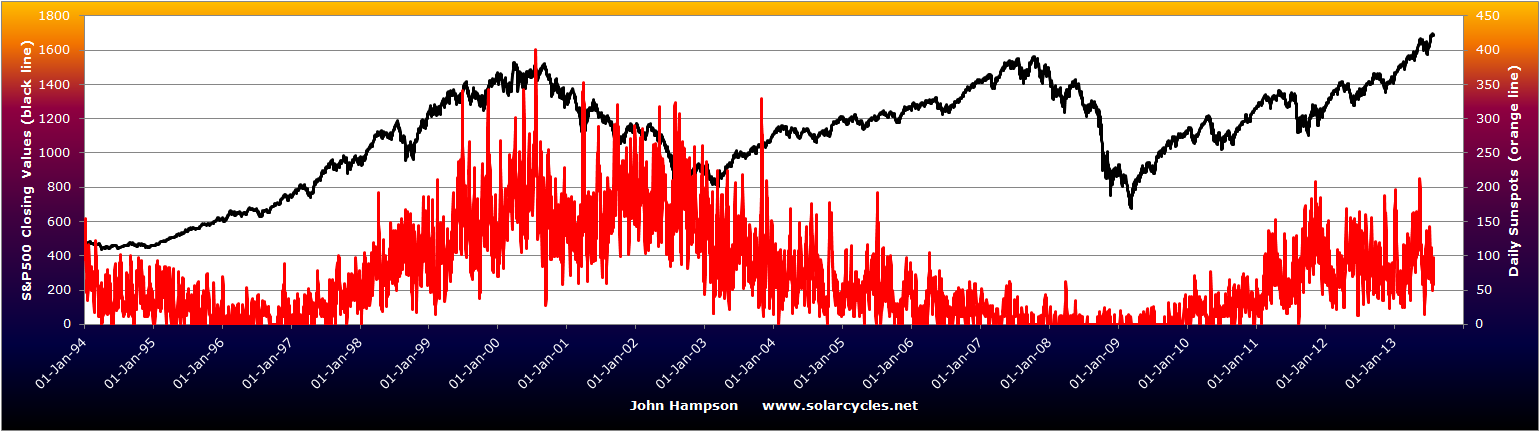
Next, solar cycles. Experts still don’t know if a solar peak is ahead or behind. Here’s the latest sunspot chart:

A2

It’s clearly a weak sunspot cycle, and fairly messy. Some scientists believe there is a second peak ahead this year, which may exceed the existing smoothed max (Feb 2012). On the other hand, an overlay of SC5 suggests that existing peak may have been it:

1aug2Source: WattsUpWithThat

If the peak was Feb 2012, then I would point to 2011’s commodities speculation including a silver parabolic together with extensive Arab revolutions as normal behaviour patterns associated with solar maxima. It should mean that we have passed the speculative peak in commodities, that global temperature may have already peaked, and that we should expect the geomagnetic disturbance peak that follows a solar max normally 1-3 years later and is associated with recession. In this scenario I would expect commodities to continue overall weakness and deflationary recession to occur.

If the peak is still ahead later this year then we may see global temperature hitting extremes and more geopolitical trouble, together with a speculative peak. All three could push up commodities in a late cyclical outperformance into 2014 with bonds already having topped and stocks topping this mid-year. In this scenario I would expect an inflationary spike to help tip the global economy into subsequent recession.

Next, geomagnetism. All models have been updated for this week, and drawing in the next 3 weeks geomagnetism forecast, we see this (mapped against the commodities index):

1aug3A flattening out in cumulative geomagnetism in August following a downtrend May-July. By normal seasonality, geomagnetism should be troubling again by September and October. August-September would therefore be a suitable time for US equities to make a final peak in a topping process, if one began in May. Did one?

Well, so far the process is developing like a typical top. A marginally higher high is currently being played out with some weakening in breadth versus the May peak (% stocks above 50MA, Mclellan summation index). Margin debt still looks like it peaked in April, and in 2000 and 2007 this peaked 3-6 months before the stock market finally rolled over. However, this would all be invalidated if stocks push on again here and away from the topping range, with breadth strengthening again. US earnings may play a role in this and so far have made an impressive earnings beat, but a poor revenue beat rate. This means companies are making profits by cutting costs. This could be a warning if the economy shows signs of weakening, which brings us back to the importance of leading indicator readings as they come out. If central banks have been able to juice the economy just enough to offset demographics, through rate cuts, QE and verbal support (do what ever it takes) then it is feasible that this already long cyclical bull (by historical comparisons) continues. But I side with the multi-month topping process currently playing out until counter-evidence increases.

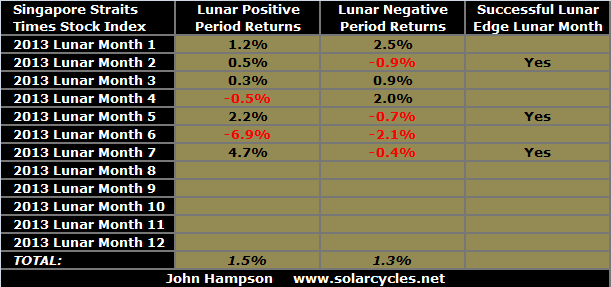
Next, lunar phasing. I have updated The Lunar Edge page and this is how the two of the most ‘sensitive’ indices to lunar phasing have performed so far this year:

LE43 LE23

The German Dax has delivered all of its annual gains so far within the lunar positive fortnights (4 days after full moon through to 4 days after new moon), whereas the Singapore Straits has really delivered no lunar edge of any note so far this year. Nonetheless, a strategy playing the lunar edge equally across both would still have returned well overall. I continue to look to the start of lunar negative periods for adding short and to the start of lunar positive periods for adding long, in order to time my longer term trades. On that note, the current lunar positive period ends by Friday next week. If equities have been able to rise further by then, I will look at taking profits where in profit, and adding short at that point if evidence continues to support a topping process.

Because we are in a lunar positive period currently, and Japanese equities fulfilled what I last suggested look liked occurring (the arching-over turning into falls) I have entered long Nikkei again, but just a starter position. My main exposure currently remains long commodities, with greatest weighting precious metals. I have various significant loss-making positions in commodities. I continue to believe that because of demographic trends precious metals will come again as the anti-demographic. I suggest central banks in US, China and Europe will continue to have to support the economy for some time to come and that renewed dovish talk will benefit gold. For other commodities, I return to the solar maximum unknown. If the solar maximum is ahead still, then I believe temperature and geopolitical disturbance and speculative mania can inspire a historically normal commodities peak following a peak in equities. Crude oil’s breakout in June gave this more credibility. Crude has now pulled back a little, and it will be important to see if this is consolidation before further gains.

If commodities as a whole have peaked and deflation continues to press them downwards, then I will be holding increasing loss-making positions. What to do? I will be looking to average down and time mean reversion. Nothing goes down in a straight line and I will be looking to convert them into winning trades in a ‘trade your way out’ style by leveraging up. Not easy, and no doubt some would view that as too risky, but that’s what I will be doing. Don’t follow me, etc, I’m just sharing with you what I’m doing, as the money management is as important as the analysis, right? But first, let’s see if commodities can outperform in the rest of 2013, as the previously detailed evidence suggests is possible. I want to give them a little more time to gather momentum, before using aggression.

Some key assets. Gold reached important resistance around 1344. Can it break through? If not then the basing process in precious metals will need some time longer. It is confidence restoration versus short squeeze, but if the latter is to occur then we will need triggers in the news. The US dollar has been in decline since the Fed backtracked on QE-tapering-hastiness, turned away at key long term resistance. However, it could yet be consolidation before another charge. I believe it will weaken as the Eurozone relatively improves, but the Fed’s actions will play a key role. Since I sold out of short-treasuries they tracked overall sideways. This could be consolidation before further rises in yields, but as there has been no pullback I don’t wish to yet rejoin.

I am writing this post US GDP release and pre FOMC output. Both market movers, and it will take until tomorrow for the dust to settle and we see where different assets want to go. But I wanted to get the post out as my trip gave me no opportunity. Thanks for your comments and emails whilst I have been away.

State Of The Markets

The SP500 followed the Russell 2000 and Nasdaq to new highs, on good breadth with healthy leading sectors. A marginal new high is normal in a topping process, but we would expect to see some kind of warning flags developing in terms of leading indicators if not in internals. We would also expect any new high to still be within an overall topping range, so not to run away too far. Here is one such topping model:

16jul6

Source: Zevcapitalresearch

So might stocks get pulled back soon? Earnings reports are just getting going so too soon to assess beat rates, but earnings season usually produces a bullish or bearish theme. Geomagnetism continues to disturb and diverge from performance in some key stock markets. I have highlighted a historic rhyme below, which would be consistent with a topping process and then a fall in earnest in US equities:

16jul2

I have updated all models on the site this morning.

ECRI leading indicators for the US have changed trend:

16jul3Source: ECRI / Dshort

And the ISM manufacturing and services composite is also trending down:

16jul1Source: Bespoke

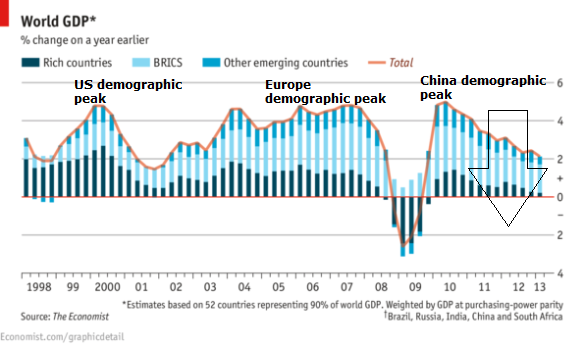
World GDP is also in a steadily weakening trend, which is in line with my expectations based on the confluence of negative demographic trends now in place between US, Europe and China. I have marked their respective demographic peaks to illustrate:

16jul4Underlying source: Economist

Because of the demographics, my primary expectation is that the economic data will indeed continue to weaken and in due course topple the stock market. The alternative would be that the collective efforts of central banks are sufficient to prop up the global economy to a sufficient degree to maintain the low-growth-low-rates environment which is positive for equities. So all eyes on the leading indicators.

The US stock market is now in the top 3 most expensive by CAPE globally. Again from my demographic work, high price-earnings valuations can go higher if demographic trends are positive. However, the US is in a period of negative demographic trend so the expensive valuation is an anomaly that should be corrected in due course.

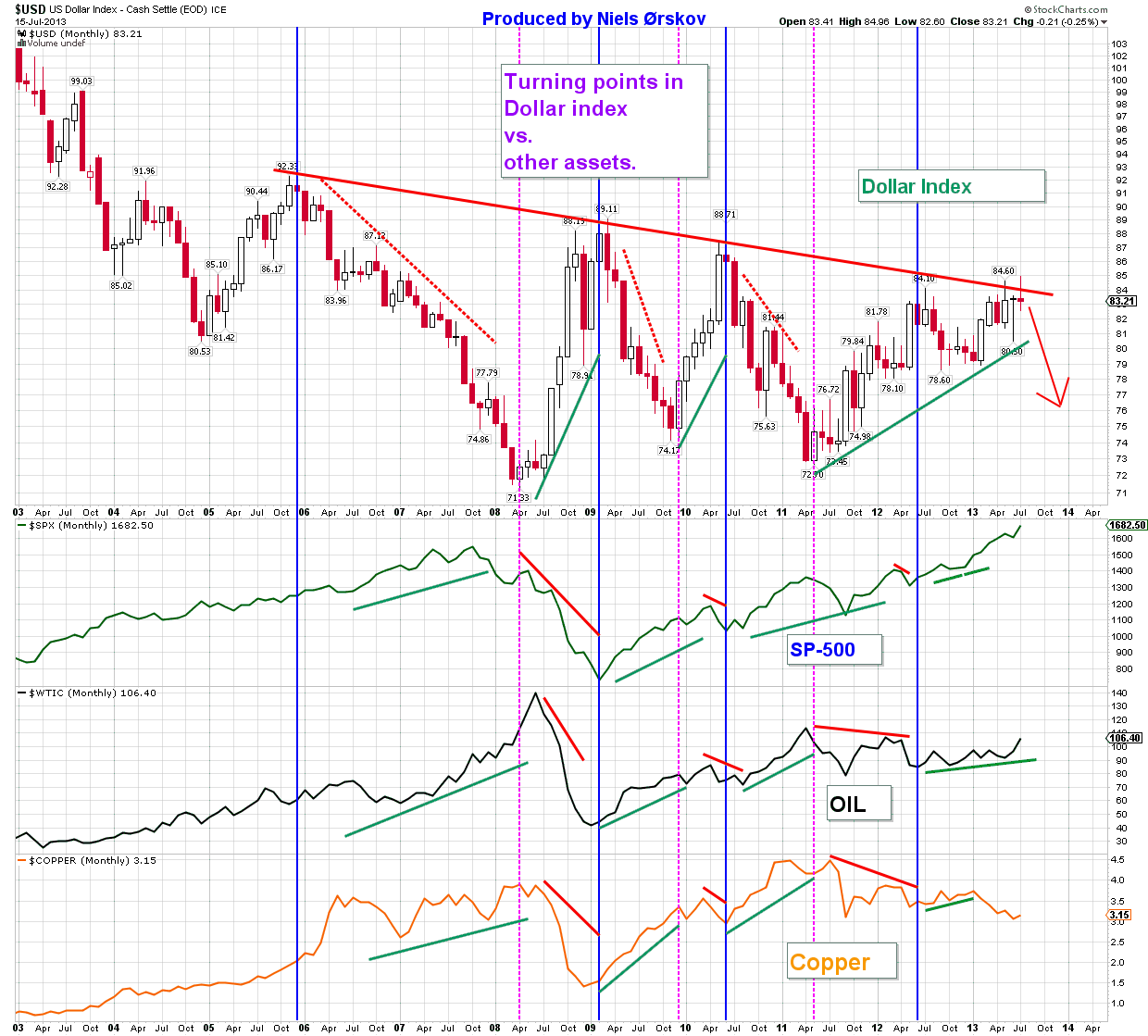
Crude oil has continued its upward trend and cemented its breakout. Gold and silver look to have carved out bottoms, though still tentative. The CCI commodities index has now been in a two week uptrend. So still early developments for commodities, but I maintain there is a greater likelihood of the historically typical process of commodities starting to outperform whilst equities make a multi-month topping process (with bonds already having topped), and eventually commodities topping last as they help tip the economy into recession. Another possible development in support of this would be if the US dollar broke down from its recent uptrend following Bernanke’s softer QE stance that came out last week. A chart by Niels here:

16jul5Source: Niels Orskov / Stockcharts

So as things stand, I maintain my overall expectation that stocks are in the first half of a multi-month topping process, with a marginal new high being carved out currently that should soon be turned back down. Commodities should outperform here forwards. Leading indicators should weaken sufficiently to prevent further advance in equities, but not too drastically to sink commodities. Moving into 2014 commodities should peak as they suck the remaining life out of the global economy, which is already vulnerable due to collective demographics of the major nations. Whether they can do this around the time of the solar maximum, as per history, remains to be seen, as the experts continue to diverge on forecasting when the solar maximum will be or was. The sunspot trend remains messy for now.

Trading-wise, if equities can rally a little higher here whilst we see a little more leading indicator or earnings degredation come to light, I will take off some more from the long side and add on the short side. Meanwhile I continue to sit on my ample commodities long positions.

Trading Update

I have taken profits on Nikkei longs today and added short on the French CAC. We are now switching into the lunar negative fortnight, with a geomagnetic storm also in progress, and I believe we are in a multi-month topping process in equities. I expect the topping process to be an overall volatile range lasting into September before falls in earnest, but within that I want to sell into strength and buy into weakness.

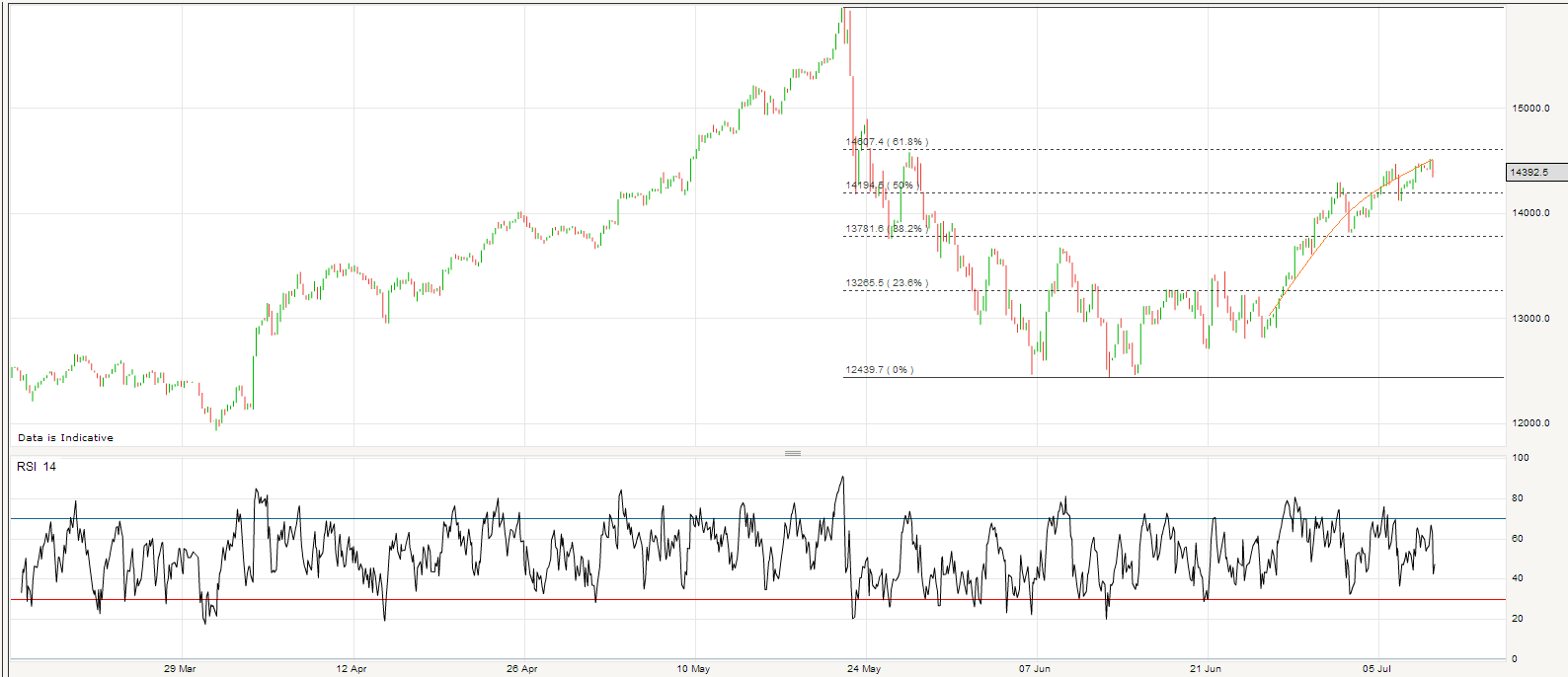
The Nikkei trade has been a big earner as I was aggressive into the pullback, based on my demographic research. Now this is how it stands: close to a 61 fib retrace of the falls, and arching over:

10jul20135

I maintain the expectation that it will eventually break upwards out of its long term downsloping resistance, but wish to step back for the lunar negative period and with the belief that if global equities are topping another leg down in equities should be next.

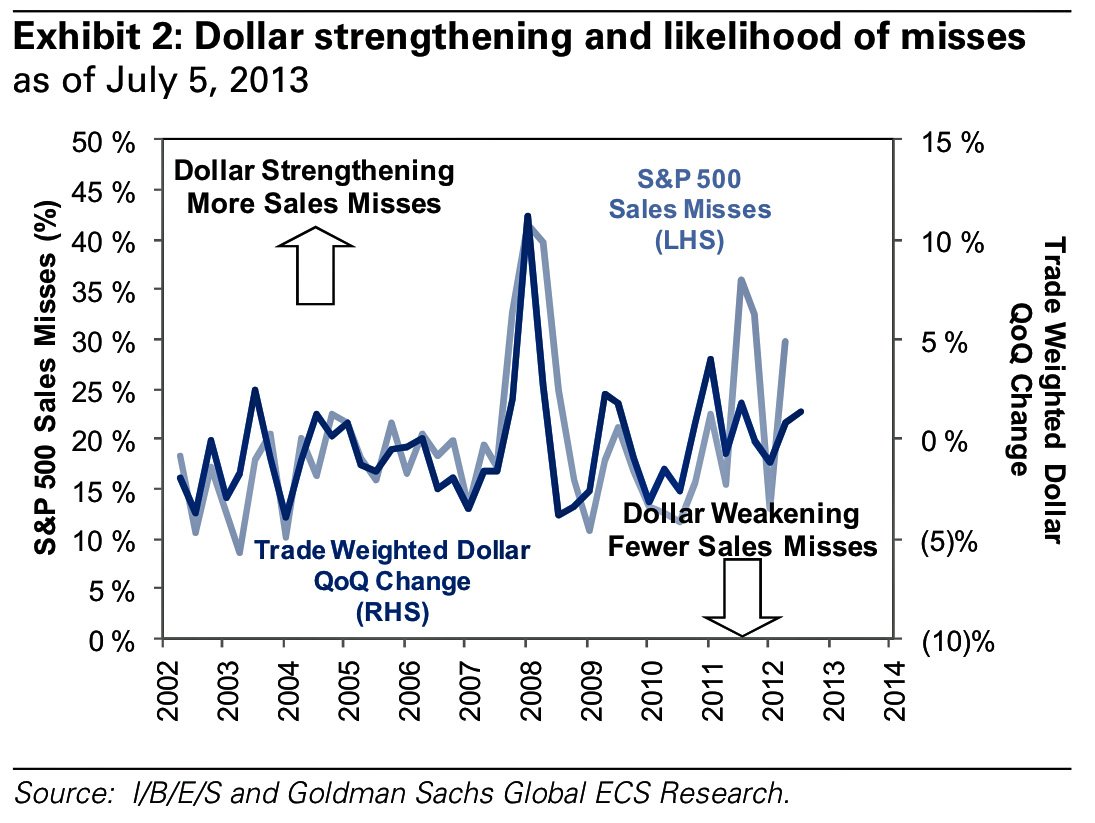
US retail and discretionary broke out to new highs along with small caps, which is bullish, but marginal new highs are normal in a topping process. There is a possibility US earnings now pull back equities, as shown by the historic correlation between USD strength and revenue misses:

10jul20134We also see encouraging signs that commodities may be beginning outperformance, with crude oil pushing on again yesterday and agriculture strong the last couple of sessions, despite USD strength. A topping process in equities beginning as commodities start to outperform would be very much in line with 2007/8:

10jul20131

Overbearish sentiment has been stretched like an elastic band on most commodities and commodity currencies for some time now, so mean reversion also supports a rally, plus Goldman and JPM have been putting out notes arguing for some fresh upside now in the class.

Sentiment has also been very bearish on treasuries for some time now, as yields have risen 70% from their lows. I am considering taking profits on short treasuries also. My thinking is that a pullback in yields is due, and I am wondering whether a combination of the fast-rising yields together with continued soft economic data (expectations based on demographics) will bring about a softening/backtracking in wording related to the announced pull back in QE. Such a development, either in yields or in policy, should then benefit precious metals. Just speculation, but as part of my overall case for a transition in the fortunes of asset classes this summer.

I continue to look for evidence in leading indicators for a weakening in economic data that the combined demographics of USA, Europe and China suggest should occur.

Based on the latest OECD data, we see fairly flat narrow real money and leading leading indicator, neither giving much clue as to future trend, but strong enough as things stand:

10jul20132Source: Moneymovesmarkets

And to finish, Citigroup economic surprises for the US. We see economists clearly struggling with data expectations following 2008 in the wild swings oscillating up and down, but gradually getting to grips as the swings range narrows:

10jul20133Source: Yardeni

If this were a stock we’d be expecting a resolution to the triangle, and as can be seen we may have one. Maybe there’s nothing to read into this, but if anyone has any thoughts I’d be interested to hear.

State Of The Markets

No collapse in the stock market, which makes the case stronger for a more regular multi-month topping process. It would be historically normal for equities to retest their May highs and even make a marginally new high, then complete a volatile trading range by around September time before falling in earnest.

Also historically normal would be if commodities outperform from here, with bonds having topped first, then stocks topping, and eventually commodities topping out, likely in 2014. The continued falls in bonds – and rise in yields – adds weight to bonds having topped – and yields bottomed – in 2012. Now are world equities in the process of making their top?:

7jul4Source: Bloomberg

The strong advance in crude oil of late has added more weight to commodities going on to outperform here, rather than the historically abnormal but deflationary case of commodities sinking. The combination of protest and unrest in Egypt together with speculation in crude oil are both historically normal for a solar maximum, so I am encouraged. Nonetheless, crude oil has yet to truly break out and some geopolitical dampening could pull it back:

7jul1Source: Stockcharts

If crude does continue to rise, then commodities as a whole should catch a bid, due to high historic correlation, with oil a a key input in the agri process and a key inflationary force, which brings us to gold. Gold has dropped around 30% from its 2011 high, which is similar to the percentage drop made in 2008. It has the potential to be making a bottom here with a higher low than in late June, and the longstanding overdue bounce based on extreme bearishness, but only if it can rise this coming week, which brings back to oil’s performance, plus also the US dollar.

The recent strength in the USD has taken the currency to back up to a key level. Below is the long term view and the potential for an important breakout:

7jul6Source: Rambus / Stockcharts

However, as per my demographic work, I believe leading indicators will weaken and gold will re-assert itself, and US stocks will top out here reducing demand for the dollar. Here is some evidence to support that view.

The latest global PMI combined services and manufacturing dropped to 51.4 from 52.9 and continues the overall weakening trend over the last few years. This is as I would expect under the combined deflationary demographics of USA, China and Europe since around 2010.

7jul7Source: Markit

The performance in corporate bonds suggests US housing may be about to turn down again also:

7jul5Source: Martin Pring

And margin debt continues to look an important pointer for the stock market. See below how a sharp run up in margin debt, a final parabolic rise, precedes the 2000 and 2007 tops in the SP500 by several months. We have seen a similar parabolic rise since mid-2012 to now and there is the possibility that margin debt peaked out in April which would suggest stocks should indeed be in a topping process now and over the next couple of months:

7jul8Source: Dshort

If stocks are topping out then normal clues would be found in negative divergences in stock market internals and leading indicators. For the former, we should look for breadth divergence once we see a retest of the highs. For the latter, we have the potential in the global PMI above, but also in this leading indicator of leading indicators, by RecessionAlert:

7jul2

Source: RecessionAlert

I have enquired with them what this MBS indicator is, but have no reply. If anyone knows, please share. But it would fit with my demographic-deflationary expectations.

We also see a potential divergence in geomagnetism, if equities can now rally again to a retest of the highs:

7jul9

The ideal combination by my work and research is for commodities to outperform again now into next year, and make a speculative peak near to the solar peak (the timing of the solar peak remains unknown, with the experts still diverging. Sunspots are currently back up over 100, which adds to the muddy trend), then deflationary demographics to mean the global economy fairly quickly tips into recession under that commodity price pressure, and then we should see the steep falls in nominal stocks. My alternative scenario is that the deflationary forces are too great and commodities in general sink with just gold, as the anti-demographic, eventually coming again alone.

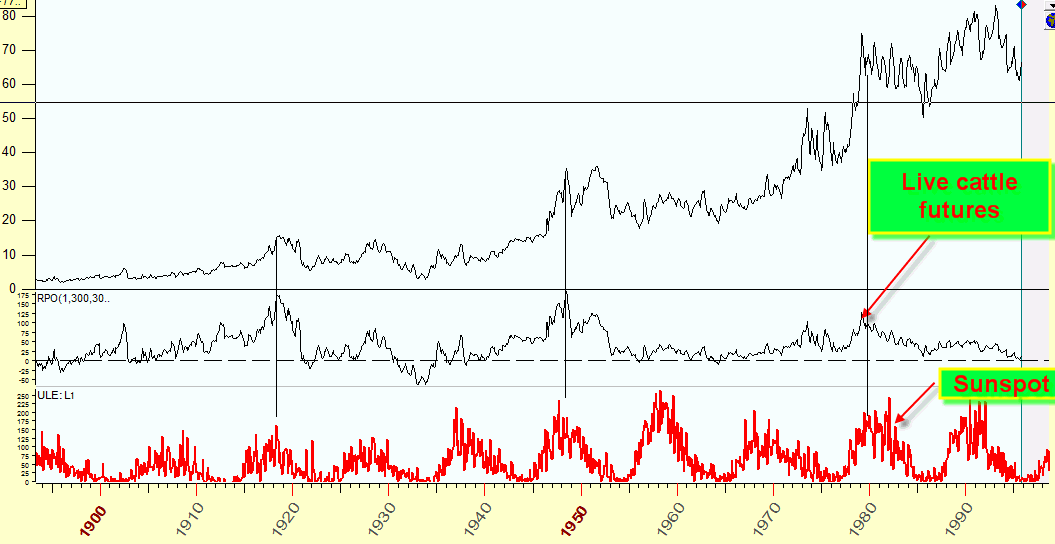
In support of my primary scenario, the action in live cattle has been very much aligned with solar history, with what looks like a peak earlier this year:

7jul10Source: Tarassov

7jul11Source: TradingCharts

Now we need to see other commodities make a fresh rally to new highs, assuming a solar peak is still ahead.

This week we have the new moon on Monday and the end of the lunar positive period by Thursday. So I am ideally looking for equities to rise further in the next couple of days and make that retest of the highs or marginally higher high, then retracing again in the negative lunar period ahead, to further the technical look of a topping process. If we get that retest of the highs then I will be looking to sell equities longs and add short. But for further support I would like to see oil break out, commodities to rise en masse and the US dollar to be turned down with gold catching a bid at last. Let’s see how the action unfolds.

Macro And Markets

The Fed announced tapering of QE as of 2014, subject to developments of course. It will first need to taper out its QE to zero before rates can rise from ZIRP. Rates will then likely be raised slowly as in the 1950s due to high government debt. Together this means easy monetary conditions will persist until US demographics bottom out 2014-2019.  I suggest that is broadly necessary to counter the demographic downtrend and could mean that we see continued low growth with more asset bubbles appearing and then popping.

What would change this course of action? If inflation became problematic and yields rose too far too fast. Currently inflation is benign as global growth remains fairly soft. History reveals that a  low growth low inflation low rates environment is good for equities. It took the last 12 months for investors to really gain confidence in economic growth persisting (if soft) and with a gradual bottoming in government bond yields:

21jun1

Source: Bloomberg

At those record low yields, investors were making a guaranteed real loss, yet money flows were still attracted into government bonds – with the assistance of QE in USA, UK and Japan – due to fear of greater losses in other asset classes. Recently that has changed, and it is because low economic growth has persisted long enough with some of the main worries (e.g. Euro debt, sovereign default) deflated. That does not preclude new crises emerging, but there has been a gradual process of repair since 2008, and I suspect we have seen the bottom in bond yields.

Because we are currently in demographic downtrends for the USA, China and Europe, I suggest it makes sense that only low growth is the current norm and that easy monetary conditions are likely to be maintained until a collective demographic improvement as of around 2020. Gains in real estate and equities should be capped by the demographic downtrends, but supported by the easy money conditions. Commodities have historically performed well during demographic downtrends, but could struggle to make large gains if soft growth holds down demand. Money should continue to flow out of government bonds, with any of those three classes the recipient, unless real yields rise too high for bonds to become attractive again. Yields cannot be allowed to rise too high because of high debt servicing and negative economic impacts. Combined, that makes for a fine balancing act between all four asset classes.

Japan is one economic giant that is in a demographic uptrend and I believe the recent surge in equities there is a belated catch up to that trend.

X2

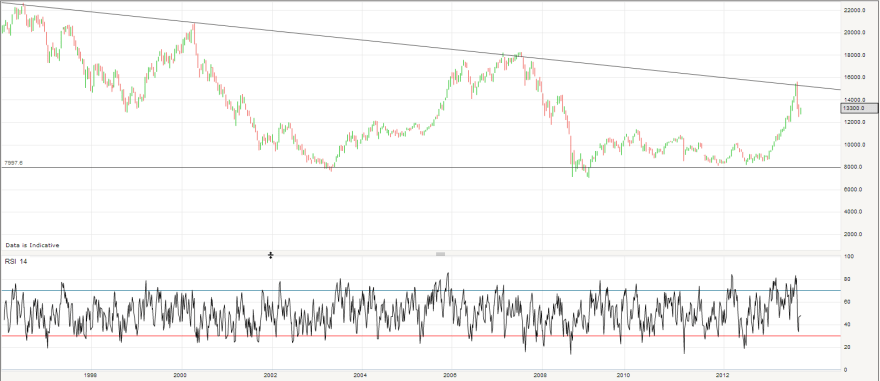
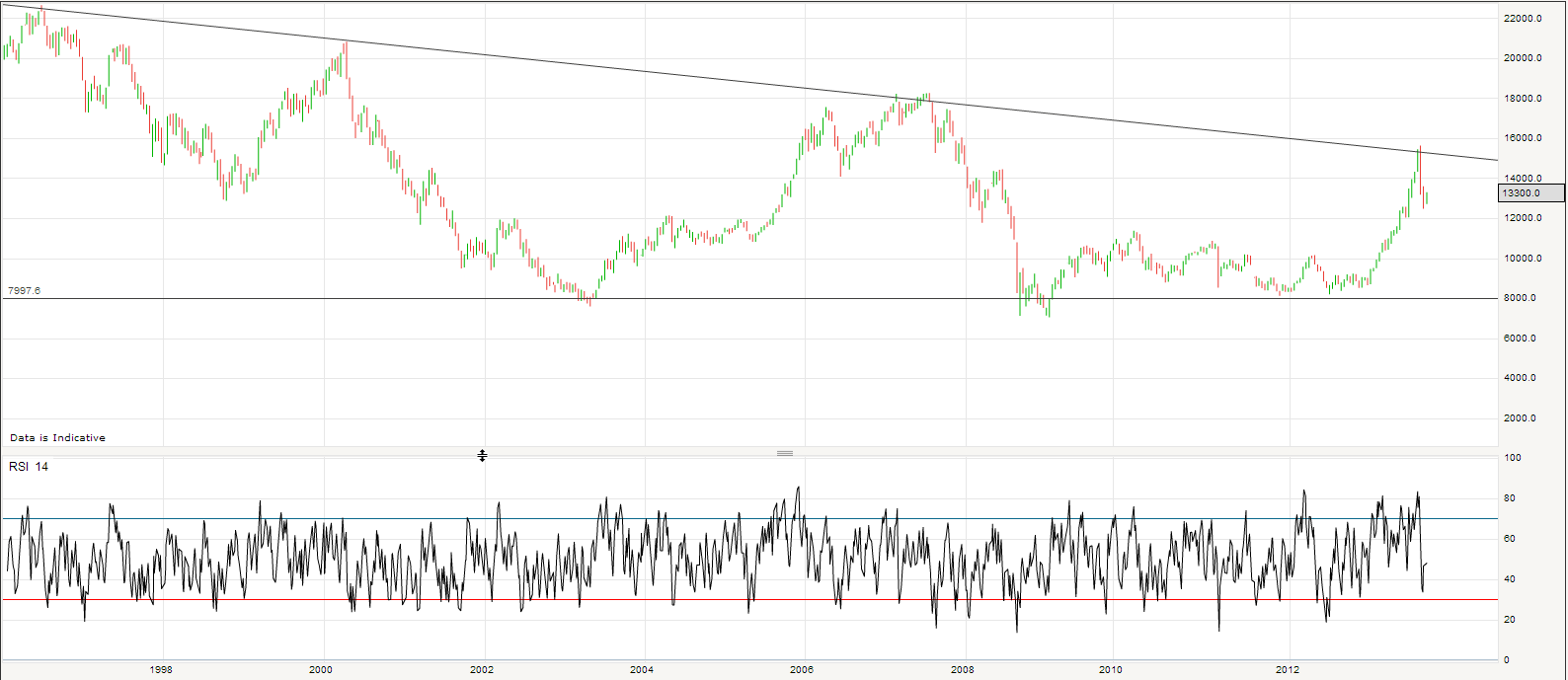
I believe Japan was ripe to bottom around 2002, along with demographics, but was then pulled back down again with the global crisis in 2007/8. The H1 2013 Nikkei rally was stopped at the long term declining resistance, but I think this time it will burst through it successfully, in due course:
21jun2

The Japanese government has declared it will do whatever it takes to re-inflate the economy and assets including buying equities. The question is how long it will take to break through. If US equities are beginning a topping process then it would seem unlikely that Japanese equities break out at this point. If emerging markets are heading into a crisis, as Russel Napier believes, then a global sell-off would likely take place again.

There are 3 possibilities here for US equities. One is that they have run up in an eiffel tower parabolic formation and will collapse now down the other side. Two is that they have begun a topping process whereby we should see an overall sideways volatile range over several months whilst negative divergences appear. Three is that they are consolidating before further gains.

Because of the sharp run up and the demographic headwinds, I have my doubts about option three. However, cyclical stocks bulls usually end with commodities and inflation rising to become problematic and helping tip the economy into recession. Inflation rises, yields rise and the higher input costs and higher rates squeeze the economy. Bonds top first, then equities, then commodities. At this point we appear to have seen a top in bonds, but do not yet see commodities or inflation rising. Therefore we don’t see the usual historic pressures to pull down equities. Low growth, low inflation, low rates: good for equities.

For option 1, a harsh collapse, some analysts are referring to a 1987 overlay, predicting a crash. I can’t rule it out, I can just refer to that current environment again – it differs significantly from 1987 where yields and rates were much higher. We know that flash crashes can happen, where automated selling begets automated selling, but I suspect we’d need a swift change of status quo to bring it about. Something like the possible emerging markets crisis.

For option 2, a topping process, we would have time. There is no rush to short until we need more technical evidence of a topping range and negative divergences in breadth and leading indicators begin to appear.

In the short term, I believe we could be reaching a point this weekend whereby equities rally up again. Passing through the full moon together with a possible bottoming out in geomagnetic disturbance – the Singapore STI shown here mapping very closely to the model:
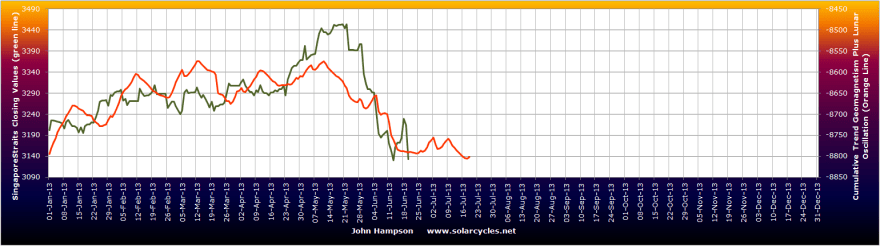
21jun3

Plus, low Nymo and bullish percent / call put readings in US equities suggest a bounce imminently.

If equities do bounce then crude oil has a chance of holding its breakout, which it is currently backtesting. If crude cannot, and falls back into the triangle, then the textbook action to follow would be a breakdown out of the bottom of the triangle, which would likely spell prolonged doom for the commodities complex.

So will commodities come again? I believe they will. Nothing goes up or down in a straight line. Mean reversions eventually occur, if not something more juicy. What could give them momentum? A top in equities or concerns about the economy functioning without QE could spur money into precious metals as safety again, with a short squeeze possible on record short interest. Geopolitical developments can affect oil prices and in turn wider commodities and protests/wars are common at solar maxima. Global warming and global wierding remain risks to agricultural commodities, with May having come in at the 3rd hottest on record globally and Jan-May the 8th hottest on record. Global temperatures have historically peaked around solar maxima.

The latest on solar peak prediction is that NASA believe a summer peak in 2013 is likely, NOAA a Nov/Dec 2013 peak, and SIDC running with two options as shown:
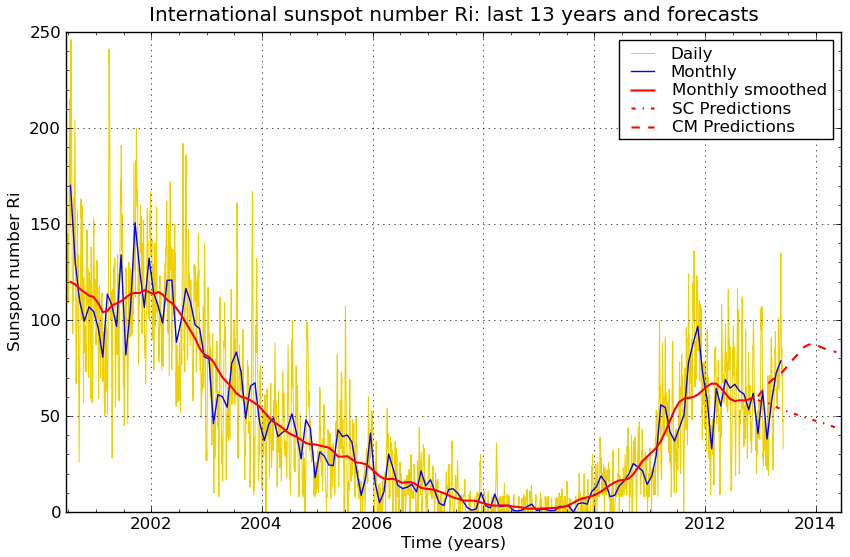
21jun4Source: SIDC

Averaging, we could look to a late 2013 smoothed maximum. Historically, secular asset peaks have been made close to solar maxima, along with inflation peaks. We should allow around 12 months for commodities to rise up and make a ‘secular’ peak and an associated inflationary peak if it is to happen along with this solar maximum, so it should be the theme from here into 2014 if it is to occur. With bonds having likely topped and equities having rallied hard, we are also ripe for outperformance to emerge in commodities. However, economic data out of China, increasing inventories, depressed sentiment in the class, and strength in the USD are some reasons why this is not occurring. Until this collective picture changes in some way, I have to remain open to the possibility that commodities will underperform through the solar maximum, and  this could mean a different asset class is bid up to a speculative peak if the solar maximum is still ahead.

From my recent Dow-gold ratio analysis, I suggested two likely bottoms in the ratio: 2014 or 2025 (approx). Either a swift run up to a speculative peak in gold into next year, or a mid-point currently on the way to a bigger gold peak a decade away at the next solar max. From the same analysis, demographics in the main nations no longer offer clear support for either equities or gold going forward, which I suggest means we are likely to see less wild swings between the two, and alternating shorter bulls. So I remain happy to average down in gold and other commodities, particularly with my new cash injection, and await either a mean reversion rally or a possible momentum move into commodities once a trigger emerges. I also would add to long Japan equities on any further drops. I am tempted by the weakness in positive-demographic Brazil and India to build more of a long positive there, but each are currently experiencing their own economic or social problems which could yet worsen so I am going to hold off. I would look to add short equities if a topping process becomes clearer with negative divergences. I remain short treasuries.

I believe the greatest risk currently to my portfolio is some kind of sharp global sell-off, a collapse in US equities infecting all pro-risk. However, I really can’t call a winner from the three options I outlined above for US equities at the moment, so await further flags and developments. If pushed, I still place greatest likelihood by a historically normal unfolding of events, namely that bonds have topped and we will see equities top as commodities outperform, with commodities topping last, helping tip the world into recession and end the equities bull; that the solar maximum will inspire speculative peak and that peak will be in commodities (or precious metals at least) due to the collective demographic downtrends aside Japan. However, I am nowadays ultimately of the view that there is complex interaction between demographics, solar cycles, fundamentals, government intervention and more, that make it a difficult calculation. I believe anomalies can occur if several of these factors conspire together to produce one, which is why there is no holy grail. However, I expect clearer ‘probabilities’ to emerge from here, one step and development at a time.

Developments

Oil broke out – upwards – though it is not yet sufficiently clear of the triangle to call it finally resolved:

18jun2

Large speculators have been betting big on such a bullish outcome:
18jun4Source: Sentimentrader

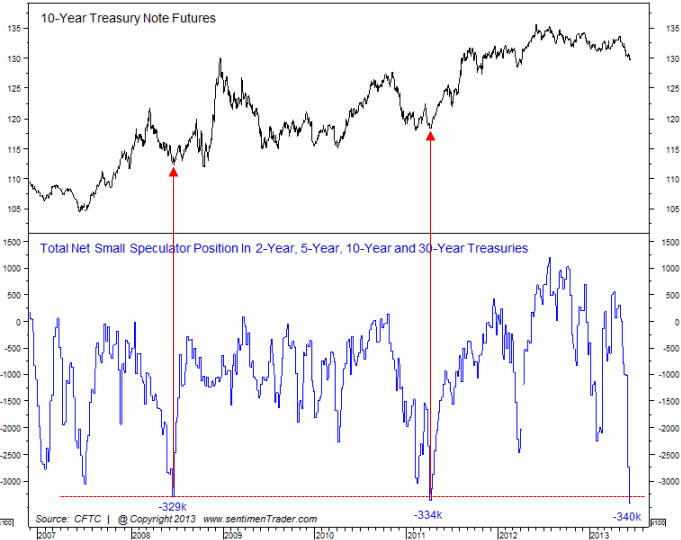
Small speculators, usually ‘wrong’, are betting big on further treasury bond declines:

18jun5Source: Sentimentrader

Which means we could see a near term pullback in yields. And that brings us to tomorow’s FOMC. Having sewn seeds of doubt that QE may see some tapering as early as in tomorrow’s announcement, I suspect whatever they say could be a catalyst for big moves in the markets. If treasuries are due a bounce, then gold is too:

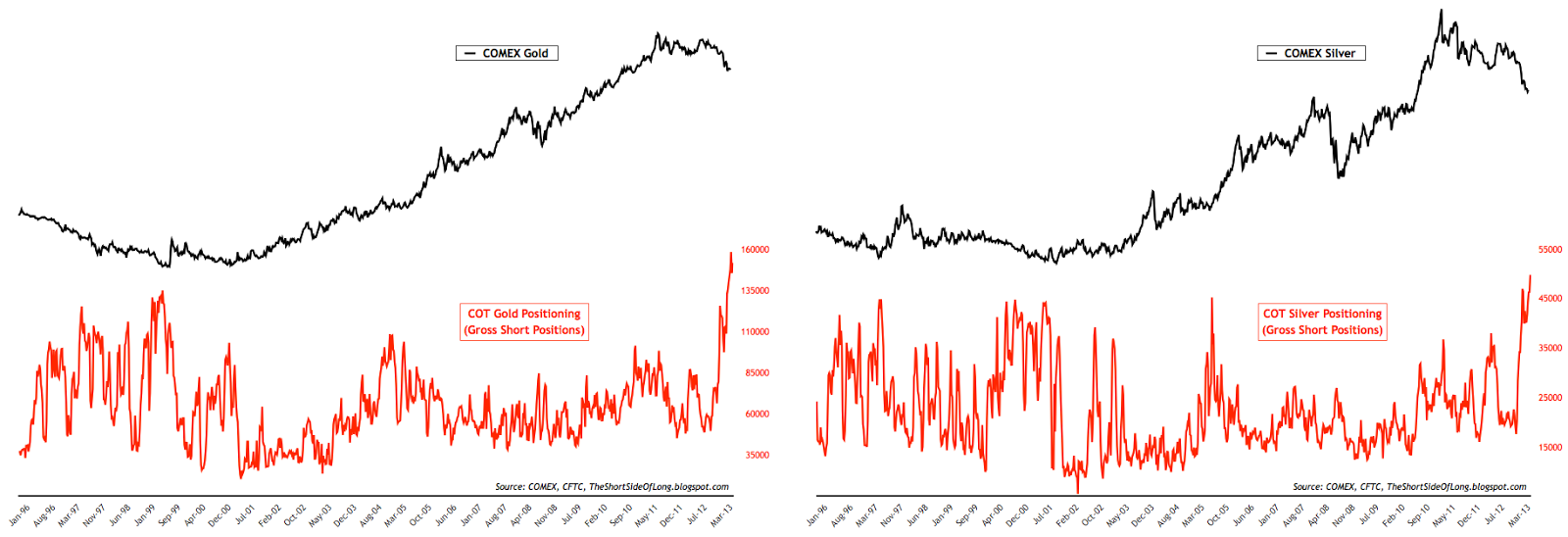
18jun6Source: ShortSideOfLong

The SP500 has consolidated its pullback and is at a point whereby it could make a further leg down, in an ABC correction, or make a fresh attempt at a new high. By geomagnetism, the former is more likely:

18jun1

I remain of the view that a topping process has begun in the SP500 and that it should take several months to play out in a volatile range. A new marginal high on negative divergences would be normal, so if an ABC correction did occur we should still then see a return to the highs. Outperformance should transfer to commodities, whilst this takes place, and maybe the breakout in oil is the first key development in this.

Leading indicators have generally softened but remain positive:

18jun3Source: Conference Board

The Bradley turn for equities is 22 June and gold seasonals take off as of mid-June.

Topping Sequence

In Martin Pring’s work on the business cycle he proposes that bonds top first, then stocks, then commodities. Here is an illustration (click to view better):

10jun20131I am of the conviction that bonds began to top last year, with momentum having taken hold the last 6 weeks. Here are US, UK, German and Japanese 10 year government bond yields:

10jun20135

Source: Bloomberg

Equities have made a steep rally over the last 12 months which echoes previous cyclical bull terminal runs:

8may20139Source: MSCI

The trajectory and the duration suggest stocks should be due to top soon, however it is usual for a topping process to unfold over several months:

10jun20137Such a process usually unfolds with negative divergence warning signs. We have one current divergence in the geomagnetic model:

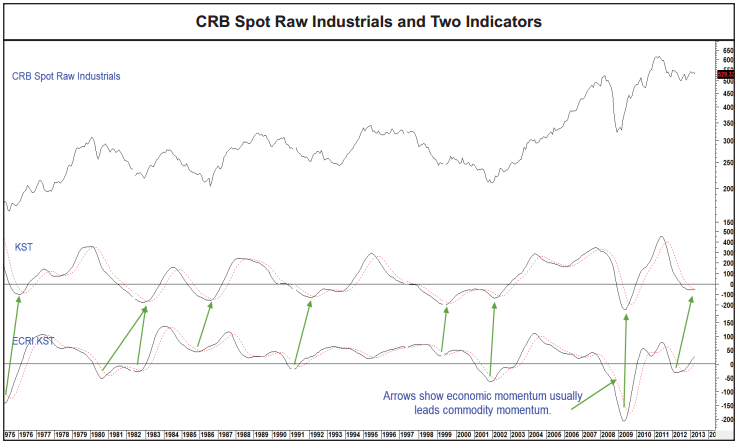
10jun20136Meanwhile, bond yields should continue to rise and commodities should attract momentum. ECRI leading indicators have historically given rise to commodity price action with a lag, and the LEI strength over the last 12 months should now turn commodities upwards:

10jun20132Source: M Pring

We see crude oil once again making an attempt to break upwards out of its long term coiling or triangle, with the support of an inverted head and shoulders pattern:

10jun20134And mid-June is a historic take-off point for gold:

10jun20133Source: Zealllc

By Russell Napier’s work, cyclical bulls in stocks historically end with yields rising and inflation troublesome. I see this as a fit with Pring’s work and my own, namely that we see equities rising, then yields and velocity, commodities become a beneficiary until inflation and yields start to tip leading indicators over and money exits equities, with commodities late cyclicals often rising into a peak once the business cycle has started to turn down. This, collectively, is the historic norm, and I believe we will see a repeat here, but it’s a question of timings.

I believe we are at the start of a multi-month topping process in equities, that commodities are from here going to be the momentum class, and that money should continue to exit bonds. However, we do not yet see rising inflation and we only have 6 weeks momentum out of bonds, which suggests the whole process should take some time yet.

A look at the equally weighted commodities index reveals that commodities prices are still elevated, and a momentum rally of 25% (red line) off a typical W-base would take us close again to record highs:

10jun20138Source: MRCI

That would ensure the missing inflation, but I suggest we may need one or more triggers to held generate such a move into commodities. I can only guess at such trigggers. One could be if crude oil can break out this time – as crude is an input in agricultural commodities and an important inflation driver, it could inspire price rises in both softs and gold. Another is the June 19 FOMC output, either sticking to or scaling back QE. The latter should create an initial sell-off but then I believe would translate into a faster flow out of treasuries and into commodities.

On a personal note, since moving to Austria we have been living with the in-laws. We will finally move into our new place 1 July, and we are renting there with no plans to buy in the foreseeable future. We just sold our house in the UK at the end of last week which means I now have a large lump sum in the bank account at my speculative disposal, because it is no longer stuck in the housing market. I am going to take my time to work with it and work out how best to deploy it, but it clearly alters the status quo. It means I am flush with cash, but as a trader I see this as a golden opportunity to turn it in to something much bigger. In the short term it means I can and will want to be more aggressive with opportunities, in building up my exposure, so I wanted to share it with you to set the context when announcing future trades.