In Perspective

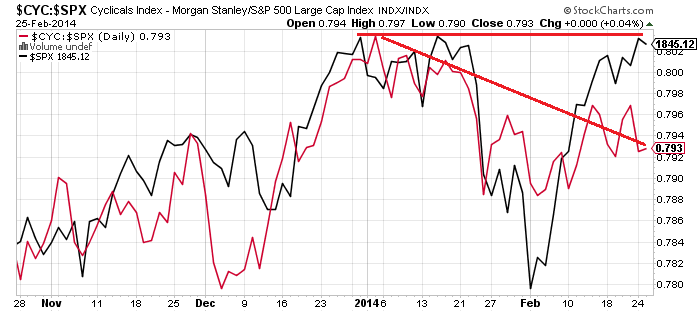
1. The start of January brought the shift to defensives, measured here in 4 ways: stocks to bonds ratio, cyclical to defensive sector ratio, small caps to all caps ratio and high yield to treasuries ratio.

9nov10Source: Stockcharts

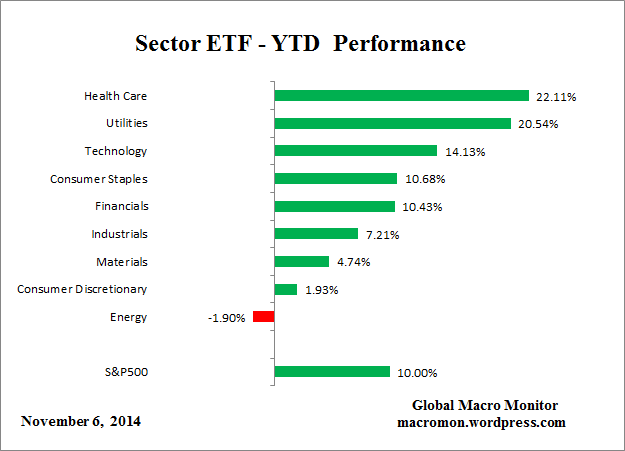
2. The best performing sectors in 2014 all year have been health care and utilities, the two defensive sectors that perform best once the stock market peak is in.
9nov15Source: Macromon

3. The yield curve, measured here by 2y versus 10 yr treasuries and 2m versus 10 yr treasuries, has flattened ever since 1st Jan. We won’t get an inverted yield curve under ZIRP so flattening takes over as a topping warning.

9nov114. The best performing asset class in 2014 has been government bonds and the chart below shows this has been a global phenomenon (Germany, Japan, UK and US quoted by 10 yr yields (bonds inverted)), again since Jan 1st.

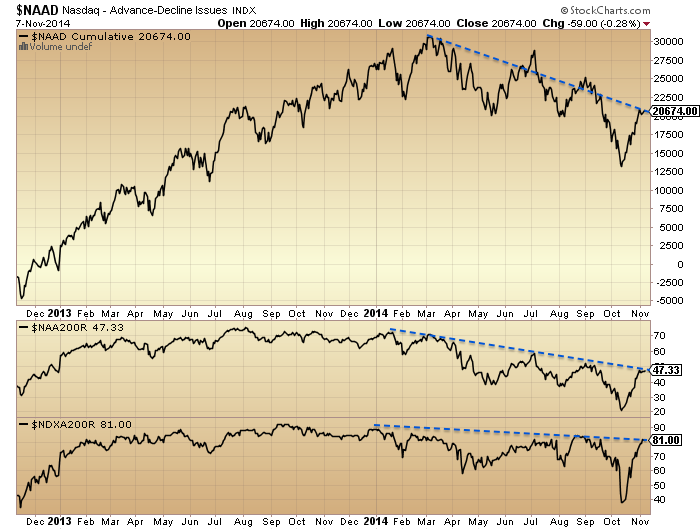
9nov85. Looking at stock market breadth, deterioration has been under way since almost the turn of the year in the Nasdaq indices.
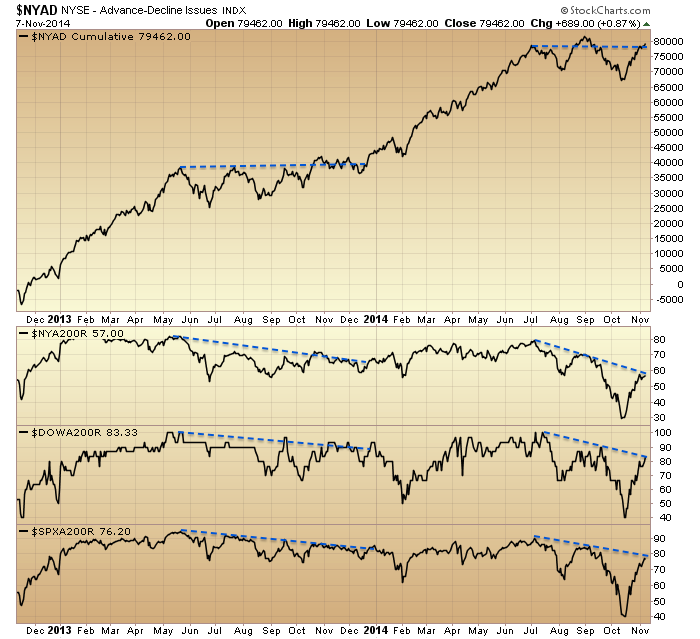
9nov126. Whilst the NYSE, SP500 and Dow picture reveals breadth issues since the turn of July. We can also see there was an earlier bad-breadth run into the turn of 2014 which was subsequently repaired: like an attempt at a bull market peak but it wasn’t quite ready.
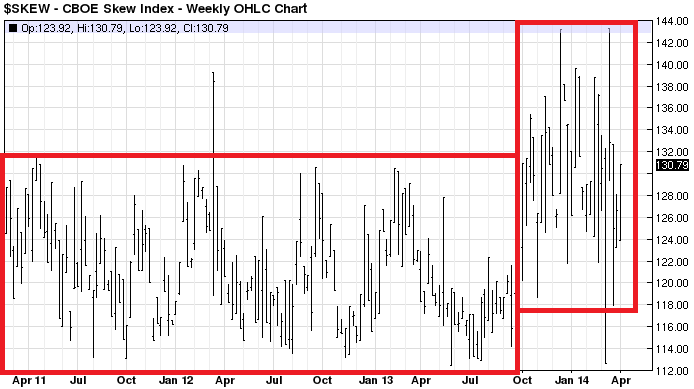
9nov137. Turning to sentiment, NAAIM manager exposure to equities has been dwindling since Jan 1st, whilst Investors Intelligence bulls made a double peak 1 Jan and start of July, since which they have dwindled too. Meanwhile, Vix made its low at the start of July and has been in an uptrend since then and Skew has stayed elevated for a year, with triple peaks in Jan, July and Sept.

9nov148. Commodities have been in sharp decline since the turn of July, as the US dollar sharply rallied, in a deflationary wave.

9nov69. For US earnings, a rising dollar and falling oil prices is overall doubly negative. Q4 earnings growth has recently been accordingly cut in half to 4.5% and sales growth cut in half to 2.2%. Earnings growth has missed target in each of the first 3 quarters of this year. The average of 5 valuations puts US equities the joint second highest in history after the 2000 mania. There is a big gulf between price and earnings.

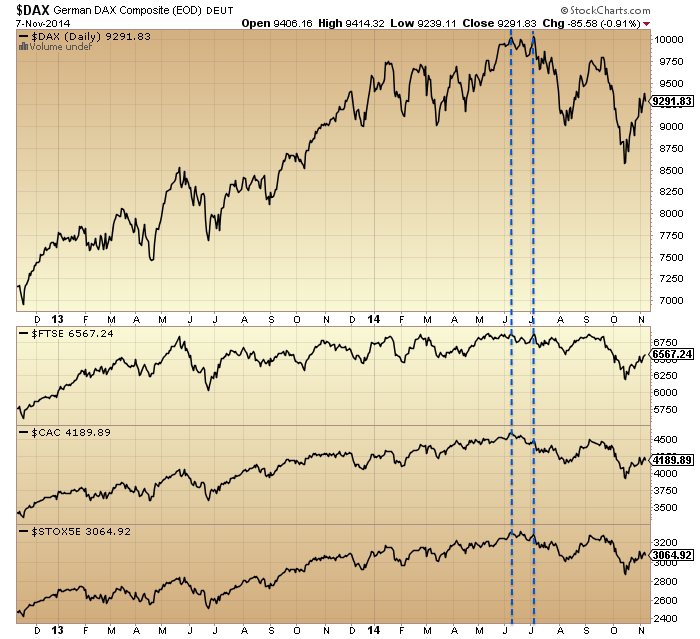
10. Global stock indices look like this. European indices peaked out by the start of July and have since made a lower high and lower low, the definition of a bear trend.
9nov2

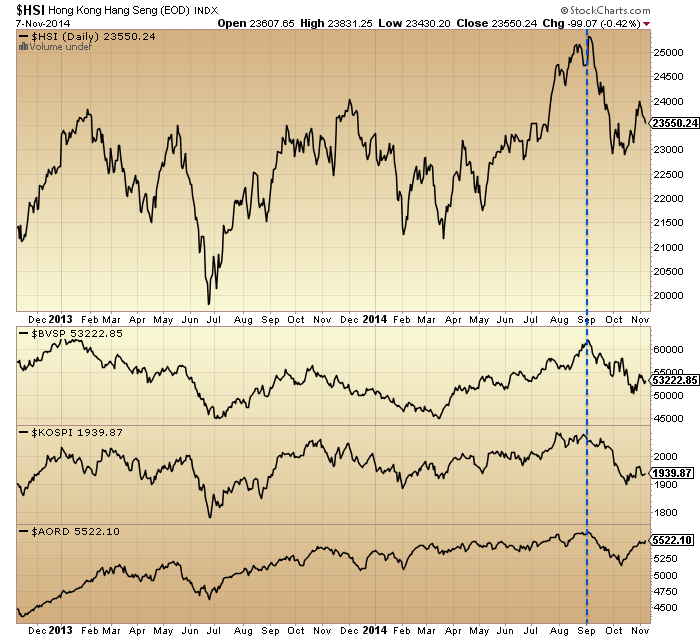
11. The Hang Seng, Bovespa, Kospi and Australian index all made peaks at the start of September.
9nov4

12. However, the US SP500, Dow and Nasdaq, as well as the Japanese Nikkei have all made new marginal highs since then.

9nov1

13. The Russell 2000 double topped at the start of March and start of July, whilst the overall Dow Jones World double topped at the start of July and start of September. Junk bonds and leveraged loans also made July/Sept double tops and lower highs and lows since.

9nov5

Across all the above charts in this post, three dates consistently stand out: the start of Jan, start of July and start of Sept. The topping process began the 1st January and additionally the Sornette bubble end flagged on the SP500 at the start of July and on Technology at the start of September. Insider selling peaked at the turn of the year and we have seen six major distribution days since then without any major accumulation days. Put/call ratio, bullish percent and the summation index additionally point to the relevance of the start of Jan and start of July:

9nov19

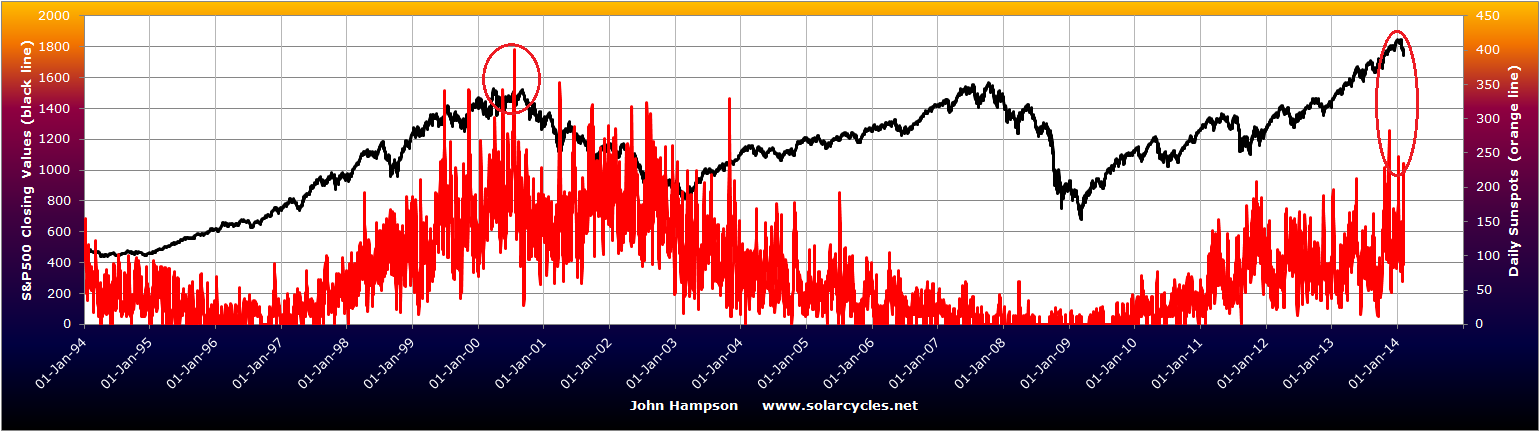
Now draw in the solar cycle. The likely smoothed maximum was April 2014 (based on SIDC, Solen, NOAA, IPS and polar switch). Here’s why the smoothed sunspot maximum is important, it generates peak speculation events:

9nov22

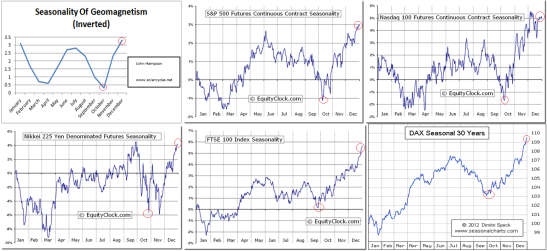
Either side of the expected smoothed solar maximum of April 2014, we have two seasonal peaks (inverted geomagnetism peaks) of turn-of-year and mid-year:

5nov40

Homing in on the new moons of those two periods we get specific dates for a triple peak confluence of speculation/optimism: 1st January 2014 and 27th June 2014. I believe this is a compelling cross-reference for all the market charts above. We see multiple index and indicator peaks clustering at the very start of Jan and very start of July (both within two trading days of the new moon).

So I maintain this is the true picture of where we are, mirrored on the last solar maximum stock market peak of 2000:

30oc6

30oc5

And I still expect stocks to reverse here like they did at the same point in 2000:

9nov17

We have had several days of small range consolidation with a slight upward bias (averaging the 4 US indices), whilst sentiment and allocations are bumping up against invisible limits. I therefore believe the next move is down, like the subsequent red candle above. Furthermore, I believe that is then the end of the topping process in global equities. It effectively ended at the start of July, and really did for various indices shown further up, including the overall Dow World. But we have now seen new highs again in US large caps which on the surface look bullish, but underneath not.

I believe the unprecedented extremes in levels and durations of price levitation, sentiment, allocations, leverage, tail-risk, and negative divergences mean a crash is coming. Like an elastic band stretched to the limit. The superficial 2014 bull trend in US large caps is nothing of the sort under the surface, but has served to fool most into a false sense of security. This last rally from October to November has sucked everyone in again (sentiment, allocations) and we have extreme lop-sidedness in the markets. I believe equities will tip over here and fall hard and fast, with no reprieve this time. No dragging on until year end: the megaphone formations on the US large caps are ripe for resolution now and overbought/overbullish indicators support this.

7nov120

The October monthly hanging man candles suggest November should be a significant down month. I maintain the view that the evidence is too compelling now for consideration of an alternative scenario. If you remove me from the equation then there is an awful lot of fact in the above charts and many other recent charts that I have relayed that a bull needs to explain away. Simply, too many. However, we can argue there is a middle position in accepting all the warning flags but predicting prices can still yet go higher into year end under dual positive seasonality. Perhaps a scenario of increasingly thin volume and increasingly bad health but still scraping higher.

The problem with that is that whether we look at Nymo, Rydex, II, AAII, RSI or the ascent and shape of the Oct-Nov rally we see the same tell: exhaustion. Stimulative action from the BOJ and ECB in recent days have failed to catapult global equities higher. So I believe the middle position’s best hope is that equities retrace away from these exhaustion levels but then quickly washout, to enable a December rally into year end. However, I would refer you again to our positioning in the topping process. There is no case for another rally. If we tip over this week I believe that is it: equities won’t come back again. This is what I expect to happen.

Screen Shot 2014-11-04 at 07.53.54

SP500 Monthly

Developments

Yesterday’s action produced a doji in US large caps, or indecision, so we roll over to today. This is how the Dow and R2K look:

13au6

Source: Stockcharts

The Dow has been saved 3 times by the 200MA and the R2K 3 times at horizontal support. Looking for a technical trigger for the waterfall declines: both to break down and initiate the voluminous selling. The small red arrow shows that volume has ebbed away the last 3 sessions; volume remains more dominant on down days.

Biotech is in the nose of a triangle, ripe for resolution, adding to the case for the downside break to be close.

13au8

Source: Stockcharts

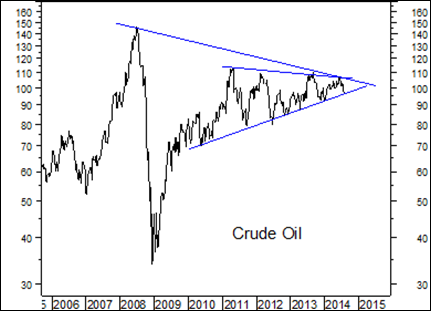
Crude oil also looks ripe for resolution. Weak growth and deflationary pressures suggest this will fall, along with equities. Meanwhile, gold and gold miners continue to make  a sturdy base and I believe they will rise as safe havens.

13au9

 Source: StreetSmartPost

Demand for safe havens is high, with German 2-year bond yields turning negative. Investors are choosing a guaranteed small loss over the alternatives.

13au1

Source: SoberLook

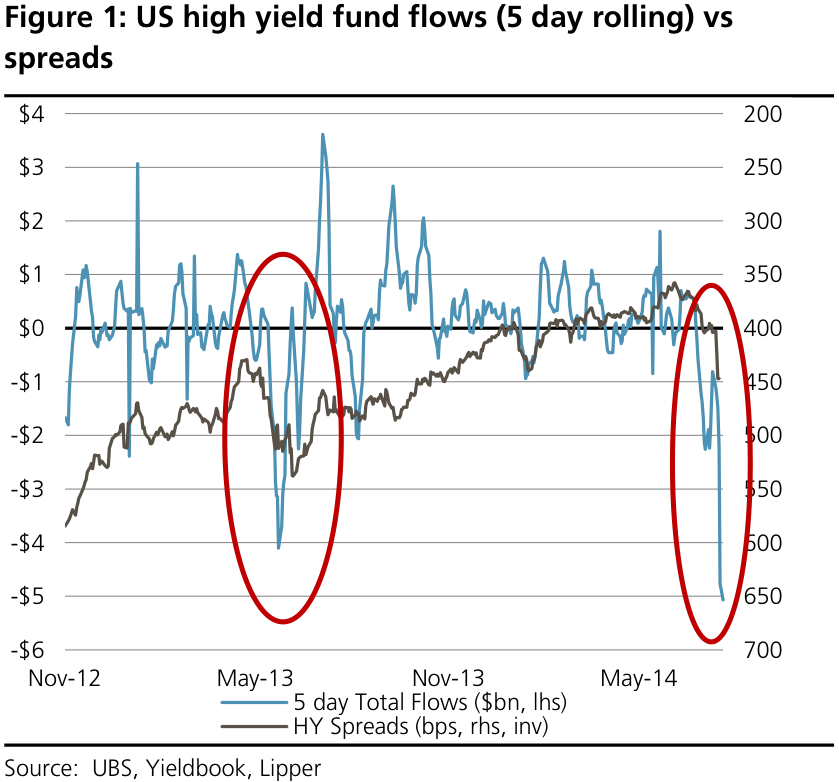
There has been a hurried exit from high yield bonds, an asset class that had become very lop-sided like equities. Investors went all-in on corporates in both shares and debt.

13au7

Source: BusinessInsider

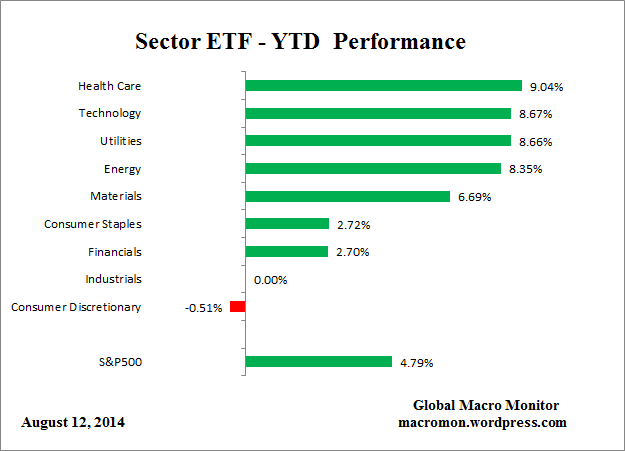
An updated look at sector performance year-to-date shows an alignment with the top of the stock market cycle and suggests we are beyond the peak:

13au10 13au11

Source: TradersLog

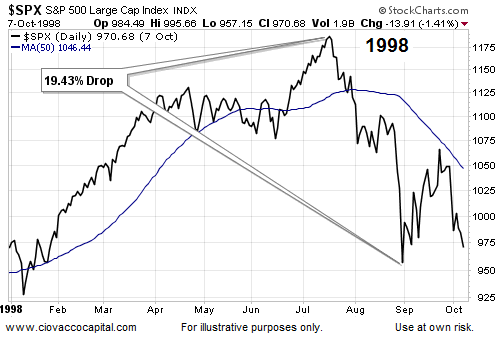
The SP500 levitation above the 200MA is second in duration to the the one that terminated in 1998. The subsequent 6 week 20% drop that occurred then is similar in speed and severity to the other analogs I recently drew together, and occurred in the typical window for drops: July to October.

13au4

Source: JohnKicklighter13au3

Source: Ciovacco

Japanese Q2 GDP, net of the sales tax, came in negative. Like the US Q1 GDP print, which net of the cold weather was still negative, it reveals a world economy still in trouble.  More reliable on China data shows weakness too:

13au14 13au15

Source: FT

Fed officials’ vocalisations of ‘secular stagnation’ are being reported in the media, namely their belated realisation that maybe the economy is not going to normalise after all but remain weak and troubled. This was written in demographics all along and suggests they did not and do not understand that driver.

Markets Update

The selling in equities into Tuesday did not wash out indicators, suggesting a lower low should be ahead. Yesterday’s bounce produced a very low put/call reading signalling high complacency.

10ap1

 Source: Stockcharts

Risk of an outsized move remains historically high:

10ap2

 Source: Barcharts

Investors Intelligence bulls back up to 54.6%, bears unchanged at 18.6%, continuing the historical extreme cluster of readings.

There is downward pressure into next Tuesday’s full moon. Presidential seasonality peaks out in mid-April. Earnings season ramps up as of next week.

8ap3

 Source: Fat-Pitch / StockTradersAlmanac

Narrow money and OECD derived leading indicators continue to point to weakness in global industrial output into May, before a summer pick up. Economic surprises for the main regions ticked further negative this week.

After a little consolidation, commodities (CCI and CRY indices) are breaking upwards again:

8ap5

 Source: Bloomberg

Whilst the US Dollar is flirting with breakdown again:

8ap4

 Source: Stockcharts

Treasuries and yields are in a range, watch for resolution:

8ap6

 Source: Stockcharts

In short, I expect the current bounce in equities to be short lived and roll over into further declines into next week’s full moon. April remains my target window for major declines in equities, based on historic patterns of falls accompanying this inverted geomagnetic seasonal low period, together with an anticipated solar maximum now on the wane. That would imply this earnings season would be a sell, and I think this is reasonable given we have negative earnings guidance once again whilst stocks have front-run up to valuations that in contrast demand a return to solid earnings and revenue growth. Leading indicators also suggest economic data should continue to disappoint into May, adding to this April window of opportunity. However, if equities can hold up in a range through this period until data picks up again, then maybe we could have a mirror of 2011, whereby stocks did not break down until the Fall. For now though, I suggest this the lower probability, and I expect April can deliver the goods.

Indicator Updates

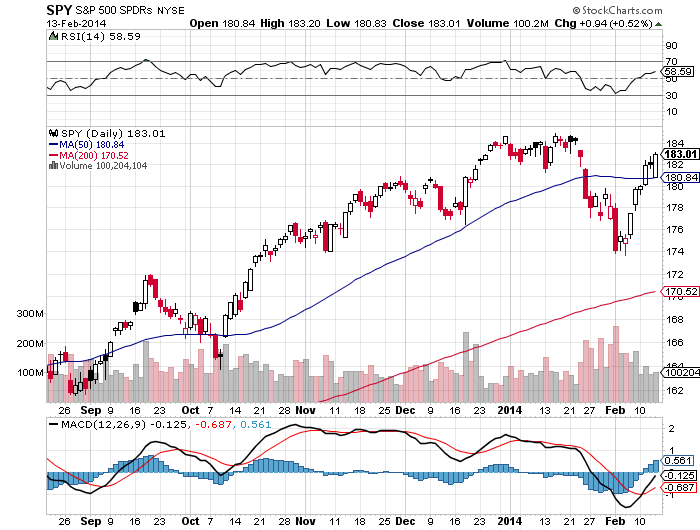
1. Dow daily candles and Monday’s volume print at high reversal:

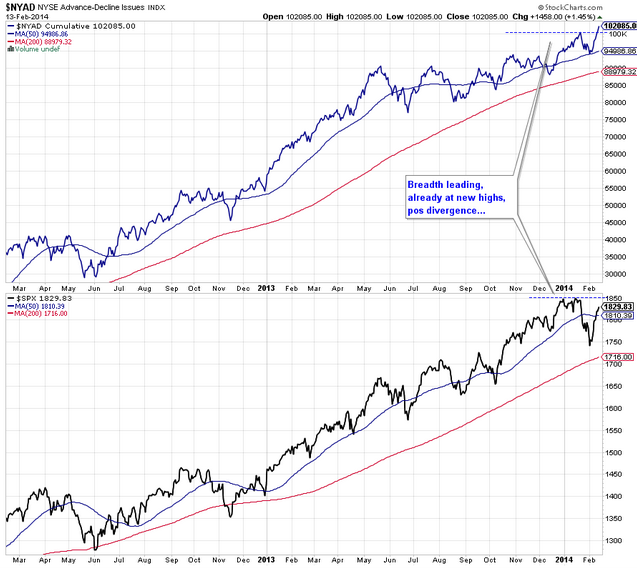
26fe12. Nasdaq 100 and breadth divergence:

26fe43. SP500 and defensives outperforming cyclicals:

26fe2

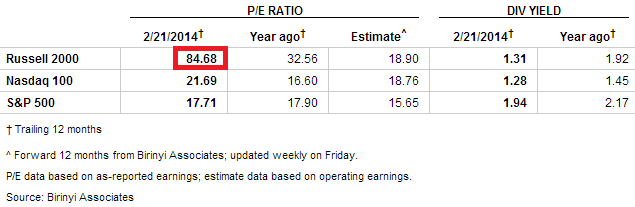
4. Russell 2000 (my largest short) P/E:

26fe11

5. Gold outperforming stocks:

26fe96. Treasuries outperforming stocks:

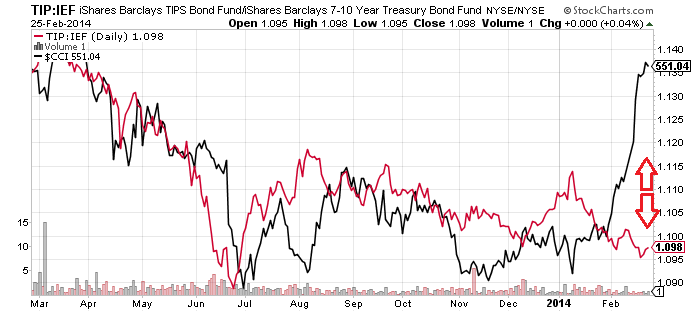
26fe107. Inflation expectations cast doubt on longevity of commodities (CCI index black line) rally:

26fe138. Smart money sold into 2013’s equities rally and outflows accelerating into this month’s upleg:

26fe89. Rydex bull ratio exceeds levels previously associated with significant corrections and 2013’s anomalous levitation raises risk of sharp collapse:

26fe710. Put/Call ratio (21 day average) also exceeds levels of previous significant corrections, and at best suggests period of consolidation with downward bias ahead for equities:

26fe5

Friday Morning Update

Yesterday was an up day for bonds, commodities, gold/miners, and equities, i.e. both pro-risk and anti-risk. Confused?

Retail sales came in weak, not just for last month, but for the revised previous month too. The string of poor economic data, in line with leading indicator forecasts of growth having peaked out, has resulted in progressive revisions to Q4 2013 GDP estimates – here is Barclays:

14fe7

Source: Business Insider

Q1 2014 GDP estimates have also been cut, with Credit Suisse reducing from 2.6% to 1.6%.

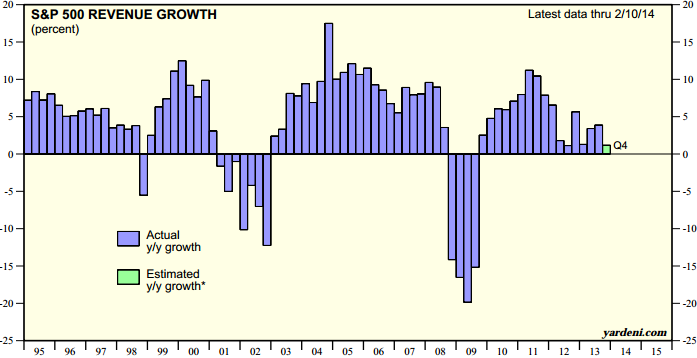
The latest picture for the Q4 earnings season shows blended revenue growth at just 0.8%, and of those companies who have given forward guidance for Q1 2014, 80% have given negative rather than positive guidance.

14fe3

Source: Ed Yardeni

Last year’s multiple-expansion rally in equities was justified on the stock market front-running a return to ‘normal’ economic growth and earnings growth, as well as the underpinning of ‘Fed policy trumps all’. With QE now being wound down, economic data worsening rather than improving, and earnings still disappointing both in terms of revenues and forward guidance, the case for anti-risk is strengthening, and the rally in stocks suspect.

Yesterday ahead of US stock market open, futures were down and equities around the world were struggling to attract buyers, then the retail sales data hit and the scene was set for a bearish US session. But the opposite occurred: a ‘stick save’ as short stops were run and bulls delivered a trend day up. We saw this occurring in January:

14fe8Eventually this gave way to the high volume decline days.

Yesterday’s volume was again weak, relative to the declines leading into the 6 day rally:

14fe6

Source: Stockcharts

Complacent put/call went lower, Skew remains elevated, and defensive rather than cyclical sectors continue to lead in 2014:

14fe1

Source: Charlie Bilello

From a bullish perspective, small caps outperformed yesterday and advance-declines continue to be strong:

14fe2

Source: Charlie Bilello

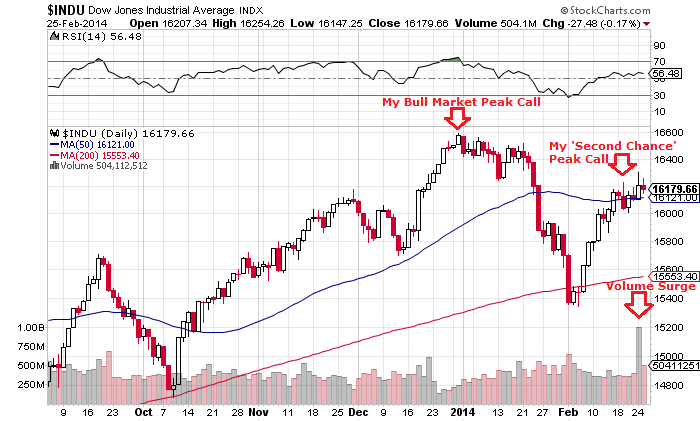
Today is the full moon, which could spell an inversion in equities. The Nasdaq 100 joined the Nasdaq Composite yesterday in making marginal new highs, but it did so on a divergence in breadth (as measured by % above 200MA). So I now watch to see whether the other US indices follow suit or all roll over from here. If the latter, then it could turn out to be the sweet spot of the top of the ‘second chance’, namely the optimal time to short, but if the former, it would open up the prospect of a longer topping process in equities. That makes it a fairly delicate position. If you have been reading my recent posts, then I have a multi-angled case for equities to roll over from here, and the developments behind the price action (volume, defensive asset flows, economic data, etc) have strengthened that case rather than weakening it. So I continue to gradually add shorts into this rally and rebuild towards my intended ‘full’ short position, until the ‘clues’ change.

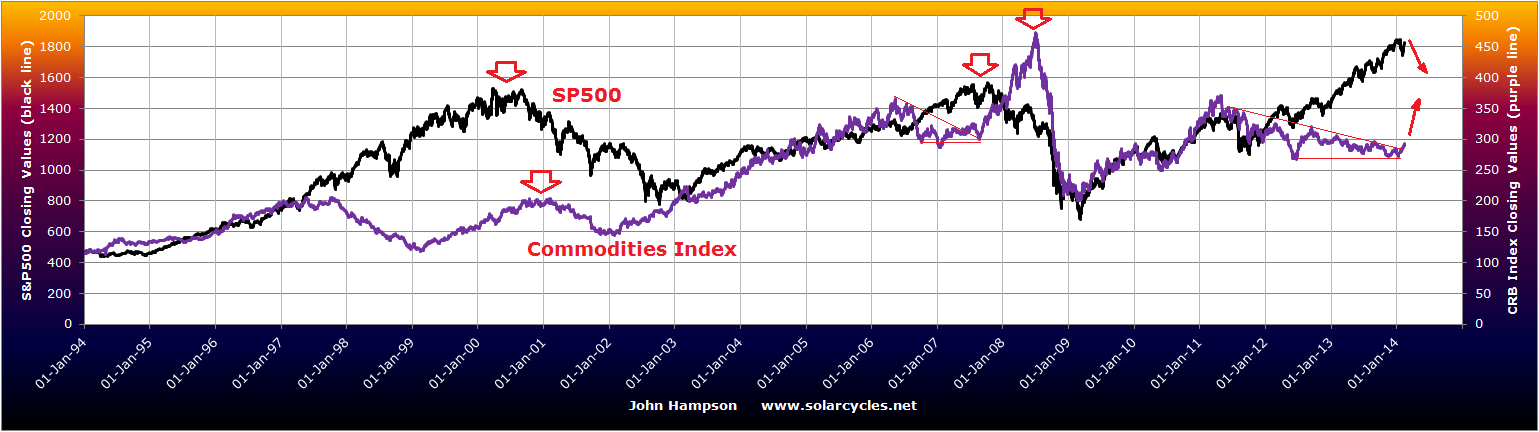
The case for commodities making a late cyclical charge now looks more compelling, with new broad momentum in the class, and siginificant breakouts. Commodities typically top out after equities and once the economy has begun to weaken, sucking the remaining life out of it. On the chart below we can see the last two such occurrences. In 2007 commodities broke out of their consolidation and into a steep rally as equities topped, and I expect similar developments this time. We have been seeing the US dollar weaken on the down days for equities, which should accelerate commodities as equities fall.

14fe4

Something Happened At The Turn Of The Year…..

1. Treasury bonds bottomed / yields topped out:

7fe22. Gold bottomed and broke out:

7fe3

3. Bitcoin peaked:

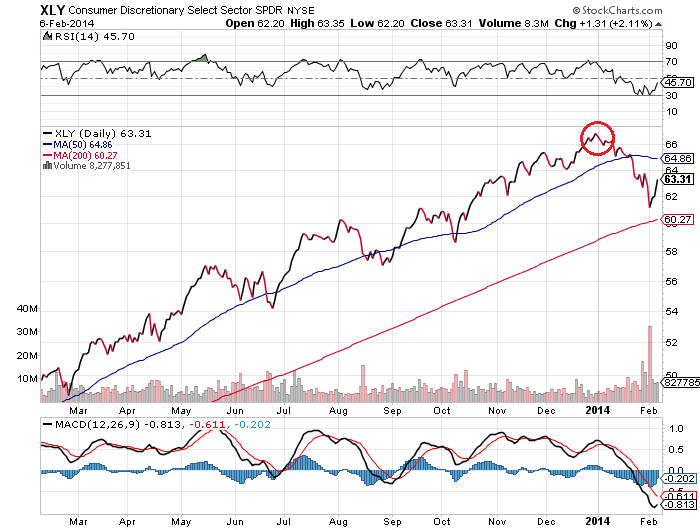
7fe44. US Consumer Discretionary and other cyclical stock market sectors peaked:

7fe55. US stock market sentiment made a historic high peak:

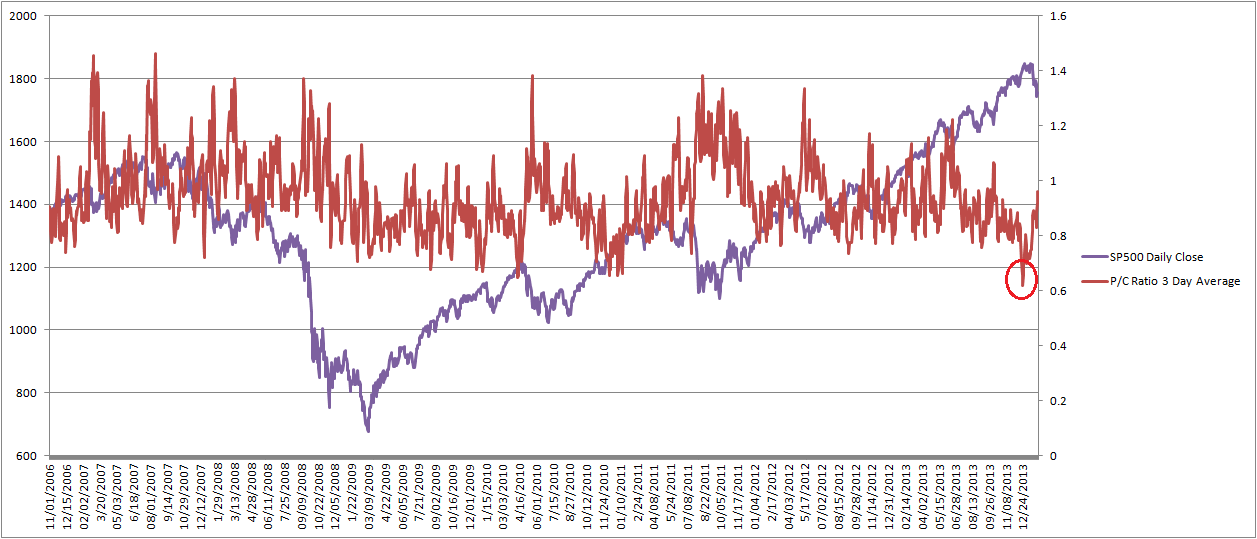
7fe66. The put/call ratio made a historic low bottom:

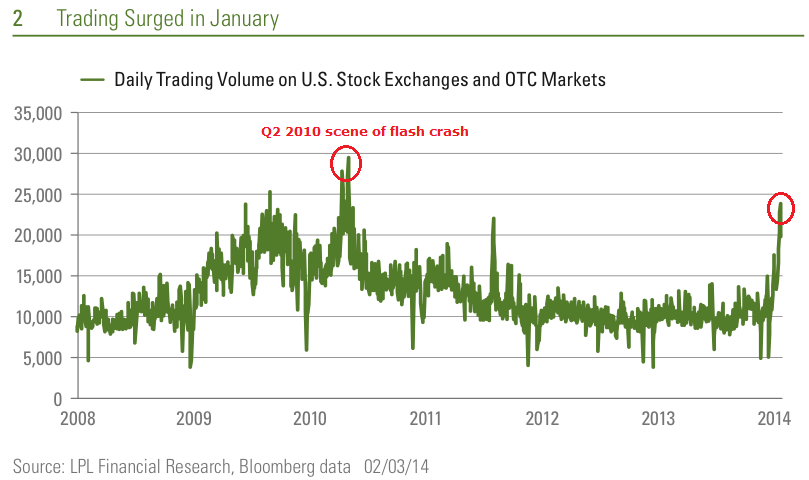
7fe87. Trading volumes surged:

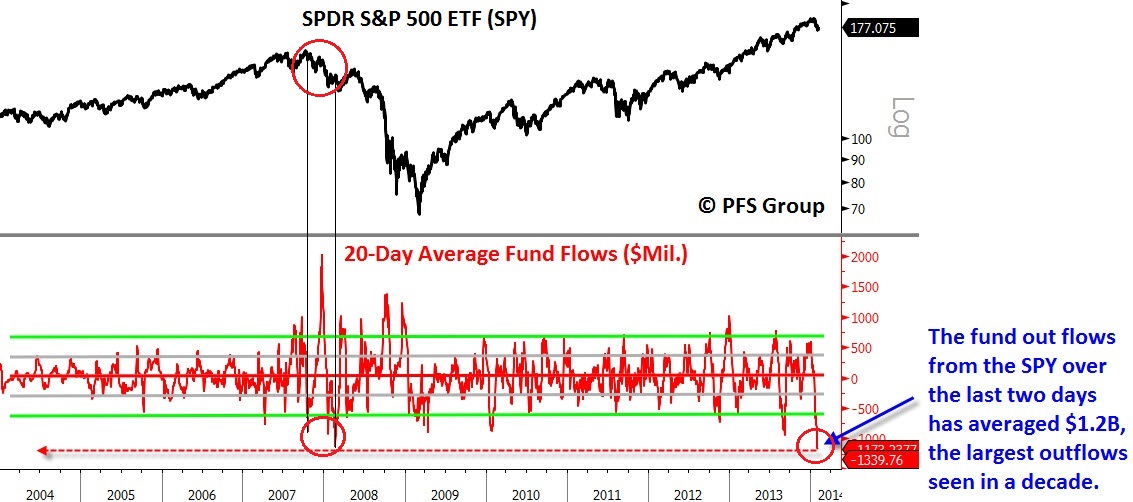
7fe98.Equity funds had their largest ever weekly outflow (whilst bond funds had a record inflow):

7fe1

9. Investor leverage spiked to real and as a percentage of market cap records:

7fe1110. The solar maximum peaked and the stock market peaked (prediction):

7fe10Plus, leading indicators (narrow money and OECD derived) forecast that global economic growth peaked out around the turn of the year.

And why? This is the part that is unpalatable to many: because we are less intelligent creatures of free will and more dumb subjects of natural forces:

7fe12 7fe13 7fe14 7fe16Caveat: If NASA/NOAA/Solen projections are wrong and the smoothed solar maximum extends further into 2014 together with another larger monthly spike in sunspots then it is possible the stock market makes a higher peak with it, close to another future new moon. However, the collective evidence (united solar forecasts plus comprehensive cyclical stocks bull topping checklist (my last post)) suggests this is low probability.
Demographics: Bear Market, Global Recession And Deflation

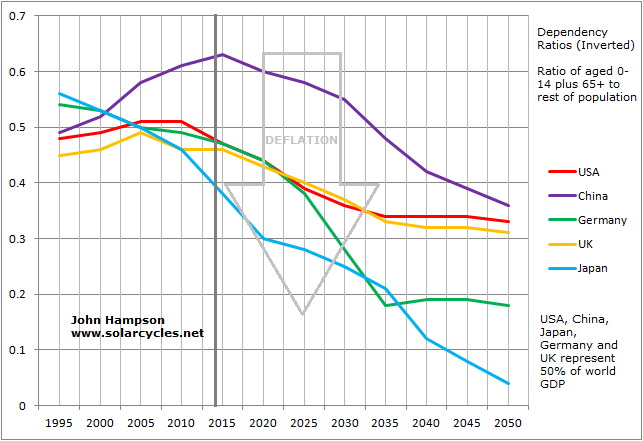
Historically, demographic trends have correlated with secular bulls and bears in financial assets, economic growth/recession and inflation/deflation. Demographic forecasts are reliable because future trends were set in place with past swells and shrinkages in birth numbers. They would change if a country was subject to large scale death (war, pandemic, or similar) or the government henceforth adopted radical immigration policies. Demographics are particularly potent in countries that are relatively closed to migration, so understand that China has the smallest percentage of immigrants of any country (0.1% of the population), and Japan just 1.9% (compared to USA, UK and Germany all over 10%). My focus is on USA, China, Japan, Germany and UK, as collectively they make up 50% of world GDP. Know that whilst the European Union abolished barriers to movement within it, the demographics across all the member nations are uniformly poor.
1. DEFLATION

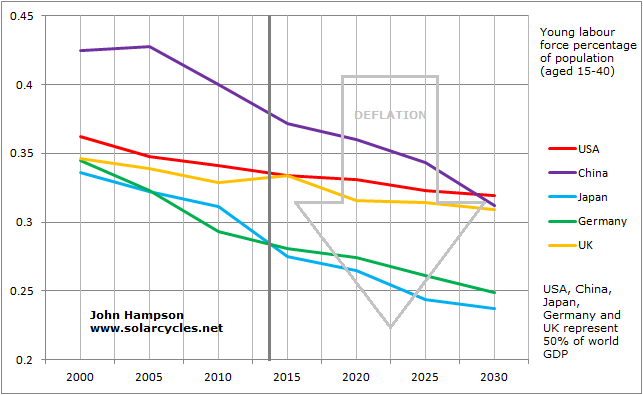
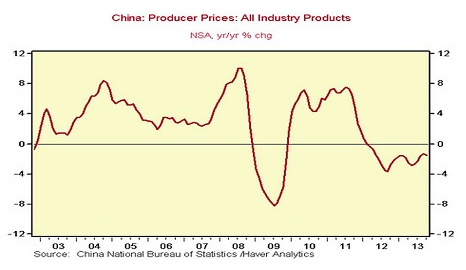
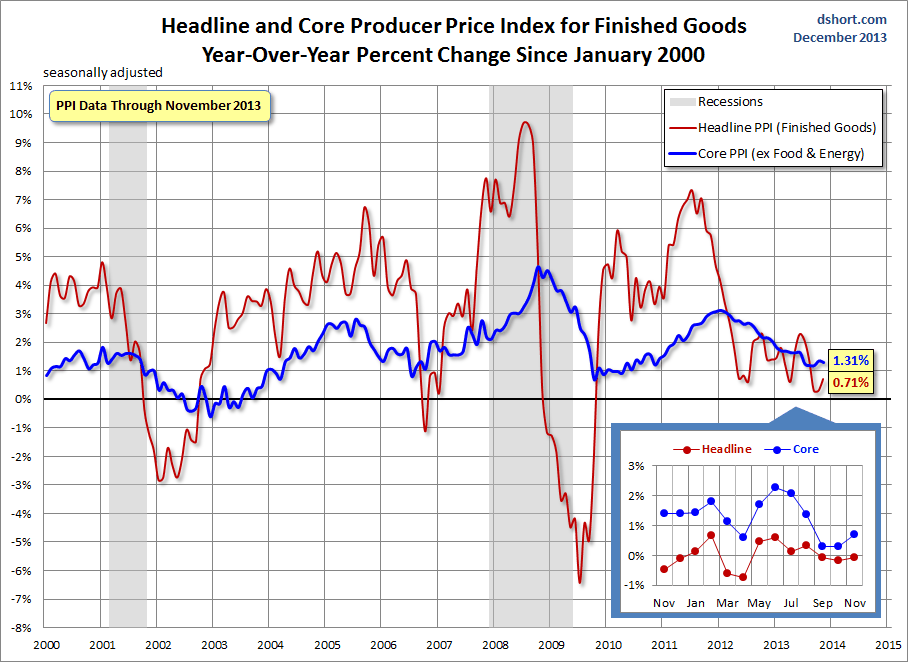
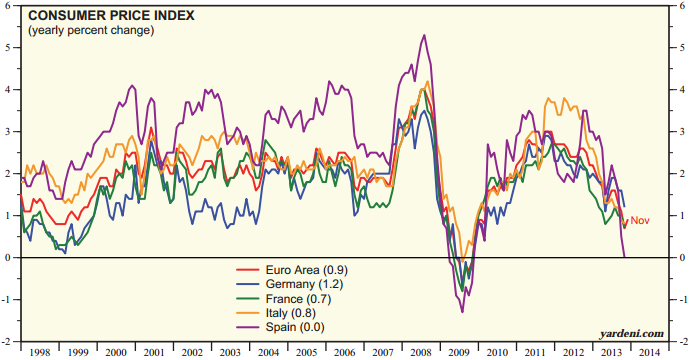
Young labour force percentage of population (aged 15-40) and dependency ratios (inverted – old and young versus the working population) have both historically correlated with inflation/deflation. A swell of people entering the workforce works up price inflation through spending, whereas more people entering old age relative to the work force is disinflationary through saving and disinvestment (read more HERE).

Deflation2

Deflation1In the first chart above, we see the UK alone is currently in a small window of young labour force growth, whilst in the second chart China is just peaking out in dependency ratio (inverted). This is reflected in reality, with the UK currently registering the highest producer price inflation and China the highest consumer price inflation of the five. At this point in time, we generally see trends of disinflation. Demographics predict this will turn into outright deflation, and that deflation should be the norm for the next couple of decades (barring countries with inflationary demographics becoming much more dominant globally, such as India and Brazil).

7ja1 7ja3 7ja4

2. GLOBAL RECESSION

Due to globalisation and an increasingly open world economy, recessions around 2009, 2001, 1998, 1991 and 1982 have all been global in nature. Due to the US contributing 22% of world GDP, particular attention needs to be paid to indicators of future US growth, with China second.

Dependency ratios (inverted – old and young versus the working population) have historically correlated with economic growth / recession. That chart is presented in section 1. above. The picture for the next 2 decades is bleak.

Stepping aside from demographics for a moment, levels of debt have also been shown to assist or impede growth historically. Where public debt to GDP has exceeded 90%, economic growth has struggled. For 2014, Japan will be around 230%, UK and USA around 115% and Germany 85%.  China has the lowest ratio of public debt of the five, but its broader debt has been ballooning since 2008. Including corporate and household debt, China’s total debt to GDP has reached 218% of GDP (from around 130% in 2008).

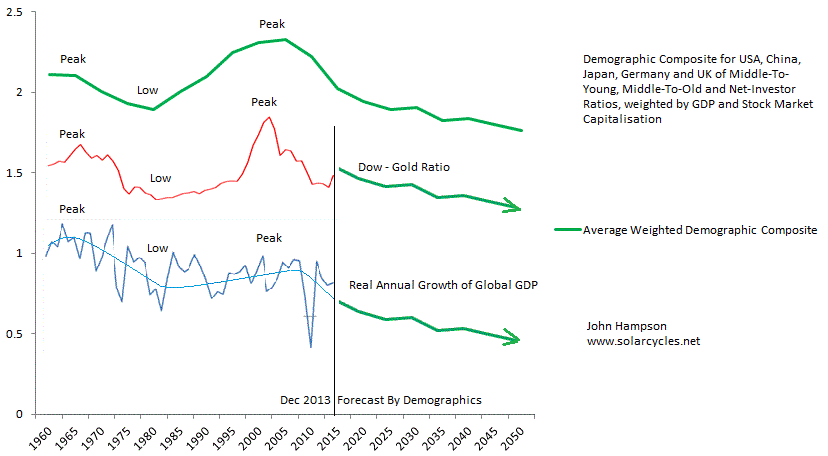
DemographicsDowGoldRatioGlobalGDP

3. EQUITIES BEAR, REAL ESTATE BEAR

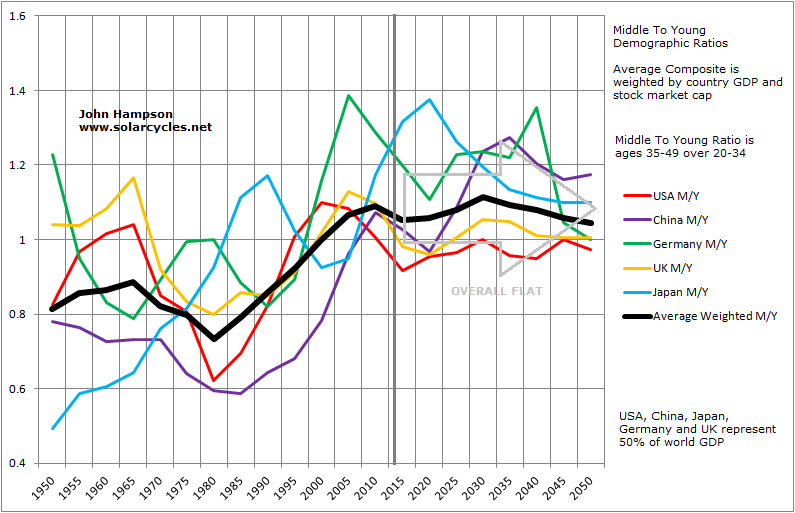
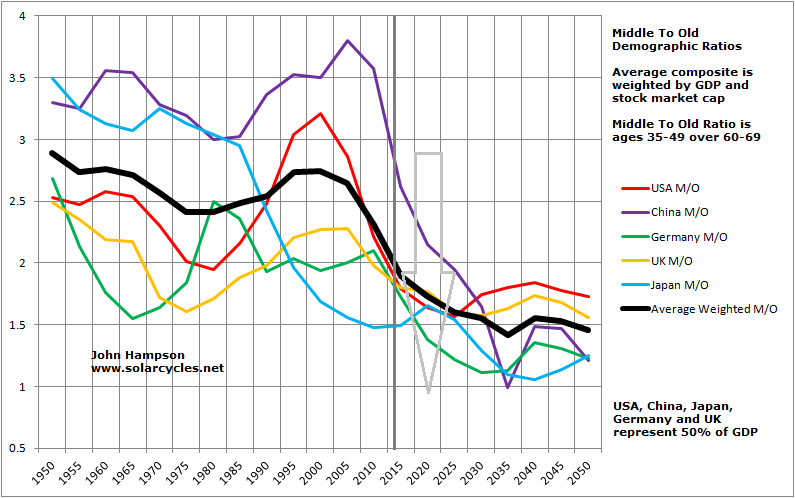
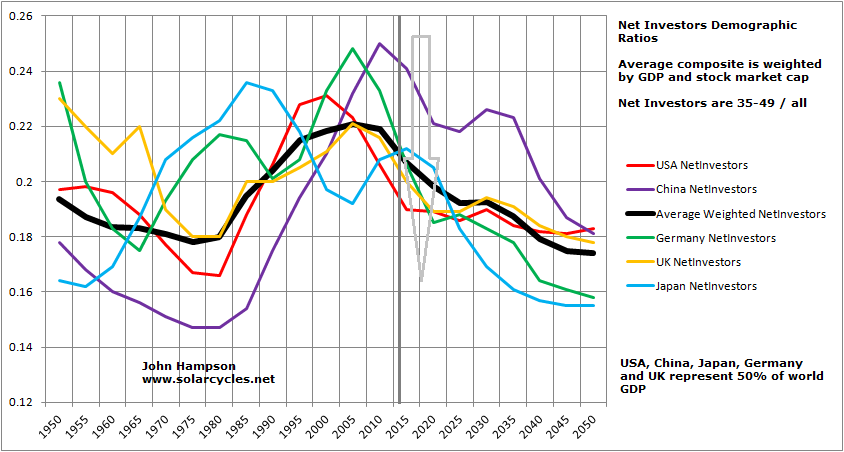
Demographic trends in middle-to-young ratio (aged 35-49 / 20-34), middle-to-old ratio (35-49 / 60-69), percentage net investors (35-49 / all) and dependency ratios (charted in 1. above) have all been shown to have a correlation with stock market and real estate market performance historically, on a longer term secular level. There are young borrowers/spenders, middle-aged investors (partially investing for retirement) and old-ages disinvestors. If the middle group is growing relative to the others, then we have a growing demand for the stock market. Similarly, the old and the young don’t typically buy houses, so a swelling middle-aged group relative to the others is an environment for a housing boom, and vice versa (read more HERE).

BM1

BM2

BM3Using the weighted average composite as our overall guide looking out to mid-century, M/Y is flat whilst M/O and NI are down, suggesting long term ‘buy and hold’ may be a strategy doomed to the past, to be replaced by ‘short and hold’. Add in Dependency Ratios from 1. above and the picture worsens further. Within those overall trends there are positive windows for individual countries, for instance the USA sees M/Y, M/O and NI measures rising together between around 2025 and 2030, and the composites also suggest that period could be the backdrop to a cyclical bull. However, when the composite trends above from 1980-2000 are compared to what lies ahead of us now, the contrast is stark and suggests enduring downwards pressure on equities and real estate, in long secular bear markets.

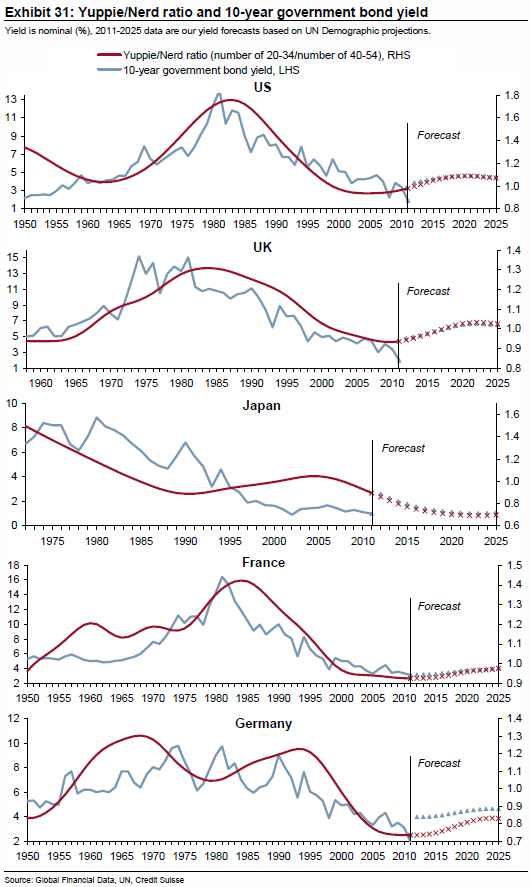
The longer term fortunes of bonds have also historically correlated with demographic trends.

23jun16This CS graphic suggests yields will remain fairly low and contained, as demand for bonds will be maintained. However, through to 2020, the bias in yields, aside Japan, is overall upwards, suggesting net selling on balance. It is my view that gold, as the historic anti-demographic, is due to be the lead asset in the period ahead, as the collective trends above suggest deflation, recession, and net selling of equities, real estate and bonds.

SUMMARY

A) Historic correlations in demographic trends and secular asset cycles, growth/recession and inflation/deflation. B) Unprecedented collective demographic downforces now in place, with evidence of impact in economic data. C) Downtrends in play for much of the first half of this century, suggesting tough times for the global economy and no safety in equities or real estate.

Europe has structural problems, a cautious central bank, and a relatively strong currency, mirroring 1990s Japan and making it the candidate for the first into deflation. China is closed to migration and thus trapped in a sharp demographic reversal, largely the result of its 1 child policy. Previous breakneck growth was built on exports, the market for which collapsed in recent years, leaving it with declining GDP and excess capacity. Stimulus response in 2008 was to invest in even more infrastructure, increasing the excess capacity issue. Non-public debt is ballooning whilst the authorities attempt to tighten, resulting in two cash crunches already this year, as well as high profile company bankruptcies. That makes China the candidate for delivering a 2008-style global crisis.

Tower Of Sand

The last two years gains in the SP500 have been mainly through multiple expansion, i.e. just price not earnings:

18dece1Source: Guggenheim Partners

This year, so far, earnings growth has accounted for just 17% of the gains. Digging into that earnings growth, revenues have been weak:

18dece2Source: Yardeni

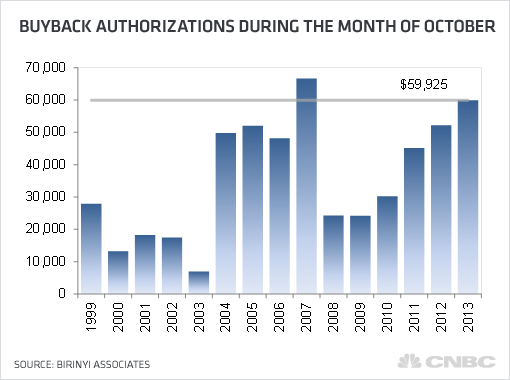
So companies have boosted earnings-per-share through buybacks, at a rate on par with 2007.

18dece3Source: CNBC

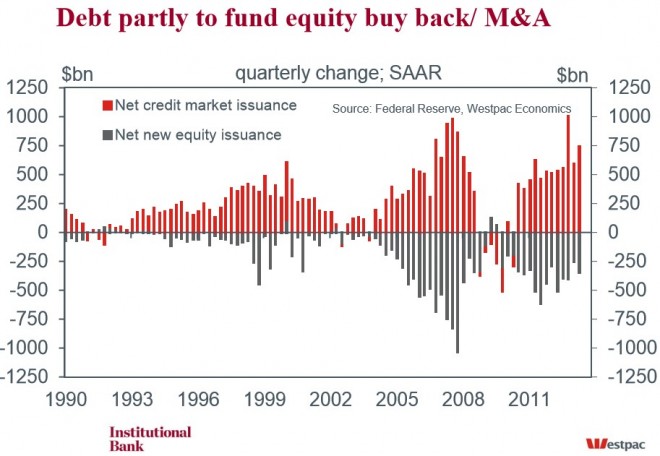
Historically, companies have funded buybacks through borrowing:

18dece4Source: FT

This time is no different.

18dece5Source: NakedCapitalism

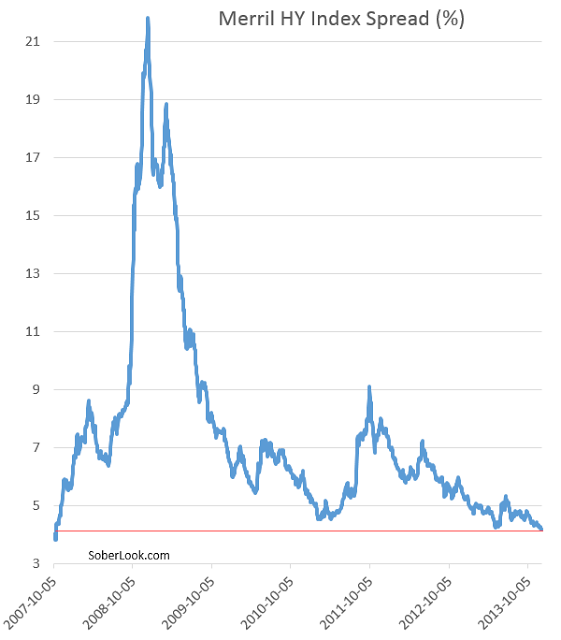
October produced a record in corporate debt issuance, and investors have piled in to this market to drive spreads to record lows this year. They have even snapped up the riskier Covenant-Lite corporate debt which offers little protection if the company gets into trouble – to another record level:

18dece6Source: SoberLook

In short, investors have gone all-in on the corporate sector, both in equities and debt. The corporates have used the debt to buy back shares, thus artificially boosting earnings-per-share whilst revenues languish. Even with that, earnings growth has only accounted for 17% of share price rises this year. The rest has been speculation built on the ‘new norm’ of Fed accommodative policy trumps all. Record low debt spreads and historic extreme equity valuations result, and now present high risk to those invested.

Earnings guidance for Q4 (reporting season kicks off in early January) is the most negative on record:

13dece7

Source: Thomson Reuters

The main reason for this is because companies have expected revenues to improve, so cut their guidance for earlier quarters but kept their year end targets in tact. Revenues have failed to materialise and therefore there is a big gap between year end forecasts and actuals, producing that big red bar for Q4 earnings.

Here we can see the persistent theme over the last two years of companies having to lower their quarterly guidance in line with economic reality:

18dece7Source: Bespoke

Of course, in response to lowering guidance analysts then reduce estimates, and with the bar set very low, companies can then peversely exceed estimates and produce a satisfying earnings beat rate, which helps shore up investor confidence. The truth of the meagre earnings and dire revenues becomes distorted.

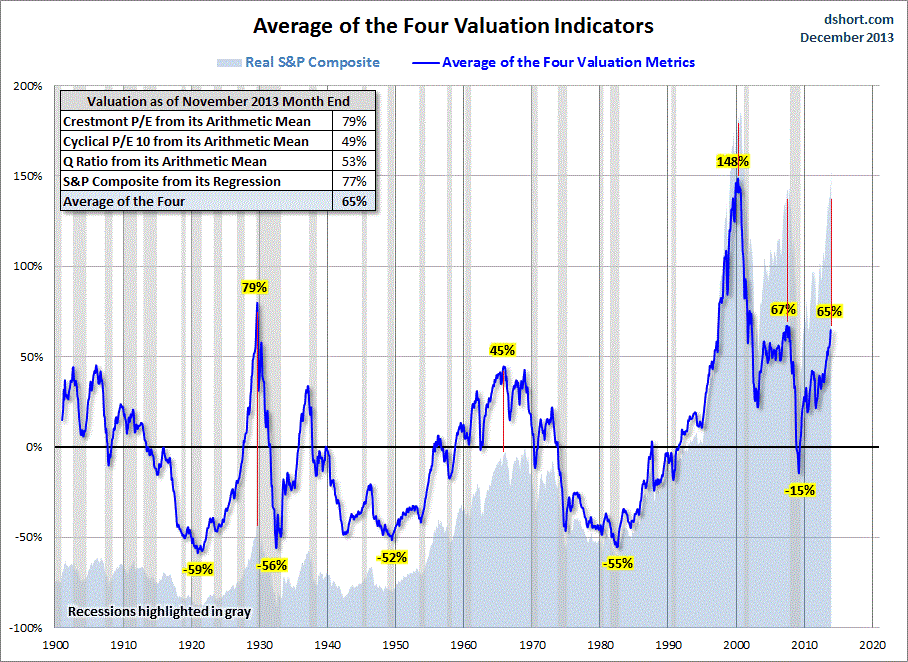
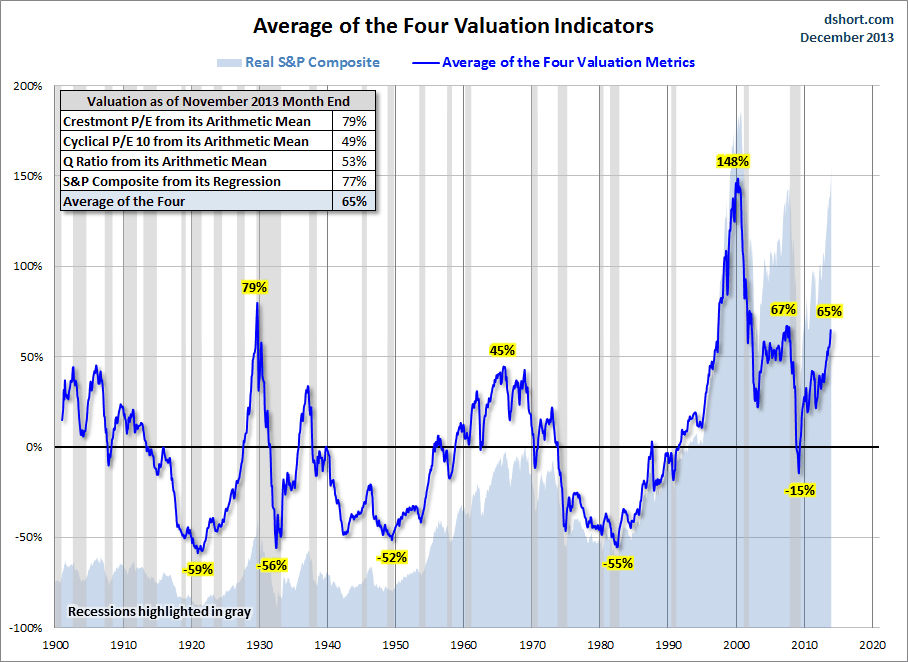
The bidding up of equity prices without associated earnings growth has produced historic extreme valuations, averaged below:

13dece5

Source: Dshort

I suggest there are 3 secular cycles in the above chart. The 1920s saw an economic boom period with a positive demographic dividend, and by the end of the decade the thinking was that this boom was here to stay, a new norm, which gave rise to the speculative bubble and then collapse in 1929. It was not a new norm after all, and it took around 18 years to wash out excesses, to take valuations to a low enough level from which a new secular bull could erupt.

The 1950s and 60s was another (post war) economic boom period with a positive demographic dividend, and again new norm thinking took valuations to greed levels. The wash out was also around 18 years until valuations were at similar secular bull starting levels (note the demographic dividend was absent in the washout period).

The 1980s and 1990s then provided a third economic boom period with a demographic dividend in the major nations, excepting Japan in the second decade. This concluded with another ‘new norm’ bubble, and dot.com thinking took valuations to an all time exuberance record, and since then I believe we are in a gradual process of washout which should last another few years yet. US demographics peaked around 2000, Europe around 2005 and China around 2010, and we won’t see a collective demographic dividend return until 2020 or beyond. I believe this is why we face a weak economy and a gradual slide into deflation, and central bank intervention can do little to change this. Rather, central bank actions only encourage people into riskier assets by suppressing cash and bond returns, and make the cost of borrowing to do this ultra low. Hence we see another big disconnect now between the stock market and the economy.

Look again at the high outliers in the valuations average chart above: all were the peaks of economic and demographic booms (even 2007 where developing countries contributed a much bigger share to global GDP as China rose towards its demographic and economic peak). In contrast, the current exuberance is set against a weak economy and unprecedented collective demographic headwinds, which I believe makes it the most dangerous outlier yet. The ‘new norm’ this time is the Fed accommodative policy trumps all. It is a bubble.

There are multiple signs that we are reaching the top of this equities bull market (see my recent post Equities Bear Market Coming), and I believe we will see a bear market that will finally produce the washout to low extreme valuations. The negative demogaphic window is set to make this bear a deflationary shock, which means nominal values will have little protection. In other words, stock market falls will be harsh. On these grounds, Russell Napier quotes 400 on the SP500 as a possible bottom. This is maths plus history, not the peddling of fear.

The result would be something like this: a large megaphone with a lower nominal low than 2009:

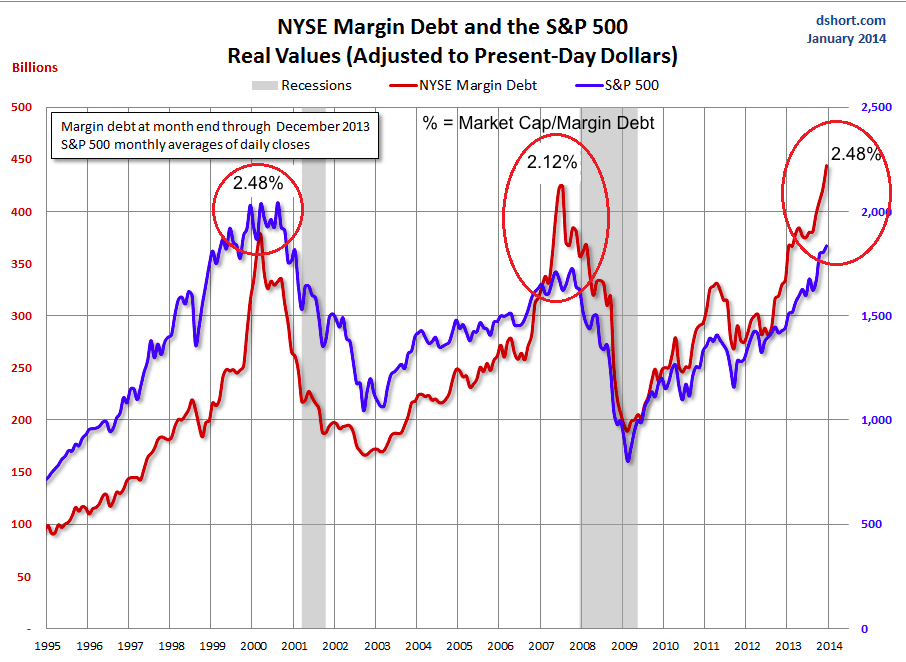
26nove17Based on margin debt, euphoria, and valuation, the bear market looks set to erupt imminently. That means the Fed would be effectively out of ammo. It has had not the usual opportunity to end stimulus and raise rates to more regular levels, from which it can then ease in the face of a downturn. This should add to the ferocity of the downdraft.

By leading indicators the current window of positive economic data should turn out to be a peak, rather than the global economy finally seeing a new dawn. With commodities finely poised, I do not know whether they will rally as equities top out (in late cyclical style, similar to 2007-8) or break down as demand-supply slack outweighs. If the former, then we would see a temporary inflation until rising commodities help tip the fragile world economy into a deflationary recession. If the latter, then further commodity falls should do the job of completing the slide into outright deflation. Because of the credit excesses again (margin debt, corporate debt), a bear market would likely be unforgiving similar to 2008, i.e. forced liquidation of assets, with few asset classes spared. This time, however, treasury bonds would not seem so safe. Gold has a limited performance history under deflation, but I believe it has potential to be the go-to asset here.

The pretender to the throne, Bitcoin, which temporarily became as valuable as an oz of gold, looks to have burst, whilst gold’s washout looks very similar to 1976:

18dece8Source: Citi

The weak hands have been purged and equities show signs of topping. The next few years are an ideal anti-demographic window for gold to shine, and deliver the dow-gold ratio extreme which we have so far not seen. The question is whether it an escape a downward spiral of forced liquidations.

State Of The Markets

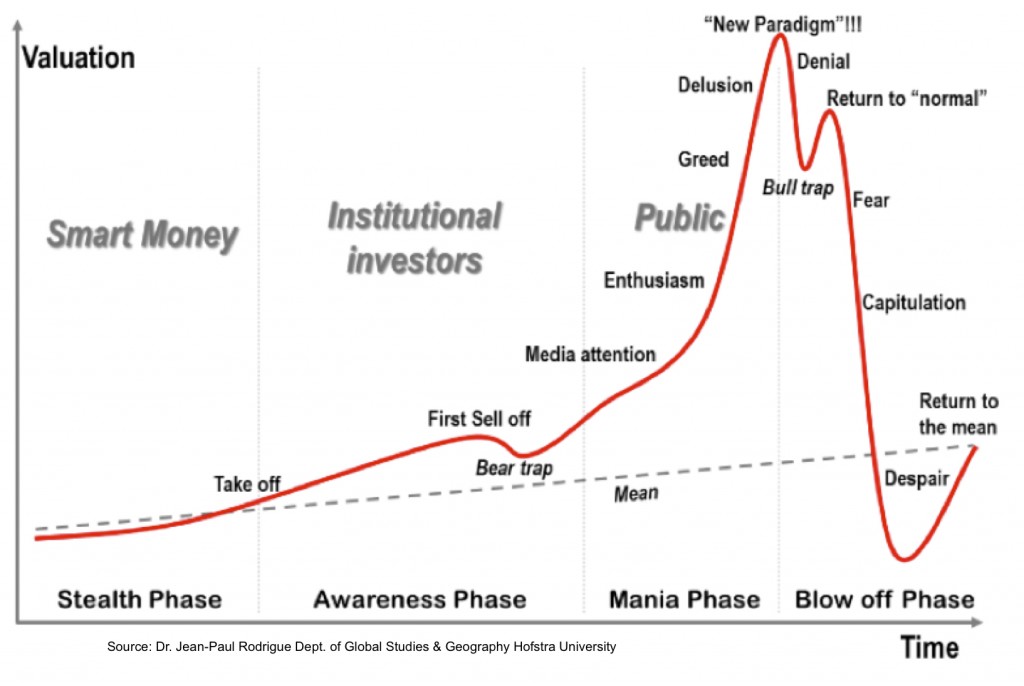
I think Bitcoin isn’t coming back. Bubble popped as per the bubble anatomy model below, and now at fear-capitulation:

8dece1Source: Bitcoincharts

8dece2Source: PortfolioProbe

Now what about the stock market bubble? No bubble?:

8dece3

8dece4

Source: Dshort
8dece5

Source: John Hussman8dece6 8dece7

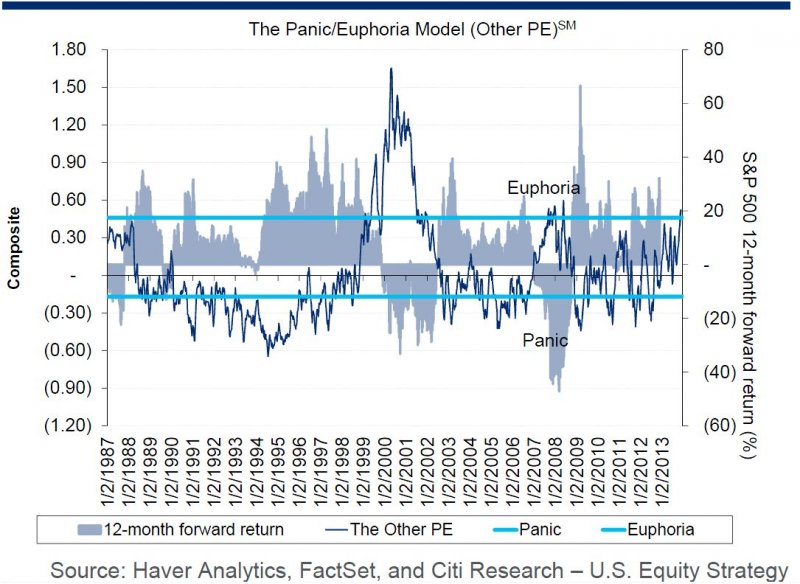
The Citigroup Panic/Euphoria model is a composite of NYSE short interest ratio, margin debt, Nasdaq daily volume as % of NYSE volume, a composite average of Investors Intelligence and the American Association of Individual Investors bullishness data, retail money funds, the put/call ratio, CRB futures index, gasoline prices and the ratio of price premiums in puts versus calls.

Add in the declining trading volumes and I believe we have a recipe for a crash ahead – the question is when. An overleveraged, thinning stock market participation, trading at historic overvaluation and euphoria extremes. That said we have to understand the current context: surpressed cash and bond yields makes equities relatively more attractive, so worthy of higher valuations. Here’s a model I’ve used before to assess the environment for equities:

1. Inflation rate – Stocks have historically risen when the official inflation rate is between 2-5%

Inflation is below, so this is a negative.

2. Bond yields versus stock yields – Long term gov bonds yields should not exceed stocks yields by more than 6%

Equities are largely yielding more than 10 year bonds in the major nations, so this is a positive.

3. Interest rates – interest rates should be low.

Ultra low – so again positive.

4. Yield curve – should be normal.

Yield curve is redundant under a balance sheet recession, and I believe that’s the current circumstances. Therefore irrelevant.

5. Stock valuations – Stocks P/Es should be historically reasonable (historic average 17)

Overvalued by CAPE, Q ratio and a number of measures, so negative.

6. Investor sentiment – II, AAII, Market Vane should not be overly bullish

Overly frothy sentiment, e.g. II bull-bear ratio at highest since 1987. Negative.

7. Money supply – should be growing and strong

Collective narrow and broad money measures weakening to flat of late suggesting we may be seeing a top in global industrial production as we turn into 2014. But no clear trend, so I suggest neutral at this point.

8dece8Source: Moneymovesmarkets

Overall it’s a mix of positives and negatives, but notably both at extremes. Stock-bond yield differential at extreme in favour of equities, but equities overvaluations extremes, for example. So which is ‘right’? You know my view: unprecedented collective demographics point to deflation and declining equity and real estate markets that cannot be overcome by government intervention. But this may yet take time to unfold.

Corporate bond yields are also into extreme territory, putting investors into the same kind of risk predicament as in equities.

8dece9Source: SoberLook

As my trading focus is currently short term, I’ll end with my view on that. In line with excessive sentiment readings reached at the start of December, most major stock market indices pulled back last week. A notable exception was the leader, the Nasdaq, which consolidated sideways and then broke out on Friday to end the week at new highs. So more Nasdaq parabolic?

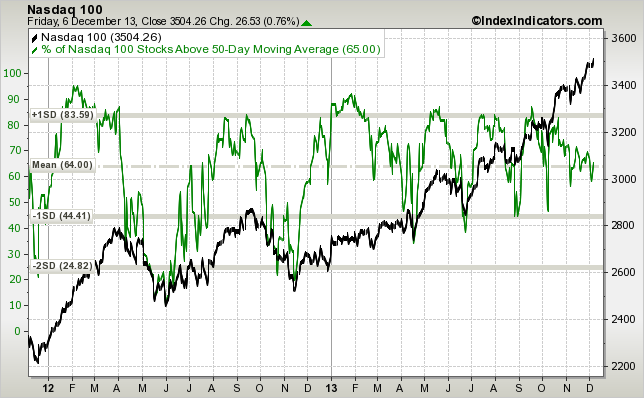
My opinion is the Nasdaq is actually going to reverse this coming week and be the last to join the correction. Volume was notably lower on Friday on that breakout, which is a sign it could be reversed. We are into the lunar negative period and there is a geomagnetic storm in progress this weekend. The Nasdaq shows a breadth divergence for the last 2 months, which again is suggestive of a correction:

8dece10Source: IndexIndicators

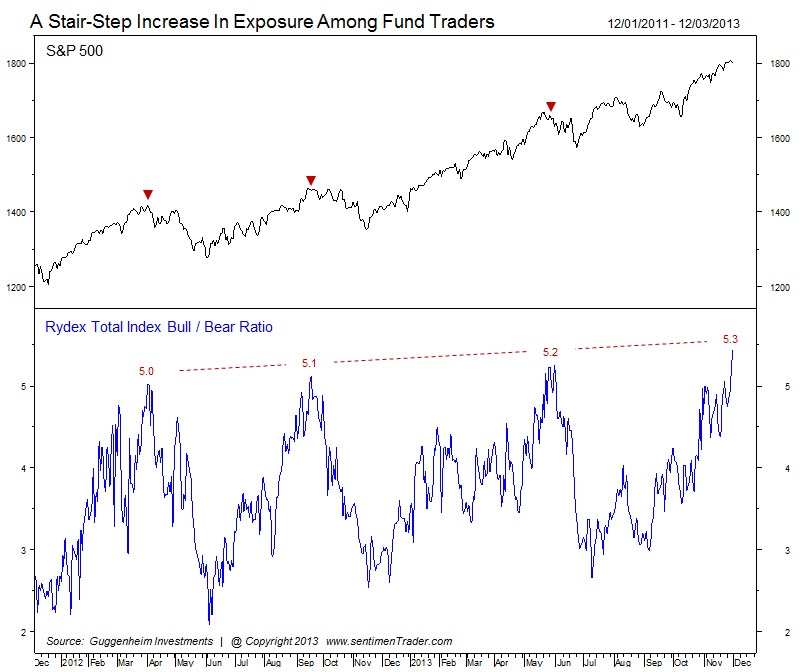
When the stock market reached those kind of sentiment levels in the past, normally a correction period of several weeks followed:

8dece11Source: Sentimentrader

Monentum has also waned. So it’ll be an interesting week, and for commodities too. Some signs of life last week which energy breaking out on the growth story, and some volume in the gold and silver buys in their range-bound week, whilst sentiment levels against gold, silver and miners are again at extreme lows. The US dollar is once again looking weak. The commodities indices remain in those large technical triangle noses since 2011, so still watching and waiting.

Disclosure: short stock indices, long commodities.