State Of The Markets

Starting with the equally-weighted commodities index versus the world equities index:

17nov11Source: Bloomberg

Commodities remain depressed but still within a large triangle. Last chance though here as the triangle compresses and they test horizontal support again. Their underperformance, based on supply and demand, is consistent with the demographic trends now in place in most of the major nations.

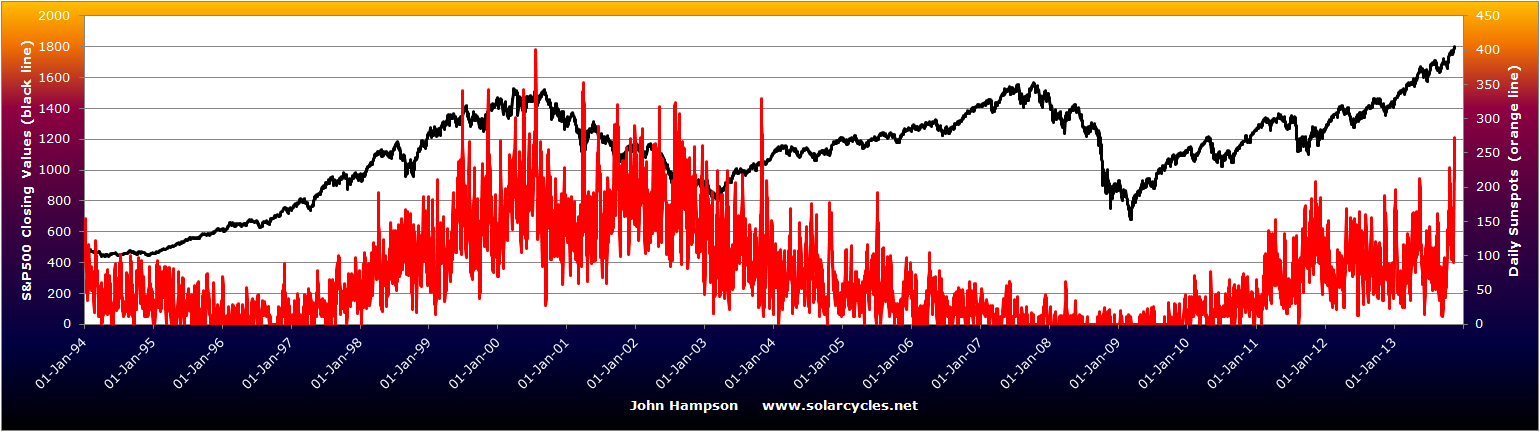
World equities broke out of their mid-year range, rendering the potential topping process redundant. That means equities need either to start over a multi-month topping process at some point ahead, or make a parabolic top instead. The increasing rate of gains, shown by the trend, suggests the latter could potentially occur (or be occurring), and this is supported by increasing evidence of a solar maximum taking place now:

17nov13Historic solar maximums have been correlated with speculative manias, such as Nasdaq 2000, Nikkei 1989, gold 1980 (last 3 solar maximums). I anticipated that commodities would be the speculative target for this solar max but there is reasonable evidence that such speculation froth is taking place in equities, as the next 5 charts show.

Firstly, Hussman’s long standing bearish call on the markets has to be taken with a pinch of salt, but the ‘bubble’ technical overlay shows what could be occurring:

17nov6Source: Hussman

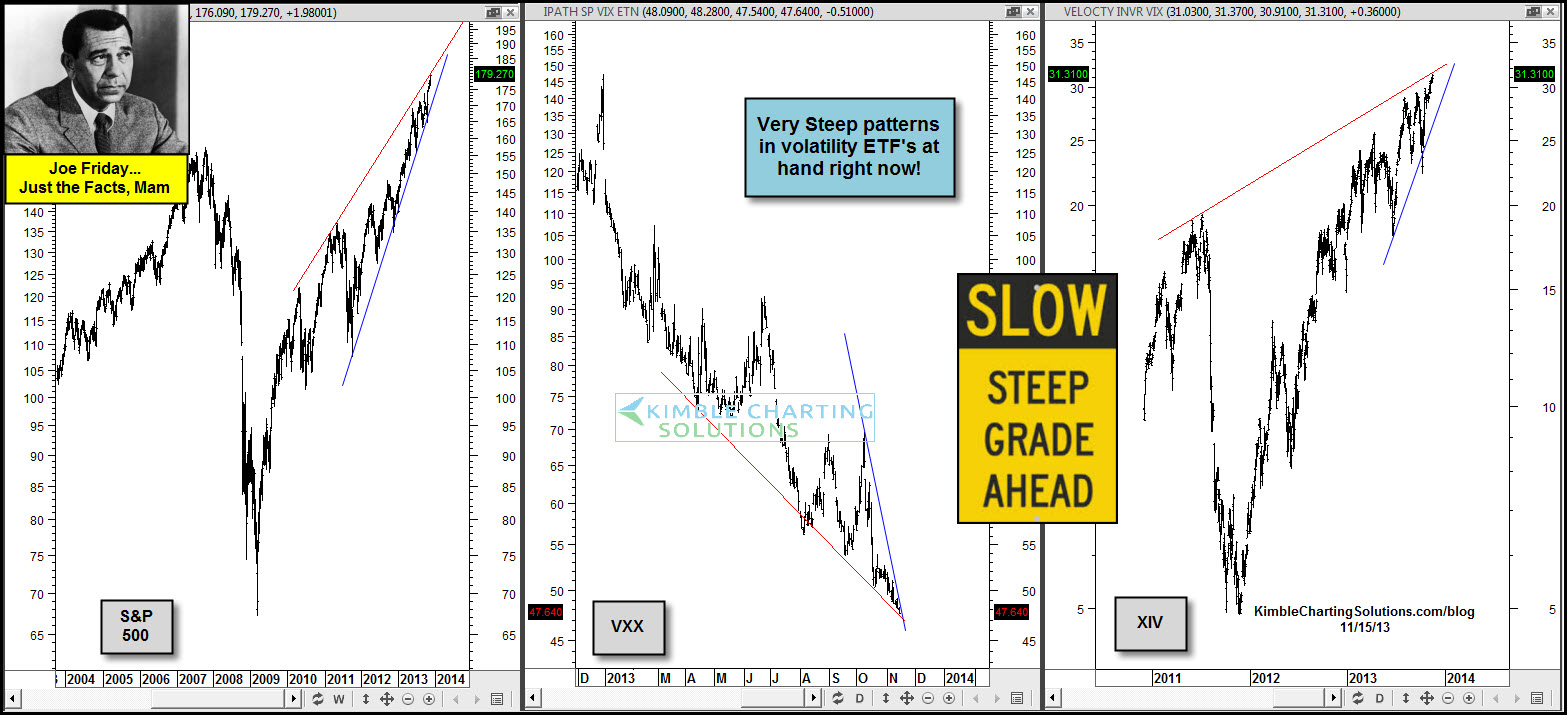
Secondly, the steep wedging of both the SP500 and volatility indices is also indicative, and suggests both could be heading for a pop:

17nov5Source: Chris Kimble

Third, the situation for free cash in margin accounts together with margin debt levels reveals a dangerous extension, which is also suggestive of excessive speculation:

17nov3Source: Dshort

And fourth, a lack of hedging to go with that:

17nov2Source: Sentimentrader

Finally, fifth, the rally is now much more weighted into the hands of traditionally ‘dumb’ money rather than ‘smart’ money participants:

17nov1Source: Sentimentrader

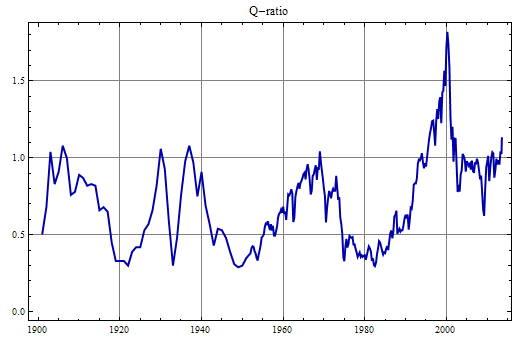
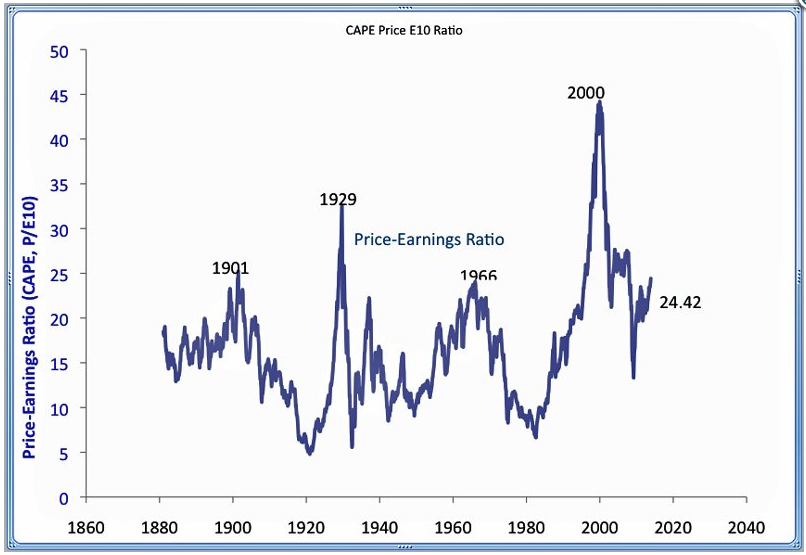
On the flip side, we do not see significant deterioration in breadth nor rotation into defensives that would ordinarily warn of a top in the markets. The next 2 weeks are the positive lunar fornight so there is a reasonable chance that equities continue to rally through that period, and indeed could feasibly carry that through the traditionally strong Xmas period into the beginning of 2014. I believe the technical breakouts and steepening trends in stock indices together with the solar-inspired excitement could potentially make for a parabolic finale here. It’s a tough one to call because of the extremes already reached in some of the indicators above. Complacency is high and it has been a long time since a 10% correction. Stocks are also overvalued, historically, as the Q-ratio and CAPE reveal:

17nov7

17nov8The 2000 outlier shows how much further overvalued stocks could feasibly yet become, but that anomaly aside we can see that by both measures warning signs are flashing. What could tip the market over? Rising rates (bond yields are back on the rise), an inflationary shock, or a deflationary shock. Normally, stocks would tip into a cyclical bear under excessive inflation. Right now we see the opposite. Take a look at the rate if disinflation in Europe:

17nov9Source: Yardeni

Add to this a crisis emerging again in emerging Europe, and I can see a case for the ECB taking to QE. If that were to occur, then maybe commodities can catch a bid again and make their speculative rally, under a brief but significant inflationary shock. Chris Carolan’s solunar model for crude oil paints the possibility that oil could come back here:

17nov12

Source: Spiralcalendar

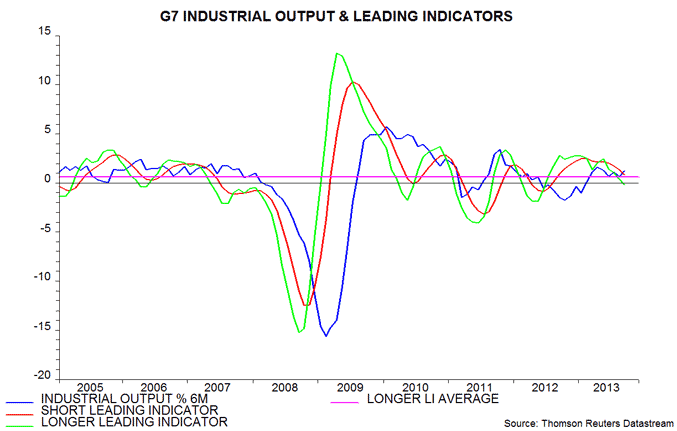
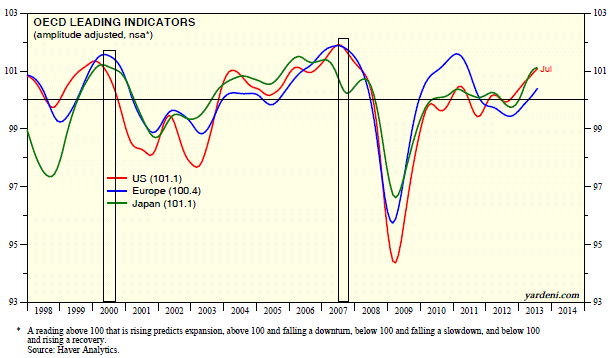
If the whole class cannot rise again, then precious metals alone could, under a deflationary shock, i.e. the world tips into a deflationary recession. This could occur with further commodity falls dragging global inflation rates yet lower. Emerging markets such as India and Brazil are in trouble again with low growth and high inflation, sinking currencies and debt problems. And leading indicators suggest global growth could be tipping over as of year end in the developed nations:

17nov10Source: Moneymovesmarkets

Under deflation, equities would normally fall hard and fast, to the lower ranges for CAPE and Q ratio above. That would likely mean sub 2009 lows in nominal terms. But under inflation, equities normally more slowly wind down to those valuation levels, and in nominal terms the damage is less severe. Under deflation the US dollar should rally, whereas under inflation the US dollar should break down. The US dollar was on the cusp of a major breakdown several weeks ago but has since rallied away from oversold and overbearish conditions, leaving both possibilities on the table, and its performance from here should be a key signal.

Right now, the deflationary outcome looks the most likely, which would make a short on the stock indices a very tasty trade. However, before that there is the potential for stocks to climb further, and possibly at an increasing trajectory. That makes for difficult timing. With the positive lunar fortnight right ahead, and momentum still with equities, I am expecting stocks can rally further in that period, barring any external shocks. But with various high danger levels already reached for this stocks bull, I am looking to build short here, not chase long. Regarding commodities, I continue to watch and wait, still long the complex, but not adding. I believe precious metals will come again, due to the unprecedented demographic downtrends, but am less sure about the broader complex due to the demographic impacts on demand. But let’s see – the moment of truth draws nearer – see below – and I don’t want to try to front-run or second-guess it. A speculative and final rally in commodities remains a possibility whilst the complex continues to consolidate up high. Yet if they cannot rally, and break down below the major support, I believe the global tipping into deflation will accelerate and kill equities in due course.

17nov14Source: Martin Pring

Latest

I’m on holidays, so just some updated data below.

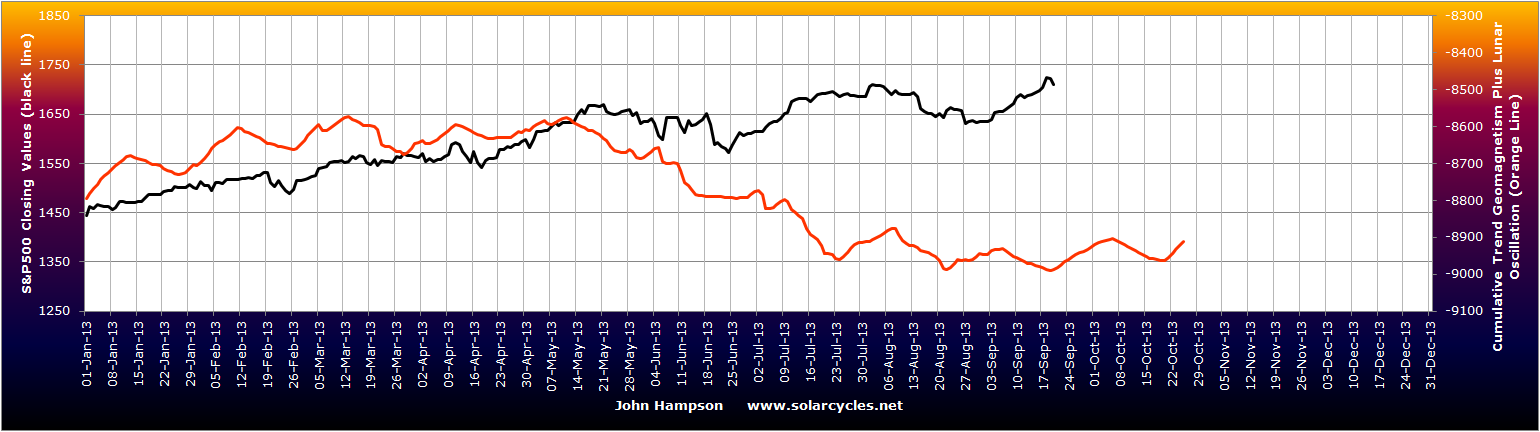
Sunspots still high, adding weight to possibility of solar max still ahead – modelled versus SP500 here:

29oct20131

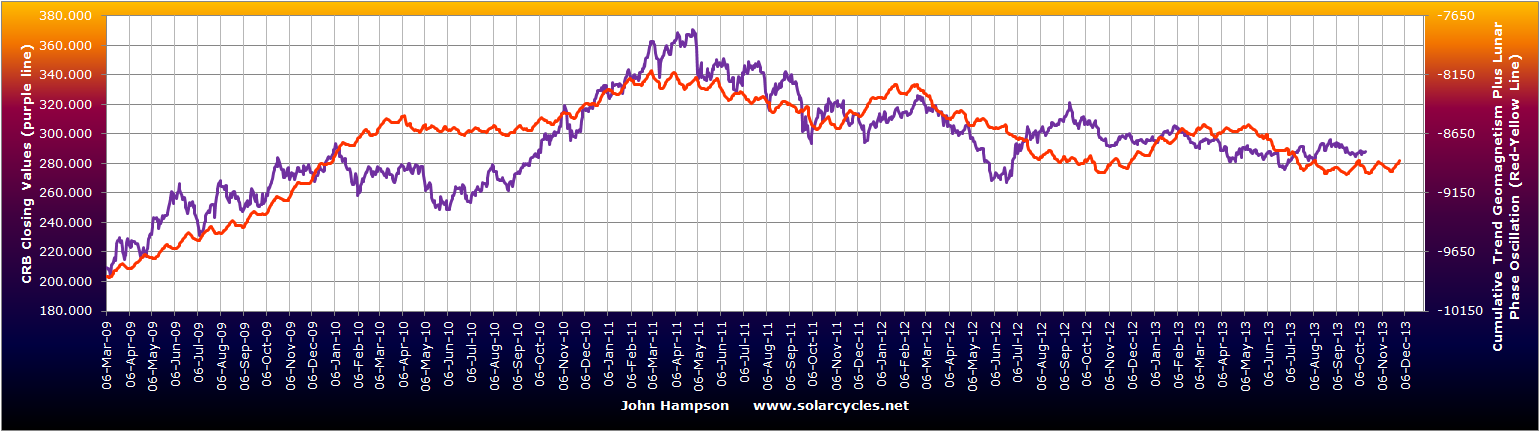
Geomagnetism forecast extended for next 3 weeks, overall still flat – modelled versus commodities index here:

29oct20132

FOMC output tomorrow, new moon on Friday, lunar negative period begins the start of next week.

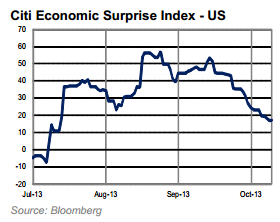
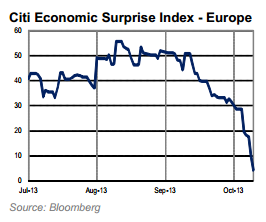
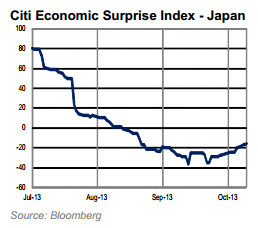
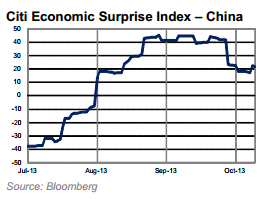
Economic surprises falling in US and Europe, improving but negative in Japan, and positive in China:

29oct2013329oct20134

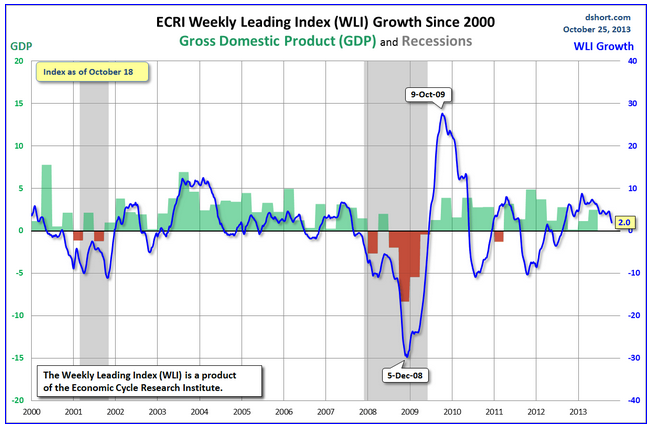
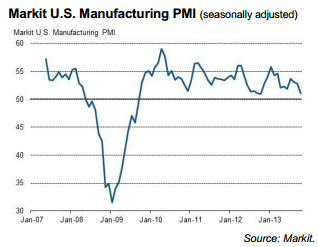
29oct20135 29oct20136Leading indicators for the US falling:

29oct20137 29oct20138

Cyclical stocks bull top?

Weighing up whether the equities bull market that began in 2009 is topping out here, we can look to fairly reliable historical topping signals, and I can summarise as follows:

1. A topping process, normally months, with reversals of reversals of reversals in a range – yes, up and down legs since May within overall range

2. Evidence of overbought and overbullish extremes (such as RSI and sentiment surveys) – I found this not to be too reliable as an indicator once the topping process has begun, but nonetheless, investors intelligence bears would be one such current reading – click here for link

3. Breadth divergence – yes, advance-declines or Mclellan summation index would be two

4. Cyclical sectors topping out before the index top and money flow into defensives – nope, not happened meaningfully yet

5. Major distribution days near the highs – we have had some 90% down days since May

6. Yield curve flat or negative – since the debt impasse began, treasury yields at the shorter end of the spectrum have indeed inverted, the longer end remains healthy

7. Tightening of rates through rising yields – we have seen a doubling in treasury yields over the last 6 months

8. Excessive inflation – nope, we are seeing global disinflation

9. Rolling over of leading indicators and recession model alerts being produced – combining OECD, Conference Board, ECRI, narrow money and Recession Alert, we don’t yet see this in any meaningful way

10. Market valuation excessive – measures such as the Q ratio and cyclical p/e show the US to be currently overvalued, whilst globally speaking valuations are within normal historic range (however, by my work this is relative to demographics and as such USA and Europe should get cheaper)

In summary, we see some warning signs of a top in progress, but not yet a full set.

To be clear, not all cyclical tops are a process. Some are parabolic manias that end in a spike, with a similar crash down the other side. Examples link here.

However, we don’t see parabolic rises in equities in global stock indices currently, and if this is a top being formed currently, then it is of the topping process type. The 2000 and 2007 tops were topping processes, as were the multiple tops around the 1970s.

What I have found about the topping processes is that when the topping range began, there were precious few topping signals present – as if the stock market were as competent a leading indicator as any other. But when the topping range ended – the last push up – the majority of signals were clearly present. I have highlighted the 2000 (Mar-Aug) and 2007 (July-Oct) topping ranges on the charts below to show this.

First, OECD leading indicators – downtrends in evidence by the end of the topping ranges

14oct20131

Second, ECRI leading indicators – by the end of the topping range had fallen through zero
14oct20133


Third, treasury yields – rising prior to the topping range, then falling once topping range in progress
14oct20134

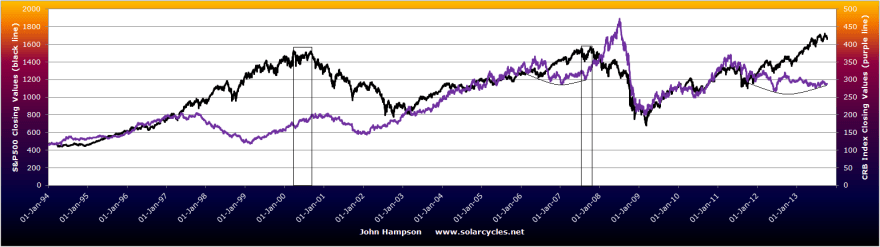
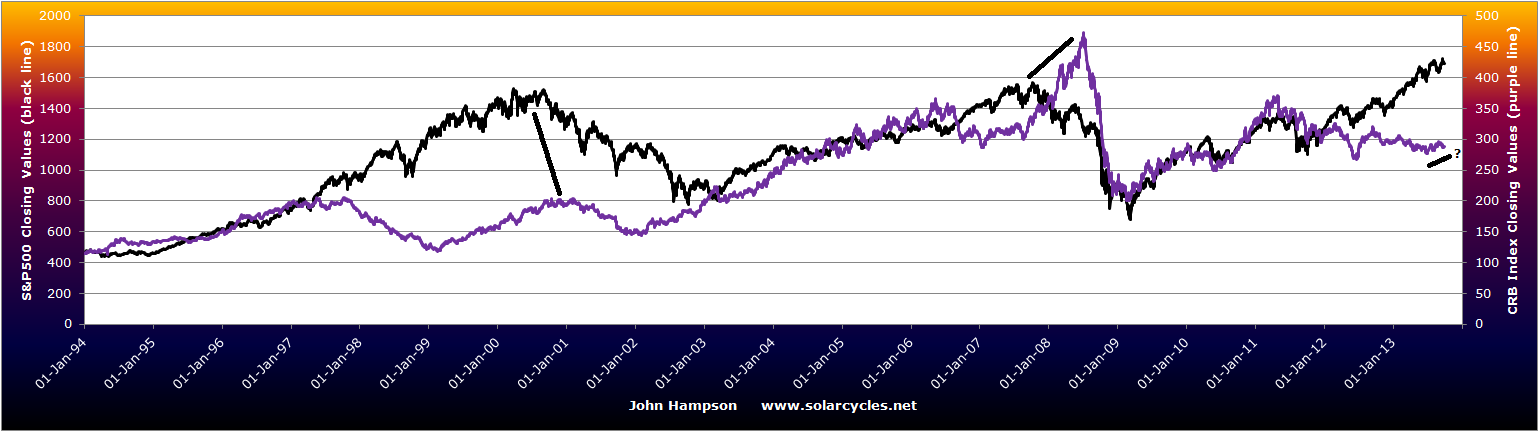
Next we see the topping ranges on the SP500, which if you zoom in, had different shapes in 2000 and 2007 but in both cases there was a last push up to the highs, with many topping signals present, before the bear began. I show here what happened with commodities – both times topping after the stock market. In 2007 commodities only took off once the equities topping process had begun, so there is the potential for that to occur now, but it has to happen without delay if this is a top.14oct20135

Fifthly I show US housing, declining into the market tops. The recent drops in new home sales, related to the increasing mortgage rates, could be similar if it continues.14oct20136

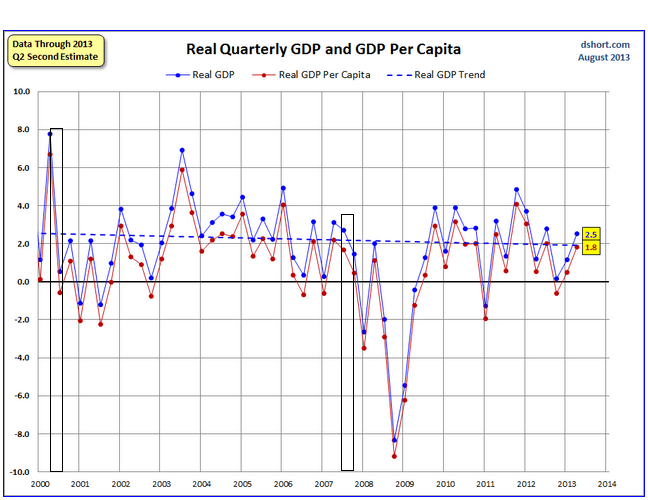
Sixth, US GDP – again clearly in a downtrend by the end of the topping ranges, so should look for the same this time14oct20137 Seventh, margin debt. We see a similar overthrow rally in margin debt recently as per the 2000 and 2007 tops, and again margin debt was in a clear downtrend by the end of the topping ranges so should look for the same to occur
14oct20139 In short my message is this. If this is a topping process in equities, then we should see a further leg up ahead where the bulk of these indicators have moved into clear downtrends. We have certain topping signals already in place, but the rest should fall into place ahead if this is a topping range. It means a golden opportunity to go short would be following a further leg up in stocks against the backdrop of these remaining indicators having turned. If this is not a top in equities, but a consolidation before further gains, then we should break free from the range, and the topping indicators in place one-by-one cease to be.

I want to end by commenting on the global disinflation in place currently. This to me is consistent with demographic trends, and is the threat to a commodities rally coming to pass. If commodities can’t rally as per historic topping order norms, then I would point to the unprecedented collective demographic deflationary trends in place now.

As inflation levels drop in the major indebted economies, the danger is that inflation drops below yields making the massive debt effectively grow bigger. Central banks would then need to intervene further to suppress rates or initiate inflation, perhaps by increasing QE. If, on the other hand, commodities become a speculative rally target here, then inflation will increase but the move would have detrimental impacts on the economy. Central banks would again be bringing out the toolkit. It’s the trap that I referred to before. Can instead the goldilocks scenario continue, of low growth, low inflation and equities rising, with the Fed able to slowly ease out of QE? I personally can’t see it, because it is such a fragile position. Rallying yields or rallying commodities or government pullback on stimulus/spending would likely tip the fragile economy over, and I believe one or more of those will happen in due course. It would take stronger growth to prevent this, and I don’t see it can occur against the demographics.


Update

I’ve been busy with the shift of focus, towards shorter term trading. I advised recently that a poor year for commodities threatens my year end PnL, so pending the validation or invalidation of solar cycle and demographic theories, I am taking action to try to ensure a good year-end figure. What this means in practice is (i) taking profits on markets where applicable (ii) using shorter term indicators and leverage to bring other positions to profit and then close out and (iii) as the range of markets I am involved in narrows, attacking the remaining markets, plus (iv) trading in and out of other opportunities where I see them. So I am gradually reducing the range of markets I am involved in whilst leveraging up on the remaining markets: a combination of decreasing and increasing exposure to keep risk levels satisfactory. And no longer term strategic positioning any more – that will be resumed following this exercise. It’s an enjoyable challenge, as I haven’t used this approach for some time. No guarantee of success though, and only in the early stages.

It remains to be seen whether the solar peak is ahead or behind us, and if it is ahead of us whether the anticipated correlated commodities peak will occur. It is also still not yet clear whether commodities are changing trend into an uptrend, or still in a bear market since 2011. Below, both commodities index and sunspots versus Sp500.

8oct20131

8oct20132Similarly unclear yet is whether equities are in a cyclical topping process. We see breadth divergences, but not yet deterioration in leading indicators. We see the kind of price oscillation within a range that would mark a top, but as yet no real marked shift in sector performance that would be typical of a top. By my demographic work, we should tip into another global recession and equities bear in due course, but it would be historically typical if this was triggered by tightening: bond yields rise too far (not yet there) or government cuts back on spending/stimulus. On the latter, the US government shutdown, if prolonged, threatens to do the equivalent job of reducing government spending; or the government may agree to spending cuts to raise the debt ceiling (deadline Oct 17th); or the Fed may taper QE (next FOMC output Oct 30th). The near term prospect of a taper looks less likely with the government shutdown potentially shaving off GDP, but it remains out there as unknown, and on that note, commodities typically perform historically (as shown in the first chart above) once equities have topped and the economy has topped, once rate cuts are underway. Clearly that isn’t our current scenario, which adds to the uncertainty over commodities. Plus, again referring to demographics, we have an unprecedented collective global downtrend in place which could potentially overwhelm any possible commodities/inflation rally. Which brings me back to the start: nothing has been validated or invalidated yet in terms of solar, demographic, commodities, equities, bond yields and government spending/stimulus. Gradually developments in all these areas will make it clear, but pending that, my focus is making money shorter term.

So to the near term. Below I show the position of the SP500: at support in a rising wedge. That rising wedge could spell a breakdown ahead, but first a bounce may be in order.

8oct20133The US government shutdown and debt ceiling uncertainty is affecting market sentiment, but news of a likely agreement could at any point provide a relief rally. If the impasse remains however, then the next two weeks are the negative lunar period which takes us up to the debt ceiling deadline and could therefore keep downward pressure on stocks.

Below is the latest geomagnetic-lunar model versus the commodities index. The geomagnetic trend has flattened out and has a positive edge looking out over the next 3 weeks. Indeed we are into the last quarter of the year, where we typically see more benign geomagnetism and positive seasonality for pro-risk (which I believe are correlated). If equities are not yet making a cyclical top, then there is both a backdrop and a time window in which to rally away from the price range of the last few months.

8oct20134The US dollar is flirting with major breakdown, but arrives there oversold and overbearish. A breakdown would add weight to a commodities rally, so I continue to watch. Crude oil is typically the main driver of an inflationary commodities rally and looks to have formed a short term low over the last couple of sessions. I am watching that too, as further drops back into the range of the last couple of years would cast doubt on commodities making a meaningful uptrend.

*Updated short term lunargeomagnetic model versus SP500 10 Oct*:

8oct20135

Demographics In Play

Demographics may be a long term theme but I believe it very much has relevance in trying to work out what’s next for the markets.

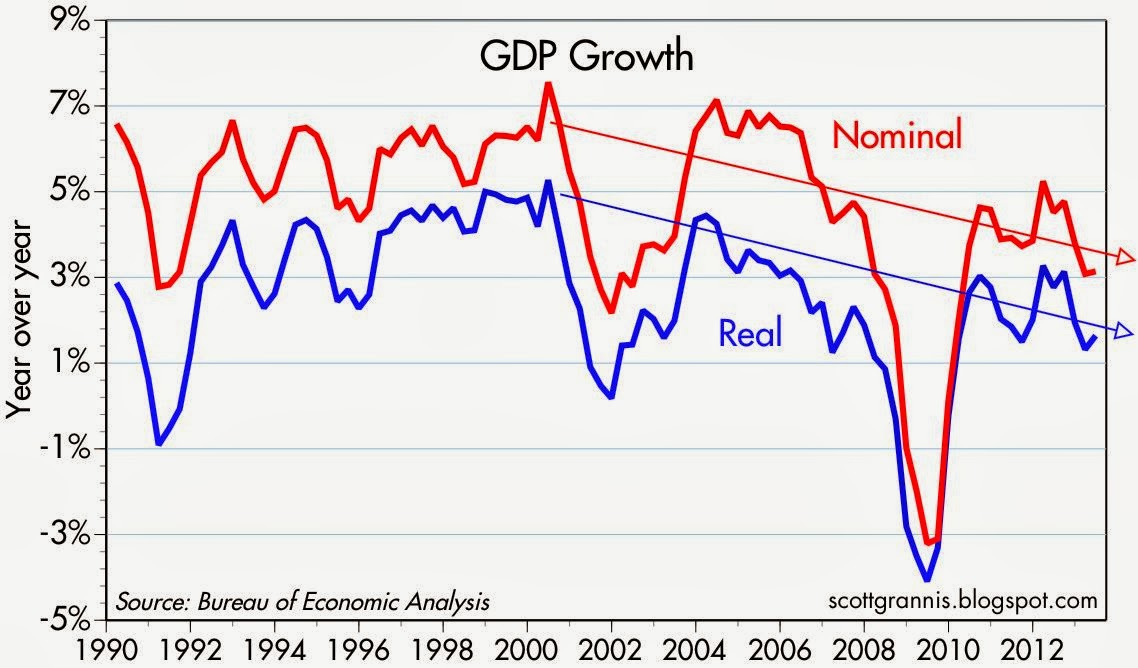
US demographics turned around 2000. Here we see US GDP changed trend around the same time, and with US demographics negative for this decade, that trend should continue. To be clear there are large oscillations within that but the overall pressure is down.

25sep20131Source: Scott Grannis

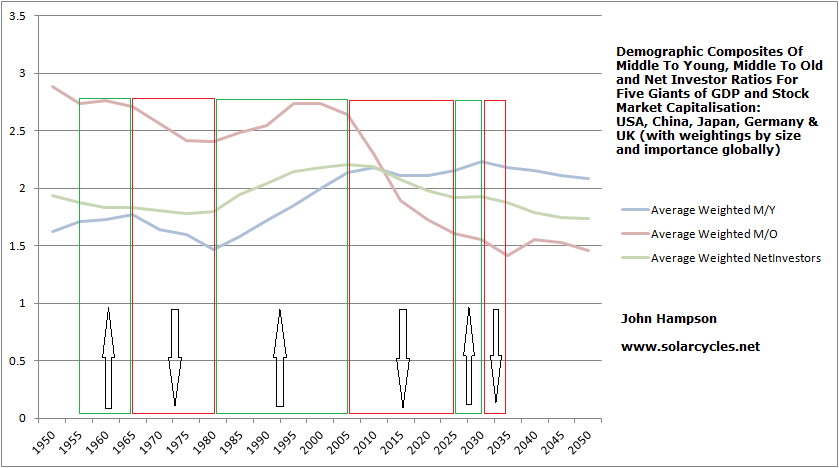
Here is my demographic (weighted) composite again for the main 5 economies of the world.

5May20131

And here is real global GDP, which again matches the trends in global demographics (represented by the line overlaid):

25sep20132Source: TheNextRecession

In short, the demographic trend is recessionary, and I believe the global economy will at some point get the trigger or catalyst to tip into negative growth again, either through excessive bond yield rising tightening or through excessive commodity price rises, which would be a temporary inflationary shock. I say temporary as I previously also showed the relation between demographics and inflation/deflation which show the trend in place now is price deflationary:

https://solarcycles.net/2013/06/23/demographics-disinflation-and-deflation/

“A swell of people aged 15-20 entering the workforce works up price inflation through spending, whereas more people entering old age relative to the work force is disinflationary through saving and disinvestment.”

The Fed is targeting 2.5% inflation, but the demographics say this is unlikely to be achieved. Also, GDP is going to remain weak and central banks are going to need to maintain intervention.

The latest US inflation rate came in at 1.5% annually. This is lower than most current treasury yields. The Fed wants inflation to be higher than yields in order to reduce its ballooning debt (by inflating away). Bond yields may still be historically low, but the demographic trends in place mean that inflation is low and growth is low. It wants to stop yields rising to 3% for fear that this level would be enough to tip a weak economy and to prevent it entering a deflationary trap where bond yields exceed inflation. Indeed the Fed’s Bullard has said that if inflation dropped to 1% annual he would want QE to be increased.

Which brings us to commodities. Can they rally? The demographics are largely against, as demand should erode and hard assets perform best in inflationary trends. On the flip side, the easy money conditions mean a loss of appetite for stocks could see money flows into commodities in a speculative momentum rally. History would suggest they probably can as late cyclicals, but history has not seen this collective demographic downtrend before between most of the major economies.

If I was to advise on a buy-and-hold portfolio for the next few years (I am not an advisor, don’t follow me etc) it would look something like this: long japan equities (positive demographics for stock market), short usa/europe/china equities (negative demographics), long gold (go-to asset as anti-demographic), short energy, short real estate, long cash with bias to asia currencies (all deflationary).

Russell Napier believes that there is trend-following in place in equities currently, but that eventually perception will turn to how QE and ZIRP have failed over 4 years to return the US to normal growth and stocks will turn bearish. I agree that this will happen and see developments ahead that can force it. If the US pulls back on government spending (debt ceiling 30 Sept) or stimulus then earnings should decrease (as per recent post) and yields should rise further, respectively. If commodities make a speculative rally they are likely to tip the weak economy over, and if they continue to decline in a deflationary trend then US inflation is likely to fall yet further beneath bond yields. In short, the Fed is in a trap, and it is a demographic trap, and a particularly potent trap because of the collective demographic downtrends amongst most developed countries, making for a downward global pressure. I don’t believe it can create sustained inflation or normal growth UNTIL demographic trends change. Collective demographics do start to improve once we get to the end of this decade, but over the next couple of years I believe there is really no way to avoid a global recession and harsh nominal stocks bear. Either yields, commodities, reduced goverment intervention or increased government intervention should tip a fragile economy over.

What does that mean for trading? Well, for me personally, I like to play an asset one way, siding with the longer term trend. If it goes against me nearer term, then I can use money management and averaging, with the conviction the longer term trend will ultimately drive it. So my anchoring would look something like that imaginary buy-and-hold portfolio I posted just above. Right now I am long energy (oil and gas commodities) which is a concern if deflationary trends dominate. However, solar cycles / historic topping order / easy money speculative conditions may yet deliver the decisive rally that I seek, so I’m going to carry on holding for now. With equities I am looking to build on the short side from the current position but am looking for more evidence of stocks topping. The technical action of the last few days has added weight to this, but we still don’t have ‘enough’ all round evidence. But this is trying to be as accurate as possible with timing, for the yearly trading P&L. I have sold my other longer term equity-related investments over the last couple of months and moved them to cash.

Charts To Start The Week

Last week, stock indices largely printed bearish shooting star candles (on a weekly view, up into and on FOMC output then reversal of gains Thu and Fri), which also looks like a potential lunar inversion, and a potential important Equinox reversal too. The Equinox was 22 September to be precise, and Gann found this date/event often marked major tops in history (on or very close). Chris Kimble has also produced this (hat tip Gary) below, and notes last week produced an all-time record for inflows into equity funds worldwide:

23sep20136

Source: Chris Kimble

As various stock indices were at important breakout levels, and ended Friday retesting those levels (having jumped above then fallen around the FOMC), then a breakdown in the first part of this week would make things look more bearish, because we would have a shooting star fake-out and more of a trend supporting lunar / equinox reversal.

Chris Puplava pointed out overbought signals as other reasons for a pullback (although he still sees no threat to the ongoing bull market). I have added vertical lines to his summary picture to view more clearly what happened to the SP500 on previous occurences, namely sharp uptrends gave way to more sideways ranges:

23sep20131Underlying Source: Chris Puplava

Leading indicators remain overall positive. For example, US CB and ECRI leading indicators were both good readings last week. This is supportive for stocks. On the flip side, we have seen some breadth divergences, which would be one topping process sign, and we know margin debt is at lofty levels.

Here is the latest geomagnetism forecast (with lunar oscillation). Overall flattish, but with a slight upward bias. I noted previously that the lunar positive fortnight from today plus the relatively benign geomagnetism could make me long-biased. However, if we have seen a lunar inversion then we could see down rather than up this week, which would negate that edge.

23sep20138Let me bring in commodities. When stocks retreated in July/August we saw commodities gain interest, which was also a potential sign of a topping process in stocks, as historically we have seen commodities rally last as (and after) stocks top out. Since then we have seen money flow back the other way. This is how we stand on the CCI and CRB commodity indices:

23sep20133

23sep20132Underlying Source: Bloomberg

Hopefully it is evident from the two charts combined that commodities have the potential to break into a bull rally here. However, it is just potential, and time is of the essence. If the CRB is to break upwards then it has to make the current backtest of the breakout stick, and pull upwards from here.

Here is the US dollar index. See how it has arched over and is now threatening breakdown. A bearish break would benefit commodities and provide one ingredient for that potential rally.

23sep20135Underlying Source: INO

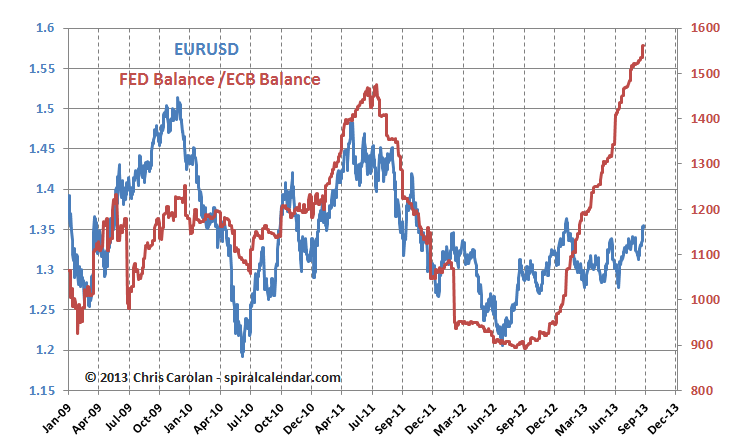
Also, here is a chart from Chris Carolan showing how the Euro has the potential to escalate against the USD based on relative central bank money printing:

http://spiralcalendar.com/wp-content/uploads/2013/09/092213eurbal.gif

As the Euro is the biggest component of the US Dollar index, that then is a possible breakdown catalyst.

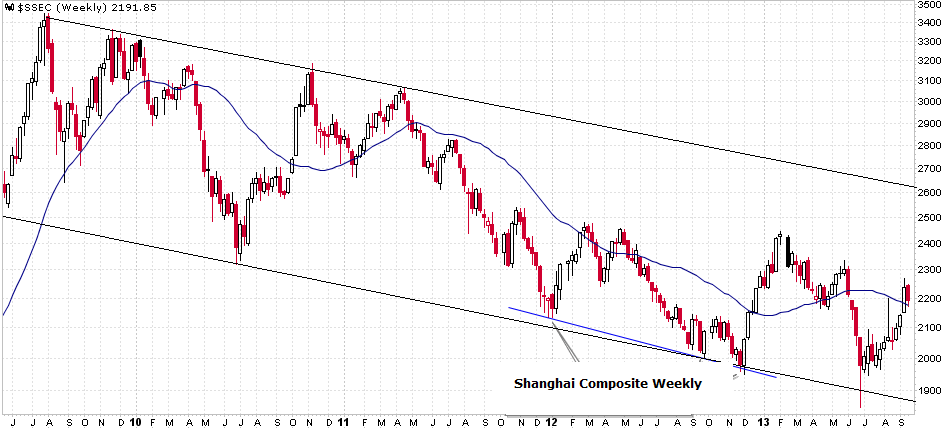
Another factor for commodities is China, as their biggest consumer. Today’s Markit manufacturing PMI came in at 51.2, a 6-month high for China. The stock market has also picked up the last two months and has the potential to run up to the top of this channel:

23sep20134Underlying Source: Cobra / Stockcharts

The most bearish assets (in terms of public opinion) of the current period are corn, wheat, oats, soybean oil and coffee – all agricultural commodities. The volatiility index for stocks (Vix), and treasury bonds, are down with them at bearish extremes. So, if we are to see a mean reversion – which is likely, but the timing is the difficult part – then it would be into commodities and out of stocks (Vix rises).

Lastly on commodities, my solar maximum correlations remain potentially in play, if the smoothed solar maximum is ahead of us. Sunspots are back up to the 100-mark currently so the sun is showing some life again, and certain analysts predict another sunspot peak ahead around the turn of the year. I have established that experts typically agree on the solar maximum once the solar magnetic flip is complete on both poles. The sun’s north pole switched polarity in May 2012, but the south pole flip is still ahead and likely within the next few months. So we should know for sure by Q1 2014. Either an end of year sunspots rally will produce a new smoothed maximum for SC24, before the final polar flip, or the pole will flip and Feb 2012 will be cemented as the solar max. By my research, a commodities rally over the next 6 months to a new index peak would fit with the former, not the latter.

In summary, the research for this post has produced a bias against stocks and pro commodities. As you know I am long commodities so disclaimer as always. However, I was also net long equities and have taken some profits on the long side. If stocks rally to new highs this week, and on good breadth, then much of the bearish case would be negated. If commodities sag further into the end of September, the rally potential in the commodity indices would fade.

Weekend Research Pt2

1. MORE ON CRUDE OIL

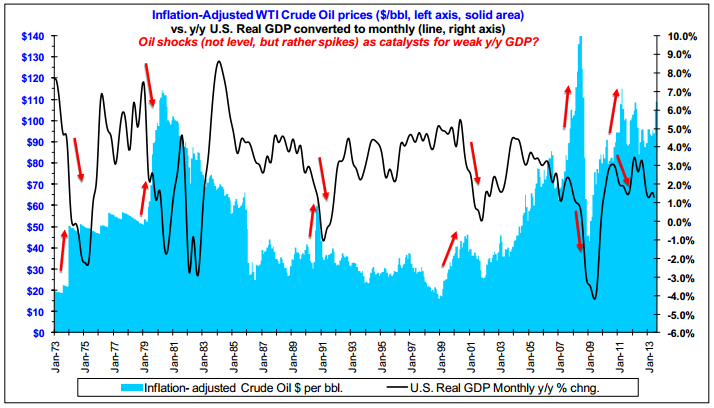
Here is a chart from Barry Bannister showing the impact of previous sharp moves higher in oil prices:

15sep1Source: Stifel

He suggests it is not the real oil price level per se but a ‘shock’ i.e. a big, fast move up in price that brings about a collapse in GDP.

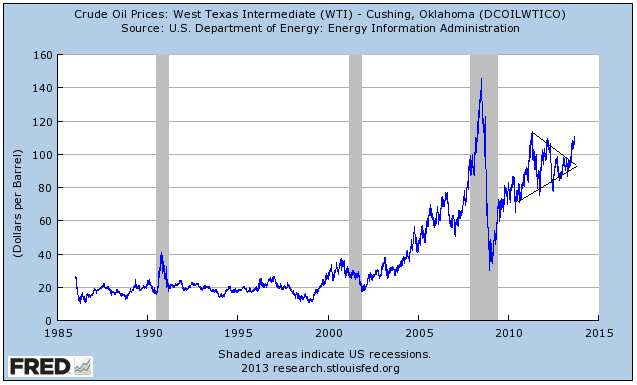
Here is the nominal view of crude:

15sep3Source: FRED

From a technical perspective, the potential for such a swift rise is there, as crude has broken out of its triangular consolidation to the upside. A break above the 2011 high of $115, which is within reach, could be enough to produce the speculative spiral that has been behind previous parabolic rises.

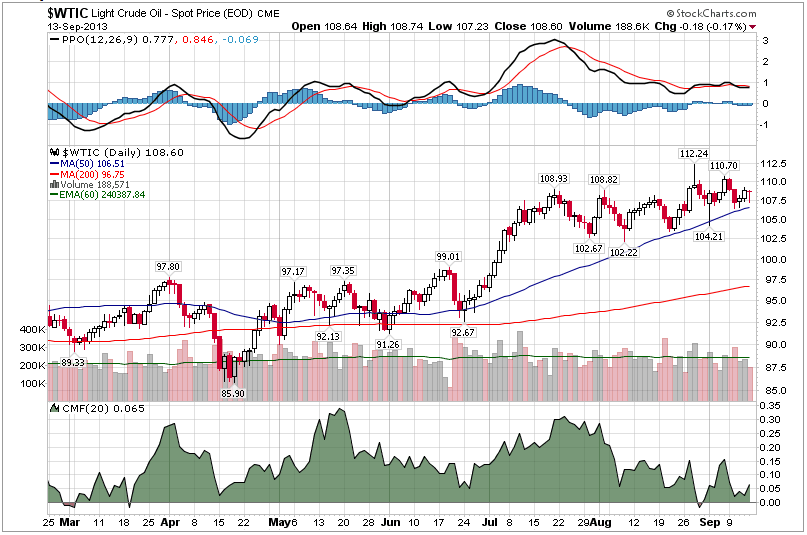
Zooming in on the nearer term, a fairly messy range has developed over the last six weeks, with the contract buffeted about over Syria. With inventories still above historical averages it could be interpreted that there is a lack of appetite to buy higher than this range, and clearly there is a risk that this stalling in momentum gives way to a breakdown.

15sep4Source: Stockcharts

However, for now, the price continues to edge upwards and a bullish intraday reversal candle formed on Friday. So let’s see what happens this week.

2. DEMOGRAPHICS, TECHNOLOGICAL EVOLUTION AND CORPORATE PROFITS

What if exponential technological evolution more than offsets negative demographics? I.e. what if rising corporate profits thanks to technology-driven gains can spur the stock market higher, maybe exponentially higher?

Here are US corporate profits, which seem to suggest that could be happening:

15sep5Source: FRED

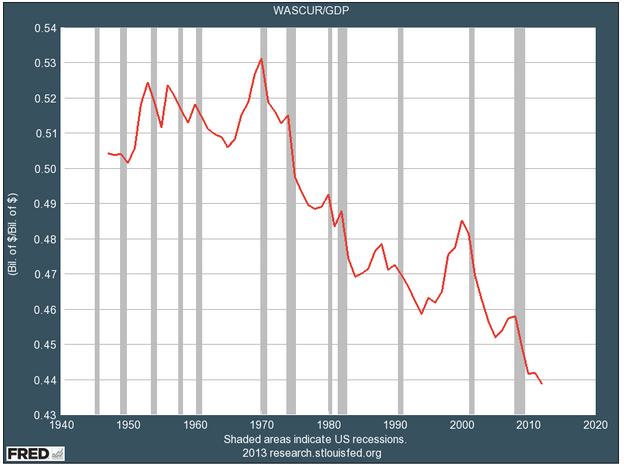
Now take a look at wages as a percentage of US GDP:

15sep6Source: Business Insider / FRED

The employment to population ratio has also fallen sharply. Companies are making more profits but employing less people and paying them less. Technology is one key factor in this: it is cheaper and more efficient for companies to increasingly employ tech over people. As we are concerned with the stock market, are the corporate profits what matter? Well, more unemployment and lower incomes means lower demand in the economy. Hence we have seen a consistent theme in recent earnings seasons of revenues disappointing versus earnings: companies not making profits through demand but through cost savings.

But now take a look at what has been to a large part responsible for the recent rises in corporate profits to all-time highs:

15sep7Source: Pyramis

It is the government defecit. Government ‘spending’ (stimulus programmes, cutting overnight lending rate to banks to zero, etc) has been the major factor since the 2008 crisis in pushing up corporate profits. Those corporate profits are real, but at the expense of increasing public debt. So the US government wants to cut back QE when it can, and facing the debt ceiling again – another ‘fiscal cliff’ – it needs to cut back spending and make savings. It also wants to keep rates low, ideally lower than inflation, to reduce debt servicing and shrink the debt, so current rising yields are a threat. Extracing from that Richard Koo PDF again, Japan only fell into deflation once it had fallen off the fiscal cliff, following an attempted fiscal consolidation.

Additionally, drawing together several pieces of research, it turns out corporate profit levels are only important in stock market returns over long timescales, e.g. a 10 year view. Sentiment is the main market driver in any one year, and p/es are the main driver if trading say on a 2-3 year timescale. By my work p/es are relative to demographics. A p/e of 20 is not expensive if the demographic trends are strong and positive, and vice versa.

So, I can now come back to the opening question of whether tech evolution can push up corporate profits and in turn the stock market, and offset weak demographics. Tech can enable cost-cutting but this can be at the expense of people, resulting in lower demand in the economy, so it’s not just a simple win, it cuts both ways. Furthermore, recent record high corporate profits are shown to be mainly due to a transfer of wealth (debt) from the Government, and the risk to future earnings is in Government action to cut back QE and savings to deal with the debt ceiling. But ultimately, corporate profits don’t matter so much for the stock market, only in long term investing. Sentiment can push the market one way or the other ‘irrationally’ before p/es and demographics come into play, before corporate profits.

In summary, I am still of the opinion that we do not have a new ‘secular’ bull market in stocks underway and that once ‘sentiment’ gives way, the collective demographic downdraft will help topple the economy and stock market. Action on QE and in response to the debt ceiling could be a catalyst for future corporate profit disappointment, which could help tip the sentiment. Crude oil, meanwhile, could do the job all on its own, if ‘some development’ provides the impetus for a speculation move into the commodity. Exponential technological evolution is a real phenomenon and I believe is ‘the great hope’ for humans to deal with the debt, resource scarcity, global wierding, demographics, overpopulation and other challenges. But I don’t see evidence that it can drive the stock market ever higher versus these phenomena in the shorter term.

Weekend Research

Time for a more in-depth post.

1. SOLAR CYCLES

By my work the secular (more accurately demographic or anti-demographic) asset class should be bid to a peak in a solar-inspired speculation blow-off close to the solar maximum, which for this solar peak should be commodities to round off a decade long (plus) bull market. If the smoothed solar max has passed and was Feb 2012 and the CCI commodities index made its ultimate peak April/May 2011 then neither should now be exceeded. If this turns out to be the case in hindsight, once the solar max has been agreed, then the commodities peak would have occurred 9 months prior to the solar peak and would within normal parameters to continue to validate the theory.
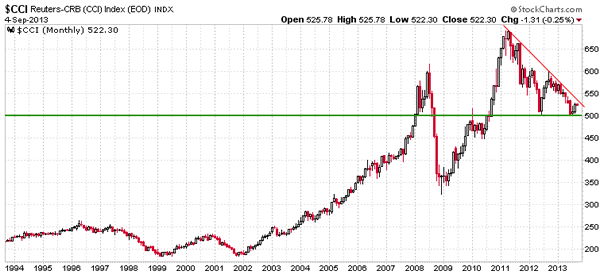
24sep3

Source: Gary Tanashian / Stockcharts

If, alternatively, the solar peak is ahead late 2013 into early 2014 (which is SIDC’s second option, and also Leif Svalgaard’s prediction – shown below), then that 2011 CCI peak is too far away and if the theory is correct we should get another commodities peak closer to the solar peak, which would mean a higher peak in the CCI ahead. We have the possible seed for this in a fledgling CCI uptrend following a base established in July/Aug 2013 together with their historic performance as late cyclicals in what is possibly a cyclical topping process in equities occurring. However, this CCI uptrend is currently tentative, devoid of momentum and without broad participation thus far. The dips in oil and precious metals at the end of this week cast further doubt for now, but their drops coincided with money flowing back into equities. If equities are in a topping process then money should flow back to commodities in due course as they go outperform as late cyclicals. I would suggest the higher peak in CCI to be possible as speculative money pours in, under these easy money conditions globally. ZIRP and QE may not be able to generate growth but they can generate bubbles.
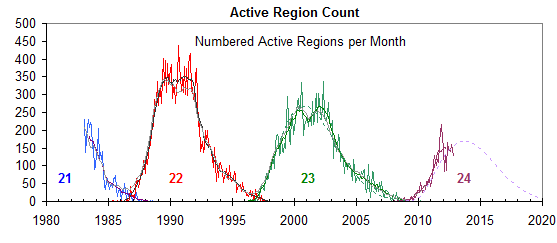
24sep4Source: Leif Svalgaard / WattsUpWithThat

If the first alternative turns out correct, and both the solar peak and commodities peak are behind us, then historically we have seen a new long term bull market in equities underway at this point, and the current easy money conditions could spell big momentum into equities (which would be the polar opposite to the second alternative of equities in a new bear and commoditites sharply rising, thus vital to call correctly). However, my demographic research shows that this is unlikely to be the case, at least not yet, as the positive demographic support for a new global secular stocks bull is absent. Indeed, the collective demographic trends of the major economies, bar Japan, are in an unprecedented collective downtrend.

2. DEMOGRAPHICS

This brings me to the question of whether central bank policy actions have been aggressive and potent enough to compensate for demographic headwinds. If that were to be the case then perhaps an enduring stocks bull and sticking economic growth could be achieved, albeit only whilst ZIRP and QE are maintained. I can very much recommend a read of the next link, which nicely summarises what QE can and can’t do and what Japan’s most-aggressive-to-date QE is likely to achieve:

http://www.scribd.com/doc/137092515/Richard-Koo-Quantitative-and-Qualitative-Easing-2013-04-16

In a nutshell, QE and ZIRP aren’t that potent as they cannot force people and companies to borrow or spend or invest. In the 1990s Japan tried to offset demographic downtrends with QE and ultra low rates and other stimulus tools. Even though most of the major economies were in demographic uptrends in that period (with booming asset markets and economies), this positive global environment AND these central bank actions were not enough to get people and companies to borrow, spend or invest.

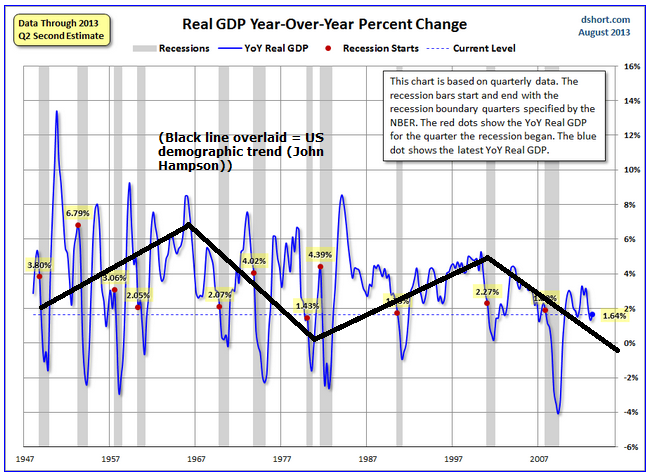
I have overlaid the overall US demographic trend against Doug Short’s real US GDP growth chart here:

24sep1

Underlying Source: Dshort

The yellow dots reveal that real US GDP is currently lower than any previous recession start point. I suggest this shows the relative impotence of QE and ZIRP, and would argue that the demographic downtrend which should be in place for the bulk of this decade, suggests that real GDP growth level should fall negative again in the near future and another recession kick in. The question is whether this occurs with or without the tipping help of a speculative rally in commodities.

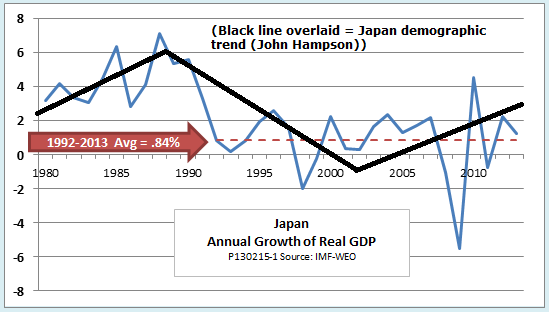
Here is the same for Japan: real GDP growth versus overall demographic trend.

24sep2Underlying Source: Economonitor

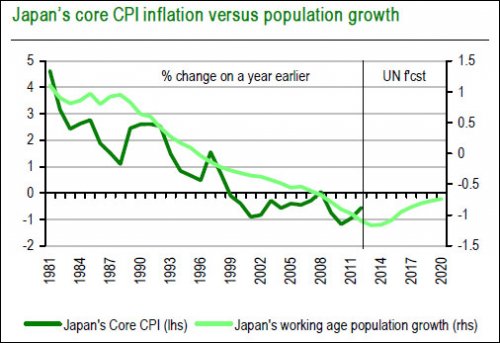
By demographics, Japan should be able to nurse along positive real GDP growth for the next few years. It should also be able to succeed in stopping price deflation:

23jun10Source: Andrew Cates

Note that both should be feasible by demographics alone, without ‘Abenomics’. The demographic trends for Japan mean that we should see underlying growth, price stabilisation, and rising asset markets, which I believe will be touted as positive results of Abenomics when in fact largely written by the demographic change of trend.

3. JAPANESE EQUITIES

So is Japan a buy? Not all recent economic data has been supportive, but manufacturing and service PMIs are indeed in runs of positive growth, revealing underlying economic improvement. The Yen and Japanese bonds both dropped sharply following the launch of Abenomics but have since retraced some. However, the Yen now appears to have broken down out of a bear flag, whilst Japanese bond yields are shaping for a higher low and a potential push on from there. The Nikkei also consolidated following the big run up earlier in the year, but has now broken upwards out of two consolidation patterns shown:

24sep6The line you can see coming into picture at the very top is the 2-decade declining resistance, the containment of the long term bear. I believe a retest of this should be on the cards and I have decided to add to playing Japan equities on the long side. However, if US equities are in a multi-month topping process and soon to enter a new cyclical bear market, then I would not expect Japanese equities to go their own way, only rather to relatively outperform, which would mean decline less. Nonetheless, a new bull market in Japanese equities is belated relative to demographics and I feel happy here trying to make profits on the long side – expecting any downside is more limited than other markets – whilst still trying to assess where US and global stocks are headed. The supporting evidence for Japanese equities to rise should come in real GDP, real economic improvement, and indeed an underlying bid in Japanese risk asset markets. So I will continue to watch the data releases.

4. USA

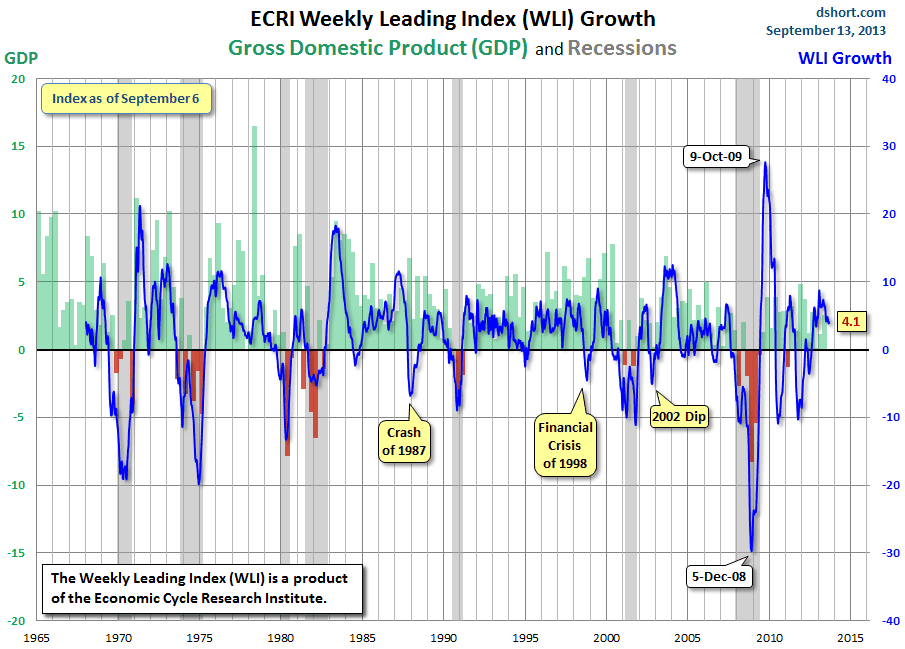
So back to the US. Here is the latest picture for ECRI leading indicator growth:
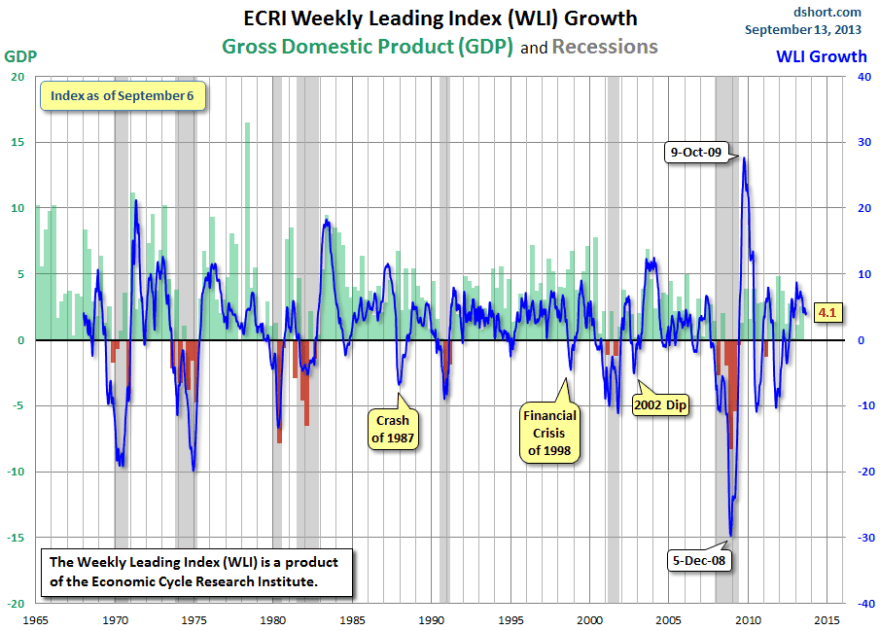
24sep7Source: Dshort / ECRI

ECRI leading indicator growth fell beneath zero prior to each recession shown in grey. The break into the negative often historically occurred close to the stock market topping, with stocks typically being a leading indicator of the economy. We can see there have been several breaks beneath zero that did not give way to a recession, not least the fairly deep fall in 2011 that helped ECRI (incorrectly) announce a recession. However, my take on the current reading of 4.1 is that we should see this fall towards zero if we are to see a cyclical bear erupt in equities and a recession to occur ahead. This growth measure has been in a declining trend since early 2013, so to add weight to an equities top being formed, we should continue to see this dropping. For now though, this leading indicator, and other leading indicators (such as Recession Alert or Conference Board) point to continued economic growth into year-end.

Weak but sustained growth and low rates are typically a good environment for equities, which would be a framework for equities to move higher and reveal the consolidation since May as digestion in an ongoing cyclical bull. In supportive of this, the Nasdaq is now convincingly at new highs for this cyclical bull, and the Dax is back testing its high-to-date (which is also the all-time nominal high). If other indices break up and away from the ‘topping range’ then we would be looking to 2014 for a cyclical top as a multi-month topping process would have to start over. As noted in a recent post we have some evidence for a topping process in play since May, but also some normal signs missing. This should be resolved one way or the other soon.

5. COMMODITIES AND BONDS

Which brings me to the two main threats to the economy and the equities cyclical bull: excessive inflation from sharp rises in commodity prices and/or excessive tightening from rising rates in escalating bond yields. Bond yields in the major economies continue to rise albeit from low levels. If economic growth persists further and the Fed begins to taper QE then we could expect yields to continue to rise. Historically, the tipping point has been when 10 year treasury yields hit 6%, however today’s demographic and debt interest pressures mean that trouble level is likely to be lower.

Regarding commodities, the most important is oil, as quick major escalations in oil prices have historically correlated with tipping the economy into recession, due to its importance as an input in so many processes. Despite the slack and weakness in the global economy, crude prices have hung around the $100 level the last 3 years. A speculative move into this asset, for any number of reasons, could under current easy money conditions swiftly lead to $125 oil, which I believe would really test a demographically-challenged weak global economy.

On the flip side, the same demographic trends could further erode commodity demand and also limit the exit from bonds. Further commodity price drops, together with yields stabilising relatively low, would again provide the backdrop for equities to march on and economic growth to persist – unless the potency of the collective demographic downtrends drag the economy down into recession on their own.

If Martin Pring’s normal historic topping order is playing out, then we have seen the top in bonds already, we should now see evidence of equities topping and of a transfer in momentum to commodities which should make a peak last as the economy rolls over. This would imply yields and commodities rise despite demographics, and for my work this would be a better fit if the solar peak were still ahead at the turn of 2013/14, with commodities making a final and bigger peak in the months around that.

I believe evidence in support of or against this could become clearer as soon as next week, watching the markets’ reactions to the FOMC output. Some mild tapering is being widely touted as a done deal, but the size and the wording we don’t know. Regardless, I expect a big reaction in the markets and it will be telling how commodities, precious metals and the US dollar, fare afterwards. If commodities are going to make a final big rally then the tentative uptrend of the last couple of months should cement and a US dollar breakdown out of its long term triangle (see HERE) would be a great partner for such a development.

6. TRADING

We are over 3/4 of the way through the year and my PnL is currently showing my worst year of performance to date since going full time, due to the run against commodities longs this year, particularly precious metals. This would repair itself if commodities did begin an uptrend in the last couple of months and now continue into year end, but it could yet go worse if they are in a bear market since 2011 and have further falls ahead. So I have decided to use the Autumn to do what I can to make sure of a good result by year-end. This means I am going to add shorter term trading to my game in this period, whilst running the more medium-term-focused global macro positions. Short trades are something I’ve done before, but not for some time due to success (and personal preference) with the longer term methods. So, I just wanted to share with you that this is what I’m going to be doing different. I am looking for liquid markets that I can play more aggressively for quick gains. So I am looking for candidates amongst the major markets that I can play confidently repeatedly either long or short (i.e. fundamentals/technicals align in favour of one way or the other), and this will include increasing exposure if movement goes the other way. One such play-thing is going to be the Nikkei on the long side, as mentioned above. I am going to pour over some other markets (stock indices, commodities, fx) to find others that I consider suitable, so will share when I decide. You may disagree with my choices and indeed the method, but I’m just sharing what I’m doing, and will let you know the results.

One last thing. Almost all my money is in sterling and I am looking to transfer this to Euros, now I am in Austria. The EUR-GBP exchange rate has therefore become part of my daily watch. A one cent movement in either direction makes a massive difference when considering the amount I am going to be transferring and getting this ‘right’ is as important as my other trading, in terms of the impact on my wealth. So I’ll share my current thoughts, but if any reader is more of a regular in the FX market, please step forward and share your knowledge.

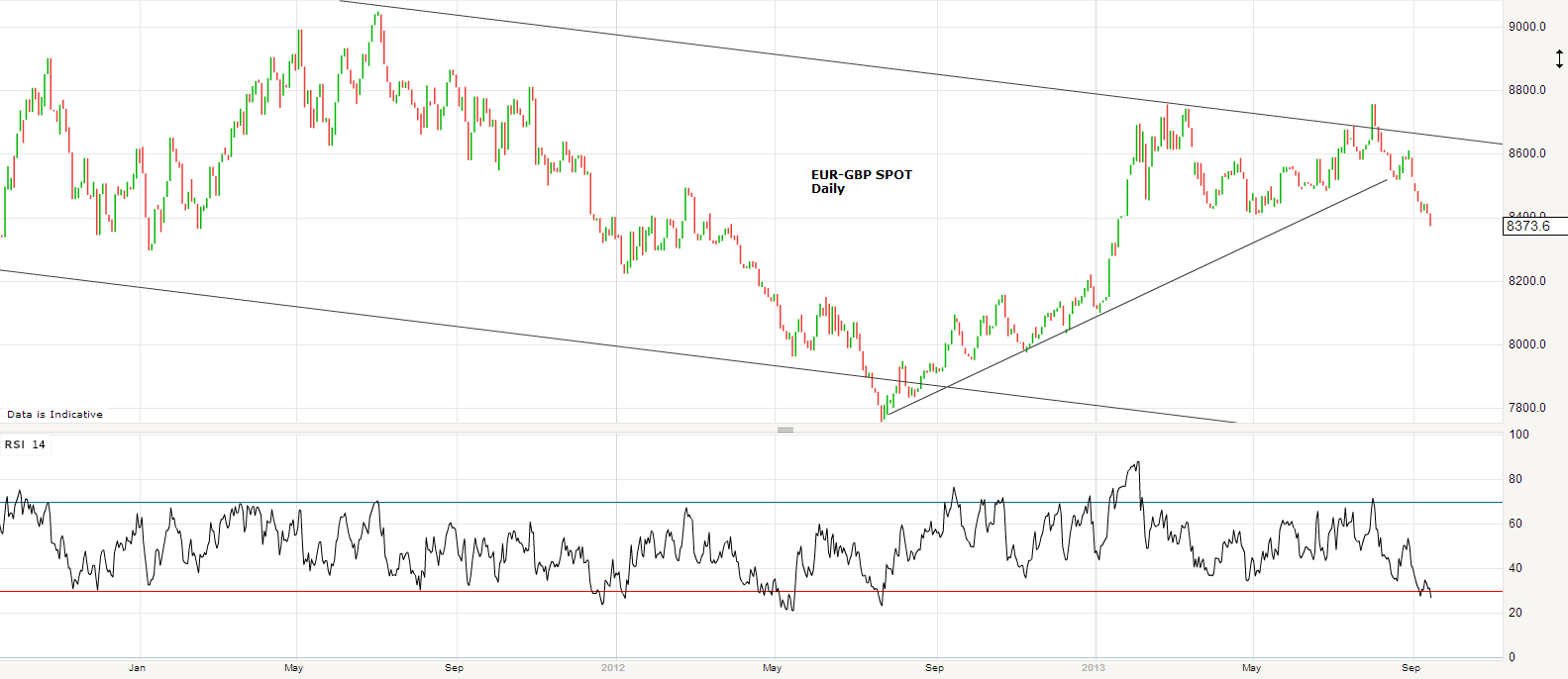
EURGBP has been in a large declining channel since the start of 2009, with the last 3 year snippet shown below. In July of this year the Euro tried to break out, as the Eurozone recovery became more apparent, but it turned out to be a fake-out, and recently UK economic data has surprised to the upside, which has helped not only turn it back down into the channel but also break down beneath the rising Euro support shown. The Pound is fairly overbought now versus the Euro and EURGBP spent last week trying to base. However on Friday there was a further breakdown in favour of the Pound, taking the pair beneath 84. The latest UK inflation data is out this coming week which should influence the pair one way or another, however I believe that ultimately the Euro can drop further here against the Pound, given the technical developments and the change in the fundamental backdrop, and I’m going to hold out for 82- at this point and will review.

24sep8

Updates

Latest OECD leading indicator updates show a healthy picture globally. Emerging markets continue to trail advanced economies but the picture is improving for them. Macro economic data for China yesterday beat expectations and Chinese, Indian and Brazilian stock indices have all risen sharply in the last couple of weeks. Rather than advanced economies joining emerging economies in weakness, we have been seeing the opposite, with emerging markets beginning to join advanced economies in strength. This should continue forwards as evidenced in the overall G7+E7 narrow money leading indicator picture no longer showing weakening around year end:

11sep20133Source: Moneymovesmarkets

Which brings me to the big question of whether central banks can offset negative demographic trends in the advanced economies, and this is the subject of a new paper from the IMF (click HERE to read, hat tip Gary). They conclude that demographics do indeed affect unemployment and inflation and central bank policy therefore has to be more aggressive and more unorthodox to offset this. Holding rates at zero and running large QE programmes could be deemed aggressive (in the former) and unorthodox (in the latter). If these actions and collective central bank actions across the globe have offset demographics ‘enough’ then we ought to see enduring strength in coincident and leading data. Regarding coincident data, US economic surprises have broken upwards and are strong positive (whilst emerging markets have been steadily rising and are now just beneath zero). This picture could provide the grounds for a reduction in QE at next week’s FOMC output.

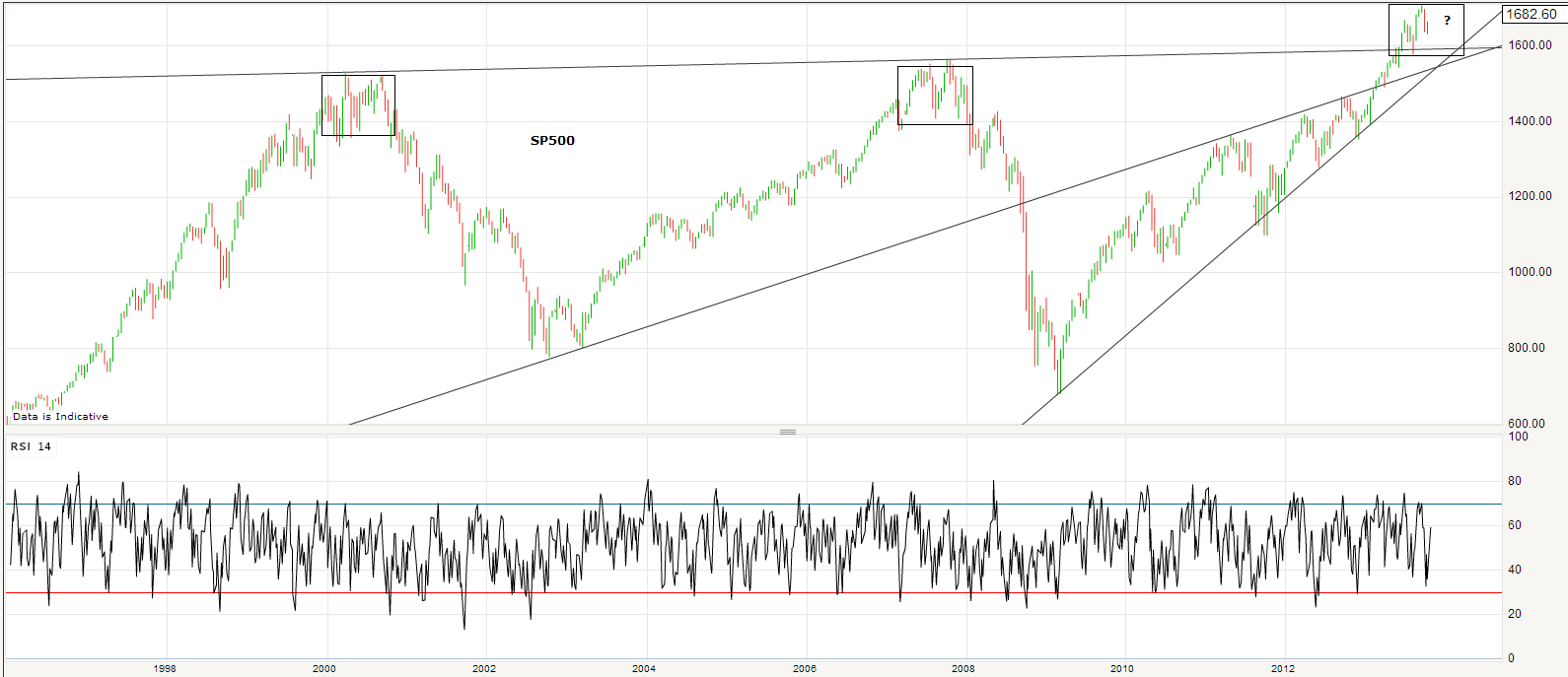
If the Fed tapers, then we could see precious metals further punctured, the US dollar rise, and treasury yields jump further. The twin threats to the economy are rising yields and rising commodity prices, particularly oil. Yesterday the softer line on Syria produced a pullback in oil and precious metals, however the recent evidence has been for a shift in outperformance towards commodities and emerging markets, which would be in line with a cyclical topping process in equities. If I am correct about the cyclical top in progress, then we should see commodities quickly come back, regardless of Syria, and energy stocks and materials stocks lead the way in this new leg up in stocks. Below I show the SP500 and the last two cyclical bull topping processes. The new upleg we are seeing now in stocks should be contained within the boxed range, if this is a top.

11sep20132

Meanwhile on gold, the GLD ETF shows a fairly tidy picture. Either gold has been turned away at resistance in a continued declining trend, or it is shaping up for an inverse head and shoulder pattern with an obvious horiztontal support. Resolution one way or the other should occur soon.

11sep20131 Source: Stockcharts

The Nasdaq has broken out and the Dax is flirting with new highs. Marginal new highs would befit a topping process, breakaway would not. I still give higher probability to an overall multi-month topping process due to evidence recently presented (such as breadth divergence, transfer to late cyclicals, technical shaping), however if leading indicators stay strong and early cyclicals regain momentum or other such developments, then I would be open to cyclical bull continuation. However, I maintain that rising yields and/or escalating commodity prices are more-potent-than-usual threats to the global economy due to the particular demographic-related fragility. Strong leading and coincident data as we are seeing can push up yields and commodities, and this is what I expect to continue. Neither have risen enough so far to put the economy at tipping point.

Trading-wise I am sat on my hands at the moment. I await to see whether oil and gold can resume advances following yesterday’s puncturing. I believe equities can rise further towards the top of the range so do not yet want to take long profits or add to short positions. I await the FOMC output next week and more importantly the market’s reaction. I am also watching the US dollar for resolution.