US Stock Indices

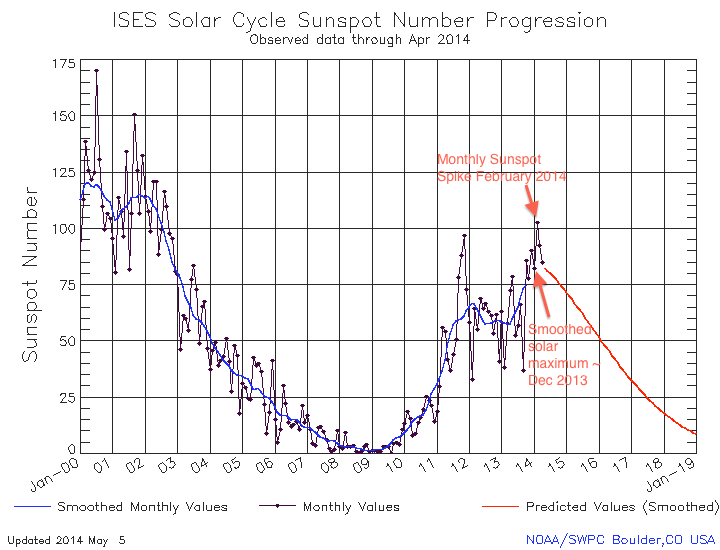
I recently gathered 40 indicators showing why the stock market is a major shorting opportunity, and now we have increased evidence as to why the speculation peak may be behind us, with the solar peak likely Dec 2013 – Feb 2014, and margin debt thus far having topped out in February.

7m1

Source: NOAA

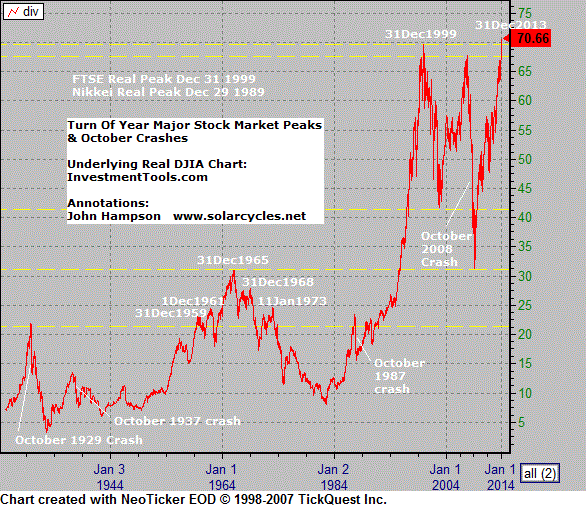
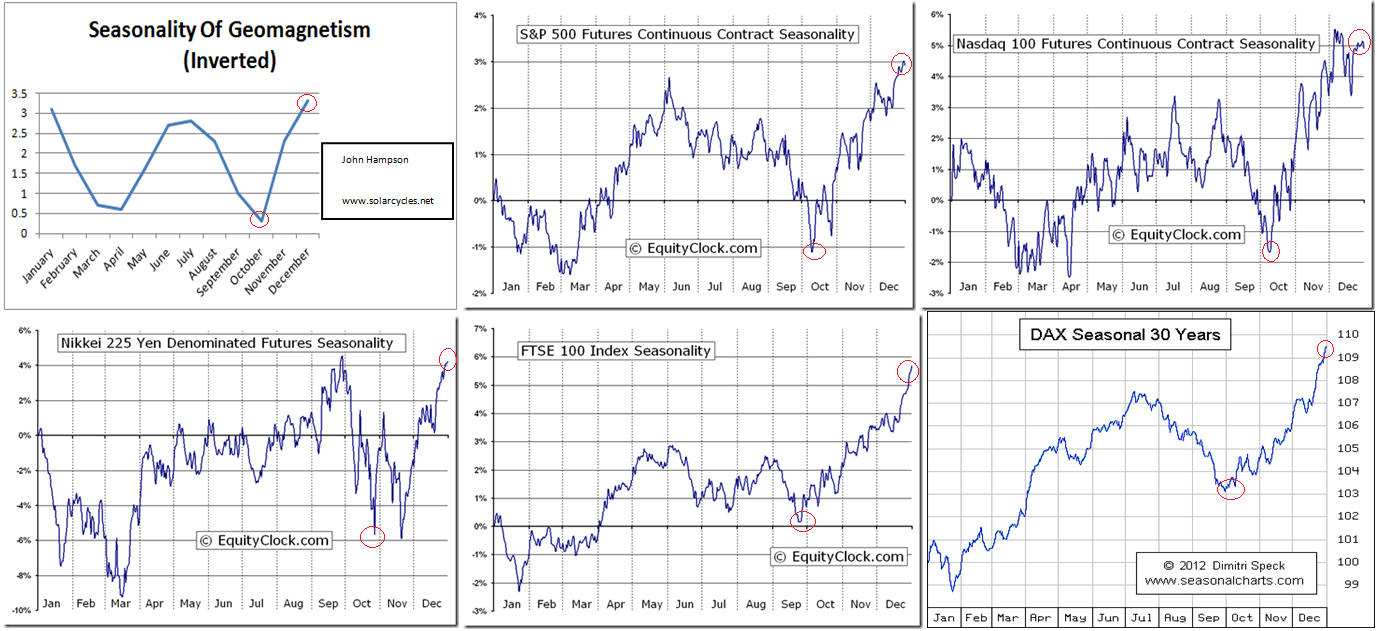
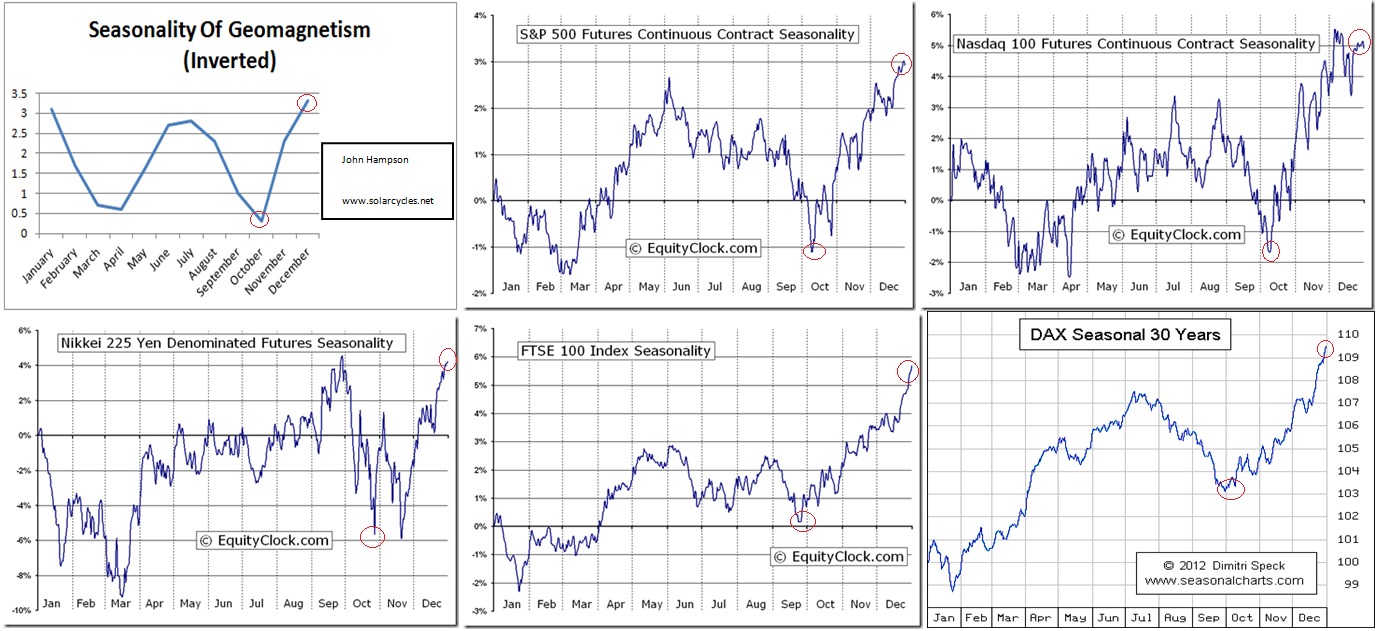
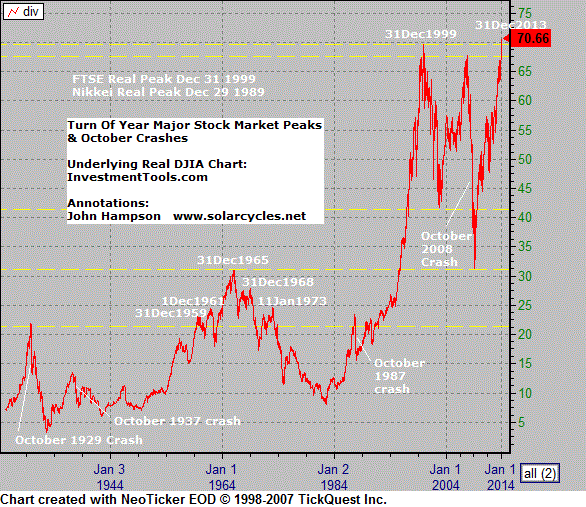
The Bitcoin speculative peak was December. The real Dow and real Nikkei peaks were thus far 31 December 2013, joining the club of historic peaks falling at the inverted seasonal geomagnetic peak (second and third charts):

7m3

 Source: Dshort

7m2

7m7

Also, the 31 Dec peak was 1 day from the new moon, which fits the pattern of historic peaks typically occurring at the peak optimism of the new moon. The Russell 2000, Nasdaq and Biotech peaks also look to have fallen at the new moon of March 1st:

5m4

Source: Stockcharts7m6

The SP500 has flat-topped between December and May. Chances are slim that this is consolidation before further upside due to the congregation of indicators at historic extremes and the likely waning from here of the solar maximum. Recall: super peaks need a solar maximum, a leverage peak (same buyers more debt) and a demographic tailwind (new buyers). The latter is absent and the leverage is at all-time extreme already.

The solar maximum generates maximum human excitement, so as well as speculation peaking in the markets, we typically see growthflation in the economy into the solar peak. I therefore expect markets and economy to decline as one from here.

A historic opportunity:

7m87m97m10

Demographics And Secular Bull Markets

First a quick note on yesterday’s stock market action. An indecisive day overall again, and on the lowest volume yet. The biotech breakdown remains tentative, but volume has been significantly higher on the down days versus the up days such as yesterday. Volume is also rapidly accelerating into BIS Ultrashort Biotech. For the wider US markets: put-call remains 5 months under 1, Skew remains 5 months historically elevated, Investors Intelligence % bears remains 5 months in the historic low band, and breadth divergences (% stocks above MA) have been running for 5 months too. With every day that passes, the likelihood of the elastic band snapping grows.

Now to the title of this post. Secular bull markets and superpeaks have always been driven by demographics. Simply, secular = demographic. If there is a swell in the middle-aged group that is the main buyer of equities, particularly if set against declines in the young dependents and in the old age disinvestors groups, then we have the recipe for an increasing flow of money into equities until the demographic trends reverse. Note that this applies to stable, developed, free market countries – a poor country run by a dictator but with a demographic tailwind will not experience the same results.

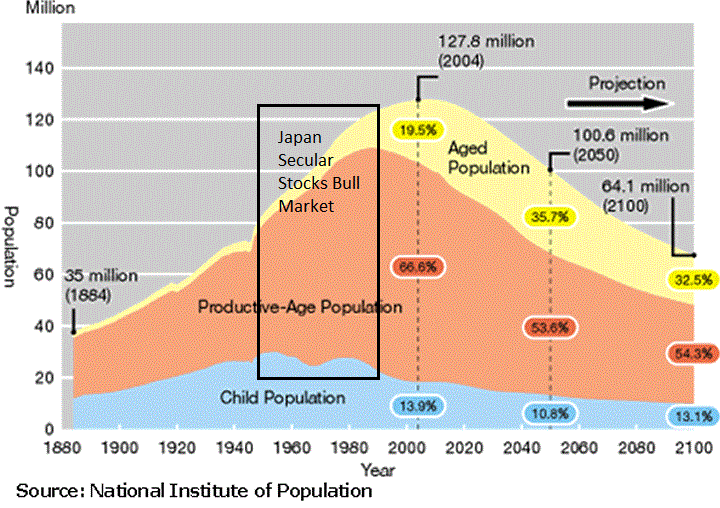
Japan’s secular bull market into 1989/1990 is explained by these two charts. A birth swell around 1950 makes for a swell in equities buyers into 1990, and from around 1950 through to 1990 there was a potent combination of a swelling middle-age group and a declining child dependent group. Thereafter the middle-age demographic trend reversed and the old-age group began to accelerate, making for a secular bear.

11ma1 11ma2

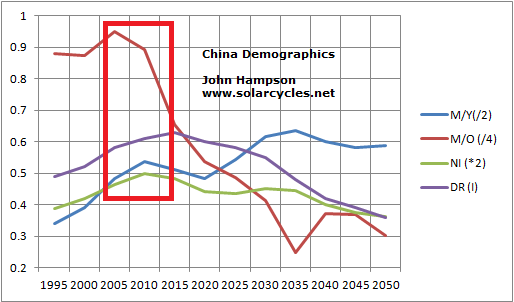
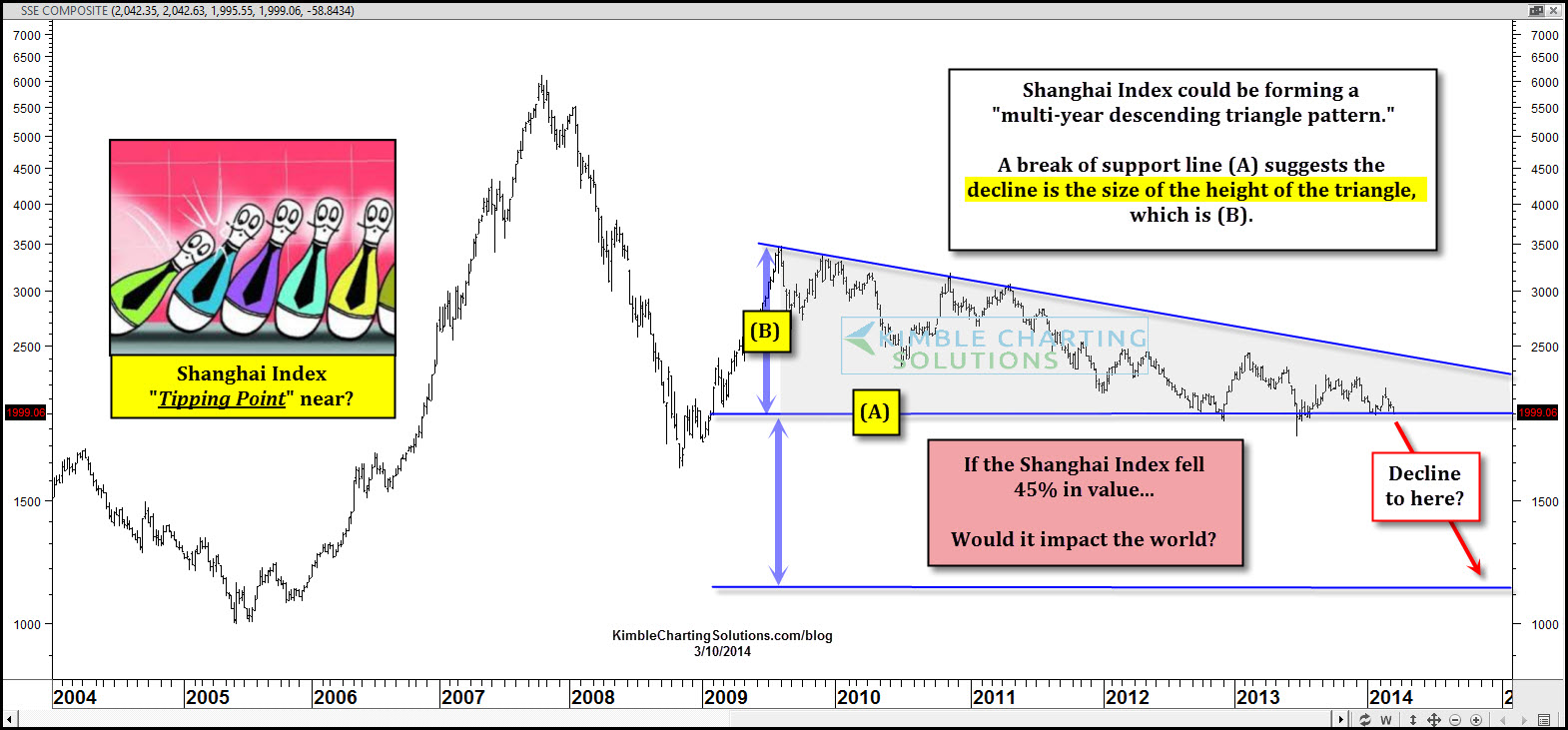
China’s Shanghai Composite superpeak appeared as its 4 demographic measures topped out, and now that stock market is currently threatening to break down even further, as all demographic measures are trending downward:

11ma7

11ma9

Source: Chris Kimble

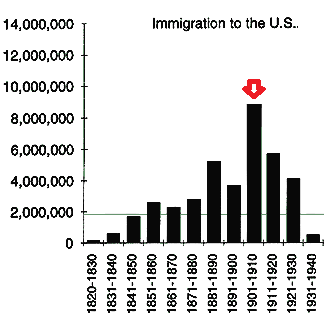
The Dow secular bull and superpeak into 1929 was a result of record immigration of younger adults into the US at the start of the 1900s followed by restriction as of the 1920s, and that swell became the key middle-age group in the 1920s. Plus a decline in births in the 1920s reduced the child dependent ratio as the decade progressed.

11ma5

Source: Susps.org11ma6

The US stock market secular bull of 1980-2000 was the result of demographic measures trending upwards for that window of time, supplemented by similar rising demographic trends in Europe and China (and Japan in the 1980s), which added to the world boom. Thereafter US demographic measures turned down and the current downward pressure is supplemented by similar downtrends in China and Europe, the recipe for a global bust.

11ma3

11ma4The secular bear market in stocks is still very much in play, and there should be a real lower low in global equities ahead. Gold behaves as the anti-demographic, making a secular peak into 1980 and beginning a secular bull in 2000 that by demographic trends should run on to the next solar maximum of the mid 2020s (solar maxima generate speculative peaks and there is a correlation between sunspot cycles and demographics).

Valuing country stock markets by PE or CAPE has to be considered relative to demographics. An expensive valuation is likely to become more expensive if demographic trends are upward, due to the increasing flows of new buyers. Hence, as the below chart shows, we saw the highest set of global CAPEs into 2000 due to the combined demographic uptrends of USA, Europe and China. Their combined current downtrends have produced a historically low set of overall CAPES.

11ma8Source: Megane Faber

The US stock market is currently the second most expensive in the world by CAPE, and above all other bands in the chart above. Relative to demographics, this is very much overvalued. As per the two charts just above this one, there is a compelling case for US and global equities to enter a new cyclical bear and continue the secular gradual washout following the 2000 superpeak, whilst gold should resume its secular bull as the anti-demographic.

Dow 1929 vs Nikkei 1989 vs Nasdaq 2000 vs Today

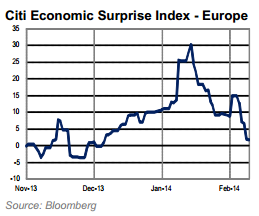
Yesterday saw a failed breakout on the SP500 on high volume which suggests exhaustion. The Skew print came in still historically high and the put/call print historically low again, which continue to signal bullish complacency and high risk of an outsized move to the downside. Economic data disappointed again, and the latest economic surprise readings are below:

25fe10 25fe11 25fe12

Source: Citi

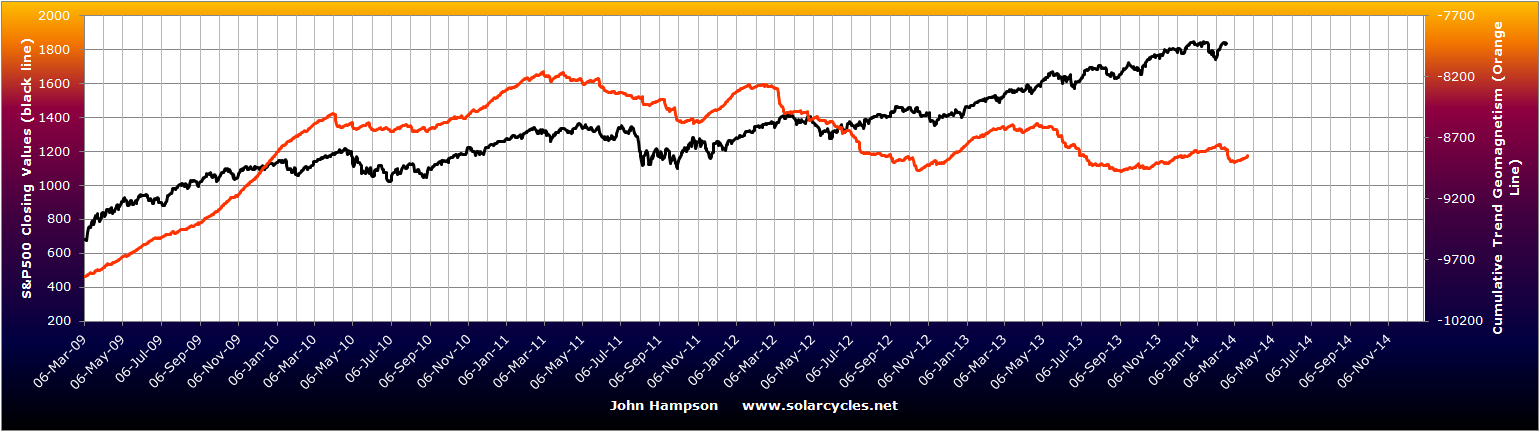
The geomagnetic storms over the last week broke the model’s multi-month uptrend (red line) and along with the NOAA forecast reveal downward pressure this week:

25fe13If you are new to the site my models are updated weekly.

The significant outstanding bubble in the markets remains the Nasdaq Biotech sector, but the unsustainable parabolic is ripe to pop:

25fe14

Source: Yahoo

Less than one third of this sector’s 122 companies earned any money in the last 12 months.

The last 2 years gains in the wider US markets were approximately 80% multiple expansion and 20% earnings growth. The justification for the multiple expansion was (1) ‘Fed policy trumps all’ and (2) stocks frontrunning a ‘normalisation’ in economic growth and earnings. Now: QE is being wound down, Q4 2013 GDP and Q1 2014 GDP estimates are being revised downwards, earnings estimates are being revised downwards and for Q1 2014 82% of companies so far have issued negative earnings guidance. Those justifications have largely evaporated.

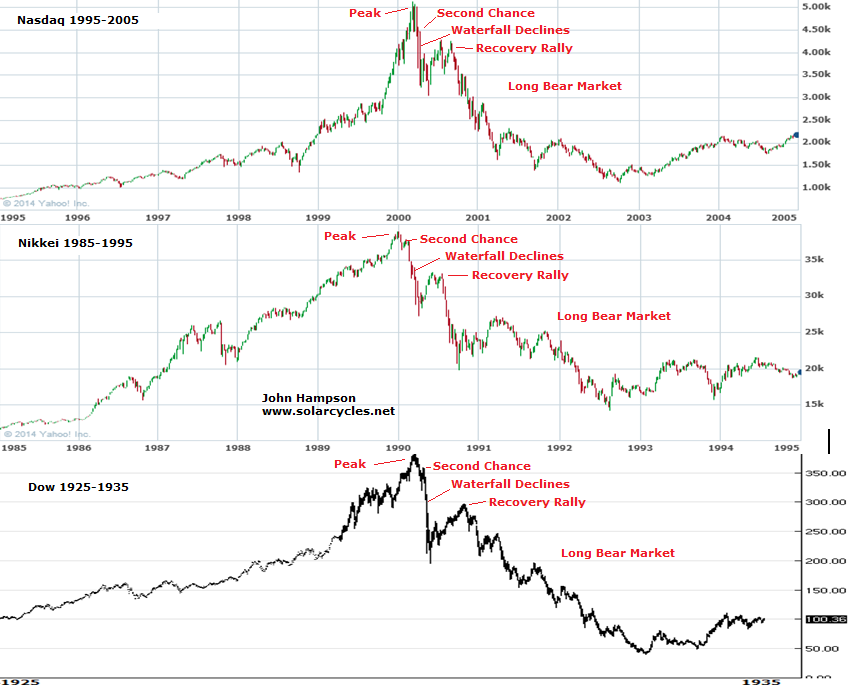
The lesser known reason for the big run up in price into the end of 2013 is the speculation peak driven by the solar maximum, and this was shared in the superpeaks of Dow 1929, Nikkei 1989 and Nasdaq 2000. A reminder that there are 3 ingredients for a superpeak: (1) speculative mania by solar maximum (2) increasing number of buyers through demographic swell and (3) increasing use of leverage amongst buyers. Both (1) and (3) apply to the current US markets but (2) is absent. There is a shrinking rather than swelling demographic pool, and for that reason we do not have a supersized peak. Otherwise, the analogies are very much applicable.

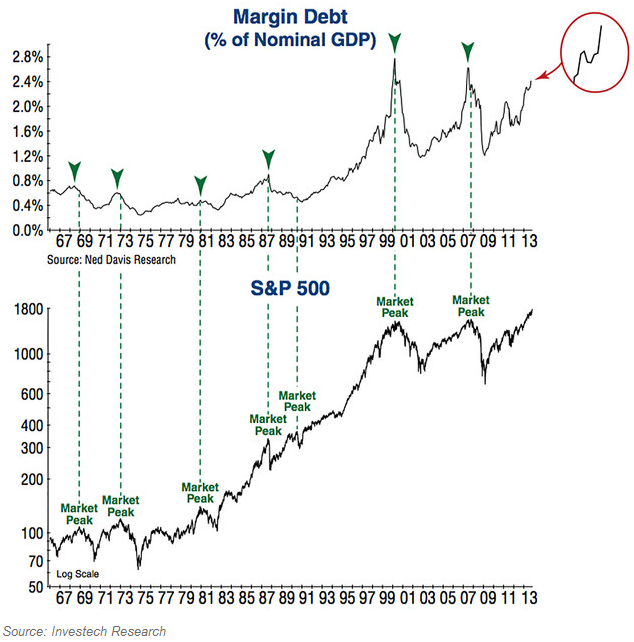
In 2013 US markets ran up in a parabolic shaping, generating historic levitation above moving averages and producing an anomalous lack of a ‘proper’ correction. Sentiment reached levels not seen since previous major peaks, and euphoria only historically exceeded in the dot.com boom. We have reached valuation levels in the Q ratio equivalent to the TOP in 1929 and in stock market capitalisation to GDP equivalent to the TOP in 2000. Leverage levels equal the TOP in 2000 as measured by margin debt to GDP and beat the 2000 top in other measures. The blow-off topping process in the current Dow so far mirrors that shared by the 3 analogs, and the peak-to-date occurred at the solar maximum.

In short, the ‘size’ of the peak in current US markets does not compare to the analogs because of the key demographic difference, but in many other ways these analogs are particularly apt. What comes next in the analogs is waterfall declines, and we have a case for the same in the current US markets due to (1) historic levitation away from moving averages or parabolic rise on long term view (2) historic time since significant correction and historic compound gains and bull duration (3) 80% multiple expansion 3-pronged justification case shattered (4) ‘all-in’ measures of sentiment, leverage and fund flows ripe for unwinding. We are likely through the solar maximum peak and the speculative excess into the peak is now vulnerable to pop.

Here are the analogs on a 10 year view centered around the peak:

25fe7Alongside I’d like to remind you of the relevance of the (inverted) seasonality of geomagnetism for the timing of peaks and falls:

13fe4

Nikkei 1989: Waterfall declines from second chance lasted about 6 weeks, centered on March (geomagnetism (inverted) seasonal low), and took off 27% from peak; Recovery rally then lasted 3.5 months from April to July, back up 20% (through seasonal high); Then 2.5 months more waterfall declines, mid July to beginning of October down 40% (through seasonal low).

Dow 1929: Waterfall declines from second chance lasted 1 month, centered on October (seasonal low), and took 48% off from peak; Recovery rally then added back on 50%, lasted 5 months from November to april (through seasonal high); Then long period of declines lasting a couple of years.

Nasdaq 2000: Waterfall declines from second chance lasted about 6 weeks, March-April, and took 36% off (seasonal low); Recovery rally lasted about 3.5 months from May through to beginning of Sept, adding back on 34% (through seasonal high); Then long period of declines lasting a couple of years.

So, averaging them out and applying to the current US markets, we could expect waterfall declines of around 35% lasting around 5 weeks, and this should occur in the seasonal low of March-April. That would then be the time to take off short positions for a recovery rally of around 35% lasting around 4 months from April to August or so, through the seasonal high. A second set of steep declines should then unfold through the seasonal low of September-October.

25fe8By that model the initial waterfall declines should wipe out all of 2013’s gains in the space of a month. I refer you to the case for waterfall declines further up the page as to why this is reasonable, and I suggest the consensus view once this occurs will belatedly point to similar factors. However, once the recovery rally then erupts, as can be seen from the 3 analogs on the 10 year view, it will keep the ongoing bull market option in play. I suggest 1987 will likely be quoted as benchmark: a harsh correction that was a golden buying opportunity. But, once the recovery rally tops out short and rolls over into more steep declines, there will be broad acceptance of the new bear.

What will happen to commodities under waterfall declines? Understand that such unforgiving drops will bring about forced liquidations as leverage is unwound so there will be some blanket selling. In all 3 analog waterfall decline periods, commodities (including precious metals) fell too, whilst the US dollar largely rallied. The same occurred in October 2008’s sharp falls. That suggests it may be prudent to pull back on or even exit commodities long positions once we get a whiff of steep declines erupting.

Previous major commodities peaks have been speculative to a large degree, but also typically founded on a fundamental supply/demand case. For energy and industrial metals the latter is currently weak, and we see oil and copper in long term ranges rather than in major breakouts. Various soft commodities have enjoyed steep moves up as shorts have scrambled to cover, but whether there can be an enduring supporting story this year remains to be seen. I am skeptical as to whether commodities as a class can make a major rally to beyond 2011’s CCI peak this year, anticipating they may sell off under the waterfall declines and perhaps struggle for a case under deflationary recession fears. However, maybe they can outperform during the ‘recovery rally’ over mid-year and particularly if the US dollar is less seen as a safe haven this time, so I remain open to the possibility that maybe they can beat 2011’s peak, but currently see this as less likely. The case for previous metals differs from other commodities, and as I have outlined before I see gold’s 2011-2013 bear as a pause in a longer term secular bull market likely to terminate at the next solar maximum. My tactics will be to reduce all commodities long positions bar precious metals once it looks likely that equities are on the cusp of waterfalling, anticipating some blanket selling across all assets in that period, and then review again as we approach the end of that event.

Looking back to the Great Depression, banking panics began in 1930 and swapping dollars for gold in 1931. In other words, it took time for things to unfold, and I would expect similar this time around. Whilst I cannot be sure, I do not expect a sudden chain of bankruptcies under the first waterfall declines, but for the real ‘trouble’ to unfold gradually and likely after the recovery rally peaks out. First things first then: I expect a major short equities opportunity to unfold swiftly from here through March and into mid-April, and am positioned for that. I will be looking to exit all equities shorts as I try to time the end of that event.

Economic Growth, Demographics And Solar Variation

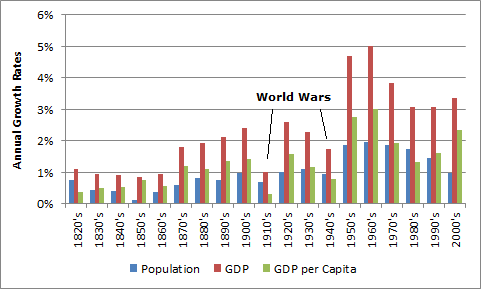
Economic growth occurs two ways: increasing population and increasing productivity per capita (which can be achieved through technological evolution and improvements in organistation/management/systems). Both increase overall GDP.

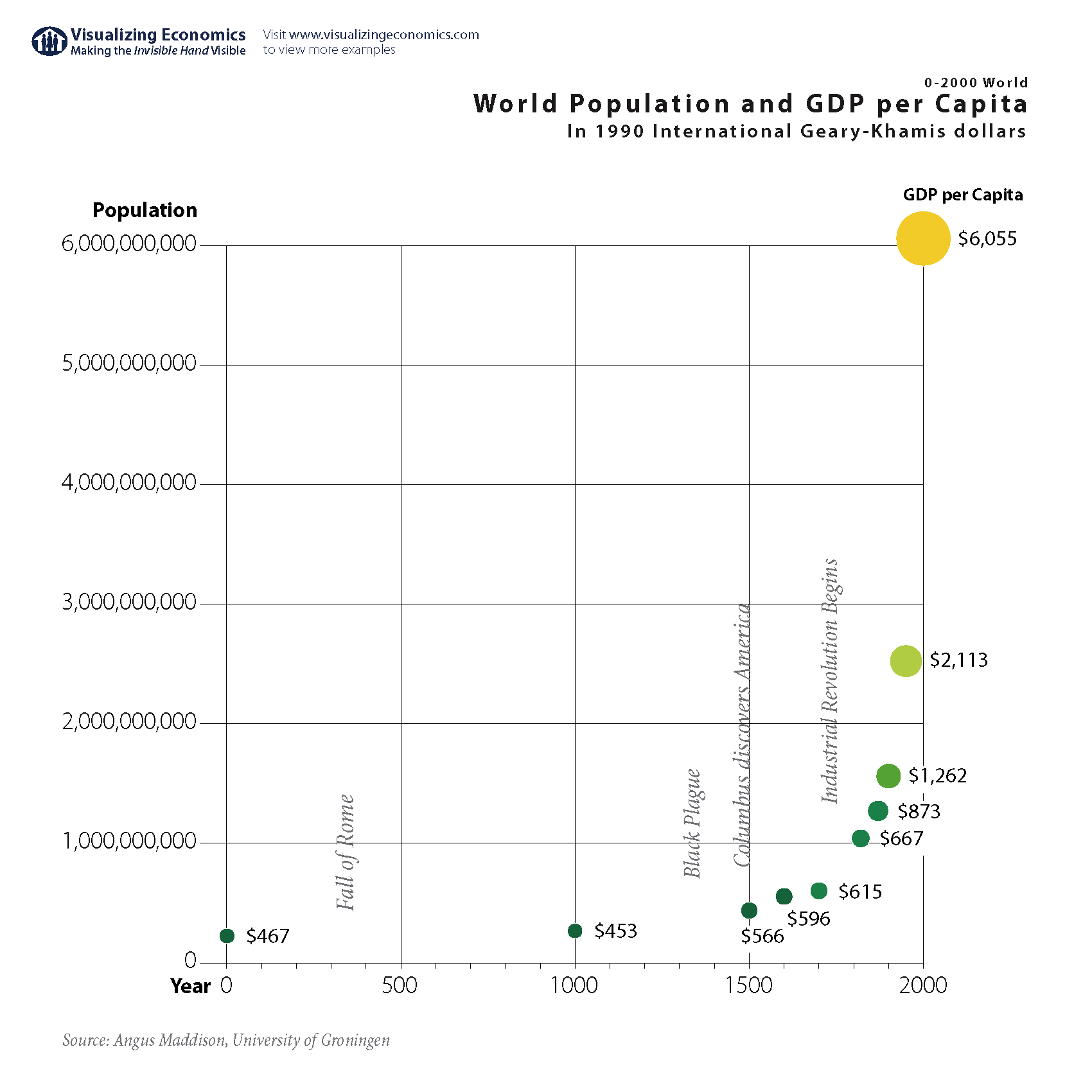
World population has grown exponentially over the last 2000 years:

24ja1

Source: Sub-dude

As has GDP per capita:

24ja2

Source: filipspagnoli

A principle of the globally adopted capitalist economic model is that compound growth enables long term poverty reduction: that people can pursue their own self-interests and help themselves to disproportionate shares of the pie as long as the whole pie grows so that more people find themselves better off than less. Hence countries typically target 2%-10% annual growth, which when compounded means exponential growth. To achieve exponential economic growth we need either exponential population growth or exponential per capita growth (ideally both). The latter reflects human progress and technological evolution whereas the former is more of a ponzi scheme, requiring ever increasing numbers of people to maintain an ‘illusion’ of increasing prosperity.

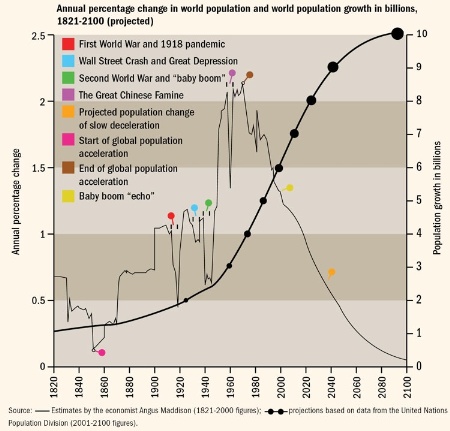
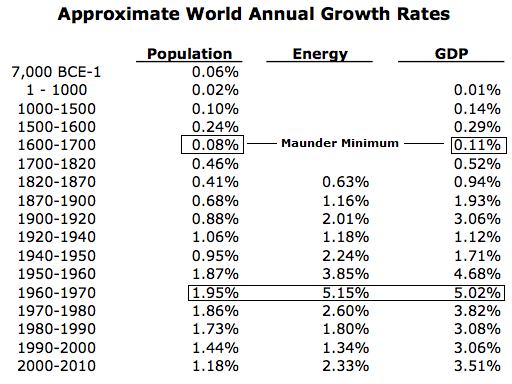
Something changed around the 1970s. The growth rate in world population went into decline:

24ja3

Source: TimesHigherEducation

World GDP growth and GDP per capita growth also trended to a peak.

24ja4

Source: DoctorCopper

The pick up in GDP and per capita GDP in the 2000s is now rolling over again, suggesting the secular trend remains down:

24ja5Source: TheNextRecession

24ja7Source: TheNextRecession

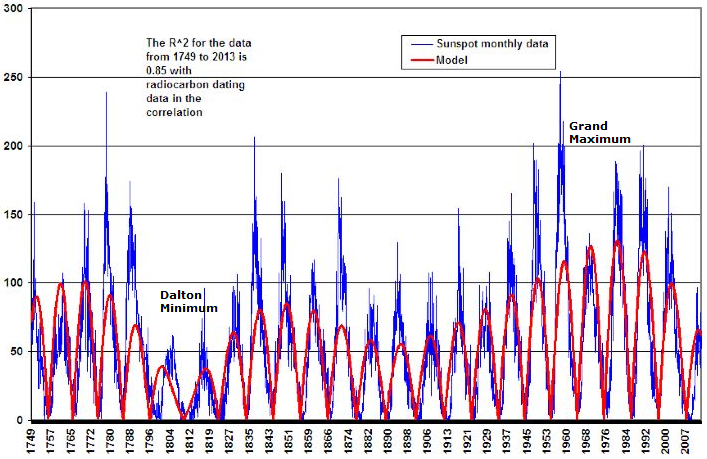
The peak in population, GDP and GDP per capita growth rates fits with the peak in solar variation: the grand solar maximum:

24ja6Source: WattsUpWithThat

The trend in long term solar variation suggests we are now headed for another minimum, like the Dalton or Maunder. These historic minima corresponded to lower GDP growth and lower population growth, cementing the relationships between the three.

Inflation also peaked around the 1970s:

24ja8Source: Yardeni

As did growth in energy supply.

24ja9Source: Financial Press

Declining rates of growth in population, GDP, GDP per capita, inflation and energy supply spell major trouble for a global system reliant on exponential economic growth as well as inflation and employment targetting. However, the true impact of this has been postponed in two ways.

Firstly, the ‘gap’ has been filled by increasing debt:

24ja15

Source: isj.org.uk

However, we have reached the point of debt monetisation in US, UK and Japan, i.e. the end game. The question is how long the end game can last.

Secondly, sub-demographic trends of the major economic nations have largely been supportive since the 1970s, peaking out in phases.

Here is US population growth per decade. Forward it by 40 years so that the births become the important ‘middle’ age bracket and we get the secular trends in real US stock prices: down into 1980, up into 2000, then down projected out to 2030.

24ja10

Source: Business Insider

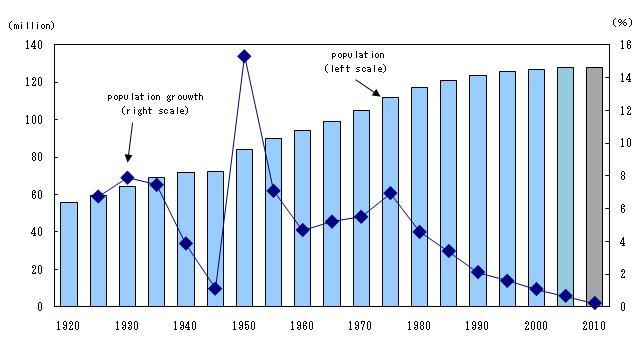
Here is Japan’s 5-yearly population growth rate. Again, forward it 40 years and we have a big spike in the middle bracket to deliver a major peak in equities and real estate around 1990, a small relief uptrend in the current window 2010-2015 (as we have been seeing) and otherwise a fairly grim outlook.

24ja11

Source: Stat.go.jp

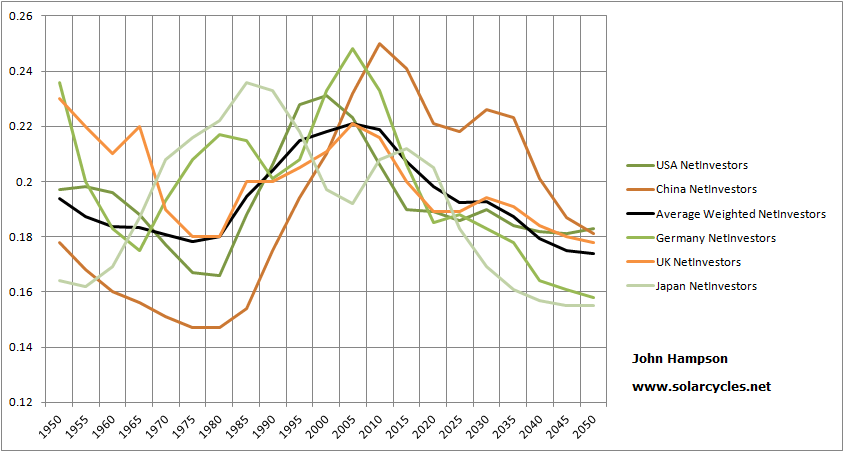
Collective dependency ratios, middle-to-old ratios and net investor ratios in the major nations were largely positive until recently, with China the last to break down: 

24ja12 24ja13 24ja14

In summary, we have postponed the impacts of the major growth rate peaks (GDP/GDP per capita/population) of the 1970s through debt until we have reached the point of monetisation, and the support from demographic sub-trends of the major nations has now expired. Solar maxima have historically given way to recession, and solar variation predicts a new grand minimum ahead which has historically correlated with low GDP and population growth. I am therefore led to the fairly bleak conclusion that this solar maximum speculative peak will turn out to be a major historic peak for the world.

Timing Major Market Peaks

Starting on the smallest timescale, and working up to the largest.

1. Timing within the month

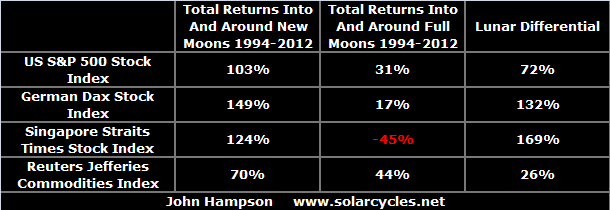
Lunar phasing influences human sentiment. It produces fortnightly oscillation in the stock market: positivity/optimism around the new moon and negativity/pessimism around the full moon. The cumulative influence of this can be seen in stock market returns over the last 20 years:
LE1

In keeping with this, we find that major market peaks typically occur close to new moons, around maximum optimism/positivity:
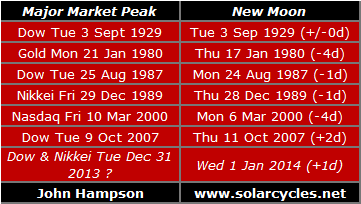
NewMoonMajorPeaksThis adds to the case for a peak having occurred in equities on 31 Dec 2013 (Dow and Nikkei, plus SP500 double top with 15 Jan), associated with the Jan 1st new moon. If that proves to be false and equities break higher, then a future new moon (next one Jan 30th) may produce the timing of the major peak.

2. Timing within the year

Geomagnetism influences human sentiment, with higher geomagnetic disturbance associated with negativity/pessimism. The inverted seasonality of geomagnetism correlates closely with stock market seasonality, and typically we find that major market peaks occur close to the peak in both, around the turn of the year:
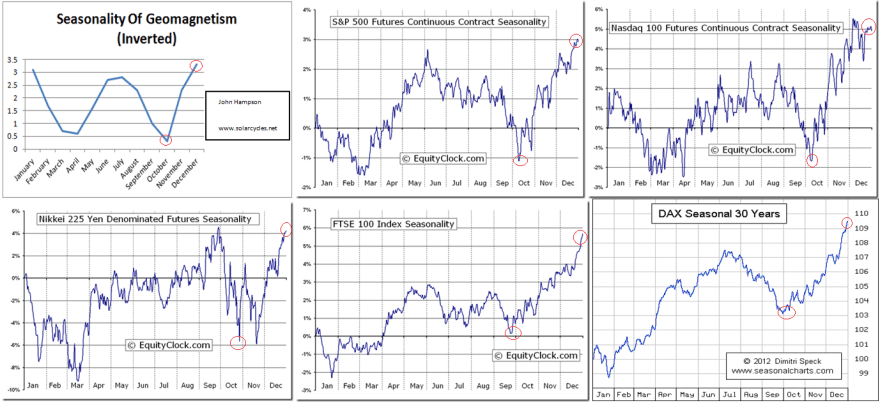
13jan50

13jan11Gold made its secular peak on 21 Jan 1980.

Again, this adds weight to equities having peaked 31 Dec 2013, but if that proves false, then we might expect a final peak still to be at hand, in January, before the seasonal model turns down.

3. Timing within the decade

Solar maxima occur roughly every 11 years and produce human excitement, which translates as protest, war, and speculative excesses in the markets. Major market peaks typically occur at the solar maximum, close to the smoothed peak and on a monthly spike in sunspots.
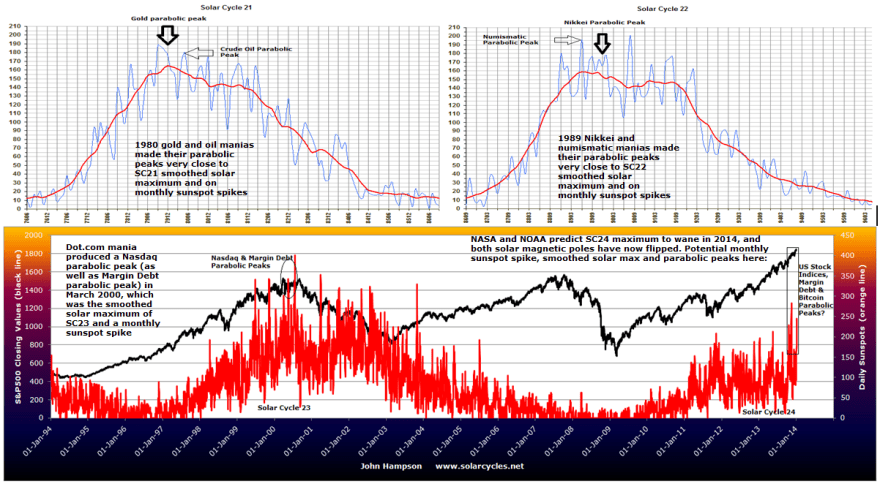
SolarMaximaParabolicPeaksWe can measure speculative excesses in terms of market valuations, sentiment readings, leverage and technical indicators and we see a cluster of these in US equities currently. Solar forecasts, solar pole flips and sunspot counts collectively suggest the smoothed maximum and monthly sunspot spike may be occurring Dec 2013 into Jan 2014, which in association with those speculative excess readings, again adds to weight to a possible peak in the Dow, SP500 and Nikkei.

4. Timing within the century

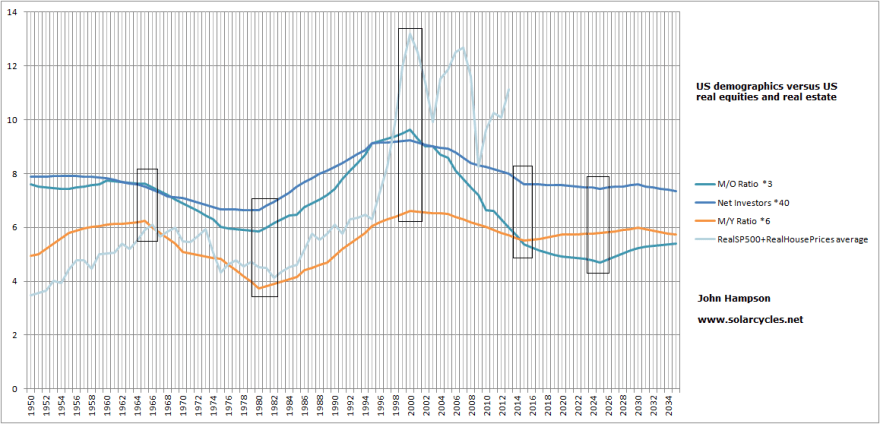
Demographics drive secular bull and bear markets, as swells in investor or disinvestor age groups produce periods of upward or downward demand for equities. Japan’s secular stocks bull ran through 4 solar cycles due to a long positive demographic trend from the late 1940s to around 1990. Japan’s middle-to-old, middle-to-young and net investor ratios all peaked in the late 1980s, and accordingly we saw Japanese equities terminate with a speculative excess at the 1989 solar maximum, and thereafter move into a secular bear in line with demographic downtrends.

US demographic measures for equities demand peaked around 1965. The real SP500 peaked November 1968, terminating with the solar maximum of November 1968. Thereafter US equities entered a secular bear market, whilst gold, as the anti-equities or anti-demographic asset, entered a secular bull market. Demographics and equities bottomed around 1980, whilst gold made its secular speculative peak, all timed with the Dec 1979 solar maximum.
X1

US demographic ratios were collectively positive from 1980 to 2000, enabling a secular bull market in equities lasting 2 solar cycles through the speculative finale of March 2000, which was again a solar maximum. Gold endured a secular bear market through those two decades, bottoming out as demographics turned down around 2000, and entering a secular bull market.

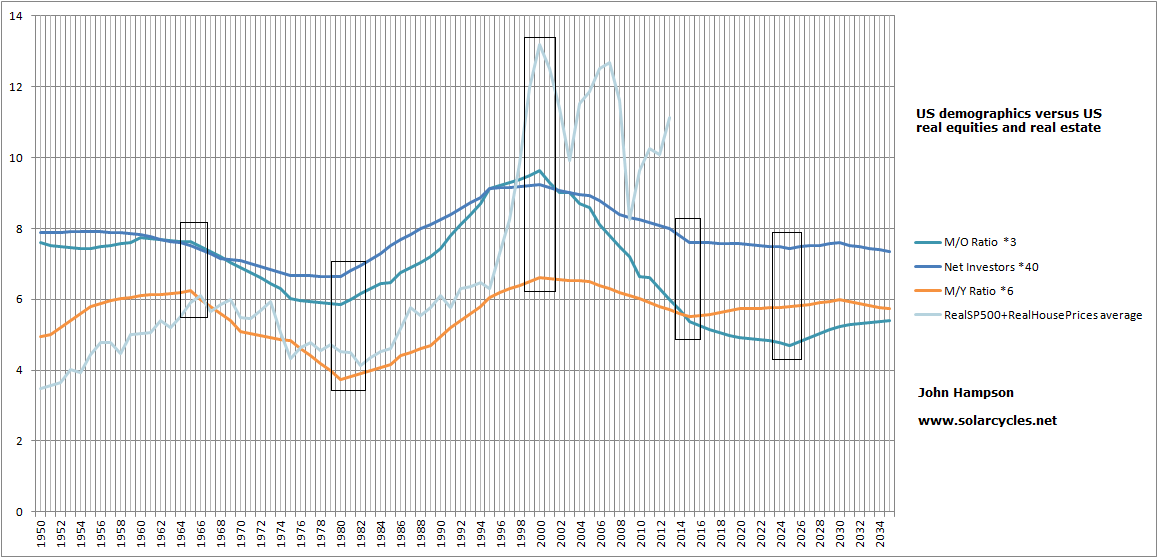
Looking forward we see a slight divergence in the 3 charted demographic measures: the middle-to-young ratio bottoms out around 2015 but the middle-to-old and net investor ratios not until around 2025 (shown boxed above). When we draw in collective downward demographic trends for Europe and China, the greater likelihood is of a secular bear in US equities (and a secular bull in gold) lasting through to around 2025, rather than ending now. Solar cycle 25 is predicted to peak around 2023-2025, which would provide the timing for a speculation secular peak in gold.

There is a correlation between solar cycles and birth rate, with evidence of an 11 yearly peak in births. There is also evidence of a link between economic prosperity and birth rate, whereby births decline in recessions and bear markets and increase in the good times. Combining the two, we have the framework for alternating positive and negative demographic swells which peak or trough around solar maxima, and hence we have historically reliably seen demographic trends and associated speculative asset bulls/bears peak and terminate around sunspot peaks.

Therefore, the secular bear in US equities that began in 2000 is likely to continue through to around 2025, and the secular bull in gold that began in 2000 is likely to continue to and peak around 2025. In support of this we see current historic overvaluations in US equities that argue for further reset in stocks ahead, and a lack of speculative mania for gold at the current solar maximum.
17ja1 17ja2Both charts above model the historic trends in US demographics and the terminations at solar maxima, and the projections forward are the extensions of these phenomena. The ‘mean reversion’ common to to them both reflects the transience of demographics (a young dependents swell headwind will become a middle-age swell tailwind which will become an old-age swell headwind) and the double-excess produced by solar maxima (demographics stretch demand by population, solar maxima stretch demand per capita) before sunspots cycle down again. The biggest mania of all-time is clear to see on that second chart: the dot.com boom. Not only does mean reversion subsequent to that mania have some way to go (a wash out to -50%) but demographics support this occurring.

To summarise all the above, and make it useful looking forward, we can time major asset peaks by probability (there are no dead certs, and exceptions occur). Any major asset peak will probably occur close to a new moon, typically around the turn of the year, and normally at a solar maximum. Demographics guide at which solar maximum a secular asset peak will likely occur and whether a solar maximum should deliver a secular or cyclical speculative excess.

Forecasts for gold and equities

We are currently at the likely solar maximum for solar cycle 24, at the turn of 2013 into 2014. Demographics are supportive of a secular bear in equities (that began in 2000) continuing through to the next solar maximum circa 2025, and similarly a secular bull in gold (2000-2025). The speculative excess in equities that we are seeing in association with SC24 maximum should be a cyclical peak. The timing of that cyclical peak in stocks has good odds of being around the turn of the year (2013 into 2014) and close to a new moon. That makes a top close to Jan 1st 2014 a contender, and failing that one near Jan 30th 2014 (the next new moon). Again, these are just probabilities, but if we take a different angle and look at indicators such as II sentiment, put/call ratio, skew, deviation above MA, yield-tightening ROC and margin debt, then we have a case for equities to begin to fall ‘imminently’, regardless of solar maxima and lunar phasing. Combining both, the case becomes more compelling for a top here.

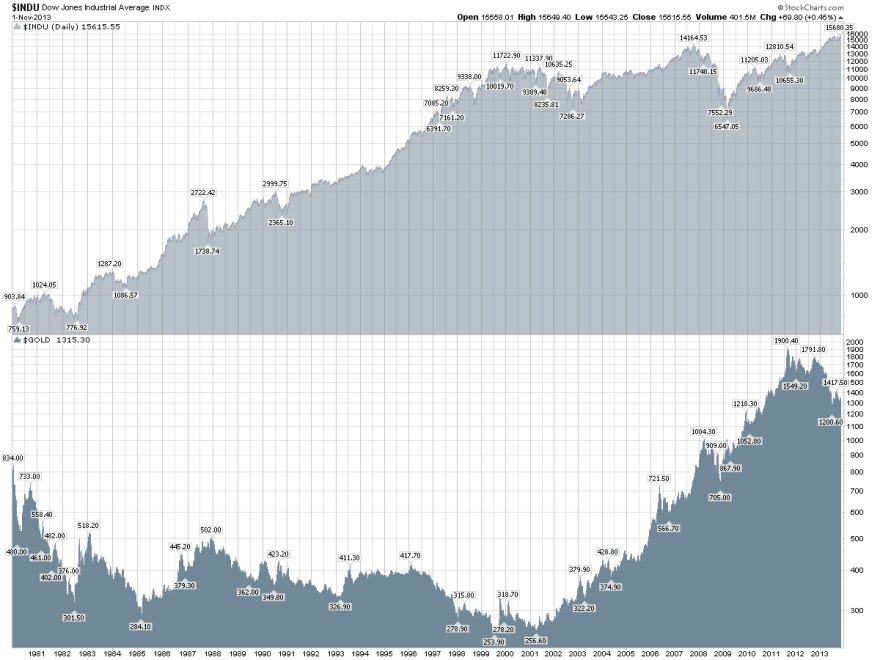
Gold’s secular bull began in 2000, and like all secular bulls, it has been in a strong dominant uptrend punctuated by occasional cyclical bears or corrections. Below we see the US equities secular bull progression 1980-2000 contrasted with gold’s secular bear in that period (cyclical bulls and bears within an overall downtrend).
17ja3Source: Stockcharts

Gold’s secular bull of 2000-2025 should be a strong dominant uptrend like stocks 1980-2000, or like an extended version of gold’s last secular bull of the 1970s.
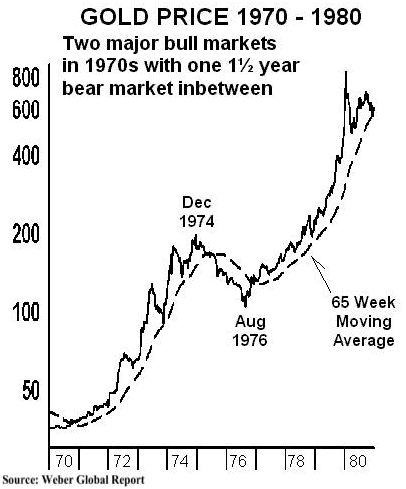
17ja4The cyclical bear of Dec 1974 to Aug 1976 occurred as the Dow rallied from a Dec 1974 low to a Sept 21 1976 top, with gold’s secular bull momentum resuming as equities topped out. We could therefore expect something similar to be occurring now, and this is supported in the oversold, overbearish extremes reached in gold and miners and the technical basing that appears to be currently taking place.

A threat to bullish resumption in gold is the current excess leverage we see in evidence in margin debt, net investor credit and Rydex leverage. If sharp falls erupt in equities then a period of forced redemptions could mean blanket selling of assets, as occurred in Autumn 1929 and Summer-Autumn 2008. Gold /miners escaped neither, in short-lived but sharp pullbacks. In THIS post I compared the topping process analogies of 1929, 1987 and Nikkei 1989 to the Dow today, and based on that we might expect sharp falls to erupt as of mid-February. There is a history of steep falls occurring at the seasonal geomagnetism peaks of around March/April and October, and occurring on Mondays once investors have had a weekend to mull over doubts. So by probability we might this time look to the particular potential of Mondays in the period March-April 2014 for heavy falls to erupt. Potentially then, we could see gold and miners rally until then, but be dragged back during such heavy stocks selling, thereafter resuming the secular gold bull in earnest.

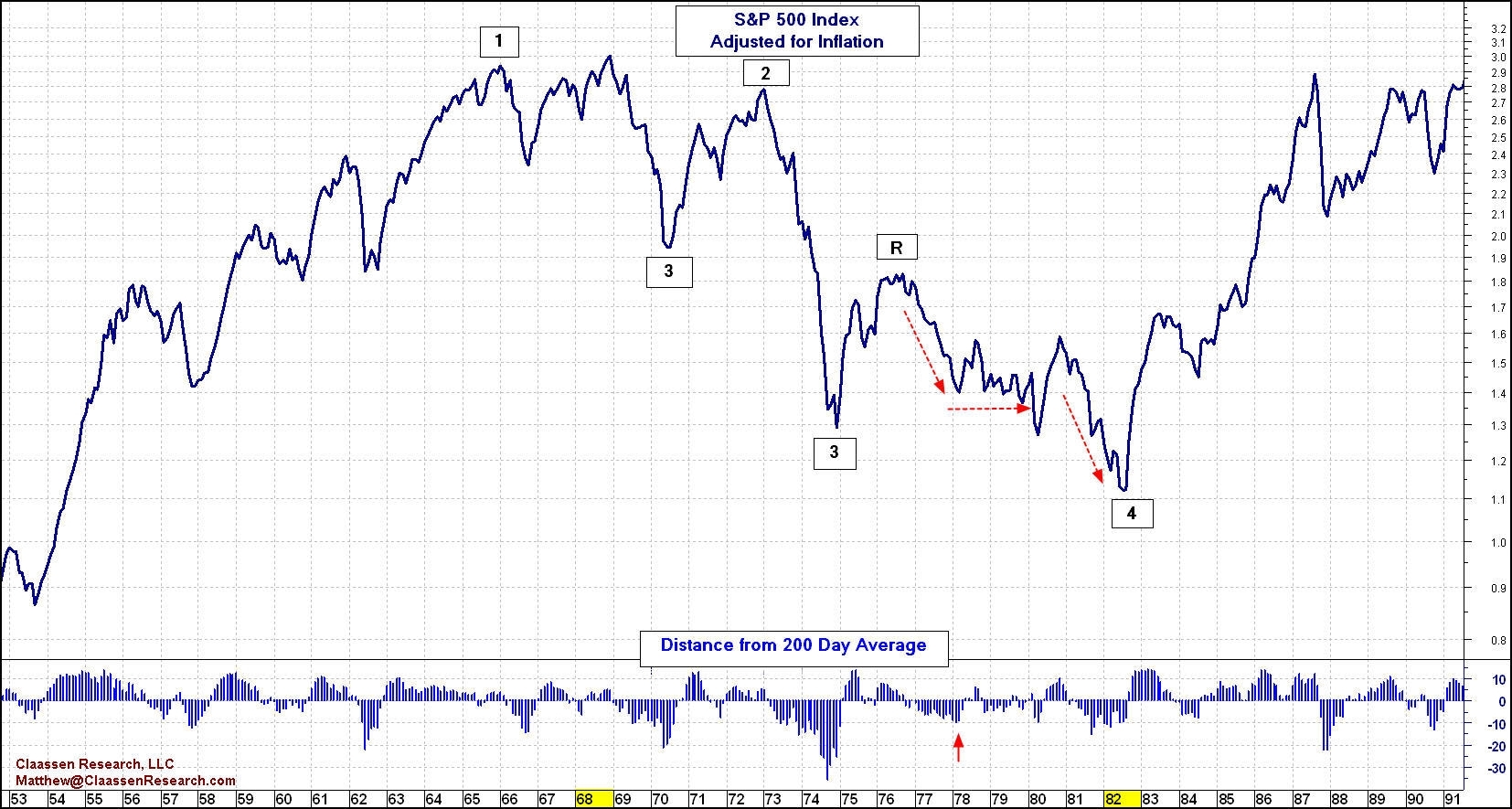
Equities should now enter a new cyclical bear market, and continue to alternate cyclical bulls and bears within a secular stocks bear through to around 2025. By demographics (and as is becoming evident in economic data) this should be under deflationary rather than inflationary conditions, and this makes an important difference to nominal prices. The path of US equities for the next 10 years should look similar to the 1990s to early 200s Nikkei or the real inflation-adjusted 1970s SP500, with lower highs and lower lows:

17ja5Source: SeekingAlpha

Using Russell Napier’s maths (taking valuations back to historic washout levels), then we have a target of around 3500 on the Dow by my target of around 2025. Again drawing on history, odds are we get there in a couple of cyclical bull-bear oscillations, and hence something like this:
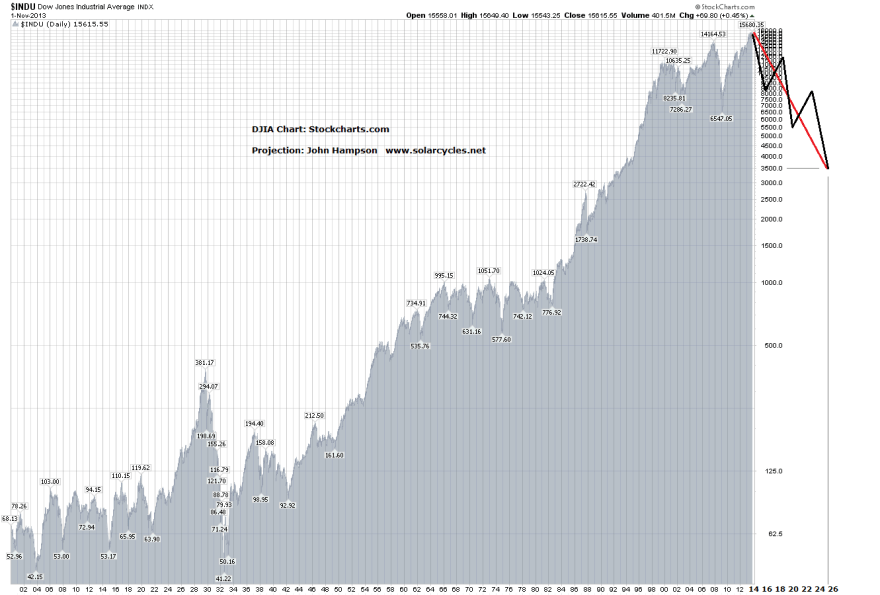
17ja6It is an initially shocking chart, but it is in keeping with deflationary demographic projections and valuations washout. Plus, this has already happened before: to the Nikkei, under the same twin circumstances.

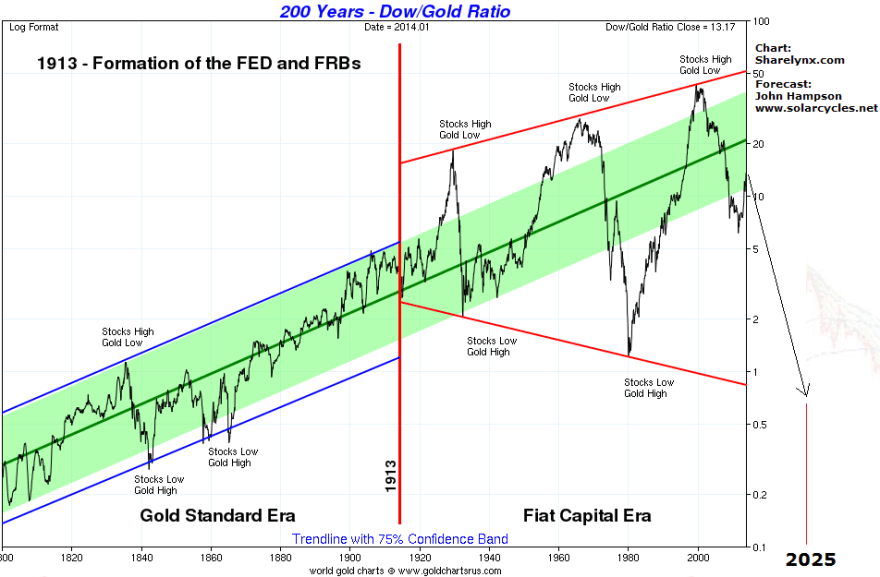
Expecting the Dow to be sub 4000 by 2025, and gold to be making a parabolic solar-max finale to a strong secular bull, the Dow-gold ratio should bottom beneath 0.5, potentially even beneath 0.1. But the one factor that I have not mentioned so far is central bank intervention.

It is certain that a tipping over into deflationary recession and equities bear will draw further response from central banks. If equities start to decline for the next couple of months but in a measured way and economic data disappoints (as predicted by certain leading indicators) then I would expect the Fed to stop tapering QE and wait-and-see, and otherwise little change. If equities then start to accelerate declines and economic troubles escalate and we enter a dangerous feedback looping, then we should expect the Fed, and other central banks, to up the ante and go more unorthodox. Quite what that will entail remains to be seen, but drawing on history, recent and past, this could mean imposing restrictions on shorting shares, preventing capital from leaving the country, ‘strong-arming’ into treasuries, and more direct, targeted inflationary tactics. There is of course the potential for increased nationalism and for hostilities between certain nations to increase (USA-China, China-Japan) as internal problems escalate.

I don’t want to speculate too far ahead, but I see major lasting opportunities at hand in short equities and long gold, tempered by realism over what central banks will do should my projections come to pass. Monetising debt whilst tipping over into deflation under unprecedented collective demographic downtrends which should mean a further decade of secular stocks bear and global economic weakness is a very bleak outlook. As a trader, I think the biggest gains are potentially to be made at the front-end of that, in case the rules get changed. Speculators making money out of an economic crisis are an easy target. It very much depends on how things come to pass, whether we are nursed through another ‘lost decade’ or whether things are about to become acute, under a global deflationary recession, a debt-monetisation end-game or a de-railing and bubble-bursting of China’s economy.

In the near term, I continue to look for clues in the markets for the equities/gold, bull/bear switch. I am long gold, short equities, and looking to add to both on further confirmations of reversals in fortunes.

Demographics: Bear Market, Global Recession And Deflation

Historically, demographic trends have correlated with secular bulls and bears in financial assets, economic growth/recession and inflation/deflation. Demographic forecasts are reliable because future trends were set in place with past swells and shrinkages in birth numbers. They would change if a country was subject to large scale death (war, pandemic, or similar) or the government henceforth adopted radical immigration policies. Demographics are particularly potent in countries that are relatively closed to migration, so understand that China has the smallest percentage of immigrants of any country (0.1% of the population), and Japan just 1.9% (compared to USA, UK and Germany all over 10%). My focus is on USA, China, Japan, Germany and UK, as collectively they make up 50% of world GDP. Know that whilst the European Union abolished barriers to movement within it, the demographics across all the member nations are uniformly poor.

1. DEFLATION

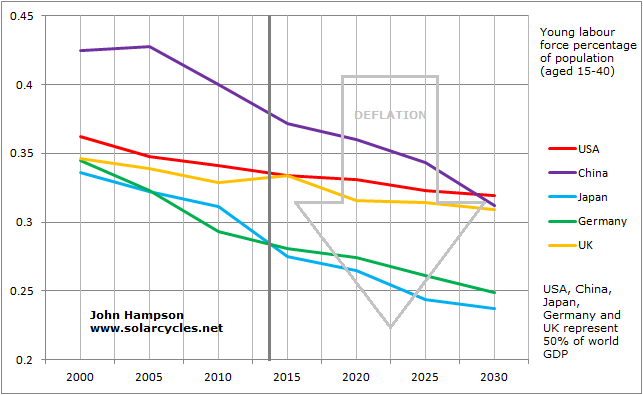
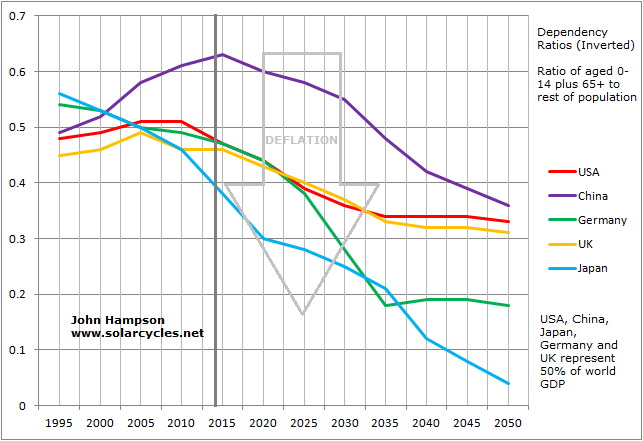
Young labour force percentage of population (aged 15-40) and dependency ratios (inverted – old and young versus the working population) have both historically correlated with inflation/deflation. A swell of people entering the workforce works up price inflation through spending, whereas more people entering old age relative to the work force is disinflationary through saving and disinvestment (read more HERE).

Deflation2

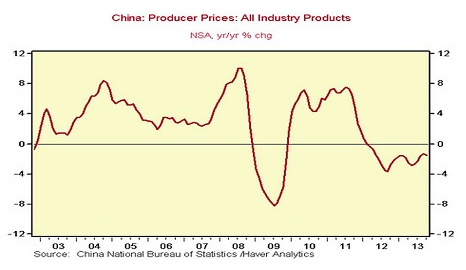
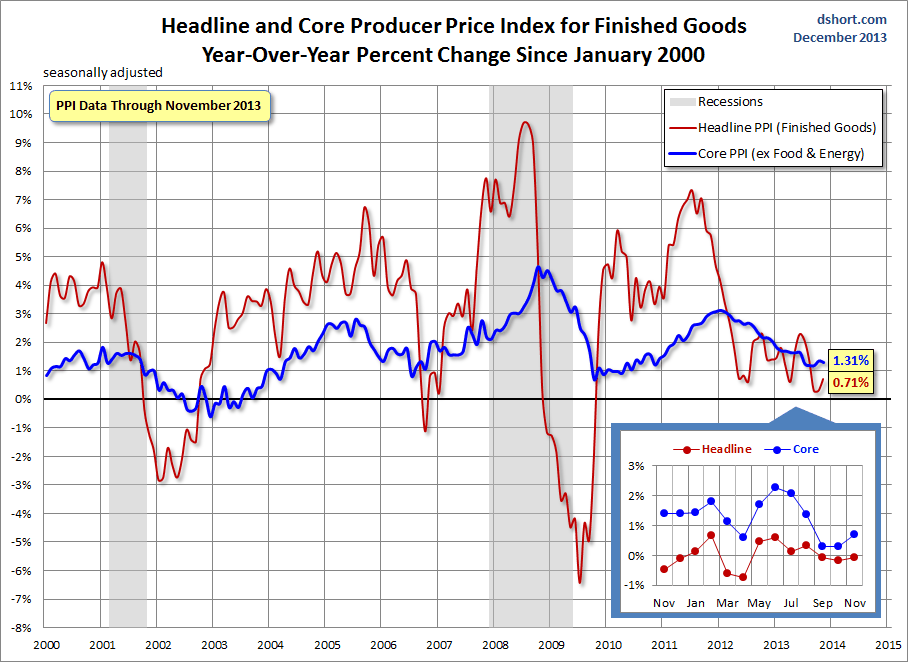
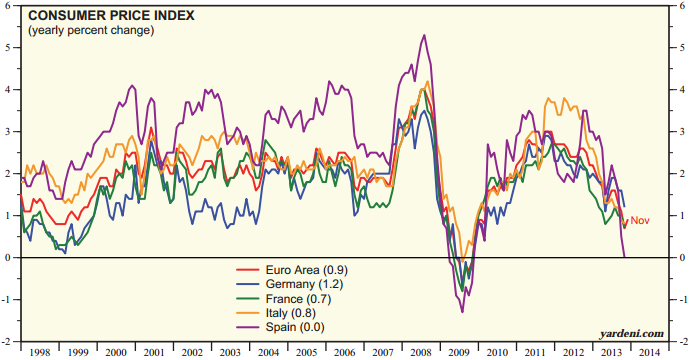
Deflation1In the first chart above, we see the UK alone is currently in a small window of young labour force growth, whilst in the second chart China is just peaking out in dependency ratio (inverted). This is reflected in reality, with the UK currently registering the highest producer price inflation and China the highest consumer price inflation of the five. At this point in time, we generally see trends of disinflation. Demographics predict this will turn into outright deflation, and that deflation should be the norm for the next couple of decades (barring countries with inflationary demographics becoming much more dominant globally, such as India and Brazil).

7ja1 7ja3 7ja4

2. GLOBAL RECESSION

Due to globalisation and an increasingly open world economy, recessions around 2009, 2001, 1998, 1991 and 1982 have all been global in nature. Due to the US contributing 22% of world GDP, particular attention needs to be paid to indicators of future US growth, with China second.

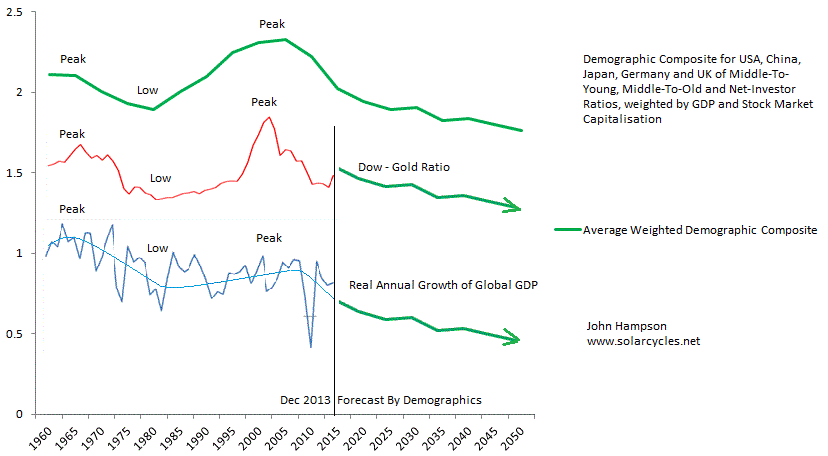
Dependency ratios (inverted – old and young versus the working population) have historically correlated with economic growth / recession. That chart is presented in section 1. above. The picture for the next 2 decades is bleak.

Stepping aside from demographics for a moment, levels of debt have also been shown to assist or impede growth historically. Where public debt to GDP has exceeded 90%, economic growth has struggled. For 2014, Japan will be around 230%, UK and USA around 115% and Germany 85%.  China has the lowest ratio of public debt of the five, but its broader debt has been ballooning since 2008. Including corporate and household debt, China’s total debt to GDP has reached 218% of GDP (from around 130% in 2008).

DemographicsDowGoldRatioGlobalGDP

3. EQUITIES BEAR, REAL ESTATE BEAR

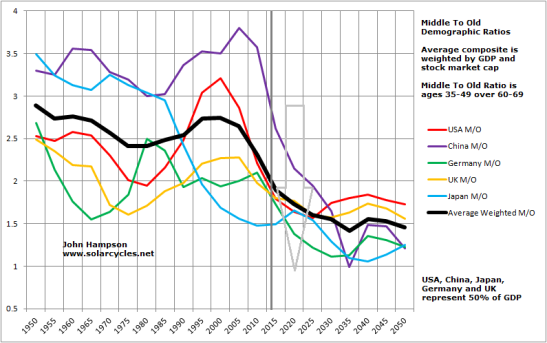
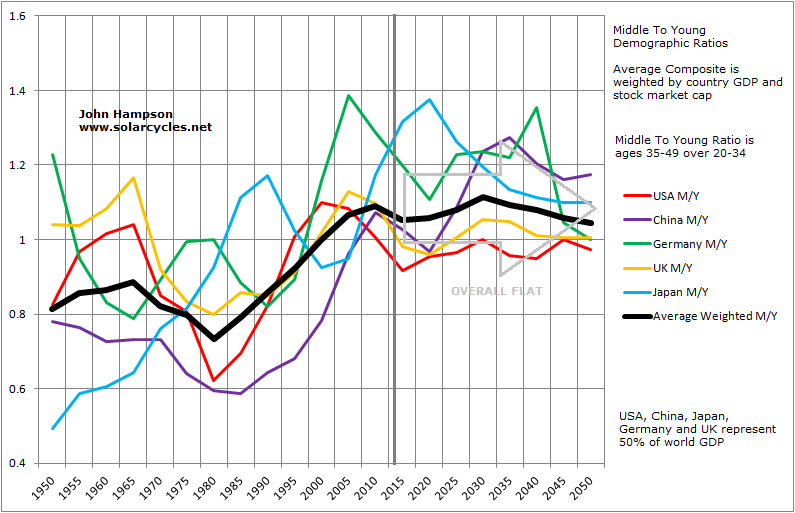
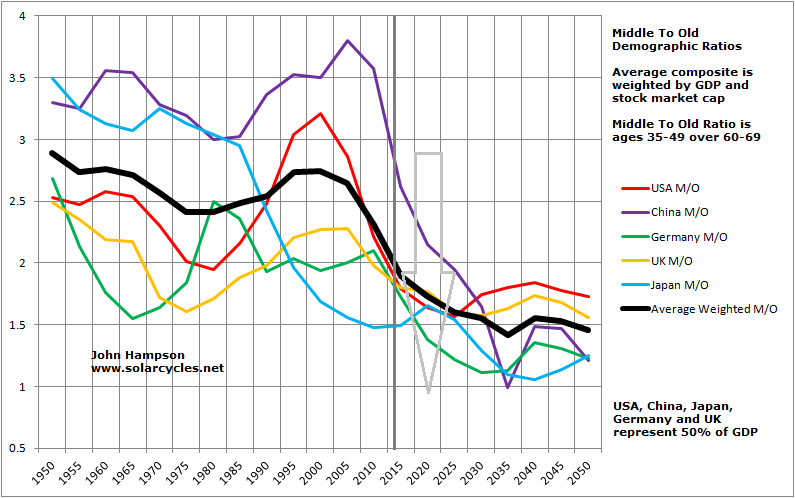
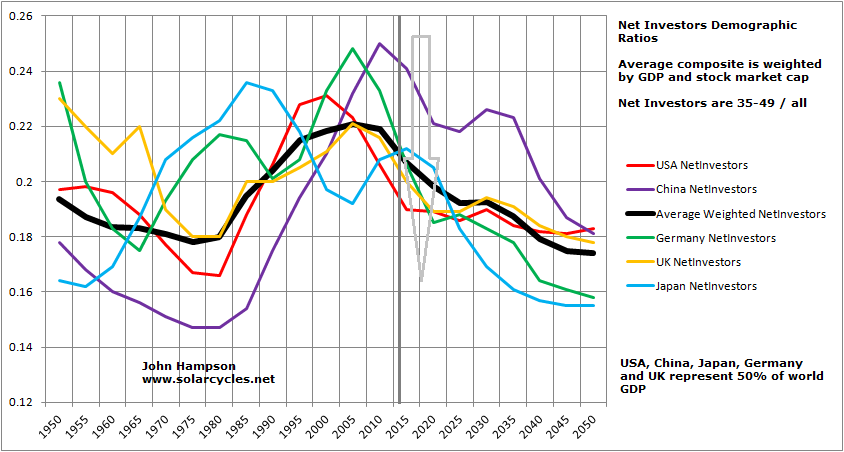
Demographic trends in middle-to-young ratio (aged 35-49 / 20-34), middle-to-old ratio (35-49 / 60-69), percentage net investors (35-49 / all) and dependency ratios (charted in 1. above) have all been shown to have a correlation with stock market and real estate market performance historically, on a longer term secular level. There are young borrowers/spenders, middle-aged investors (partially investing for retirement) and old-ages disinvestors. If the middle group is growing relative to the others, then we have a growing demand for the stock market. Similarly, the old and the young don’t typically buy houses, so a swelling middle-aged group relative to the others is an environment for a housing boom, and vice versa (read more HERE).
BM1

BM2

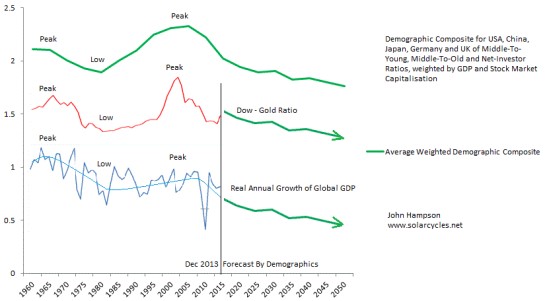
BM3Using the weighted average composite as our overall guide looking out to mid-century, M/Y is flat whilst M/O and NI are down, suggesting long term ‘buy and hold’ may be a strategy doomed to the past, to be replaced by ‘short and hold’. Add in Dependency Ratios from 1. above and the picture worsens further. Within those overall trends there are positive windows for individual countries, for instance the USA sees M/Y, M/O and NI measures rising together between around 2025 and 2030, and the composites also suggest that period could be the backdrop to a cyclical bull. However, when the composite trends above from 1980-2000 are compared to what lies ahead of us now, the contrast is stark and suggests enduring downwards pressure on equities and real estate, in long secular bear markets.

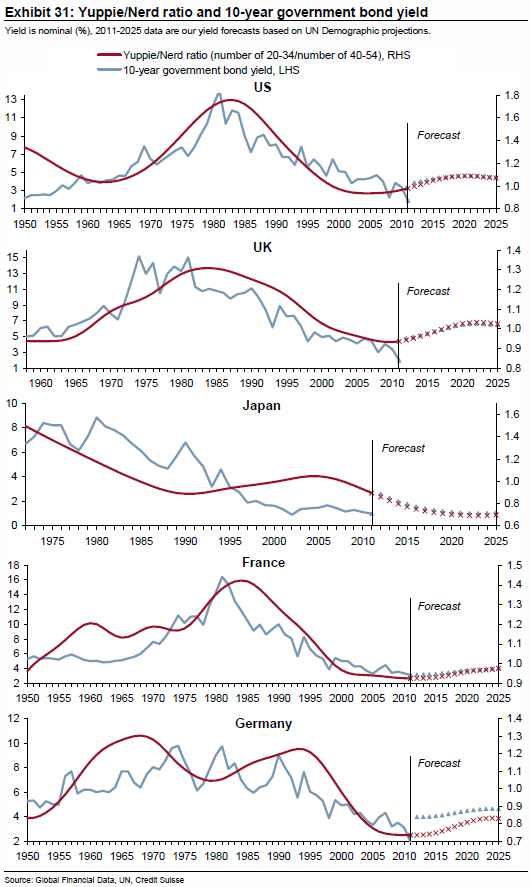
The longer term fortunes of bonds have also historically correlated with demographic trends.

23jun16This CS graphic suggests yields will remain fairly low and contained, as demand for bonds will be maintained. However, through to 2020, the bias in yields, aside Japan, is overall upwards, suggesting net selling on balance. It is my view that gold, as the historic anti-demographic, is due to be the lead asset in the period ahead, as the collective trends above suggest deflation, recession, and net selling of equities, real estate and bonds.

SUMMARY

A) Historic correlations in demographic trends and secular asset cycles, growth/recession and inflation/deflation. B) Unprecedented collective demographic downforces now in place, with evidence of impact in economic data. C) Downtrends in play for much of the first half of this century, suggesting tough times for the global economy and no safety in equities or real estate.

Europe has structural problems, a cautious central bank, and a relatively strong currency, mirroring 1990s Japan and making it the candidate for the first into deflation. China is closed to migration and thus trapped in a sharp demographic reversal, largely the result of its 1 child policy. Previous breakneck growth was built on exports, the market for which collapsed in recent years, leaving it with declining GDP and excess capacity. Stimulus response in 2008 was to invest in even more infrastructure, increasing the excess capacity issue. Non-public debt is ballooning whilst the authorities attempt to tighten, resulting in two cash crunches already this year, as well as high profile company bankruptcies. That makes China the candidate for delivering a 2008-style global crisis.

2014 For Equities

Dow is up more than 5% five consecutive years now. A sixth such year has not happened before in history. A 5-year bull trend only occurred once before, in the 1990s, and was followed by 3 down years. Russell 2k rallies of similar size and duration to 2013’s (excluding accelerations from major bear lows) are shown below. In each case all the gains were given back the following year.

22dece1

Source: Fat-Pitch

2014 is the second year in the Presidential cycle, and is the weakest historically by returns, averaging flat. The logic for this is that is it a time for governments to deploy tougher, unpopular policies. The Investors Intelligence bull-bear ratio currently exceeding 40% also forecasts a flat return for the SP500 by the end of 2014, by averaging history, whilst the II bear percentage alone, around 15% the last 4 weeks, has historically produced returns of -5% to -20% over the next 6 months.

The Citigroup Panic/Euphoria Model, having crossed the Euphoria threshold, predicts an 83% chance of losses in 2014. Goldman’s analysis of performance following a year of 25% gains or more point to a median drawdown of 11% in the next 12 months.

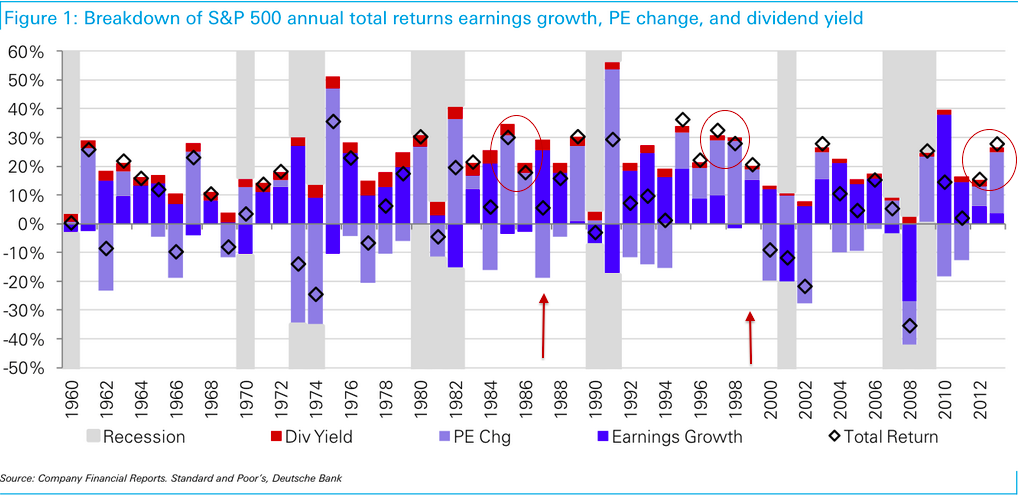
Next is a chart highlighting a couple of previous occurrences similar to 2012 and 2013 where stock index rises were dominated by multiple expansion, not earnings growth.

22dece3Source: Fat-Pitch

In both instances the following two years saw better earnings growth. But notably the next two years were 1987, stock market crash, and 1999, at the end of which the Dow peaked, suggesting a common theme of pre-correction exuberance.

Both the following charts reveal that 10 year stock market returns are closely correlated to deviations from norms 10 years earlier. The first correlates average investor allocations and the second market cap to GDP. I have added the blue horiztonal line averages, revealing both are overvalued currently, but one more extreme than the other.

22dece4

Source: Philosophical Economics22dece5Source: Hussman

The logic behind both is that mean reversion always occurs. The bigger the deviation build the bigger the subsequent normalisation, as ‘this time is different’ each time is disproven. For US markets currently, we see the second highest market cap to GDP valuation outside of 2000, the 4th highest Q ratio valuation and 4th highest CAPE valuation in history. In all the other such historic outliers, a bear market followed to correct the extreme, there was no orderly consolidation of prices whilst the underlying fundamentals accelerated to catch up. ‘This time is different’ thinking argues that because the Fed has suppressed cash and bond yields, equities have to be revalued higher, so this valuation outlier doesn’t count, and there will be an orderly normalisation of valuation as earnings and GDP will accelerate and yields rise slowly, without any crash in equities.

Interesting to discover that the rally in the 1990s was also at the time considered to be Fed-induced and prolonged. Also interesting to find out that the rally in 1980s, where price also accelerated beyond earnings, was achieved in the opposite environment to today where bond yields were record high and twice as high as equity yields at the time. So for no risk, investors could choose bonds at twice the yield, but still went big into equities as they were at historically cheap valuations and were bought up to mean reversion. Today, investors can choose equities at higher yield than bonds, but equities are conversely at historically expensive valuations. No ‘revaluation’ was required in the 80s, so maybe none is required today and equities will be sold down to mean reversion.

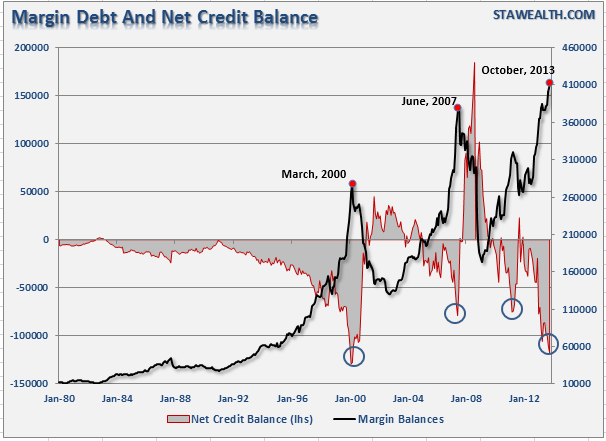
Spikes in margin debt and net investor credit balances to extremes have never previously been resolved in an orderly manner, always leading to bear markets or sharp corrections (as in 2011).

20dece4Source: STA Wealth

If ‘this time is different’ we would need to see an orderly reduction in leverage whilst lots of new buyers come to market. But recall through demographics, net investor populations are shrinking across USA, Europe and China, and this is reflected in declining trading volumes.

11dece3We therefore have a gradually thinning investor population, which adds weight to the likelihood of the current leverage excess spike being resolved in the usual historic manner, namely a deep correction or bear market.

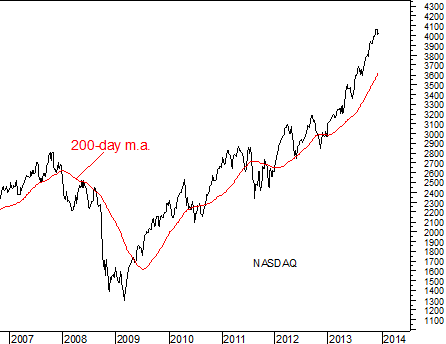
However, in the near term, we could yet see more equities allocation and potentially even more leverage. How much higher could equities run before a bear market or a proper correction erupts? I say proper correction, because none of the pullbacks in 2013 have displayed the usual correction characteristics in terms of depth, duration, and flush-out or spike in breadth and vix. They have been shallow pullbacks, with keen buy-up. To this prolonged lack of correction we can add the deviation in distance above the 200MA of the major indices, the excessive bullish sentiment and the current divergences in breadth, and history is fairly compelling in suggesting high risk of a sharp correction. But again, the question is when, and from how much higher?

The 2007 top in US equities was marked by a steeper ascent in the last 12 months of the bull, but this is beaten in steepness by 2013’s rally. In fact, stocks have moved into a parabolic pattern:

20dece12Source: Sy Harding

Parabolic rises are typically resolved in a crash of similar steepness and depth. Comparisons to 1929 are valid if we consider the parabolic ascent, exuberance extremes in valuations, leverage and debt extremes, and a ‘this time is different’ mantra. Where 1929 differs is that it was the culmination of an economic boom with a demographic dividend. The current episode is neither.

History suggests a combination of internals degradation, buyer exhaustion and one or more ‘triggers’ are the likely terminators of a parabolic bull. We see breath divergence, but this should yet degrade further. In a normal topping process, there would be thinnest participation at the final push, but if this is a parabolic top, then we should see increasing divergence as we move higher. There is evidence of buyer exhaustion in sentiment and leverage extremes. We lack the trigger or triggers for the shift in perception. One potential trigger is the earnings season in January, as negative guidance is at a record extreme. A second is that the boost in GDP due to inventory build is likely to be reversed ahead as inventories give-then-take. A third potential trigger is if we see evidence that the current pick up in growth turns out to be a peak in growth rather than a new dawn.

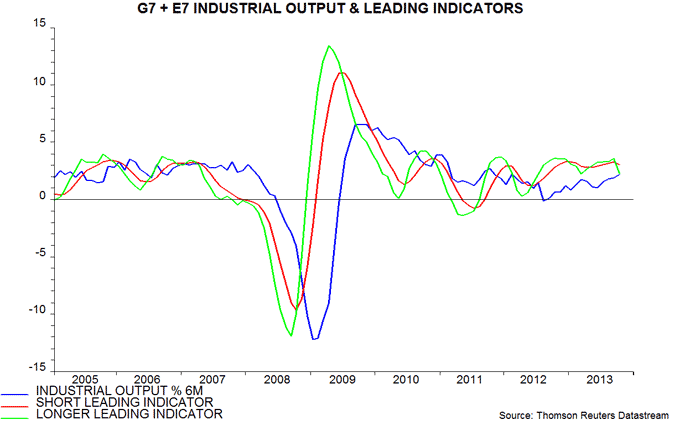
22dece6Source: Moneymovesmarkets

The above chart is derived from OECD’s leading indicators and predicts a peak in industrial output between Dec and Feb.

The case that we are in a new secular bull market for equities relies on growth picking up in a meaningful way from here. For forward earnings calculations to be valid, GDP next year would have to average over 3% for the year and earnings growth come in around 10%. If global growth were to pick up, then we would likely see relative outperformance in emerging market equities and in commodities relative to developed market equities, as both are at relative cheapness to the latter and both are beneficiaries of a growth theme.

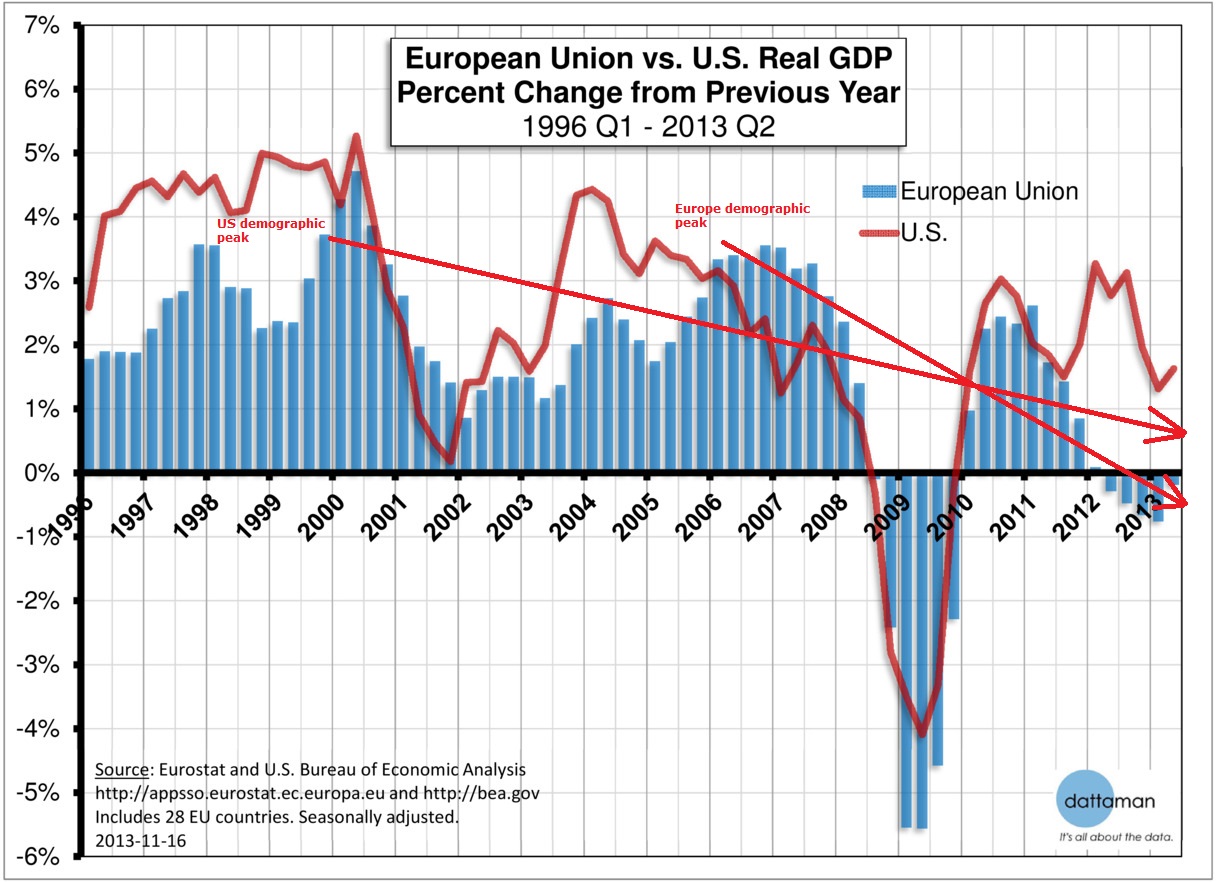
However, the history of demographics suggest a sustaining economic revival is unlikely to occur in the foreseeable future. Collective demographic trends in USA, Europe, other developed countries (aside Japan) and China are now both recessionary and deflationary, and we can see that in evidence below:

22dece9

Source: dattaman

22dece10

Source: Yardeni

The only G7 country in a positive inflationary trend is the only G7 country in a curent demographic tailwind window: Japan.

The demographic trends are pretty fixed on a medium term view, and historic evidence suggests that government / central bank intervention cannot force people to borrow or spend. Hence we see continued weakness in bank lending in Europe and the US, and real final sales of domestic product at previous recessionary levels.

5 years after the financial crisis, ZIRP is still in place across most of the developed world, and large QE programmes are still required in USA, UK and Japan. The global economy is fragile, and this puts it risk of rising bond yields and/or commodity price increases snuffing out any pick up in growth, as the former two tend to accompany the latter. The US cannot afford bond yields to rise much further because it would have a detrimental effect on interest sensitive sectors such as housing and autos (and also because of the servicing costs of its ballooning debt), whilst rising commodity prices, particularly energies, are input cost drags on all sectors.

To sum up, from a pure statistical perspective, removing any notion of the bigger picture, the probability for 2014 is at best a flat year for equities with a significant drawdown on the way, and at worst a significant down year. Stats are just a guide, but we see united predictions across a range of measures, drawn together at the top of the page.

However, when we look at similar episodes of stock market rises without earnings growth, similar outliers in stock market valuations to now (market cap to GDP, Q ratio, CAPE), similar historic spikes and extremes in margin debt, and similar extremes in bullish sentiment or euphoria as are currently in place, the same mirrors from history keep cropping up: 1929, 1987, 2000, 2007. Together, these signals point to something more historic and devastating at hand, and the ‘fundamentals’ for that occurring are provided by demographics. Yet the bullish momentum of the market and ‘this time is different’ thinking (Fed trumps all, equities need revaluing due to suppressed bonds and cash yields) are making for widespread complacency about (and dismissal of) the parallels.

Whilst we should not overly rely on any one indicator or discipline, it’s the collective case that gives me such conviction on the short side (disclosure: short stock indices). Now do me a favour and give me a convincing case below for why equities will rise in 2014.

Tower Of Sand

The last two years gains in the SP500 have been mainly through multiple expansion, i.e. just price not earnings:

18dece1Source: Guggenheim Partners

This year, so far, earnings growth has accounted for just 17% of the gains. Digging into that earnings growth, revenues have been weak:

18dece2Source: Yardeni

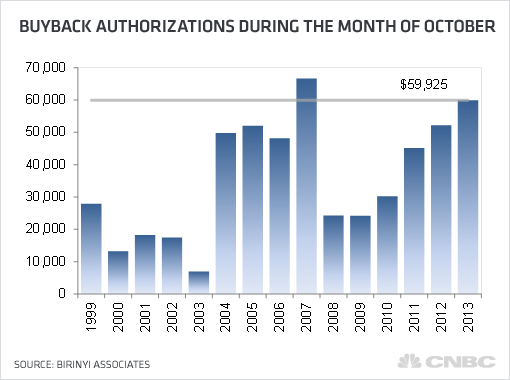
So companies have boosted earnings-per-share through buybacks, at a rate on par with 2007.

18dece3Source: CNBC

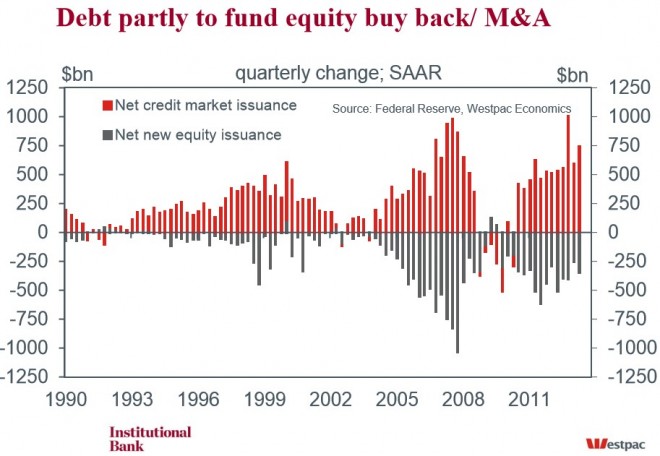
Historically, companies have funded buybacks through borrowing:

18dece4Source: FT

This time is no different.

18dece5Source: NakedCapitalism

October produced a record in corporate debt issuance, and investors have piled in to this market to drive spreads to record lows this year. They have even snapped up the riskier Covenant-Lite corporate debt which offers little protection if the company gets into trouble – to another record level:

18dece6Source: SoberLook

In short, investors have gone all-in on the corporate sector, both in equities and debt. The corporates have used the debt to buy back shares, thus artificially boosting earnings-per-share whilst revenues languish. Even with that, earnings growth has only accounted for 17% of share price rises this year. The rest has been speculation built on the ‘new norm’ of Fed accommodative policy trumps all. Record low debt spreads and historic extreme equity valuations result, and now present high risk to those invested.

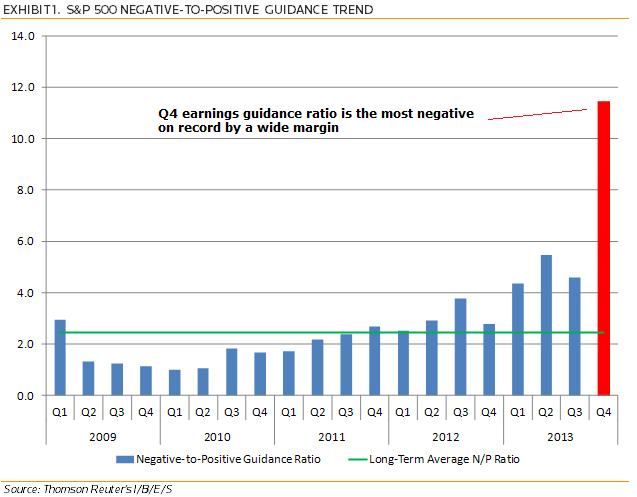
Earnings guidance for Q4 (reporting season kicks off in early January) is the most negative on record:

13dece7

Source: Thomson Reuters

The main reason for this is because companies have expected revenues to improve, so cut their guidance for earlier quarters but kept their year end targets in tact. Revenues have failed to materialise and therefore there is a big gap between year end forecasts and actuals, producing that big red bar for Q4 earnings.

Here we can see the persistent theme over the last two years of companies having to lower their quarterly guidance in line with economic reality:

18dece7Source: Bespoke

Of course, in response to lowering guidance analysts then reduce estimates, and with the bar set very low, companies can then peversely exceed estimates and produce a satisfying earnings beat rate, which helps shore up investor confidence. The truth of the meagre earnings and dire revenues becomes distorted.

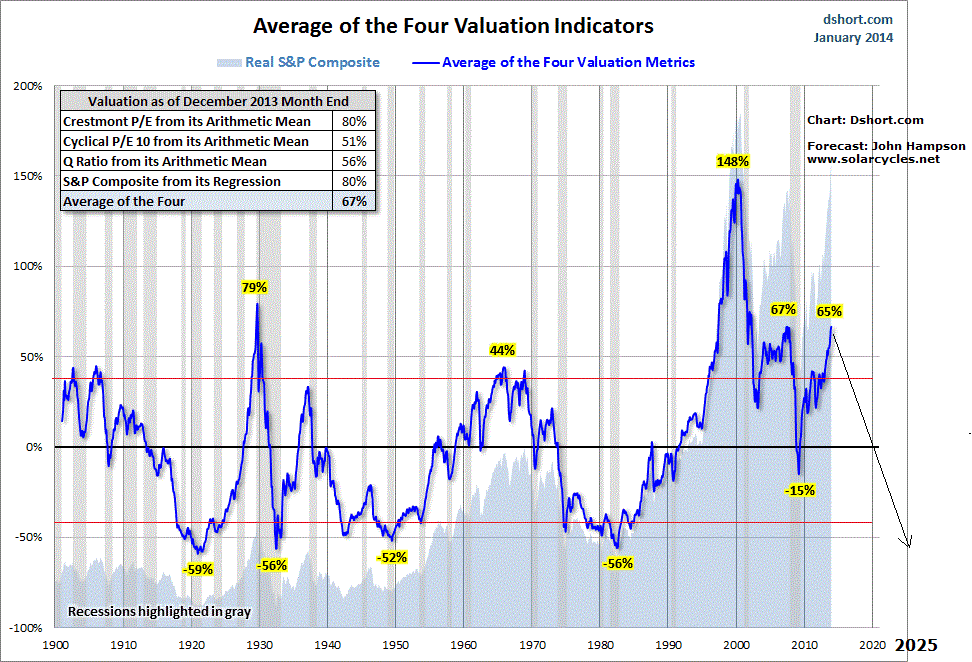
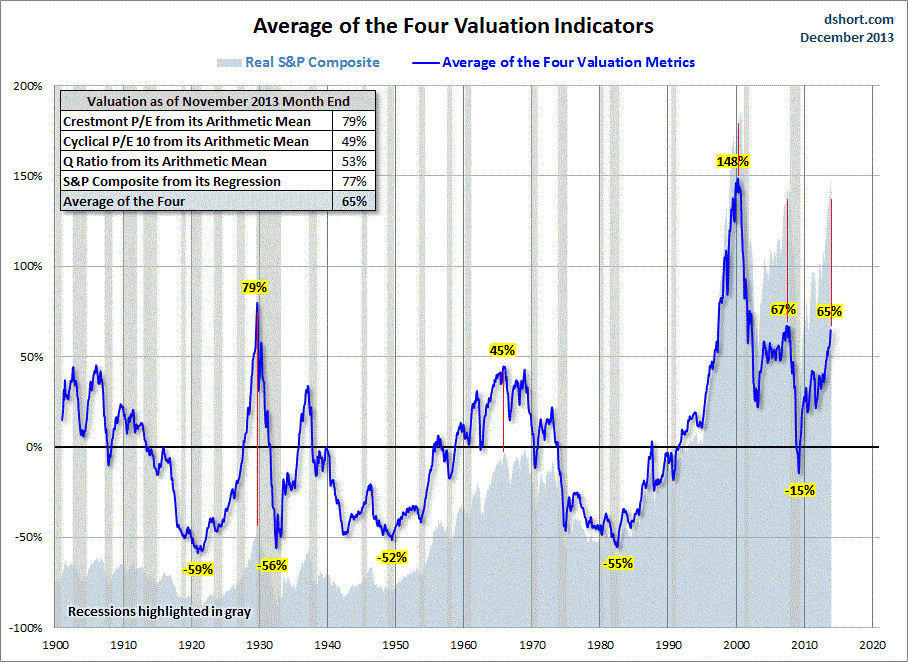
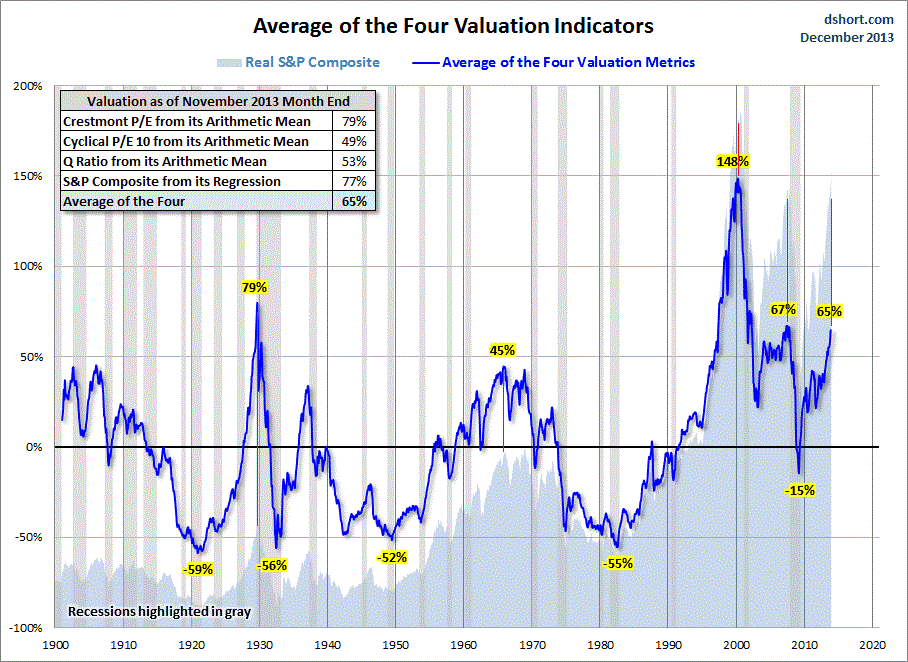
The bidding up of equity prices without associated earnings growth has produced historic extreme valuations, averaged below:

13dece5

Source: Dshort

I suggest there are 3 secular cycles in the above chart. The 1920s saw an economic boom period with a positive demographic dividend, and by the end of the decade the thinking was that this boom was here to stay, a new norm, which gave rise to the speculative bubble and then collapse in 1929. It was not a new norm after all, and it took around 18 years to wash out excesses, to take valuations to a low enough level from which a new secular bull could erupt.

The 1950s and 60s was another (post war) economic boom period with a positive demographic dividend, and again new norm thinking took valuations to greed levels. The wash out was also around 18 years until valuations were at similar secular bull starting levels (note the demographic dividend was absent in the washout period).

The 1980s and 1990s then provided a third economic boom period with a demographic dividend in the major nations, excepting Japan in the second decade. This concluded with another ‘new norm’ bubble, and dot.com thinking took valuations to an all time exuberance record, and since then I believe we are in a gradual process of washout which should last another few years yet. US demographics peaked around 2000, Europe around 2005 and China around 2010, and we won’t see a collective demographic dividend return until 2020 or beyond. I believe this is why we face a weak economy and a gradual slide into deflation, and central bank intervention can do little to change this. Rather, central bank actions only encourage people into riskier assets by suppressing cash and bond returns, and make the cost of borrowing to do this ultra low. Hence we see another big disconnect now between the stock market and the economy.

Look again at the high outliers in the valuations average chart above: all were the peaks of economic and demographic booms (even 2007 where developing countries contributed a much bigger share to global GDP as China rose towards its demographic and economic peak). In contrast, the current exuberance is set against a weak economy and unprecedented collective demographic headwinds, which I believe makes it the most dangerous outlier yet. The ‘new norm’ this time is the Fed accommodative policy trumps all. It is a bubble.

There are multiple signs that we are reaching the top of this equities bull market (see my recent post Equities Bear Market Coming), and I believe we will see a bear market that will finally produce the washout to low extreme valuations. The negative demogaphic window is set to make this bear a deflationary shock, which means nominal values will have little protection. In other words, stock market falls will be harsh. On these grounds, Russell Napier quotes 400 on the SP500 as a possible bottom. This is maths plus history, not the peddling of fear.

The result would be something like this: a large megaphone with a lower nominal low than 2009:

26nove17Based on margin debt, euphoria, and valuation, the bear market looks set to erupt imminently. That means the Fed would be effectively out of ammo. It has had not the usual opportunity to end stimulus and raise rates to more regular levels, from which it can then ease in the face of a downturn. This should add to the ferocity of the downdraft.

By leading indicators the current window of positive economic data should turn out to be a peak, rather than the global economy finally seeing a new dawn. With commodities finely poised, I do not know whether they will rally as equities top out (in late cyclical style, similar to 2007-8) or break down as demand-supply slack outweighs. If the former, then we would see a temporary inflation until rising commodities help tip the fragile world economy into a deflationary recession. If the latter, then further commodity falls should do the job of completing the slide into outright deflation. Because of the credit excesses again (margin debt, corporate debt), a bear market would likely be unforgiving similar to 2008, i.e. forced liquidation of assets, with few asset classes spared. This time, however, treasury bonds would not seem so safe. Gold has a limited performance history under deflation, but I believe it has potential to be the go-to asset here.

The pretender to the throne, Bitcoin, which temporarily became as valuable as an oz of gold, looks to have burst, whilst gold’s washout looks very similar to 1976:

18dece8Source: Citi

The weak hands have been purged and equities show signs of topping. The next few years are an ideal anti-demographic window for gold to shine, and deliver the dow-gold ratio extreme which we have so far not seen. The question is whether it an escape a downward spiral of forced liquidations.