The State Of The Markets

Thank you so much for all the messages of support – I was really touched to read them all. I had a burn out and now have to take things easy. I was working long days with the markets and doing too much of everything on top. So my posts will be less frequent for the foreseeable future, but as my focus is on the medium and long term, less intensive tracking may be no bad thing. I come back to the markets after a couple of weeks away and although price continues to frustrate, little has changed in the big picture. Some of my near term timings didn’t work out, but the overall case remains solidly bearish, and it’s a question of patiently waiting for price to fall in line.

Focusing on US stock indices, I have updated the bearish indicators and flags and added some new ones below:

1. A 5-year bull trend only occurred once before, in the 1990s, and was followed by 3 down years

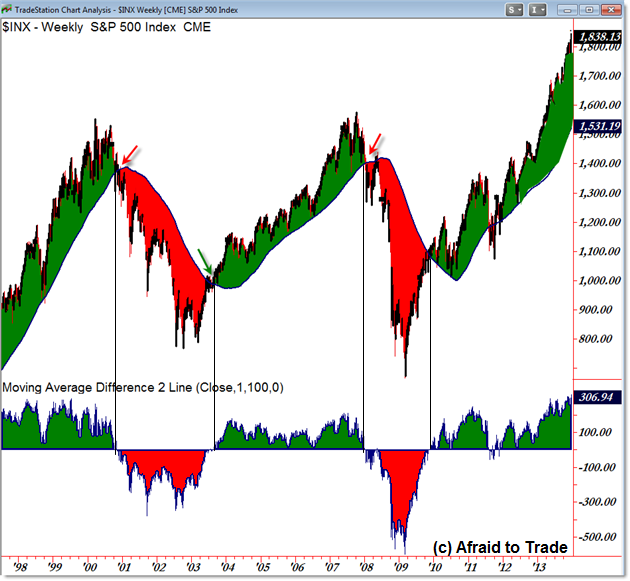
2. Historic levitation above longer term moving averages and lack of 10%+ correction since 2012
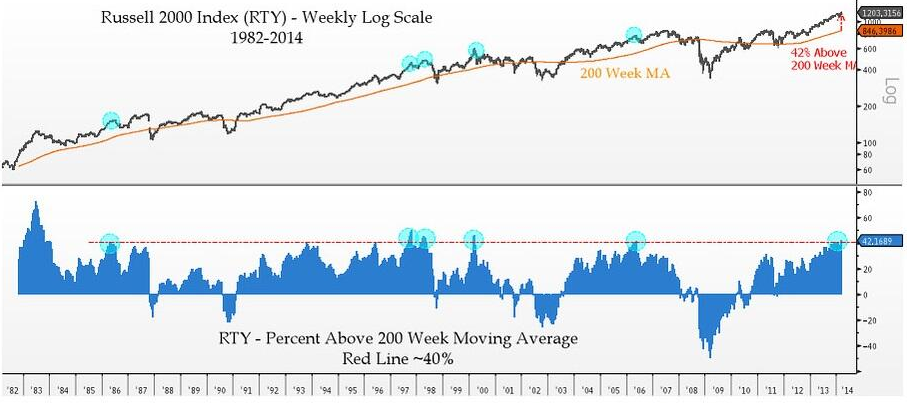
3ap35

Source: Gordon T Long

3. Last 2 years rally in US stock indices has been made up of less than 20% earnings growth and more than 80% multiple expansion. The last 2 such occurrences in history were 1985:1986 (leading into 1987 crash) and 1997:1998 (leading into 1999 real Dow peak)

4. Compound annual growth rate in equities since 2009 was only exceeded in 1929, 1937, 1987 and 2000, all of which led to steep market declines

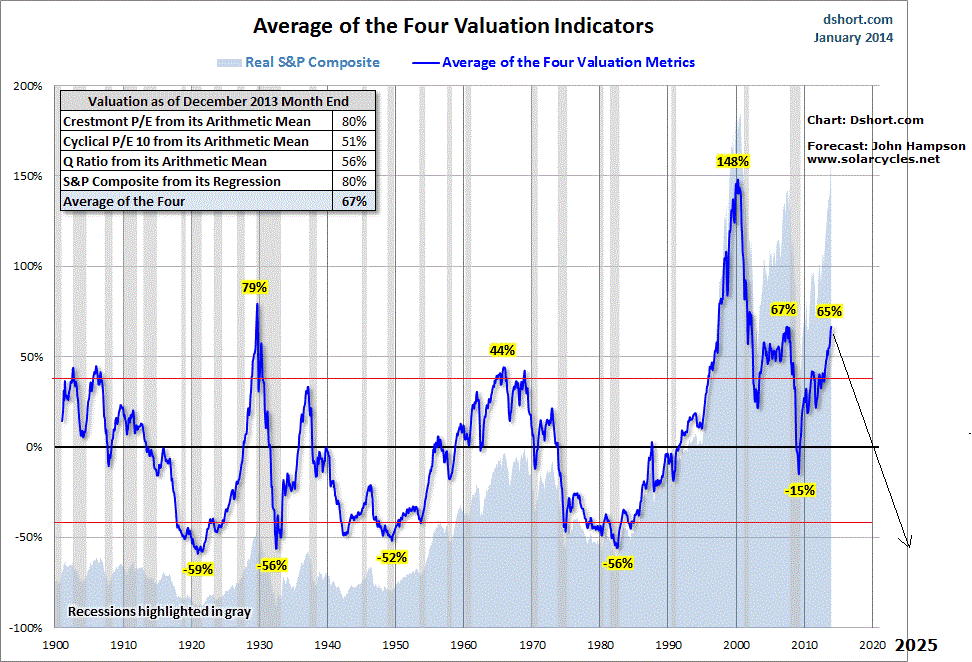
5. Crestmont P/E is the 3rd highest in history after 1999-2000 (market peak) and 1929 (market peak), and in 97th percentile

6. This is the 2nd highest market capitalistation to GDP valuation outside of 1999-2000 (market peak)

7. This is the 2nd highest Q ratio valuation in the last 100 years outside of 1999-2000 (market peak)

8. This is the 3rd highest CAPE valuation in the last 100 years outside of 1928-1929 (market peak) and 1999-2000 (market peak), and the US is the 4th highest CAPE valuation in the world currently.

9. Russell 2000 index p/e is currently 74.8; Russell 2000 to SP500 valuation differential at all time record

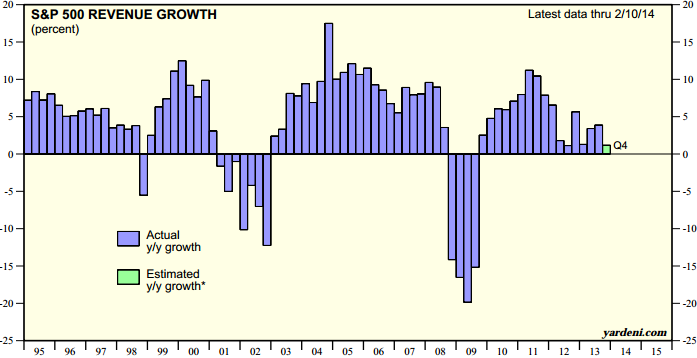
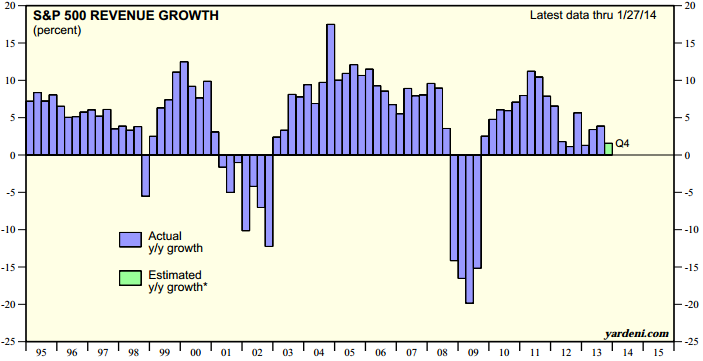
10. 84% of companies have offered negative earnings guidance for Q1 2014 so far; Last quarter’s revenue growth was the lowest since 2009

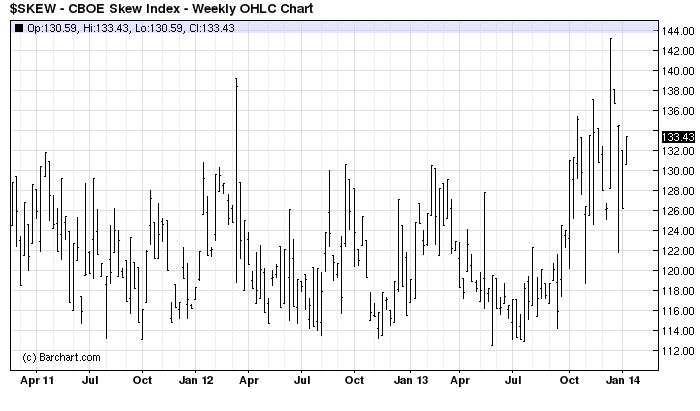
11. Skew is in elevated range for the last 6 months; Cluster of extreme Skew readings not seen since June 1990 before recession began July 1990

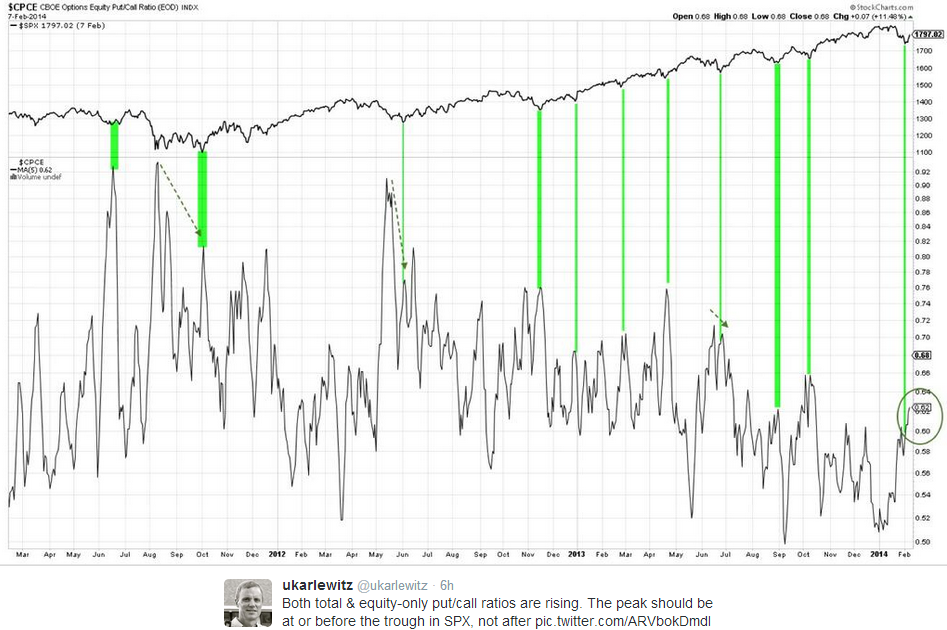
12. Put Call ratio 21 day average over the last several months has clustered in the extreme low zone that previously led to sharp corrections

3ap1

13. Greedometer – aggregate of macroeconomic, fundamental and technical data – is at a record level exceeding the 2000 and 2007 market peaks

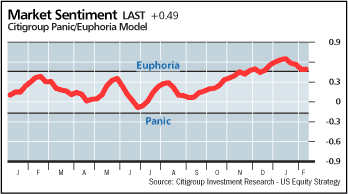
14. Citi Panic/Euphoria model at a level only exceeded into the 2000 peak:

3ap2

Source: Fat-Pitch

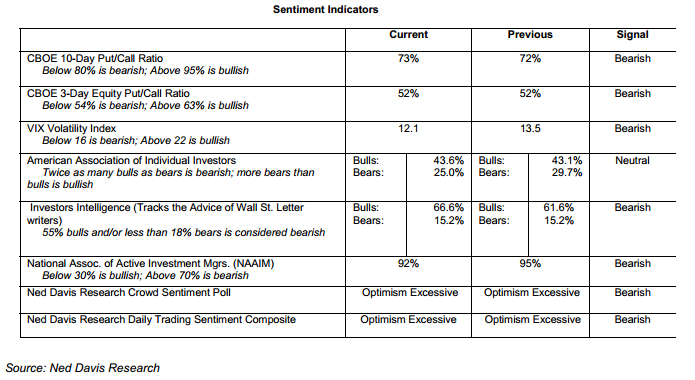
15. NAAIM sentiment remains historically high

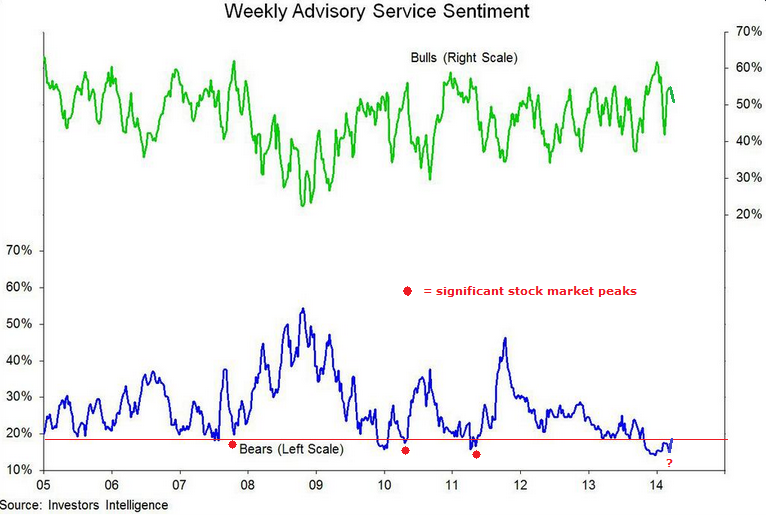
16. Investor Intelligence % bears levels and pattern similar to previous significant stock market peaks
3ap29

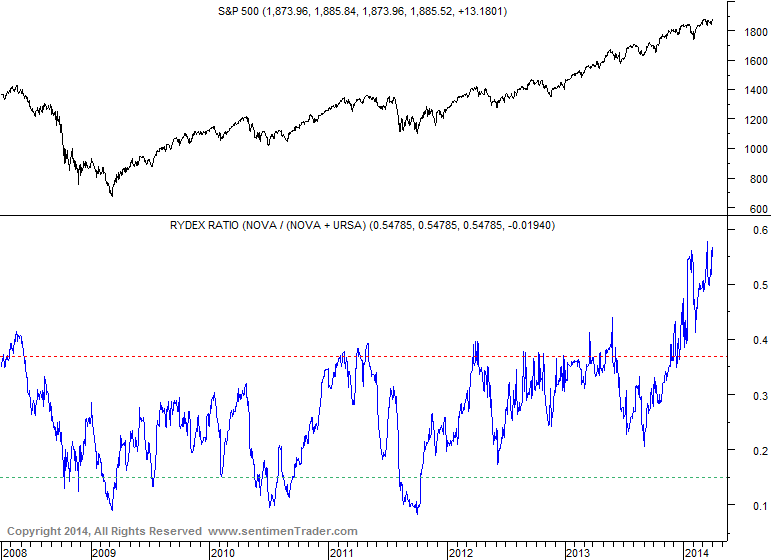
17. Rydex bull ratio at extreme historic high
3ap16

 Source: Sentimentrader

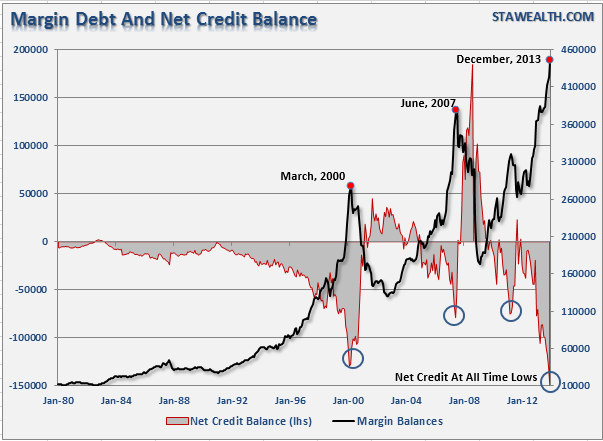
18. Margin debt (updated for Feb 2014) is at an all-time record, both in nominal and real terms, and as a percentage of market cap; Net investor credit balances are at an all time low

3ap4

Source: Dshort

19. IPOs with negative earnings at levels consistent with previous market peaks

20. Leveraged loan issuance at record, surge mirrors 2007 and 2011 important stock market peaks

21. High yield corporate bonds to 20+ year treasuries shows a divergence with the stock market that has previously marked tops

22. AAII equity allocations highest since June and Sep 2007 and Dec 2013
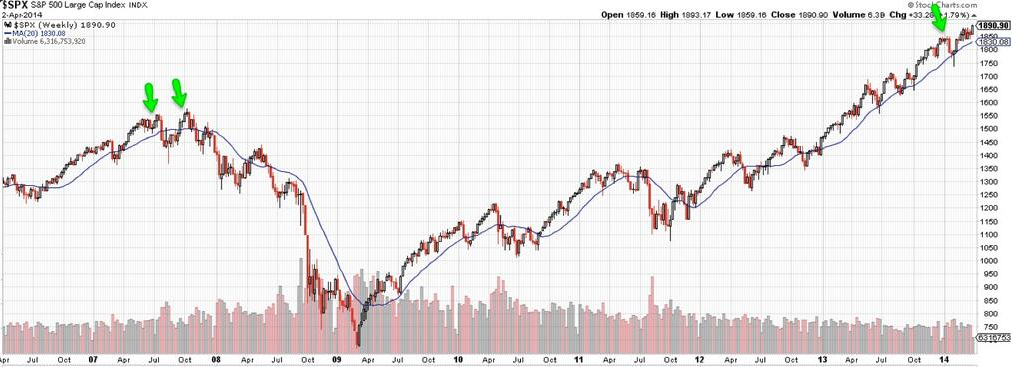
3ap5

 Source: UKarlewitz

23. Smart Money Flow Index shows siginificant divergence in 2014

3ap6

Source: Todd Harrison

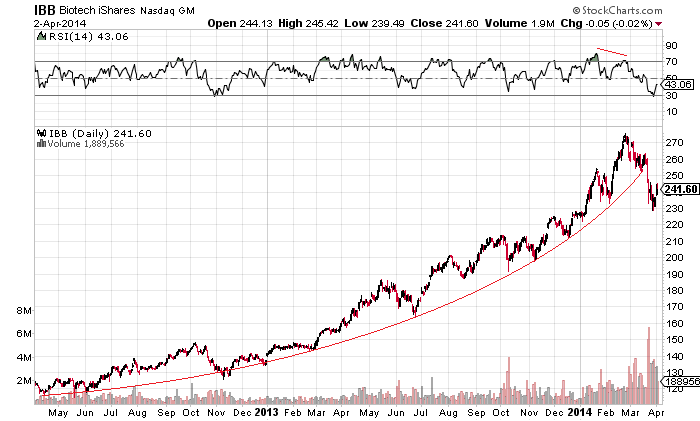
24. Biotech parabolic bubble breakdown
3ap7

Source: Stockcharts

25. Wider momentum stocks breakdown

3ap14

Source: Charlie Bilello

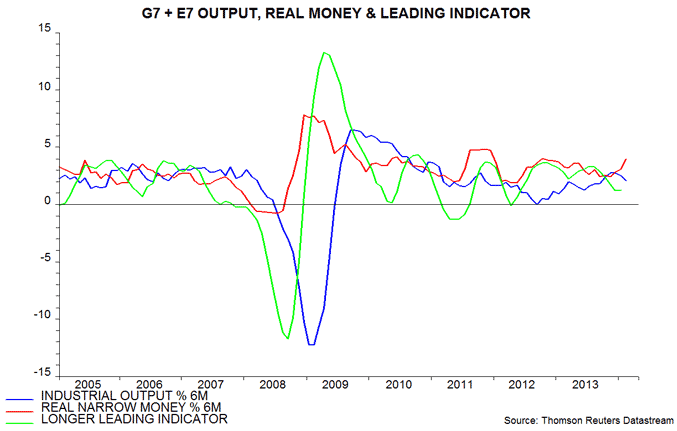
26. Leading indicators suggest global industrial output slowdown into a May trough, then a pick up into late summer
3ap15

Source: MoneyMovesMarkets

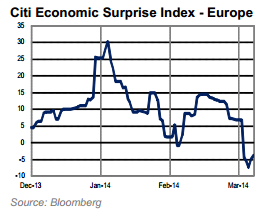
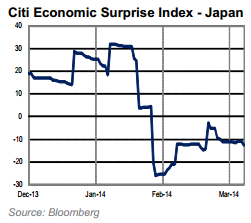
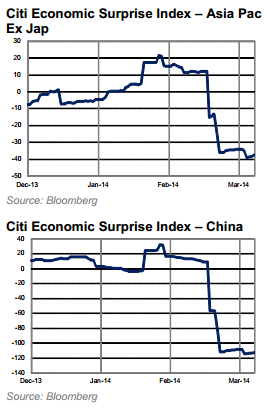
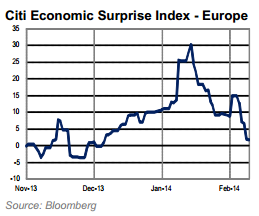
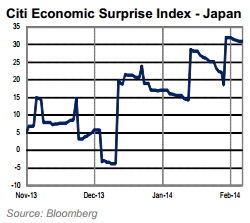
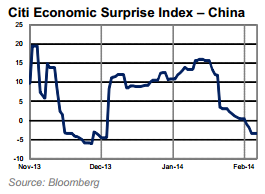
27. Citi Economic Surprise Indices for major global regions all negative

3ap17 3ap18 3ap19 3ap20Source: Citigroup

28. Fund manager allocation to global equities is at levels that previously led to a market peak or correction

29. Percentage of stocks hitting new highs is thinning into current new SP500 highs

3ap10

Source: Stockcharts

30. Six month breadth divergence in Nasdaq 100 in stocks above 200MA

3ap11

Source: Stockcharts

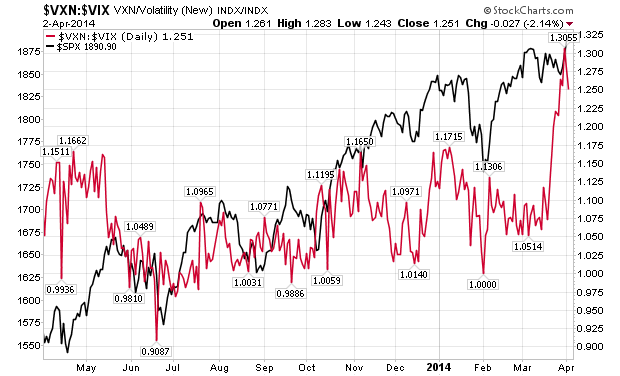
31. VXN/VIX ratio is a risk-off current flag
3ap22

Source: Stockcharts

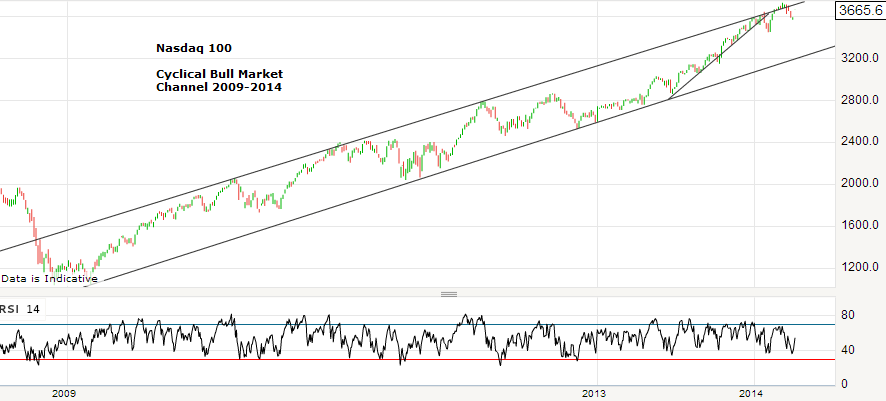
32. Nasdaq 100 made a fake-out from its cyclical bull channel in March
3ap24

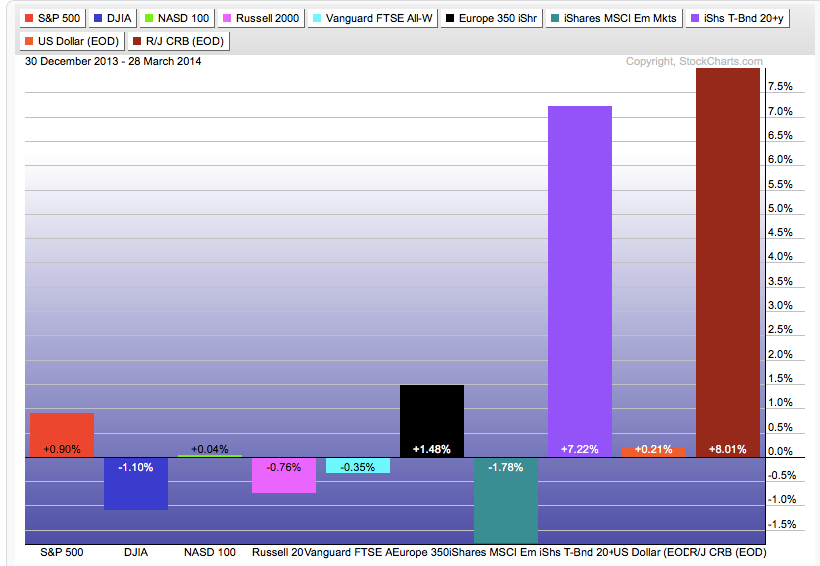
33. Best performing classes and sectors in Q1 2014 were commodities, treasuries and defensives
3ap30 3ap31

Source: Fat-Pitch

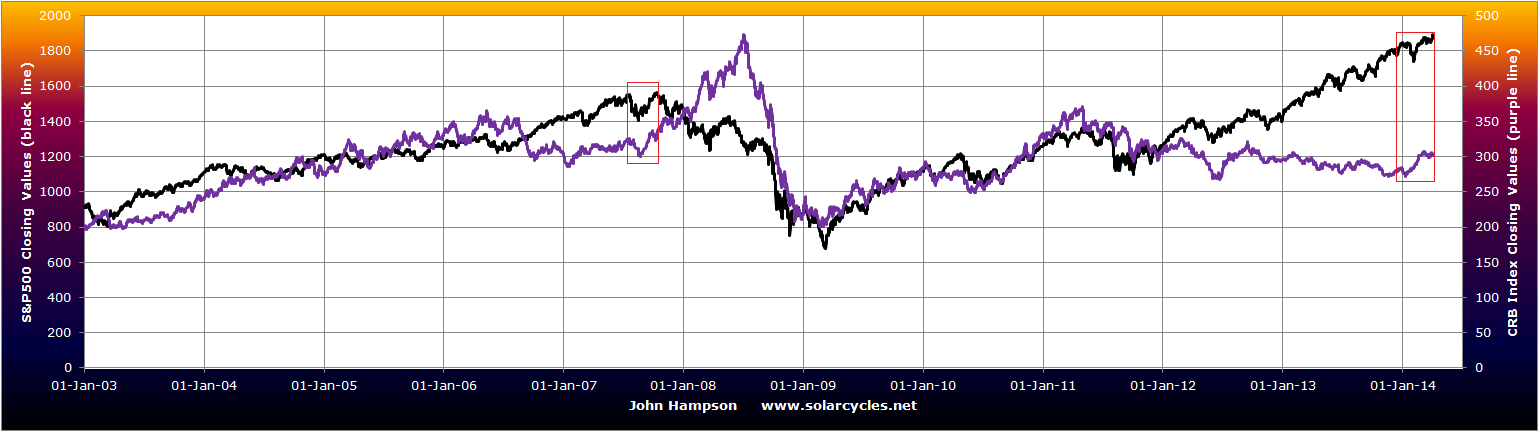
34. Late cyclical outperformance of commodities as equities top out consistent with 2000 and 2007 peaks
3ap32

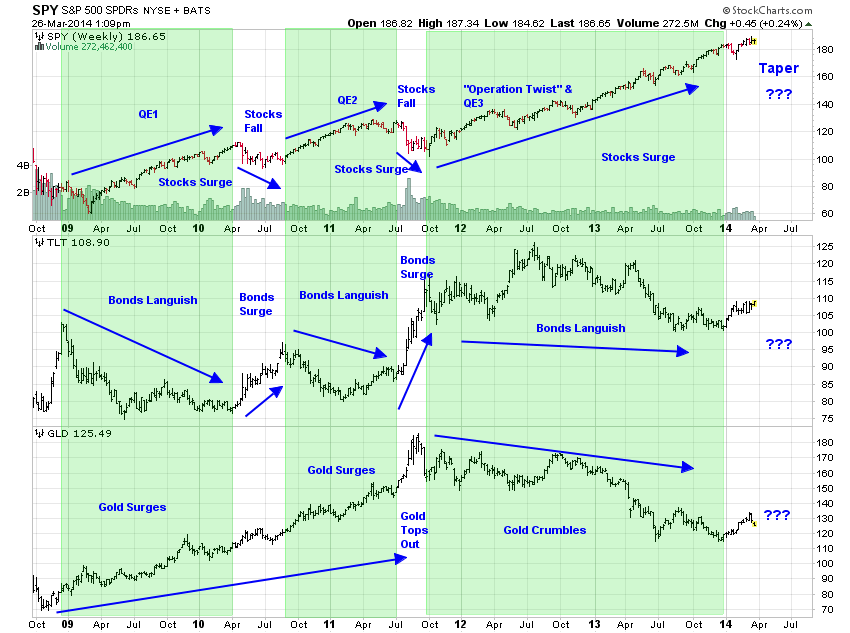
35. Winding down of QE historically negative for equities, positive for bonds and gold
3ap21

Source: Jesse Felder

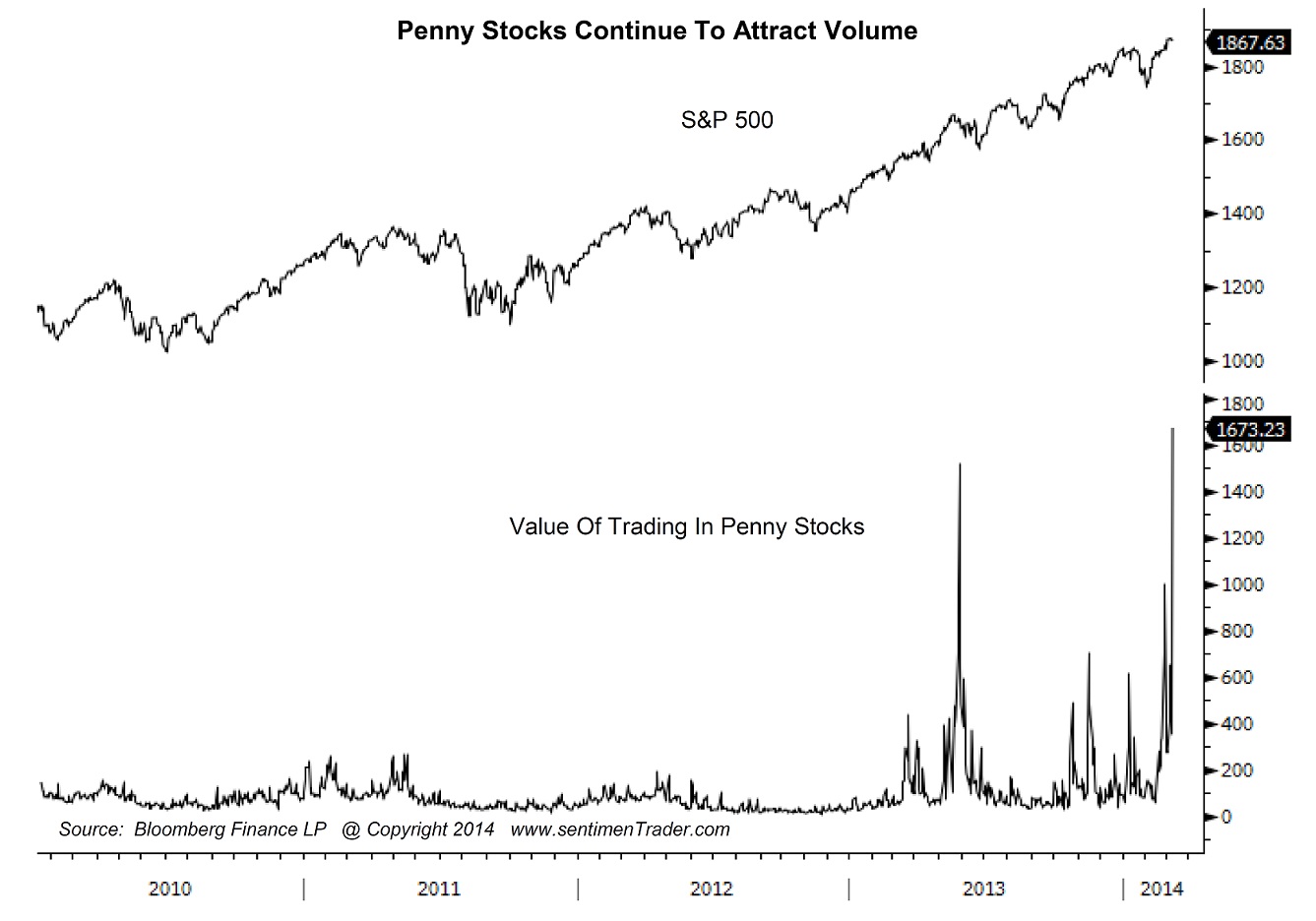
36. Trading in penny stocks signalling a peak
3ap36

Source: Sentimentrader

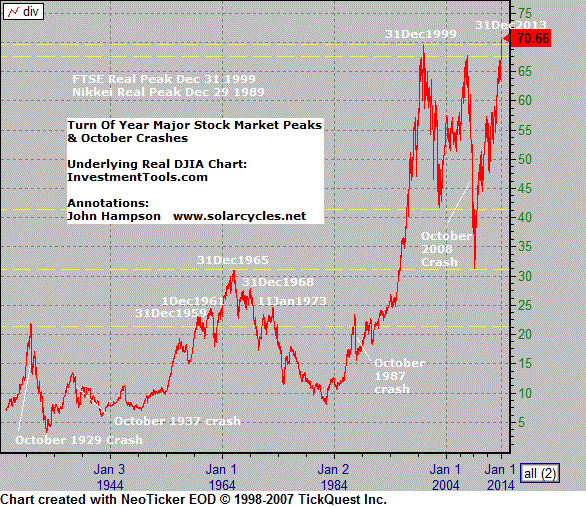
37.  Dow, FTSE and Nikkei are all at long term resistance levels (connecting 2000 and 2007 peaks)

38. Treasury Bond Yields Rate Of Change over last 12 months is at a level that previously led to market tops in 2000 and 2007

39. Rydex money market assets back to 1999 lows

40. Equities topping out with the solar maximum, in line with history

3ap23

Underlying Source: Solen.info

A 40-indicator case is a fairly strong case to go short. But we need to balance with what’s supporting the bullish case.

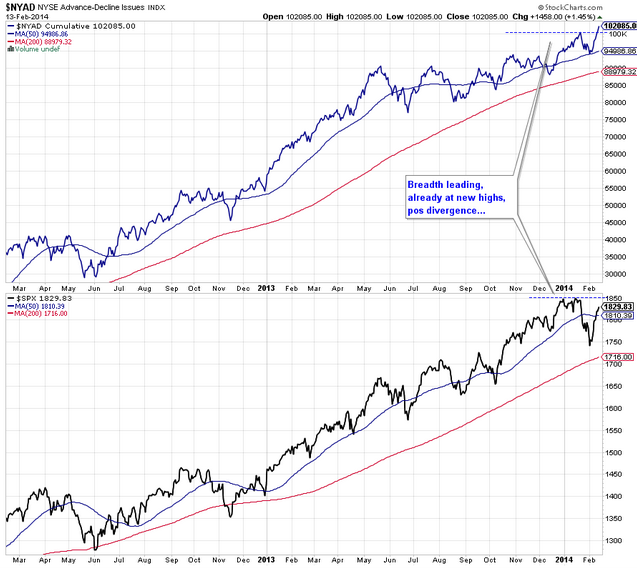
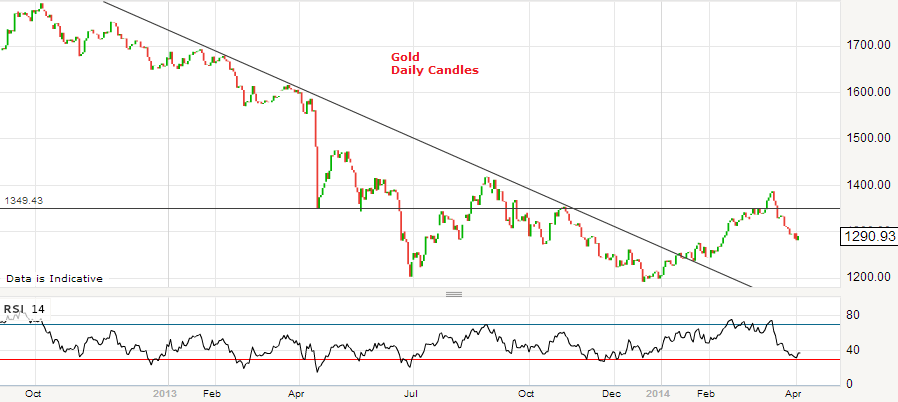
Cyclical stocks have broken out upwards over the last week. The cumulative advance-declines breadth measure remains in an uptrend, supporting the advance in equities. Euro Stoxx broke out to a new high. Gold and gold miners have pulled back in March, with gold having failed to hold a break out above the first meaningful resistance level:
3ap27

The question is whether a higher low can now be made in gold, to continue the bottoming process.

Margin debt, for which we have data up to the end of February, did not yet top out. I had initially expected margin debt to top out in December with an anticipated highest monthly sunspots spike at that time. However, a higher monthly sunspot spike in February suggests speculation could have topped out as we moved into March instead. We have thus far seen peaks in the Russell 2000, Nasdaq and Biotech in March, and we saw a lower monthly sunspot spike in March than in February. The consensus view is that the smoothed solar maximum for SC24 already passed at the turn of the year and that sunspots should decline from here. However, SIDC are still running a second alternative whereby a smoothed solar peak still lies ahead in H2 2014:

3ap34

 Source: SIDC

Playing to that possibility is the trend in leading indicators noted above. If stocks can hold up whilst economic data starts to improve again as of May then may be they can rally through to the Fall. On the flip side, we should have another month of disappointing data right ahead which could equally pull the rug from under equities. Were the second SIDC scenario to occur then I would expect speculation not to top out until the Fall, and a suitable technical mirror from history may be 1987 whereby sentiment reached record levels in Q1 1987 but stocks did not fall hard until Q3. But for now, the more probable scenario is of a smoothed solar maximum having passed and speculation declining from here, and for this to be confirmed I would be looking to see that the RUT and Nasdaq indices do not make a higher high from here, and that margin debt tops out. Sunspots should also notably trend down as we head into mid-year to confirm this.

3ap33

There have been a concentration of market falls occurring in the inverted geomagnetism seasonal lows of March-April and October. So again taking that primary scenario of sunspots now on the wane, I look to this new month of April to deliver major falls in equities, in line with the Nasdaq in 2000 (smoothed solar max and sunspot spike March 2000). Presidential cycles in the market suggest stocks could eek out further gains in the first part of April before falling for a period of weeks. DeMark also believes a top is within days but suggests the SP500 could reach 1931 before inverting.

The primary scenario of a smoothed solar maximum having occurred in December 2013 and a highest monthly sunspot spike in Feb 2014 is supported by a chain of events to date: Bitcoin peaked in Dec, Nikkei and Dow (very tentative at the time of writing) peaked and money flows switched into defensives at the turn of the year, the ‘theme’ stock indices and sectors of the cyclical bull exuberance phase peaked out Feb-Mar 2014. But this is all subject to confirmation or invalidation. So let’s see how April develops. I remain significantly short equities, and siginificantly long precious metals, with other smaller positions long commodities. My worst case scenario is the continuation of speculation into late summer before Q3 falls in equties, and I would hold my positioning until then if so. But for now this is the outside scenario, and I maintain good odds of April delivering significant falls in equities, and momentum returning to gold with a higher low.

Thank you for all your input whilst I was away.

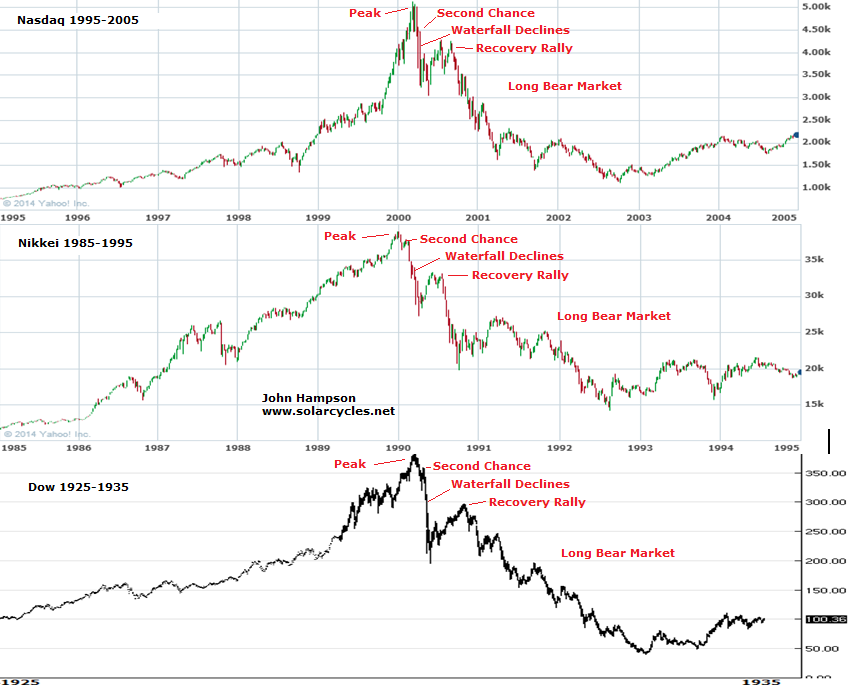
Dow 1929 vs Nikkei 1989 vs Nasdaq 2000 vs Today

Yesterday saw a failed breakout on the SP500 on high volume which suggests exhaustion. The Skew print came in still historically high and the put/call print historically low again, which continue to signal bullish complacency and high risk of an outsized move to the downside. Economic data disappointed again, and the latest economic surprise readings are below:

25fe10 25fe11 25fe12

Source: Citi

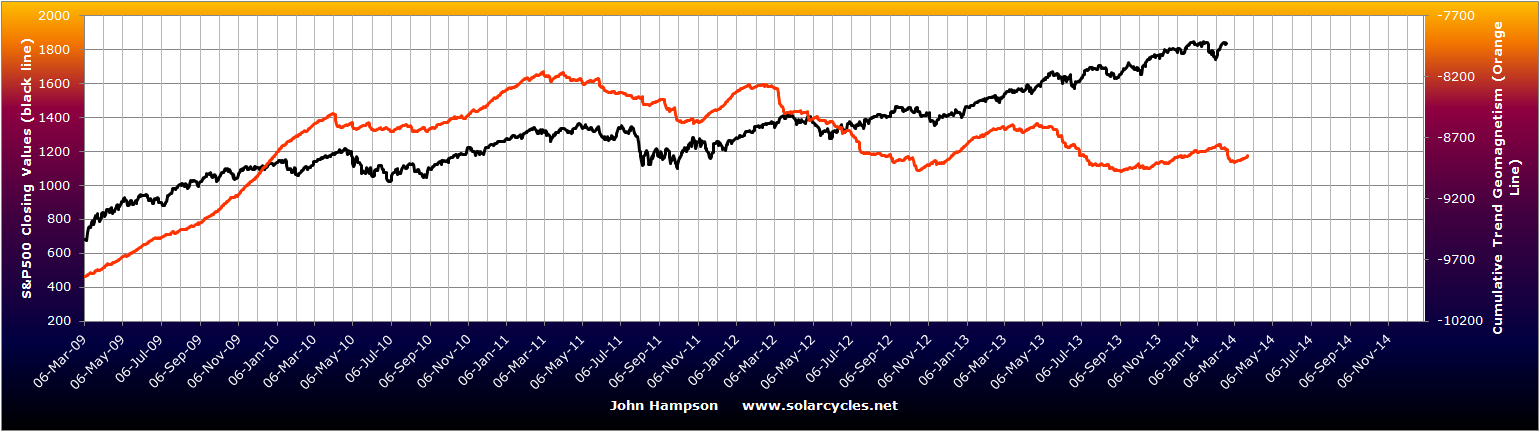
The geomagnetic storms over the last week broke the model’s multi-month uptrend (red line) and along with the NOAA forecast reveal downward pressure this week:

25fe13If you are new to the site my models are updated weekly.

The significant outstanding bubble in the markets remains the Nasdaq Biotech sector, but the unsustainable parabolic is ripe to pop:

25fe14

Source: Yahoo

Less than one third of this sector’s 122 companies earned any money in the last 12 months.

The last 2 years gains in the wider US markets were approximately 80% multiple expansion and 20% earnings growth. The justification for the multiple expansion was (1) ‘Fed policy trumps all’ and (2) stocks frontrunning a ‘normalisation’ in economic growth and earnings. Now: QE is being wound down, Q4 2013 GDP and Q1 2014 GDP estimates are being revised downwards, earnings estimates are being revised downwards and for Q1 2014 82% of companies so far have issued negative earnings guidance. Those justifications have largely evaporated.

The lesser known reason for the big run up in price into the end of 2013 is the speculation peak driven by the solar maximum, and this was shared in the superpeaks of Dow 1929, Nikkei 1989 and Nasdaq 2000. A reminder that there are 3 ingredients for a superpeak: (1) speculative mania by solar maximum (2) increasing number of buyers through demographic swell and (3) increasing use of leverage amongst buyers. Both (1) and (3) apply to the current US markets but (2) is absent. There is a shrinking rather than swelling demographic pool, and for that reason we do not have a supersized peak. Otherwise, the analogies are very much applicable.

In 2013 US markets ran up in a parabolic shaping, generating historic levitation above moving averages and producing an anomalous lack of a ‘proper’ correction. Sentiment reached levels not seen since previous major peaks, and euphoria only historically exceeded in the dot.com boom. We have reached valuation levels in the Q ratio equivalent to the TOP in 1929 and in stock market capitalisation to GDP equivalent to the TOP in 2000. Leverage levels equal the TOP in 2000 as measured by margin debt to GDP and beat the 2000 top in other measures. The blow-off topping process in the current Dow so far mirrors that shared by the 3 analogs, and the peak-to-date occurred at the solar maximum.

In short, the ‘size’ of the peak in current US markets does not compare to the analogs because of the key demographic difference, but in many other ways these analogs are particularly apt. What comes next in the analogs is waterfall declines, and we have a case for the same in the current US markets due to (1) historic levitation away from moving averages or parabolic rise on long term view (2) historic time since significant correction and historic compound gains and bull duration (3) 80% multiple expansion 3-pronged justification case shattered (4) ‘all-in’ measures of sentiment, leverage and fund flows ripe for unwinding. We are likely through the solar maximum peak and the speculative excess into the peak is now vulnerable to pop.

Here are the analogs on a 10 year view centered around the peak:

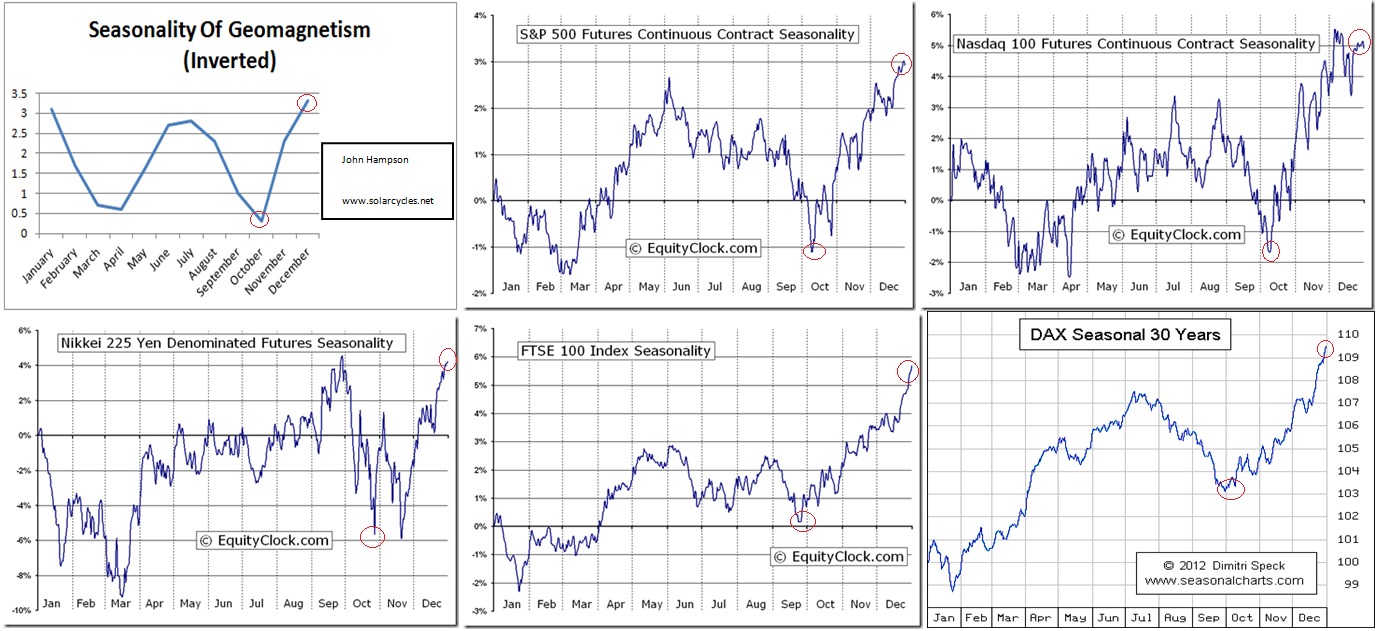
25fe7Alongside I’d like to remind you of the relevance of the (inverted) seasonality of geomagnetism for the timing of peaks and falls:

13fe4

Nikkei 1989: Waterfall declines from second chance lasted about 6 weeks, centered on March (geomagnetism (inverted) seasonal low), and took off 27% from peak; Recovery rally then lasted 3.5 months from April to July, back up 20% (through seasonal high); Then 2.5 months more waterfall declines, mid July to beginning of October down 40% (through seasonal low).

Dow 1929: Waterfall declines from second chance lasted 1 month, centered on October (seasonal low), and took 48% off from peak; Recovery rally then added back on 50%, lasted 5 months from November to april (through seasonal high); Then long period of declines lasting a couple of years.

Nasdaq 2000: Waterfall declines from second chance lasted about 6 weeks, March-April, and took 36% off (seasonal low); Recovery rally lasted about 3.5 months from May through to beginning of Sept, adding back on 34% (through seasonal high); Then long period of declines lasting a couple of years.

So, averaging them out and applying to the current US markets, we could expect waterfall declines of around 35% lasting around 5 weeks, and this should occur in the seasonal low of March-April. That would then be the time to take off short positions for a recovery rally of around 35% lasting around 4 months from April to August or so, through the seasonal high. A second set of steep declines should then unfold through the seasonal low of September-October.

25fe8By that model the initial waterfall declines should wipe out all of 2013’s gains in the space of a month. I refer you to the case for waterfall declines further up the page as to why this is reasonable, and I suggest the consensus view once this occurs will belatedly point to similar factors. However, once the recovery rally then erupts, as can be seen from the 3 analogs on the 10 year view, it will keep the ongoing bull market option in play. I suggest 1987 will likely be quoted as benchmark: a harsh correction that was a golden buying opportunity. But, once the recovery rally tops out short and rolls over into more steep declines, there will be broad acceptance of the new bear.
What will happen to commodities under waterfall declines? Understand that such unforgiving drops will bring about forced liquidations as leverage is unwound so there will be some blanket selling. In all 3 analog waterfall decline periods, commodities (including precious metals) fell too, whilst the US dollar largely rallied. The same occurred in October 2008’s sharp falls. That suggests it may be prudent to pull back on or even exit commodities long positions once we get a whiff of steep declines erupting.

Previous major commodities peaks have been speculative to a large degree, but also typically founded on a fundamental supply/demand case. For energy and industrial metals the latter is currently weak, and we see oil and copper in long term ranges rather than in major breakouts. Various soft commodities have enjoyed steep moves up as shorts have scrambled to cover, but whether there can be an enduring supporting story this year remains to be seen. I am skeptical as to whether commodities as a class can make a major rally to beyond 2011’s CCI peak this year, anticipating they may sell off under the waterfall declines and perhaps struggle for a case under deflationary recession fears. However, maybe they can outperform during the ‘recovery rally’ over mid-year and particularly if the US dollar is less seen as a safe haven this time, so I remain open to the possibility that maybe they can beat 2011’s peak, but currently see this as less likely. The case for previous metals differs from other commodities, and as I have outlined before I see gold’s 2011-2013 bear as a pause in a longer term secular bull market likely to terminate at the next solar maximum. My tactics will be to reduce all commodities long positions bar precious metals once it looks likely that equities are on the cusp of waterfalling, anticipating some blanket selling across all assets in that period, and then review again as we approach the end of that event.

Looking back to the Great Depression, banking panics began in 1930 and swapping dollars for gold in 1931. In other words, it took time for things to unfold, and I would expect similar this time around. Whilst I cannot be sure, I do not expect a sudden chain of bankruptcies under the first waterfall declines, but for the real ‘trouble’ to unfold gradually and likely after the recovery rally peaks out. First things first then: I expect a major short equities opportunity to unfold swiftly from here through March and into mid-April, and am positioned for that. I will be looking to exit all equities shorts as I try to time the end of that event.

Friday Morning Update

Yesterday was an up day for bonds, commodities, gold/miners, and equities, i.e. both pro-risk and anti-risk. Confused?

Retail sales came in weak, not just for last month, but for the revised previous month too. The string of poor economic data, in line with leading indicator forecasts of growth having peaked out, has resulted in progressive revisions to Q4 2013 GDP estimates – here is Barclays:

14fe7

Source: Business Insider

Q1 2014 GDP estimates have also been cut, with Credit Suisse reducing from 2.6% to 1.6%.

The latest picture for the Q4 earnings season shows blended revenue growth at just 0.8%, and of those companies who have given forward guidance for Q1 2014, 80% have given negative rather than positive guidance.

14fe3

Source: Ed Yardeni

Last year’s multiple-expansion rally in equities was justified on the stock market front-running a return to ‘normal’ economic growth and earnings growth, as well as the underpinning of ‘Fed policy trumps all’. With QE now being wound down, economic data worsening rather than improving, and earnings still disappointing both in terms of revenues and forward guidance, the case for anti-risk is strengthening, and the rally in stocks suspect.

Yesterday ahead of US stock market open, futures were down and equities around the world were struggling to attract buyers, then the retail sales data hit and the scene was set for a bearish US session. But the opposite occurred: a ‘stick save’ as short stops were run and bulls delivered a trend day up. We saw this occurring in January:

14fe8Eventually this gave way to the high volume decline days.

Yesterday’s volume was again weak, relative to the declines leading into the 6 day rally:

14fe6

Source: Stockcharts

Complacent put/call went lower, Skew remains elevated, and defensive rather than cyclical sectors continue to lead in 2014:

14fe1

Source: Charlie Bilello

From a bullish perspective, small caps outperformed yesterday and advance-declines continue to be strong:

14fe2

Source: Charlie Bilello

Today is the full moon, which could spell an inversion in equities. The Nasdaq 100 joined the Nasdaq Composite yesterday in making marginal new highs, but it did so on a divergence in breadth (as measured by % above 200MA). So I now watch to see whether the other US indices follow suit or all roll over from here. If the latter, then it could turn out to be the sweet spot of the top of the ‘second chance’, namely the optimal time to short, but if the former, it would open up the prospect of a longer topping process in equities. That makes it a fairly delicate position. If you have been reading my recent posts, then I have a multi-angled case for equities to roll over from here, and the developments behind the price action (volume, defensive asset flows, economic data, etc) have strengthened that case rather than weakening it. So I continue to gradually add shorts into this rally and rebuild towards my intended ‘full’ short position, until the ‘clues’ change.

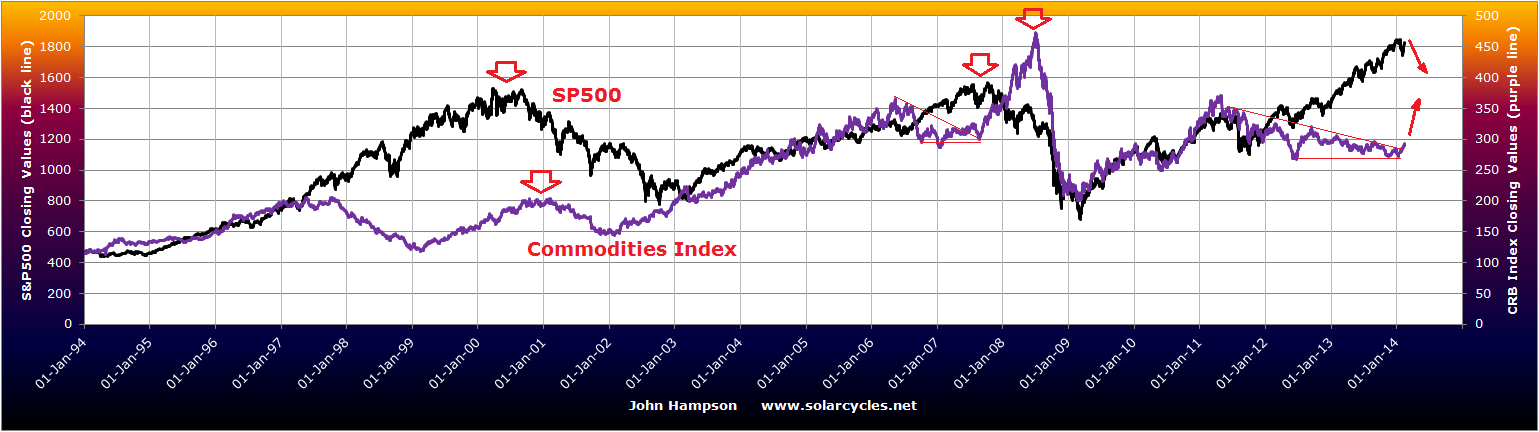
The case for commodities making a late cyclical charge now looks more compelling, with new broad momentum in the class, and siginificant breakouts. Commodities typically top out after equities and once the economy has begun to weaken, sucking the remaining life out of it. On the chart below we can see the last two such occurrences. In 2007 commodities broke out of their consolidation and into a steep rally as equities topped, and I expect similar developments this time. We have been seeing the US dollar weaken on the down days for equities, which should accelerate commodities as equities fall.

14fe4

Chart Updates

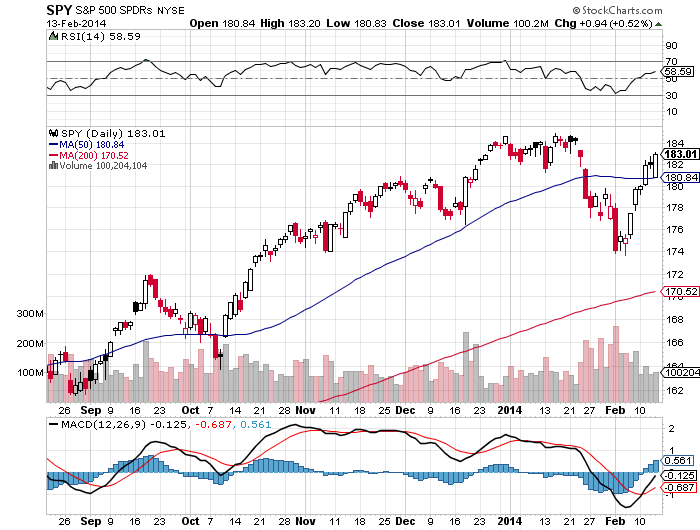
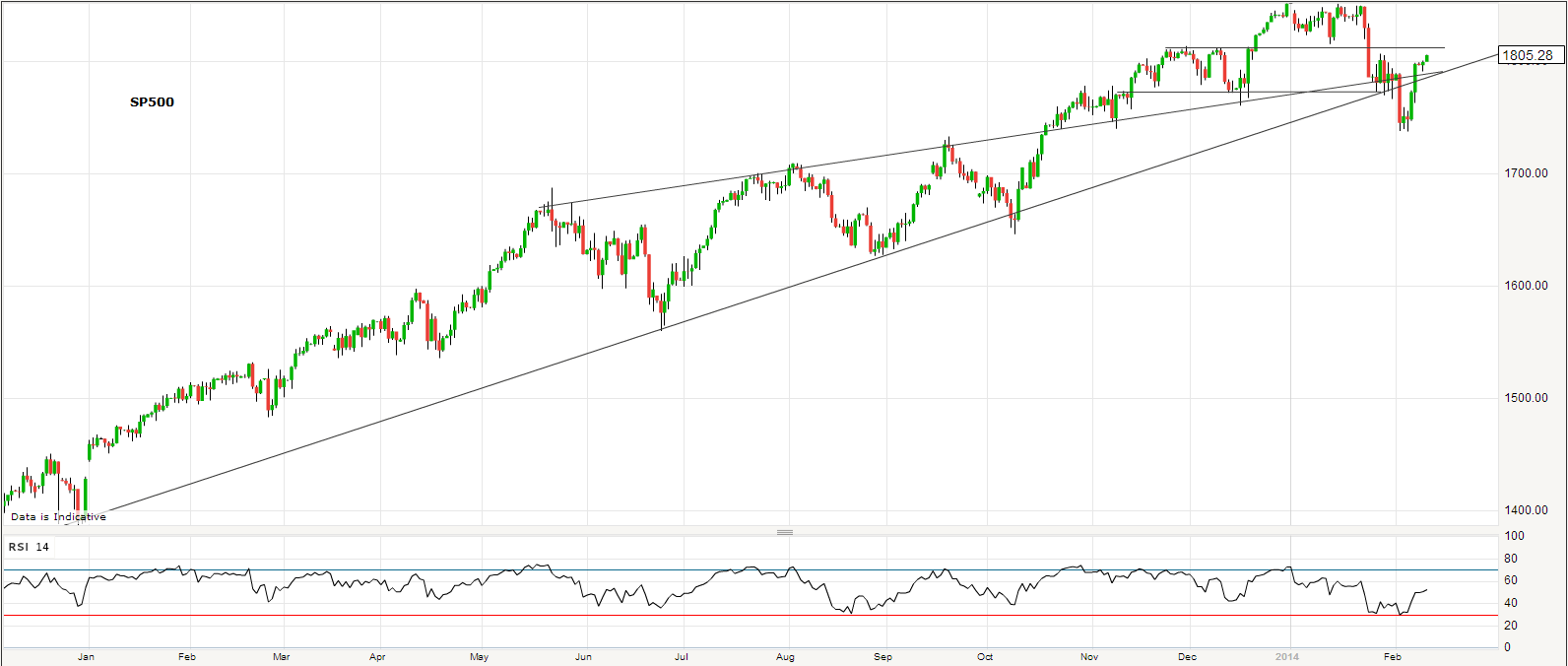
1. SP500 – the rally since Thursday has kept both bull and bear cases open:

11fe112. However, volume has been weak on the rally versus the falls – the reverse of December’s rally from correction:

11fe183. Call/Put versus SP500 – see U Karlewitz comment at bottom of chart:

11fe24. Rydex Bull-Bear versus SP500 – again see U Karlewitz comment at foot:

11fe15. Cyclicals continue to display relative weakness despite the rally:

11fe196. The Nasdaq 100 is the most bullish looking US index, but continues to reveal underlying breadth divergence:

11fe127. The Russell 2000 is currently the weakest index, but still has a long way to fall to mean-revert in valuation:

11fe178. Bull-defining parabolic stock, sector and index charts which have yet to break down (whilst others have):

11fe3 11fe411fe69. Economic Surprise Index latest – a reversal of fortunes in 2014 bar Japan:

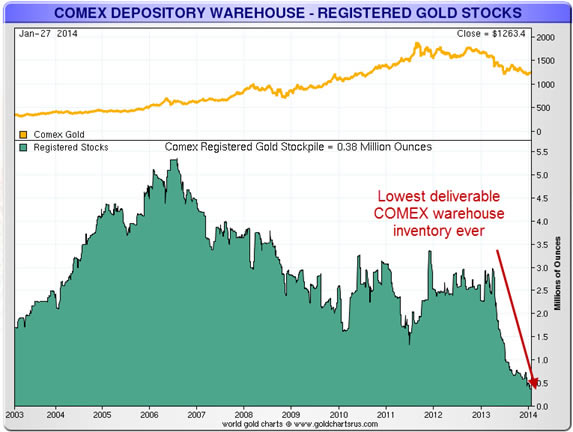
11fe7 11fe8 11fe9 11fe1010. Commodities inventories latest – tightening broadly in progress (and echoed in some softs):

11fe13 11fe1411fe16 11fe15

Gold, gold miners and treasury bonds continue to attract money flows despite the stock market rally of the last few days. I have added to my short stock index positions today and will add more if we move higher still. Based on the indicators in my last post and this, I expect the rally to top out imminently and revisit the lows of last week. At that point we can review to see if indicators have washed out more thoroughly. Based on bigger picture indicators I don’t expect the market to recover from there, but first we can judge that nearer term picture for clues. I would stop adding shorts if US indices rallied back up to their highs on good breadth, volume and renewed cyclical strength, with accompanying weakness in gold and treasuries. Yellen speaking today and likely some market reaction to her overall tone.

The Second Chance

Into the end of last week we saw a two day rally for the stock market, making for a partial retrace of 2014’s declines. So how do things stand heading into this week?

1. Capitulative Breadth has reset from 10 to zero. So no further edge from this for the bulls: its rallying potential from Wednesday fulfilled.

2. Both volume and breadth on the down days in 2014 have exceeded volume and breadth on the up days, which is bearish.

3. The volume surge in January dwarfs anything from 2012 and 2013, suggesting this correction has further potential.

4. Citigroup’s panic/euphoria model is still in Euphoria, suggesting further declines are required for mean reversion:

10fe1

Source: Barrons/Citi

5. Put/call ratios (both CPC and ISEE) did not wash out sufficiently in the correction-to-date, suggesting further downside:

10fe2Source: Fat-Pitch

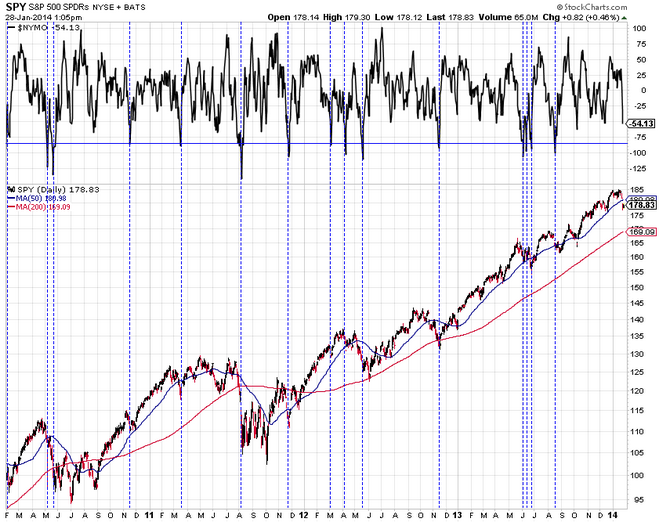
6. Nymo also failed to reach typical wash-out levels for a 5%+ decline.

7. Investors Intelligence latest bull-bear spread down to 29, but some way from the levels of previous correction bottoms:

10fe3Source: Astbury Research / UKarlewitz / My annotation

8. NAIIM sentiment down to 51, but durable lows historically sub 30, suggesting a deeper correction (Source: Fat-Pitch)

9. Skew remains historically elevated, suggesting more of a wash-out required

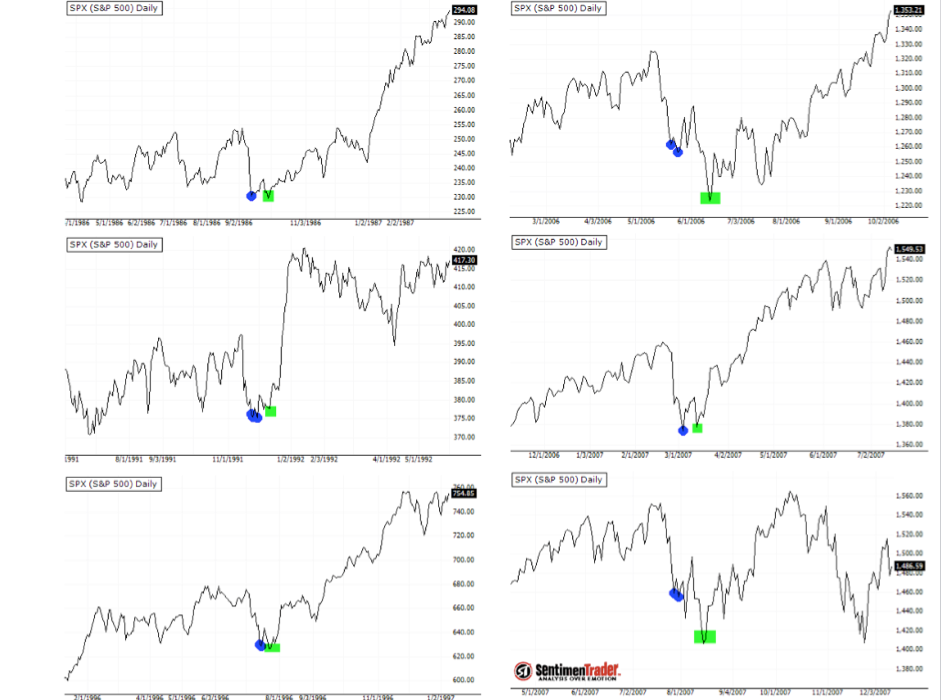
10. From Sentimentrader “Every time, since 1928, when SPX went from a 52-week high to a 70-day low within two weeks, it was higher in three-months, averaging gains of 8%”:

10fe4Such a drop from 52WK high to 70D low has occurred again in 2014. U Karlewitz has added the green dots to show that when these instances occurred there was some of kind of second low, before the rally to new highs.

In short, I have listed 8 indicators that argue for a deeper correction from here, and 1 indicator that argues for new highs, but before that some kind of second low, in the form of a double bottom or lower low. Plus 1 indicator now neutral: capitulative breadth. So that’s pretty good odds that the rally of the last two days of last week gives way to renewed declines ahead, and maybe we can time that.

11. Drawing on the 1929, 1987 Dow and 1989 Nikkei analogies (see previous posts), the peak of the ‘second chance’ partial declines retrace (the last chance to exit longs and the optimum point to short) occurred around 28-30 trading days from the high in each case. From the 31 December 2013 highs in the Dow and Nikkei, that would take us to this Wed 12 February – Fri 14 February, as a guide.

12. Looking at the biggest down days in history, there is a clustering around both new and full moons, as well as Mondays (after weekend reflection). This coming Friday 14 February is a full moon, and gives us the potential set up of falls into the Friday close, followed by a major heavy down day on Monday 17th February.

13. There is a geomagnetic storm in progress this weekend, for which we typically allow a lag of up 5-6 days on the markets. The pessimistic influence of geomagnetism together with the negativity into and around full moons, makes for dual negative pressure in the week ahead.

In short, I have a case for rally of the end of last week to give way to renewed declines during the week ahead, potentially making for large falls in the window Fri 14 Feb to Mon 17 Feb.

So what news or events are coming up as potential triggers for market movement?

14. Earnings season continues and currently shows a positive 65% earnings beat rate and 64% revenue beat rate, which may bolster the bulls, but we should be aware that this is set against a very low bar through record low earnings guidance. A more valuable picture comes from the blended earnings growth rate (8.1%) and blended revenue growth rate (0.8%) which is the sum of earnings reported and the projections for those still to come. So sales continue to be weak, as companies get by on cost-cutting, and that remains a negative for the markets.

15. The postponement of the debt ceiling issue ended on Friday and the US is projected to run out of funds to pay its bills by the end of this month, unless the Republicans and Democrats can agree on the criteria for increasing it. Whilst neither party would wish to risk default, this issue may now become a market mover again until resolved.

16. Emerging market issues may return to the fore as they continue to simmer.

17. Sunspots remain strong. This would become a threat (to the bearish case) if February produced the highest monthly spike in solar activity of solar cycle 24, understanding this is a driver of excitement and speculation. However, as previously noted, forecasts are fairly united in expecting the solar maximum to wane as of the turn of the year, and the fairly comprehensive set of cyclical bull topping indicators that already congregated support this from a different angle.

In conclusion, even if we allow for the lower probability of the solar max continuing to strengthen and a higher high in stocks still to come, we can nonetheless draw together all the points in the post above and argue that the stock market should first decline, likely starting in the week ahead and probably to a lower low, to fulfil a more satisfactory wash-out and based on a cluster of bearish signals. That would make the current ‘rip’ a sell, and thereafter we can assess again the clues for whether the ‘dip’ would be a buy. However, drawing together all the evidence of my recent posts, I maintain the balance of probability is that we have just experienced a major stock market top and that such a ‘dip’ will in fact turn out to be waterfall declines, and as such I will be adding to my short positions this week. I believe the current partial retrace of 2014’s falls-to-date will turn out to be the ‘second chance’, or rather last chance, to move from long to short on equities.

Where Are We?

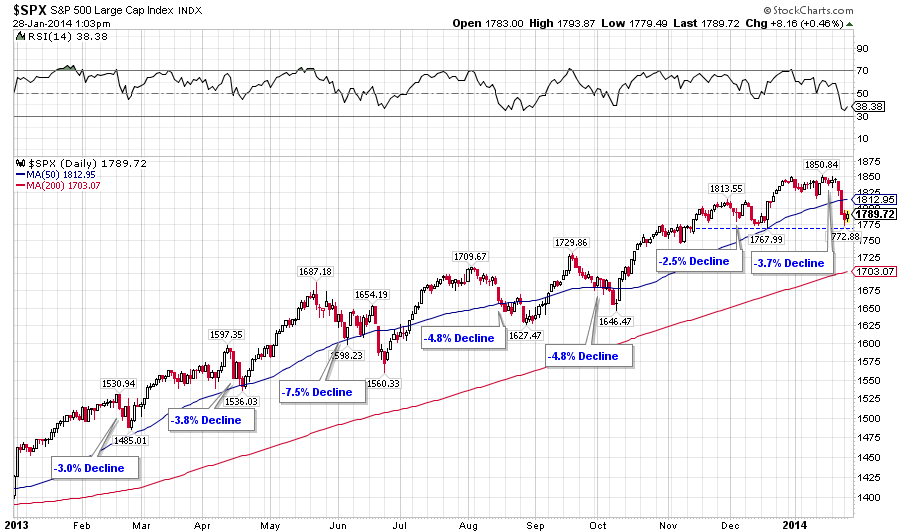
So far in 2014, the SP500 has made a correction similar to those of 2013, and a larger correction remains historically overdue:

29ja1Source: Charlie Bilello

Yesterday’s bullish candle also came at a key support level, shown dotted above.

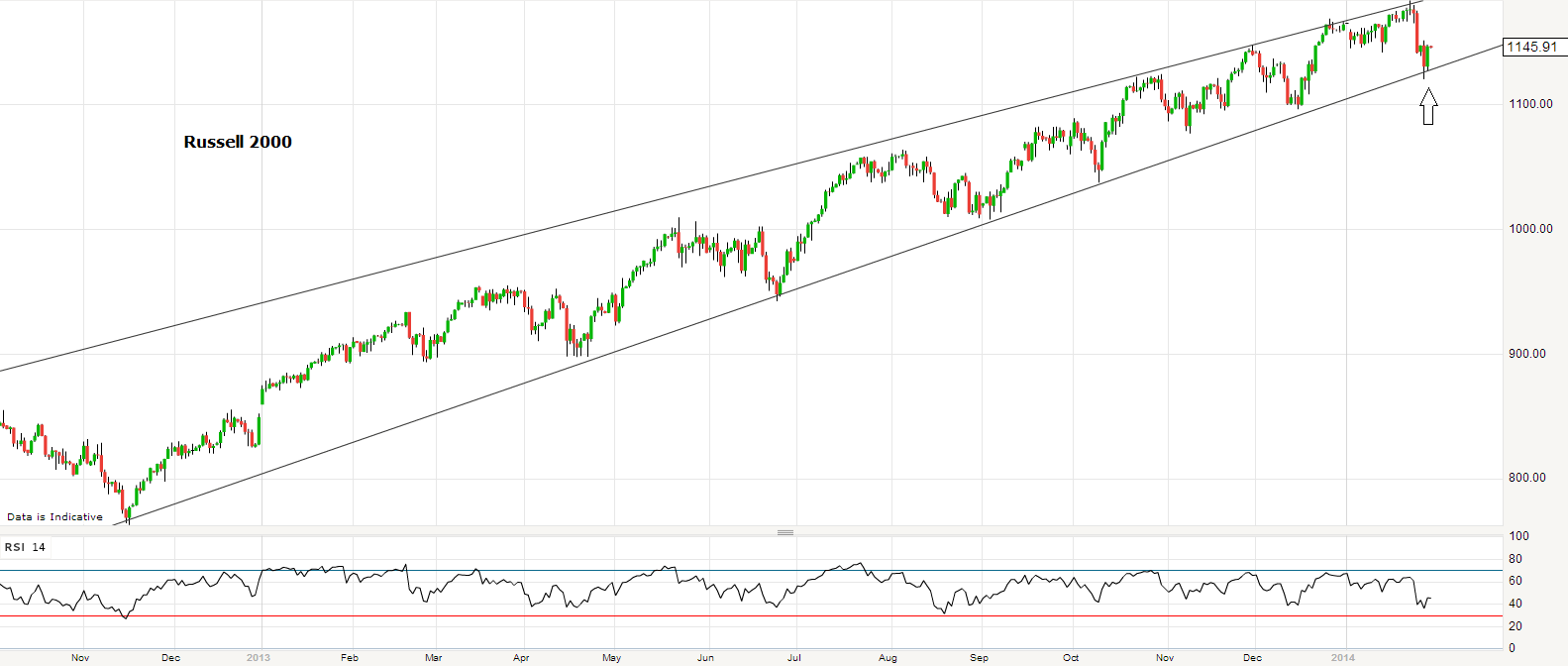
The bull save came at an important point on the Russell 2000 also, at channel support:

29ja2

Both teasingly keep bull and bear cases in tact.

Tomorrow is the new moon and we are still in a seasonal low period for geomagnetism. Barring any adverse reaction to today’s FOMC output or economic/earnings data, the next few days would ordinarily be bullish on that moon/geomagnetism combination, before we roll over on both:

Guide2014

However, the potential for a market crash remains present with the extremes reached in sentiment, leverage, Skew and positioning, echoing May 2010 and 1987.

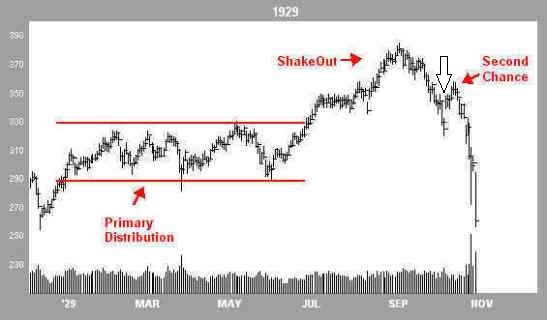
The Dow looks like this, and I have marked the potential position on the analog, given that we have pulled back to the top of the primary distribution range:

29ja3

29ja4

A little more retracing of the falls over the next few days would fit, creating a head and shoulders pattern and teeing up declines in February.

Why not head to new highs on all indices? Firstly, I had a multi-angled case for a market top 31 December 2013, which is so far being honoured on Dow and Nikkei (and Sp500 double top). Secondly, this is a parabolic top rather than a topping range, and we see typically see similar lower-high second-chance patterns on parabolic bubble charts, as opposed to marginal higher highs on divergences in topping ranges. Thirdly, there is a change in backdrop here in January: economic data has started to disappoint in line with leading indicators having predicted an economic peak between November-February and we have seen money flows into treasuries and defensive sectors away from cyclicals. Fourthly, the correction in equities over the past week has further to go, by multiple indicators.

The put/call ratio still signals complacency:

29ja5Source: Stockcharts

Nymo suggests more downside is required to complete a wash-out:

29ja6Source: Charlie Bilello

Friday was a 90% down major distribution day, and typically from a new high they normally come in clusters of more than one. Yesterday’s volume was unimpressive which also hints at more downside ahead. Skew remains elevated and divergence in breadth has increased. Sentiment measures are still lopsided.

December margin debt data is in, hitting a new record and an even steeper spike:

29ja7

Source: STA Wealth

It has now reached 2.6% of GDP, similar to peaks in 2000 and 2007. With January’s price action in the stock markets, I expect that may turn out to be the peak in leverage. If margin debt, stock indices and the solar maximum peaked out at the end of December it will echo March 2000 where all peaked out together.

It remains too early to judge whether commodities are going to rally as a class as late cyclicals. Precious metals continue to base but are as yet without momentum. I believe that will come once equities more clearly enter a downtrend. Energy has been firmer, in part linked to the US cold spell, but whether oil and gas can rally if stocks more sharply decline remains to be seen. The risk-off days that we have seen have typically been pro-yen and anti-dollar, which could mean we see the support for commodities of a declining US dollar, should those equity declines erupt again. Soft commodities have yet to advance in a meaningful way, but scientists believe El Nino is forming and historically this has been positive for agri prices through the supply effects of increased droughts and floods. El Nino years have produced some of the hottest years on record. Global temperature variation has a correlation with solar cycling once the global warming trend is removed, so the combination of the solar maximum and El Nino would give potential for a new hottest year on record, but we will see how things develop.

China’s repo rate remains elevated heading into their week-long holiday. The markets welcomed Turkey’s large rate hike, but emerging market issues continue to simmer. US earnings reports this season have so far had a similar theme to previous quarters: poor revenues or weak sales guidance, profits through cost cutting, and share buybacks. The blended earnings growth rate for Q4 is 6.4% so far, but the blended revenue growth rate is just 0.7%.

29ja8Source: Yardeni

Barring some stellar revenue reports in the remainder of the earnings season, this is another impediment to further price gains in US equities.

Economic Growth, Demographics And Solar Variation

Economic growth occurs two ways: increasing population and increasing productivity per capita (which can be achieved through technological evolution and improvements in organistation/management/systems). Both increase overall GDP.

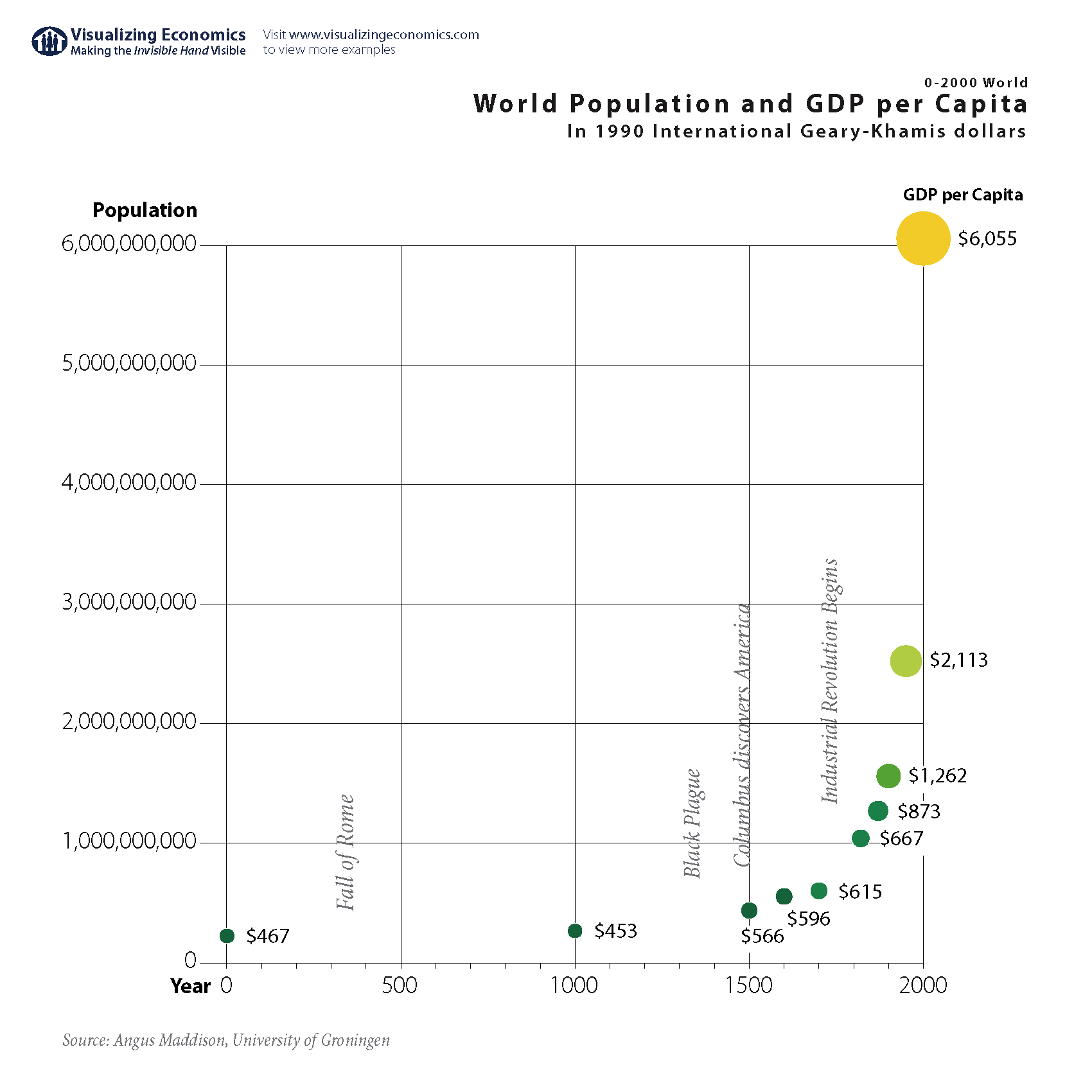
World population has grown exponentially over the last 2000 years:

24ja1

Source: Sub-dude

As has GDP per capita:

24ja2

Source: filipspagnoli

A principle of the globally adopted capitalist economic model is that compound growth enables long term poverty reduction: that people can pursue their own self-interests and help themselves to disproportionate shares of the pie as long as the whole pie grows so that more people find themselves better off than less. Hence countries typically target 2%-10% annual growth, which when compounded means exponential growth. To achieve exponential economic growth we need either exponential population growth or exponential per capita growth (ideally both). The latter reflects human progress and technological evolution whereas the former is more of a ponzi scheme, requiring ever increasing numbers of people to maintain an ‘illusion’ of increasing prosperity.

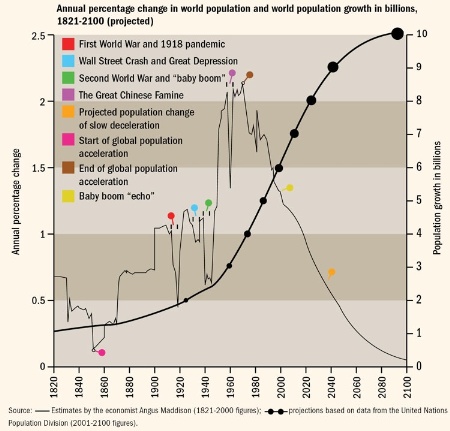
Something changed around the 1970s. The growth rate in world population went into decline:

24ja3

Source: TimesHigherEducation

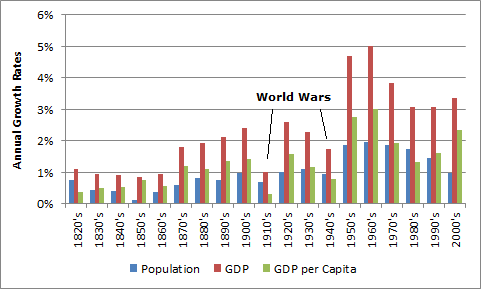
World GDP growth and GDP per capita growth also trended to a peak.

24ja4

Source: DoctorCopper

The pick up in GDP and per capita GDP in the 2000s is now rolling over again, suggesting the secular trend remains down:

24ja5Source: TheNextRecession

24ja7Source: TheNextRecession

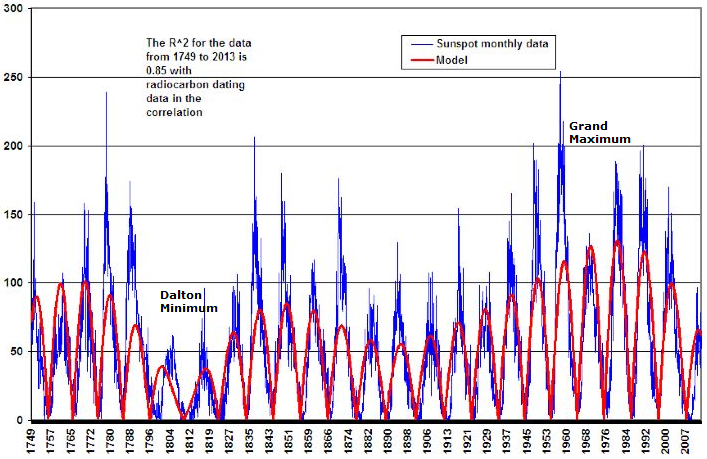
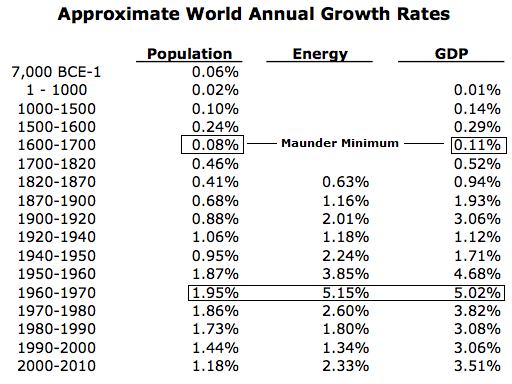
The peak in population, GDP and GDP per capita growth rates fits with the peak in solar variation: the grand solar maximum:

24ja6Source: WattsUpWithThat

The trend in long term solar variation suggests we are now headed for another minimum, like the Dalton or Maunder. These historic minima corresponded to lower GDP growth and lower population growth, cementing the relationships between the three.

Inflation also peaked around the 1970s:

24ja8Source: Yardeni

As did growth in energy supply.

24ja9Source: Financial Press

Declining rates of growth in population, GDP, GDP per capita, inflation and energy supply spell major trouble for a global system reliant on exponential economic growth as well as inflation and employment targetting. However, the true impact of this has been postponed in two ways.

Firstly, the ‘gap’ has been filled by increasing debt:

24ja15

Source: isj.org.uk

However, we have reached the point of debt monetisation in US, UK and Japan, i.e. the end game. The question is how long the end game can last.

Secondly, sub-demographic trends of the major economic nations have largely been supportive since the 1970s, peaking out in phases.

Here is US population growth per decade. Forward it by 40 years so that the births become the important ‘middle’ age bracket and we get the secular trends in real US stock prices: down into 1980, up into 2000, then down projected out to 2030.

24ja10

Source: Business Insider

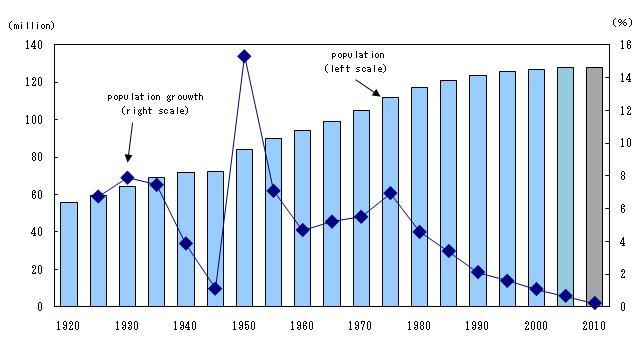
Here is Japan’s 5-yearly population growth rate. Again, forward it 40 years and we have a big spike in the middle bracket to deliver a major peak in equities and real estate around 1990, a small relief uptrend in the current window 2010-2015 (as we have been seeing) and otherwise a fairly grim outlook.

24ja11

Source: Stat.go.jp

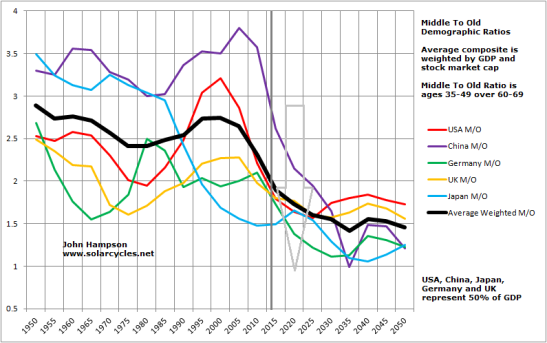
Collective dependency ratios, middle-to-old ratios and net investor ratios in the major nations were largely positive until recently, with China the last to break down: 

24ja12 24ja13 24ja14

In summary, we have postponed the impacts of the major growth rate peaks (GDP/GDP per capita/population) of the 1970s through debt until we have reached the point of monetisation, and the support from demographic sub-trends of the major nations has now expired. Solar maxima have historically given way to recession, and solar variation predicts a new grand minimum ahead which has historically correlated with low GDP and population growth. I am therefore led to the fairly bleak conclusion that this solar maximum speculative peak will turn out to be a major historic peak for the world.

Timing Major Market Peaks

Starting on the smallest timescale, and working up to the largest.

1. Timing within the month

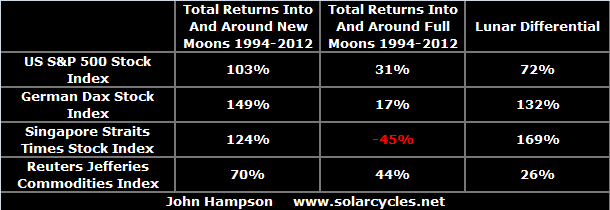
Lunar phasing influences human sentiment. It produces fortnightly oscillation in the stock market: positivity/optimism around the new moon and negativity/pessimism around the full moon. The cumulative influence of this can be seen in stock market returns over the last 20 years:

LE1

In keeping with this, we find that major market peaks typically occur close to new moons, around maximum optimism/positivity:

NewMoonMajorPeaksThis adds to the case for a peak having occurred in equities on 31 Dec 2013 (Dow and Nikkei, plus SP500 double top with 15 Jan), associated with the Jan 1st new moon. If that proves to be false and equities break higher, then a future new moon (next one Jan 30th) may produce the timing of the major peak.

2. Timing within the year

Geomagnetism influences human sentiment, with higher geomagnetic disturbance associated with negativity/pessimism. The inverted seasonality of geomagnetism correlates closely with stock market seasonality, and typically we find that major market peaks occur close to the peak in both, around the turn of the year:

13jan50

13jan11Gold made its secular peak on 21 Jan 1980.

Again, this adds weight to equities having peaked 31 Dec 2013, but if that proves false, then we might expect a final peak still to be at hand, in January, before the seasonal model turns down.

3. Timing within the decade

Solar maxima occur roughly every 11 years and produce human excitement, which translates as protest, war, and speculative excesses in the markets. Major market peaks typically occur at the solar maximum, close to the smoothed peak and on a monthly spike in sunspots.

SolarMaximaParabolicPeaksWe can measure speculative excesses in terms of market valuations, sentiment readings, leverage and technical indicators and we see a cluster of these in US equities currently. Solar forecasts, solar pole flips and sunspot counts collectively suggest the smoothed maximum and monthly sunspot spike may be occurring Dec 2013 into Jan 2014, which in association with those speculative excess readings, again adds to weight to a possible peak in the Dow, SP500 and Nikkei.

4. Timing within the century

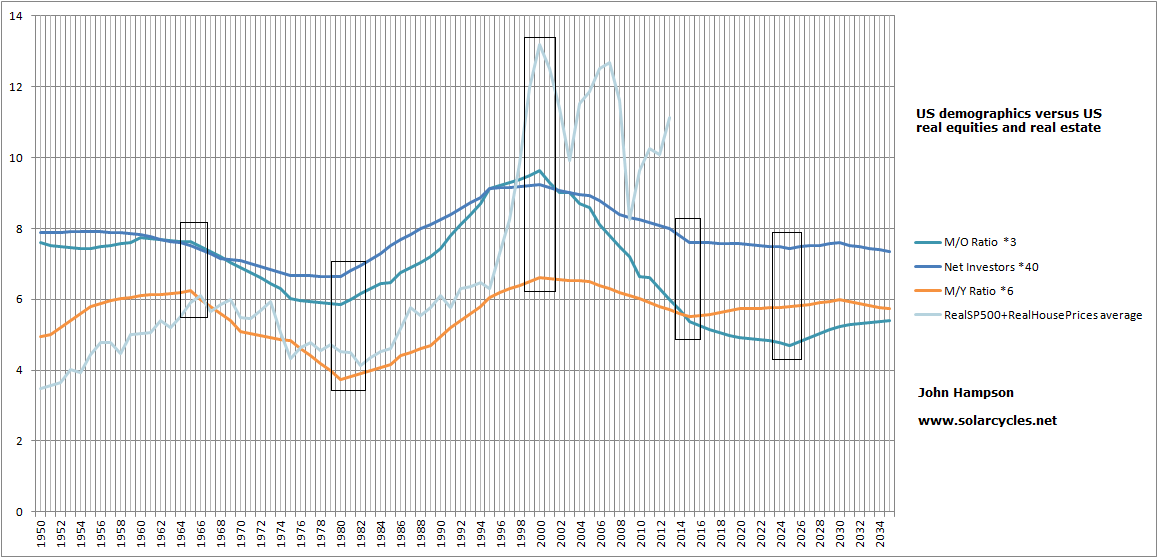
Demographics drive secular bull and bear markets, as swells in investor or disinvestor age groups produce periods of upward or downward demand for equities. Japan’s secular stocks bull ran through 4 solar cycles due to a long positive demographic trend from the late 1940s to around 1990. Japan’s middle-to-old, middle-to-young and net investor ratios all peaked in the late 1980s, and accordingly we saw Japanese equities terminate with a speculative excess at the 1989 solar maximum, and thereafter move into a secular bear in line with demographic downtrends.

US demographic measures for equities demand peaked around 1965. The real SP500 peaked November 1968, terminating with the solar maximum of November 1968. Thereafter US equities entered a secular bear market, whilst gold, as the anti-equities or anti-demographic asset, entered a secular bull market. Demographics and equities bottomed around 1980, whilst gold made its secular speculative peak, all timed with the Dec 1979 solar maximum.

X1

US demographic ratios were collectively positive from 1980 to 2000, enabling a secular bull market in equities lasting 2 solar cycles through the speculative finale of March 2000, which was again a solar maximum. Gold endured a secular bear market through those two decades, bottoming out as demographics turned down around 2000, and entering a secular bull market.

Looking forward we see a slight divergence in the 3 charted demographic measures: the middle-to-young ratio bottoms out around 2015 but the middle-to-old and net investor ratios not until around 2025 (shown boxed above). When we draw in collective downward demographic trends for Europe and China, the greater likelihood is of a secular bear in US equities (and a secular bull in gold) lasting through to around 2025, rather than ending now. Solar cycle 25 is predicted to peak around 2023-2025, which would provide the timing for a speculation secular peak in gold.

There is a correlation between solar cycles and birth rate, with evidence of an 11 yearly peak in births. There is also evidence of a link between economic prosperity and birth rate, whereby births decline in recessions and bear markets and increase in the good times. Combining the two, we have the framework for alternating positive and negative demographic swells which peak or trough around solar maxima, and hence we have historically reliably seen demographic trends and associated speculative asset bulls/bears peak and terminate around sunspot peaks.

Therefore, the secular bear in US equities that began in 2000 is likely to continue through to around 2025, and the secular bull in gold that began in 2000 is likely to continue to and peak around 2025. In support of this we see current historic overvaluations in US equities that argue for further reset in stocks ahead, and a lack of speculative mania for gold at the current solar maximum.

17ja1 17ja2Both charts above model the historic trends in US demographics and the terminations at solar maxima, and the projections forward are the extensions of these phenomena. The ‘mean reversion’ common to to them both reflects the transience of demographics (a young dependents swell headwind will become a middle-age swell tailwind which will become an old-age swell headwind) and the double-excess produced by solar maxima (demographics stretch demand by population, solar maxima stretch demand per capita) before sunspots cycle down again. The biggest mania of all-time is clear to see on that second chart: the dot.com boom. Not only does mean reversion subsequent to that mania have some way to go (a wash out to -50%) but demographics support this occurring.

To summarise all the above, and make it useful looking forward, we can time major asset peaks by probability (there are no dead certs, and exceptions occur). Any major asset peak will probably occur close to a new moon, typically around the turn of the year, and normally at a solar maximum. Demographics guide at which solar maximum a secular asset peak will likely occur and whether a solar maximum should deliver a secular or cyclical speculative excess.

Forecasts for gold and equities

We are currently at the likely solar maximum for solar cycle 24, at the turn of 2013 into 2014. Demographics are supportive of a secular bear in equities (that began in 2000) continuing through to the next solar maximum circa 2025, and similarly a secular bull in gold (2000-2025). The speculative excess in equities that we are seeing in association with SC24 maximum should be a cyclical peak. The timing of that cyclical peak in stocks has good odds of being around the turn of the year (2013 into 2014) and close to a new moon. That makes a top close to Jan 1st 2014 a contender, and failing that one near Jan 30th 2014 (the next new moon). Again, these are just probabilities, but if we take a different angle and look at indicators such as II sentiment, put/call ratio, skew, deviation above MA, yield-tightening ROC and margin debt, then we have a case for equities to begin to fall ‘imminently’, regardless of solar maxima and lunar phasing. Combining both, the case becomes more compelling for a top here.

Gold’s secular bull began in 2000, and like all secular bulls, it has been in a strong dominant uptrend punctuated by occasional cyclical bears or corrections. Below we see the US equities secular bull progression 1980-2000 contrasted with gold’s secular bear in that period (cyclical bulls and bears within an overall downtrend).

17ja3Source: Stockcharts

Gold’s secular bull of 2000-2025 should be a strong dominant uptrend like stocks 1980-2000, or like an extended version of gold’s last secular bull of the 1970s.

17ja4The cyclical bear of Dec 1974 to Aug 1976 occurred as the Dow rallied from a Dec 1974 low to a Sept 21 1976 top, with gold’s secular bull momentum resuming as equities topped out. We could therefore expect something similar to be occurring now, and this is supported in the oversold, overbearish extremes reached in gold and miners and the technical basing that appears to be currently taking place.

A threat to bullish resumption in gold is the current excess leverage we see in evidence in margin debt, net investor credit and Rydex leverage. If sharp falls erupt in equities then a period of forced redemptions could mean blanket selling of assets, as occurred in Autumn 1929 and Summer-Autumn 2008. Gold /miners escaped neither, in short-lived but sharp pullbacks. In THIS post I compared the topping process analogies of 1929, 1987 and Nikkei 1989 to the Dow today, and based on that we might expect sharp falls to erupt as of mid-February. There is a history of steep falls occurring at the seasonal geomagnetism peaks of around March/April and October, and occurring on Mondays once investors have had a weekend to mull over doubts. So by probability we might this time look to the particular potential of Mondays in the period March-April 2014 for heavy falls to erupt. Potentially then, we could see gold and miners rally until then, but be dragged back during such heavy stocks selling, thereafter resuming the secular gold bull in earnest.

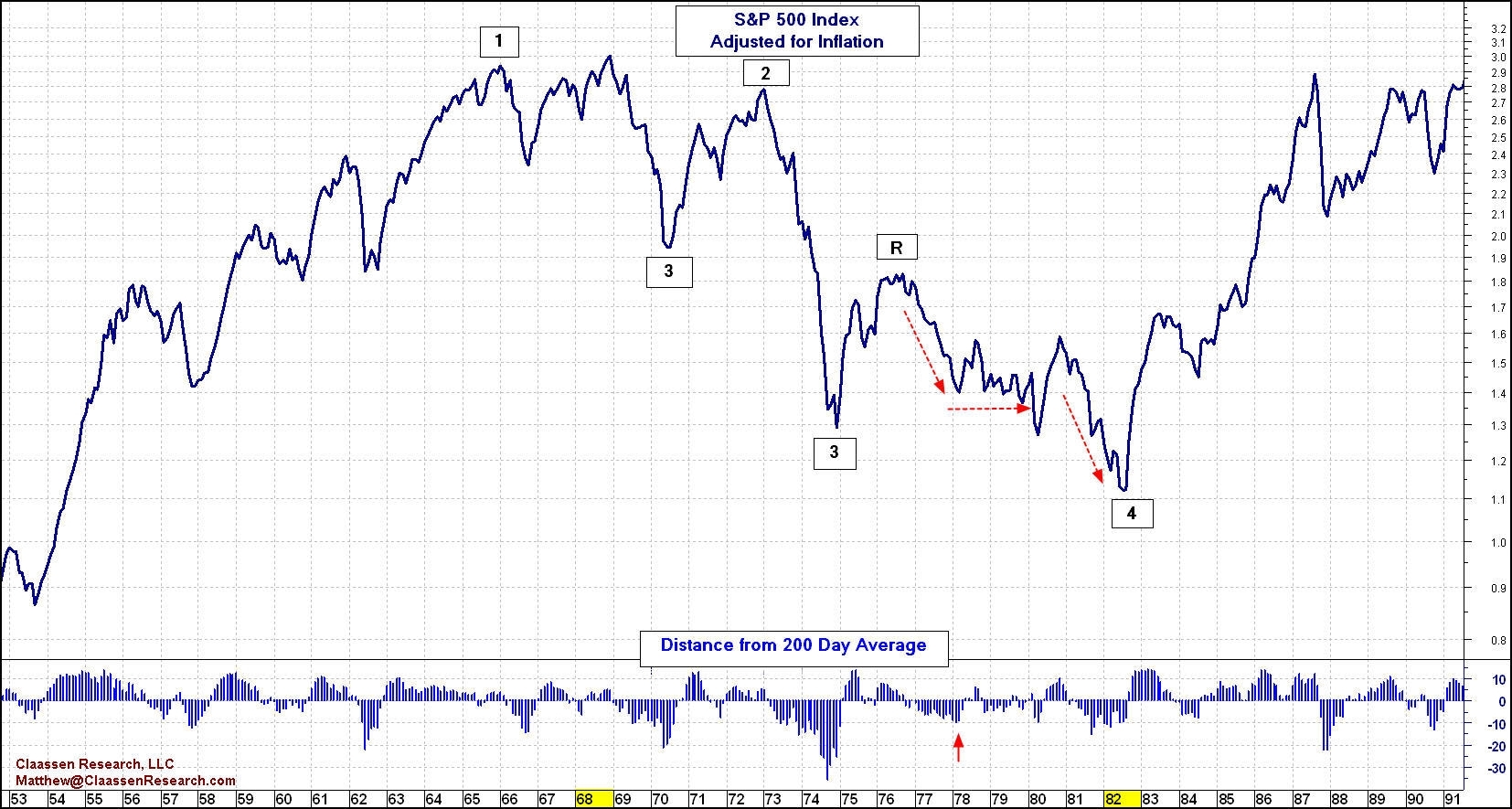
Equities should now enter a new cyclical bear market, and continue to alternate cyclical bulls and bears within a secular stocks bear through to around 2025. By demographics (and as is becoming evident in economic data) this should be under deflationary rather than inflationary conditions, and this makes an important difference to nominal prices. The path of US equities for the next 10 years should look similar to the 1990s to early 200s Nikkei or the real inflation-adjusted 1970s SP500, with lower highs and lower lows:

17ja5Source: SeekingAlpha

Using Russell Napier’s maths (taking valuations back to historic washout levels), then we have a target of around 3500 on the Dow by my target of around 2025. Again drawing on history, odds are we get there in a couple of cyclical bull-bear oscillations, and hence something like this:

17ja6It is an initially shocking chart, but it is in keeping with deflationary demographic projections and valuations washout. Plus, this has already happened before: to the Nikkei, under the same twin circumstances.

Expecting the Dow to be sub 4000 by 2025, and gold to be making a parabolic solar-max finale to a strong secular bull, the Dow-gold ratio should bottom beneath 0.5, potentially even beneath 0.1. But the one factor that I have not mentioned so far is central bank intervention.

It is certain that a tipping over into deflationary recession and equities bear will draw further response from central banks. If equities start to decline for the next couple of months but in a measured way and economic data disappoints (as predicted by certain leading indicators) then I would expect the Fed to stop tapering QE and wait-and-see, and otherwise little change. If equities then start to accelerate declines and economic troubles escalate and we enter a dangerous feedback looping, then we should expect the Fed, and other central banks, to up the ante and go more unorthodox. Quite what that will entail remains to be seen, but drawing on history, recent and past, this could mean imposing restrictions on shorting shares, preventing capital from leaving the country, ‘strong-arming’ into treasuries, and more direct, targeted inflationary tactics. There is of course the potential for increased nationalism and for hostilities between certain nations to increase (USA-China, China-Japan) as internal problems escalate.

I don’t want to speculate too far ahead, but I see major lasting opportunities at hand in short equities and long gold, tempered by realism over what central banks will do should my projections come to pass. Monetising debt whilst tipping over into deflation under unprecedented collective demographic downtrends which should mean a further decade of secular stocks bear and global economic weakness is a very bleak outlook. As a trader, I think the biggest gains are potentially to be made at the front-end of that, in case the rules get changed. Speculators making money out of an economic crisis are an easy target. It very much depends on how things come to pass, whether we are nursed through another ‘lost decade’ or whether things are about to become acute, under a global deflationary recession, a debt-monetisation end-game or a de-railing and bubble-bursting of China’s economy.

In the near term, I continue to look for clues in the markets for the equities/gold, bull/bear switch. I am long gold, short equities, and looking to add to both on further confirmations of reversals in fortunes.

Stock Market And Red Flags Update

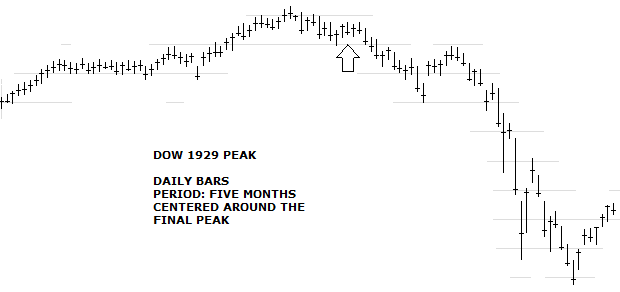
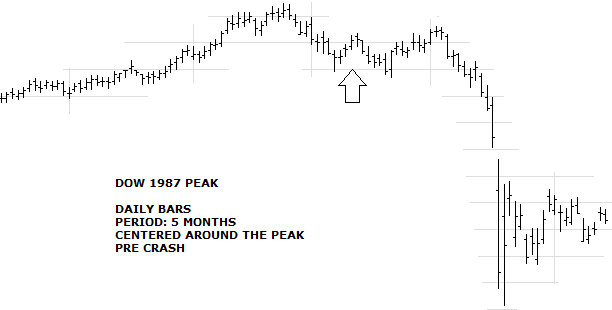
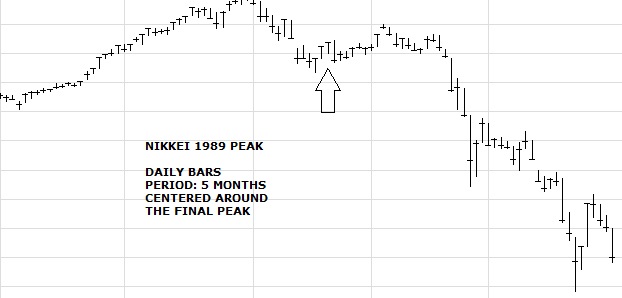
Yesterday’s strong up day in the SP500 and Dow claimed back a significant chunk of the previous day’s losses, but less than the full amount and on lower volume. Unless we see follow through on this over the next few sessions to break out to new highs (above Dec 31) on momentum, then this is still consistent with the 1929 and 1987 Dow peaks and the 1989 Nikkei peak, in that we should see several weeks of battling between bulls and bears. I have marked with an arrow where I see us, as the timings in these analogies are fairly consistent with each other.

Dow1929b Dow 1987b Nikkei1989bThese are guides, so the technical shaping of the indices this time round won’t look exactly like any of them, but the idea is the same: many major topping signals are in place but with such extreme bullish sentiment and positioning, a process is required to gradually change perception. Since Dec 31, we see a tug-of-war between bulls and bears but with an overall downward bias, and the topping process is so far in tact. If I am wrong about the Dec 31 timing and the bulls regain control and we see a break out on momentum, then I would see the markets going yet steeper parabolic before a similar peaking process coming to pass. As previously indicated, the confluence of warnings and flags suggest this should occur by March at the very latest.

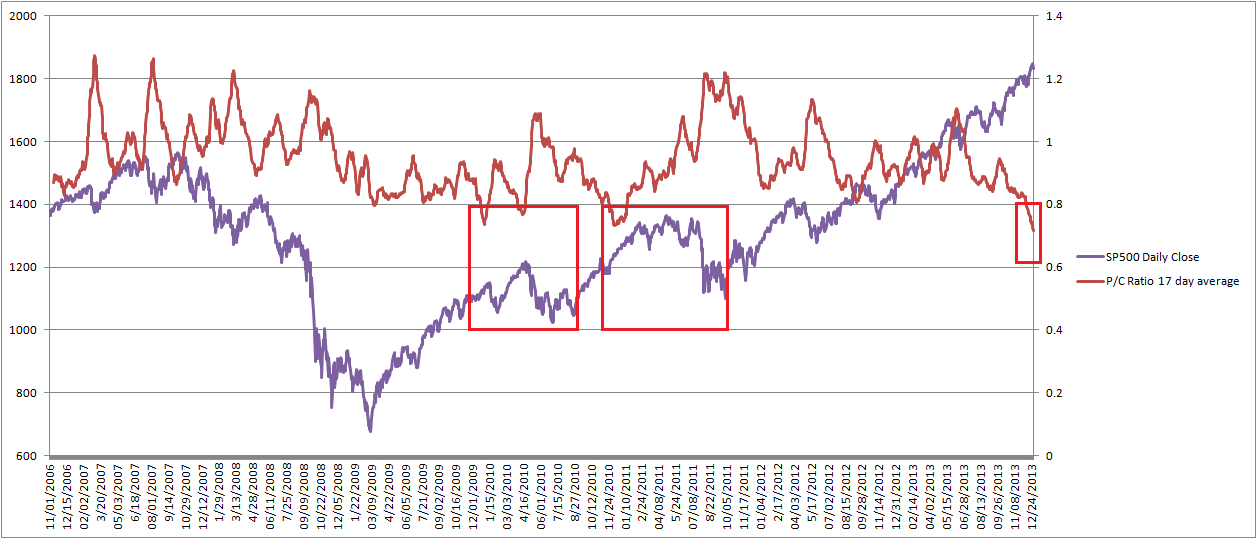
Monday’s falls did nothing to temper the put/call ratio. Below is the 17 day average versus the SP500. The current extreme beats the other incidences of sub 0.8, but in both those cases a correction followed.

15jan1Risk of an outsized move persists with the Skew still evelated at historic extreme levels:

15jan2Sentiment measures remain collectively extremely bullish (contrarian bearish) and continue to be a red flag:

15jan3Distance above the weekly 100MA is at a historic extreme and warns of a deep pullback:

15jan4

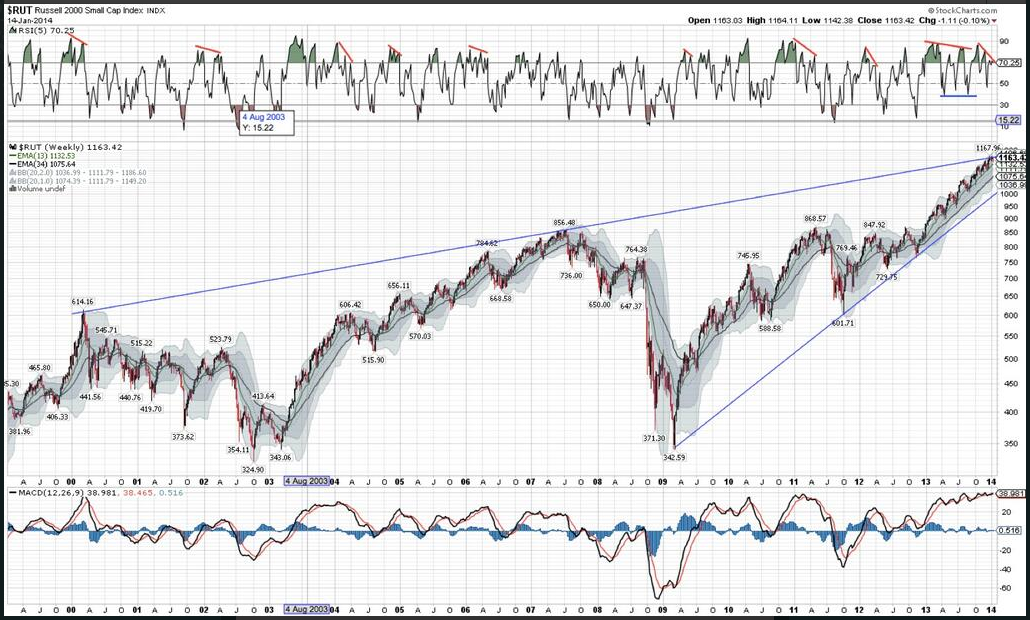
RSI divergence and long term resistance set the scene for the Russell 2000:

15jan6

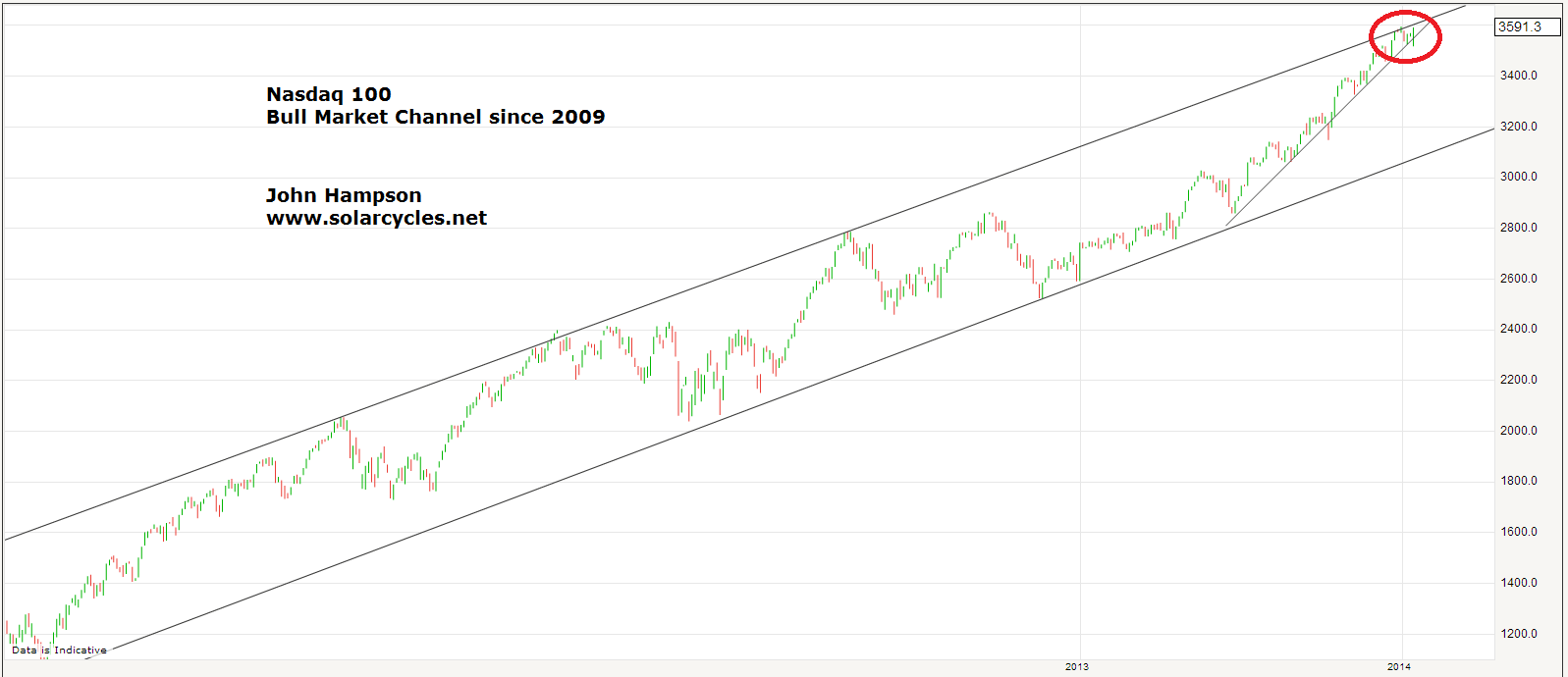
Nasdaq 100 is also at important resistance. Break up and out, or break down here?:

15jan7

Rydex buying power, which is money-on-the-sidelines, is at very low levels, which is consistent with other measures of ‘all-in’:

15jan8

Sentiment against bonds and gold miners remains depressed, whilst bonds, gold and gold miners look finally to be basing. OECD derived leading indicators point to a global economic peak Jan/Feb, whilst narrow money leading indicators point to a global economic peak having occurred around November. Economic Surprises are in the historic high range for the US, and as this is a mean-reverting indicator (analysts will accordingly raise economic forecasts) we should see a a twin-negative going forward in worsening data versus elevated expectations. Earnings season for the US now starts to ramp up, with the most negative guidance on record. In short, I see everything in place for money to exit equities and move into gold and bonds, but this is a process and patience is the key.