Equities Red Flags

1. Nasdaq Big Money Shorts:

7jan1Source: Sentimentrader

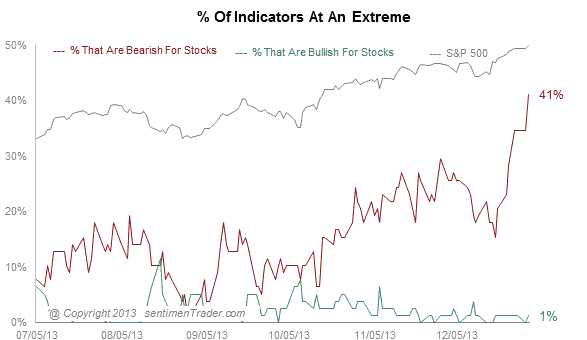
2. Percentage Of Indicators At Bullish Or Bearish Extremes:

7jan2

Source: Sentimentrader

3. NAAIM Sentiment Survey:

7jan4

Source: PensionPartners

4. Margin Debt Relative To GDP:

7jan3

Source: GuruFocus

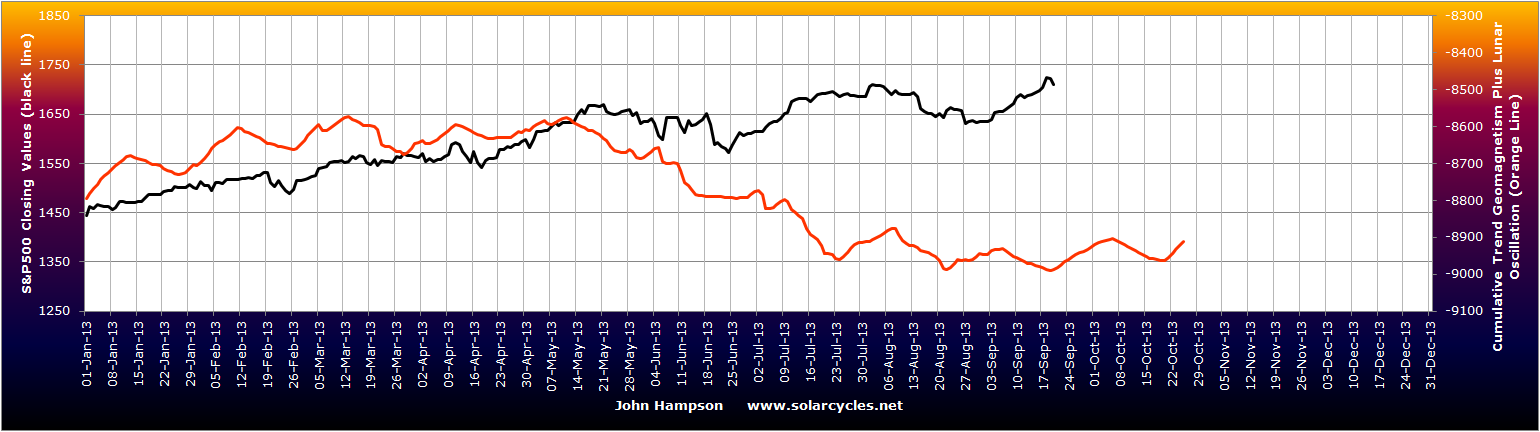
5. Lunar Geomagnetic Model January Peak:

Guide2014

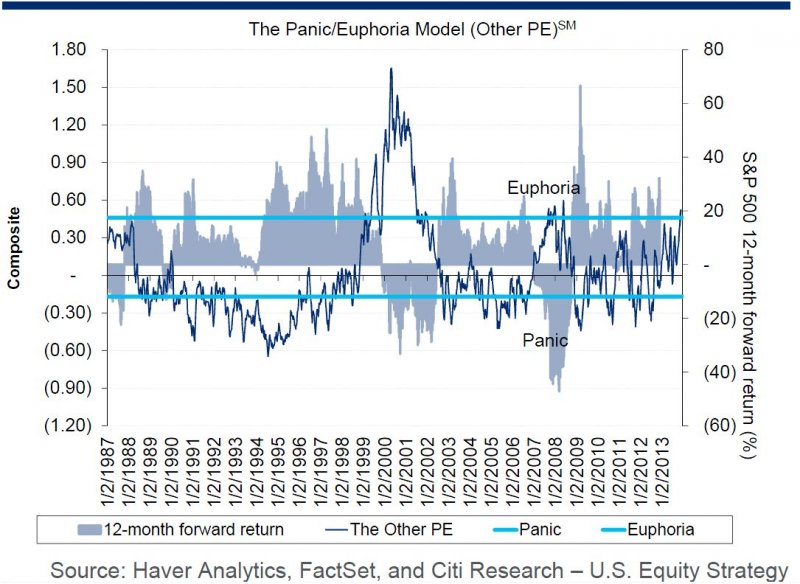
6. Citi Panic/Euphoria model further into Euphoria (to +0.6 from 0.52):

7jan5Source: Barrons/Citi

Solar Maximum Delivers Speculative Parabolics

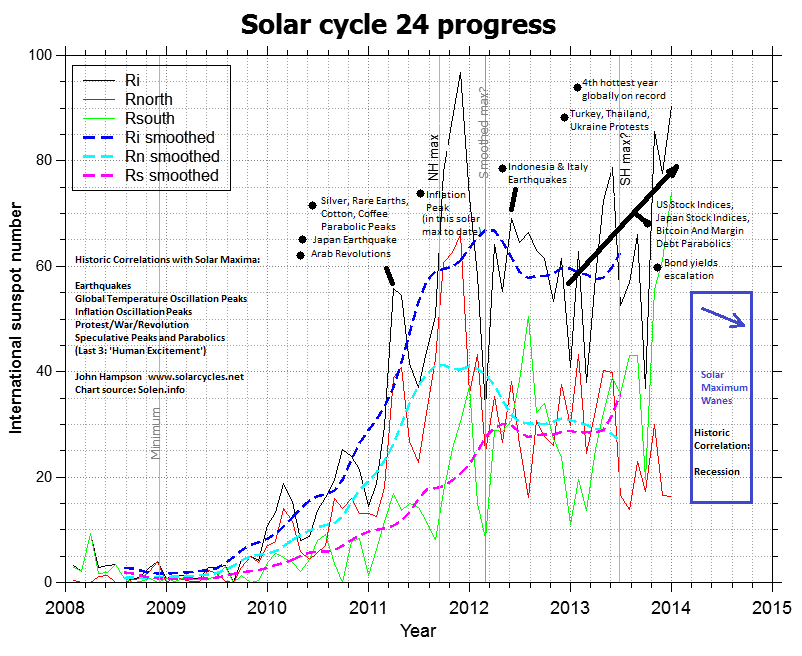
Historically, solar maxima have correlated with earthquakes and peaks in temperature oscillation. They have also correlated with protest/war/revolution, inflation oscillation peaks and speculative parabolic peaks (often secular bull peaks). With both magnetic poles now having flipped for SC24 maximum, I’ve annotated the following chart from Solen:

6ja1The Japanese and Indonesian earthquakes were both amongst the highest Richter magnitude quakes ever recorded. The Italian earthquake was one of the most devastating ever in property damage.

2013 was the 4th hottest globally on record. Historically we have seen global temperature oscillate into a peak around the solar maximum.

The Arab Spring was a world-transforming series of major protests and revolutions. The Turkey, Thailand and Ukraine protests were amongst the largest ever in terms of participants.

We saw a series of commodity price parabolics peaking out towards the early part of the maximum, and we currently see a series of stock index parabolics (plus margin debt parabolic), which, with history as our guide, should peak out as the solar maximum starts to wane this year. However, we don’t know at what point that waning begins. By NOAA and NASA predictions it should be now, but by SIDC’s foreast it could be as of mid-2014. With 225 sunspots currently, it still appears to be in an uptrend:

A2Either way, the annotated top chart is unlikely complete. We could yet see further earthquakes, or greater temperature extremes in 2014, or more geo-political unrest, or more speculative mania. But without any more such developments, solar cycle 24 has re-affirmed those correlations.

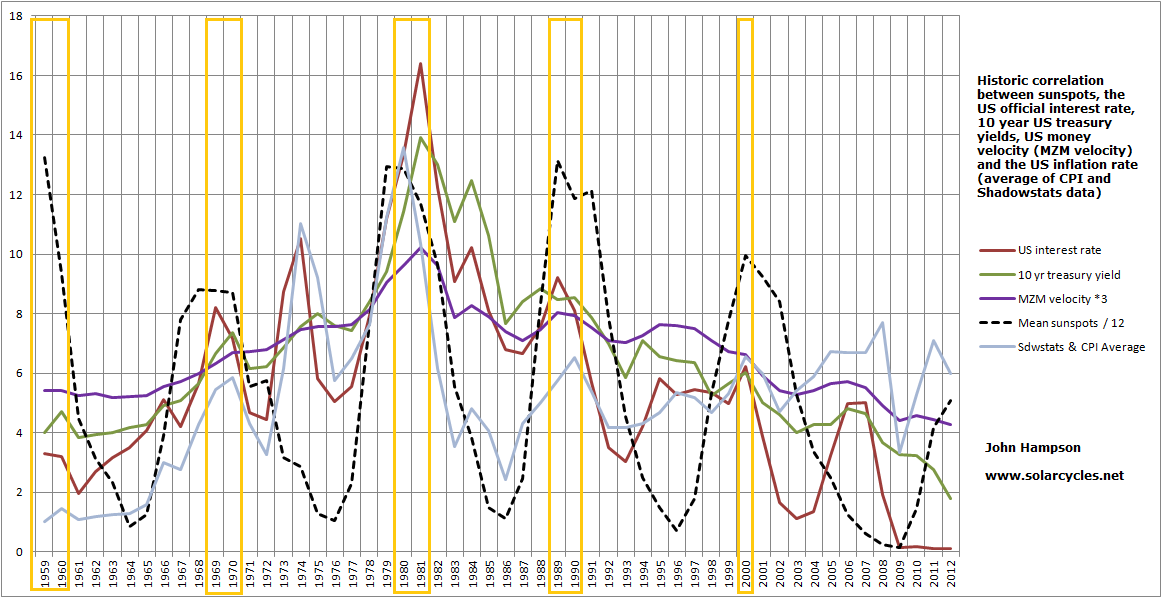
Historically, the solar max then gives way to economic recession. Global recessions (if based on where real global GDP has been less than 3%) occurred in 2001-2 (SC23 max 2000), 1990-3 (SC22 max 1989) and 1980-3 (SC21 max 1979). Several factors may contribute to why this is. Geomagnetism, which is negative for sentiment, peaks after the solar max. Inflation, yields, rates and speculation all typically peak into the solar max, which collectively can tip an economy into recession. The chart below shows those correlations.

10may20131This time, we have not seen any interest rate rises, but we have seen a rate of change in bond yields in the last couple of years which is comparable to that marking previous tops. Inflation peaked out early in the SC24 max and is currently depressed, in keeping with collective demographic trends (money velocity has also diverged in line with demographics). There remains the possibility that commodities make a late-cyclicals charge and deliver a temporary inflation shock, but I’m not so sure.

Prior to all my demographics research earlier this year, I expected commodities to be the speculative target of this solar maximum, and to make their secular peak here, with gold the leading asset. However, by demographics gold has some years further to run, and is more likely to make its secular peak at the next solar maximum, or even beyond.

DemographicsDowGoldRatioGlobalGDP

That commodities have made secular peaks each 3rd solar maximum to date appears a pattern, but I believe is instead is demographic, but this will only be validated in the months and years ahead.

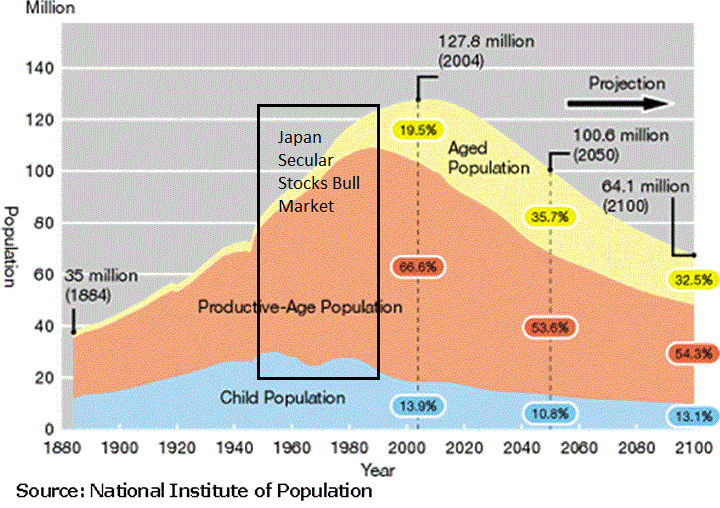
Let me explain. Japan enjoyed a long secular bull market from the late 1940s to the late 1980s, as shown in the first chart below, through 4 solar cycles. The second chart shows that this was because of a long demographic golden period, where productive-aged population ballooned, old-aged dependents stayed low, and child dependents were in decline.
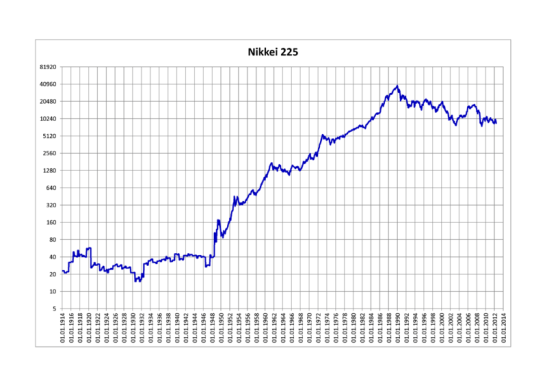
26dece126dece2

The Nikkei peaked in 1989, in a parabolic, along with solar cycle 22. So it peaked at a solar maximum, but it took 4 solar cycles to exhaust the demographics.

The US demographic boom of 1980-2000 ran through 2 solar cycles. Stocks peaked in 2000, in a parabolic, at the same time as solar cycle 23.

The negative demographic period of the 1970s was a trend lasting just one solar cycle, and gold and commodities peaked out, in a parabolic, along with solar cycle peak 21.

In short, there is a history of demographics dictating secular market trends (so using secular market duration ‘averages’ is misleading), and of secular bulls peaking out at solar maxima (which average 11 years apart). We have negative collective demographic trends in the major nations lasting to circa 2025, before a flattening, which I therefore expect could deliver another full solar cycle of secular gold bull, to potentially peak out at the next solar max (which would be circa 2025). You may note though from the demographic composite that demographic trends look fairly woeful even out to 2050. It poses an interesting question as to whether this will be a different period for relative asset performance.

If commodities do not make a late surge in this solar cycle 24 maximum, then I believe we will tip into deflationary recession, as destined anyway by demographics, with the speculative manias and yields tightening assisting in this. That would then largely complete the correlations of a solar maximum.

If you are new to the site, reasoning and evidence for all these solar-related phenomena can be found by using the search facility.

State Of The Markets

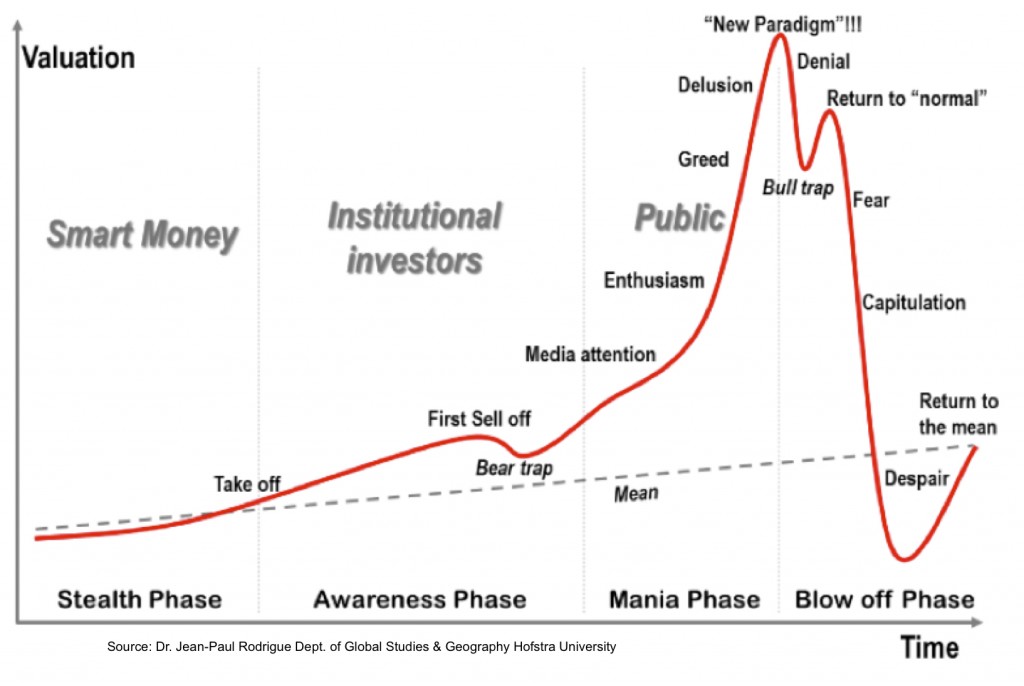
I think Bitcoin isn’t coming back. Bubble popped as per the bubble anatomy model below, and now at fear-capitulation:

8dece1Source: Bitcoincharts

8dece2Source: PortfolioProbe

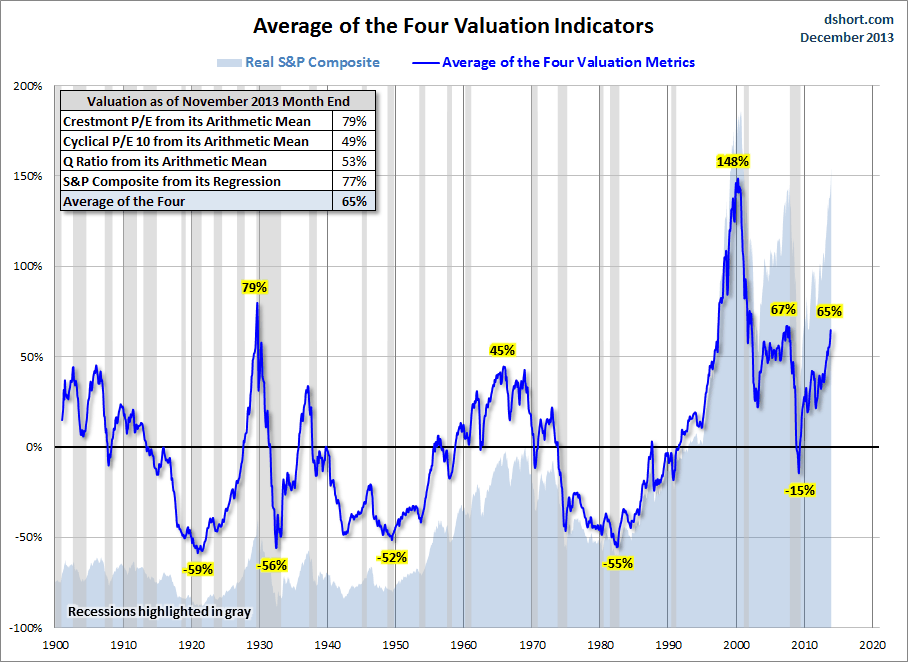
Now what about the stock market bubble? No bubble?:

8dece3

8dece4

Source: Dshort
8dece5

Source: John Hussman8dece6 8dece7

The Citigroup Panic/Euphoria model is a composite of NYSE short interest ratio, margin debt, Nasdaq daily volume as % of NYSE volume, a composite average of Investors Intelligence and the American Association of Individual Investors bullishness data, retail money funds, the put/call ratio, CRB futures index, gasoline prices and the ratio of price premiums in puts versus calls.

Add in the declining trading volumes and I believe we have a recipe for a crash ahead – the question is when. An overleveraged, thinning stock market participation, trading at historic overvaluation and euphoria extremes. That said we have to understand the current context: surpressed cash and bond yields makes equities relatively more attractive, so worthy of higher valuations. Here’s a model I’ve used before to assess the environment for equities:

1. Inflation rate – Stocks have historically risen when the official inflation rate is between 2-5%

Inflation is below, so this is a negative.

2. Bond yields versus stock yields – Long term gov bonds yields should not exceed stocks yields by more than 6%

Equities are largely yielding more than 10 year bonds in the major nations, so this is a positive.

3. Interest rates – interest rates should be low.

Ultra low – so again positive.

4. Yield curve – should be normal.

Yield curve is redundant under a balance sheet recession, and I believe that’s the current circumstances. Therefore irrelevant.

5. Stock valuations – Stocks P/Es should be historically reasonable (historic average 17)

Overvalued by CAPE, Q ratio and a number of measures, so negative.

6. Investor sentiment – II, AAII, Market Vane should not be overly bullish

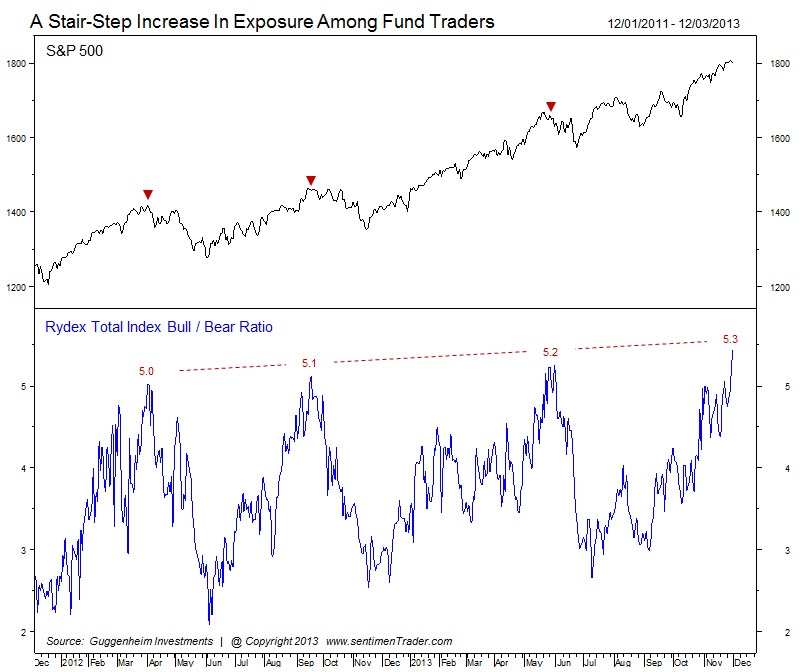
Overly frothy sentiment, e.g. II bull-bear ratio at highest since 1987. Negative.

7. Money supply – should be growing and strong

Collective narrow and broad money measures weakening to flat of late suggesting we may be seeing a top in global industrial production as we turn into 2014. But no clear trend, so I suggest neutral at this point.

8dece8Source: Moneymovesmarkets

Overall it’s a mix of positives and negatives, but notably both at extremes. Stock-bond yield differential at extreme in favour of equities, but equities overvaluations extremes, for example. So which is ‘right’? You know my view: unprecedented collective demographics point to deflation and declining equity and real estate markets that cannot be overcome by government intervention. But this may yet take time to unfold.

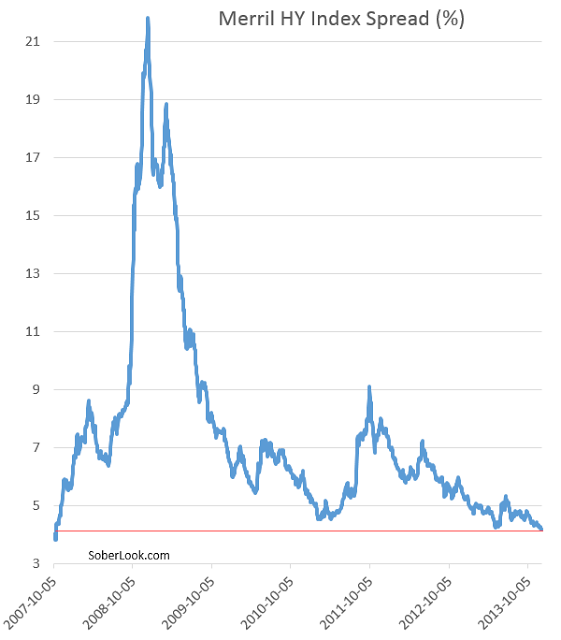
Corporate bond yields are also into extreme territory, putting investors into the same kind of risk predicament as in equities.

8dece9Source: SoberLook

As my trading focus is currently short term, I’ll end with my view on that. In line with excessive sentiment readings reached at the start of December, most major stock market indices pulled back last week. A notable exception was the leader, the Nasdaq, which consolidated sideways and then broke out on Friday to end the week at new highs. So more Nasdaq parabolic?

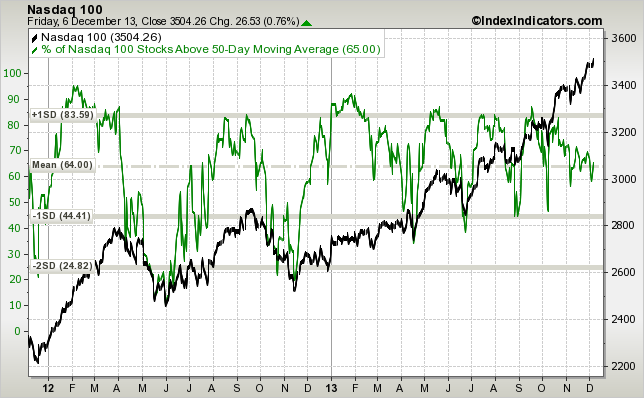
My opinion is the Nasdaq is actually going to reverse this coming week and be the last to join the correction. Volume was notably lower on Friday on that breakout, which is a sign it could be reversed. We are into the lunar negative period and there is a geomagnetic storm in progress this weekend. The Nasdaq shows a breadth divergence for the last 2 months, which again is suggestive of a correction:

8dece10Source: IndexIndicators

When the stock market reached those kind of sentiment levels in the past, normally a correction period of several weeks followed:

8dece11Source: Sentimentrader

Monentum has also waned. So it’ll be an interesting week, and for commodities too. Some signs of life last week which energy breaking out on the growth story, and some volume in the gold and silver buys in their range-bound week, whilst sentiment levels against gold, silver and miners are again at extreme lows. The US dollar is once again looking weak. The commodities indices remain in those large technical triangle noses since 2011, so still watching and waiting.

Disclosure: short stock indices, long commodities.


Stocks, Gold, Money Supply and Debt

Here is a chart from Gary Tanashian through SlopeOfHope’s charting facility, which could be argued legitimises the current steep ascent in US stocks:

24nove1Parabolic money pump, steeply rising corporate profits, and therefore equities going vertical (on a long term view).

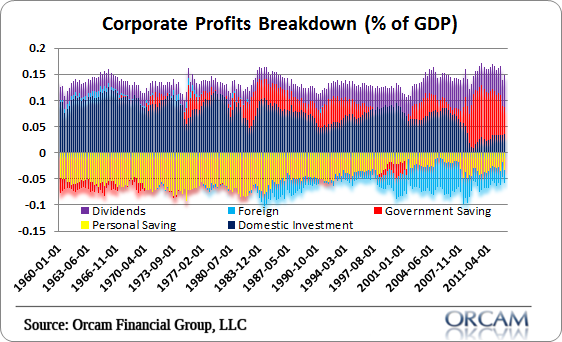
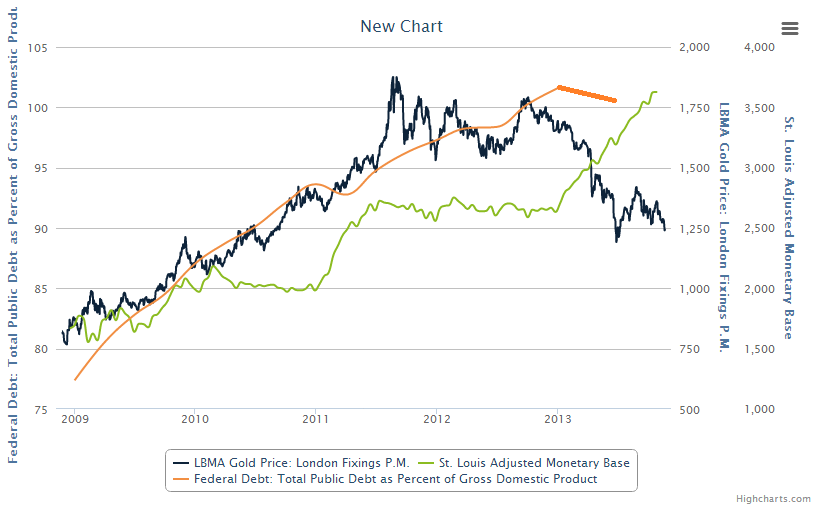
In fact the sharply rising monetary base is directly contributing to those rising corporate profits, as government spending (debt) has been the key driver of corporate profits since 2008:

24nove2Therefore, if the US Fed begins to withdraw stimulus, disappointment in corporate profits is likely, as the chart shows the traditional profits driver of private investment has collapsed and not recovered over the last few years. Once again, this fits with demographics, and we should therefore not expect private investment to ramp up significantly again any time soon. So it’s in the hands of the US government and Fed. Maintain or increase stimulus, corporate profits should keep rising; decrease or end stimulus, corporate profits should retreat.

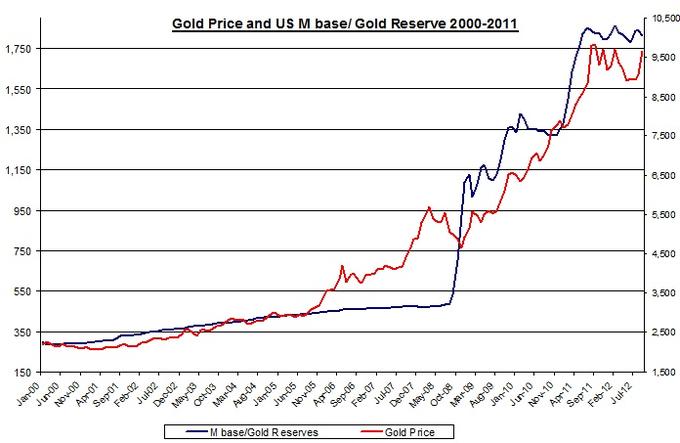
Turning to the monetary base, equities are not the only correlated class. In fact, gold has had a tighter correlation, until 2013. Here 2000-2012:

24nove3Source: Fool.com

Gold displayed a similar correlation with government debt, also until 2013.

24nove4

Source: RockSituationReport24nove5

Source: SlopeCharts

The first shows the debt limit, which will be back on the agenda soon, and surely must keep rising, whilst they retain the need to stimulate, which they will due to demographics. The second shows debt as a percentage of GDP, which actually fell back a little in H1 2013 (my extension on the chart). The reason for that was better than expected economic growth and a trimming in certain areas of government spending. Total debt continues to rise at a historically rapid rate.

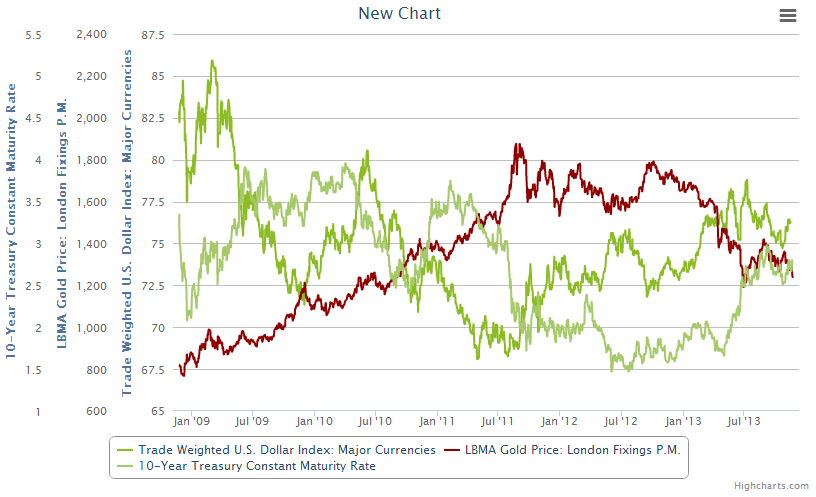
So are these correlations with gold broken, or is gold set to come back? One more chart shows that the US dollar and treasury yields have been largely inversely correlated with gold and the pair strengthening for much of 2013 has been a key factor in gold’s decline:

24nove6Source: SlopeCharts

In my opinion, gold’s relations with money supply and debt levels are logically sound, and both money supply and debt should continue to rise into the future under the demographic trends. I therefore I expect gold can restore its bull market if the US dollar and treasury yields tip again into sideways or declining trends. If the US economy strengthens and a little inflation is restored, then this is unlikely to happen and gold will remain in the doldrums. However, demographics and debt suggest the Fed will have to keep fighting to maintain growth and keep deflation at bay (taper disappointment, yields suppression, new measures to attempt to inflate), which could bring about such a reversal in fortunes.

I still expect equities can go a little more parabolic first, under a typical solar maximum speculation push. However the warning flags already in place of dumb/smart money, trading volumes, margin debt and trading credit balances, and overvaluations (e.g. Q ratio) suggest it is most likely limited in duration and size. I would go with something like this from trader Moe:

24nove7Source: Trader Moe

A further 10% gain in a rapid time, with a catalyst being collective major breakouts in the major global indices, to get to some crazy extreme indicator readings, and a subsequent termination. My first checkpoint is the start of December, because the 3rd is the new moon and as of the 4th geomagnetism is forecast to ramp up again. If equities can rally hard and fast into that point, with a spread of indicators flashing, then I would suggest that could be the earliest point for declines to set in (barring any external shocks). If, however, equities can rally through the seasonally strong Xmas period, and solar intensity stays high into the beginning of 2014, then the next checkpoint would be early January.


Divergences, Ratios and Surprises

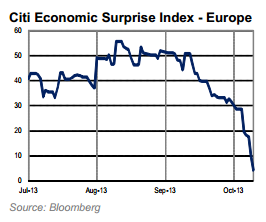
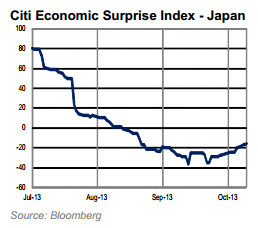
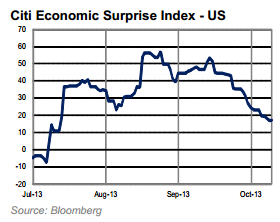
Here are the latest economic surprises indices for the major nations:

19sept5 19sept4 19sept3 19sept2Source: Citibank

Japan aside, economic surprises for most of the majors topped out as we turned into September. Historically there has been a fairly good correlation between economic surprises and stock market returns, but the correlation has deteriorated throughout 2013 and turned negative:

19sept7

Source: JP Morgan

Is there anything about that period from early 2009 to mid 2010 where correlations also were anomalously negative? My take is that by March 2009 most of the major stock indices were at p/e 10 or below, and thereafter we saw a period of post-panic bargain hunting at historic cheapness, despite and regardless of continued disappointing economic data. That doesn’t apply at today’s valuations.

Here’s another look:

19sep1I’ve charted the peaks in US economic surprises versus the SP500. It can be seen that from 2006 to 2012, trend reversals in economic surprises reliably brought about corrections in the SP500, but sometimes with the stock market eeking out a marginal new high and then rolling over. But since the end of 2012 the two economic surprises peaks have been largely ignored by the market.

There have been other notable divergences since the turn of the year.

Equities have diverged from geomagnetism:

19sept12

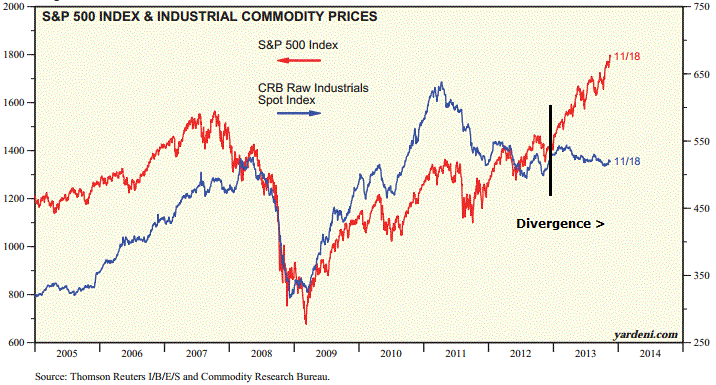
Junk bonds, which have historically correlated with equities fairly well under ‘risk-on/off’ sentiment, have parted ways with stocks and are actually down for the year. Commodities likewise:

19sept11Source: Yardeni
I have extended this commodities:stocks ratio chart from early 2012 to the current level in November 2013, showing the degree to which stocks are now valued versus commodities:

19sept13Source: Stockcharts

Down to 0.15, very close to the level reached at the 2000 equities peak.

Versus bonds, equities have also made a sharp run up in relative valuation this year:

19sept14Source: ispyetf

If this is the solar maximum at the end of 2013, then it would be normal, by history, for the secular asset class of the time to be bid up in a speculative finale, diverging from normal correlations and leaving models behind, in a final overthrow. If this is occurring with equities (perhaps disinflation has killed off commodities), then the above charts would be evidence for that, and we are left trying to look for clues as to how much further, both in time and price, the speculative finale has to run. If it isn’t equities, but rather commodities that are bound for a speculative finale (as they would rather befit the ‘secular’ asset class leading into this solar peak), then the above charts are warnings that the rug could be pulled from under equities at any time.

Right now, the balance of evidence suggests that it is stocks being bid up to a speculative finale, if my solar thesis is correct. Even without solar, we see various evidence for that, in my last post and this. See how margin debt has accelerated over the last 12 months, as it did prior to the last 2 major stocks peaks:

19sept10

Source: Dshort

And now look at the decline in trading volumes:

19sept15Source: Marketwatch

There are fewer and fewer participants in the market chasing it higher, and the margin debt and credit account levels (last post) suggest increasing leverage to do so. Unless more people and institutions come to the market, then that is a recipe for a steep decline or crash ahead. By demographics, those additional participants are unlikely to materialise. Recall that demographic trends in the US were up into around 2000 and have since been downward, continuing this decade. I suggest that is what we are seeing in the trading volumes ‘mountain’ above.

In summary, I believe the equities bull is on borrowed time and that risk-reward is stacking up on the short side. But it comes down to how much further in price and time stocks can extend first. If solar-inspired speculation is at work then parabolic becomes more possible. If on the other hand equities are to make a topping ‘process’ rather than a parabolic, then by normal measures this has not started in a meaningful way so should at least extend for several months and postpone a major decline until 2014. If commodities are to become the speculative target then they should take off as late cyclicals whilst stocks make a topping process. This remains theory only, and deflationary demographics are a headwind to this occurring, so I have my doubts.

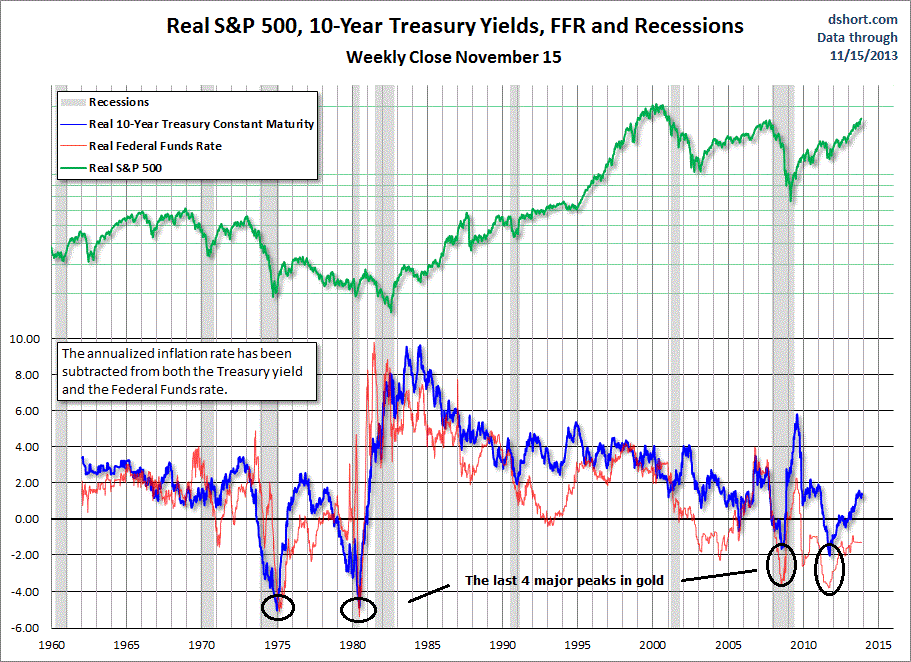
On that note, if we look at when gold really took off in the past, it was under conditions of negative real treasury yields. Rises in yields over the last 12 months, together with shrinking inflation, have taken real yields positive and are a problem for gold. Deflationary winds, due to demographics, threaten to take inflation yet lower, whilst treasury yields by late 2012 had reached historic extreme lows, suggesting renewed downside may be limited. So, if I could speculate how fortunes could be reversed in gold, it would be either the world tips into deflation and gold performs more ‘uniquely’ (gold’s performance under deflation is limited in history, but I suggest it ought to perform as the default go-to asset under such conditions when all others are unattractive) – or – central banks take renewed action against the disinflation in progress by increasing rather than decreasing stimulus, e.g. the ECB launches QE and the Fed maintains QE rather than tapers.

19sept9Source: Dshort

Latest

I’m on holidays, so just some updated data below.

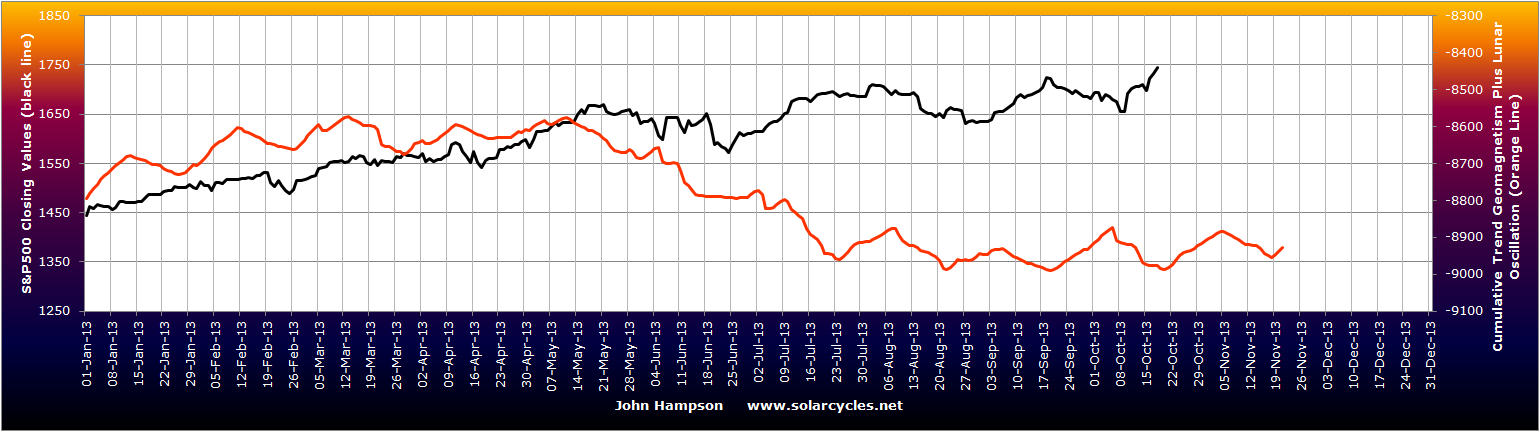
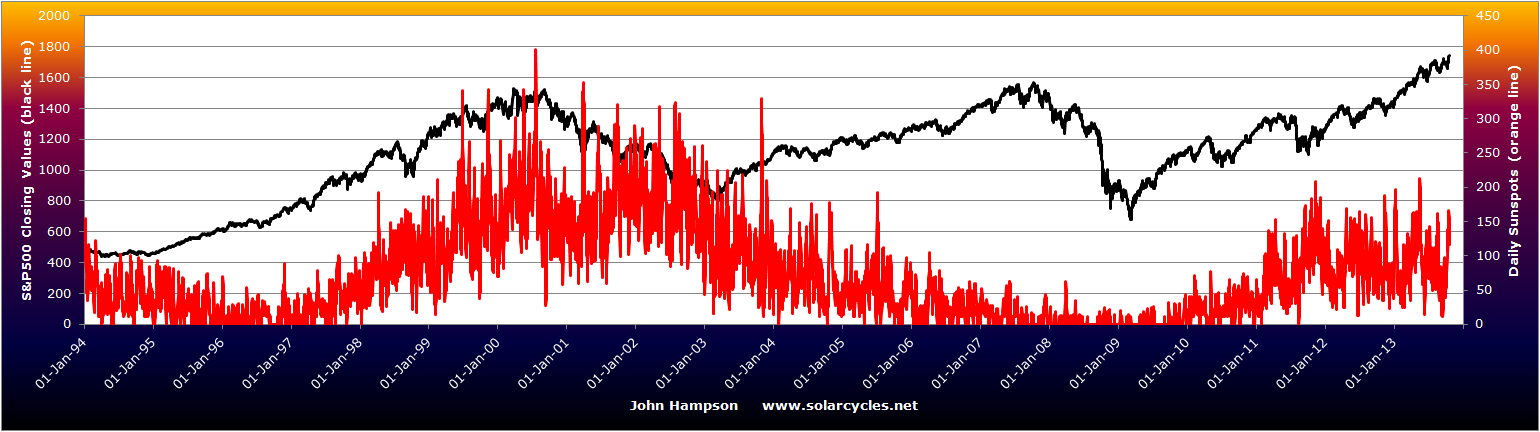
Sunspots still high, adding weight to possibility of solar max still ahead – modelled versus SP500 here:

29oct20131

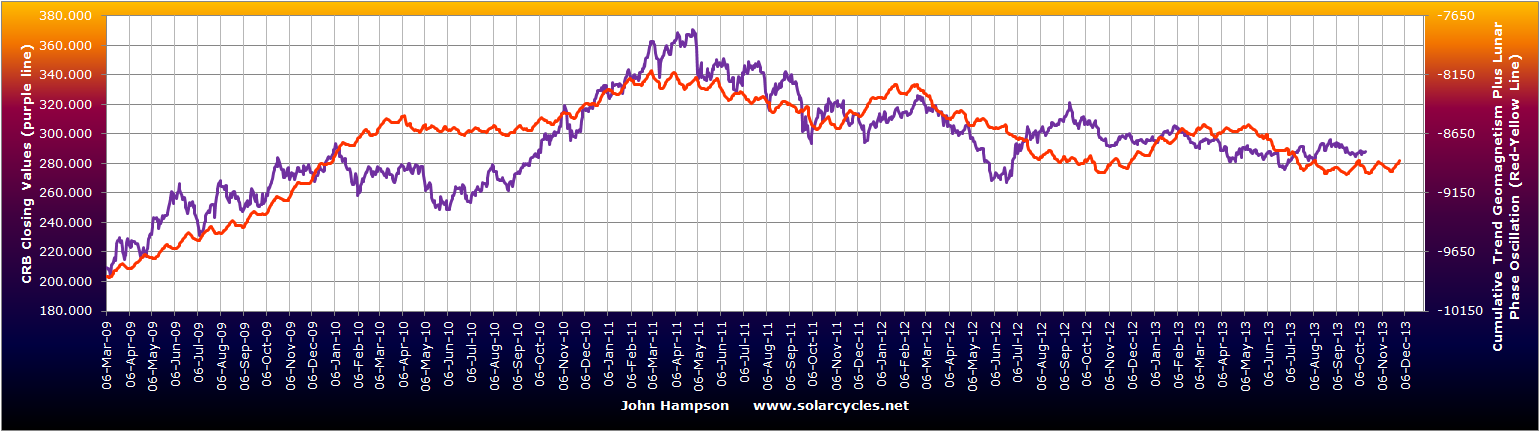
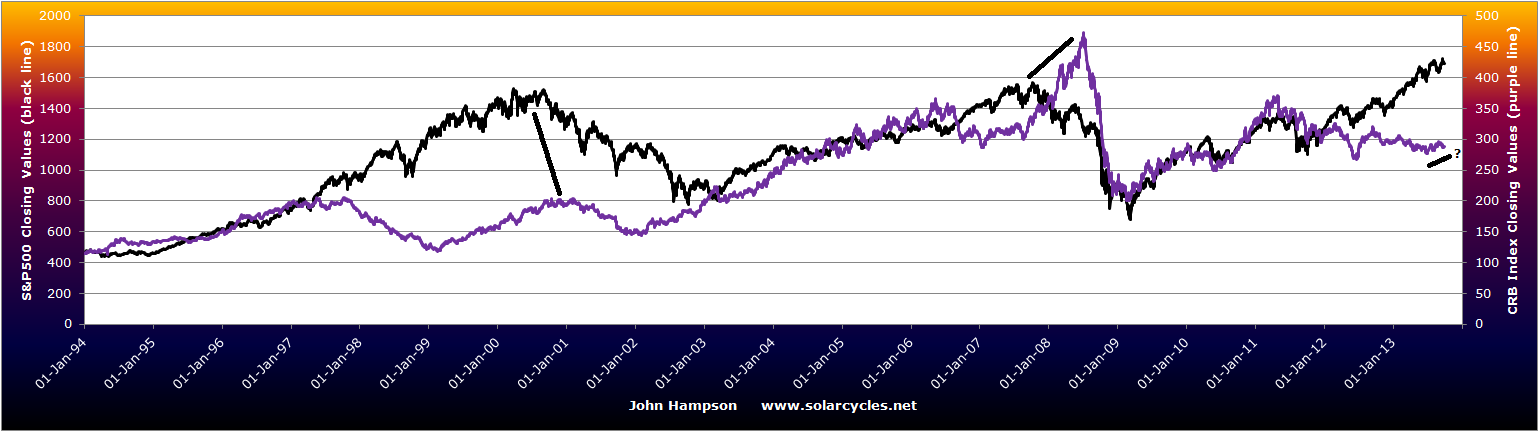
Geomagnetism forecast extended for next 3 weeks, overall still flat – modelled versus commodities index here:

29oct20132

FOMC output tomorrow, new moon on Friday, lunar negative period begins the start of next week.

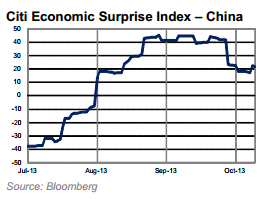
Economic surprises falling in US and Europe, improving but negative in Japan, and positive in China:

29oct2013329oct20134

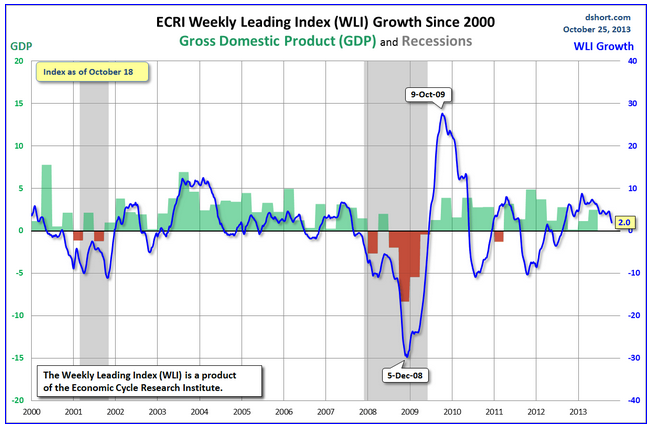
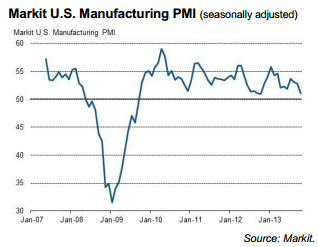
29oct20135 29oct20136Leading indicators for the US falling:

29oct20137 29oct20138

Update

Stock indices rose into the full moon, making for a third consecutive lunar inversion. Here is the updated lunar-geomagnetic model versus the SP500:

21oct20131Forecast geomagnetism is fairly benign and we are now into lunar positive fortnight, however the three back-to-back inversions leave me less confident as to the direction of the stock market. Normal service may resume here (i.e. a two week uptrend) but the triple inversion maybe has some significance.

Breadth broke out, as in Advance-Declines:

21oct20132Source: Stockcharts

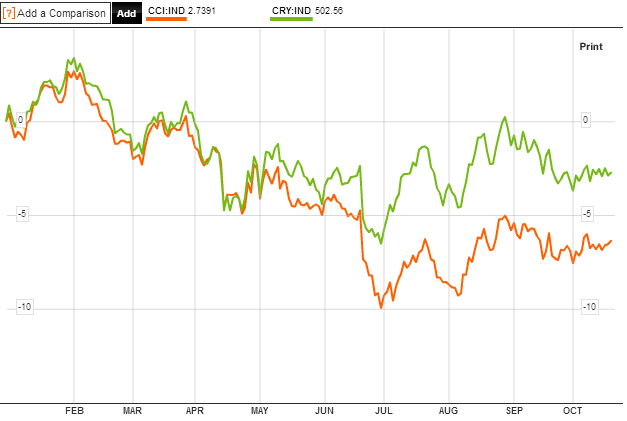
This development casts doubt on a stock market topping process. However, other developments have added weight to my criteria list for a top (last post), namely treasury yields fell again, commodities indices edged up again, ECRI leading indicator growth fell further, narrow money leading indicators for the G7 have worsened, Citigroup economic surprises for the major nations have all turned into downtrends, bar China which has turned flat. Here are the CCI and CRY commodity indices:

21oct20133


Source: Bloomberg

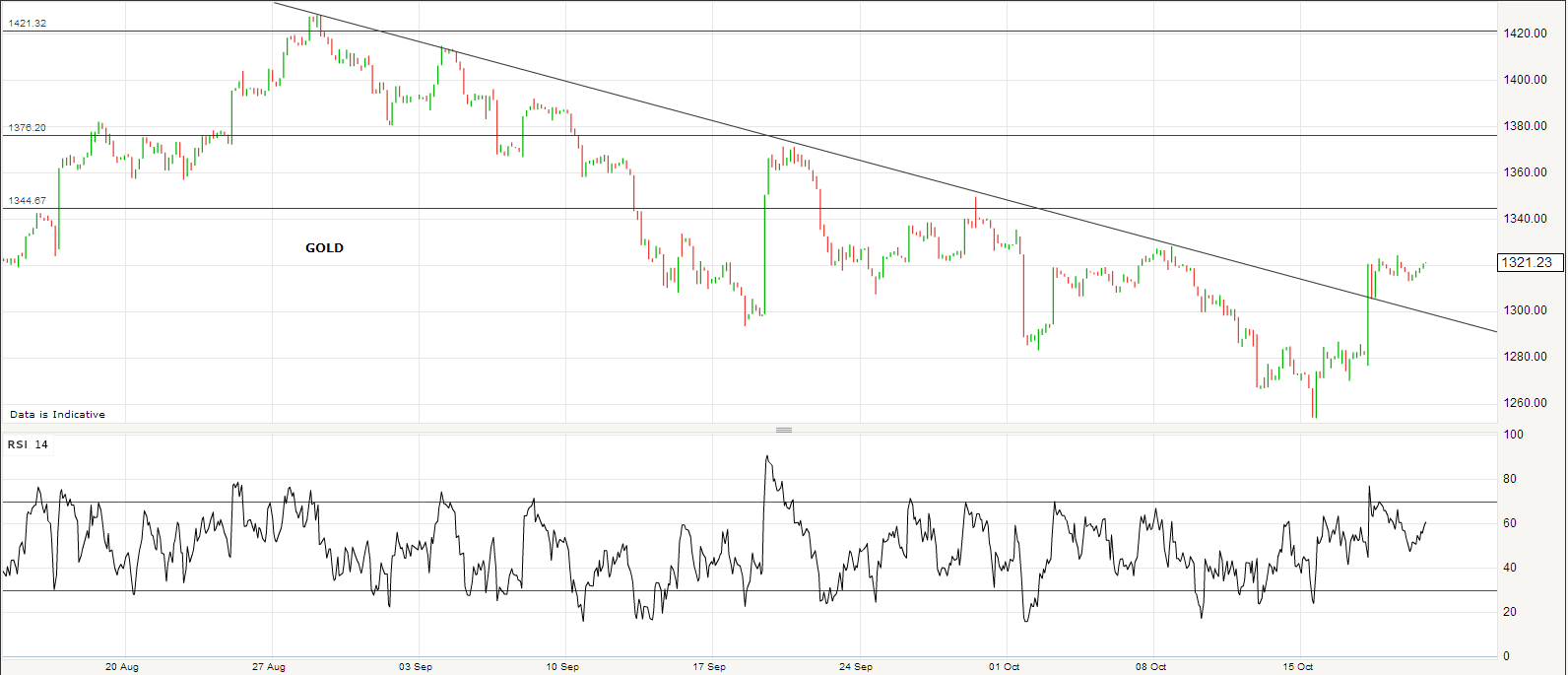
Still tentative uptrends short of momentum, still too early to say if they are going to take off. Crude oil has flattened out but is still in a downtrend for now, whilst gold broke up beyond downsloping resistance on Thursday and held the break on Friday:

21oct20134

Follow through is still required though, so also tentative but more promising.

The result is I am watching the markets at the start of this week: can stocks rally and the SP500 break upwards out of its wedge on good breadth, or is another pullback going to come to pass (earnings revenues disappointing so far but the season only still getting under way); can commodities (particularly gold) rally and gain momentum; can the US dollar break beneath another support level at 79 (expectation has switched again to no QE taper in the near term)?

For a more definitive judgement on whether equities are topping cyclically we need more time, and more developments. On balance I believe we are in the early part of a topping process, pending further evidence. Next we would require a deeper correction ahead to produce a lower low, followed by a rally back to the highs whilst leading indicators fall. Rising commodities would normally play a role too, and if they are in a new uptrend, they need more time to rally some way higher. But all this could take weeks or months to fully develop.

I am also watching the sunspot count as the sun has woken up again. If the solar max is still ahead then we ought to see a sustained period of higher solar activity.

21oct20135


Update

I’ve been busy with the shift of focus, towards shorter term trading. I advised recently that a poor year for commodities threatens my year end PnL, so pending the validation or invalidation of solar cycle and demographic theories, I am taking action to try to ensure a good year-end figure. What this means in practice is (i) taking profits on markets where applicable (ii) using shorter term indicators and leverage to bring other positions to profit and then close out and (iii) as the range of markets I am involved in narrows, attacking the remaining markets, plus (iv) trading in and out of other opportunities where I see them. So I am gradually reducing the range of markets I am involved in whilst leveraging up on the remaining markets: a combination of decreasing and increasing exposure to keep risk levels satisfactory. And no longer term strategic positioning any more – that will be resumed following this exercise. It’s an enjoyable challenge, as I haven’t used this approach for some time. No guarantee of success though, and only in the early stages.

It remains to be seen whether the solar peak is ahead or behind us, and if it is ahead of us whether the anticipated correlated commodities peak will occur. It is also still not yet clear whether commodities are changing trend into an uptrend, or still in a bear market since 2011. Below, both commodities index and sunspots versus Sp500.

8oct20131

8oct20132Similarly unclear yet is whether equities are in a cyclical topping process. We see breadth divergences, but not yet deterioration in leading indicators. We see the kind of price oscillation within a range that would mark a top, but as yet no real marked shift in sector performance that would be typical of a top. By my demographic work, we should tip into another global recession and equities bear in due course, but it would be historically typical if this was triggered by tightening: bond yields rise too far (not yet there) or government cuts back on spending/stimulus. On the latter, the US government shutdown, if prolonged, threatens to do the equivalent job of reducing government spending; or the government may agree to spending cuts to raise the debt ceiling (deadline Oct 17th); or the Fed may taper QE (next FOMC output Oct 30th). The near term prospect of a taper looks less likely with the government shutdown potentially shaving off GDP, but it remains out there as unknown, and on that note, commodities typically perform historically (as shown in the first chart above) once equities have topped and the economy has topped, once rate cuts are underway. Clearly that isn’t our current scenario, which adds to the uncertainty over commodities. Plus, again referring to demographics, we have an unprecedented collective global downtrend in place which could potentially overwhelm any possible commodities/inflation rally. Which brings me back to the start: nothing has been validated or invalidated yet in terms of solar, demographic, commodities, equities, bond yields and government spending/stimulus. Gradually developments in all these areas will make it clear, but pending that, my focus is making money shorter term.

So to the near term. Below I show the position of the SP500: at support in a rising wedge. That rising wedge could spell a breakdown ahead, but first a bounce may be in order.

8oct20133The US government shutdown and debt ceiling uncertainty is affecting market sentiment, but news of a likely agreement could at any point provide a relief rally. If the impasse remains however, then the next two weeks are the negative lunar period which takes us up to the debt ceiling deadline and could therefore keep downward pressure on stocks.

Below is the latest geomagnetic-lunar model versus the commodities index. The geomagnetic trend has flattened out and has a positive edge looking out over the next 3 weeks. Indeed we are into the last quarter of the year, where we typically see more benign geomagnetism and positive seasonality for pro-risk (which I believe are correlated). If equities are not yet making a cyclical top, then there is both a backdrop and a time window in which to rally away from the price range of the last few months.

8oct20134The US dollar is flirting with major breakdown, but arrives there oversold and overbearish. A breakdown would add weight to a commodities rally, so I continue to watch. Crude oil is typically the main driver of an inflationary commodities rally and looks to have formed a short term low over the last couple of sessions. I am watching that too, as further drops back into the range of the last couple of years would cast doubt on commodities making a meaningful uptrend.

*Updated short term lunargeomagnetic model versus SP500 10 Oct*:

8oct20135

Charts To Start The Week

Last week, stock indices largely printed bearish shooting star candles (on a weekly view, up into and on FOMC output then reversal of gains Thu and Fri), which also looks like a potential lunar inversion, and a potential important Equinox reversal too. The Equinox was 22 September to be precise, and Gann found this date/event often marked major tops in history (on or very close). Chris Kimble has also produced this (hat tip Gary) below, and notes last week produced an all-time record for inflows into equity funds worldwide:

23sep20136

Source: Chris Kimble

As various stock indices were at important breakout levels, and ended Friday retesting those levels (having jumped above then fallen around the FOMC), then a breakdown in the first part of this week would make things look more bearish, because we would have a shooting star fake-out and more of a trend supporting lunar / equinox reversal.

Chris Puplava pointed out overbought signals as other reasons for a pullback (although he still sees no threat to the ongoing bull market). I have added vertical lines to his summary picture to view more clearly what happened to the SP500 on previous occurences, namely sharp uptrends gave way to more sideways ranges:

23sep20131Underlying Source: Chris Puplava

Leading indicators remain overall positive. For example, US CB and ECRI leading indicators were both good readings last week. This is supportive for stocks. On the flip side, we have seen some breadth divergences, which would be one topping process sign, and we know margin debt is at lofty levels.

Here is the latest geomagnetism forecast (with lunar oscillation). Overall flattish, but with a slight upward bias. I noted previously that the lunar positive fortnight from today plus the relatively benign geomagnetism could make me long-biased. However, if we have seen a lunar inversion then we could see down rather than up this week, which would negate that edge.

23sep20138Let me bring in commodities. When stocks retreated in July/August we saw commodities gain interest, which was also a potential sign of a topping process in stocks, as historically we have seen commodities rally last as (and after) stocks top out. Since then we have seen money flow back the other way. This is how we stand on the CCI and CRB commodity indices:

23sep20133

23sep20132Underlying Source: Bloomberg

Hopefully it is evident from the two charts combined that commodities have the potential to break into a bull rally here. However, it is just potential, and time is of the essence. If the CRB is to break upwards then it has to make the current backtest of the breakout stick, and pull upwards from here.

Here is the US dollar index. See how it has arched over and is now threatening breakdown. A bearish break would benefit commodities and provide one ingredient for that potential rally.

23sep20135Underlying Source: INO

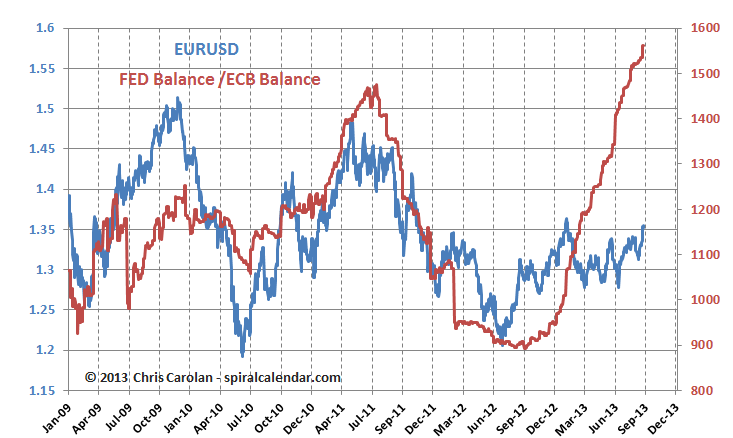
Also, here is a chart from Chris Carolan showing how the Euro has the potential to escalate against the USD based on relative central bank money printing:

http://spiralcalendar.com/wp-content/uploads/2013/09/092213eurbal.gif

As the Euro is the biggest component of the US Dollar index, that then is a possible breakdown catalyst.

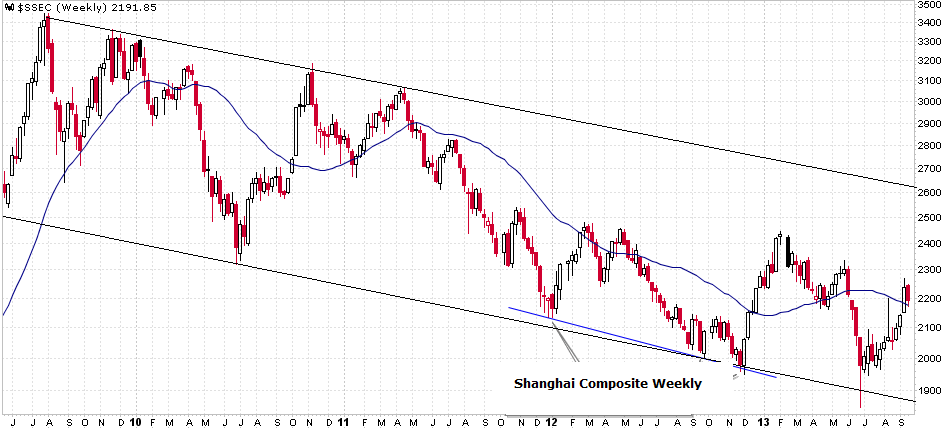
Another factor for commodities is China, as their biggest consumer. Today’s Markit manufacturing PMI came in at 51.2, a 6-month high for China. The stock market has also picked up the last two months and has the potential to run up to the top of this channel:

23sep20134Underlying Source: Cobra / Stockcharts

The most bearish assets (in terms of public opinion) of the current period are corn, wheat, oats, soybean oil and coffee – all agricultural commodities. The volatiility index for stocks (Vix), and treasury bonds, are down with them at bearish extremes. So, if we are to see a mean reversion – which is likely, but the timing is the difficult part – then it would be into commodities and out of stocks (Vix rises).

Lastly on commodities, my solar maximum correlations remain potentially in play, if the smoothed solar maximum is ahead of us. Sunspots are back up to the 100-mark currently so the sun is showing some life again, and certain analysts predict another sunspot peak ahead around the turn of the year. I have established that experts typically agree on the solar maximum once the solar magnetic flip is complete on both poles. The sun’s north pole switched polarity in May 2012, but the south pole flip is still ahead and likely within the next few months. So we should know for sure by Q1 2014. Either an end of year sunspots rally will produce a new smoothed maximum for SC24, before the final polar flip, or the pole will flip and Feb 2012 will be cemented as the solar max. By my research, a commodities rally over the next 6 months to a new index peak would fit with the former, not the latter.

In summary, the research for this post has produced a bias against stocks and pro commodities. As you know I am long commodities so disclaimer as always. However, I was also net long equities and have taken some profits on the long side. If stocks rally to new highs this week, and on good breadth, then much of the bearish case would be negated. If commodities sag further into the end of September, the rally potential in the commodity indices would fade.