Thursday Charts

Small range day for equities yesterday, on low volume, consolidating the previous day’s advance. Gold has paused at its first meaningful resistance level of 1350. Treasury yields decline also currently arrested. So are we to see precious metals and bonds reverse their 2014 trends here whilst equities break up and away? Let’s take a look at some charts.

1. We have a possible analogy from July/August last year, shown below. Then, the market appeared to be rolling over by the end of July, only for a gap-up candle to a new high, as occurred this Tuesday. In that 2013 instance, it represented exhaustion.

6ma6Source: Stockcharts (and next two charts)

2. Total put/call ratio is now 5 months under 1.0, which is a historical extreme:

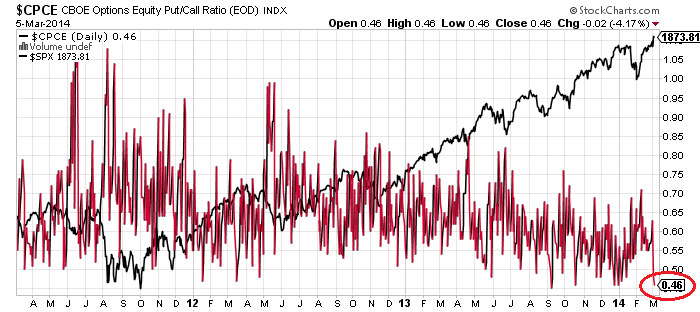
6ma23. Equity options put/call ratio yesterday moved back to historic extreme low:

6ma14. ISEE put/call index 5 day average over 200 for the second day, other instances shown:

6ma5

Source: Helen Meisler

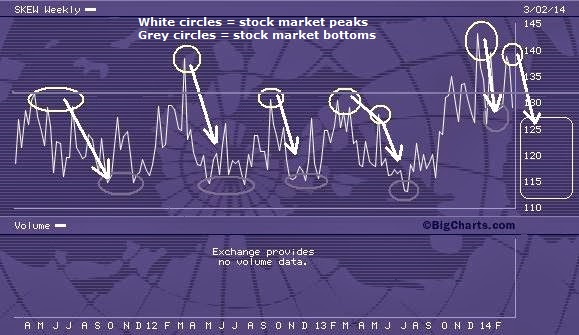
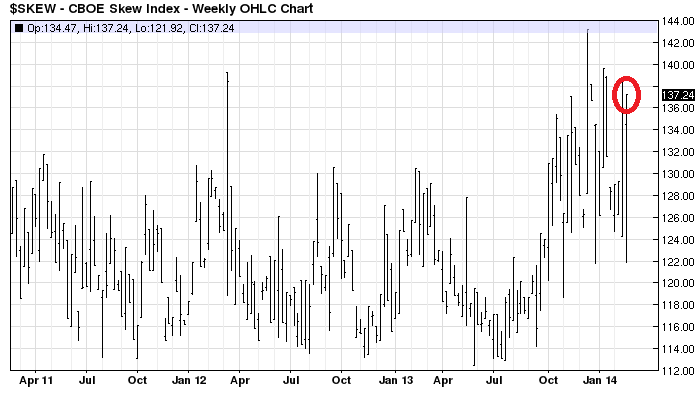
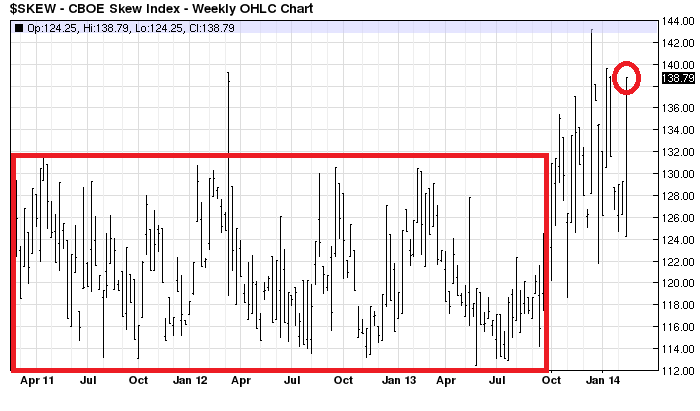
5. Skew remains historically elevated for 5th month. Weekly Skew reading suggestive of another top, as per the beginning of Jan and other historic incidences.

6ma10Source: Keystone Speculator

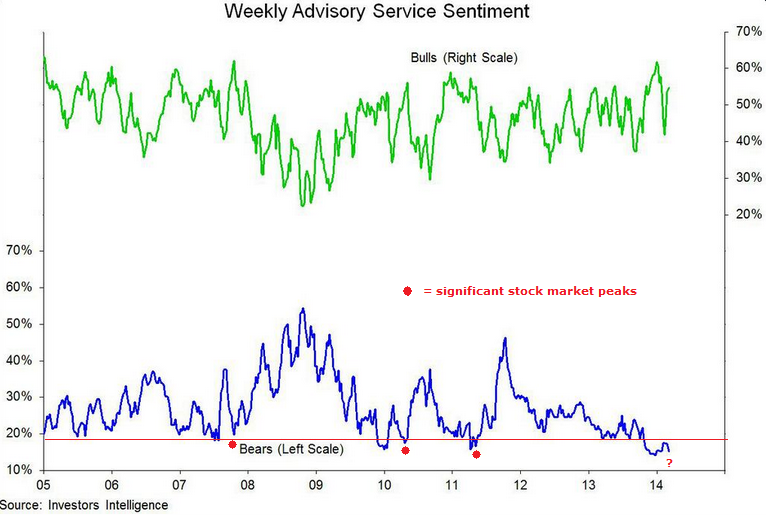
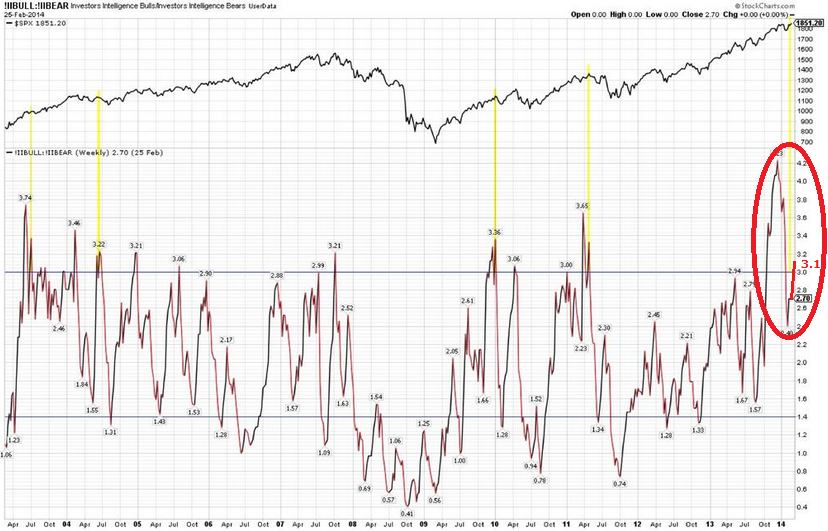
6. Investors Intelligence %bears is beneath the level associated with significant market tops in 2007, 2010 and 2011. Also note those peaks occurred on the second spike down in %bears, which is potentially what we have now (with end of Dec dip):

6ma11

Source: Willie Delwiche (My annotations)

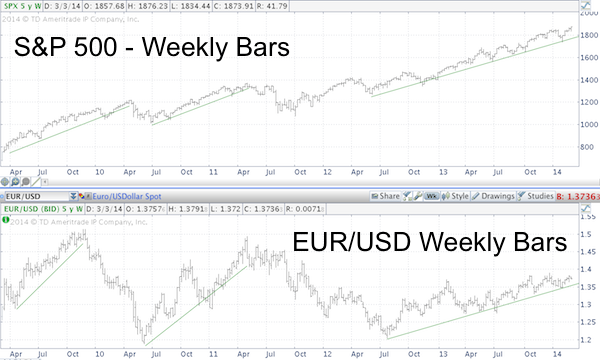
7. Euro-USD is at long term resistance and has had a reasonable correlation with stock market performance. Break out or break down here?

6ma7 6ma8Source: Ispyetf

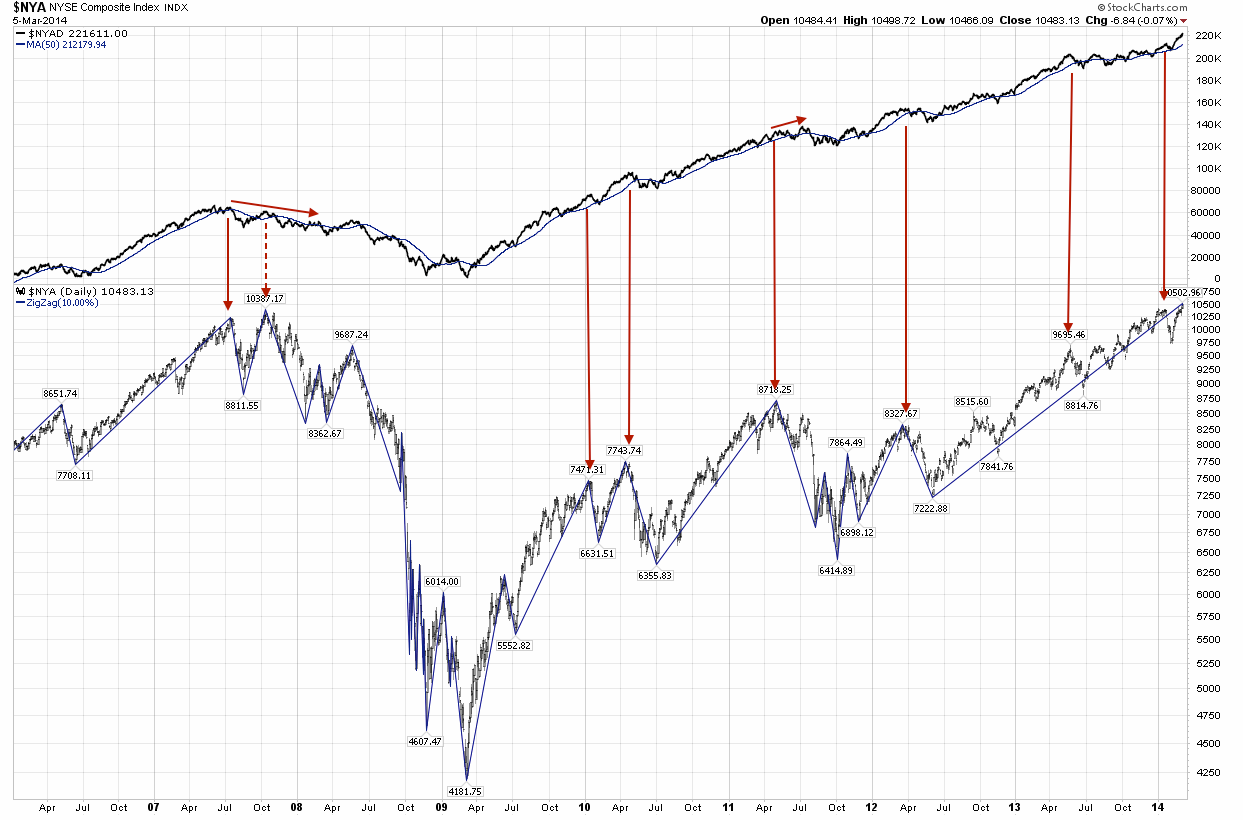
8. The two measures of breadth of cumulative advance-declines and % stocks above MA are divergent. Which one is more reliable as a leading indicator? The below charts show that the former (NYAD) typically expands into market peaks whilst the latter (using a combination of 50MA and 200MA) typically diverges into market peaks and is more of a leading indicator. This suggests we should be looking at a market peak now, not a break out.

6ma3 6ma4Source: Fat-Pitch

In short, the balance of evidence still points to the stock market reversing down here, rather than breaking up and away. Maybe tomorrow’s employment report will be the catalyst.

Post Pop

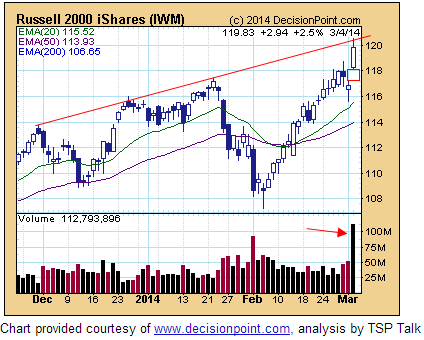
A surprising day yesterday. Russell 2000 up 2.75%, and all US indices popped strongly. Clearly nothing to do with Ukraine. If we look beyond price, not much has changed. There is still a momentum divergence on this new high. The Russell 2000 is up 15 out of 16 days, which is a record. Indicators suggest this is more likely to be an overshoot rather than a breakout. Put/call is sub 1 for 5 months now, and is 5 days away from an all-time record. Skew is is also 5 months at historic elevation levels. Investors Intelligence sentiment is back to extreme (see below). I remain confident a crash is ahead, but yesterday’s action has made the short term picture less clear. For that reason I did not add further short positions into the rip. So let’s see how today unfolds, I expect more clarity by tomorrow/Friday.

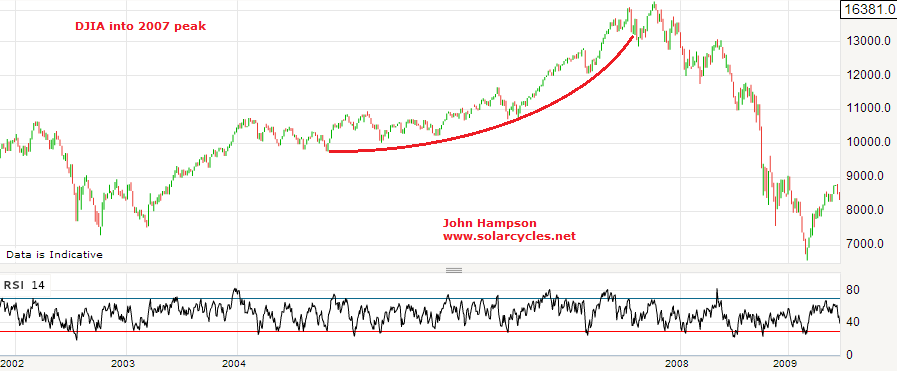
I leave you with a few charts, which are hopefully self-explanatory. At the bottom I looked to see how the Dow’s parabolic ascent into 2007’s peak terminated, which may give us clues about how the Nasdaq’s current parabolic could feasibly resolve if this short term action is an overshoot before renewed downside. The Dow made a higher high then a lower low, which was the definitive kill of the parabolic. The Nasdaq has made a higher high, but remains in the parabolic until we see a lower low.

5ma5

5ma1

5ma2

5ma3

5ma4


Indicator Updates

Yesterday we saw a gap down in European and US stock markets on fears over Ukraine. Stocks then continued to sell off during market hours, but US stocks managed to recover some of the losses into the close. At the time of writing US futures are up on news that Putin ended military exercises near the Ukraine border. In fact, it had already been announced that those exercises would be completed today. News typically buffets the market but major trends and turns are set by other factors. If stock markets topped out on Friday then I suggest more relevant is the telling developments in indicators and the relevance of new moon peaks. If stocks have not yet topped out then it also won’t be due to news in the geopolitical arena, and we might point to the strength in cumulative advance-declines and renewed interest in cyclicals. So let’s put Ukraine to one side and see how things look after yesterday’s action.

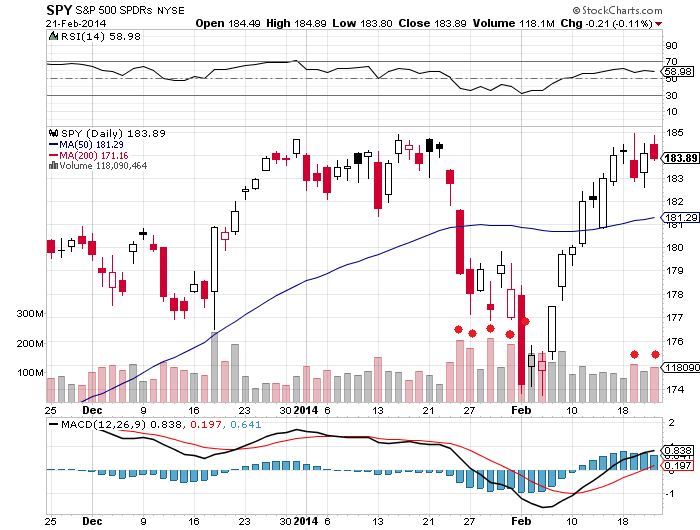
1. SPY shows what looks like a bull trap. My suggestion last week was that the marginal new high on divergences would be the bait to lure in the last of the ‘dumb’ money. The rip in the overnight futures could set the scene for the gap left yesterday to be filled before downside renews. Volume and RSI divergence are bearish. Cyclicals repaired their January weakness, particularly in the last week, which is bullish, but there is a divergence with the higher high on SPY as shown. If SPY breaks higher again and cyclicals make a new high, then that top may be postponed.

4ma2Source (and other charts below): Stockcharts

2. The Nasdaq 100 (black line) has room to pull back further before retesting the January high, whilst the breadth divergence continues:

4ma1

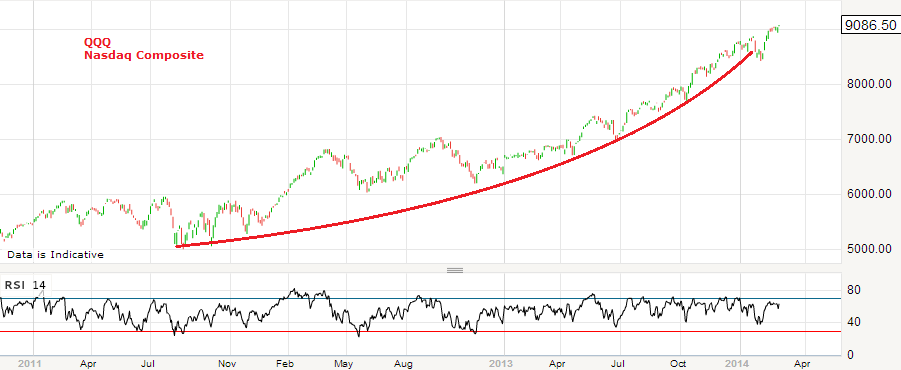
3. On the longer term view, the Nasdaq 100 is creeping along the top of its bull channel since 2009. If it can break up and away from here that would be a particularly bullish development, but I put higher probability on it being dragged back down into the channel, with the RSI divergence joining the breadth divergence.

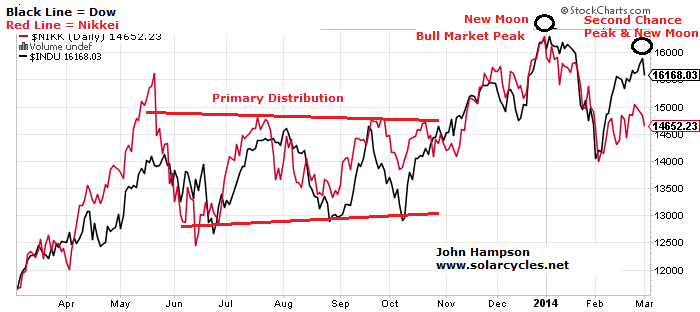
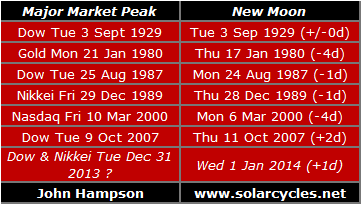
4ma174. The Dow and Nikkei continue to honour my 31 Dec top call, with their charts still mirroring the topping processes of the historical analogs. 31 Dec was 1 day from the new moon and at the inverted geomagnetic seasonal peak, and if Friday turns out to have marked the peaks in the other US indices then that was also one day from the new moon and at the turn into the seasonal lows of March and April.

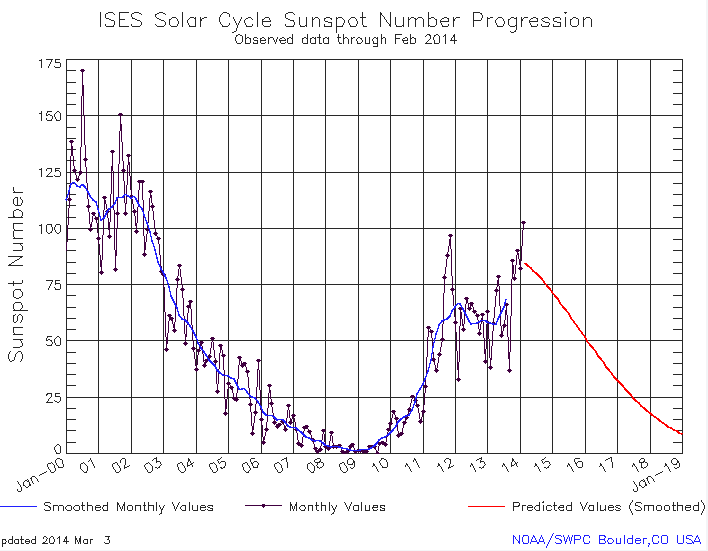
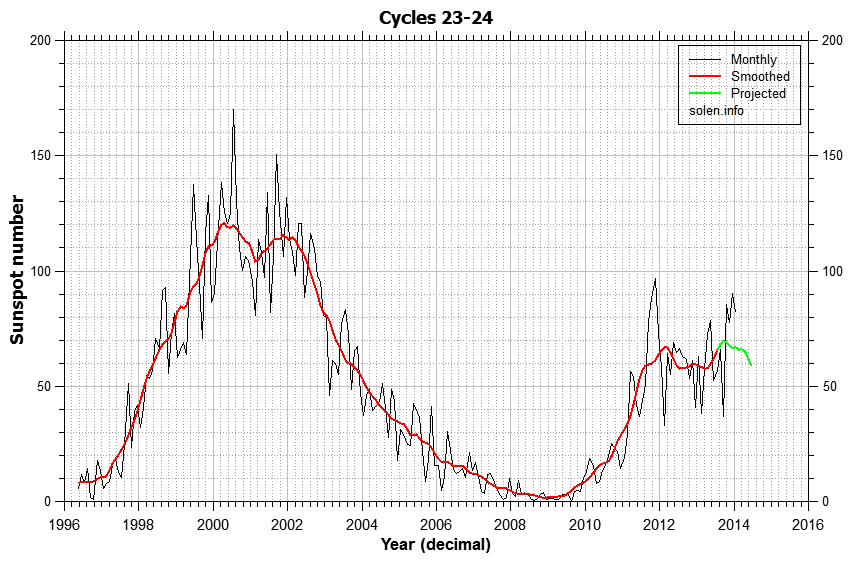
4ma135. My bull market peak call was also very much related to timing the solar maximum, and below are the updated sunspot charts of NOAA, SIDC and my own. It now looks more certain that the smoothed solar peak (blue line on NOAA, red line on SIDC) will turn out to be around now rather than the earlier peak of Feb 2012, which fits with speculation peaking out now rather than back then. Historically, markets tend to peak close to the smoothed solar maximum and on a monthly sunspot spike. A top at the end of December fits both, and we see evidence of accompanying developments as we turned the year such as Bitcoin peaking, trend reversals in treasuries and gold, and historically high trading volumes and insider selling in January. However, we actually made a higher monthly sunspot spike in February, and that could partially explain why other stock indices made higher highs in that month. NASA agree with NOAA and Solen in predicting the smoothed solar maximum to be behind us and waning from now, but SIDC still have that as one of two options, with the other being a mid-2014 smoothed maximum. If that turned out to be the case then that, for me, would be the strongest reason for bull market continuation until then. However, I consider this lower probability than the smoothed maximum turning out to be the end of 2013.

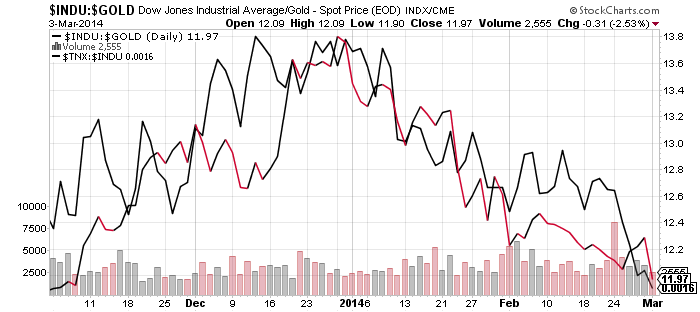
4ma11 4ma12 4ma106. Gold and treasuries continue to outperform stocks and is supportive of the 31 Dec relevance:

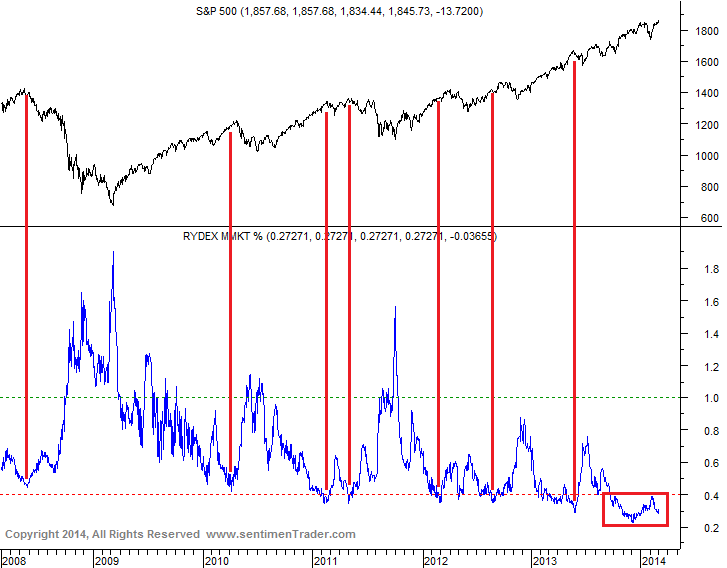
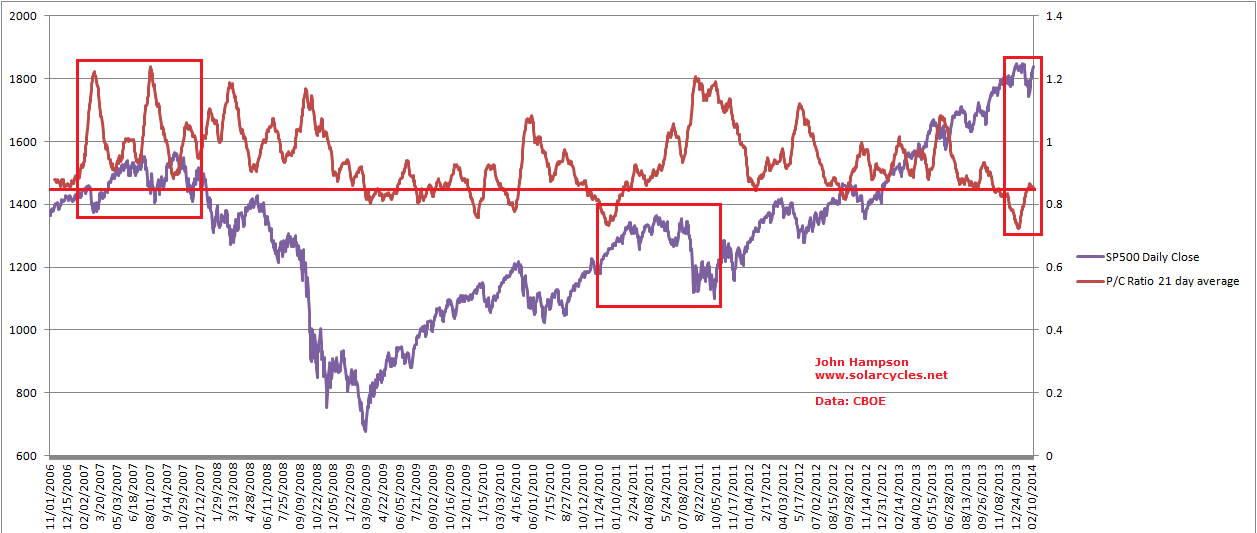
4ma37. Rydex cash levels and put/call 21 day average share similarities. They are not just at low levels consistent with market peaks, but at historically extreme low levels, that suggest high complacency, the kind of which could be a catalyst for the waterfall declines that I predict are imminent. The 2013 exuberance rally was key to generating these historic readings, whilst similarly postponing any meaningful correction into what I believe will be a super-correction. If we look at the the 2007 peak in the put/call chart we see less extreme complacency than now but also complacency resetting during the corrections in the topping process (the two spikes to over 1.2). This did not occur in the January 2014 sell-off and is another warning of an impending much deeper correction to come.

4ma14Source: Sentimentrader

4ma168. Peak excess in equities is also reflected in these 3 charts. Retail investors have belatedly joined the party, as is typical at market tops, and global stock market capitalisation is back to 2007 peak levels whilst achieved on dwindling demographics in the major nations. We see lower overall trading volumes whilst investor net debt, real margin debt and margin debt to GDP (now at 2.72%) exceed 2007 and 2000 market top levels, i.e. less participants but more indebted and leveraged, and this fits with the historic complacency above.

4ma5

Source: Ispyetf4ma7

Source: U Karlewitz4ma4Source: Scott Grannis

Biotech And Russell 2000

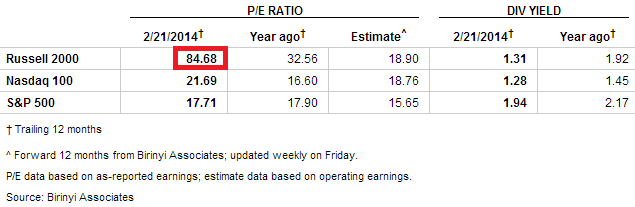
Just as the defining sector of the 2000 solar maximum speculative mania was Internet, a case can be made for both Small Caps and Biotech as defining manias at the current solar maximum. In 2000 the Nasdaq Composite made a parabolic blow-off and hit p/e >80 as companies were ‘revalued’ on expectations rather than earnings. The Russell 2K currently trades at p/e >80 and the index of Biotech companies trades at p/e>160, with both having a significant weighting of companies trading on expectations.

The Russell 2K trades at its most expensive historic valuation:

2ma1

Source: Karla Tango

The Nasdaq Biotech sector is in a parabolic trajectory signalling imminent exhaustion:

2ma2

Source: Blogspot

Marrying the two, the strength in the Russell 2K in 2014 has been dominated by Biotechs:

2ma3Source: Bespoke

Similarly the Nasdaq Composite has been significantly driven recently by Biotech strength. So a pop in the Biotech bubble would have significant ramifications for the Russell 2K and Nasdaq, and the wider markets.

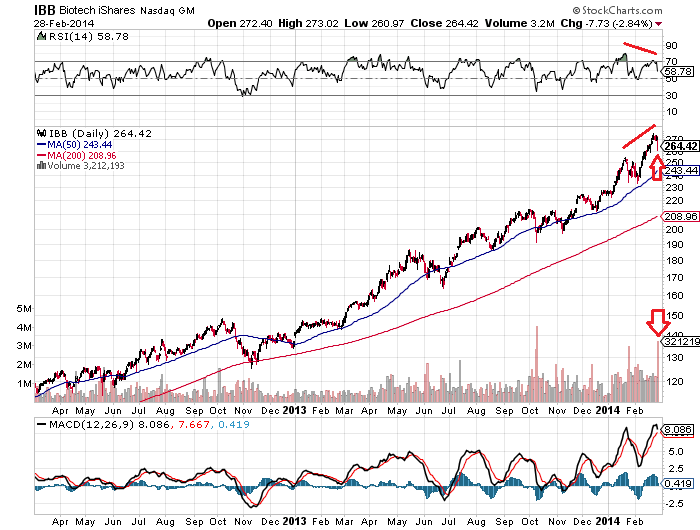
On Friday, Biotech had a significant down day on high volume, having built up a negative divergence in RSI:

2ma5This occurred at the new moon and as we head into the inverted geomagnetic seasonal lows of March and April. Add in the near vertical trajectory of the parabolic on the longer term view and we have the potential for a top having occurred on Friday, but subject to follow through next week.

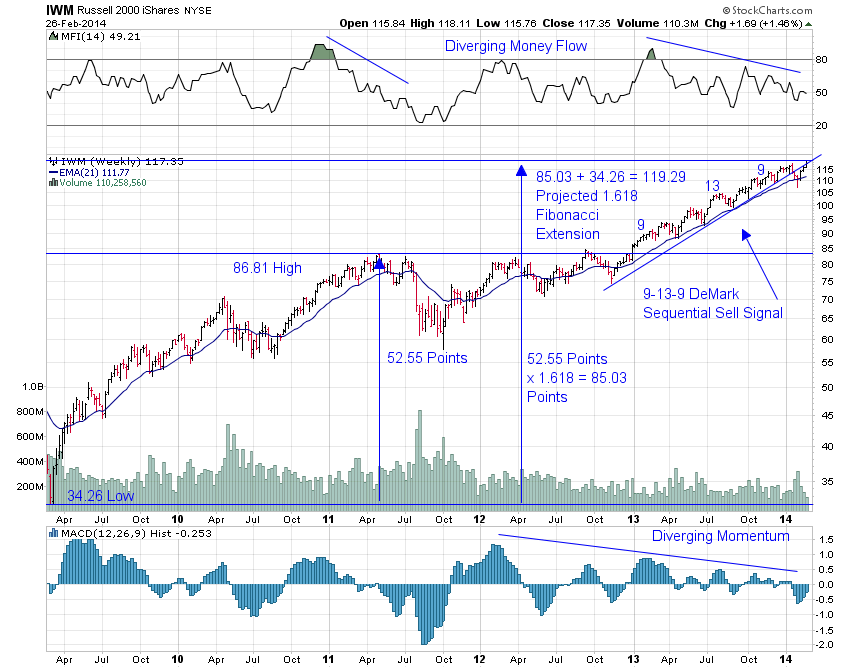
Similarly, the Russell 2K experienced a high volume reversal on Friday and shows other topping signals:

2ma6Source: Stocktwits

To further judge the likelihood of a top, a key question is: could the R2K and Biotechs rise materially higher yet? Whilst we cannot calculate a precise answer to that, we can look to various indicators to build up a case for a limit.

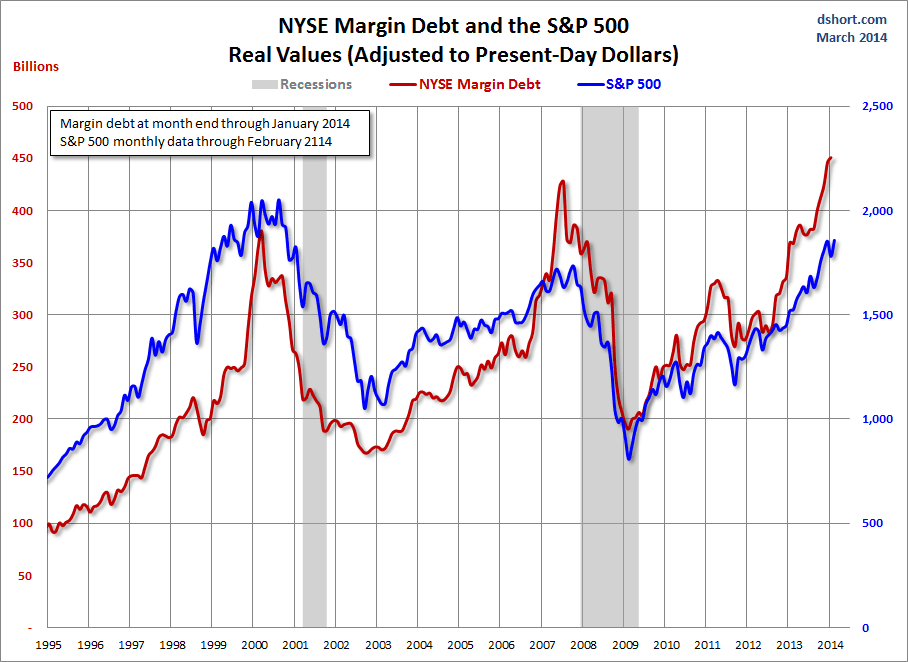
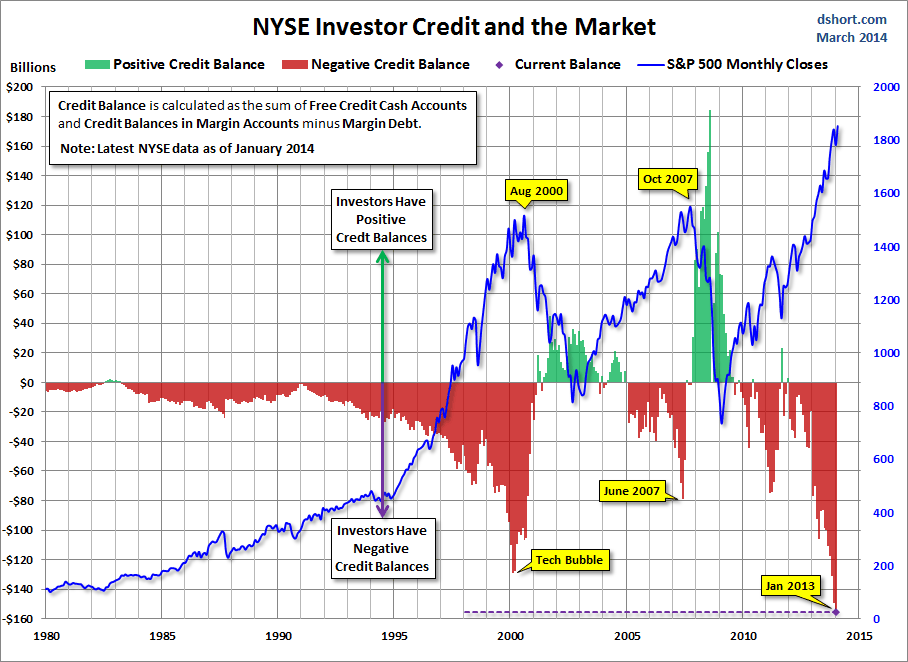
The Biotech sector has risen approx 150% in the last 2 years, which is very similar to the gain in the Nasdaq Composite from 1998-2000. Real margin debt and net investor credit have both now exceeded the 2000 market peak (and 2007 peak), whilst real margin debt to GDP is at the same level as the 2000 peak.

2ma7

2ma8Source: DShort

Citigroup’s panic/euphoria model, which aggregates short interest, put/call ratio, retail money funds and more, is above 2007’s peak but remains some way off 2000’s mania; whilst their CEM model points to a market correction right ahead which would fit with Friday having marked a peak:

2ma13Source: Citi / Fat-Pitch

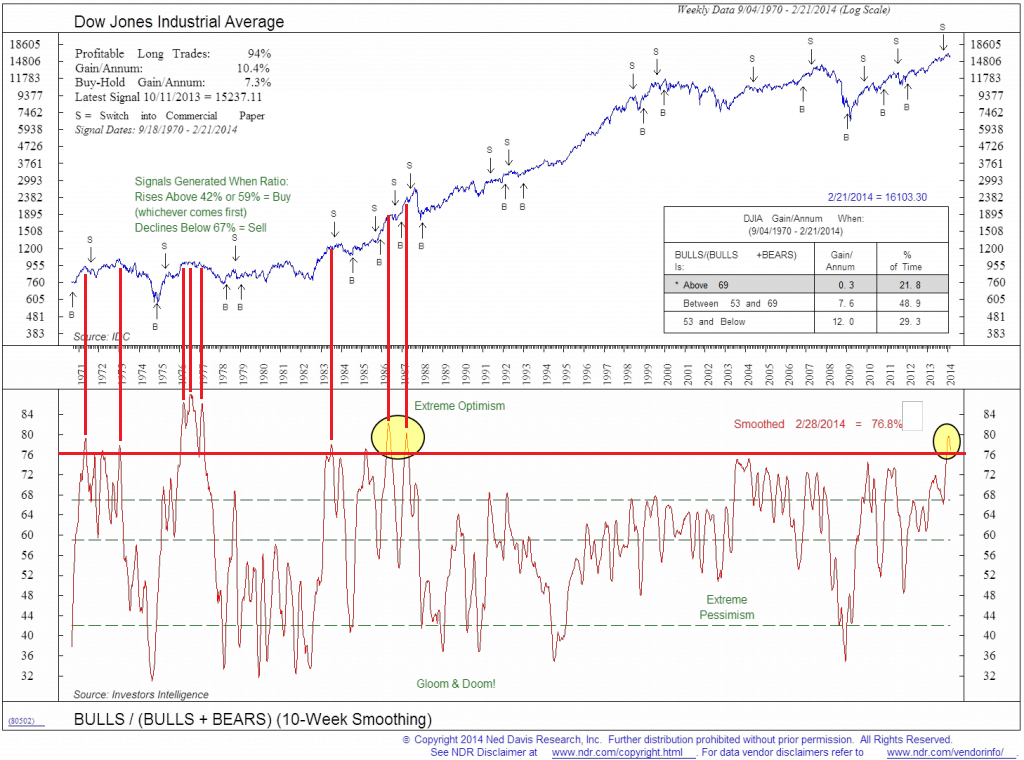
Sentiment as measured by Investors Intelligence with 10 week smoothing is above or at levels that have previously marked tops, with an exception in 1986-7 where the market first rallied higher for several months before ultimately crashing.

2ma12Source: CMG Wealth

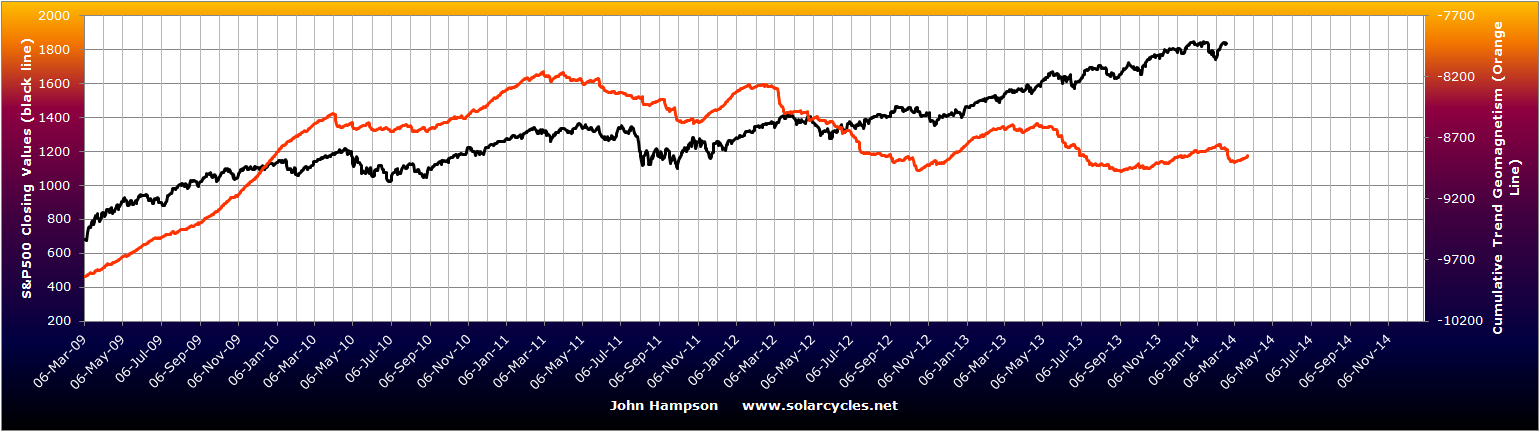
Solen’s updated solar cycle progress and prediction chart still suggests a peak at the end of 2013, which is consistent with the Dow and Nikkei having topped out then and other indices now rolling over to join, and my own daily sunspots chart also reflects this:

2ma10

Source: Solen2ma15

The waning of the solar maximum has historically given rise to a recession in the US. ECRI’s leading indicators rolled over in early 2013 and have recently reasserted that downtrend. Any further deterioration from here would suggest such a recession is coming, and that sort of timing would be a general fit with the business cycle:

2ma16

2ma11Source: DShort

In keeping with that prospect, 20-year treasury bonds look to be breaking out following an 8-month basing:

2ma14Source: Fat-Pitch

Drawing all together, I have a reasonable case for the Russell 2000 and Biotech to have peaked out on Friday, with the latter feeding into the former, and both into the wider markets. The Friday candles and volume and the negative divergences in both the R2K and Biotech suggest a peak. The Citi CEM, new moon and inverted geomag seasonal lows of March and April suggest follow through could then occur this coming week forwards. The rate of trajectory of the Biotech sector suggests terminal exhaustion should be close at hand, and that would then feed into the R2K’s fortunes as per the Bespoke table above. Valuations, leverage and sentiment collectively suggest significant further gains are unlikely. Solar speculative maximum timings suggest other US indices should now be ripe to join the Dow in rolling over, or more specifically began a topping process at the end of December which is now completing, and in so doing becoming leading indicators of a looming recession.

Higher Close Implications

Yesterday the SP500 finally closed above 1850 with a rally in the last 15 minutes of the US session, and in so doing carved out a marginally higher high than December/January, in a club with the Russell 2000 and Nasdaq 100 indices. I do not see a bullish breakout that sets the scene for a new round of gains, because as per my note before yesterday’s session, it is indeed achieved on multiple divergences and is likely to be short-lived.

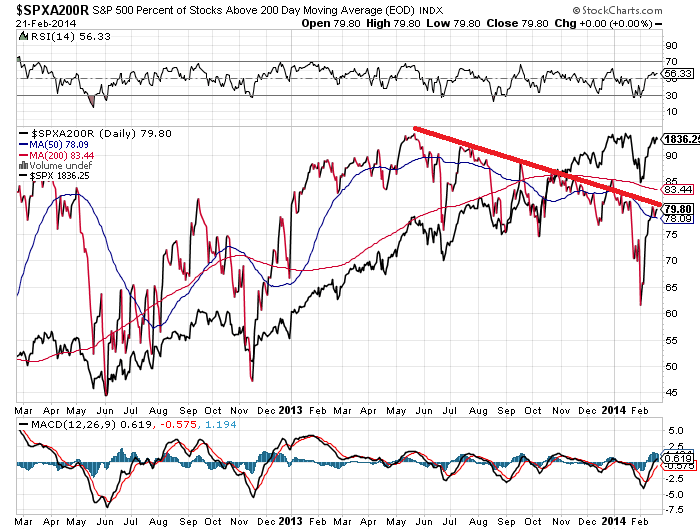
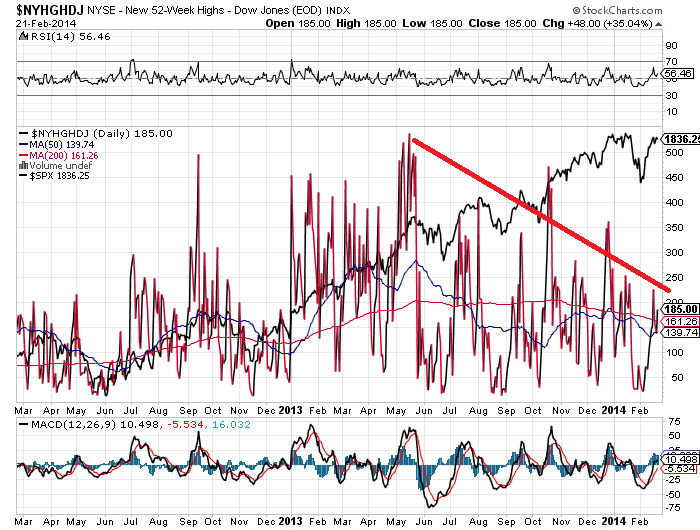
Volume on yesterday’s SP500 up-day was again inferior to the down-days, whilst treasuries had another up-day despite equities and continues to be a signal. Economic data was again poor and remains divergent. There is a momentum divergence in the SP500 new high versus the previous whilst breadth measures of % stocks above 200 MA and 52 week new highs continue their divergent downtrends. The VIX also shows divergence and the trend exhaustion indicator suggests any further gains will be hard to come by currently.

Current Skew reading:

28fe1Source: Barcharts

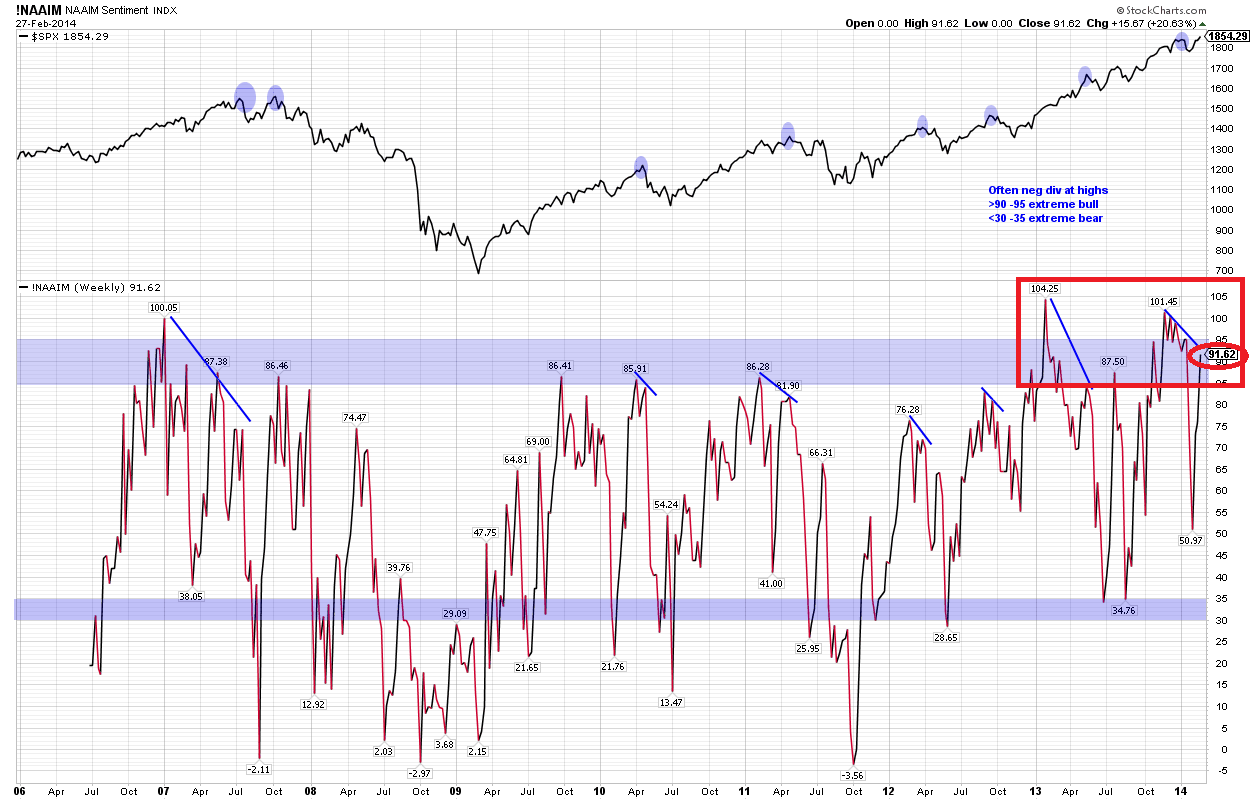
Current NAAIM reading:

28fe4Source: U Karlewitz

Current Investors Intelligence bull-bear reading:

28fe6Source: U Karlewitz

Plus ISEE equity only call-put reached an extreme yesterday. In short, the rally has lured back in the ‘dumb’ money and I suspect yesterday’s new high close on the SP500 will turn out to be the final bait for ‘all-in’.

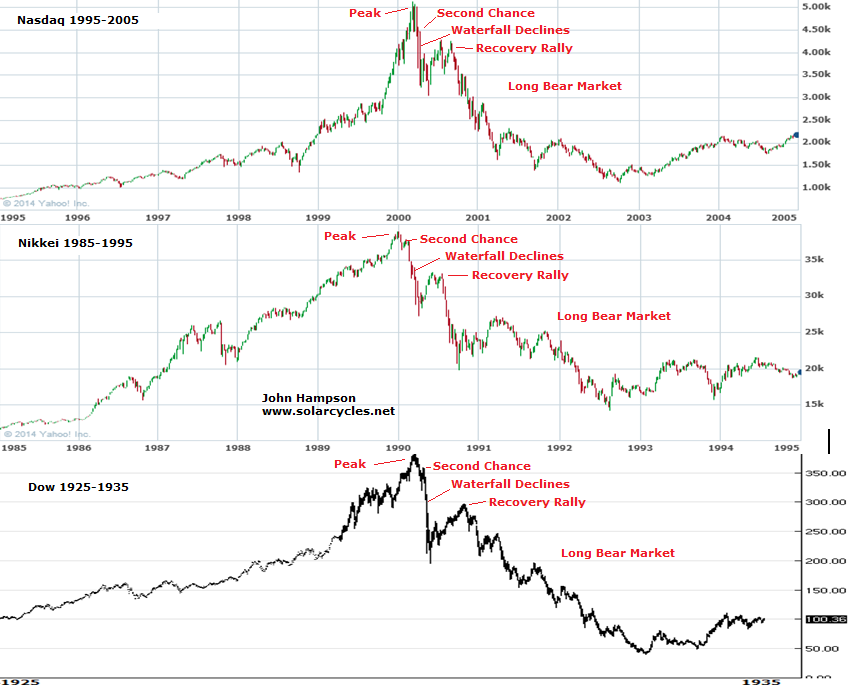
The Dow and Nikkei continue to honour my 31 Dec 2013 top call, and are both several hundred points away from a challenge to that. They also both continue to carve out the ‘second chance’ peak of the historic analogs topping pattern. The FTSE, Dow, Russell and Nikkei remain at long term resistances.

I remind you of this:

28fe3Tomorrow is the new moon and that sets up the possibility of the other US indices now topping close to it: either yesterday, today or the first couple of days of next week. As March and April are inverted geomagnetism seasonal lows and another geomagnetic storm is currently in progress adding to the recent upswing in disturbances, I have additional reasons for the markets to top here as we exit February.

If we look behind the price action at internals, valuation, sentiment, leverage, technicals and fundamentals (all of which I have covered in detail in posts since the turn of the year) then the short opportunity is clear: this a rip to sell, and there won’t be many opportunities as golden as this.

Let’s see how today unfolds. I prefer to comment once the action is complete because there are many intraday swings currently, as evidenced by all the tails on the daily candles recently (another clue for a trend change), but I will comment intraday if I see something more decisive in progress. A reminder that some sharp selling into the close would set up the potential for a big down day on Monday, particularly with the geomagnetic storm aiding again.


Indicator Updates

1. Dow daily candles and Monday’s volume print at high reversal:

26fe12. Nasdaq 100 and breadth divergence:

26fe43. SP500 and defensives outperforming cyclicals:

26fe2

4. Russell 2000 (my largest short) P/E:

26fe11

5. Gold outperforming stocks:

26fe96. Treasuries outperforming stocks:

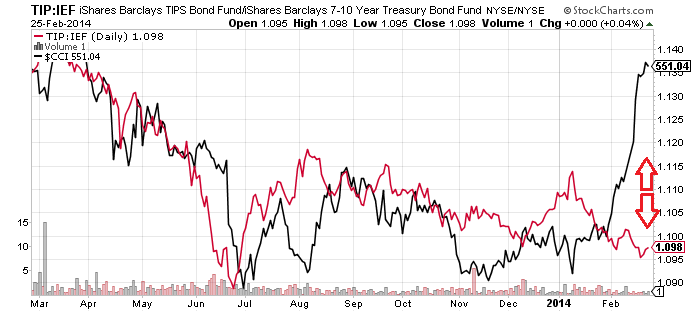
26fe107. Inflation expectations cast doubt on longevity of commodities (CCI index black line) rally:

26fe138. Smart money sold into 2013’s equities rally and outflows accelerating into this month’s upleg:

26fe89. Rydex bull ratio exceeds levels previously associated with significant corrections and 2013’s anomalous levitation raises risk of sharp collapse:

26fe710. Put/Call ratio (21 day average) also exceeds levels of previous significant corrections, and at best suggests period of consolidation with downward bias ahead for equities:

26fe5

Dow 1929 vs Nikkei 1989 vs Nasdaq 2000 vs Today

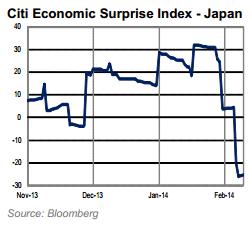
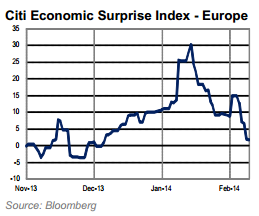
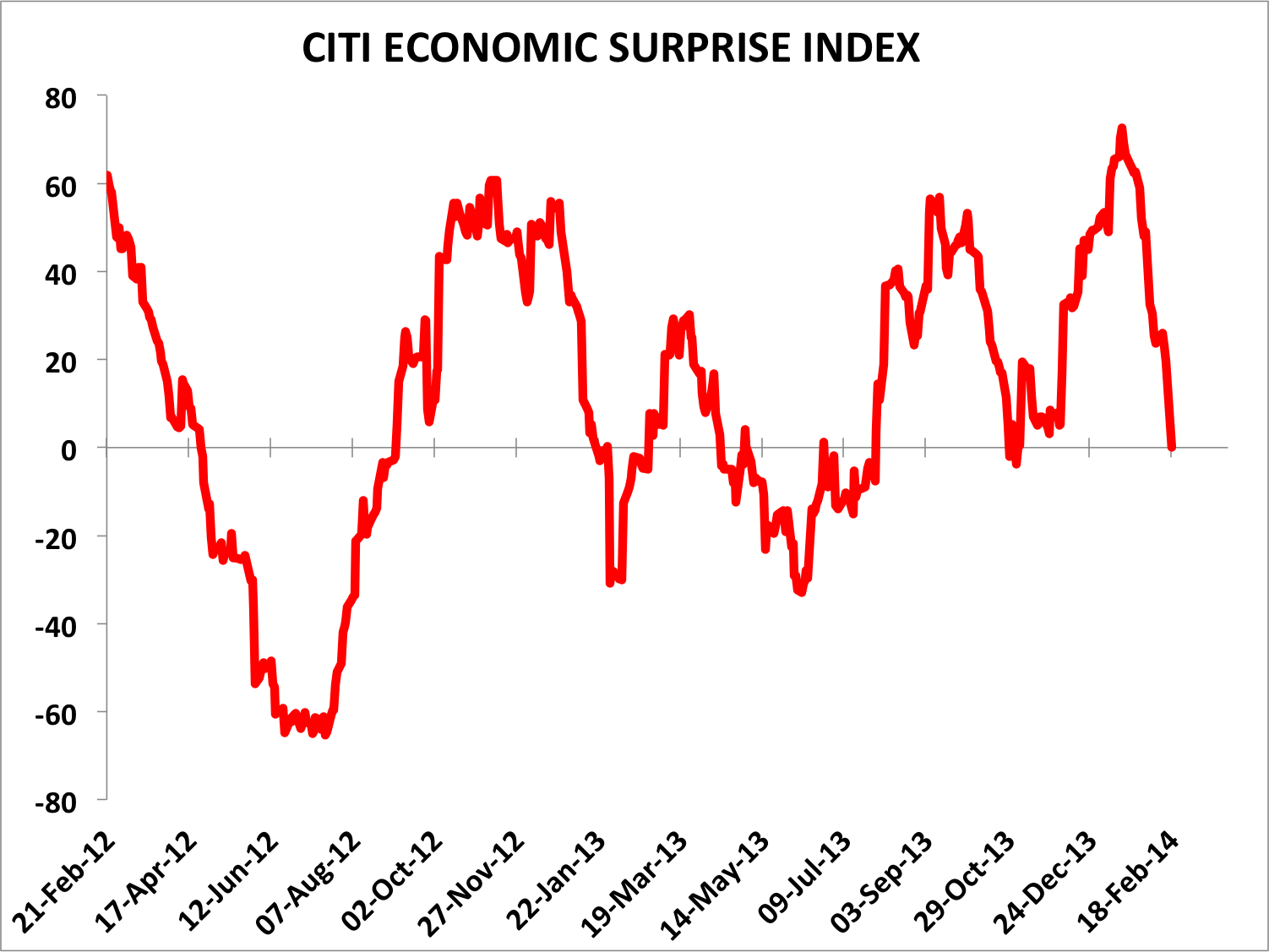
Yesterday saw a failed breakout on the SP500 on high volume which suggests exhaustion. The Skew print came in still historically high and the put/call print historically low again, which continue to signal bullish complacency and high risk of an outsized move to the downside. Economic data disappointed again, and the latest economic surprise readings are below:

25fe10 25fe11 25fe12

Source: Citi

The geomagnetic storms over the last week broke the model’s multi-month uptrend (red line) and along with the NOAA forecast reveal downward pressure this week:
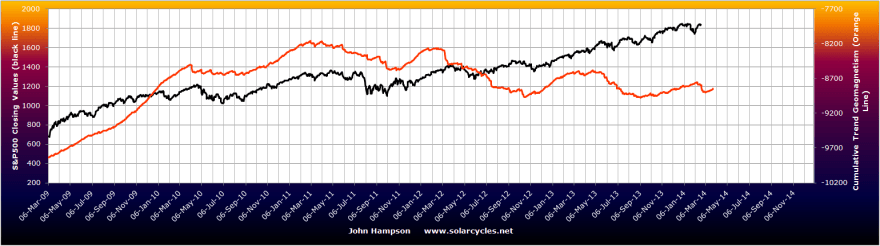
25fe13If you are new to the site my models are updated weekly.

The significant outstanding bubble in the markets remains the Nasdaq Biotech sector, but the unsustainable parabolic is ripe to pop:
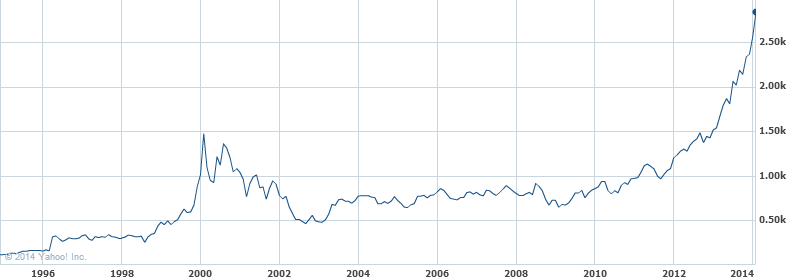
25fe14

Source: Yahoo

Less than one third of this sector’s 122 companies earned any money in the last 12 months.

The last 2 years gains in the wider US markets were approximately 80% multiple expansion and 20% earnings growth. The justification for the multiple expansion was (1) ‘Fed policy trumps all’ and (2) stocks frontrunning a ‘normalisation’ in economic growth and earnings. Now: QE is being wound down, Q4 2013 GDP and Q1 2014 GDP estimates are being revised downwards, earnings estimates are being revised downwards and for Q1 2014 82% of companies so far have issued negative earnings guidance. Those justifications have largely evaporated.

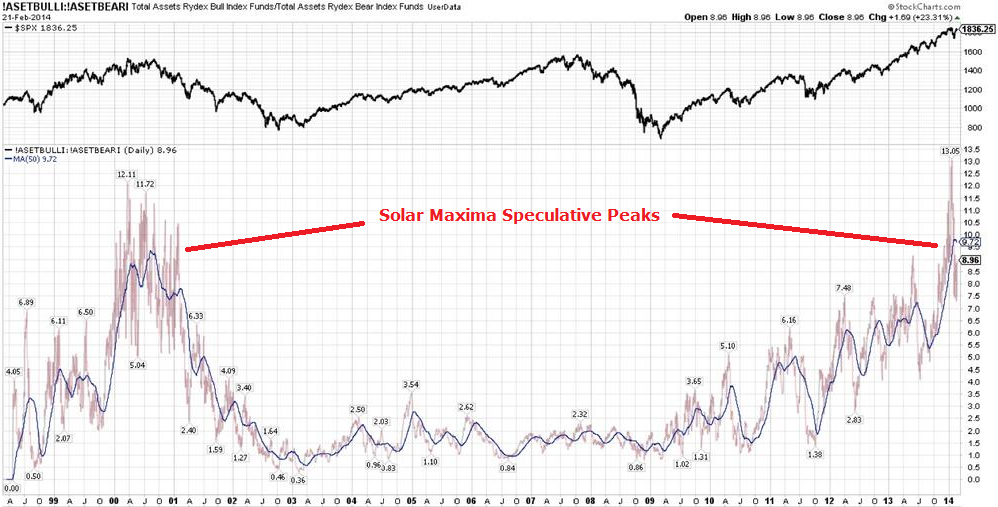
The lesser known reason for the big run up in price into the end of 2013 is the speculation peak driven by the solar maximum, and this was shared in the superpeaks of Dow 1929, Nikkei 1989 and Nasdaq 2000. A reminder that there are 3 ingredients for a superpeak: (1) speculative mania by solar maximum (2) increasing number of buyers through demographic swell and (3) increasing use of leverage amongst buyers. Both (1) and (3) apply to the current US markets but (2) is absent. There is a shrinking rather than swelling demographic pool, and for that reason we do not have a supersized peak. Otherwise, the analogies are very much applicable.

In 2013 US markets ran up in a parabolic shaping, generating historic levitation above moving averages and producing an anomalous lack of a ‘proper’ correction. Sentiment reached levels not seen since previous major peaks, and euphoria only historically exceeded in the dot.com boom. We have reached valuation levels in the Q ratio equivalent to the TOP in 1929 and in stock market capitalisation to GDP equivalent to the TOP in 2000. Leverage levels equal the TOP in 2000 as measured by margin debt to GDP and beat the 2000 top in other measures. The blow-off topping process in the current Dow so far mirrors that shared by the 3 analogs, and the peak-to-date occurred at the solar maximum.

In short, the ‘size’ of the peak in current US markets does not compare to the analogs because of the key demographic difference, but in many other ways these analogs are particularly apt. What comes next in the analogs is waterfall declines, and we have a case for the same in the current US markets due to (1) historic levitation away from moving averages or parabolic rise on long term view (2) historic time since significant correction and historic compound gains and bull duration (3) 80% multiple expansion 3-pronged justification case shattered (4) ‘all-in’ measures of sentiment, leverage and fund flows ripe for unwinding. We are likely through the solar maximum peak and the speculative excess into the peak is now vulnerable to pop.

Here are the analogs on a 10 year view centered around the peak:

25fe7Alongside I’d like to remind you of the relevance of the (inverted) seasonality of geomagnetism for the timing of peaks and falls:

13fe4

Nikkei 1989: Waterfall declines from second chance lasted about 6 weeks, centered on March (geomagnetism (inverted) seasonal low), and took off 27% from peak; Recovery rally then lasted 3.5 months from April to July, back up 20% (through seasonal high); Then 2.5 months more waterfall declines, mid July to beginning of October down 40% (through seasonal low).

Dow 1929: Waterfall declines from second chance lasted 1 month, centered on October (seasonal low), and took 48% off from peak; Recovery rally then added back on 50%, lasted 5 months from November to april (through seasonal high); Then long period of declines lasting a couple of years.

Nasdaq 2000: Waterfall declines from second chance lasted about 6 weeks, March-April, and took 36% off (seasonal low); Recovery rally lasted about 3.5 months from May through to beginning of Sept, adding back on 34% (through seasonal high); Then long period of declines lasting a couple of years.

So, averaging them out and applying to the current US markets, we could expect waterfall declines of around 35% lasting around 5 weeks, and this should occur in the seasonal low of March-April. That would then be the time to take off short positions for a recovery rally of around 35% lasting around 4 months from April to August or so, through the seasonal high. A second set of steep declines should then unfold through the seasonal low of September-October.

25fe8By that model the initial waterfall declines should wipe out all of 2013’s gains in the space of a month. I refer you to the case for waterfall declines further up the page as to why this is reasonable, and I suggest the consensus view once this occurs will belatedly point to similar factors. However, once the recovery rally then erupts, as can be seen from the 3 analogs on the 10 year view, it will keep the ongoing bull market option in play. I suggest 1987 will likely be quoted as benchmark: a harsh correction that was a golden buying opportunity. But, once the recovery rally tops out short and rolls over into more steep declines, there will be broad acceptance of the new bear.

What will happen to commodities under waterfall declines? Understand that such unforgiving drops will bring about forced liquidations as leverage is unwound so there will be some blanket selling. In all 3 analog waterfall decline periods, commodities (including precious metals) fell too, whilst the US dollar largely rallied. The same occurred in October 2008’s sharp falls. That suggests it may be prudent to pull back on or even exit commodities long positions once we get a whiff of steep declines erupting.

Previous major commodities peaks have been speculative to a large degree, but also typically founded on a fundamental supply/demand case. For energy and industrial metals the latter is currently weak, and we see oil and copper in long term ranges rather than in major breakouts. Various soft commodities have enjoyed steep moves up as shorts have scrambled to cover, but whether there can be an enduring supporting story this year remains to be seen. I am skeptical as to whether commodities as a class can make a major rally to beyond 2011’s CCI peak this year, anticipating they may sell off under the waterfall declines and perhaps struggle for a case under deflationary recession fears. However, maybe they can outperform during the ‘recovery rally’ over mid-year and particularly if the US dollar is less seen as a safe haven this time, so I remain open to the possibility that maybe they can beat 2011’s peak, but currently see this as less likely. The case for previous metals differs from other commodities, and as I have outlined before I see gold’s 2011-2013 bear as a pause in a longer term secular bull market likely to terminate at the next solar maximum. My tactics will be to reduce all commodities long positions bar precious metals once it looks likely that equities are on the cusp of waterfalling, anticipating some blanket selling across all assets in that period, and then review again as we approach the end of that event.

Looking back to the Great Depression, banking panics began in 1930 and swapping dollars for gold in 1931. In other words, it took time for things to unfold, and I would expect similar this time around. Whilst I cannot be sure, I do not expect a sudden chain of bankruptcies under the first waterfall declines, but for the real ‘trouble’ to unfold gradually and likely after the recovery rally peaks out. First things first then: I expect a major short equities opportunity to unfold swiftly from here through March and into mid-April, and am positioned for that. I will be looking to exit all equities shorts as I try to time the end of that event.

Sunday Charts

1. Bearish candles on US stock indices on Friday with volume continuing to be greater on down days versus up days:

23fe4

Source: Stockcharts

2. Put/call ratio finished at extreme low again, which is more consistent with peaks rather than breakouts:
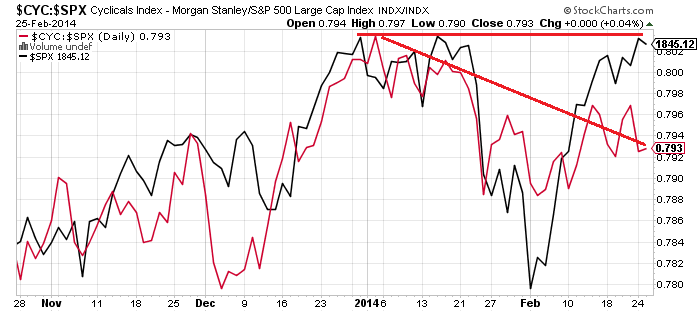
23fe2Source: Stockcharts

3. Trend exhaustion indicator also suggests breakout now unlikely:

23fe7

Source: Rory Handyside

4. Skew finished at extreme high again, which signals amplified risk of an outsized move ahead:

23fe1Source: Barcharts

5. Two breadth measures remain in six month divergences:

23fe3Source: Stockcharts

23fe6Source: Stockcharts

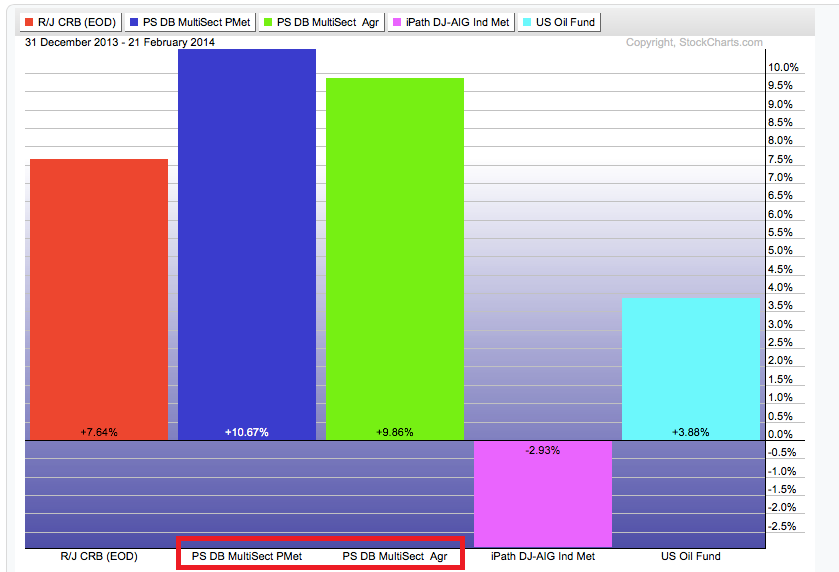
6. Economic growth is also divergent, and this is reflected in the advance in commodities being weighted to precious metals and agriculture rather than industrial metals and energy:

23fe5Source: Citi

23fe11Source: U Karlewitz

7. Long term view of Rydex bull/bear ratio points to a market top, specifically a solar-maximum speculative-excess market top:

23fe10Source: U Karlewitz

Max Short Equities

A reversal in equities at the right time, right place. The closes on the Dow peaked at Friday’s full moon suggesting an inversion may well have occurred. A big up day yesterday for commodities, including 10% gains in natural gas and coffee. US economic surprises slipped below zero as data once again disappointed, and rising input prices (commodities) are, in line with history, threatening to tip an already weakening economy over as 2014 progresses. A significant geomagnetic storm played out yesterday, with another one in progress at the time of writing, and the timing of these disturbances is notable.

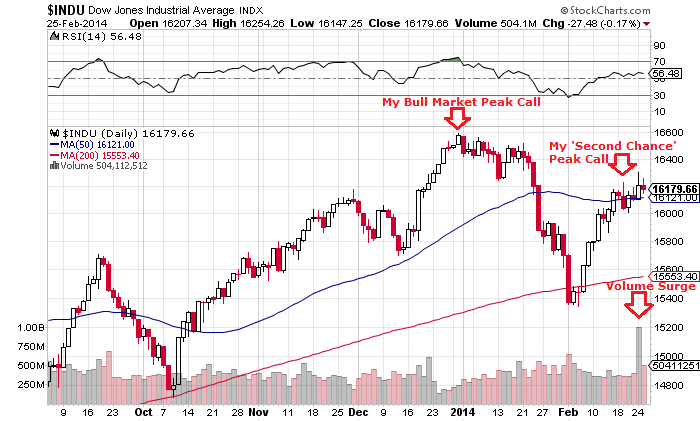
I believe yesterday will turn out to be the spot for optimal maximum short equities. Maybe you disagree with the timing, but if you have been a reader of my posts for the last couple of months then you will know I am acting on a multi-angled, multi-layered case. Maybe you disagree with being short at all, but having done a little tally I have published about 50 different indicators since the turn of the year which all individually suggest a shorting opportunity in equities is at hand (either for multi-week, multi-month or multi-year gains), and collectively produce something compelling. Whilst it would be unwise to rely on any one indicator as anomalies can and do occur, I feel pretty confident with fifty. If my specific timing of the optimal shorting point turns out wrong, then that aggregate of indicators calls for that spot being near both in time and price. Until disproven I have now two specific calls: (1) Stock market topped 31 Dec 2013 (Dow, SP500 (double top) and Nikkei) and (2) Optimal shorting opportunity (peak of the second chance) was 19 Feb 2014. A reminder: I am not an advisory service and I am short equities, long commodities.

Click on the two charts to view larger:

20fe1

20fe2