Japan Financial Markets Economic Correlations

I wanted to test the correlations and interrelations on Japan. As it went through a different experience to the USA over the last half a century, did the same correlations in assets and the economy hold true? Data history is more limited than for the US, but sufficient to test. Correlation coefficients over +0.5 are considered strong positive correlations between two datasets, and some datasets have been scaled to share the same chart, where e.g. *3 or /10 is shown. Click on a chart to see it larger.

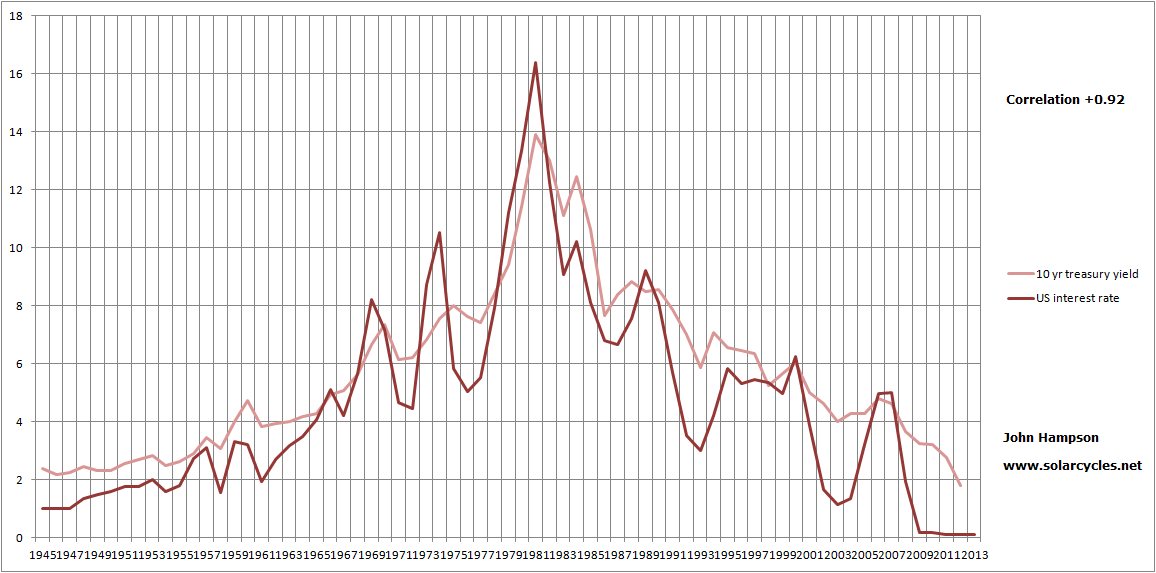
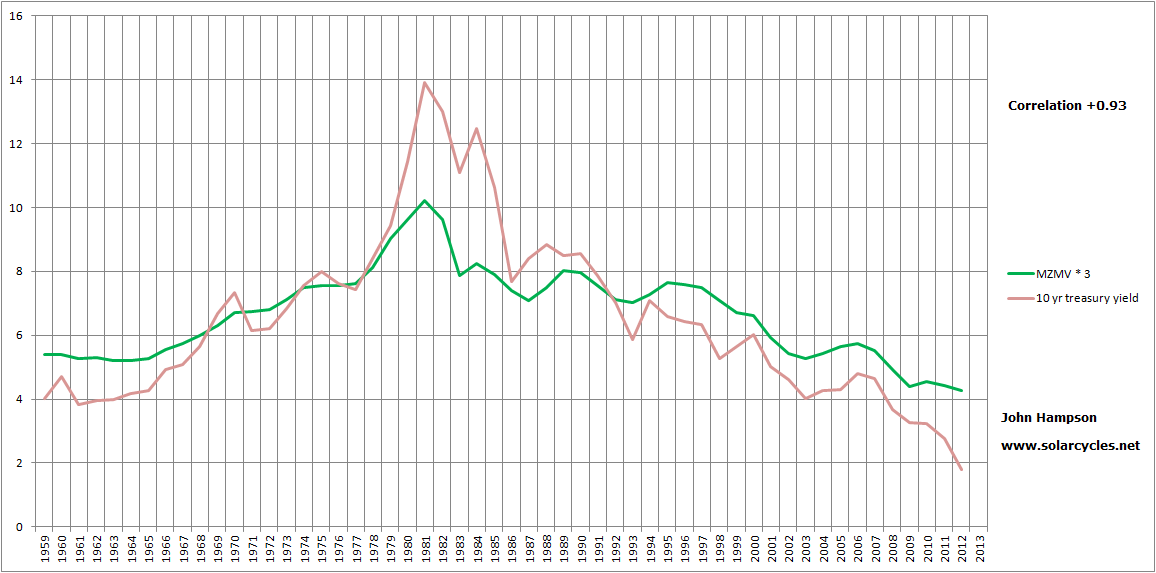
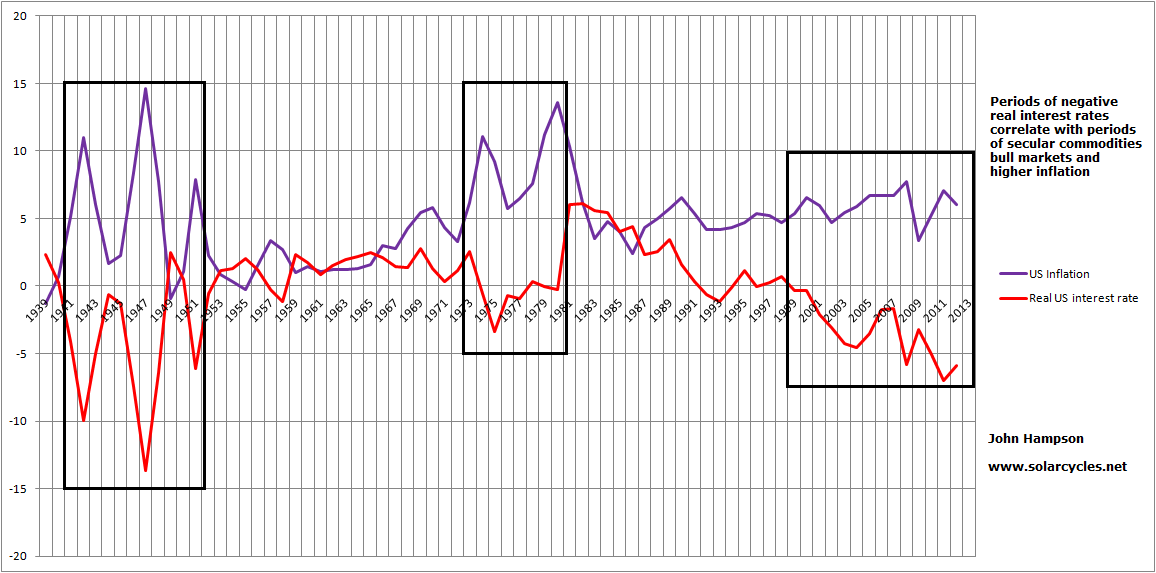
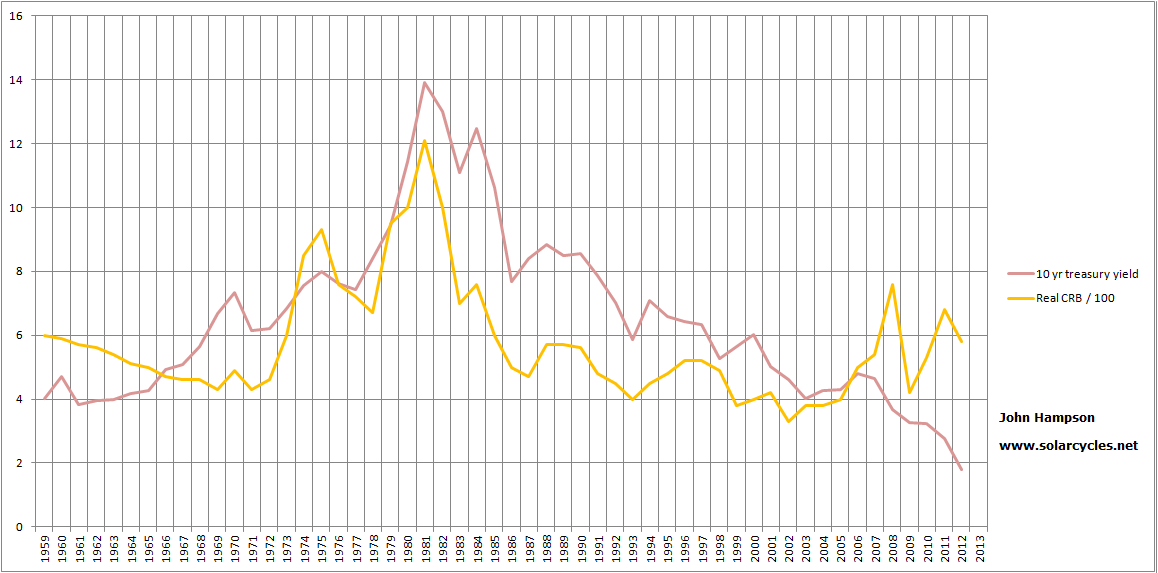
Firstly, I found the same five-way block correlation between interest rates, bond yields, money velocity, real commodities and inflation. Here are two pairings from that group:

Y1

Y2Note that the level of inflation was overall at a lower level than in the US over the last 3 decades but the relationship between real commodities and inflation is still clear.

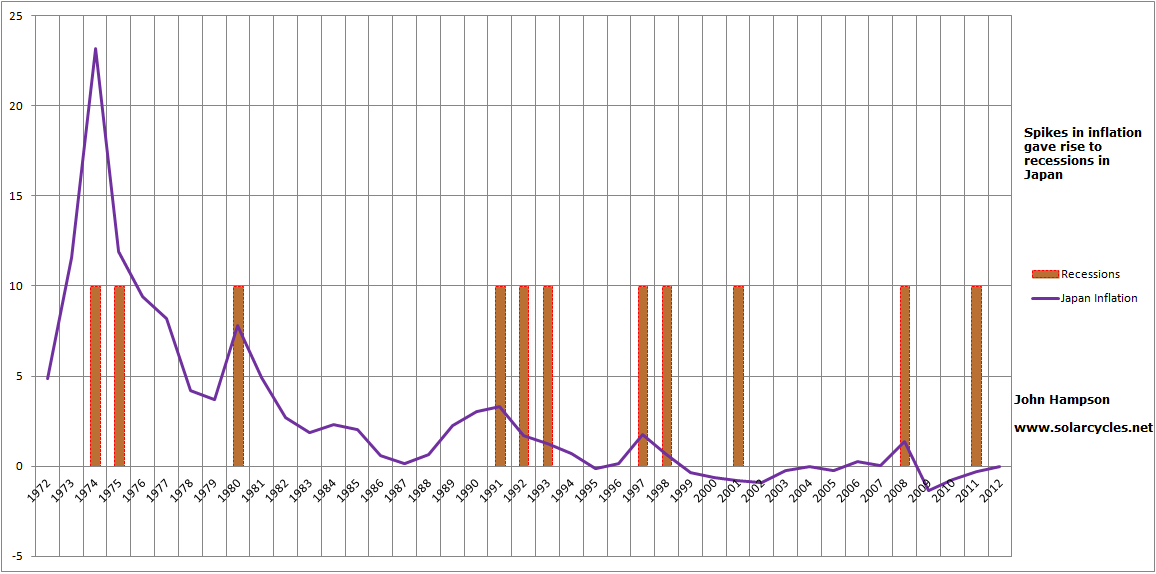
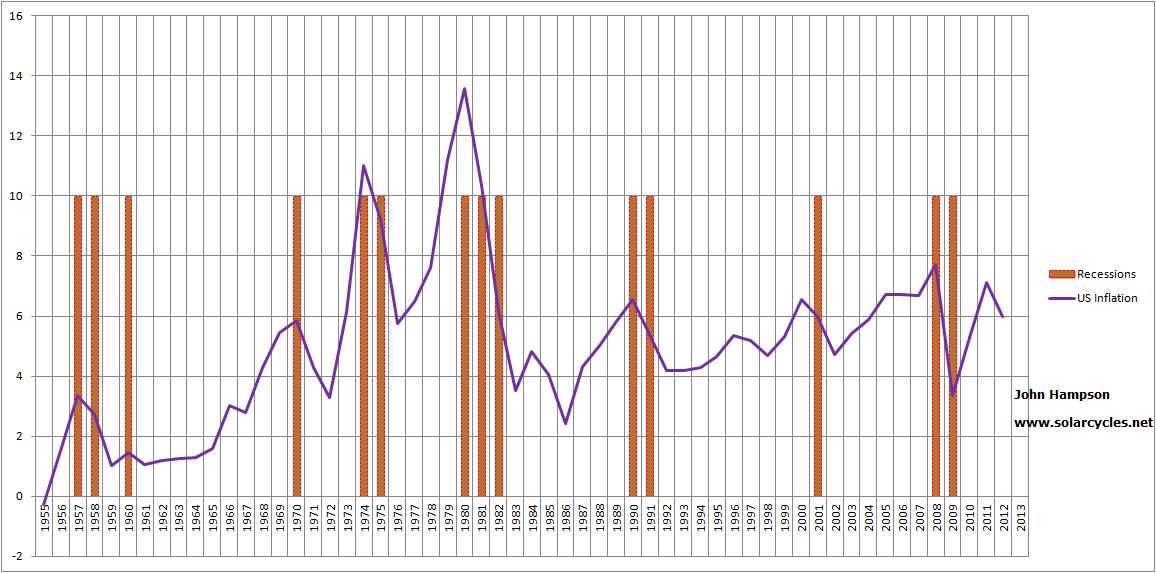
As per for the US, I found this five-way block then produced the correlated-two of recession and unemployment. Below it can be seen how recession followed spikes in inflation, even if the spikes were low.

Y3

I also discovered the asset pairings are again found in Japan, with bond yields and commodities related, whilst real house prices and real equities go their own shared path. I show here real stocks and real house prices:

Y4

Uniting those two assets into a composite in the next chart, demographic trends again appear to have played a key role in their secular trending.

Y6That Japan did not participate in the secular stocks bull through to 2000 and the secular housing bull through to 2005 that the USA did, makes sense in light of the demographic trends in the period from 1990 to 2005. Additionally, the speculative peaks in Japanese stocks and housing circa 1989/1990 (around the human excitement solar maximum of 1989) were fairly extreme ‘greed’ overthrows, which then need time to washout on the other side.

However, demographic trends overall collectively turned up again from around 2005 and should continue positively until circa 2020. Japanese equities effectively made a triple nominal bottom in 2003, 2008/9 and 2011/12, whilst real estate has been basing since 2010, but a sustained rise in risk assets in Japan did not materialise until November 2012 onwards and I believe this sharp move is a belated catch up to the demographics. If 2013-to-date was added to the above chart we would see a significant pull-up in the stocks/housing composite.

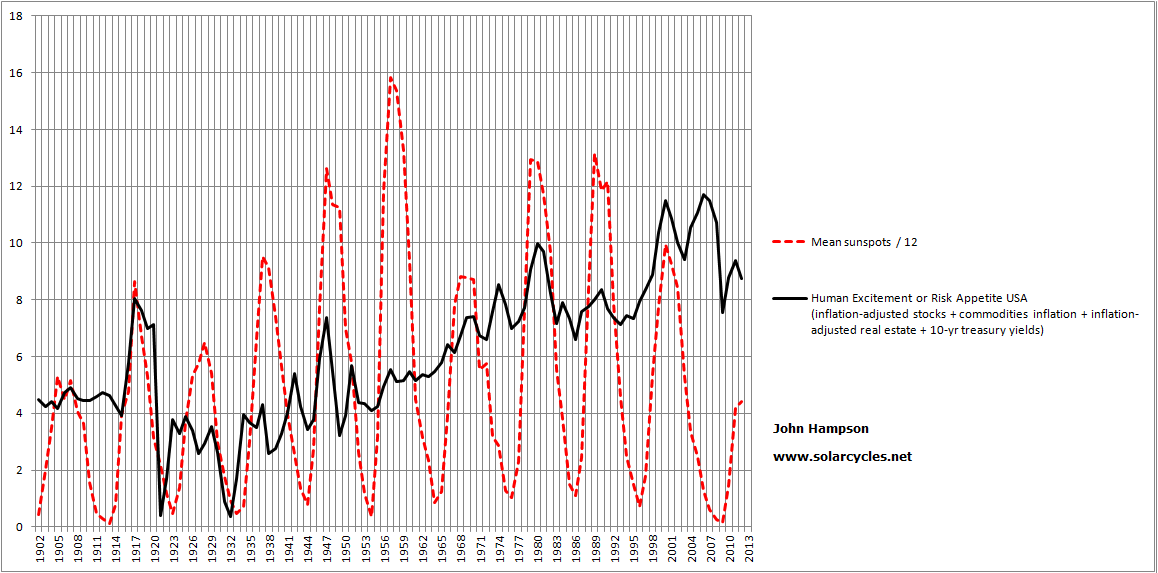
Drawing in bond yields and real commodities to make a 4-way risk asset composite, and as per the USA comparing against the quadruple-agent composite of sunspots, geomagnetism, demographics and real interest rates, there is again a notable mapping between the two (again, 2013 should provide a belated pull-up to the model: a divergence being rectified):

Y7Generating the forecast into the future, but with the caveat of using assumptions and historic rhymes, we get this:

Y8The prediction will be refined over time to validate or invalidate those underlying assumptions and patterns, but the overall uptrend is due to the demographic trends that stand to boost risk assets until circa 2020 and then the next solar maximum should continue the upwards pull until circa 2025, implying there is a good chance of an overall secular bull in stocks and real estate in Japan for the years ahead.

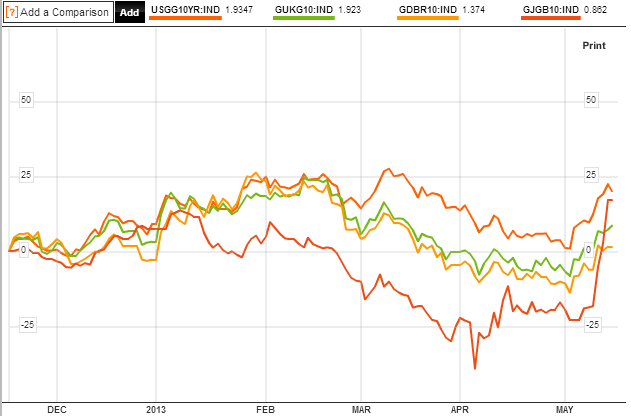
I therefore suggest that the government’s recent doubling down on stimulus is in fact not required, and so it has the potential to supercharge proceedings. So far the yen has dropped sharply, bonds yields have taken off and inflation expectations have risen significantly:

Y9Source: BusinessInsider

As Japan is a net commodity importer, the sharp drop in the Yen pushes up import prices for energy and other resources, so they already have commodity price inflation despite commodities recently underperforming. If commodities now rise, as per my forecasts, then there is a danger that Japan suffers major commodity-based inflation, which should be correlated with money velocity soaring, and an inflationary feedback spiral develops. The government should then accordingly raise rates, but cannot raise them too fast or too far because of the record debt servicing. That, collectively, is why there is a hyperinflation risk. If problematic inflation does erupt then eventually the risk is of a stock market crash. However, until then (and maybe it does not come to pass), stocks are likely to do well based on demographics and a belated catch up, and they should also perform well under ‘some’ inflation. So the question is whether stocks will pullback sufficiently to offer an opportunity to get in or add more. I am long the Nikkei, but do not feel comfortable adding more on the long side at this point when stocks have risen almost 100% in 6 months. Conversely, despite the trade doing very well at the moment, I do not wish to take profits as I believe the major rally to be justified, and expect more gains ahead. So I stay put for now and we’ll see how things develop.

What Really Moves The Markets

The evidence has led me to a ‘dumb’ model of the markets, whereby humans are more subjects and less intelligent creatures of free will. It’s up to you to decide whether I have simply found what suits me and filtered out the rest, i.e. dumb seeks dumb. If we remove all the noise by looking long term, I suggest sunspots and geomagnetism are two big (but very subtle) drivers of human behaviour towards risk assets, with demographics (which are influenced by solar cycles) simply providing bulges in demand to produce long term bull markets in stocks and housing.

I suggest the solar phenomena are influencing human behaviour in the economy and financial markets alike, and that is why we find treasury yields, interest rates, money velocity, inflation and commodities largely correlated together. Optimism, excitement and positive sentiment driving all up, or pessimism, fear and negative sentiment driving all down. Just waves of sentiment supplied by nature. Plus, when increasing numbers join the investor age bracket of the population versus old and young over a period then enduring bull markets in stocks and housing can occur simply due to the growing demand the demographic trend provides. No complex interaction of fundamentals, just more people investing for retirement.

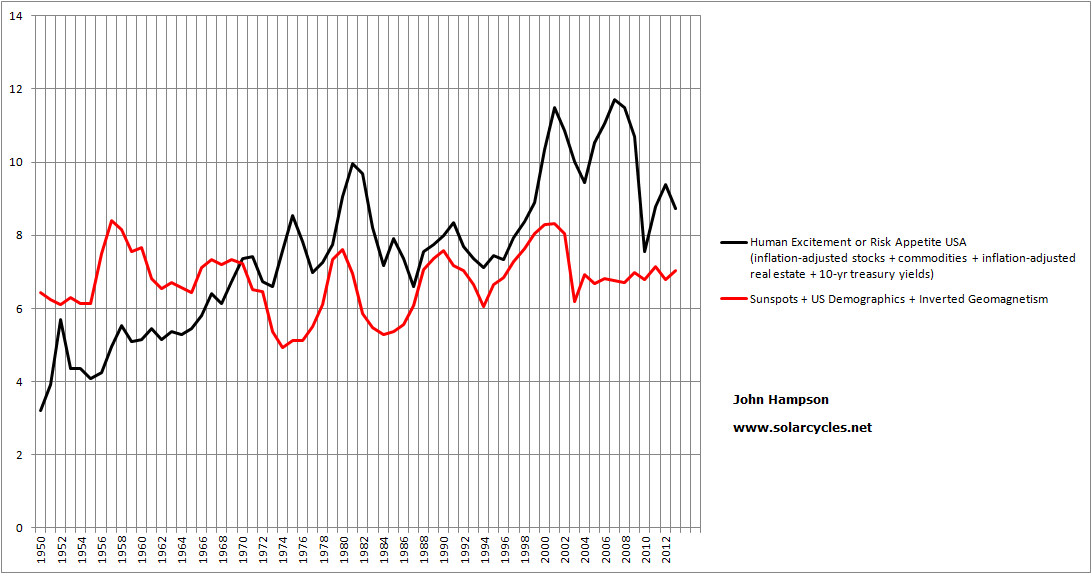
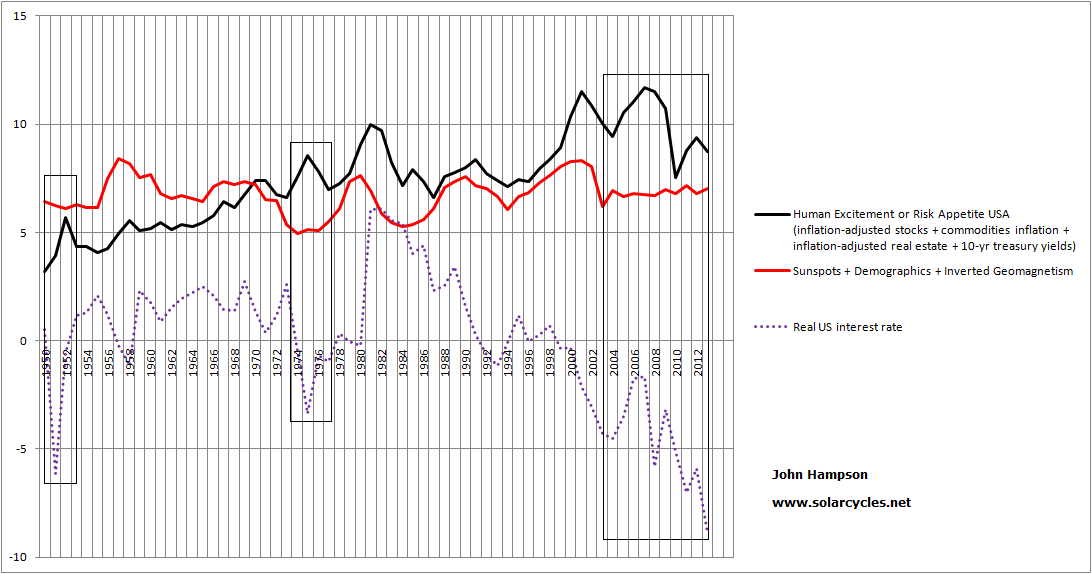
So I figured the next step was to produce a composite model of sunspots, geomagnetism and demographics for the USA over the last century to see to what degree this correlates with the long term US risk asset composite that I charted earlier in the week: namely real stocks and commodities, real house prices and treasury yields. To do make the triple ‘agent’, I used annual mean sunspots, annual average geomagnetism (inverted, because low geomagnetism is pro-risk, high geomagnetism anti-risk) and for the demographics the middle-young ratio up to 1950, then a composite of middle-young, middle-old and percentage of net investors from 1950 to current. To make the quadruple ‘subject’ I used real SP500 annual values, the Schiller real house price index, the commodities index and 10 year treasury yields.

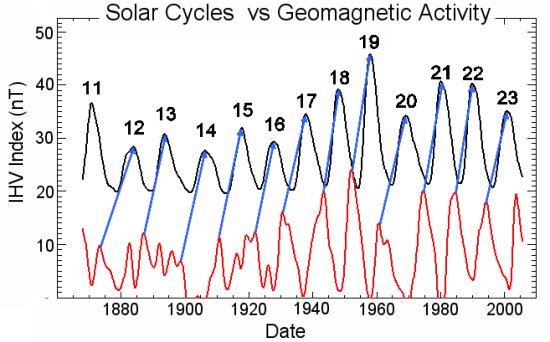
This chart shows how geomagnetism relates to sunspot cycles over the long term:

17may20131Source: NASA

Peaks in geomagnetism occur typically 1-3 years after sunspot peaks, averaging 2 years later. This fits with recessions and unemployment peaks usually occurring within a couple of years after the solar peak, as peak geomagnetism escalates pessimism and fear. The strength in a geomagnetic peak is also a reasonable predictor of the strength of the next solar cycle.

Once I had worked back half a century, compiling the data, this is what popped out (click to view charts larger):

Z16

The model didn’t work out so well in the periods around 2006, 1974 and 1951. I then discovered what united the three: real interest rates were negative:

Z15

Inbetween, the model worked very well. When real interest rates were negative, risk assets (particularly commodities) got an uplift, regardless of sunspots, geomagnetism and demographics. This is because this type of inverted evironment discourages cash and savings, and encourages borrowing and speculation. People are not being compensated by leaving their money at the bank to offset the gradual erosion of purchasing power, so they seek hard assets and risk investments instead.

So I added negative real interest rates to the model (netting them from the composite where they occurred in the last century) and completed the history, and this is the result:

Z17

Overall a very close match with the moves into and out of stocks, commodities, housing and t-yields over 100 years.

Therefore, I am suggesting there are 4 main agents in moving financial risk asset markets: sunspots, geomagnetism, demographics and negative real interest rates. On a yearly basis, they collectively mapped the bull and bear waves up and down, with little missing.

I then attempted to project the model into the future for the next 20 years.

Demographic projections to this end are fairly reliable as those entering the key age groups over the next 20 years are largely already alive so we have a good idea of numbers moving through. I therefore used all three measures again – middle / old, middle / young and net investors – and combined into a composite.

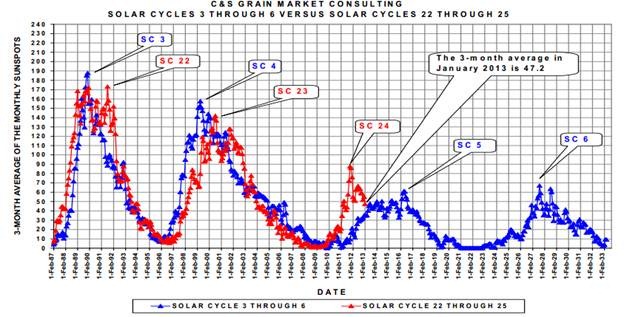
For sunspots, there is a historic rhyme with a past period of solar cycles as shown:

17may20132Source: WattsUpWithThat

So I projected sunspots forward based on solar cycles 5 and 6. Then, using the link between a geomagnetic peak with the next solar peak, as referenced further up the page, and its typically peaking 2 years after a solar peak as well as general relations with the sunspot cycling, I constructed a geomagnetism model for the next 20 years.

Lastly, for negative real interest rates, I used the late 1940s and 1950s as a guide due to its historical mirror, with high government debt meaning rates had to be kept low, whilst modelling inflation based on its correlation with solar maxima.

The result:

Z18

Clearly, there are assumptions and a reasonable tolerance allowance in my 20-year forecasts for the three datasets that make up the model other than demographics. One assumption is that the solar maximum is ahead this year. If that proves correct then there is a fairly potent combination of a sunspot peak with negative real interest rates, which contribute to the 2014 spike, before dwindling sunspots and peak geomagnetism arrive along with fading demographics. From 2022 to 2027 a bull market in stocks and housing should be enabled by an upturn in demographics and the next solar maximum. Overall, however, the future model is downward sloping, as demographics are poor relative to a golden period like 1980-2000, and the sun potentially enters a new ‘minima’ period as shown in the SC5 and SC6 historic rhyme above.  This is also despite the built-in expectation that real interest rates may oscillate in the negative for some time yet, as the Fed only slowly and gingerly moves up rates, balancing servicing high debt with keeping inflation in check.

As time progresses, the assumptions in the projections can be confirmed or denied and the forecasts within it refined. As this is a long term model, forward validation is going to take some time. Nonetheless, the backwards validation that came out of the data confirmed the validity of what I believed mainly moves the markets over time, with negative real interest rates added to the three that I set out to test. I am well aware that this is not the mainstream view and would be a hard sell to investors: that the four agents of risk asset markets over the long term are sunspots, geomagnetism, demographics and negative real interest rates. However, drawing those together into a composite appears to account for all the major bulls and bears that we have seen in equities, bonds, real estate and commodities over the last century.

I am still formulating my thoughts on the findings of this last week, but here’s one to end the post: maybe the Fed isn’t as foolish as many make out. The reason the Fed intervenes at all in periods of ‘bust’ or cleansing is to prevent a depression, which would be much harsher on the population and likely bring about social conflict. By pushing down interest rates into the real negative, it can induce risk-asset rallies, which make the people feel better if their investments are rising, and housing rising. The problem is this action typically produces commodity inflation, which is bad for the people. Now there is a large block correlation between official interest rates, t-yields, money velocity, real commodities and inflation, and then recession and unemployment. The first five typically rise together and then produce the latter two. By acting on t-yields through QE, rather than just acting on official rates, might the Fed be able to keep the 5-correlated from rising, and thus also prevent the recession and unemployment that follows too? It would seem worth a try. If that worked, they would perhaps be able to maintain an environment of negative real rates with the beneficiaries stocks and housing, whilst preventing the undesirable trio of commodities inflation, recession and unemployment from rising until they end QE. Right now, that overall scenario seems to be what’s in play in the markets, doesn’t it? However! I am doubtful this actually works. Commodities staged a big rally in 2011 despite QE2. I believe they will do so again and normal correlations will apply.

Update: 

One additional chart to ponder – is global temperature correlated too? It’s tempting to shift this along and see how it matches up, but I’d need a good reason to apply a lag. Any ideas folks?:

Z19

State Of The Markets

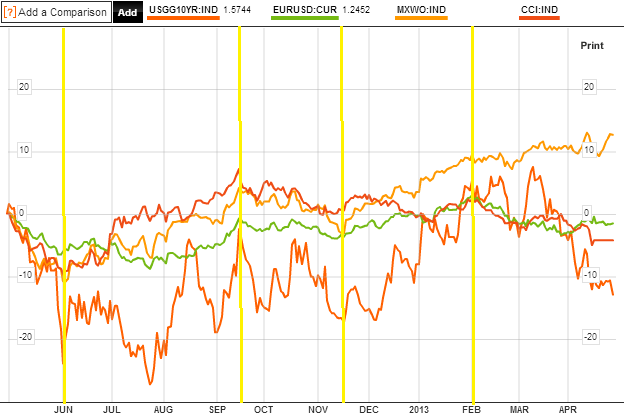
The latest picture for 4-way pro-risk:

16may20131

Source: Bloomberg

If a trend change occurred in late April then commodities and Euro-USD have yet to meaningfully participate. Stocks and bond yields however, have been strong.

The sharp rise in treasury bond yields continues to be reflected in German bunds and UK gilts, and the rush for the exits in bonds has been at its greatest in Japan:

16may20132

Source: Bloomberg

Here is the Japanese Nikkei monthly – an amazing six months:

16may20137If equity markets are on track, per my forecasts, for a top around June, then the Nikkei has a potential resistance there from which it could pull back.

Gold so far is progressing like the Nasdaq correction which I drew attention to HERE. I am looking for a higher low than in mid-April, or a lower low on positive divergence.

Crude oil is still in is large triangle, failing again at resistance:

16may20136As we are in the lunar negative period, we may need to wait until late May if it is going to eventually manage to break out upwards.

This chart suggests that an upturn in G10 economic surprises is required to shift outperformance away from defensives to cyclicals, which would include energy:

16may20133As economic surprises is a mean reverting indicator, the G10 indicator may have reached low enough to warrant a reversal.

Leading indicators also look supportive for this to occur as they remain overall positive. The latest Conference Board data revealed +0.4 for the UK, +1.2 for Korea and +2.1 for Japan. The latest OECD leading indicator picture is very healthy:

16may20134Source: OECD

My overall projections remain the same. A mid-year topping process for equities and rotation into commodities. Leading indicators are showing sufficient health for this to occur, and narrow money predicts emerging market outperformance going forward, which would tie in with increased strength in commodities. I am looking to see a gold bottoming formation, and an eventual break upwards in oil, as supporting developments. The sharp rise in bond yields bodes well for my overall scenario as that was a missing piece of the puzzle, and should be accompanied by a rise in money velocity. Geomagnetism has flattened out, but by seasonality there should be improvement into June/July before a trend change donwards into the Fall. Daily sunspots currently remain close to the record so far for this solar cycle – strength that looks more promising for a solar cycle maximum ahead in the Fall.


USA Financial Markets Economic Correlations

Correlations between real stocks, real commodities, real house prices and treasury yields, together with inflation, interest rates, recessions, unemployment, demographics and sunspots. A more detailed, step by step study of the correlations, using correlation coefficients, whereby +1 means a perfect lockstep relationship between two things and -1 means a perfect inverse relationship, whilst zero would mean no relationship. A reading over +0.5 is considered a strong positive correlation. Note some of the data has been scaled to share the same chart (indicated by, for example, /10 or *3). Also note for US inflation I have used an average of Shadowstats and official CPI since the 1980s, and official CPI before that. You can click on any of the charts to view larger.

Let’s start with a couple of the highest correlations:

Z1

Z2Combining the two, 10 year treasury yields, official US interest rates and MZM money velocity all move in almost perfect lockstep. They are currently all together at record lows. If one begins to rally, we should expect all to rally – with implications for the Fed.

Now let’s look at another closely correlated pair:

Z3Real commodity prices and inflation show a strong correlation. There is a feedback looping between the two as rising commodity prices cause price inflation but price inflation spurs money into commodities (hard assets) as an inflation hedge. There was a lot of debate around the 2008 and 2011 commodity spikes as to whether speculators were to blame. The trading of commodity futures has been around for 150 years in the US, and price spikes are more speculator-heavy because of the feedback looping. Regardless of which kicks off the process, the two occur together.

The next chart shows the relationship between US official interest rates and inflation. Most of the time there is a strong correlation, and as the Fed is the sole agent in rate-setting, we can say that the Fed move rates up and down either in response to or in anticipation of inflation, but largely in line with. However the late 1940s and the current period don’t match up as well as the rest.

Z4

The picture becomes clearer when we look at real interest rates (net of inflation), and extend further back in time:

Z5

We see three clear periods of negative real interest rates – which notably coincided with secular commodities bull markets. Inflation was higher during these periods. If you subscribe to the Shadowstats calculation of inflation (that official inflation stats have been significantly doctored over the last 3 decades) then the purple and red lines would be somewhat higher and lower respectively than shown at the current time. If you take the official CPI data as true, then annual inflation would be currently running around 1.5% which would still maintain the real rates line in the negative. I suggest true inflation is likely somewhere between the two, and thus as shown. As things stand currently, therefore, the environment for the secular commodities bull is still in tact.

Here is another correlation with inflation. US unemployment brought forward two years has a correlation over +0.5 with US inflation:

Z8

This is because recessions occur following inflation spikes:

Z7So we see inflation spikes bringing about recessions which bring about peaks in unemployment around 2 years after the inflation spike (due to unemployment being a lagging economic indicator).

Now let’s draw together unemployment (brought forward 2 years) and inflation, and bring solar sunspot cycles into the picture:

Z9Sunspot solar peaks correlate with inflation peaks, and unemployment brought forward 2 years. This is not a lockstep relationship – it is a correlation specifically related to the solar maxima – and the reasoning for that is the ‘excitement’ that Aleksandr Tchijevsky discovered around solar peaks in human history which is backed up by more recent research revealing bilogical changes in humans at sunspot peaks. If this ‘excitement’ translates into buying and speculation at solar peaks then we can justify spikes in inflation (with subsequent recessions and unemployment spikes).

If it is true that humans are biologically disposed to buying and speculation at solar maxima then a composite of risk assets, namely real stocks, commodities, real estate and treasury yields, should spike up at each solar maximum. Here it is:

Z10The composite uses Schiller real house price data and real SP500 index annual values. Each solar peak is accompanied by a spike in what can be termed risk appetite. There are other spikes inbetween the maxima, but what is key here is whether solar maxima reliably bring about spikes in risk assets, given that we are likely in the year of a solar maximum in 2013.

Within the risk asset composite, there are broadly speaking two pairs:

Z12

10 year treasury yields have a distinct relationship with real commodities, whilst real equities and real house prices correlate very positively together:

Z11

Yet commodities and stocks display an inverse relationship over time of around -0.5, with the result that the two above pairs are often going separate ways. Indeed, thus far in 2013 we have seen US equities and real estate rallying whilst commodities and treasury yields have been languishing. Is it time for a reversal?

If we bring in demographics at this point, and combine stocks and real estate into a composite, this is what we see:

Z13

All three demographic measures – middle to old ratio, middle to young ratio and percentage net investors – are all pointing down for the next couple of years. The stocks and real estate composite has historic correlations with the three measures ranging from +0.54 to +0.7, so all strong positive. It would therefore seem more likely that there is another leg down for real equities and real housing into circa 2015, rather than secular bull upwards action from here. Another leg down in real terms would also help satisfy secular p/e, Q ratio and regression to trend measures for equities, which all call for further washout.

Drawing all the above together, along with my previous analysis, I suggest it remains the most likely scenario that we see an inflationary peak to coincide with the solar maximum (allowing for a reasonable time window), within which commodities and treasury yields rise and stocks and real estate decline in real terms, but due to significant inflation hold up in nominal terms. A recession and peak in unemployment should then follow the inflationary peak. As of around mid-decade demographics improve sufficiently to remove the headwinds for equities and housing, which could enable a new stocks bull, with real interest rates turning positive again.

Once again, your observations and suggestions are welcome, as I believe there is more to be teased out.

More Demographics

The lunar positive period begins here for the next two weeks. Is there a buying opportunity in pro-risk? The geomagnetic trend is still up. Sentiment is at pessimistic levels in a variety of commodities which would be fuel for a mean reversion rally. Sentiment remains a little frothy in equities. Economic surprises for the G10 are in a downtrend and negative. US earnings and revenue beat rates are so far unimpressive. PMIs and leading indicators for key nations have overall weakened a little in the latest readings. Here is the combined picture for pro-risk:

29apr201316Source: Bloomberg

It still looks like a correction has been in place since the turn of February, but global equities as a whole have managed to carve out a sideways range rather than down. By 5-models-in-alignment the next move would be up from here into mid-year to make a cyclical top. PFS forecast that recent soft commodity prices will provide economic improvement ahead again, as cheaper input costs make for growth. If solar/secular history is to reoccur here, then commodities and treasury yields should start to make their move. I would like to see some evidence of change in trend in economic surprises and a renewed pick up in leading indicators to bolster this likelihood.

Back to demographics. Here is a reminder of real UK equities:

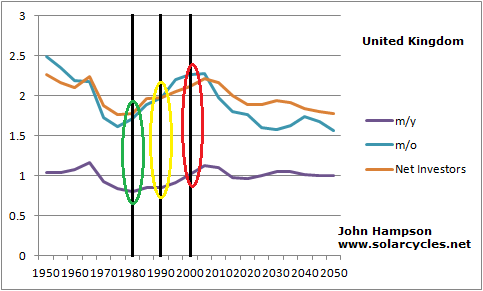
23apr20131The biggest real gains came in the two solar cycles from 1980 to 2000. I have used the population pyramids to draw out the three demographic trends that have been shown to have a correlation with stock market performance, namely the middle/young ratio (m/r), middle/old ratio (m/o) and the proportion of net investors. We can see that the period of bumper gains in UK stocks was one in which all three measures were trending upwards – a kind of demographics ‘holy trinity’:

29apr201315

Looking forward there is no such golden period ahead for the UK. The caveats, as some of you pointed out, are that immigration policies can change (changing the demographic projection) and investor behaviour may change (disturbing the correlation with the local stock market). But barring any major changes, the UK stock market may struggle going forward.

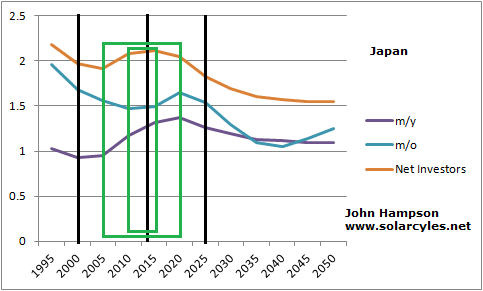
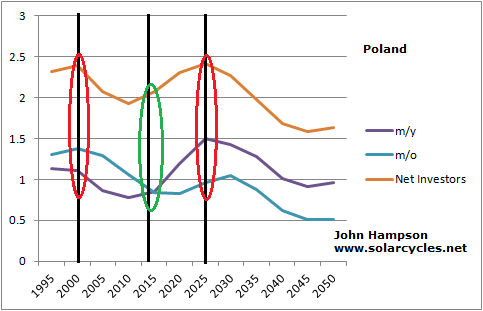
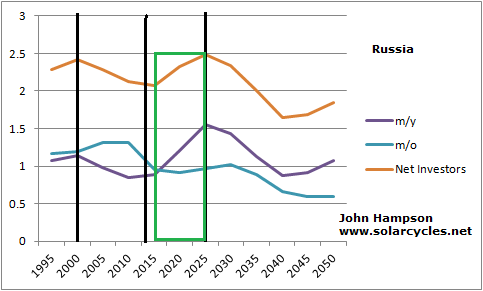
So here are three countries that do have such a demographic positive unity ahead, i.e. all three measures trending up for a period.

The first is Japan. The black lines are the solar maxima. The outer green box is the overall positive period, and the inner green box when all three are trending upwards together. The window of opportunity is now.

29apr201314The second is Poland. This next solar cycle, from circa 2013 to circa 2025, is one where all three measures are rising. That makes Poland a likely secular bull market in that period.

29apr20138And the last for today is Russia. The positive alignment runs from around 2015 to 2025 for a decade.

29apr201313Russian stocks are still very cheap, at p/e 5.6 and paying a 4% dividend. If commodities can accelerate once more, as per my prediction, then I believe Russian stocks can mean revert to some degree. The positive demographics just ahead also suggest that if the trade does not come good quickly that it should with time.

So my trade for today has been to add to (and average down a little) JPM Russia. The lunar positive period, the expectation that commodities will outperform, plus the picture just outlined.

Solar Cycles, Demographics and Equities

A long post coming up, but I found this to be outlook-changing research.

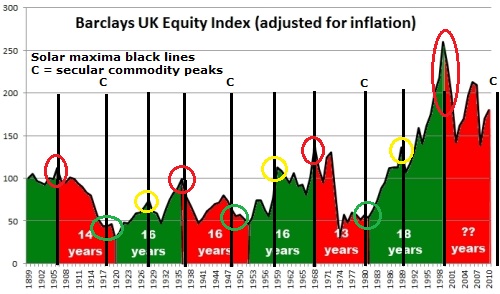
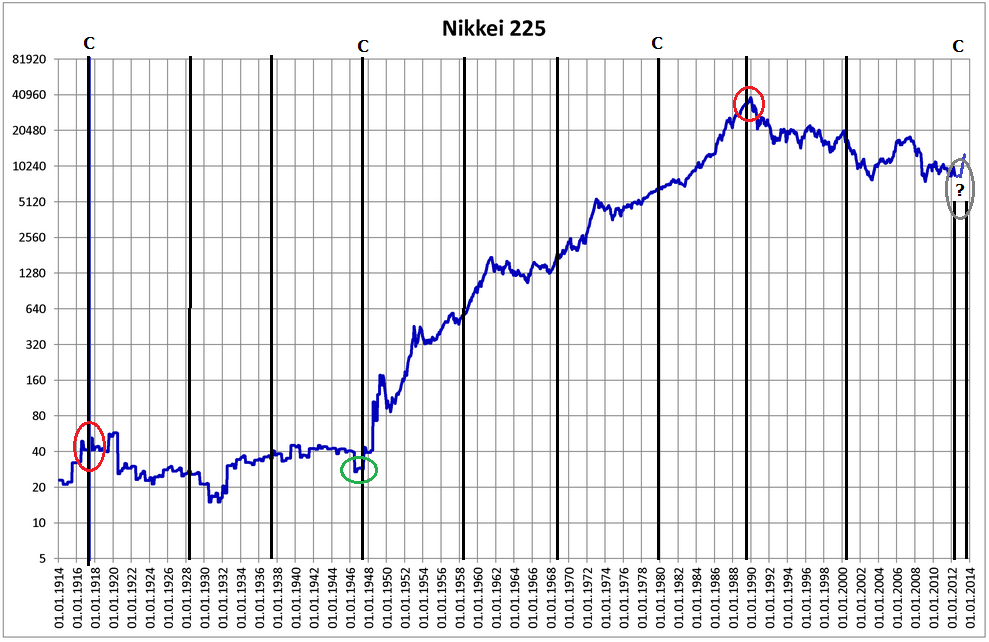
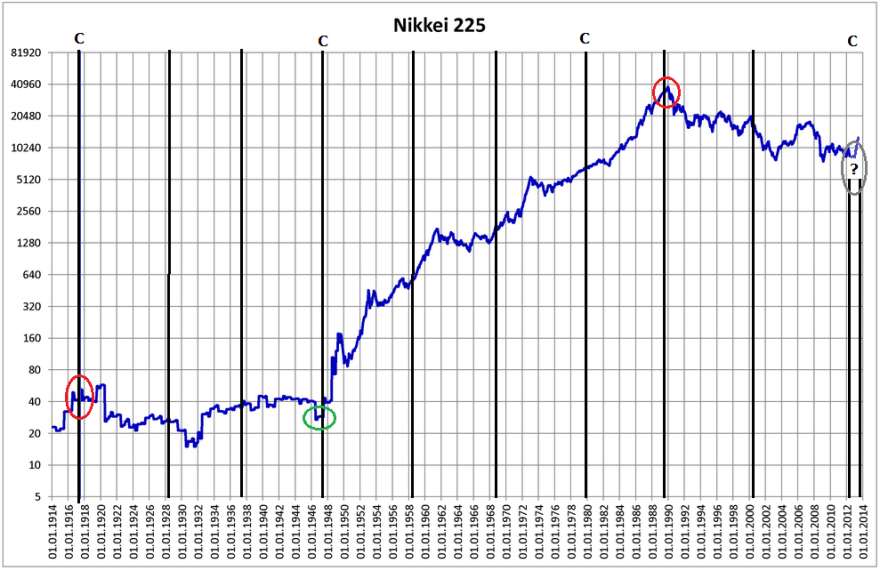
Firstly, the Japanese stock index long term chart, with solar cycle maximums marked as black lines (C for commodity secular peaks):
22apr20131Underlying source: Wikipedia

A fairly simple 100 year history: a long secular bear followed by a long secular bull followed by a long secular bear that potentially just ended at the turn of 2012 into 2013. The secular turns fell very close to solar maxima.

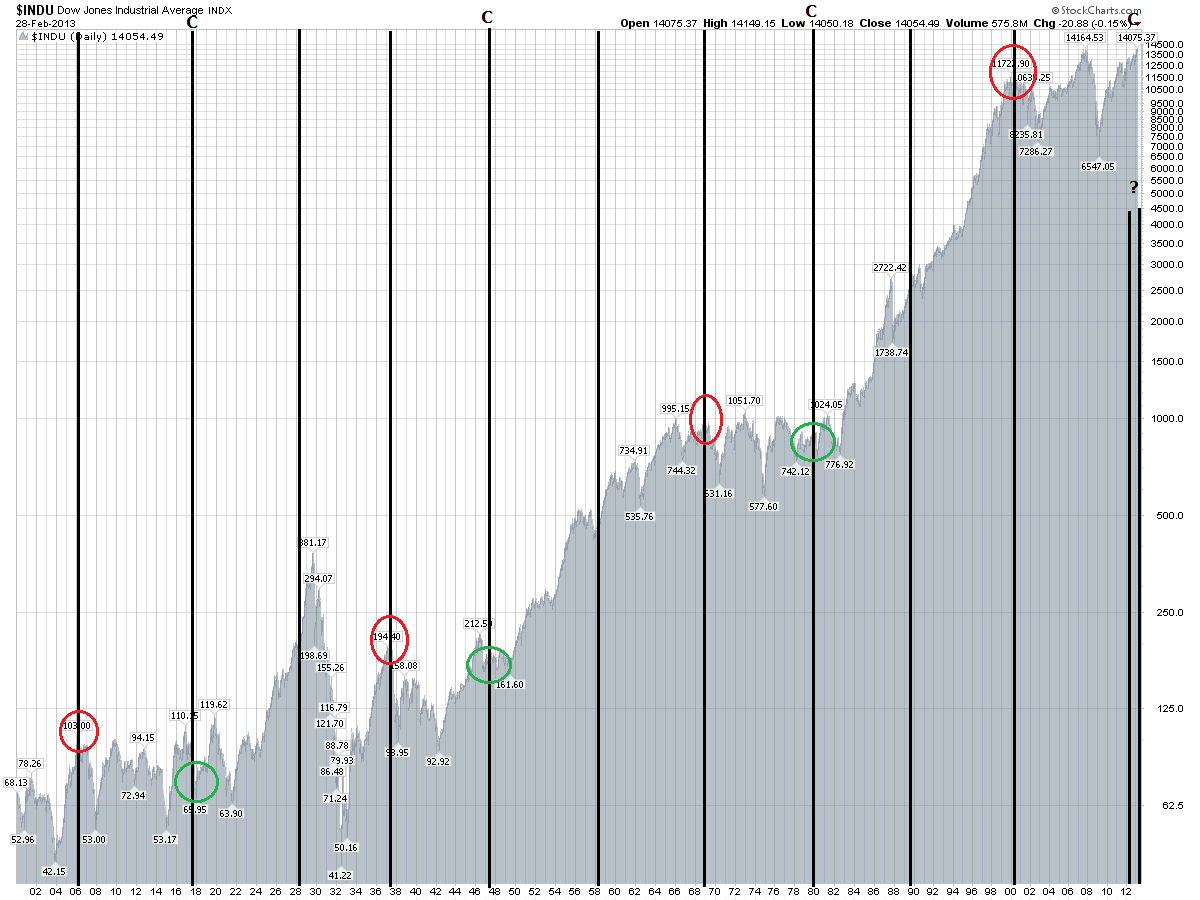
Secondly, the US Dow stock index long term, with solar maximums again marked in black.

22apr20132

Underlying source: Stockcharts

Alternating secular bulls and bears. I argue the mid 20s to mid 30s episode was outsized greed and fear events that cancelled each other out on the way to the true secular peak in 1937. The secular turns fell very close to solar maxima.

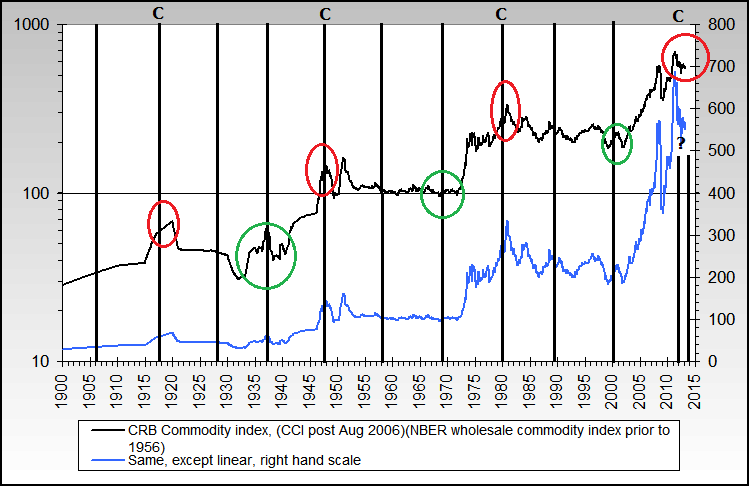
Thirdly, the commodities index long term, with solar maxima marked. Again, alternating secular bulls and bears, and again secular turns falling very close to solar maxima.

22apr20133Source: Nowandfutures

Fourthly, 10 year treasury yields long term chart, with every third solar maximum marked.
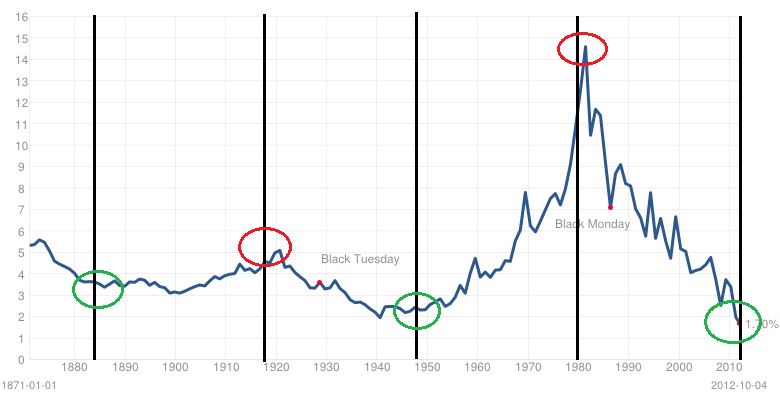
22apr201317Underlying source: Multpl

A longer term cycling of secular bulls and bears, but again the secular turns falling close to solar maxima.

Here is real estate, but only half as much history available as a global index (hat tip Rob):

22apr201316

Underlying Source: P Loungani

There is a tentative cycle here, with the peaks alternating on solar maxima and solar minima. Furthermore, there is the main (circadecadal) solar cycle averaging 10.66 years, and a lesser (circahemidecadal) solar cycle averaging 5.75 years. They fit rather well with the two cycle parts noted above. But a little more history going forward is required to judge this model’s validity.

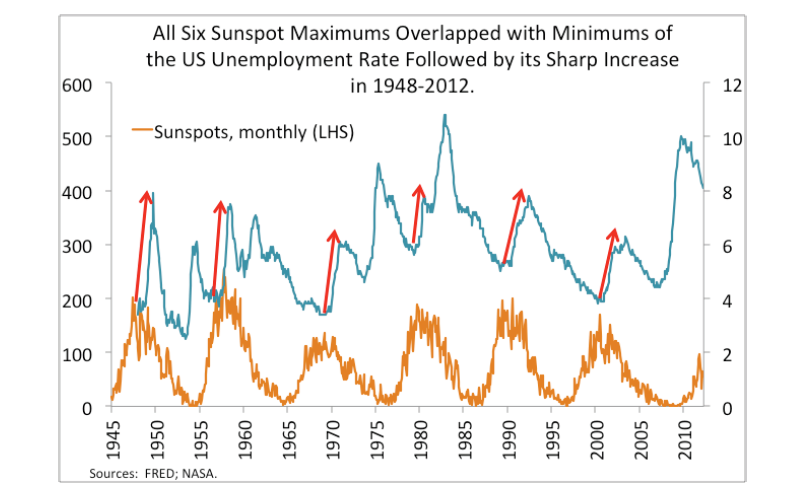
Moving on, the next chart is US unemployment versus solar cycling.

22apr201318Source: Gorbanev / Ktwop

Rises in unemployment just after the solar peaks. The chart fits well with my own chart, showing recessions occurring after each solar peak (which correlates with geomagnetism peaks lagging sunspot peaks).

recessions

And also this chart, which shows inflation spikes occurring at each solar peak.

17sep18

Below we see money velocity rising into solar maxima and peaking before or at the subsequent recessions:

22apr201314And the next chart shows the treasury spread (10 year treasury yields minus 3 month treasury yields) widens to a peak leading into a recession:

22apr201315

Source: New York Fed

Let me draw all that together. At each solar maximum, we see a particular risk asset or assets making a secular peak, whether this be equities, commodities, real estate or bond yields. I argue this is sunspot-driven biological human excitement that translates as a speculative mania in the popular asset class of the time. We also see inflation and money velocity spikes at each solar maximum, which I argue is also behavioural effects in the economy of the same excitement phenomenon. After each solar maximum we see peaks in the yield spread and unemployment and recessions. Market history dictates that bull market cycles end with inflation rising, yields rising and overtightening, so this fits with the picture being revealed. Excessive and unsustainable speculation and buying in the markets leads to excessive inflation and tightening and tips the world into recession – economists would relate to that phenomenon as a regular cycle of greed and fear, boom and bust. But add in solar theory, and sunspot maxima biologically help inspire the greed/boom part, whilst geomagnetism maxima (lagging sunspot peaks) depress sentiment to assist in delivering the fear/bust part.

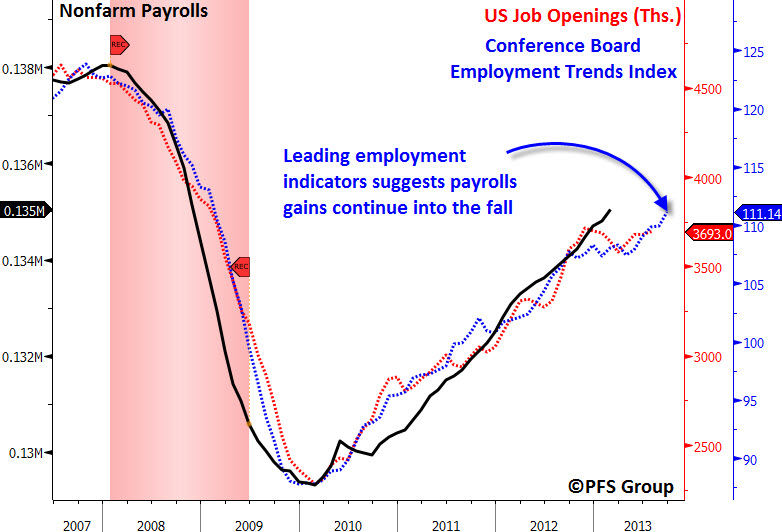
So by this modelling, we should be seeing a secular peak in commodities and a secular bottom in treasury yields around the current solar maximum, which should fall either Feb 2012 (past) or ahead in Fall 2013.  Both commodities and treasuries have fulfilled secular bulls through to 2012/13, regardless of what happens next. The difficult part is in timing the turns when you are close in on the action, as we are as traders here in 2013. What is clear is that money velocity has not yet picked up and inflation has not peaked (making its high thus far in 2008). US jobs and yields spreads do not indicate a recession, and geomagnetism is currently benign. Jobs are in fact predicted to grow ino the Fall:

22apr201329

Source: PFS Group

Historically, recessions have begun an average 14 months after solar peaks, so we might expect to see leading indicators for jobs falling by now if the solar peak passed in feb 2012.

Collectively, these suggest the solar peak is more likely ahead in Fall 2013 than behind us in February 2012. I previously showed that world bond yield and money velocity charts could be bottoming out based on technical action thus far in 2012-2013, and in which case an escalation from here through the solar peak (assuming Fall 2013) would fit well with history. That would also suggest an inflation peak, and a secular commodities peak, lies ahead.

We can now cross-reference this solar picture with demographic models.

The next chart is a 100 year chart of the US Dow p/e ratio together with the trend in US demographics as measured by the middle-aged to young-aged ratio:
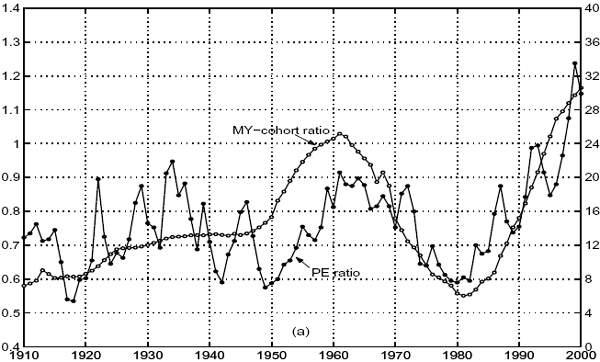
22apr201319Source: CXOAdvisory

This chart is the same demographics trend shown against the inflation-adjusted Dow.
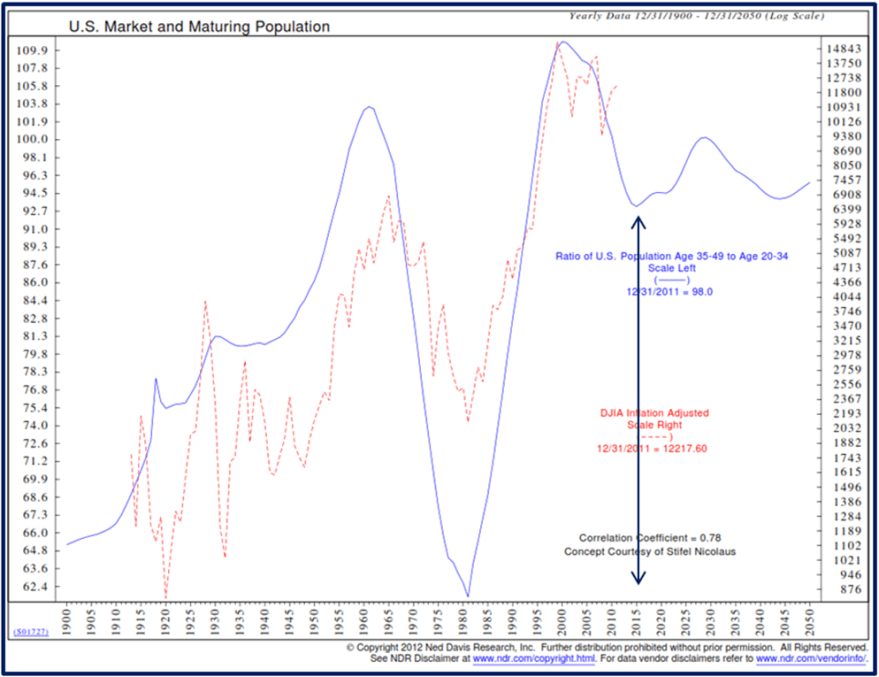
22apr201320Source: CMG Wealth

Both the p/e and ‘real’ Dow do the same job of removing inflation from the picture. There is a clear correlation between equities and demographics.

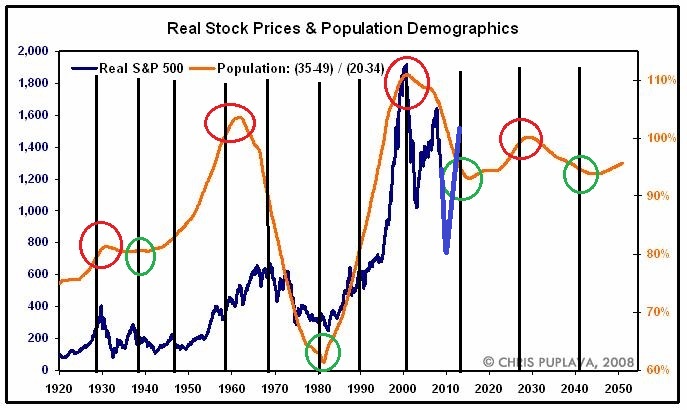
Chart 14 shows the SP500 netted of inflation versus the same demographic trend, and I have added in the solar maxima (black lines) again.

22apr20134Underlying source: Chris Puplava

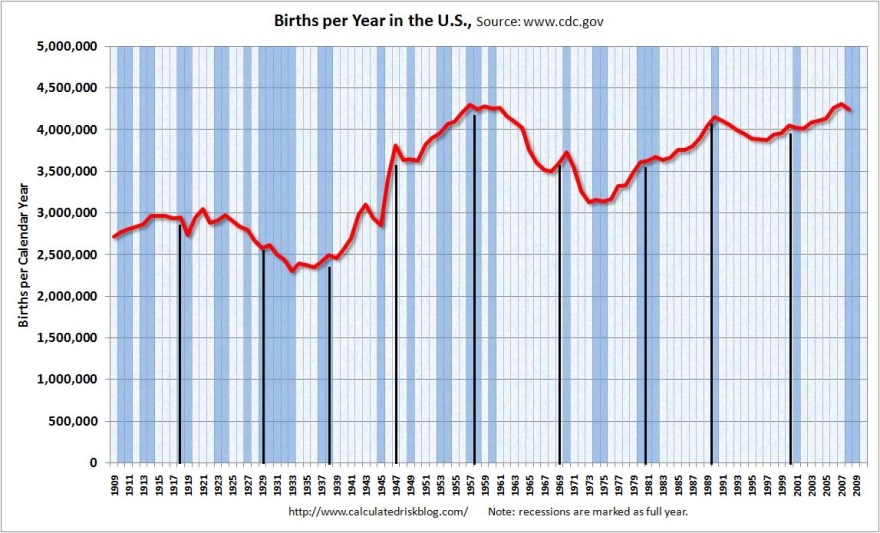
Now things get interesting, because there appears to be a three-way relationship between solar maxima, demographics and equities, with peaks and troughs in all three lining up. In my Trading The Sun PDF I noted there was some research identifying solar cycling as influential in population and demographics in other species, as well as research attempting to correlate solar cycles with longevity and mortality in humans. But I have now additionally found a research paper by Walter Randall (1991) that identifies an 11-year cycle in human births, and here is the chart showing that dominant cycle in the US:
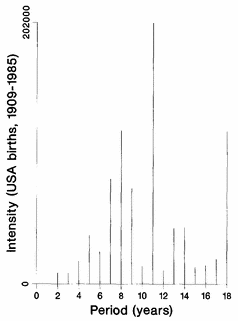
22apr201349

Source: W Randall

Randall also found variation in human conceptions relate to sunshine levels and geomagnetism.

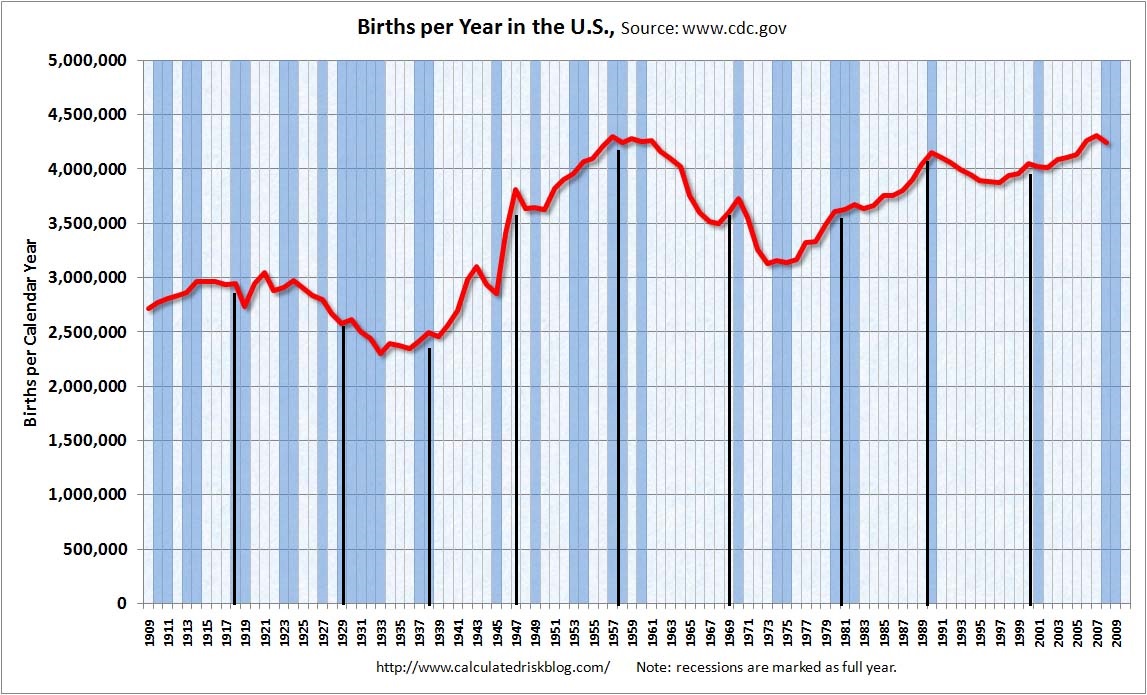
I have added the solar maxima to the US births per year chart below. We see births have typically spiked up a little at the solar peaks.
22apr201350

Underlying Source: CalculatedRisk

And here are UK births, with solar maxima overlaid:

22apr201352

Some clear peaks and troughs aligning with solar maxima.

So, we have solar-inspired waves in demographics which provides a reasoning for a correlation between the two.

We can also explain the demographics correlation to the stock market. There are young borrowers/spenders, middle-aged investors (partially investing for retirement) and old-ages disinvestors. If the middle group is growing relative to the others, then we have a growing demand for the stock market. Similarly, the old and the young don’t typically buy houses, so a swelling middle-aged group relative to the others is an environment for a housing boom, and vice versa.

So there we have our three way correlation between sunspots, demographics and equities (and housing too). Because of the solar cycle related births swells, we will find certain demographic groups peaking in numbers and relative numbers around solar peaks. That provides peak demand or supply (e.g. a peak in retirees disinvesting), and together with the sun-driven biological changes in human excitement at the peaks, we have a recipe for asset invesment and speculation peaks at solar maxima.

In the US demographic chart above we can see that the steepness of the secular bull from 1980 to 2000 appears related to the steep demographic uptrend of that period. Now here is the same demographic model for Japan:

22apr20135

Underlying source: Chris Puplava

Again, peaks and troughs in stocks, solar and demographics line up. The steep secular bull up until 1989 again appears related to the steep demographic uptrend of that period. The reversal in demographic trend as of 1989 appears to explain why Japanese equities topped out at that solar maximum and did not keep going until the 2000 solar maximum, whereas US demographics did.

Looking forward, we can see that the US demographic model reveals a new uptrend from this solar maximum (circa 2013) to the next (estimated mid 2020s), which is supportive of a secular bull, albeit a relatively shallow one in real terms. Meanwhile, the Japanese model is already in an uptrend and is good until around 2020. Japanese stocks are currently in a sharp upswing, belatedly catching up the demographics and suggestive of a new secular bull.

We have looked at middle-young demographics, so let’s now draw in middle-old demographics. The chart below shows the picture for the US:
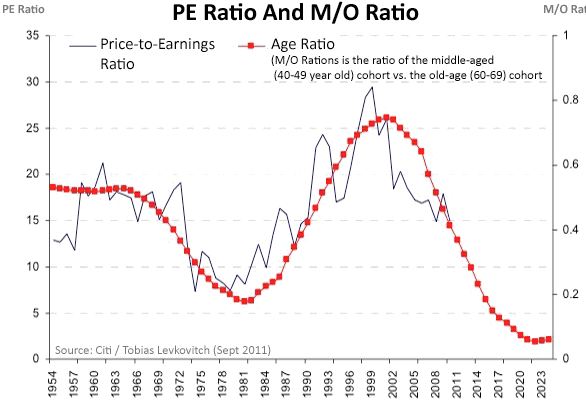
22apr201324

Source: BusinessSpectator

The US faces a demographic headwind looking out to 2020 in this regard, unlike its middle-young asset. Using the m/o ratio only we see a prediction for the p/e ratio to drop to just 2-3 by 2020. This should be offset to some degree by the improvement in the m/y ratio. Nonetheless, there is something notable here, which is that p/e ratios for country stock indices appear to largely reflect demographics. In other words, a country stock index with a cheap p/e is only a good buy if the demographic trend forecast reveals an uptrend ahead. Some of the most ‘expensive’ stock indices around the world right now by p/e valuation are Indonesia, Mexico and Philippines, all of which have very favourable demographic trends looking forward compard to most of the world. Rather than shying away from these indices because they appear overvalued compared to historical averages, it might instead pay to invest there, as they should get more ‘expensive’ going forward. This also explains why the Nikkei around 1982 maintained a p/e of around 20 whilst other stock indices were making single digit secular bottoms, because it was in the midst of a positive demographic trend looking out to 1989. Note this relationship is longer term and does not preclude shorter term p/e oscillations. P/e valuations will overshoot and undershoot the demographic trend but mean revert to it over time.

The next chart shows the middle/old trend for Japan, which is a tailwind out to 2020, like the middle/young for this country.
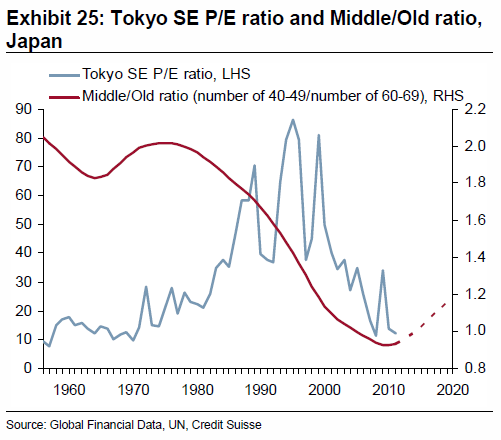
22apr201322Source: Zerohedge

Two more demographic measures for the US. The first chart points to a bottoming out by around 2020, followed by an upswing into 2036, which is supportive for a secular bull market.
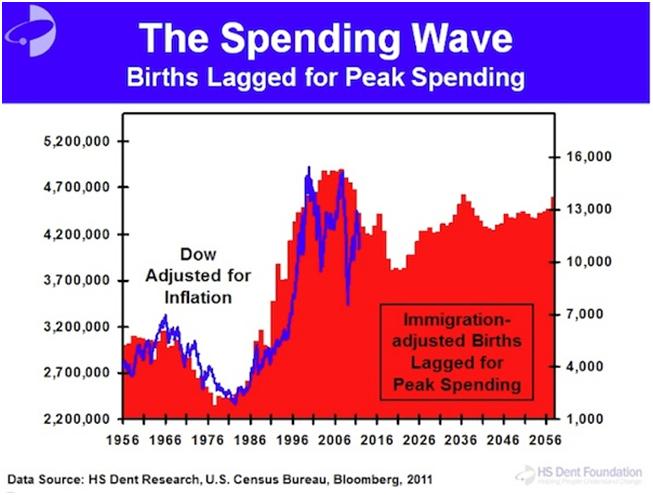
22apr201323

Source: HS Dent

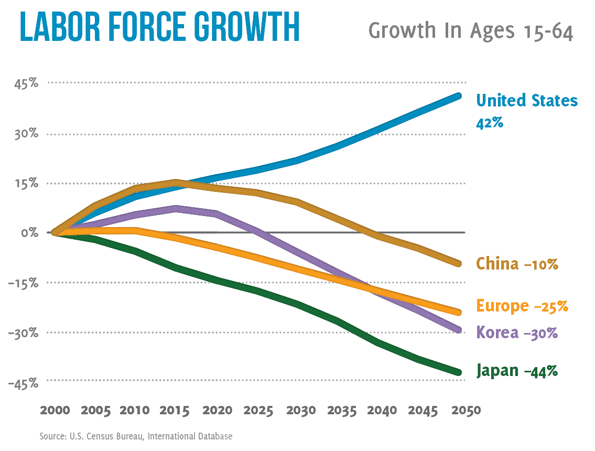
And this chart shows an enduring trend in nominal labour force expansion in the US into mid-century, standing out from the other developed countries shown.

22apr201325Source: SeekingAlpha

So combining all four demographic measures for the US, we have strong odds of a secular bull from around 2020 to 2030. Prior to 2020 it may struggle to gain traction, and  need a deeper washout in p/e. Let’s not forget that we are dealing with ‘real’ Dow/SP500 and p/es, so inflation matters. A sharp rise in inflation could drive down p/es whilst the index goes sideways. A lack of inflation could mean the index falls nominally before embarking on a momentum secular bull run from 2020-2030. Either way, because this demographic uptrend from 2020-2030 is ahead, we might not expect a major washout in p/e in the US. The SP500 and Dow are amongst the more expensive indices by p/e around the world but this could reflect the positive demographics ahead.

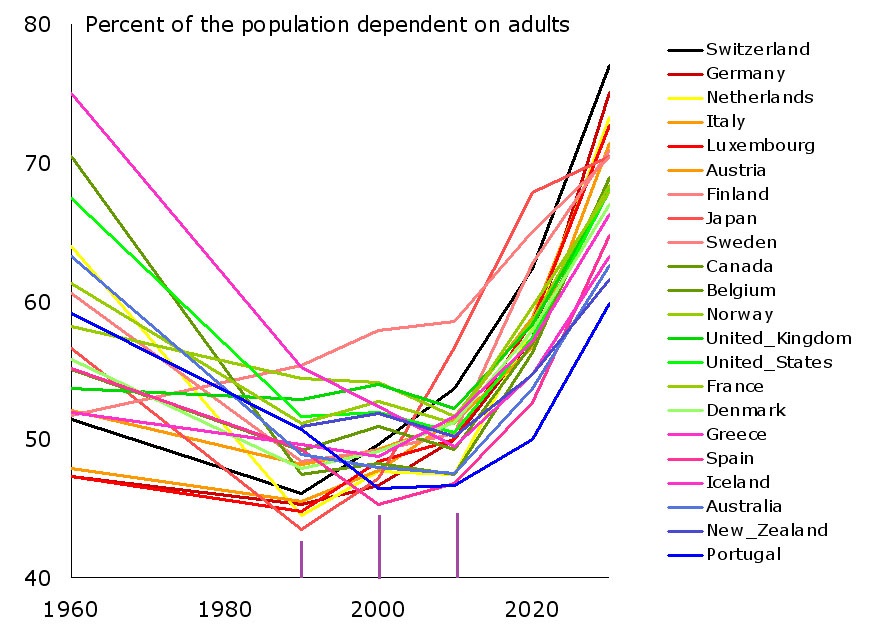
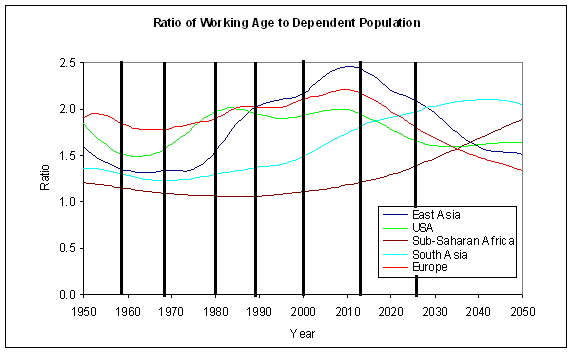
Let’s now look at dependency ratios (proportion of retired and young to the working population) demographics globally. Trends in the developed world contrast starkly with trends in emerging countries, as shown here:
22apr20136

Chart 23 reveals the bad situation kicking in as of now in developed countries:

22apr20138

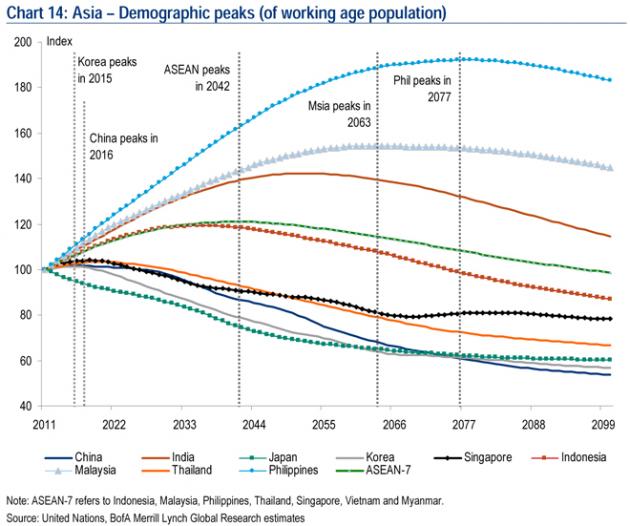
Whilst the next chart shows a particularly positive outlook for Philippines, Malaysia and India:
22apr201327And the next chart provides another comparison:
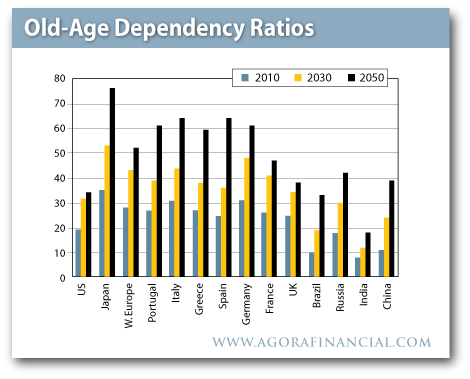
22apr201328Brazil looks good. The USA improves looking out to mid-century. And the worst: Japan. So let’s return to Japan, which we can also model using the dependency ratio as below:

22apr201332

Japan is understood to have battled with asset deflation for 2 decades. However, we see that demographics were responsible for a p/e or real downtrend in Japanese equities from 1989 to around 2000. Then the m/o and m/y demographic trends picked up again, and we can see in the chart below that the Nikkei effectively tracked sideways since then.

22apr201330

We might therefore take a fresh look at it and consider the Nikkei was in a downtrend for a decade (or one solar cycle) and then turned sideways as the demographic trends in m/o and m/y changed upwards. The massive spurt since October 2012 therefore looks reasonable, as a belated catch up to trend. However, not all is well for Japan. The dependency demographic trend is the worst around the world in that it is likely to become devastating by mid-century. It also has the largest debt-to-GDP ratio in the world, over 230%. Interest rates are effectively zero, and cannot be allowed to rise much because of the servicing of the debt. There is little hope of major GDP growth in the years ahead because of the dependency trends and the debt. Despite this, Japan is going hell for leather in a bid to restart the economy and ignite inflation, now doubling money supply from 29pc of GDP to 56pc of GDP by 2014. The first result of this ultra-aggressive policy has been a swift 20% drop in the yen. As Japan is an energy importer, this has immediately produced a big uplift in energy price inflation. If I am correct in predicting a pick up in money velocity here, and also correct in a commodities/inflation peak ahead relating to the solar maximum, then I suggest there is the potential for Japanese inflation to quickly become problematic. As the government cannot combat with rate rises because of the debt servicing, the risk then would be hyperinflation. I know hyperinflation is overhyped, but I just wonder whether it is worth an outside bet here.

Hyperinflation has historically been initiated by either rapid increases in either money supply or money velocity, then the other one has joined in to complete the feedback looping. Japan is obviously at full acceleration on the former. Under hyperinflation, stock markets have historically gone wild in nominal terms, but the cost of living has gone even wilder. In Zimbabwe, the stock market went up 47,000% in a year, but the cost of living rose even faster. So a Japan hyperinflation trade could be achieved either by a spreadbet on the nominal index or a long Japan fund whilst short the yen. This is how I see it: Japanese stocks should rise on the belated catch up to m/o and m/y demographic trends, regardless of the Japanese government’s policy actions, but those actions have the potential to produce wild inflation which would then take Japanese stocks in nominal terms much higher.

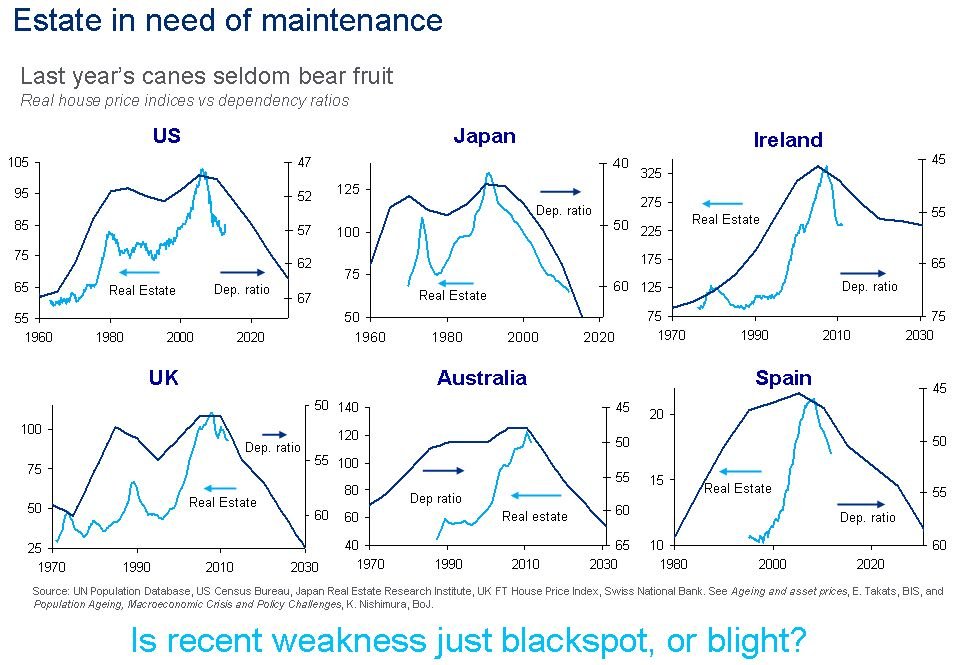
Back to demographics. The headwinds facing many developed countries in dependency trends are problematic. Here is real estate modelled against dependency for six developed nations:

22apr201331Source: Business Insider

If we refer back to the global house index chart further up the page, that cyclical model projected no real take-off in global house prices until 2019. These dependency charts suggest headwinds that further cement the likelihood that housing won’t offer a great return for the next few years in the developed world, applying equally to most other European countries, New Zealand and Canada. China and Korea also faces the same dependency trend issues starting around now.

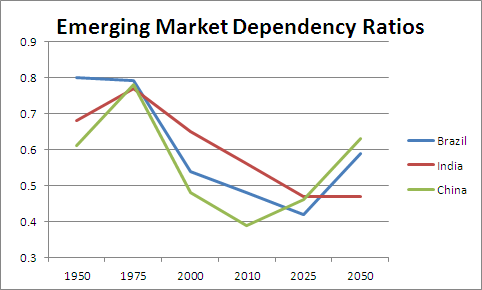
The countries with the best demographic trends looking forward include India, Brazil, Mexico, Indonesia and Philippines. South Asia, ASEAN and South America look particularly fruitful regions going forward, and Sub-Saharan Africa too. If this is a global transition into a K-Spring, then investments in equities and real estate (K-Spring’s champions) might do best in these countries and areas. The USA should perform well too, from 2020 to 2030, but the period before 2020 is less certain.

Brazil and Mexico have good prospects until around 2025 but India and Philippines extend until 2040. Contrast this with China, which is just hitting trend reversal point into a negative trend, and we can see the likelihood of China stepping back from being the world’s leading growth engine, and in doing so maybe provide a backdrop to a secular commodities bear (as it is the world’s largest commodity consumer).

22apr201334

Source: DarwinsMoney

Dependency ratio trends and projections for select nations:

22apr201335

Source: John Eyers

Maybe the investment star of the next two decades will be India, which could feasibly rise for multiple solar cycles in a powerful secular bull that resembles the Nikkei into 1989 or the Nasdaq into 2000. With its 1.2 billion inhabitants it has the potential to mobilise something significant. But India, just like Brazil or Philippines or Mexico or Indonesia is an emerging country, with emerging risks. Let’s say the demographic outlook provides potential for great returns in these countries, but the structure to achieve it is less reliable than in the developed nations. The developed nations conversely have the track record but now the demographic headwinds.

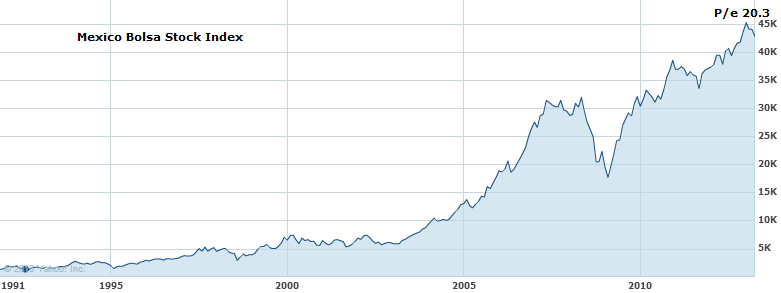
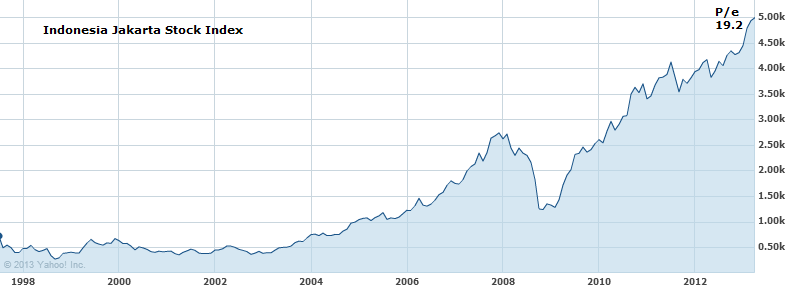
To draw back together demographic trends, solar cycling and equities, we might expect that the positive demographic trends that have been in place in some of these emerging countries to have provided a secular bull over the last solar cycle, much like the Nikkei powered its way through 4 solar cycles in a secular bull set against a positive demographic backdrop. This is indeed what we see:
22apr201340

22apr201341

22apr201343

22apr201345

Source: Yahoo Finance

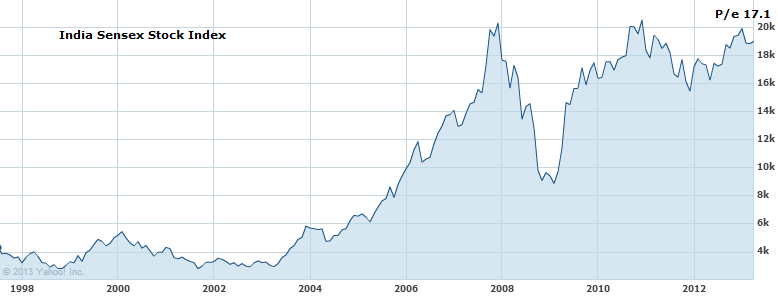
Over the last solar cycle, from 2000 until now, all the four country indices shown have made secular bull markets, not secular bears, in line with the demographic trends. They are all also amongst the most ‘expensive’ countries in the current p/e spectrum in the world, again in line with the demographic trend. I suggest that the ‘expensiveness’ of a country’s p/e rather has to be measured in terms of its relativity to its demographic trends. I also suggest that due to the demographic trends in all four remaining positive for another solar cycle, they should go on to continue their secular bull over the next solar cycle. I suggest that may be at a steeper rate, because it will be against the backdrop of a global K-spring, an up-cycle. As a reference point, see how the Nikkei secular bull (first chart in the article) that lasted for 4 solar cycles was at its steepest in the solar cycles of 1947-1958 and 1980-1989, both of which were global upcycles, a K-spring and a K-Autumn.

To conclude, these are the opportunities that I see (for myself of course… I am not an advisor).

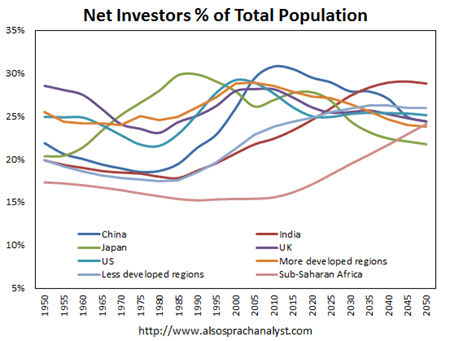
1. Long Japan, due to m/y and m/o demographic uptrends until 2020, and an outside bet for hyperinflation. Averaging into any falls. We can see Japan’s little window of positivity here, in the upturn in the green line between 2005 and 2020:
22apr201346

2. Long USA, but more compelling as of 2020. At risk of a p/e washout before then. These two charts show head and tail winds respectively for the US market from now until 2020:

22apr201347

22apr201351

Source: Informed Broker

3. Long a basket of emerging markets with the best demographic outlooks: choosing from India, Philippines, Indonesia, Brazil, Mexico and potentially sub-Saharan Africa. Averaging into any falls.

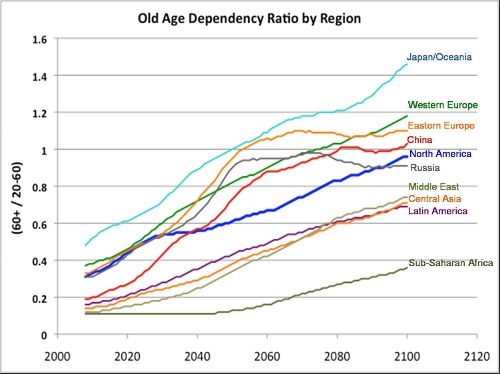
Here is the very long term look at dependency ratios to end:
22apr201348Source: Appliedmythology

If these projections hold true, then the four lowest listed regions should offer the best opportunities over the next solar cycle. The following solar cycle the USA stands to fare well (where the blue line flattens). And later his century Russia and Eastern Europe may get their shot at being investment gold.

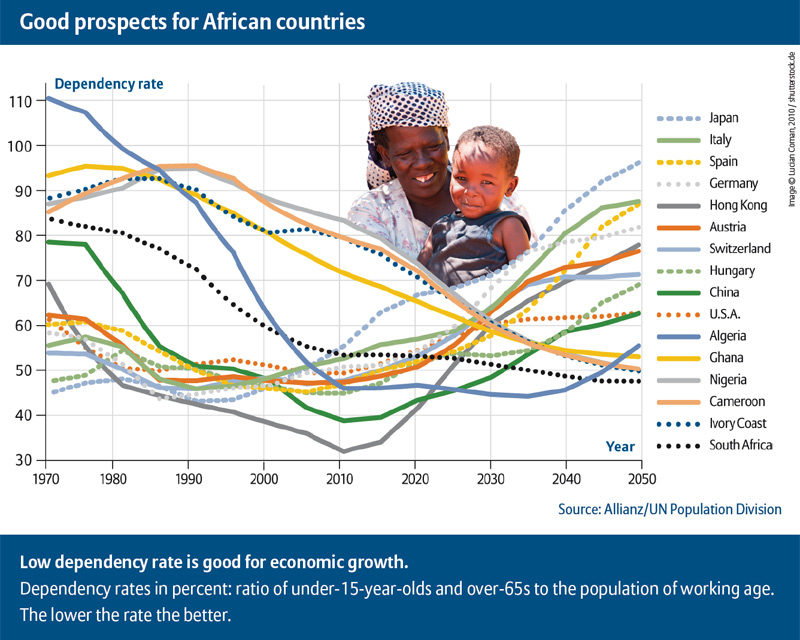
Additional chart: prospects for specific sub-Saharan African countries: positive demographic trends for the next solar cycle for Algeria, Ghana, Nigeria, Cameroon, Ivory Coast and South Africa:
22apr201360

The Secular Position For Equities

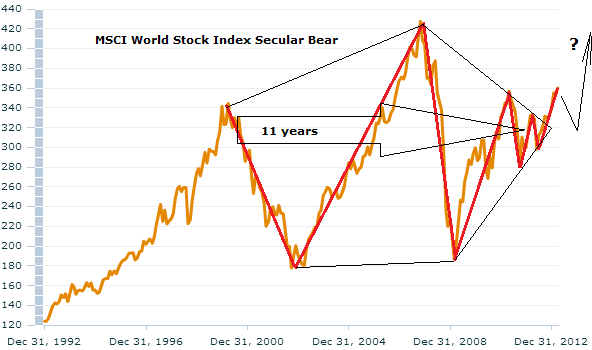
I wrote last year about secular equities bear market progression in this post (click to view). I suggested that a pentagon was a typical formation based on history, and that based on pattern repetition what should occur next was an upwards breakout, followed by a retrace to the nose level, then secular bull momentum after that.

This is how the MSCI World Stock Index now looks:

19apr20131Underlying Source: MSCI

A breakout has occurred. This pentagon shape and breakout can be found on the same timeframe for FTSE, Dax, SP500, Dow, Hang Seng and other indices. The action represented by the black arrow is what I suggested could happen next, with the momentum go point potentially coming in 2014/2015. This idea was based around my primary scenario of commodities making a secular top ahead in 2013/2014, helping to tip the world into a mild recession with stocks falling into a mild bear accordingly, before they charge – rather than the alternative that commodities peaked in 2011 and secular stocks bull momentum is already underway.

Here are the SP500 and Dow technical shapes during the last two secular bears:

19apr20132In addition to the pentagon formation, I have highlighted on these charts and the top MSCI world chart above what is in effect a large W formation followed by a small W formation (in red). OK, we are operating on a fairly meagre sampling from history here, due to many country stock indices only having recent history, so perhaps don’t read too much into either of the formations that I am picking out. However, the message from both the pentagon and the WW formation would be that secular bears typically end with a coiling, a narrowing of volatility, and based on that we might not expect another major cyclical bear market ahead.

However, these charts are nominal. The inflation adjusted picture is very much a down-sloping pentagon, rather than the relatively benign-looking sideways range that the above charts show. The true secular bear progression can also be revealed through a gradual wash out in the stocks to gold ratio, and a similar gradual demolition in the price/earnings ratio in equities. In the last secular bear, US stocks began with a p/e of 24.1 and ended on a p/e of 6.6, shown here:

19apr20134Source: Zealllc

Also note the bottoming p/e of the 1940s secular bear reached around 9. What I have tried to highlight with boxes on the above chart is that both the last secular bears ended with overall sideways action whilst p/es fell significantly to reach their secular low. This was because they both ended with an inflationary peak (circa 1947, 1980). High inflation will pull down the p/e ratio as stocks trade sideways, because they are cheapening in real terms.

So, in our current times, if stocks are to end with a similar final washout in p/es before new secular bull momentum, then there are two ways to achieve it. The first would be in line with history and this would be a period of peak inflation, where p/es shrink as stocks trade overall sideways. The second would be an absence of inflation (commodity slack and low money velocity continue), whereby stocks fall hard in nominal terms to achieve the p/e washout. This second scenario perhaps has a rhyme with Japan’s secular bear from 1989, which made a series of lower lows as it progressed, in the clutches of deflation. So, like I posed yesterday, is the US the new Japan, or is inflation still dominating and peak inflation a likely possibility? I suggest the shaping of the secular bear to date (we are currently at all time highs despite being in a secular bear) and the undoctored picture of inflation reveal that inflation is in play in the US, rather than deflation.

17sep18

I don’t subcribe to a hyperinflationary outcome, but I think a pick up in yields and in money velocity and an inflationary feedback looping with stocks moving overall sideways is more likely than a deflationary end to the secular bear, whereby stocks fall hard to reach a washout in p/es. But have stocks already washed out enough by p/e?

I believe there is a reason why US stocks bottomed at a p/e of 9 in the 1940s bear, compared to 6.6 at the bottom of the 1970s bear, and that’s the difference in yields and rates, which were at opposite extremes in the two periods. In the current enviroment, and back in the 1940s, bonds and cash are earning little or even negative returns. Dividends are higher on many stocks than the yields on bonds. The p/e alone then doesn’t tell the whole story, because stocks are relatively more ‘valuable’ if bonds and cash are paying you a guaranteed loss. I suggest therefore that, generally speaking, a bottoming p/e of 9, rather than 6, may be more appropriate for this secular bear.

The Dow, SP500, Dax, FTSE, Singapore Straits and Hang Seng all already reached either p/e of 9 or below in this secular bear, not to mention much lower p/es for the PIIGS. Plus equities in general began this secular bear in 2000 from a much higher p/e (44) than the previous bears began. This begs the question as to whether we are going to see higher secular p/e bottoms and tops now and in the future as stocks capture exponential technological evolution or human progress. This question aside, perhaps we could doubt that US equities have washed out enough when we look at CAPE (at its lowest 12 so far) or the Q ratio (0.6 so far versus 0.3 historically). However, not all stock indices necessarily have to washout to single CAPEs (Japan ended the last secular bear at CAPE 20), and the Q ratio perhaps has a long term trend towards higher values, as shown by the narrowing of its two components over time here:

19apr20135

Source: Dshort

In short, I don’t see a compelling case that equities need to wash out more than they have by valuation in this secular bear so far. Meanwhile, the Dow-gold or SP500-gold ratio has also washed out ‘sufficiently’ in this secular bear, if not to record extremes.

So could secular stock bull momentum already be underway and commodities flipped into a secular bear in 2011? Much of what I wrote in The Alternative Scenario (here) to support this alternative possibility is still valid, with the added developments that gold has since broken down and NASA say perhaps the solar maximum already occurred in February 2012. It will become clearer as developments unfold with time, but until then, perhaps my best case against this having happened would be a lack of pick up in yields or velocity by now.

So these are my current conclusions. I don’t see a massive case to wash out valuations further, but will assume that some last drag-down is ahead because of historical secular bear ending patterns and perhaps CAPE and Q ratio. I don’t see a deflationary case for equities to tumble in nominal terms to achieve this, as the secular bear has proceeded against an inflationary backdrop with stocks currently at all time highs, so any such washout, if it is to occur, I’d expect to be overall sideways against an inflationary backdrop. The environment of low yields and rates is pertinent: it perhaps means stocks do not need to wash out ultra low by valuation, and that bid support would be higher. And there is also the potential that we have a permanent shift higher in Q ratio and p/e bottoms. In summary, I don’t expect a major drawdown in equity prices. but something milder.

So, I want to buy into a significant pullback in stocks with a secular bull view. Ideally something that looks like the pullback to the pentagon nose level. Ideally with a few more countries dropping under p/e 10, and ideally on the back of an escalation in commodities and inflation. Until I can rule out that a secular bull in stocks began already, I will likely adopt the strategy of layering in to any pullbacks that I consider deep ‘enough’, perhaps 10% off or more.  However, if stocks were to mount such a pullback, then the action in commodities would likely be telling as to whether they have a peak left ahead, and in turn shed more light on the secular equities position, which which to further navigate.
Velocity, Yields, Inflation, Growth And Commodities

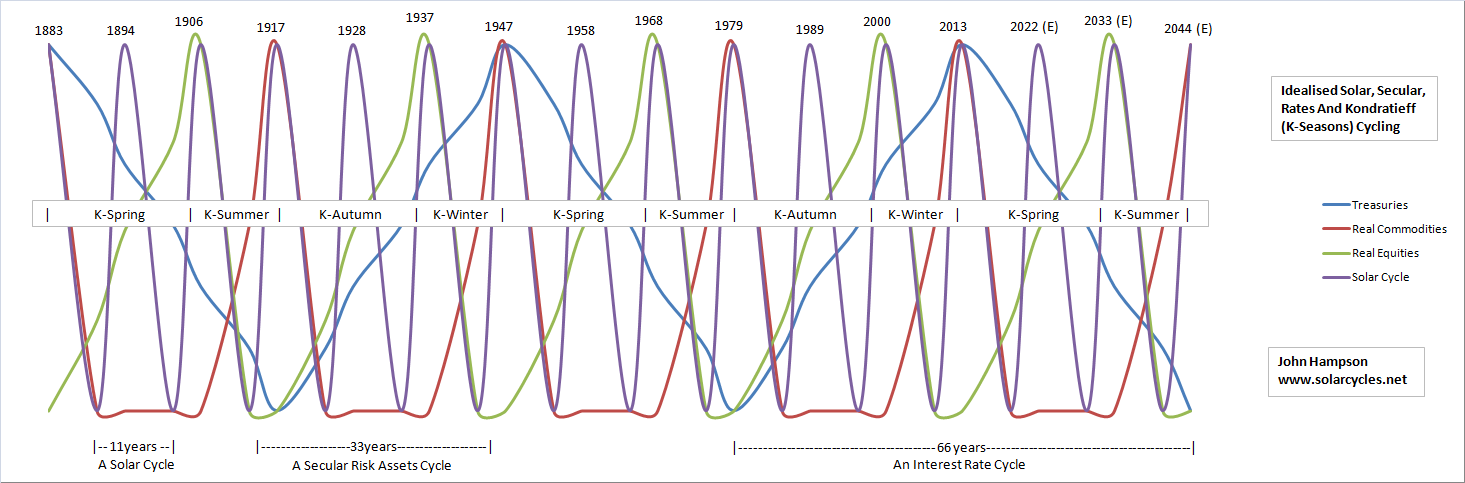
I maintain the late 1940s is our closest historical mirror, as per this chart:

Idealised Solar Cycle

Then, as now, they had a problem with money velocity. But it reversed course and took off as of 1946.

18apr20131

Source: Hoisington

Yields also reversed course as of 1946.

18apr20132

18apr20133Source: Milton Friedman

As per my last post on money velocity, there is a historical relationship between the two. Here we see it clearly:

18apr20134Source: BNVInsight

Essentially, expectations of rates, inflation and growth determine the path of yields and velocity. In 1945, like now, there were very low expectations in these three areas due to excessive post-war government debt, government controls and growth that would not stick. But then in 1946 yields and velocity began to increase and inflation took off and peaked in 1947. The picture changed.

In my recent post on money velocity I showed a selection of charts that show a current potential bottoming out of both velocity and yields, though only tentative at this stage. If this is the case, then we could also be set to see inflation take off and potentially reach a peak within a year in line with the historical mirror. If the solar peak is ahead later in 2013, this is a very good fit with 1947 which was also a solar maximum.

Here are 5 year treasury yields versus core inflation (excludes food and energy). We can see yields are overdue a catch up. Money is parked in bonds paying a negative real return. The divergence captures a lag in belief and sentiment that is overdue a reversal.

18apr20136

Source: Scott Grannis

Yes the Fed is manipulating this market, but it is not the difference since 2011 – it was doing this before. Rather it is the mired perception of unsustainable growth. However, since mid-2012 we have seen a sustained positive picture in leading indicators that still persists at the time of writing. Unless leading indicators turn down again sharply soon, then I give good odds to a belated change in perception, a belief in growth, that should generate an upturn in yields, velocity and inflation.

What would that mean for commodities and stocks? Using the late 1940s historical mirror, we can see that commodities were the beneficiary, with corn and copper charted here:

18apr20137

28nov201214

Both accelerated as of the turn up in yields and velocity of 1946, and had made the bulk of their parabolic rises within a year. Oats and wheat performed similarly, crude oil escalated in price by 50% from 1946 to 1947, and the CCI index as a whole made its peak by late 1947.

If we turn to the Dow-gold ratio, we can see that by 1947 the ratio was already in an uptrend, because stocks had been on a tear, much like now.

18apr20138

Source: Macrotrends

Here is the Dow Jones chart from the period in question:

18apr20139Source: Stockcharts

Stocks rose fairly steeply into a 1946 peak. That stocks perform well in an environment of low rates and low growth was in evidence then, as it has been into 2013. In 1946 stocks made a pullback and then traded sideways, before the secular stocks bull momentum ‘go’ point as of 1949. So whilst stocks consolidated around 1947, commodities esclatated.

But let’s not get too carried away with the historical rhyme. Back in 1946 in the US, price controls, that had been implemented during the world war, were lifted, which along with weather-related bad harvests, helped drive up commodity prices. There are no such price controls today. The government also abolished the buying rate it had set for treasury bills, which helped free yields. In short, the government took several measures at the time to reduce its controls over the economy. Clearly there is a chime with today: the US government has supressed yields and taken controls over the economy in terms of ZIRP and QE and other policy actions. What we do not yet see is the relinquishing of such controls. However, if the US government were to announce it was stepping back from QE or eyeing an end to zero interest rates in the future, then this could have the same effect as in 1946 of yields rising, which would be accompanied by velocity, and inflation could then logically follow. Perhaps then an end to QE would not be a nail in the coffin for gold, but the opposite.

What 1946/7 and 2012/13 do have in common is the solar maximum. If you subscribe to the theory that sunspots drive human excitement and this manifests itself as speculation, buying and inflation, then we have another angle. This alone should encourage money velocity, bullish policy actions, and drive money into pro-risk.

Now if you don’t buy into the solar idea, or maybe the solar maximum passed already in Feb 2012, and you don’t buy into the historical correlation with the late 1940s either, the we nonetheless still have an unsustainable situation of negative real rates and yields, and money supply and velocity at opposite historical extremes. Unless the system is broken, then at some point growth is going to stick and accelerate, and these extremes will mean revert. Is it broken? Is the US the new Japan? Unable going forward to get growth and inflation to entrench? As it is by far the largest contributor to world GDP, this would be felt globally for some time. Well, the US was keen to avoid Japan’s errors, i.e. being slow to react to deflation until it was set in. It was aggressive in response to the 2008 crisis. We also have an exponential trend in technological evolution, which at an even faster rate of paradigm shifts going forward, should be the fuel for a new secular stocks bull. The US remains a world leader in technology. Plus, through natural gas disoveries and shale oil the US has its own ample energy resources again to power growth, which Japan lacked. So time will tell, but there are reasons to believe that the US can make a normal transition into a new K-spring, and so likewise the global economy.
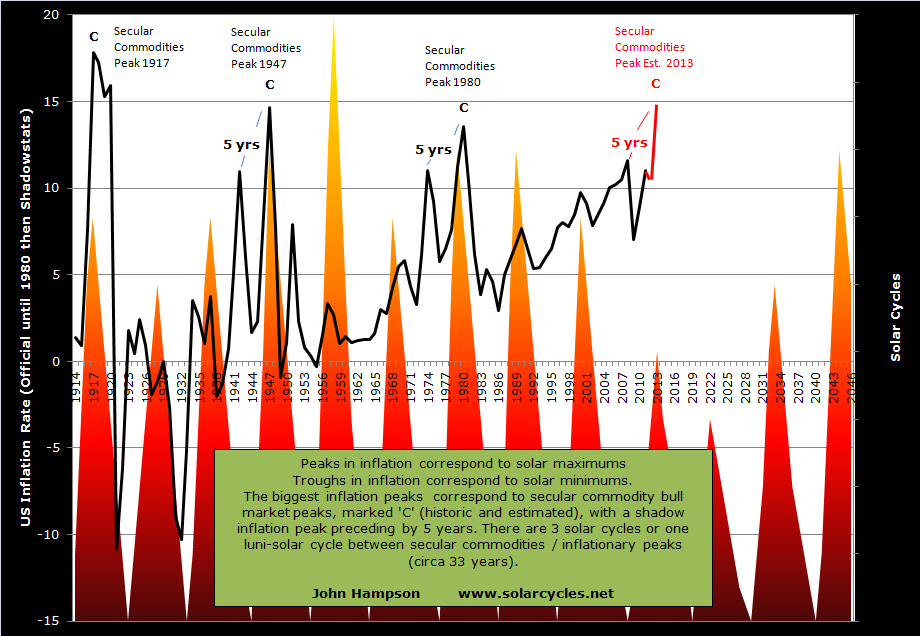
I suggest the natural cleansing cycle, a regular secular bear, a K-winter, has worked through within normal parameters, and we are in the realm of a secular transition. Unless you do believe the system / the US is broken, then a new cycle of growth should be emerging, and yields and velocity should be undergoing a reversal. As that occurs, it would be normal to see the fresh circulating of the parked money bring about inflation, and for commodities to enjoy another leg up. If you draw in solar cycles (assuming the solar max is ahead not behind) and the 1946/7 historical mirror to this, then the prediction is refined further: we should see stocks pull back and give way to commodities outperforming, for yields and velocity and inflaton to rise up, all around now. The Dow-gold ratio having bottomed should not be the death knell for gold, but instead reflects the environment being positive for equities as it was into 1946, and such a  pullback on equities (as occurred then) would be a buying opportunity for a forthcoming momentum ‘go’ point in stocks.

In the worst case scenario, the current status quo would persist for some years longer. Yields and rates and velocity would remain trapped at ultra low levels as sustained, entrenched growth remains elusive. Therefore, I continue to watch leading indicators closely. I believe that if they can remain positive and healthy into mid-2013 then we would have a long enough run behind us to change perception, and this should inspire the moves I am imagining.

State Of The Markets

Starting with leading indicators, the latest Conference Board table is a sea of green:

17apr201319Source: Conference Board

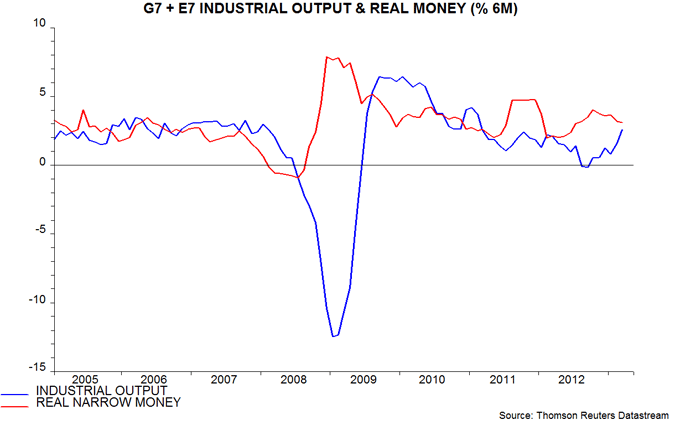
Global money supply suggests a flattening out of industrial output in mid-year, but at good growth levels:

17apr201318Source: Moneymovesmarkets

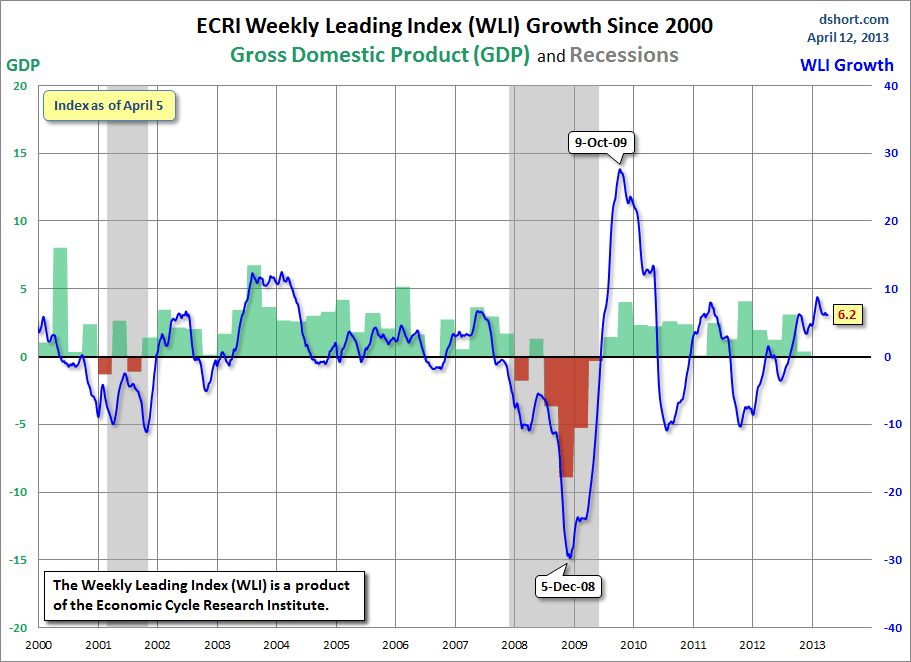
US leading indicators remain positive:

17apr201323Source: Dshort/ECRI

In short, the global picture looking out on the horizon is good.

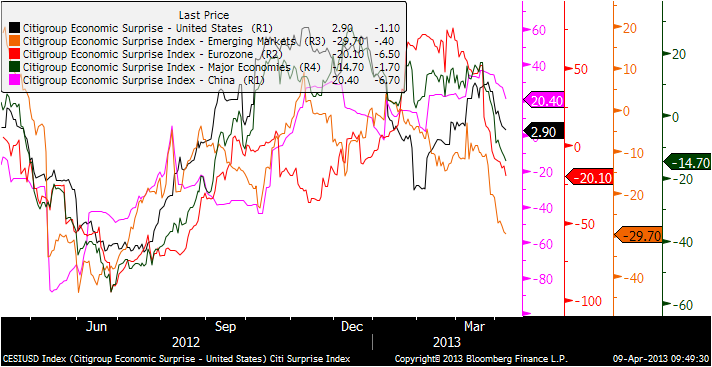
However, with coincident data, things look different. Economic surprises have tumbled of late:

17apr201322Source: Brokenmarkets

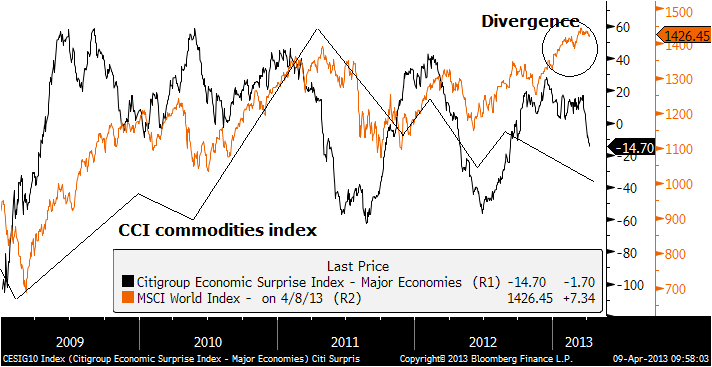
If we look at relations between the CCI commodities index, the MSCI World stock index and major economy economic surprises, then we see they generally move together, but typically economic surprises lead the turn:

17apr201321Underlying source: Brokenmarkets

What is notable is that equities have diverged over the last 6 months, whilst relative weakness in commodities has been more in line with the trend in economic surprises. It suggests equities may be overdue a correction.

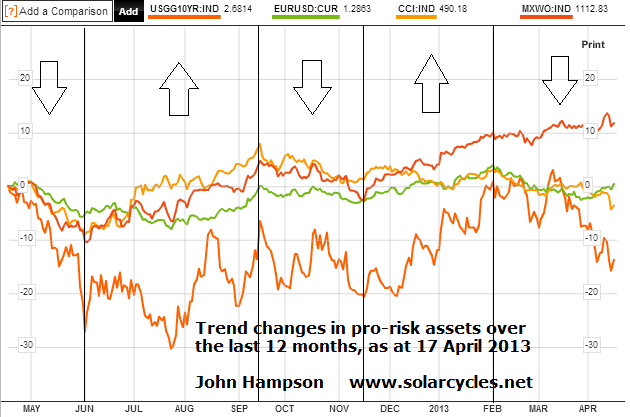
If we aggregate 10 year treasury yields, Euro-USD, the CCI Commodities and MSCI World Equities indices, then the collective trend changes over the last 12 months appear like this:

17apr201316Source: Bloomberg

We see a notable downtrend in pro-risk since the start of February but with equities diverging. To be specific, it is the US and Japanese stock indices that have diverged, as we see corrections more clearly over the last couple of months in the Hang Seng, STI, Dax, FTSE. And a result of outperformance in US and Japanese stocks is more expensive valuations, with both now having p/es of around 17 (compared to the other country indices listed which are between 11 and 14 p/e). So are US and Japanese stocks due a period of underperformance, a belated correction? Or do the two biggest QE programmes in the world make for a difference that will endure until those policies are reigned in?

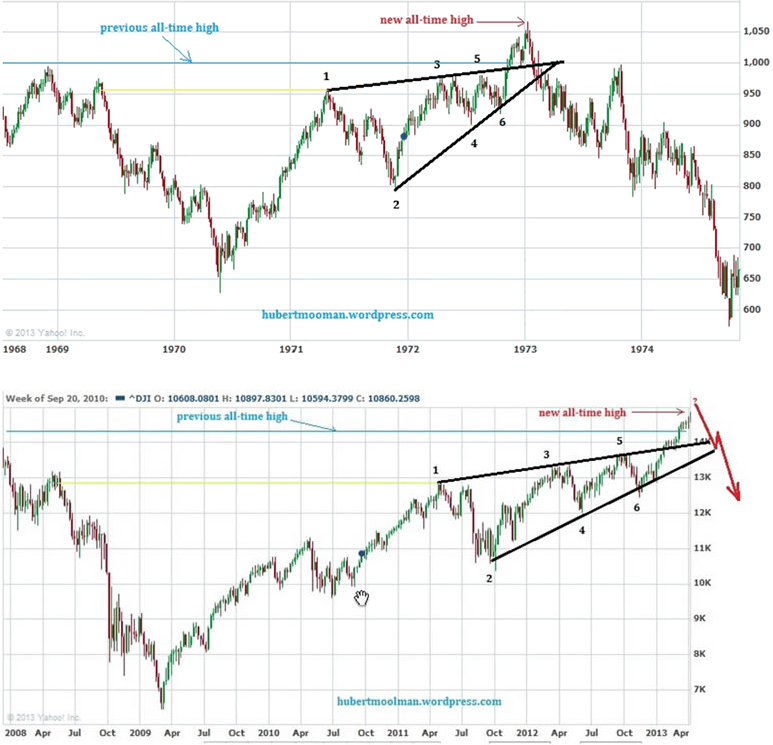
There is a potential topping pattern in the Dow Jones currently, as shown by the historical mirror below:

17apr20137Source: HubertMoolman

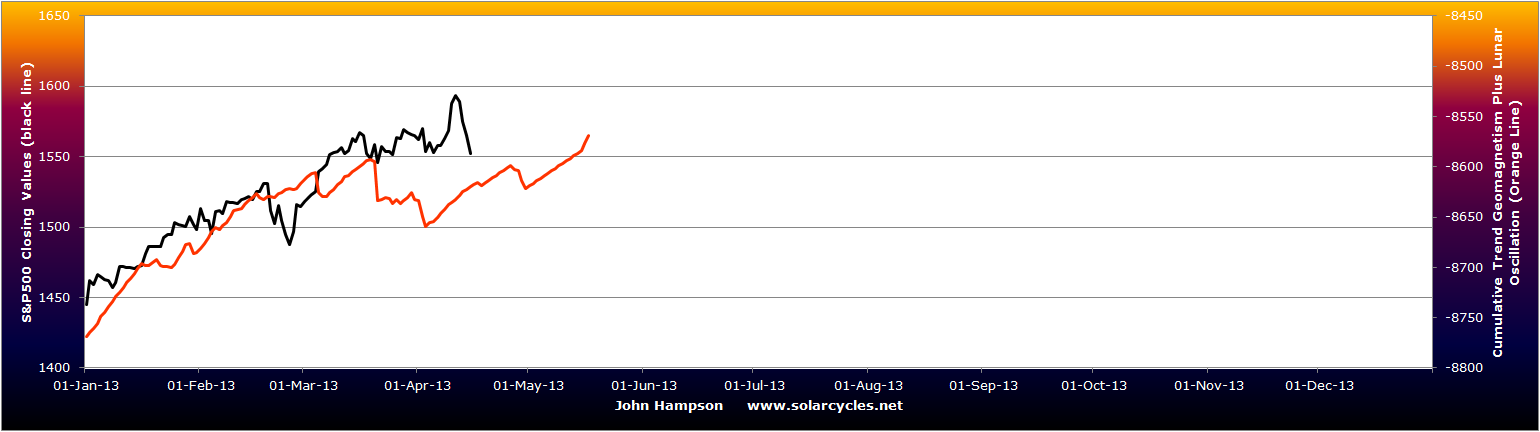
The overthrow out of the wedge could be reversed. Monday’s action – when gold toppled 10% – added to the likelihood of this topping pattern. However, yesterday we saw a partial retrace. The trend in economic surprises suggests they are overdue a proper pullback, however on the flip side the geomagnetism trend has resumed upwards. If I remove lunar phasing and show the short term geomagnetic trend only versus the SP500 it looks like this:

17apr201326

A correction has given way to a new uptrend which currently extends out to mid-May. This could imply that the pro-risk chart aggregate above is due a turn into a new uptrend, in line.

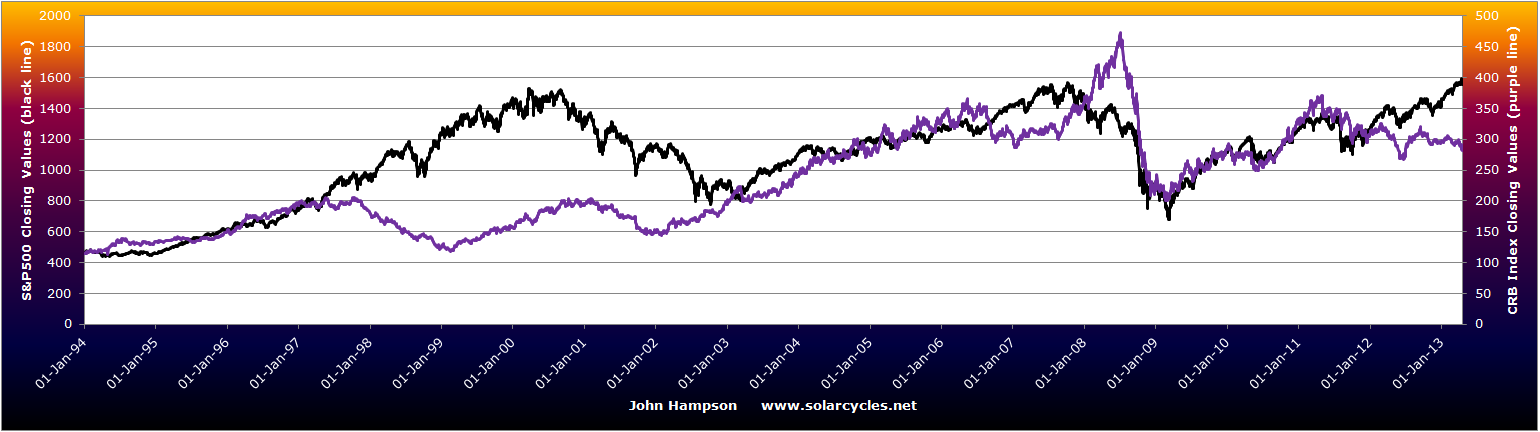
If equities were to make a proper pullback, then the question is whether commodities would outperform, as they historically tend to as late cyclicals. Below we see this occurring in both 2000 and 2008.

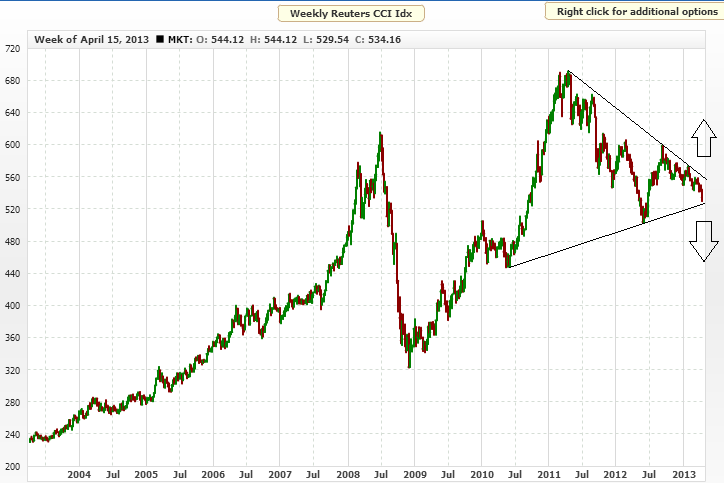
17apr201324There is a distinct gap between stocks and commodities formed over the last 12 months. If there remains a secular bull in commodities, then we should see that close again and commodities to perform well despite a pullback in equities. On the other hand, if the secular bull in commodities is over, then we should see that divergence continue. The CCI commodities index remains tantalisingly in a triangle, as shown:

17apr201317Source MRCI

The breakdown in precious metals has pulled it to the support line, which makes the next move in commodities the key.

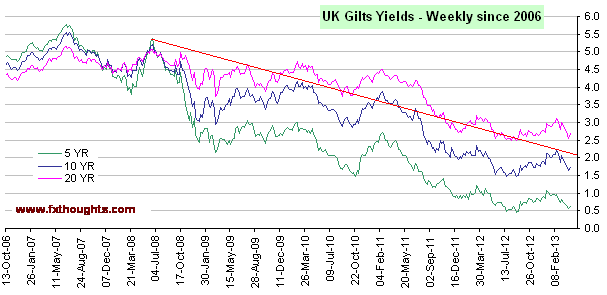
So imagine commodities made their secular peak in 2011 and the sharp breakdown in gold is to be followed by general steep commodity falls that take the CCI into a breakdown. Resource stocks would get hit hard, and we would see a pullback in equities accordingly. Equities would fall, commodities would fall harder, treasuries would be a likely beneficiary. However, I can’t square this scenario with the positive picture in leading indicators. Unless we see a rapid deterioration in the general picture of growth ahead then I see it as more likely that commodities will hold up, and at worse continue to build out the triangle sideways. To add to this, from my recent post on money velocity, we see a potential bottoming out in progress in money velocity and treasury yields, that I suggest could have begun in 2012. We similarly see a potential bottoming out  in UK gilt and Geman bund yields below, as of mid-2012:

17apr201310

17apr20139Source: Fxthoughts

If the wall of parked money begins to circulate a little in the economy, based on a more entrenched picture of growth, then we ought to see a pick up in pro-risk asset inflation and a pick up in price inflation. So I continue to watch leading indicators for evidence that growth is becoming entrenched or for evidence that we are cycling down into danger again, to be met by another central bank response. Right now the evidence is for the former, and so I have my doubts that the commodities secular bull is quite over. Below we see the secular bull progression in commodities since around 2000, in terms of relative expensiveness versus other assets:

17apr20138Source: Nowandfutures

It is clear that there has been a large relative repricing of commodities in that period, but it is also clear by the various measures that we have not seen levels reached in the 10s, 40s or 70s. That said, we saw a much more extended repricing of equities into 2000. So my question would be: has the exponential rate of technological evolution brought about a change whereby we see future Dow-gold ratio tops and bottoms at ever higher levels (as human progress is captured in equities)? Or is this offset by increasing scarcity of commodities and increasing demand (more humans chasing fewer resources), which means the secular commodities bull still has work to be done to drag those ratios to normal historic levels?

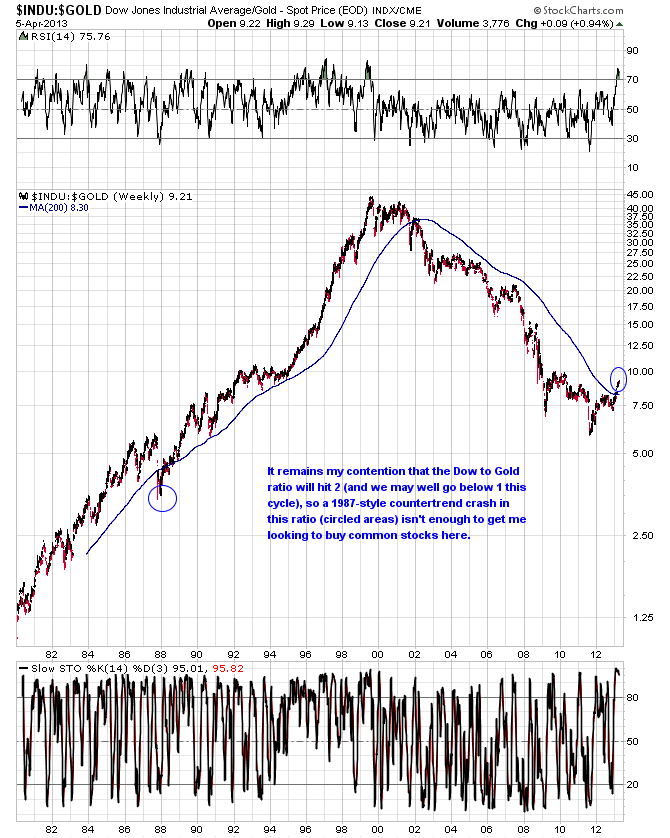
Below we see the Dow-gold ratio and the author (not me) questions whether what we just saw in gold was the equivalent of a 1987 event for stocks, namely a crash that appeared to spell the end of the bull market in stocks and a breakout for gold, but was swiftly reversed.

17apr201313

Source: Goldversuspaper

If that is so, then we should see buyers step back in on precious metals and retake the breakdown level of 1550 in due course.

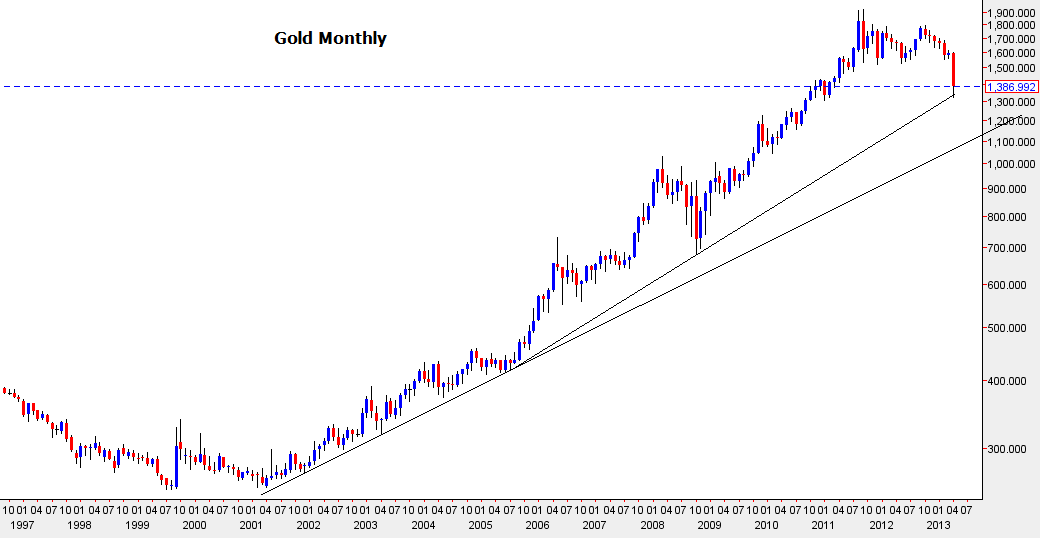
A look at gold monthly in log scale shows the crash so far like this:

17apr201312

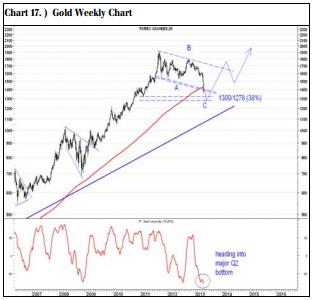
As things stand this is a correction that does not violate the secular bull market. UBS echo Chris Puplava’s view that the correction in gold will turn out the start of a new up phase:

17apr201325Source: UBS

And a reminder of real yields globally is still a positive environment for gold:
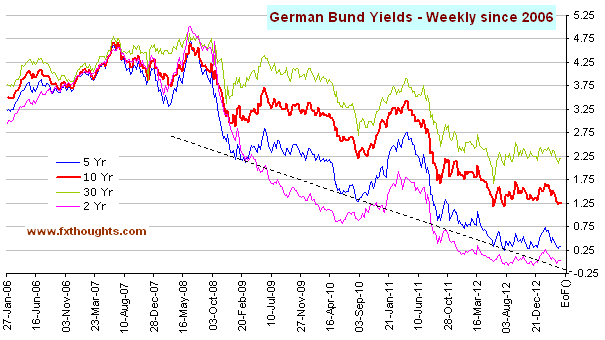
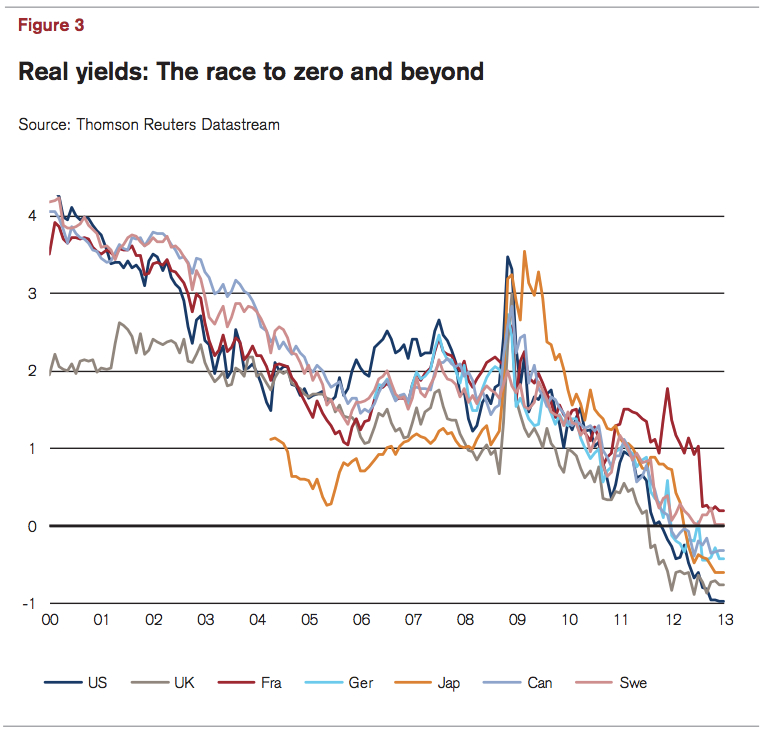
17apr20132

However, I maintain the picture for gold – and commodities – is very much in the balance. As you know I can write a broad-based case for commodities having peaked in 2011, aligned with a sunspot maximum in 2012, as well as a broad-based case for the secular commodities peak being ahead, in line with a sunspot maximum in late 2013. The breakdown in gold adds weight to the former. Piece by piece we will see the clear winner, and right now I look to see if buyers step in on gold to reveal a weak-hand shake-out whilst retaining its log support and whether commodities attract interest here to prevent a CCI breakdown. Sunspots have picked up, but not to new highs, and so it remains in the balance as to whether the solar maximum was in Feb 2012 or is ahead.
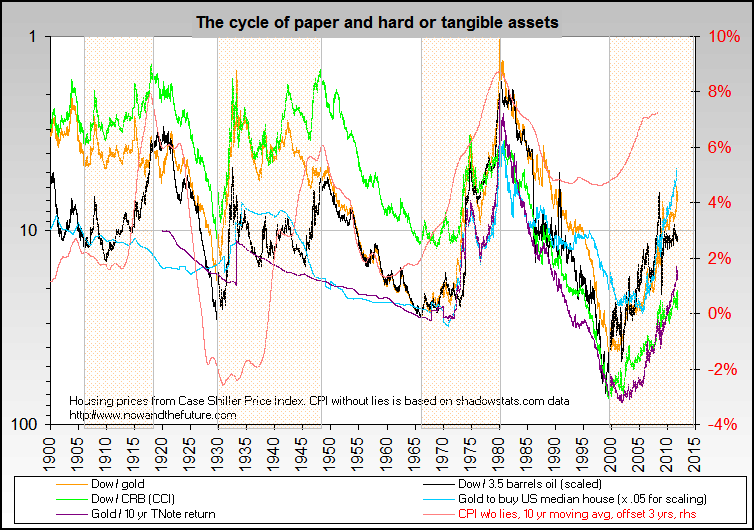
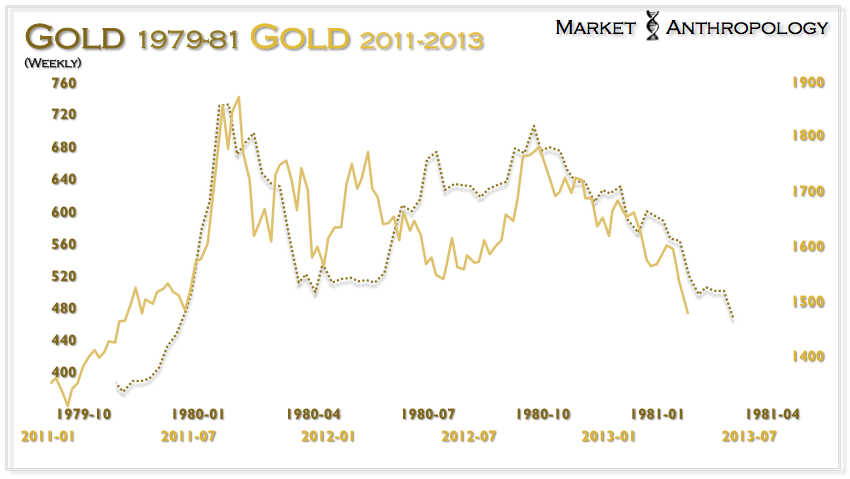
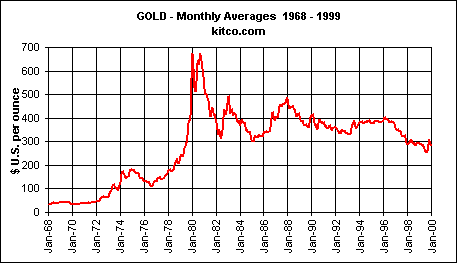
If gold did make its secular peak in 2011, then we could point to similar technical shaping at the end of the last secular bull:

17apr201314Since that chart was produced, gold dropped to a low of 1320, which would be equivalent to around 350 in 1981. Looking at what happened next in the 1980s, gold was then not far off a bounce, which retraced half the falls before failing again.

17apr201315In summary, I still think it remains in the balance as to whether the secular bull market in commodities and gold is still in play and has one final (biggest) leg up still to come. Since selling my stock indices longs, my positions consist of short treasuries, long multiple commodities, and long gold, silver and gold miners. I doubled up on these last three into the sharp falls. My exposure is significant, and it is going to get expensive if the secular bull market is over and more falls are ahead. However, if this was the last correction before a bull market finale, then those positions would conversely turn out highly profitable. It’s a risky business, but I am leaning towards staying put and watching developments for further clues, rather than lightening up.