Max Short Equities

A reversal in equities at the right time, right place. The closes on the Dow peaked at Friday’s full moon suggesting an inversion may well have occurred. A big up day yesterday for commodities, including 10% gains in natural gas and coffee. US economic surprises slipped below zero as data once again disappointed, and rising input prices (commodities) are, in line with history, threatening to tip an already weakening economy over as 2014 progresses. A significant geomagnetic storm played out yesterday, with another one in progress at the time of writing, and the timing of these disturbances is notable.

I believe yesterday will turn out to be the spot for optimal maximum short equities. Maybe you disagree with the timing, but if you have been a reader of my posts for the last couple of months then you will know I am acting on a multi-angled, multi-layered case. Maybe you disagree with being short at all, but having done a little tally I have published about 50 different indicators since the turn of the year which all individually suggest a shorting opportunity in equities is at hand (either for multi-week, multi-month or multi-year gains), and collectively produce something compelling. Whilst it would be unwise to rely on any one indicator as anomalies can and do occur, I feel pretty confident with fifty. If my specific timing of the optimal shorting point turns out wrong, then that aggregate of indicators calls for that spot being near both in time and price. Until disproven I have now two specific calls: (1) Stock market topped 31 Dec 2013 (Dow, SP500 (double top) and Nikkei) and (2) Optimal shorting opportunity (peak of the second chance) was 19 Feb 2014. A reminder: I am not an advisory service and I am short equities, long commodities.

Click on the two charts to view larger:

20fe1

20fe2

History In The Making

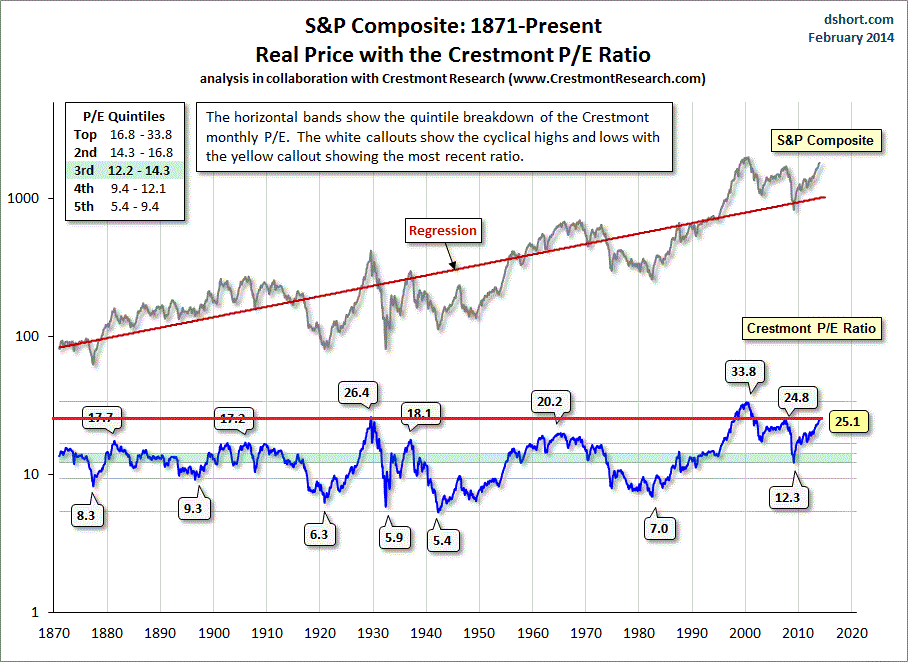
1. Crestmont P/E valuation only exceeded at 1929 peak and in 2000:

18fe1

2. CAPE / Shiller PE / PE10 valuation only exceeded in 1901, 1929 and 2000:

18fe2

3. Compound annual growth rate since 2009 bull start only exceeded into 1929, 1937, 1987 and 2000 peaks:

18fe10

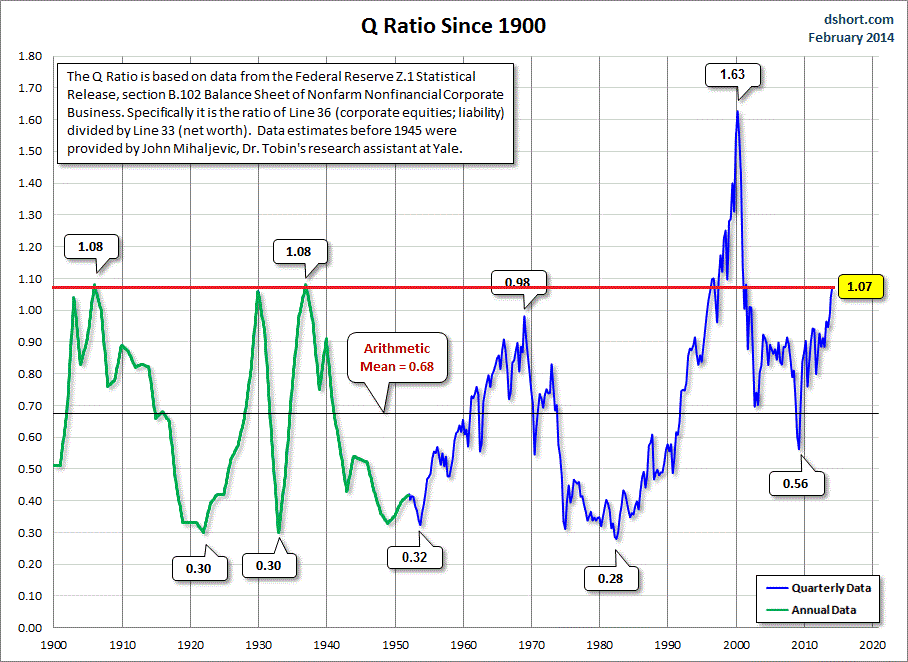
4. Q ratio valuation at major historic peak levels, barring 2000 outlier:

18fe4

5. Stock market capitalisation to GDP from Fed data second highest in history:

18fe5

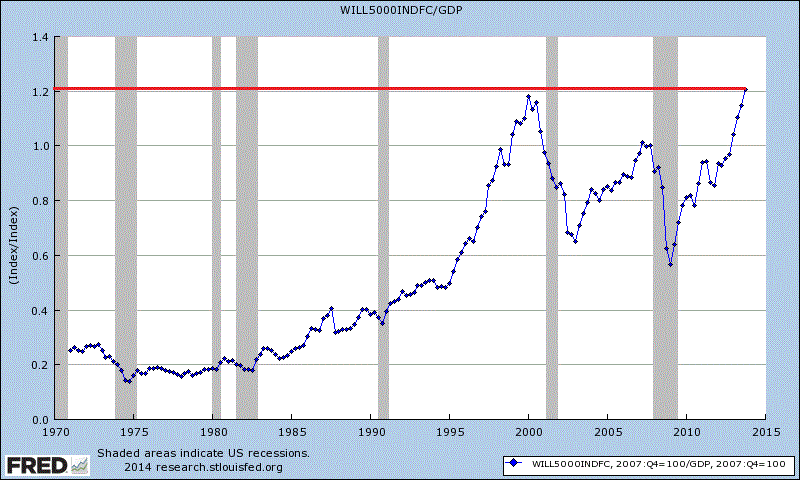
6. Stock market capitalisation to GDP based on Wiltshire 5000 (the broadest and most comprehensive US index) equal highest in history with 2000:

18fe6

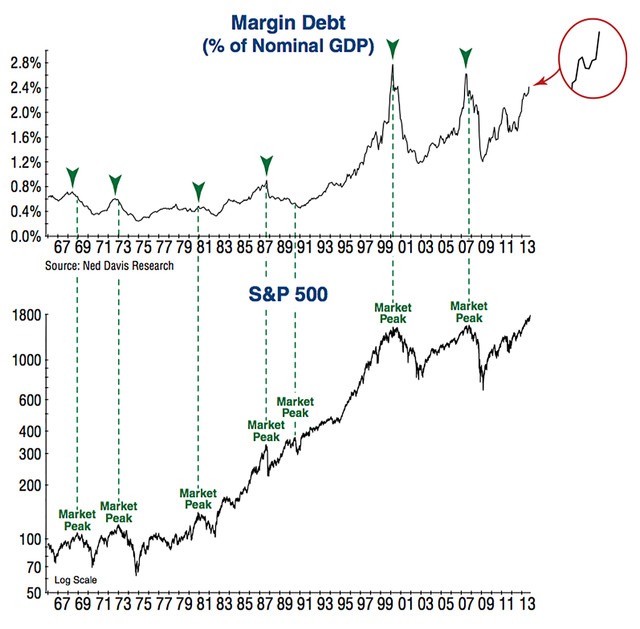
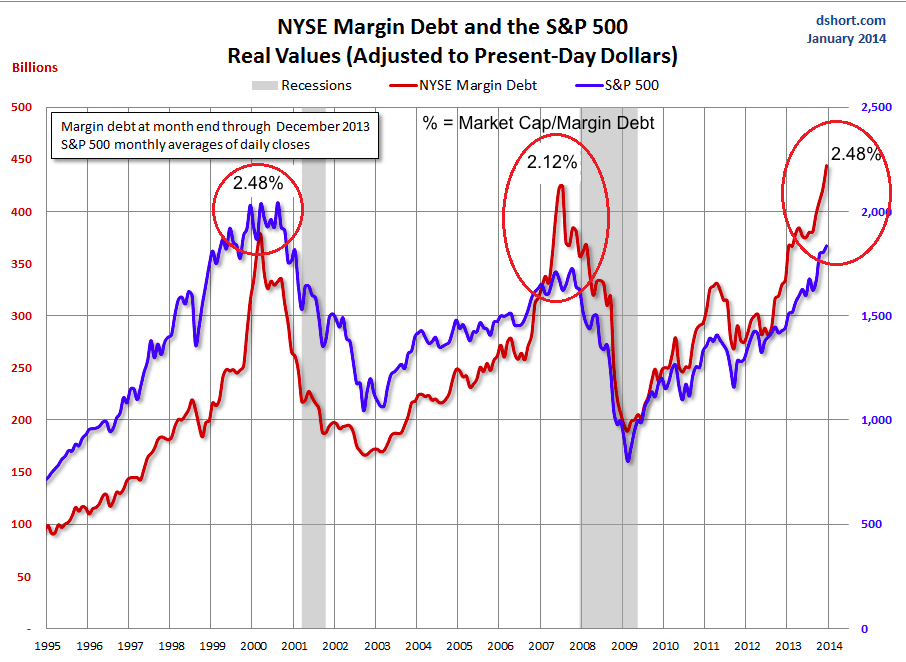
7. Margin debt as a percentage of GDP joint highest in history with 2000 (and net investor credit at all time low):

18fe8 18fe7

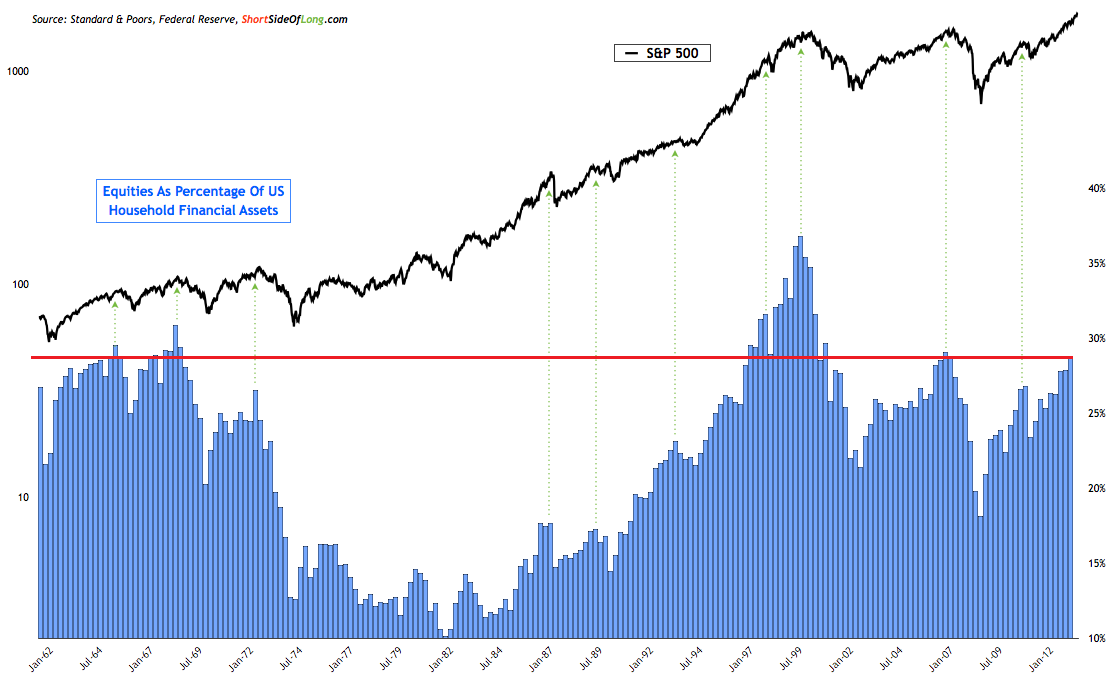
8. US household equities exposure at level of previous major peaks, barring 2000 outlier:

18fe139. Skew readings cluster highest ever:

18fe26

10. Panic/Euphoria second highest ever euphoria after 2000:

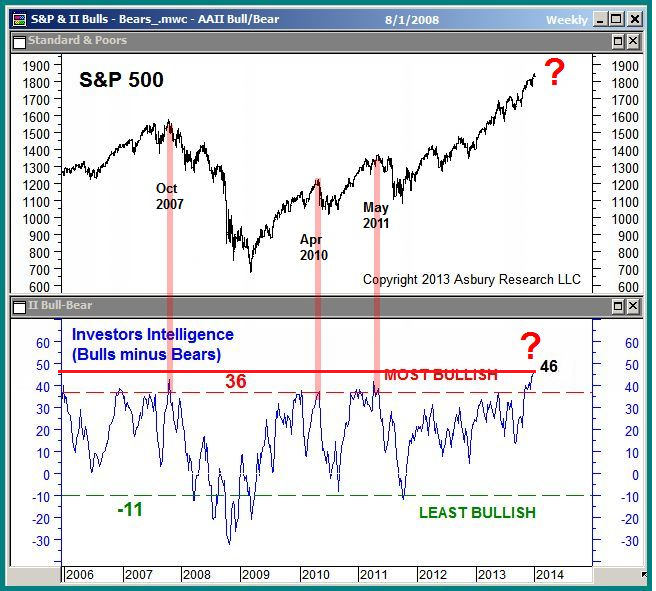
18fe1211. Highest ever Investors Intelligence bull-bear sentiment spread:

18fe11

12. Sunspot, geomagnetism and lunar phase potential historic convergence:

18fe25

Solar maxima deliver speculative peaks but as these peaks in the sun’s activity occur only around every 11 years, we see cyclical market peaks in between. More often than not markets peak in the seasonal (inverted geomagnetism) highs around December and July, and within the month they typically fall close to new moons. If the Dow peaked 31 Dec 2013, the closest parallels as highlighted in the table are 1980 gold and 1989 Nikkei. Both these were secular peaks occuring at a solar maximum, at the turn of the year and close to a new moon. The Nikkei is particularly pertinent as it peaked on the last trading day of the year and led Japan into a period of deflation, which I believe awaits the US now. US deflationary recessionary demographics should break the Dow out of a very long secular run that has been in place from the 1940s to now.

If the Dow and Nikkei did not peak on 31 Dec 2013, then the next new moon would be 1 March 2014, by which those indices would need to be at new highs. However, by that point we have moved into the (geomag-inverted) seasonal lows, and, based on current solar forecasts, gradually away from the solar maximum. The caveat to that latter point is if solar forecasts are wrong and we see a stronger sun in the weeks or even months ahead, making for a higher cluster of sunspot spikes. We might then look to the next seasonal high period of June-August and future new moons in looking at top-timing probabilities (note probabilities, as the table shows exceptions). However, the stronger case is for the 31 Dec 2013 top, and the evidence that has built up since then is supportive, including January spikes in trading volume and insider selling, 2014 money flows into treasuries, gold and defensive sectors and a downtrend in economic surprises. The last piece of the puzzle is for price to now confirm, with the Dow rolling over again this week, and in doing so adding a lower high to the Jan/Feb lower low, marking a trend change. Prices on the US indices hit technical targets on Friday, and volume for the rally remained divergent, setting up that roll over potential. We had a geomagnetic storm for the second weekend in a row too. However, we are clearly very delicately poised: either a definitive bullish breakout (with bullish internals) from here postpones a market top into the future, or we are at the top of the ‘second chance’ and staring at a major bearish opportunity.

Nasdaq 2000 vs. Nikkei 1989/90 vs. Dow 2013/14

The dot.com boom peak in 2000 occurred on a monthly sunspot spike at the ~11 year solar maximum, with the familiar topping process pattern of primary distribution – shake out – second chance – waterfall declines. The major declines and flash crash occurred in March/April, with associations of Mondays and the new moon (correlations that hold up in wider stock market history).

13fe1

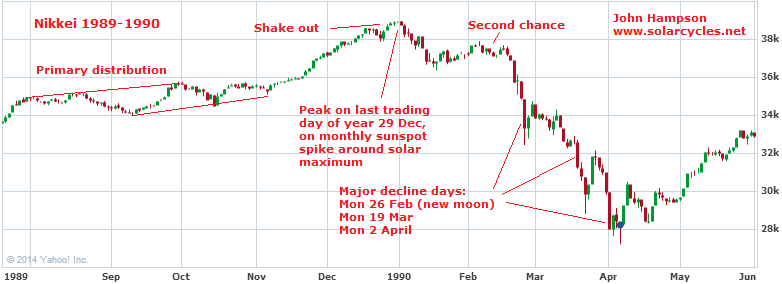
The Nikkei boom peaked on the last trading day of 1989 on a monthly sunspot spike at the ~11 year solar maximum, with the same topping process waves. The major declines were centered around March, with associations again of Mondays and the new moon.

13fe2

The Dow peaked so far on the last trading day of 2013, on a monthly sunspot spike at the ~11 year solar maximum (11 years is average and this was a longer solar cycle), with a similar topping process so far.

13fe3With the historic associations of Mondays and new moons, we have a potential major down day Monday 1st March, which is the new moon (CORRECTION: Monday 3rd March, 1st trading day after the Saturday 1st March new moon), and based on the percentage drops of the Nikkei and Nasdaq we could potentially waterfall to 11,000 by the end of April. The relevance of March and April is captured here:

13fe4

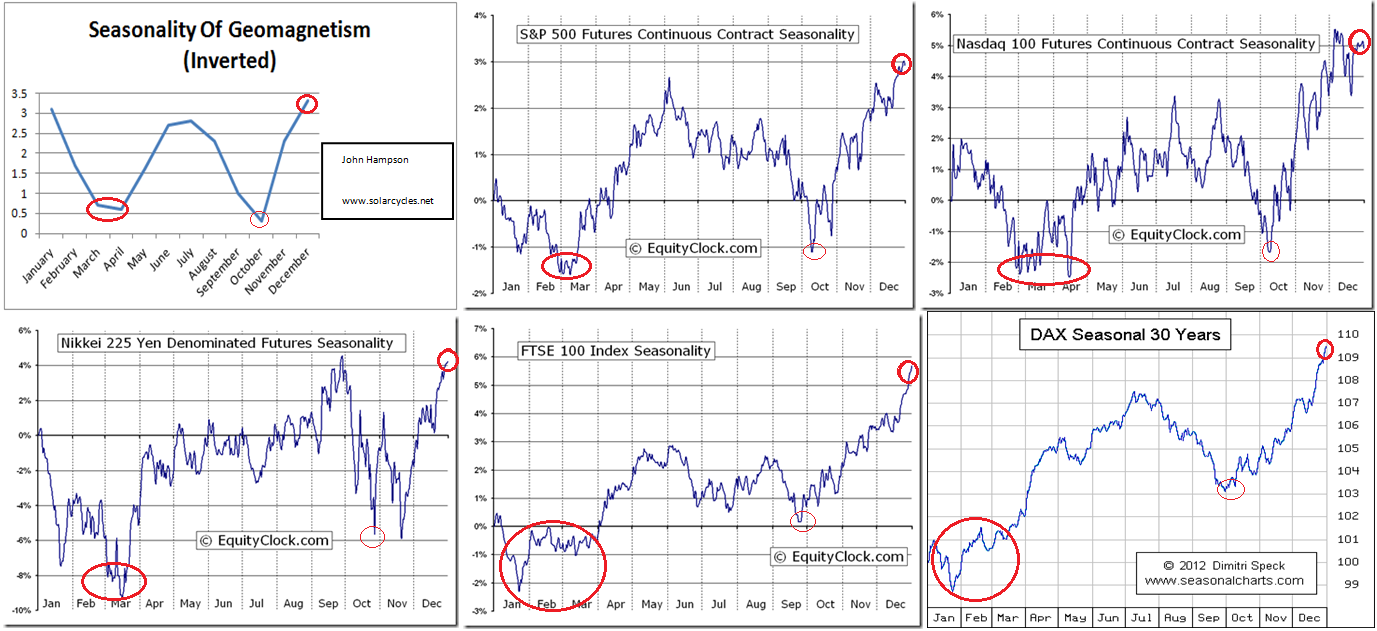
Just as the seasonal peak of geomagnetism (inverted) corresponds to peak stock market seasonality and a clustering of major tops having occurred at the turn of the year, so the seasonal lows of March/April and October have corresponded to worst seasonal stock market performance and a clustering of market crashes.

Something Happened At The Turn Of The Year…..

1. Treasury bonds bottomed / yields topped out:

7fe22. Gold bottomed and broke out:

7fe3

3. Bitcoin peaked:

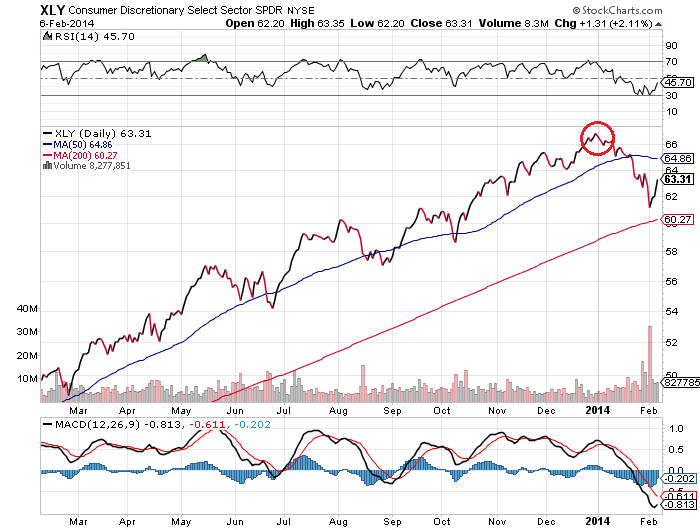
7fe44. US Consumer Discretionary and other cyclical stock market sectors peaked:

7fe55. US stock market sentiment made a historic high peak:

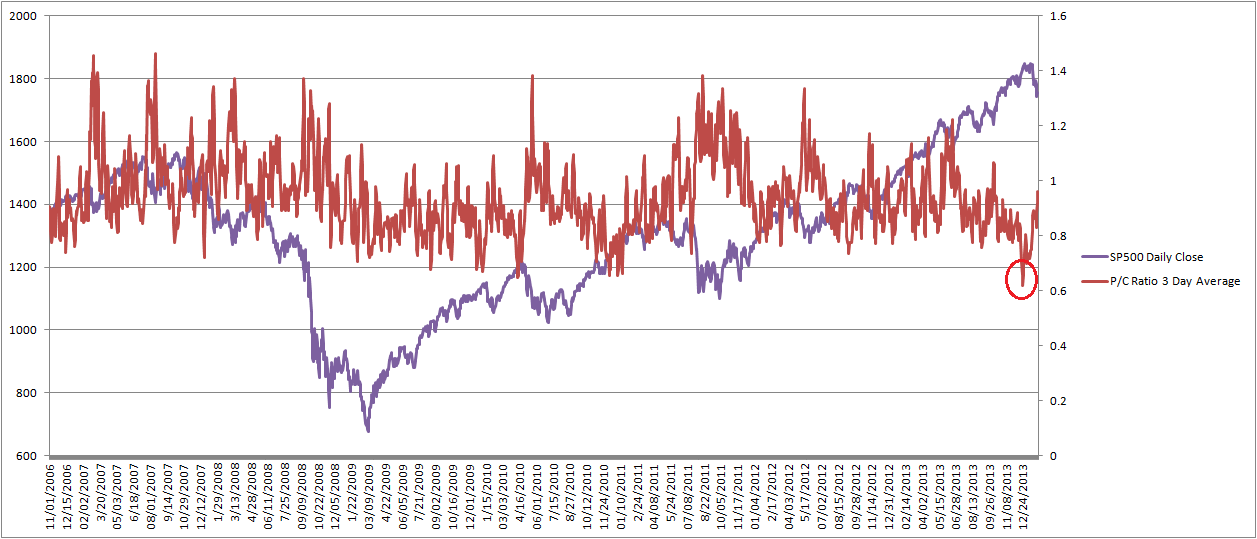
7fe66. The put/call ratio made a historic low bottom:

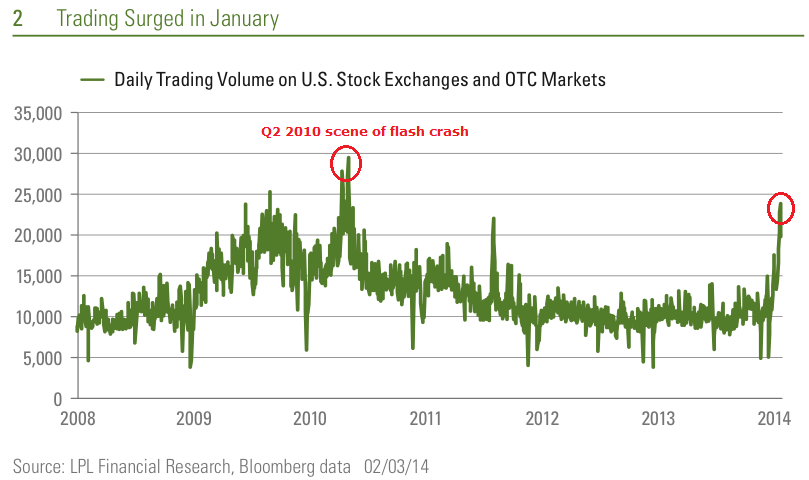
7fe87. Trading volumes surged:

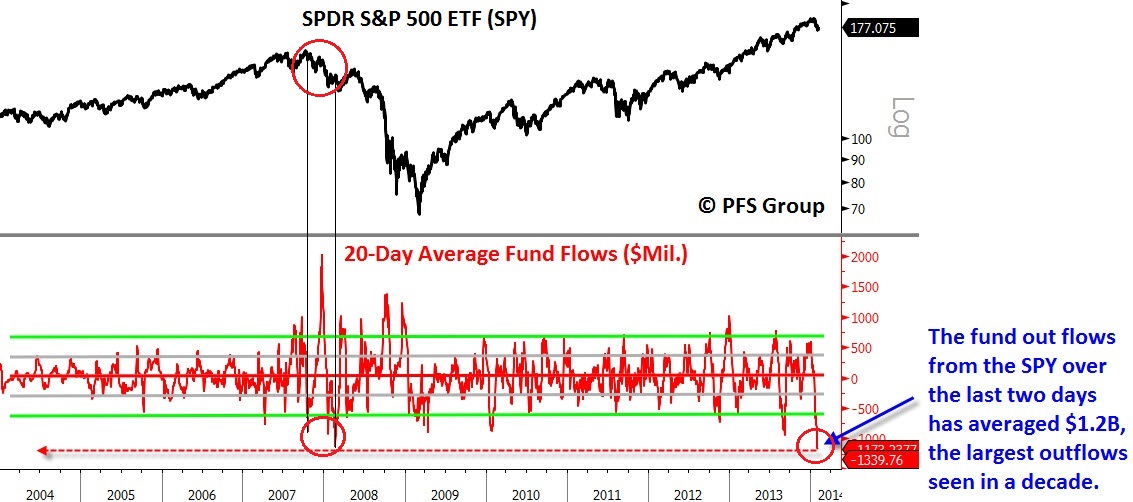
7fe98.Equity funds had their largest ever weekly outflow (whilst bond funds had a record inflow):

7fe1

9. Investor leverage spiked to real and as a percentage of market cap records:

7fe1110. The solar maximum peaked and the stock market peaked (prediction):

7fe10Plus, leading indicators (narrow money and OECD derived) forecast that global economic growth peaked out around the turn of the year.

And why? This is the part that is unpalatable to many: because we are less intelligent creatures of free will and more dumb subjects of natural forces:

7fe12 7fe13 7fe14 7fe16Caveat: If NASA/NOAA/Solen projections are wrong and the smoothed solar maximum extends further into 2014 together with another larger monthly spike in sunspots then it is possible the stock market makes a higher peak with it, close to another future new moon. However, the collective evidence (united solar forecasts plus comprehensive cyclical stocks bull topping checklist (my last post)) suggests this is low probability.

Near Term Assessment For Equities

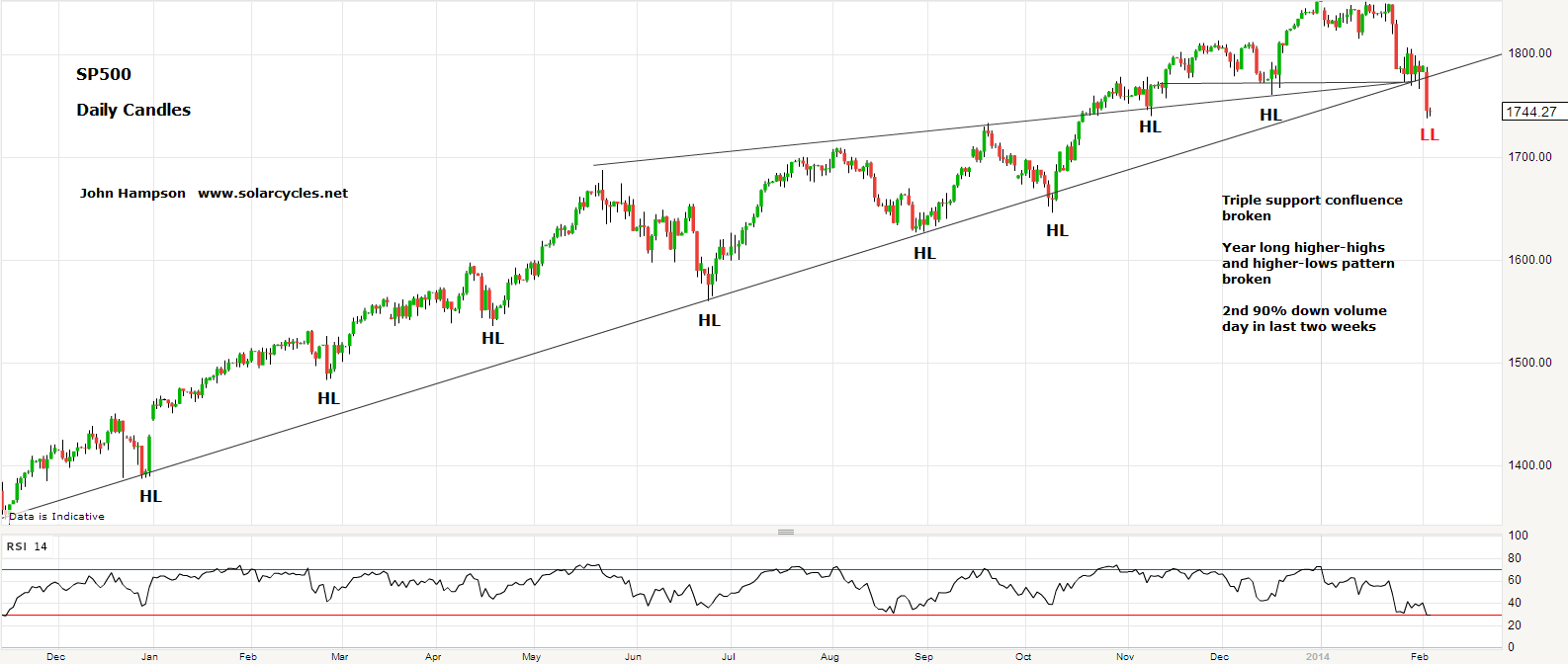
Yesterday delivered an important breakdown in US equities. Following a 90%+ down volume day on the 24th Jan, we received our second such day yesterday. Price broke triple-support on the SP500 and delivered a lower low which breaks a pattern in place for a year:

4Fe1Like the SP500, the Russell 2000 had been clinging to a lower channel support in last week’s mixed action, but decisively broke it yesterday. So the question is, what now for stocks?

As yet, we do not see sufficient mean reversion in sentiment (II, NAIM, Panic/Euphoria all still evelated), nor has Skew returned to more benign levels. Put/call ratio remains persistently low, despite yesterday’s sell-off, and suggests more selling is required to reset the complacency. Nymo has broken downwards but is still not at typical bottom levels:

4Fe2Source: Charlie Bilello

On the other hand, Vix, Arms and % stocks above 50MA have moved towards levels that marked bottoms over the last year, and that second 90% down day also meant a low was close in that same period. That could mean buyers may become interested again.

However, as per my recent posts, I don’t think last year is going to work as a guide any more. My case for a major top in equities has been aided by treasuries outperforming since the turn of the year and cyclicals changing trend in their relative performance to the SP500 also as of the start of January. We have also been seeing some economic data disappointments, as expected, and this Friday’s jobs report is likely to be another market mover. I believe we need to see those sentiment and put/call indicators wash out before price makes an important low, and that means any near term buying should ultimately give way to selling to a lower low.

If we look again at the 1929, 1987 and 1989 (Nikkei) topping analogs (this post and this post), the waterfall declines were kicked off at similar times in all three: after around 30 trading days from the major peak. Today is the 23rd trading day since Dec 31st, which makes things unclear. We could potentially make an upward retrace over the next couple of weeks to a lower high and then begin the true declines, or we could roll over into the waterfall declines from here. The price action analogs suggest similar: we may yet need to build out more of a definitive ‘second chance’ retrace or we may achieved a weaker version of that between 24th Jan and yesterday. So we need to see how price action develops this week and keep an eye on the indicators for clues.

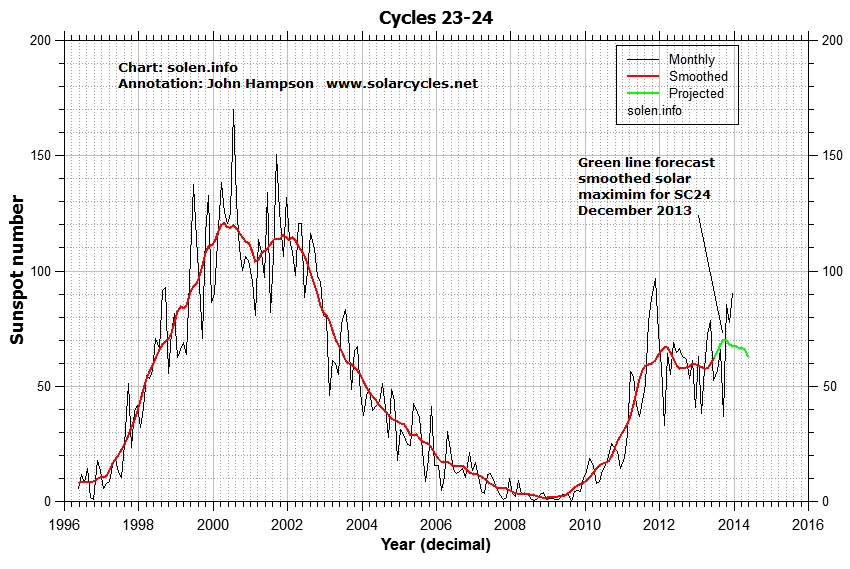
Solen’s monthly solar maximum and projection update is below and remains supportive of my Dec 31 equities top case, with the monthly spike in sunspots and smoothed solar maximum projection combination:

4Fe3

Source: Solen


Economic Growth, Demographics And Solar Variation

Economic growth occurs two ways: increasing population and increasing productivity per capita (which can be achieved through technological evolution and improvements in organistation/management/systems). Both increase overall GDP.

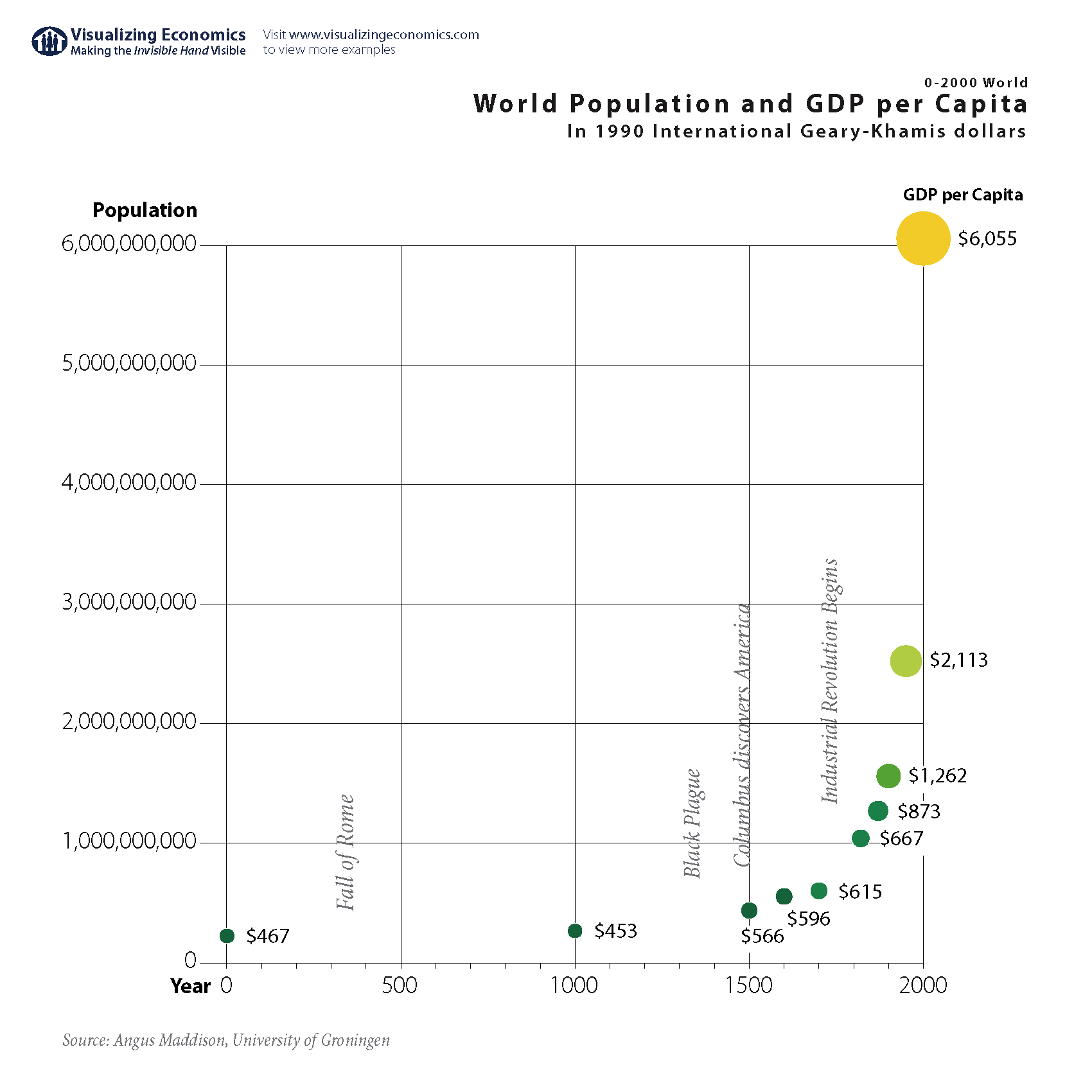
World population has grown exponentially over the last 2000 years:

24ja1

Source: Sub-dude

As has GDP per capita:

24ja2

Source: filipspagnoli

A principle of the globally adopted capitalist economic model is that compound growth enables long term poverty reduction: that people can pursue their own self-interests and help themselves to disproportionate shares of the pie as long as the whole pie grows so that more people find themselves better off than less. Hence countries typically target 2%-10% annual growth, which when compounded means exponential growth. To achieve exponential economic growth we need either exponential population growth or exponential per capita growth (ideally both). The latter reflects human progress and technological evolution whereas the former is more of a ponzi scheme, requiring ever increasing numbers of people to maintain an ‘illusion’ of increasing prosperity.

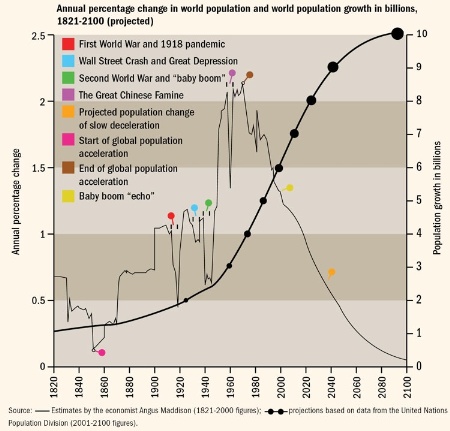
Something changed around the 1970s. The growth rate in world population went into decline:

24ja3

Source: TimesHigherEducation

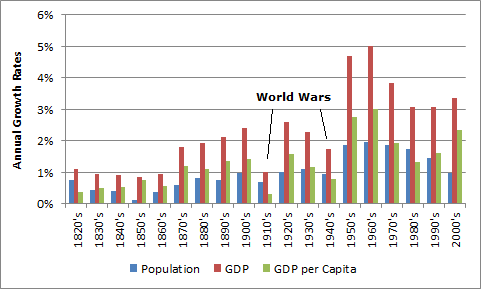
World GDP growth and GDP per capita growth also trended to a peak.

24ja4

Source: DoctorCopper

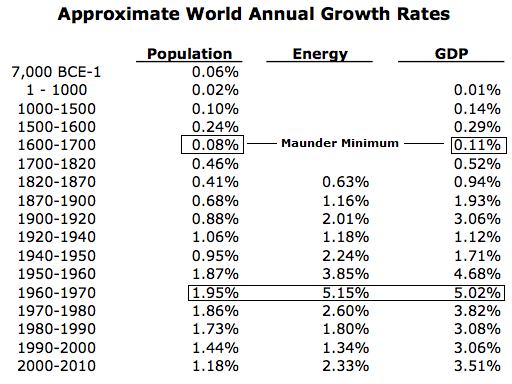
The pick up in GDP and per capita GDP in the 2000s is now rolling over again, suggesting the secular trend remains down:

24ja5Source: TheNextRecession

24ja7Source: TheNextRecession

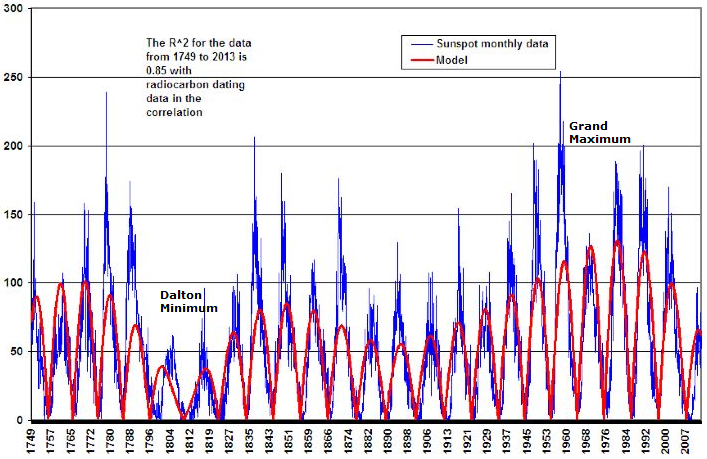
The peak in population, GDP and GDP per capita growth rates fits with the peak in solar variation: the grand solar maximum:

24ja6Source: WattsUpWithThat

The trend in long term solar variation suggests we are now headed for another minimum, like the Dalton or Maunder. These historic minima corresponded to lower GDP growth and lower population growth, cementing the relationships between the three.

Inflation also peaked around the 1970s:

24ja8Source: Yardeni

As did growth in energy supply.

24ja9Source: Financial Press

Declining rates of growth in population, GDP, GDP per capita, inflation and energy supply spell major trouble for a global system reliant on exponential economic growth as well as inflation and employment targetting. However, the true impact of this has been postponed in two ways.

Firstly, the ‘gap’ has been filled by increasing debt:

24ja15

Source: isj.org.uk

However, we have reached the point of debt monetisation in US, UK and Japan, i.e. the end game. The question is how long the end game can last.

Secondly, sub-demographic trends of the major economic nations have largely been supportive since the 1970s, peaking out in phases.

Here is US population growth per decade. Forward it by 40 years so that the births become the important ‘middle’ age bracket and we get the secular trends in real US stock prices: down into 1980, up into 2000, then down projected out to 2030.

24ja10

Source: Business Insider

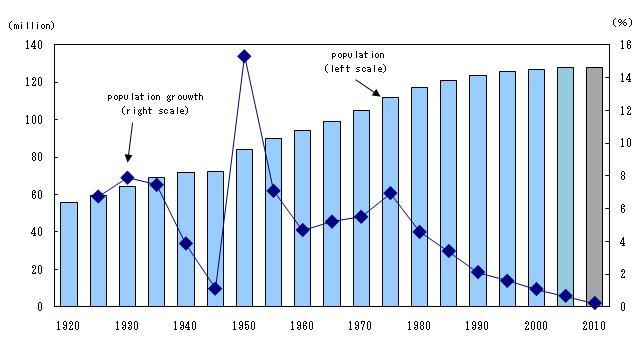
Here is Japan’s 5-yearly population growth rate. Again, forward it 40 years and we have a big spike in the middle bracket to deliver a major peak in equities and real estate around 1990, a small relief uptrend in the current window 2010-2015 (as we have been seeing) and otherwise a fairly grim outlook.

24ja11

Source: Stat.go.jp

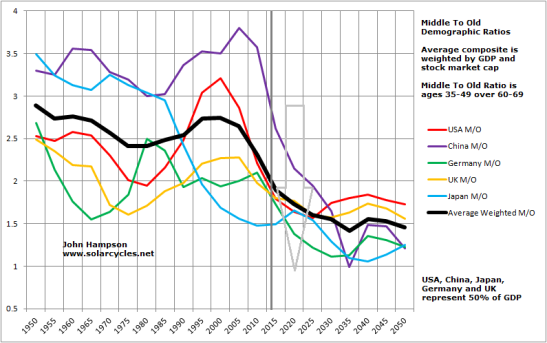
Collective dependency ratios, middle-to-old ratios and net investor ratios in the major nations were largely positive until recently, with China the last to break down: 

24ja12 24ja13 24ja14

In summary, we have postponed the impacts of the major growth rate peaks (GDP/GDP per capita/population) of the 1970s through debt until we have reached the point of monetisation, and the support from demographic sub-trends of the major nations has now expired. Solar maxima have historically given way to recession, and solar variation predicts a new grand minimum ahead which has historically correlated with low GDP and population growth. I am therefore led to the fairly bleak conclusion that this solar maximum speculative peak will turn out to be a major historic peak for the world.

Red Flags Update And More Solar Research

First, the flags:

1. China repo rate has escalated sharply today suggesting another cash crunch may be at hand:

20ja1Source: Chinamoney

2. Insider selling in the US is now historically high, a further sell signal for equities:

20ja2Source: Barrons

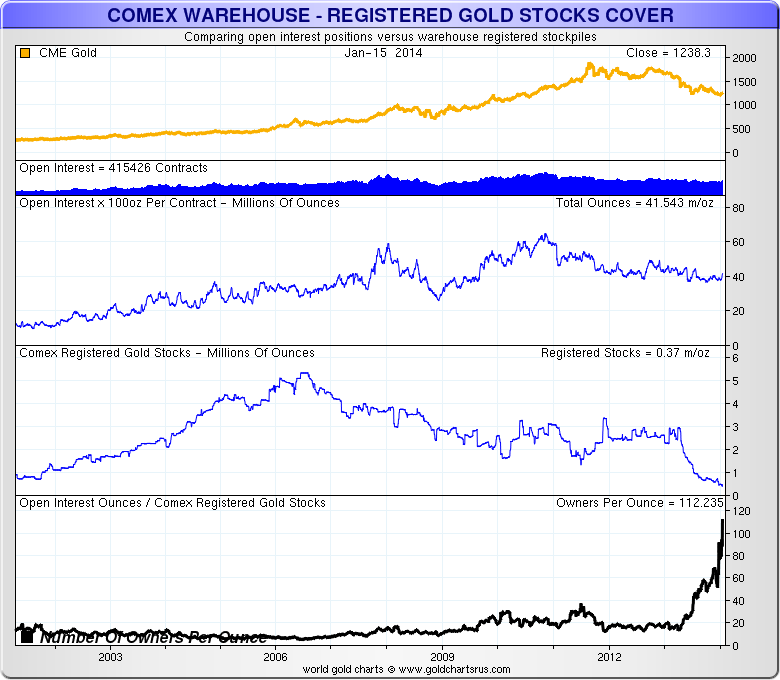
3. Comex gold stocks that are eligible for delivery versus open interest has risen to a historic extreme of 112:1. This means that the gold owners will demand higher prices to put their gold up for delivery and is bullish for gold prices.

20ja3Source: Jesse / goldchartsrus

Now to the solar findings.

Below is a chart showing the last 4 solar cycles. In the last 4 decades there have been 3 major real estate peaks in the US and UK: 1979, 1989 and 2006/7. There has been one in Japan: 1991. In the last 4 decades there have been 2 secular peaks in the CCI commodities index: 1980 and 2011 (which exceeded the 2008 high). In the same period we saw one major secular equities peak in Japan in 1989 and two major global equities peaks in 2000 and 2007. All are annotated below.

SCsThe theme of major market peaks falling at solar maxima is again revealed, but two recent anomalies stand out: the equities and real estate peak of 2007 falling at a solar minimum, rather than a solar maximum; and the commodities speculative peak of 2011 falling on the rise towards SC24 maximum.

Tackling the first, that 2007 peak gave way to the 2008 financial crisis, in which we saw crashes in real estate, equities and crude oil prices. This is in keeping with other crashes and crises that have historically occurred around solar minima. 1987’s historic crash in equities took place near a solar minimum. 1994 delivered a treasury bond market crash. 1997 saw the Asian financial crisis and a crash in equities. 2008 the aforementioned multi-asset crashes and financial crisis, and 2010 the flash crash in global stocks. All saw significant price rises into the crashes/crises. Central bank policies of this last decade were particularly friendly to asset bubbles, hence a suitably large boom and bust.

Turning to the second anomaly, one possibility is that commodities have not yet peaked and go on to make a higher high than 2011 in a late and swift cyclical charge as equities top out.

20ja4Source: MCRI

If they have already made their highs, then one explanation for their early peak on the SC24 maximum could be that China’s demographics topped out around 2010, and as the main driver of commodities demand the speculative finale had an earlier bias. China’s demographic trending to peak is perhaps better reflected in the bull market in commodities from 2000 than in their brief stock market mania around 2007.

But there is something else. Solar cycles average 11 years 1 month, but there have been outliers as short as 9 years and as long as almost 14 years. Here are the smoothed solar maxima of the last 100 years:

Aug 1917 (+11y6m after the previous solar maximum)

Apr 1928 (+10y8m)

Apr 1937 (+11y)

May 1947 (+10y1m)

Mar 1958 (+10y8m)

Nov 1968 (+10y8m)

Dec 1979 (+11y1m)

Jul 1989 (+9y7m)

Mar 2000 (+10y9m)

Dec 2013 ? (+13y9m)

Most aren’t far from average cycle lengths, but May 1947 was a year shorter, July 1989 shorter still, and if this smoothed solar maximum turns out to be around December 2013, that will be a much longer one than any of the others. Even if the smoothed maximum turns out to be Feb 2012 (the smoothed max to date) it will still be an outlier on the long side.

If lunar phasing still works despite artificial lighting and is to some degree ‘hard coded’ in human evolution, could sunspot cycles be too? Do we see evidence of human excitement through speculative peaks occurring around 11 years 1 month after the last solar maximum on those occasions where solar maxima occur significantly earlier or later?

The last smoothed solar maximum was March 2000. Add 11 years 1 month and we get April 2011, which is where we saw speculative peaks in silver, cotton, coffee, rare earths and others. However, we also see evidence of a speculative peak occurring now, at the likely smoothed solar maximum, as evidenced in many indicators and measures of equities.

July 1989 was an early outlier. 11 years 1 month from the previous peak would have been January 1991. Close to that, Japanese real estate peaked June 1991 and crude oil peaked in October 1990 in a war-associated major spike. However, we also saw US and UK real estate and Japanese equities peaking close to the actual solar maximum of July 1989.

May 1947 was an early outlier. Had it been a more regular May 1948, then we saw wholesale prices and crude oil peaking out around 1948. Yet commodities such as wheat, corn and oats peaked close to the 1947 actual smoothed maximum.

That may suggest there is some degree of hard coding of rhythm in human excitement, as well as some degree of variance in speculative peaks according to when actual solar maxima fall. However, when we look at the solar cycle progression charts,  we find that the tops of the solar maxima stretched across 1989-1991 and 1947-1948, which suggests there was no anomaly: speculative peaks were in line with actual solar maxima. But this is not really the case for the 2011 speculative peaks which fell on the rise into SC24 maximum. Therefore, we need to wait to see if commodities do make a late charge to a high exceeding 2011, wait to see if the solar maximum is falling and completing now, and also to wait to see if equities top out here and deliver a peak aligned with that potential solar maximum, before we can judge this further.

US Equities Bull Market Peak, New Bear Market At Hand

First, a compilation of indicators and flags warning of a major market top in US equities:

Bull Market History Statistics

Dow is up more than 5% five consecutive years now and a sixth such year has not happened before in history.

A 5-year bull trend only occurred once before, in the 1990s, and was followed by 3 down years.

Last 2 years rally in US stock indices has been made up of less than 20% earnings growth and more than 80% multiple expansion. The last 2 such occurrences in history were 1985:1986 (leading into 1987 crash) and 1997:1998 (leading into 1999 real Dow peak)

Compound annual growth rate in equities since 2009 was only exceeded in 1929, 1937, 1987 and 2000, all of which led to steep market declines

Valuations

Crestmont P/E is the 3rd highest in history after 2000 (market peak) and 1929 (market peak), and in 97th percentile

The 2nd highest market capitalistation to GDP valuation outside of 2000 (market peak)

The 3rd highest Q ratio valuation in the last 100 years outside of 1929 (market peak) and 2000 (market peak)

The 3rd highest CAPE valuation in the last 100 years outside of 1929 (market peak) and 2000 (market peak)

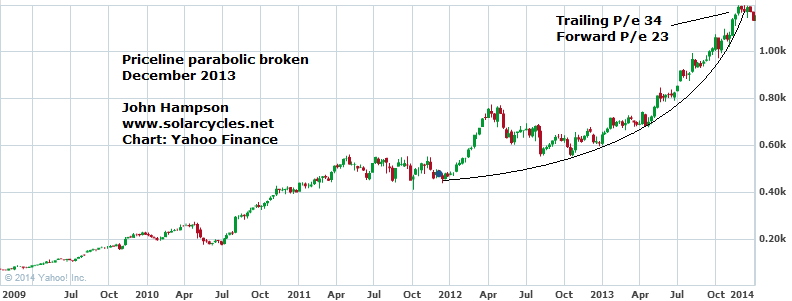
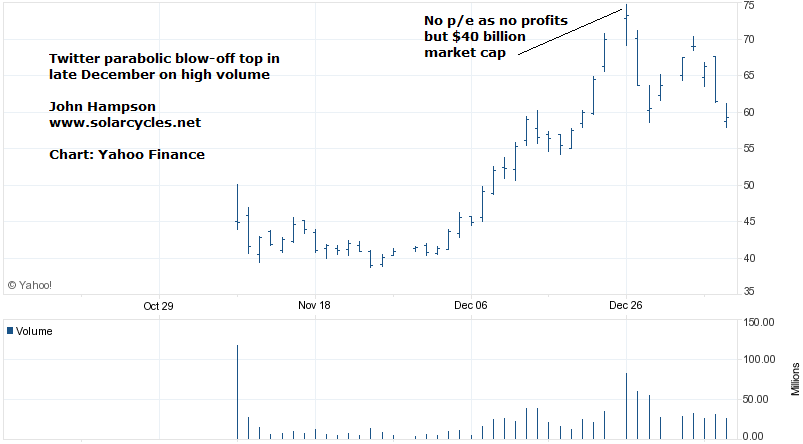
Russell 2000 trailing p/e ratio 88; Amazon trailing p/e 1440; Facebook trailing p/e 148; Twitter reached $40bn market cap with zero profits

Earnings guidance for US Q4 most negative on record

Technical Indicators

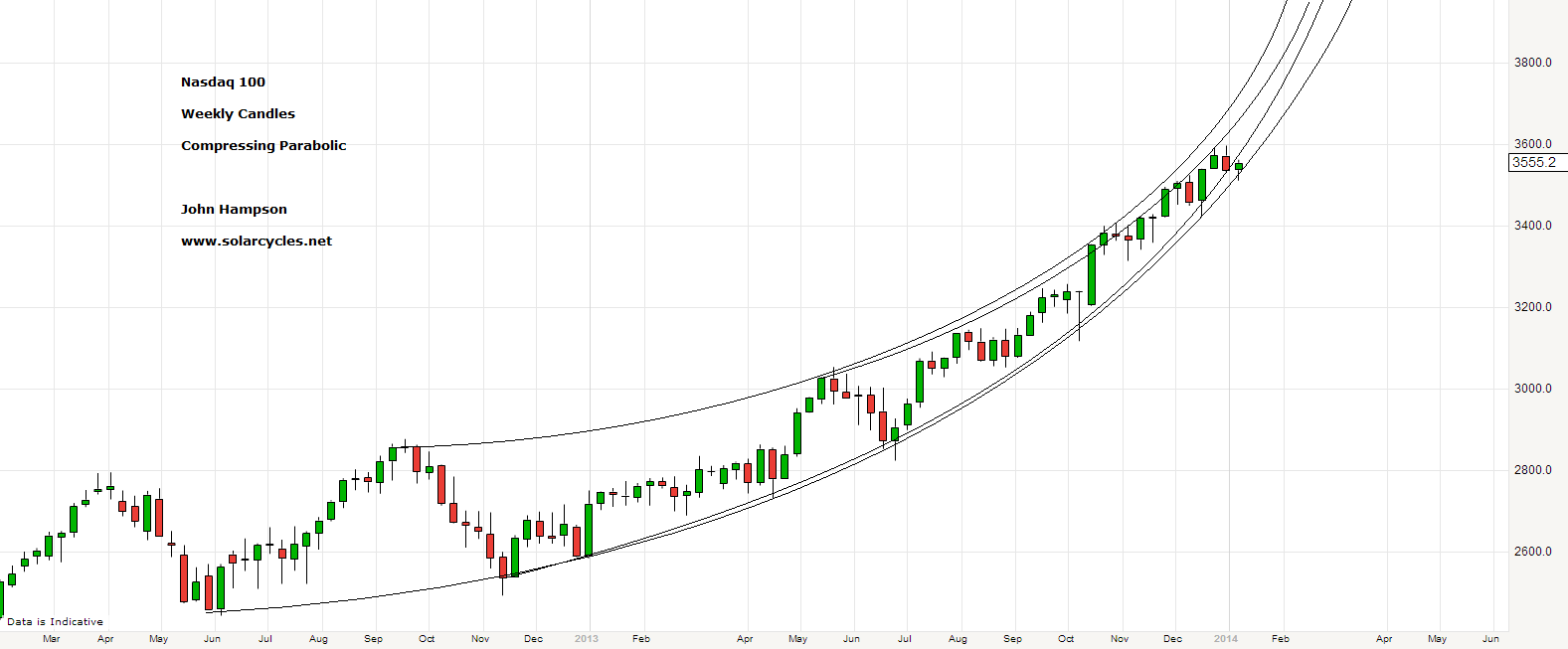
US stock indices are in an unsustainable compressing parabolic / Sornette bubble price formation

6 month breadth divergence on US indices in the percentage stocks above 200MA

Declining breadth in the number of countries participating in world equities rally

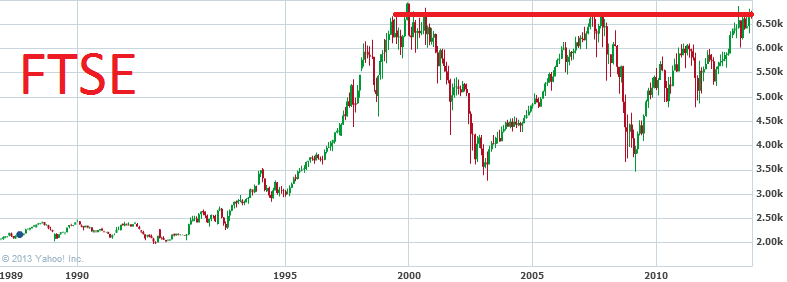
Dow, FTSE and Nikkei are all at long term resistance levels (connecting 2000 and 2007 peaks)

Treasury Bond Yields Rate Of Change over last 12 months is at a level that previously led to market tops in 2000 and 2007

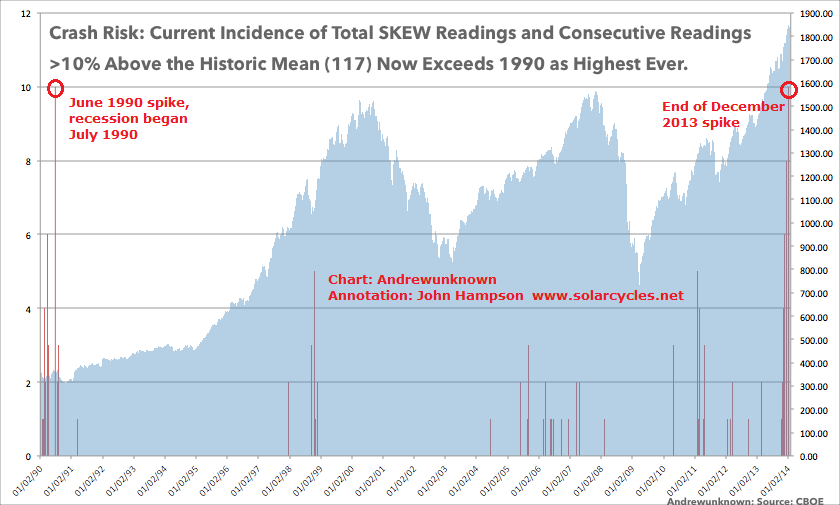
Second highest Skew reading ever (protection against outsized move)

Cluster of extreme Skew readings not seen since June 1990 before recession began July 1990

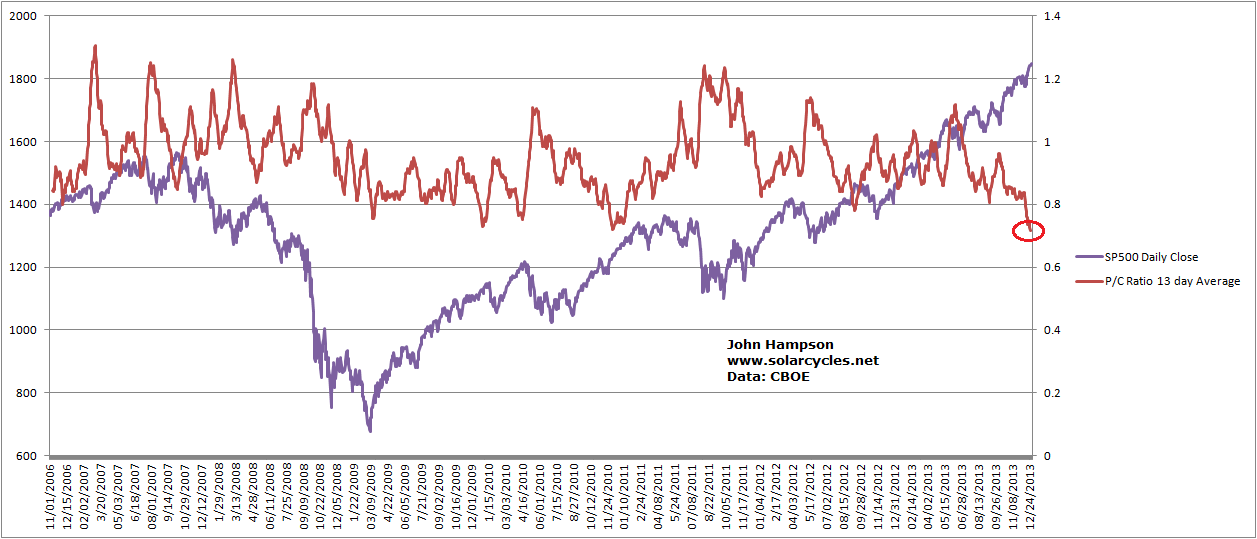
Put/Call Ratio 10 day average is at an extreme that previously marked significant corrections, including May 2010 flash crash

SP500 distance above 100MA is the highest of all time

Sentiment/Euphoria

Investor Intelligence percentage bulls are at 2007 levels (market peak)

Investor Intelligence percentage bears and bull-bear spread are both at 1987 levels (market crash)

NAAIM survey sentiment is in the 98th percentile = extreme optimism

Citigroup Panic/Euphoria model is now 2 months above the Euphoria threshold

Credit Suisse Risk Appetite US model is into Euphoria

Greedometer aggregate of macroeconomic, fundamental and technical data is at a record level exceeding the 2000 and 2007 market peaks

Equities Exposure And Leverage

US household exposure to equities has risen to the same levels as the 2007 top

Fund manager allocation to global equities is at levels that previously led to a market peak or correction

Rydex bull-bear and levergaged bull-bear ratios are at an all-time record

Margin Debt has escalated to 2.5% of GDP, only exceeded at the 2000 market peak

Investor Credit balances are at an all-time record negative

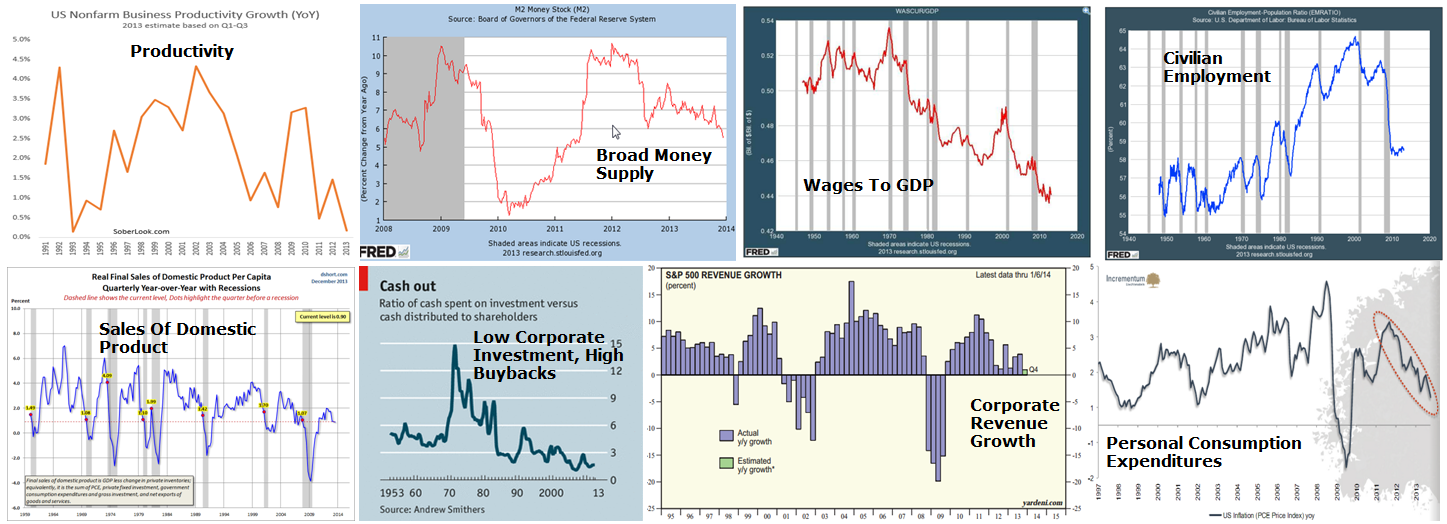
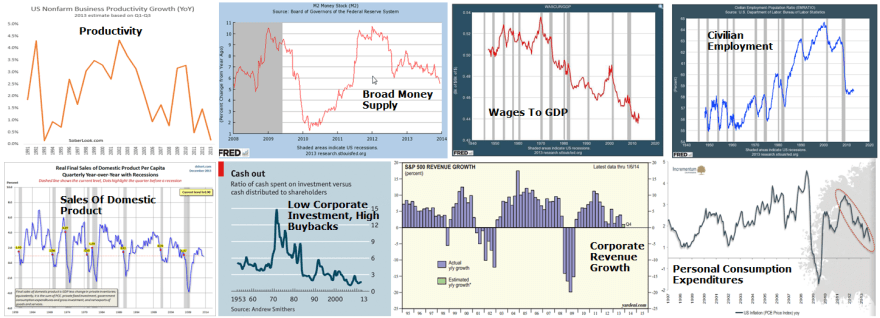
Second, the US economy is in trouble (click to view larger):
13jan40

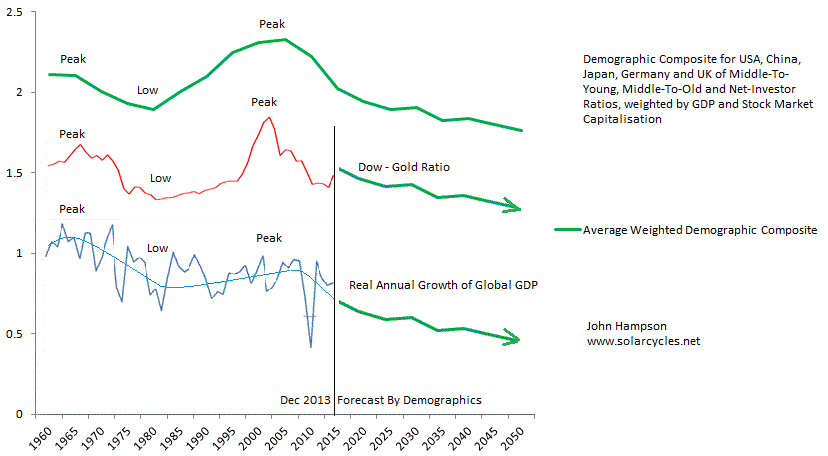
Third, this is reflective of both the record levels of debt and unprecedented collective demographic downtrends which are now in place in US, Europe and China and are deflationary, recessionary and equities-bearish.

DemographicsDowGoldRatioGlobalGDP

Fourth, equity markets have historically made major peaks at the turn of the year:
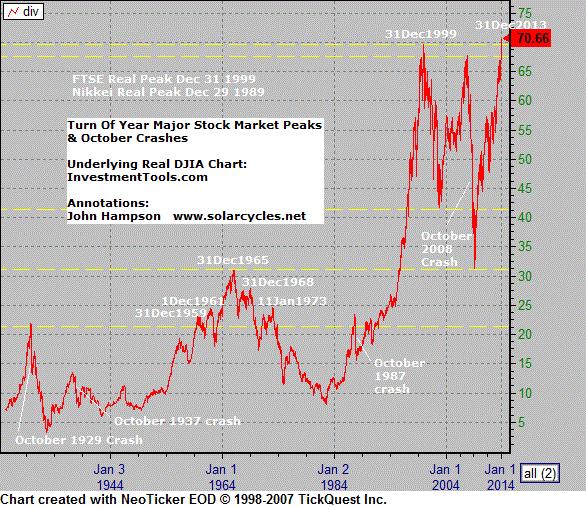
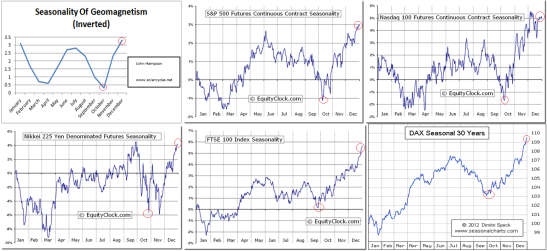
13jan11Market peaks at the turn of the year correlate with the seasonal yearly lows of geomagnetism, which inversely correlates with market sentiment. Market crashes in October (also shown above) correlate with the seasonal yearly highs of geomagnetic disturbance, and there is a close fit in the full yearly seasonality of global stock indices to the annual pattern of geomagnetism (inverted):

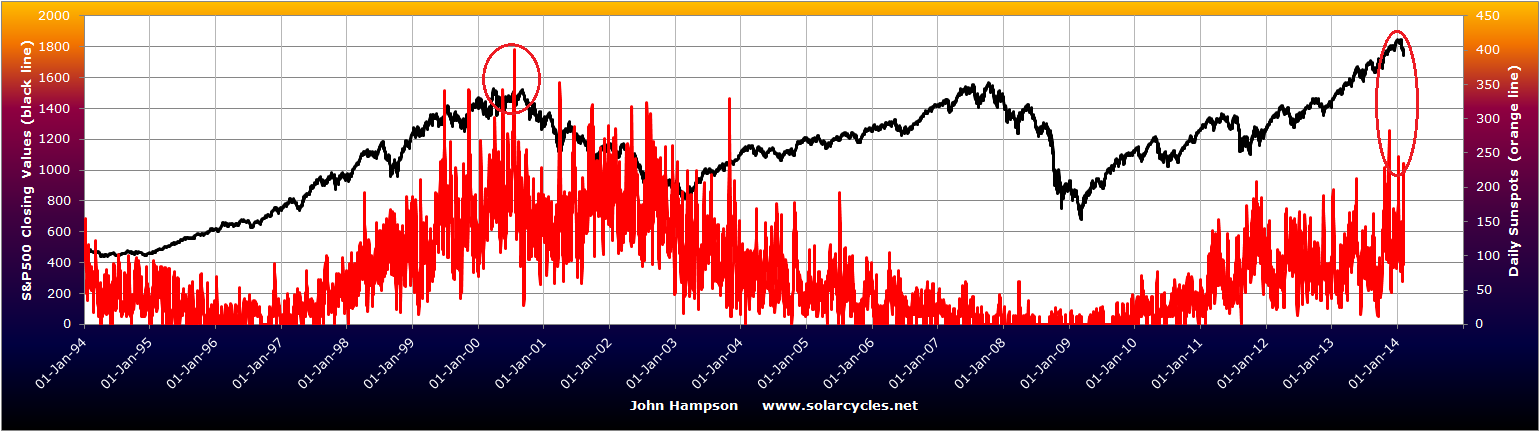
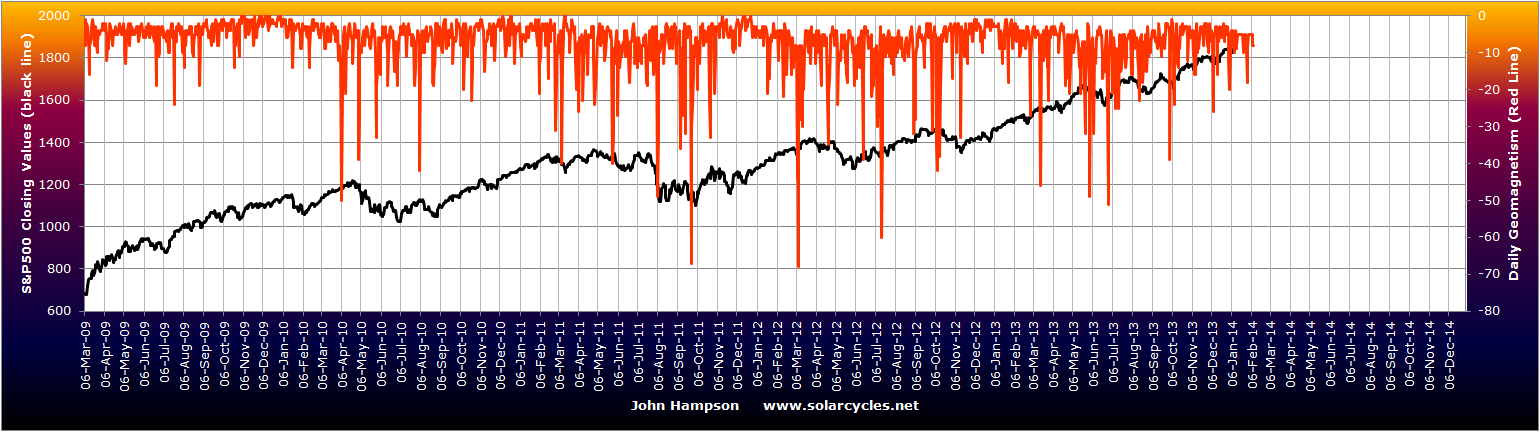
13jan50Most analysts are unaware of this underlying cause of stock market seasonality. Geomagnetic activity is demonstrated to make people more irritable and aggressive, and can affect melatonin synthesis and blood pressure. There is a correlation between geomagnetic storms and depression in humans. Here is a chart showing daily geomagnetic disturbance versus the SP500 over the last 5 years:

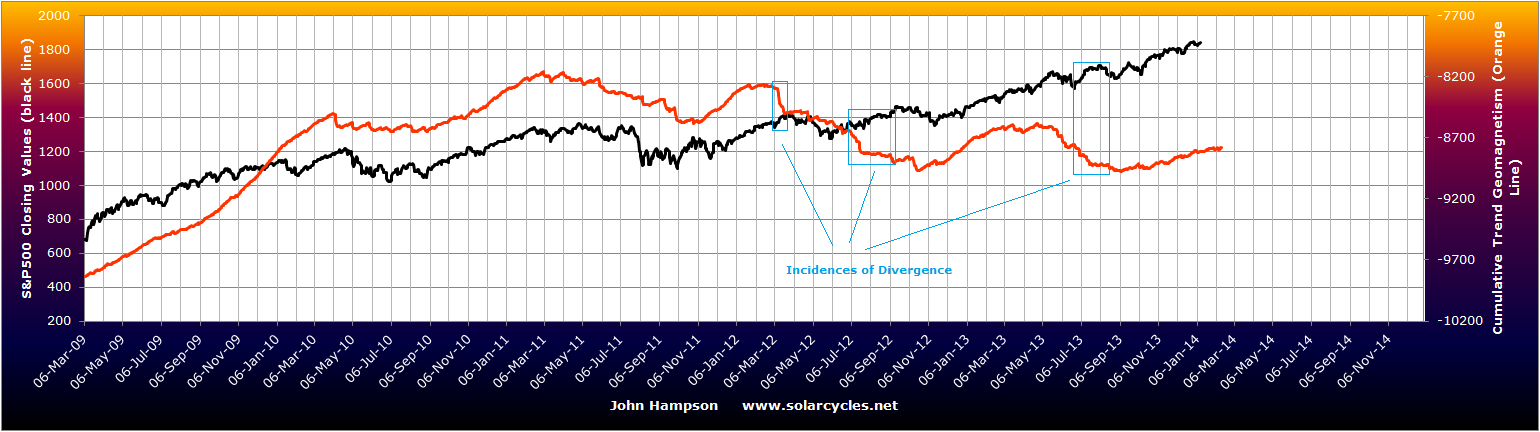
13jan52The bigger the geomagnetic disturbance, the bigger the spike. By turning this into a trend line we see the ebb and flow of the SP500 correlates with the ebb and flow of actual geomagnetism, with the only exceptions marked in blue:

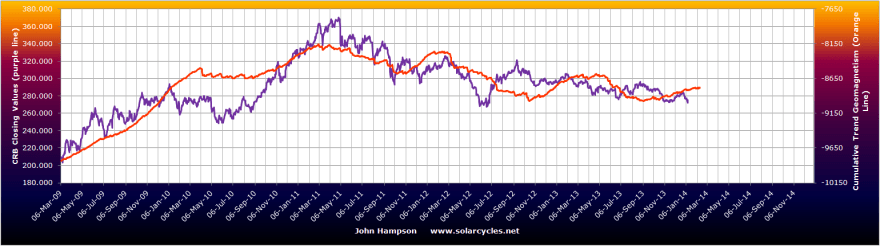
13jan51The correlations of the Singapore STI stock index and the TR CRB commodities index to the geomagnetic guide are closer still, which demonstrates the link between geomagnetism, sentiment and risk asset performance:

13jan53 13jan54Fifth, major speculative peaks have historically occurred at the solar maximum, which is occurring now.

Peaks in solar sunspot activity occur on average every 11 years and have historically correlated with human excitement peaks in the form of protest, war, growth-flation and major speculative parabolic peaks. Again there is biological evidence for this in elevations in oral temperature, pulse rate, blood pressure, and respiration rate, and again few analysts are aware of this critical influence.

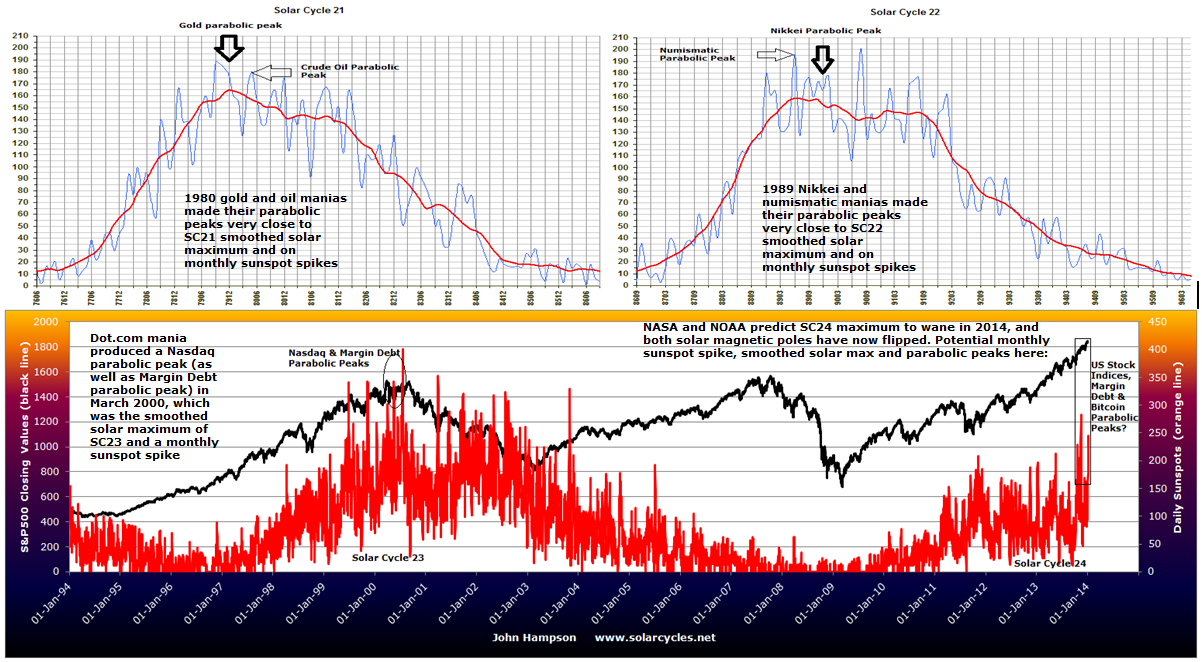
The majority of the famous secular speculative parabolic peaks in history took place on monthly sunspot spikes close to the smoothed solar maximum:

SolarMaximaParabolicPeaksWe see a spiking in sunspots from late 2013 currently taking place, and this is predicted to mark the smoothed solar maximum and the high of this solar cycle:

9ja2The evidence for a peak in speculation can be seen at the top of this article, in the congregation of extremes in sentiment, leverage, technical and valuation indicators.

Sixth, drawing all together, there is a case for the US stock market having peaked on the 31st December 2013.

A) We see a wide range of indicators and flags, ranging from valuations to sentiment to leverage to technicals, all pointing to a major peak, right at hand. B) The assumption that the US economy will return to normality this year is one of hope, neither reflected in the data nor in the demographic/debt backdrop. C) Historically major peaks often occurred around the turn of the year, with a cluster falling exactly on the last trading day of the year, and this reflects the annual seasonal peak which is caused by the seasonality of geomagnetism. D) Historically, major speculative parabolic peaks have terminated at the solar maximum on a monthly sunspot spike, which is likely occurring now in Dec 2013 / Jan 2014.

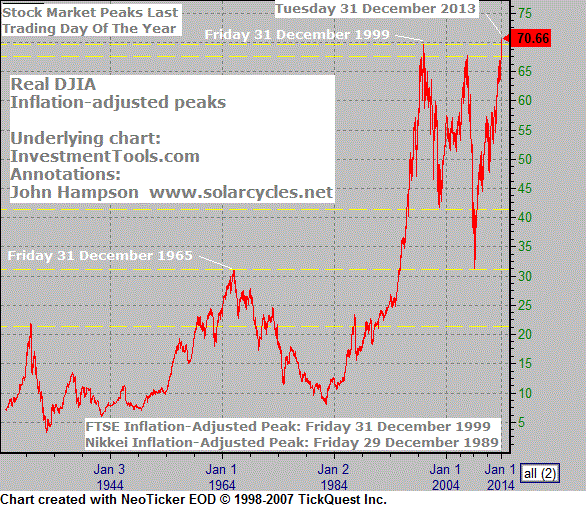
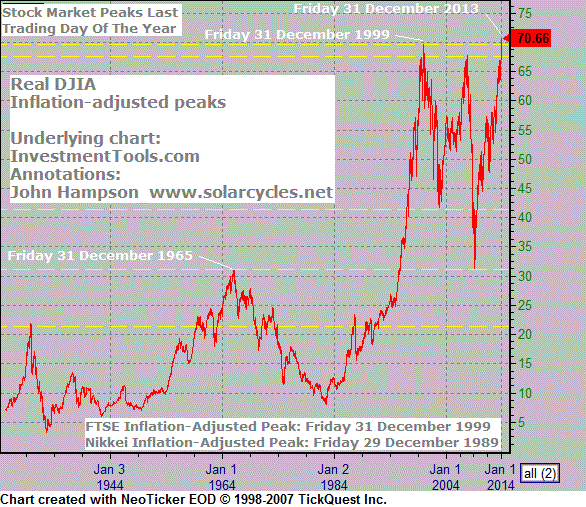
Specifically, where solar maxima have fallen near the turn of the year, speculative parabolics have tended to terminate on the last trading day of the year, in line with the seasonal peak. The real highs of FTSE 31 Dec 1999, Dow 31 Dec 1999, Nikkei 29 Dec 1989, and Dow 31 Dec 1968 were all such occurrences. This is a dual confluence of peak sunspots and peak inverted geomagnetism.


Stock Market Peaked 31 December 2013

I could have put a question mark at the end of the title but figured that’s a bit wet. I have a case, so here it is. Now let the market shame me, preferably as early as you are reading this.
1. Last-trading-day-of-the-year applies to the major real peaks on the Dow, FTSE and Nikkei.

9ja12. Solar maximum alignment (sunspot maxima – human excitement peaks – speculative parabolic peaks): based on Solen’s forecast this is likely to have been December 2013, with associated monthly spike in sunspots (implications on second chart beneath):

9ja2

SolarMaximaParabolicPeaks3. The embodiment-stocks of this earnings-less, multiple-expansion bull market parabolic finale, potentially peaked out in December or are blowing-off now:

9ja39ja49ja5

9ja6

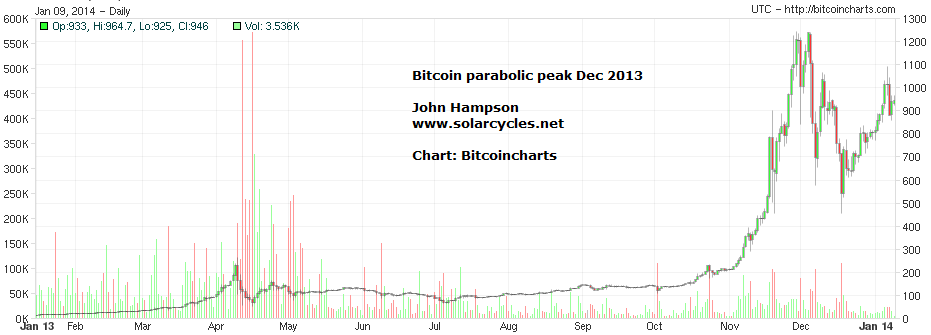
9ja84. Solar maximum speculative parabolic peak also in evidence in Bitcoin, which potentially topped out in December:

9ja95. Dow, FTSE, Nikkei all collectively at long term major resistance:

31dec4 31dec5 31dec66. Collective warnings in sentiment, valuations, topping patterns, leverage and more congregated in late 2013:

EquitiesFlags7. Some additions/updates:

9ja10

9ja11

9ja12

9ja13

What’s missing in terms of topping signals? We have some breadth divergence (e.g. stocks above 200MA) but not sufficient for a typical top (e.g. cumulative advance-declines, congregation of stocks making New Lows). We do not see cyclicals flagging whilst defensives take over in a meaningful way, as is typical of tops. The 31 Dec high was a momentum high and normally we would see at least a second attempt at the high on divergence.

If the market hasn’t topped yet, then the table of flags and warnings suggests a peak within 3 months is likely, as do the parabolics on the US indices:

Arcsp500 ParabolicNas100