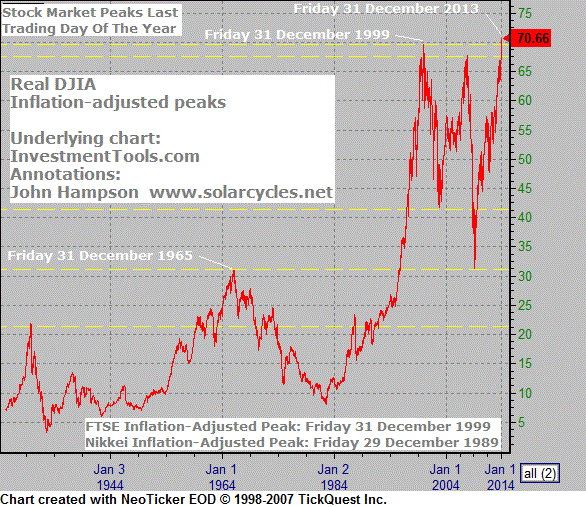
US Equities Bull Market Peak, New Bear Market At Hand

First, a compilation of indicators and flags warning of a major market top in US equities:

Bull Market History Statistics

Dow is up more than 5% five consecutive years now and a sixth such year has not happened before in history.

A 5-year bull trend only occurred once before, in the 1990s, and was followed by 3 down years.

Last 2 years rally in US stock indices has been made up of less than 20% earnings growth and more than 80% multiple expansion. The last 2 such occurrences in history were 1985:1986 (leading into 1987 crash) and 1997:1998 (leading into 1999 real Dow peak)

Compound annual growth rate in equities since 2009 was only exceeded in 1929, 1937, 1987 and 2000, all of which led to steep market declines

Valuations

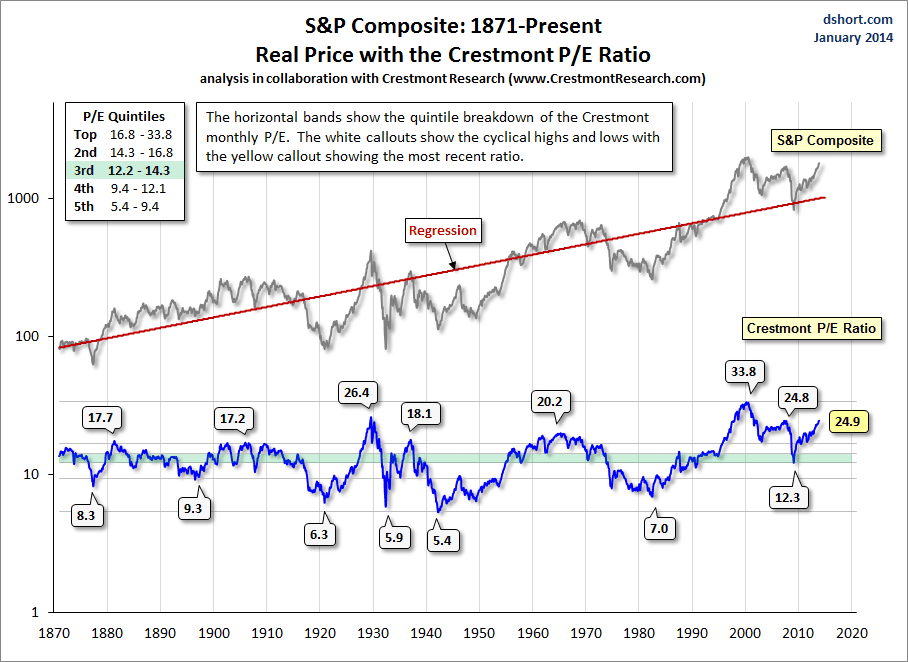
Crestmont P/E is the 3rd highest in history after 2000 (market peak) and 1929 (market peak), and in 97th percentile

The 2nd highest market capitalistation to GDP valuation outside of 2000 (market peak)

The 3rd highest Q ratio valuation in the last 100 years outside of 1929 (market peak) and 2000 (market peak)

The 3rd highest CAPE valuation in the last 100 years outside of 1929 (market peak) and 2000 (market peak)

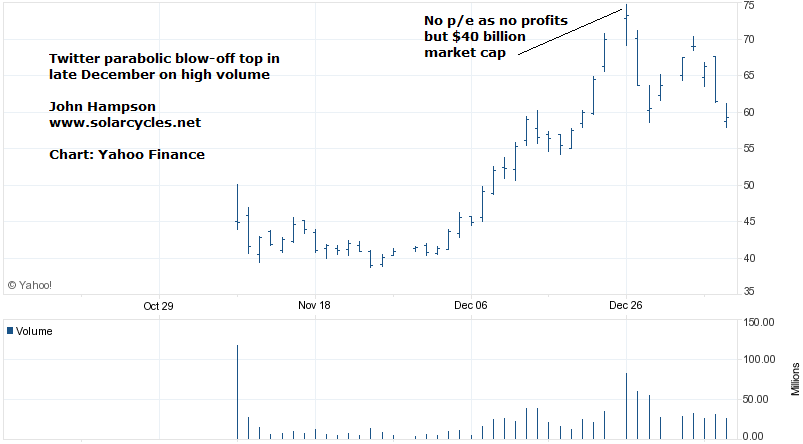
Russell 2000 trailing p/e ratio 88; Amazon trailing p/e 1440; Facebook trailing p/e 148; Twitter reached $40bn market cap with zero profits

Earnings guidance for US Q4 most negative on record

Technical Indicators

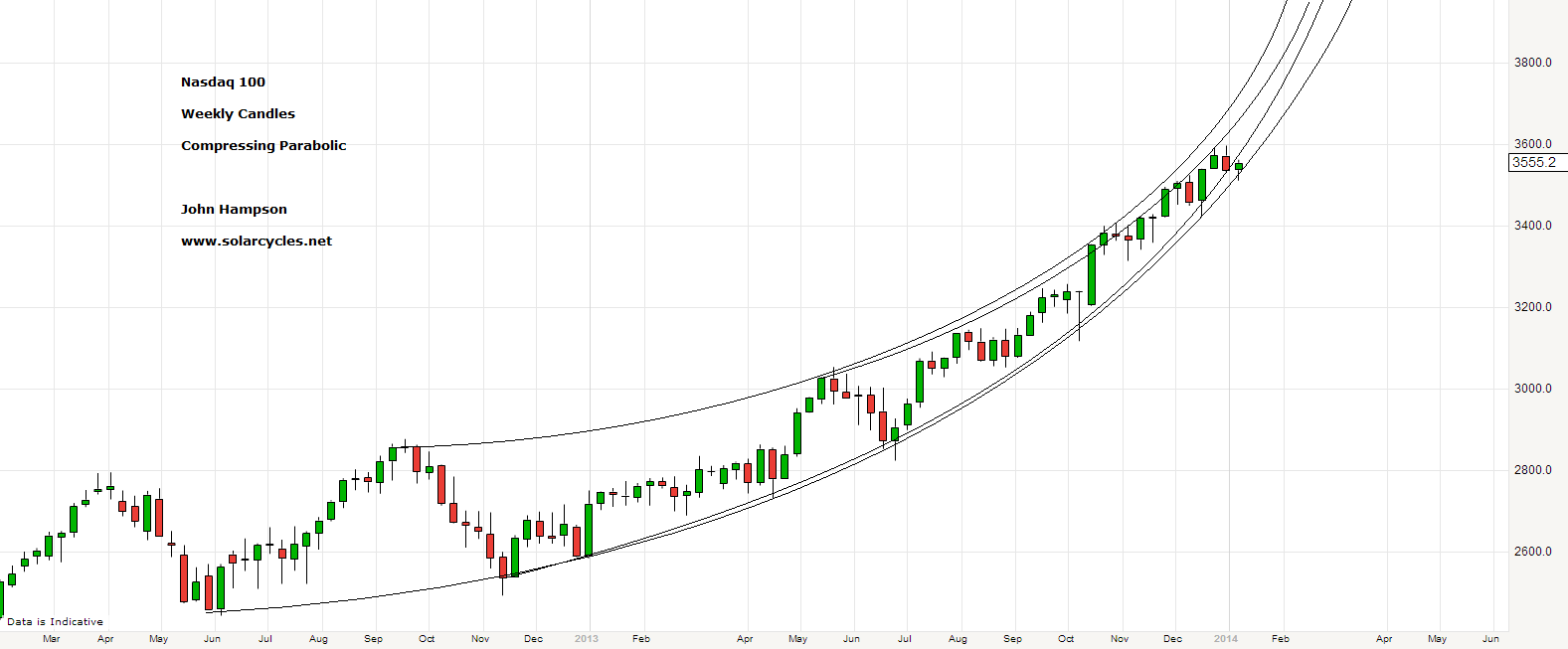
US stock indices are in an unsustainable compressing parabolic / Sornette bubble price formation

6 month breadth divergence on US indices in the percentage stocks above 200MA

Declining breadth in the number of countries participating in world equities rally

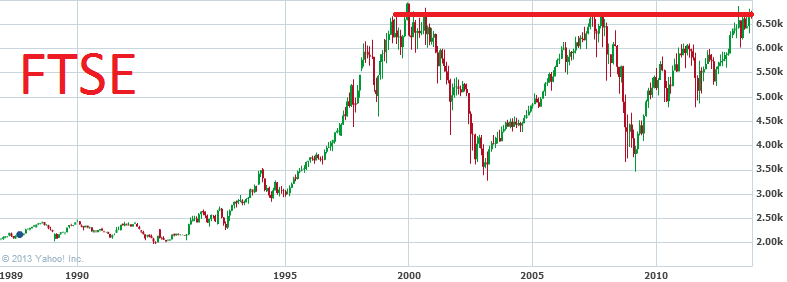
Dow, FTSE and Nikkei are all at long term resistance levels (connecting 2000 and 2007 peaks)

Treasury Bond Yields Rate Of Change over last 12 months is at a level that previously led to market tops in 2000 and 2007

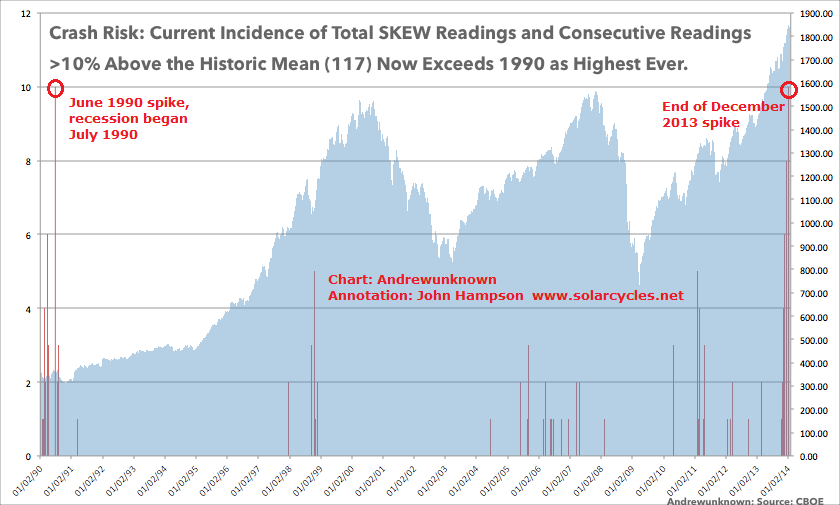
Second highest Skew reading ever (protection against outsized move)

Cluster of extreme Skew readings not seen since June 1990 before recession began July 1990

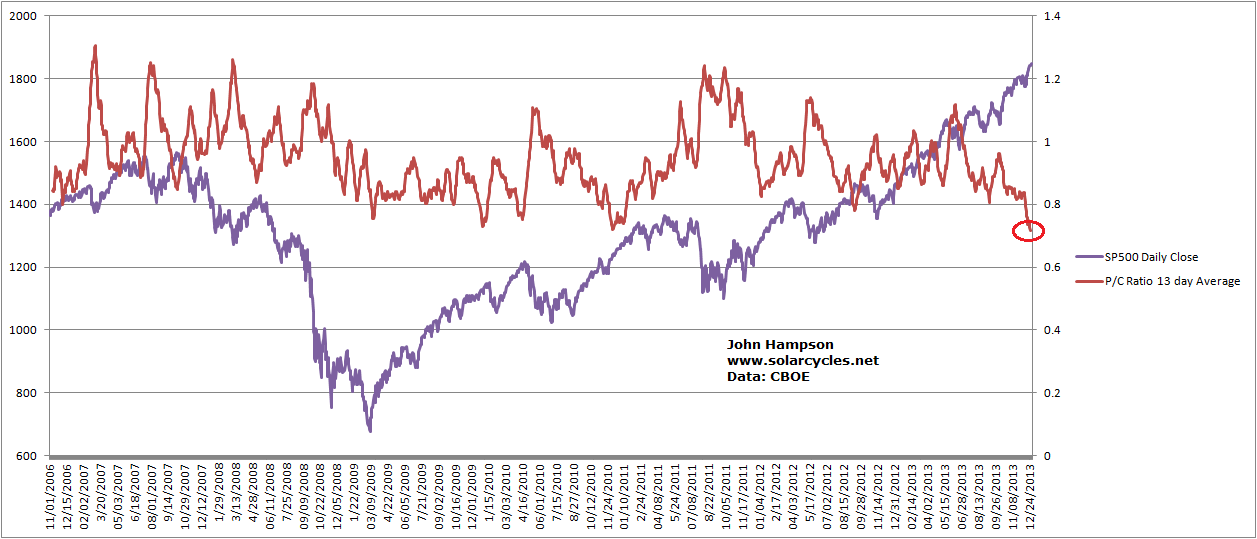
Put/Call Ratio 10 day average is at an extreme that previously marked significant corrections, including May 2010 flash crash

SP500 distance above 100MA is the highest of all time

Sentiment/Euphoria

Investor Intelligence percentage bulls are at 2007 levels (market peak)

Investor Intelligence percentage bears and bull-bear spread are both at 1987 levels (market crash)

NAAIM survey sentiment is in the 98th percentile = extreme optimism

Citigroup Panic/Euphoria model is now 2 months above the Euphoria threshold

Credit Suisse Risk Appetite US model is into Euphoria

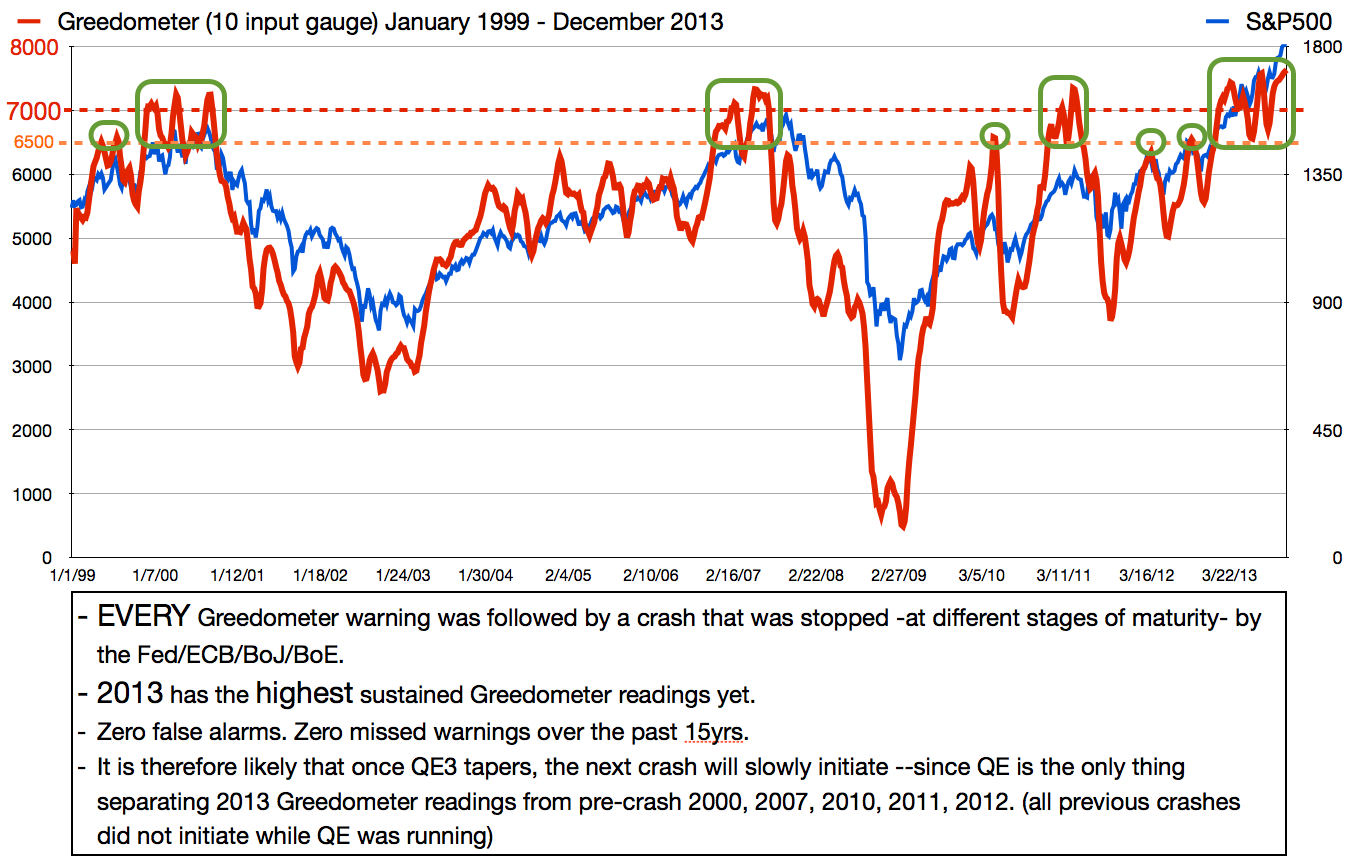
Greedometer aggregate of macroeconomic, fundamental and technical data is at a record level exceeding the 2000 and 2007 market peaks

Equities Exposure And Leverage

US household exposure to equities has risen to the same levels as the 2007 top

Fund manager allocation to global equities is at levels that previously led to a market peak or correction

Rydex bull-bear and levergaged bull-bear ratios are at an all-time record

Margin Debt has escalated to 2.5% of GDP, only exceeded at the 2000 market peak

Investor Credit balances are at an all-time record negative

Second, the US economy is in trouble (click to view larger):
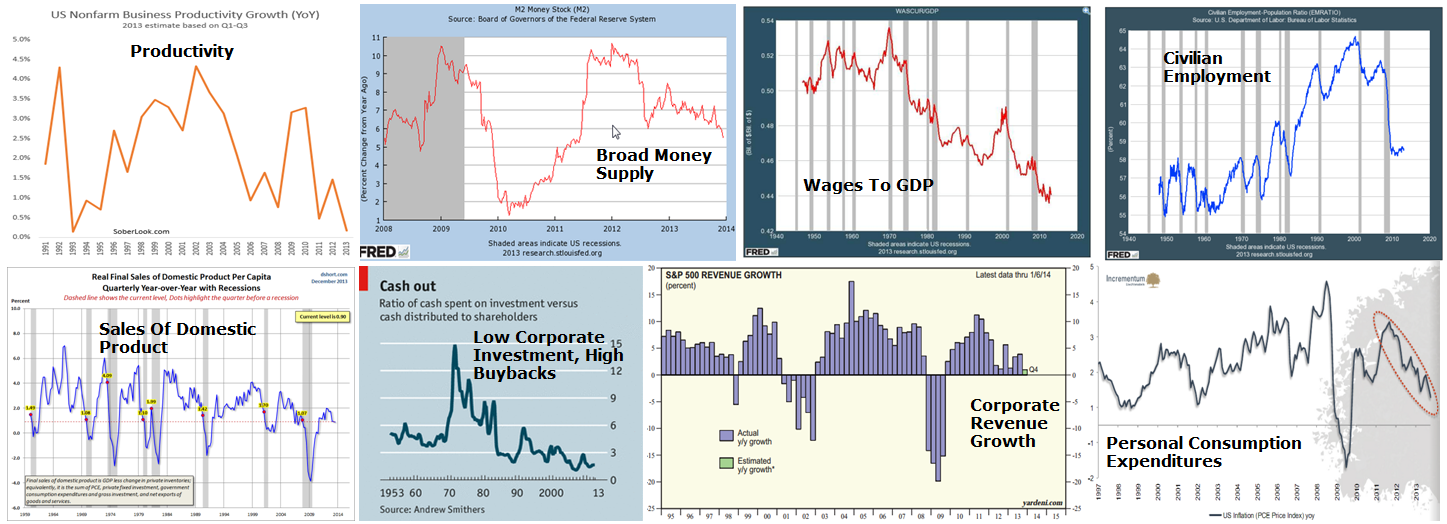
13jan40

Third, this is reflective of both the record levels of debt and unprecedented collective demographic downtrends which are now in place in US, Europe and China and are deflationary, recessionary and equities-bearish.
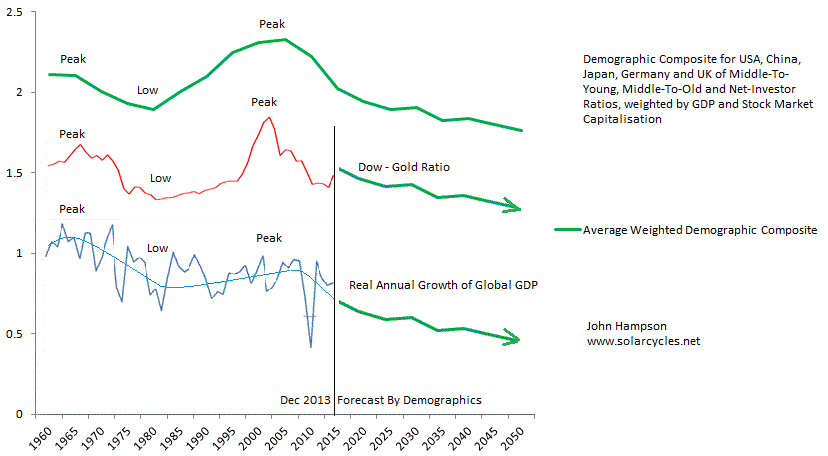
DemographicsDowGoldRatioGlobalGDP

Fourth, equity markets have historically made major peaks at the turn of the year:

13jan11Market peaks at the turn of the year correlate with the seasonal yearly lows of geomagnetism, which inversely correlates with market sentiment. Market crashes in October (also shown above) correlate with the seasonal yearly highs of geomagnetic disturbance, and there is a close fit in the full yearly seasonality of global stock indices to the annual pattern of geomagnetism (inverted):

13jan50Most analysts are unaware of this underlying cause of stock market seasonality. Geomagnetic activity is demonstrated to make people more irritable and aggressive, and can affect melatonin synthesis and blood pressure. There is a correlation between geomagnetic storms and depression in humans. Here is a chart showing daily geomagnetic disturbance versus the SP500 over the last 5 years:
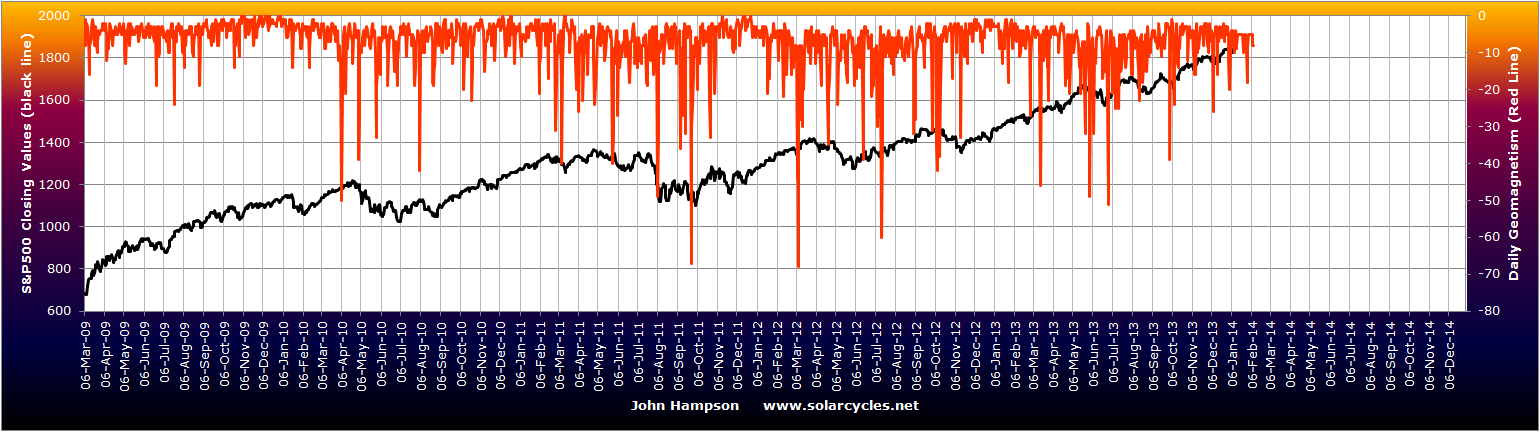
13jan52The bigger the geomagnetic disturbance, the bigger the spike. By turning this into a trend line we see the ebb and flow of the SP500 correlates with the ebb and flow of actual geomagnetism, with the only exceptions marked in blue:
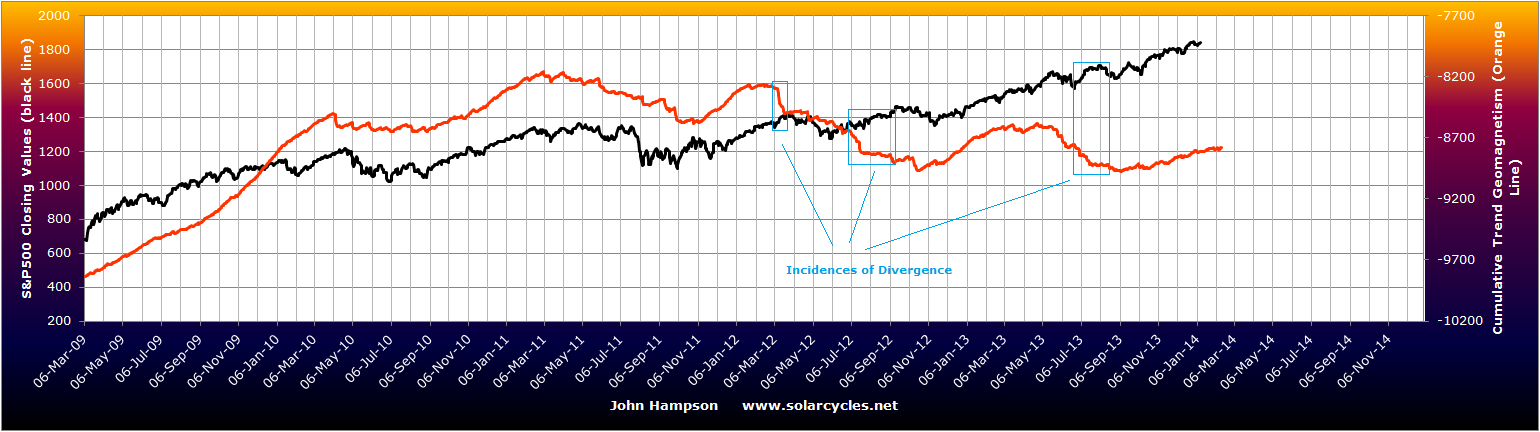
13jan51The correlations of the Singapore STI stock index and the TR CRB commodities index to the geomagnetic guide are closer still, which demonstrates the link between geomagnetism, sentiment and risk asset performance:

13jan53 13jan54Fifth, major speculative peaks have historically occurred at the solar maximum, which is occurring now.

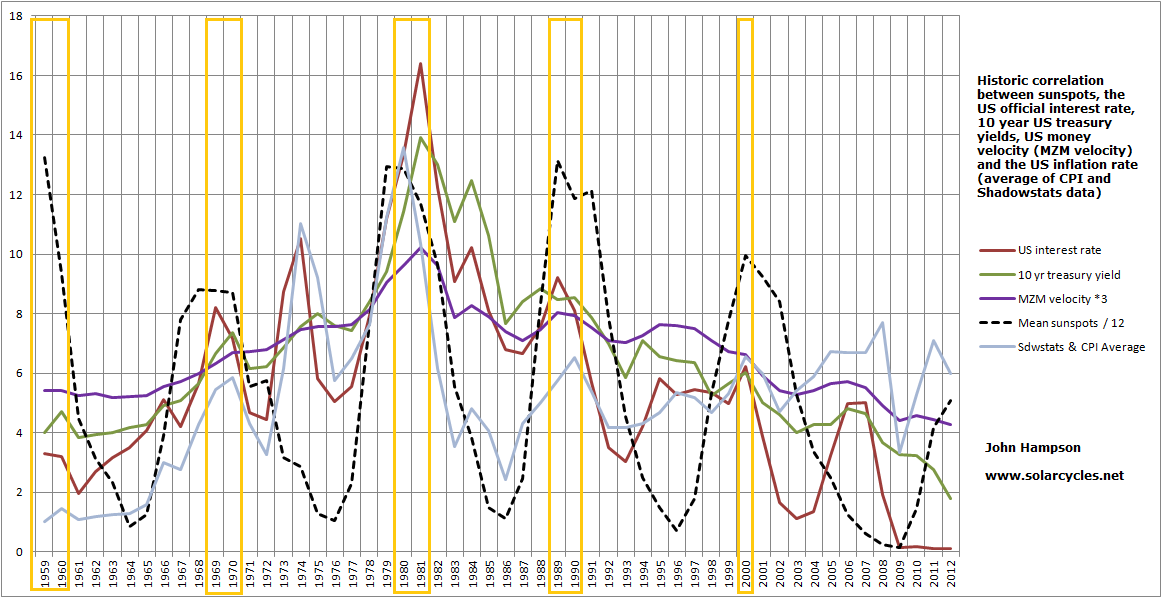
Peaks in solar sunspot activity occur on average every 11 years and have historically correlated with human excitement peaks in the form of protest, war, growth-flation and major speculative parabolic peaks. Again there is biological evidence for this in elevations in oral temperature, pulse rate, blood pressure, and respiration rate, and again few analysts are aware of this critical influence.

The majority of the famous secular speculative parabolic peaks in history took place on monthly sunspot spikes close to the smoothed solar maximum:
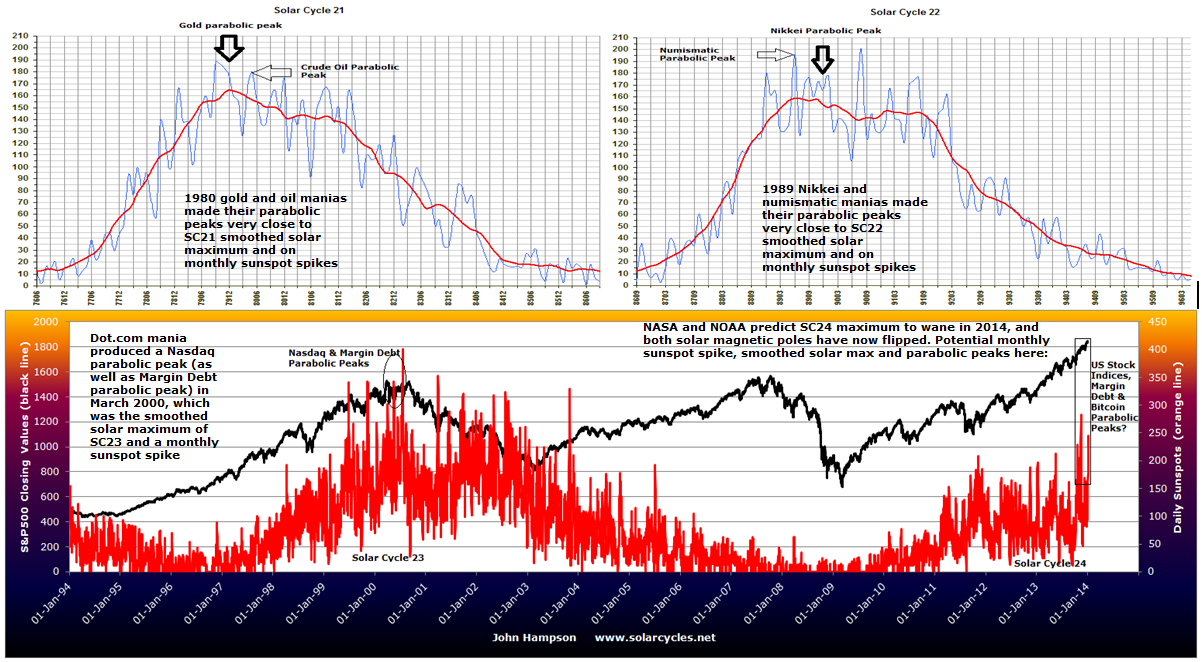
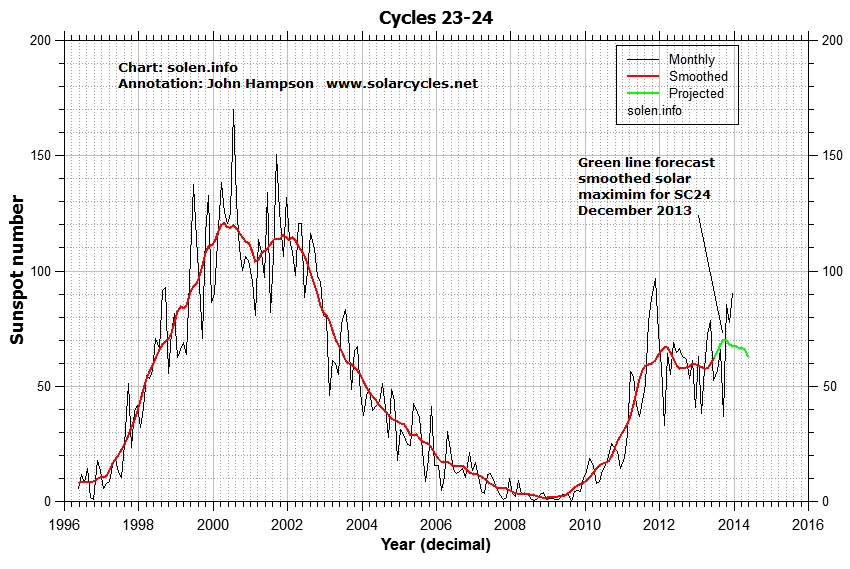
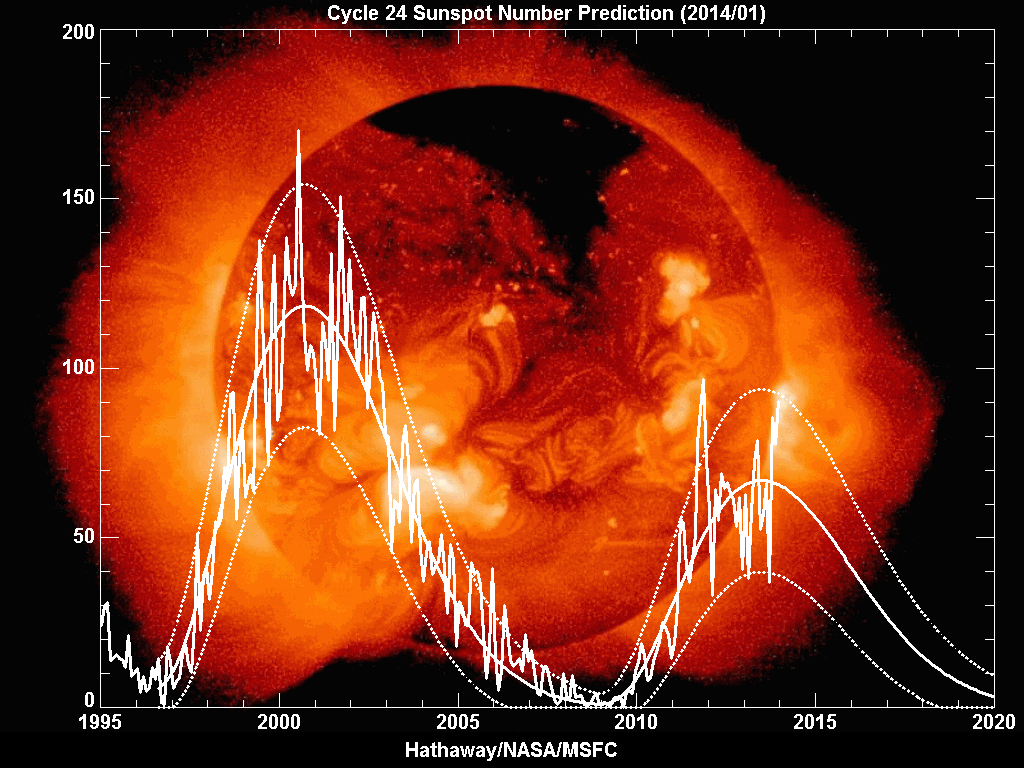
SolarMaximaParabolicPeaksWe see a spiking in sunspots from late 2013 currently taking place, and this is predicted to mark the smoothed solar maximum and the high of this solar cycle:

9ja2The evidence for a peak in speculation can be seen at the top of this article, in the congregation of extremes in sentiment, leverage, technical and valuation indicators.

Sixth, drawing all together, there is a case for the US stock market having peaked on the 31st December 2013.

A) We see a wide range of indicators and flags, ranging from valuations to sentiment to leverage to technicals, all pointing to a major peak, right at hand. B) The assumption that the US economy will return to normality this year is one of hope, neither reflected in the data nor in the demographic/debt backdrop. C) Historically major peaks often occurred around the turn of the year, with a cluster falling exactly on the last trading day of the year, and this reflects the annual seasonal peak which is caused by the seasonality of geomagnetism. D) Historically, major speculative parabolic peaks have terminated at the solar maximum on a monthly sunspot spike, which is likely occurring now in Dec 2013 / Jan 2014.

Specifically, where solar maxima have fallen near the turn of the year, speculative parabolics have tended to terminate on the last trading day of the year, in line with the seasonal peak. The real highs of FTSE 31 Dec 1999, Dow 31 Dec 1999, Nikkei 29 Dec 1989, and Dow 31 Dec 1968 were all such occurrences. This is a dual confluence of peak sunspots and peak inverted geomagnetism.
 

The Bull Case And The Big Picture

Let’s distinguish between prospects for a stock market correction and prospects for a bear market, and start with the former.

There are multiple signals for an imminent stock market correction, such as sentiment and euphoria readings, put/call ratio, skew, distance from 200MA, divergence in stocks above MA. I’ve covered these, and more, in detail in recent posts. The history of each individual flag gives us a guide as to the timing and nature of a correction, but it’s just a guide. The risk, and the bull case, is that things go crazier yet: steeper parabolic under the excitement influence of the solar maximum. We see no decisive break in the markets yet and certain measures of breadth and sector participation are still supportive. Barring an external shock it can take time for perceptions to shift. If we try to anticipate buyer exhaustion, then current leverage, sentiment and investor credit are suggestive of ‘all in’, but we could still eek a little more out of each and propel higher yet.
My ‘balanced’ view. Multiple flags, with different angles on the market and with broadly reliable histories, are pointing to an imminent correction. Some of these indicators are at all-time record extremes, and the aggregation of both the warnings and the levels is a trader’s opportunity. Mean reversion always occurs, so a correction will come, but that could be ‘eventually’. If I were to play the long side, I would look for bullish momentum to resume, and play with stops for short term profits, knowing that under such one-way sentiment, high leverage, and technical levitation, the market is particularly vulnerable to a sudden fall or a lasting decline. If we take a purely statistical approach to the markets (you can find that in THIS post), and remove any big picture bias, then the risk-reward is on the short side, until we have seen a correction that relieves the current extremes. The data gives high confidence that short positions here will produce positive returns, if any drawdown en-route can be tolerated. If there is little leeway for drawdown long or short, then the prudent approach would be to sit aside whilst both prospects of steepening parabolic and steep drop or crash are in currently in play.

Now to the bigger picture, and the potential for a bear market.

Looking statistically again, valuations such as market cap to GDP and CAPE, corporate profit margins to GDP, levels of margin debt and investor credit, and bull market trend/gain history: they are all at top percentile readings that have historically ushered in bear markets. The bull case relies on ‘this time is different’, namely: valuations need adjusting as bond yields and cash are suppressed, margin debt can go some way higher yet due to low rate of borrowing or there will be an orderly transfer from leveraged buyers to new buyers, and the Fed is underpinning the stock market and trumping normal factors. It has always been dangerous to side with ‘new norms’ because mean reversion, until now, has always occurred.

The current extremes seen in sentiment and euphoria typically occur towards bull market peaks, but can on occasion be generated in young bull momentum. The case for a young bull is that certain stock indices, e.g. SP500, decisively broke above 2007 highs in a mirror of historic secular bear termination breakouts, and the economy is now finally picking up. Regarding the former, the break-out case doesn’t apply to other major global indices such as FTSE, Euro Stocks, Nikkei and Hang Seng, and regarding the latter, the pick up in the economy is tentative and may prove to be fleeting. Much of the data coming out currently is backward looking to October/November. Broad and narrow money measures suggest the pick up may be tipping over again. But, for now, data is generally positive and we could argue for the possiblity of positive feedback looping. Nonetheless, it is still a stretch to make a case for young equities bull momentum when valuations, leverage and bull market history collectively indicate we are at historic secular/cyclical topping levels. It would be unprecedented to see either a rapid catch up in the underlying (GDP, earnings, revenues) or significant collective further extension of valuations, leverage, and bull market trend/gain. Rather, the evidence suggests current euphoria and sentiment extremes are more typically those of a bull market ripe for termination.

So let’s now look at the macro picture and assess what kind of bear market we could be in for, because there are again two options.

The first option would be a bear market that is a pause in a new secular stocks bull, sufficient to remove the froth that has built up in sentiment, valuations and leverage. On the SP500, this could be a retrace to the 2000/2007 resistance breakout, which from current levels would be 20% down. A successful backtest and a new cyclical bull thereafter. The option second would be a deeper, longer bear market, which would be classed as continuation of a secular bear market from 2000. A case for the first option could be built on exponential technological evolution and collective central bank support (commitment to enduring low rates and stimulus as appropriate). A case for the second option could be built on demographics and debt. We then need to look for evidence as to in which camp the balance of power lies.

The economic recovery since the 2008 crisis has been historically weak in various areas, such as consumption, income, retail sales, job growth, productivity and private investment, and thus we still have ZIRP and QE 5 years on. I believe there are two reasons for this: demographics and debt. I have covered demographics in detail on this site – please do a site search if you are a new reader – and I can summarise that we see collective trends that suggest growth and consumption will remain weak for some years ahead. The bull case relies on growth and earnings picking up this year onwards to historically normal levels but this will be very difficult to achieve against the demographic backdrop. Over the longer term, a combination of pro-active immigration policies, greater global economic influence in positive-demographic countries such as India and Brazil, technological and societal shifts could potentially help alleviate the pressures, but we are looking at sustaining a secular bull market right now.

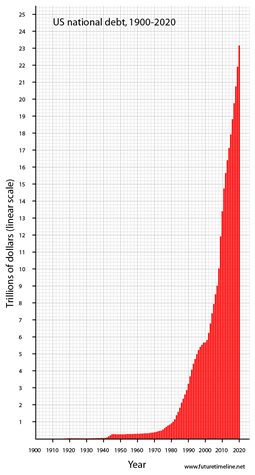
Turning to the debt issue, much of the world is suffering from all-time record debt: household, corporate and public. The problem with high and growing debt is that more and more has to be spent on servicing the debt, crowding out investment, and restricting other spending.  High debt has historically correlated with low growth and low productivity. Money invested in government bonds is not invested in productive capital. Below we see the growth in US debt:

10ja1

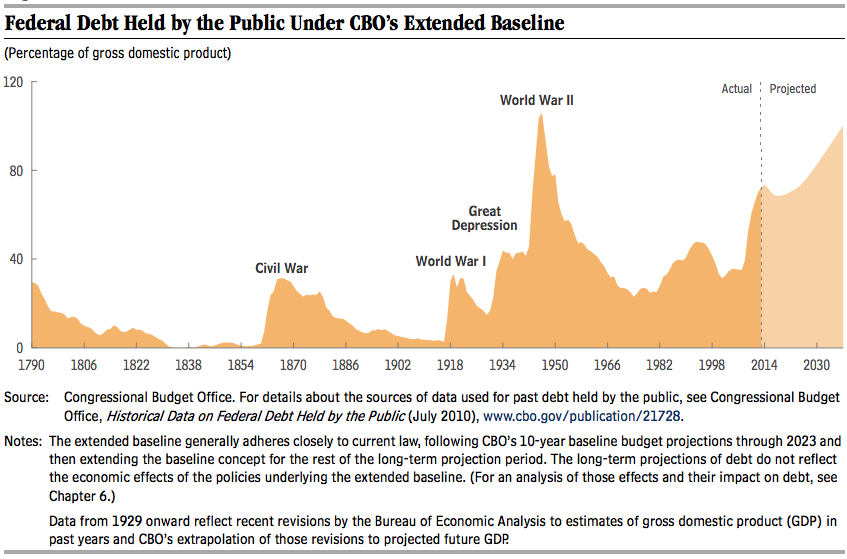
Next we see US public debt as a percentage of GDP. To add to the wars labelled, the Vietnam war of the 60s-70s was also highly costly.
10ja2

It is the combined costs of the wars that have led to the current predicament. War provides no economic benefit. There is a short term boost as certain industries boom and jobs are created, but ultimately it is highly costly, paid for in part by increasing taxation and by cutting other government spending, but mainly by increasing government borrowing. The build up of the debt led to the cutting of the gold standard, and since then debt has been on a one-way path. Compound debt can run away, unless revenues (GDP) can grow at a faster rate, or inflation is sufficiently high to shrink the debt, or, as a last resort, monetisation is undertaken (money printing to buy the debt). As growth has shrunk under the debt-overhang and both inflation and growth have been crimped by demographics, even more borrowing has been taken on to try to offset these factors, exacerbating the problem. Hence we are at that last resort of monetisation and no way back.

Here is the combined debt picture for US, UK, Eurozone and Japan:
10ja3China’s debt is ballooning too. All these countries are in demographic downtrends, and all are compromised by ballooning debt. This sets the scene for a particularly nasty global negative feedback looping (US demographics topped out around 2000, Europe around 2005 and China around 2010, therefore the collective pressure is now at its greatest). It is asking a lot of technology to deliver a range of paradigm shifts in the near future to somehow turn this around, particularly when corporate investment has been neglected. Meanwhile, conditions of zero rates and QE have failed to convince consumers and corporates to spend, borrow and invest, other than in asset bubbles. Thus it seems likely that debt and demographics will and are overwhelming policy and technological evolution, and the secular bear market will ultimately continue. However, I would of course accept that this position is to some degree theoretical whilst equities remain in a bull market and whilst economic reports are largely respectable.

The proof, of course, will come piece by piece in the economic data. Should equities hold up a while longer and central banks / governments get their balancing acts right, particularly China, then maybe a period of positive feedback looping can develop and extend. If a stocks bear erupts, as indicators alone suggest, then realistically this would sink the fragile economy as that wealth evaporates. A deflationary shock is also a possibility, as such events have occurred in the past when countries flirted with very low inflation.

Understand that I have not changed stance from my previous posts, but rather I’ve tried to keep it balanced in this post and see the bull case, as it’s important to challenge yourself. So yes, equities could potentially move higher in the near term. The onus is on the bears to take this down and until they do in a meaningful way then we are in a strong bull market. However, the weight of evidence for either an imminent correction or bear market is compelling. And yes, at the global macro level, things are currently reasonably benign and economic data generally not too troublesome, so my expectations regarding demographics and debt could potentially be proven to be less potent than I predict. However, again, it’s about the weighing up the evidence and I believe I side with the probability. I’m short, either for a correction or a bear, and will increase shorts on market clues.

Stock Market Peaked 31 December 2013

I could have put a question mark at the end of the title but figured that’s a bit wet. I have a case, so here it is. Now let the market shame me, preferably as early as you are reading this.

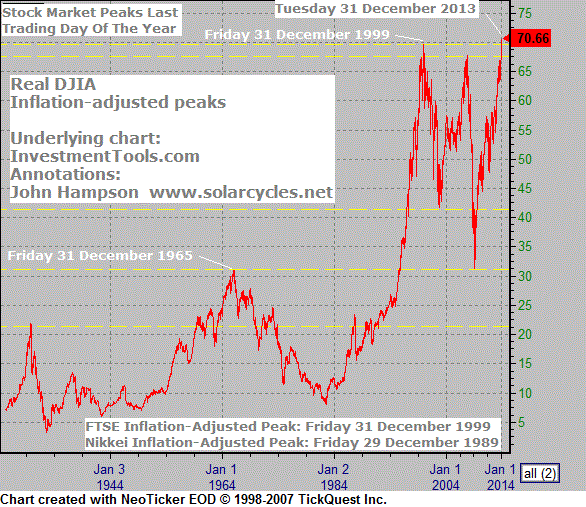
1. Last-trading-day-of-the-year applies to the major real peaks on the Dow, FTSE and Nikkei.

9ja12. Solar maximum alignment (sunspot maxima – human excitement peaks – speculative parabolic peaks): based on Solen’s forecast this is likely to have been December 2013, with associated monthly spike in sunspots (implications on second chart beneath):

9ja2

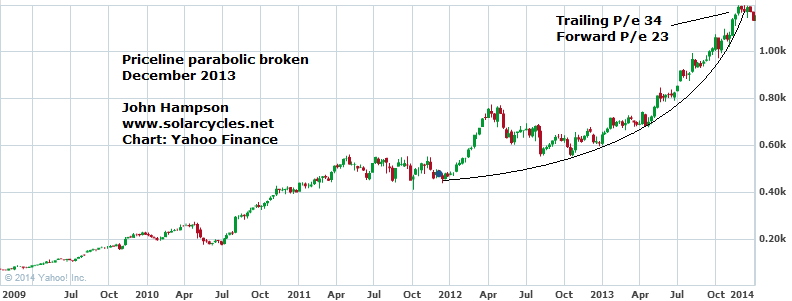
SolarMaximaParabolicPeaks3. The embodiment-stocks of this earnings-less, multiple-expansion bull market parabolic finale, potentially peaked out in December or are blowing-off now:

9ja39ja49ja5

9ja6

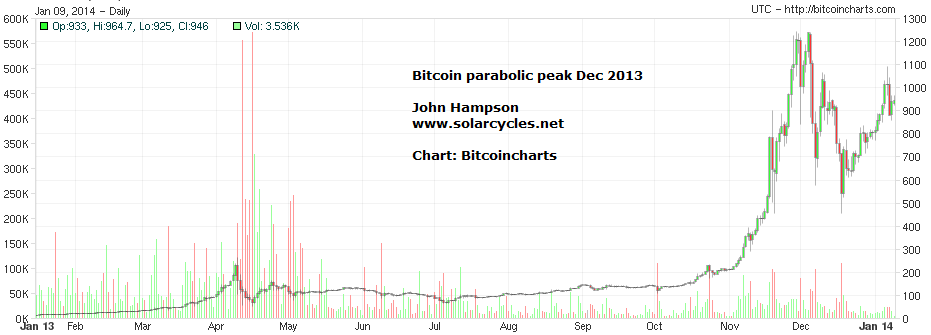
9ja84. Solar maximum speculative parabolic peak also in evidence in Bitcoin, which potentially topped out in December:

9ja95. Dow, FTSE, Nikkei all collectively at long term major resistance:

31dec4 31dec5 31dec66. Collective warnings in sentiment, valuations, topping patterns, leverage and more congregated in late 2013:

EquitiesFlags7. Some additions/updates:

9ja10

9ja11

9ja12

9ja13

What’s missing in terms of topping signals? We have some breadth divergence (e.g. stocks above 200MA) but not sufficient for a typical top (e.g. cumulative advance-declines, congregation of stocks making New Lows). We do not see cyclicals flagging whilst defensives take over in a meaningful way, as is typical of tops. The 31 Dec high was a momentum high and normally we would see at least a second attempt at the high on divergence.

If the market hasn’t topped yet, then the table of flags and warnings suggests a peak within 3 months is likely, as do the parabolics on the US indices:

Arcsp500 ParabolicNas100

No Corporate Investment Means No Growth

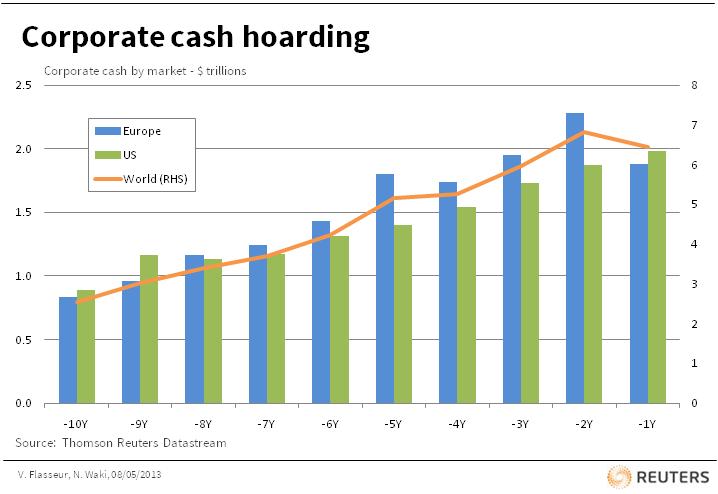
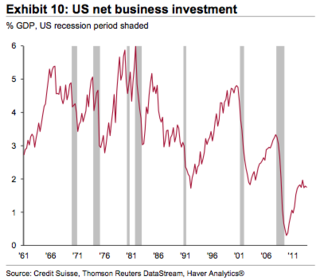
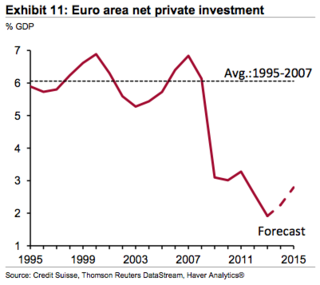
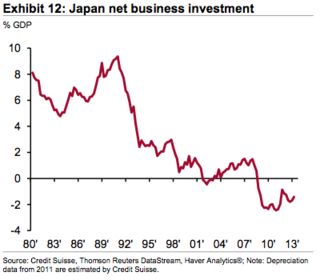
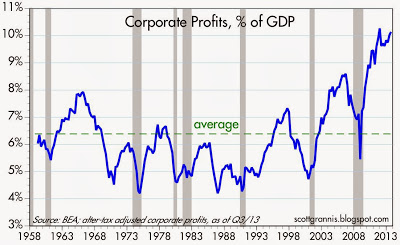
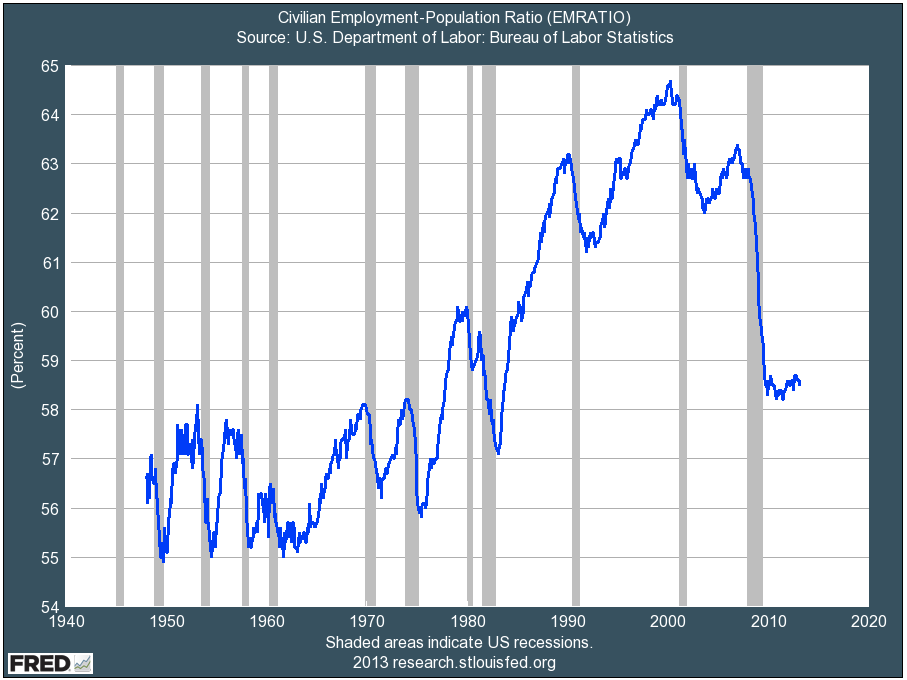
Corporate profits, corporate cash piles and corporate share prices are record high. Yet corporate investment is at historic lows across US, Europe and Japan.

???????????????????????

8ja10

8ja11

8ja12

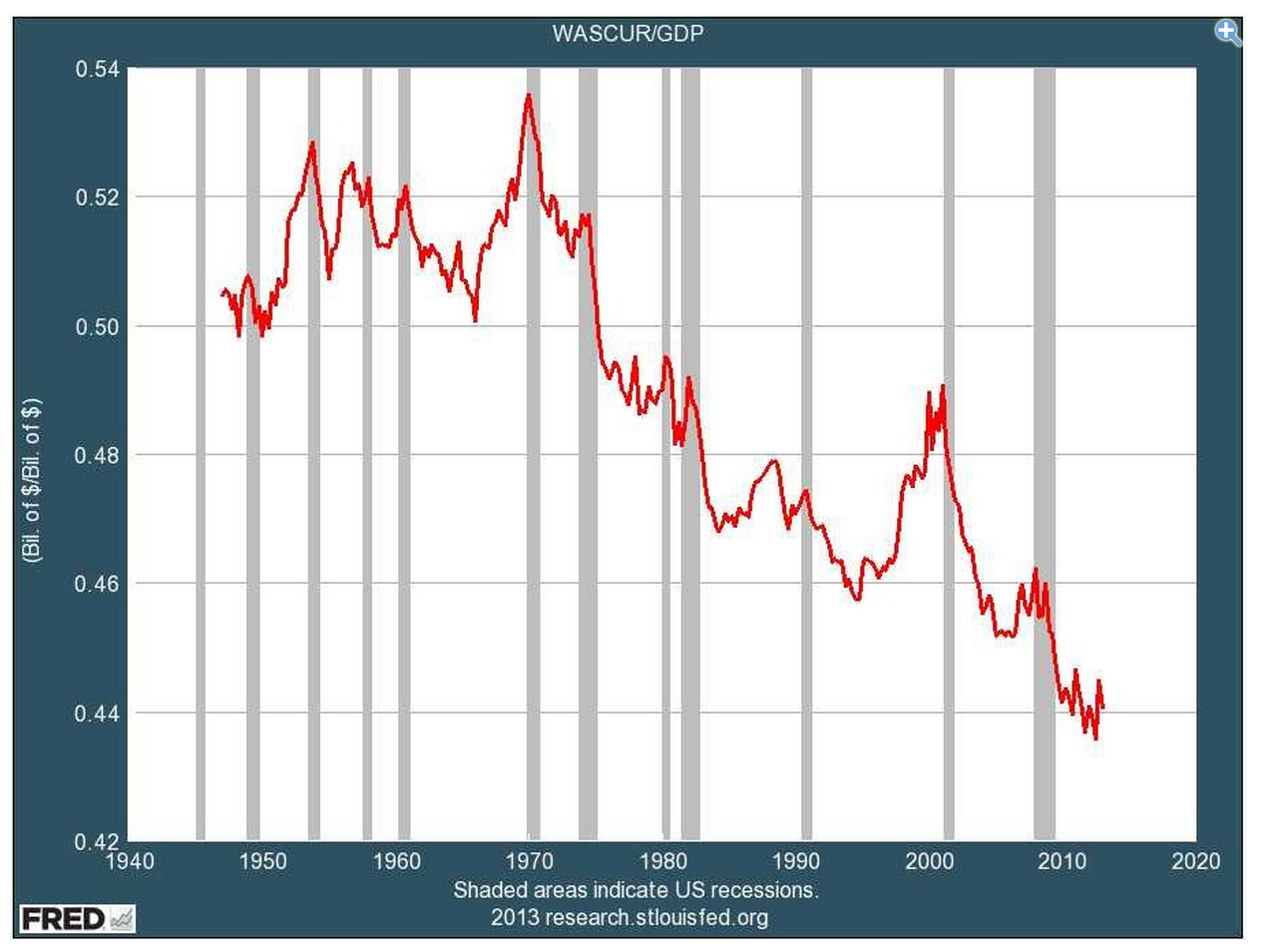
Contrast below the rise in US corporate profits to GDP with the decline in US wages to GDP and the proportion of the population working:

8ja14

8ja15

8ja17

Companies have cut costs to boost profitability, whilst (and because) revenues have remained persistently weak (which fits with demographic trends). As a key part of the cost-cutting has been jobs and wages, this naturally creates a feedback loop back through weaker consumer spending to corporate revenues. Ultra low interest rates have also helped boost company profits.

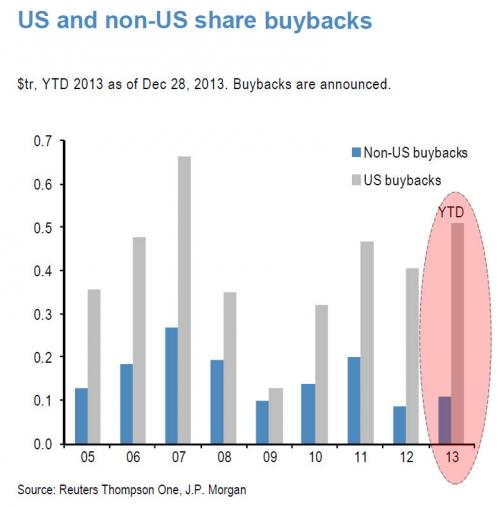
Recall from my post Tower Of Sand (HERE) that corporates have been borrowing a lot of cash and engaging heavily in share buybacks, buying shares from the open market and destroying them. The result is an increase in share price, and earnings-per-share (as there are less shares in circulation). No increase in revenue or profits but a payout to the stock investor. Shares rise, investors are rewarded and thus inclined to buy more, and that has played a key part in 2 years of over 80% multiple expansion versus less than 20% earnings growth. Buybacks escalated into the end of 2013, to a level last seen in 2007. Note that buybacks peaked just after the stock market in 2007.

8ja18

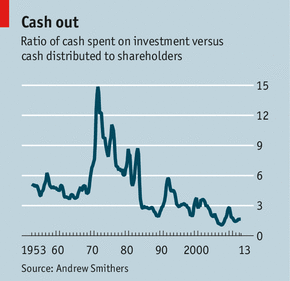
The ratio of corporate investment to investor-payout is now historically low. Companies in Europe, Japan and the US have remained fearful of investment in plant, equipment and technology due to economic uncertainty, particularly new tech and R&D which requires high funding without any certain return. Hence they prefer to sit on cash piles, and keep investors happy with buybacks. In the short term, this shores up their position, but it is at the expense of their future, and, aggregated across all companies, the economy’s future. Without investment, future growth and future jobs are severely compromised.

Investment was high and investor-payout low in the 1970s. A boom followed 1980-2000. Investment has been low and payouts high in the 2000s, so the future is bleak.

8ja16


Demographics: Bear Market, Global Recession And Deflation

Historically, demographic trends have correlated with secular bulls and bears in financial assets, economic growth/recession and inflation/deflation. Demographic forecasts are reliable because future trends were set in place with past swells and shrinkages in birth numbers. They would change if a country was subject to large scale death (war, pandemic, or similar) or the government henceforth adopted radical immigration policies. Demographics are particularly potent in countries that are relatively closed to migration, so understand that China has the smallest percentage of immigrants of any country (0.1% of the population), and Japan just 1.9% (compared to USA, UK and Germany all over 10%). My focus is on USA, China, Japan, Germany and UK, as collectively they make up 50% of world GDP. Know that whilst the European Union abolished barriers to movement within it, the demographics across all the member nations are uniformly poor.

1. DEFLATION

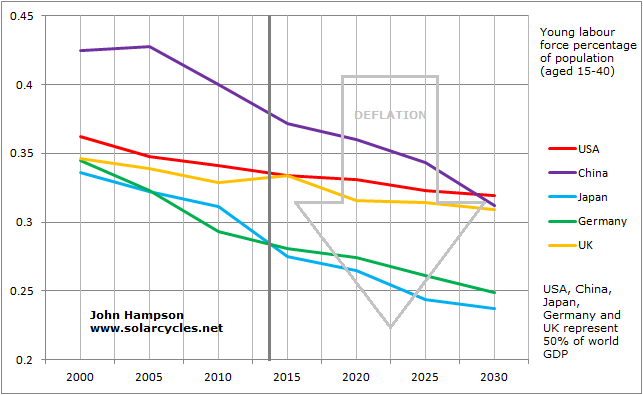
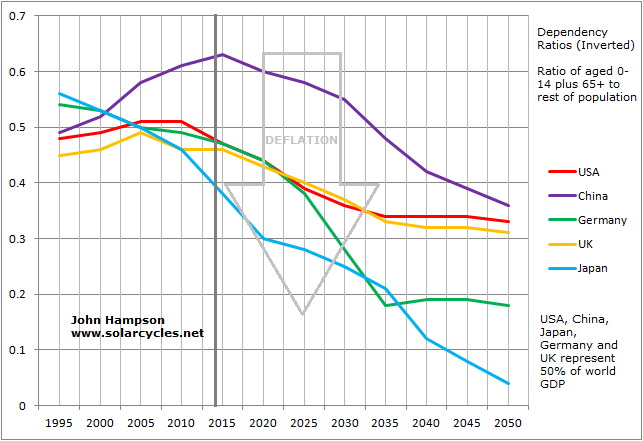
Young labour force percentage of population (aged 15-40) and dependency ratios (inverted – old and young versus the working population) have both historically correlated with inflation/deflation. A swell of people entering the workforce works up price inflation through spending, whereas more people entering old age relative to the work force is disinflationary through saving and disinvestment (read more HERE).

Deflation2

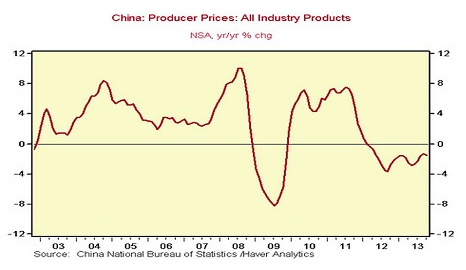
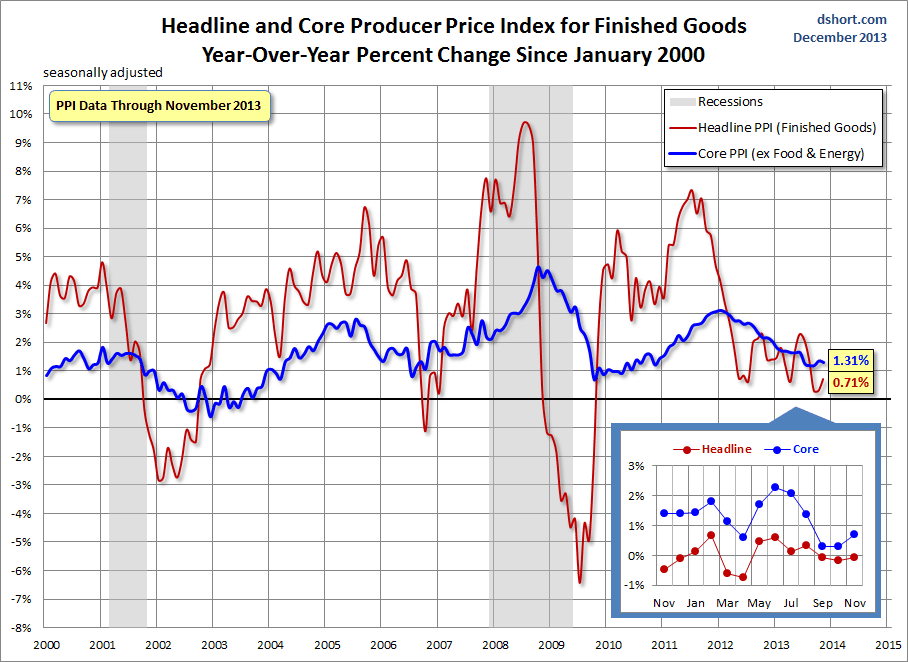
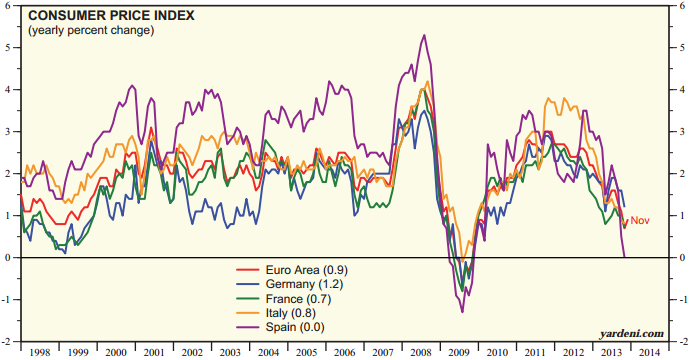
Deflation1In the first chart above, we see the UK alone is currently in a small window of young labour force growth, whilst in the second chart China is just peaking out in dependency ratio (inverted). This is reflected in reality, with the UK currently registering the highest producer price inflation and China the highest consumer price inflation of the five. At this point in time, we generally see trends of disinflation. Demographics predict this will turn into outright deflation, and that deflation should be the norm for the next couple of decades (barring countries with inflationary demographics becoming much more dominant globally, such as India and Brazil).

7ja1 7ja3 7ja4

2. GLOBAL RECESSION

Due to globalisation and an increasingly open world economy, recessions around 2009, 2001, 1998, 1991 and 1982 have all been global in nature. Due to the US contributing 22% of world GDP, particular attention needs to be paid to indicators of future US growth, with China second.

Dependency ratios (inverted – old and young versus the working population) have historically correlated with economic growth / recession. That chart is presented in section 1. above. The picture for the next 2 decades is bleak.

Stepping aside from demographics for a moment, levels of debt have also been shown to assist or impede growth historically. Where public debt to GDP has exceeded 90%, economic growth has struggled. For 2014, Japan will be around 230%, UK and USA around 115% and Germany 85%.  China has the lowest ratio of public debt of the five, but its broader debt has been ballooning since 2008. Including corporate and household debt, China’s total debt to GDP has reached 218% of GDP (from around 130% in 2008).

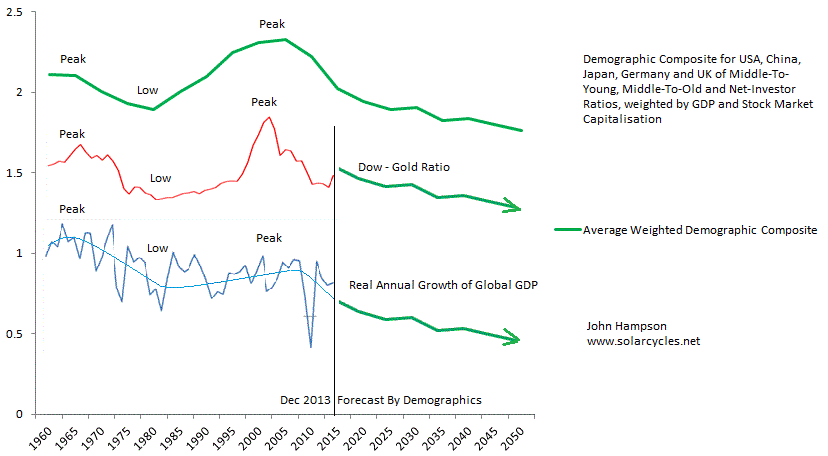
DemographicsDowGoldRatioGlobalGDP

3. EQUITIES BEAR, REAL ESTATE BEAR

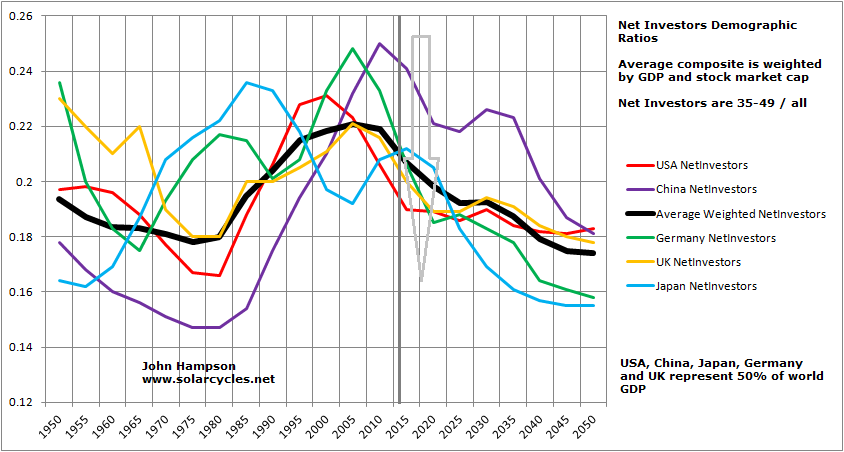
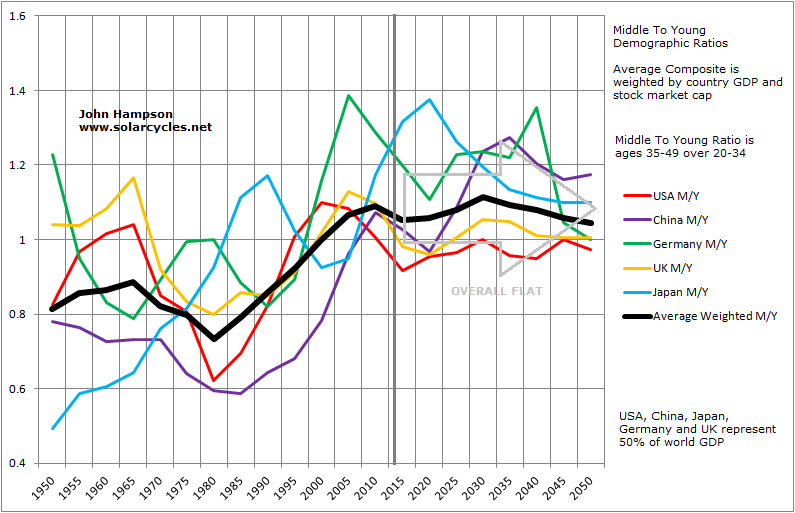
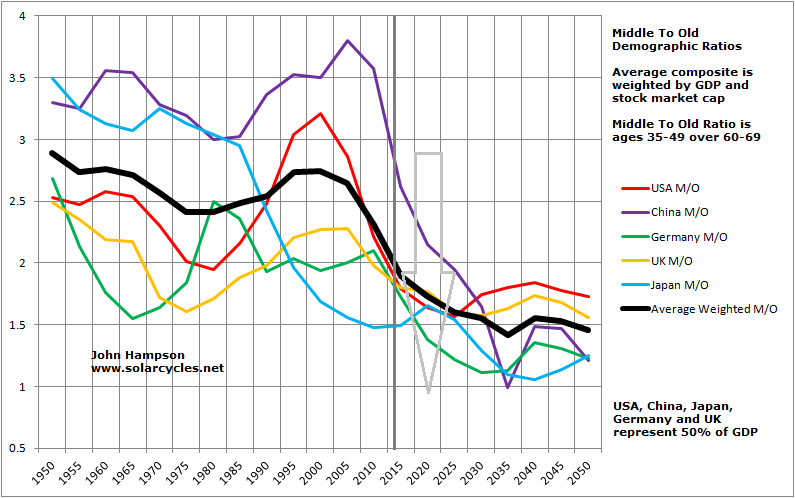
Demographic trends in middle-to-young ratio (aged 35-49 / 20-34), middle-to-old ratio (35-49 / 60-69), percentage net investors (35-49 / all) and dependency ratios (charted in 1. above) have all been shown to have a correlation with stock market and real estate market performance historically, on a longer term secular level. There are young borrowers/spenders, middle-aged investors (partially investing for retirement) and old-ages disinvestors. If the middle group is growing relative to the others, then we have a growing demand for the stock market. Similarly, the old and the young don’t typically buy houses, so a swelling middle-aged group relative to the others is an environment for a housing boom, and vice versa (read more HERE).

BM1

BM2

BM3Using the weighted average composite as our overall guide looking out to mid-century, M/Y is flat whilst M/O and NI are down, suggesting long term ‘buy and hold’ may be a strategy doomed to the past, to be replaced by ‘short and hold’. Add in Dependency Ratios from 1. above and the picture worsens further. Within those overall trends there are positive windows for individual countries, for instance the USA sees M/Y, M/O and NI measures rising together between around 2025 and 2030, and the composites also suggest that period could be the backdrop to a cyclical bull. However, when the composite trends above from 1980-2000 are compared to what lies ahead of us now, the contrast is stark and suggests enduring downwards pressure on equities and real estate, in long secular bear markets.

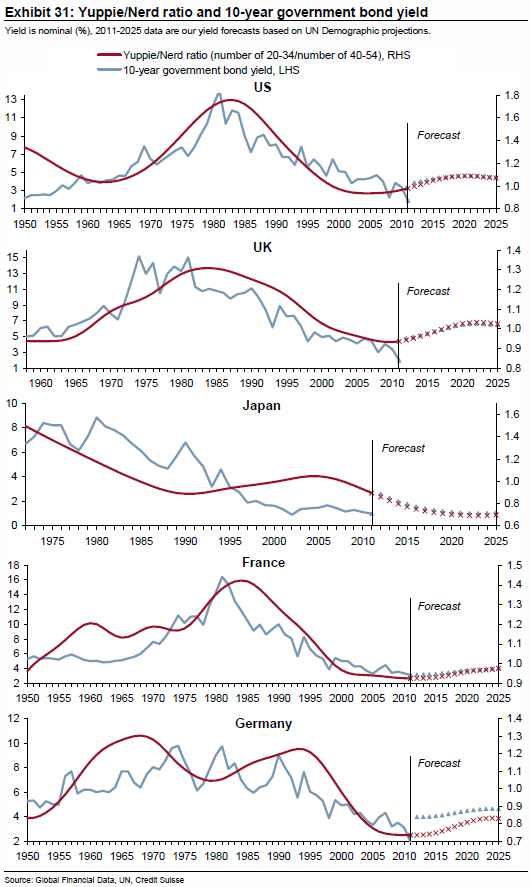
The longer term fortunes of bonds have also historically correlated with demographic trends.

23jun16This CS graphic suggests yields will remain fairly low and contained, as demand for bonds will be maintained. However, through to 2020, the bias in yields, aside Japan, is overall upwards, suggesting net selling on balance. It is my view that gold, as the historic anti-demographic, is due to be the lead asset in the period ahead, as the collective trends above suggest deflation, recession, and net selling of equities, real estate and bonds.

SUMMARY

A) Historic correlations in demographic trends and secular asset cycles, growth/recession and inflation/deflation. B) Unprecedented collective demographic downforces now in place, with evidence of impact in economic data. C) Downtrends in play for much of the first half of this century, suggesting tough times for the global economy and no safety in equities or real estate.

Europe has structural problems, a cautious central bank, and a relatively strong currency, mirroring 1990s Japan and making it the candidate for the first into deflation. China is closed to migration and thus trapped in a sharp demographic reversal, largely the result of its 1 child policy. Previous breakneck growth was built on exports, the market for which collapsed in recent years, leaving it with declining GDP and excess capacity. Stimulus response in 2008 was to invest in even more infrastructure, increasing the excess capacity issue. Non-public debt is ballooning whilst the authorities attempt to tighten, resulting in two cash crunches already this year, as well as high profile company bankruptcies. That makes China the candidate for delivering a 2008-style global crisis.

Solar Maximum Delivers Speculative Parabolics

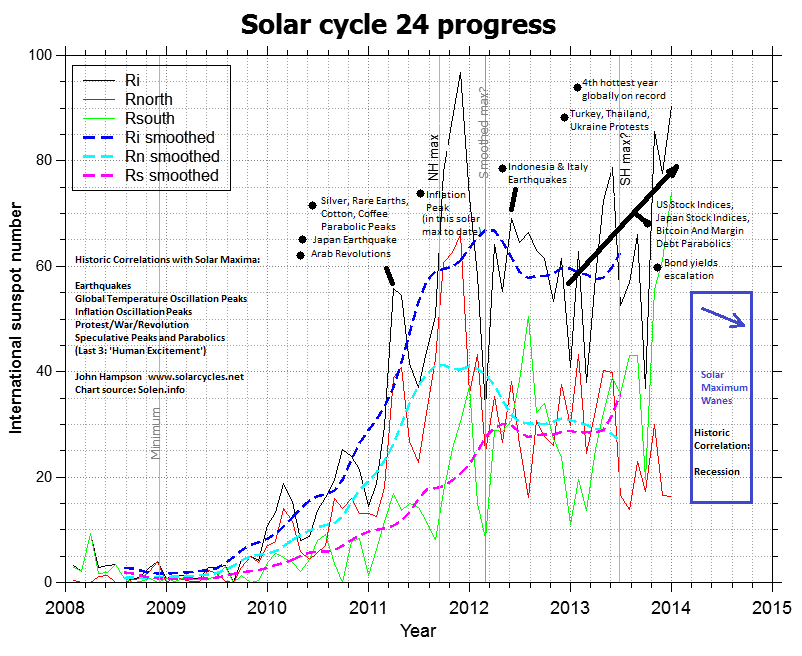
Historically, solar maxima have correlated with earthquakes and peaks in temperature oscillation. They have also correlated with protest/war/revolution, inflation oscillation peaks and speculative parabolic peaks (often secular bull peaks). With both magnetic poles now having flipped for SC24 maximum, I’ve annotated the following chart from Solen:

6ja1The Japanese and Indonesian earthquakes were both amongst the highest Richter magnitude quakes ever recorded. The Italian earthquake was one of the most devastating ever in property damage.

2013 was the 4th hottest globally on record. Historically we have seen global temperature oscillate into a peak around the solar maximum.

The Arab Spring was a world-transforming series of major protests and revolutions. The Turkey, Thailand and Ukraine protests were amongst the largest ever in terms of participants.

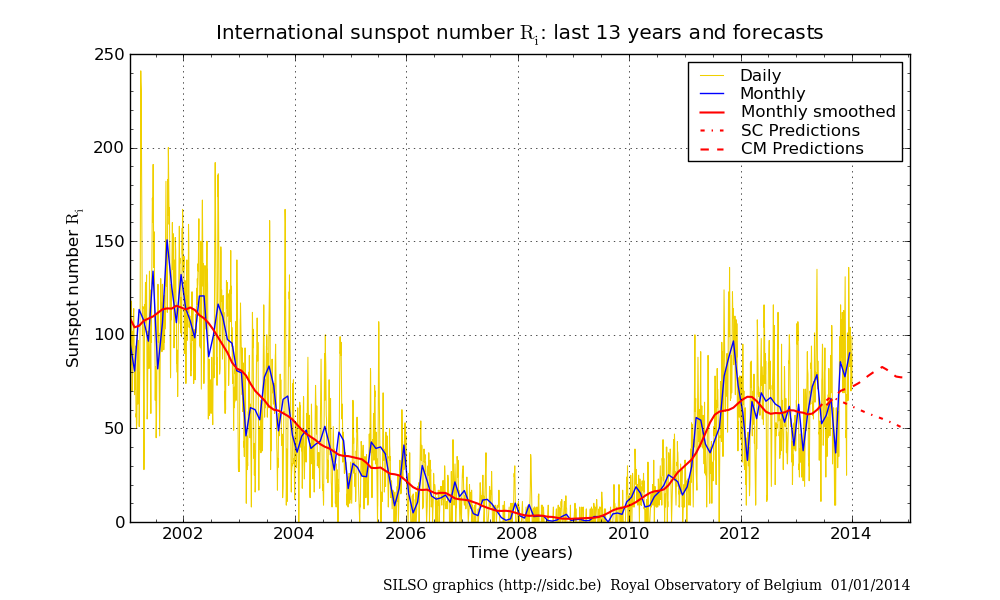
We saw a series of commodity price parabolics peaking out towards the early part of the maximum, and we currently see a series of stock index parabolics (plus margin debt parabolic), which, with history as our guide, should peak out as the solar maximum starts to wane this year. However, we don’t know at what point that waning begins. By NOAA and NASA predictions it should be now, but by SIDC’s foreast it could be as of mid-2014. With 225 sunspots currently, it still appears to be in an uptrend:

A2Either way, the annotated top chart is unlikely complete. We could yet see further earthquakes, or greater temperature extremes in 2014, or more geo-political unrest, or more speculative mania. But without any more such developments, solar cycle 24 has re-affirmed those correlations.

Historically, the solar max then gives way to economic recession. Global recessions (if based on where real global GDP has been less than 3%) occurred in 2001-2 (SC23 max 2000), 1990-3 (SC22 max 1989) and 1980-3 (SC21 max 1979). Several factors may contribute to why this is. Geomagnetism, which is negative for sentiment, peaks after the solar max. Inflation, yields, rates and speculation all typically peak into the solar max, which collectively can tip an economy into recession. The chart below shows those correlations.

10may20131This time, we have not seen any interest rate rises, but we have seen a rate of change in bond yields in the last couple of years which is comparable to that marking previous tops. Inflation peaked out early in the SC24 max and is currently depressed, in keeping with collective demographic trends (money velocity has also diverged in line with demographics). There remains the possibility that commodities make a late-cyclicals charge and deliver a temporary inflation shock, but I’m not so sure.

Prior to all my demographics research earlier this year, I expected commodities to be the speculative target of this solar maximum, and to make their secular peak here, with gold the leading asset. However, by demographics gold has some years further to run, and is more likely to make its secular peak at the next solar maximum, or even beyond.

DemographicsDowGoldRatioGlobalGDP

That commodities have made secular peaks each 3rd solar maximum to date appears a pattern, but I believe is instead is demographic, but this will only be validated in the months and years ahead.

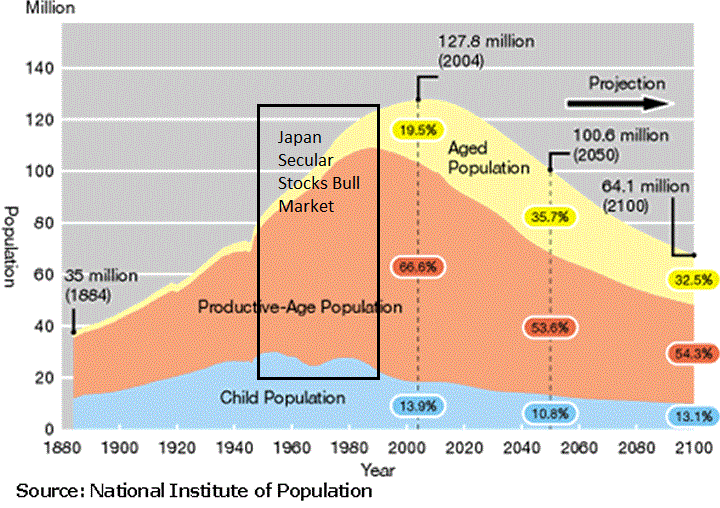
Let me explain. Japan enjoyed a long secular bull market from the late 1940s to the late 1980s, as shown in the first chart below, through 4 solar cycles. The second chart shows that this was because of a long demographic golden period, where productive-aged population ballooned, old-aged dependents stayed low, and child dependents were in decline.

26dece126dece2

The Nikkei peaked in 1989, in a parabolic, along with solar cycle 22. So it peaked at a solar maximum, but it took 4 solar cycles to exhaust the demographics.

The US demographic boom of 1980-2000 ran through 2 solar cycles. Stocks peaked in 2000, in a parabolic, at the same time as solar cycle 23.

The negative demographic period of the 1970s was a trend lasting just one solar cycle, and gold and commodities peaked out, in a parabolic, along with solar cycle peak 21.

In short, there is a history of demographics dictating secular market trends (so using secular market duration ‘averages’ is misleading), and of secular bulls peaking out at solar maxima (which average 11 years apart). We have negative collective demographic trends in the major nations lasting to circa 2025, before a flattening, which I therefore expect could deliver another full solar cycle of secular gold bull, to potentially peak out at the next solar max (which would be circa 2025). You may note though from the demographic composite that demographic trends look fairly woeful even out to 2050. It poses an interesting question as to whether this will be a different period for relative asset performance.

If commodities do not make a late surge in this solar cycle 24 maximum, then I believe we will tip into deflationary recession, as destined anyway by demographics, with the speculative manias and yields tightening assisting in this. That would then largely complete the correlations of a solar maximum.

If you are new to the site, reasoning and evidence for all these solar-related phenomena can be found by using the search facility.

Updates

1. Investors Intelligence bulls now highest since Oct 2007:

3jan1Source: Investors Intelligence

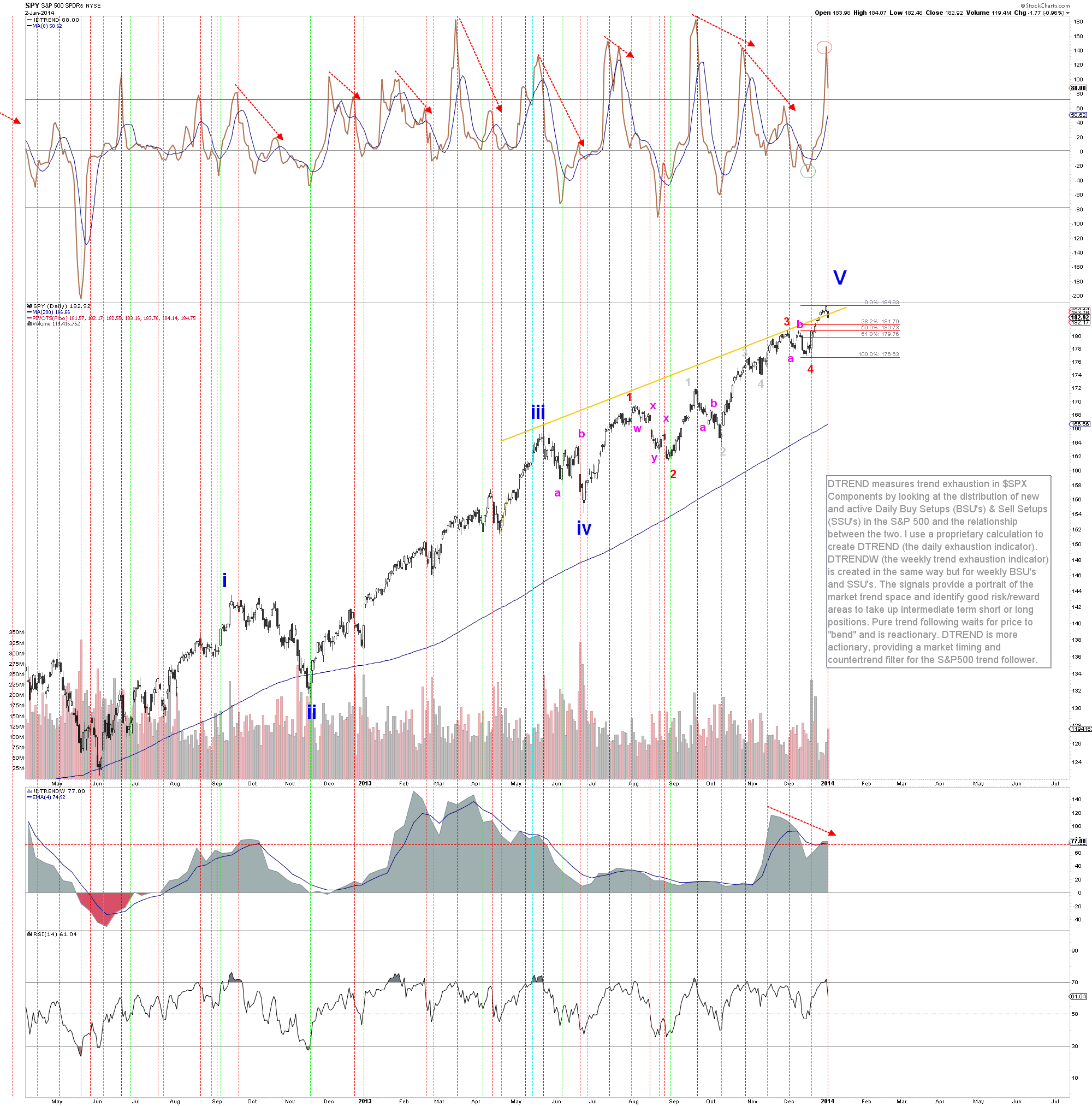
2. Short term trend exhaustion on SP500:

3jan2Source: Rory Handyside

3. Parabolic and compression on SP500 shown here:

3jan3Source: AfraidToTrade

4. Breadth divergence on SP500 as measured by % stocks above 200MA:

3jan7Source: Index Indicators

5. Crestmont P/E now 3rd highest in history after 2000 and 1929, and in 97th percentile:

3jan4Source: Dshort

6. Solar cycle 24 updates from NASA and SIDC – potentially a higher smoothed max, but either way a second peak, which fits with current speculation excesses:

3jan5 3jan6Sources: NASA and SIDC

7. Misc:

Lunar negative fortnight begins this weekend

Some geomagnetic disturbance in progress

US Q4 earnings season effectively begins with Alcoa 9th January

Portfolio rebalancings so can’t read too much into action at the start of January whilst this is taking place

China liquidity eased, but rates remain at elevated levels

US Stock Market Top

Time for another run through the checklist of typical cyclical bull tops in stocks.

1. Market valuation excessive

Second highest market cap to GDP valuation outside of 2000, the 4th highest Q ratio valuation and 4th highest CAPE valuation in history, last two years gains more than 80% multiple expansion and less than 20% earnings growth – CHECK

2. Evidence of overbought and overbullish extremes

II bears highest since 1987, II bulls highest since October 2007, CS Risk Appetite US model into Euphoria; Citi Panic/Euphoria model into Euphoria; Put/Call ratio at extreme low; Second highest ever Skew reading; Greedometer at extreme; Margin Debt at all-time record; Twitter up 80% in a month to a $40bn market cap despite zero profits – CHECK

3. Major distribution days near the highs

In total in 2013 we have had just one major accumulation day and seven major distribution days, which is divergent and atypical for a bull year; We should see further distribution days once the current melt-up breaks – WATCH

4. Rolling over of leading indicators

ECRI WLI is in a downtrend, OECD-derived leading indicators and narrow money point to a topping out at the turn of the year, whilst CB and Markit leading indicators still show strength – MIXED

5. Excessive Inflation

No, we are instead flirting with deflation, in line with demographics trends, which is a potentially bigger threat to a stocks bull but historically atypical. However, commodities remain on the cusp of a potential breakout and a potential typical late cyclical outperformance, whilst the US dollar is potentially flirting with breakdown, which together could provide a short inflation shock; If commodities instead break down, then that should ensure the drop into deflation – WATCH

6. Tightening Of Rates

We see this in the recent sharp rise in treasury yields, touching 3% yesterday; This development is echoed in bond yield rises in both developed and emerging markets globally; Plus China is actively trying to reign in its credit excesses by tightening, which led to the recent cash crunch issues – CHECK

6. Cyclical sectors topping out before the index top and money flow into defensives

This bull market has been dominated by flows into low-beta, dividend paying defensives, which again reflects demographic choices, whilst cyclicals have been more shunned, thus making this indicator less potent – so more N/A

7. Market breadth divergence

We see some breadth divergences in stocks above 200MA in place now for several months, whilst similar divergence in Advance-Declines has been reset by the strong rally of the last two weeks – MIXED

8. A Topping Process/Pattern – I want to focus on this, so:

We see evidence of a ‘blow off top’ pattern. Parabolic shape on the indices long term view. Corrections increasingly shallow. Permabears capitulating and converting to bulls. Perception market can only go in one direction. Euphoria. 

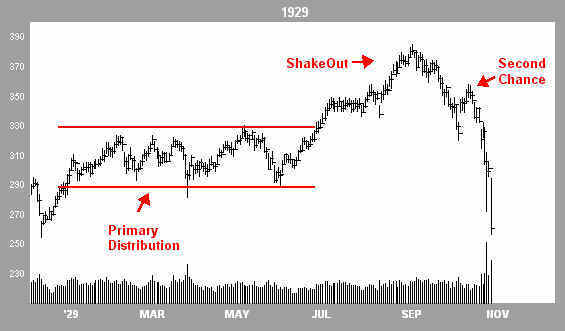
Blow off tops increase the likelihood of a crash, rather than a more leisurely ‘topping process’ range. There are some well known examples from history, and they display a similar technical unfolding to each other.

27dece2

27dece3

Source: Financial-Spread-Betting. Their labelling, but others might recognise the pattern as a kind of wedge-overthrow-top, or a blow off top, where the final rally beyond the consolidation range is the blow-off part, characterised by euphoria and capitulation.

We see a similar pattern unfolded into the Nasdaq’s 2000 peak, and also on the Nikkei’s 1989 top:

27dece4

On a longer term view, we see a parabolic rise and collapse, but it’s in the Daily view action prior to the collapse that we see the clues in the pattern.

The Dow today:

27dece1

The pattern is there, the euphoria is there. A little more breadth divergence would be more compelling, but this could potentially accumulate into the ‘second chance’ point.

So increased chance of a market crash ahead, and if we draw on history again then the combination of a sharp sell-off together with the record high leverage extremes currently in play (margin debt, Rydex), suggest an episode of forced-selling and margin-calls similar to 2008 or 1929, where little will be spared.

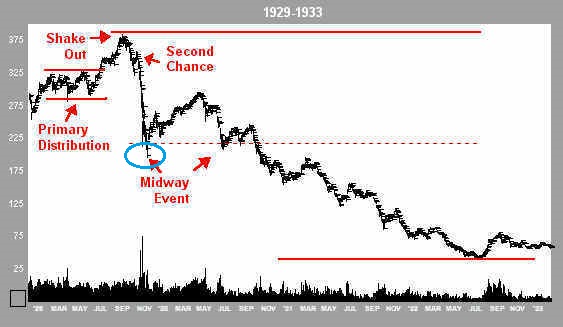
Here is the bigger picture for the 1929 crash. Note that all assets sold off together in the crash down to where I have marked a blue circle. After that, gold stocks took off and diverged from the bulk of equities which progressed into a bear market.

27dece5Source: Financial-Spread-Betting

Therefore, although I expect precious metals and miners to return to a bull market as equities top out here, we have to be aware that a market crash could see EVERYTHING sell off due to forced redemptions (1929, 1987, 2008), before PMs can take off in earnest.

More Red Flags

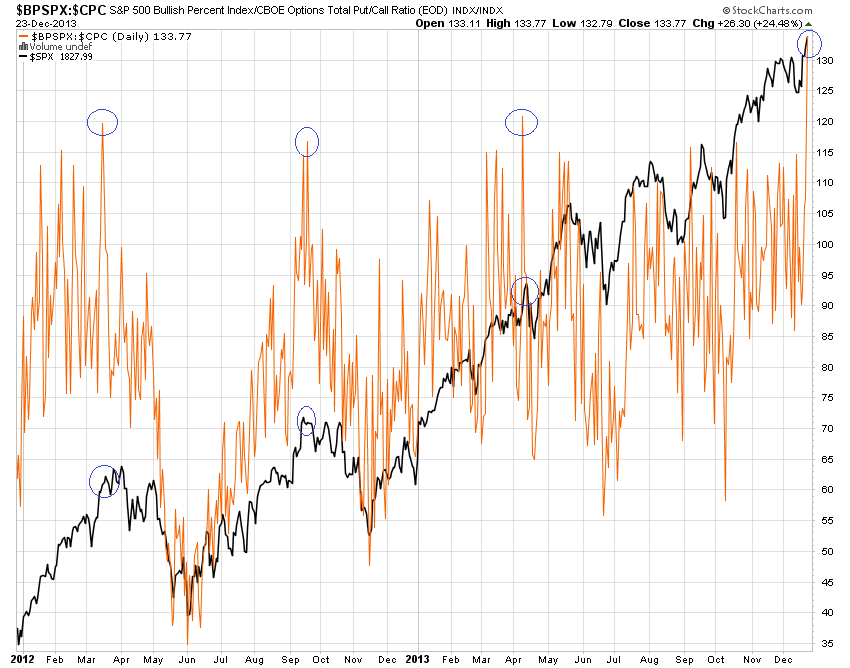
1. Spike in SP500 Bullish Percent over Put/Call Ratio:

24dece1Source: Stockcharts

2. Spike in Skew:

24dece3Source: J Lyons

3. MACD and RSI divergences versus Dow, courtesy of Karni:

24dece8

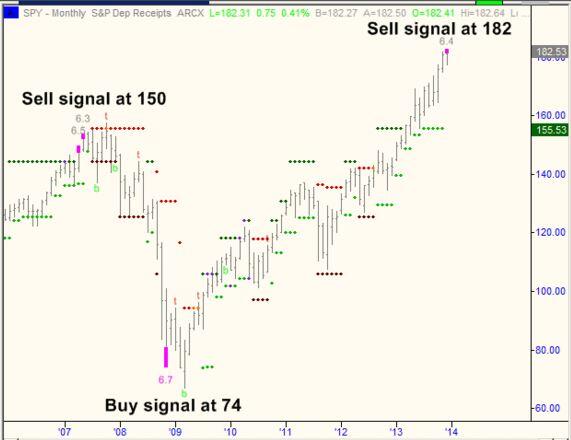
4. Parallax SP500 topping signal:

24dece2Source: Larry Footer

5. Greedometer at extreme:

24dece4Source: Greedometer

6. Margin Debt for November at new record high:

24dece5Source: Greedometer

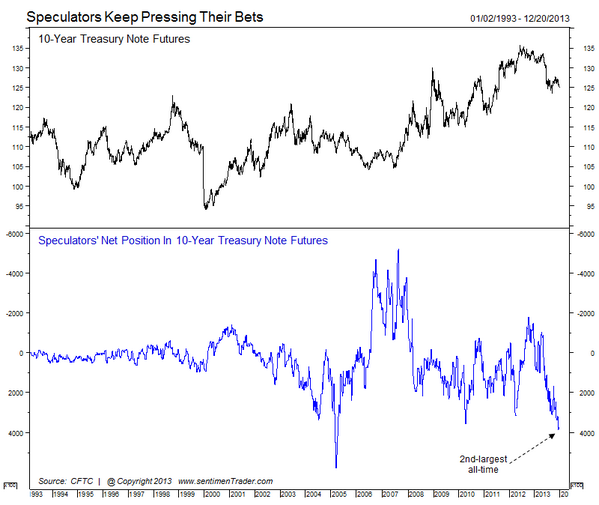
7. Second highest ever short position in treasuries:

24dece6Source: Sentimentrader

8. Corporate profit margins may be rolling over which has been a precursor to a recession in the past:

24dece7Source: Business Insider

9. Spike in China repo rate and Shibor. Liquidity issues in the credit markets (which have ballooned in the last couple of years to 220% of China’s GDP) led to a spike in June and a spike now. China is trying to deflate it again by pumping in liquidity today, but analysts suggest there are danger signs. It is a potential trigger that needs watching. More here: http://www.businessinsider.com/patrick-chovanec-on-the-spike-in-chinese-interbank-rates-2013-12

24dece9Source: Shibor