Friday Update

The SP500 has pushed up to the 1600 zone, which fits with the Birinyi/Bannister target, in a potential overthrow move. Plus this weekend marks the shift from the lunar positive to the lunar negative period, and a geomagnetic storm is predicted to be on its way. Lastly, economic surprises for the main regions have been in collapse and a change in trend in this indicator has previously led tops in the market. So collectively reasons for a top here.

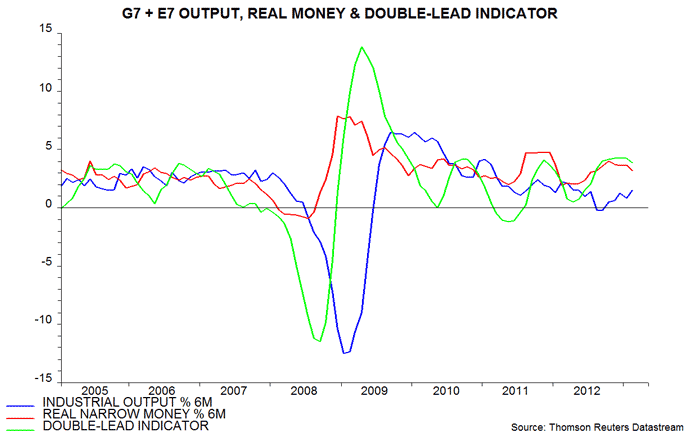
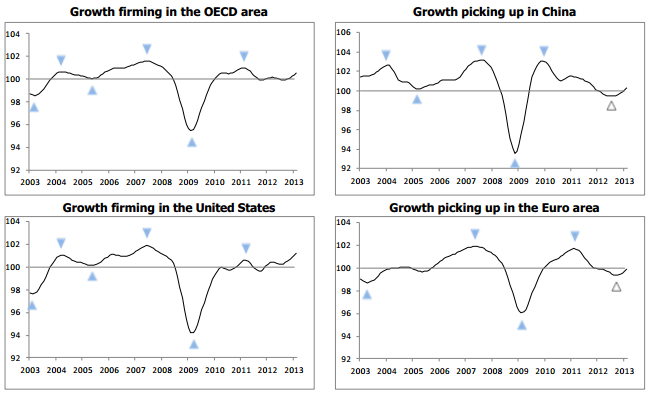
However an opposing case can be made too. We don’t see particular degradation in stocks breadth and the SP500 has broken out into clear air. We see a strong/stable position in leading indicators. Here is the latest OECD collection:

12apr20132Source: OECD

Plus CB reported Japan leading indicators at +1.0, in the first of this month’s updates. Using narrow money the updated picture is one of potentially moderating growth ahead, but as yet no significant downturn.

12apr20133Source: Moneymovesmarkets

In terms of overbought and overbullish, some measures for equities are elevated, but there is a lack of major warning signs. Conversely we do see extremes in sentiment versus some commodities and commodity related sectors but the other way: bearish.

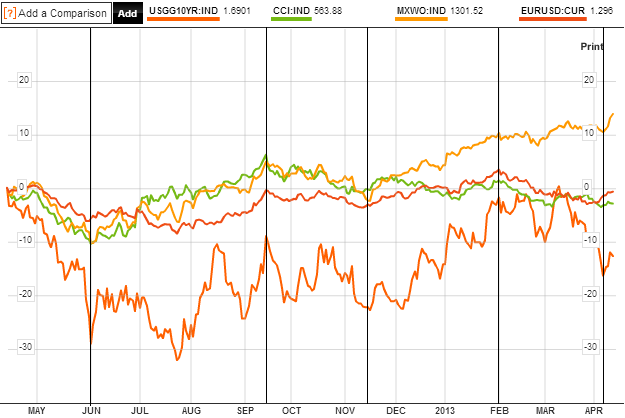
If you are following the SP500 or Nikkei then things look to be overwhelmingly bullish, but it should be noted that these are the two countries with the most aggressive central bank stimulus/easing programmes. A wider look at pro-risk is captured through combining the world stock index, equally weighted commodities index, euro-usd and 10 year treasury yields:

12apr20131Source: Bloomberg

We see collective behaviour in pro-risk, but with under- and out-performers. So, up from June to Sept 2012, down to mid-November, up then to the turn of January into February, down into the end of last week. Could we now be the start of a new collective uptrend for pro-risk? Again, followers of the SP500 or Nikkei might find that hard to believe, but the wider look at pro-risk suggests it could be possible, and a rotation in leadership if of course feasible. The collective picture for pro-risk fits with 5-models-in-alignment:

https://solarcycles.net/2013/01/09/tools-for-2013/

Namely, a pullback from the end of Jan to Mar/April, then a final rally into around June time, to either end the cyclical bull (in my primary scenario) or produce a significant swing top (in my alternative scenario).

With US earnings season just getting under way, there is another potential mover in the markets. Let’s see.

More In The Balance

Secular commodities peak behind or ahead? Here we go again.

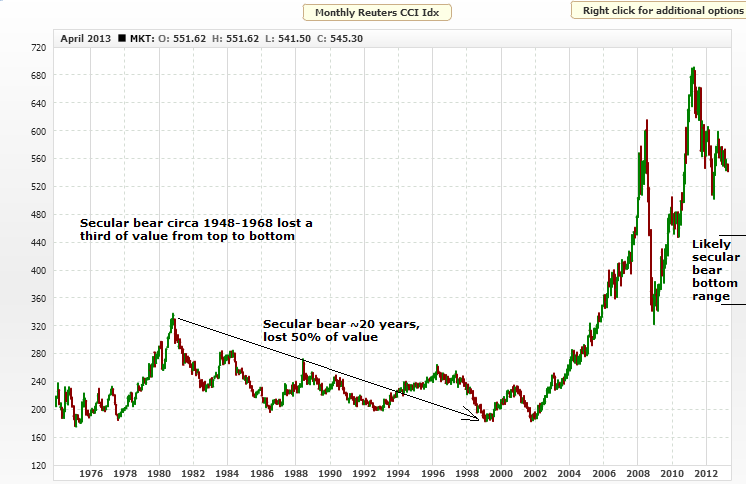
The last secular bear in commodities, circa 1980-2000, lost 50% in nominal value from top to bottom. The previous secular bear, circa 1948-1968 lost a third of its value top to bottom. Assume a secular bear in commodities began following the peak in 2011, then drawing on those past events we could estimate a secular bear bottom in the zone shown:

10apr20137Source: MCRI

We could go further back in time to average in more secular commodity bears, but I suggest the evironment was different, pre fiat capital era, pre free globalised markets, and pre inflationary government policies. The 1980-2000 secular commodities bear has a sideways bias, that is also shared by the 1948-1968 secular bear, and we see overall sideways action in secular equities bears too – and these are all because of modern government policies of inflation. In real inflation-adjusted terms, we see more of a downward bias, compared to the nominal.

The 1980-2000 commodities bear proceeded in waves, i.e. cyclical bulls and bears within an overall secular bear, and this too is similar to progress in secular stocks bears. If the secular bull peak for commodities is already in, back in 2011, then the chart above shows that we would already be getting towards around half way between secular bear top and bottom. Given that the secular bear progresses in waves, then a wave up ought to be soon due, perhaps like the 1982-1984 cyclical bull, post 1980 peak. As it happens, multiple commodities are currently at levels of extreme bearish sentiment, including corn, silver, copper, soybean meal and sugar, which would provide the fuel for such a potential rally. That said, overbearish or oversold increases the likelihood of a mean reversion or relief rally, but on occasion these extremes can persist and test patience, until the evironment becomes more supportive. So how does demand and supply look currently in some key commodities?

Natural gas shows a recent tightening of demand and supply, as inventories are dipping beneath the historic average. Nothing extreme though:

10apr20131

Crude oil inventories are plentiful, which is a depressant on price:

10apr20132Source: Bespoke

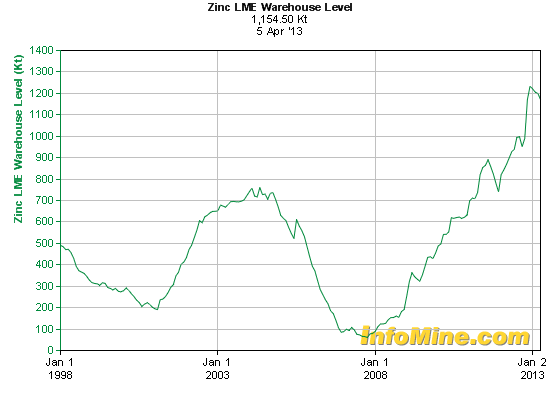
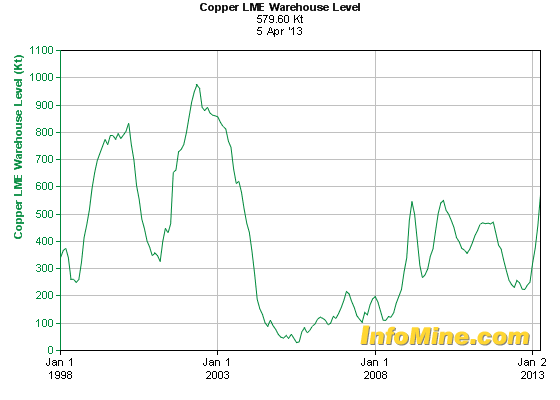
Both zinc and copper show increasing inventories. Both in notably different positions to 2008 when commodities made a big interim peak.

10apr20139

10apr20138

Cereals, i.e. wheat, rice, maize, show a fairly steady position, with inventories largely tracking sideways over the last 5 years:

10apr20133Source: FAO

And lastly to gold. Demand decreased last year on the year before, but remains high, with central bank and investor demand the main areas of growth the last few years:

10apr20135

Source: Moneygame

Whilst supply has been growing since a bottom in 2008, to a now all time high:

10apr20134Source: ZealLLC

In summary, the overall demand-supply situation in these key commodities is no backdrop to a major rally, at least not as things currently stand. But to return to the opening question of whether a secular commodities peak is behind or ahead of us, the clues may still be in gold. If the period since 2000 is a K-winter then gold should be the leading asset. If demand slack in other commodities reflects recent weak economic growth, then the picture for gold is more complicated, as it is less a commodity and more a hard currency. Gold can thrive in conditions of negative real interest rates and money printing (or currency dilution). That said, it is also an inflation hedge and depressed commodity prices are doing nothing to convey troubling inflation expectations. As gold is sensitive to investor interest, were there to be a shift in stance from central bank away from negligible rates and currency diluting policy action, we might have conditions in place for an enduring secular bear. Indeed, this is what I predict will happen, the question is when? Does gold have a parabolic rise left in it yet, to end its secular bull, or did that occur in 2011 with silver making such a blow-off move?

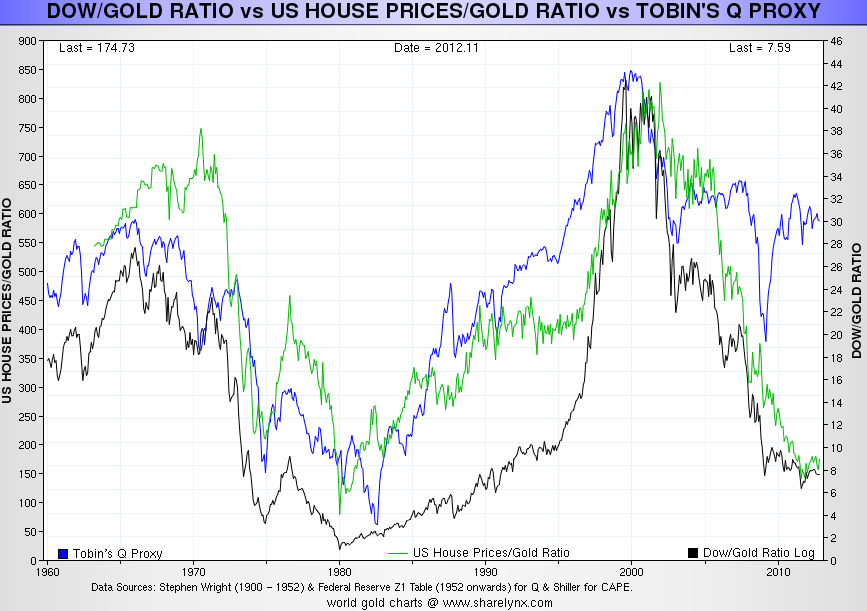
This next chart shows how we are into the region of a secular transition in stocks and real estate versus gold. Gold is relatively expensive versus both and a rounded bottoming in the ratios could be in progress:

10apr20136

Source: Sharelynx

The ratios are low enough to justify a secular reversal, or they could yet break lower to around 1980’s levels to complete the secular extreme relative valuation. The curiosity is the Q ratio, which together with CAPE for US stocks, leads some analysts to expect steep falls in US equities from here, such as to 450 on the SP500 ( Russell Napier) to rectify it. I doubt it because of secular low valuations reached already on other stock indices around the world in this secular bear: such as Japan sub p/b 1, PIIGS p/es between 2 and 7, Germany, UK and Hong Kong all reaching below 10. In the last secular stocks bear, Japan only reached a low of p/e 20, so not all indices necessarily have to wash out, as long as most do.

Add in treasury bonds, due a reversal out of a 3 decade secular bull market and potentially bottoming around now along with money velocity, and consider the rounded bottoming in progress in many real estate markets around the world, and we have a window, and evidence, here for a broad secular transition, out of a K-winter and into a K-spring, switching from a secular commodities bull to a secular stocks bull, to a new secular treasuries bear and a new bull market in real estate.

The US dollar also appears primed for a new bull market, following a decade long bear. Interestingly, although the perception is that commodities generally advance when the US dollar is declining, in fact the last secular commodities bull peak took place against a sideways dollar, and the previous two commodities peaks against a rising dollar. In the secular commodities bull since 2000 we have seen more periods of commodities rising whilst the dollar has been falling, but we have also seen periods of them moving together. In summary, it does not appear that the fortunes of the USD particularly correlate to the fortunes of commodities. So what other clues can we use to assess if commodities made a secular peak in 2011 instead of biding time before a secular peak erupts ahead?

Well, I’ve left out solar cycles until now so time to bring them in. My analysis shows commodities making secular tops close to solar maximums. Danny suggested that food and metal peaks tend to occur at different times. It is true that historically individual commodities have peaked at different times. Here is a brief summary of previous secular commodities bull peaks:

1917 solar peak: copper peaked 5 months before, wheat 4 months before, corn dead on the solar peak, silver not until 27 months after.

1947 solar peak: oats peaked 6 months after, wheat 6 months after, corn 7 months after, copper 15 months after.

1979/80 solar peak: copper peaked dead on, gold peaked 1 month after, oil 4 months after, sugar 9 months after.

There is the possibility that the tighter packing to the solar peak in 1979/80 could be related to the free-est, fast-est, most globalised conditions to enable solar-related speculation to be at its most potent, but if we exclude that then we are left between the historic examples to expect commodities to make individual peaks at various times around the solar peak window. That peak is currently anticipated for Autumn/Fall 2013. Could the peaks in copper, silver, and cotton in 2011 be near enough to be within range for solar validation? Possibly, but a little stretched, and when we consider the likes of oil and wheat made their peaks back in 2008, that becomes then too far away.

What I have previously explained is that secular asset peaks around solar maximums are speculative. The solar activity brings about buying and speculation behaviours in humans through biological changes. Spikes in inflation occur at each solar maximum as shown, within a range of about a year either side:

17sep18

Therefore I suggest it is possible through a feedback looping of commodity speculation and inflation to bring about a secular commodities peak ahead, even with looser inventories. Once demand increases and the perception is of a change in trend in inventories (rather than accute inventories) then the status quo can quickly change. However, there is no doubt that the looser inventories and weaker Chinese / global growth are a headwind. After all, there is nothing magical about the solar influence, it is just one influence in sentiment. I have also argued that the secular asset of the time becomes the target of the solar-influenced speculation, and if the perception is currently that commodities and equities have already switched secular position, then could stocks become the target of the speculative frenzy? I can’t rule it out. However, it remains that oil and other commodities tend to be late cyclicals, making a peak after stocks, so when stocks make their swing or cyclical peak, we could then see a move into commodities. As gold has built out a sideways range near its secular highs, it could then potentially break out, giving the technical break into clear air to inspire a speculative frenzy.

In conclusion, the call as to whether a secular commodities peak is ahead or behind us remains a tough one, very much in the balance. But it comes down to how to trade this, until evidence aligns more decisively one way or the other (gold breaks up or down, CCI breaks up or down, sunspots make a new high, commodities take over as the outperforming class or equities roar away). I am already positioned long a basket of commodities. Because of the uncertainty I do not wish to add here, despite the overbearish extremes. However, if commodities did peak in 2011 then as per the first chart the CCI is reaching towards a price level and time point where it is due a cyclical bull rally soon. I therefore believe that I can likely make a profitable trade out of commodities regardless of their secular position, with a little patience.

Money Velocity

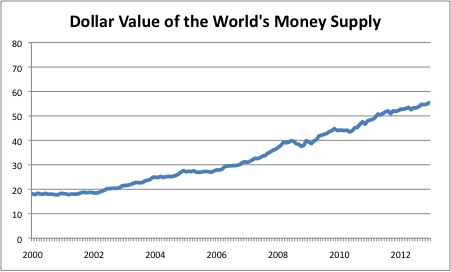
The Fed, BOE and BOJ have all been busy creating money out of thin air to make purchases in the bond market. The institutions selling the bonds then have new money in their accounts and so this produces an increase in the money supply. The intention is to stimulate the economy by increasing the money supply, once interest rate cuts have been exhausted. The ECB has this kind of direct action on standby. The BOJ has just doubled its purchases. The result of these policies is that we have seen a large and unprecedented increase in the world’s money supply over the last few years:

9apr20137Source: Maomoney-maoproblems

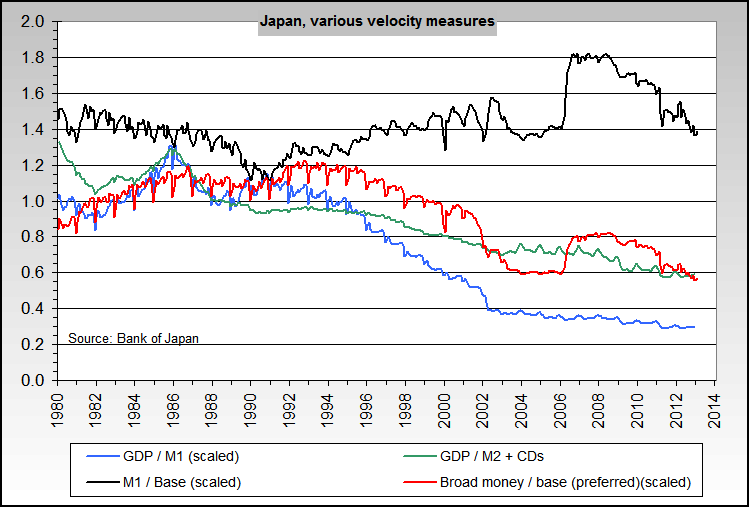
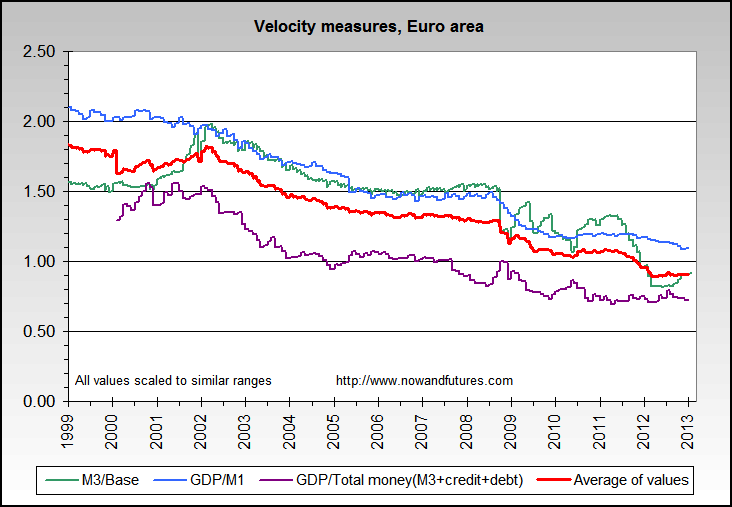
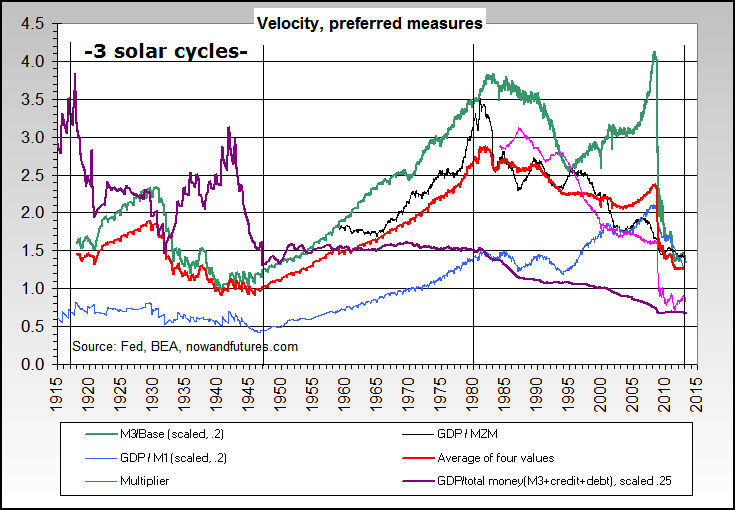
As more money chases the same amount of goods and services, this clearly has the potential for massive inflation. Yet, so far, the banks and institutions have largely sat on their increased reserves. The new money is parked, rather than circulating in the economy. This shows the lack of confidence in growth and a persistence of fear. So the increase in the money supply has been offset by a lack of money velocity. Here are money velocity charts for Japan, the Eurozone and the US, in order: 9apr20131 9apr20132

9apr20133Source: Nowandfutures

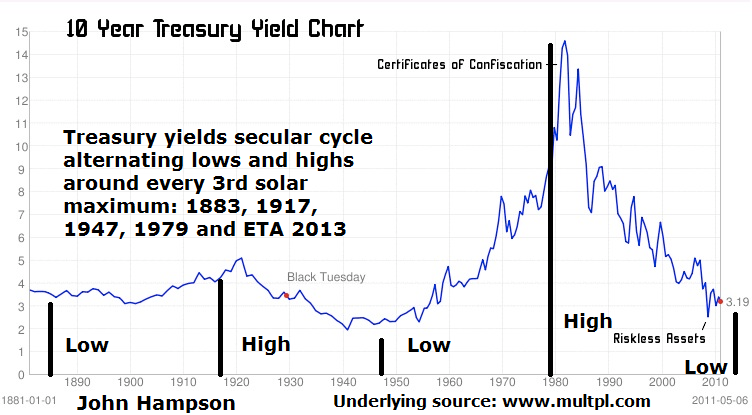
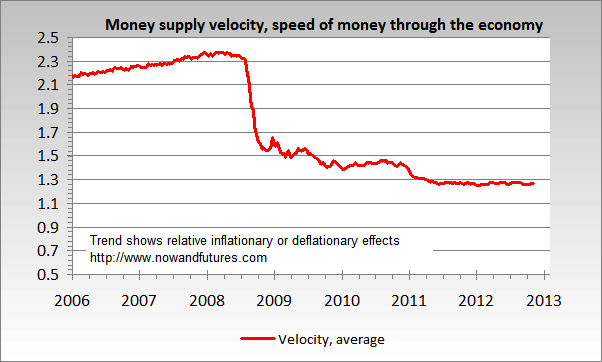
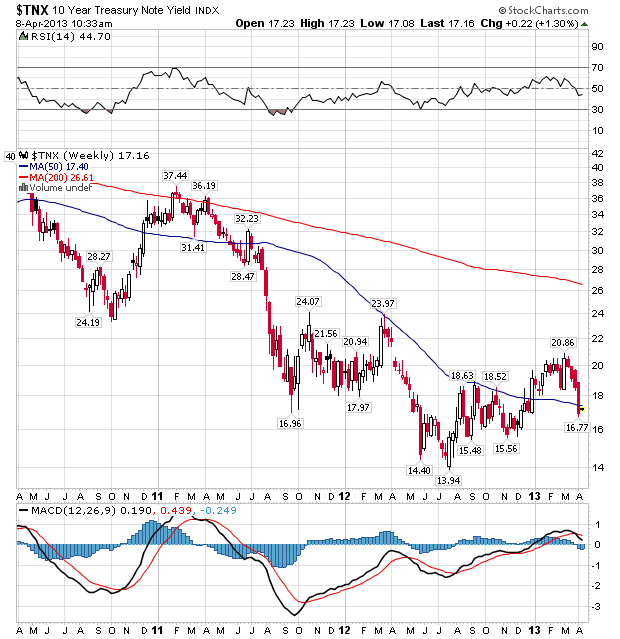
On the US chart, which is longer term, we see the same long term cycling in money velocity as in treasury yields: treasuryyields This perhaps makes sense as money velocity would tend to be lower when money is being parked into treasury bonds in an enduring trend, and vice versa. So, are we going to see money velocity about to turn upwards, at the same time as treasuries starting a new long term bear market? Certainly, with treasury bonds up to 20 years in duration paying negative real returns (using official CPI), the potential is there. Purchasers of treasuries are buying something offering a guaranteed loss, and the main reason for that is capital preservation: they expect equities, real estate and commodities to do worse. If confidence is restored in growth and pro-risk assets then we could expect a significant reversal in money flows, out of bonds. Aggregating the US money velocity measures and zooming in on the last few years we see have seen a gradual flattening out, which raises the potential this could begin to rise in 2013: 9apr20134 By my solar cycles work, this is indeed what should occur. Growthflation, money bidding up the secular pro-risk asset into a peak, money reversing out of treasury bonds. But we need to see velocity start to pick up, rather than flatline. If we look back at our closest historical mirror, 1947, then in the US longer term velocity chart further up we can see that velocity just reversed out of its downtrend with about a year to go before the solar/secular commodities peak. Treasury bonds also topped around a year before the solar peak, which confirms the correlation between the bonds and velocity. So, with the solar peak expected around Fall / Autumn 2013, did treasury bonds top out and yields bottom some time last year? They potentially did, subject to where they go from here: 9apr20139

Source: stockcharts

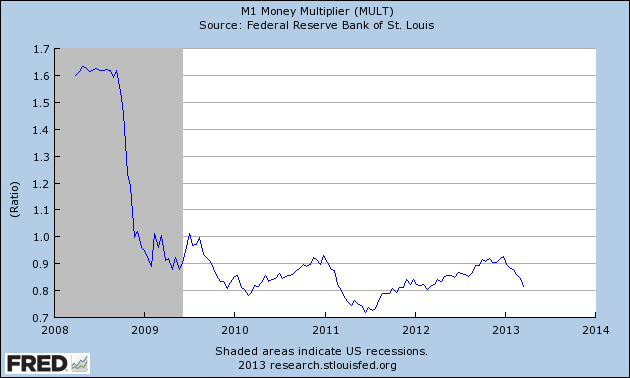
And using the money multiplier measure of velocity, we also see potential this bottomed too:

9apr201310Source: St Louis Fed

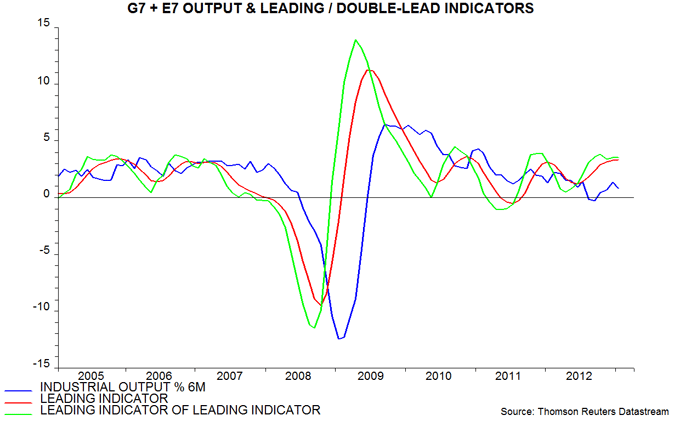
Now let’s say I’m wrong about the solar maximum correlation. Unless you believe the system is broken and/or not cleansed in the cleansing cycle since 2000, then a natural cycle of growth should still take hold at some point – only the timing would differ. Once the entrenched growth becomes clear then the wall of money will be rapidly tempted out of cash reserves and bonds as it remains that they are paying negative real returns. Unless central banks then very swiftly neutralise all the new money and the easy conditions – and with history as our guide this is unlikely – then there is a high risk of major inflation in the prices of goods and in pro-risk assets. If we get such an inflationary episode, we should see the feedback looping with commodities (as hard asset inflation hedges) to deliver the secular parabolic finale that I anticipate. The alternative scenarios would be these. One, we continue to only muster low and spotty growth, nothing entrenched or sustained, which keeps the wall of money largely parked, central banks on the accelerator, and stocks gently rising. Two, all the central bank interference has prevented the cleansing cycle from doing its work, and we need a big deflationary episode before any genuine growth can be mustered. I don’t rate either of these scenarios as likely. I believe we have seen a normal cleansing cycle, with equities and real estate valuation sufficiently washed out, and private sector balance sheets significantly repaired (public sector clearly not – but it is the private sector that is the engine of growth – and public debt should not reach crunch point in the major economies until later this century on current trends). Plus the cleansing cycle has been of normal duration and characteristics. The central bank action did not succeed in restoring natural growth in this period – the cycle was king – but rather their actions are likely to supercharge what happens next. With history as our guide, it is likely that central banks will be behind the curve as inflation and speculation rapidly escalate, and with little appetite to reverse or neutralise all the new money supply. Bring back in my solar cycling theory, and we are primed for that to occur 2013 into 2014, before excessive commodity prices and belated central bank tightening tip us into a global recession again. If leading economic indicators start to turn down again, then central banks are likely to respond again, with yet more stimulus. Perhaps the ECB would join the QEers. But another cycle of indicators and asset prices falling over the next few months would start to stretch the solar timing. So I’m keen to see if the current growth is the one that sticks, and that leading indicators stay in the positive. The next chart suggests that this may be so:

9apr201311Source: Moneymovesmarkets

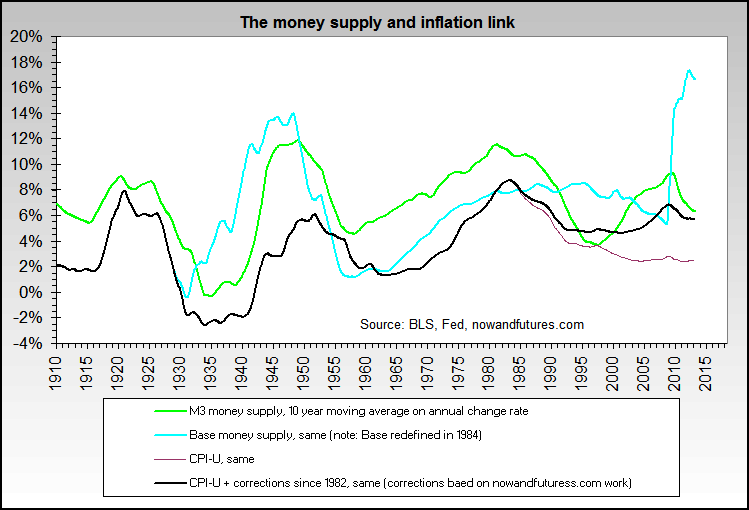
The leading indicator of leading indicator has just lately strengthened again instead of tumbling. If the growth can stick here, then I expect the rest to fall into place: money flows out of treasury bonds, money velocity to pick up, commodity price escalation and inflation, and all to the timing of the solar maximum. Here’s a final chart that may be predicting this:

9apr201312Source: Nowandfutures

In The Balance

Time for an updated look at the big picture: is a secular commodities peak ahead or behind us?

Here is the equally weighted commodities index. It remains in the nose of a large triangle. A decisive break down through the twin supports will add weight to a secular commodities peak having already occurred in 2011, whereas an upwards break beyond down sloping resistance will add weight to a secular bull still in tact.

4apr20131Source: MCRI

By solar/secular history, a secular commodities peak normally occurs around or closely following a solar maximum. However, that too remains in the balance as shown by the alternate predictions in the SIDC chart below – either a solar peak occurred at the turn of 2012 or a solar peak is ahead later this year.

4apr201317Source: SIDC

The most common consensus remains that the solar peak is rather ahead than behind us, with the median forecast for Autumn/Fall 2013. Planetary models predict a spike in sunspot action around Sept/Oct 2013 and some physicists also predict a burst in activity later this year, which would fulfil the NOAA red line prediction below:
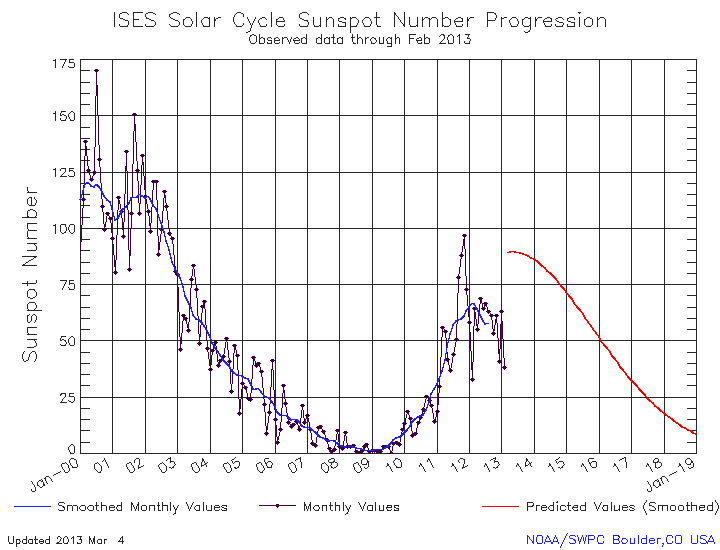
4apr201311

However, until such a flurry is seen, it remains unresolved.

Danny challenged the 33 year secular commodities peak and solar peak correlation with this chart:

4apr20132It is an ultra long term modelling of commodity prices, to which I have added the markers to show when the industrial revolution began and when the gold standard was abolished. It can be seen that the correlation in solar peaks and commodities peaks largely failed prior to the industrial revolution. Understand that prior to this time there were only localised markets for commodities, little storage, and almost nothing in the way of demand and supply matching. Farmers tended to grow their usual crop, bring it to market, get the best price they could for it, and anything unsold went to waste. For a natural cycle that influences collective human behaviour to manifest itself, I suggest optimum conditions are instant, globalised, free markets, like we have in the current day and age. In pre-revolution conditions, it would have been impossible to draw out real cycles from slow, localised, restricted and fragmented markets. I don’t see that part of the chart as valid therefore. See also below how the solar/secular oscillation in the Dow-gold ratio became pronounced after the freeing of gold and paper:
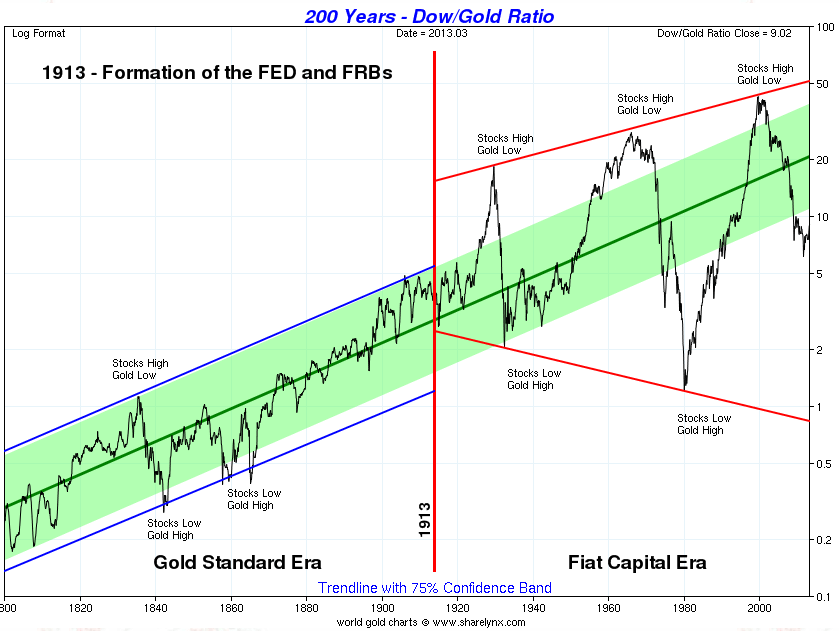
4apr20135

Source: Sharelynx

So, returning to the ultra long term commodities price chart above, we see an broken success rate (as shown by the circles) in the fiat era and between the industrial revolution and fiat era two successes and a potential inversion or double failure. However we classify that anomaly, such a failure could potentially reoccur in the future – unless it was the result of a non-free, slow, localised era. But a failure amongst a majority of successes would be in line with all other ‘real’ trading disciplines, i.e. there is no holy grail, nothing that works all the time, just things that work most of the time. To sum up, the solar peak is probably ahead, and the secular commodities peak is probably ahead in line with that.

Turning to climate and agricultural commodities, are we going to see another year of extreme temperatures and natural disasters, which would drive up commodity prices? The next chart reveals that the last two years have not been as severe as a cluster before that. However, they were both La Nina years, which has a cooling effect.

4apr201312

Source: NOAA

This year, a largely neutral year is expected (no dominance of La Nina – or El Nino either) so there is the potential for a bigger bar – unless the long term trend is now reversing.

Global warming is one factor, global wierding (rate of natural disasters) another, and in the US, drought conditions at the start of 2013 are displaying patterns that could unfold into the equivalent of the worst drought years in history. Grains took a big hit in price this last week due to higher than expected plantings and stockpiles, but there remains the potential that climate developments could drive agricultural commodities higher again in the remainder of the year.

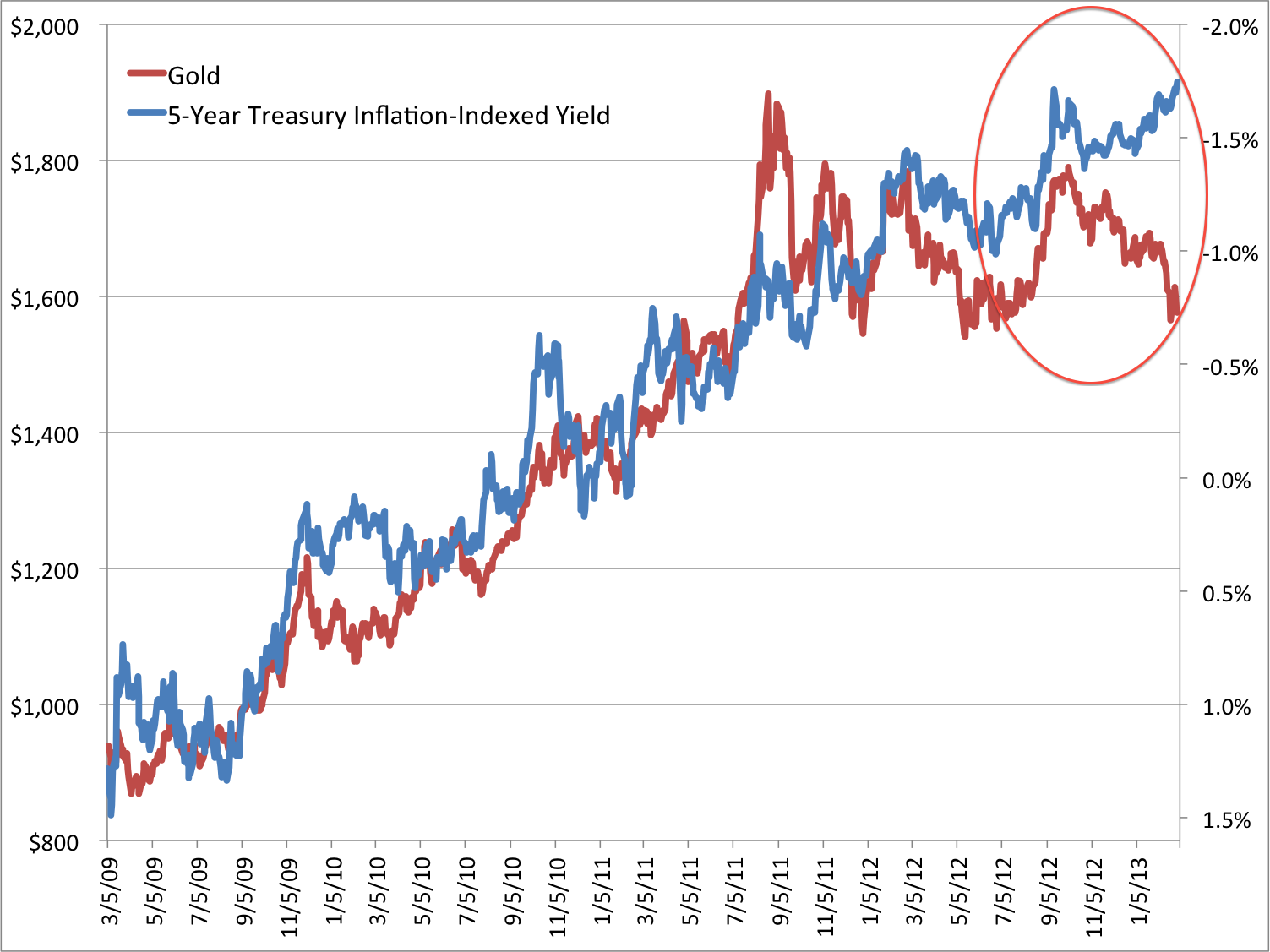
Rising commodity prices and inflation together make a mutually reinforcing feedback loop. Escalating commodity prices drive up inflation and escalating inflation attracts money into commodities as an inflation hedge. So how do inflation expectations look, aside any climate developments? The next chart shows expectations have been on the rise since Q3 2012, with a divergence in gold that we might expect will be rectified:

4apr20139Source: M Boesler

If gold is not to make up that ground, then we might expect inflation expectations to fall instead – i.e. a period of deflation would be ahead.

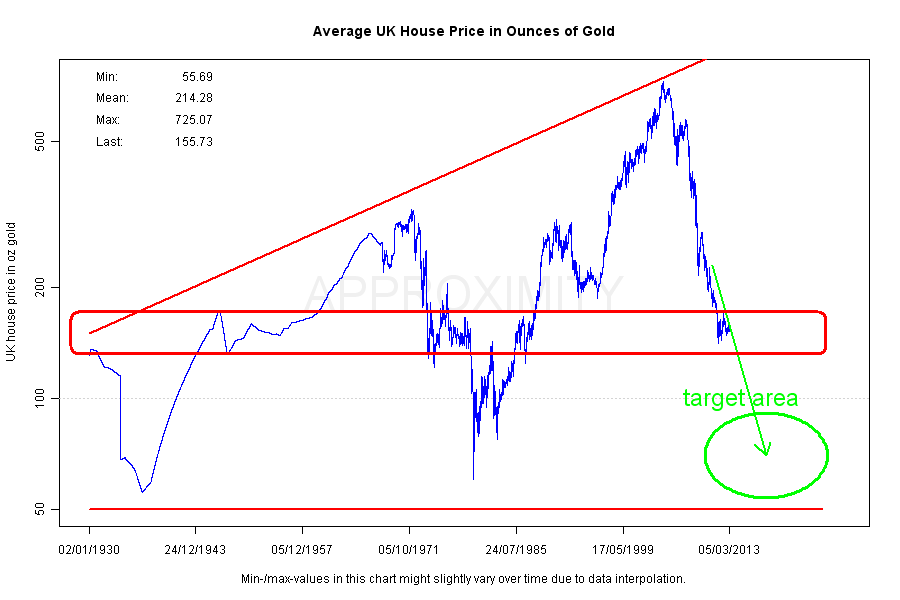
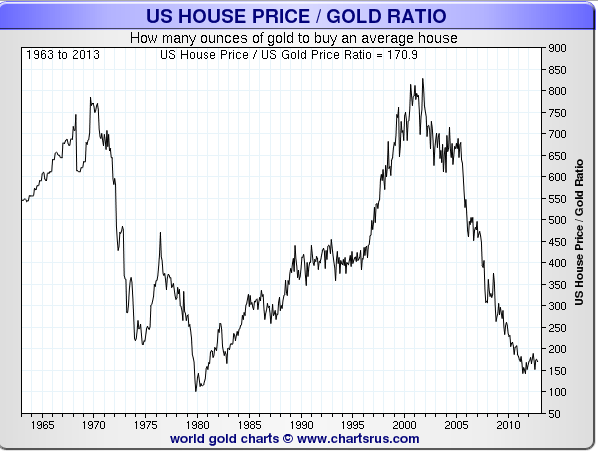
Turning to valuations, gold is historically expensive here versus stocks and real estate, but could yet become more extreme expensive before reversing.
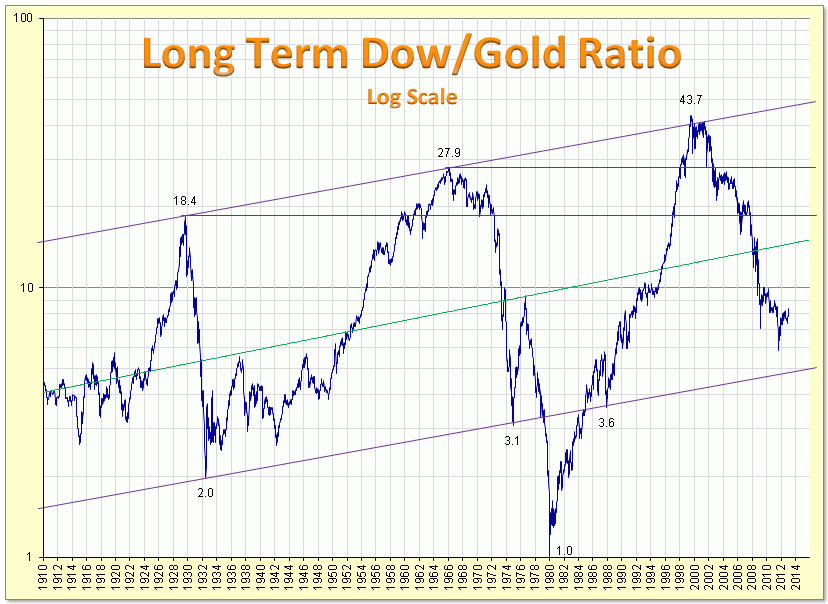
4apr20133

Source: Fred4apr20136

Source: Approximity

4apr20137All 3 charts reveal gold’s meteoric relative rise in price to stocks and real estate since 2000. The question is, does it have a parabolic finale yet to come in which it reaches the obvious zones, or is going to stop short and is already in relative decline?

If gold has already made its secular top (in 2011), then we would expect stocks to be now in a new secular bull. So did stocks wash out sufficiently, in terms of price/earnings and price/book valuations, to make it likely the secular bear is over? So far in the secular bear, the FTSE reached a p/e of 7, the Dax 9, the Hang Seng 8, the SP500 and Dow 9. The Nikkei only reached 13, but it made a p/b ratio of under 1. Broadly speaking, they are all low enough to satisfy secular bear cleansing, and we can add to that the extreme low p/es reached in the PIIGS at the height of the Eurozone crisis. If we look at other valuation measures in relation to the SP500 then we get a different picture:

4apr20138Source: Dshort

These four valuations combined suggest the secular bear has not washed through sufficiently, and that current valuations are closer to a top than a bottom. However, we ought to note the much higher top in 2000 and question whether central bank policies of unprecedented easing and stimulus have dragged all these measures permanently higher.

US indices aside, we have reasonable evidence from around the world that secular cleansing could be largely complete in terms of valuations reached at the bottom of the falls in 2011. Plus this year we have what appears to be a new secular bull break out in the Japanese indices.

What about treasuries? This secular transition should also be accompanied by a secular transition in treasuries from a long term bull market to a new long term bear. Did treauries top – and yields bottom – in 2012? It remains to be seen as it is currently too technically ambiguous to say with confidence.

4apr201313Source: Stockcharts

Using history as our guide, if a secular commodities peak is ahead later this year (and potentially into H1 2014), then we should see a topping process in equities by around mid-year whilst commodities take over as the outperforming class. A feedback looping between inflation and commodities should occur, until too expensive commodity prices and tightening yields help push the economy into recession. That recession should be fairly mild, with stocks making a shallow bear market, whilst commodities plunge harder, in the mirror of their preceding parabolic escalation. The bottom of that shallow stocks bear would be the momentum ‘go’ point for the new secular stocks bull.

Alternatively, if a secular commodities peak already occurred in 2011, then secular bull momentum in stocks should already be underway, and we might point to action in the Nikkei or SP500 in 2013 as supporting evidence. The recession that should follow the secular commodities peak occurred then in 2011-12, with the Eurozone and the UK two notable areas that experienced this. It was not a world recession however, and we did not see typical cyclical stocks bull topping bells ringing preceding it. If we look at an overlay of the CCI commodities index on the MSCI World stock index, we can see that they topped together in April/May 2011:
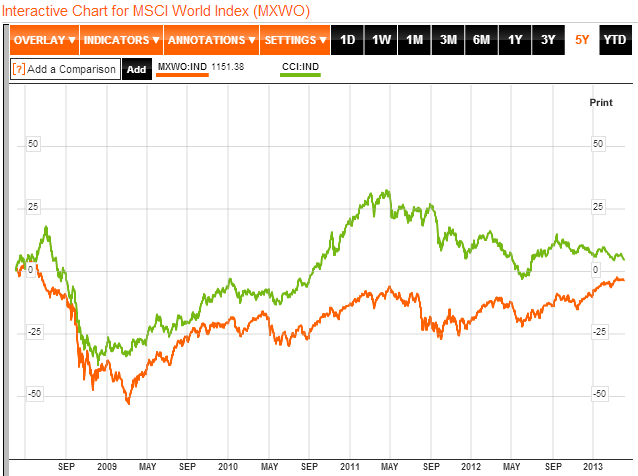
4apr201314Source: Bloomberg

We did see outperformance in commodities, but not to the degree of 2008, or the last secular commodities bull peak of 1980. But silver did make a suitable parabolic blow-off in price.

To sum up, a case can be made for both competing scenarios: a secular commodities peak ahead or behind us in 2011. It remains in the balance, but not indefinitely. The CCI commodities index will break one way or the other. Gold will catch up to inflation expectations, or inflation expectations will fall. Sunspot evidence will come in more definitely in favour of a solar peak ahead or behind. Climate evidence as 2013 unfolds will drive agricultural commodities to escalating or plummeting prices. Equities will maintain secular bull momentum and outperformance of equities, or they will begin to make a topping process whilst commodities outperform.

What about a third scenario: both equities and commodities drop here into a bear market, with treasuries the beneficiary? For that to occur, we should still need to see a topping process in stocks whilst leading indicators and internals deteriorate. Currently, we do not see major warning flags in either, with leading indicators and breadth supportive. However, we have lately seen changes in trend in economic surprises, both in the US and Europe:
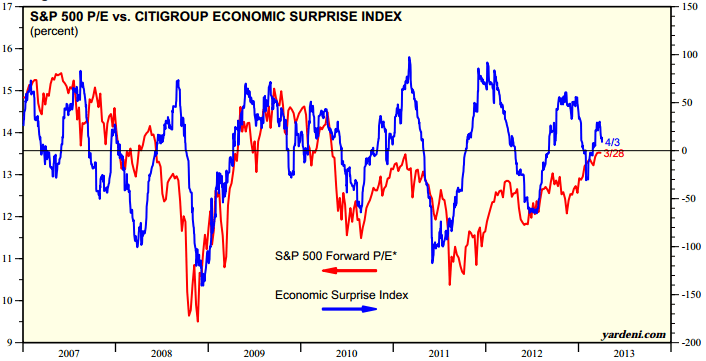
4apr201315

4apr201316This coincides with the change in geomagnetism trend, and perhaps provides fuel for a pullback. I do not believe, however, that we have evidence for more than a swing pullback at this point, but it could become part of a more significant topping process that lasts several months.

If we pull back and look at the wider environment for assets, we largely/generally have ultra low rates, central bank support, money supply growth, cash and bonds paying negligible or negative real returns, stock yields exceeding bond yields, low/spotty economic growth and not excessive inflation, and historically below average valuations for stocks and real estate. This is a fairly positive environment in which equities and housing can attract money flows, and that is what we are seeing. It would take another sharp slowdown in the world or another debt-related crisis coming to the fore somewhere, for this to change. The question is whether we have seen a sufficient cycle of cleansing since 2000 and sufficient foot-on-the-accelerator central bank action to now sustain growth. If growth can stick and even accelerate, then we have better chances of reaching growthlationary froth and the commodities/inflation feedback loop, as all the inflationary stimulus and easing could quickly become problematic, with faster money flows out of bonds.

Finally, a few more potential clues as to the likely winner in the scenarios. Crude oil inventories are approaching a record, which has the potential to pull the rug from under crude prices if growth stumbles. Inflation should make a bigger peak 5 years after 2008, which would be this year, based on secular/solar history. Emerging markets manufacturing surveys (a leading indicator) picked up to 52.6 in March (over 50 is growth), of which China is the biggest commodity consumer. Commodities generally move opposite to the US dollar, as they are priced in US dollars, and the US dollar could be ripe for a sustained decline as speculator positions hit a record and this has previously led a swing top.

In conclusion, there remains no clear winner, with good evidence supporting a secular commodities peak ahead, or that it occurred already in 2011 and a new secular stocks bull is in progress. I maintain that the balance of probability lies with the secular commodities peak being ahead in H2 2013 – H1 2014, which should mean a cyclical stocks bull top occurring by mid-year 2013. However, if that is the case, then it should only give rise to a shallow stocks bear before new secular bull momentum. I am positioned for a secular commodities bull finale ahead, with significant exposure to precious metals, energy and agricultural commodities. I have only a position in Russia by way of equities exposure. So there is my concern: if the alternative scenario is the correct one, then my current portfolio will perform badly. However, if commodities did top in 2011, there should be an ‘echo’ bounce around 3-4 years later in line with history (as the commodities supply-demand story is not resolved overnight), which would be a belated opportunity to make some profits on those positions, with correct timing. In the meantime, evidence would increase in favour of a new secular stocks bull being underway and I would add trades there.

I will continue to weigh this up as developments come to light. Your views and any additional evidence very welcome. I have personally found that we have reached a period of time in the markets, and perhaps in my progress, where I don’t really feel there are any ‘experts’ out there I can rely on. I believe this is the difficulty of trying to navigate a secular transition, which in effect takes several years.

Russian Stock Index

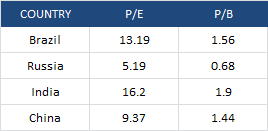
Russian stocks are currently very cheap. Firstly, they are the cheapest by p/e around the world in the table below (cheaper than when I last drew attention to them here), whilst paying a 4.5% yield:

2apr20133Source: FT

Secondly, they are also ultra cheap by cyclically adjusted p/e valuation:

2apr20137Plus thirdly, they are on a price-to-book ratio of just 0.68 (data as at 1st March). Anything less than 1 means that a liquidation of the entire index would return more in net assets than the current valuation. Something to bear in mind when considering how much lower they could yet fall.

2apr201311Source: Fool.com

Generally speaking historically, stock indices have been a buy when p/es have reached sub 10 and p/bs sub 1.5, i.e. they have returned consistently well when purchasing at these levels. So what’s up with Russian stocks that sees them languishing at extreme cheap valuations? Why haven’t buyers stepped in?

There are some ongoing broad issues with investing in Russia, such as a lack of political transparency, a corruption problem, and demographic issues. These collectively give Russia a risk premium, that can lead to cheaper ‘normal’ valuations. We can see this in the next chart, showing p/e trends over recent years for certain emerging markets – Russia has largely traded at cheaper levels to the others. It broke sub p/e 5 at the bottom of both of the last two cyclical bears, but the current valuation has not been beaten aside of these.

2apr20138

Compared to the other three members of the BRIC emerging group (of which China also has political and demographic challenges), the economic position in Russia stands up fairly well, with low debt to GDP and unemployment, yet it trades at a 50% discount or more:

2apr201310Source: Fool.com

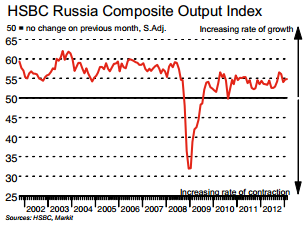
Russia experienced a recession around the financial crisis of 2008 but has since maintained positive growth. That growth however is at a lower level to pre-2008, as shown:

2apr201316Source: Syz

One reason for this lower growth has been energy prices. Energy contributes up to 25% of GDP and 65% of exports. It is the largest producer and exporter of oil in the world, and has the largest reserves and is the largest exporter of natural gas. Up to and into 2008, energy was ‘hot’ and Russia benefited accordingly. Whereas since 2008, natural gas prices have tumbled, and in the last two years oil prices have largely tracked sideways.

In the next chart it can be seen that the Russian stock index has a close correlation with the oil price, up to a 0.9 correlation.

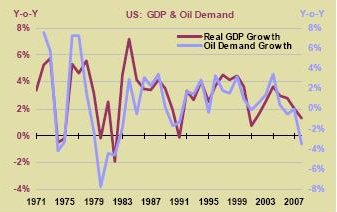
2apr201312Three companies dominate the RTS and MICEX stock indices: Gazprom, Lukoil and Sberbank, of which the first two relate to energy. Therefore, both by economic weighting and stock index weighting, Russia is an energy play, and a key question is, therefore, where are energy prices headed? To partially answer that, let me also show the association in oil demand and oil price to GDP in both USA and China:

2apr201313

2apr201314

Global economic growth is a key driver of energy prices, and therefore expectations in growth become important to the performance of the Russian stock indices. In fact, Russia is regarded as a high beta bet on global growth. As growth spurts have been weak and short-lived over the last 3 years, Russian stocks have been sensitive to that growth ‘not sticking’.

Since mid-2012, however, we have seen a fairly sustained pick up in growth and this picture still persists in leading indicators today. Has the secular cycle rinsing process combined with sustained central bank supportive actions finally produced a new cycle in growth? It is normal for there to be a growthflationary finale to the current cyclical stocks bull and secular/solar cycling, bringing about a tightening in yields and potentially rates, so I see this as very much possible at this stage.

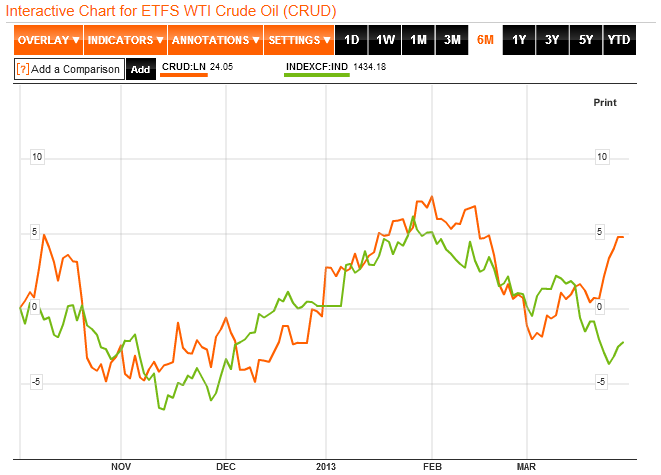
The action in crude oil over the last two weeks also suggests belief in some sustained global growth here, as it has accelerated on good momentum to a point of potential breakout. It outperformed stocks in this period and in the chart below we can see that the Russian Micex index got left behind:

2apr201315

Source: Bloomberg

This is evidence that they do not move lock-step, and another glance at the RTS and Crude Oil longer term price correlation chart reveals that there are occasional periods where one can outperform the other. After all, both the Russian economy and the Russian stock index are not just about energy. So with that in mind, let’s take a look at leading indicators for the Russian economy as they stand currently:

2apr201317

Source: OECD2apr201318

A pick up in the Russian economy, seen here, is in line with the general global picture, and confirms that Russia is not an outlier to be avoided.

Additionally, natural gas prices have been making a potential bottom, with a reclaim of $4 last week adding to that positive technical picture.

2apr201320

Source: Trading Charts

A technical advance in gas and oil prices, together with maintained positive leading indicators of growth, ought to drag up the Russian stock index. This is also a seasonally positive time for both oil and gas, with prices typically historically on the rise over the next couple of months.

Let me draw all this together. Russian stocks are very cheap by all three valuation measures, both compared to other countries and by their own history. The Russian stock index is generally a play on energy prices and a high beta play on global growth. Global growth and energy prices correlate fairly well, so we could simplify it and say that if global growth can be sustained here, then Russian stocks are an attractive proposition at this point. Alternatively, if energy prices can rally here (which they tend to do as late cyclicals taking over from stocks), then Russian stocks may equally be an attractive proposition.

If we are unsure about the prospects for global growth or momentum in energy prices, then there may still be a mean reversion opportunity here: Russian stocks could play catch up with the oil price rises of the last two weeks, and/or pull a little away from extreme cheap valuation as investors look for value. As an additional consideration, what would happen to Russian stocks under the competing scenarios of a secular commodities finale ahead versus a secular commodities bull over and a new secular stocks bull underway? I suggest that under the former they would be a late outperforming index due to the energy correlation, and under the latter they would suffer from any sharp falls in energy prices but ultimately their cheapness and momentum in global stocks would drag them higher (a rising tide lifts all boats) eventually. Under both scenarios such developments could take time, as patience is often needed for value plays.

Finally, this is a higher risk opportunity – Russia is not the most investment-friendly country, and is more at risk from an ‘event’. That said, it is the 9th largest economy in the world and as such a key player in the global scene.

OK, I have opened a long trade in Russian stocks today. The timing of this is also not far from the start of the lunar positive period, which provides an additional potential support for the trade. I am open on the timescale involved in this trade, as it could be a swift gainer or a longer term play of patience.