Exhaustion Or Breakout

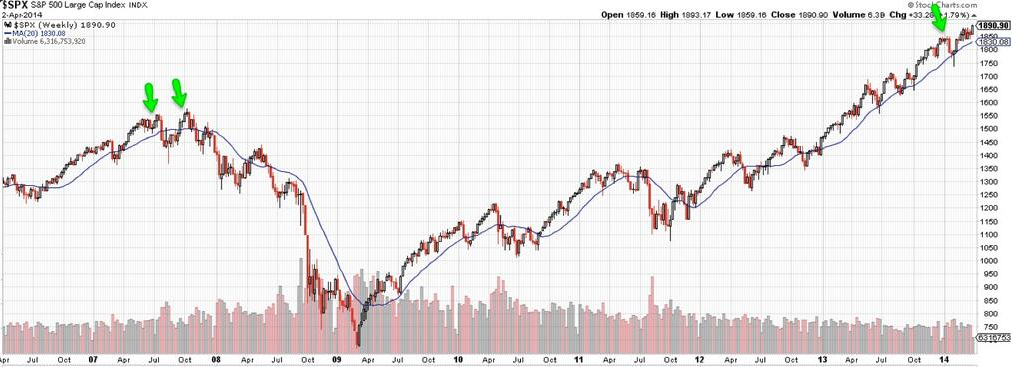
Superficially a bullish breakout, but behind the scenes both the SP500 and Dow met DeMark’s exhaustion topping criteria yesterday.

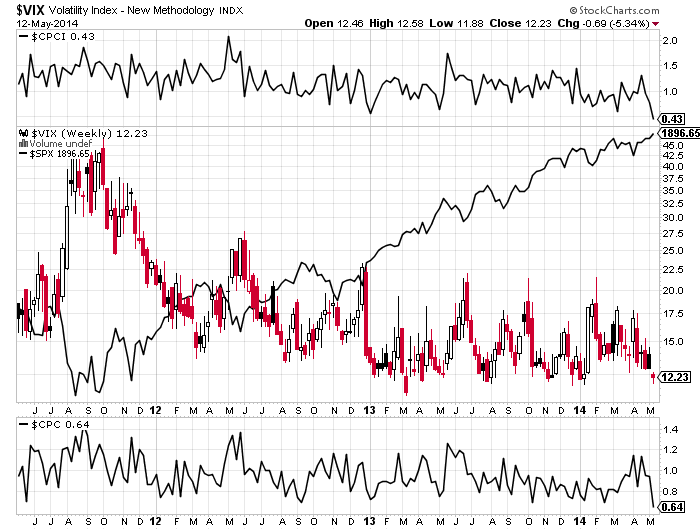
Supporting that, the breakouts/rallies were on low volume, the put/call ratio for the indices (CPCI) finished at one of its lowest ever readings, and the CPC and VIX also reached contrarian low levels:

13m2Source: Stockcharts

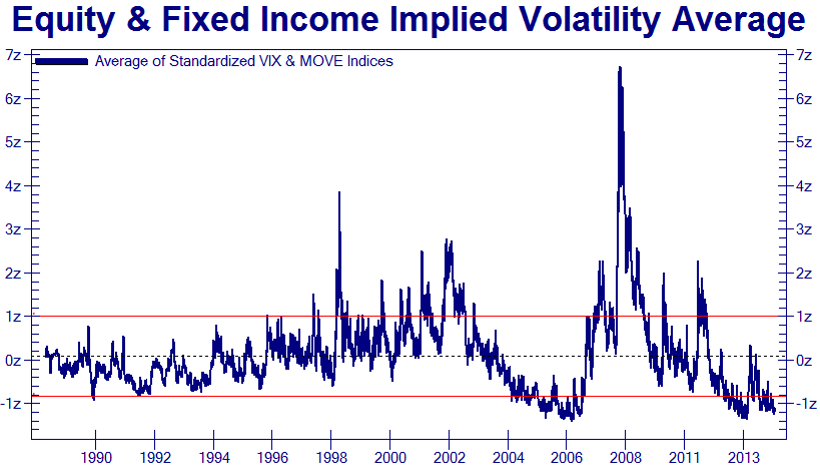
A longer term look at stocks volatility plus treasuries volatility reveals historic compression:

13m3Source: @Not_Jim_Cramer

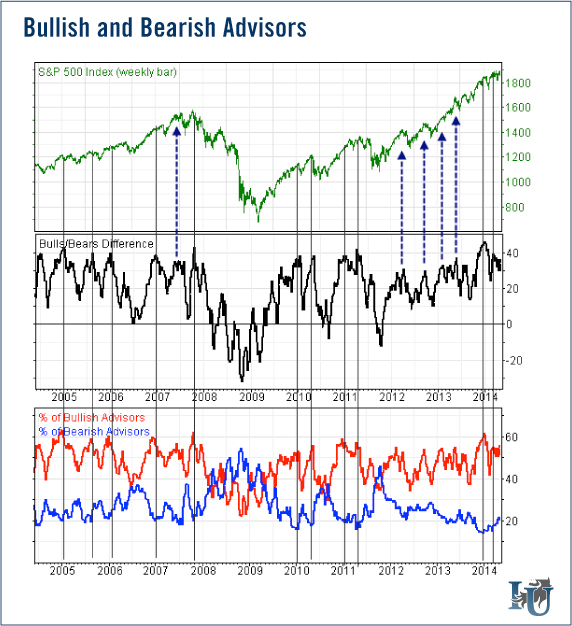
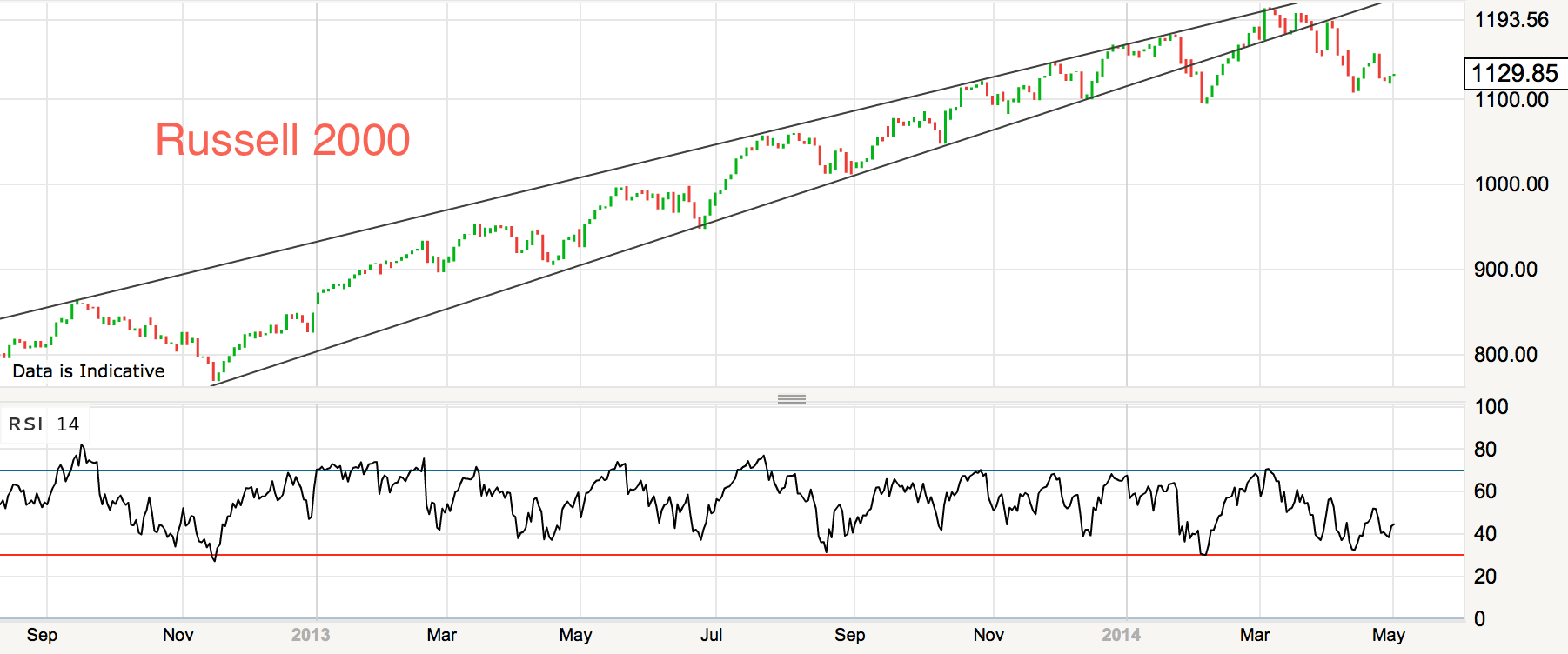
Sentiment remains elevated, as the March/April falls in the Nasdaq and Russell 2000 made little impact:

13m4Source: Investment U

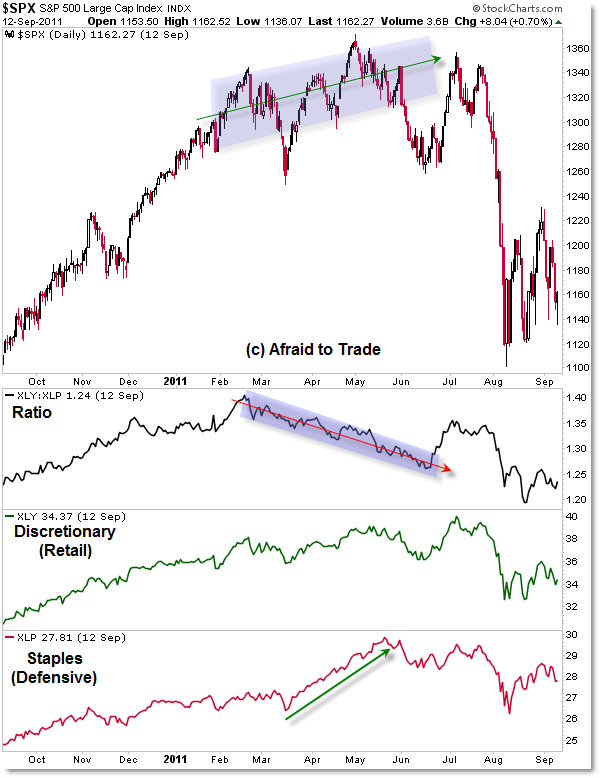
So, put/call, volatility and sentiment all signal high complacency, whilst the last time we saw such persistent money flow into defensives was 2011:

13m5Source: AfraidToTrade

I’ve added again to the SP500 and Dow short positions. Tomorrow is the full moon, let’s see if we get an inversion and bull trap.

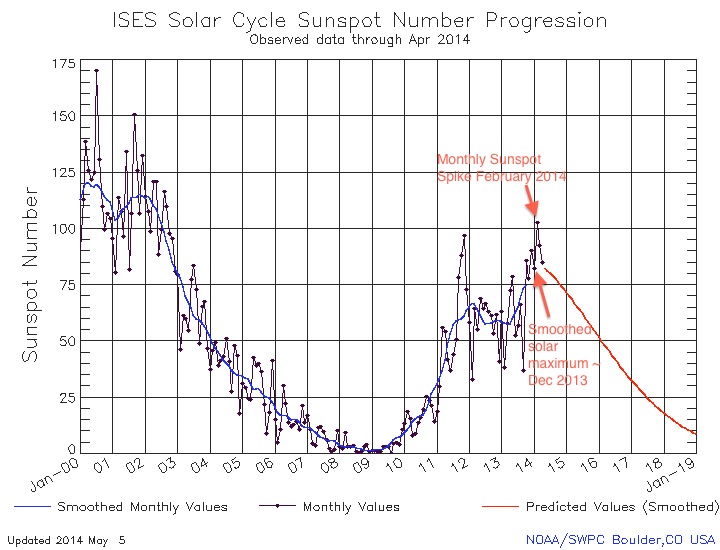
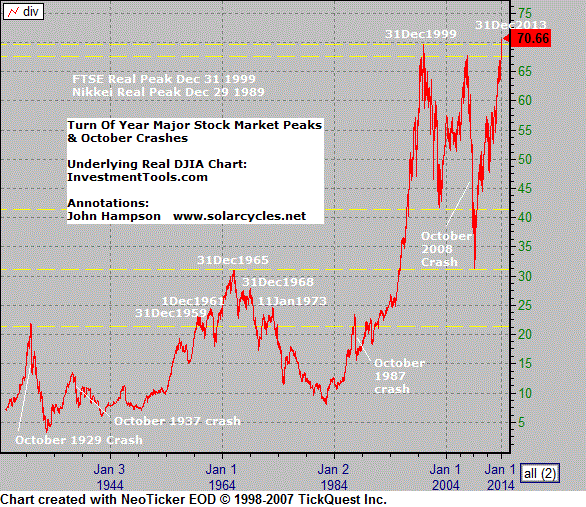
To finish, this is how the Dow peak looked at solar cycle 20 maximum, namely a topping process at a turn-of-year solar top:

13m6

Underlying Source: FiendBear

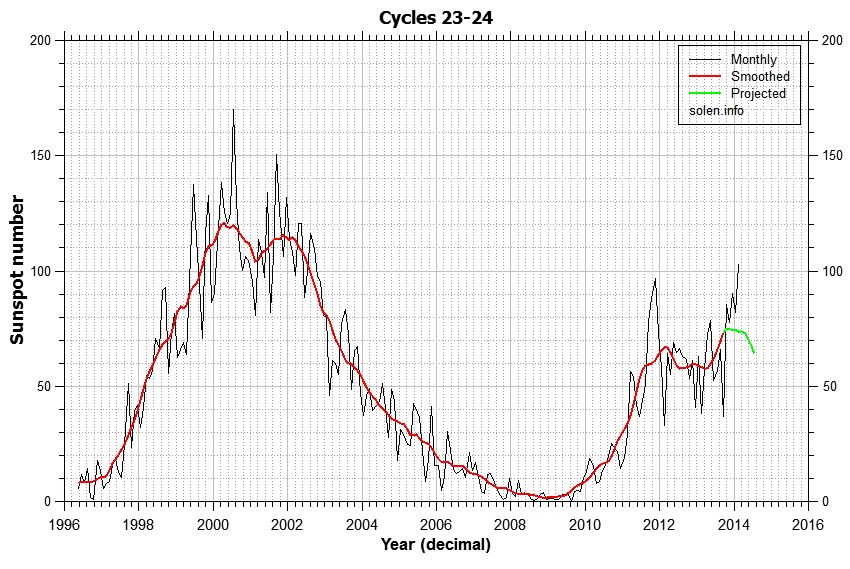
As things stand, the current solar cycle (24) smoothed peak is likely to have fallen circa Dec 2013, the monthly sunspot spike in Feb 2014, the real Dow peak likely end of Dec 2013 and the secondary high here in May: all very similar to 1968/9.

US Stock Indices

I recently gathered 40 indicators showing why the stock market is a major shorting opportunity, and now we have increased evidence as to why the speculation peak may be behind us, with the solar peak likely Dec 2013 – Feb 2014, and margin debt thus far having topped out in February.

7m1

Source: NOAA

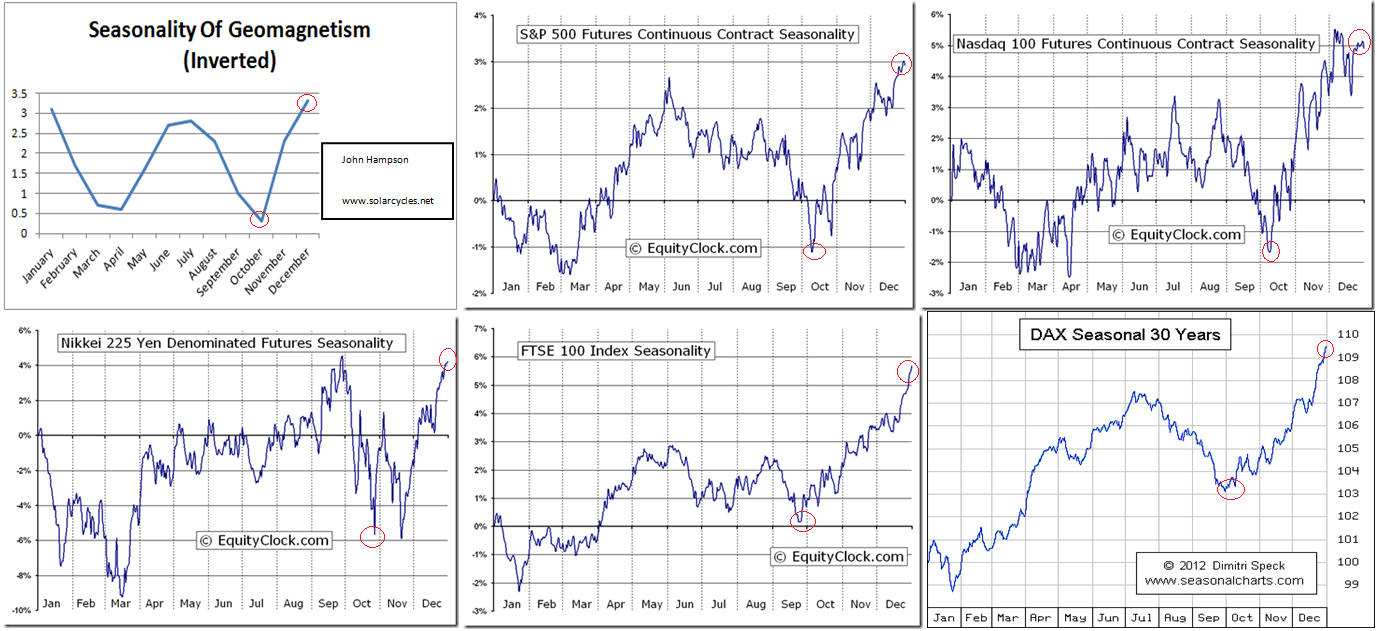
The Bitcoin speculative peak was December. The real Dow and real Nikkei peaks were thus far 31 December 2013, joining the club of historic peaks falling at the inverted seasonal geomagnetic peak (second and third charts):

7m3

 Source: Dshort

7m2

7m7

Also, the 31 Dec peak was 1 day from the new moon, which fits the pattern of historic peaks typically occurring at the peak optimism of the new moon. The Russell 2000, Nasdaq and Biotech peaks also look to have fallen at the new moon of March 1st:

5m4

Source: Stockcharts7m6

The SP500 has flat-topped between December and May. Chances are slim that this is consolidation before further upside due to the congregation of indicators at historic extremes and the likely waning from here of the solar maximum. Recall: super peaks need a solar maximum, a leverage peak (same buyers more debt) and a demographic tailwind (new buyers). The latter is absent and the leverage is at all-time extreme already.

The solar maximum generates maximum human excitement, so as well as speculation peaking in the markets, we typically see growthflation in the economy into the solar peak. I therefore expect markets and economy to decline as one from here.

A historic opportunity:

7m87m97m10

Peak Speculation And Russell 2000

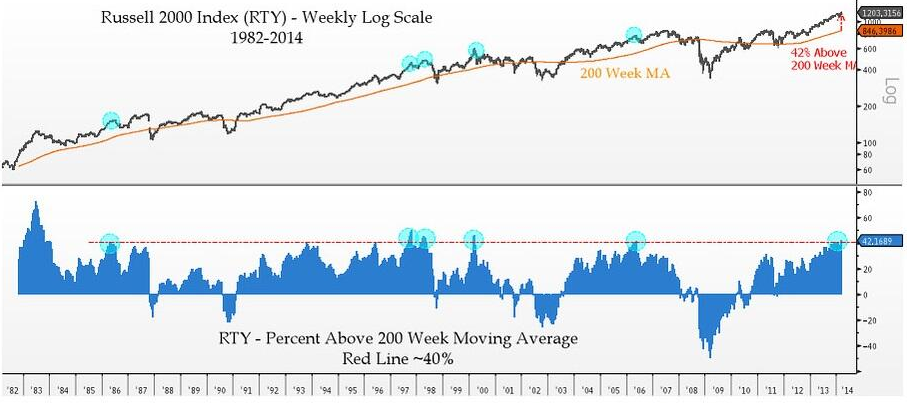
Speculation typically peaks out at solar cycle peaks. In 1989, the Nikkei was the speculative target reaching p/e>80 as it topped out at the solar cycle 22 peak. In 2000, the Nasdaq soared to p/e>80 as it topped out at the solar cycle 23 maximum. Now, at the current solar cycle 24 peak we see a broad range of historic topping valuations in equities but it is particularly the small caps that have been subjected and bid up to the extreme, as the trailing p/e for the Russell 2000 currently stands at >100.

Remove the companies with negative earnings, which is about 20% of them, and it would be 23, which is at the top of its historical pricing:

1ma7

 Source: Andrewunknown

Valuing by EBITDA, the R2K reached 10.8 in March, the highest since 1995.

Small caps are also at the top of their historical pricing relative to large caps:

1ma8

Source: Alhambra

Similar historical rallies to 2013 in the R2k have been reversed in full the following year:

1ma10

 Source: Fat-Pitch

R2K current historic levitation is demonstrated here:

Screen Shot 2014-05-01 at 10.40.50

 Source: Gordon T Long

Biotechs have been a key driver of the R2K outperformance, but their parabolic bubble looks to have popped:

1ma11

 Source: Alhambra

Along with Biotech, the Russell 2000 potentially topped at the turn of February into March:

Screen Shot 2014-05-01 at 10.19.08Lerverage also looks to have peaked out in February:

1ma1

Source: DShort

Over the last 5 months, the collective performance of the four major US stock indices switched from uptrend to range:

1ma5

Source: Stockcharts

I believe this is a topping process aligned with the solar cycle topping, so let’s look at the updated solar charts.

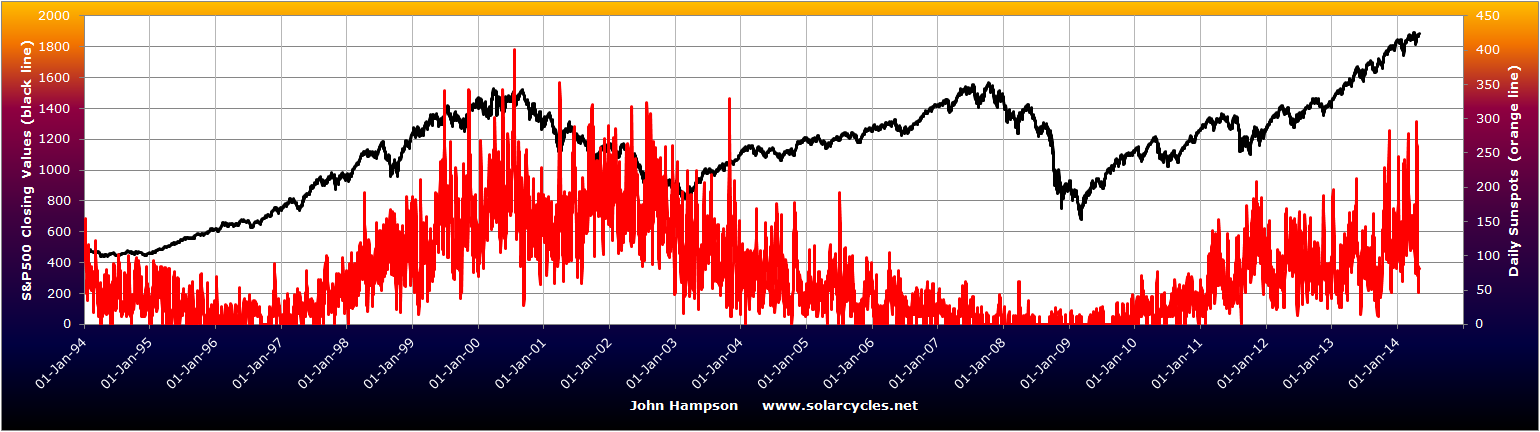
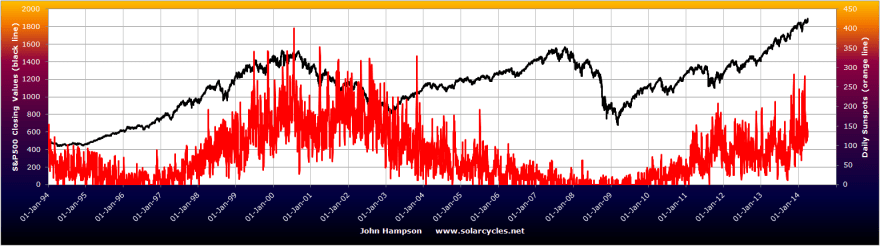
My daily sunspots chart shows a higher high but a lower low in April:

1ma2

The pole-switch progress has been oscillating around a trend that is now set to complete:

1ma3Source: Leif Svalgaard

Nasa and Noaa models suggest the smoothed solar peak is behind us. Solen agree, suggesting a smoothed peak around December 2013. The below forecast aligns with that, whilst allowing for an April peak:

Screen Shot 2014-05-01 at 10.49.49

Source: Sunspotwatch

SIDC are still running with their two alternatives. The SC prediction aligns with that of solar cycle 16 progress, which SC24 has mirrored to date. The CM forecast predicts ongoing but plateauing strength into late 2014.

1ma12

Source: SIDC

Previous speculation peaks occurred close to the smoothed solar maximum and on a spike in monthly sunspots. Aggregating the predictions, the smoothed solar maximum for SC24 is likely to have been at the turn of the year from 2013 into 2014, whilst the monthly sunspot spike so far was February 2014, with both March and April coming in lower.

As things stand, US equities broke out of their uptrend and into a range at the turn of the year and the R2K, Nasdaq, Biotech and momentum stocks all peaked out at the end of February. A February peak in margin debt is also supportive of a potential speculation peak having occurred.

I suggest chances are slim that equities resume an uptrend here following this price ranging, due to the 30 bearish indicators that I recently amassed, some of which are already overdue fulfilment by historic norms. We have a compelling cross-reference of stock market topping indicators (price clues) and solar cycle topping indicators (time clues) in the window of Dec 2013 to April 2014. I believe the Dow’s marginal new high yesterday will be shorted lived: a fake-out.

My biggest short remains the Russell 2000 and I have added to this today. It is the largest trading position I have ever had, so there’s my conviction. NFP Friday a likely market mover, and the start of the lunar negative period this weekend.

SC24 v SC16

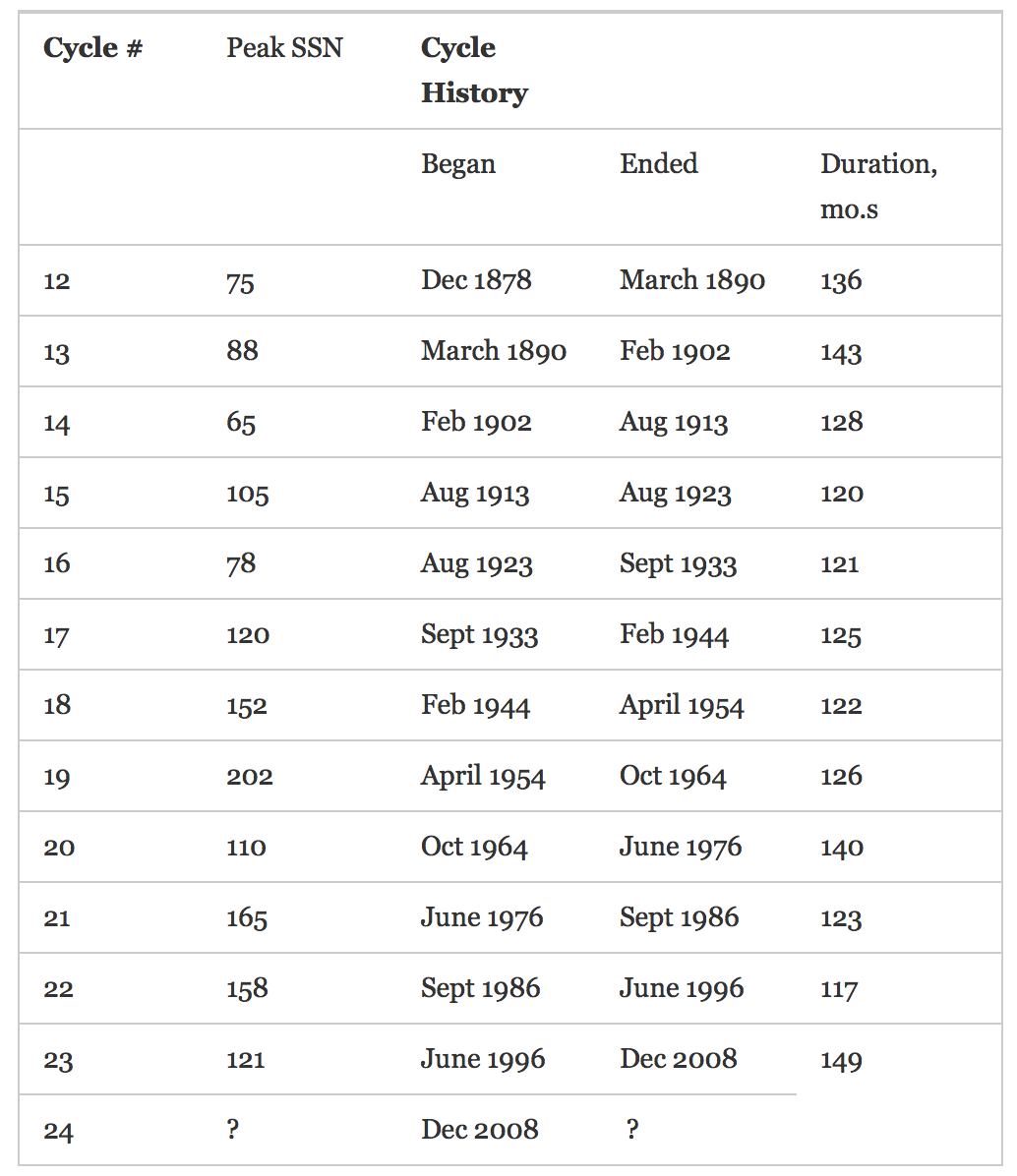
Solar cycle 24 is projected to peak with a smoothed sunspot count of under 80 (peak SSN), which makes it the weakest cycle since solar cycle 16:

Screen Shot 2014-04-29 at 15.08.49Source: CBDakota

Solar cycle 24 is also the first since solar cycle 16 to have a higher secondary peaking of activity at the maximum, rather than the higher peaking coming first:

Screen Shot 2014-04-29 at 15.19.55

Source: Livingston & Penn

Solar cycle 16 is also the most similar in shape and progress to solar cycle 24:

29ap2

Source: Solen.info

The solar cycle 16 maximum ended with the 1929 crash and the start of the Great Depression. Demographics forecast a similar such period ahead and current stock market indicators point to both a bull market peak and a the set up for a stock market crash.

The chart of SC16 below shows that the stock market did not collapse until the final and largest monthly sunspot count:29ap3


Source: Solen.info

Have we experienced a similar last burst in solar activity in Q1-Q2 2014?:

29ap5

Source: Solen.info

Or does the top need to extend further yet in time? Either way, the similarities are intriguing.

I maintain the solar cycle is key to the stocks bear. We have 30 bearish indicators, and max leverage in the markets. Now we need to speculation to top out and leverage to unwind, and I believe it will do so when the solar maximum starts to wane. It may have already begun to wane and stocks have already topped out, but the evidence comes in slowly. Patience and money management are the key.

Price Cheerleading

Time to look at what has been invalidated from my Q1 analysis.

I am no permabear. I played equities long-only from 2009 through to 2013 but by the end of 2013 there was an impressive congregation of topping indicators, which aligned with a predicted peak in the solar cycle. Adding in my demographic research, the case was particularly compelling to short stocks and hunt for a major peak. So I decisively switched teams. That compelling bearish case still stands, as just a couple of weeks ago I produced a list of 30 indicators advocating short. See that list here.

In short, focussing on US stock indices, whether we look at valuations, bull market characteristics, sentiment, euphoria, leverage, IPOs, equity allocations, smart money flows, breadth divergences and other indicators with reliable histories, we have a case for a top in US equities. Add them all together, and it’s just about the timing. Therefore I don’t understand shorters throwing in the towel at this point, and particularly because as things stand, US stock indices have traded sideways in 2014. There is no definitive bull or bear trend, and at the time of writing 3 of the 4 main US indices are below their Dec 31 close, whilst only marginally so. Price has only paid for short term trading over the last 4 months, and the rest of us are patiently – or impatiently – waiting. Pending that resolution, beware the price-cheerleading from both bull and bear camps, thinly disguised as analysis.

So, with that multi-angled case for a top, why have stocks not fallen decisively yet? I argue that the reason is the solar cycle maximum extending beyond the predictions of the major solar scientists, and its implication on speculation in the markets.

23ap1

Therefore, my anticipated waterfall declines in March and April and analog aggregation did not happen:

23ap2

However, by indicator extremes and similarities, the set up remains for a crash in the markets and the delivery of those waterfall declines as the peak leverage is unwound. But, for now, the stock indices have morphed into sideways ranges, as the solar maximum has extended. The solar maximum, through human excitement, influences speculation and also economic activity. Once the solar maximum begins to wane I expect both to ebb together, and I therefore consider this one of the most important items to track.

Should the solar maximum not peak out until mid-2014 then I would look to the possible analogs of 2011 and 1987 as price guides. Both these analogs shared similar indicator extreme readings and backdrops, and both saw waterfall declines in the Fall/Autumn. 2011 produced a long sideways range ahead of the falls, whilst 1987 eked out further price gains in the summer, before the falls. My approach is to stay short and attack short until we see the major declines, shearing off profits as I see fit based on the short term action, and should stocks eke out further new highs before the falls, as per 1987, then my current exposure can cope with that.

Should the smoothed solar maximum be behind us, and sunspots wane from here, then those Q1 2014 trading ranges in the indices may turn out retrospectively to be the beginning of a new downtrend, made clear by imminent sharp falls (declines from here would fit the Presidential cycle). In support of that possibility, my January call that the Dow and Nikkei peaked 31 Dec still stands at the time of writing, and my March 2 call that the Russell 2000 and Biotech sector peaked out around last day of Feb is so far accurate.

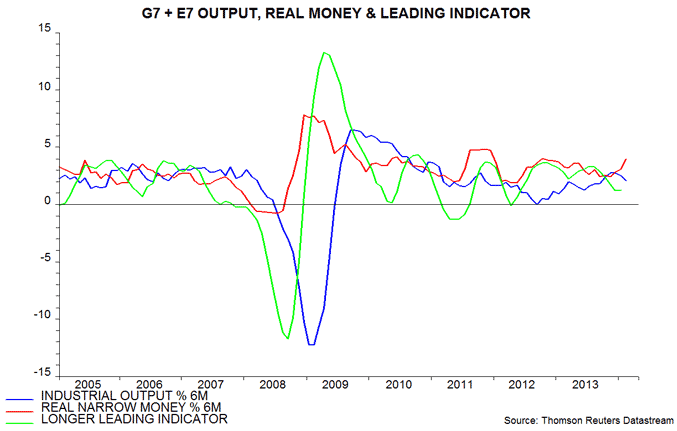
From a bullish perspective, cumulative advance-declines continue to support, and cyclical sectors recovered after their January sell-off. Gold and miners have fallen back since mid-March. Leading indicators suggest a pick up in global industrial production as of mid-May, so that could become a tailwind if stocks do not significantly sell off over the next couple of weeks. Q1 earnings are projected to produce an overall decrease in earnings, for the first quarter in some time, but thus far we do not see overall bearish price reaction to those that have reported. Economically, we do not yet see the tip into outright deflation or negative growth, but I expect that to come hand in hand with the stock market declines post-solar-maximum, i.e. sharp stock market declines will affect the economy and vice versa, all guided by the sun’s influence on people.

My Q1 2014 ‘misses’ in terms of analysis can be summed up as impatience over the sharp falls into a definitive bear trend, but I believe the reason for that is the extension of the solar maximum, which was unknown at the time. The bulk of my analysis still stands, and will continue to do so until that definitive selling erupts.

In the near term I am looking at market reaction to earnings, how price behaves into the new moon at the end of April, and the indicator reports at the turn of April-May for sunspots, margin debt, and more. I am adding short into the stock market rallies, such as this 6-day rally into today, looking to short term indicators for overbought/exhaustion. I am also watching commodities to see if they can continue to rally as a late cyclical class (considering gold separate) which typifies a top, but I have been taking profits on commodities positions as I have my doubts about the longevity of their rally due to deflationary/recessionary pressures. Potentially reflecting such pressures, treasuries have continued to perform since their turn-up as of the start of January and are another clue into what lies ahead.

23ap3


Solar Cycle 24

The solar cycle matters for this reason:

20ap1

Peaks in the activity of the sun produce speculative peaks by variation in human excitement, so it is a trading timing tool.

It has been a thrill to watch in real time this solar maximum unfolding and the associated congregation of indicators suggesting a historic top in equities occurring close the solar maximum again. Each of those indicators that I have aggregated has a reliable history on its own, so the question is why the stock market has not tipped over to the downside more decisively by this point. It looks like the answer may be that the sun is still increasing in activity:

20ap3

4 consecutive daily sunspot prints over 240 over Easter weekend keeps the visual in trend in ascendance.

Previous speculative peaks occurred close to the smoothed solar maximum and on a monthly spike in sunspots, so the question is whether this solar strength can be maintained for the rest of April and for the weeks and months ahead to drag the smoothed maximum from end-2013 to mid-2014. Either way, this continued solar strengthening was a bad miss by most solar scientists, with only SIDC in my congregation running such an alternative, and kudos to Mark for suggesting the maximum would extend.

Note also how at this solar maximum we are seeing a higher later peak in a fairly typical double peak, whereas previous cycles tended to produce the higher peak first:

20ap5 20ap4Sources: Solen and SIDC

This adds to the peculiarity of this solar cycle maximum.

The implications for trading depend on how the solar maximum continues to unfold. If the smoothed solar maximum is dragged out to mid-2014 then we may then be looking at the Autumn/Fall for a true stock markets sell-off. If on the other hand sunspots quieten down in the weeks ahead then the smoothed solar max may be retained as ~Dec 2013 and the stock markets may be about to decline in a more major fashion. But either way, the persistent strength in the sun’s activity beyond the end of 2013 through to now has been a key and unexpected factor in maintaining speculation and keeping the markets elevated despite indicators at historic readings.

I now look to the end of April to see how the monthly sunspot count shapes up, to see how solar scientists adjust their forecasts, and to see whether other measures of speculation, such as margin debt, show a peak or continue to rise.


The State Of The Markets

Thank you so much for all the messages of support – I was really touched to read them all. I had a burn out and now have to take things easy. I was working long days with the markets and doing too much of everything on top. So my posts will be less frequent for the foreseeable future, but as my focus is on the medium and long term, less intensive tracking may be no bad thing. I come back to the markets after a couple of weeks away and although price continues to frustrate, little has changed in the big picture. Some of my near term timings didn’t work out, but the overall case remains solidly bearish, and it’s a question of patiently waiting for price to fall in line.

Focusing on US stock indices, I have updated the bearish indicators and flags and added some new ones below:

1. A 5-year bull trend only occurred once before, in the 1990s, and was followed by 3 down years

2. Historic levitation above longer term moving averages and lack of 10%+ correction since 2012

3ap35

Source: Gordon T Long

3. Last 2 years rally in US stock indices has been made up of less than 20% earnings growth and more than 80% multiple expansion. The last 2 such occurrences in history were 1985:1986 (leading into 1987 crash) and 1997:1998 (leading into 1999 real Dow peak)

4. Compound annual growth rate in equities since 2009 was only exceeded in 1929, 1937, 1987 and 2000, all of which led to steep market declines

5. Crestmont P/E is the 3rd highest in history after 1999-2000 (market peak) and 1929 (market peak), and in 97th percentile

6. This is the 2nd highest market capitalistation to GDP valuation outside of 1999-2000 (market peak)

7. This is the 2nd highest Q ratio valuation in the last 100 years outside of 1999-2000 (market peak)

8. This is the 3rd highest CAPE valuation in the last 100 years outside of 1928-1929 (market peak) and 1999-2000 (market peak), and the US is the 4th highest CAPE valuation in the world currently.

9. Russell 2000 index p/e is currently 74.8; Russell 2000 to SP500 valuation differential at all time record

10. 84% of companies have offered negative earnings guidance for Q1 2014 so far; Last quarter’s revenue growth was the lowest since 2009

11. Skew is in elevated range for the last 6 months; Cluster of extreme Skew readings not seen since June 1990 before recession began July 1990

12. Put Call ratio 21 day average over the last several months has clustered in the extreme low zone that previously led to sharp corrections
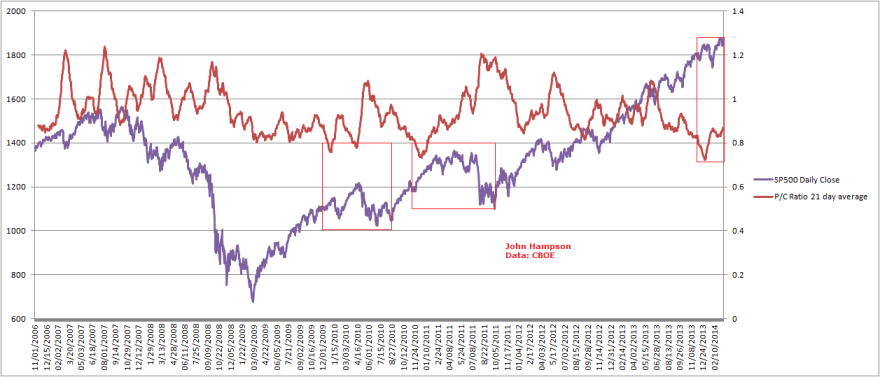
3ap1

13. Greedometer – aggregate of macroeconomic, fundamental and technical data – is at a record level exceeding the 2000 and 2007 market peaks

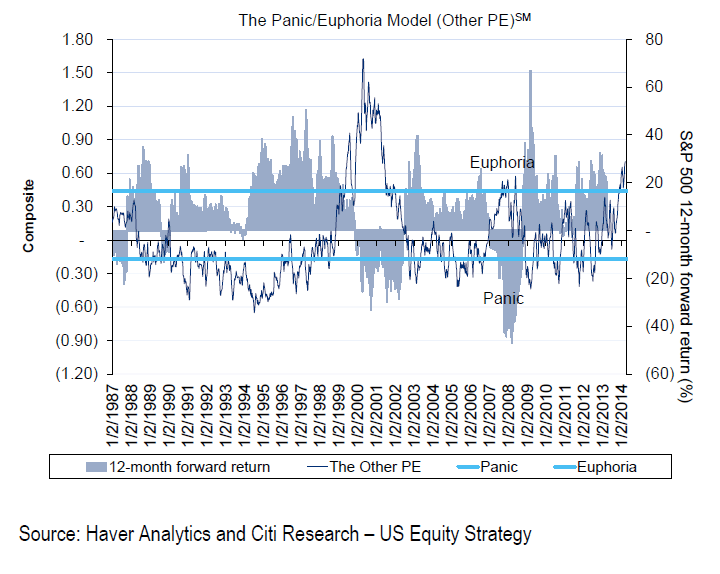
14. Citi Panic/Euphoria model at a level only exceeded into the 2000 peak:
3ap2

Source: Fat-Pitch

15. NAAIM sentiment remains historically high

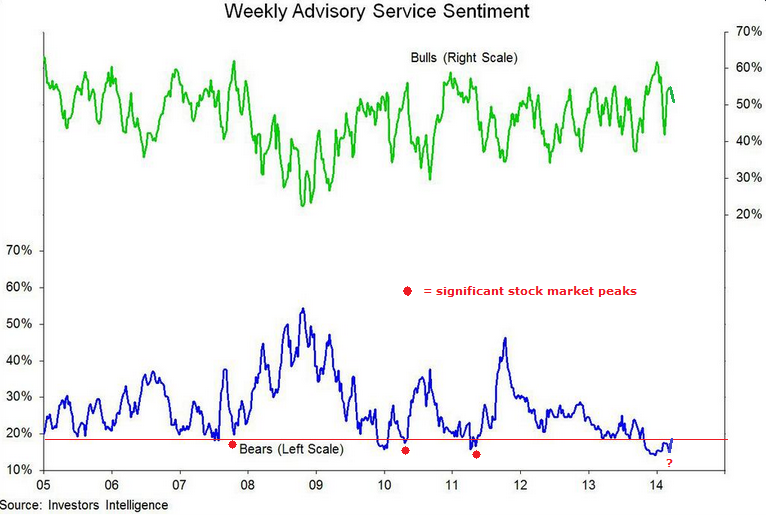
16. Investor Intelligence % bears levels and pattern similar to previous significant stock market peaks

3ap29

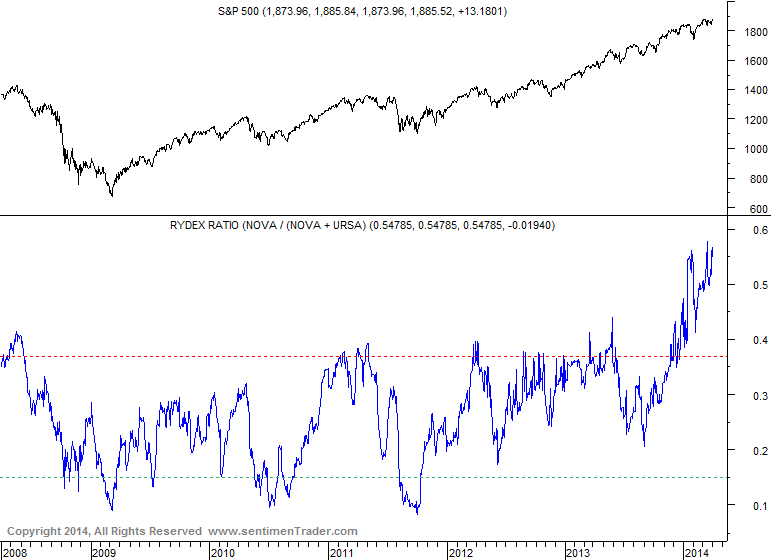
17. Rydex bull ratio at extreme historic high
3ap16

 Source: Sentimentrader

18. Margin debt (updated for Feb 2014) is at an all-time record, both in nominal and real terms, and as a percentage of market cap; Net investor credit balances are at an all time low

3ap4

Source: Dshort

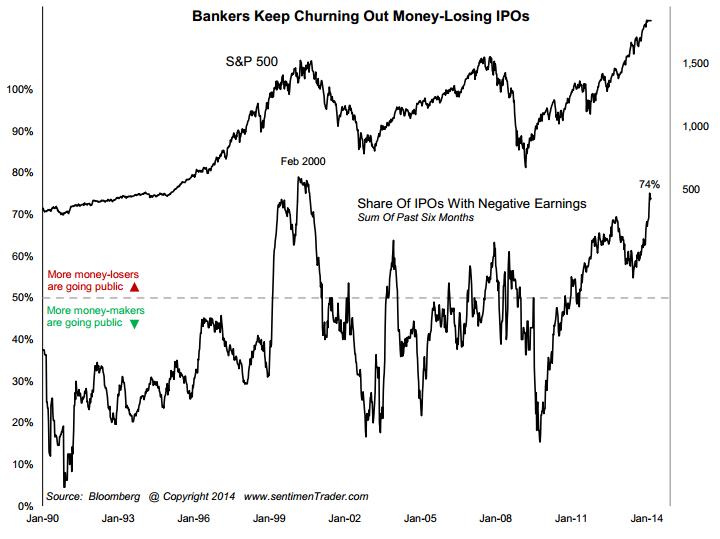
19. IPOs with negative earnings at levels consistent with previous market peaks

20. Leveraged loan issuance at record, surge mirrors 2007 and 2011 important stock market peaks

21. High yield corporate bonds to 20+ year treasuries shows a divergence with the stock market that has previously marked tops

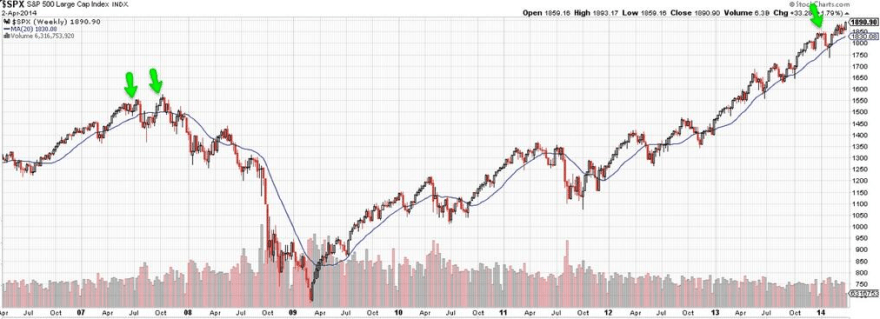
22. AAII equity allocations highest since June and Sep 2007 and Dec 2013
3ap5

 Source: UKarlewitz

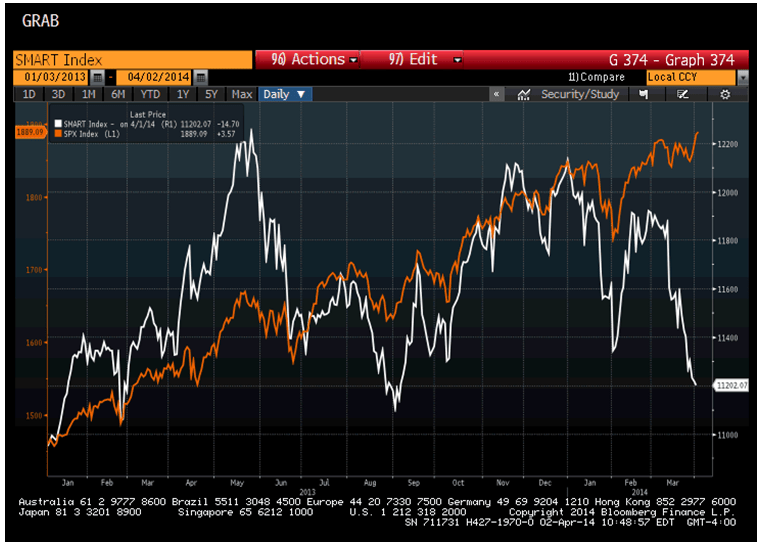
23. Smart Money Flow Index shows siginificant divergence in 2014
3ap6

Source: Todd Harrison

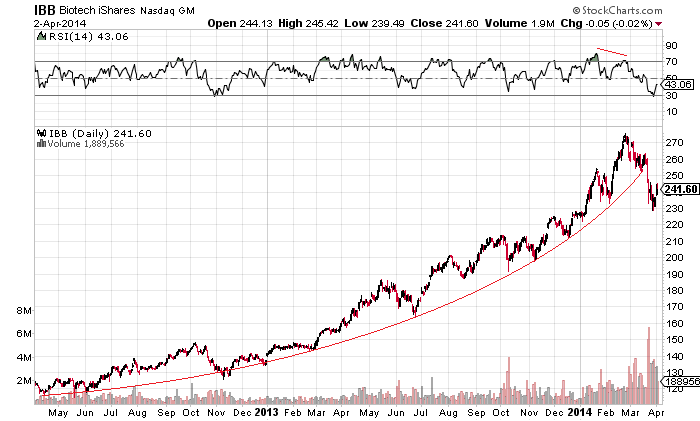
24. Biotech parabolic bubble breakdown

3ap7

Source: Stockcharts

25. Wider momentum stocks breakdown
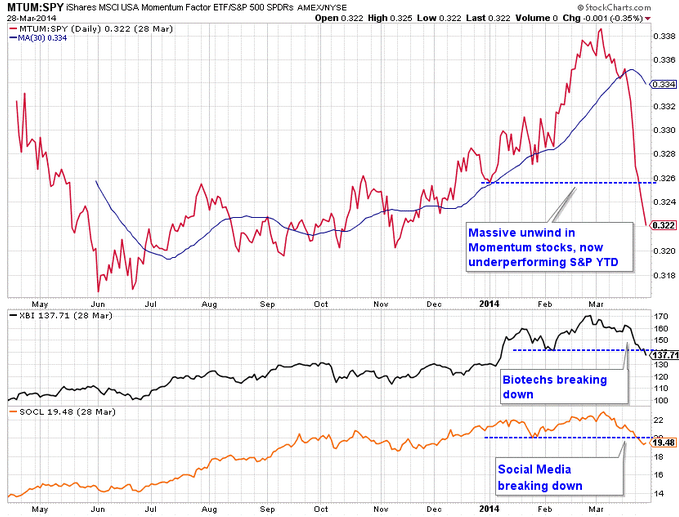
3ap14

Source: Charlie Bilello

26. Leading indicators suggest global industrial output slowdown into a May trough, then a pick up into late summer

3ap15

Source: MoneyMovesMarkets

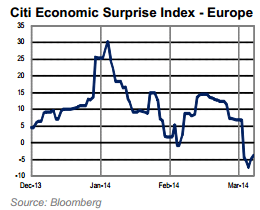
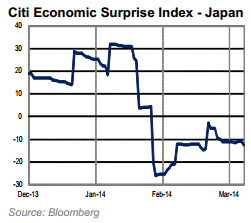
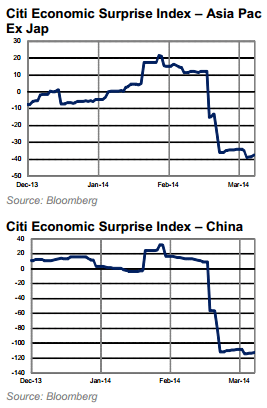
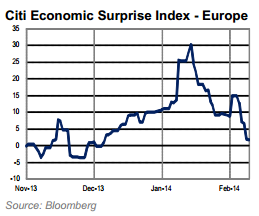
27. Citi Economic Surprise Indices for major global regions all negative
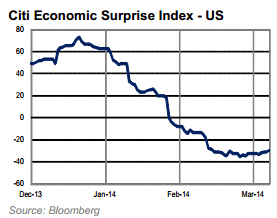
3ap17 3ap18 3ap19 3ap20Source: Citigroup

28. Fund manager allocation to global equities is at levels that previously led to a market peak or correction

29. Percentage of stocks hitting new highs is thinning into current new SP500 highs
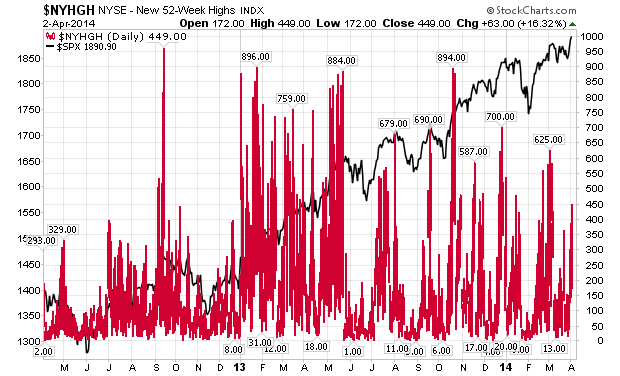
3ap10

Source: Stockcharts

30. Six month breadth divergence in Nasdaq 100 in stocks above 200MA
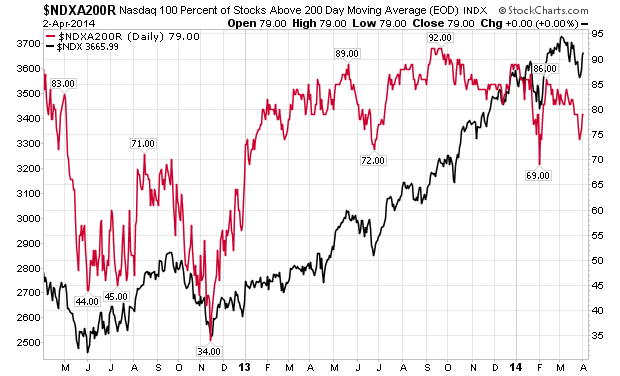
3ap11

Source: Stockcharts

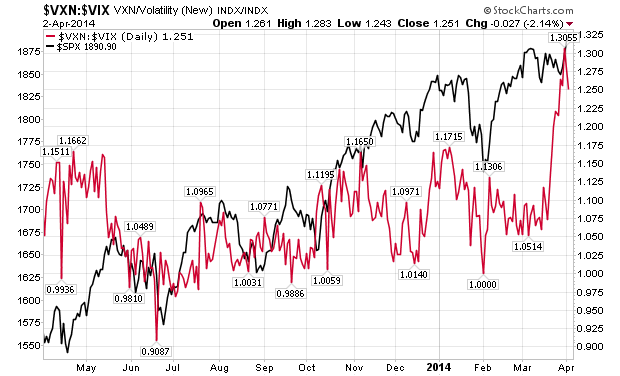
31. VXN/VIX ratio is a risk-off current flag

3ap22

Source: Stockcharts

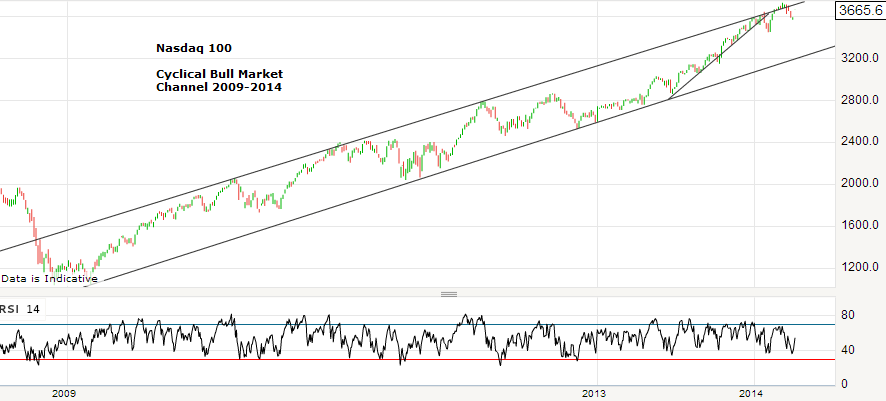
32. Nasdaq 100 made a fake-out from its cyclical bull channel in March
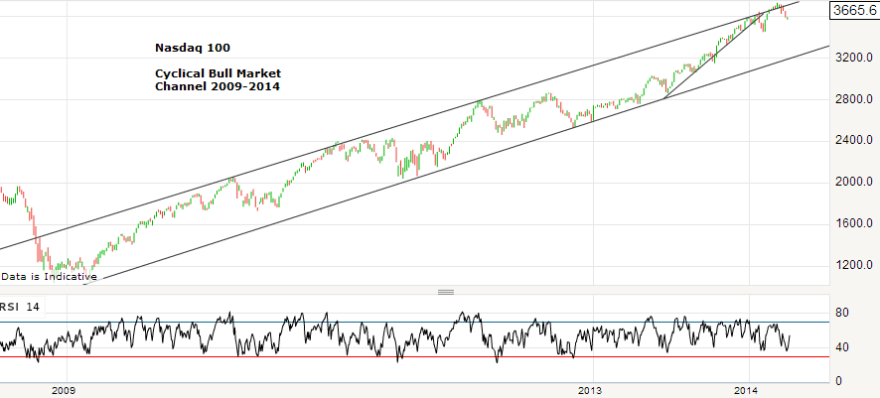
3ap24

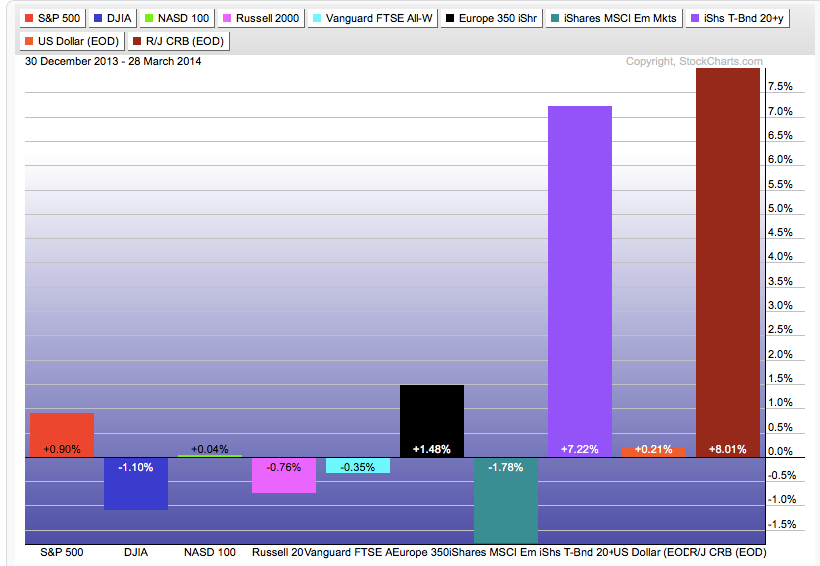
33. Best performing classes and sectors in Q1 2014 were commodities, treasuries and defensives

3ap30 3ap31

Source: Fat-Pitch

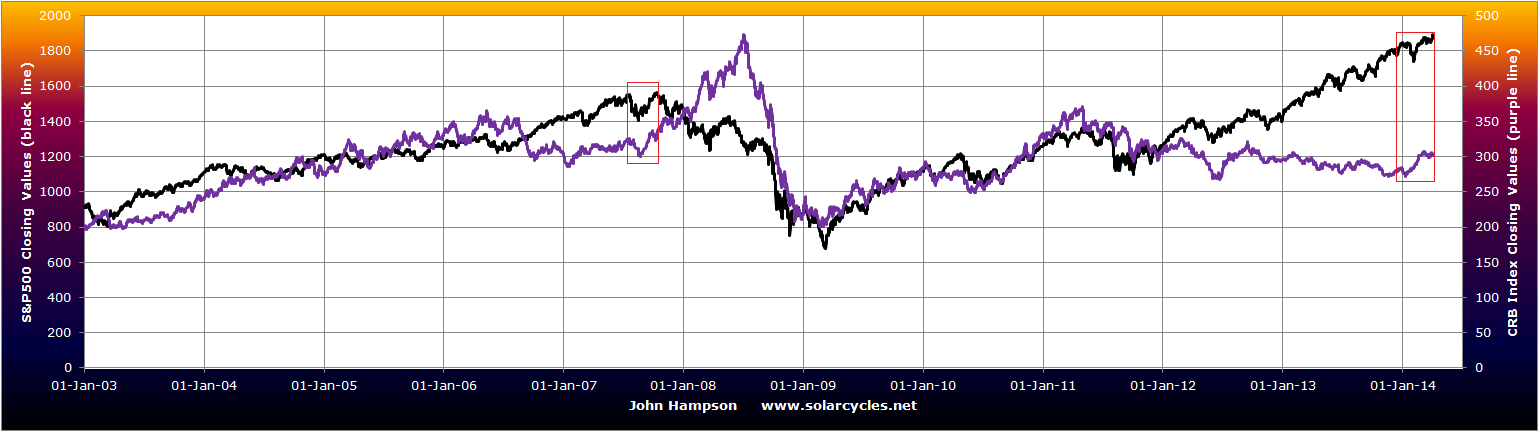
34. Late cyclical outperformance of commodities as equities top out consistent with 2000 and 2007 peaks
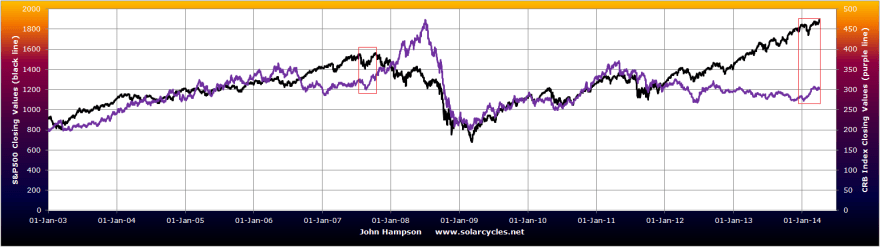
3ap32

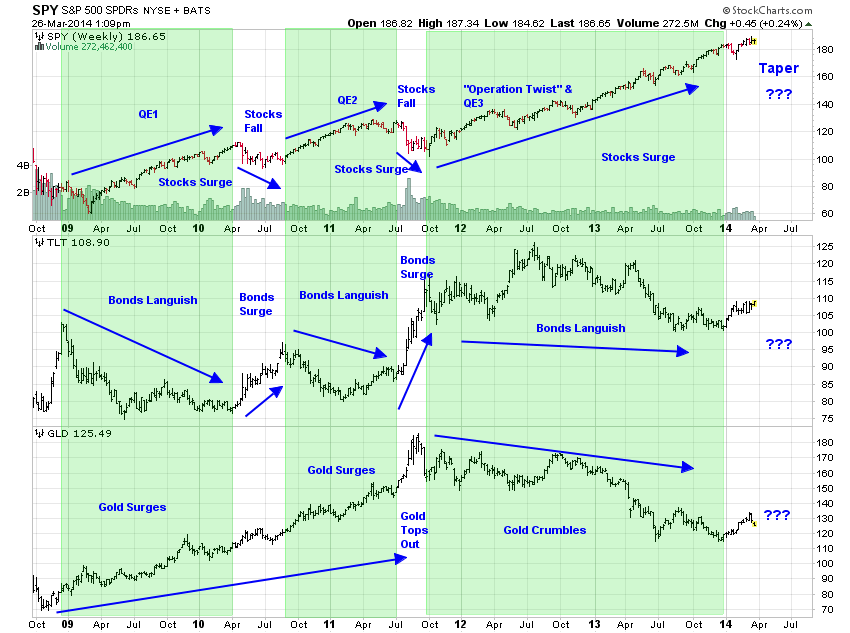
35. Winding down of QE historically negative for equities, positive for bonds and gold

3ap21

Source: Jesse Felder

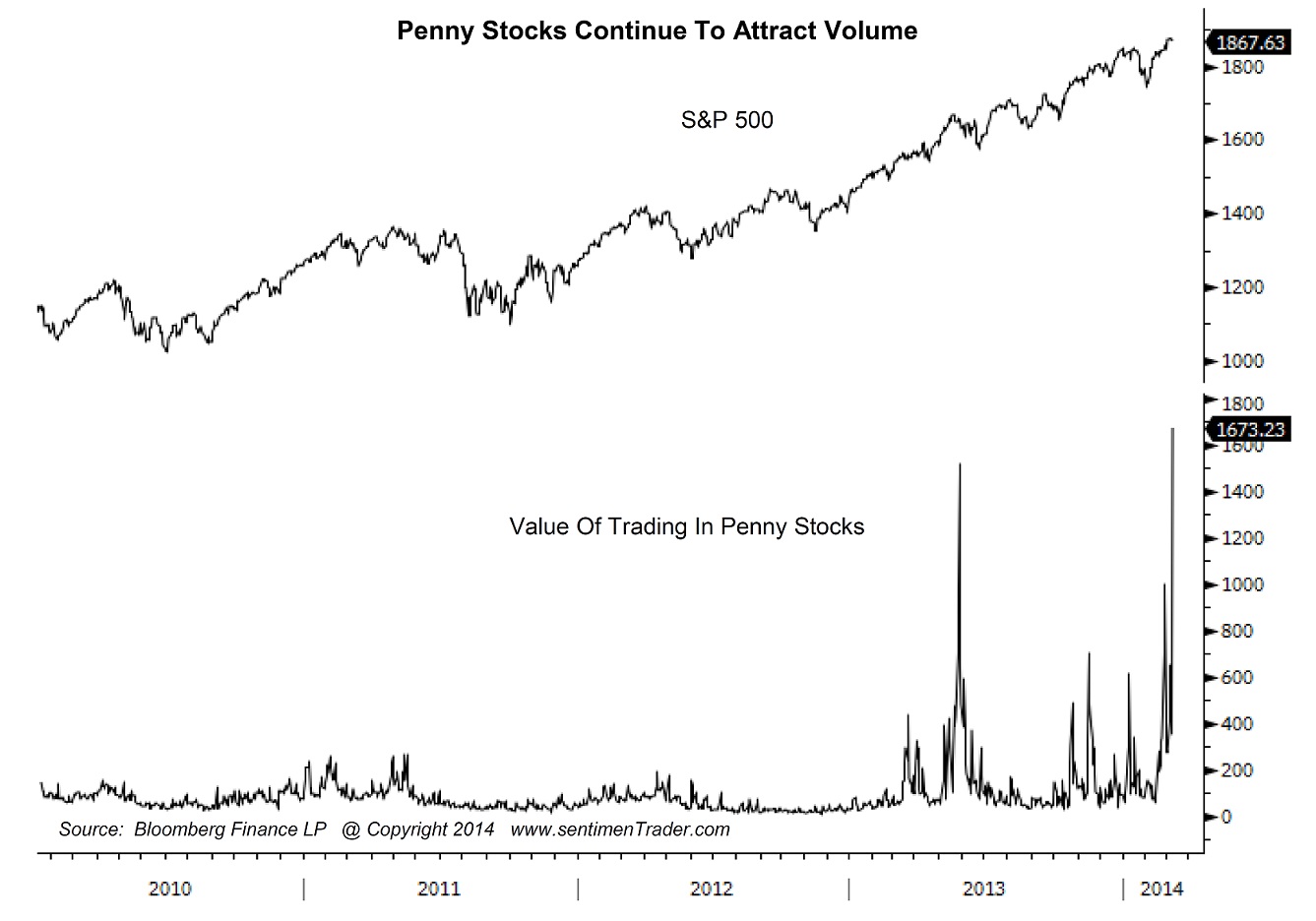
36. Trading in penny stocks signalling a peak
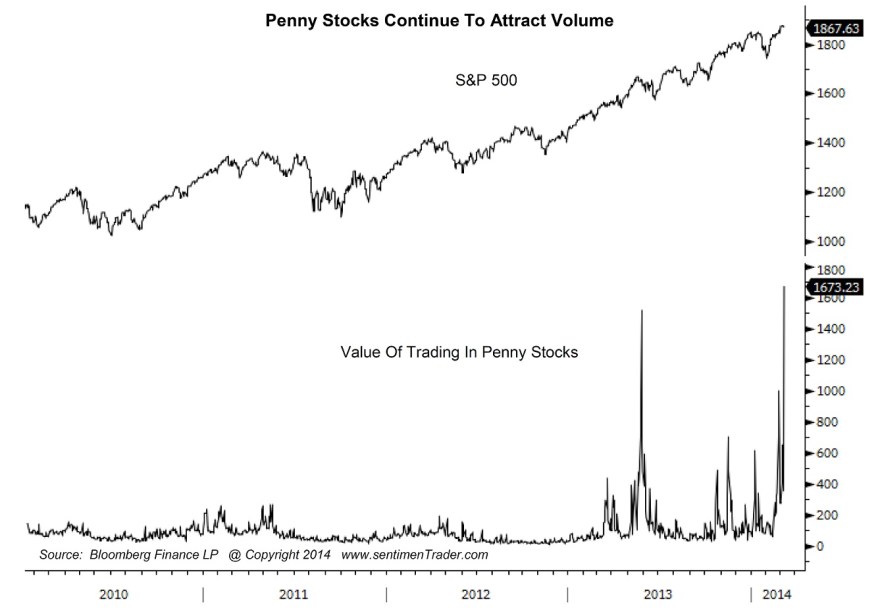
3ap36

Source: Sentimentrader

37.  Dow, FTSE and Nikkei are all at long term resistance levels (connecting 2000 and 2007 peaks)

38. Treasury Bond Yields Rate Of Change over last 12 months is at a level that previously led to market tops in 2000 and 2007

39. Rydex money market assets back to 1999 lows

40. Equities topping out with the solar maximum, in line with history

3ap23

Underlying Source: Solen.info

A 40-indicator case is a fairly strong case to go short. But we need to balance with what’s supporting the bullish case.

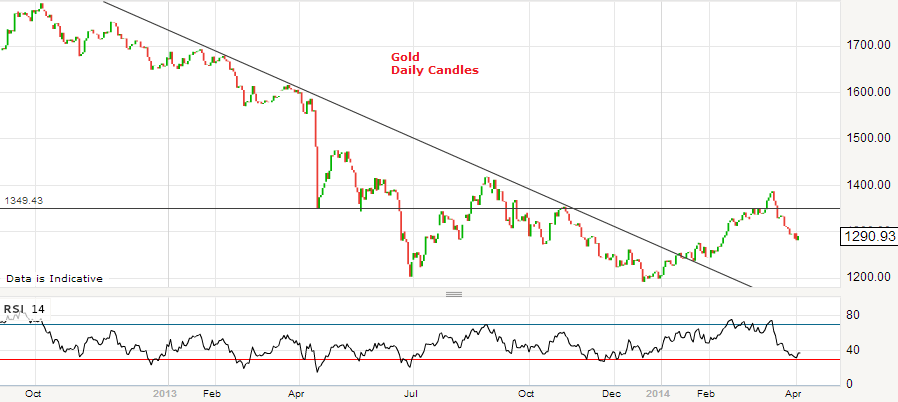
Cyclical stocks have broken out upwards over the last week. The cumulative advance-declines breadth measure remains in an uptrend, supporting the advance in equities. Euro Stoxx broke out to a new high. Gold and gold miners have pulled back in March, with gold having failed to hold a break out above the first meaningful resistance level:
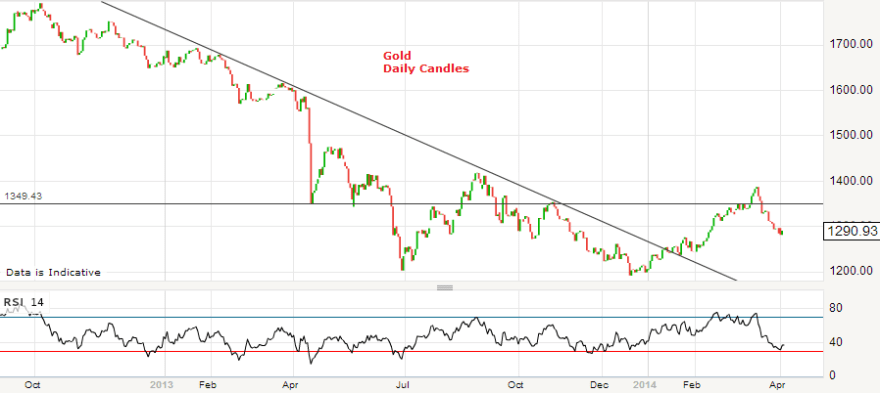
3ap27

The question is whether a higher low can now be made in gold, to continue the bottoming process.

Margin debt, for which we have data up to the end of February, did not yet top out. I had initially expected margin debt to top out in December with an anticipated highest monthly sunspots spike at that time. However, a higher monthly sunspot spike in February suggests speculation could have topped out as we moved into March instead. We have thus far seen peaks in the Russell 2000, Nasdaq and Biotech in March, and we saw a lower monthly sunspot spike in March than in February. The consensus view is that the smoothed solar maximum for SC24 already passed at the turn of the year and that sunspots should decline from here. However, SIDC are still running a second alternative whereby a smoothed solar peak still lies ahead in H2 2014:

3ap34

 Source: SIDC

Playing to that possibility is the trend in leading indicators noted above. If stocks can hold up whilst economic data starts to improve again as of May then may be they can rally through to the Fall. On the flip side, we should have another month of disappointing data right ahead which could equally pull the rug from under equities. Were the second SIDC scenario to occur then I would expect speculation not to top out until the Fall, and a suitable technical mirror from history may be 1987 whereby sentiment reached record levels in Q1 1987 but stocks did not fall hard until Q3. But for now, the more probable scenario is of a smoothed solar maximum having passed and speculation declining from here, and for this to be confirmed I would be looking to see that the RUT and Nasdaq indices do not make a higher high from here, and that margin debt tops out. Sunspots should also notably trend down as we head into mid-year to confirm this.
3ap33

There have been a concentration of market falls occurring in the inverted geomagnetism seasonal lows of March-April and October. So again taking that primary scenario of sunspots now on the wane, I look to this new month of April to deliver major falls in equities, in line with the Nasdaq in 2000 (smoothed solar max and sunspot spike March 2000). Presidential cycles in the market suggest stocks could eek out further gains in the first part of April before falling for a period of weeks. DeMark also believes a top is within days but suggests the SP500 could reach 1931 before inverting.

The primary scenario of a smoothed solar maximum having occurred in December 2013 and a highest monthly sunspot spike in Feb 2014 is supported by a chain of events to date: Bitcoin peaked in Dec, Nikkei and Dow (very tentative at the time of writing) peaked and money flows switched into defensives at the turn of the year, the ‘theme’ stock indices and sectors of the cyclical bull exuberance phase peaked out Feb-Mar 2014. But this is all subject to confirmation or invalidation. So let’s see how April develops. I remain significantly short equities, and siginificantly long precious metals, with other smaller positions long commodities. My worst case scenario is the continuation of speculation into late summer before Q3 falls in equties, and I would hold my positioning until then if so. But for now this is the outside scenario, and I maintain good odds of April delivering significant falls in equities, and momentum returning to gold with a higher low.

Thank you for all your input whilst I was away.

Monday Charts

Whilst Friday’s action in the stock markets was not decisive, it looks promising for a reversal, so let’s see how this week begins.

1. Insider selling consistent with peaks:

10ma1Source: ShortSideOfLong

2. Euphoria model now up to +0.65:

10ma2Source: Barrons/Citi

3. Latest Economic Surprises US:

10ma3Source: Citi

4. IPO characteristics consistent with peaks:

10ma4Source: Sentimentrader

5. From Kent’s link, US small caps peaked at the beginning of 2002:

10ma5Source: ClaassenResearch

6. And that fits with the second peak of solar cycle 23:

10ma6Underlying Source: Solen

7. The anticipated smoothed solar maximum at the end of 2013 and the February 2014 monthly sunspots spike is very similar to the solar peak at the start of 2000, and the monthly candles in the Nasdaq 100 show a similar pattern. A series of green candles into the end of 1999/2013, a red January candle, up again in February and now a potential March reversal:

10ma7

The reason it is not as supersized as the 2000 peak is due to the difference in demographics, but we see a similar monthly RSI peak and by various measures the current high compares to the top of 2000 (such as margin debt, sentiment and certain valuations).

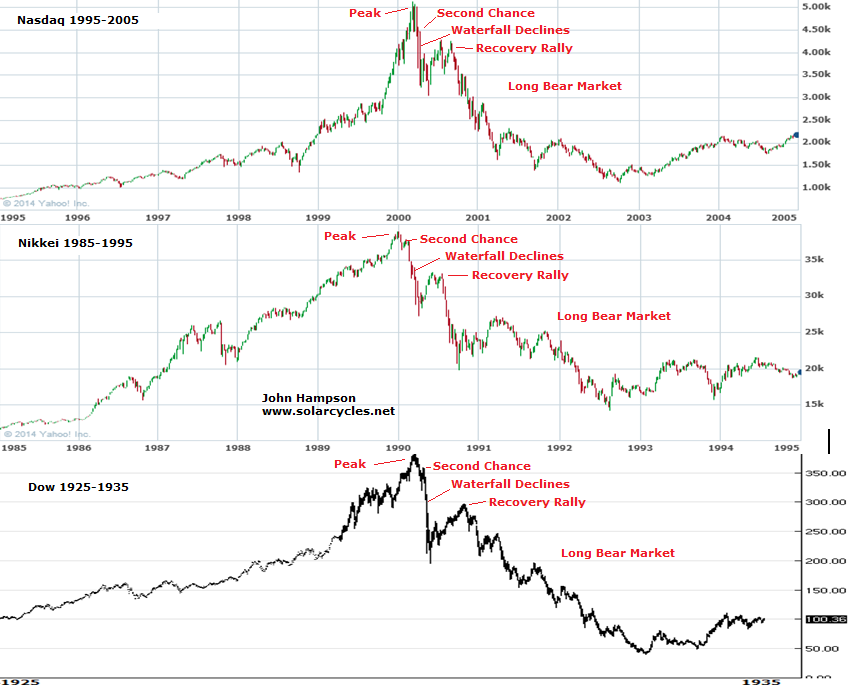
Dow 1929 vs Nikkei 1989 vs Nasdaq 2000 vs Today

Yesterday saw a failed breakout on the SP500 on high volume which suggests exhaustion. The Skew print came in still historically high and the put/call print historically low again, which continue to signal bullish complacency and high risk of an outsized move to the downside. Economic data disappointed again, and the latest economic surprise readings are below:

25fe10 25fe11 25fe12

Source: Citi

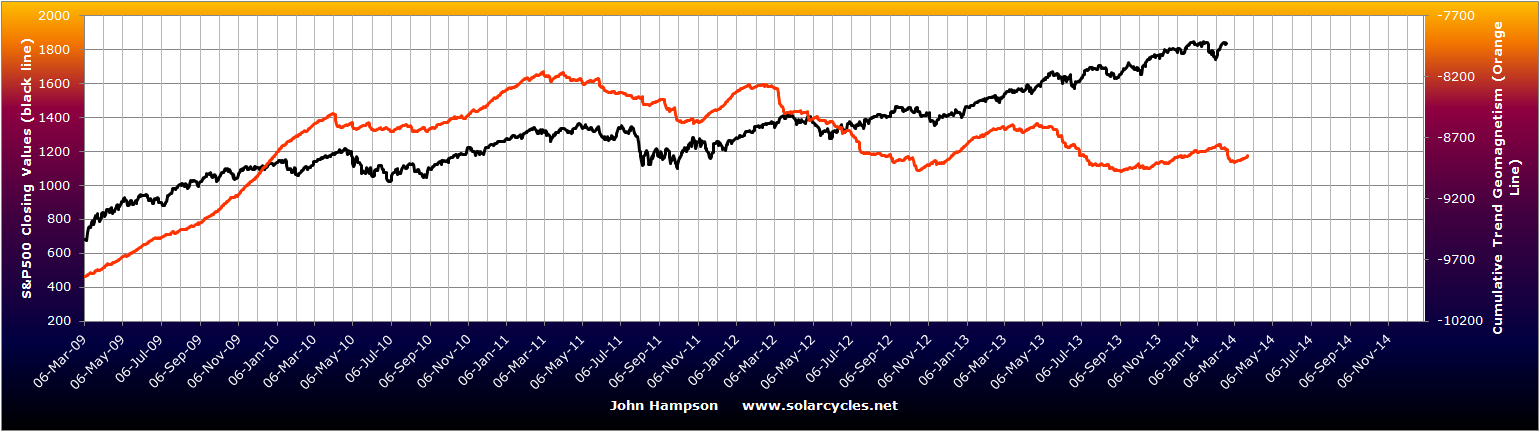
The geomagnetic storms over the last week broke the model’s multi-month uptrend (red line) and along with the NOAA forecast reveal downward pressure this week:

25fe13If you are new to the site my models are updated weekly.

The significant outstanding bubble in the markets remains the Nasdaq Biotech sector, but the unsustainable parabolic is ripe to pop:

25fe14

Source: Yahoo

Less than one third of this sector’s 122 companies earned any money in the last 12 months.

The last 2 years gains in the wider US markets were approximately 80% multiple expansion and 20% earnings growth. The justification for the multiple expansion was (1) ‘Fed policy trumps all’ and (2) stocks frontrunning a ‘normalisation’ in economic growth and earnings. Now: QE is being wound down, Q4 2013 GDP and Q1 2014 GDP estimates are being revised downwards, earnings estimates are being revised downwards and for Q1 2014 82% of companies so far have issued negative earnings guidance. Those justifications have largely evaporated.

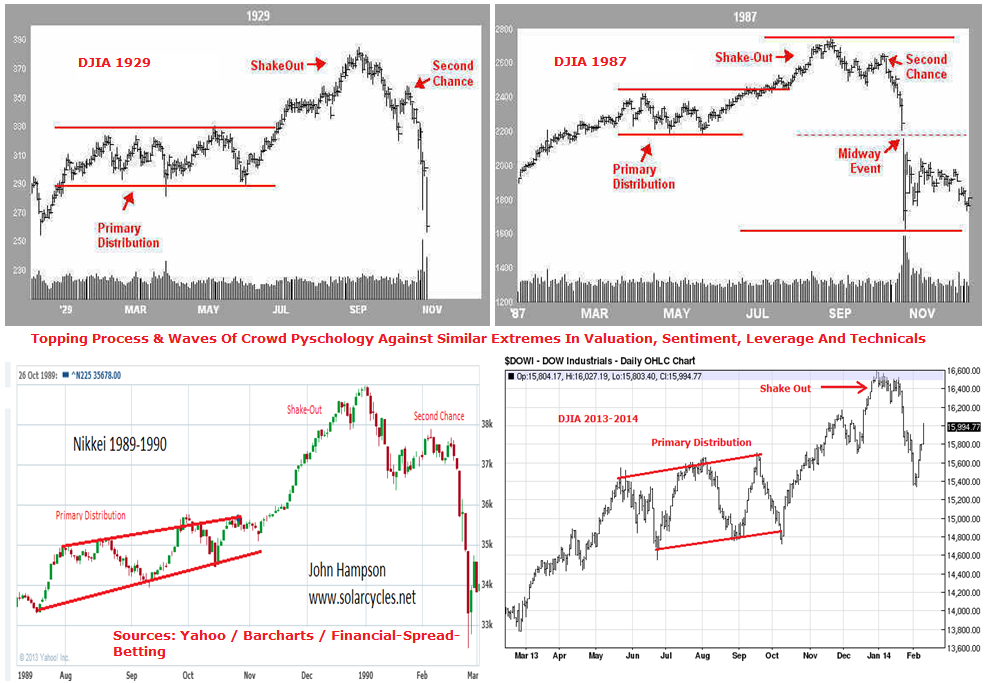
The lesser known reason for the big run up in price into the end of 2013 is the speculation peak driven by the solar maximum, and this was shared in the superpeaks of Dow 1929, Nikkei 1989 and Nasdaq 2000. A reminder that there are 3 ingredients for a superpeak: (1) speculative mania by solar maximum (2) increasing number of buyers through demographic swell and (3) increasing use of leverage amongst buyers. Both (1) and (3) apply to the current US markets but (2) is absent. There is a shrinking rather than swelling demographic pool, and for that reason we do not have a supersized peak. Otherwise, the analogies are very much applicable.

In 2013 US markets ran up in a parabolic shaping, generating historic levitation above moving averages and producing an anomalous lack of a ‘proper’ correction. Sentiment reached levels not seen since previous major peaks, and euphoria only historically exceeded in the dot.com boom. We have reached valuation levels in the Q ratio equivalent to the TOP in 1929 and in stock market capitalisation to GDP equivalent to the TOP in 2000. Leverage levels equal the TOP in 2000 as measured by margin debt to GDP and beat the 2000 top in other measures. The blow-off topping process in the current Dow so far mirrors that shared by the 3 analogs, and the peak-to-date occurred at the solar maximum.

In short, the ‘size’ of the peak in current US markets does not compare to the analogs because of the key demographic difference, but in many other ways these analogs are particularly apt. What comes next in the analogs is waterfall declines, and we have a case for the same in the current US markets due to (1) historic levitation away from moving averages or parabolic rise on long term view (2) historic time since significant correction and historic compound gains and bull duration (3) 80% multiple expansion 3-pronged justification case shattered (4) ‘all-in’ measures of sentiment, leverage and fund flows ripe for unwinding. We are likely through the solar maximum peak and the speculative excess into the peak is now vulnerable to pop.

Here are the analogs on a 10 year view centered around the peak:

25fe7Alongside I’d like to remind you of the relevance of the (inverted) seasonality of geomagnetism for the timing of peaks and falls:
13fe4

Nikkei 1989: Waterfall declines from second chance lasted about 6 weeks, centered on March (geomagnetism (inverted) seasonal low), and took off 27% from peak; Recovery rally then lasted 3.5 months from April to July, back up 20% (through seasonal high); Then 2.5 months more waterfall declines, mid July to beginning of October down 40% (through seasonal low).

Dow 1929: Waterfall declines from second chance lasted 1 month, centered on October (seasonal low), and took 48% off from peak; Recovery rally then added back on 50%, lasted 5 months from November to april (through seasonal high); Then long period of declines lasting a couple of years.

Nasdaq 2000: Waterfall declines from second chance lasted about 6 weeks, March-April, and took 36% off (seasonal low); Recovery rally lasted about 3.5 months from May through to beginning of Sept, adding back on 34% (through seasonal high); Then long period of declines lasting a couple of years.

So, averaging them out and applying to the current US markets, we could expect waterfall declines of around 35% lasting around 5 weeks, and this should occur in the seasonal low of March-April. That would then be the time to take off short positions for a recovery rally of around 35% lasting around 4 months from April to August or so, through the seasonal high. A second set of steep declines should then unfold through the seasonal low of September-October.

25fe8By that model the initial waterfall declines should wipe out all of 2013’s gains in the space of a month. I refer you to the case for waterfall declines further up the page as to why this is reasonable, and I suggest the consensus view once this occurs will belatedly point to similar factors. However, once the recovery rally then erupts, as can be seen from the 3 analogs on the 10 year view, it will keep the ongoing bull market option in play. I suggest 1987 will likely be quoted as benchmark: a harsh correction that was a golden buying opportunity. But, once the recovery rally tops out short and rolls over into more steep declines, there will be broad acceptance of the new bear.

What will happen to commodities under waterfall declines? Understand that such unforgiving drops will bring about forced liquidations as leverage is unwound so there will be some blanket selling. In all 3 analog waterfall decline periods, commodities (including precious metals) fell too, whilst the US dollar largely rallied. The same occurred in October 2008’s sharp falls. That suggests it may be prudent to pull back on or even exit commodities long positions once we get a whiff of steep declines erupting.

Previous major commodities peaks have been speculative to a large degree, but also typically founded on a fundamental supply/demand case. For energy and industrial metals the latter is currently weak, and we see oil and copper in long term ranges rather than in major breakouts. Various soft commodities have enjoyed steep moves up as shorts have scrambled to cover, but whether there can be an enduring supporting story this year remains to be seen. I am skeptical as to whether commodities as a class can make a major rally to beyond 2011’s CCI peak this year, anticipating they may sell off under the waterfall declines and perhaps struggle for a case under deflationary recession fears. However, maybe they can outperform during the ‘recovery rally’ over mid-year and particularly if the US dollar is less seen as a safe haven this time, so I remain open to the possibility that maybe they can beat 2011’s peak, but currently see this as less likely. The case for previous metals differs from other commodities, and as I have outlined before I see gold’s 2011-2013 bear as a pause in a longer term secular bull market likely to terminate at the next solar maximum. My tactics will be to reduce all commodities long positions bar precious metals once it looks likely that equities are on the cusp of waterfalling, anticipating some blanket selling across all assets in that period, and then review again as we approach the end of that event.

Looking back to the Great Depression, banking panics began in 1930 and swapping dollars for gold in 1931. In other words, it took time for things to unfold, and I would expect similar this time around. Whilst I cannot be sure, I do not expect a sudden chain of bankruptcies under the first waterfall declines, but for the real ‘trouble’ to unfold gradually and likely after the recovery rally peaks out. First things first then: I expect a major short equities opportunity to unfold swiftly from here through March and into mid-April, and am positioned for that. I will be looking to exit all equities shorts as I try to time the end of that event.