State Of The Markets

It’s been a while, so here’s how things now stand.

1. The topping process kicked off at the turn of the year with a gradual shift to defensives, as represented here by stocks:bonds, consumer discretionary:utilities, high yield:treasuries and small caps:all caps.

13dec10

Source: Stockcharts

2. The shift to defensives was a global phenomenon, shown here by German, Japanese and UK bond yields, as well as US.

13dec13

3. The smoothed solar maximum is likely to have been April 2014. Historically, peak speculation and appetite for risk assets has topped close to that:

Screen Shot 2014-12-13 at 11.05.52Source: Solen

4. In keeping with that, margin debt peaked in February, the commodities index peaked in April and certain breadth measures peaked around that time:

13dec16

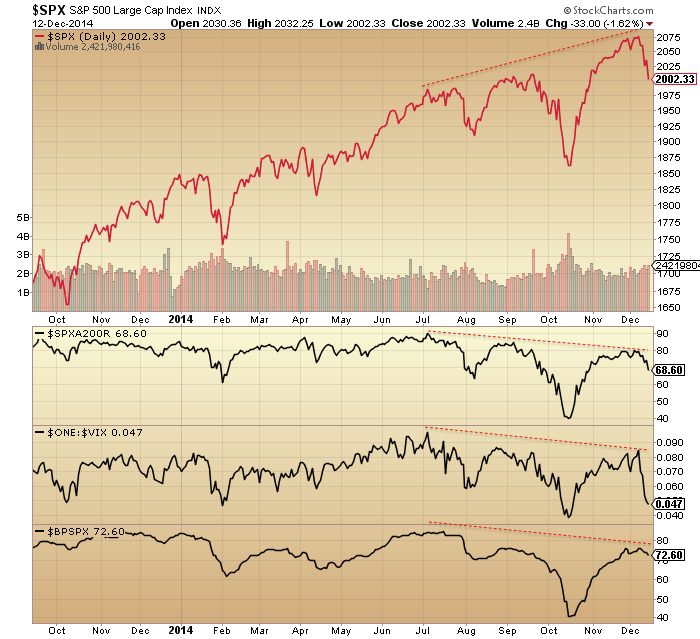
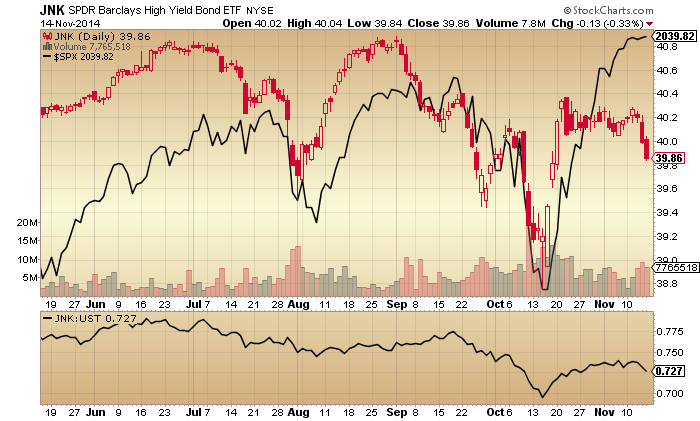
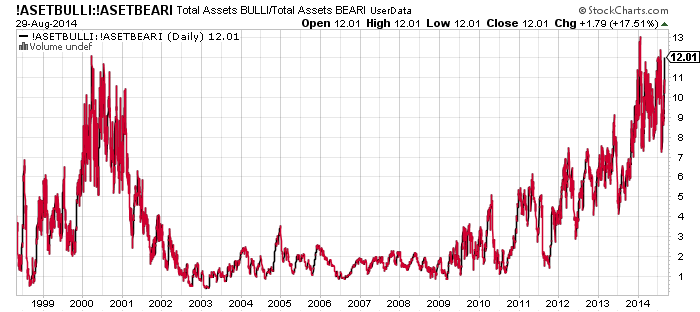
5. Then either side of that, the move to defensives occurred as of January and the price topping formation in equities took place in the window from July to November, with US large cap stock prices rising in a megaphone formation whilst the remaining supports for equities were dismantled and many flags were raised. Here shown are breadth, volatility, bullishness, junk bonds and leveraged loans as examples.

13dec18 13dec19

6. Considering the final thrust to the peak to be the rally from October to the start of December, then its size and duration fits in well with similar topping thrusts from history:

2000: 17% in 23 days

2007: 15% in 39 days

2010: 16% in 55 days

2014: 14.5% in 37 days

So is this finally it? Dare we dream that equities have topped out and are now in a bear market? Yes we do.

7. A key change in the last two weeks has been that the remaining leaders appear to have finally reversed, such as the Sensex, Nasdaq 100, Apple, USD/JPY and the Nikkei. These are tentative reversals but the point is they have aligned in the declines.

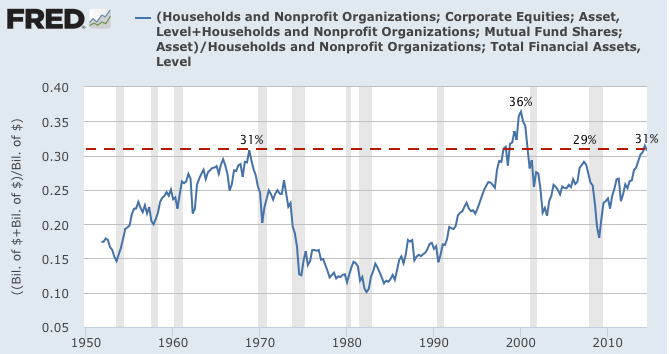
8. Looking at the bigger picture, households are about as exposed to equities are they likely to be (given no demographic tailwind):

13dec30

Source: Fat-Pitch

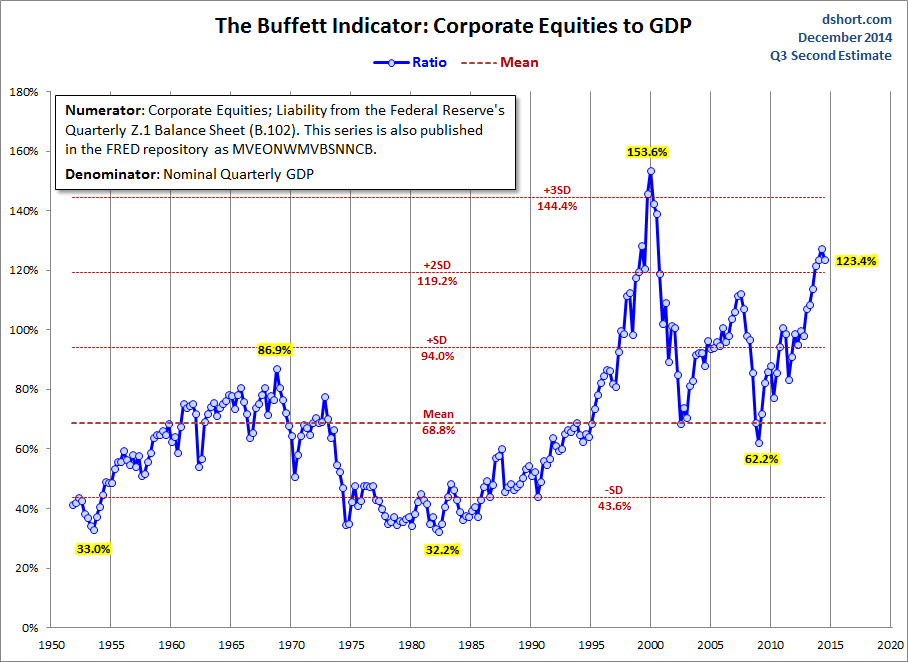
9. Dittto, valuations are as high as they likely to reach:

13dec40

Source: DShort

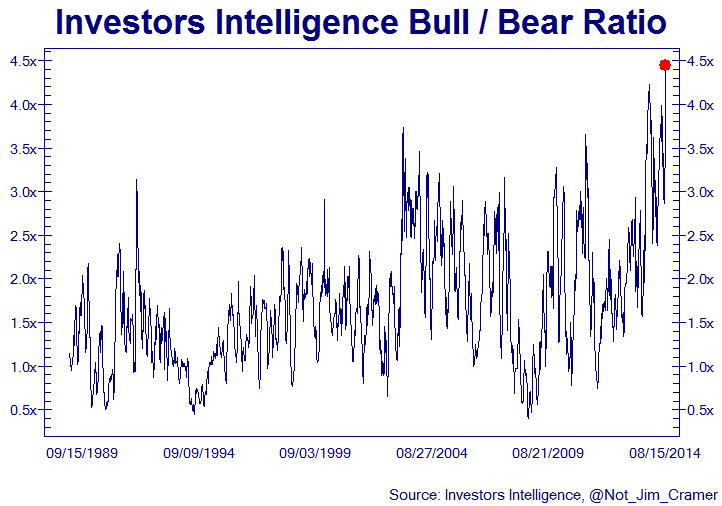
10. Sentiment is as lop-sided as it could be:

Screen Shot 2014-12-13 at 13.58.23

Source: Yardeni

11. Leading indicators for the US are negative:

13dec50

Source: DShort

12. Corporate earnings for Q4 have been sharply revised downwards due to both the high dollar and falling oil price.

13. Put/Call ratio is signalling further price declines:

Screen Shot 2014-12-13 at 07.01.14

Source: Barrons

14. Stocks are nowhere near oversold yet:

13dec60Source: Charlie Bilello

15. However, Rob Hannah’s capitulative breadth hit 5 at the close of the week, suggesting more selling Monday/Tuesday could take this to exhaustion levels.

16. Which brings us to the phenomenon I have covered before: selling right into the close on Friday can trigger steeper selling on Monday due to weekend reflection. Is this finally going to happen? Allocations, sentiment and Skew are all set for it to occur.

17. But what about the favourable seasonality of year end, the ‘Santa rally’ in the second half of December?:

13dec70Source: Sentimentrader/UKarlewitz

There is upward pressure into the Dec 22 new moon and a limited history of bull market peaks occurring near the last trading day of the year. Offsetting that, we have downward real geomagnetism pressure at this time of year, and that megaphone price topping formation which ought to now have a destiny with the lower boundary given the overthrow turned out to be just that. Meanwhile gold has built out a compelling bottom and is ready for a rally at the expense of stocks.

The whole topping process is already on borrowed time versus the solar maximum, and indices such as RUT and DAX stretched about as far as they could again in November without jeopardising the topping process. Therefore, I see reasonable odds that the Santa rally won’t happen. In mirror topping years 2000 and 2007, December was a down month both times.

Let’s see if Monday opens the selling floodgates. The key should be a gap down open, with weakness starting from early in Asia/Europe. Should stocks alternatively garner support again then maybe they can hold up into the end of Dec before finally rolling over. But it’s high time we saw weakness into Friday’s close follow through, against that sentiment/allocation/skew backdrop.

Weekend Update

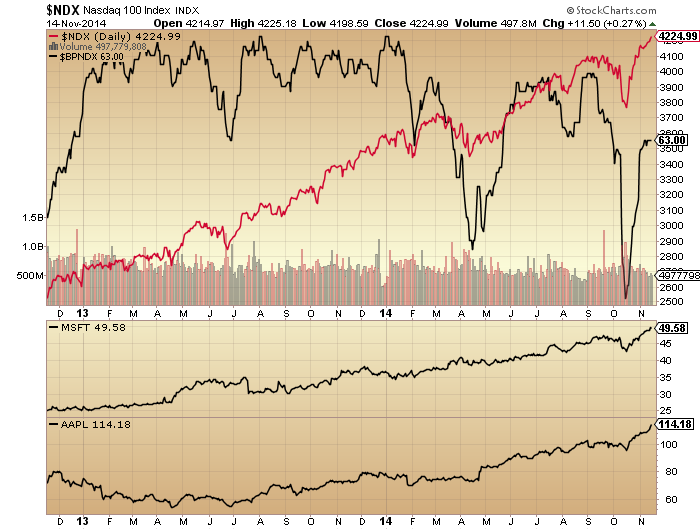
A doji on the SP500 on Friday, making for a week of sideways range. But there is one index still not slowing down, the Nasdaq 100. Apple and Microsoft are still in steepening uptrends, dragging this index higher. Note that these two stocks outperformed right into the end of 2007, later than most, so their rollover may be the last domino to fall. Unlike the other indices, the Nasdaq 100 is showing no major breadth issues, but does have divergences in bullish percent and volatility.

15nov42 15nov61

Source: Stockcharts

The longer term Nasdaq 100 chart does however show typical major topping divergences:

11nov14So, I’d like to see large intraday reversals / voluminous down candles on Apple and Microsoft and in turn the NDX as a sign of a peak.

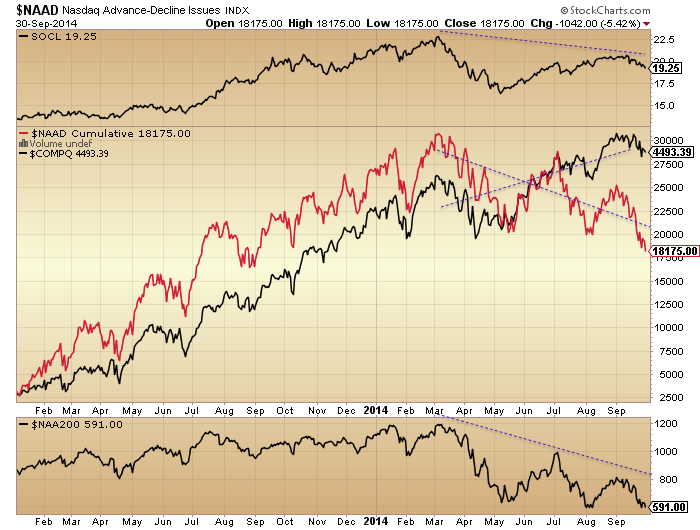
The last dominos to fall idea is supported by the bigger picture. Various risk measures peaked out in January, European stock indices and US small caps topped out around June, other global indices peaked out in September, and breadth has been diverging on the SP500, Dow and Nasdaq composite. Look at the Nasdaq composite breadth compared to the NDX, it now has 4 lower highs and lower lows over an 8 month period:

15nov10

The Dow Jones World index is shown below. A clear double top and lower high/low, with divergences on this rally since the turn of November. John Li raised the possibility that US large caps may still need a ‘second chance’ peak given they have made new highs again, and I can’t rule that out, but on DJW this is a fairly typical second chance peak should stocks now roll over.

15nov20

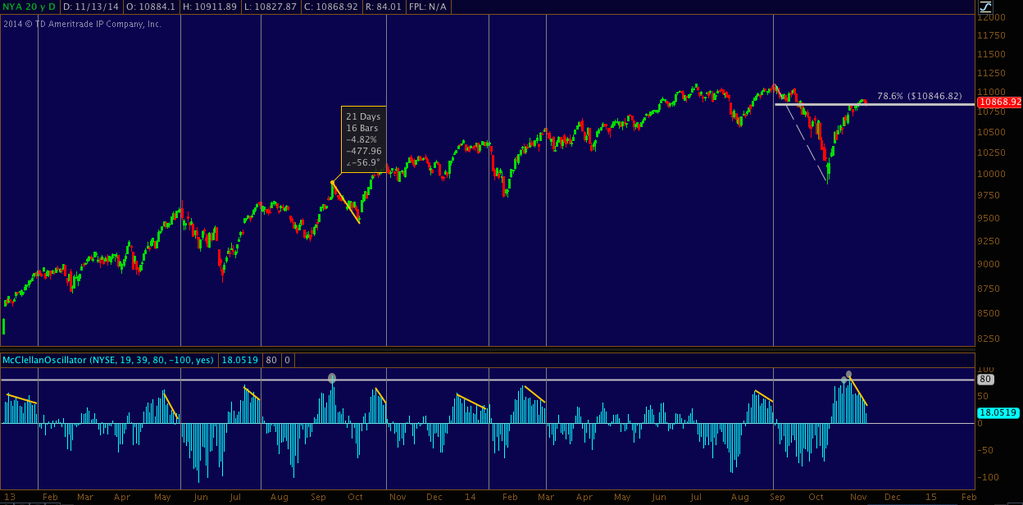
Here’s why stocks should be ready to now finally roll over. The McClellan Oscillator has diverged as it did at previous recent peaks:

15nov97

Source: Andrew Kassen

ISEE put/call ended over 200 again on Friday, making for 4 prints over 200 in the last 2 weeks. These extremes are signs of topping.

15nov99

Source: Andrew Kassen

Rydex allocations made a new all-time record at the end of Friday. Take a look at the Rydex history in conjunction with AAII bears and II bears history versus current readings:

15nov41 15nov89 15nov98

All at absolute extremes. If a bull market top occurs when there are no bears left to convert then these three proxies are screaming exactly that.

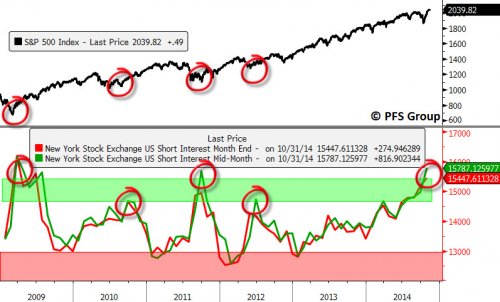
However, here is short interest, which appears to reflect the opposite:

15nov83

Source: PFS

Either this is supremely bullish, like previous major lows, or something else is going on. It should be clear that we are not at a significant low like 2009 or 2011, and the October correction didn’t get close to a washout in sentiment or allocations like the other two lows shown, so how can we explain it? Look at the rising trend since the turn of 2013 which is when the mania began. I suggest this is hedging. Similar to the persistently high range in Skew that has been in place.

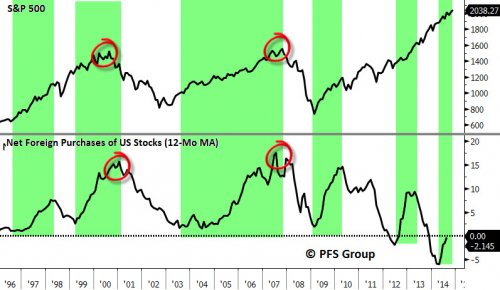
On a related note, look at foreign buying of US stocks, below. This also diverged from the turn of 2013 when the mania began. PFS see the current reading as bullish, but it should be clear again that something else is going on. Foreign purchases trended closely with the SP500 until the turn of 2013, after which they stopped tracking. Again the idea that this level is synonymous with a major low in stocks is clearly wrong. We know that buybacks and US retail clients have been the two main drivers of the mania phase and that leverage and allocations have been take to record extremes. We know that institutions have been net sellers in the mania phase and the below chart reveals there has been dwindling fuel from overseas too. Therefore, the combination of companies borrowing to buy their own shares back and retailers buying high and going all in on leverage is the worst possible foundation for current prices.

15nov81

Treasuries rallied on Friday, precious metals burst upwards, and junk bonds had another down day. All these developments suggest stocks should be about to fall.

15nov70

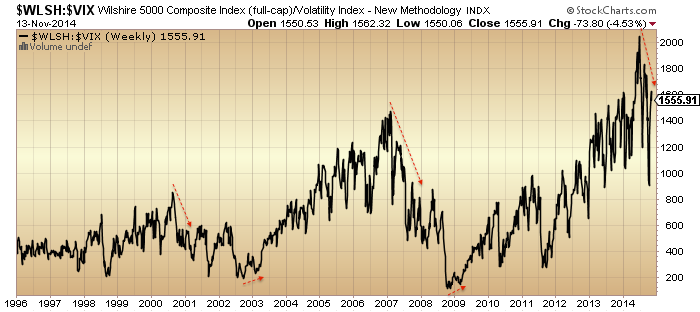
Vix rose last week and continues its overall divergence which again warns of a change in trend in stocks. Look at the similarities in stocks:volatility to the previous major peaks:

14nov15

In short, I still think stocks will see a voluminous down day in the next few days and kick off the new and final leg down. There is no fuel for higher by various indicators above, so I believe the flattening out of the SP500 last week is the prelude to the next big move: down. I am not a fear-monger but given the incredible extreme state of multiple indicators, the ferocity and exhaustiveness of the rally since mid-Oct, and the large megaphone formation on US large caps, I believe an almighty crash is going to occur. In the last solar maximum mania of 2000, the Nasdaq’s mania from the start of 1999 to March 2000 was all retraced by the end of 2000. I equate us to November 2000 but here in 2014 we have postponed any true correction as the year has progressed, making for what may become a mega-correction right at the end of the year. How the mania reversed hard in 2000:

15nov88

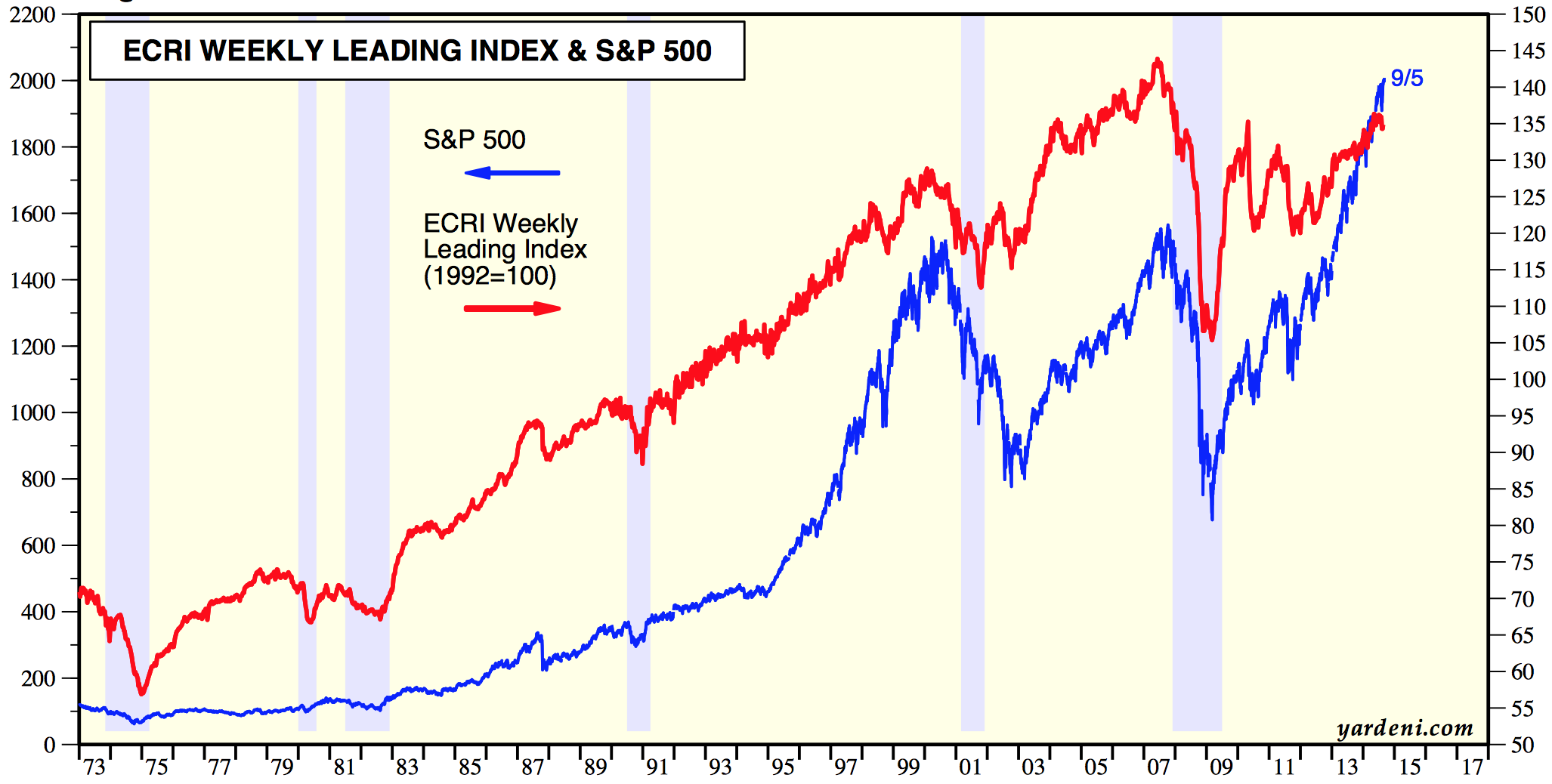
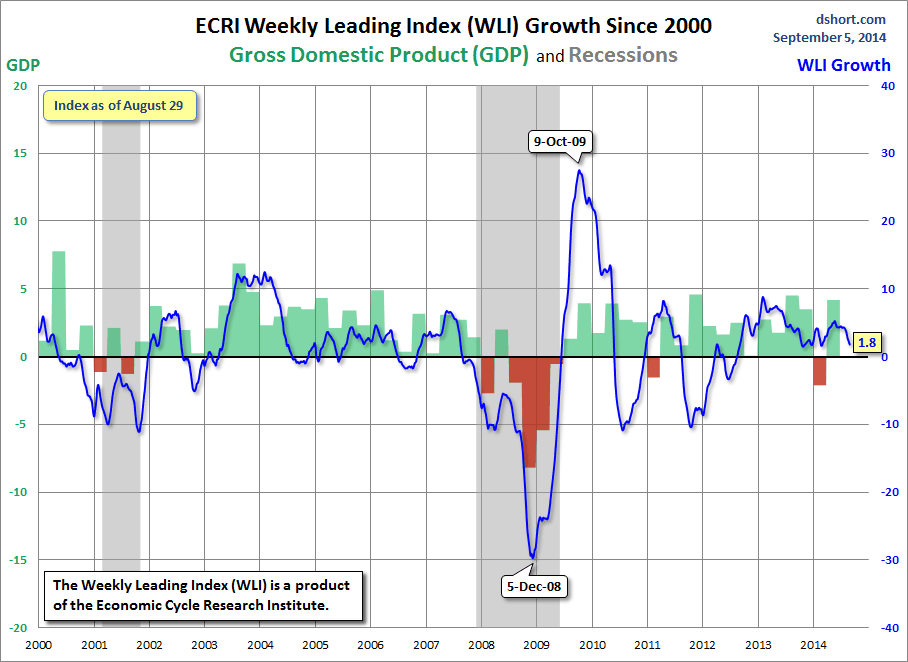
ECRI leading indicates for the US have dropped further. Their shaping level now mirrors 2011, 2010, 2007 or 2000: all significant market peaks.

15nov1

 Source: DShort / ECRI

Lastly, the Sornette bubble end flag remains at July for the SP500 and September for US Tech. There has been no rebubbling since.

Screen Shot 2014-11-15 at 05.20.34Source: Financial Crisis Observatory

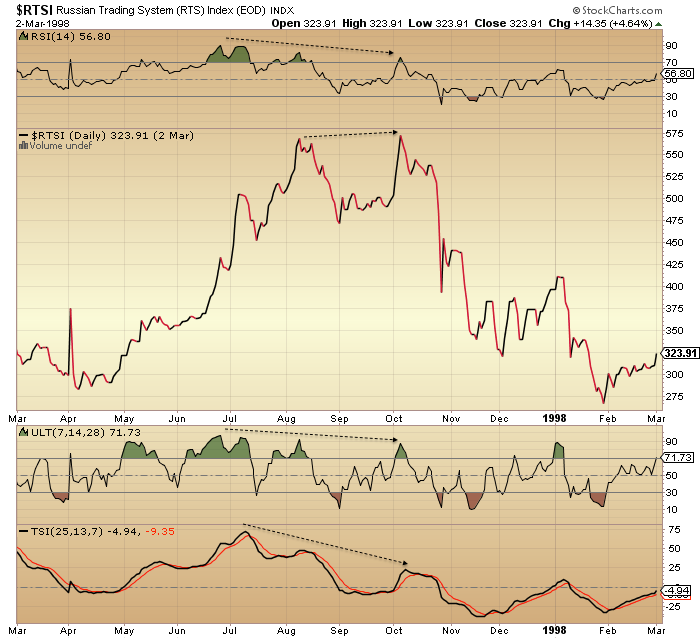
Looking for an analog where the Sornette bubble ended before stocks made marginally higher highs and then fell, there are only a couple of examples from history. In 2007, the bubble-end flagged in June/July and then stocks made their marginal higher high on multiple divergences in October 2007. In Russia 1998, something similar:

15nov60

Screen Shot 2014-11-15 at 05.20.07

It was the same phenomenon: marginally higher highs but on multiple negative divergences. Same as now: a lot of divergences have developed since the start of July whilst we have gone on to make marginally higher highs.

15nov12

So, it’s more support for the case that stocks should turn down here at their marginal higher highs in a final manner, rather than breaking upwards.

We have a week left until the new moon. Can equities hold up or even rally into then? Hold up with a few more dojis whilst we see further deterioration? Maybe. Rally? I just can’t see it when allocations and sentiment are so super-stretched. Rather, I still expect we will end November down and follow through on the large monthly October hanging man candle. That would imply stocks should fall before we get to the new moon. I am looking for a large red daily candle early next week, with the behaviour in gold, junk bonds, European indices and small caps last week as the lead in.

Last Quarter Of 2014

September finished as a down month for all US stock indices, which means the peak in margin debt should remain as February. Cross-referencing: SOCL, RUT and Nasdaq breadth peaks are still signalling a likely Feb/Mar speculation top, whilst biotech remains tentatively supportive, at a double top with March. The smoothed solar maximum continues to look like it occurred around March, so the whole picture remains strong for a sun-driven speculation peak around March and a period of ‘borrowed time’ for equities since.

1oc9

1oc2 1oc3

The SIDC chart shows that they are still running with an alternative in which the smoothed solar max double tops ahead at the end of the year, but the majority of other solar scientist models are aligned to their SC prediction (smoothed max behind us, circa March). By cross-referencing with measures of speculation above, the behind-us scenario gains further weight.

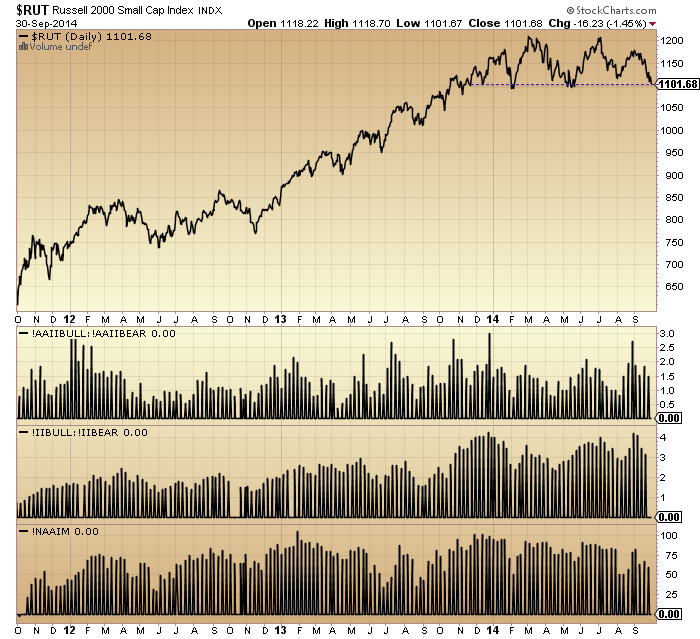
The Russell 2000 has now reached the key technical level around 1100 for triggering potential waterfall declines, and it arrives here at the most bearish point in the year, the seasonal geomagnetic low of October supplemented by downward pressure into the full moon of next Wednesday 8th.

1oc1Conversely, if the RUT and other US stock indices can hold up through the full moon and the rest of October, then a year end peak in large caps would gain weight, with the seasonal upward pressure out of November. As things stand though, the recent collapses in junk bonds and inflation expectations, the September declines in all stock indices and the acuteness and maturity of many different stock market indicators (which I have detailed on this site) all support the October breakdown option.

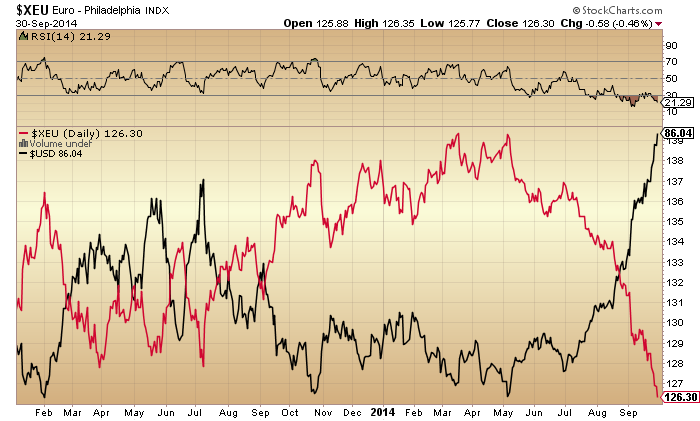
Turning to other markets, the US dollar is in a parabolic ascent, the Euro a parabolic descent, and the slide in precious metals continues. All three show extremes in positioning and indicators that are suggestive of a reversal, and the parabolic trajectory of the FX pair suggest a snapback should be imminent, but when?

1oc8 1oc5I see it as linking in nicely with the situation in equities. If US equities break down through the key technical supports (to clearly kill the prospect of another v-bounce), then gold should at that point reverse course, and the dollar may then be sold off. Much of my recent work on stock market indicators shows that the case is strong for equities to break down without delay, suggesting these intercorrelated reversals ought to indeed occur here in this pertinent window at the beginning of October.

The rising Dollar negatively affects 45% of S&P companies. Earnings season for Q3 gets underway next Wednesday, and the predicted earnings growth rate is 4.7%. This stood at 8.9% on June 30th and 12.2% at the start of the year. For the YTD picture, US earnings growth forecasts at the start of 2014 were Q1 4.4%, Q2 9.2%, Q3 12.2%, Q4 13.5%, whilst actuals are Q1 2.2%, Q2 7.7%, Q3 4.7% (est). In other words, to justify valuations, average quarterly 10% earnings growth was required and projected, but the reality looks like less than half that. As earnings season typically have a ‘sell’ or ‘buy’ theme, I suggest odds are this one will be a sell (as reality dawns), and help pull down equities in October.

At the macro economic level, economic surprises in Europe and China continue to languish negative, whilst the US remains positive. The global real narrow money leading indicator predicts a slowdown once we hit 2015, whilst ECRI leading indicators for the US remain poised at a low level from which a fall in equities would likely tip then negative. This brings me back to what leads what. I recently covered that equities in fact tend to lead leading indicators by a month on average and that previous major tops reversals in leading indicators only occurred once equities had made initial hard falls, which in 2014 they have yet to.

This in turn leads me to the question of whether equities could yet have a second chance peak ahead, like in August 2000 (after the first March peak) or October 2007 (after the June top). In both those scenarios, large caps dropped around 15% before rallying to the second chance peak, whilst leading indicators diverged negative into the second chance peak. The possibility here would be for large cap stocks to break down in October, perhaps 15% again, but then rally back up towards the recent peaks by year end, perhaps for a 31 Dec second chance (lower) peak.

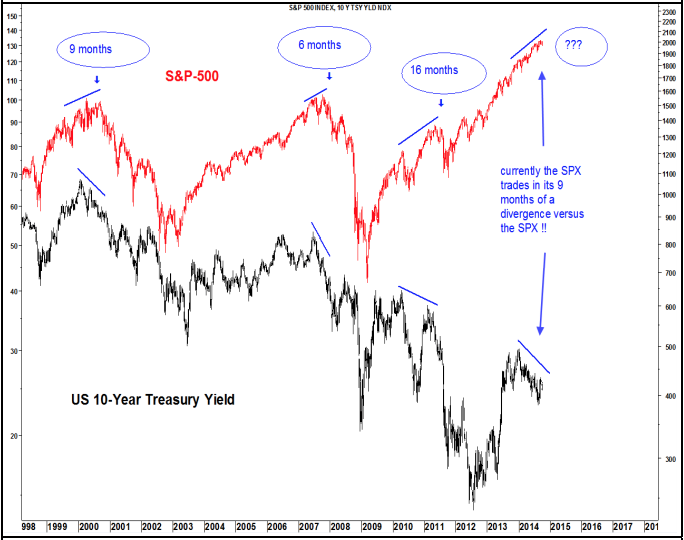
Well, the speculative targets of RUT, SOCL and IBB all show second chance peaks already. Developments in margin debt, HYG:TLT, NAAIM, Rydex and various mature divergences also suggest we should be at second not first chance peak. But the price patterns in large caps don’t really fit. UBS side with the year-end second chance prediction, shown below, yet beneath that their TNX divergence chart is another indicator conversely suggesting we should be at second chance peak already:

Screen Shot 2014-10-01 at 12.12.28 Screen Shot 2014-10-01 at 09.56.18I suggest that if we are post-second-chance but having ‘cheated’ a decent first chance correction (and this is the picture painted by most stock market indicators), then the falls from here should be twice as hard and echo action post-second-chance in 1929, 1987, or 1989 (Nikkei) whereby the falls become waterfall declines or panic selling. If the selling is more measured and back and forth then we should alternatively look to indicators to washout and align for a bottom at perhaps a 10% or 15% correction, before a potential rally into year end.

This last quarter was the best quarter so far for viewing stats on solarcycles.net. The best month was this last month (shown below), the best day just yesterday. So, thanks for reading my analysis and thanks to all those who contribute and make for a good discussion board.

Screen Shot 2014-10-01 at 10.01.55

To sum up, I’d give 80% odds to equities falling in October through technical supports and cementing a new bear market. I’d give 20% odds to equities holding up into or making a second chance peak at year end (both around 31 Dec). I don’t have a case for a bull market extending into 2015, as this would invalidate a variety of historically reliable indicators with different angles on the market.

As this is the last quarter, it seems appropriate to stick this up: predictions from the professionals at the start of 2014 for year-end. We can see that all were bullish on equities, predicting an up-year (accepting that they largely play it safe and align with each other). As you know, I was bearish at the turn of 2014 and always expected us to end the year in a bear market, so it’s a black mark against me if we don’t. But I believe the weight of evidence still supports the markets swinging to me by year-end, so let’s see at 31 Dec.

Screen Shot 2014-10-01 at 13.10.46

Population, GDP, Debt, War And Solar Variation

On a longer term view, these all fit together, and understanding their relationships can help us predict what’s coming.

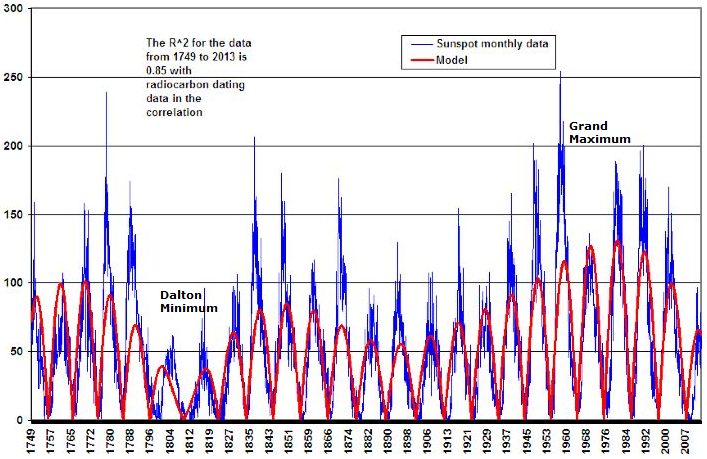
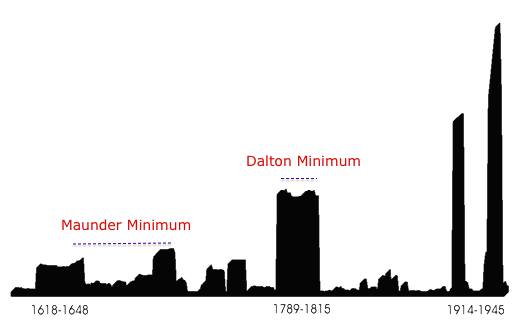
The grand solar minima correlate with clusters of war:

29se1

War clusters / cycles

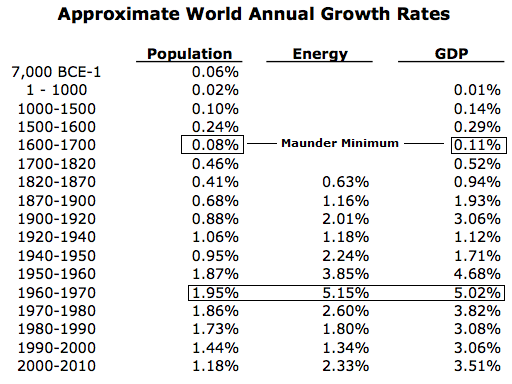
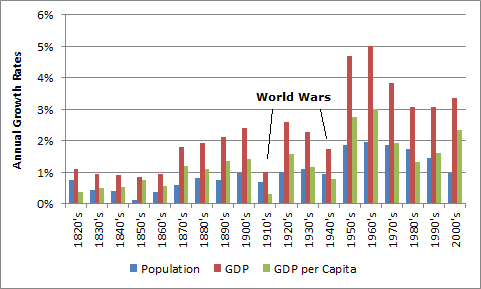
The grand minima were periods of lower population growth and lower GDP growth whilst conversely the grand solar maximum of the 1960s-70s was a period of peak population growth and GDP, shown here:

29se3 29se4

So, broadly speaking, the grand solar minima have equated to war, low GDP growth and low population growth, whilst the recent grand solar maximum was the opposite.

Benjamin Friedman established the correlation throughout history of declining economic growth giving rise to war. Extremists are brought to power under economic suffering. Revolutions occur when people are struggling (most recently, the Arab uprisings when food prices had risen to price people out of the basics).

World wars 1 and 2 were periods of low GDP growth, and WW2 occurred out of the Great Depression:

29se5

The end of that double great war period gave rise to a global baby boom that produced a young adult price-inflation swell in the 1970s then a middle-aged stock market boom swell between 1980 and 2010 (phased across individual countries).

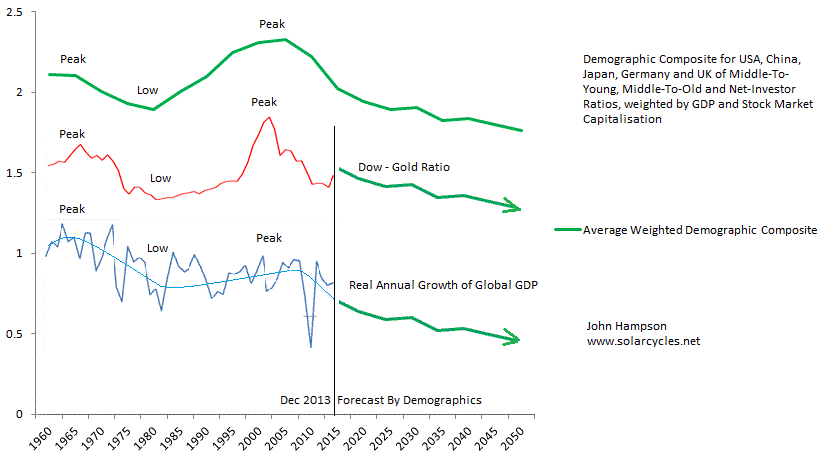
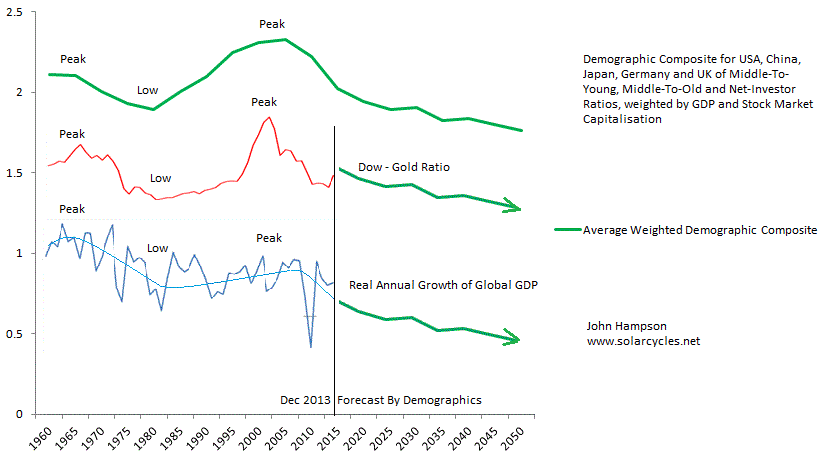
Since then demographics are united in downtrends in the major nations producing this sobering composite:

29se8

Global GDP growth is struggling and should do so for an extended period, and stock markets should suffer likewise.

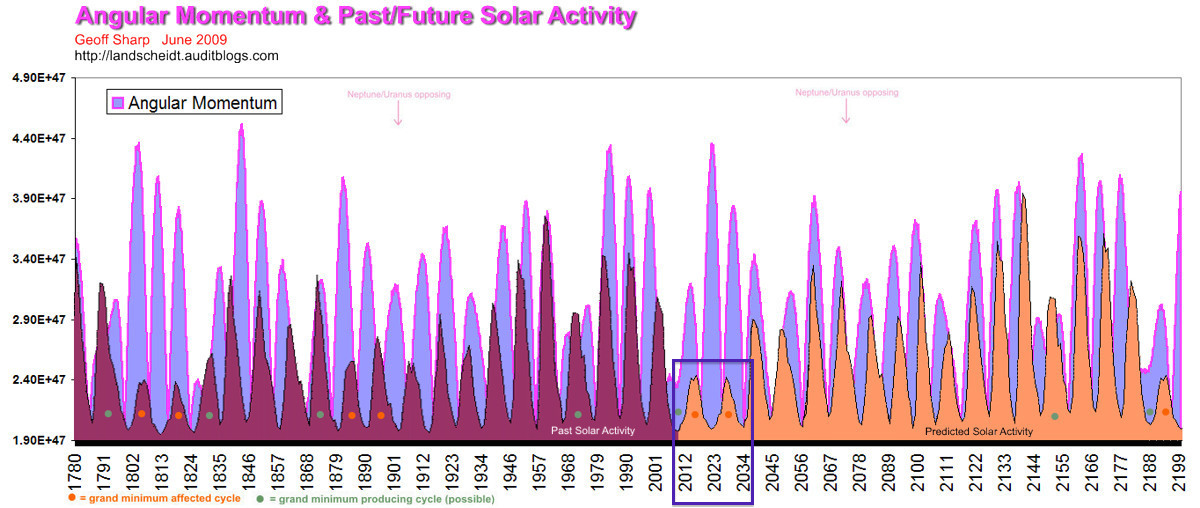
Meanwhile, solar scientists predict that we are tipping into a new grand solar minimum. The predicted low GDP growth above fits with the grand solar minimum predicted below, making for a compelling cross-reference.

29se9The last piece of the puzzle is debt. Debt is prosperity taken from the future and has been increased with each war and each major recessionary/depressionary period, to pay for or offset those events:

29se8

The resultant long rising debt trend means more productive receipts have to be spent on servicing the debt, which crimps the economy beyond that of demographics.

The end game for debt is QE. Printing money to buy your own debt is the policy of last resort. The only way out of this is if demographics point to much higher receipts ahead, but in fact they show the opposite.

Drawing all these relationships together, the outlook is grim. The next couple of decades will be characterised by low global GDP (as written in demographics), which puts the world at risk of war (at both national and international levels). The debt situation threatens to accelerate out of control in certain countries (Japan is at highest risk) as central banks offset even lower GDP and potentially have to pay for war additionally. Major war would cut both GDP and overall population further, making for even greater per capita debt burdens.

These are the major themes. The specifics by country and by timeline are more difficult to predict. But at the global level, the negative feedback looping between solar, population, GDP, debt and war, suggest the crunch is unstoppable for the world.

Eventually, these interconnected phenomena will turn into a positive feedback looping. Out of the ashes of a grand solar minimum with a purge of population, the devastation of war and bankruptcies should come a new solar normal with another baby boom and some anticipated revolutions in systems and organisation (financial, economic, social). True new ways of doing things only occur when circumstances force.

Set against the bleak outlook of the next couple of decades is the continued parabolic rise of technological evolution. Developments in nanotechnology, biotechnology, artificial intelligence, space exploration, geonengineering and renewable energy may produce paradigm shifts that assist with GDP and debt, and accordingly could ease the conditions for war. However, the negative feedback looping captured above extends its grip over this too, as corporate investment has been shrinking across the world in recent years, in accordance with lower economic demand and higher uncertainty.

29se11

Declining levels of investment and R&D worsen the outlook for the future and add to the downward spiral.

We could argue that the global secular bear in the economy and stock markets began in 2000 and that as yet we have avoided major war. However, collective demographics have worsened since then, as Europe and China tipped over to join the US and Japan. With a comprehensive case for stock market peak here in 2014, the next leg down both in equities and the global economy should be the worse yet. To add to this, a large percentage of the population has seen little improvement in personal finance for some years (as the cyclical recovery since 2009 has been very unevenly distributed), which creates bubbling trouble.

The situation in Ukraine and between Russia and the West may be a fruition of these themes. Economic troubles were a major factor in bringing about the revolutions in Ukraine. The sanctions against Russia are hurting both the Eurozone and Russian economies, which are already struggling, thus worsening the situation for both parties. Protectionism was a theme of the Great Depression, and is a self-defeating policy, but it will most likely increase here with the anticipated next leg down in the global economy and markets, as nations turn to helping themselves and trying to prevent domestic unrest. There is the risk that China and/or Russia sell chunks of their large US treasury holdings and destabilise global markets in a major way. Both countries have been increasing gold holdings in recent years. Indeed, ‘war’ could take a new form in this era of global, interconnected and instant: financial markets may be targeted, adding to the risks for traders.

Putting such speculation aside, the trends in debt, demographics and solar variation combine to make a compelling case for a period of serious economic trouble. That period kicked off in 2000 but is now strengthening in intensity, and stock market indicators assess us to be on the verge of the next leg down, which should be the worst yet. The conditions for war are in place, and it seems fairly sure that trouble around the world will intensify. The question is to what degree and how matters unfold. The recent deterioration of relations between the West and Russia is an ominous development if we are now heading into a major breakdown in the markets and global economy at the end of 2014. Major international conflict is by no means certain, but if we were looking for the appropriate conditions for it, then they are in place.

US Demographic Peak Of 2000

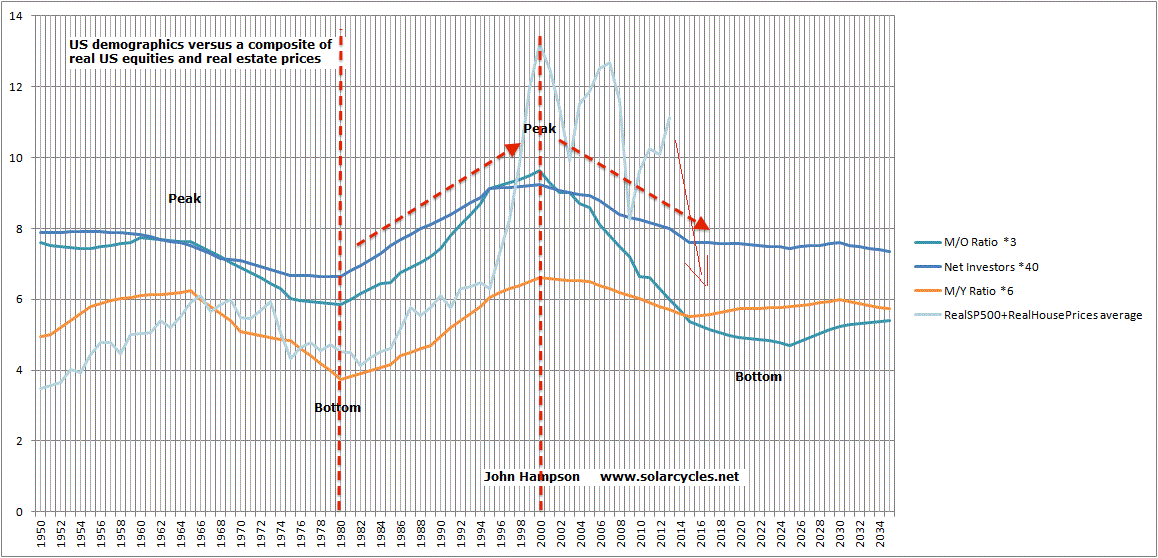
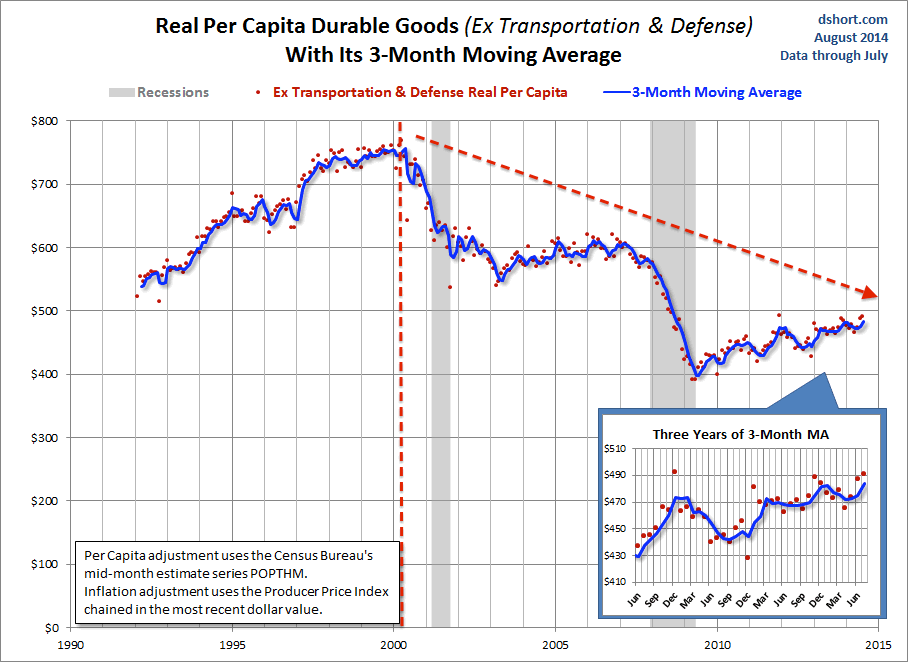
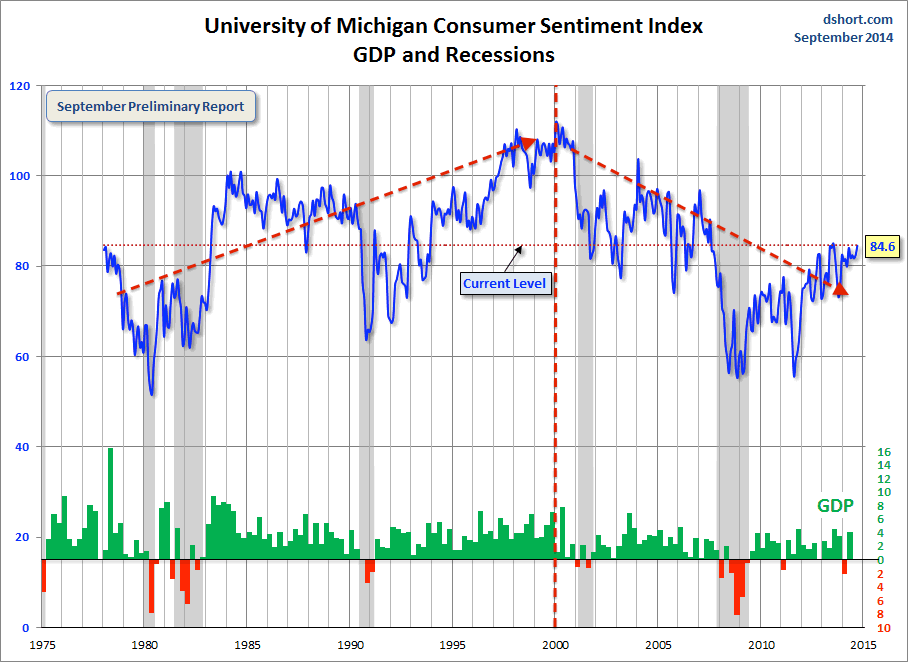
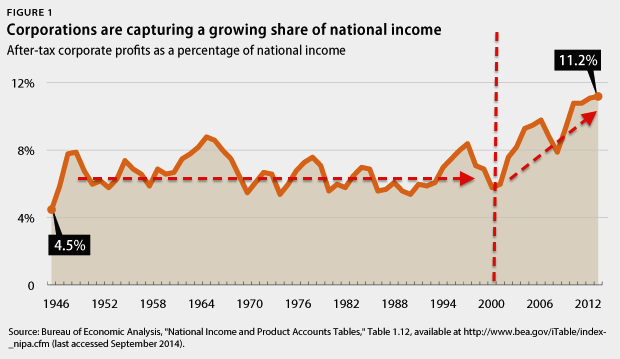
The US enjoyed united demographic uptrends from 1980 to 2000 and since then united downtrends. Here are a collection of charts that show the powerful reality of this influence.

1. Risk assets markets in real terms trended accordingly, and are calling for another cyclical bear down within a secular bear underway since 2000:

18se27

2. Real economic growth trends also align:

18se4

18se10

3. A dwindling proportion of people in jobs:

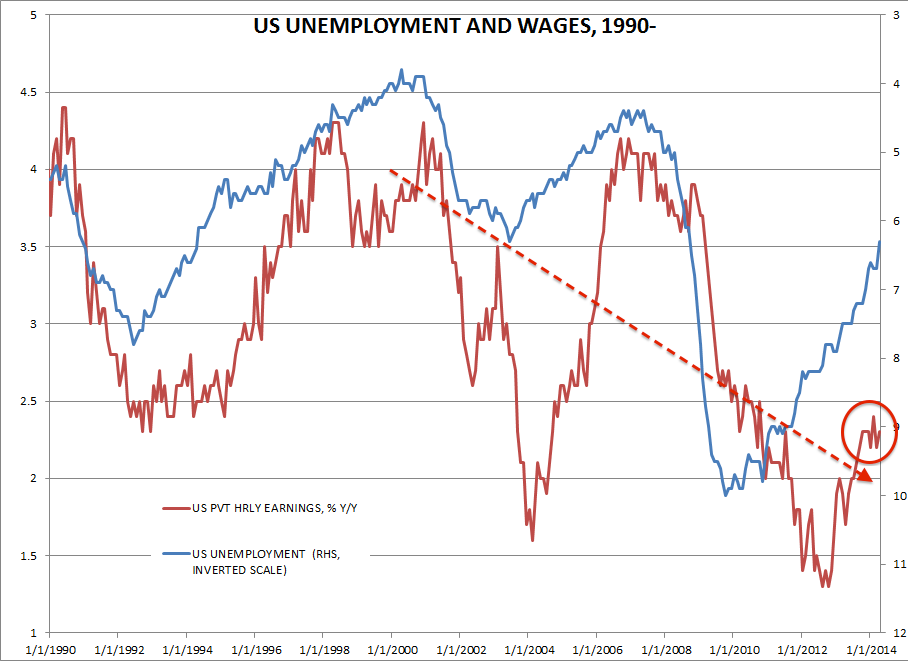
18se54. With associated lower household incomes:

18se8

5. Means that there is less dollar circulation in the economy Screen Shot 2014-09-18 at 07.18.07

6. And consumer sentiment is overall waning.

18se77. Turning to the supply side of the equation, business capacity utilisation is in decline:

18se198. And corporate investment too:

18se21

9. However, corporations have been doing better than households:

18se310. As they have cut staff, replaced with tech, and kept wages low for retained staff:

18se29Source: ForexLive

11. With shrinking real demand in the economy and in asset markets, the Fed has attempted to offset this by depressing rates:

18se2Source: Gary North

12. And ‘printing money’:

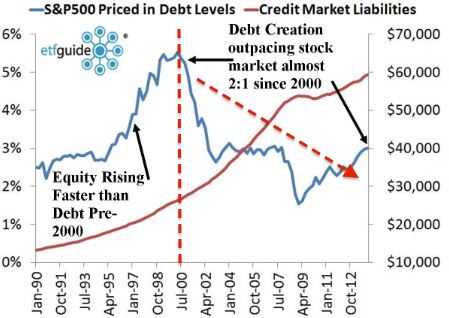
18se2413. The stock market has to a degree been a beneficiary as investors search for yield and corporations indulge in buybacks rather than business investment. However, this has all been sponsored by increasing debt, enabled by the low rate environment:

18se28


Drawing this together, demographic trends are creating a negative feedback looping between jobs, wages, incomes, spending, business investment and utilisation in the economy. Lower demand and lower supply. QE and ZIRP can’t really influence this because they are nothing ‘productive’ (tinkering with the money mechanism), and they are also only policies of encouragement rather than policies of force. However, they have served to shore up the banking sector, to keep debt costs low, and to push some people and businesses to look for yield, driving up some asset markets with an associated wealth effect. Equally though they have detrimental effects by postponing necessary economic cleansing, driving up asset prices through increasing debt (i.e. unsustainable), discouraging more productive use of money and in some ways worsening the economic situation by reducing incomes dependent on saving rates. Nonetheless, the Fed was keen to avoid the 1930s front-loaded deflationary devastation and has succeeded in this. But have they prevented it, or just postponed it? On a long term view, they have of course only postponed it, because the massive borrowing that they have undertaken is wealth taken from the future. But for us traders, the shorter term outlook is key.

I believe the above collection of charts demonstrate clearly that the Fed’s policies do not overcome the overarching demographics as they all show a series of stair-steps downward since 2000. If we contrast it with the 1930s we see evidence that the Fed has helped to phase the devastation, but the charts show they have not been able to neutralise it. When we consider the unprecedented collective demographic downtrends in place now in all the major nations, I believe it is clear we are on the cusp of another leg down, both in economic measures and asset markets, that will take us to a new level in all lower than 2008/9. We can cross reference this with the stock market currently at extremes in valuation, sentiment, leverage, buybacks and allocations: namely it has the attributes of a ponzi scheme wealth effect, at high risk of full reversal. When the stock market collapses, the next leg of demographic devastation will wash through, revealing the relative impotence of the central banks.

18se30

Problems in China

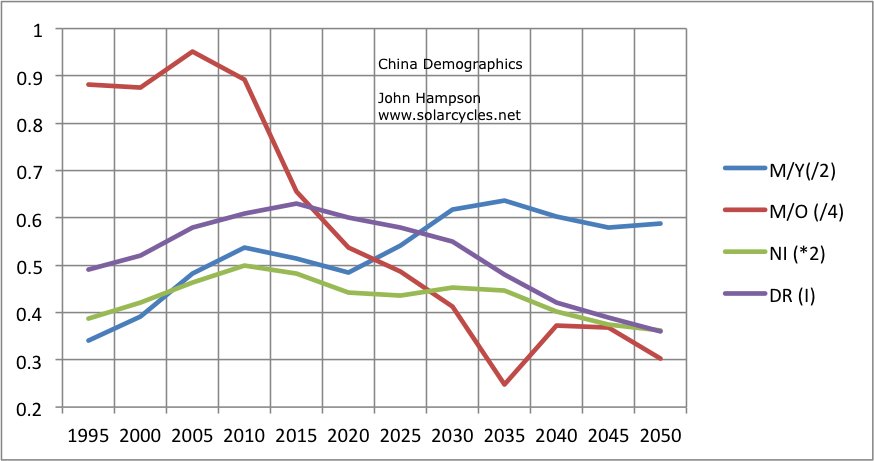
1. China tipped over the demographic cliff circa 2007-2010. Here are middle to young, middle to old, net investors and dependency ratio (inverted) measures:

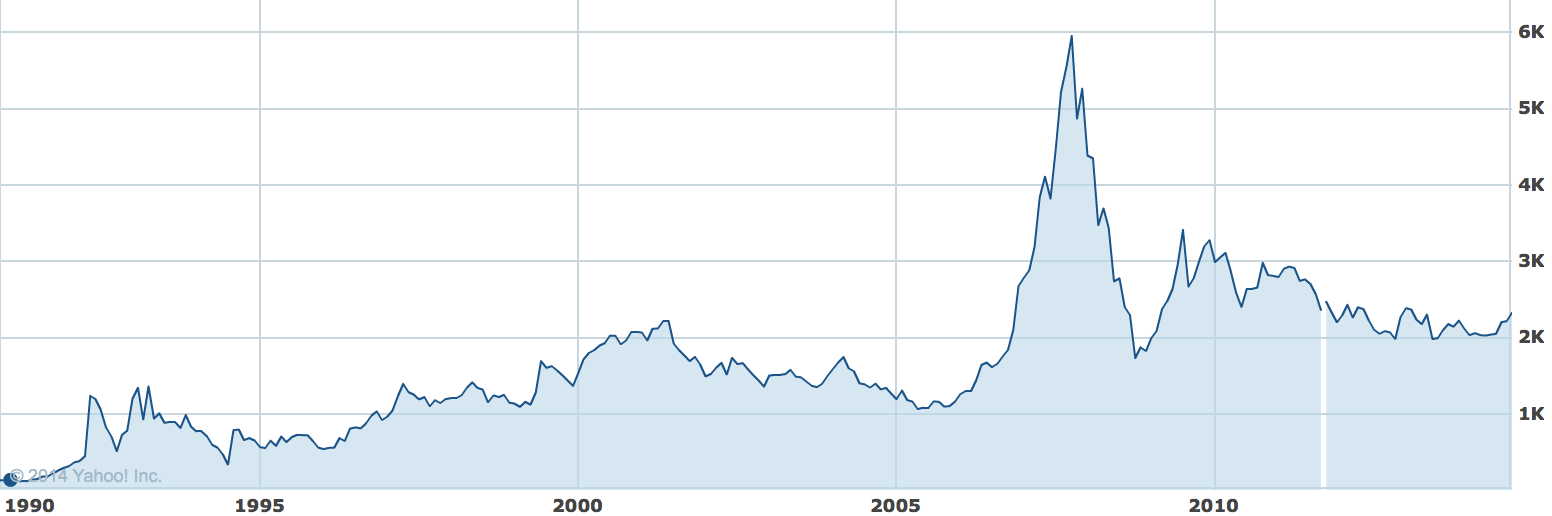
16se152. China’s stock market enjoyed a parabolic mania at the demographic peak, like the US did in 2000 and Japan in 1989.

Screen Shot 2014-09-16 at 07.39.37

Source: Yahoo

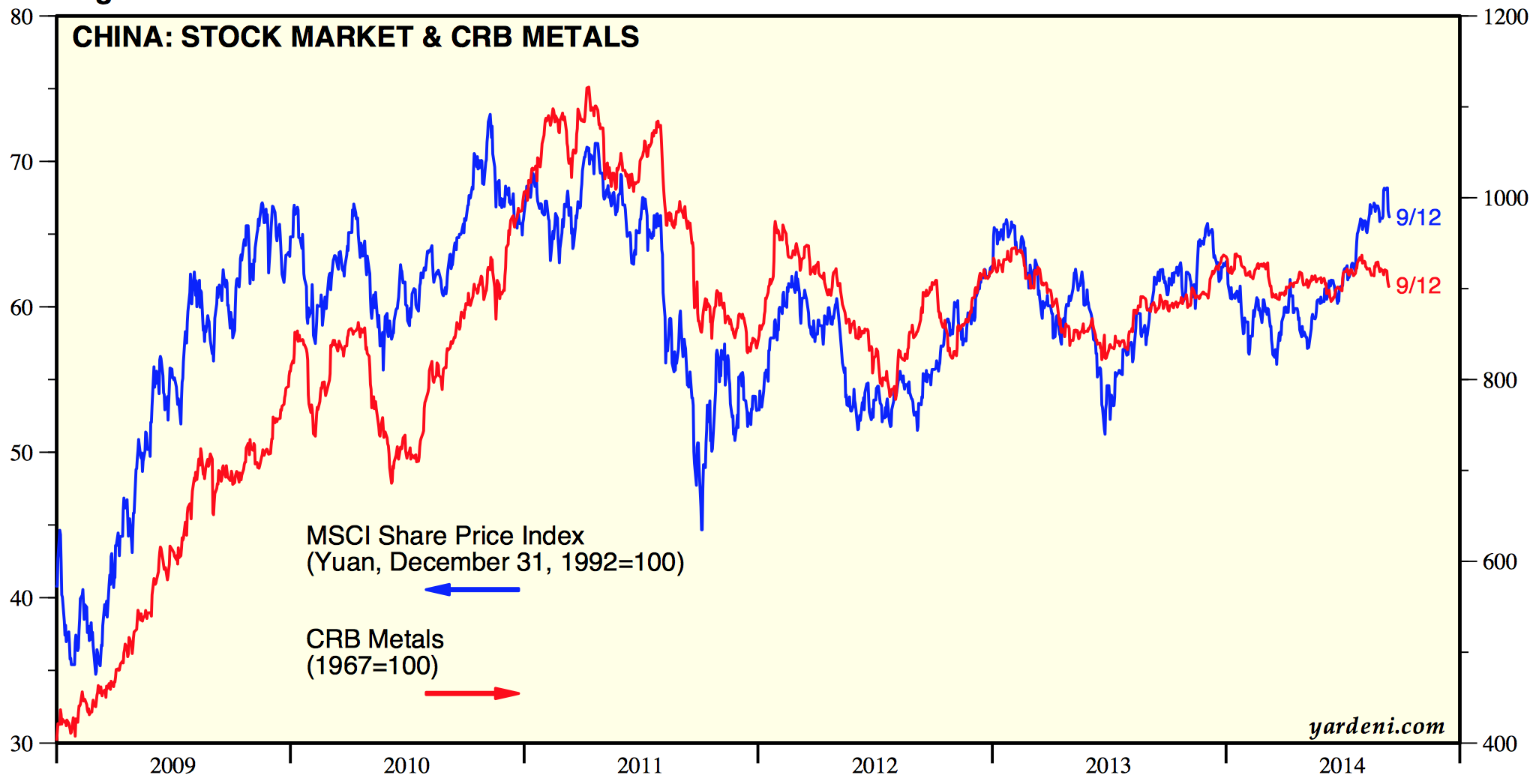
3. China’s stock market correlates closely with commodities:

Screen Shot 2014-09-16 at 07.33.17

Source: Yardeni

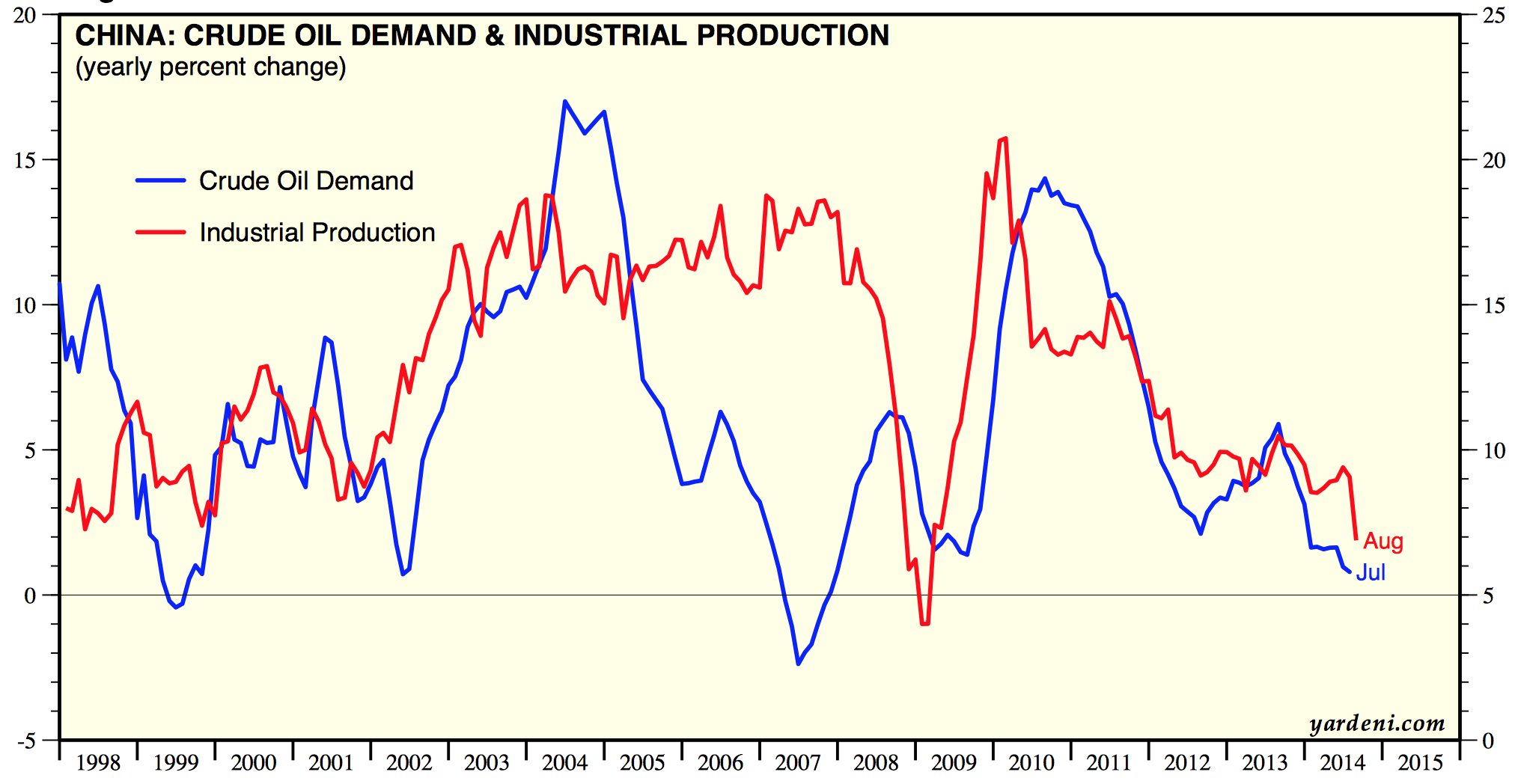
4. Demand for commodities is weakening as the economy weakens:

Screen Shot 2014-09-16 at 07.25.48Source: Yardeni

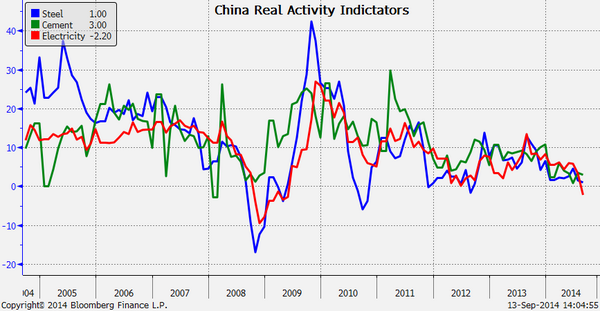
5. Chinese official GDP stats are questionable, so proxies are used for greater reliability. Here, steel, cement and electricity output show a wilting in 2014, flirting with the zero level:

16se9

Source: Bloomberg

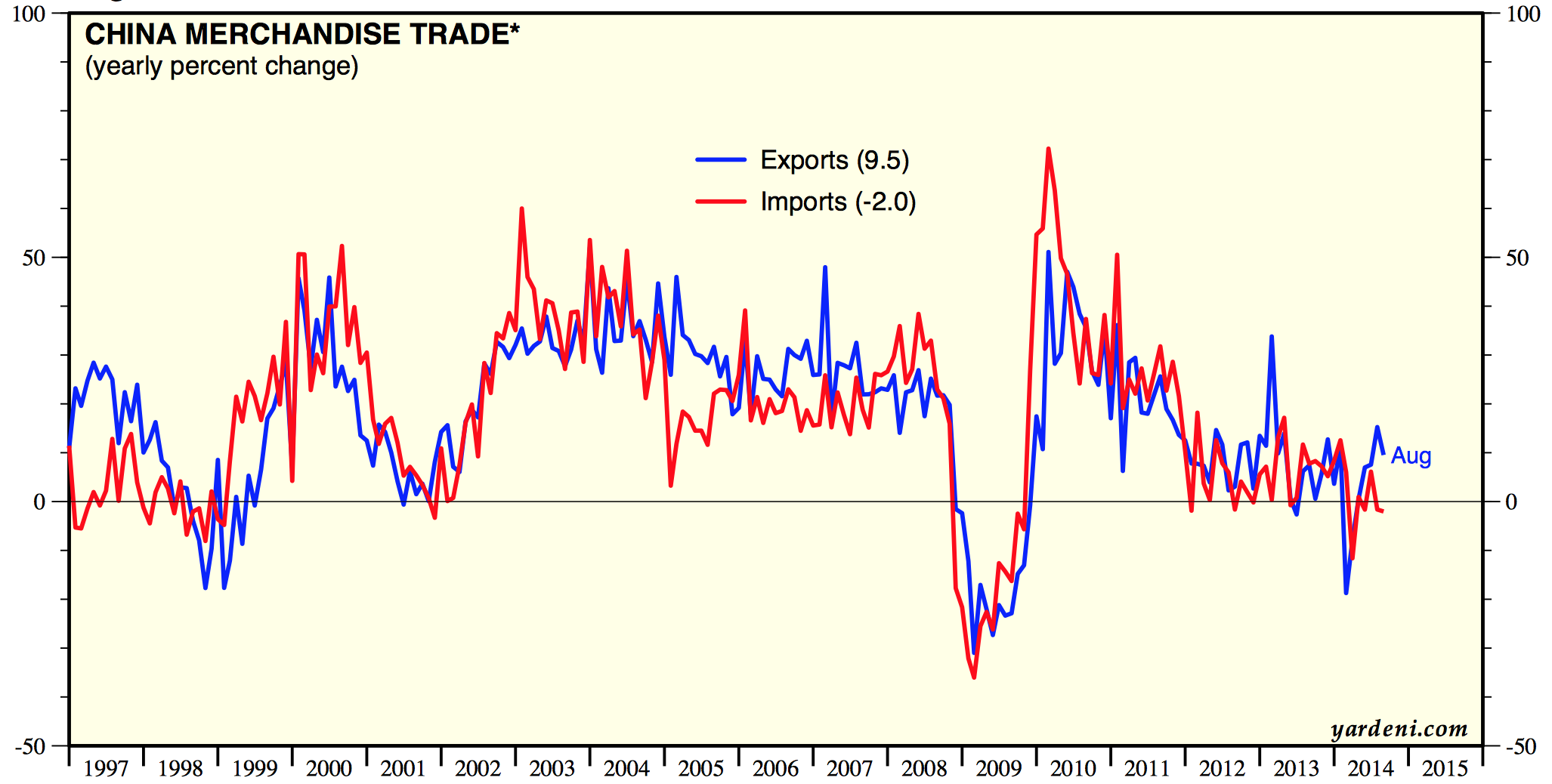
6. Imports and exports are at much weaker growth levels since the demographic peak, and both have seen lurches below zero in 2014:

Screen Shot 2014-09-16 at 07.26.24

Source: Yardeni

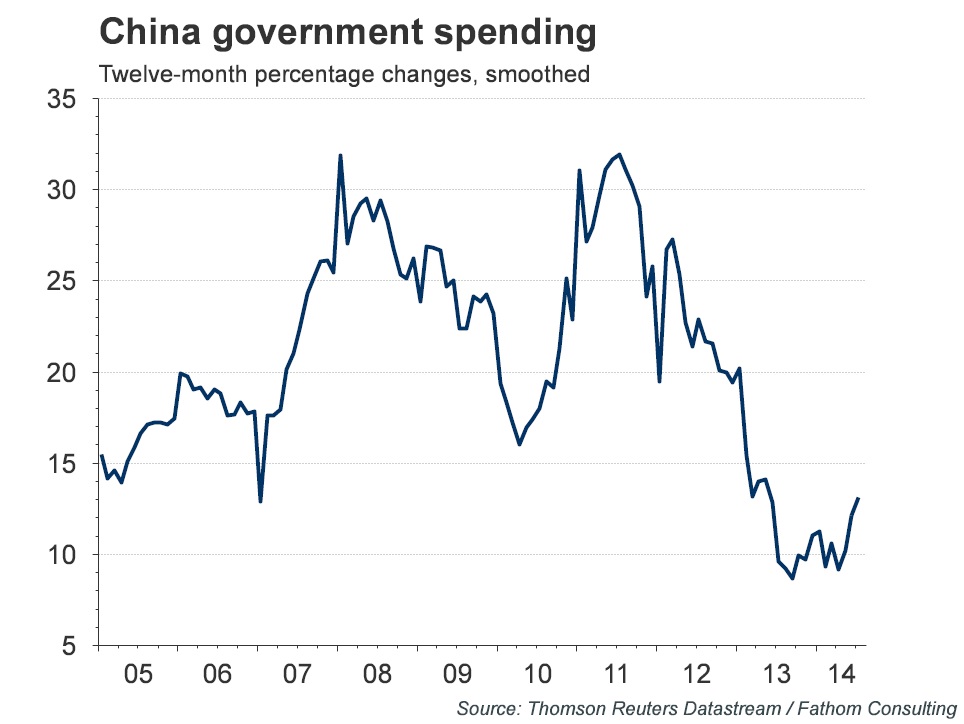
7. Government spending has shrunk:

16se7Source: AlphaNow

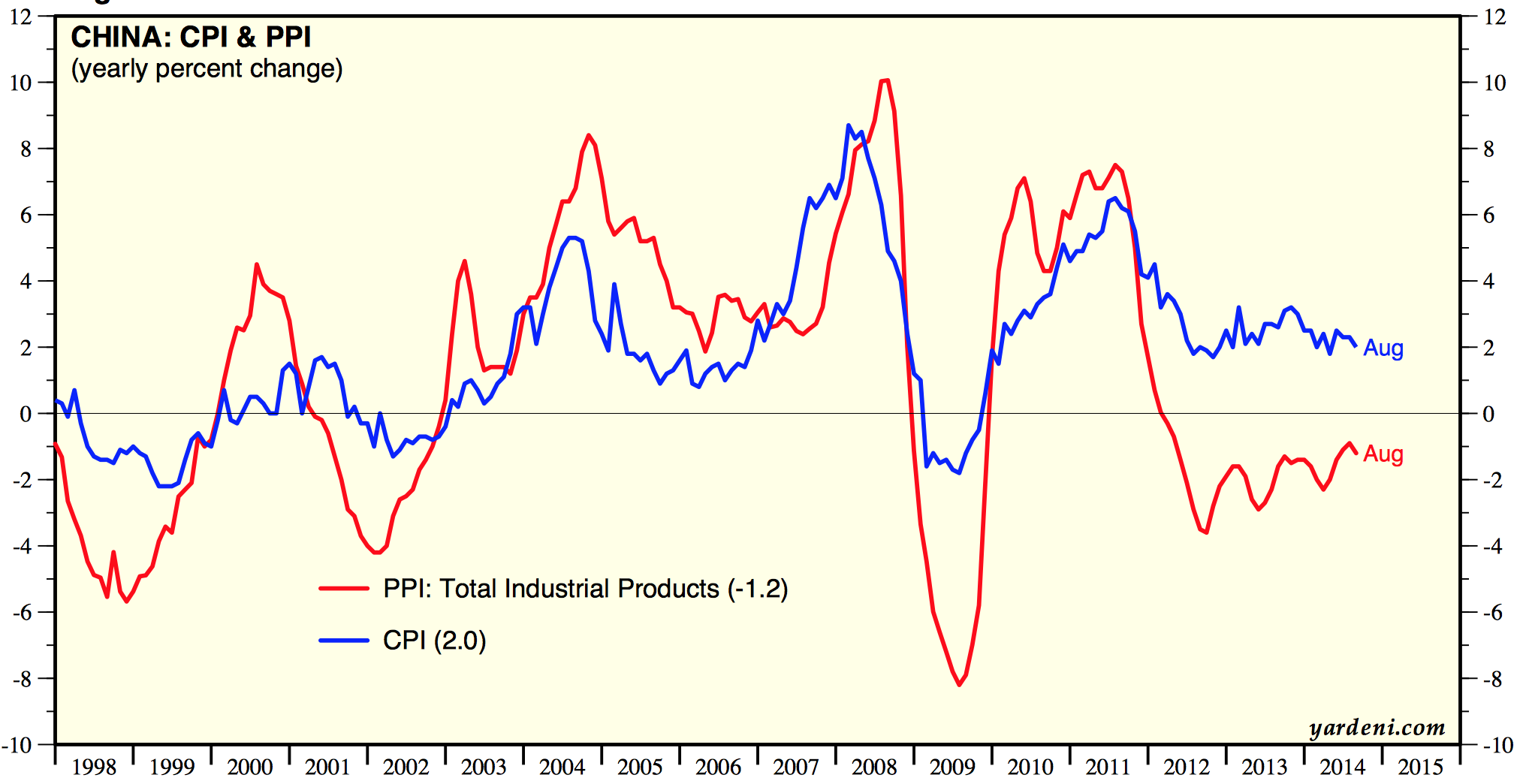
8. Producer prices are mired in deflation:

Screen Shot 2014-09-16 at 07.26.59

Source: Yardeni

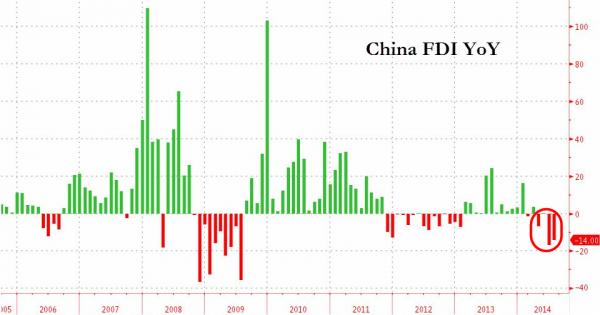
9. And certain indicators have suddenly become more acute in 2014, starting with foreign direct investment:

16se3

Source: ZeroHedge

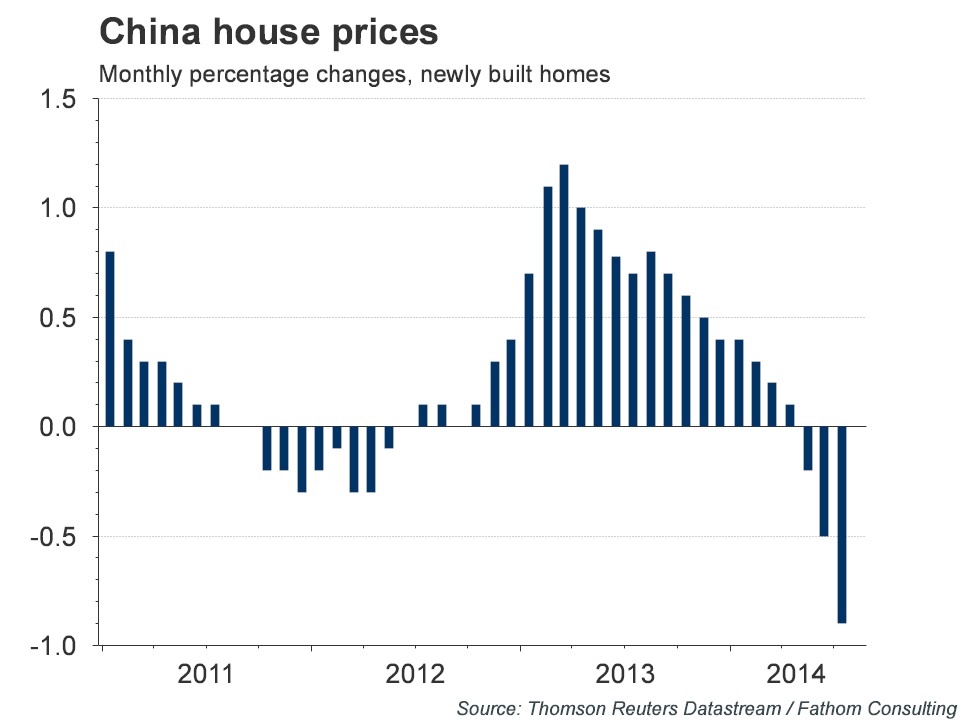
10. Then the housing market:

16se6Source: AlphaNow

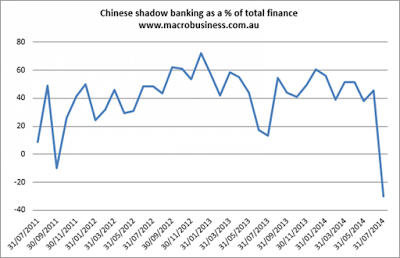
11. The shadow banking market:

16se2Source: Investment Watch

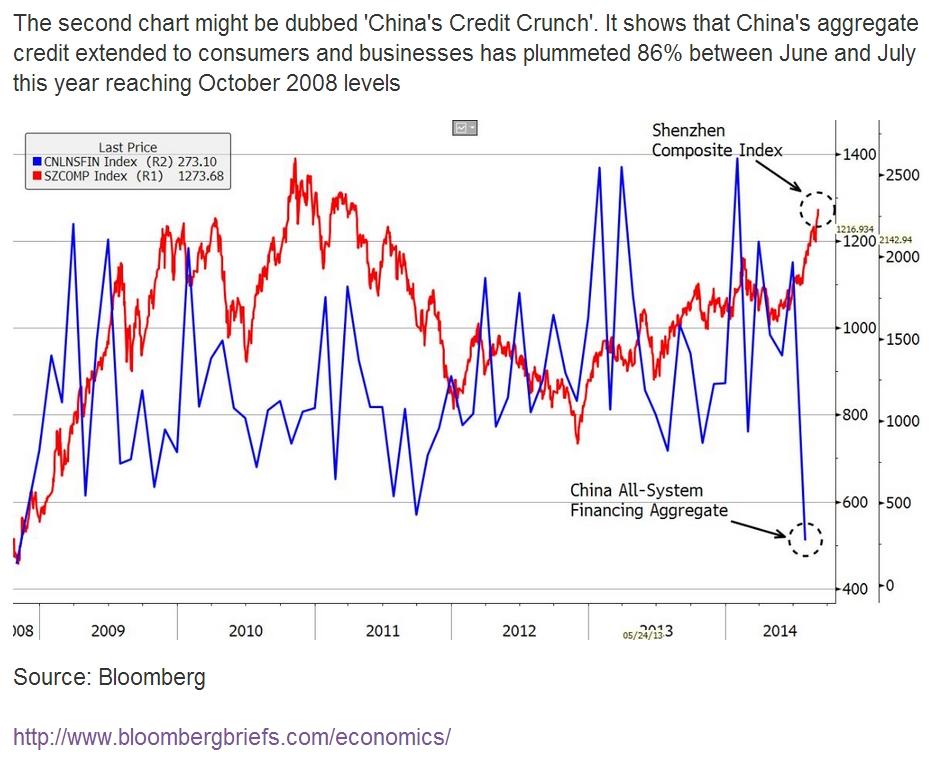
12. And lending:

16se18History shows that economies which expand at breakneck speed typically derail at some point. A potential hard landing for China has been discussed in the media for a long time, but analysts don’t largely understand that it is only in the last 3-4 years that this has become more realistic, since China fell over the demographic cliff. Their one child policy has a nasty sting in its tail. The key is whether the Chinese government can roll out measures that nip the sharp 2014 declines in the bud (which would postpone rather than prevent the devastation), before the negative feedback looping becomes too acute.

In my view, it is the unprecedented collective demographic downtrends in USA, Europe, Japan and China that are tipping the global economy into an unstoppable negative spiral here (only currently propped up by the wealth effect of the stock markets) and central banks will not be able to prevent it. Japan, USA, Europe and China all took turns to be the engine of the world economy between 1980 and 2010 but now we are engineless until circa 2020/2025. By demographics that means a global deflationary recession, or a depression. Passing through the solar maximum here in 2014 should produce dwindling speculation and economic activity and nudge the stock markets and world economy over the edge, feeding off each other.

Characteristics Of A Stock Market Peak

Focussing on the US stock market, I’ll divide this into two: what’s currently flagging a peak, and what’s – arguably – missing.

First, the different angles and disciplines that are signalling a top.


A. Valuations

(1) CAPE, (2) CAPE/Baa yield, (3) Crestmont, (4) Q ratio, (5) Stock market to GDP ratio, (6) Median stock, (7) Relative pricing to bonds and commodities, (8) Relative pricing to other countries, and (9) Relative pricing to demographic trends: all show extreme overvaluation, fitting with previous major peaks.

B. Sentiment & Allocations

(10) Investors Intelligence, (11) Rydex, (12) Fund Managers, (13) AAII allocations, (14) Households, (15) Put/Call Ratio. We don’t need to speculate about whether this is ‘the most hated rally’ or whether Joe Public has yet to get involved. These measures collectively tell us that allocations and bullishness are extreme high and echo previous major peaks.

C. Dumb Money

(16) Retail v. Institutional, (17) Major distribution days, (18) Multiple Expansion, (19) Money losing IPOs, (20) Buyback levels. Again, these all resemble previous peaks.

D. Leverage

(21) Margin Debt, (22) Net Investor Credit, (23) Leveraged loan issuance. Compensating for a lack of demographic tailwind these have been driven to new all-time records.

E. Negative Divergences

(24) Stocks over 200MA, (25) New high-lows, (26) Nasdaq advance-declines, (27) NAAIM exposure, (28) High-yield to treasuries, (29) Consumer discretionary to utilities. These have broadly been in place since the turn of the year and are now mature versus previous major peaks, suggesting we should be around the end of a topping process.

F. Technical Indicators

(30) Skew, (31) Extreme low volume (Nasdaq and SPY volume on up down days), (32) Extreme low volatility (levitation above 200MA, weeks without a 3% move), (33) Sornette bubble end flag, (24) Compound annual growth. A variety of angles, each with a case for a peak.

G. Sector & Asset Rotation

(35) Best performing asset in 2014: Treasuries; (36) Best performing sectors: Utilities & Healthcare; (37) Hot assets, sectors and indices broke down from parabolics: Bitcoin, RUT, SOCL, IBB (tentative). In summary: out of speculative and cyclical and into defensives.

H. Natural Force Timing

(38) Peaks typically occur close to solar maxima (est. March 2014 (RUT)), at (39) Inverted geomagnetic seasonal peaks (Dec/Jan (risk, Nikkei), Jun/July (Dax, Dow)) and (40) Close to new moons (in Jan, Mar, Jul and Aug). The solar maximum is the question mark, because it is an estimate currently, but we know we are in the timezone of a smoothed solar maximum and from history a market peak is likely near.


Drawing all these angles and disciplines together it should be clear that we are in the vicinity of a stock market peak. You may take issue with a particular discipline or a particular angle or those indicators with shorter histories, but the collective case overwhelms. If you take issue with the collective case by arguing that is has all been distorted by QE and ZIRP, then I would point to 1930s US and 2000s Japan where the conditions were the same and we nonetheless experienced bear markets and recessions. But I’ll tackle this distortion idea more below.

Let’s now turn to what may be missing for a stock market peak and thus keeping the bear market at bay.


I. Topping pattern and technical breakdown

Nikkei, FTSE, Dax, Russell 2K are all overall flat for 2014 and display typical topping patterns. Yet, the other US indices remain in clear uptrends, India’s Sensex remains in a steep ascent, and the Hang Seng recently broke out. So the overall picture is mixed. None of the indices have made a decisive technical breakdown at this point.

J. Leading Indicators, Corporate Profits, Recession models, Financial Conditions

Conference Board LEI, ECRI WLI, corporate profits, yield curve recession model, other proprietary recession models. Corporate profits have turned down by certain measures but not all and the rest of these indicators display no clear warnings currently. Economic surprises are currently positive and the US economy is generally doing ‘fine’. More on these below.

K. Inflation & Rate Tightening

Commodities and inflation rallied from Nov 2013 and peaked out in May 2014, but still at overall historically low levels. Yields tightened into the end of 2013 but since then have reversed and eased. The Fed remains on zero rates but is tapering QE to an Oct 2014 termination. This is a general misfit with recent bull market peaks that have seen higher inflation and a series of interest rate rises. More on this below.

L. Question marks over (i) The solar max, (ii) Sornette bubble end flag, and (iii) NYSE Advance-Declines

Most solar models predict the smoothed solar max to be behind us, circa March 2014. However, SIDC are still running with an alternative model that peaks at the turn of 2014-2015. Also, Mark has a theory that under weaker solar maxima, like this one, speculation runs beyond the smoothed solar max, which would also take us beyond the end of 2014. The Sornette bubble end that flagged in July was at a lower intensity than mirror bubble ends in history, allowing for a potential greater flag ahead (which would imply the market needs to rally further yet). NYSE advance-declines have not negatively diverged yet unlike previous recent major peaks, however they did not at all peaks, and Nasdaq advance-declines have been divergent for 6 months.

More on these below.


Leading indicators by CB and ECRI typically do a good job of announcing recessions ahead of time (though there have been some false positives and false negatives). However, they are not a good predictor of the stock market, with research showing they are typically coincident with each other.
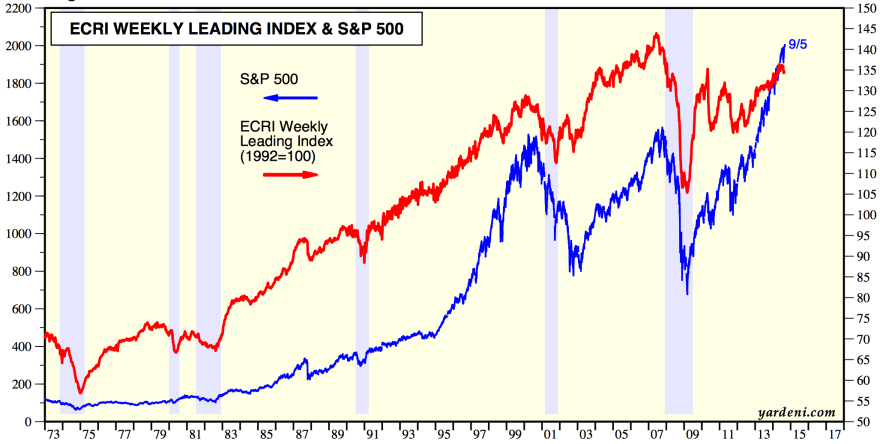
Screen Shot 2014-09-08 at 08.16.18

Source: Yardeni

The stock market is a leading indicator of recessions itself, and in fact an agent, due to the wealth effect. Both ECRI and CB accordingly include the stock market performance in their leading indicator calculations.

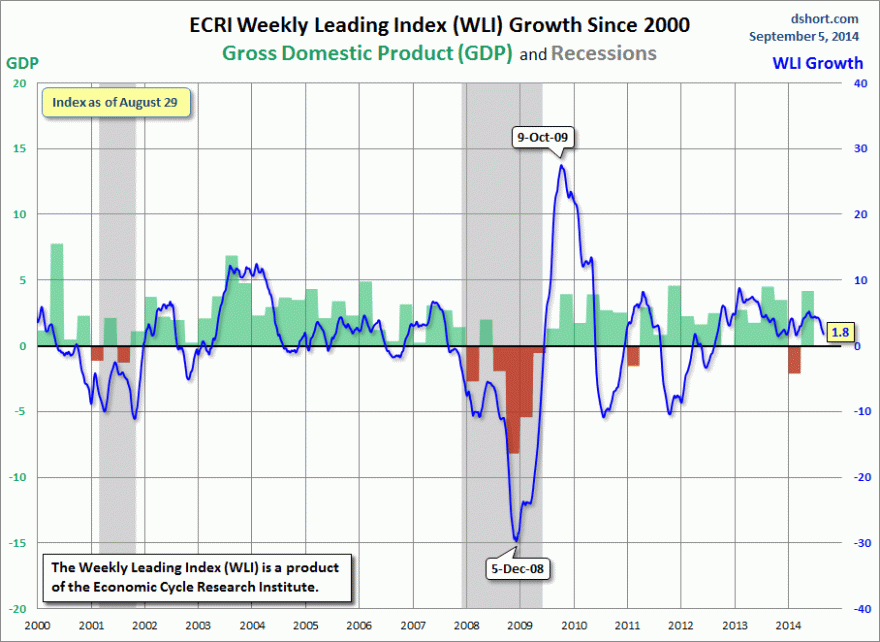
ECRI WLI growth turned negative in 2000 and 2007 after the SP500 had suffered initial falls of around 15% in both cases (from March 2000 and from June 2007). In 2014 we have seen no such damaging break yet, but with ECRI WLI down to 1.8, a true technical break in stocks would likely pull it below.
7se8

Source: DShort

CB LEI topped out with the market in March 2000, and whilst it topped in early 2006 ahead of the 2007 market peak, it didn’t fall until stocks fell in 2007.

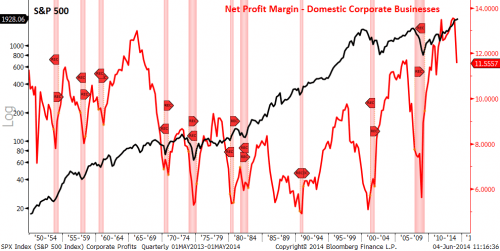
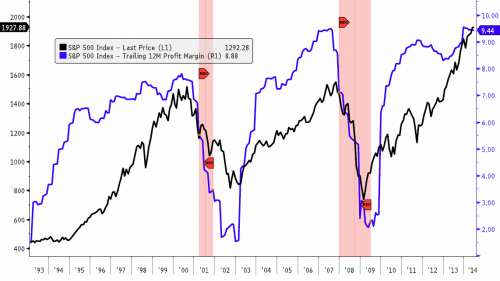
Turning to corporate profits, they also typically turndown as a leading indicator of a recession, but there are different ways of calculating this indicator.

The first method below shows profits peaked ahead of the stock market peak six times, coincident twice and after once. By this measure corporate profits peaked at the end of 2013, and are diverging in line with the majority of historic cases.
7se8

 Source: PFS Group

A second method shows that corporate profits peaked out coincidentally with the stock market the last two times (or along with the initial falls of ~15%), and accordingly this measure is still levitating with stocks in 2014.
7se9

Source: PFS Group

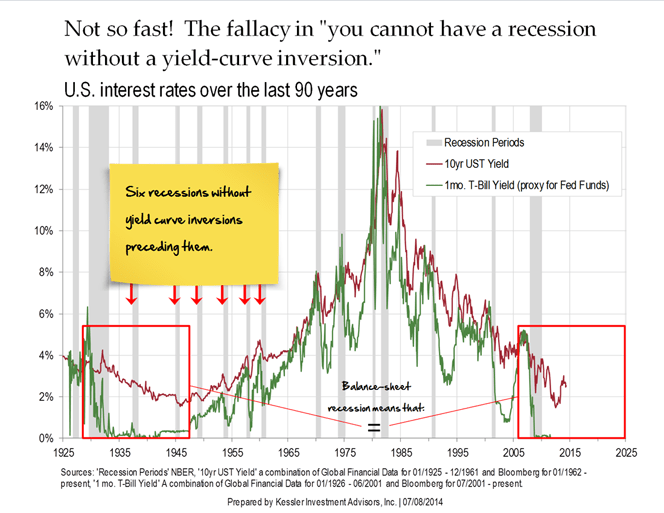
The yield curve as a recession predictor does not work under ZIRP. Japan three times entered recession without yield curve inversion under ZIRP, and the US did likewise in the 1930s-40s.
7se3

 Source: ZeroHedge

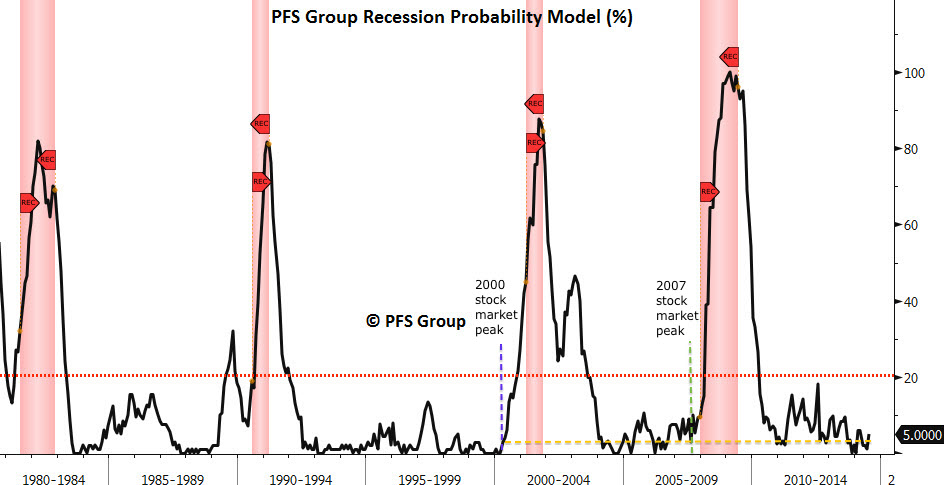
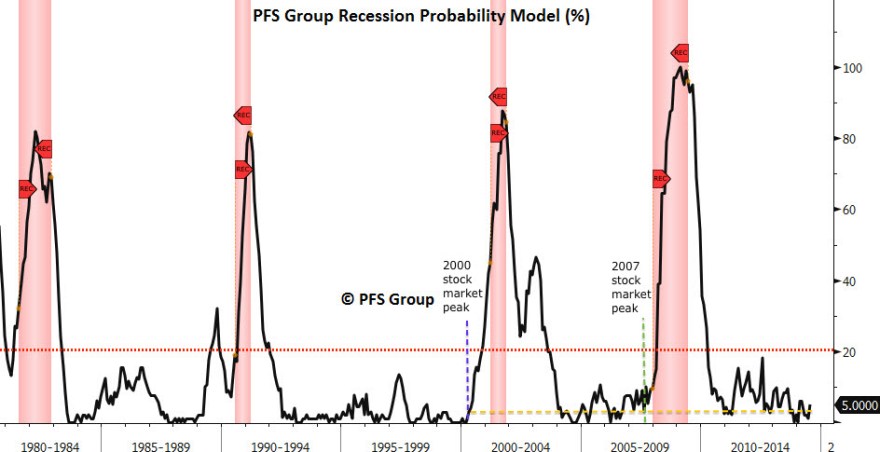
PFS’s recession model is proprietary but note how it only took off once stocks fell hard in the last two peaks:
7se10

Source: PFS Group

Like ECRI and CB leading indicators, it is coincident with the stock market.

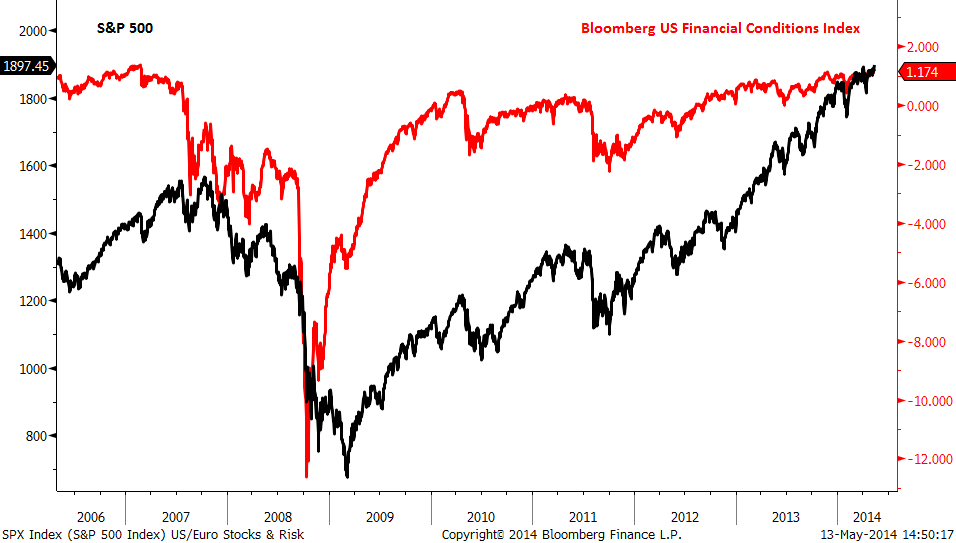
Similarly, financial conditions also did not fall until the stock market peaked in June 2007, May 2010 and July 2011.
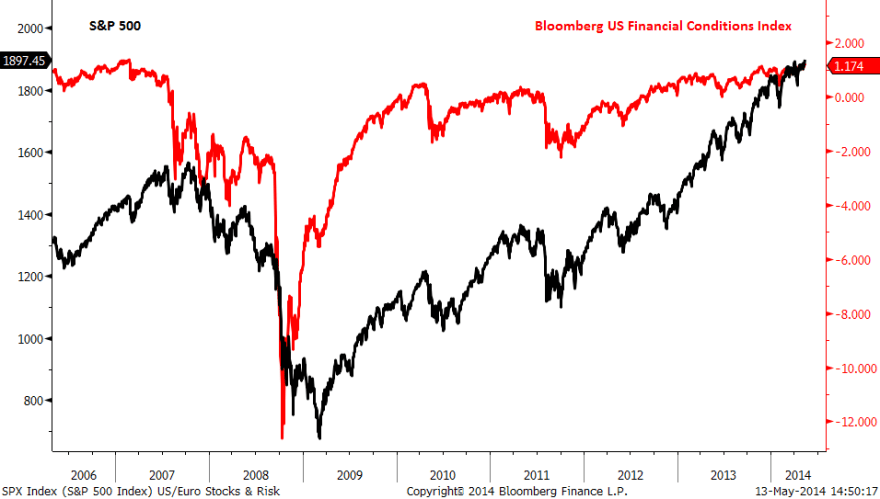
7se5

 Source: Financial Sense

In short, leading indicators, financial conditions and valid recession models are benign whilst the stock market continues to levitate. Once it falls, they will begin to flag, as the wealth effect rapidly declines. The yield curve model is invalid and corporate profits are either coincident or warning with negative divergence, depending on the method. So, none of these indicators are bullish support for the stock market.


US QE is being wound down and will end in October. The stats show that 80% of QE money is parked as excess reserves at the Fed paying a meagre return to the banks. This is because they can’t lend it out: the demand simply isn’t there under demographics. The money multiplier and money velocity are both still in decline. So, 80% of QE money is impotent for now, but this is a threat for the future once demographics improve and demand comes back. The other 20% of QE money is difficult to track, but under conditions of ZIRP we can assume some has entered the stock market searching for yield and return. Ultimately though, QE does not create economic growth: it is just corruption of the money mechanism. Therefore, price rather than the earnings has risen significantly in stock market, making for valuations on a level with previous major peaks. Zero interest rates encourage money to search for yield but also can only tweak demand, not revolutionise it. Also, a large swathe of retirees have less income under ZIRP which acts as a drag in the economy.

The reality is that the US economy is overall chugging along at a lower rate than in the past when demographics (and debt levels) were more favourable. As in the 1930s US and 2000s Japan, QE and ZIRP can only have limited effect whilst demographics dictate.
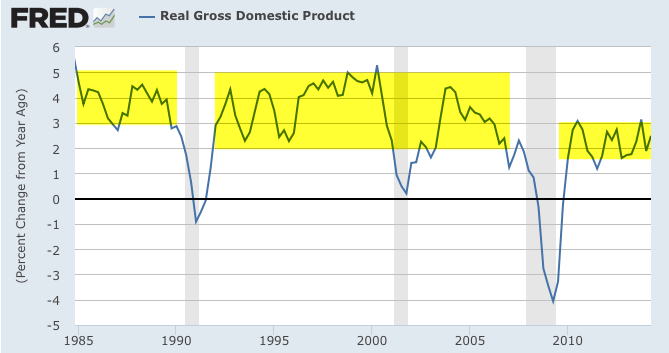
8se10

 Source: Fat-Pitch

Demographics are both deflationary and recessionary. Therefore, we have seen overall low inflation recently and the Fed does not have the luxury of rate rises. The point about both inflation and rate rises is that they choke the economy in rising input prices and tightening. Yet demand is too weak to stoke inflation and the economy too weak for rate rises. The tightening is coming from QE wind-down, but as noted the overall effects of QE are less than touted. I would argue that a sharp fall in equity prices is all that is missing from tipping the economy over, and that we again have to look to 2000s Japan and 1930s US as the most relevant analogs here.

We could argue that falling commodity prices lower input costs and are a driver for the economy and that falling yields are effective as easing. However, if we are in the last gasps of a stock market top then both treasuries and commodities are acting as per a deflationary recession.

The ECB cut rates and launched a form of QE last week. Does that offset the Fed winding down? Analysis of the ECB package shows it to be more window-dressing than content. The Eurozone economy is 3.5 times the size of Japan yet its package amounts to just one tenth the size of what Japan is doing, whilst the rate cuts were largely symbolic. Despite Japan’s aggression, the effects have been disappointing, which brings us back to the point about what QE actually does: it does not drive economic growth, and therefore, the new ECB actions are unlikely to make a significant difference.

Leading indicators predicted a mid-year upturn in US economic growth and this has occurred. Accordingly, economic surprises have leapt into the positive. However, leading indicators predict a peak in growth around now, which should set the scene for disappointment in data in Q4. As this coincides with the termination of QE, maybe this combination will unsettle the ‘Fed policy trumps all’ crowd perception.

In summary, the evidence suggests policies of ZIRP and QE are limited in their potency. They may both play a role in current higher stock market valuations, but the disconnect between prices and earnings/growth is bearish, as it was in 1937. The weak economy under demographic trends is unable to support inflation and rate rises, and I believe is at the mercy of the stock market. Namely, if the stock market falls, the economy will tip over. If it doesn’t it will continue to chug along.


So what is the trigger for the stock market? History shows that major peaks typically occurred without a major trigger, and then sharp falls occurred once there was a suitable technical break. So what factors bring about the topping out?

The evidence suggests one is saturation or buyer exhaustion. We have very recently seen sentiment, allocations and leverage all back to extremes of extremes. I therefore believe we are running out of fuel to go higher: everyone bullish, no-one left to buy, credit facilities stretched.

A second one is natural force timing, and the biggest factor in 2014, I believe, is the solar maximum. Most models point to a smoothed solar max being behind us, around March. Most market peaks, and growthflation peaks, occurred very close to the smoothed solar max, so we should be able to cross reference this.

As things stand, margin debt peaked Feb, the Russell 2K and social media peaked Feb/Mar and biotech is making a double peak now with Feb/Mar. Also, commodities and inflation peaked around April time, and we have seen various indices and risk measures peak out between December and August, either side of this kind of epicentre. So it looks promising.

However, as noted, SIDC are still running a model with an end of year smoothed solar max, and Mark’s theory is that weaker cycles such as this won’t see speculation peak until later in the maximum, not until 2015. Playing into these possibilities we see biotech, junk bonds, the Dow, and (likely) margin debt challenging their highs and attempting breakout. We can also monitor sunspots in real time to see if likely to exceed Feb.

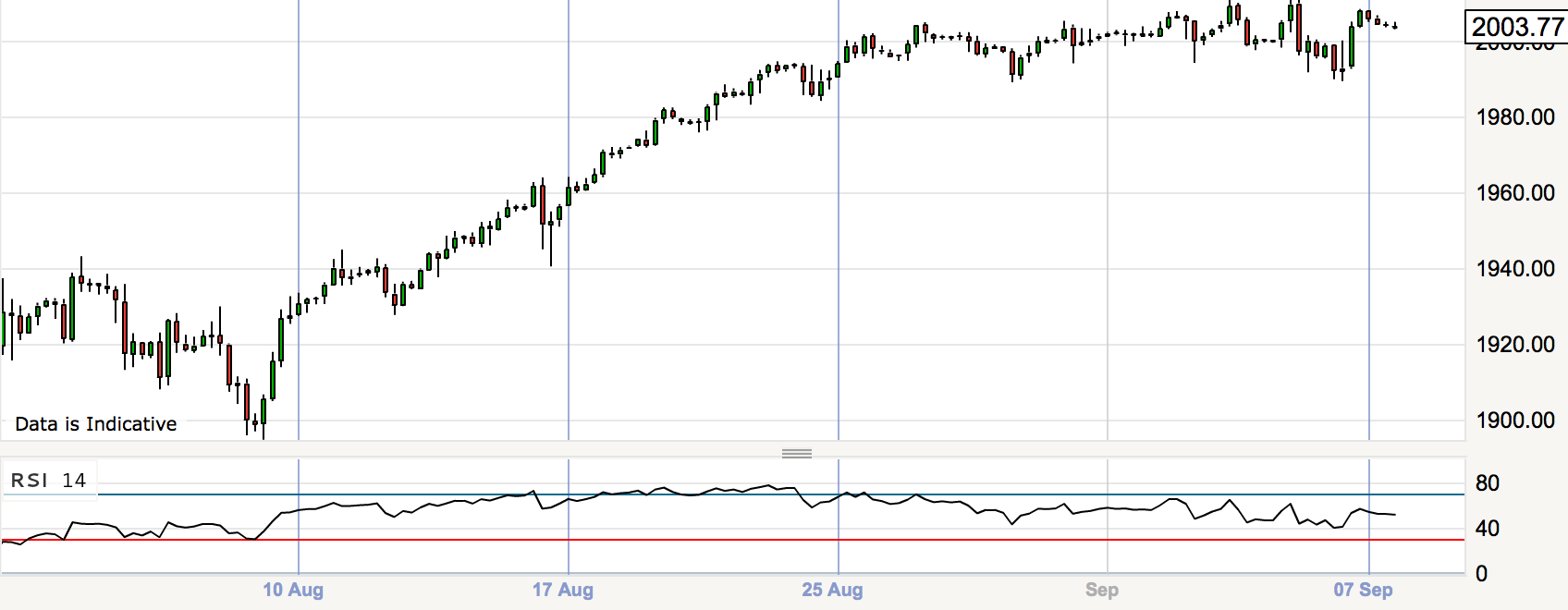
So, I believe we have a useful combined measure there: if JNK, INDU, IBB, leverage and sunspots all break upwards and out to new highs then peak speculation is delayed, and we might then also look to the Sornette bubble end flag to rally again to a higher intensity. However, cross-referencing further, with sentiment and allocations last week back to record extremes, I see a breakout will be very hard to achieve here. Plus, the mature divergences in the market suggest this should be the last gasps of the topping process, not earlier in the process, and we are in the relevant time of the year for the falls to occur. I therefore continue to believe that the most likely scenario is that this rally since August 8th is the terminal rally, shown arching over on the 4-hourly SP500 below, and that JNK, INDU and IBB will all double top out.
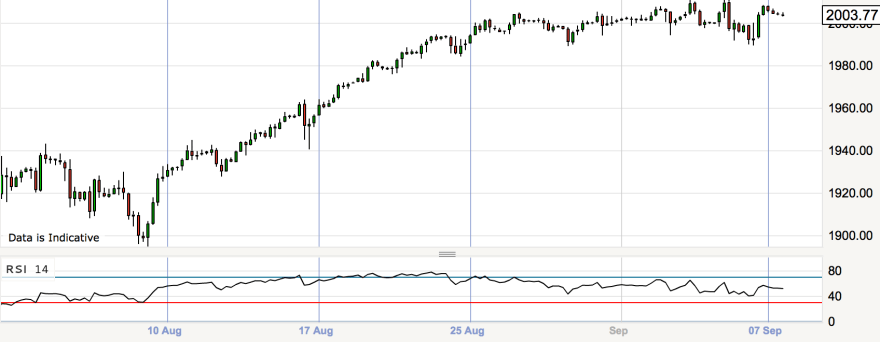
Screen Shot 2014-09-08 at 10.16.32

 SP500 4-hourly


Summary

40 indicators in 8 angles argue for a stock market peak. The only question is the timing, and that is the difficult calculation. The best-fit remains an epicentre of March 2014, placing us now in last gasps. Breakouts from here in several speculation measures would negate that and postpone the top. When the stock market falls it should trigger the ‘missing’ alerts in recession models, financial conditions and leading indicators. The effects of QE are overstated, whilst ZIRP and disinflation reflect the overarching weakness in demographics. Whilst the stock market levitates, the economy should continue to chug along, but if the market falls meaningfully then the economy should tip over into deflation and recession. I believe the two key and associated drivers of the peak are buyer exhaustion and the solar-speculation-maximum, and it appears they came together to peak levels between January and now, making a topping process. Helping tip the perception should be the inverted geomagnetic seasonal lows of Sept-Nov, the predicted disappointing economic data ahead, and the termination of QE support. For this not to materialise, sentiment, allocations and leverage will all have to stretch to new levels of excess to enable a higher stock market. Whilst not impossible, it is not probable.

Last 30 Years

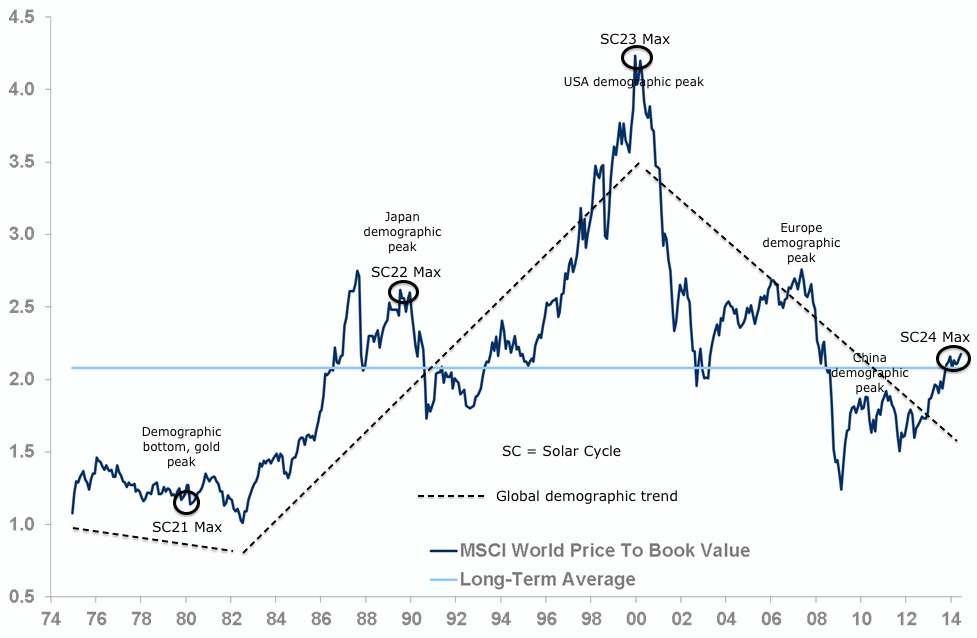
MSCI world equity index valuation chart for the last 30 years:

3se1

Source: Investec

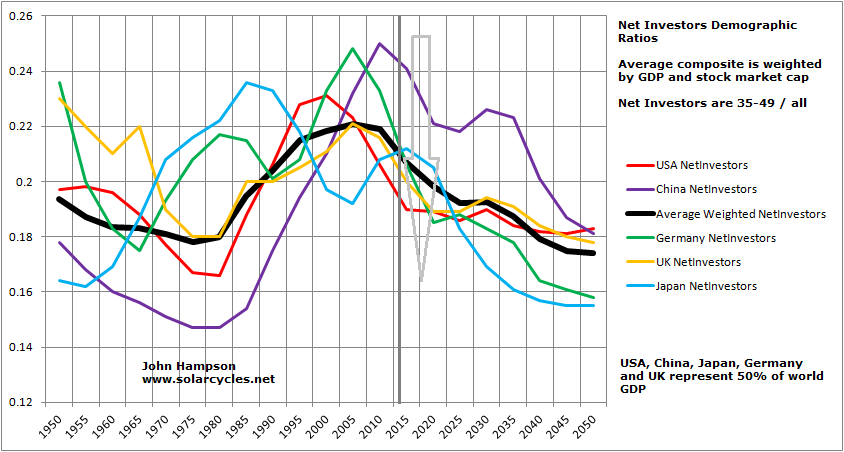
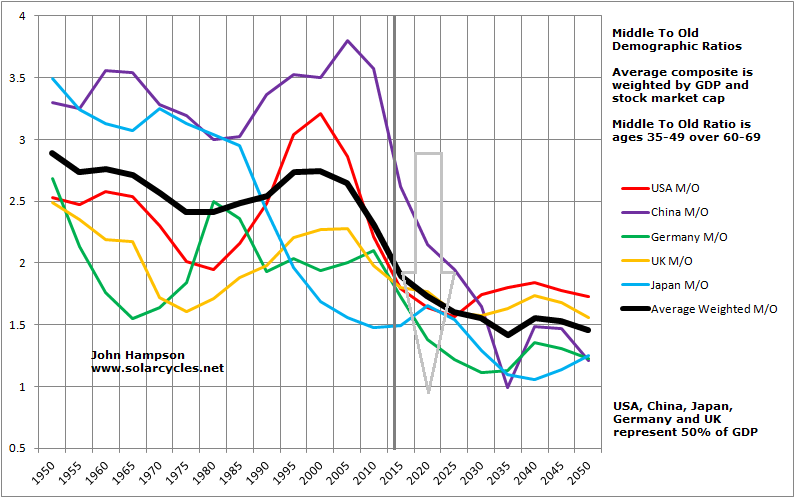
The overall dotted line trend matches the black global demographics composite in the next two charts:

3se2 3se3

Conventional analysis of equity valuations considers cheapness relative to history and averages as a predictor of returns. But valuation has to be considered relative to demographics, or rather, long term trends in valuation ARE demographics. Expensive will get more expensive if you have an increasing swell of people in the right age group to buy the market, and vice versa. By global demographics, we are destined for cheaper valuation yet, and the current bull rally is a counter-trend solar-maximum-inspired speculation peak.

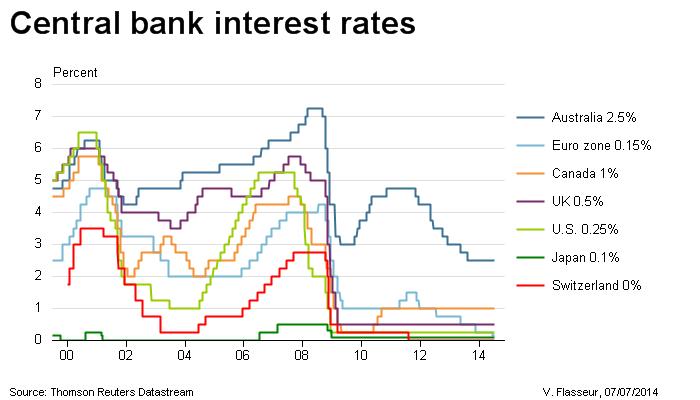
The MSCI world index is weighted like my demographic composites. Therefore the US demographic peak was the most important peak and put in the main top. Since then Europe and China have joined the trend change, making post-2009 the most heavy collective demographic pressure yet. Accordingly, we have seen interest rates held at unprecedented low levels due to the resultant economic weakness.

3se9


If demographics are so dominant then we should see evidence in the current counter-trend bull of major weakness under the hood, which we do.

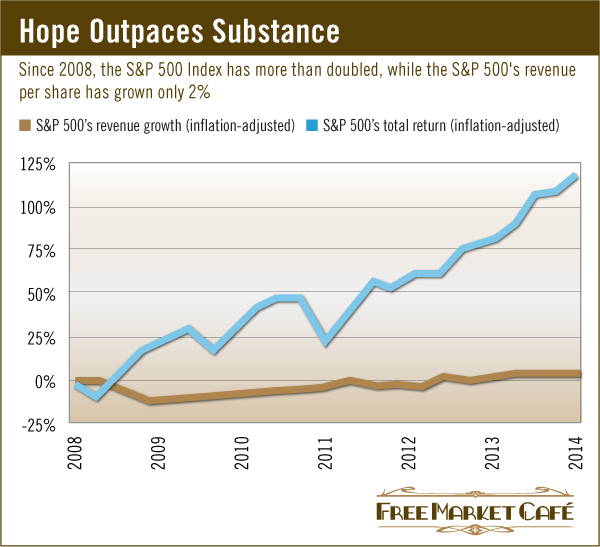
Whilst the SP500 has grown 120% in real terms since 2008, real revenues have grown just 2%. Companies have engaged heavily first in cost cutting then in buybacks. Sales remain elusive.

3se4

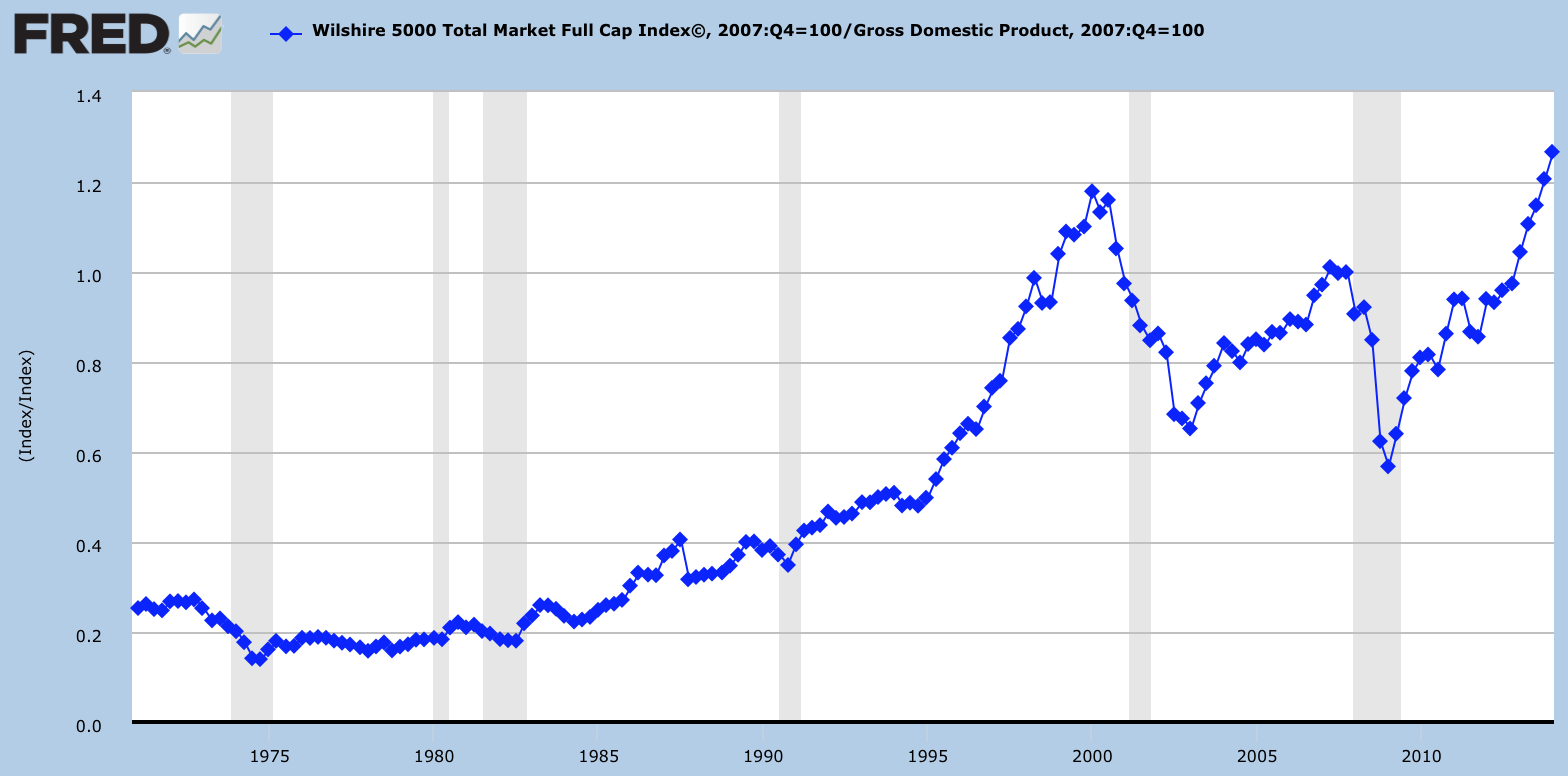
Also, the last 2.5 years in US stocks have been over 80% multiple expansion versus less than 20% earnings expansion, and this price-based rather than earnings-based expansion in equities whilst the economy has remained weak has taken stocks cap to GDP to an all-time record:

Screen Shot 2014-09-03 at 09.00.19

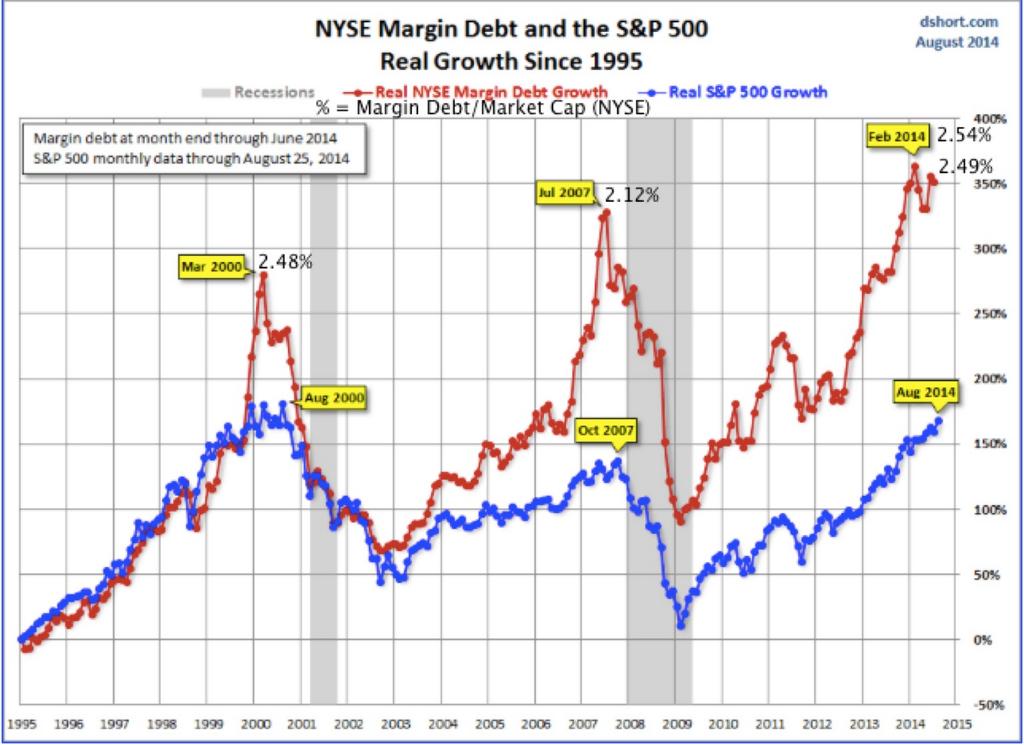
With a dwindling pool of stock market buyers under demographics, the market has been bid up on lower volume and increasing use of debt, taking the latter also to a new all-time record:

3se10Source: DShort / UKarlewitz
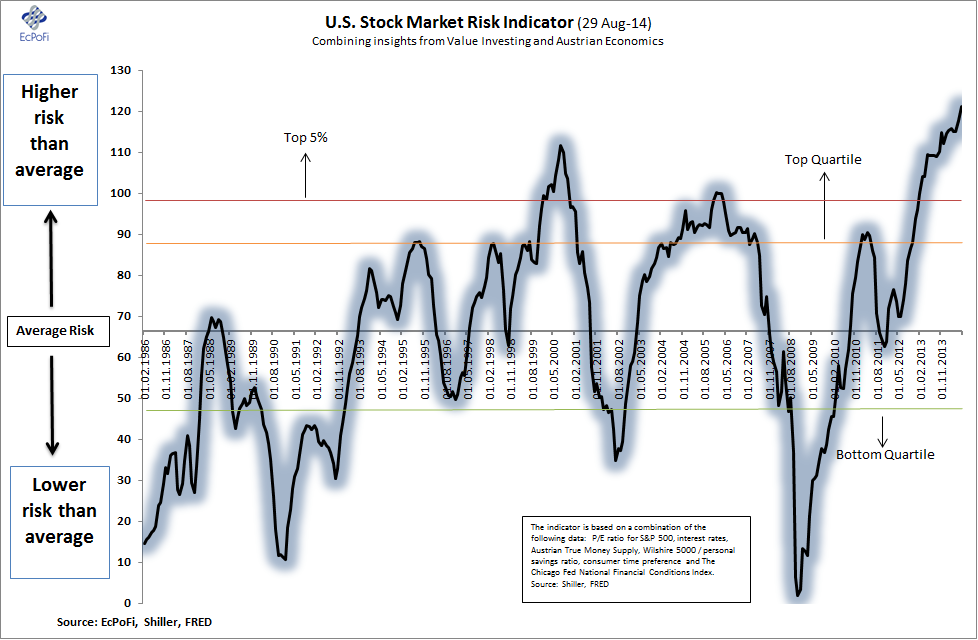
This mix of unhealthy attributes has taken stock market risk to an appropriate record:

3se9Source: EcPofi

In summary, the stock market rally since 2009 has been built despite demographics, largely through QE money, stocks buybacks, private investor leverage and a speculative pull into the SC24 solar maximum. But accordingly it is a rally at high risk of total reversal, it is a tower of sand.

It is the unprecedented collective demographic downtrend now in place between USA, Europe, Japan and China that make it so potent. World trade is depressed and each of these areas is struggling individually. Europe is on the cusp of deflation and recession. Japan’s Abenomics is not working. The USA, although outperforming currently in certain measures, is still operating at a lower all-round level of economic performance versus previous decades. And China, the last to tip over the demographic cliff, is now facing a bursting housing market and shrinking growth. In the 2000s China was driving the world economy, offsetting the USA which had gone over the demographic cliff. Now the world economy has no driver, with India’s economy still too small to offset all the majors. It makes for a negative feedback looping that ZIRP and QE should be powerless to stop.

Turning to the near term. Froth has gone back up to the max.

3se8 2se3Increased volume did return yesterday post Labour Day, to test the validity of last week’s rise. Indecision was the result, so we roll over to today. The market is up so far with a burst on Ukraine peace news. Recall the Bin Laden top? Bin Laden captured and killed 2 May 2011, the market burst up, closed down and it marked the top for the year. With the Dow, JNK and IBB all still at double tops, it could go either way here. So let’s see how today closes.

US Stock Market Valuation

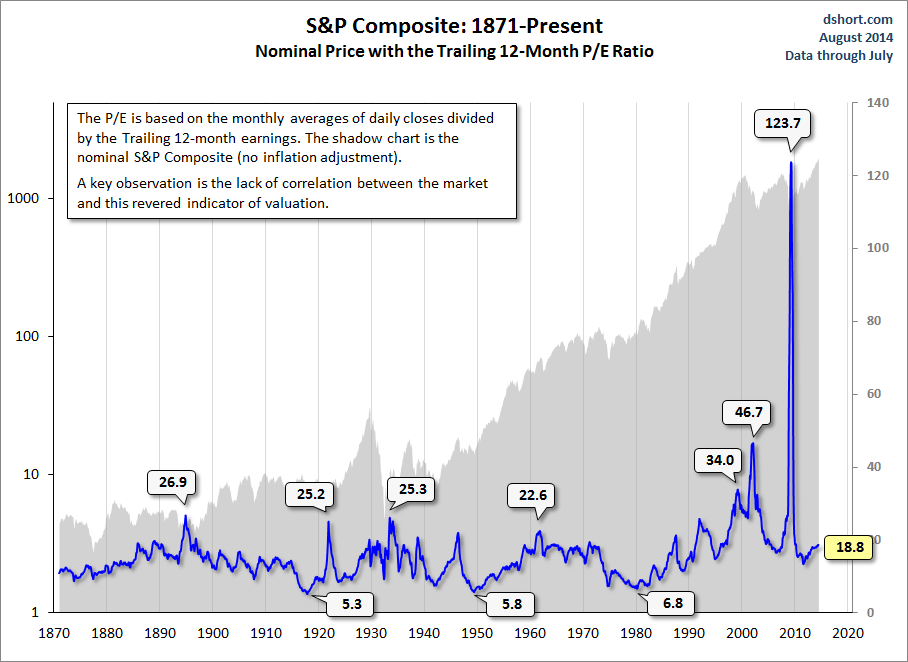
Firstly, trailing 12m p/e valuation. This chart clearly shows this measure is a rather useless tool, and can be disregarded:

1se1

Source: D Short

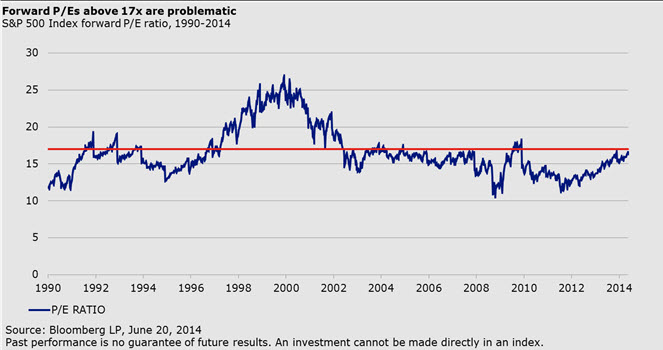
Secondly, forward p/e (12m) valuation. This measure is based on expectations and guidance from companies and analysts. Under- and over-estimating is common for a myriad of reasons (some deliberate, some unrealistic), so this measure lacks reliability and produces another poor chart:

1se3

 Source: Invesco

Thirdly, dividend yield valuation. Also a valuation measure with problems, due to companies increasingly having moved away from paying dividends in favour of share buybacks:

Screen Shot 2014-09-01 at 15.47.11

 Source: Vector Grader

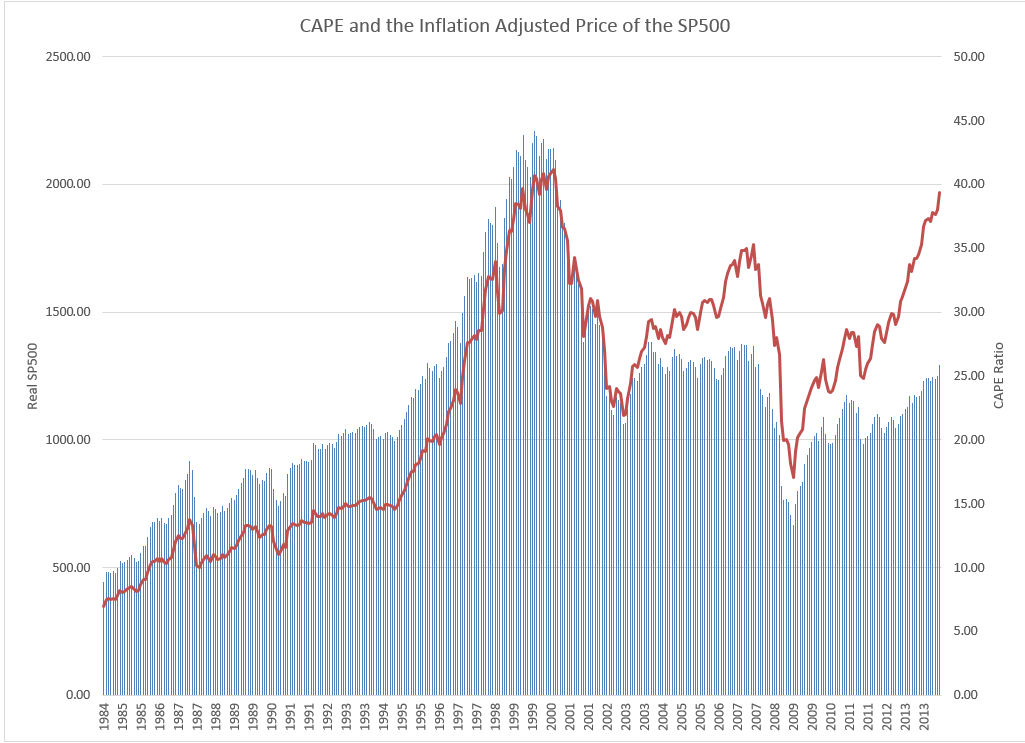
Fourthly, CAPE (or Shiller) valuation. Takes the last 10 years earnings inflation adjusted, and is much more reliable, with a 0.9977 historic correlation with the real SP500:

1se5

 Source: D Short

By CAPE valuation the SP500 is in the 93rd percentile of all historic valuations.

However, the last couple of years have seen the real SP500 diverge from CAPE, suggesting an additional degree of exuberance is in play:

1se6

 Source: Lucretalk

This is resolved by using, fifthly, the Crestmont p/e. Similar to the CAPE but uses a different method of normalising the EPS, which makes for an even tighter fit including that additional recent exuberance. By Crestmont p/e US stocks are in the 98th percentile historically:

1se8Source: D Short

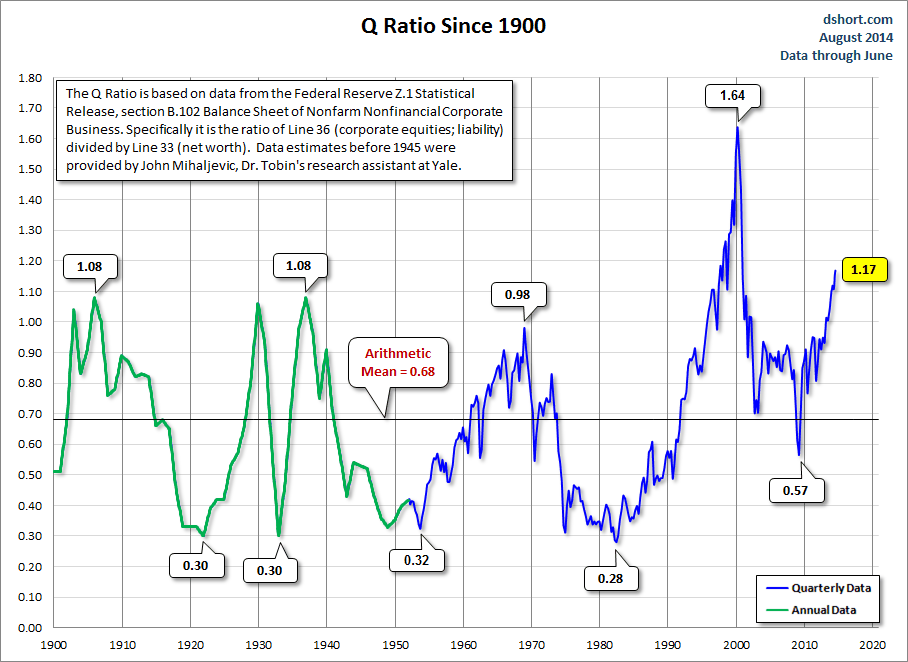
Sixth, the Q Ratio. This is a totally different approach based on the market divided by the replacement cost of all its companies. It, however, produces a similar compelling result historically, and estimates stocks to be in the 97th percentile historically, cross-referencing with Crestmont:

1se9Source: D Short

Seventh: Market Cap to GDP. We can add in Warren Buffet’s preferred valuation measure as additional confirmation of the extreme historic over-valuation:

1se10Source: D Short

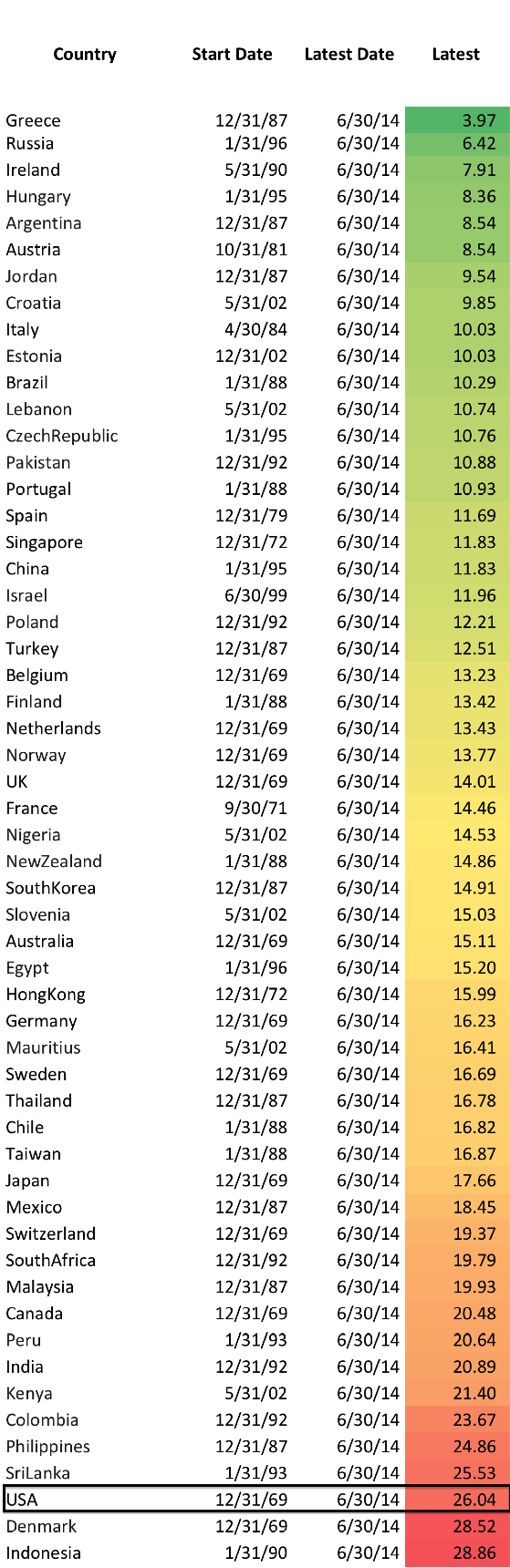
Using the level playing field of the CAPE measure, we can see how the US’s valuation stands up relative to other countries:

1se11


Source: Seeking Alpha

By this comparative measure, US stocks are again extremely expensive, almost the dearest in the world.

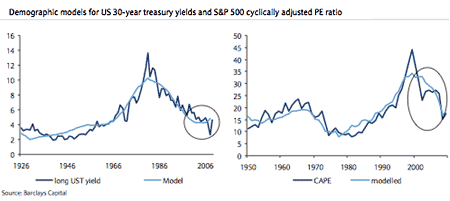
Now we need to draw in demographics. Here are treasury yields and SP500 CAPE versus their respective US demographic trends:

1se14Source: Barclays 

The implication is that market valuation has to be assessed in the context of demographics. An expensive market will get more expensive if there is a swelling population of the age that would buy stocks (or bonds), and vice versa.

US demographic trends argue for lower valuations ahead, lower real stock prices:

USDemographicDestiny

Therefore, the extreme valuations in US stocks, both relative to history and relative to other countries (with more favourable demographics) argue for a bear market. There is no demographic tailwind to take them to even higher valuations.

The question is, why have US stocks run up so far?

Is it the aggression and support of the Fed? If so, then with QE scheduled to end in October, the market should be readying to fall. But, as per my recent post, I rather believe ‘Fed policy trumps all’ has been the mantra for the mania rather than the driver.

Is it the relative economic performance versus Europe and Japan, including its progress from energy importer to exporter? The problem is that all that is priced into the valuations, i.e. price has nonetheless run up far beyond earnings.

Is it the safe haven perception of US equities and the US dollar? Perhaps.

Is it the propensity for US companies to equity buybacks or for US investors to draw on loans and margin, both propelling prices higher? Could be.

Or is it that US stocks began the process still elevated following 2000’s biggest mania of all time? The valuation charts show this to be so.

I believe I can explain the mania of the last 18 months with the solar cycle. The sunspot maximum has driven the speculation to take US equities to these dizzy valuations and cast doubt on the secular bear progression since 2000, as the current bull has been given an exuberant last leg into 2014’s solar max (see my recent Last 18 Months post). However, now that we are through the smoothed solar maximum, the combination of valuations (CAPE, Crestmont, Q ratio and market cap to GDP) and demographics argue for a new bear market at hand within an ongoing secular bear to take us to the kind of washout valuations that 2002 and 2009 so far failed to deliver. Rather, we have stair-stepped our way down since 2000 in alternating cyclical bulls and bears, and we can see this in other economic measures:

1se17

Source: D Short

1se18

Source: Fat-Pitch

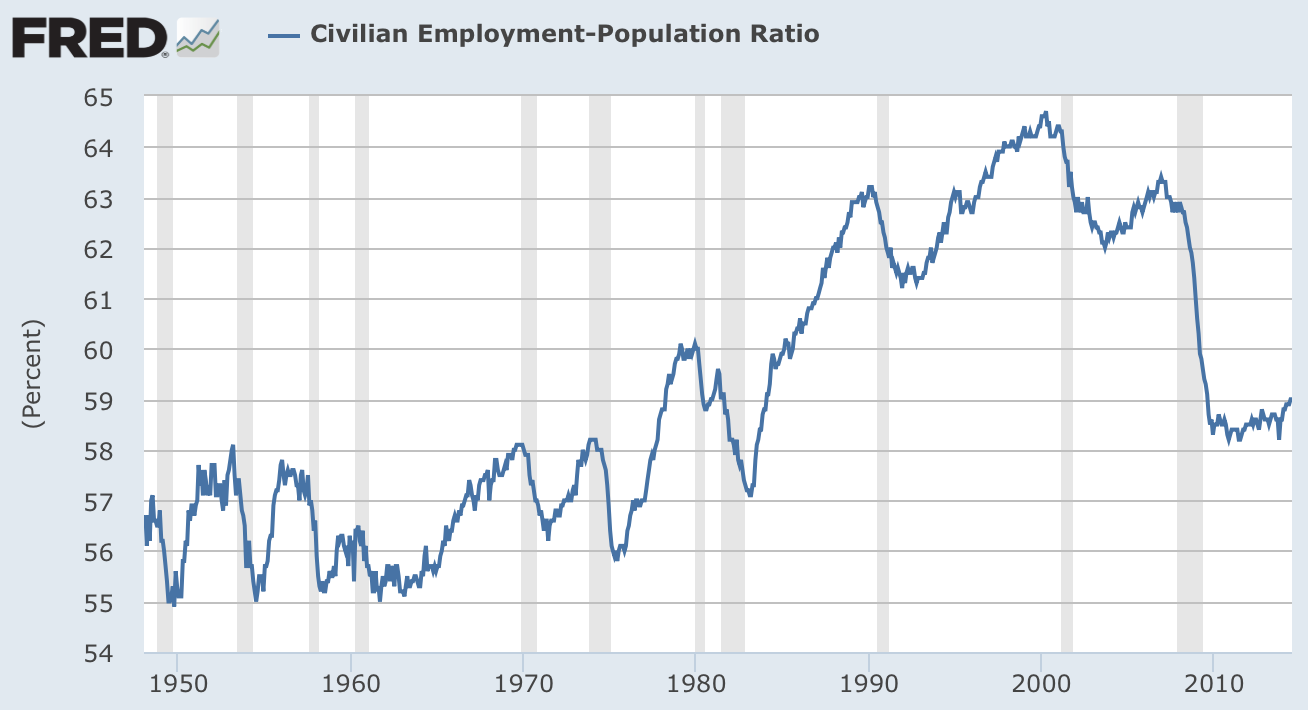
Screen Shot 2014-09-01 at 16.53.35Source: Fred

Demographics and valuations both argue for another step (or even steps) down lower from here.

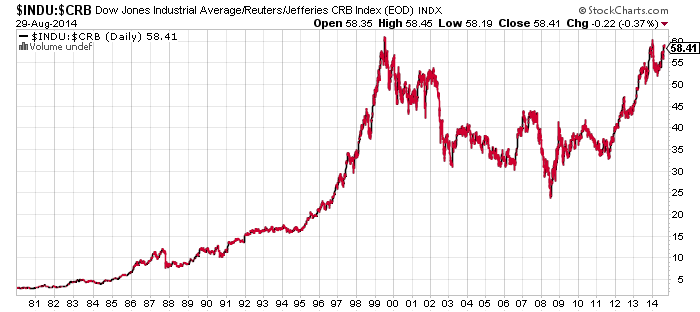
One more valuation measure to finish: we can look at US stocks pricing relative to commodities and relative to bonds. In both regards US equities are now at the same extreme relative pricing as 2000’s peak.

1se19 1se20

Source: Stockcharts

Therefore, by CAPE, Crestmont, Q ratio and market cap to GDP; by relative expensiveness to commodities and bonds; by relative valuation to other stock markets around the world; and all in the context of demographics: I believe US equities are very clearly a major SELL.