Thailand

In total I spent 4 weeks in Thailand in 4 different places: Phitsanulok, Bangkok, Hua Hin and Phuket. There were some common threads to my experience in all 4 regions, which, backed up by reading and research, have formed the impression I outline below.

There are two notable pillars in Thai society: the Buddha and the King. 95% of Thais are Buddhist, and the King is also revered. Wherever you go, there are Buddha statues and portraits of the Thai King.

There are draconian laws against being outwardly critical of the King, but the majority of Thais have a true love and respect for the King, who is often talked of in demi-god terms. Understand that the Thai King is the longest serving living monarch in the world, and has been a constant in Thais’ lives throughout a politically unstable environment of 15 coups and 27 prime ministers, as well as a major economic transformation from an agricultural to an industrialised country in the last half century. The King has occasionally intervened in the political sphere, so he is not a neutral bystander, but he has largely overseen some impressive economic growth, as well as a few crises.

Thai buddhist monks are a common sight wherever you go, because they survive solely on what is given to them by the people. Their day largely consists of meditation, then going out barefoot begging for breakfast from the local community, a few domestic chores, more meditation, the remains of the food for lunch then no food allowed until the following breakfast, some schooling in the afternoon and more meditation in the evening. What is impressive is that the majority of Thai men (and some women) become Thai monks for a period (normally from 3 months to a year as young adults), much like military service in other countries. It is not compulsory but it is considered important to have served time as a monk when it comes to marriage and positions of authority. Some Thais go on to remain monks all their lives, but for the majority it is a rite of passage as a young adult. Perhaps because is it so widely pursued, it is not without issues. It has been reported that almost half Thai monks are overweight, because the community provide them with rich food (with good intentions of course) and the monks’ day is largely one of inactivity. Plus it is not uncommon to see them now with mobile phones or Ipads, despite the ideology of no possessions and a simple life. Nonetheless, in my simplistic view, it would appear to be a fruitful experience to go through such a humble, conditioning process as a young adult.

Thailand stands out in this part of Asia because it was not colonised like the other neighbouring countries. The result is a culture that is less diluted, with one notable barrier to entry being the unique language and script. In Phitsanulok, the least tourist-trodden of our destinations, we generally had to get by on gestures and signs, as zero English was spoken. Thais embrace ‘fun’ living and this has been a key factor in drawing in tourists, extending to an ‘encouraged’ sex industry (for revenues) and some of the party capitals of Asia having grown here. Massage is also everywhere and the cost of living cheap. Unsurprisingly therefore, it has become a favourite backpacker destination. So how about for a ‘flashpacker’ with family in tow?

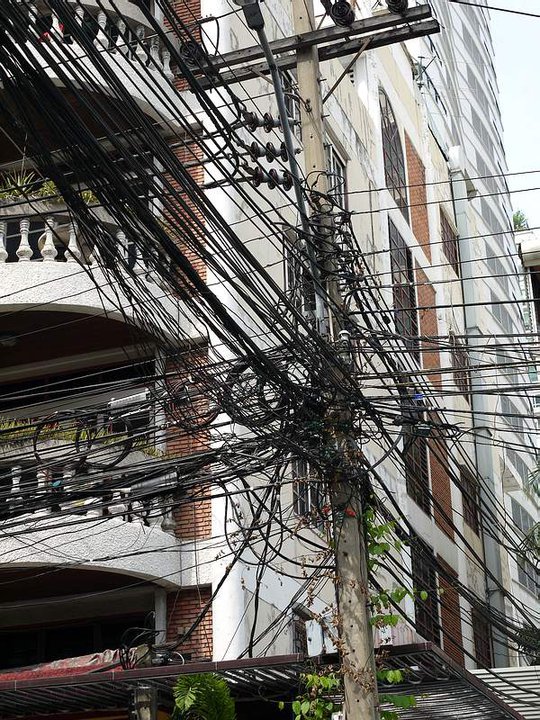
Well, Thailand didn’t measure up to Singapore, Malaysia and Bali. In Kuala Lumpur I was amazed at how friendly and laid back people were for a capital city, Bangkok was all round more ‘edgey’. In Bali journeys around the island were a sensory overload of both interest and beauty, whereas land travel through Thailand was more underwhelming. Overall, I found Thailand to be more scruffy than the other countries on my route so far (accepting it is a developing nation), and this would apply to both the natural and the man-made. Thailand was one of the fastest growing countries in the world in the 1980s and 90s but there have been some growing pains with such a rapid transformation. There is more of a crime issue than in the other countries I have so far visited and, to my eye, aesthetics have been rather overlooked in the country’s rapid development. One image that will remain in my mind is the jungle of telephone wires everywhere we went (see images below). A lot of these cables are put up illegally at night, until there are so many that some of the telephone poles start to lean over. I can only imagine that the spaghetti wiring is not considered an eyesore in Thailand, and maybe it isn’t to other travellers. But travel is a personal thing, and I found this to be a dominant ‘blot on the landscape’.

I enjoyed the food, the cheap living and the glorious weather, and we met some very friendly Thais. But overall there was more effort required to gauge people and their motivations than in Singapore, Bali and Malaysia, and in Bangkok we certainly came across a few unpleasant types. Honestly, I wouldn’t have expected otherwise, but having been spoiled with collective warmth and friendliness in those other countries, Thailand didn’t quite measure up.

The Thai SET stock index was one of the best performers of 2012: the 5th best returner in the world. However it is now one of the more expensive in terms of p/e valuation at around 18. Thailand reached one of the cheapest ever valuations in the wake of the Asian financial crisis of the late 1990s, reaching a p/e of just 3, shown here:

26oct20127

Source: Cnx Translation

This has since been beaten by Greece in the recent Euro crisis, which got to p/e sub 2. The Thai SET history shows that a brave purchase at such a cheap level would have been rewarded handsomely with time, and I believe Greece prove similar for those who took the plunge at the extreme (not I). At current p/e 18, I don’t want a holiday souvenir of a stake in the Thai SET. Instead I’ll settle for a few pictures below.

Long live…

P1030367

Cape Panwa, Phuket:

Panwa

Insect snacks:

P1030652

Monks on walkabout:

P1030618

Those wires…

phone-wires-thailand

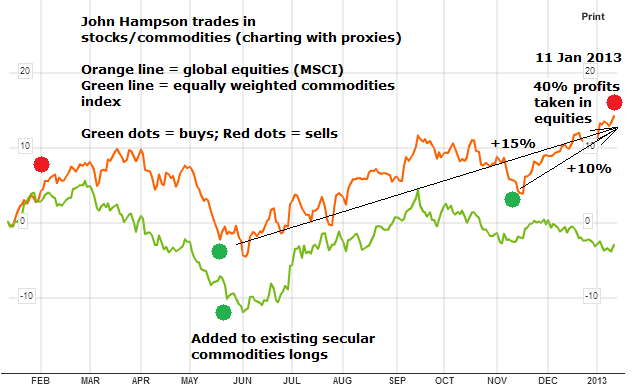
40% Stock Indices Longs Closed

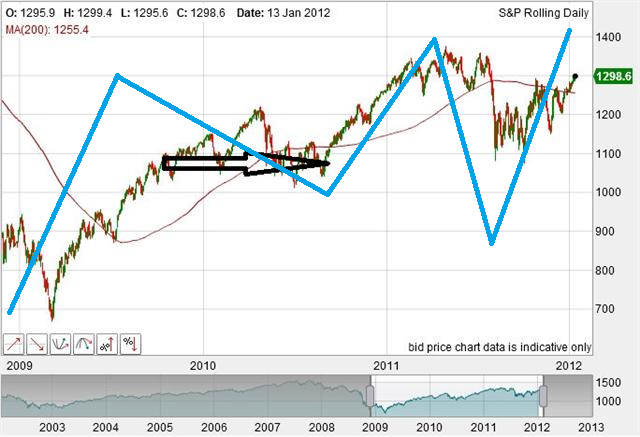
We got the advance that I was looking for into today’s new moon, taking us a little more overbought and overbullish, plus Tom DeMark also fairly well aligned: his call yesterday was to exit Europe longs and that the SP500 should top by 1492 possibly as early as today – for a subsequent 5% decline. My forecast based on solar/secular history for world equities looked like this in Sept 2012, namely a breakout from the secular bear pentagon into 2013 and a final but mild and short-lived cyclical bear 2013-14 before secular bull momentum erupts:

11jan20132The MSCI World today looks like this:

11jan20131

Source: MSCI

A breakout indeed, and drawing together the models of the previous post, I predict a higher high (and cyclical bull topping high) by around June 2013, but on negative divergences, before a cyclical bear in H2 2013 into early 2014 takes us back to the pentagon angle level roughly. All subject to developments of course.

So I took 40% stock indices longs profits today, but I retain all the different country stock indices that I listed to some degree. I don’t believe this is the cyclical top, but that stocks should in due course pull back, advance again to a new marginal high on weaker internals and that the whole H1 2013 will be a topping process in hindsight. Therefore if stocks do make the anticipated pullback I may add again for a final push up. If stocks continue upwards some way further I shall ride the remaining positions. But the main focus is now to see if commodities can start to outperform equities, as my weighting is now much more skewed towards them, playing for a secular finale of parabolic fashion, expecting that outperformance versus equities as of now, born out of current excessive pessimism in various softs and precious metals.

11jan20133Underlying source: Bloomberg

Have a great weekend all. I now in the Kota Kinabalu region of Borneo for a few days.

Tools For 2013

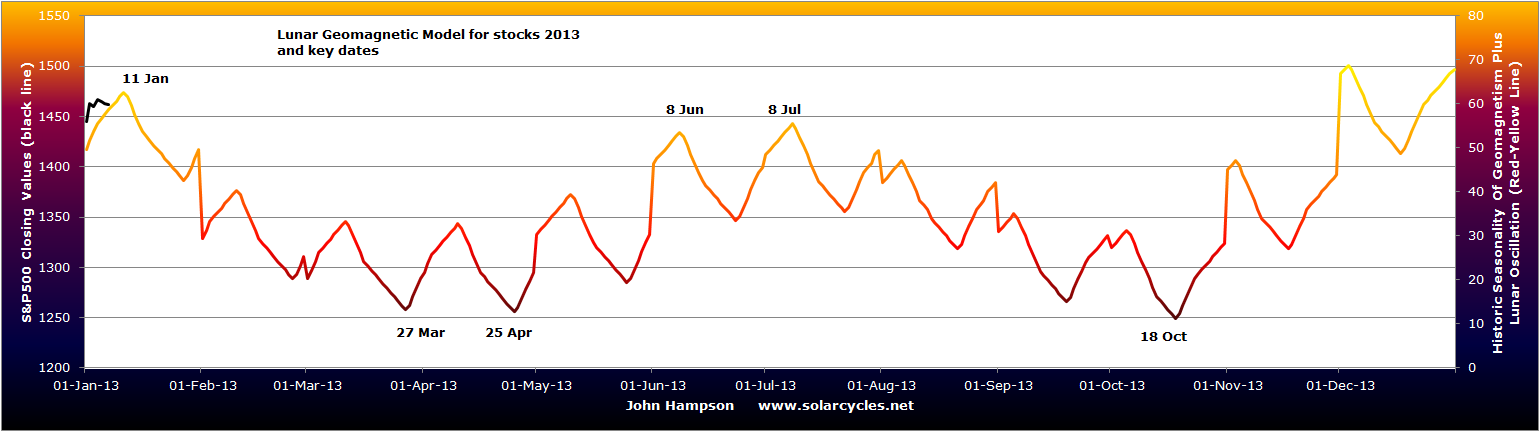
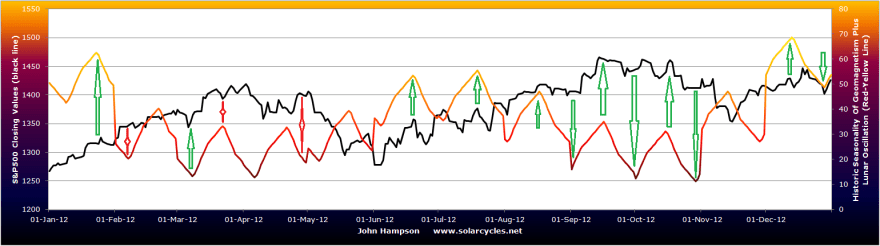
Here is the lunar geomagnetic model for the stock market for 2013:

9jan20131This combines the seasonality of geomagnetism with lunar phase oscillation. Both phenomena influence human sentiment and therefore market performance. The caveat is that some years are more ‘seasonal’ than others, and that lunar phase oscillation doesn’t work all the time, with lunar inversions also occurring. Nonetheless, the key dates are noted with a potential peak this coming Friday, a March-April low, a June-July peak and an October low.

Now take a look at Eurodollar COT as a lead indicator (by 1 year) for equities:

9jan20132

Source: NowAndFutures

There is a clear alignment with my model above: Jan and June peaks, March and Oct lows.

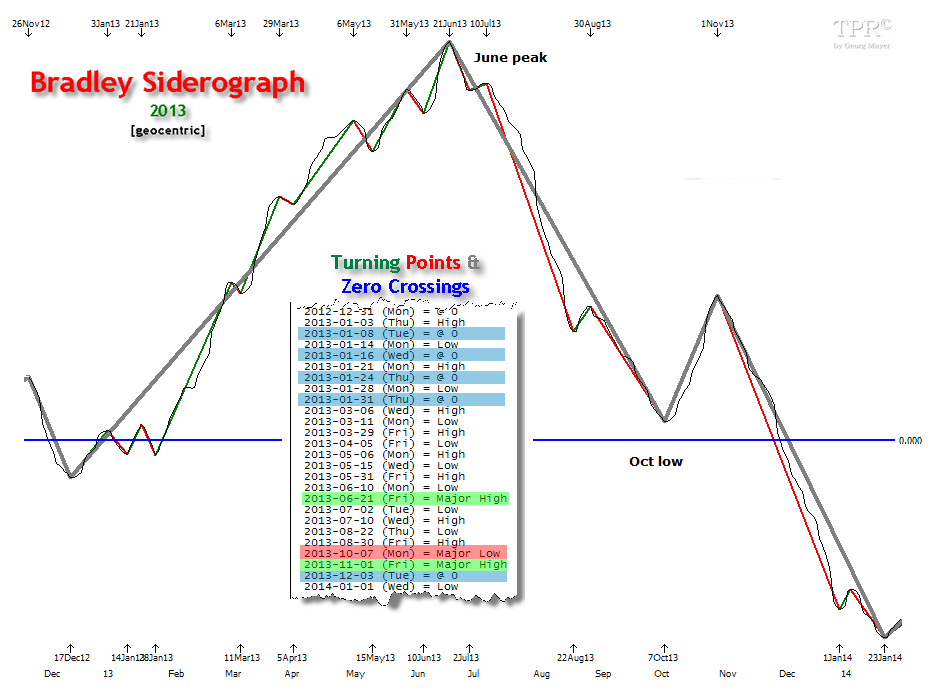
I have found Bradley turns too hit and miss to be a part of my regular toolkit, but for those hits when they occur, I like to keep it on the radar each year. Bradley turns are based on the planets, and it should be noted that whilst chart maps are built on them each year, the turn dates can be either lows or highs so do not actually indicate a path for the market, only trend change points. With that caveat, here is a siderograph for 2013:

9jan20134

Source: Time-Price-Research-Astrofin Blogspot

A June peak and an October low again, but this time no low around March, just upward into June.

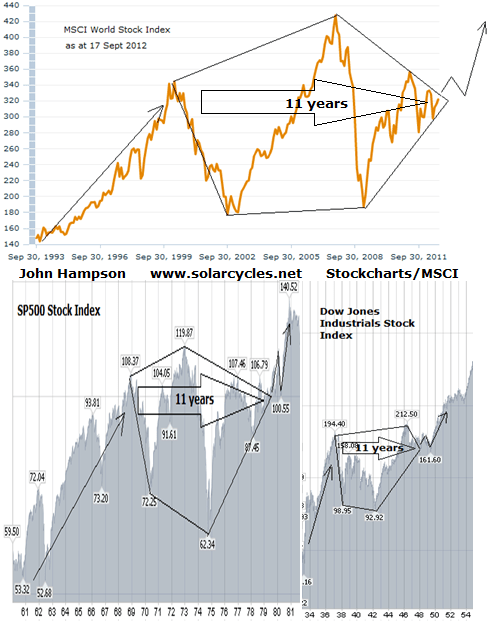
The 45 year cycle was brought up in the comments on my last post. I would argue that this is in fact 4 solar cycles, and suggested this when I reproduced this Dow Jones spectrogram in 2012 showing actual cycles in the Dow Jones. The peaks show real cycles around 11, 33 and 44 years, all approximations and multiples of the solar cycle:

9jan20136

Source: Sergey Tarassov

What perked my interest however was that in Dec 2012 I had shown a chart using MCRI’s tool that revealed 1967 to be the closest mirror from history for US stocks with a 90% correlation, and I now realise this is 45 years ago, which adds weight to the potency of the 45 year or 4 solar cycle repetition in time. The next chart therefore shows what happens next in 1968 with potential connotations for 2013:

9jan20135

Source: MRCI

Interestingly, similar peaks and troughs pop up: Jan high, March low, June peak.

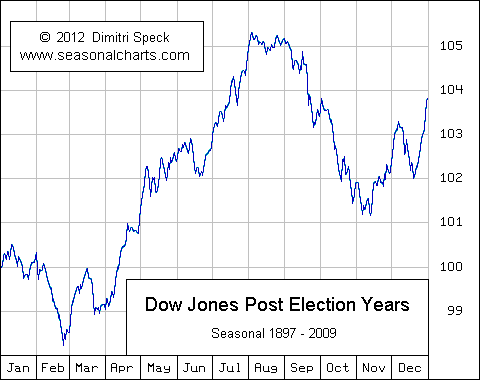
Here’s one more. Presidential seasonality in the year after US elections looks like this:

9jan20137Source: SeasonalCharts

Spring low, Summer high, Autumn/Fall low. That’s five models in impressive alignment. But before we get too carried away, I suggest there is likely to be some repetition in the underlying for this range of models, namely common seasonality. By my research, the seasonality of geomagnetism is behind the seasonality of the stock market (see Seasonality section of my Trading The Sun PDF). The majority of years play out similar to the seasonal model. Therefore that overall theme of a Jan high, spring low, summer recovery and bottom around October time, is fairly common looking back at stock market years in history. But sometimes we get an atypical year. Geomagnetism may not follow the usual roadmap or technical and fundamental factors may blow the market off course. One potential such factor is that we enter 2013 with an overall pick up in economic data together with recent technical breakouts in certain key markets, both of which could inspire stocks to perform beyond January. Also recall that cyclical stocks as a leading indicator suggest a peak around March and a mid-year low – quite the opposite to the above:

7jan20133Source: PFS Group

However, we do currently see evidence of overbought and overbullish extremes in certain pro-risk markets, which could provide the backdrop to a January high. Look at the excessive optimism across the different US stock market sectors, with one obvious exception in gold miners:

9jan20138Source: Sentimentrader

Furthermore, economic surprises for the US appear to be rolling over, which could also drag back equities (although the lead time on that has historically varied):

9jan20139Source: Ed Yardeni

In H2 2012 I was on the look out for cyclical stocks bull topping indicators, including: a topping range process lasting several months whilst internals degrade; divergences in breadth and/or leading indicators; a spike in yields and inflation. We didn’t see them, so I remained long equities. Now, in January 2013, if stocks are topping, then they can only be at the beginning of a topping process, because we still do not particularly see those characteristics. That said, I am confident we will see a cyclical stocks bull top in 2013, based on secular/solar history, and it should occur by the latest at the solar peak (forecast for circa Sept 2013 currently).  So a mutli-month topping process that began now and completed by mid-2013, would fit well.

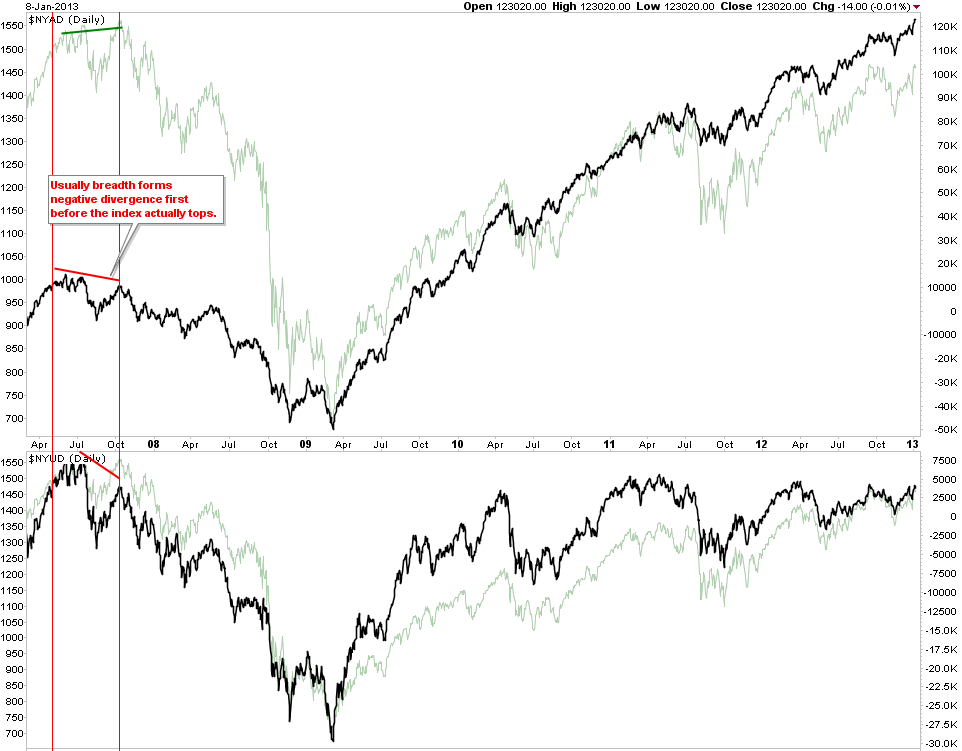
Here is a typical example from the last cyclical bull top:

9jan201310Source: Cobra/Stockcharts

Stocks made a high then a marginal new high several months later, whilst breadth diverged. There were two opportunities to exit stock longs, but the clues for the cyclical top were only in evidence by the second opportunity: the marginal new high.

So here’s a hypothesis. Stocks make a top in January 2013, as per the aligned models, followed by a pullback within an overall topping range process, then a marginal new high around June which bears the divergences of a cyclical bull top. Were this to come good, then that could imply that the first opportunity to exit stock longs would be imminent, possibly Friday of this week. One factor that could play into this is US earnings, which began yesterday with Alcoa. The season really gets going next week, and a ‘sell’ theme could potentially play out on an overall disappointing beat rate or outlook.

An alternative scenario would be that stocks continue to advance into March, as per the cyclical stocks model, with support from recent improvement in economic data, before the topping process begins and lasts through to the Autumn/Fall.

So what to do? I am going to mull this over but if stocks can rise further into bull/bought extremes by the end of this week, I may sell a chunk of long positions. Understand though that as things stand with my equity longs in tact, my bigger pro-risk weighting is to commodities. A concern I have is that if I exit equities I am very much dependent on commodities making a final secular push – a push which one would have to say is currently absent. So let’s have a look at commodities.

As previously noted, many commodities are currently suffering extremes of overbearish sentiment. That sets them up for a potential rally. Supporting this is economic improvement in China – the biggest consumer in commodities. Plus inflation expectations have risen of late, and treasuries have begun to experience outflows, both of which should inspire more money into commodities. All that said, commodities as a class remain without momentum at the moment, despite Gann forecasting acceleration would begin as of November 2012, and solar/secular history also suggesting commodities should accelerate over the course of the 12 months into the solar peak. Here is the current combined solar peak forecast – note that a pick up in sunspots over the last week has helped give the overall solar oscillation more of an uptrend look:

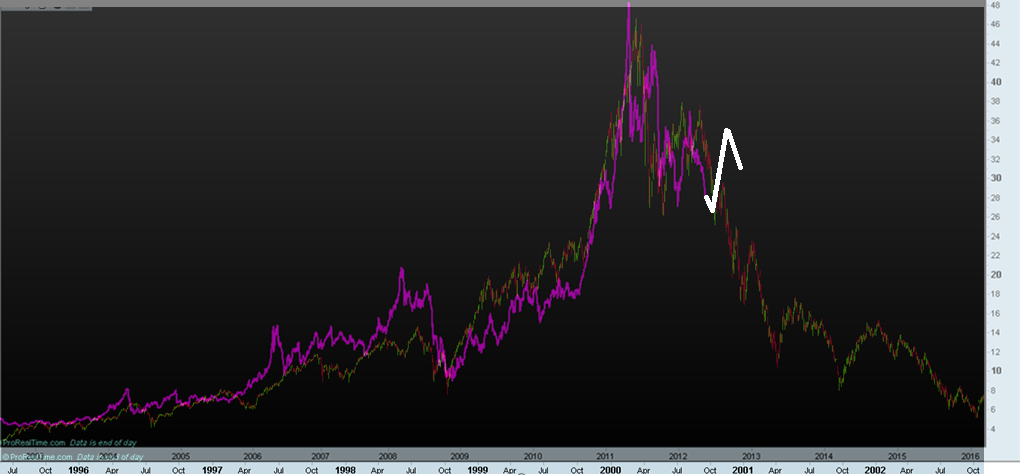
9jan20133In short, commodities should accelerate without delay, and start to outperform stocks. Precious metals should be the leading class. A long term look at the Dow-gold ratio reveals that equities are historically cheap compared to precious metals. Long precious metals at this point is therefore a play on a parabolic finale to extreme overvaluation. That may be a dangerous game, but history has fairly reliably delivered such a parabolic finale to a secular bull. There was some question last year over whether silver had in fact made that secular parabolic peak, by comparing it to the Nasdaq bubble:

9jan201311

Source: Profitimes

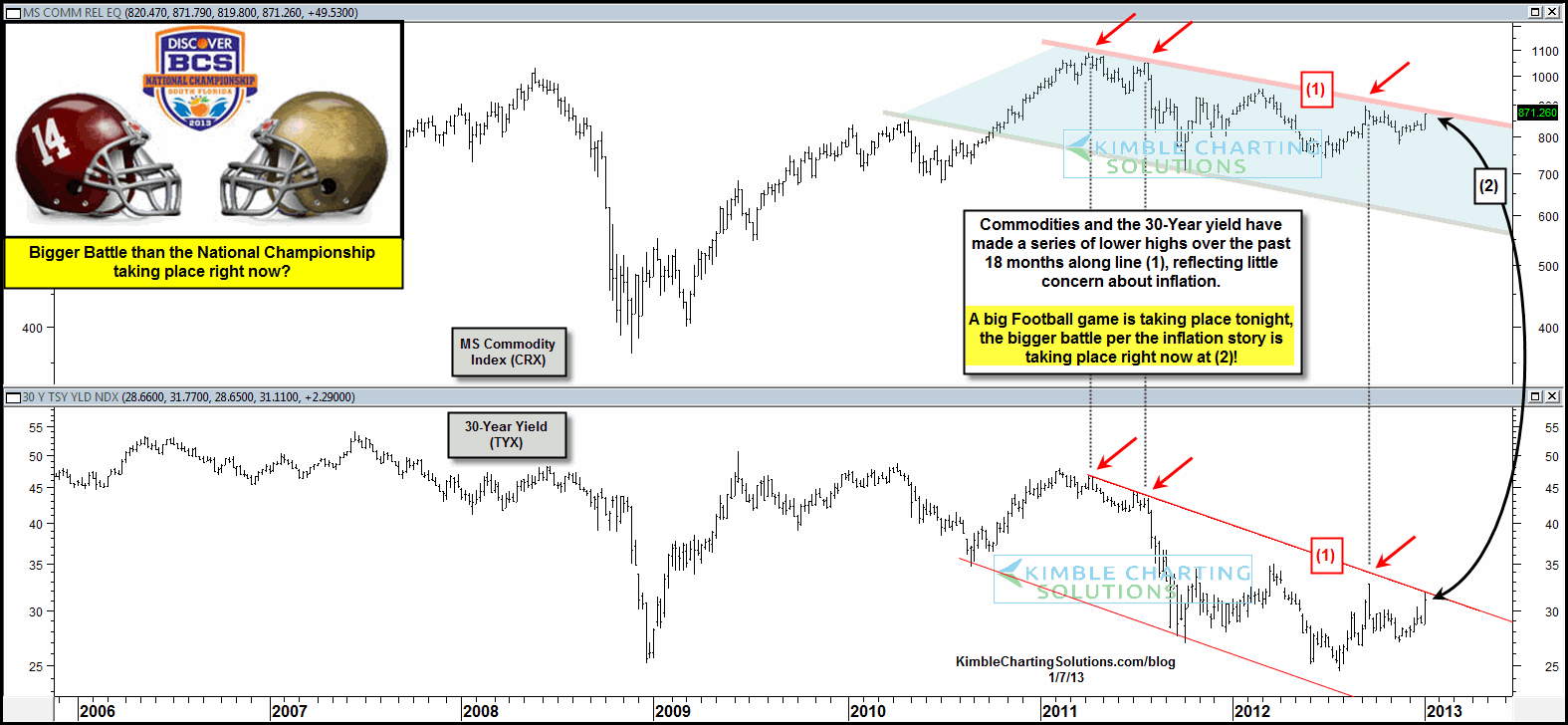
I have added in white what happened since – and in the bulls’ favour it broke free from the analogy and did not collapse into the start of 2013. Gold made no such parabolic but remains range bound over the last year, neither confirming the bull or bear case. In short, I still maintain precious metals will go on to make a parabolic finale ahead this year, along with commodities as a whole, but right now it remains a position of faith. As we are in a multi-year transtion period from secular commodities and treasuries bulls and secular equities bear to the opposite in each, with equities cheap compared to treasuries and commodities, and commodities lacking in momentum, I have concerns about leaving myself heavily weighted to commodities making their finale, until we see that acceleration begin to occur. However, we may potentially be knocking on the door of that development:

9jan201312Source: Chris Kimble

This is what I am going to chew over today and tomorrow. If you have anything to add to this, please step forward in the comments below, as I welcome your input.

Current State Of The Markets

Mixed fortunes for pro-risk currently. Commodities, as a class, are still struggling to gain upward traction, although pockets have woken up in recent weeks, such as crude oil and iron ore, as China has displayed increasing evidence of a turnaround. However, the weakness in gold and softs has brought daily sentiment readings down to sub 10 for gold, soybean, soybean meal and oats, and sub 15 for corn, wheat, coffee and sugar (out of 100). I believe this extreme bearishness should provide a reversal in due course.

Treasury yields, on other hand, have made a move of some momentum, which adds weight to a potential bottoming mid-2012:

7jan20131Source: Stockcharts

Equities have been particularly strong since the fiscal cliff relief. The global stock index has broken out beyond its Q3 2012 high and is now within touching distance of new cyclical bull highs as shown:

7jan20138

Source: Bloomberg

Dow Transports have broken out. The Shanghai Composite has rocketed 18% over the last 4-5 weeks. The SP500 is just 10 points away from a new cyclical bull high. We do not see major negative divergence in internals or in leading/economic data so I believe global stocks can go on to make new highs. We have upward pressure into the new moon of the 11th January, and thereafter the rapid climbs in the Nikkei and Shanghai may need to digest.

The combined global manufacturing and services PMI composite looks like this – a notable improvement in Q4 2012. It is not clear however whether this is just another oscilliation in the downward trend in place the last 3 years that will roll over again shortly.

7jan20137

Source: Markit

Narrow money as a leading indicator currently suggests improvement in the global economy into February and then a peak out.

7jan2013

Source: MoneyMovesMarkets

Citigroup economic surprises may be topping out in the US, as this index has made a rounded head over the last couple of months, in a high zone historically associated with turnarounds (and this is a mean-reverting indicator as economic data or analyst expectations eventually shift). Here’s a reminder of what happened to stocks when economic surprises (blue line) topped the last two times:

7jan20132Equities were on borrowed time, though in both cases there were several months in which to sell.

Cyclicals as a leading indicator suggest a top by March 2013:

7jan20133Source: PFS Group

Lastly, Eurodollar COT as a leading indicator suggests a top right here, or if not a topping process beginning here and lasting until June (second high on negative divergence would be the norm):

7jan20139

Source: Nowandfutures

All combined, we may be looking at a top in equities in Q1 2013, but as yet there is a lack of the usual topping indicators, so I am sitting tight for further gains until more data evidence comes to light to support the time predictions.

I completed Thailand with Phitsanulok and Hua Hun and am now in Borneo, starting with 4 nights in Kuching.

Review of 2012

I hope you all made money in 2012 and I wish you a very profitable 2013. I made a 17% return in 2012, versus a personal target of 40%, and compared to the world’s 300 most important hedge funds, my return is likely to rank in the top 30 (source HSBC – final week’s report not yet in). For comparison, I made a 40% return in 2009 but made only the top 50 in hedge fund ranking that year due to the bumper returns on offer from a trend year. I made my lowest return of 15% in 2011, but conversely that made the top 15, as it was a more difficult year in the markets. So for me, it’s important to measure both ways, and in doing so, I can declare 2012 a satisfactory year but not amazing.

40% is a stretch goal each year, but I shall be gunning for it again in 2013. If commodities accelerate towards their secular peak, as per my forecast, then it is very much achievable, based on my existing positioning. Yet, it was commodities that provided the drag on 2012’s returns, as they ended the year essentially flat:

2jan20132

I carried forward commodities long positions from 2011 (maintaining secular positioning), added to them on the sell-off into May, and have since held. The net result is little return from this asset class this last year. It is equities that have provided the larger part of my profits. I entered 2012 with long stock indices positions, and sold out of the remainder by late Jan / early Feb of 2012, before I switched from Amalgamator to Solarcycles. Here is one of the final charts from Amalgamator showing this:

2jan20131I then bought back into equities in May 2012 on the oversold/overbearish selling exhaustion, and have largely sat on those positions since. I made additional purchases at the start of November with a longer term view (e.g. China at its cheapest p/e to date, Japan at ultra low p/b (since up 18%), Russia at ultra low p/e). I advised of all my trades on my site at the time of their action, and this can all be verified using the search functionality should you be new to the site.

I also added short treasuries in that May sell-off window. This is a smaller position compared to commodity and equity exposure, and has ended the year effectively flat like commodities. I have participated little in the currency markets this last year, and overall there have been no positions in any class that I have had to abandon and take a loss on. The bulk of my trades are open positions that are in profit.

My trading style is to attempt to call the global macro position for assets correctly, namely are we in secular bull or bear markets and are we in cyclical bull or bear markets, and be positioned accordingly. Within that I attempt to call turns, and buy on oversold/overbearish indicators, sell on overbought/overbullish indicators. Throughout 2012 I have deemed us to be in a secular commodities bull market and a cyclical equities bull market, as well as suggesting that we reached a secular treasury bond turn mid-year (from secular bull to secular bear). As we turn into 2013, we cannot definitively state that all those are true, but none of them have been proven false. I think they look good, and my profit snapshot is supportive of this. I have been looking for evidence of a cyclical equities top in H2 2012, but that evidence has been lacking, and so I enter 2013 with my stocks longs still in tact and will again be looking for that evidence coming to light in H1 2013. In short, I believe I have mainly called the strategic asset positioning correctly, but the biggest surprise of this last year, in my opinion, was the flat performance of commodities, as I was expecting their secular finale acceleration to begin and be a theme of the year.

One key factor in that commodities under-performance was economic weakness in China, which is the biggest consumer of commodities. As we move into 2013, China is strengthening, which – if this can be maintained – should provide a trigger for the commodities acceleration. Here is the latest China PMI reading:

2jan20133

Otherwise, global leading indicators and economic data are mixed, so the overall picture remains tentative and to be watched, one development at a time. Nonetheless, my forecasts for 2013 remain largely as predicted in my series of Forecast 2013 posts in September. If you are new to the site or wish to be reminded, go here and then click ‘Next Post’ five times to view the whole series in five parts:

https://solarcycles.net/2012/09/19/forecast-2013-part-1-inflationary-peak/

In a nutshell, I forecast an inflationary peak, a secular commodities peak (which could stretch into the beginning 2014), a new secular bonds bear market, and a winding out of a secular equities bear market. The shaping of this secular bear conclusion I suggested would look like this:

17sep69…And as we begin 2013 that MSCI World chart line is now peaking out of the top of the pentagon (we have seen such breakouts in the Hang Seng, FTSE, Nikkei and others). So I maintain that equities can rally further away from the secular bear pentagon before making a shallow and final cyclical bear in 2013/14 before new secular bull momentum erupts as of 2014/15. From the Forecast 2013 series, this was my combined forecast for stocks and commodities:

17sep66

That is still the shaping that I expect, and therefore commodities ought to begin that out-performance soon. Equities should go on to make some kind of topping range whilst internals deteriorate and give clues to a cyclical top.

Returning for a moment to 2009, we stepped back from financial system meltdown and acknowledged ultra cheap assets, to deliver a very bullish year for pro-risk that a lot of participants ‘got’. In 2010, there was a mid-year retreat that had the hallmarks of a correction within an ongoing bull market, which most of those who I read ‘got’, for another year of bull returns. In 2011 however, action was more volatile and developments more confused, and I found the analysts that I read and respected at the time much more divided, with some getting it right and some getting it wrong. 2012 was similar to this. It was difficult to take the stance that ECRI were wrong in their recession call (but this now appears to be so), that H1 2012 concerns of a European sovereign default would not come true, and that, amongst others, Tiho’s detailed reasoning for a global recession and stocks bear since mid-year was not the accurate picture – at least not yet. It has been a year of fluctuating and short-lived developments and I maintain this more confusing action of the last 2 years is because we are in a gradual transition period from secular bear to secular bull in equities and from secular bull to secular bear in commodities and bonds. Wouldn’t we be glad of a trend year like 2008 (all down) or 2009 (all up), right? Well, I have some hope that this year will be a trend year for commodities: their final secular acceleration – so let’s see.

As I have previously detailed, my view is that March 2009 was the secular equities bear nominal low, and that since then we have been in a period of gradual repair. From financial system meltdown to sovereign default fears (that’s improvement), then from sovereign default fears to no natural growth (the European debt fear that was headline news in H1 2012 was very much wound down in H2 2012). I suggest that this year global growth will pick up and we will finally see the ‘growthflation’ that central banks have been keen to generate. Tightening (yields rising) and over- exuberance in commodity prices will then usher in the last equities cyclical bear before new secular bull market momentum. Of course problems and fears will still abound – the secular bull market will be built on a wall of worry – but they will gradually decrease with time.

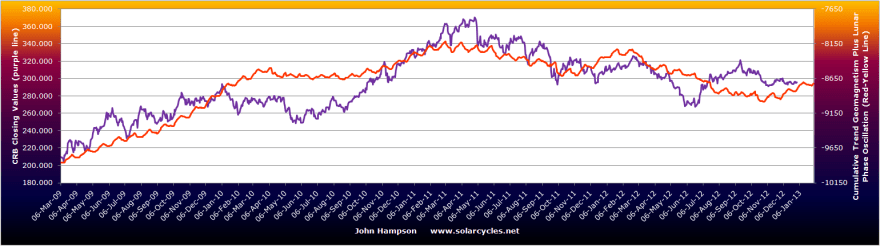
My geomagnetic models did not overall perform as well in 2012 as 2011, however commodities still follow the geomagnetic model very well:

2jan20134

And using lunar phasing continued to provide an edge in 2012, with the SP500 ‘hits’ shown here in green, as well as some lunar inversions in red:

2jan20135

I believe the most important model in 2013 will be the sunspots model, which should see solar activity reach a peak in H2 2013, biologically inspiring speculative behaviour and excitement in humans (potentially also through war and protest behaviours).

So here’s to an exciting year. Thanks for all your comments and mails and links in 2012, I value your input. And to the silent majority: don’t be shy in coming forward with a question or a view or a great find. Keep spreading the word guys – it’s the year of the Solar. Happy New Year to you all.

Bali

The Bali experience has left me with a bit of a conundrum: where is going to be as good as that?! Travel is a personal thing, but you can perhaps relate at least in part to my take on an idyll: safe, friendly, rich in culture, beautiful nature, beautiful man-made, great climate, and a cheap cost of living for a bonus. Bali delivered on all fronts.

Bali is peculiar to Indonesia because it is Hindu, rather than Muslim, and the Bali form of Hinduism permeates everything here (95% of residents follow). Tiny offerings and statues of gods everywhere, at least three temples per village and in every building a shrine. 500 new shrines and temples are built every month – the religion is as current as it ever was, with the youth fully involved. A tremendous amount of rituals and ceremonies means the Balinese are often seen in traditional dress, with flowers a key part of the look and the offerings. The extension of Hindusim into Balinese behaviour is ‘ritualised self-control’, which in practice means modesty and restraint. In short, the religion is all-involving.

The religion merges into the culture as their religious devotion is echoed in their devotion to arts and crafts (on a large scale) and to architecture. The architectural themes of gated entrances, pavillions, water features, and of course shrines and statues have been studiously reflected in the hotels and villas on the island, giving the whole island a consistent feel, and beauty. The man-made beauty across the island is all the more impressive given that existence here is tough for many. Tourism now accounts for 80% of the island’s income, but 80% of Balinese still work in agriculture. Working in tourism pays little, working in agriculture less. Hence, it is not uncommon for parents to sell a rice field and send their kids to tourism school. Labour is cheap here – you could live here and have a maid, cook and driver all for $200 a month.

Despite the meagre earnings, the Balinese are a happy people and could not be more friendly. It’s not possible to be a faceless person on the island – all are involved, and this extends to tourists. Tourism has clearly had an impact on the island, but not in the kind of ruinous way whereby the original reasons for coming are slowly devoured. There is no problematic friction between locals and tourists (on which note, the Bali bombings were carried out by a Muslim terrorist group), and the Bali culture remains strong and dominant, rather than diluted and then packaged up for visitors in a less authentic way. To complete the picture, the nature is lush green, with tiers of paddy fields amongst the palms, and there are beautiful beaches, wild chickens and lizards galore.

Negatives? There are quite a lot of ill looking dogs around. The Balinese largely consider them scavengers in league with evil spirits, and as a result they have a difficult existence. There is a caste system, in line with Hinduism elsewhere, meaning not all are equal. You will see swastika symbols – but this is nothing sinister, in fact it means in harmony with the universe and precedes Nazism. And of course, as with anywhere that might be considered idyllic, greed naturally steps in, and some long-time visitors to Bali bemoan this. There are a few opportunists in the most touristy south (often coming over from neighbouring Java), big luxury hotel resorts have edged out old backpacker Bali, and Jakarta has taken its slice through shortening visas and applying a departure tax. As a first time visitor, I would say this: the mature Bali remains very attractive: crime remains very low, trust and friendliness reign, and the beauty and culture of the island rival anywhere I have been.

The majority of visitors to Indonesia go to Bali and Bali alone. On my current trip, that is also the limit of my dip into the 4th most populous nation on Earth too. So I will leave this post as a little Bali travel summary and not attempt a wider analysis of Indonesia and its markets. Some pics to finish then:

A Bali temple ceremony.

Ubud Temple

Rice field terracing.

P1030311

There is no limit to what a motorcycle can carry here.

P1030013

My wife gets a head massage.

Gabi Monkey 2My son relaxes at the beach.

P1030153

Friday Drama

I’ve suffered poor internet access this week, but have it now, so let me catch up on developments since last Friday. I will respond to comments and emails in due course, but first, analysis.

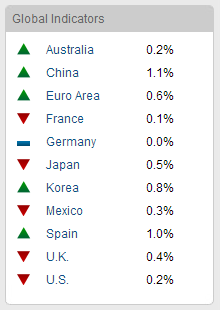
Conference Board leading indicator updates have been mixed. USA, France and Mexico slipped negative. Germany improved to flat and the general Euro area jumped into the positive. Australia also moved into the positive and China put in another good month. The summary table currently looks like this.

21dec20121Source: Conference Board

So a continued picture of mixed fortunes, but with a rotation in leaders, and overall a picture of weak growth ahead, rather than recession. ECRI leading indicators for the US advanced from 3.5 to 4.4 last week and US economic surprises have picked up again the last couple of weeks:

21dec20122Source: Ed Yardeni

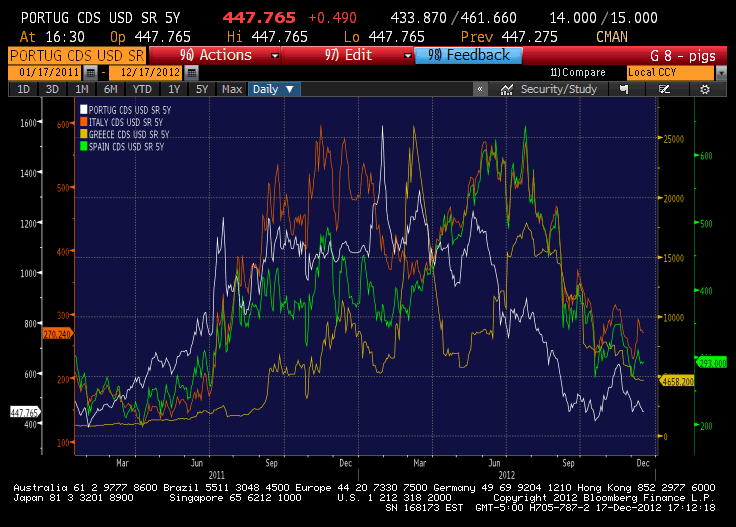
Euro debt, which bothered the markets from mid-2011 to mid-2012, has deflated as an issue, to much more benign levels.

21dec20126

Source: Acting Man

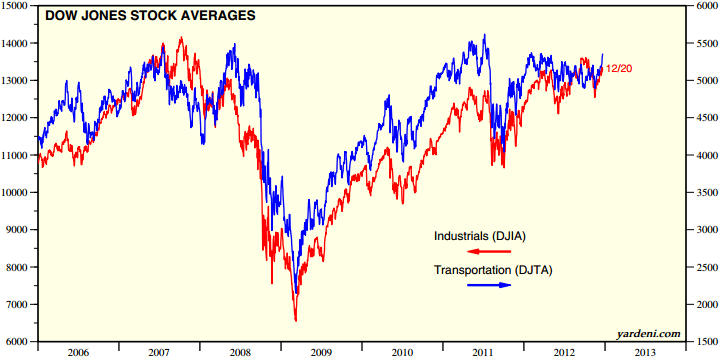
The Dow theory divergence of mid-year, which was a potentially bearish signal, has been resolved, with Transports since resuming strength:

21dec20123

Source: Ed Yardeni

And cyclical stocks in the US continue to perform strongly, with breadth also healthy.

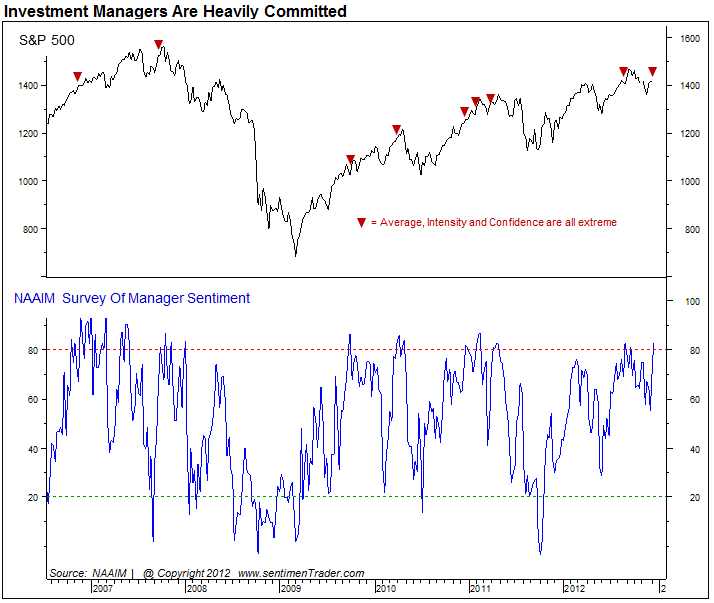
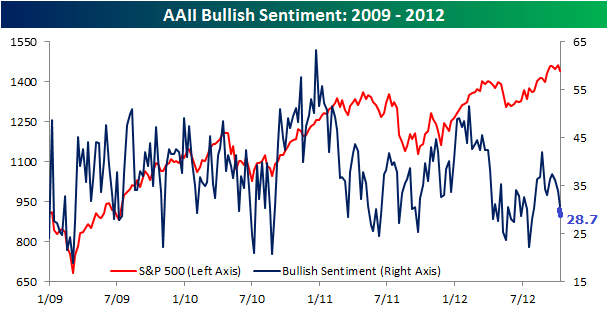
However, sentiment for US stocks has reached into frothy bullish territory in both NAIIM and AAII surveys:

21dec20129Source: Sentimentrader

21dec201210Source: Bespoke

Investors Intelligence and bullish percent over call put ratio both however remain in neutral territory, but overall risk aversion has reached very low levels:

21dec201211Source: Big Picture

Meanwhile, the Shanghai Composite has pulled up in a more compelling bottoming fashion, as the drop beneath shown support now looks like a fake out.

21dec20125

Source: Cobra / Stockcharts

Treasuries have declined and yields have added credibility to a W-bottom:

21dec20124Source: Stockcharts

Copper remains in a triangle, unprepared to give a diagnosis on the global economy at this point:

21dec20127Source: Stockcharts

And crude oil ditto:

21dec20128Source: Trading Charts

November’s global climate stats from NOAA came in at the 6th hottest on record, making the year to date (minus December) the 5th hottest on land since records began. That’s a continued support for agri longs, as extreme conditions persist. Yet, soft commodities are, as measured by a broad agri commodities ETF, just range trading of late. Despite China’s improving fundamentals, and the Euro strengthening against the US dollar (USD technically weak formation shown below), commodities as a whole are failing to ignite currently.

21dec201212Source: SeeitMarket

The most surprising underperformer is gold, which currently looks like this:

21dec201213

It just dipped beneath the 200 MA, which has largely supported the secular bull since 2000. Is that a worrying development? It’s not great, but it is doing so on oversold RSI and a daily sentiment index reading of sub 10. Furthermore, gold miners have reached a bearish extreme in public sentiment. I still suggest that gold broke upwards out of its 11 month consolidation in August this year and has resumed its uptrend, albeit tentatively at this point. Gold seasonals, solar/secular history and negative real interest rates all support gold bouncing here and making that tentative renewed uptrend more concrete, but once again it is finely poised. I am happy with my exposure both to precious metals and to miners, but if i were underexposed I would choose now to buy both, based on the reasons I have aggregated here. In other words, I believe gold will bounce here and reclaim its 200MA (with the weak hands shaken out).

Today is the Mayan apocalypse, the Mayan hinge point, a miscalculation, or a falsehood. Tomorrow is a Bradley turn, which would mean today (due to market opening days). I do not buy in to the Mayan blogosphere phenomenon, and have found Bradley turns more miss than hit, but that said we do have some drama today, with fiscal cliff nerves helping bring about a big sell off this morning which at the time of writing has been semi-reversed. I place more weight on lunar cycles, and next week’s full moon typically spells downward pressure into it. However, this is balanced by positive seasonality which goes hand in hand with favourable geomagnetism at this time of year – the updated model shows an uptrend into early January:

21dec201214It’s the morning session in Europe at the time of writing, and I don’t pretend to know how today is going to turn out, given the dramatic market action in the early hours. However, my stance is to stay put on my pro-risk portfolio currently. 1. Weakness in precious metals, 2. indecision in copper and oil, 3. frothy sentiment in US stocks, and 4. complacency in risk aversion, are all current flags. But I would contrast with: 1. oversold and overbearish readings in precious metals and miners, 2. improvement in China, leading indicators and renewed dollar breakdown, 3. good breadth and cyclicals performance, better technicals in European and Asian stock indices, and 4. money pulling out of treasuries which should seek out pro-risk assets (by solar/secular/cyclical history). Broken down into my 3 areas on involvement: I don’t want to exit stock indices longs yet because we do not yet see sufficient congregation of cyclical bull market top indicators; I do not want to exit commodity longs yet because I maintain by solar/secular history the parabolic peak is to come 2013/2014; and I do not want to exit treasury shorts yet because I believe a new secular bear market in treasuries is getting underway and a rise in yields (of some note) should be one feature of the end of the cyclical stocks bull.

Next week is usually a quiet week in the markets globally, due to Xmas, but there is the fiscal cliff deadline at the turn of the year, and so this period could be more volatile. My expectation is that agreement will be reached to prevent the fiscal cliff, and that markets will enjoy a relief rally when that occurs. However, there are no guarantees, so let’s see how things unfold. Next week I will be in Bangkok.

Friday Roundup

This is the main story of my year: aggressive buying in stocks and commodities in mid-May, and then largely sitting on the portfolio since then.

It looks straight forward with hindsight, but of course the hardest part has been staying put and resisting selling. Now the key question is whether we are going see further upside into year end, or whether the ‘sitting’ should be brought to an end before then.

Based on solar/secular history, the next top in equities should be a cyclical bull top. Based on cyclical bull history, we might expect an overthrow move as the ending move, and given we have just broken out technically in various indices around the globe we are in a good position for that to now occur. Equities should top out (cyclical top) before commodities (secular top), so timing the exit of stock index longs is the most pressing, I believe.

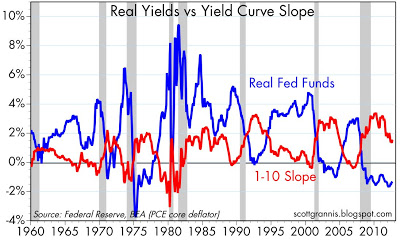
Cyclical stocks bulls have historically ended with a tightening of rates (yields). Too much money pours into pro-risk and out of safety, there is too much buying, speculation and inflation, until a tightening of yields, or central bank rate tightening chokes it off and tips the economy into recession. See here:

Source: Scott Grannis

We last saw this phenomenon when the last cyclical bull ended in 2007. So the question is, has QE and central bank interference broken this mechanism, or are we headed for the same this time round, namely an overbubbling of growthflation and speculation, before we top out? By solar/secular history, we should indeed be heading for an inflationary and speculative finale in 2013 (analysis and evidence here), so I believe this is going to occur. As yet, we don’t see a particularly strong uplift in inflation around the world, but as per that analysis I believe it is coming, and nor do we see excessive froth in pro-risk or a hasty exit out of bonds. We just see tentative evidence of reflation and so I believe the process has some way to go yet before we enter the likely zone of a cyclical equities top. To support this, we do not see the usual cyclical topping indicators yet such as breath divergence, evidence of distribution and a rolling over of leading indicators.

Those who I read who are largely in tune with my view would include the Puplava brothers and Scott Grannis, whilst those on the other side include Marc Faber and Tiho. Marc Faber has been gradually selling out of long positions and moving to cash since May/June time. Because he has been on the wrong side of it for some months now, I believe he has got it wrong for once and was wrong-footed by developments. I believe the same of ECRI and Tiho who also diverged around the same time. I am going to address some of the points that Tiho makes in this post, so I’ll start with evidence that there is historically low levels of money in cash, as a contrarian indicator to get out of pro-risk.

Reducing interest rates to negligble or zero discourages money from being held on deposit. QE then brings down bond yield rates to negative real levels, including the longer end of the spectrum. This discourages money out of bonds and also is currency-devaluing, which further decreases the attractiveness of holding cash. In this environment it is therefore normal to see historically low cash levels and money market fund flows. Because currencies and bonds have international markets, central bank actions in rates and QE have global affects, producing bubbles in assets and pockets of inflation as we have seen over the last few years. Rare earth minerals are a recent example:

Source: Scott Barber

What rate cuts and QE cannot do is directly bring about economic growth or hiring or lending or consumption. However, they reduce the systematic risk and provide an environment that as far as possible encourages money to be put to work rather than held on deposit. In fact, much of the new money through QE has become banking reserves and is not being lent out. The increase in money supply is balanced by the decrease in money velocity. The US Fed and others are continuing with these measures until they see money circulation pick and growth take off in an enduring way. The risk is that they are pressing on this accelerator for too long and could see a sharp inflationary episode ahead as too much of the new money gets lent out or too much money is chased into hard assets in a low-yield environment.

I do not share the view that central bank actions are impotent, and that once this is recognised the markets will tank. If I am correct in that, then the recent succession of rate cuts, the renewed QE and other 2012 stimulus measures (such as China infrastructure programmes) should produce a global reflation, and I believe we now see evidence that this is occurring.

1. Both the Shanghai Composite stock index (green line) and the Baltic Dry Index have broken up out of falling wedges. Still tentative at this stage, but promising.

Source: Bloomberg

2. The Dow Transports has been catching up the Dow Industrials and shrinking the divergence.

Source: Bloomberg

3. Inflation expectations have picked up.

Source: Scott Grannis

4. Stock market breadth is strong – there is no negative divergence.

Source: SeeItMarket

5. Economic Surprises for the G10 nations have trended up into the positive. Emerging markets are trending down but there is some evidence in leading indicators for improvement ahead.

Source: Citigroup

6. Credit markets have normalised.

Source: Chris Puplava

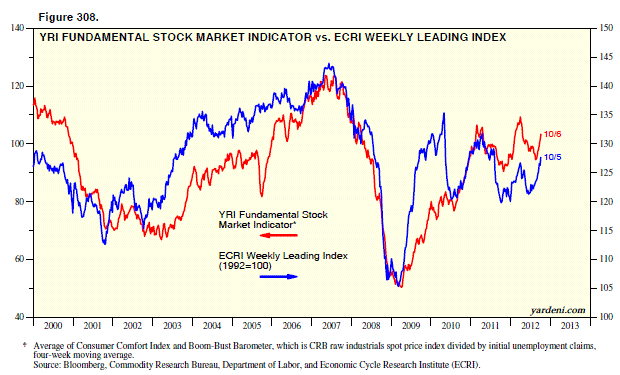
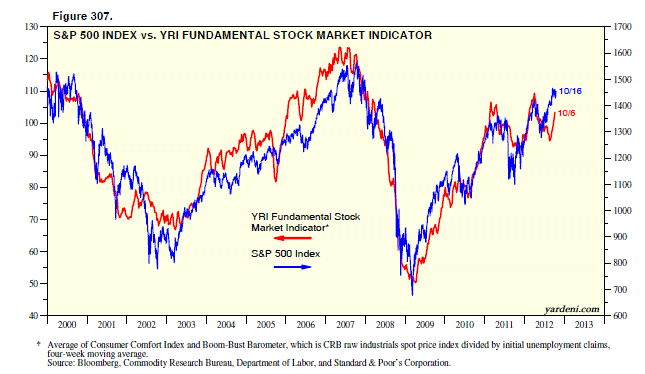
7. US fundamentals have turned up to follow stocks upwards and resolve the divergence, and they echo improvement in ECRI leading indicators (ECRI WLI growth is forecast to rise again today).

Source both: Ed Yardeni

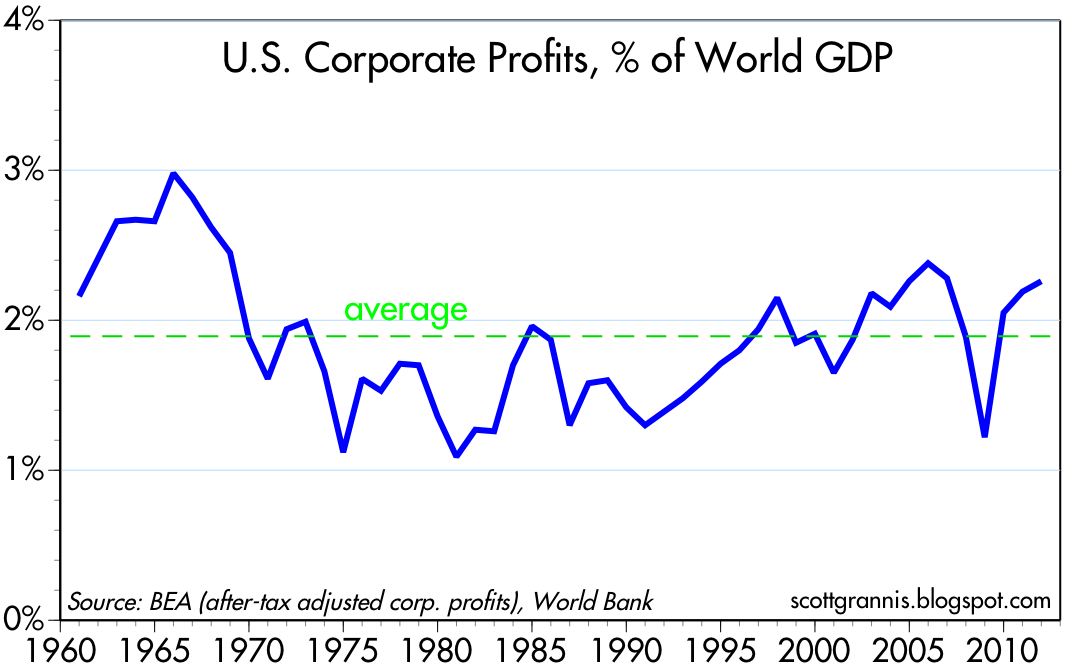
8. US SP500 earnings so far this season have come in at a 64% beat rate, and show marginal earnings growth year on year. Whilst earnings are not very impressive, the expectation was for negative growth, which so far has not been the case. Google’s report was bad yesterday and dragged down the Nasdaq, but the overall earnings picture has not been so troubling so far. One chart that regularly pops up (in Tiho’s analysis and many others) is this one below, that suggests US corporate profits should come down a long way and mean revert to the historic average importance to GDP.

However, the chart is a red herring because globalisation and the world dominance of multiple US behemoths mean the relation to US GDP is now different. Comparing these global US giants to global GDP is a fairer reflection.

Source: Scott Grannis

9. Global trade may be about to turn up based on global PMIs. This is again tentative but promising.

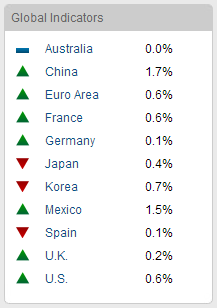
10. Below top is how the latest Conference Board global leading indicators stand, and beneath that is the table as it was at the end of August. There is a notable improvement across the board, and whilst Japan and Korea are still negative, even they have improved.

Source: Conference Board

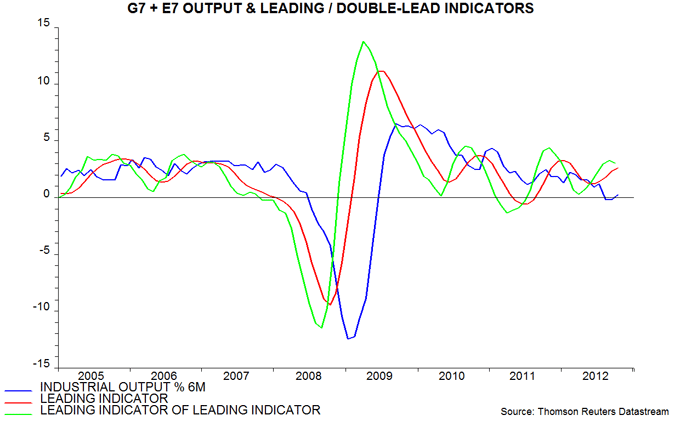
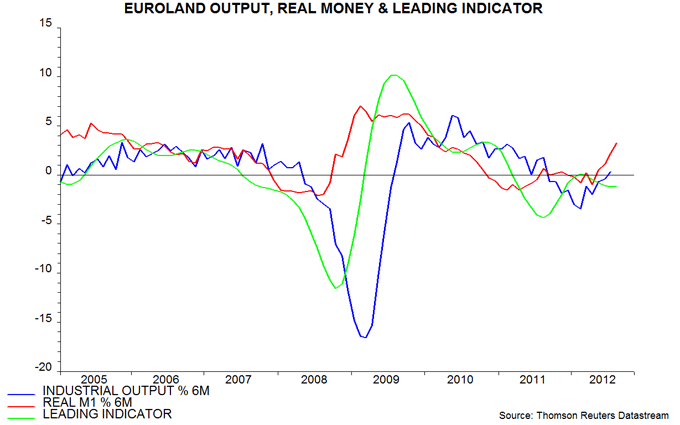
11. The combined picture of output, real money and leading indicators in Euroland and China also suggests an upturn.

Source both: Thomson Reuters

I therefore refute assertions that the global economy is deteriorating and that China is heading for hard landing. Whilst both those things could occur at some point in the future, the current picture and near term future show a global economy tentatively reflating and a stabilisation in China rather than an accelerating decline.

Turning to equities, Tiho suggested that  the risk-on correlation between corporate bonds and stocks means that an imminent burst in corporate bonds (which reveal excessive inflows and historical pricing) could spell trouble for equities.

Excessive inflows into corporate bonds reflect excessive pessimism in relation to equities. That excessive pessimism can be seen in equity yields recently diverging. I expect that yield gap to be corrected by flows out of corporate bonds and into equities. I don’t subscribe to the view that flows out of corporate bonds would have negative implications for equities – I rather believe they would be a recipient. Corporate bonds are at the end of a 30 year bull market like treasury bonds, rather than in a decade long secular bear like equities. The yields chart below shows this (inverted).

Source: Scott Grannis

Treasury bonds are potentially making a rounded top (yields a rounded bottom), which by Gann is predicted to be the secular top, and based on internal secular history should be the start of a multi-month decline (or advance for yields). If so, that would again be supportive of the normal unfolding into the cyclical stocks bull top as outlined above.

Source: Stockcharts

Neither of the two most widely-followed US stocks sentiment surveys are indicating excessive bullishness currently. Both these should reach bullish extremes to end the cyclical bull.

Source: Schaeffer Research

Source: Bespoke

And here is Credit Suisse’s global risk appetite updated. Currently around zero it is very neutral, and I would also expect this to reach into the upper extreme in a pro-risk inflationary finale next year.

Underlying Source: Credit Suisse

All things considered, I believe there is sufficient evidence of global reflation to support pro-risk markets, together with a lack of cyclical topping indicators in equities or broader risk excessive frothiness. As always, it’s a probability calculation and I will keep reviewing the technicals and fundamentals as they develop. Things can of course change quickly, but right here right now, I believe the evidence supports maintaining my pro-risk portfolio as it is and further ‘sitting’.

To finish today, a re-sharing of cycles evidence, prompted by Rick’s link. There are many financial markets cycles banded about, but we can verify which are real by spectrograms (for markets with a long enough history). These reveal the greatest concentrations of actual real cycles, shown by the blue lines in the charts below. The first chart is for the Dow Jones and reveals the most important cycles to be 3.5 years (Presidential cycle 4 years plus cyclical bull average 3 years), 9-14 years (solar cycles range from 9 to 14 years averaging 11), 19 years (your causal explanations welcome, readers), 33 years (3 solar cycles or 1 lunisolar cycle) and 44 years (4 solar cycles).

Source: Sergey Tarassov

I suggest this provides good evidence for solar cycles operating in the stock market. It also refutes certain other supposed cycles.

Turning to commodities, here is a spectrogram for wheat. The main cycles are 9-11 years (one solar cycle), 33 years (3 solar cycles or one lunisolar cycle), and something ultra long over 100 years.

Source: Sergey Tarassov

Again, that provides good evidence for solar cycles in the wheat market not only being present but being more dominant than any other cycles.

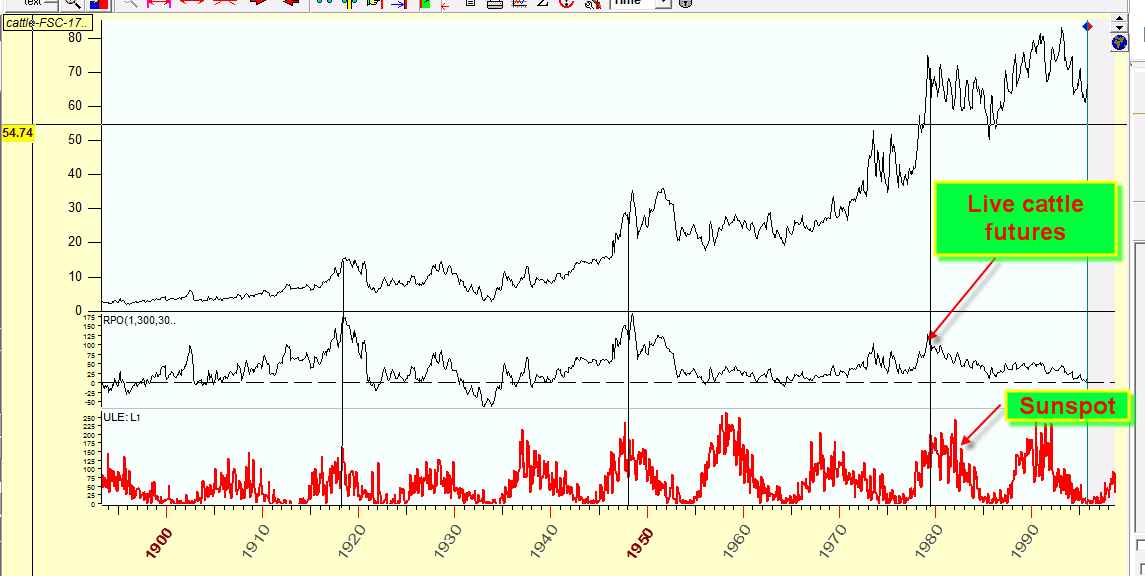
We can cross reference this with other commodities by looking at long term charts of cattle prices and corn prices with solar cycles and we can see that pattern of price spikes in both every third solar cycle, or one lunisolar cycle, as per my work on my site.

Source: Sergey Tarassov

I did not choose solar cycles to be dominant in my work, but rather, the evidence led me there. If there are cycles in the market, I want to see statistical/data evidence for them, and scientific or logical reasoning. I do not agree with the approach of those who suggest there are cycles in the market but don’t provide a reasoning as to why. With solar cycles, there is both the evidence for their presence and dominance in stocks and commodities, and the scientific reasoning as to why: the biological impacts on humans and their subsequent behaviour in relation to risk-taking, speculation and sentiment.

Agri Commodities Awake

I have updated all the models, on their respective pages.

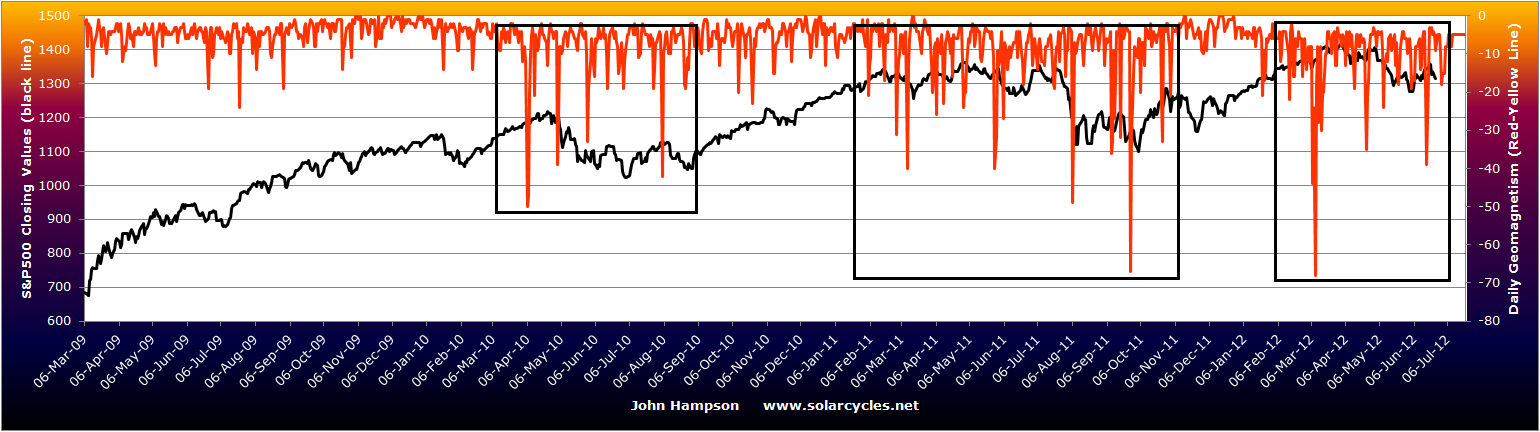
Geomagnetism continues to be a good guide. Here I have highlighted the periods of higher geomagnetic disturbances corresponding to periods of correction for the stock market. The question is whether the most recent period if now over, or continues. Seasonality suggests we should experience fewer disturbances through to August, which if so, would be supportive of upside for pro-risk. That would fit with a period of mean reversion coming to pass away from recent extremes of oversold and overbearish in pro-risk.

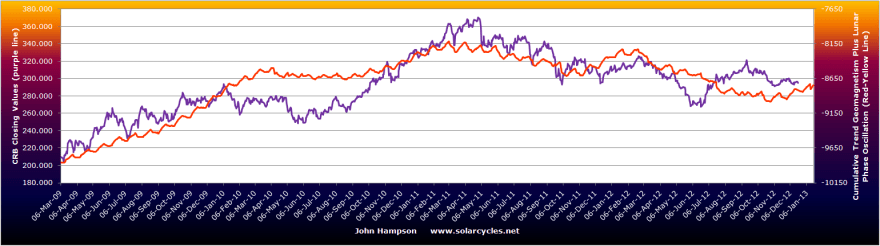
The shorter term geomagnetic lunar models continue to perform. The last two lunar turns were on the nose and the cumulative geomagnetism trend has provided an overall route map for the markets. Here are the Dax and the CRB commodities index, with the tails showing the forecast for the next 3 weeks. As yet the model does not show a renewed upturn, but commodities, being below model, have room to pull up.

Which brings me to the title, as in the last week we’ve seen soft commodities wake up and put in daily gains of up to 7% in some foodstuffs, as the hot dry weather in key producer parts of the world comes into focus. Agri gains have been made despite other pro-risk assets pulling back. As I previously stated, whether the extreme weather continues into the end of July is likely to determine whether or not we see a run away rally in soft commodities to new highs in H2 2012.

I have previously shown charts displaying close relationships between the different commodity classes, so if softs do take off in a meaningful way, that should provide the impetus for precious metals to break out.

The all-commodities chart since 2000 doesn’t look too bullish:

Source: Bank of Canada / Reed Construction

Yet, take out energy and a secular bull appears very much in tact. Fluctuations and weakness in oil and natural gas have largely accounted for what some analysts have identified as technical weakness in the overall commodities picture. Commodities ex-energy:

Source: Bank of Canada / Reed Construction

As you know, I believe the secular commodities conclusion is ahead, following next year’s Spring solar maximum. Increasing sunspots inspire speculation and growthflation. The current window of economic weakness is providing the opportunity for another round of global central bank supportive and stimulative interventions. More needs to be done in this regard, but I expect the natural pick up in growth, speculation and inflation combined with the aid of the central banks to come to fruition.

Currently, we continue to see problematic levels for Spanish and Italian CDSs. Economic Surprises continue to languish. Chinese leading indicators came in better yesterday at +1.1% (Conference Board), but other leading indicators have been largely negative. I am not belittling these issues, but refer you again to the secular position and recent extremes in indicators, whereby we are more likely to see pro-risk rise on slight improvement in these areas, rather than fall again.

Here is someone else who shares my view that secular stocks bulls need redefining from the nominal lows, and concurs that the new secular stocks bull began in 2009, noting the similarities to the last two secular nominal lows.

Source: Federated Investors

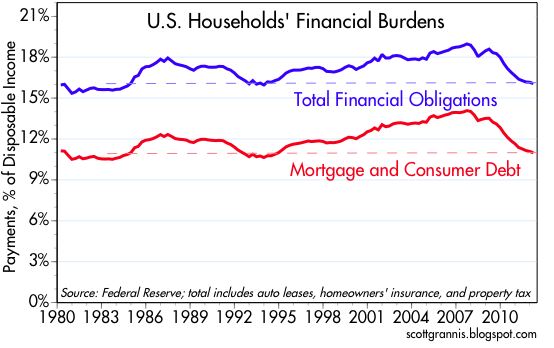
And here is a chart from Scott Grannis showing how US housholds have largely completed their secular deleveraging, allowing the private sector to releverage from here (despite the increase in public debt). This also fits with US housing increasingly showing it bottomed already.

Source: Scott Grannis 

Evidence increases that we are into a secular inversion period. The timing is however critical – when to switch out of commodities and bonds and into stocks and real estate, in terms of longer term buy-and-hold. I maintain the blow-off top should still be ahead for commodities, which provides the best opportunity out of the 4 classes into 2013 – I believe. But that will be the final pop, as relative cheapness of stocks and real estate to bonds and commodities reach historic extremes.