Developments

Back from hols and it was a good week for pro-risk and my account. Can pro-risk go further? I maintain that it can. By solar and secular cycles, we should see a blow-off top in pro-risk, with stocks overthrowing (H2 2012) and then wilting (end of 2012 / start of 2013) whilst commodities make a parabolic secular finale (into the solar peak of Spring 2013 and terminating around summer 2013). So do the technicals, indicators and macro data support this?

Firstly, we see the SP100, soybeans and corn at new 3 year highs:

Source: Stockcharts

Soybeans – Source: Tradingcharts.com
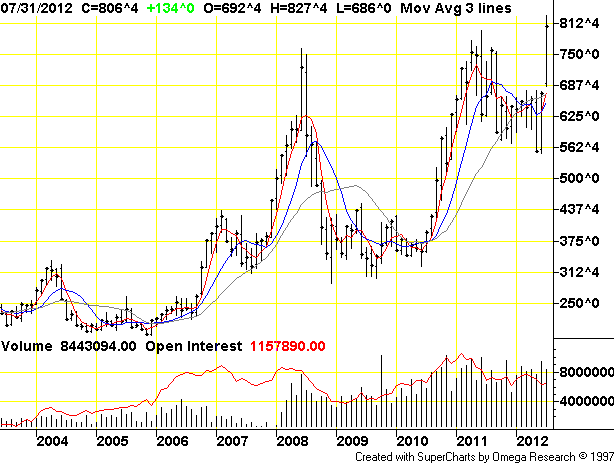
Corn – Source: Tradingcharts.com

Those developments give more confidence that commodities did not already make their secular peak and that other equity indices could break out. However, it’s tentative for now as these new highs are marginal and until other pro-risk follows suit. Furthermore, we continue to see opposing indicators that present a confused picture. Here are four indicators from Sentimentrader.

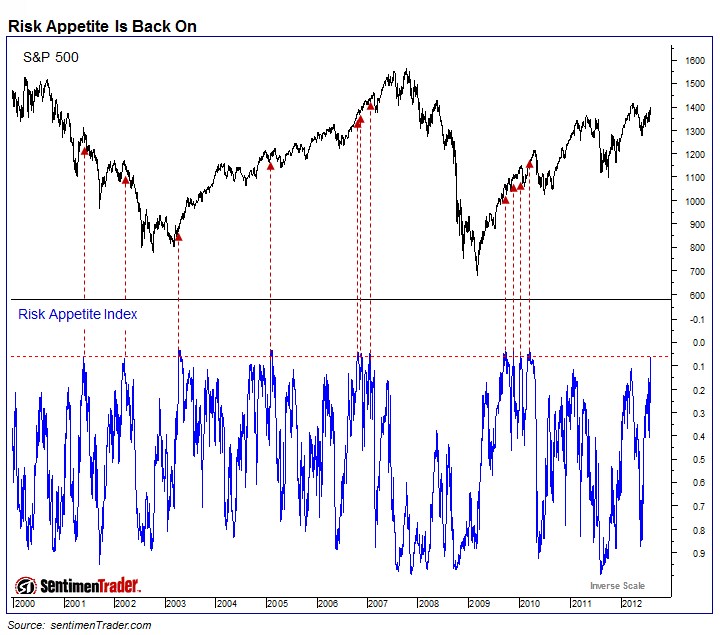
Commercial shorts on the SP500 suggest a market due a pullback – although the two occurrences in 2010 and 2011 led to more gains before a pullback. The Farrell sentiment index suggests the SP500 is a buy. Economic uncertainty has reached a level that also could imply a buy. Lastly, risk appetite is up to the kind of exhaustion level that could mean pro-risk needs to pull back – although in 2006 and 2009 we saw stocks push higher whilst risk appetite spent more time at this kind of level.
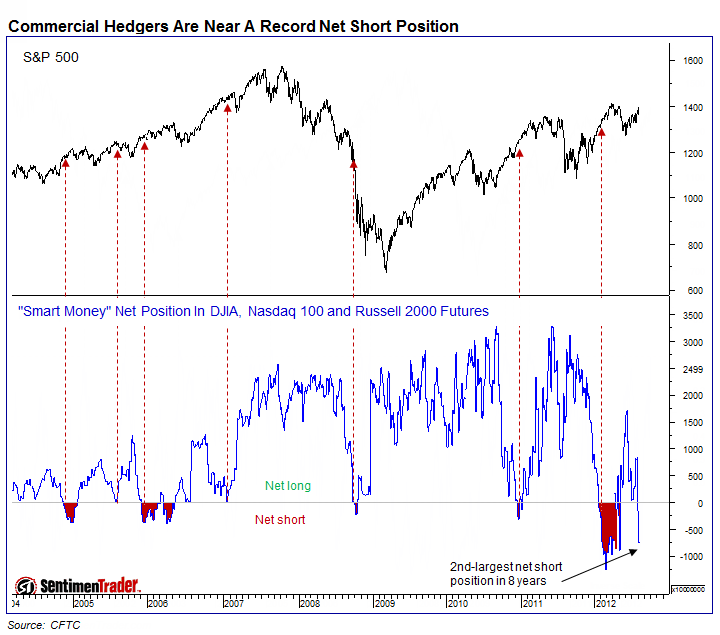
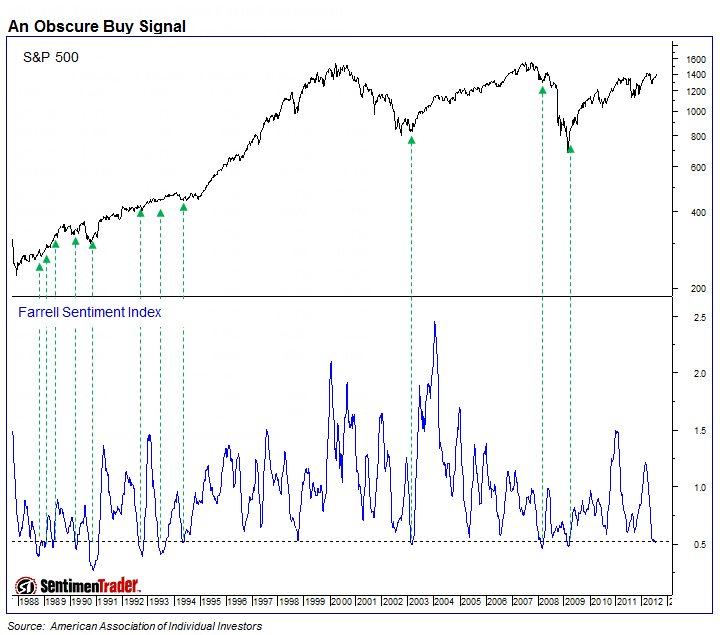
Source all: Sentimentrader

Drawing those indicators together, it is a mixed picture, but bullish developments in the weeks ahead have the edge.

As previously noted, the rally in equities has been more defensive than a normal healthy rally, but there is potential evidence that this is turning:

Source: Ryan Puplava

US equities have not reached either overbought or overbullish yet.

Source: Technical Take
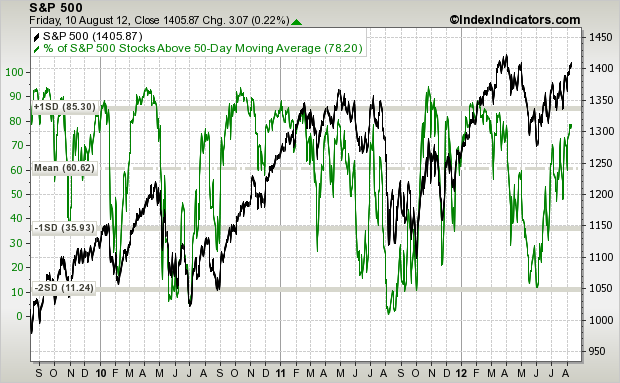
Source: IndexIndicators

Both show there is room to push higher yet. Meanwhile, overbought and overbullish indicators for the German Dax are a little higher but also room for more gains yet.

Grains had reached levels of overbought and overbullish but have spent the last 3 weeks or so consolidating and relieving those indicators. The fundamentals support further gains ahead.

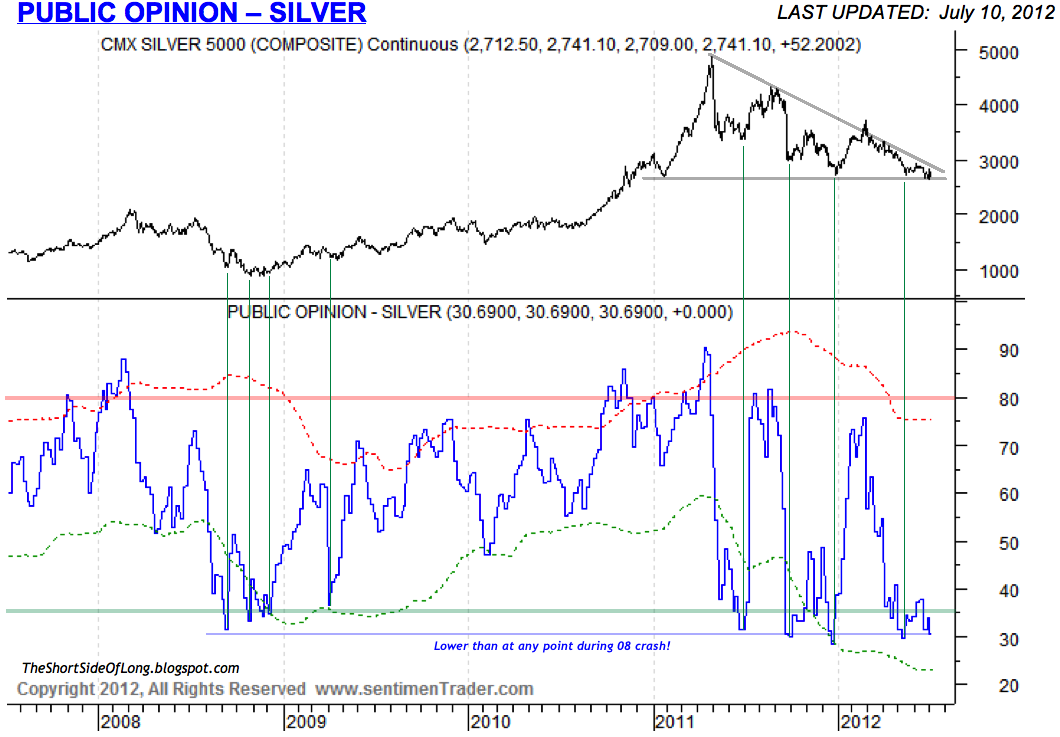
Gold and silver remain at the low extremes of sentiment (public opinion, Hulbert), suggesting the breakout move will be upwards out of the mutli-month triangles. This is supported by the recent acceleration in soft commodities, recovery in the oil price, and renewed global efforts to maintain negative real interest rates.

Treasuries have pulled back, and there is a good chance of this continuing, due to the parabolic unsustainable rise coupled with having reached overbought and overbullish extremes.

Turning to global macro, Euro debt has continued to pull back from accute:
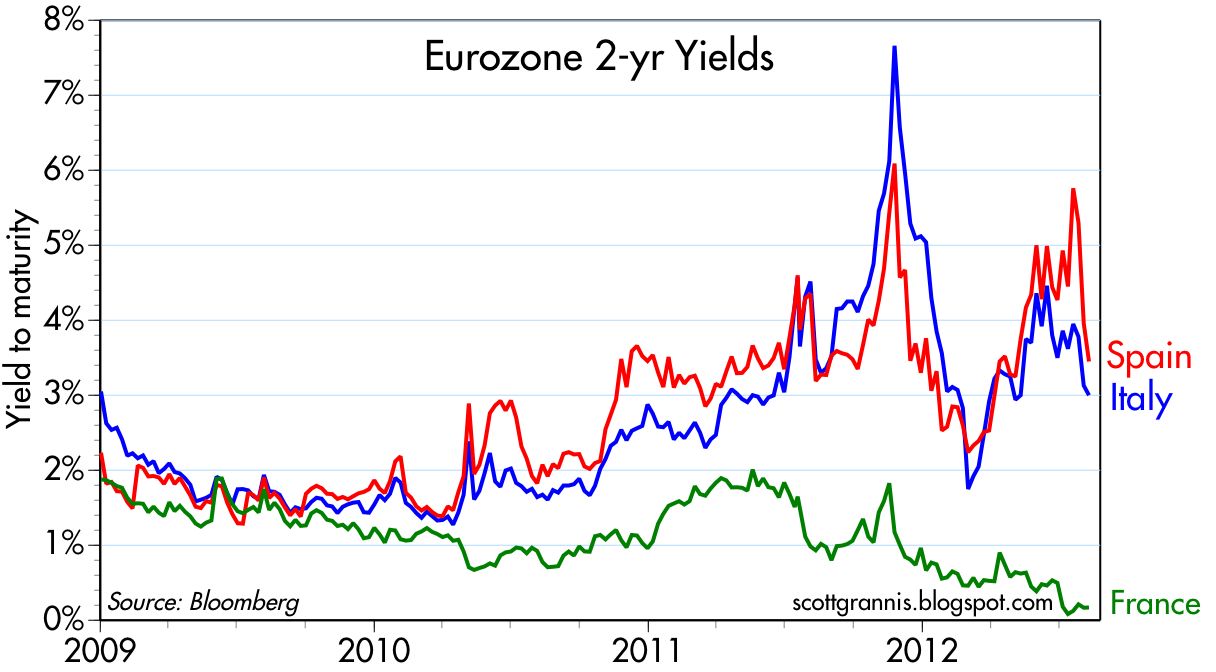
Source: Scott Grannis / Bloomberg

Citigroup economic surprises continue to maintain a rising trend for the US, emerging markets, and G10 nations (shown below).

Source: Bloomberg

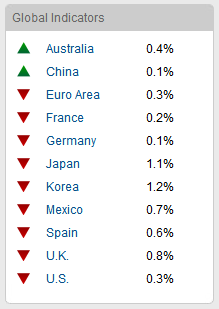
However, global leading indicators continue to languish. China trade data on Friday was particularly bad. The latest OECD readings show a precarious global economy. ECRI leading indicators for the US look reasonable. Conference Board leading indicators for the key nations are below and show a picture that is notably more negative than positive:
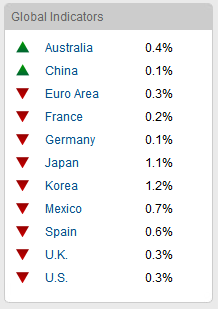
Source: Conference Board

US earnings this season have come it at around a 59% beat rate, compared to a 62% average since 1998. More of a negative than a positive.

Geomagnetism has been fairly benign the last 3 weeks and the forecast for the next 3 weeks is likewise. That has finally given the geomagnetism models an up turn.
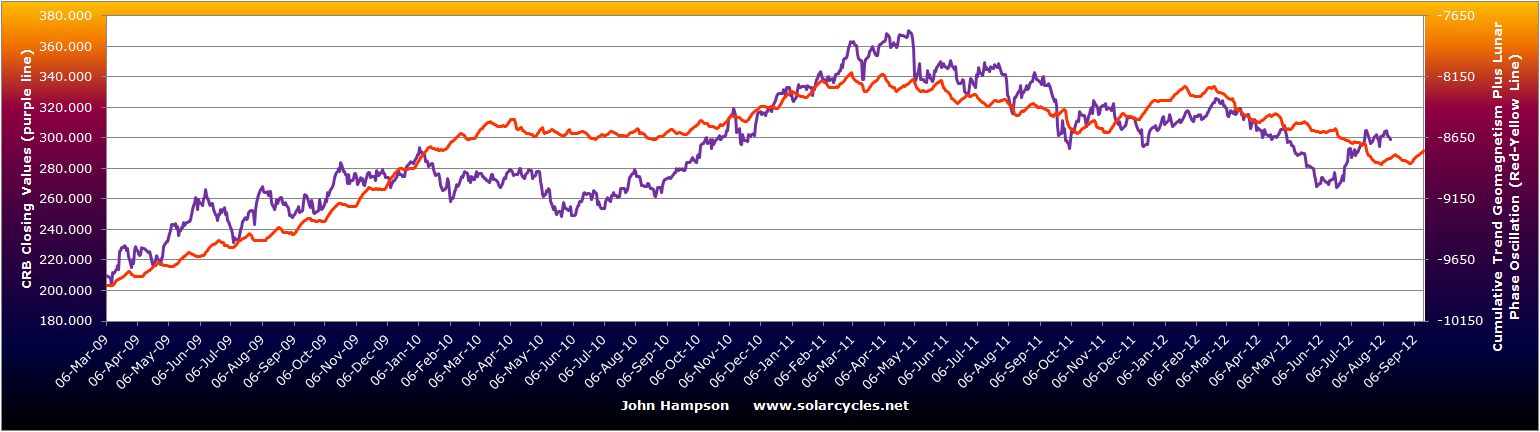
The SP500 remains significantly above the geomagnetism model, and this is reflected in the SP500 being one of the most expensive global indices by p/e valuation. So at some point we should expect the SP500 to correct, but when? Well, I maintain not yet – that stocks should first go on to make new highs in a cyclical bull overthrow finale. I believe the SP100 is the first to lead the way.

Into previous secular/solar peaks (secular asset peaks align with solar maximums), increasing sunspots had the effect of inspiring speculation excess in human behaviour. I believe that’s what we are seeing unfolding here, but it’s not directly measurable. We need to look for the signs. Pro-risk assets going to new highs. Risk appetite high and staying high. Pro-risk assets leaving behind the geomagnetism models (for a period). Excessive speculation in the context of the current economic situation.

There is some evidence for each of those, but we are just getting started. We need to see more stock indices move to new highs. We need to see gold and silver break out upwards. A period of Euro outperformance versus the dollar. And most likely additional fuel by global central banks.

In short, I have no current reason to doubt what I have maintained for some time will come to pass (as per the first paragraph in this post), but it will become much clearer one way or the other as the remainder of 2012 plays out. The current picture is mixed, but there is increasing supporting evidence.

For now, I am looking once again to lunar phasing for a near term position tweaking. Namely, the new moon is this Friday, which suggests positive pressure into the end of this week, supported by tame geomagnetism. If pro-risk pushes higher into this Friday, I may trim back my overall pro-risk positions again, and will notify you if so. However, I will be looking for evidence of overbought/overbullish and technical resistance. I will also be looking at developments in leading indicators or central bank  action between now and then. September and October is typically a more difficult time for pro-risk, however this has not historically applied in a US election year, plus this is the run-up into a solar peak.

Opposing Indicators

A lack of concrete action from Draghi yesterday and pro-risk sold off accordingly, making for an appropriate full moon low. However, there was a little recovery into the close and this has been continued this morning (Europe time), suggesting the markets were holding up on more than Draghi’s promise. Gold is back into its large triangle meaning the breakout, for now, was premature. By lunar phase and geomagnetism the pressure is upward for pro-risk as of next week, so for me it is back to watching and waiting. My focus remains on leading indicators which I see as crucial to market fortunes now. ECRI for the US today and then the next 2 weeks give us the latest Conference Board and OECD leading indicators for key countries around the globe.

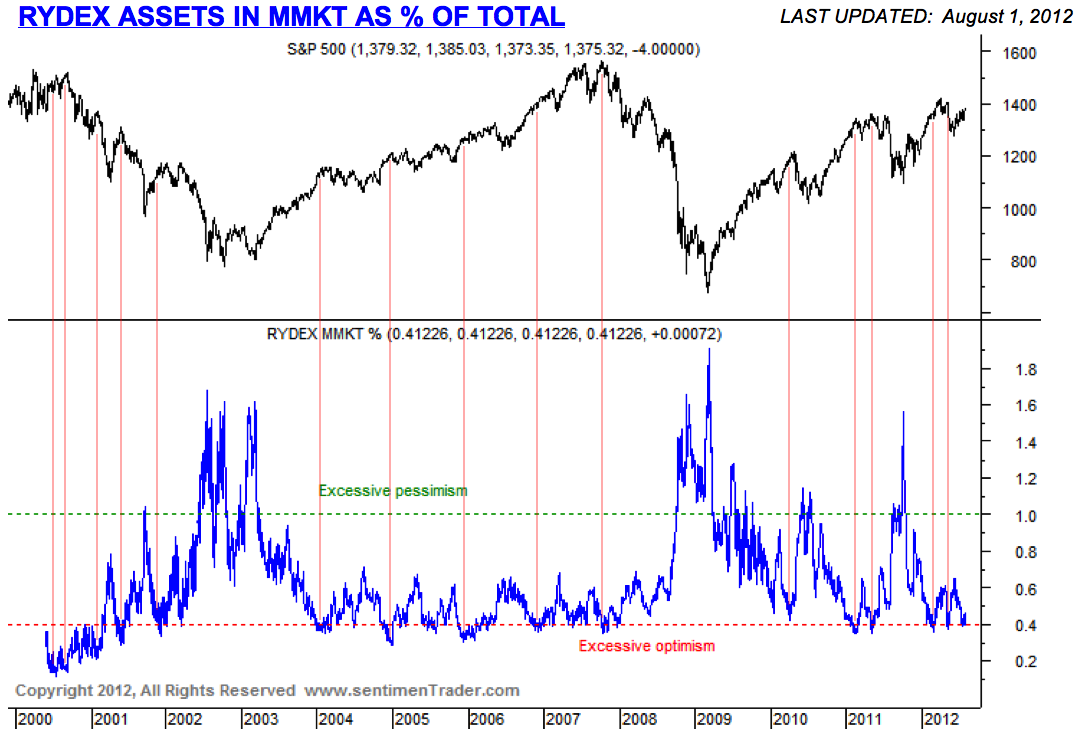
There is an interesting opposition of indicators for equities. First AAII sentiment says the stock market should go up from here.

Source: Sentimentrader / AAII

But second, Rydex involvement in the market says the market should go down from here.

Source: Sentimentrader / Tiho

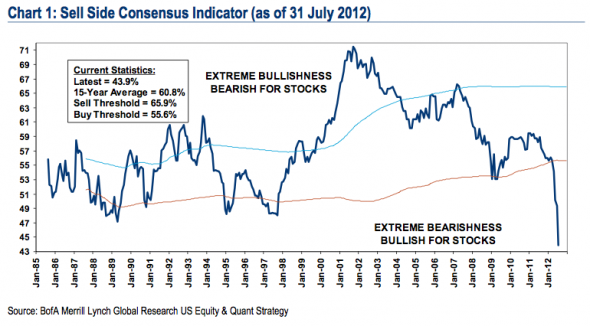
Yet, third, Wall Street strategists equity allocation recommendation says the market should go up from here.

Source: Business Insider / BofA (Hat tip Gary)

And fourth and last, open interest shows that large specs and commercials are short and small specs long, which can be read as smart v dumb money, suggesting the market should decline from here.

Source: Cotpricecharts / Bill L

It’s rare to find normally reliable indicators at such odds with each other. What does it mean? I noted that this current rally isn’t a run-of-the-mill rally. Small caps are underperforming – although Quant Edges and Sentimentrader have now both run studies which suggest this is historically actually bullish for the market ahead rather than bearish. I suggest the market action will morph into something more typical – either a full involvement rally or a regular decline. But which is it to be? Putting my wider views aside (secular and solar supporting a bullish resolution) I would suggest the opposition of the indicators above suggests the market may struggle to move decisively one way or the other – at least until one of these indicators starts to shift the other way. So I will be watching for what shifts and which way.

I am on hols next week so there will be no posts and no model updates until w/c 13 August.

State Of Play

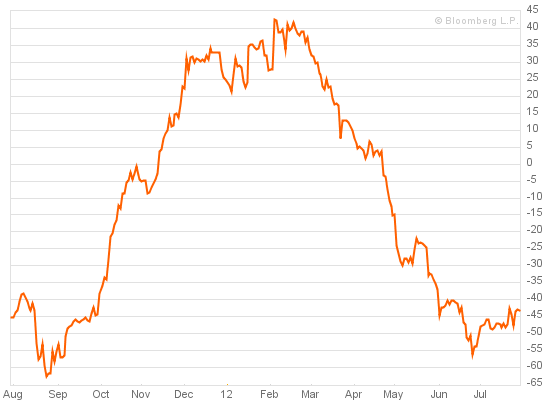
Let’s start with the big 3 macro: economic surprises, Euro debt and leading indicators. Economic Surprises for the G10 nations show increasing evidence of having bottomed and entered a new uptrend:

Source: Bloomberg

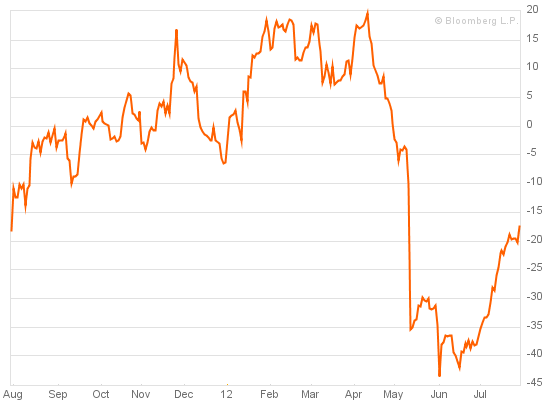
Economic Surprises for Emerging Markets even more so:

Source: Bloomberg

Turning to Euro debt, overall PIIGS risk continues to ebb from its 2011 highs:

Source: Bloomberg / Scott Grannis

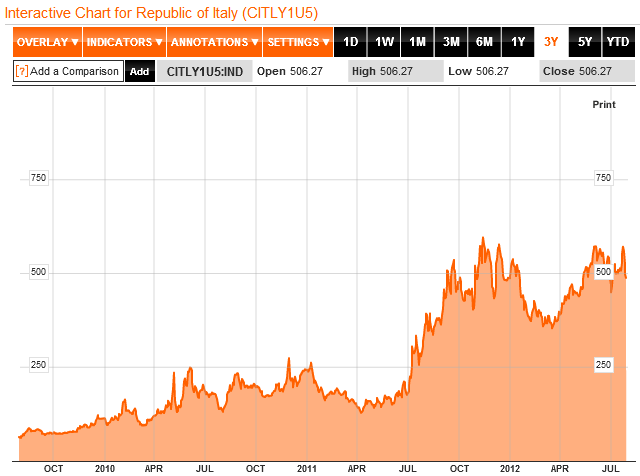
Homing in on the big two, Spain and Italy, we see 5 year CDSs having entered a consolidation the last few weeks. It is too early to say if a downtrend is emerging, or a pause in the uptrend:

Source: Bloomberg

Moving on to global leading indicators, here is a summary of the latest readings from the Conference Board, showing that we do not yet see general positive signs ahead for the global economy:

Source: Conference Board

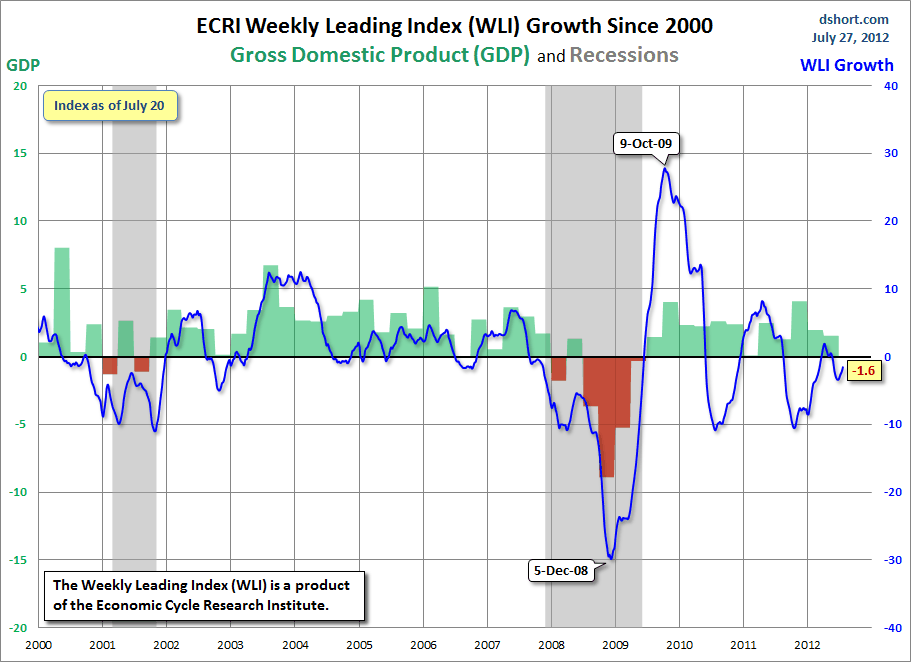
There have however been four consecutive weeks of rises in ECRI’s leading indicators for the US. Whilst still negative, they have been trending upwards again:

Source: ECRI / Dshort

Drawing in US earnings, the earnings beat rate so far has been around 60%, fairly average historically, whilst the revenue beat rate has been around 48% which is some way lower than the average of around 60%. This continues to reveal that companies have maintained earnings rather by cutting costs rather than genuine growth, which in turn reflects the economic weakness that we have been experiencing.

So the key question remains whether we are now to see a turn up in growth. I maintain that we will, due to lower commodities prices in H1 2012, due to a natural upswing in growth, and due to a new round of global easing and stimulus currently occurring. That brings us to the Federal Reserve meeting outputs of tomorrow and the ECB meeting on Thursday. What should we expect in terms of further action? I suspect the Fed will reiterate its commitment to act without actually acting, but go with more dovish wording, whereas I suspect the ECB will deliver something tangible. Since Draghi propelled the markets last week with his ‘do whatever it takes’ wording, the markets are expecting something concrete. If we get nothing on Thursday, those gains may be retraced. Thursday is the full moon, and we would normally decline into a full moon. There is still the possibility of big declines the last 2 days into and on it, if the Fed and ECB disappoint, however it rather looks like we will make an inversion.

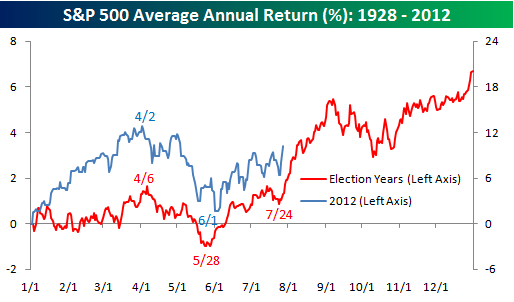
I have updated all the models this morning. We have a particularly tame 3 weeks ahead in terms of forecast geomagnetism. That provides a backdrop for pro-risk to rally. Presidential seasonality also supports this for equities:

Source: Bespoke

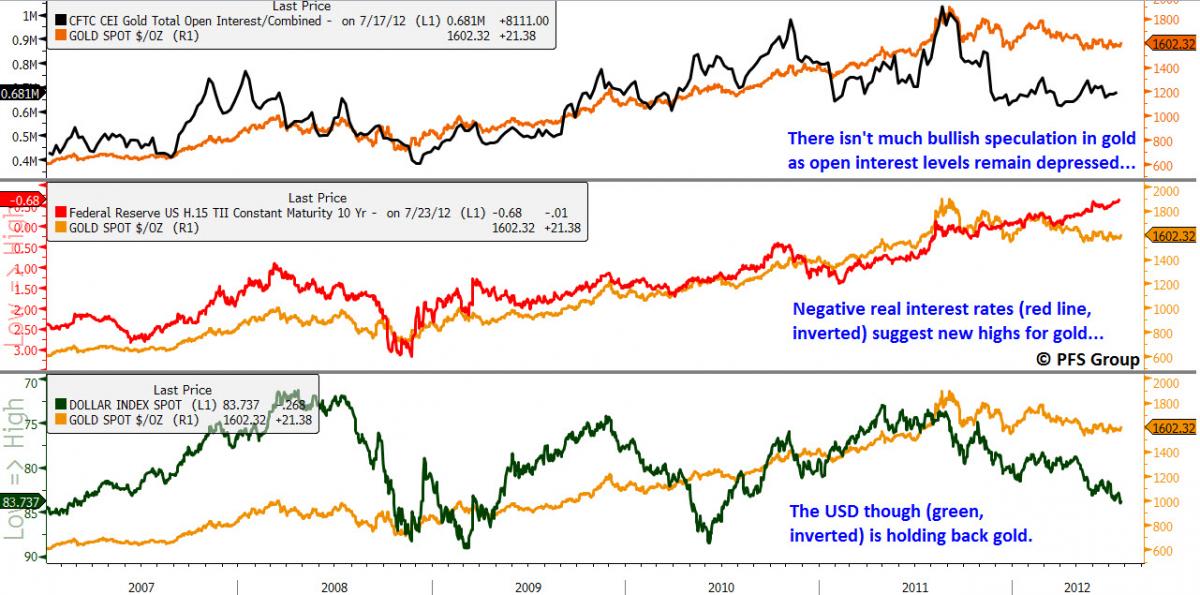
In addition, the oversold and overbearish readings for both the Euro and precious metals also provide fuel for a pro-risk rally and dollar retreat. Chris Puplava’s chart here shows that open interest and real interest rates both support an upward move for gold, with the US dollar apparently holding it back. A mean reversion in Euro-dollar therefore could sustain a rally in gold, which would be technically very important as it would mark an upside resolution out of its 9 month triangle.
Source: PFS Group

Agri commodities have consolidated a little, having reached overbought levels. Fundamentals are still currently supportive with more normal weather conditions perhaps returning as of September, which keeps harvest fears at the forefront for now.

Treasuries made a large reversal on Friday from all-time highs. It is too early to judge whether that marked a significant top. On the one hand, the overbought and overbullish parabolic recent move is ripe for an enduring reversal, but on the other hand the Fed is still a supportive player in that market.

OK, bringing it all together, the question on my mind is whether I want to take some pro-risk profits off the table here into the FOMC and ECB. For anyone new to my site, my portolio of positions is currently 100% pro-risk, with the biggest weighting long commodities (precious metals, agri, energy) then long equities (various global stock indices), then short treasuries in a much smaller weighting. I currently have no currencies positions. Drawing together the secular and the solar I anticipate a pro-risk rally in H2 2012 through to the solar maximum of 2013, but with equities wilting before we reach the solar maximum whilst commodities make their final blow-off secular top. Equities could therefore top out before the end of 2012 but not before they’ve had a pop to new highs.

Right now the picture looks more supportive of that general scenario that I have been promoting for some time. Economic surprises now look supportive, Euro debt is showing signs of coming off the boil again and US earnings are good enough. Leading indicators remain the area of concern, but if I am right in my reasoning for why they should begin to improve then I believe that provides the final piece of support for a move to new highs in pro-risk. Chinese leading indicators in particular are important for commodities. However, soft commodities have had a thrust due to global wierding and precious metals have the support of reinforced negative interest rates from the latest central bank interventions. Precious metals enter their seasonally strong period of the year as of August, with Indian wedding demand one factor, and global wierding remains supportive for soft commodity prices for the near future.  By solar cycles, inflation should peak around the solar maximum, and the price rises in softs that began in June should feed through into in inflation 6 months later. If they can further their rises and oil was to also rise on H2 growth (or supply issues) then we could indeed see that acceleration in inflation into Spring 2013.

So right now I am going to maintain all my positions and not take any profits. However, if pro-risk pushes up significantly more today and tomorrow before the FOMC outputs then I may trim back. I will let you know in the comments if so.

Charts Of Interest

1. AAII sentiment survey bullish percent 12 week average at level that represented important bottom for US equities historically:

Source: Sentimentrader / AAII / TSP Talk

2. Yet Vix is at a level that has represented a top for equities the last 3 years:

Source: Forbes / Bloomberg

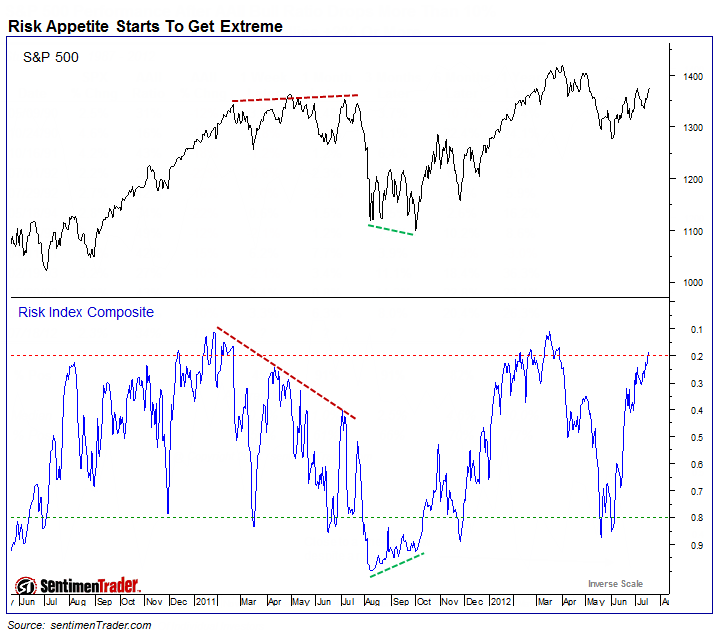
3. Risk appetite is reaching towards a level that has implied stocks may not be able to advance too far from here, although there is scope for the rally to continue some way further in price and time yet.

Source: Sentimentrader

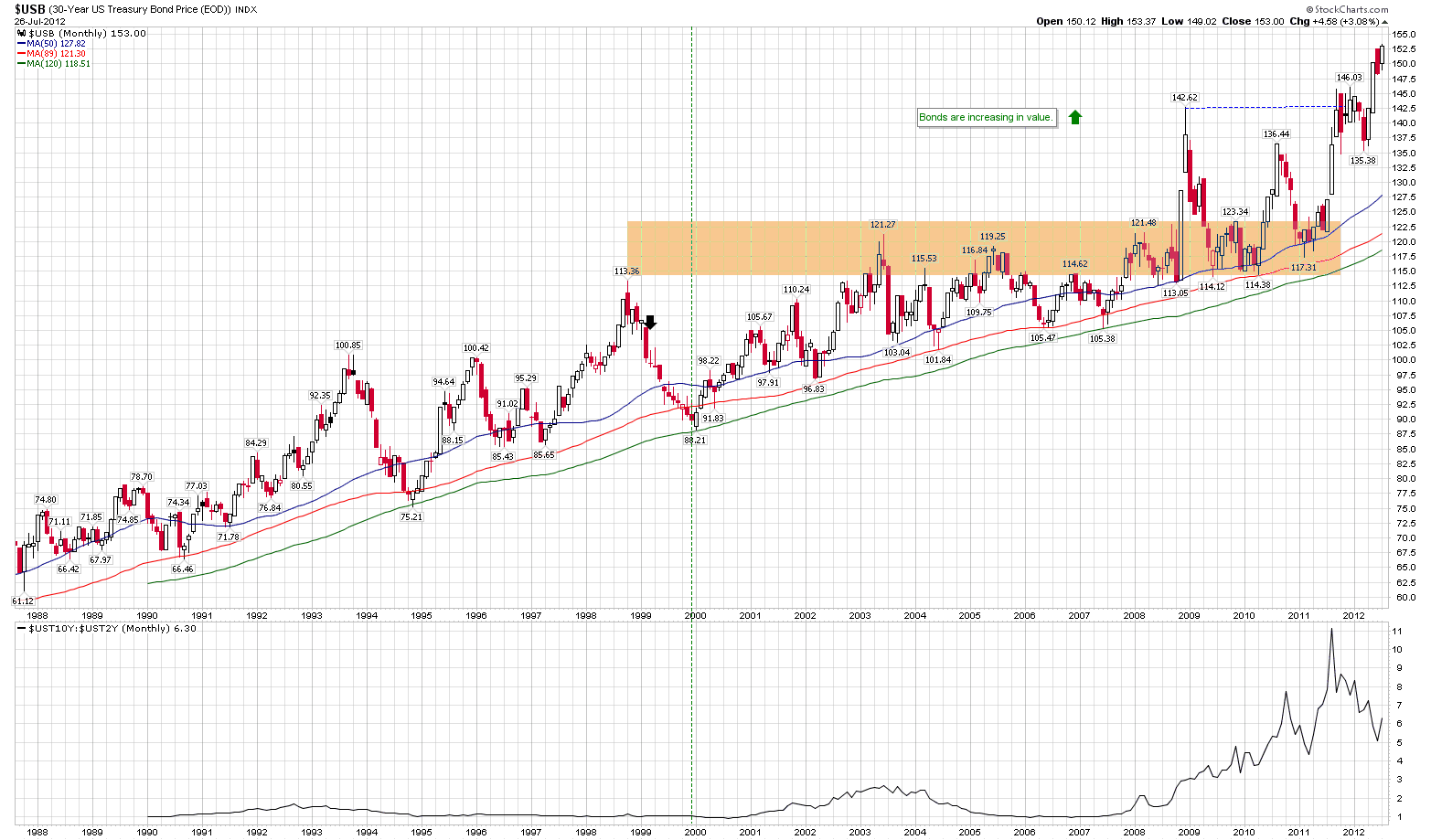
4. Treasuries are at record extremes in price (with sentiment at the bullish extreme, suggesting a reversal):

Source: Stockcharts / James Craig

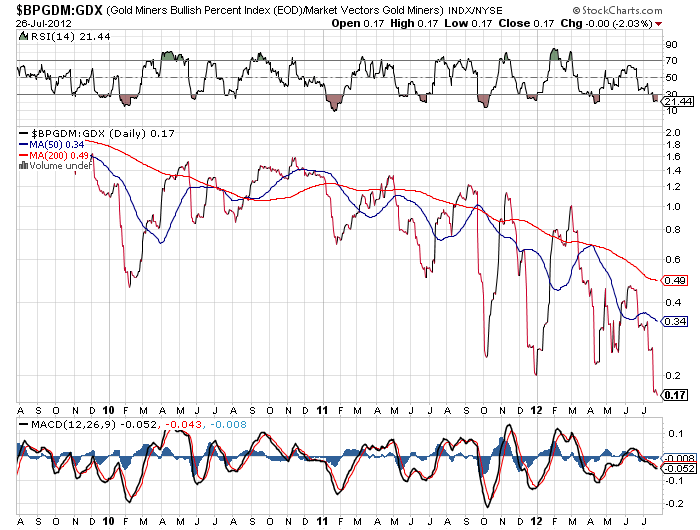
5. Gold miners bullishness is at the extreme low, suggesting miners should rally imminently:

Source: Stockcharts

6. Euro bullishness is also at the extreme low, a level that has historically implied a Euro rally:

Source: Sentimentrader

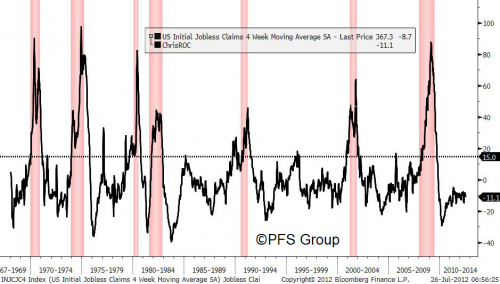
7. US jobless claims suggest there is no US recession now or ahead:

Source: PFS Group

Technical Equities

This is the technical picture for the Nasdaq, the leading index. In a very tidy channel since the bull market began in 2009, it has made a series of advances and consolidations. I have marked the horizontal supports for the consolidations – in each instance the market retreated to the previous bull market high and successfully backtested it without dropping below it. This has happened again in 2012, with the market holding above the 2011 highs. In short, the bull market is very much in tact from a technical perspective. The Nasdaq is currently at the bottom of its bollinger bands, suggestive of an up-move ahead, however there is scope for the overall consolidation to be extended deeper into 2012 without compromising either channel or horizontal support.

Source: Me

Barry Bannister send me his latest macro deck and I pick out this one chart below which shows his expectations for where stocks are headed. He forecasts reflation for H2 2012, like myself, to push up stocks. He quotes four phases to a cyclical stocks bull in a secular bear, and accordingly anticipates a kind of overthrow move to complete this cyclical bull (similar analysis and forecast to Laslo Birinyi).

Source: Barry Bannister

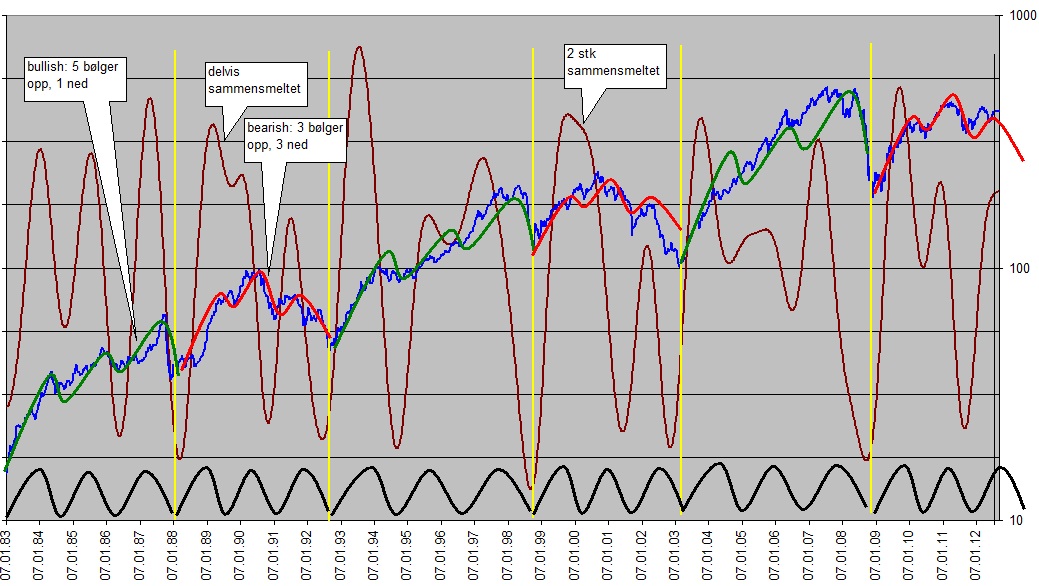
Now I’m going to contrast the above with Jan’s charts that show the key cycles on the Norwegian index. What both show is a decline into 2013. He expects the decline in equities to begin now or at the very latest October.

Source: Jan Benestad

Eurodollar COT one year advanced suggests a rally in equities into the US elections. Presidential cycles also predict a rally from here into November. The next major Bradley turn is 28th July, and after that 22nd December. I concur with those commenters that Bradley turns can be highs or lows and the siderograph is just a ‘best guess’ for which are likely to be which. Geomagnetism, by seasonality, becomes more intense in September and October, before lessening into year end, whilst sunspots should continue their waving up towards the solar peak, still forecast to be Spring 2013.

So the question is, can we unite all the above?

The best fit is that stocks bottom out as we turn into August, and then rally into year end (Eurodollar, presidential, Bradley turns, sunspots, Bannister, Birinyi).

The alternative is that stocks top out as we turn into August and fall into the US elections (Jan’s cycles, geomagnetism, Bradley siderograph). By Jan’s cycles we would in fact keep falling into mid 2013.

As previously noted, I believe that we will see a pick up in leading indicators in the weeks ahead, which will inspire the best fit to come good. As I expect stocks to top out before the solar peak (and associated secular commodities peak) it is still possible that they then fall into mid-2013 in line with Jan’s cycles. Let’s see if equities rally or fall out of this next week’s Bradley and FOMC. By my shorter term models, we should fall into the FOMC, and then bottom out to rally.

Macro Update

Let’s start with Economic Surprises. G10 nations:

Source: Bloomberg / Citigroup

And Emerging Markets:

Source: Bloomberg / Citigroup

The message is one of improvement in actual data versus expectations.

Next, leading indicators. Here is the latest Conference Board summary:

Source: Conference Board

The message is one of continued negativity. ECRI US leading indicators made an uptick on Friday but one week doesn’t make a trend, and it came on the heels of another ECRI media appearance reaffirming their call that the US is in recession. Scott Grannis made a compelling case in response as to why the US isn’t in recession here.

Next, Euro debt. Here are Portugal, Greece, Spain and Italy CDSs:

Source: Acting Man

And here France, Belgium, Japan and Ireland:

Source: Acting Man

There has been general improvement since the Euro summit outputs, in that French, Spanish and Italian CDSs have all fallen back the last 4 weeks. Only Greek CDSs are notably rising again.

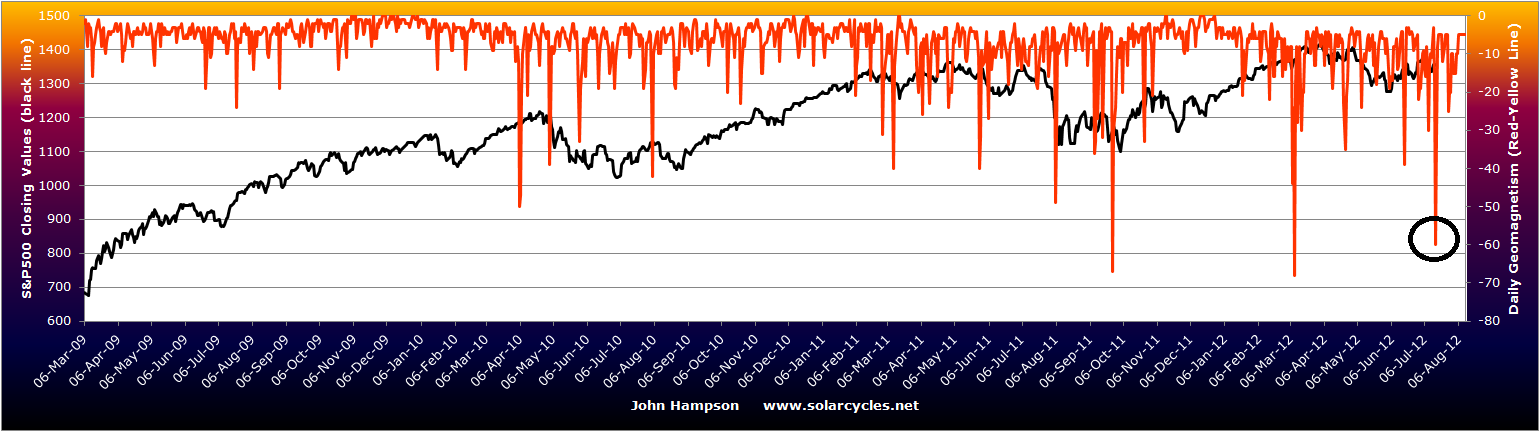
Now let’s turn to geomagnetism and sunspots. All models have been updated this morning. There was a big geomagnetic storm the last 2 days (circled on the chart below) and there is another siginificant episode predicted all the way through from the 27th July to the 4th August.

This is higher geomagnetism than is seasonally expected, and the result is that my short and medium term models continue to trend downwards. There is neutral pressure into this Thursday’s new moon but thereafter downward pressure erupts.

On the flip side, sunspots continue their general trend upwards which is a positive.

Next, US earnings. Goldman report today and we will see other big names this week. Only one third of companies have beaten estimates so far, but we need to see the bigger volume of reports this week to get a better feel of the beat rate. So far though, earnings are a negative.

Turning to central bank intervention, Bernanke is scheduled to speak today and the markets are again looking for clues as to whether more stimulus is likely. August 1 is the next FOMC outputs. Otherwise, central banks around the world continue a theme of more easing and stimulus, but there is a new threat to this in that soft commodities have been sharply acccelerating, particularly grains. In emerging markets especially, this is likely to translate into inflation in H2 2012, which may impede further easing. So let’s finally turn to agri commodities.

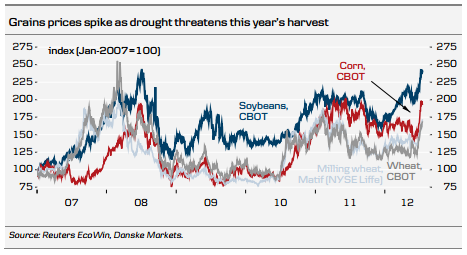
Soft commodities, particularly grains, have been experiencing a supply-side push due to global wierding. The global climate report for June is in and it was the hottest global June on land on record, as shown below. This follows the hottest May on land on record and the second hottest April on land on record.

Source: NOAA

In July so far, the heat and drought extremes persist. El Nino should develop as the summer progresses which could ease these issues, but El Nino also brings it own problems. For now, grains are surging in price and are threatening their previous two major highs of 2008 and 2010/11. Danske predicts that the UN food price index will accordingly shoot up in H2 2012 to a new high. If that occurs, it will be highly significant in support of a secular commodities peak ahead rather than already occurred in 2011.

Source: Danske Bank

So let me summarise. Economic surprises and Euro debt both appear to be turning in favour of pro-risk. Meanwhile, leading indicators continue to point red, but global policy responses also continue, with the likelihood that at some point leading indicators will improve as a result. However, recent soft commodity price rises may be about to close the window on easing. US earnings gather pace this week and by Friday we should have a better feel for whether they are likely to be a drag on the markets over the next few weeks. Geomagnetism is currently higher than is seasonal, and should be a downward pull on pro-risk after the end of this week. Sunspots, however, continue to rise in an overall trend, and should encourage speculation into commodities.

Trading-wise, I am leaning towards a little more upside in pro-risk into this Thursday’s new moon, due to the technical picture on most charts. Should that occur, I will take some profits off the table. The FOMC is an unknown, however Bernanke could telegraph his intentions as early as today. If he sticks with no further action then the markets may protest again.

I have focussed on the macro today, but technical indicators continue to show excess bullishness in treasuries and dollar and excess bearishness in the Euro (plus a positive divergence) and excess bearishness in precious metals. What this means is that a move the other way is ripe, subject to supportive developments. In other words, some evidence of improvement in leading indicators,  some dovish noises from Bernanke or some big US earnings beats could all set the scene for a more enduring pro-risk rally. Without improvement in these three areas, the danger is the current pro-risk rally tops out again.

Equities v Bonds v Commodities v Dollar

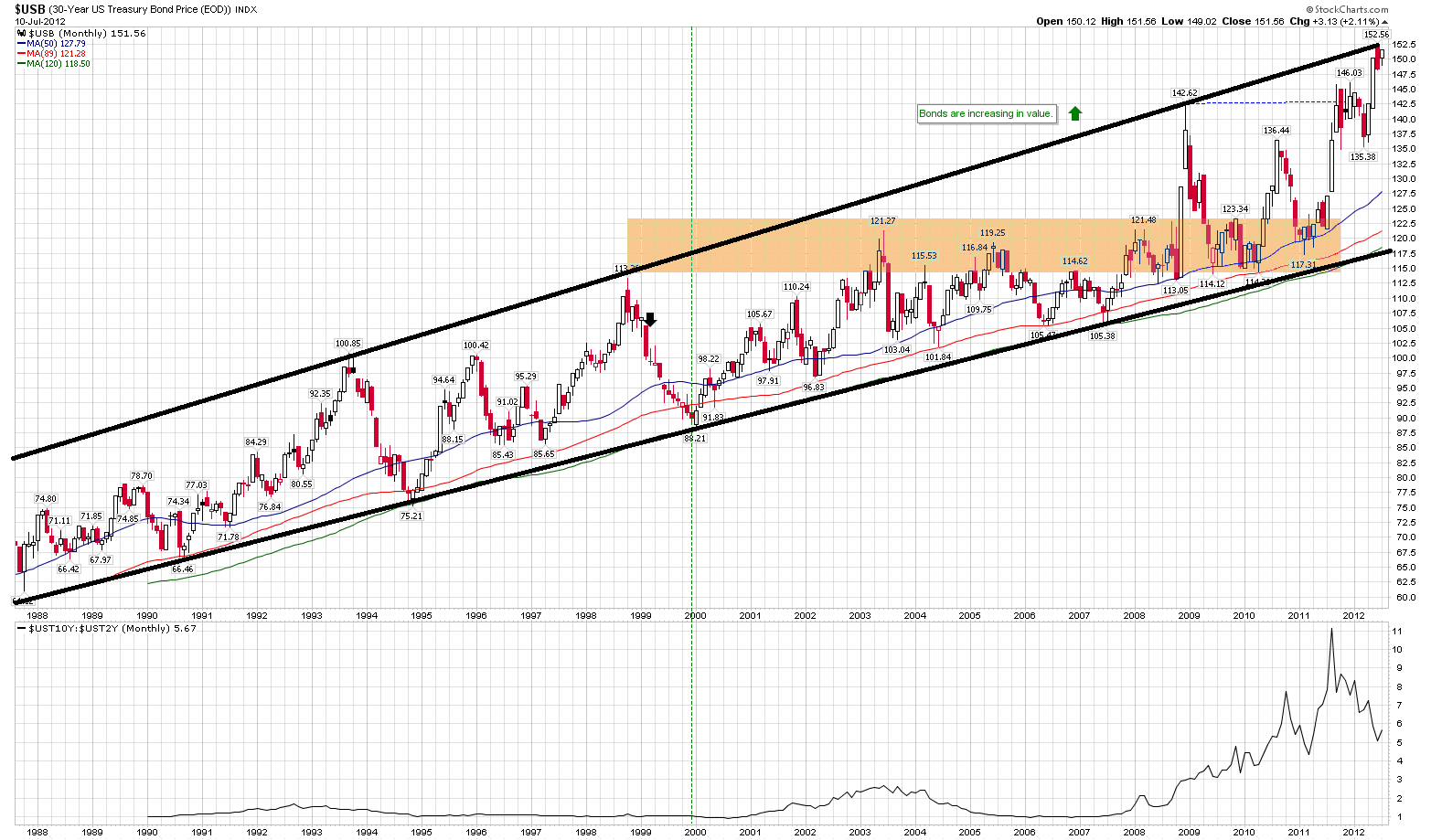
Here is the 30 year treasury long term chart. Price has hit the top of the channel from which previous reversals occurred.

Underlying Source: Stockcharts / James Craig

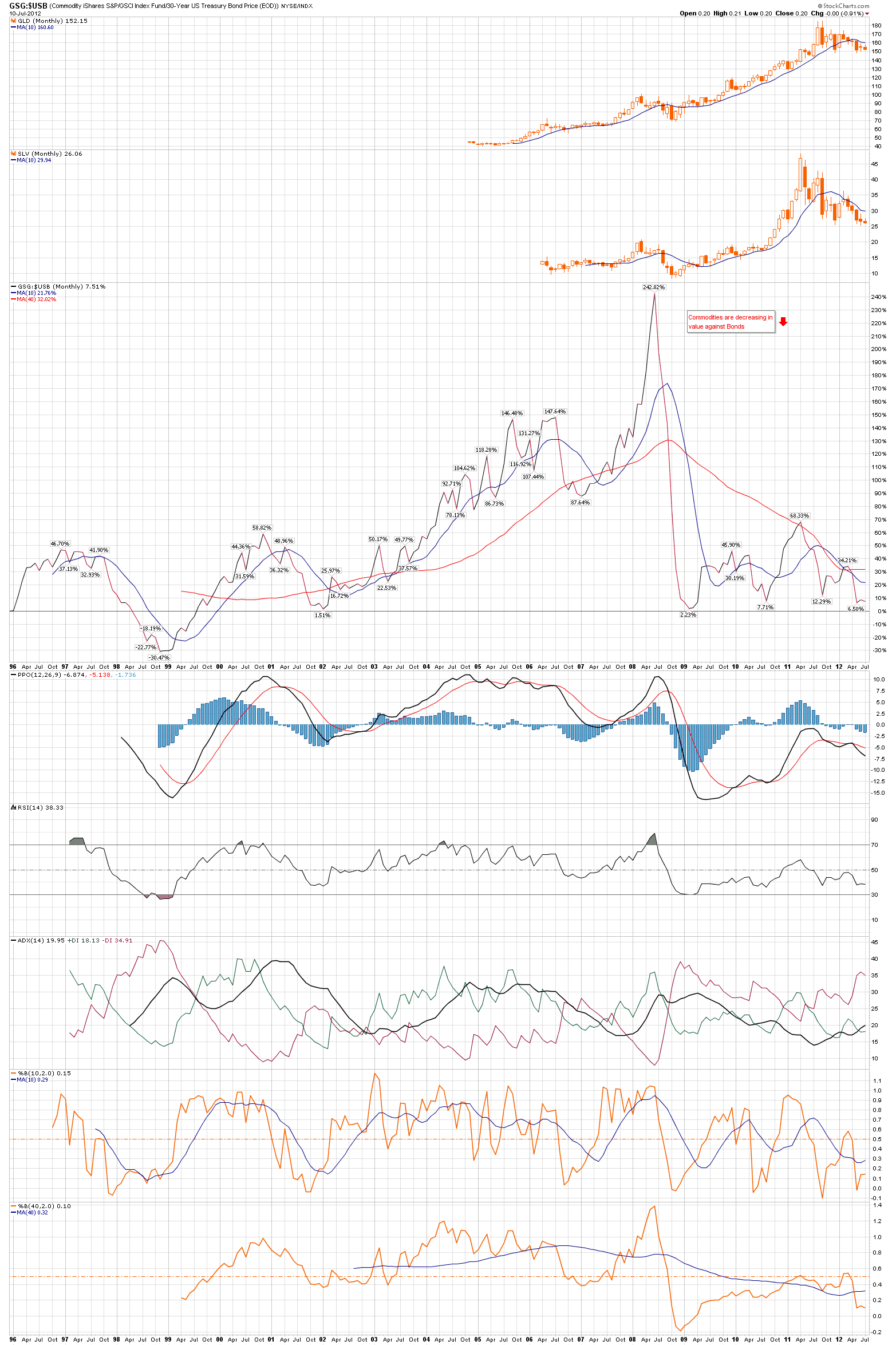
Below we see the commodities to 30 year treasury bond ratio which is back to the level at which historically commodities have been bought versus bonds.

Source: Stockcharts / James Craig

Next we see that Wall Street strategists’ recommended allocation to bonds is at a 15 year high and to equities at a 15 year low. The steep drop in recommended stock allocation not only exceeds the 2008/9 panic low but also resembles a capitulation.

 Source: Sentimentrader/Bloomberg

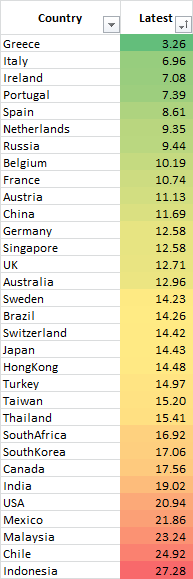
Below are the global p/e ratios as at the end of June. Those in single digits are at secular bottom valuations.

Source: Megane Faber

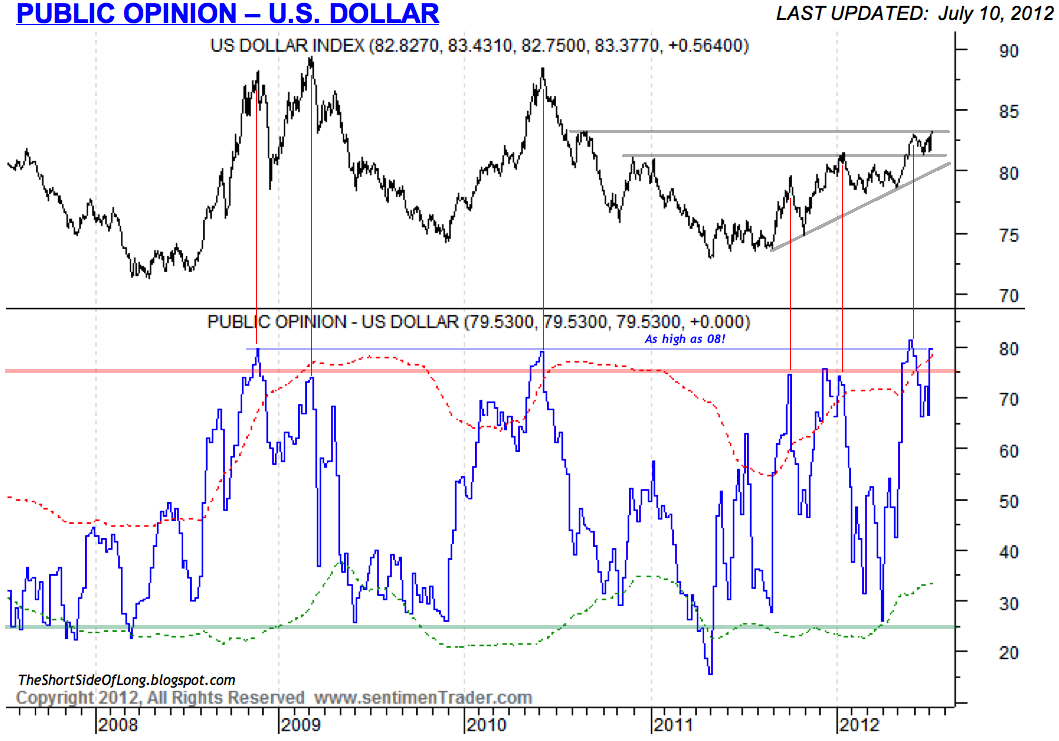
Next, two charts courtsey of Tiho, which show that public opinion is at opposite extremes for silver and the US dollar, both at comparable levels to the 2008/9 panic lows.

Source: Short Side Of Long / Sentimentrader

And lastly, a chart showing there is internal strength to the recent up move in stocks, with cumulative advance/declines at a new high, that normally suggests new market highs ahead.

Source: Sentimentrader

Drawing all together, the bigger picture suggests that an enduring move should be at hand away from treasury bonds and the US dollar towards commodities and stocks (particularly European), in other words a major rally in pro-risk and out of safe havens.

The Macro Picture

Citigroup Economic Surprises for the G10 nations:

Source: Bloomberg

Citigroup Economic Surprises for Emerging Markets:

Source: Bloomberg

The message is one of a potential bottoming in June, but we need to see a clearer uptrend emerge for the G10.

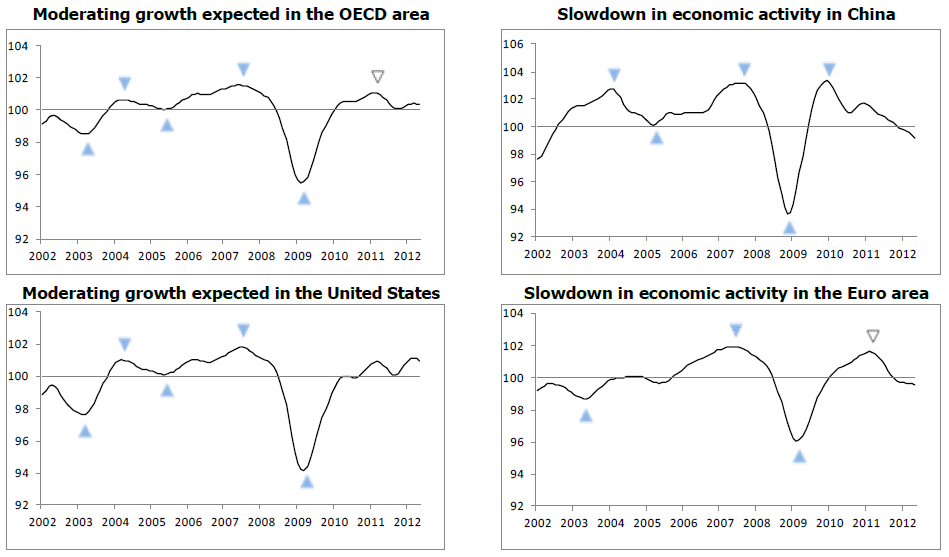
Turning to leading indicators, the latest OECD data continues to show a weak picture in China and Europe, but the overall OECD nations area maintaining growth, albeit unimpressive.

Source: OECD

Moving on to the Eurozone debt troubles, the pressure deflation in Spanish CDSs following the Eurozone summit outputs of the end of June has now been reversed and CDSs are back near to their highs.

Source: Bloomberg

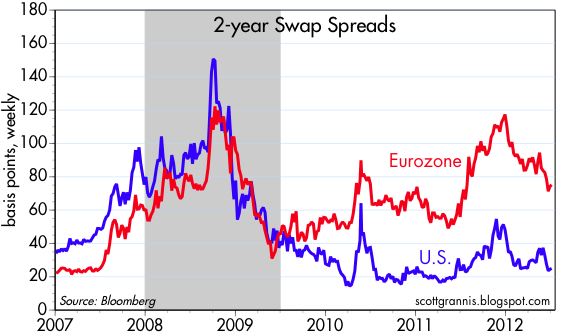
Meanwhile the risk of systemic failure in the Eurozone is declining:

Source: Scott Grannis

The message is that more action is going to required to satisfy the markets on Euro debt but that with Spain, Italy and Greece equities priced at secular bottoms, they are prices for systemic failure which isn’t likely.

Overall in terms of the big 3 (economic surprises, leading indicators and Euro debt), we don’t yet see the kind of positive combined momentum that would support a big move up in pro-risk. However, the global policy response, in terms of rate cuts and stimuli, has yet to make itself fully felt and is unlikely complete. Last week we saw fresh UK QE, China, Euroland and Denmark rate cuts added to previous global moves. August 1st is the next FOMC outputs, where we will see whether the US adds any further stimulus.

So the question, I believe, is how pro-risk performs in this window where we see continued macro weakness but continued new global policy responses.

One other macro development is that of global wierding on agri commodities, which gives us a supply side push on prices, regardless of economic outlook. Record global temperatures in April and May have brought about droughts that have spurred grains to an almost 30% gain in the last month and have by association pushed up all softs. Now, agri commodities are looking overbought and due a rest. The severe weather continues but El Nino is expected to make a full return this summer which should improve conditions for drought-affected farming. It is therefore a question of how great the impact is on plantings and harvests before less extreme conditions return.

Turning to solar influences, sunspots and geomagnetism are working opposite ways. Sunspots continue to rise in a general upward trend towards next year’s solar maximum, and this should spur speculation and inflation. But, geomagnetism continues to be disruptive and the cumulative trend continues downwards, rather than pulling up in line with mid-year seasonality. I have updated all models this morning. Here is the medium term picture for the CRB commodities index showing that cumulative geomagnetism trend is still down:

There is the potential within that for a little upside into the end of next week, the 20th July, around the new moon, before we experience a bearish combination of a significant period of geomagnetism and a full moon around the turn of the month into August – which coincides with the FOMC. Disappointment out of the FOMC is the potential therefore.

Lastly, US earnings season began yesterday with Alcoa. JP Morgan report on Friday but the major earnings don’t really get going until next week. There’s usually a theme to US earnings season (it is sold off, or bought up). The out of season earnings and significant forecasts downgrades both suggest it could be a season offering a good beat rate, which could therefore be bullish for stocks. However, we will need to wait to next week at least to see if that is the case.

Charts For Thought

Other analysts’ views of the bigger picture:

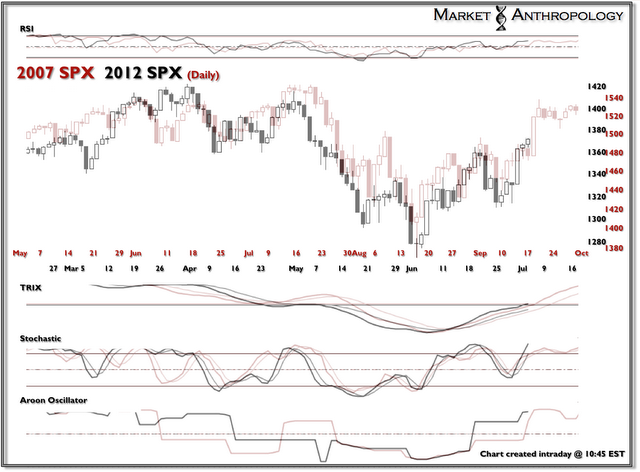
Market Anthropology show this technical analogy with 2007 (below). What happened next? The beginning of the waterfall declines all the way down to March 2009. I don’t believe that’s where we are now, but the technical similarities are not in doubt. Analogies can work – e.g. the Mammis sentiment analogy played out in H2 2011 very well. Yet, 2011’s mid-year correction provided a similar close analogy with 2007’s top and subsequent action, which various analysts noted at the time, but eventually failed as the market rallied out of it late in 2011. But if the analogy below is to play out a little further, then we might look to 1400 as a potential target for the Sp500.

Source: Market Anthropology

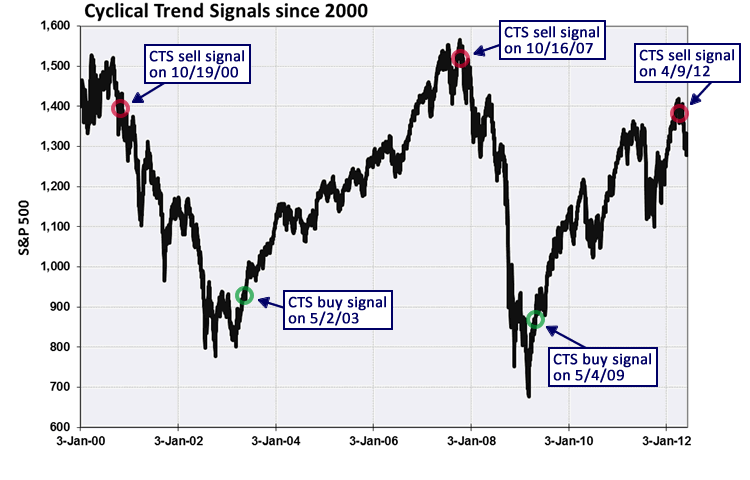
Prometheus show a (proprietary) cyclical bull market top signal took place at the top at the start of April this year. They believe the cyclical bull in place since March 2009 has topped out. If that’s the case then we should not make a higher high, and 1400 might again be a suitable limit before renewed and deeper declines.

Source: Prometheus MI

On the other hand, a golden cross (moving averages crossing) that just occurred on the SP500 suggests significant advances ahead to new highs. This is coupled with a death cross on the Vix also just happening – a twin occurence that previously gave way to strong gains for stocks. When I draw in my main references (solar and secular positioning), this is more aligned to my predictions – new highs in equities in H2 2012, before we consider any new cyclical bear market.

Source: Schwab

Of course not all 3 chart predications can come good, but there is perhaps a little window here where they can unite in calling the index up towards around 1400 before they diverge.

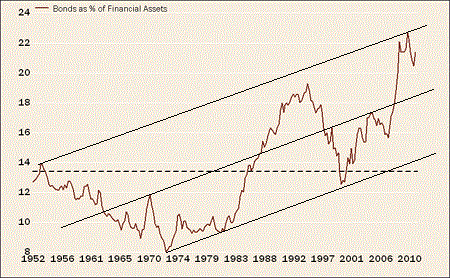
Lastly, here are (i) stocks and (ii) bonds as a percentage of household assets (US) with my channel lines added. The message I suggest is that we are close to the end of the secular bear market in equities and the secular bull market in bonds or even beyond that point.

Underlying Source: Schwab 

Addition:

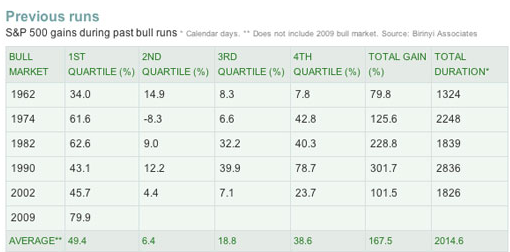
Laslo Birinyi’s historical analysis of equity bull markets looks like this:

Source: Birinyi

He says that bull market generally have four quartiles, lasting around 410 days each. The biggest gains come in the first and fourth quartiles. He believes that from here stocks should make a siginificantly higher high accordingly in the fourth quartile which is soon to begin.

Here are my calcs for the 2009 bull:

Quartile 1: March 2009 – May 2010: 80% gain

Quartile 2: May 2010 – July 2011: 13% gain

Quartile 3: July 2011 – September 2012: the table average of an 18% gain would put the SP500 at 1593 by September this year

Quartile 4: September 2012 – November 2013: again using the table average for the fourth quartile, the Sp500 would be around 2200 by November 2013 which would mark the end of the cyclical bull (NB: Birinyi comes up with an ending level of 2100, which cross references with my calcs).

My take is that Nov 2013 is too far out, IF the solar maximum comes good in Spring 2013 (note Jan has been doing more solar work and estimates the solar max could occur Jan/Feb 2014). But as the calcs are based on averages clearly that could come in earlier but still generally fit with Laslo’s analysis.

I have highlighted the first two quartiles below.

If 1593 by September 2012 seems far-fetched, then note it would be achieved with a return to the top of the cyclical bull channel:

Again, all the predictions in this post can’t all come good. It’s up to you to work out which are the red herrings.