Bull Market Peak

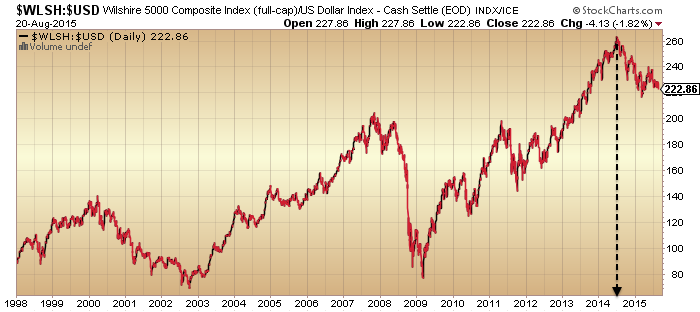
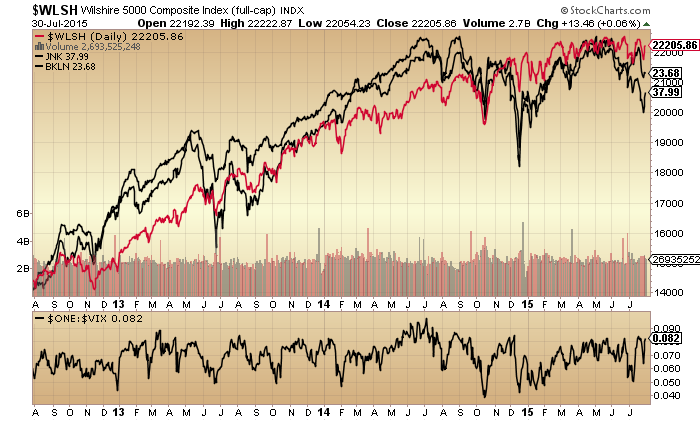
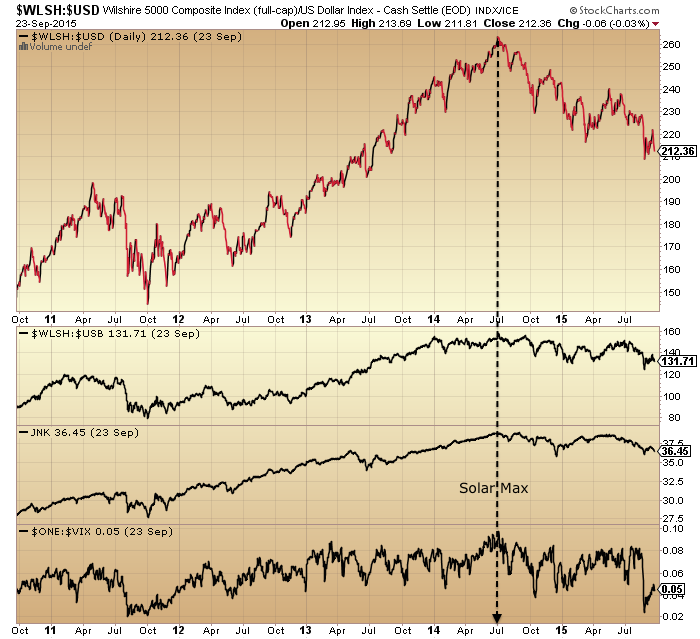
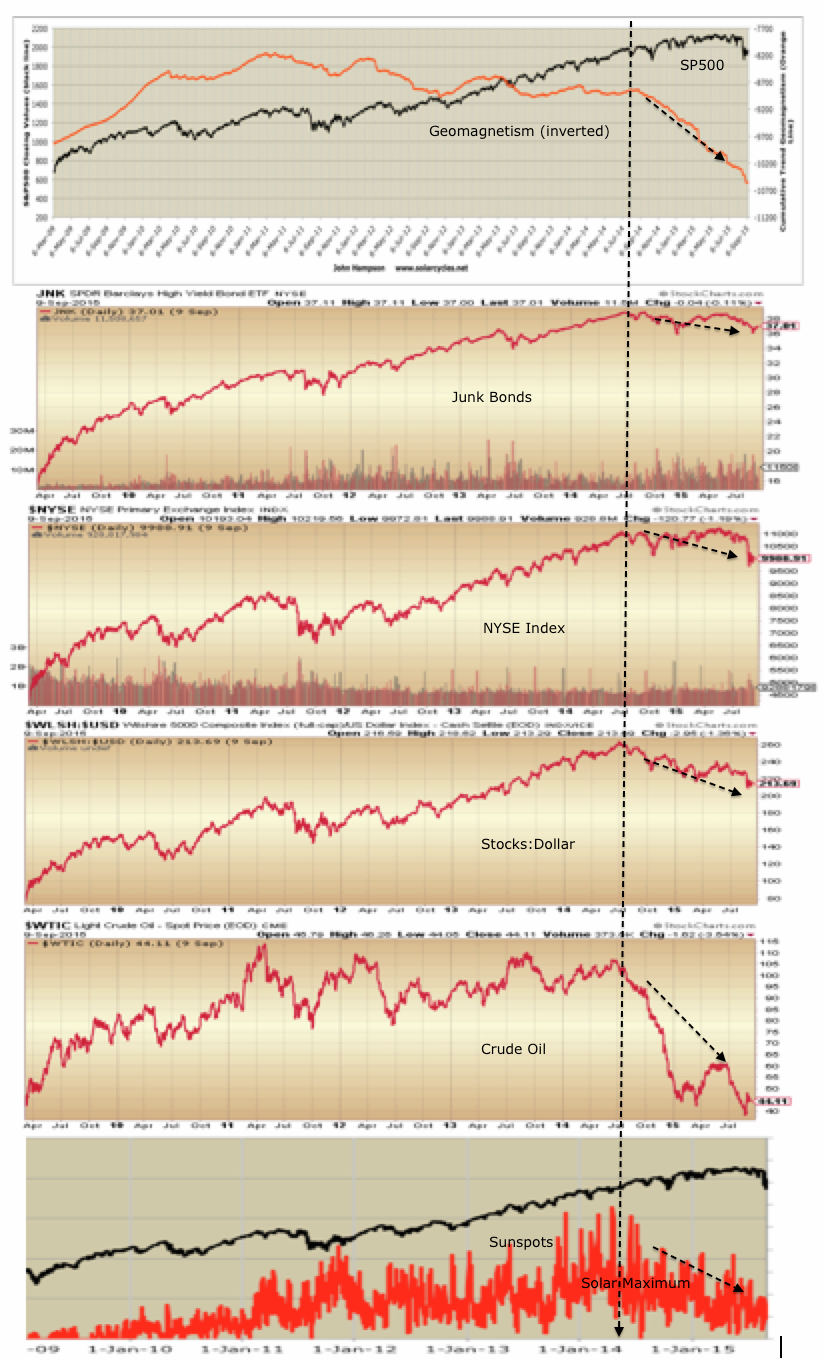
US Stocks:dollar, stocks:bonds, junk bonds and volatility (inverted) all peaked out mid-2014 with the solar maximum.
24sepe1

Source: Stockcharts

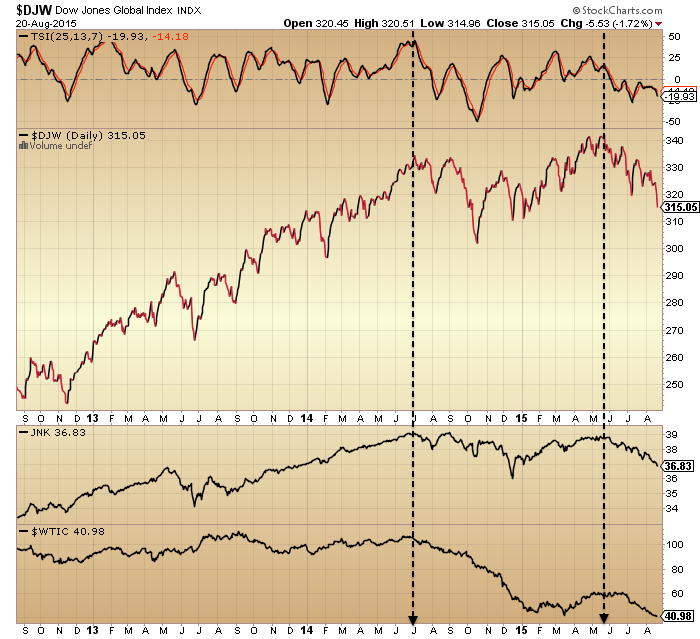
Crude oil, put/call, breadth and bullish percent did likewise.

26sepe1

Sornette’s bubble end flagged then too.

Screen Shot 2015-09-24 at 20.18.51

Source: FinancialCrisisObservatory

Global business activity peaked out at the same time.

22sepe9

Source: Thenextrecession

And economic surprises.

24sepe12

Source: Not_Jim_Cramer

So did financial conditions, Europe and US.

Screen Shot 2015-09-22 at 20.28.53 Screen Shot 2015-09-22 at 20.27.06

Source: Bloomberg

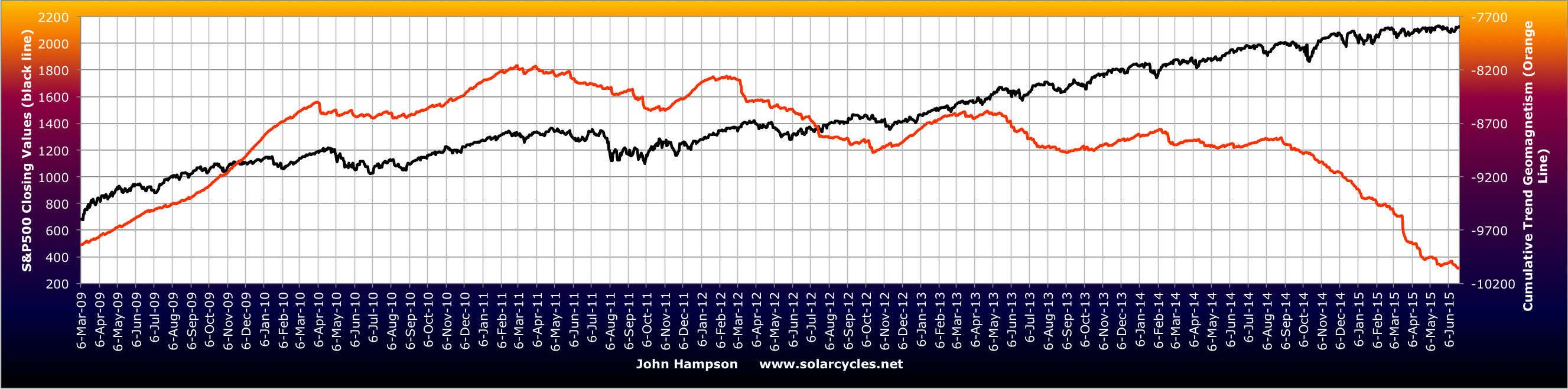
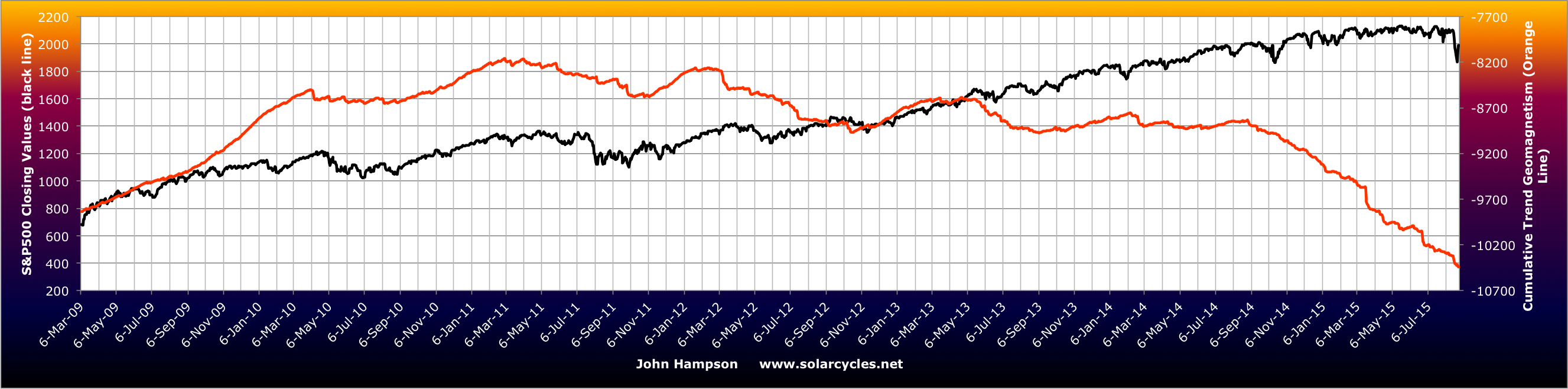
And geomagnetism has played a key role in these developments, intensifying since mid-2014.
a3

With united demographic downtrends in the major nations, solar history suggests markets and economy should tumble down to the next solar minimum.

26sepe7

Source: NOAA

26sepe2

Source: Tarassov

Drawing demographics, solar cycles and valuation together we get this:

19sepe9

It fits all three and that’s what makes it fairly compelling.

The mid-2014 peak we see in many indicators and assets is unrecognised by most. They see the August 2015 drops as the first drop in a topping process or a wave 4 in EW, both meaning we head back up. But the drops into last October fit better with this, with a secondary and final peak then forming in May 2015. The nominal price action has been uniquely confusing in this major peak, but the clues are provided by those under the hood and cross asset indicators.

What resonates with me about Elliott Waves is the waves of mass crowd psychology. We see this phenomenon playing out in solar cycles, lunar oscillation, demographics and valuation. But the weakness of Elliott Waves is that on any chart at any time multiple different counts can be produced and are then refined with time to make the count always ‘right’ with hindsight. I simply don’t see evidence that Elliott Waves are reliable market predictors (emphasis on the reliable), but the general underlying idea is very much in play in overall price action, something like this:

22sepe3

Source: ProfitF

We all know an up trend rarely ends abruptly but instead typically peaks, reverses a while and next heads back up. Then, typically, the move either fails before the previous peak, double peaks with it, or makes a marginal higher high but on negative divergences, before the trend reversal takes off in earnest. All akin to turning a tanker at sea: it takes some time. Whatsmore, the last move up is typically the stage on which the retail money makes its usual late and painful act.

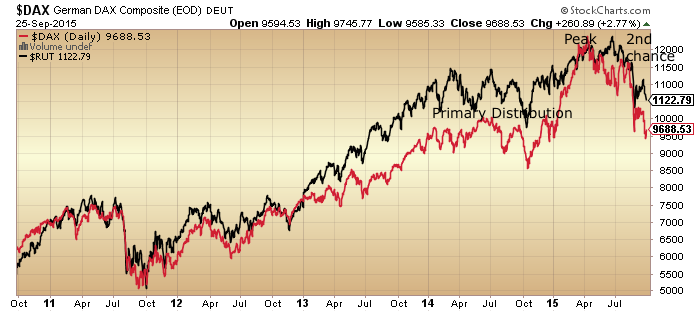
Between last July and this May we saw smart money flows weaken, dumb money indicators hit new highs, leverage jump to a new record and stock market internals notably diverge. All evidence of a wave 5, a secondary peak, or the terminal rally after the primary distribution, whatever you want to call it:
26sepe9

That second chance peak is now looking fairly potent on Biotech:

Screen Shot 2015-09-21 at 21.06.18The point is that topping processes share similar characteristics which reflect how humans work. A peak takes time to form with some back and forth, some telltale signs in those leaving early and those joining late, and some health warnings.

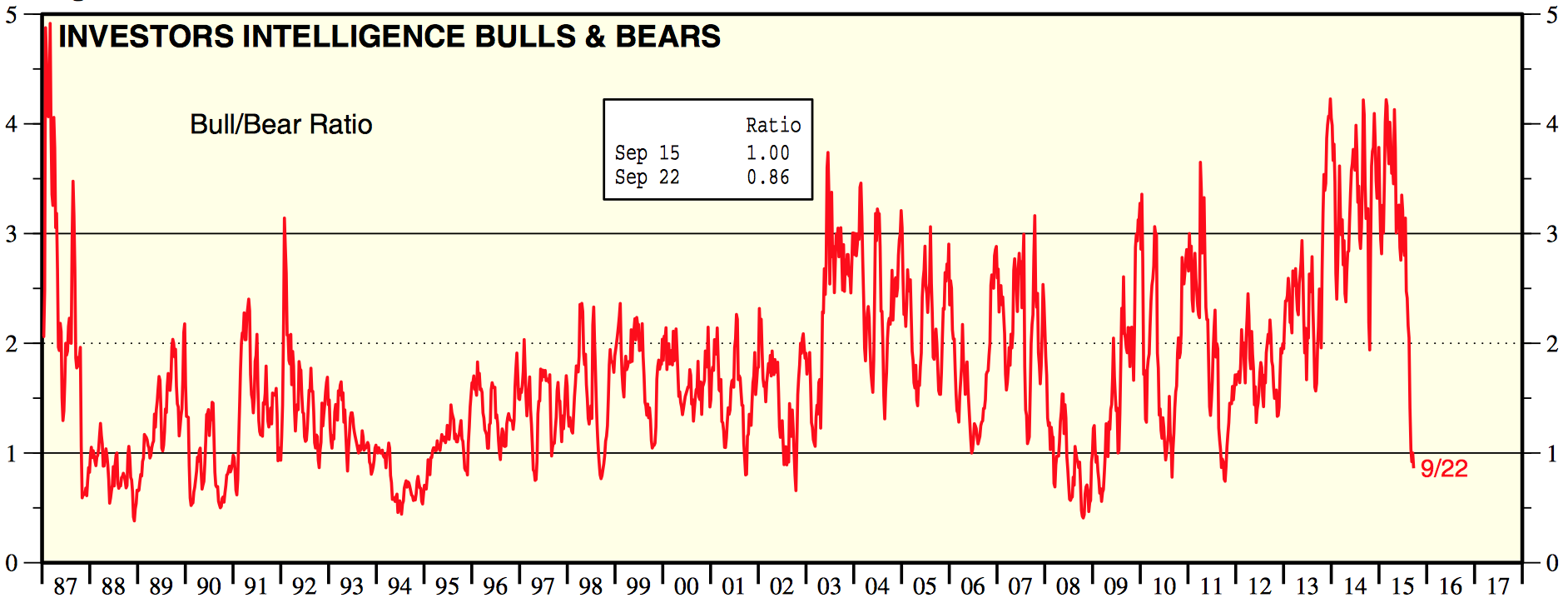
Finally, let’s recall that this has been the second biggest mania of all time, as measured by valuations, leverage, allocation and sentiment. The second major error analysts are currently making (to go with the failure to see the topping process began last July) is to see charts like this one as contrarian bullish:
Screen Shot 2015-09-26 at 07.29.22

Source: Yardeni

The jamming of the indicator at record highs last year highlights the mania that was in play. The subsequent crash is the mania bursting. The low reading is bearish, not bullish. It will take some time to recover, maybe even years. Given how ultra saturated the market was in terms of allocations, leverage and sentiment, it is unrealistic to think that the market will now go make new highs. Some of the dumb money was wiped out in the August falls, some more is selling on every move up to get out at break even.

The most bullish outcome is that the market gradually digests the falls and range trades whilst all the excesses of 2014 are gradually mopped up. But, there is no precedent for this in history. From 2014’s valuations, leverage, sentiment and allocations levels we have only seen devastating bear markets in the past. The post solar max and demographic environment add to this likelihood.

Gold looks to be completing its basing. Global stocks are now retesting their August lows. Clearly, if gold takes off here and stocks decisively break down beneath their August lows then the mood will properly change. The most bullish outcome I consider is that stocks range trade and recover some whilst the 200MA gradually arches over, as bear markets often aren’t in a rush, more of a slow bleed. However, written into the record leverage, is a period or periods of panic selling. Biotech is in an ideal technical set up for that to now occur. DAX and RUT look post second chance, which in past major peaks led to waterfall selling. So maybe we fall apart rapidly here – or, my bullish scenario – we hold up (without exceeding the highs) into the end of the year and fall apart in early 2016. Every man and his dog thinks that stocks are going to bottom out and resume bullish in October in line with seasonality so it seems likely that something else occurs. I think actual (rather than seasonal) geomagnetism is likely to play a role in this, so I am watching developments. I favour the falling apart option but you know my positions disclosure. Trades-wise I’ve been increasing shorts and adding to gold on the basing evidence, and adding stops to all of it. I’m going to carry on with this strategy unless the market bounces on positive divergences and shows evidence of a renewed move up for the bulls.
Stock Market, Sunspots And Geomagnetism

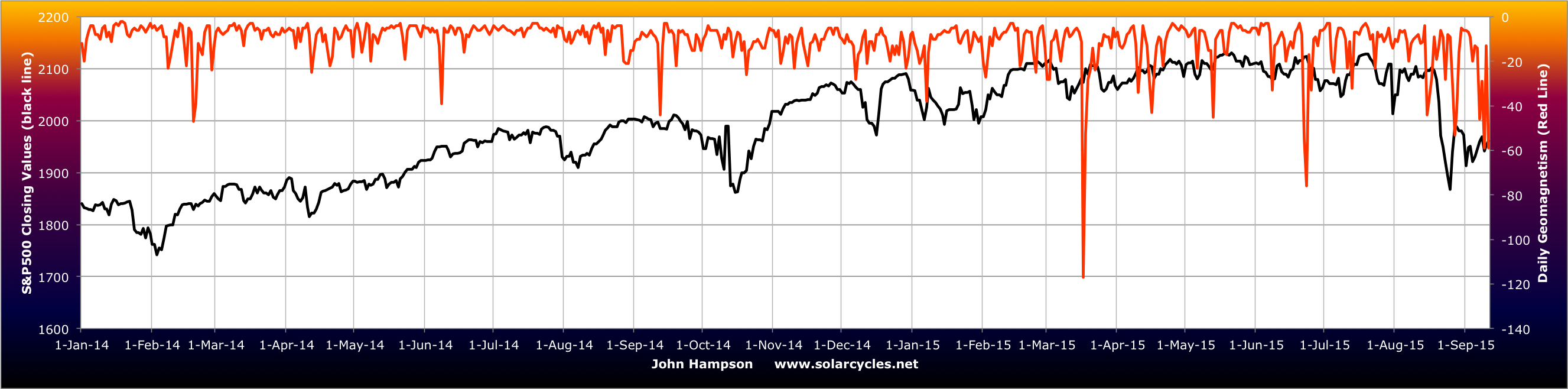
The smoothed solar maximum was April 2014. Geomagnetism intensified as of August 2014. This is normal progression: positive pressure up into the sunspot peak, then negative pressure as both sunspots wane and geomagnetism ramps up in the following window. The influence on financial markets is captured here:

Screen Shot 2015-09-11 at 16.29.43

We can see that the solar-inspired speculative mania effectively ended in that window of mid-year 2014, with stocks making a topping process between then and May 2015.

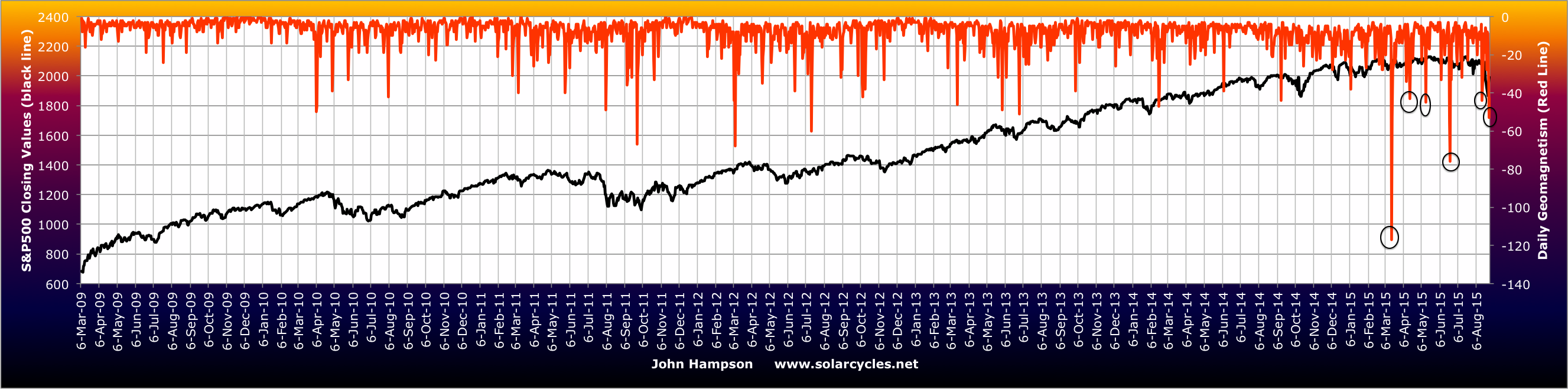
Daily geomagnetism reveals an intensification in recent months.

12sept1

Something similar happened in 2000.

12sept4

Stocks were led into a 2 year bear.

Back to the current, the overdue snap in equities in August 2015 changed the picture. No V-bounce like in 2013-2014, plus a sharp escalation in complacent indictors. This is not like those 2013-4 corrections.

12sept10

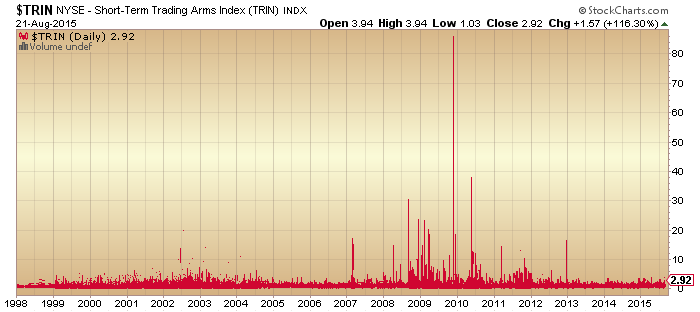
Various indicators which were stuck at bullish extremes in 2014 have now not only mean reverted but have moved all the way to bearish extremes. Amongst these are Investors Intelligence bulls, US equity outflows, capitulative breadth, Trin and a cluster of 90% down volume days. Collectively they represent bear market bottom readings, leading some analysts to call time on the current the correction in equities and predict a bull market resumption.

In that scenario we need to square why stocks only corrected 10%. In the first chart at the top we can see a year long stealth bear in progress, more apparent in some markets and indicators than others. So did stocks correct in time rather than price? Proponents of that option then have a problem with big picture indicators, in that both valuations and leverage are still a long way from mean reversion.

12sept20
29augu10Source: DShort

Due to the lack of demographic tailwind, the bull mania was fuelled by debt: traders leveraging up and companies leveraging up to make buybacks. For the bull market to continue, both those would need to rise to new record highs. Given the sharp snap in equities in August, the appetite for that is likely absent, at least for some time.

Rather, in my opinion, that was the point at which the mania popped, at which record complacency and froth was finally shot down. The bear market bottom readings in certain indicators are indeed a sign of a bear market: a pause in the downdraft. These indicators show selling and fear and are only bullish if they revert. Case in point: in 2014 they were stuck at extreme bullish and did not revert, hence stocks continued to edge up. The question is why they were stuck at record bullish extremes, and the answer is the hidden force of the solar maximum. Now we have the twin powers of waning sunspots and intense geomagnetism, which are likely to keep these indicators bearish.

There is a common misperception that the economy (i.e. recession) causes bear markets, but the data in fact shows that the stock market leads the economy.

US quarterly GDP at past major stock market peaks:

Q4 2007 4.4%
Q1 2000 6.18%
Q3 1987 6.08%
Q1 1973 11.91%
Q4 1968 9.84%

Rather it works like this: demographics and sunspot cycles bring about the major peaks and troughs. In our current case, the rise into the mid-2014 solar max caused the speculative mania in the markets, identified by extremes in valuations, sentiment, allocations and leverage. Then the wane from the solar max and associated intensification in geomagnetism have brought about the burst. That burst isn’t complete until valuations and leverage have reverted sub-mean, a process that is already fixed in demographic and solar trends right ahead.

October is the seasonal peak intensity for geomagnetism. This is the reason for a cluster of major historic drops to lows in October. We are finely poised leading into it. Stocks have made a triangle consolidation following the August drops. Gold has a weak higher low, as a tentative basing. For equities a retest of the August lows would be historically normal following such sharp drops, whether bull or bear bigger trend. But, various indicators are already at bearish extremes, i.e. contrarian bullish, so we could move further sideways or upwards before heading down again. Friday was the new moon, so we are now tipping over again into negative pressure, and this is assisted by current raging geomagnetism. FOMC and OpX this week.

My view. Stocks are in a bear since May 2015. That means no new highs and another lurch down lies ahead. Given the collective shock at the August drop in equities – despite 40+ topping indicators forming last year – another leg down to lower lows would have a major effect on the masses. If indicators can’t pull up now from their current extreme bearish readings, then that’s the recipe for another sharp break downwards in the current geomagnetic environment. Odds are this can transpire as we move into October. Invalidation would be stocks holding up through this window, gold breaking down, and equities indicators pulling away from bearish levels.

The Big Picture

Financial markets are the function of swells and shrinkages in buyers and leverage, brought about principally by demographics and sunspot cycles, additionally with the latter influencing the former.

The big theme in demographics over the last half century has been that the major nations have largely experienced similar swells and shrinkages in key age groups due to the post WW2 baby boom. As a swell of young adults they produced inflation in the 60s and 70s, which then turned into a middle-aged swell producing stock market and real estate booms post 1980.

This chart shows the ratio of middle-aged to all population in the major nations. This ratio experienced a major peak in each of the countries between 1989 and 2011 producing the according stock market and commodity major peaks.
5sept1

First Japan’s demographics peaked out, producing the Nikkei and Japanese real estate tops. Then the US peaked in 2000 with the resultant biggest ever stock market mania. Next UK and Germany peaked out with the 2007 stock market and real estate peak. Finally, China peaked out and as the world’s biggest consumer of commodities, the commodities index accordingly delivered a major top.

Since then demographics are united in a downtrend, which is the main reason why 6 years post financial crisis we still have ZIRP, QE and easing as the dominant central bank policies worldwide, and why the world economy is under such deflationary and recessionary pressures. Ultra low rates helped give rise to the stock market mania of 2013-2015, but otherwise we have to turn to solar cycles not demographics for the driver.

Each of the sunspot maxima in the era of globalised, free markets produced a peak speculative mania. Between July 2014 and May 2015 we saw commodities, junk bonds, leverage, breadth and stocks peak out, following the smoothed solar max of April 2014.

5sept30

That lag is not dissimilar to that in 1929: a slight overthrow beyond the solar max. In both instances breadth peaked out at the same time as the solar max but nominal stock prices didn’t top out until a year later.

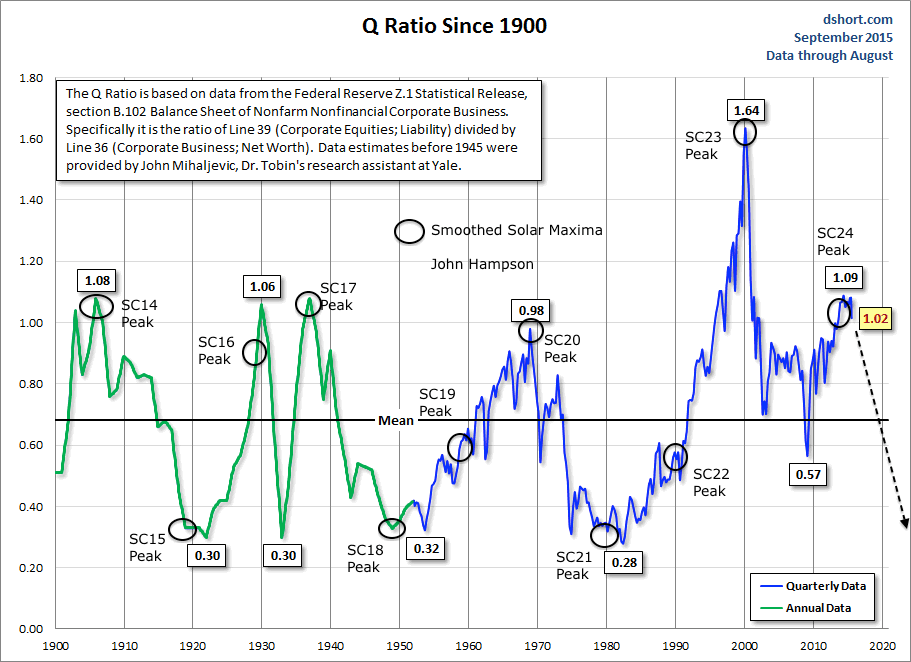
Drawing on Q ratio valuation for the big picture we can see that solar maxima typically produced high extremes in valuation which then mean reverted. Meanwhile, low extremes corresponded to major commodity or gold peaks.

5sept15

Draw together both the solar cycles and demographics above and we get the projection of the black arrow, namely that stocks should wash out to undervaluation levels by around 2025, the next solar max, and gold should rise into a major peak then. What’s key is that there is no demographic relief in any of the major nations between now and 2025 nor a solar maximum (they are roughly every 11 years). Therefore, I expect a long bear market in stocks in this window, like these examples from history:

5sept40

If I was to narrow the projection a little further, then the solar minimum of around 2018-19 is likely to mark the first major bottom within that. That means a bear from now of around 3 years, similar to those historic cases above. After that stocks ought to continue to languish, perhaps sideways Japan-1990s-style, whilst gold rises to dizzying heights to a peak circa 2025. But that time frame is a little to long to be anything more than speculative, so let’s keep the focus on the first major cyclical move, which I consider to be a bear from May this year to last some time and take valuations sub-mean.

The question mark is over central bank response. They won’t stand by and watch this occur but are likely to turn to increasingly unorthodox measures. The reason demographics and solar cycles work is because the markets are globalised, free, instant voting machines that therefore capture major collective trends. If central banks ban shorting, restrict capital flows out of the country, penalise people for not investing in government bonds, penalise savings, or other such policies then the markets environment will become more distorted and we will have to adjust accordingly. So far, however, central bank distortive measures haven’t been able to override the collective demographic trends, as evidenced here in global inflation and economic trade.

5sept7

Source: Gavekal5sept5

All that stands between outright global deflation and recession is the wealth effect of the stock market. So let’s turn to that.

In 2014 we saw around 40 different topping indicators aggregate in the US stock market. From mid-2014 we saw multiple divergences in breadth and risk, whilst commodities and emerging markets broke down. In 2015 developed nation stock prices arched over, topped in May and snapped in August. Now, we see washout levels in commodities, emerging markets and various stock market measures such as sentiment, breadth and risk.

In the big picture, US stock market valuations have declined from their peak but are still highly levitated.

5sept6

II sentiment and Rydex allocations either show a major unrepairable pop of the stock market bubble, or a healthy washout from which stocks can now in due course resume bullishly.

Screen Shot 2015-09-04 at 22.27.15

Source: Yardeni5sept51

It’s clear that the mania or the last 2 years depicted in these two indicators is about as crazy as it gets and odds are much higher that that recent bursting of the bubble is likely to have ushered in a period of mean reversion. Effectively it has broken the collective complacency and the record leverage deployed in the markets is now likely to shy away from its peak. Without the demographic tailwind, leverage has been the main fuel for this bull, through both margin debt and buybacks-via-borrowing.

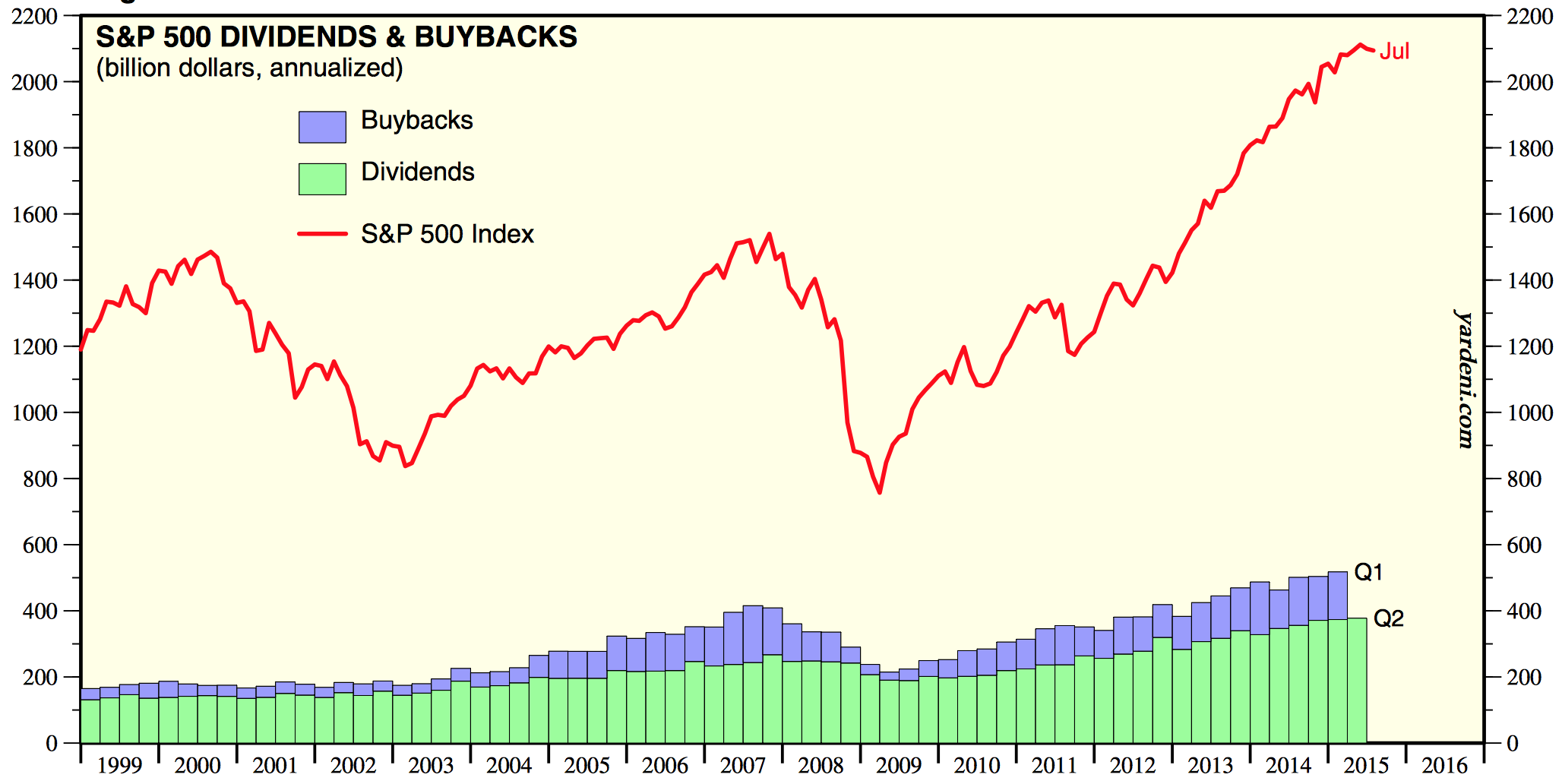
Regarding buybacks, this fuel source is likely to continue through the end of this year as companies execute their purchase plans. We can see how something similar transpired in 2007.

Screen Shot 2015-09-04 at 17.31.11

At some point, the leverage in the system will unwind in a disorderly way, producing a crash. What I am wondering is whether this may occur again once both buybacks and margin debt are declining in a more united way together (like in 2008), which would likely be once 2016 hits. Just speculation.

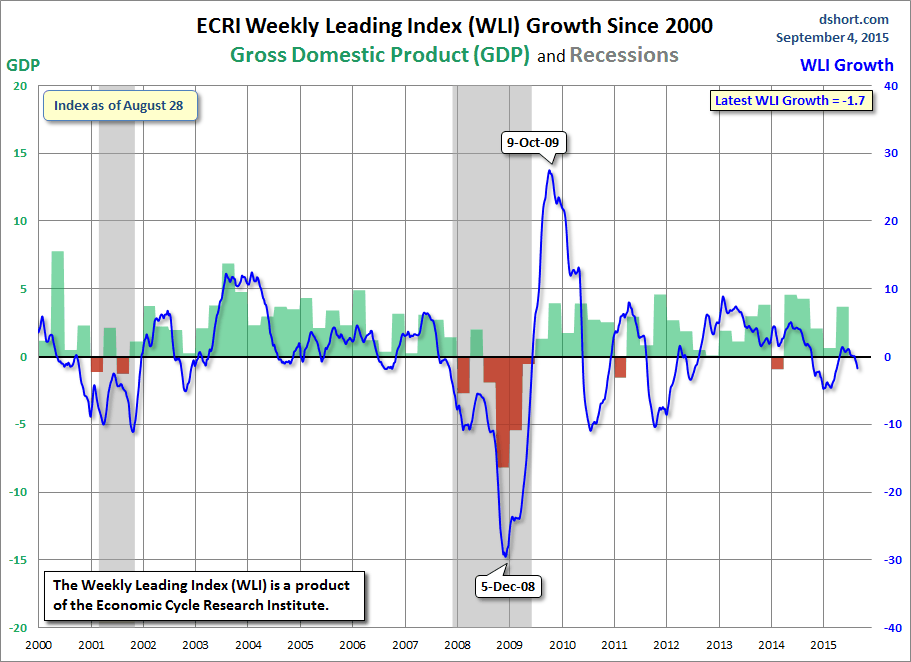
In the meantime, the August breakdown in stocks has likely done enough damage to cement the bear and kick off the negative feedback looping that will produce escalating trouble from here on. ECRI leading indicators and Bloomberg financial conditions have both slipped negative.

5sept13

Screen Shot 2015-09-05 at 08.28.15

Source: Bloomberg

Turning to the near term, this is how the SP500 looks:

5sept60

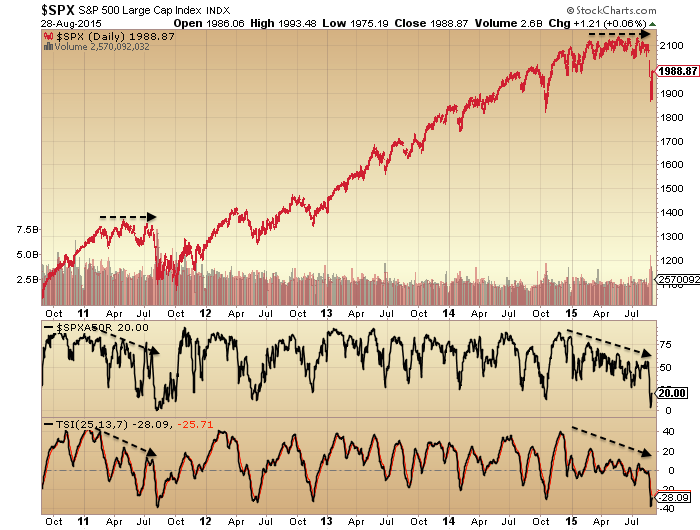
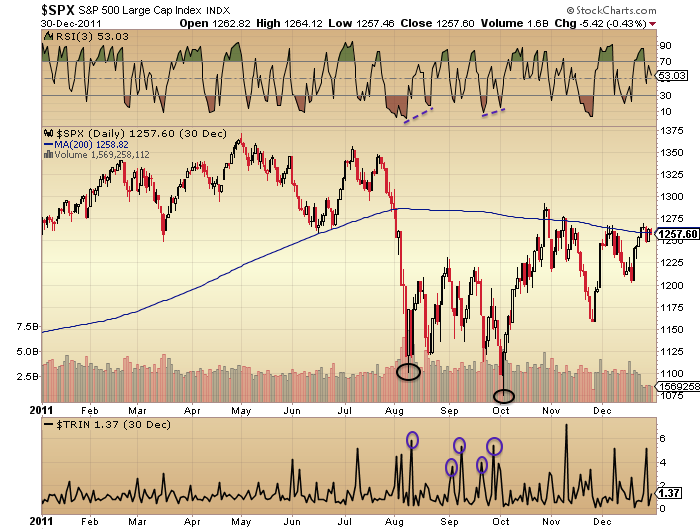
Prices are consolidating after the August drop. Breadth, Trin and volatility show similar washout readings to 2011. Nonetheless, the historic pattern is that stocks ought to retest the August lows and at that point bulls should be looking for positive divergences. An absence thereof likely spells lower prices which in turn increases the odds we are in a bear market.

If we are in a bear market then this doesn’t prevent ripping rallies. In fact they are common. What’s important is to see a pattern of lower highs and lower lows. So, should we push upwards from the current oversold/overbearish short term readings then we should stop short of the August breakdown point. Should we break downwards we should take out the October low and initiate the lower low pattern. On a longer term view, the bear market should very gradually eliminate the dip buyers, until all hope is truly lost.

My tactics then are: hold short (Biotech, R2K, Dow), add short if we go higher, wait for August lows retest, check for positive divergences and bottoming pattern to judge whether to take profits. Cross market to gold, I am long and holding, looking for gold to cement its higher low than July and build out its rally. Were gold to break down to new lows, then it would be a warning.

Lastly, a note on washed out emerging market stocks and non-precious metal commodities. Oil has dropped from $100 to sub $40 in a short time and emerging market equity valuations are historically very low. Are they a buy?

5sept11

My perspective is that we have experienced something similar to 2006-8 whereby markets crumbled in order. Then, real estate fell first, then equities then commodities. This time, commodities and emerging markets fell earlier than developed equities. When developed equities have eventually truly washed out then there may be attractive risk-reward on emerging and commodities. But between now and then I expect a bear market and global recession, which would keep the pressure on both asset classes.

Bear V Bull

We can now see that the arching over in price in 2015 set against negative divergences in breadth and strength were indeed a prelude to a collapse in stocks like in 2011:

29augu1

Source: Stockcharts

After such a steep collapse and catapult readings in fear indicators, the market historically needs some time to consolidate and recover. The pattern should be that the rally of the last 3 days gives way imminently and we retest the lows.

29augu2

Source: ShortSideOfLong

That point would then be the next key test.

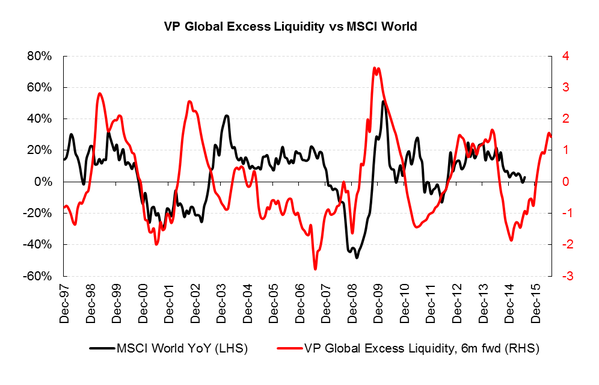
Bulls should be looking to see a double bottom or lower low on positive divergences from which price then resumes a bull trend to new highs. The best fit timeline by geomagnetism/seasonals would be a bottoming out in October and Xmas new highs. Supporting this scenario is liquidity trends.

29augu3

Source: Variant Perception

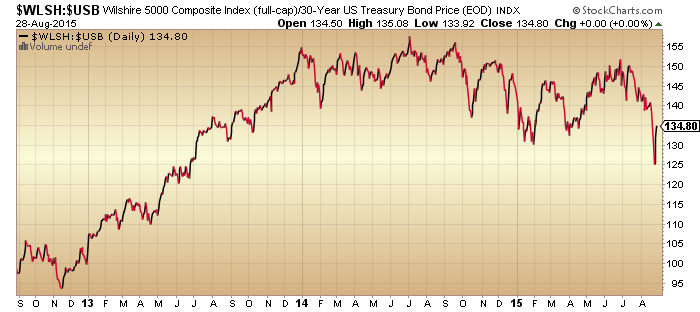
However, I rather see the overall evidence as supportive of stocks now being in a bear market. Drawing together all the indicators and disciplines that I trust, the data suggests stocks entered a topping process Jan 2014, made a first major peak in June/July 2014 with the solar max, made a first major low in October 2014 and a final second peak in May 2015. Several indicators reflect this progression, so here is one: stocks to bonds.

29augu4

Source: Stockcharts

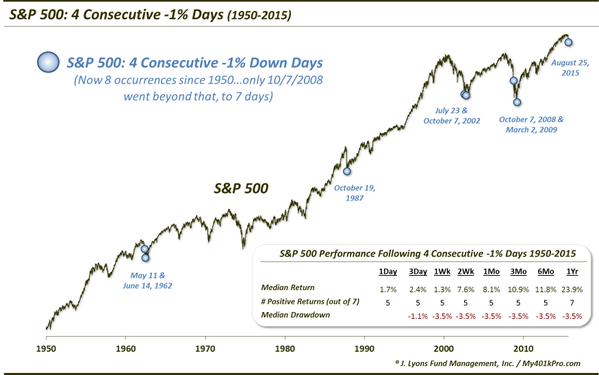
Multiple indictors have registered bear-market-bottoms readings over recent months. Here’s another one from Dana Lyons:

29augu5

Source: Dana Lyons

Capilulative breadth too, which hit its highest ever reading last week.

29augu8

CBI data from Rob Hannah

If we take the bull angle again, then we could argue that such readings are a springboard to much higher prices, but we need to explain why they have anomalously occurred at <10% from the highs. If buybacks were to blame for the shallower washout in nominal prices then we should have seen small caps and non-buyback large caps collapse whilst buyback large caps held up, but this has not been the case.

If, on the other hand, they are signals that we are in a bear market then prices should now fall again Sept-Oct and make significantly lower lows. The shaping in Biotech is supportive of this:

Screen Shot 2015-08-28 at 18.15.32

All in all, I think the extreme bearish readings we are printing this year in various indicators are a fair match for the all time record bullish readings we saw last year, namely that the markets have become excessively unbalanced.

But, what can we can say for sure is that multiple indicators that were screaming for a reset in equity prices have now been satisfied (such as breadth, sentiment divergences), which makes the next move particularly telling. Again, bulls see this as a refuel for eventual higher prices, but certain big picture indicators make any such notion that we have now reset rather foundation-less.

Valuations ought to end up negative, and leverage ought to be wound down from their extreme high readings:

29augu11 29augu10

Source: DShort

Which brings us to our particular environment not seen in over 50 years: ultra low rates, low inflation and overall deflationary trends. Are such valuations and leverage fair in the context of ZIRP? It’s a really useful test. If stocks are in a bear now and break down, then it will be without high rates or oil prices ‘choking the economy’ and despite QE ongoing in several major nations. It will be clearer that valuations do not need recalculating in the context of low rates and low inflation. In short, it will be much more supportive of my dumb model of the markets: demographics and solar cycles.

On that note, what I see as most important here is what has been offsetting demographic trends, namely increasing leverage. Buybacks through borrowing continue, but did so at record levels in 2007 despite stocks breaking down into a bear. Buybacks didn’t stop the collapse occurring last week. Margin debt dropped in July, and likely dropped harder in August. If stocks are to rally to new highs then leverage has to recover and make new highs too. However, what I see as likely is that a section of high leverage participants were wiped out last week and all-round appetite for high borrowing levels has been dealt a decisive blow. I very much doubt from here that leverage will make new highs.

Using Rydex as a proxy for retail, I would argue the craziness has been broken and we will now see a gradual reversion to mean.

29augu12

Looking cross-asset, I believe gold will now make a higher low than the July low and in so doing cement its new bull trend, completing the gold and equities flip at the cyclical level.

To finish, here is the SP500 big picture again. If we are in a bear then we should make lower highs and lower lows. But note that in a bear we still get some ripping rallies that test the overall downtrend.

29augu15

For now then, what’s important is that the rally of the last 3 days topples over in due course and eventually prints a lower low than October 2014 in all indices.

We have had significant geomagnetism in progress the last couple of days. It adds to the recent cluster which acts as a negative pressure on market participants.

29augu15

I am short Biotech, Russell 2000, Dow and long gold.

Sunday Indicator Updates

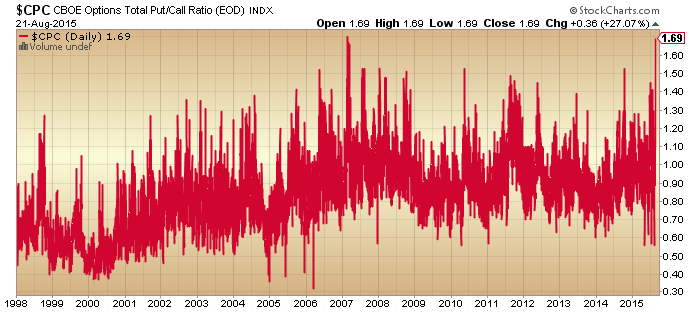
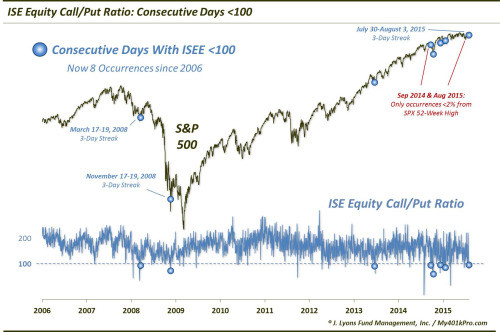
There are a bunch of indicators already at contrarian extremes and they would argue that stocks are close to a low. Here, ISEE put call, daily sentiment index and CBOE put call:

23augu15 23augu11 23augu1

Sources: Contrahour, Chad Gassaway, Stockcharts

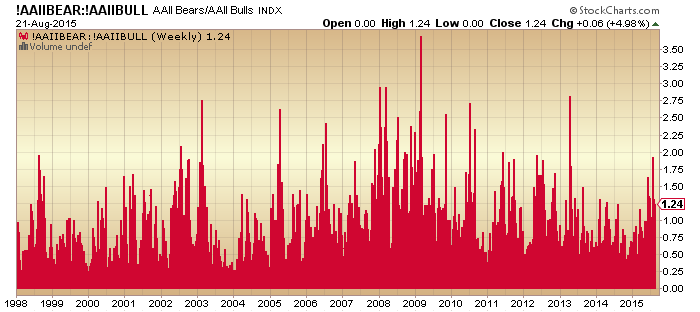
Then there are others which have either not washed out sufficiently yet or at levels whereby we might argue ‘done’ if just a bull market correction or ‘just getting started’ if we are now in a bear market. Here, Investors Intelligence sentiment, AAII sentiment, SP500 new highs new lows, NAAIM manager exposure, volatility, and the Arms index.

Screen Shot 2015-08-23 at 07.43.01 23augu7 23augu6 23augu4
23augu2

Sources: Yardeni, Stockcharts

If we consider the 5% decline across the last two days of last week, it suggests we are in the territory of a nastier correction or bear market.

23augu13

Source: Ryan Detrick

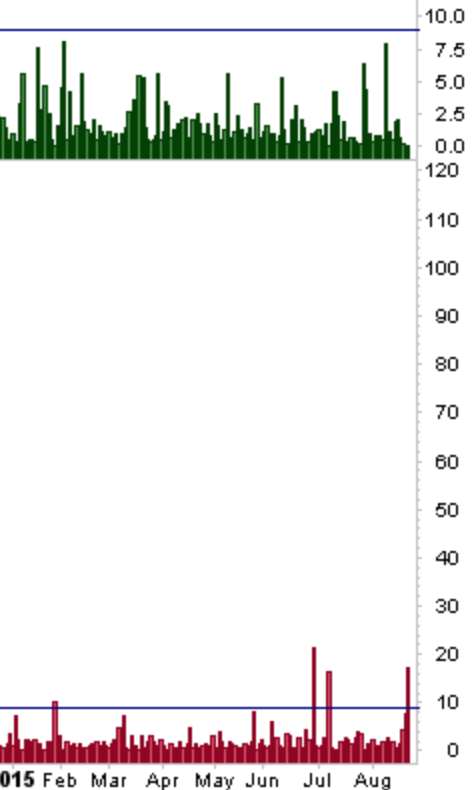
Additionally, Friday was a major distribution day and one of four recent such events. Major distribution days near the highs are a typical sign of a market peak. On the chart below, green above the line = major accumulation days (none in the last 6 months), red above the line = major distribution days.

Screen Shot 2015-08-23 at 07.49.10

Source: Cobra

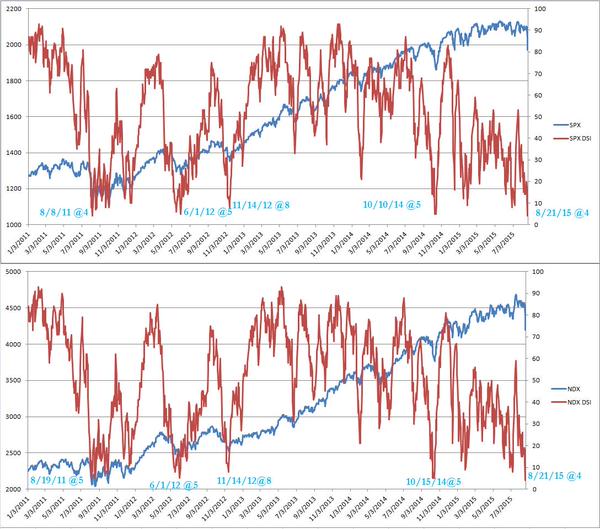
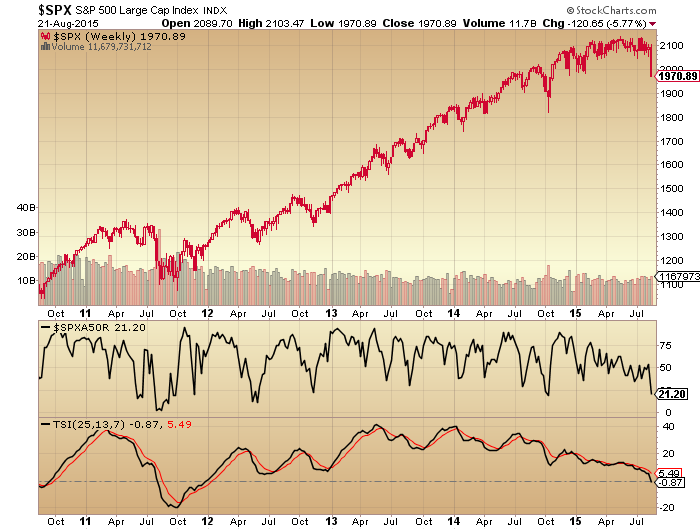
If we look at the SP500 chart we can see that the steepness of the declines of last week does not resemble the v-corrections of the last 2 years. It looks more like the crash of August 2011 (also preceded by both an arching over in price and divergence in breadth), but notably without the volume spike that may signal a bottom yet.

23augu30

The heaviest falls in August 2011 took place on Monday 8th. Ditto Black Monday in 1987. The reasoning is that investors have time to stew over the weekend and rush for the exits on Monday morning. Typically stocks crash from oversold overbearish conditions, not from highs. So we have a similar set up here for tomorrow (CPC, daily sentiment, RSI all at oversold, overbearish), and a major down day is possible.

23augu20

Source: Mark Minervi

Closing at the lows on Friday makes it more likely that we will open to further selling tomorrow. The question is whether buyers now step in and that can be turned into a reversal or consolidation day, which is also possible.

In short, certain indicators suggest a bounce should be near. But the steepness of the declines and the bigger picture of the (likely) bear market suggest that we could drop further and trigger the more neutral indicators to greater extremes before a bounce. I suggest the best all round fit here is that we fall hard at the start of this coming week and then get a bounce soon but from significantly lower levels. I suggest a bounce is more likely on a high volume intraday reversal hammer candle and a bottom more likely to hold if it shapes out as a lower low on positive divergences. Both are absent so far.

Here is 2011 for reference. Note we saw higher fear spikes than we currently have, two long tailed intraday voluminous reversals and two lower/twin lows on positive divergences.

23augu40

Increasing Validation

Testing several key theories here real time, it’s been a slow process, but patience is being rewarded.

Firstly, that demographic forces are more powerful than central bank actions. Look what’s happened since 2010 despite QE and ZIRP:

21augu20

Source: Don Draper

21augu23

Source: Charlie Bilello

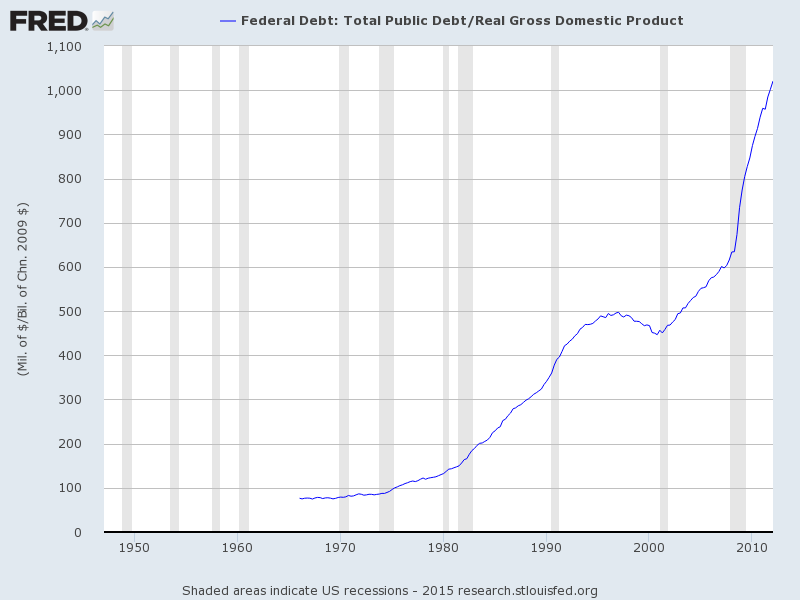
Slow degradation and now all negative. What an expensive mistake:

21augu27

Source: FRED

Is it really a surprise? They actions amounted to entering numbers into a computer, corrupting the money mechanism and then trying to deceive the public with carefully chosen words that all is well with the economy. But that massively increased debt is real, and the plan to withdraw it gradually once the economy is booming again looks to be a pipe dream. So what do they do now? Having spent so much, they can’t admit failure and won’t give up. Expect more action and more unorthodox policies, but based on the evidence they won’t be able to stop demographics.

Secondly, that solar maxima bring about speculative peaks. As we hit the solar max of mid-2014, we saw a wide range of mania attributes in equities: valuations, sentiment, allocations, leverage, and more. What has been missing is the definitive puncture of the mania post solar max. But under the hood there has been a lot of evidence that speculation did indeed peak out then, such as in stocks:bonds, stocks:dollar and financial conditions.

21augu5 21augu6

Source: Stockcharts

Screen Shot 2015-08-21 at 08.33.14

Source: Bloomberg

Only if those ratios/indices made new highs since, would invalidation become more compelling. But a year later, they still haven’t and remain in downtrends.

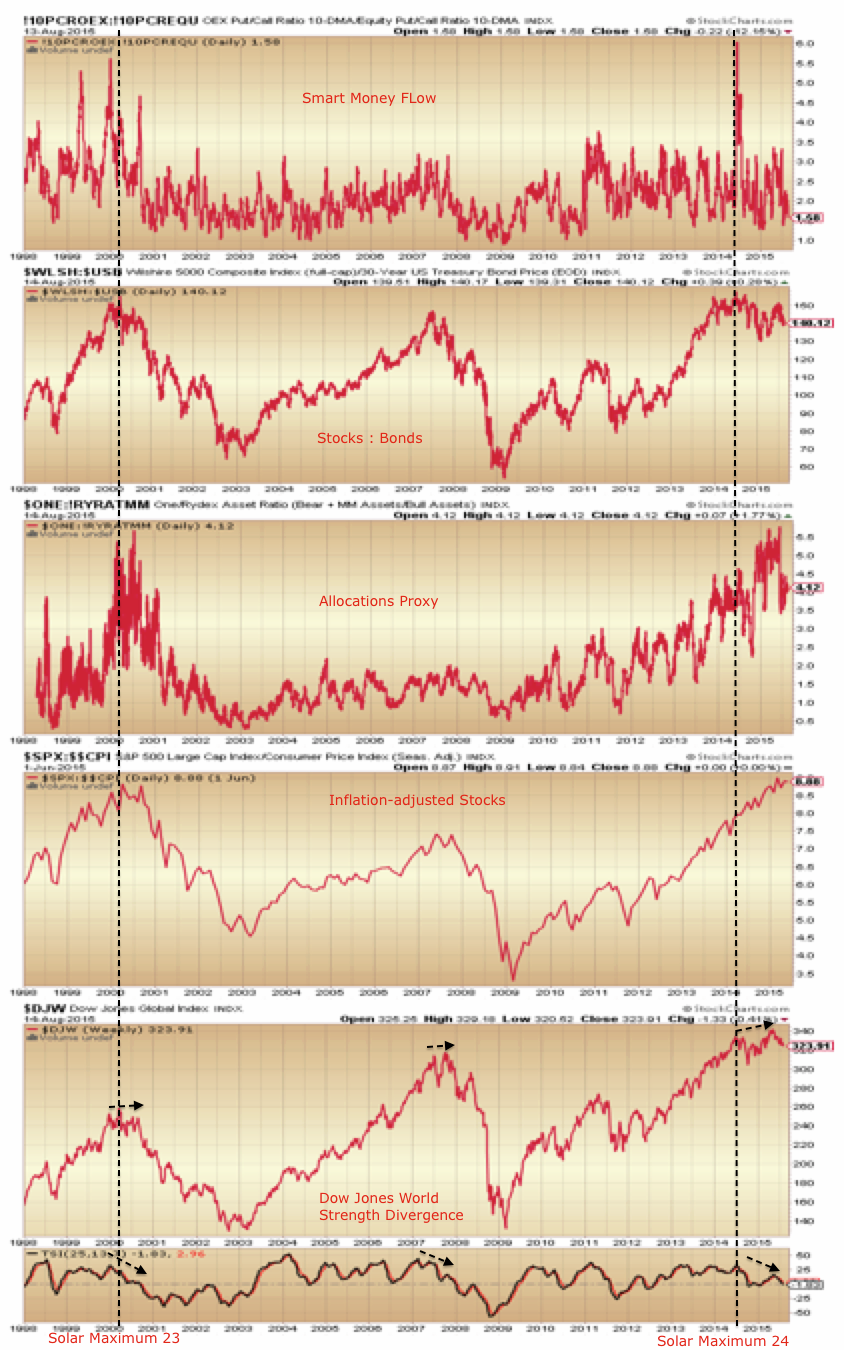
That mid-2014 peak also shows among many more charts, along with a second important peak around May this year. Here, the Dow Jones World stock index (with a strength negative divergence between the two peaks), junk bonds and crude oil.

21augu1

Next, the NYSE index, with negative divergences in breadth and volatility (inverted) between the two key peaks.

21augu3

And here, a bunch of major country stock indices from around the world, showing similar twin peaks.

21augu4

We see mainly a higher secondary peak in nominal prices, but this is not atypical historically. In 2007 we experienced a higher high in October after the first peak in July, with multiple telltale negative divergences between the two.

What’s challenging is that every top is different. The duration between the two peaks in 2014 and 2015 has been a long 10 months, fooling many bears and bulls in the process. In 2000, it was just 5 months between March and August. Yet we see similar hallmarks: degradation in internals, environment and risk appetite between the two.

The situation remains tentative of course. We can’t say for sure that stocks won’t rally back up to new highs. But the sideways price range of 2015 is now breaking to to the downside, and either it has been the arching over of a top, or a pause to refresh the bull. There is a lot of evidence for the former, and very little for the latter.

Thirdly, drawing the first two theories together, that ‘central bank policy trumps all’ has been the mantra rather than the driver for this bull market mania. Just like at all other major tops it has been an excuse for excessively high valuations, but one much more readily embraced than that herd behaviour under the sun’s influence brought about the mania.

Well, if stocks are now in a bear market, and the evidence argues that we likely are since May, the central bank support idea is about to face a tough challenge. Interest rates are zero or negligible and quantitative easing has been shown to have little positive effect on the economy: central banks are at risk of being shown to be totally impotent. This, together with the record leverage deployed in equities, is the recipe for stocks to fall hard. Panic selling lies ahead at some point, and if we think of equities like Wile E Coyote running off a cliff since the solar max of last year, they have been levitating with no support. I maintain the geomagnetic seasonal down period since June-July into October this year remains the likely window for that swift acceleration to occur, meaning this week’s key technical breaks could be kicking it off.

A Dumb Mechanism

Evidence reveals the financial markets to be ‘dumb’. Long term trends are dictated by demographics (swelling numbers of buyers or sellers) and solar cycles (influencing speculation levels amongst participants). Markets top out when there are no new buyers left and/or no room or appetite for existing buyers to increase debt, and bottom at the opposite. This contrasts with common wisdom that markets are instead dictated by central bank actions, economic indicators, or company fundamentals. They play a role, but the evidence shows that the stock market leads the economy, that central banks are typically behind the curve, and that stocks rise purely on multiple (valuation) expansion if there is either swelling leverage or swelling buyers (or fall vice versa).

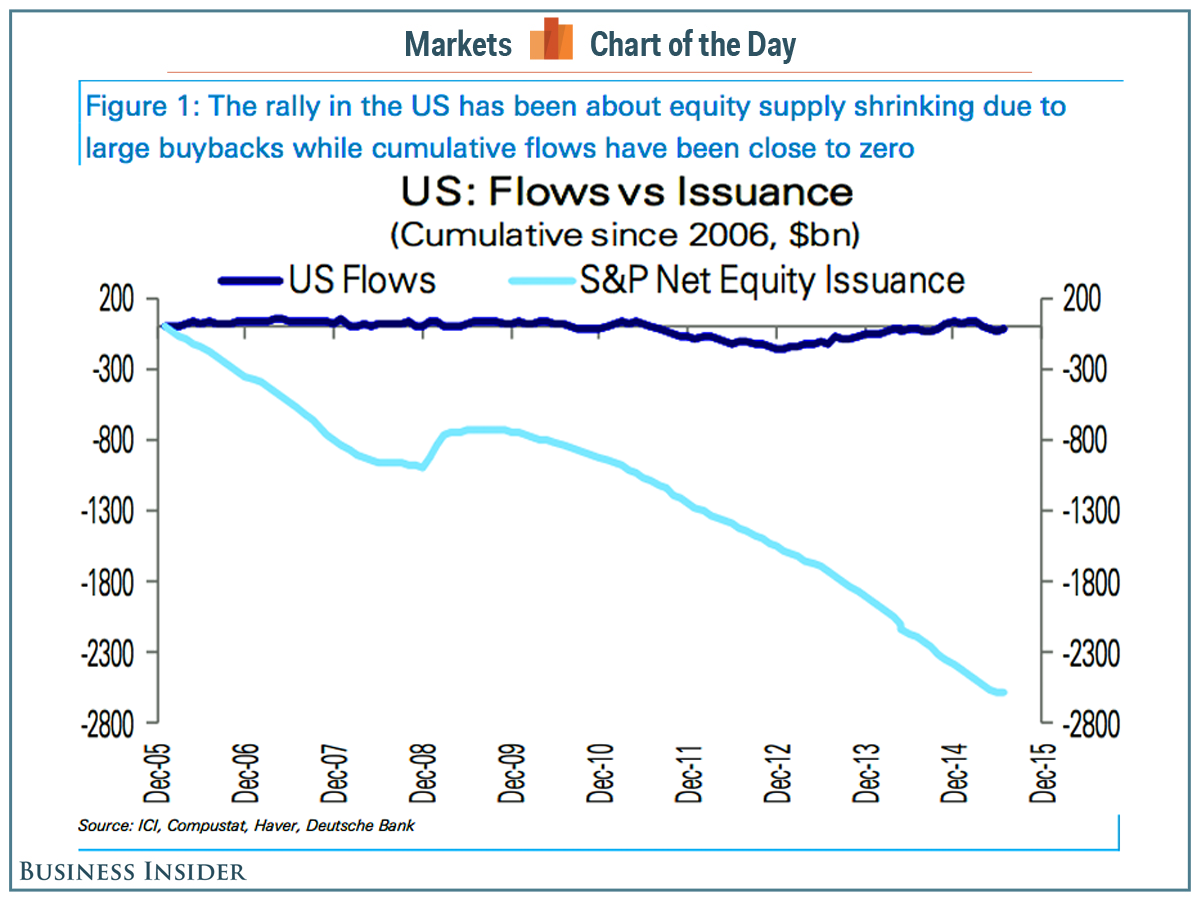
Into 2014’s solar maximum we saw a speculative mania in equities akin to the last solar maximum of 2000. But unlike 2000, there was no demographic tailwind, instead a headwind. Without new buyer flows into the market, we have therefore seen equities bid up by (1) existing buyers leveraging up and (2) companies buying back their own shares.

This chart captures the flat money flows as predicted by demographics versus the declining share issuance due to buybacks.

15augu2Source: Business Insider

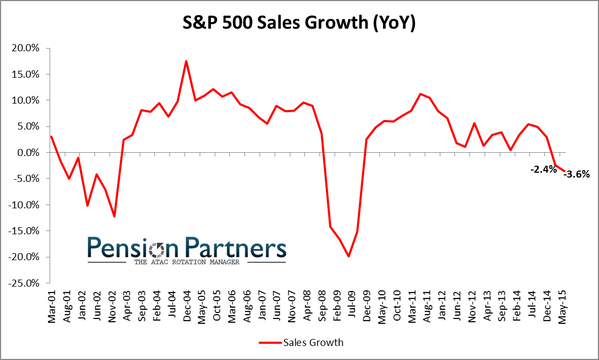
The effect of buybacks is to increase EPS and decrease P/E. The latest earnings show a blended 1% decline YOY, but without those buybacks the figure would have been closer to -4%. Revenues declined 3.3% YOY and reveal a truer picture of companies performance. Additionally, companies have largely borrowed to buy back their shares, making this market fuel particularly ‘unhealthy’.

Buybacks are likely heading for a new record this year, beating the 2007 record. This may partially account for stocks continuing to levitate despite all-round deterioration in other indicators.

15augu30Source: Bloomberg

The other fuel source has been increasing leverage. We can see that leveraged loans peaked out around last year’s solar maximum:

15augu22

Source: LeveragedLoan

Whilst margin debt lurched upwards again in 2015 to a current April high.

15augu40Source: D Short

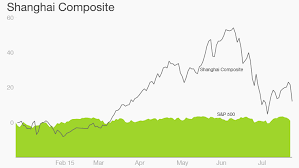
Meanwhile in China margin debt went crazy and can be seen to be wholly accountable for the rise in the Shanghai Composite. This too fits with demographics there: no new buyers, only existing buyers leveraging.

15augu20Source: FX Street

The subsequent collapse in China’s stock market shows what happens when there is no room or appetite for further leverage amongst participants, which brings us back to the top of this post. Then, when leverage starts to unwind, it brings about forced redemptions and thus more selling, as it is effectively a ponzi scheme.

So the question is when leverage in the US and elsewhere starts to unwind. Based on historical evidence, appetite for leverage should wane post solar maximum. We see that in leveraged loans above, but margin debt has rallied further. We know from 1929 that leverage extended a year post solar maximum before collapsing, whilst breadth deteriorated over the same 12+ months. We are again producing that kind of outlier extension, set against a similar ongoing breadth deterioration since the solar max of last year.

Either the sideways range in US stocks in 2015 is the pause that refreshes the bull or it is the topping process that turns into the leverage reversal inspired sharp declines. Solar-aside, there have been so many indicators that this is a market top, sharing characteristics with 2007, 2000 and other major historic peaks, that a bull pause is highly unlikely. But what’s different is that the interest rate, QE and inflation environment, together with commodities relative performance, hasn’t been seen in 50+ years, if this is to mark a top. However, rather than that negating a top, we simply need to look further back in time for reference points. Yet, if the stock market is a dumb mechanism, then we shouldn’t even need to do that.

The solar max produced the stock market mania. Demographic trends meant it has been fuelled by leverage and buybacks. The flat market of 2015 suggests saturation has been reached. Post-solar max, appetite for speculation unwittingly declines. China has broken and all markets are off their peaks. The last several weeks, indicators that have worked for the bulls over the last 2 years haven’t been working. I think the fuel is spent. Buybacks and margin debt are the key here, but both data sets come out with a lag.

Below we see several key indicators peaked out with last year’s solar max whilst a couple of others extended beyond. Now the latter should fall in line with the former. Note how the levels reached have been largely similar to 2000’s saturation levels.

Screen Shot 2015-08-15 at 08.43.03Source: Stockcharts

We are now through the August new moon, heading into the seasonal (geomagnetic) lows of Sept/Oct. I’ve been back on the attack short stocks, with particular emphasis on Biotech.


Top Signals And Bottom Signals

The Dow and SP500 are combined flat for the year and the 7 month price range has resulted in bollinger bands that are the closest in 20 years. Behind the scenes we see evidence of a major peak in equities, making the range a likely topping process.

6augu3Source: Hussman

31juli13

Source: Dana Lyons

Screen Shot 2015-08-06 at 06.50.11

Source: Yardeni

Yet we are also seeing signs of a significant bottom.

6augu2

Data source: Rob Hannah

6augu7

Source: Dana Lyons

6augu8

Source: Fat-Pitch

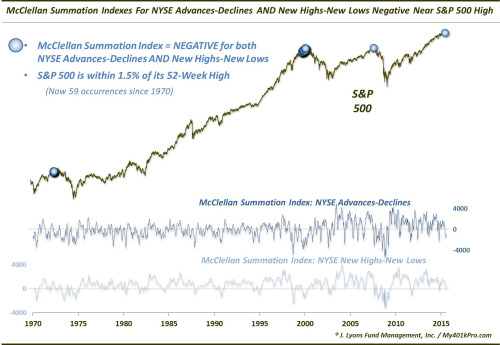
These bottoming signals have formed less than 5% from the highs. So are they a springboard for a break upwards out of the price range before stocks top out? It’s one possibility.

Note that previous incidences of the topping indicators gave rise to at least a 15% sell off, whether it be more like 2011, 2010, 2007 or 2000 in nature. Meanwhile, the bottoming indicators often formed at bear market pauses, at selling exhaustion points. Has a bear market begun then? It’s another possibility, but the shallowness so far of the selling is odd.

What’s also confusing is that some indicators have washed out at this point whereas others remain at contrarian levels, such as Vix. Plus note that some indicators have produced a clustering of extremes for 12 months now, stuck at levels from which mean reversion would have historically fairly swiftly occurred. All told, it’s more history in the making and makes it difficult to call the outcome with high confidence.

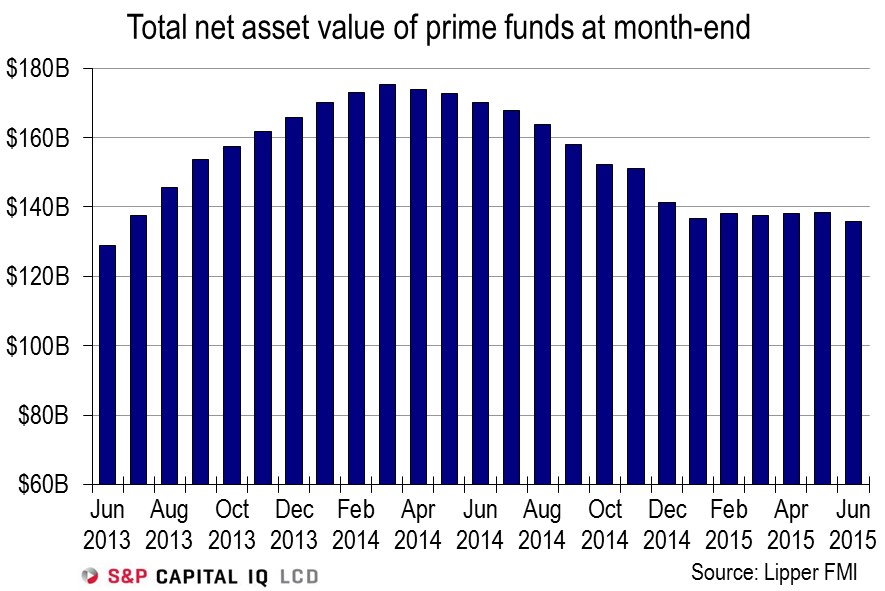
Buybacks peaked out in Q1 2014, IPOs in Q3 2014. Data shows that money flows into equities have been flat in this cyclical bull, in line with demographic predictions. Without new buying sources, the bull has been fuelled by buybacks and existing participants leveraging up. With buybacks decreasing, the bull (if still in progress) is reliant on continued increases in leverage.

As things stand right now, stocks may need to move higher to neutralise those bottoming indicators. Therefore I can’t rule out the possibility of a final move higher, an overthrow, before a true rollover. However, stocks are also overdue a deep and sharp correction and the clustering of indicators, both top and bottom, within such a tight price range, could also produce a swift move lower, before a partial retrace upwards. It may be that fuel has been exhausted and certain indicators are therefore not as contrarian as they may be perceived. In short, right now I’m watching and waiting to see which we way we break before attacking again.

Update

Capitulative breadth now down to 6 on the rally in stocks, but still suggestive of some more upside for equities to properly neutralise it.

31juli40

Source: Rob Hannah

Today is the full moon, and lunar phasing for 2015 looks like this:

31juli1

Not all have been compelling turns but nonetheless shorting each new moon and going long on each full moon would so far have made a profit every time this year. Historically, lunar phasing has worked better in periods of sideways chop like this. Based purely on the moon, we could expect stocks to peak out again in mid-August. But at some point this price range will break one way or the other.

As you know there have been many technical indicators for a bull market peak, suggesting that price range to be a topping process. Here are two more from Dana Lyons:

31juli13 31juli10Source: Dana Lyons

Valuations are crazy high:

31juli50

And US small caps are the most expensive they’ve ever been.

31juli2


Source: Meb Faber

But whilst stocks continue to levitate the key question remains whether excesses in valuations, sentiment, allocations and leverage need to be reassessed in the context of ZIRP and QE, and don’t pose the same threat as typically historically. That analysis is further complicated by not having experienced this combination of negligible rates, low inflation, low growth and high debt for over half a century.

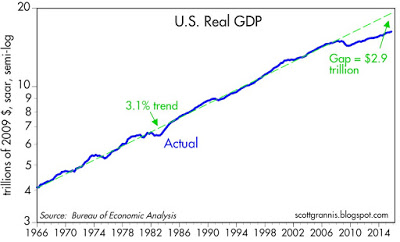
However, the reason for ZIRP and QE is that the world economy has been in serious trouble since 2008, with demographic trends in the major nations all having turned negative. Below we can see the break in the long term trends of US growth and employment and how they remain broken:

31juli11 31juli12


Source: Scott Grannis

So, either (1) the stock market is majorly divorced from reality and reverting to mean soon, or (2) the economy finally picks up from here and catches up with stocks having led, or (3) this is a new norm skewed by central banks whereby current indicators of a top that resemble 2007, 2000 and others no longer apply. You know where I stand on this question, but the sideways price range of 2015 has yet to validate or invalidate any of the options.

Leading indicators still largely point to a pick up now and towards the end of 2015.

Screen Shot 2015-07-31 at 08.31.10

Source: Variant Perception

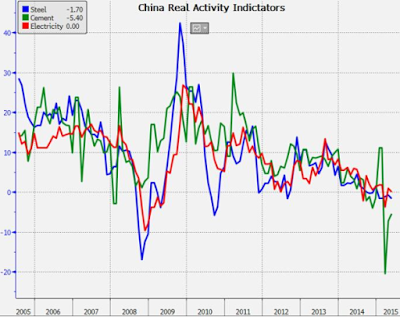
Whereas China looks to be in trouble.

31juli4

Source: Cam Hui

31juli60

Source: CNN

Biotech is also wobbling currently, testing the bottom of the parabolic. So are these the last gasps of a topping process? Or is the price range of 2015 in broad equities the pause that refreshes the bull? We saw some evidence of reset by the end of last week: AAII sentiment, bullish percent, capitulative breadth, put-call all suggestive of a significant low. However, in the bigger picture historically, these look like a low in a bear market, i.e. from which a counter rally erupts before lower lows ahead. What’s confusing is their occurrence just 5% from the highs in nominal terms.

Right now I expect stocks can move higher before they move lower again. So I am waiting and watching for evidence they are rolling over again. The key is whether they do so before they reach the July highs and then the May highs. At the same time I am looking for a lower low in gold and miners on positive divergence.

We still have a host of indicators pointing to an underlying peak around the solar maximum of last year:

31juli20 31juli22 31juli30That June/July 2014 peak remains in play unless we see those indicators reverse and reset. 12 months later they still haven’t. So I remain of the opinion that equities will ultimately break downwards. It’s just a matter of gauging the shorter term waves. On which note I have to prudently add that I can’t rule out a final move up to new highs before a collapse. It happened in 1987 and 1929. A range trade over the first half of the year and then a final rally to a peak in Aug or Sept:

31juli70 31juli90

Source: Financial-Spread-Betting

That extreme reading in capitulative breadth may support this occurring, so have to stay open minded. Hence the importance of watching indicators and price for evidence of a roll over before the July highs, then the May highs.