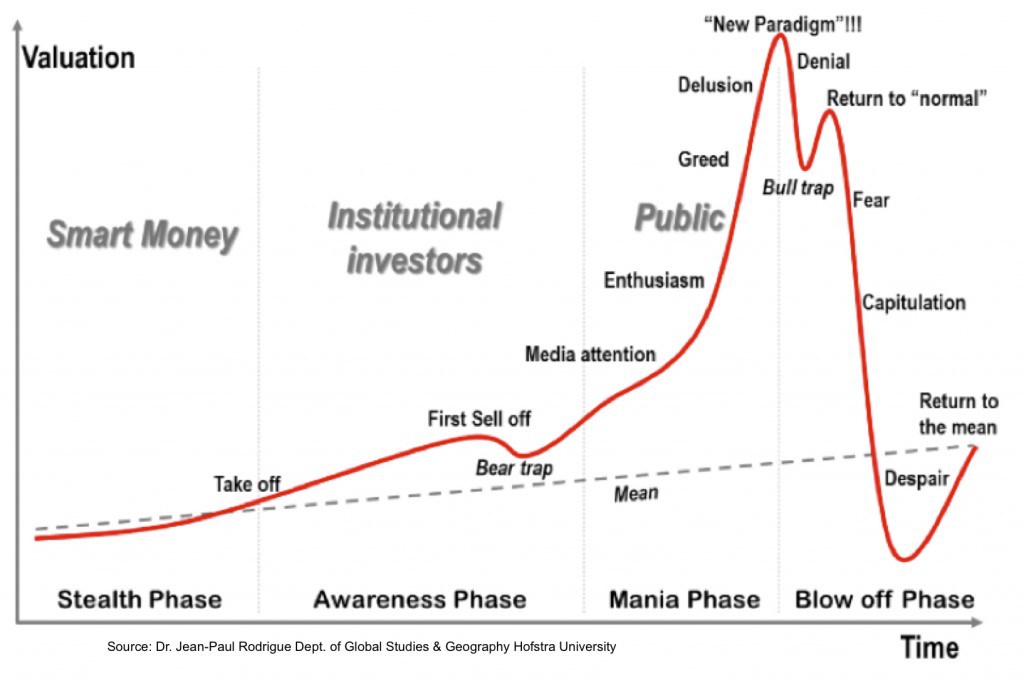
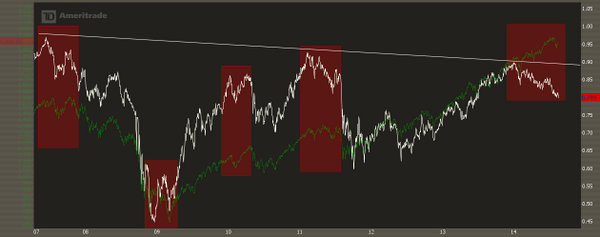
November

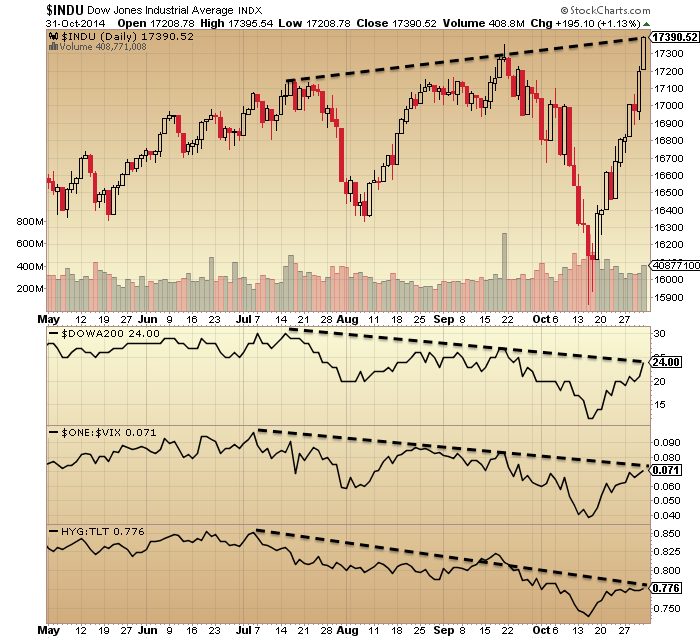
October ended with new marginal highs on the SP500, Dow and Nasdaq. The bottom line is: my analysis doesn’t change. Here’s why.

There are too many stock market topping indicators for this not to be a bull market peak. I refer you to this list:

Screen Shot 2014-10-16 at 17.57.40

We can add to this now that ECRI leading indicators have turned negative, financial conditions are in decline and we have various additional negative divergences.

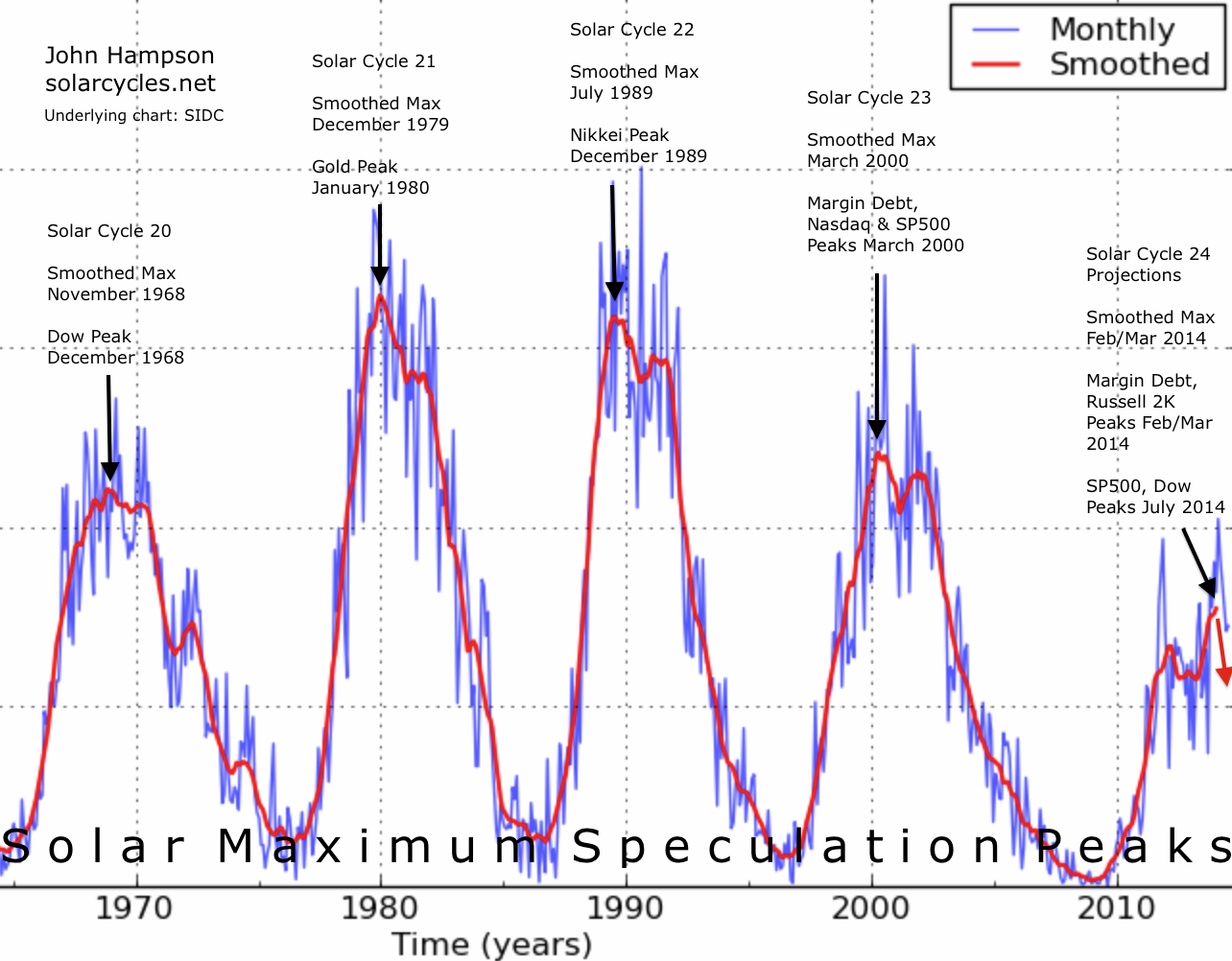
We can then cross-reference the list with the solar maximum for timing. Being able to refine with hindsight, the smoothed solar maximum looks likely to have been April 2014, with SIDC no longer running an alternative model with a higher high ahead. That puts the stock market on borrowed time since April.

Screen Shot 2014-11-02 at 06.44.48Source: Solen

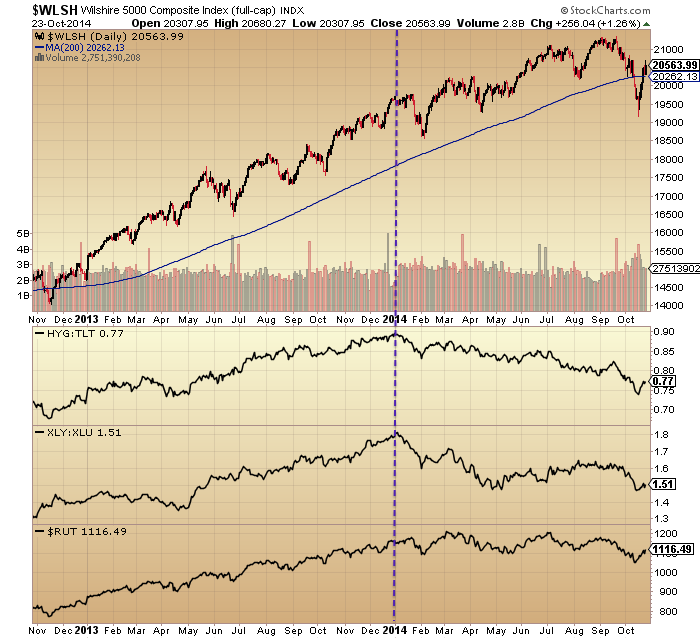
We have evidence the stock market topping process initiated 31 Dec 2013, with a persistent move to defensives since then.
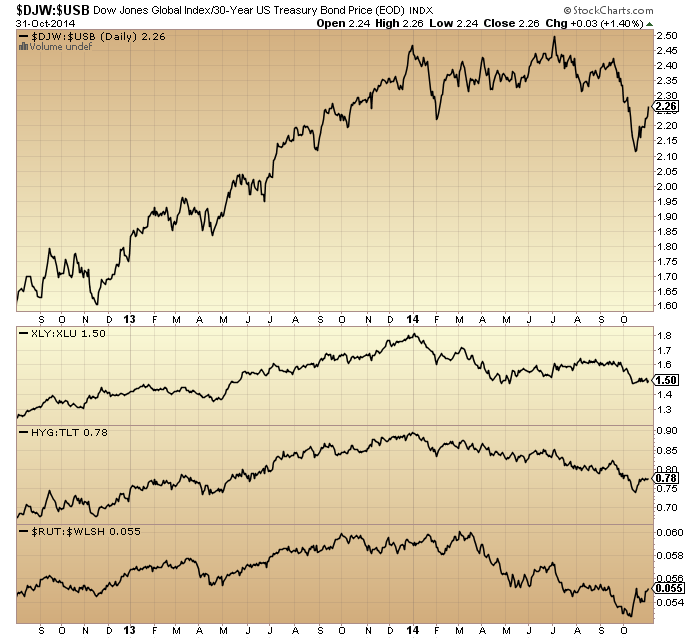
2nov3Source: Stockcharts

Plus dumb money flow took over from smart:
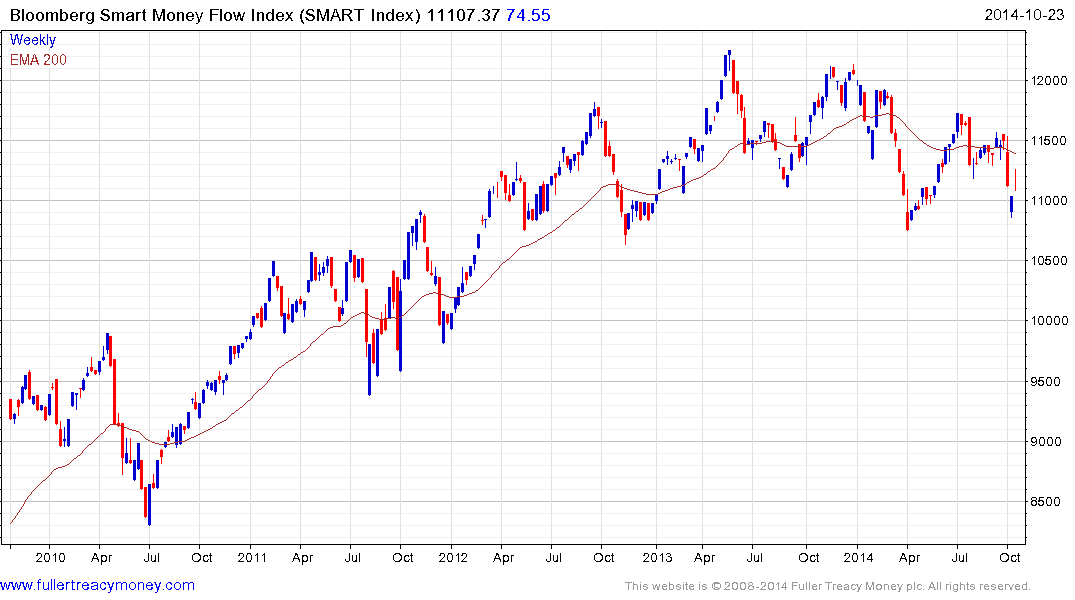
31oc20Source: Fullertreacymoney

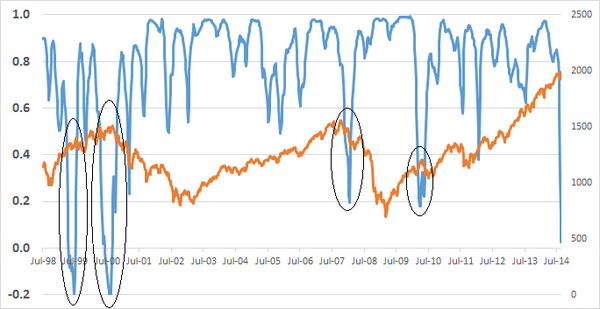
The stock market topping process appears to closely mirror the last solar/stocks peak of 2000, putting us right at the end of the process:

30oc530oc6The question mark is over the higher highs in price here in 2014. US large caps have now made yet another higher high in October. However, they do so on negative divergences, similar to 2011 or 2007’s peaking (just marginal highs on clear divergences).
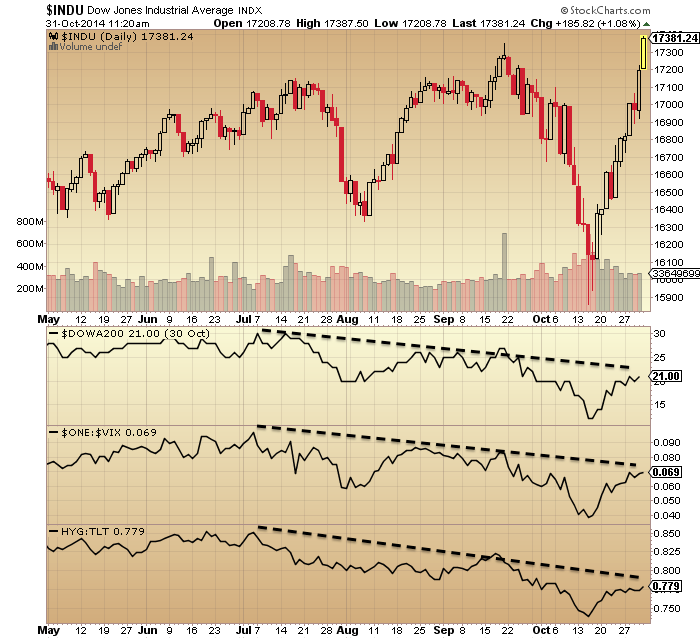
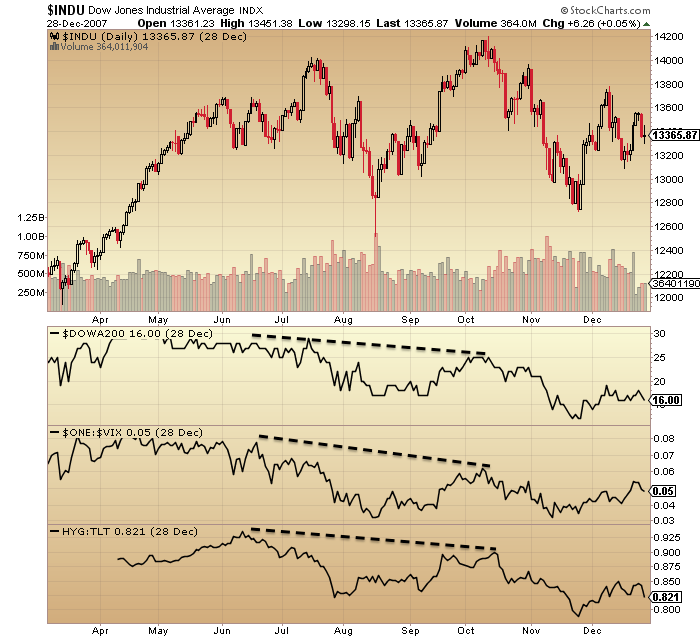
31oc2 31oct1

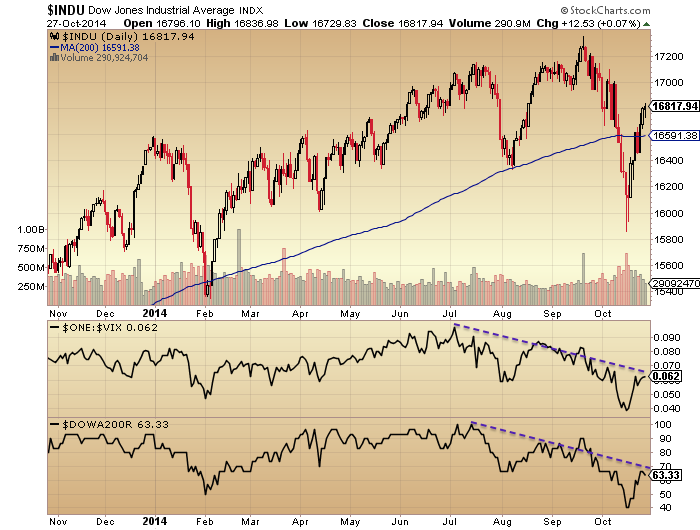
Indeed this powerful rally in price over the last two weeks is weak under the hood, with multiple further divergences:

2nov6 2nov7 2nov8This rally ought to fail imminently, and this is backed up by overbought stats: Nymo hit over 80 on Friday for the second time in 5 days. Per Andrew Kassen, this twin-occurrence happened 9 times before, resulting in an 11% average fall, with 8 out of 9 of them turning down the day after this signal.

That means Friday’s gap up could turn out to be an exhaustion gap. But it’s fairly unequivocal: stocks ought to turn down at the start of this coming week, and being just several days from the full moon the pressure ought to be downward. We can draw into this picture the position in gold and miners, which appear to be capitulating on heavy volume:

2nov10

Source: Dr.Cooper

The extremes reached echo the 2000 bottom:
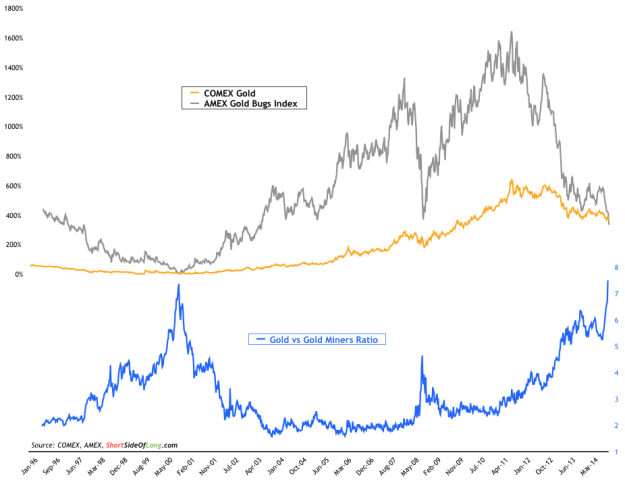
2nov9

Source: ShortSideOfLong

I’m looking for a high volume intraday reversal candle on gold and miners to tie in with a peak in stocks.

Also unequivocal is that November should be down, per the positioning in the topping process by multiple indicators. October 2014 is matched up with its counterparts in the last two major tops below:
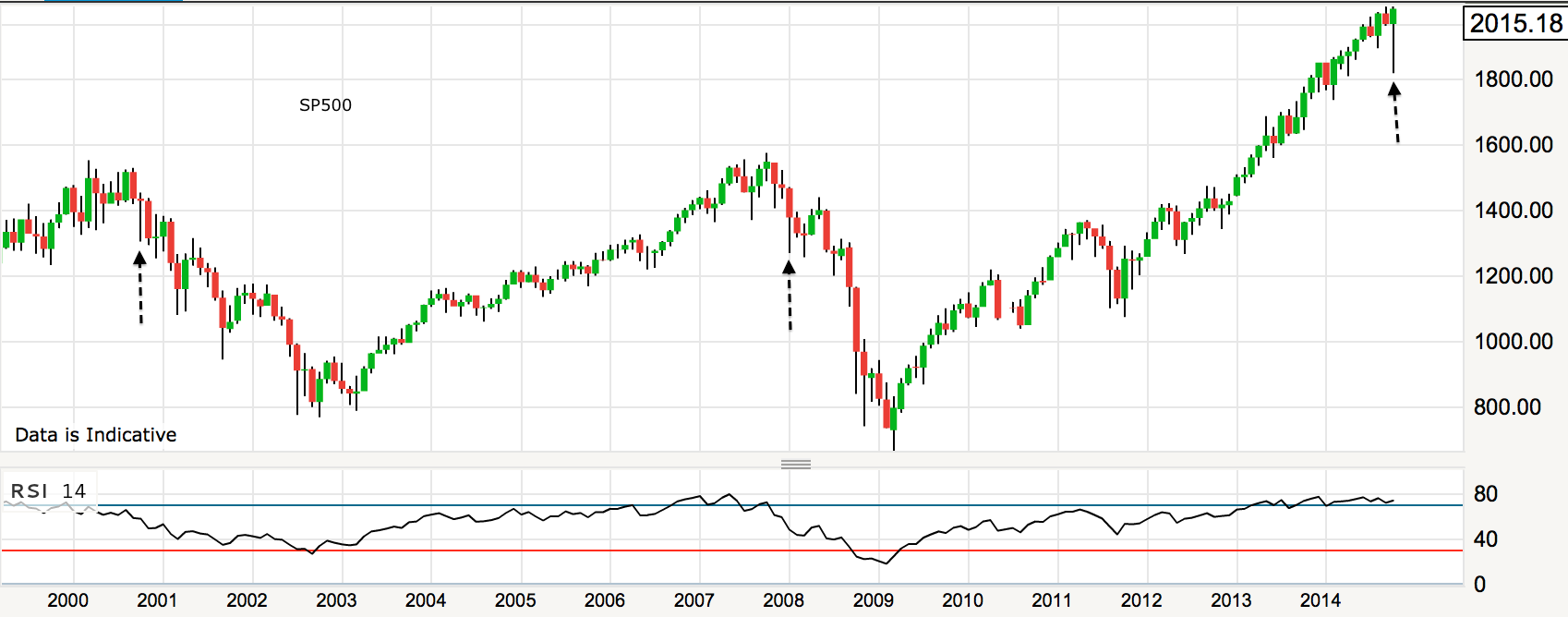
Screen Shot 2014-11-02 at 07.10.34The long tails look the same, but the candle tops do not. Things are different this time. Look at the clustering of V-bounces and of extreme lop-sided sentiment:
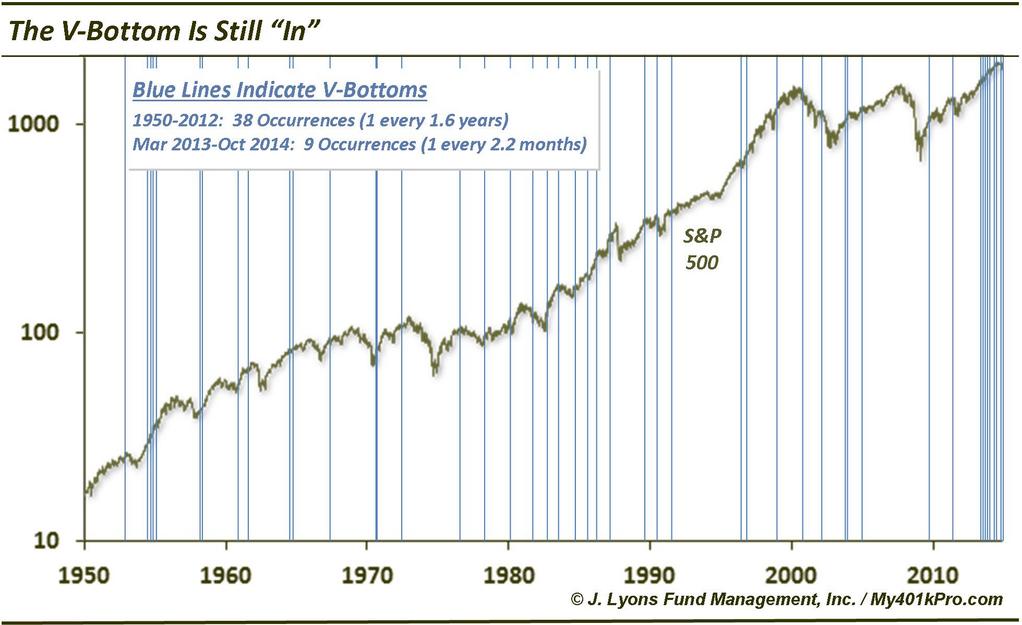
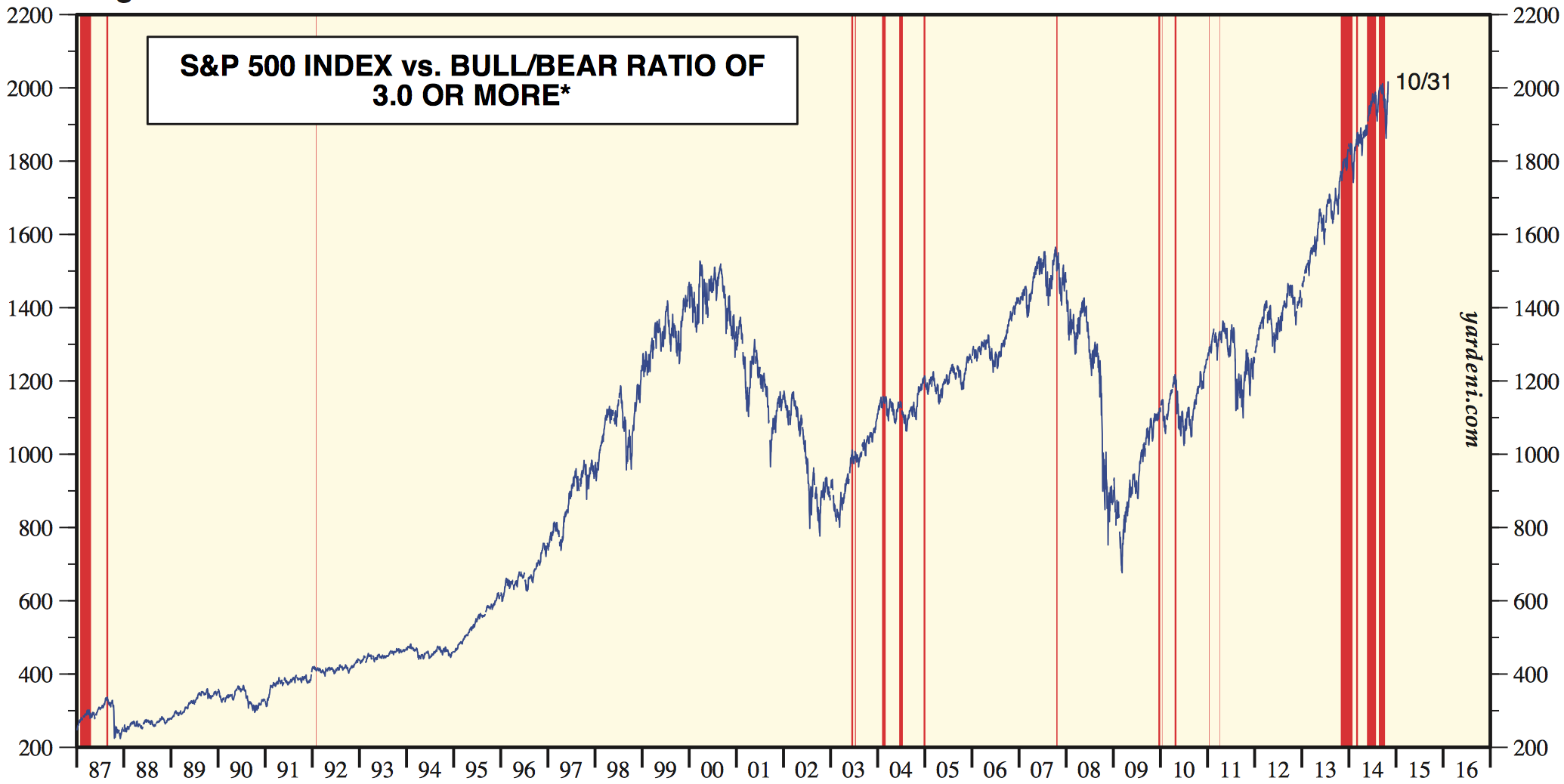
2nov9

Source: Dana Lyons
Screen Shot 2014-11-02 at 07.16.11

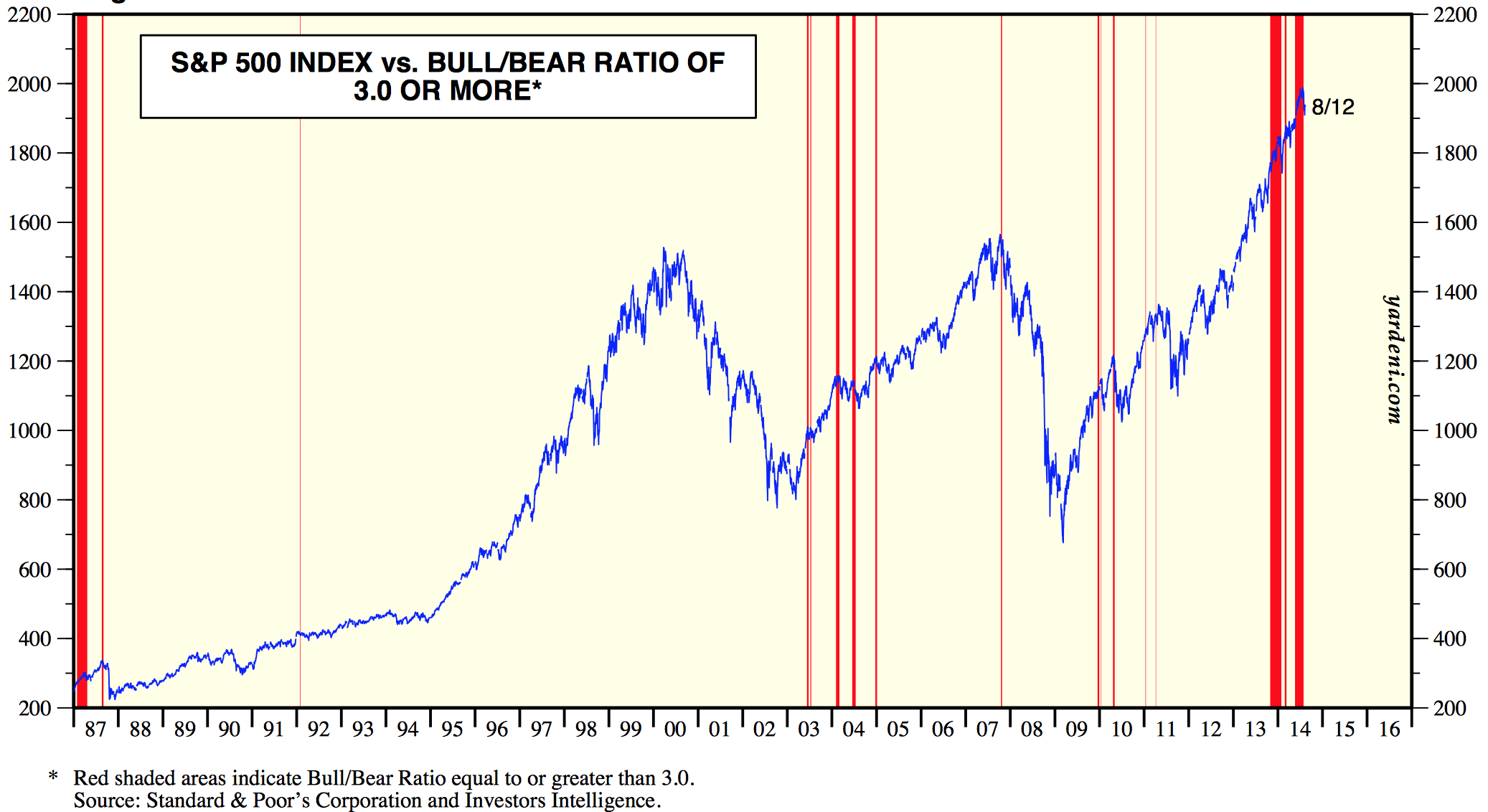
 Source: Ed Yardeni

Unprecedented. It seems fairly certain that both are reflective of a mania but does it mean a stock market topping process won’t play out in the ‘usual’ way? It’s not easy to answer that without a historical precedent.

However, this brings us to the bull case which would advocate that central bank policies have caused this and postponed any bear market. Supporting this we have once again made new highs on large caps following a very strong buying-of-the dip, whilst seasonality is doubly positive from here into year end (geomagnetic, Presidential). The Japanese BOJ shocked the markets with increased QE and the Japanese pension fund announced increased purchases of Japanese equities. So is it a losing battle fighting such intervention and support? Could those 37 topping indicators shown above all be attributed to ZIRP and QE making equities the only home for a decent return, and therefore this time not actually signals for a market peak?

I just don’t believe that. If you don’t agree with me, then I’m fine with that: you’ll find plenty of bullish blogs to follow. Understand that I’m feeling the pain with a significant drawdown on my short positions, so it’s imperative that I try to be as objective as possible. Ultimately, this is about my money and my life. I go over and over the data and come to the same conclusions:

I see a large cluster of market topping indicators aligning with timing by solar maximum. I see multiple negative divergences on this last rally up. I see lower highs and lower lows on US small caps, European indices and junk bonds since July, making the price action in US large caps the anomaly that will be the last to resolve. I see a positioning by indicators right at the end of the topping process. I see a mantra for this mania of ‘central bank policy trumps all’.

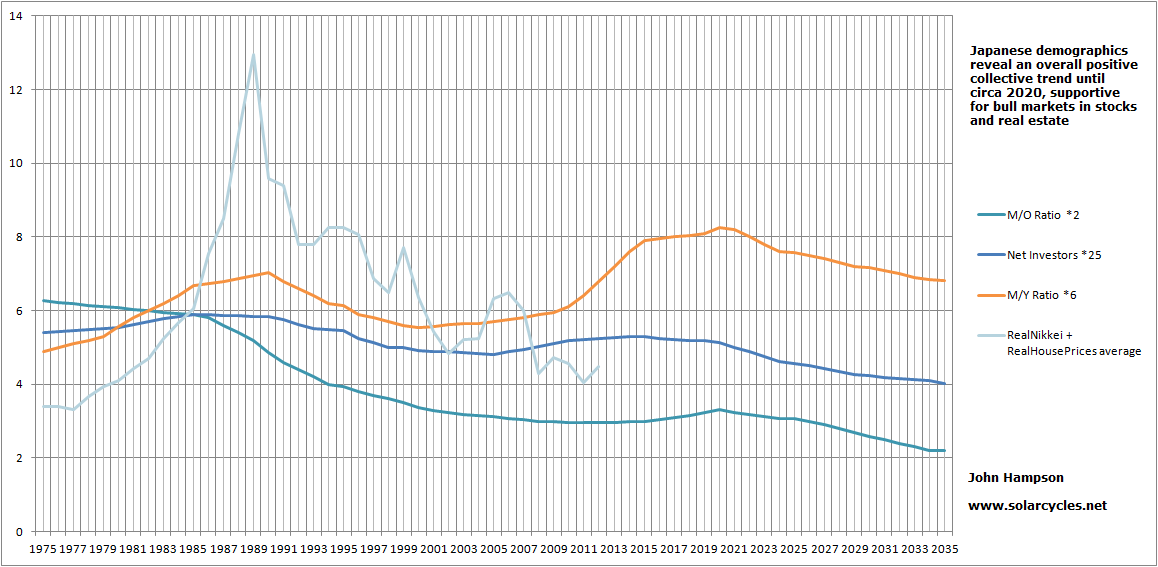
Note: I would not want to be short Japanese equities here. I may go long this week with a stop if the Nikkei can hold its breakout. Japan is in a slight demographic tailwind window in contrast to the other majors, and the direct buying of stocks by the Government is notable.
2nov15

But this doesn’t affect my view on US and European equities where I remain short, and gold where I remain long. By my analysis it’s fairly clear that a renewed turn-down in these stock indices and a capitulative low in precious metals should occur within the next few days and November should be a strong down month for stocks, as this is the only fit by indicators. If this doesn’t happen I will be stepping aside, closing positions and waiting. I am not being stubborn or wedded to a view, I just have such an overwhelming multi-angled bearish topping case that I think even if I was a total delusional, it has to be right.

So, it looks like we are making a megaphone top on the Dow and SP500. There is room for just a fraction higher into the top of the megaphone but the reversal ought to be close at hand. Nymo suggests as soon as Monday, so let’s see.

2nov20

Solar And Stocks Update

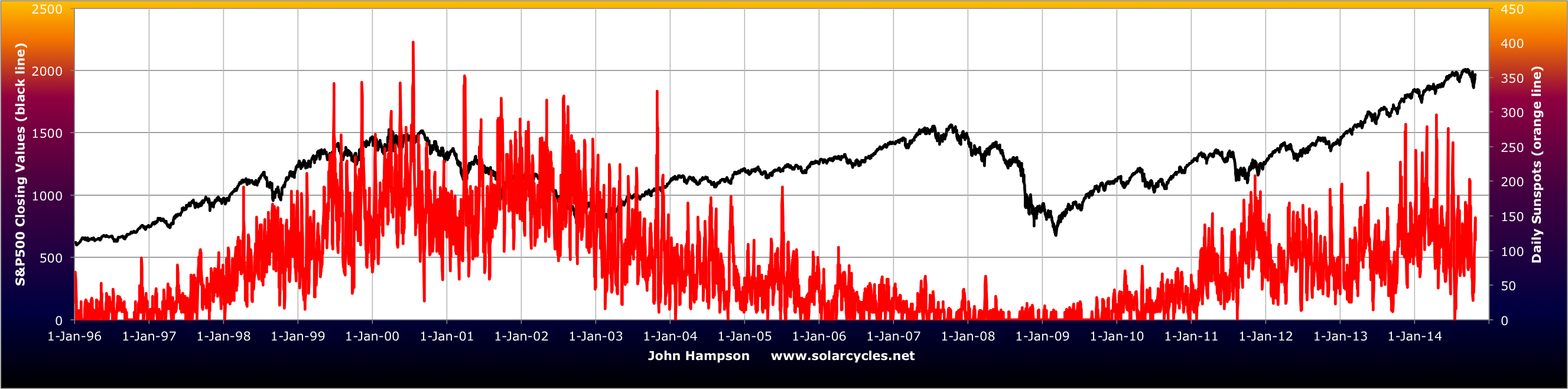
Sunspots and the smoothed solar maximum appear to have peaked around March 2014.

28oc2

Margin debt, Russell 2000, social media and various breadth measures look to have peaked around then, in a speculation peak epicentre, and all major global stock indices have tentatively topped out within 6 months of that.

28oc3

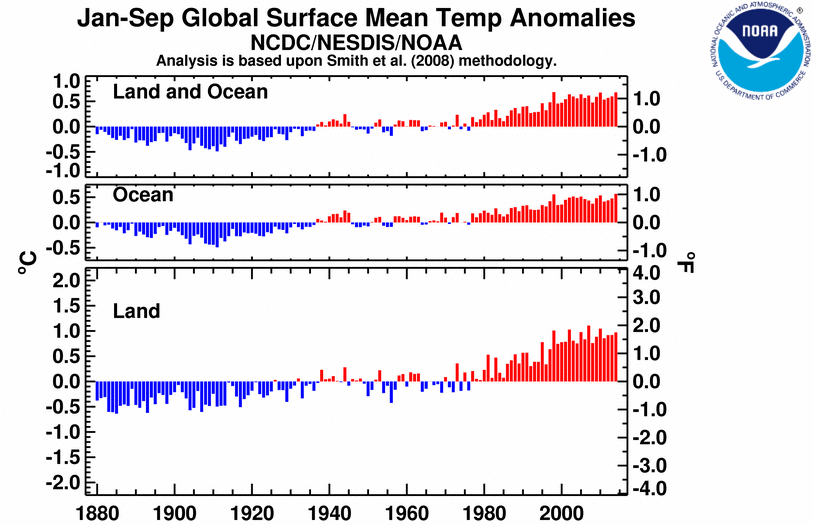
In line with previous solar maxima we are seeing a particularly hot year globally, with 2014 so far the joint hottest on record globally for land and ocean combined.

28oc5

Agricultural commodities may have a burst ahead of them.

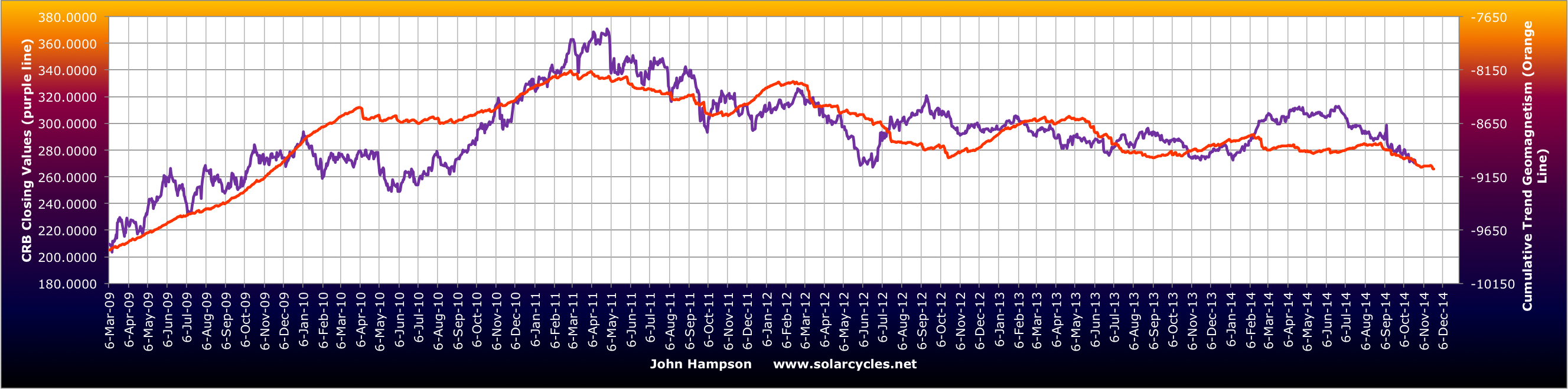
Equities have run away from the cumulative geomagnetic trend in keeping with a speculation mania over the last 18 months, whilst broad commodities continue to track the model.

28oc1

The geomagnetic trend just lately steepened downwards, in keeping with the seasonal geomagnetic peak time of year.

This post-solar-maximum, geomagnetic pressure period is likely to drag equities down and maintain the peaks between March and September in the major global indices, implying we are in a new stocks bear market.

I maintain the likelihood of the new moon reversal, i.e. that this week should now see the renewed move lower, making for a lower high in US large caps.
28oc8

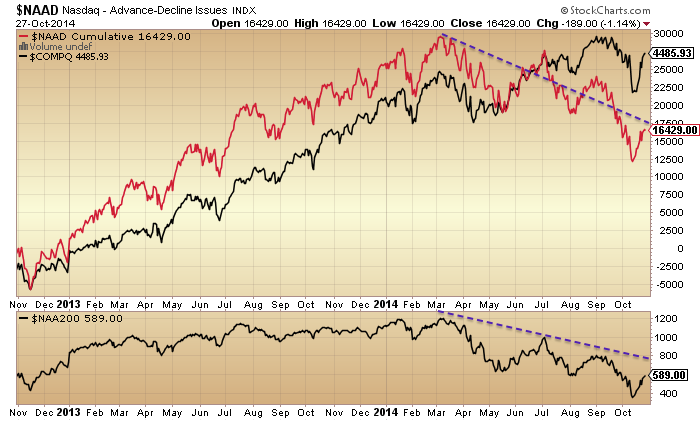
This probability is supported by the picture in Nasdaq breadth, which peaked out around March.

28oc9

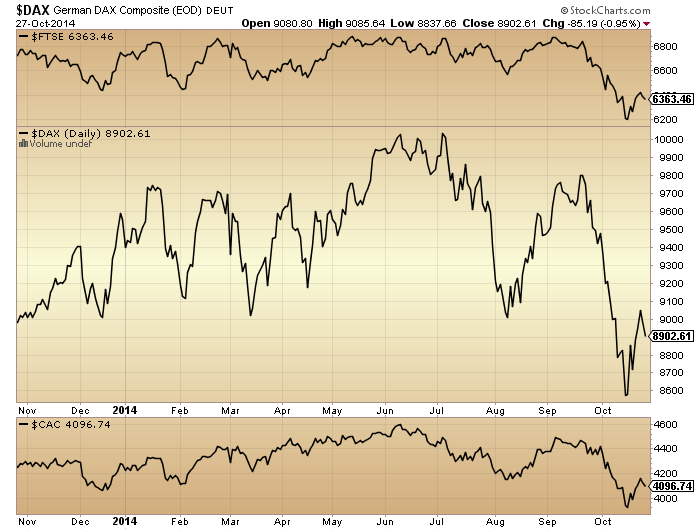
The European indices likely initiated the roll over yesterday.

28oc10

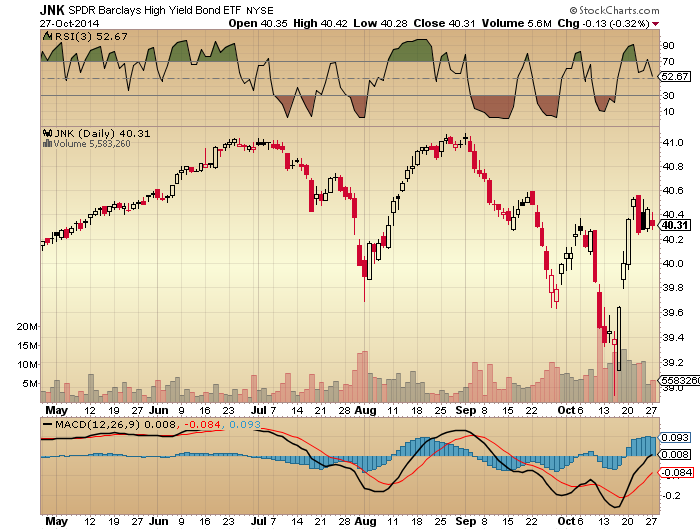
Whilst the junk bonds rally has possibly petered out the last few sessions.

28oc11In summary, I still expect the markets to roll over here, providing the missing lower high in US large caps to go with the lower low (and existing lower highs in other indices). With a doji candle yesterday in US indices, a further doji candle today would provide the roll over set-up similar to 1987 and 1929. The likelihood of the Fed sticking with their QE exit in tomorrow’s FOMC output could then provide the trigger for the falls to initiate. The triple negative of the period into the full moon, the geomagnetic seasonal peak and the post-solar-maximum hangover provide the backdrop for this all to occur. I believe we are already in a bear market in equities but this isn’t going to be clear for a little while.

New Moon Reversal?

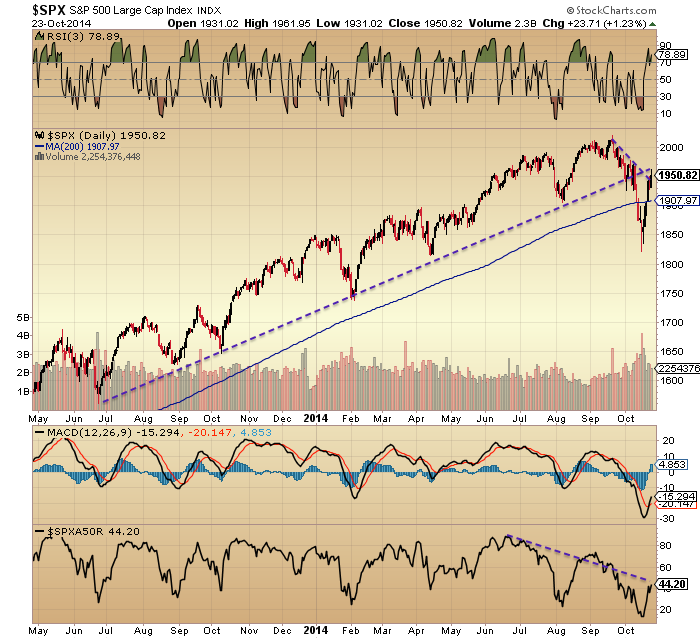
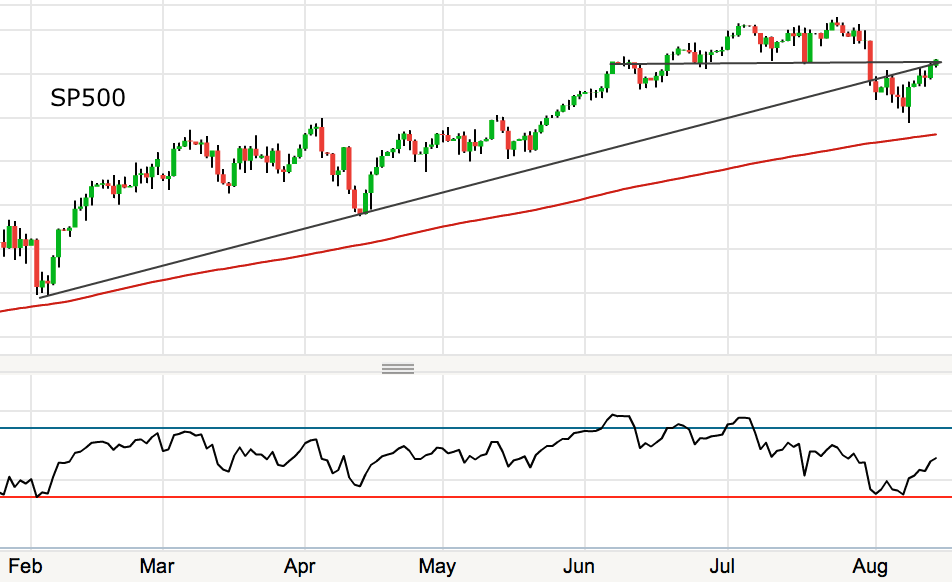
A bullish day but with a weak close and weak after-hours produced a candle with a tail to the upside that could spell a reversal, with new moons often marking tops. The SP500 has rallied back up to the measured decline trend since September and has made a retest of the broken bull trend of the last 18 months, so adds to this being a suitable spot to reverse:

24oc1

Source: Stockcharts

Additionally it has made a 61.8 fib retracement of the Sept-Oct falls, and this is in keeping with the second chance peak of 1929 which was a 61.8 fib retrace of the initial falls.

19oc5

Underlying Source: Ritholz

On the flip side, Apple and Biotech broke out to new highs, so we have to allow for an alternative scenario of wider new highs being ahead, unless the markets swiftly reverse here. However, when we look at Nasdaq breadth as a whole we see a continued pattern of weakening with underperformance behind the current rally, which casts doubt on such broader new highs:

24oc10

The key question is where we are in the topping process. It’s a process that began at the turn of 2014:

24oc3

By the majority of indicators we are late in the topping process, equivalent to January 2008 or October 2000. So when we look at the selling climax of last week, the most applicable mirror is that from the turn of 2008, the first true leg down in the bear market:

24oc2

Source: Sentimentrader

If that isn’t our current position, then we would be looking at a catapult to higher highs. Ditto the reading in capitulative breadth that last week hit a ‘bear market bottom’ level. How do we reconcile those with (1) II bears still being at the (toppish) extreme <20%, (2) AAII bull-bear ratio back over 2 despite last week’s sell off, (3) margin debt and net investor credit still being at levels that exceed previous bull market peaks, (4) the average of 5 valuation measures putting us on a par with the 1929 peak as the second biggest mania after 2000, and (5) allocations such as Rydex and Fund Managers still being too high to have sustained a washout?

24oc6Source: Fat-Pitch

I believe we can reconcile if CBI and selling climaxes marked the bottom of the first leg down in a new bear market, because the sentiment, allocations, leverage and valuation indicators have a long way to go yet before they will have mean-reverted.

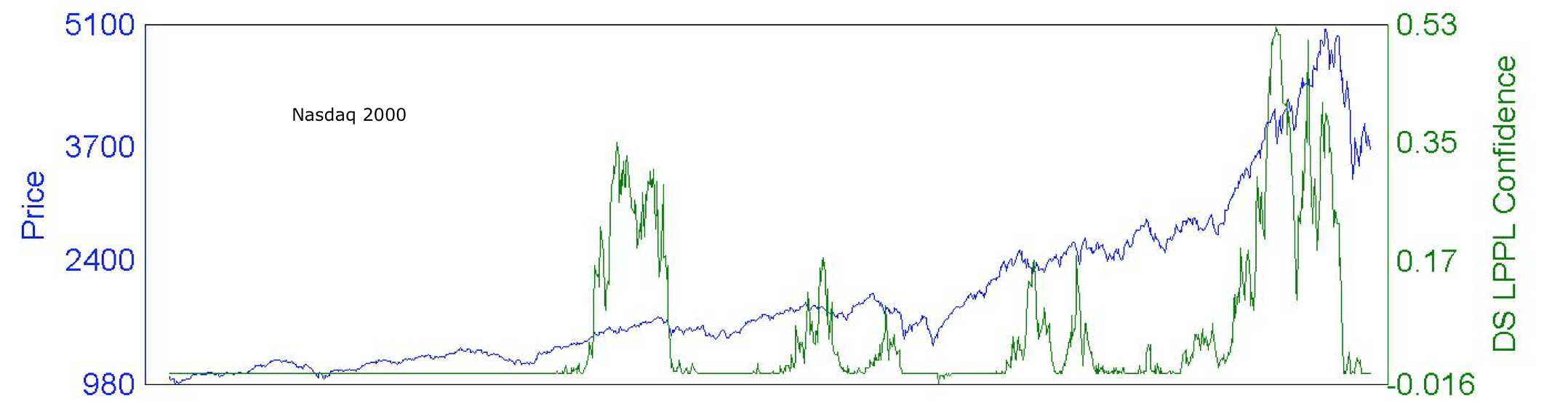
The wildcard remains the solar maximum, which I believe is the most dominant force in play. It is the reason certain indicators reached all time extremes this year and why speculation once again became of mania proportions. The stamp of previous solar maxima such as Nikkei 1989 and Nasdaq 2000 has been all over this year’s developments. Knowing that the current solar max has comparisons to SC5 which produced a delayed smoothed maximum or that the market resonates with 1929 which was a delayed peak beyond the smoothed maximum, then we have to allow for the possibility of a peak stretching out into 2015. However, this is where the cross-referencing has been powerful…

The most probable scenario by solar models and data is that the smoothed solar maximum is behind us circa March time, and we can cross-reference that with the peaks in the R2K index and margin debt, i.e. it appears speculation did indeed peak then. Generally, indicators reveal a 6-8 month topping process that ended in September, and this timeline fits with previous major peaks. Various indicators aligned already with the solar/market peak in March 2000, not earlier in the process. And through a combination of extremes in leverage, allocations, sentiment and valuations in the face of a demographic headwind, we appear to have reached saturation in the markets, i.e. questionable that there would be fuel to go some way higher yet.

In essence, if we remove the solar maximum from the equation then we have a strong case for a topping process in equities that initially began 31 Dec 2013, had an epicentre around March, and completed by September. If we now add the solar cycle back in with most models pointing to a smoothed solar max behind us around March, then this looks doubly compelling versus the chance of a market peak delayed until 2015. But, if I am to be proved correct, then equities have to now turn down again and not reach back up to new highs.

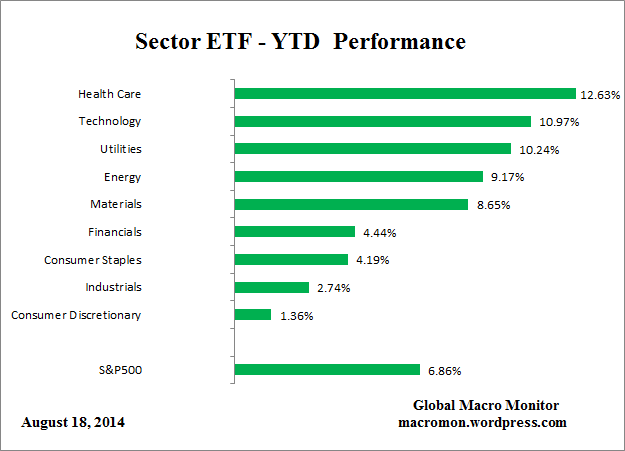
Year to date sector performance still looks like a trademark market peak. These are the two sectors that perform the best once the market tops out:

24oc11

Earnings growth for Q3 currently stands at 5.5%. This needs to be over 10% to justify valuations. Don’t take my word for it: analysts projections for this quarter at the turn of 2014 were 13% growth, but the reality means they were gradually reduced to 5% as the year progressed, so now in fact we have a little ‘beat’. I just don’t believe that is enough to propel equities higher, but rather, the gap between valuations and reality has been a flag for 2 years now and with three failure quarters out of three so far in 2014 that gap is at its biggest yet. Hence I believe the repair in price is now underway and we are in a bear market.

The Sornette bubble end flag still shows as July for the SP500 and September for Technology. There has been no move back up with the recent rally.

Screen Shot 2014-10-24 at 08.28.08

Source: Financial Crisis Observatory

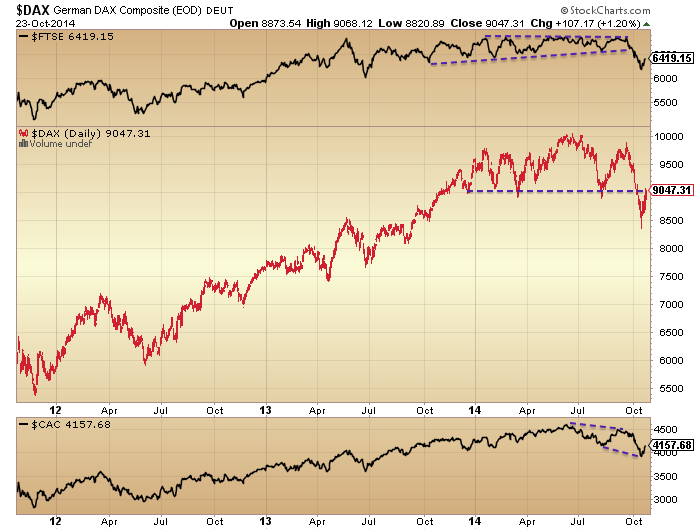
The European indices are bearish, unless the Dax can break back upwards here. Rather it appears the ideal place for a reversal back downwards, along with the US indices.

24oc14

The pattern of a lower high and a lower low since June is fairly clear on the European indices and also on the Russell 2000 and the Bloomberg financial conditions index. What’s missing is a definitive lower high on US large caps, so that is what I am looking for. Uniting all the above analysis I believe this has to now occur and that we won’t rally back up to new highs. With the new moon now behind us and stocks arriving overbought and on negative divergences at suitable technical levels for a reversal I expect stocks to reverse back down to last week’s lows. Once that occurs we can judge whether there is evidence of capitulation again and also of positive divergences. I believe there won’t be and that will be the trigger for the markets to then cascade lower. But first things first, let’s see if equities are repelled from yesterday’s peak.

Last 18 Months

Over the last 18 months, US equities rose on 80% multiple expansion and just 20% earnings, and they diverged from economic fundamentals.

Screen Shot 2014-08-27 at 14.45.02Source: Yardeni

Institutions were net sellers in this period whilst retail investors became the buyers, typically the ‘dumb money’ and a sign of a peak.

27au1

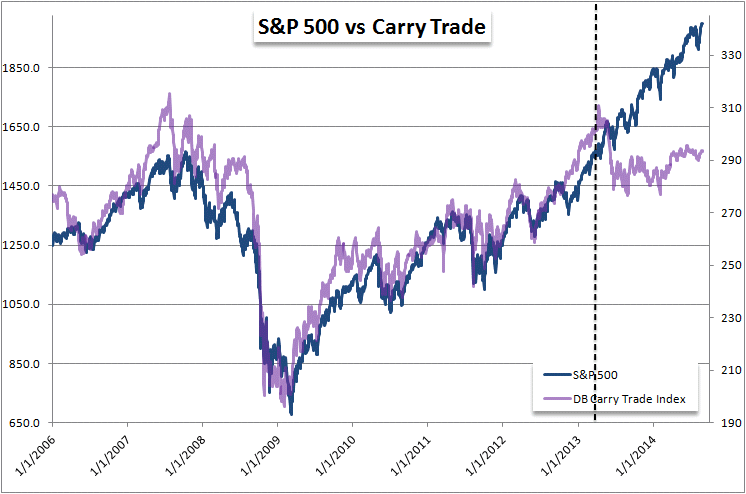
The carry trade ceased to be fuel for higher prices.

28au7

Source: John Kicklighter

Instead, retail investors went all-in on bullish equities allocations and then leveraged up in a major way, to propel equities higher.

27au2

Source: Stockcharts27au4

 Source: D Short

28au8Source: Sentimentrader

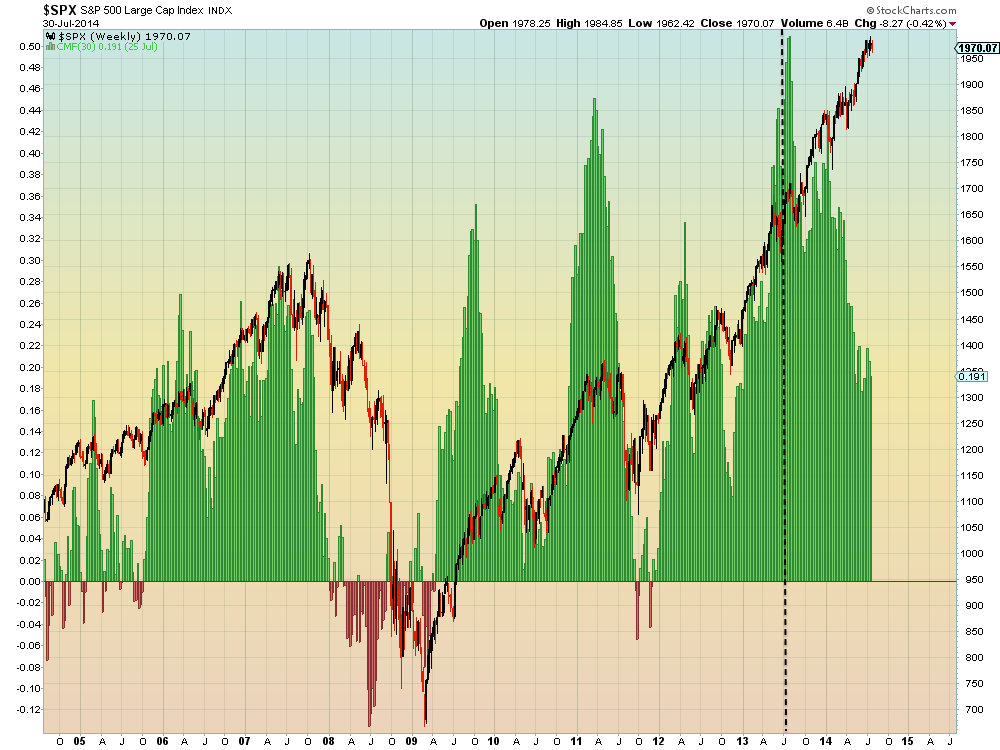
We see a trend of distribution in this period, both in major accumulation days (just 1) versus major distribution days (12) and in Chaikin money flow, which suggests underlying building smart selling pressure.

28au9Source: Ponzi World

In short, the stock market mania of the last 18 months has been fuelled by the retail crowd and their credit facilities, not manipulated by the big institutions in some sort of cartel as some suggest.

The whole process can be explained by the rise into the solar maximum, driving people to speculate.

The process is mature and here in mid-2014 we see a range of indicators suggesting termination:

1. The best performing asset in 2014 is treasuries.

2. The best performing sectors in 2014 are utilities and healthcare, the defensives that typically outperform post market peak.

3. The hot speculative targets of Bitcoin, social media stocks and small caps all appear to have topped out, with Biotech a question mark but having made no progress since February.

4. Margin debt has also made no progress since February, which remains the peak.

5. Divergences have grown in breadth, sentiment and risk measures.

6. Volume on down days versus up days resembles previous peaks.

7. Sornette bubble end has flagged and extreme Skew continues to warn of a big move to the downside.

8. The smoothed solar maximum appears to have passed around Feb/March time.

9. Valuations have reached dizzy levels, with the median stock average valuation higher than in 2000 which was more concentrated in tech stocks:

28au3

Source: Hussman

Turning to the short term, yesterday was another record ultra low volume day. Also, $SPY remained in a 1 cent range for 18 minutes, almost dead, beating a Nov 2006 extreme of 10 minutes. Indices went nowhere overall, so we roll over to today. Geomagnetic disturbance is underway.

To sum up, my bottom line is this. Whatever research angles I collate always point to the same: a comprehensive multi-angled case for a bull market peak, and not just a peak some time soon, but the last gasps of a peak that has been in progress all year. We can argue over select indicators and doubt them individually, and no-one can avoid confirmation bias. But the breadth of the indicators and differentiation of the angles make for a multi-way, cross-referenced set that is surely something objective and compelling. The evidence just does not support a bull market continuation from here nor a parabolic blow-off top from here. The evidence says we should collapse any moment, not just into a correction, but into a devastating bear market with all that retail leverage and skewed allocations unwound in a very painful way.

Clearly price is all that ultimately counts, and therefore you should maintain a healthy doubt about my case until price proves it. But, rightly or wrongly, I still think this is it:  the stock market mania began 18 months ago; risk peaked 31 Dec 2013; the solar max, margin debt, hot sectors and indices peaked Feb/Mar 2014; and the last phase of the top was July/Aug with the Sornette bubble peak, European indices peaks and US indices peaks. I believe the current ultra-low volume double tops / marginal higher highs on negative divergences in Dow, SP500, JNK and IBB will resolve to the downside, and the devastation be reaped in September and October.

The Alternatives

Alternative 1: The Bull Is Safe

Stocks are in a new secular bull market. This cyclical bull began from the low in 2011. The economy is recovering and we need a series of rate rises before the bull’s termination is likely. If so, the bull, right now, is faced with these:

1. Over 80 weeks levitation above the 200MA on SP500

2. Over 80 weeks with no 3% change

3. Biggest ever cluster of extreme Skew readings over the last 10 months

4. Biggest ever cluster of extreme Investors Intelligence bull-bear spread over the last 10 months

5. Lowest ever net investor credit and highest ever margin debt to GDP ratio

6. Highest ever Rydex bull-bear asset spread and cluster of fund manager equity allocations

7. 8 months of ‘risk-off’ behaviour in HYG:TLT, WLSH5:GDX, XLY:XLU

8. Best performing sectors being those defensive sectors associated with a market peak

9. Averaging 4 valuation measures the market has reached a par with the peak of 1929 in terms of expensiveness

In other words, this market needs a reset to continue. The duration and magnitude of these indicator extremes mirrors 1987. The market is a mean-reverting mechanism and like an elastic band it will snap back. Therefore a significant reset is on the cards, and every day it has gone without a washout correction has stored up a major correction when it occurs. Therefore, even if the market were in a secular bull heading much higher, it is over-ripe for a cleansing. The maturity of the divergences and readings suggest the inverted geomagnetic seasonal downtrend from August to October is the most likely window for that to occur. The secular bull break outs post 1930s and 1970s also saw a reset shortly after breakout.

Alternative 2: The Terminal Melt-Up

Stocks, although stretched, are heading for a blow-off top. The kind of unsustainable trajectory that everyone knows can’t last but no-one wants to miss out on. A crazy rate of ascent to crazy valuations, and then ultimately an even more devastating pop than stored up currently. Like the Nasdaq in 2000, the Nikkei in 1989, the Dow in 1929. Although neither a demographic peak nor an economic boom peak like those three events, the combination of QE, low rates and a goldilocks economy (neither too hot nor too cool) provides different ingredients for the same kind of mania result.

(Understand, I disagree with a lot of what I am writing in these first two alternatives, I am just presenting the opposition).

The most likely candidate for that currently is the Nasdaq 100, which is the most parabolic of the indices. I’ve labelled the chart to show a potential mirror with the action in 2000 and where we might be:

Screen Shot 2014-08-23 at 16.02.59

Label (1) in both periods shows a first burst to what participants expect to be the peak, only for a running correction (2) to give way to an even steeper final termination leg higher (3). 5 months of crazy gains from ‘Here’ would take us to a January 2015 peak, which fits well as the other inverted geomagnetic seasonal peak of the year. If the index did break into the kind of terminal velocity of phase (3) then, make no mistake, it would be the biggest stock market mania ever, because to accomplish it we would see the highest ever valuations, leverage, allocations, sentiment and more.

Apple is the dominant stock in the Nas100 and as shown it has just made a potential breakout on the monthly view above its 2012 high:

Screen Shot 2014-08-23 at 16.17.22

If Apple can finish August by consolidating this breakout, then it could be set for further gains in clear air above, leading the Nas100 higher. If Apple is repelled this week, it would keep the double top option in play.

Alternative 3: The Bull Market Ends Here

As you know this is my favoured option and I have detailed my case for this many times over, so if you are new to my site, read back through a few recent posts.

This is the alternative to which all the evidence fits the best. Valuations and demographics show us to be at a cyclical bull peak within an ongoing secular bear, whilst the list of indicator extremes and divergences are features of a major peak, rather than anomalies in a bull market.

In the same way as for alternative 1, the stretched elastic band that those indicators depict means a period of heavy selling will feature in the erupting bear market, and the maturity of the indicator readings and divergences imply their satisfaction is likely very close at hand, in the period Aug-Oct 2014. Therefore, I would argue that alternatives 1&3 are similar in offering likely >20% bear gains imminently, whilst alternative 2 is the threat to my bearish stock-indices positioning.

If alternative 2 fulfils, then, because of the demographic headwind, it will require all-new levels of leverage, equity allocations and skewed-positioning. In thin volume, like in 1937, a smaller group of participants has been able to rally the market to the current level by taking Rydex and fund manager allocations, margin debt and net investor credit to beyond those previous major peaks. In all 4 of those measures we already exceed the biggest mania of all time, 2000. So, with less people available to buy the stock market, the only way to achieve the current market highs has been to stretch individual positioning and leverage to record extremes.

All the big blow-off top stock index manias of the past required leverage to rise into the peak. Therefore, with margin debt having so far peaked out in February, one important development would be that leverage peak being taken out. Tying in with that we would see various speculative targets break upwards. Expecting margin debt to be down in July, due to indices being down in that month, this last week in August becomes key, and we enter that with various investments showing obvious lines in the sand.

If IBB’s bubble has burst then it should tip over here under negative divergence. If not, it should break upwards and re-take the March high.

Screen Shot 2014-08-19 at 14.12.09

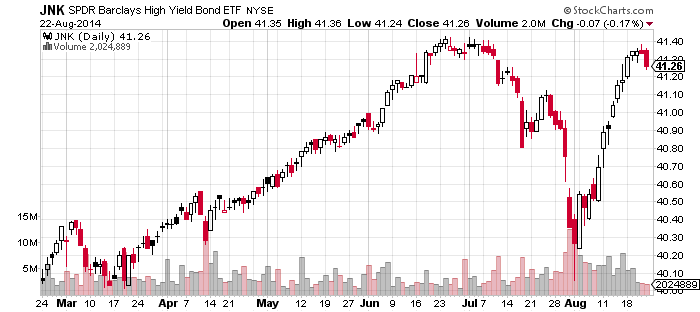
If JNK’s collapse in July was a true warning, then it should break down again here. New highs would invalidate.

25au1

The SP500 will either tip over here with a marginal higher high on multiple negative divergences, or it will ignore those indicators and cement an upward breakout.

22au15

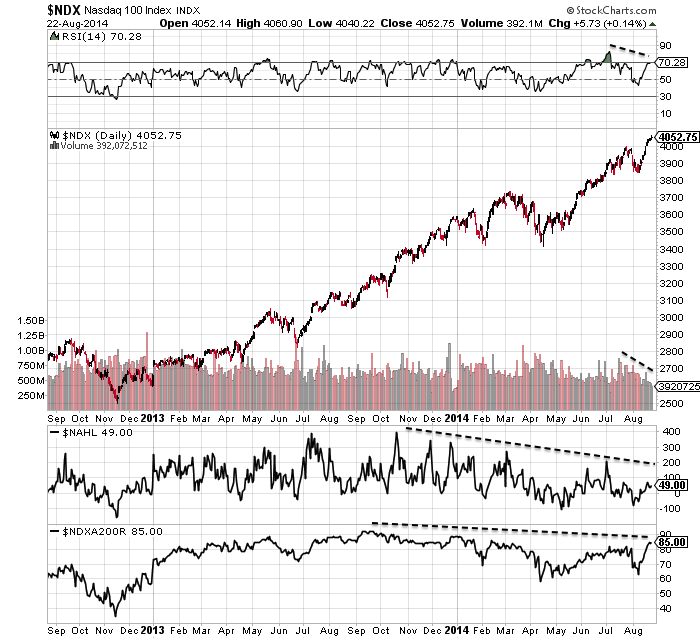
The Nasdaq indices are also operating on very clear divergences:

23au1 24au2

I believe the next 2 weeks will be highly revealing. It is the lunar negative fortnight and indicators argue for a retreat. DeMark sell signals were reached at the end of last week, whilst today is the new moon and the last likely seasonal peak of mid-year. If stocks retreat from here it will make the SP500 breakout a fakeout and Dow will put in a lower high than July. The February/March peak in speculative indices and sectors and margin debt will likely be maintained. All those indicators that have been screaming ‘correction’ will move further towards validation.

If, on the other hand, stocks rally this week and next and various speculative measures break or cement upwards, then the melt-up alternative will gain weight. At that point I would consider stopping my positions, moving aside and waiting, because it would put great doubt on the epicentre of the top as the speculation peak of Feb/Mar with margin debt, IBB, SOCL and RUT.

Some further charts to consider:

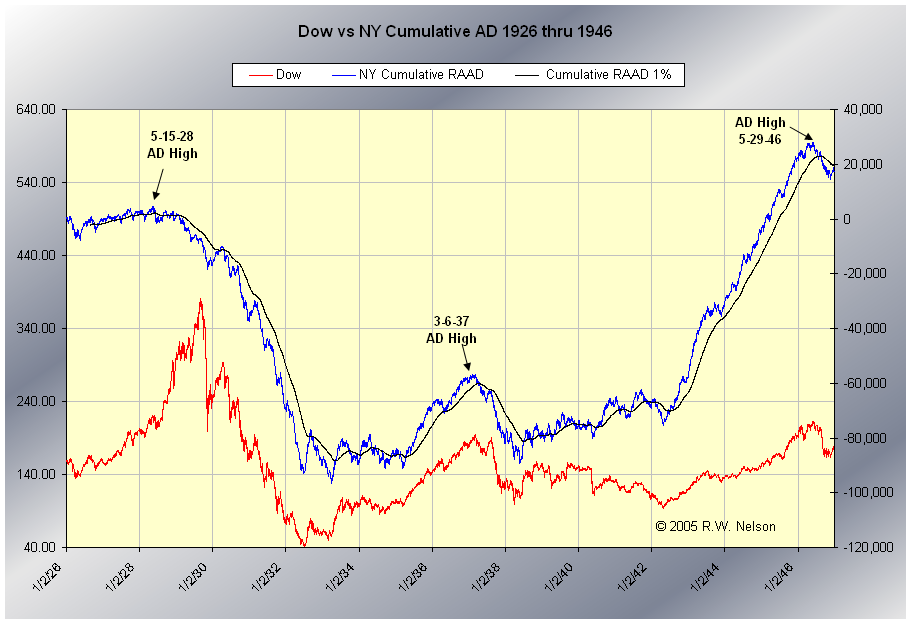
The Nasdaq chart above shows advance-declines have diverged. But NYSE advance declines continue to rise in line with the SP500. Does it need to diverge too before we see a proper correction? The chart below shows a divergence into 1929 but a simultaneous peak in 1937 and 1946. With other breadth divergences in play in 2014, I’m not convinced it does.

25au2

The Sornette bubble end flagged in July 2014, but the peak nominal level of DS LPPL reached so far is lower than for previous major events:

Screen Shot 2014-08-25 at 08.44.39

Screen Shot 2014-08-25 at 08.39.51 Screen Shot 2014-08-25 at 08.40.37 Screen Shot 2014-08-25 at 08.40.50

As the three historical charts show, the ultimate market peak was always accompanied by a spike in DS LPPL, just not necessarily the highest spike. That means either July was the ultimate peak, or stocks are heading higher and we will see another spike in DS LPPL ahead, probably to a higher intensity level.

Is the global economy chugging along nicely? Germany, Japan and Russia GDP readings came in negative for Q2, France flat. China’s housing market is dropping sharply:

25au7

Global leading indicators predict a growth peak at the end of Q3. Therefore, although the US has produced some recent good data, that may be about to roll over, and data from the other majors in turn worsen. Deflationary trends are strengthening again in 5 year break-evens and in commodities:

25au6

With Europe on the cusp of deflation, waning commodities prices may provide the tipping point.

I would argue that those who believe we need to see a series of rate rises before the bull ends are failing to see that we do not have the luxury this time. Rate rises help kill bulls because they help choke off the economy. The global economy is too weak for rate rises, the choking is occurring without them.

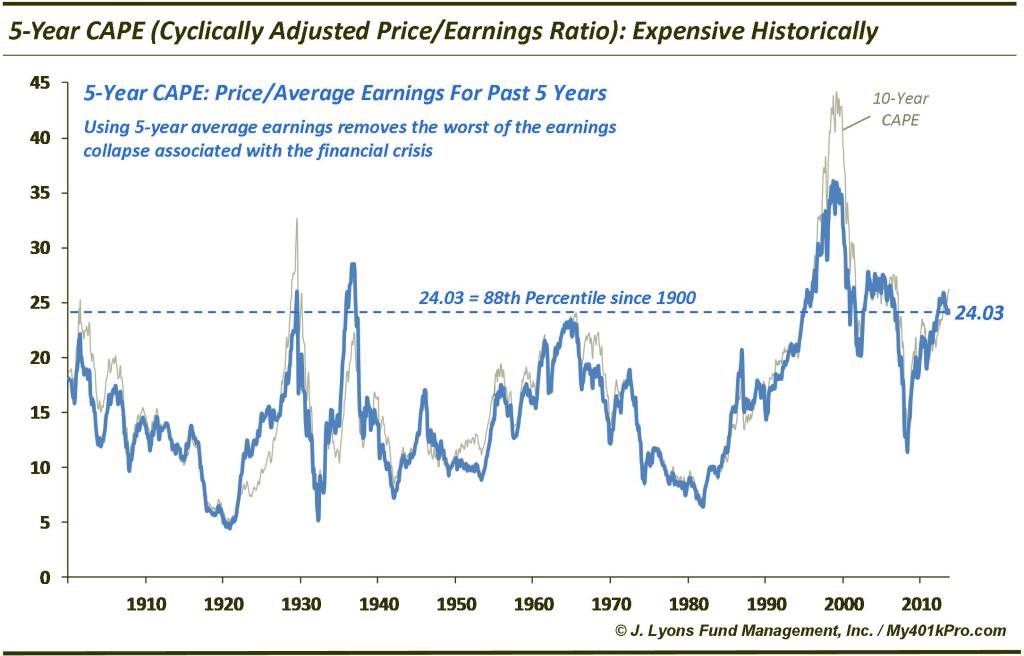
Lastly, there has been some debate about the validity of the high CAPE valuation for the market. So here is 5 year, rather than 10 year CAPE, produced by J Lyons as an alternative:

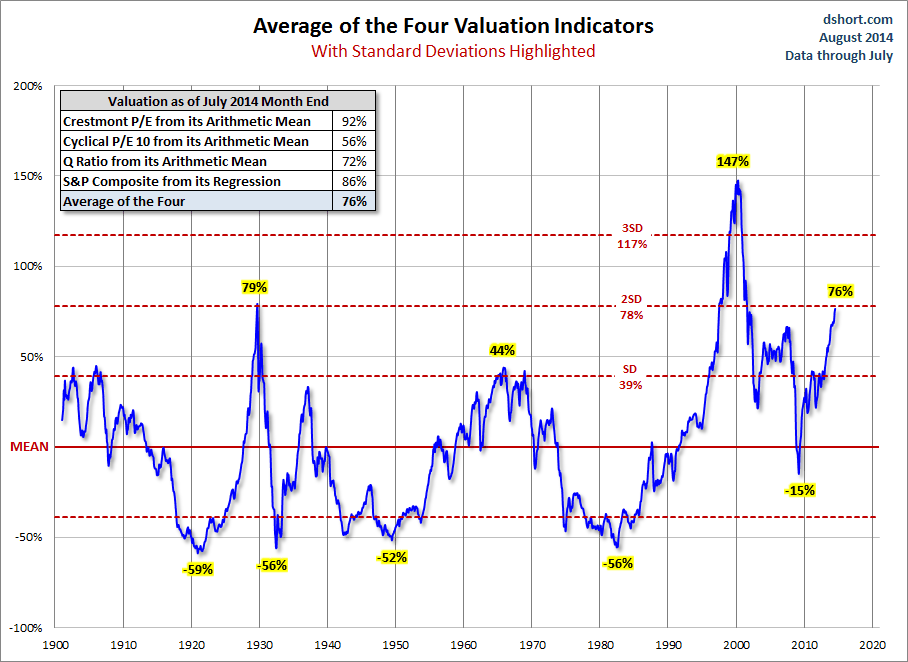
5au12It still shows us having reached the same overvaluation as the 1929 peak, and this is echoed in Doug Short’s aggregate of 4 valuation measures:

25au19

Which brings me back to alternative 2, the melt-up. Can we really challenge the biggest mania of all time without a demographic tailwind nor a booming economy, and from already-record leverage, sentiment and allocations? I find that extremely unlikely, but if we really can, then we surely equally see the biggest crash of all time as that is unwound.

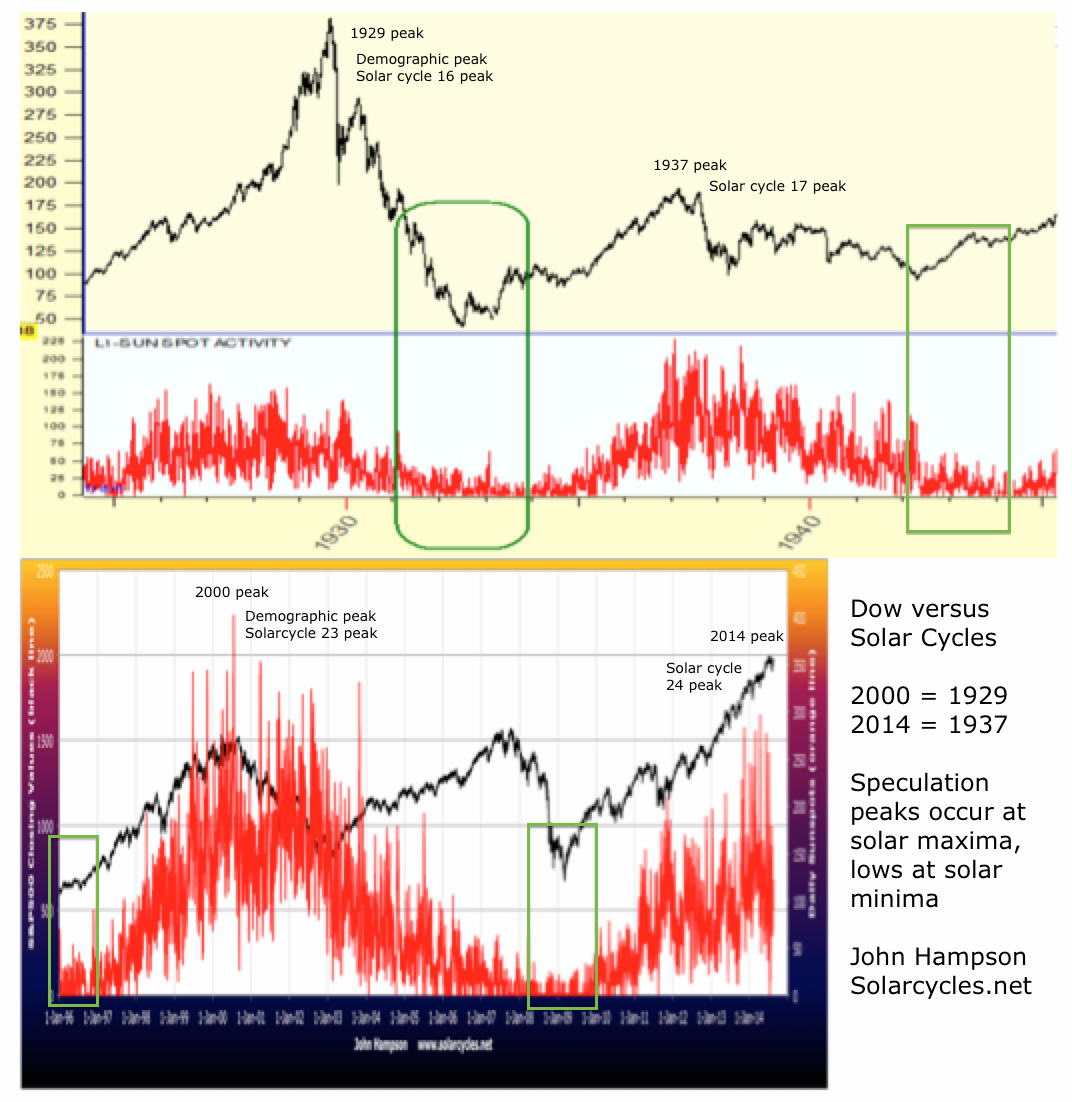
Instead, the evidence supports us being in a 1937 peak to the 1929 demographic/economic peak (1929 being 2000 in this case). 1937 did not see a parabolic blow-off, but rolled over with sufficient disconnect between valuations and the economy.

The evidence still supports us being here in the last gasps of a topping process that began Dec 31st with a peak in risk, then followed with a speculation peak in Feb/Mar, then a final peak in July. European indices appear to have decisively broken down, and US small caps are some way from their highs. The Dow broke down from its 2014 wedge in July, and volume has been very thin in US equities on this August rally back up. I have outlined my lines-in-the-sand above and see the next 2 weeks as the crucial confirmation or invalidation.

Short Term Update

With Monday being August’s new moon, we arrive at the last higher-probability topping point mid-year 2014 for those indices which have not yet topped out:

22au9

With SP500 and Nasdaq overbought and showing negative divergences, their breakouts this week have the potential to become fakeouts here.

22au10Source: Stockcharts

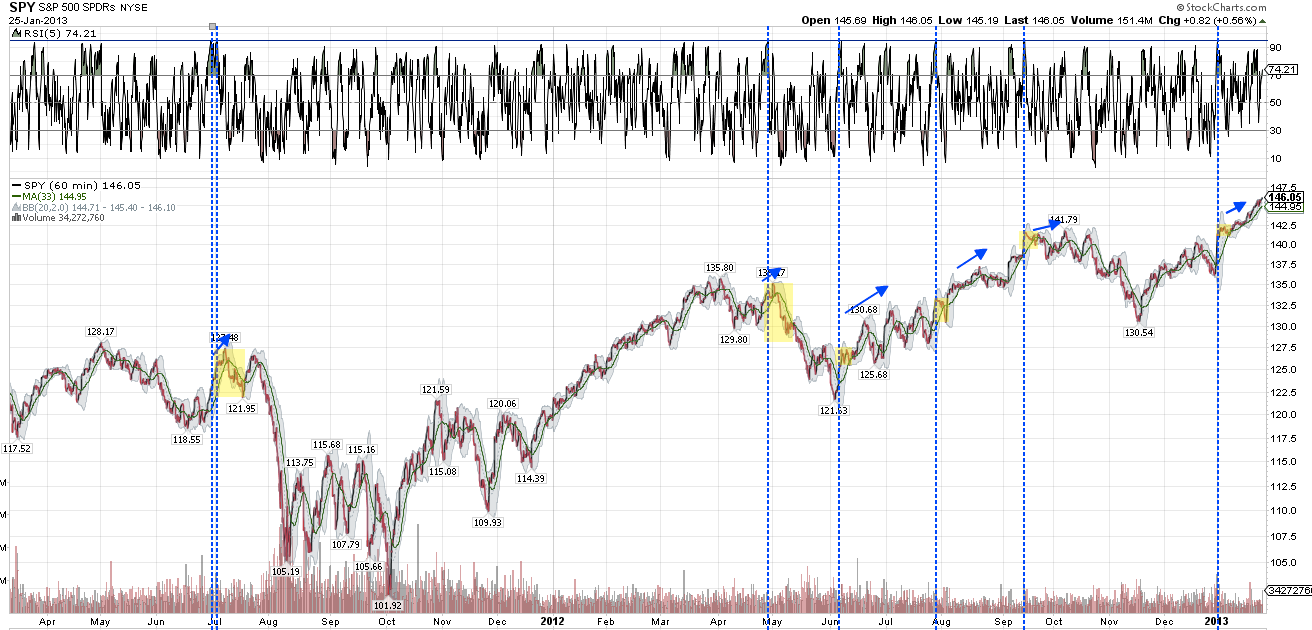
SP500 hourly RSI reached >95 and previous occurrences are shown in yellow on the two charts below, i.e. typically a pullback followed:

22au7 22au8Source: U Karlewitz

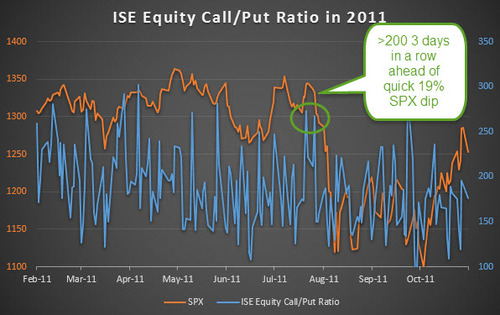
ISEE put/call ratio is 3 days over 200 and the last such occurrence led to a drop in January and the previous time before that in 2011:

22au2 22au3Source: Ryan Detrick

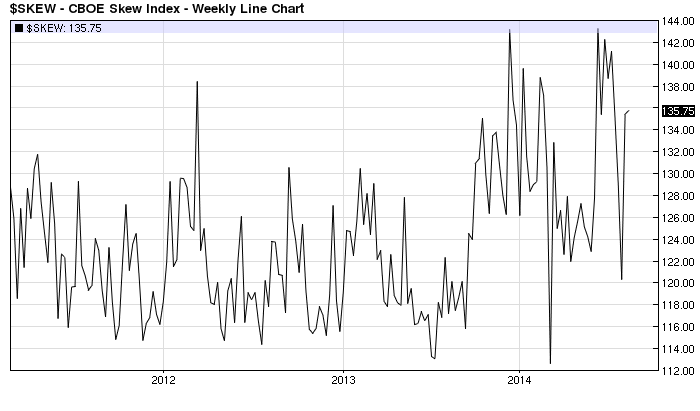
Thursday produced the most NYSE unchanged issues since 22 Feb 2007 (source: Dana Lyons), which could be a sign of complacency as last time it preceded a 3.5% drop on 27 Feb 2007. This is supplemented by Skew which is back at historical elevation warning of a potential big down move:

22au6Source: Big Charts

Nasdaq reached a Demark exhaustion sell signal on Thursday and SP500 is expected to today.

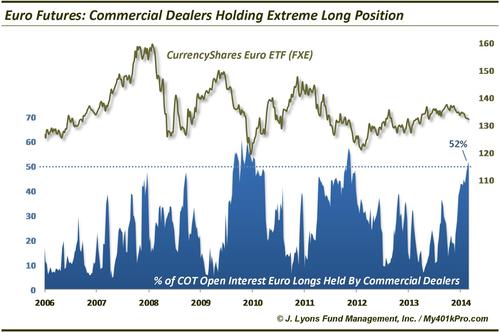
Gold has weakened as the US dollar has surged higher. However, positioning in the Euro, which acts inversely to the USD, suggests that may be about to reverse:

22au13

Source: Emma Masterson22au12

 Source: J Lyons

In short, we have the set-up for a reversal here in both equities and USD, for at least a partial retrace of the recent gains, and as we pass through Monday’s new moon the set-up looks good for a down week next week. Margin debt has yet to be released for July, but with indices overall down in that month I expect a decline. However, if stocks were to rally further next week it would raise a question mark over margin debt in August, whilst taking the Dow to new highs and cementing the breakouts of the SP500 and Nasdaq. Alternatively a down week next week should create fake-outs on the SP500 and Nasdaq and set up the possibility of a full retrace of the rally of the last 2 weeks. The negative divergences on the new marginal high in SPX versus the July peak support this occurring:

22au15Source: Stockcharts

Double Top Or Breakout

A double top here on the SP500 or another breakout to new highs? Below shows Aug 8th was another channel hold, so is it bull-business as usual or has something changed?

21au8

Source: Stockcharts

The vertical dotted lines show the last two times Nymo surged from oversold to overbought like now: one chopped sideways and one retreated. The CPCE and Vix indicators show that there were some changes under the hood in the last couple of months: possible capitulation in the Vix and big volatility in put/call. These developments may have meaning because the Sornette bubble end flagged at that time:

Screen Shot 2014-08-21 at 08.44.35Source: Financial Crisis Observatory

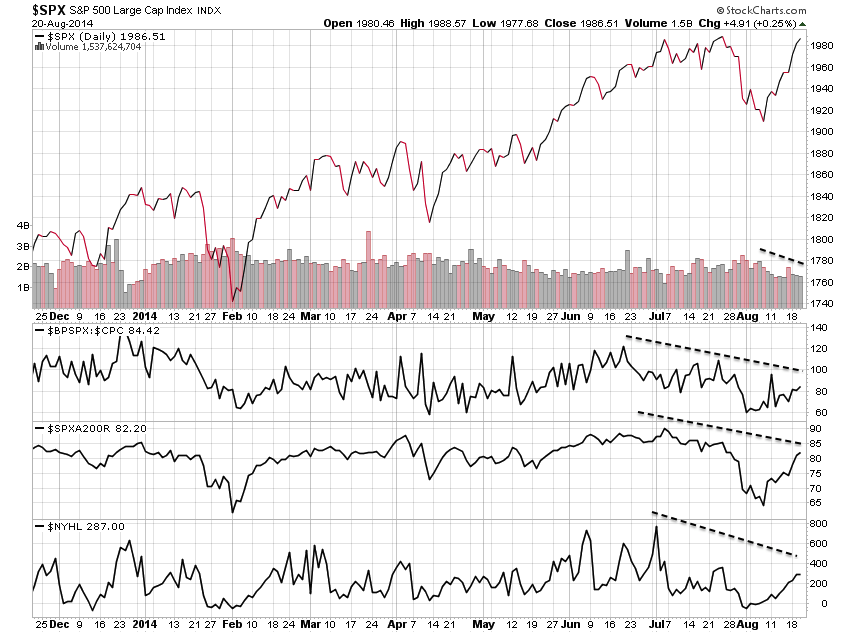
There are also several negative divergences now in place in breadth, bullish percent and volume, with the July peak:

21au9

Source: Stockcharts

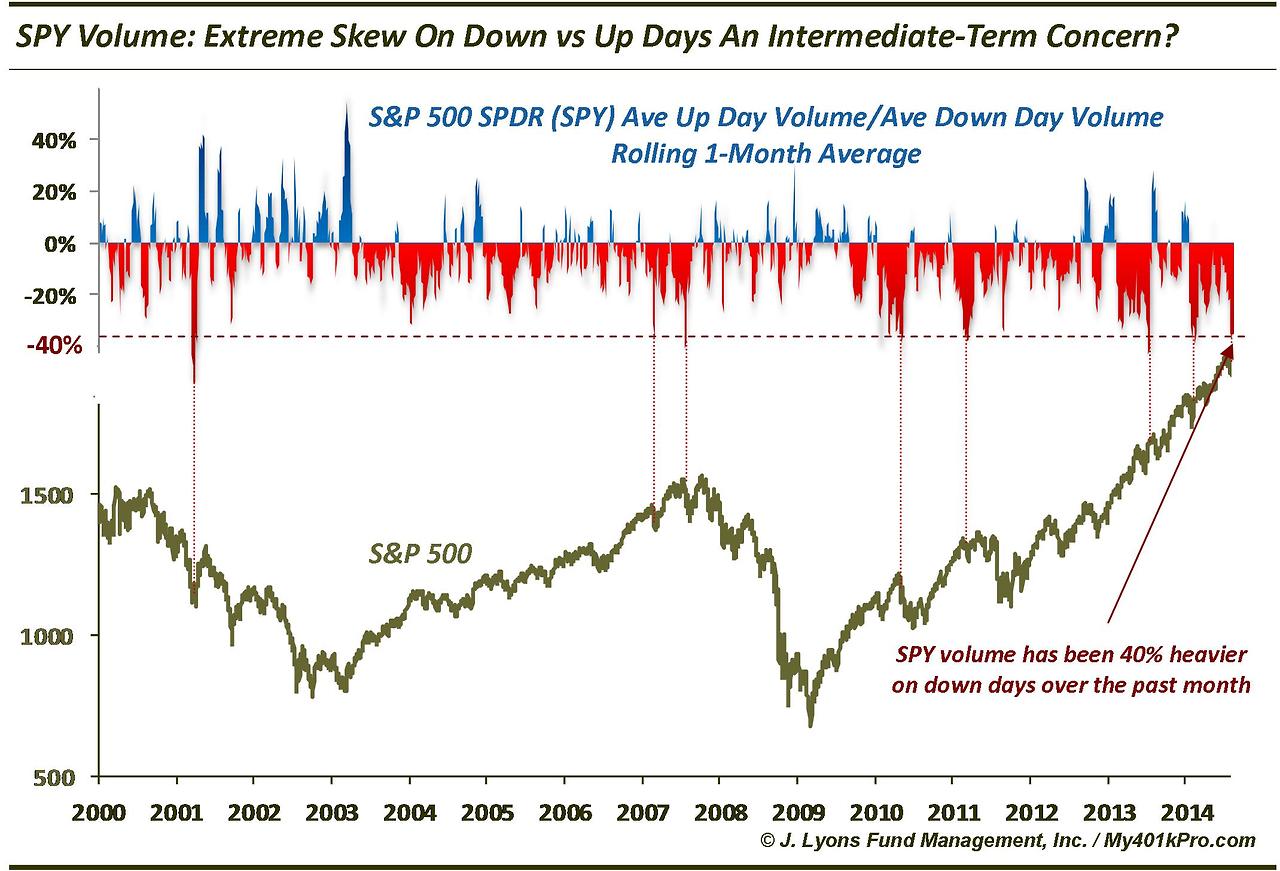
Volume has been particularly weak on this rally whilst continuing to be dominant on down days recently. The relevance of that is shown here, i.e. often associated with significant peaks:

21au1

Source: Dana Lyons

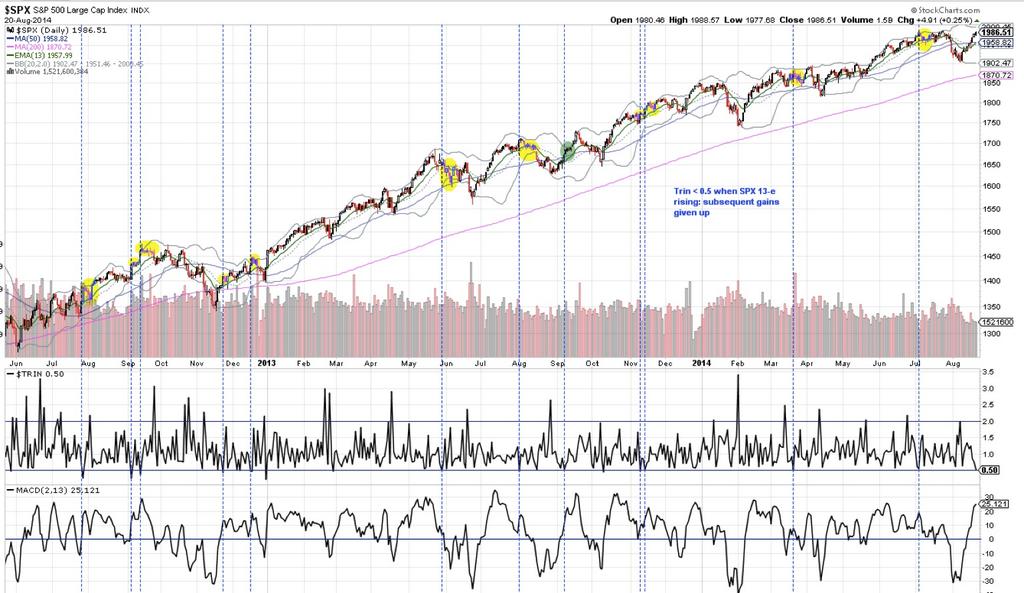
Trin closed low yesterday at 0.5 and suggests sideways chop then pullback may be next, previous occurrences in yellow below:

21au2

Source: U Karlewitz

The new moon is on Monday and therefore we might expect the markets to roll over after that.

The European markets were weak yesterday. Below is the German Dax performance relative to the SP500 over time. Such notable divergence has previously been associated with major peaks:

21au2Source: @Market_Time

US small caps underperformed yesterday and the Nasdaq gave back all its day’s gains in the last 15 minutes.

In summary, the stronger case is for the rally to end here. A marginal higher high on SP500 would not negate that. Around this weekend’s new moon is the most likely scene for that to occur if it is to. But effectively a double top, with indicators and divergences calling for chop-then-retreat or just retreat. The two longer term charts above add to the comprehensive case for this being a major peak, and along with Rydex, II sentiment, Skew, sector rotation and risk-measure peaks call for the top being ripe or through.

The evidence still supports the sequence of events: risk peaked 31 Dec 2013 (HYG:TLT, INDU:GLD, XLY:XLU and more); speculation peaked Feb/Mar 2014 (smoothed solar max, margin debt, IBB, SOCL, RUT) and the topping sequence completed in July (European indices, Dow, Sornette bubble, various indicator completions). So the last week in August – next week – is important. If it is an up-week then it will cast doubt on some of those peaks, if it is a down-week it will further cement them.

The united picture of solar maxima and valuations and the relevance of 1937 to now:

Screen Shot 2014-08-20 at 15.47.48

21au6

Failure High

The potential post-second-chance positioning was negated as the rally since the 8th August gained momentum, albeit out of hours momentum. So the question is whether this rally now produces the failure high second chance peak, i.e. a lower peak than July, and thereafter we tumble into the bear-controlled post-second-chance market.

Whilst the Nasdaq has made a marginal higher high, the RUT, DJIA and European indices are some way from their peaks and as we reach increasingly overbought here, the odds favour those indices turning down again to cement lower highs. Plus, the Nasdaq has made the higher high on negative divergences, making the potential to become a fake out. If that is to occur, and with the SP500 not far from its July peak again, a renewed move to downside has to happen fairly promptly. With the new moon several days away providing such a potential peak (an optimism peak), that now becomes my most probable case: markets topping by the end of this week, making a lower peak to July on the majority of indices, and a critical lower high / failure high.

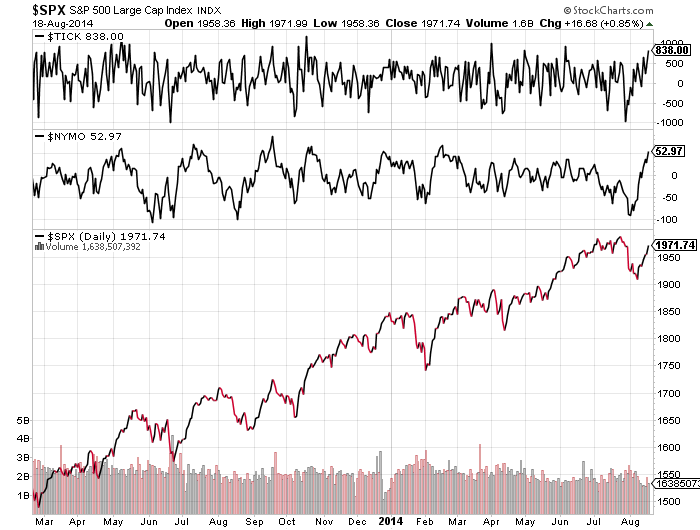
Tick and Nymo amongst those indicators showing overbought:

19au5

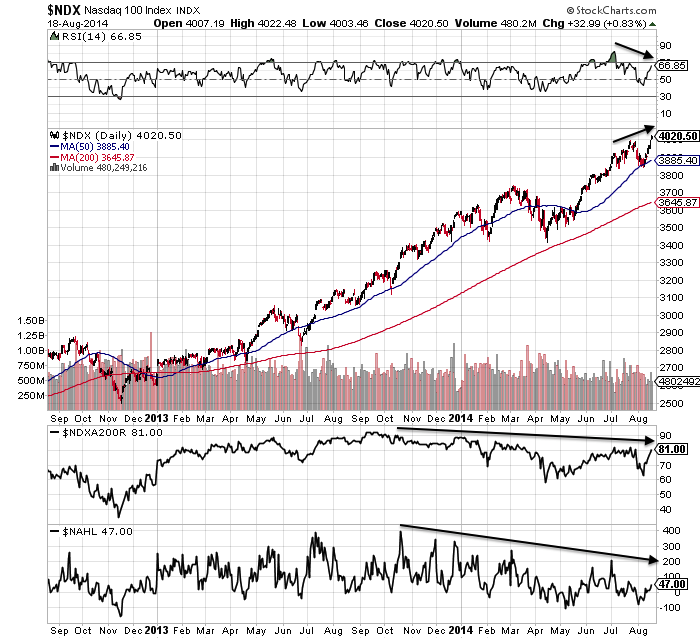
Nasdaq 100 negative divergences in place since late 2013, plus short term RSI divergence:

19au29

R2K, SOCL and IBB still peaked Feb/Mar but need to turn down soon to maintain the lower high / failure high patterns. A look at IBB shows the typical bubble model has played out and the short term RSI divergence shows the potential for another leg down. If that does occur, then it should be the major bear leg down. However, the recent rally has made the turn-down fairly urgent.


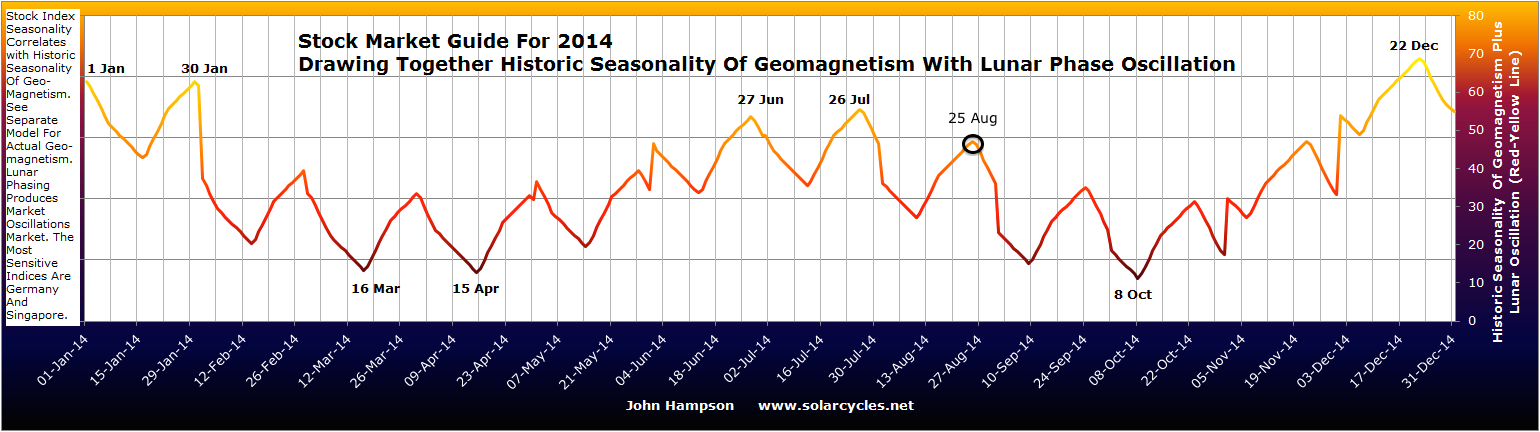
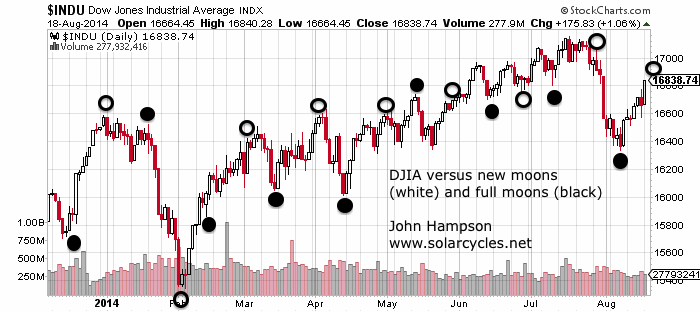
19au26 19au25The Dow versus lunar phase oscillation shows the potential for a peak around the new moon of August 25th, which would also likely be a lower high, adding to the case of the late-July breakdown:

19au27


The bigger picture argues that a major peak in equities is in, and if not in, then overdue. Ten different angles on a stock market peak produce a cross-referenced case:

1. HYG:TLT divergence at major peaks:


19au8

 Source: InflatedTemper

2. Implied correlation at major peaks:

19au22

 Source: Rory Handyside

3. Skew at major peaks:

19au23

Source: Rory Handyside

4. Sentiment at major peaks:Screen Shot 2014-08-19 at 08.26.30

Source: Ed Yardeni

5. Valuations at major peaks:

19au24


Source: DShort

6. Sornette bubble end flagged at the start of July:Screen Shot 2014-08-19 at 08.27.23

 Source: Financial Crisis Observatory

7. Various risk measures peaked, along with the Nikkei, at the turn of the year:

19au10

8. Rydex allocations echo the 2000 peak:

19au9

9. Sector rotation shows the two post-peak sectors of health care and utilities performing strongly relative to others:

19au2

 Source: Macromon

10 Sunspots continue to be in a waning trend since their February peak, and a smoothed solar maximum of Feb/Mar ties in with margin debt and hot sector/index peaks of Feb/Mar as the speculation peak epicentre:
Screen Shot 2014-08-10 at 16.30.44


To sum up, I am looking for European indices, RUT, SP500 and DJIA to make lower highs / failure highs / second chance peaks by the end of this week around the new moon, and thereafter break downwards into post-bubble-pop momentum, into the geomagnetic seasonal low of October. Past analogs show hard falls lasted up to 8 weeks, which ties in with the available window from late August into late October. The mulit-angled case is still strong for a major peak not just being at hand but being in already, and the out-of-hours, low volume nature of this rally since 8th August add to the likelihood of it failing and cementing the broad July final peak in risk, in a topping process that began at the turn of the year.

New Secular Stocks Bull

Is not underway:

14au22

Does not begin at these valuations:

14au16

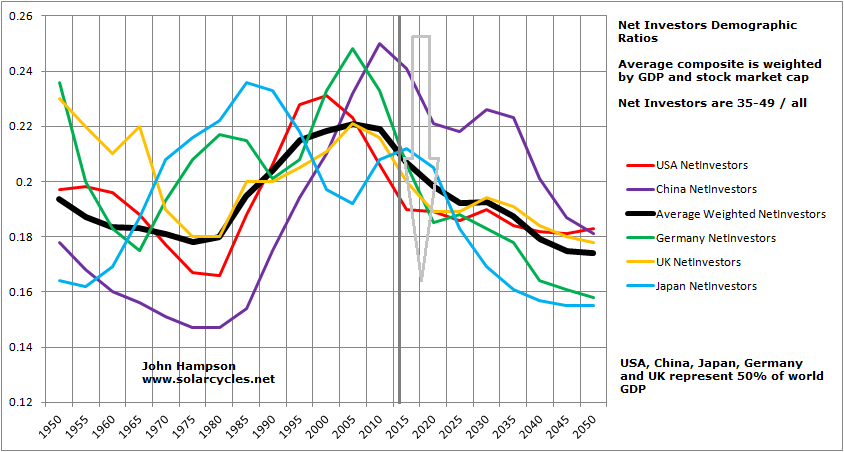
And can not occur under these demographic trends:

14au15

Rather, those charts collectively present the real story. This is a cyclical bull market peak (per valuations) within an ongoing secular bear that began in 2000 (per demographic trends). The inflation-adjusted SP500 and gradual downtrend in p/e valuations show the secular bear  in progress. The destiny (per demographics) is single digit p/es, in line with historic normalisation and necessarily befitting the greatest mania ever. The reason the cyclical bull peak is particularly high in nominal and valuation is the speculative drive of the solar maximum, with the current peak being one solar maximum after the mania peak, as 1937 was to 1929:

15au2


Turning to the near term. We’ve seen a partial retrace of the falls, but all the evidence suggests this will now roll over and firm up the new downtrend, the new bear market. On European indices the technical breakdown is clear and the current retrace barely a blip in the downtrend so far. Germany announced negative GDP and France zero GDP yesterday.

14au10

The SP500 now stands at twin resistance and this is an obvious point for the rally to roll over.

Screen Shot 2014-08-14 at 19.00.01A look under the hood shows that volume has been thin and waning each day of this rally, and the best performing sectors have been healthcare and utilities, the post-peak duo. US small caps underperformed, treasury yields made new lows and crude oil broke down yesterday – all risk-off developments. Therefore I expect bears to resume control today or Monday.