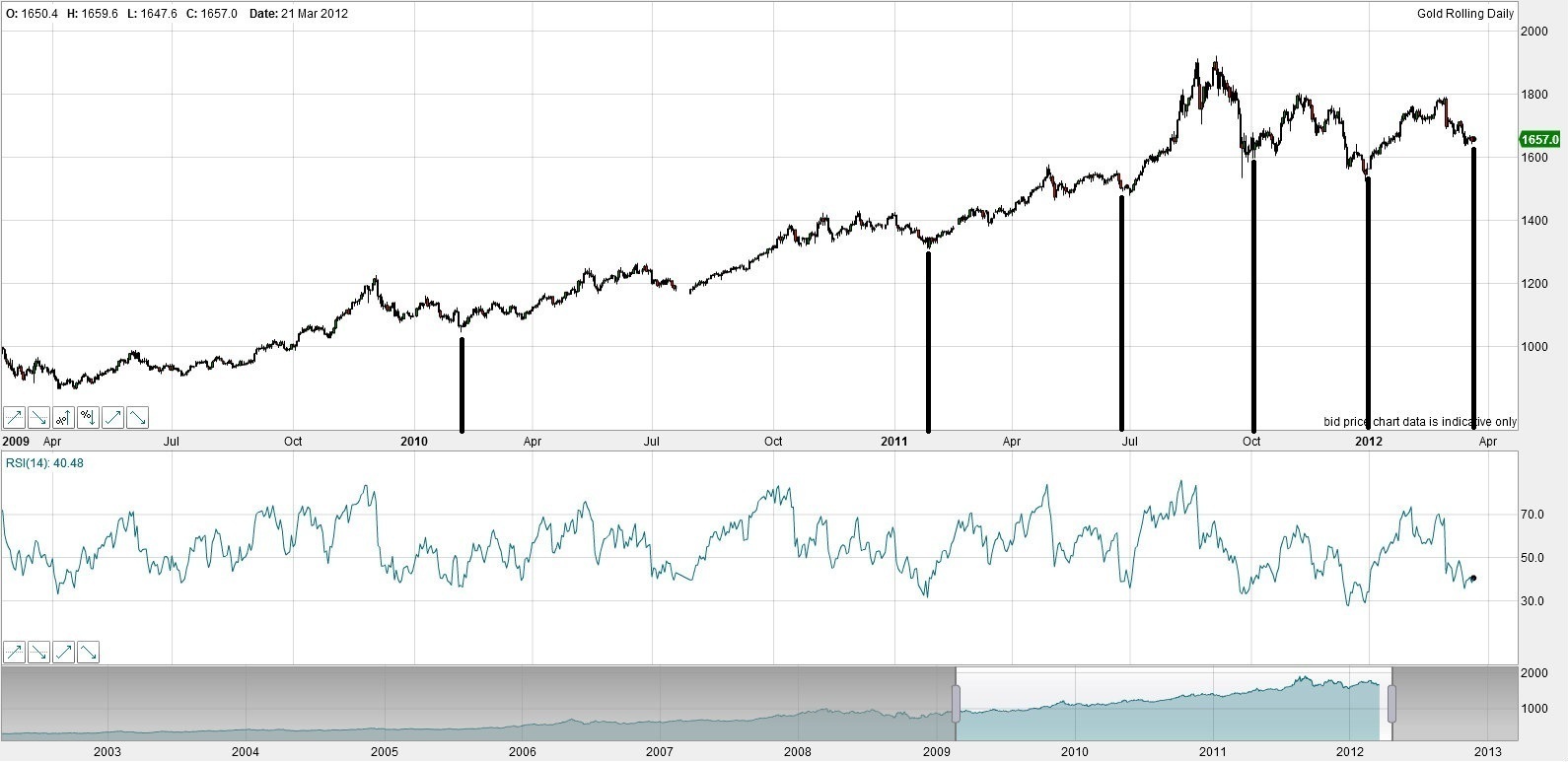
The Secular Position

What if I said the prices stock indices are at currently may never be seen again? I’ve not gone crazily bullish, but it is possible. Let me explain.

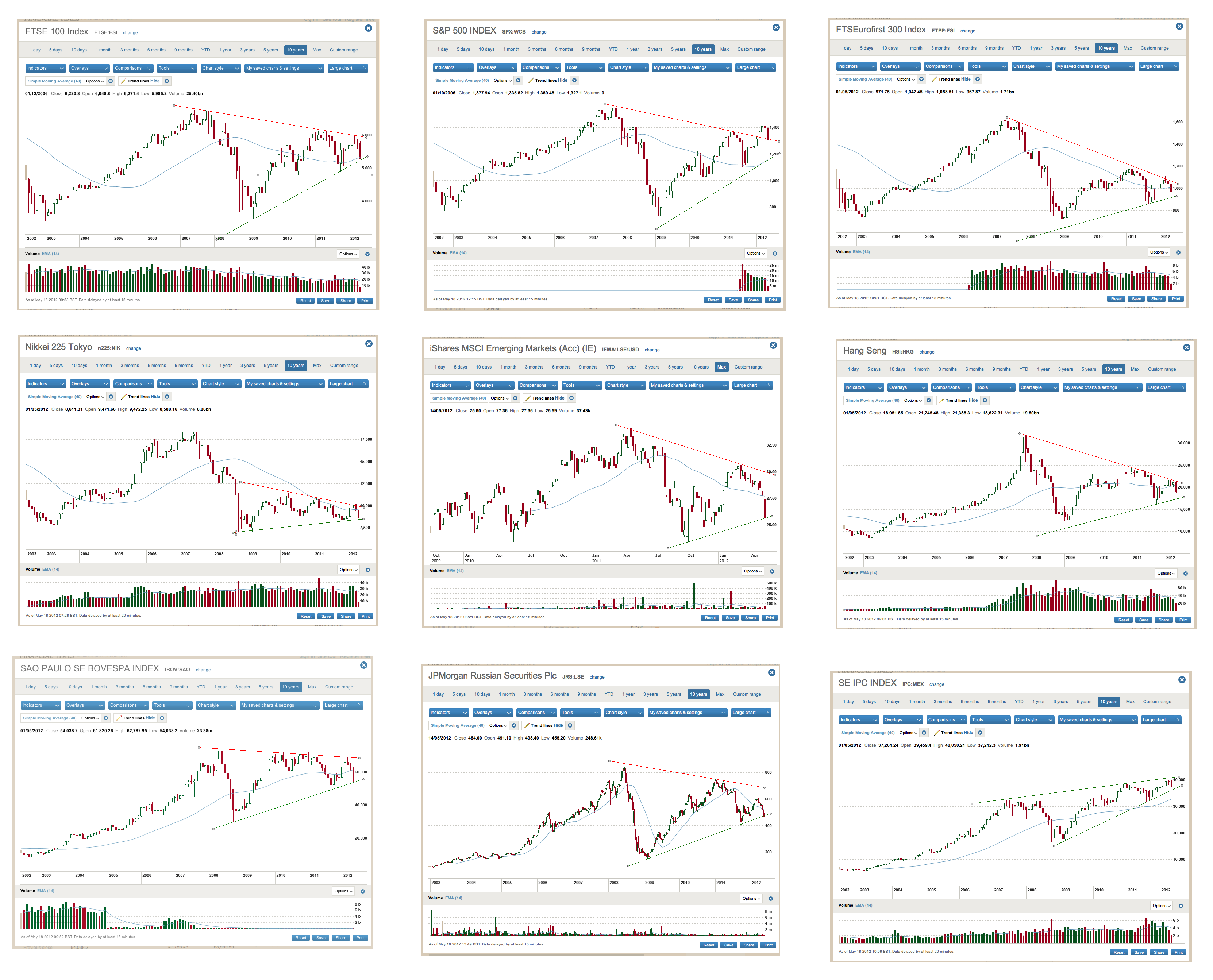
This is a compilation of global stock indices, provided by commenter John. They are all in large triangle formations. Symmetrical triangles following sideways action since 2000 is very much in keeping with previous secular stocks bears under permanent policies of inflation, namely sideways coiling.
Source: R Bowden 

So which way are they going to break? A symmetrical triangle forming following a sideways range gives no edge technically – it can go either way. But note that the S&P500 has broken out upwards and is backtesting the triangle, whilst the Nasdaq, not shown, is even more bullish than that.

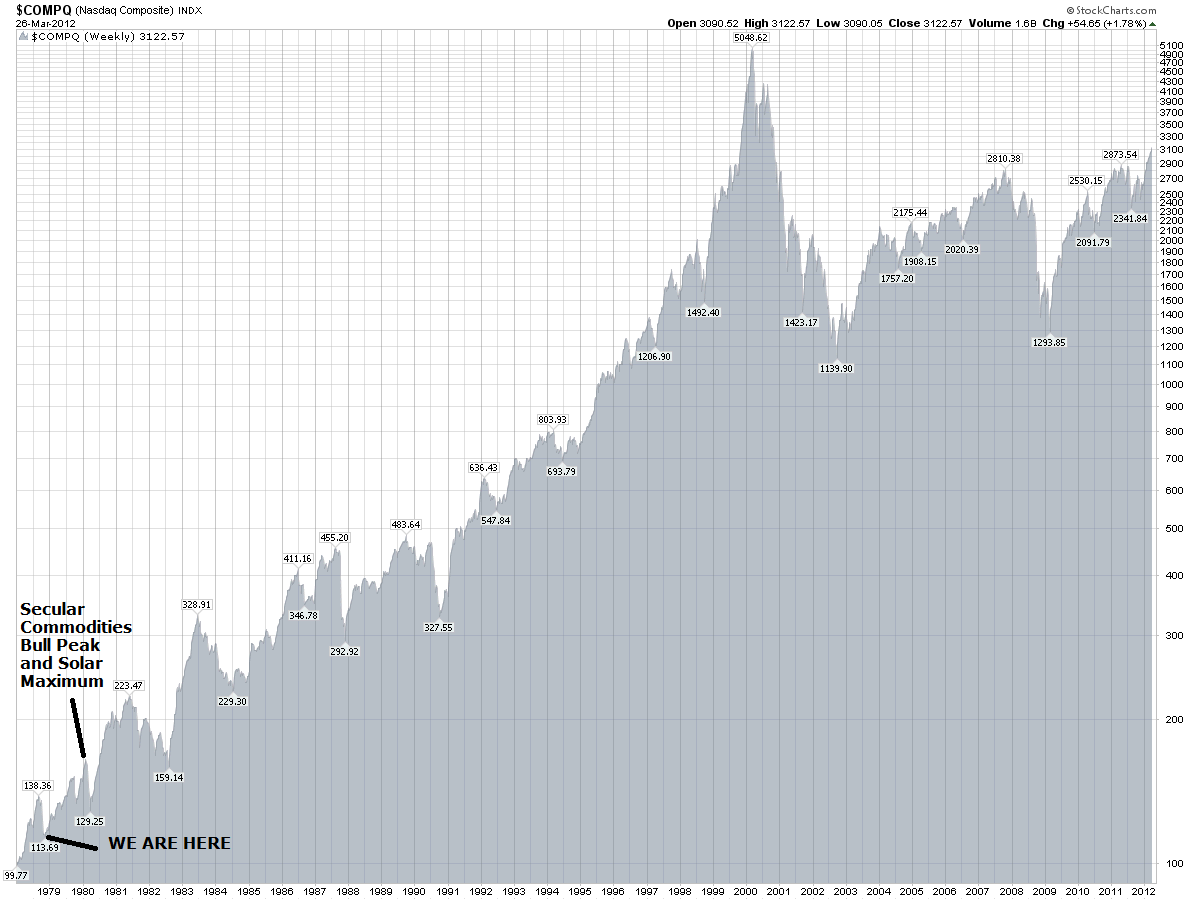
Below is the last secular stocks bear market. The secular/solar stocks peak of 1968 corresponds to the secular/solar stocks peak of 2000. The secular nominal / solar bottom of 74/75 to 2008/9. A large triangle formed (in red) and broke out to the upside. One year away from the solar/secular commodities peak of 1980 (like now, 1 year away from the Spring 2013 solar peak), stocks had also broken out and were backtesting the triangle – the We Are Here point. Now note that although stocks didn’t gain real new secular bull market traction until mid 1982 after the post-solar peak recession, they never got as low as that ‘We Are Here’ point again.

Underlying Source: Stockcharts

Now take a look at the Nasdaq at the same point. Even more bullish, much like today’s Nasdaq.
Underlying Source: Stockcharts

Cross over the pond, and the FTSE 100 did make slightly lower lows after the current equivalent point, but only marginally.

Underlying Source: Sharelynx

A look at the FTSE All Share paints the same picture: barely new lows after this point.

Underlying Source: Thomson Reuters

Looking at the secular bear market of the 1940s and the Dow Jones, stocks did not take off in earnest until 2 years after the equivalent current point, but again barely reached lower than the lows made 1 year before the solar peak.

Underlying Source: Stockcharts

So, using secular bear market history as our guide and combining with the timing and influence of solar cycles, we have fairly bullish roadmap for equities from here forwards. Into a solar peak we see a speculative maximum, making for secular tops. It therefore follows that stocks do not decline into a solar peak even when it is a secular commodities solar peak (and this is reflected in my historical analysis of stocks returns into solar maximums), as the pro-risk sentiment prevails. But what’s interesting is that the post-solar peak recession and bear market didn’t do much damage. It reflects what I previously said about redefining secular stocks bulls as beginning at the nominal lows of 1942, 1975 and, I argue, 2009.

In past secular bears, the low point has come in the middle of what’s commonly understood to be the secular bear range, followed by a gradual process of repair. It therefore follows that the nominal lows for equities are successively higher after that point – e.g. between 1975 and 1980, between March 2009 and 2013. Right now, things look bleak. It seems that global growth struggles to sustain without central bank stimulus. Euro debt keeps returning to the fore despite government actions. Large companies are still going under as weak economies prevail. Yet, this is how secular stocks bulls begin – a huge wall of worry, which is dismantled piece by piece. They don’t start from everything being fixed, they start from a mess, but a mess where equities are historically cheap and a lot of excess has been purged from the system. All the last 3 secular bears have had more in common than differences: problematic inflation combined with sluggish growth, geopolitical disturbance, debt crises and the loss of companies and jobs. If it seems like problems are major this time round, it was no different back then. In 1979, the equivalent point to now, there were debt crises in Latin America and Korea and the USA had to raise its debt ceiling, much like today. In 1946, again the equivalent point, excessive war debts meant that interest rates had to be kept low, despite inflation, much like today.

At the turn of 2009, the talk was of total system melt down. Consider that the start of the huge wall of worry, the very messiest point. Now we are no longer facing total system meltdown but facing Euro debt contagion and economies seemingly dependent on central bank stimulus. That is an improvement on 2009, and the stock market (the US stock market) has doubled since then. There has also been significant cleansing and repair since then: bloated companies purged, house prices deflated to historical normal ranges, household debt burdens back to the levels where the last secular stocks bull market began:

Source: Scott Grannis 

Fund flows in equities have been negative the last 5 years and continue to be outflows. Retail participation in stocks still isn’t happening. Yet participation in treasuries continues to increase despite real treasury returns being negative. In other words, the fear of stock declines is so great that people would rather be parked in something paying a guaranteed small real net loss.

Source both: Scott Grannis

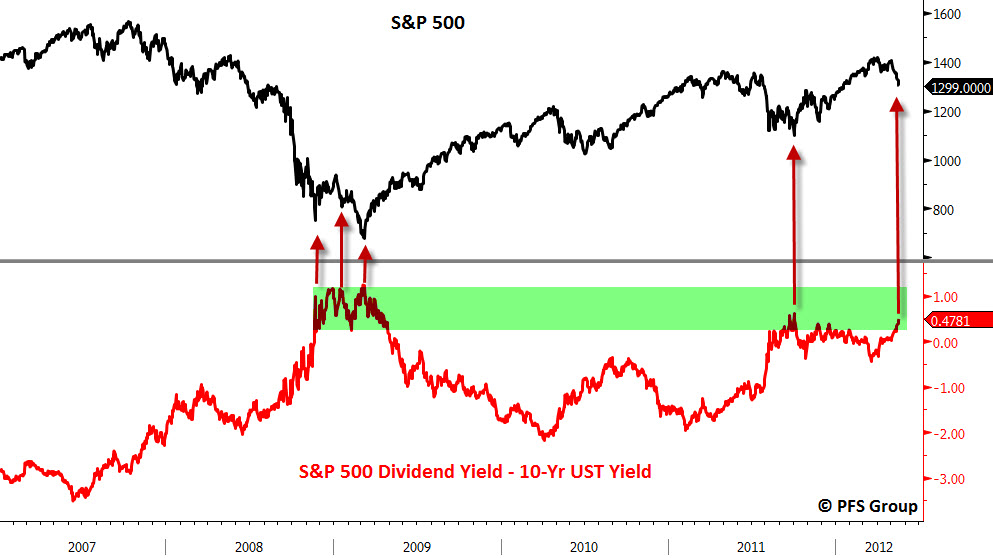
Stock dividends are highly attractive compared to treasury yields, back at levels compared to 2009. As it slowly dawns that stocks are going up, not down, money still start to flow the other way. Once that occurs the secular stocks bull will truly gain traction.
Source: Chris Puplava

Secular bear markets in stocks typically end with p/es in single digits. Current country p/e ratios that have reached single digits right now include China 7.2; Hong Kong 9.2; Norway 9.6; Russia 5.2; Singapore 8.9 and UK 9.7. Others aren’t there yet, such as US 14, Brazil 10, Germany 11, Australia 13 and Japan 14, but after the next bear and recession, circa 2014 by solar cycles, I expect them all to be there. Consider that US stocks topped around p/e 40 in 2000 – again, that’s quite a process of repair.

Once the natural cleansing cycle is close to completion, genuine global growth will get going again, without central bank support. Technological evolution will be the engine. Excess debt may have been transferred to government balance sheets, but the major economy debt to GDP levels aren’t at crisis points. Once revenues pick up and central bank support diminishes, the rate of balance sheet expansion will slow. Euro debt and the Greece situation needs further counter action currently, but governments have made it clear, both in words and actions, that they will step in to prevent worst case scenarios.

In short, I acknowledge the seriousness of the issues we face right now, but also the intent of global leadership. Most importantly though, history reveals that it is normal at this point in the secular bear to still be facing such challenges and that despite the challenges (or even thanks to them: wall of worry) we should be looking up, not down for equities. I’m not implying that all-in on equities right now is the way to go. Commodities should make their final blow-off move into next year, making them more attractive than stocks over the next 12 months, and thereafter a bear and recession should eventually provide the final great opportunity to get into equities. But there is a chance, even a likelihood, that the low in equities at that point will be higher nominally than now, which makes me reflect on all the long positions I took last week in equities.

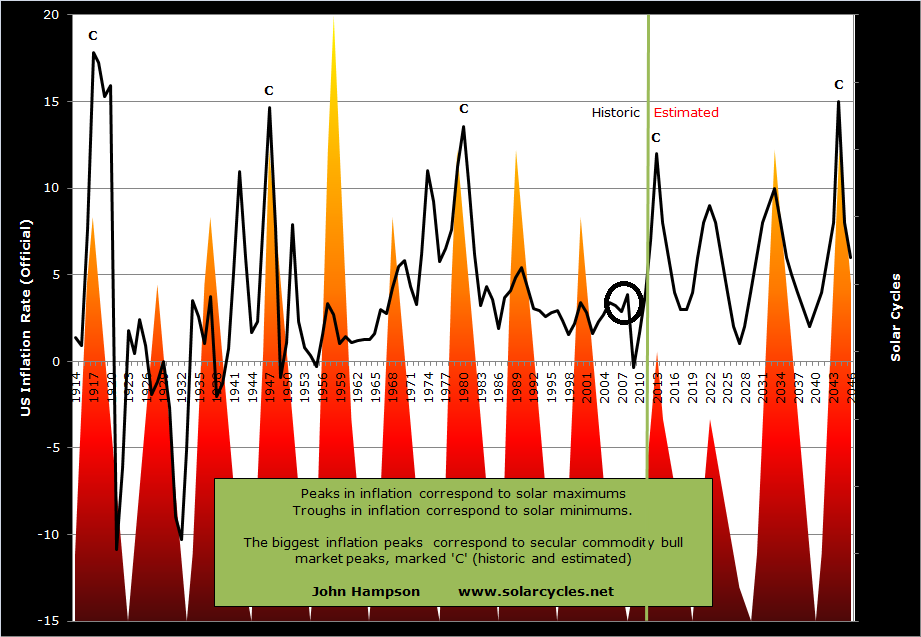
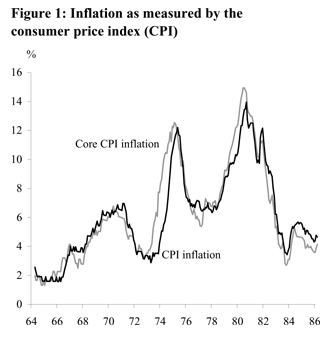
Turning to commodities then, and using history as our guide again, there was a peak in inflation in 1942 and a higher peak in inflation in 1947, the solar / secular commodities peak. There was a peak in inflation in 1975, and a higher peak in inflation in 1980, the solar / secular commodities peak:
Source:  FRBSF

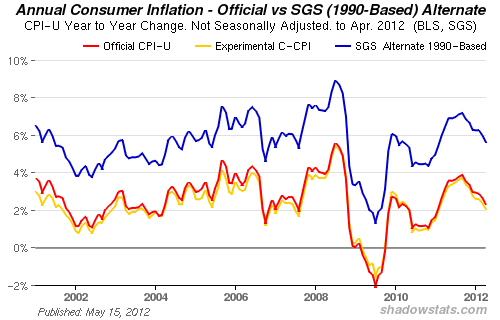
2013 is the forecasted solar peak, inflation peak and secular commodities peak by solar cycles. We saw the first inflation peak in 2008 – which would be 5 years prior, just like in the 1940s and 1970s. The chart below shows the 2008 peak and our trending upwards since then again, despite the ‘deflation’ chatter.
Source: Shadowstats

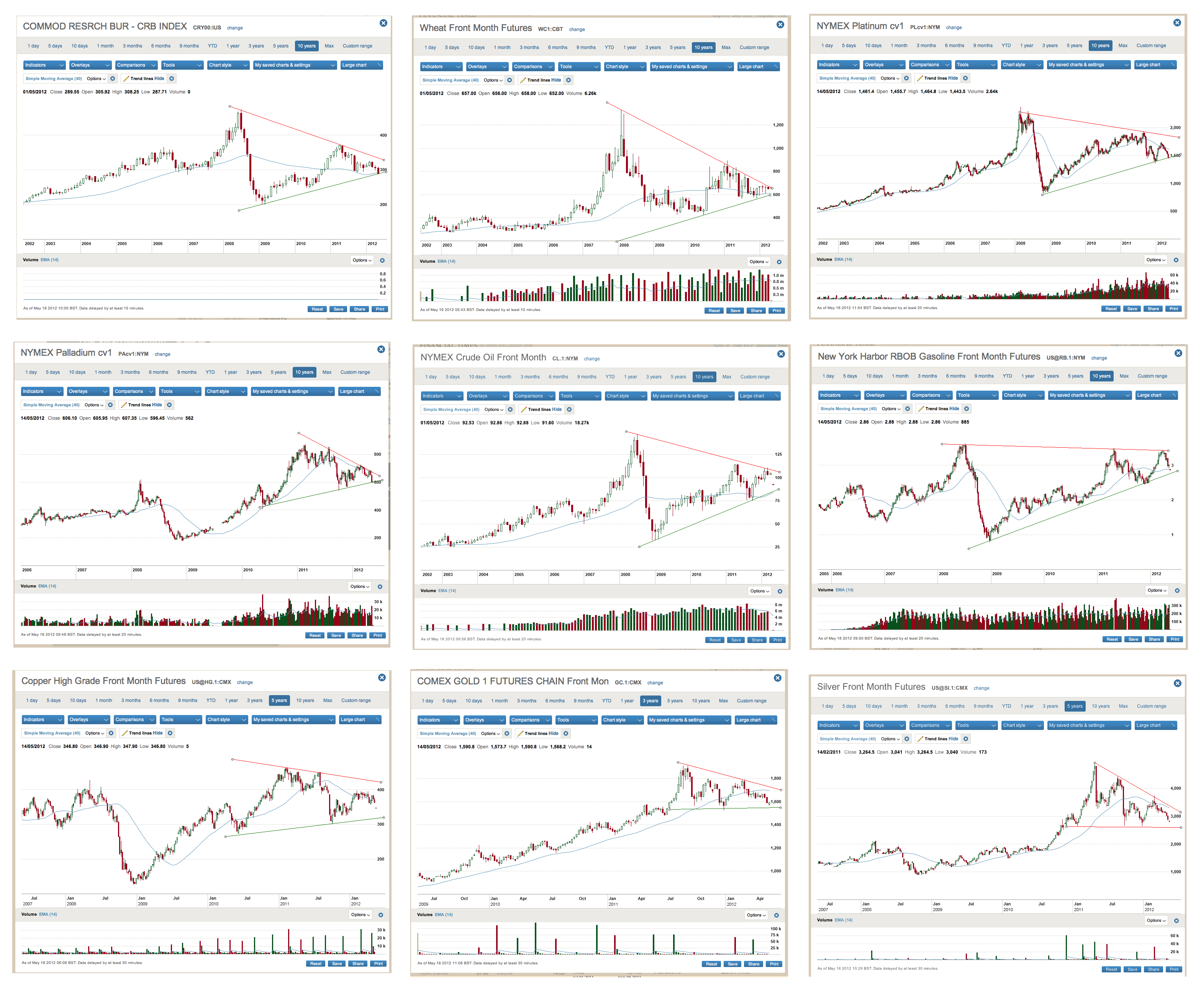
Now look at the commodities charts, courtesy of John again. Large symmetrical triangles, like stock indices, but the difference is that these formed in upward rising trends in place since 1998/2000. By the book, that makes them more likely to be continuation patterns. I believe they will break out upwards, and when they do, they should make the acceleration into the secular /solar peak, fulfilling the inflation prediction at the same time.
Source: R Bowden

Opportunities

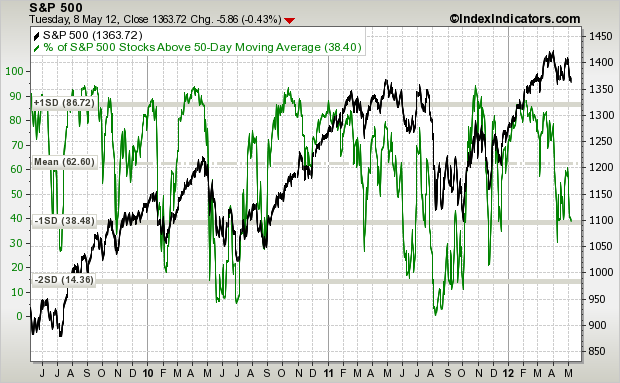
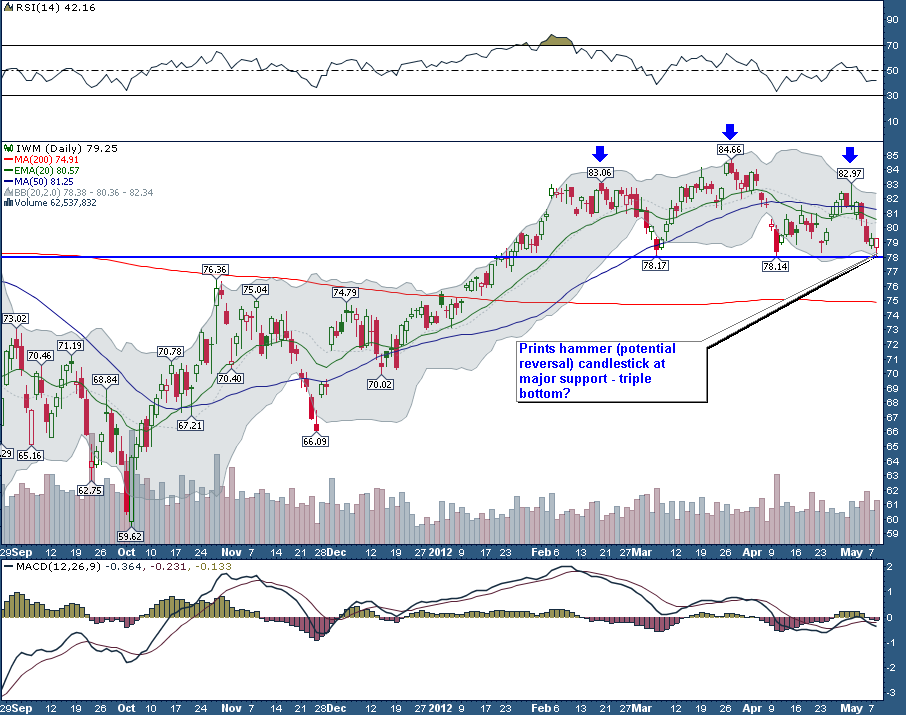
More selling yesterday, but then intraday reversals that produced hammer candles (stocks, oil). Hammer candles often mark bottoms, but capitulative breadth still didn’t trigger. Ryan Puplava compiles some oversold indicators and divergences that are suggestive of an imminent rally, but he also notes that market breadth has weakened.

This is how the SP500 stands. There is a trio of supports coming together around 1341, if we head lower, and that would potentially put us sub RSI 30.

The Russell 2000 has either made a triple bottom or is playing out a large head and shoulders to a considerably lower target.

Source: StockSage

Stocks are reaching towards overbearish but sentiment could drop lower yet before a reversal.

Source: Stockcharts

Stocks are heading towards oversold, but could also drop further yet to reach extreme.

Source: Indexindicators

The Chinese stock index needed to make a higher high to confirm a new bull trend since the start of 2012 but has pulled back at a double top, shown. If it can break out, it will be suggestive of China growth and associations with commodities.

Source: Bloomberg

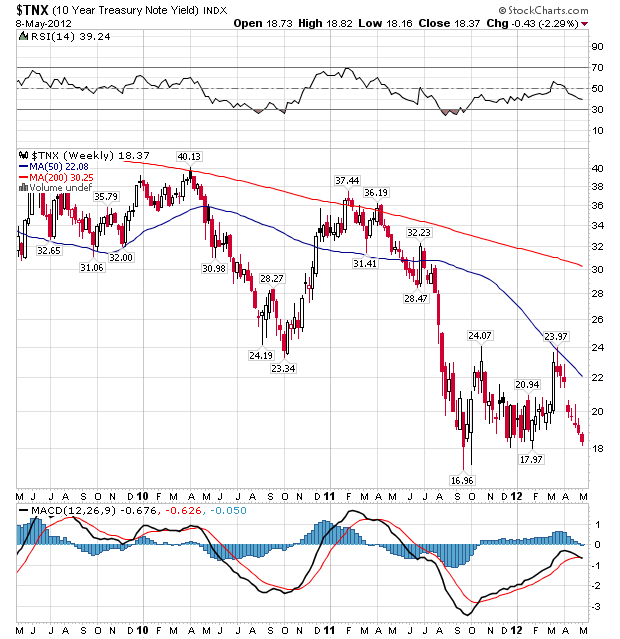
10 year treasury yields are back to all time lows.

Source: Stockcharts

30 year treasuries back to all time highs.

Source: Stockcharts

I have added to short treasury positions. Doug Kass is bearish on treasuries here (hat tip Juan), calling it the trade of the decade.

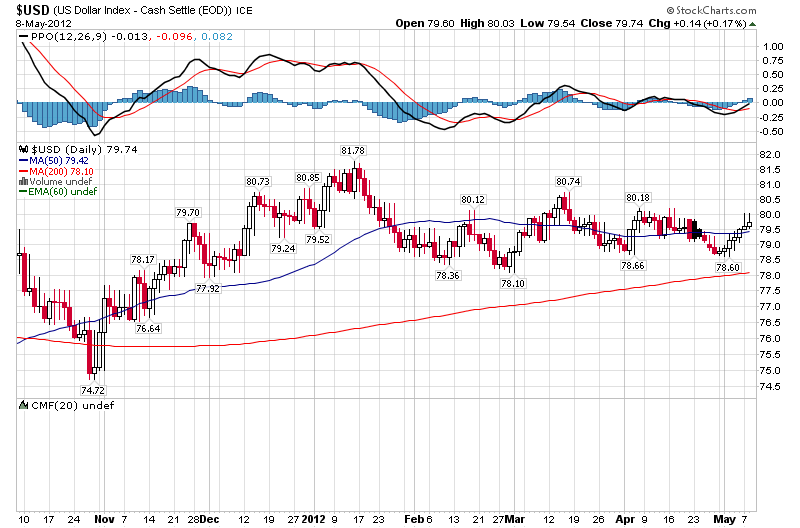
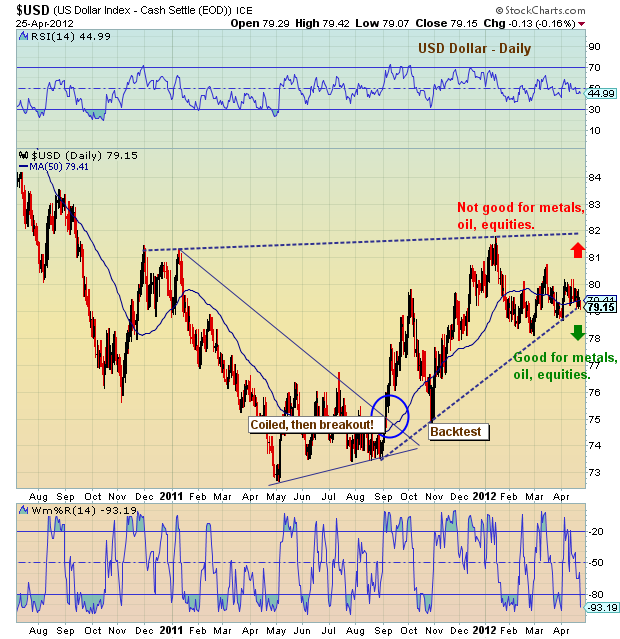
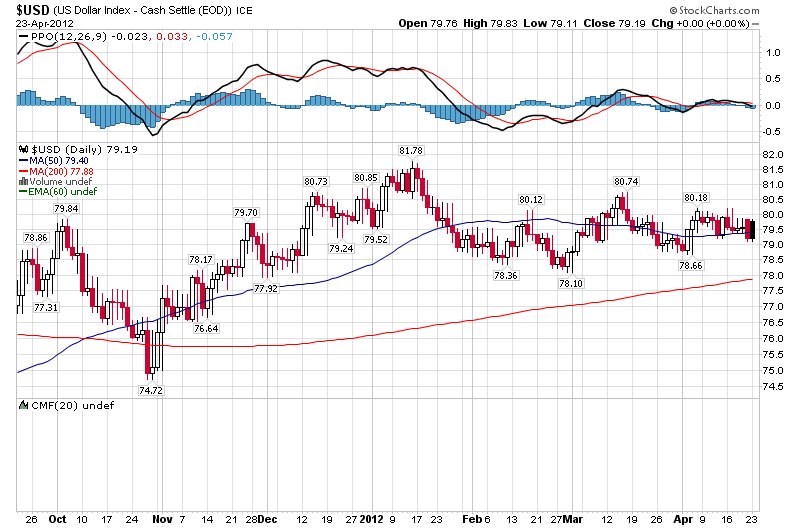
The US dollar remains in a range, despite the Euroland troubles. As yet this is not resolved.

Source: Stockcharts

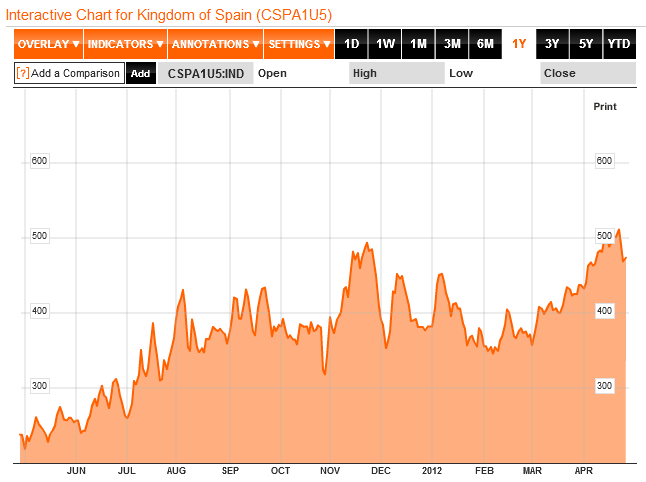
Spanish CDSs have nudged back up, but other than Greece CDSs, Euro debt hasn’t catapulted up again in this fresh round of fear.

Source: Bloomberg

Right now, it looks like 2010 and 2011 again – mid year pro-risk retreat with Euro debt back to the fore and slowing growth. I find it hard to believe we will see the same again, as the market always likes to surprise. So what if not that? Well, the run up into the solar peak is typically one of growthflation. The mid year should be lower geomagnetism, by seasonality, which is supportive. Sunspots should continue upwards, which is supportive. And stocks generally fair well mid year in US election years. I suggest therefore that we need either a natural pick up in growth here (economic surprises ticked up for all regions yesterday but we need to break the downward trend; China and emerging markets could take over as the driver) or we need central bank assistance, such as ECB action to deflate Euroland issues again, and the Fed to replace Twist in June. But either way, I rather expect we will see a more pro-risk friendly mid-year.

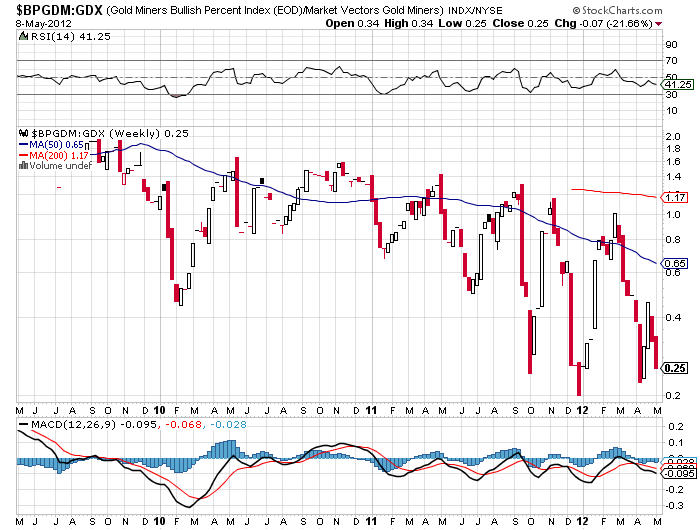
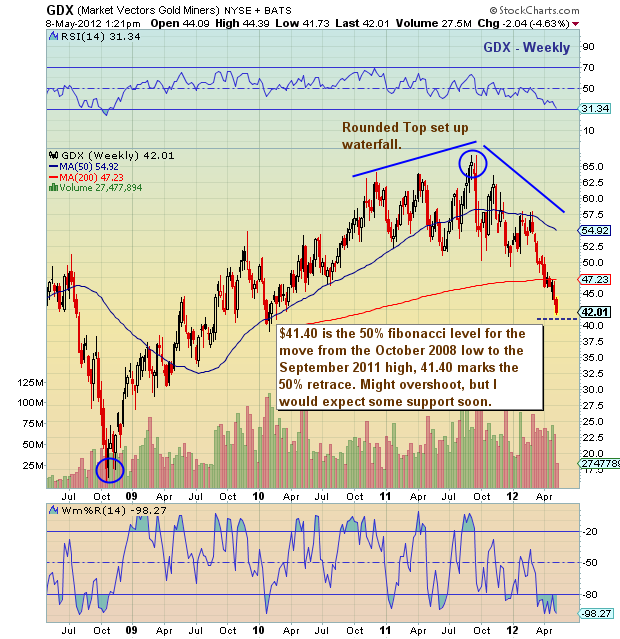
Gold miners’ cheapness relative to the gold price, overbearish sentiment and oversold RSI sub 30 make them still a great opportunity here, I believe. I added to long gold miners.

Source: Stockcharts

Source: Andrew Nyquist

Silver is sub RSI 30 and overbearish sentiment. I added to silver longs.

Crude oil is also oversold. I added to oil longs.

Orange juice has halved in price since the turn of the year due to ample supplies, but is now oversold and extreme overbearish. I opened a long OJ position.

Source: TradingCharts

Nothing (so far) has shifted me from my view of how things will play out into 2013, namely a commodities surge, and even if I were wrong, oversold AND overbearish assets eventually mean-revert. If we move further to extremes in commodities, treasuries pricing and sentiment in the sessions ahead I will add again. These are great opportunities, in my view. The picture for equities is more in the balance, with some indicators of a bottom but some reasons to expect further selling. Developments in the macro picture need close monitoring, as evidence of a pick up in data or government intervention could cause a surge, or equally, continued deterioration could cause a big sell-off.

Models Update And Commodities Peak

I have updated all the short, medium and long term model pages.

A quick recap. By solar cycles, commodities should make their secular peak close to the next solar maximum, expected Spring 2013 (within the following 6 months fits with history). In the run up to that point, we should see commodities outperform stocks by some margin, and we should see commodities pull away from the geomagnetism/lunar model. I am positioned for that, with a ‘full’ set of commodities longs.

Yet, so far in 2012, it is stocks outperforming commodities, and US stocks pulling away from the geomagnetism/lunar model, whilst commodities are closely following the model, which has recently been trending down.

Below I have boxed in black the outperformance of stocks into the last solar peak of March 2000. On the far right of the chart we see developments right up to date and observe that commodities have not pulled away in the same way yet, with just 12 months or so to go, in fact, stocks have pulled away in the last couple of months.

The purple box above shows the last episode of full commodities mania whilst stocks pulled back. This is what I expect into the solar peak. By history, stocks should track overall sideways from here into the solar peak, falling away towards the end, whilst commodities should accelerate into a final mania. That purple box lasted just 6 months, and drawing on history again, we might indeed expect commodities to accelerate as of 6 months before their peak, and go truly manic as of 6 weeks before their peak.

Right now, certain commodities display contrarian oversold and overbearish readings. That makes for a fairly compelling buy if I am correct about outperformance and mania ahead in 2012/2013. Gold should be the leading commodity in this Kondratieff Winter, and it is one commodity showing excess pessimism, with gold miners likewise.

Source: ActingMan / Sentimentrader / Hulbert

The reasoning behind secular asset peaks merging with solar peaks is that sunspots drive human exciteability which translates as speculation, buying and inflation in the markets and economy. Sunspots have been a little underwhelming in Q1 2012, but just lately picked up. If sunspots start to make new highs, then I expect commodities to begin their outperformance. But putting sunspots aside, let’s recall what happened in late 2007 and early 2008 when commodities went the opposite way to stocks.

Oil was the driving commodity. A decline in reserves, peak oil worries, Middle East tension, monetary inflation all played their part, and eventually a feedback looping of speculative greed dominated, until the global slowdown became more accute and commodities popped along with everything else.

Food prices rose to records, as oil is dominant in the process. Plus increasing demand from emerging markets and global wierding affecting harvests both shrunk stocks. Gold rose as an inflationary hedge, as a safe haven and as a hard currency.

In 2012, we still have low reserves in oil and agricultural commodities. Global wierding has been less extreme in recent months, depressing food prices as record harvests are expected from record plantings. Nature has the ability to deliver that, or to sabotage it and put low inventories back into focus. Oil inventories have been rising as global growth has gone through a slow patch, but emergency reserves remain low. Geopolitical concerns remain, but right now are more muted than, say, during the Arab Spring of 2011. Rising sunspots into the solar peak have historically correlated with protest, revolution and war, so again, nature has the ability to cause trouble here and affect oil prices.

There is a close relationship between food prices and the gold price (a chart I recently published), there is a correlation between oil and food, as oil is everywhere in the process, and there is a correlation between oil and gold, as oil drives inflation and gold hedges inflation. Farmers also switch plantings (foodstuffs, biofuel) depending on prices, adding to the interrelations. So, if we get a trigger in either energy, precious metals or agriculture, we may see the feedback looping begin in all three.

In summary, I reiterate my expectations for commodities to surge into the solar peak of 2013, and I maintain my trading positions to match, but patience is required as we could potentially not see true acceleration and outperformance until Q3 or Q4 of 2012. However, we see contrarian overbearish or oversold extremes in certain commodities now, providing a base from which to begin an uptrend, and a recent pick up in sunspots that has the potential to inspire speculation and potentially geopolitical disturbance which could drive up oil or gold.

Update

The Dow made a new high yesterday but closed beneath it. The other indices did not yet see new highs.

The Hang Seng has made a pretty compelling breakout – a successful backtest of a bull flag and then a pop today with China data good again and the Shanghai Composite performing well.

The threats of declining and negative Economic Surprises, weakening US leading indicators, and Spanish CDSs close to record highs, all remain. But for now, equities look technically bullish. I continue to expect some weakness to occur into this coming weekend, so let’s see how today unfolds.

The latest POMO schedule was released here and shows a programme of both buys and sales, not making much of a push or pull either way.

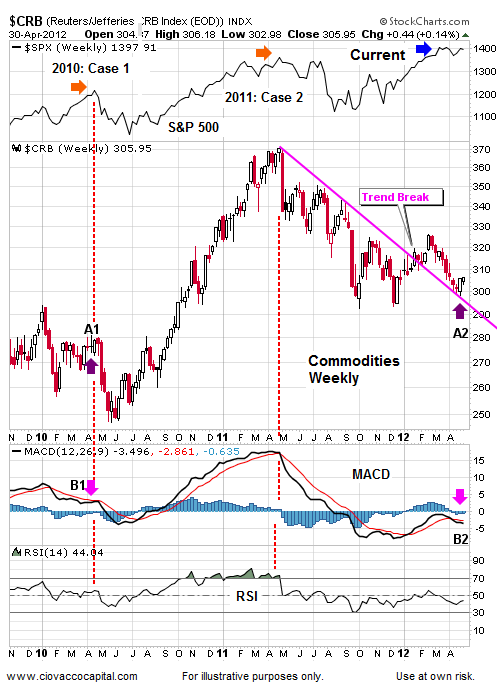
Commodities look to have potentially made an important trend break here.

Source: Chris Ciovacco

Certain commodities are still at extremes of pessimism or bearishness. However, yesterday’s positive US data and hawkish Fed tones have pushed up the dollar and pulled back gold. The commodities complex may struggle if that holds. Euro PMIs today may affect sentiment one way or the other.

In short, good reasons to fancy commodities here (China growth signals, excess pessimism), but as always patience may be required.

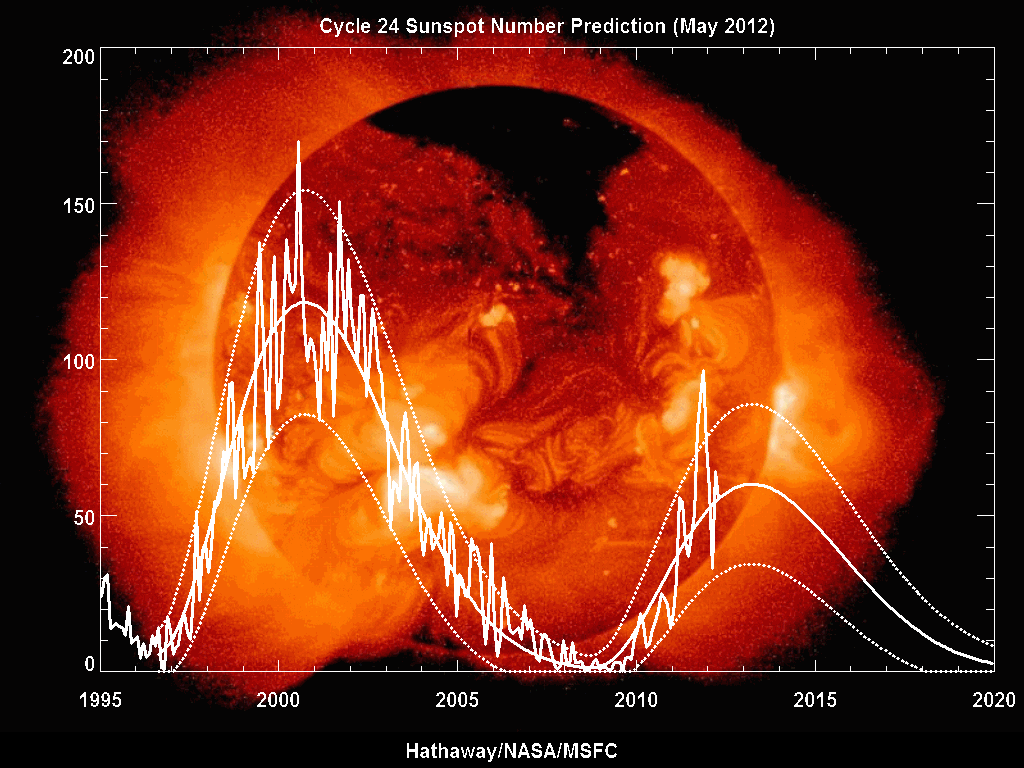
The latest solar maximum prediction from Nasa was released and continues to forecast a solar maximum in Spring 2013.

Source: NASA

In The Balance

The US dollar appears to be on the verge of breaking down, but it isn’t a done deal yet.

Source: Andrew Nyquist

The Chinese stock index is on the cusp of a breakout. A Shangai breakout and a dollar breakdown would really give commodities some acceleration. However, no China break out either as yet, and a reversal into the triangle is possible.

Source: Bloomberg

AAII bullish sentiment has really washed out, which is supportive for US stocks.

Source: Bespoke

European stocks are underperforming, and Euro debt continues to weigh. Spanish CDSs have eased a little, but only to just below record highs. I expect them to come again.

Source: Bloomberg

Economic Surprises continue to collapse.

Source: Bloomberg

Geomagnetism appears to have ebbed today, but 4 days of disturbance has tipped the model projection over to a slightly downwards bias, with particular downward pressure into next weekend’s full moon.

We have US earnings exceeding, a washout in bullish sentiment, and a double bottom on the S&P500 at the backtest of the 2011 old highs, together with a lack of major topping indicators at the 2012 highs, all supportive of further upside for stocks. Then we have collapsing economic surprises, Euro debt, and geomagnetism all exerting downward pressure. And we have the US dollar index and Chinese stock index both at crunch points.

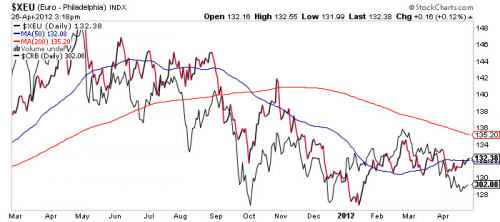
The combination of excessive pessimism in multiple commodities, higher sunspots which should encourage commodity speculation, and lagging in both Euro and Shanghai correlations as shown below, makes it likely commodities are about to perform.

Source: PFS Group / Stockcharts

If commodities are about to perform, then a breakdown in the US dollar and a breakup in China stocks would make sense, and those developments should in turn pull up equities too. But as yet we remain in the balance, and if we get movement the other way in the dollar/China, due to Economic Surprises, Euro debt, and/or geomagnetism/full moon then it may mean a little more time is needed. But to reiterate my expectations drawing together previous solar maximum / secular commodity conclusions, commodities should start to outfperform whilst stocks track overall sideways with volatility. I remain lightly long stocks and heavily long commodities.

On a personal note, Spring is here in the UK, and the outdoor pursuits are calling. I have a list of research threads to look into related to trading and the markets, some provided by readers, some of my own sourcing, but I expect to address them in the next off-season, towards the end of 2012. I fully intend to maintain posting and analysis several times a week, but additional deeper, original pieces of research are on hold for now, so if you put a suggestion my way, it’s on my off-season to-do list. The UK good weather season isn’t as long as some others, so time to make the most of it.


Update

The sun has woken up. Current sunspots are more in line with a rising trend.

A geomagnetic storm is in progress, so caution. But the extended geomagnetism forecast continues to show a flat to upwards trend ahead, which should provide support for risk assets.

I have updated all the short term and medium models, on their relevant pages.

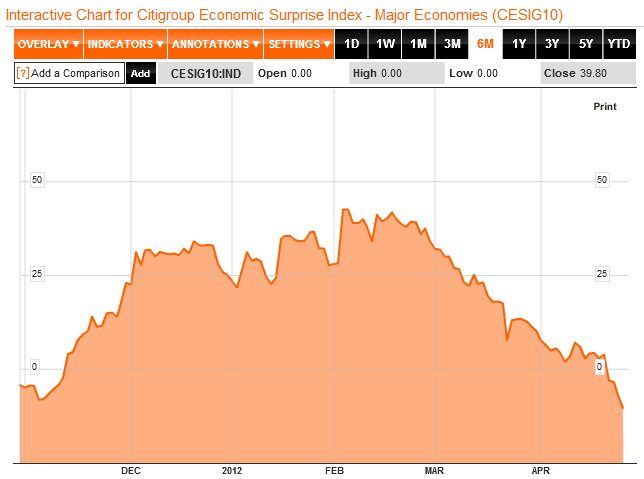
Economic Surprises for major economies finally went negative yesterday – a bearish development.

Source: Bloomberg

European PMIs were weaker than expected, suggesting Europe is not out of recession yet. Leading indicators for Germany and China came in positive.

The US dollar remains undecided in the nose of its triangle, but running out of room. I maintain the expectation that the FOMC outputs may push it one way or the other.

Source: Stockcharts

Spain, Italy and France CDSs continue to rise. Portgual CDSs have fallen away and out of the limelight. But the bigger trio have the potential to overwhelm the markets if this continues.

Apple earnings today after the bell.

Solar Peak Secular Asset Conclusion

Here is a table showing just the last 3 secular commodities bulls and associated solar maximums. I have created a forecast along the top row for the current cycle, based on them.

I found it help clarify what could come to pass. Gold could potentially not peak until late 2013. But peak inflation should occur fairly close to the solar peak, suggesting oil/food, at least, should surge ahead of that, and gold should be performing well by association. Real equities valuations could potentially not bottom for another few years, if a recession begins later or a double recession occurs. It doesn’t alter my strategy or positions. It perhaps implies a little more patience is required in seeing it all play out.

The chart below shows the current Dow chart overlaid on the 1980-82 Dow chart. 1980 was the US election year like now, and it was also a parallel secular commodities and solar maximum. A similar unfolding would see equities track sideways to upwards into the elections later this year, before down into their final low in 2014. I would note though that the solar maximum takes place after the elections this time, not before like back then.

Source: Charles Githler (Hat tip Juan)

Turning to the current markets, Tiho did another great summary yesterday at his Shortsideoflong blog, and my thinking is very much aligned with that. I will just add that I continue to expect a bit more pro-risk upside into this weekend’s new moon, so that means today, but I expect to keep my bounce longs as the upside hasn’t been decisive. As my equities longs are fairly small, I would happily add lower if this turned out to be an extended B wave in an ABC down. Sunspots continue to increase. Economic Surprises continue to flounder. Asia continues to outperform currently.

Solar, Earnings, Commercials

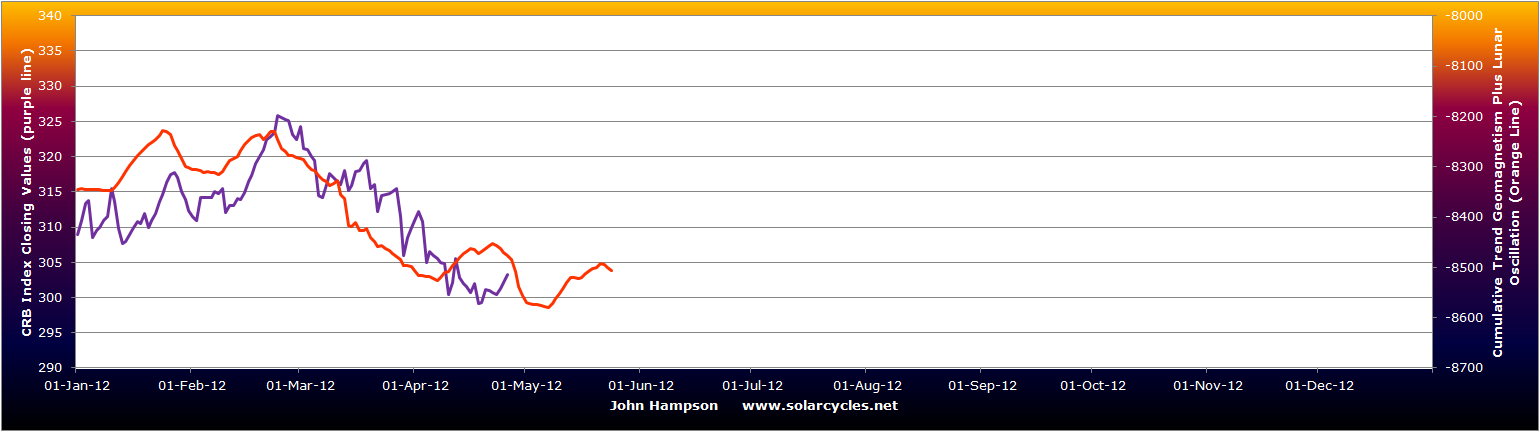
The R/J CRB commodities index now looks very close to the geomagnetism and lunar model in 2012:

It is a closer match than equities so far, which is in contrast to my expectation, as I predicted that commodities would pull away from the model into the solar/secular peak of 2013, whilst stocks would stay with the model. Well, that may still happen, and I believe there is a greater likelihood once sunspots pick up in a sustained way.

Above, we can see that sunspots are starting to trend up again, but we should see them push up higher and longer as we wave our way into the solar peak. That should in turn inspire speculation and inflation.

Scott Grannis has some useful insight into the apparently extreme US corporate profits. This first chart you may recognise, as its the one that suggests mean reversion should be imminent. However, the second shows corporate profits as a percentage of global GDP rather than US GDP, which shows US company profits closer to average. Because companies have globalised and emerging markets have grown faster than the US, the result has been a distortion of the first chart, with the second a more true picture.

Source: Scott Grannis

Lastly, Tom McClellan uses a model of Euro-dollar net commercial positions advanced by 12 months to predict the stock market (hat tip Gary), in other words, how the big commercials position themselves in this contract is reflected in the stock index a year later. If that sounds unlikely, here is his explanation: ” It may help to understand that the commercial traders of eurodollar futures are typically the big banks, who are using these futures contracts to manage their assets and fund flows.  So what we are seeing in their futures trading are responses to immediate banking liquidity conditions, and those actions give us a glimpse of future liquidity conditions for the stock market.  These liquidity conditions are revealed first in the banking system, and then the liquidity waves travel through the stock market a year later.”

Here it is this week, predicting consolidation in stocks from now into June, and then a rally into US elections in November:

Source: Bloomberg

Risk Asset Cycles And Gold

In my last analysis I suggested a new secular stocks bull began 2009 lasting through to 2032, so does that mean you missed the boat if you didn’t load up in equities in 2009? Well, with the secular commodities solar peak expected around Spring 2013, take a look at the Dow action into previous such peaks, denoted by the orange lines in the long term Dow chart below. The Dow pulled back just before these peaks and tracked sideways across them, making for a higher nominal peak than denoted by the nominal low red circles, but a good buying opportunity. So, if history repeats and we see a commodities overthrow into 2013 followed by a stocks low around 2014, then the most profitable trade would be to focus investment in commodities until the 2013 solar peak and then switch to stocks at their low circa 2014.

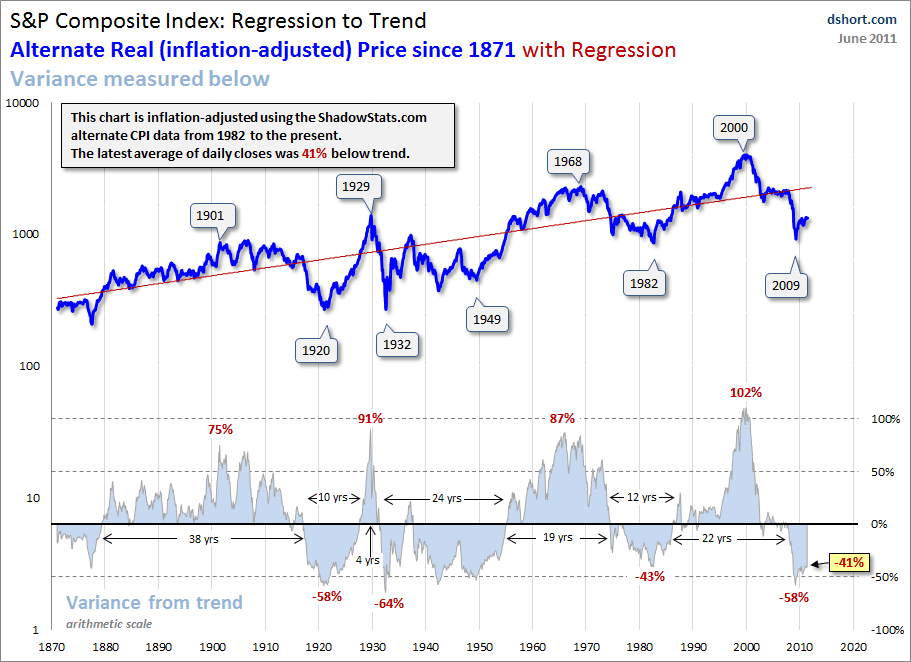
Let’s now remove inflation and look at ‘real’ long term stocks. i.e. net of inflation – this time the SP500. I have marked the same secular and interim stocks peaks in green and commodities secular peaks in orange, plus the full risk assets cycle between the black lines. In real terms, the dip in real stocks value around the secular commodities peak each cycle is notable, followed by an upswing into the interim and secular stocks peaks. The result is a waveform, marked in dark red, known as a sine wave. This wave pattern is very common in nature, occuring in ocean waves, sound waves and light waves. Again, there is an upward trajectory to the long term wave, which reflects technological evolution and increasing human value-add. Following the waveform and the history, a lower real low for the S&P500 should be yet to come around the commodities / solar peak of 2013, and it looks like it needs to fall some way.

Source: Dshort

Yet, if we adjust for ‘undoctored’ inflation (Shadowstats figures) rather than ‘official’ inflation, the chart looks quite different, with the 2009 real low already at the low extreme:

Source: Dshort

Between the two charts, some kind of rounded bottom looks likely with another low still to come, before stocks take off in real terms, and I suggest it is indeed possible that we see a higher low in nominal terms and a lower low, or perhaps double bottom, in real terms, with inflation making the difference between the two. By solar cycles and history, inflation should peak along with solar activity and commodities, meaning the difference between the nominal and the real price of stocks may be fairly substantial at that point.

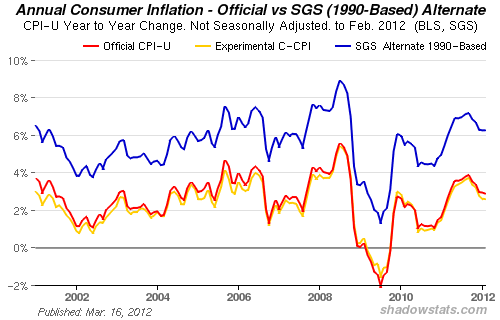
So let’s look at inflation. The chart below shows that both official inflation and Shadowstats inflation peaked in early 2008, when oil spiked. If, as some argue, we have already seen the secular peak in commodities, say with oil in 2008 and with precious metals in 2011, then we are unlikely to exceed that 2008 inflation peak.

Source: Shadowstats

The implications of that would be that the circle on the next chart would mark the inflation peak of this solar cycle, and that would be an anomaly with previous solar maxima both in time and height.

Of course if we apply Shadowstats figures to the chart, then the height of that spike would become more compelling, but nevertheless, by solar cycles and by history, the next solar maximum of 2013 should drive human behaviour to maximum speculation in commodities and maximum consumer inflation.

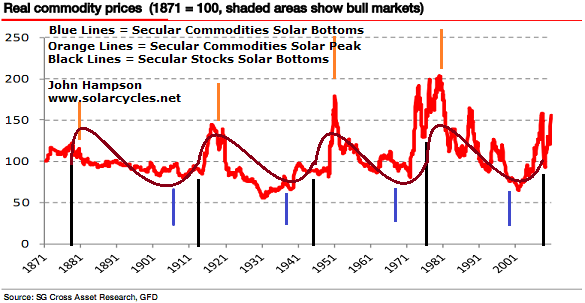
Next is a similar long term inflation-adjusted chart, but this time for commodities. Again, I have marked the same commodities peaks in orange and the risk asset cycle markers in black. I have applied waveform again, and again we see a sine wave but with reverse polarity to that of stocks.

Again, it would be an anomaly if commodities had already peaked around the solar minimum secular nominal stocks bottom of 2008/9, instead of around the next solar maximum of 2013.

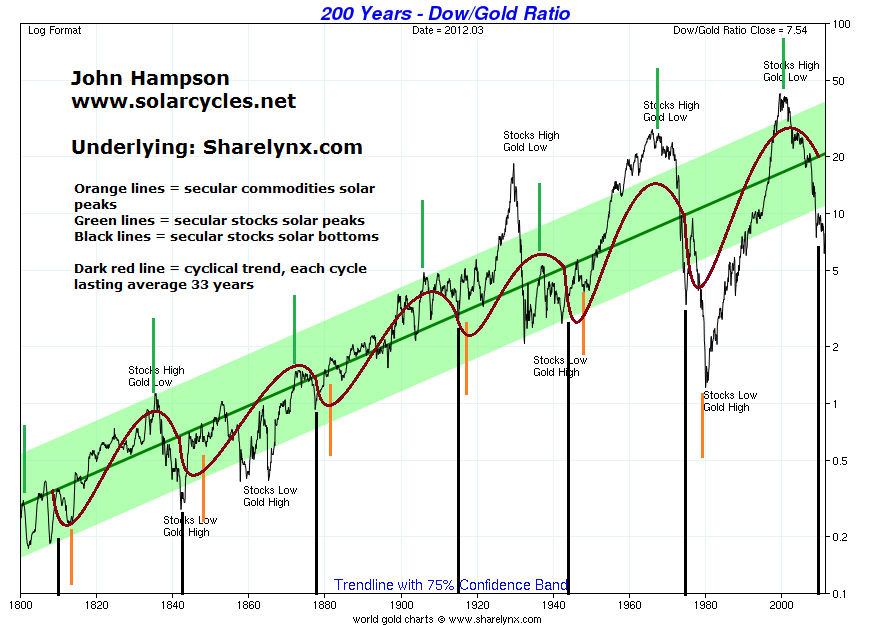
One more chart – here is the long term Dow-gold ratio. Again, note the sine wave.

It can be seen that at the time of each secular nominal stocks bottoms (black lines), there was a notable spike down in the Dow-gold ratio. In fact, that spike down was sometimes the nominal bottom in the ratio. From those spike lows, the ratio then made a bounce, lasting 2-4 years, up towards the middle trend line, before typically falling again to another low around the solar/commodities peak.

Curiously, following the 2008/9 low, the ratio made only a weak bounce into 2010 before falling again. With the solar peak looming just 12 months away now, the likelihood of an intermittent bounce in 2012 up to the middle trendline, i.e a Dow-gold ratio of 20 (gold falls to 650, or Dow rises to 32,000), looks slim to say the least. Either the weak bounce is a clue that the ratio will keep dropping to a new and final low around the solar peak of 2013, as it did in 1979/80, of perhaps 1-2, or it will make some kind of W bottom, with stocks outperforming currently and then giving way to commodities again into the solar peak, with a ratio bottom of 5 or above. As the evidence further up the page suggests stocks might track overall sideways into the solar peak, the difference between the two ratio scenarios perhaps indicates the scale of a final gold ascent, ranging from meagre (maybe final gold $2000 or so) to colossal (maybe $10,000).

In my recent post of 6th March, ‘Precious Metals’, I detailed the fundamental support for gold into 2013 from negative real interest rates, central bank and investment demand. Disinvestment and greater new supply is forecast to occur after 2014. In short, the window from here into 2013 has the fundamental support to fulfil the final parabolic ascent forecast by solar cycles and historic rhymes. Not only that, but I suggest that the entry point for gold and miners is right now, and here is the evidence.

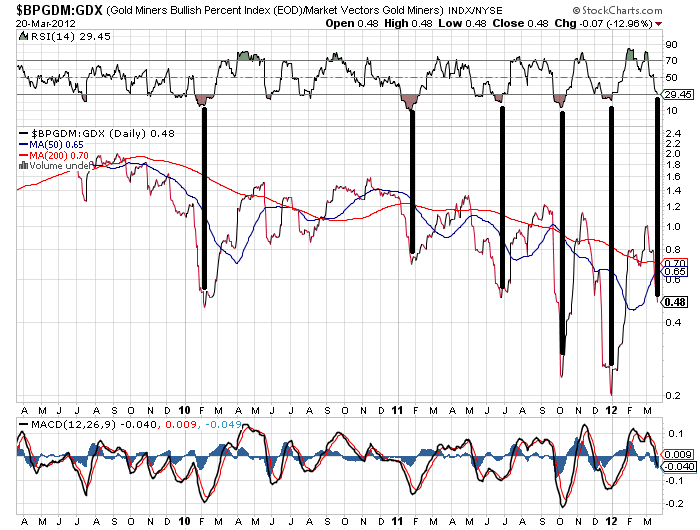
Gold miners bullish percent index / Market Vectors Gold Miners ratio is at an overbearish level that has previously corresponded to bottoms in gold (see second chart):

Source Stockcharts

PFS’s intermediate term gold indicator is at a buy level, by history:

Source: PFS Group

Rydex precious metals allocations are into the extreme low zone:

Source: Pater Tenebrarum / Sentimentrader

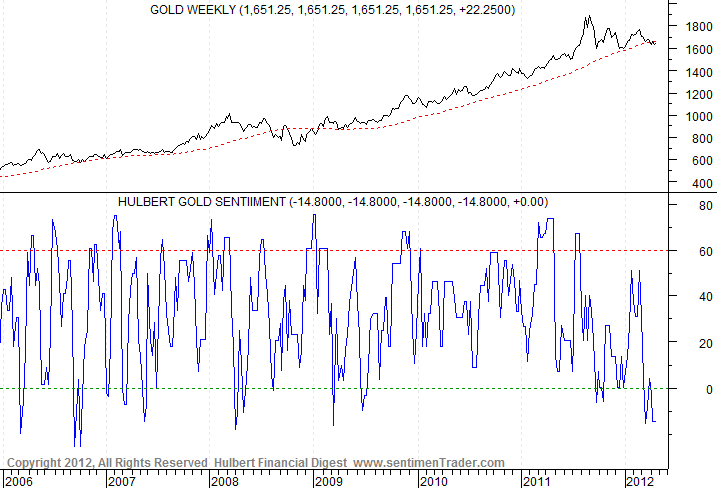
Hulbert gold sentiment in the latest reading is now -15.7. The below chart is taken prior to that reading, but note it will now be down at a level on par with 2008:

Source: Pater Tenebrarum / Hulbert / Sentimentrader