As Things Stand

The latest CB leading indicator summary looks unequivocally strong:

28mar20131Source: Conference Board

US economic surprises are also positive and in an uptrend:

28mar20132Source: Ed Yardeni

However Eurozone economic surprises are conversely in a downtrend, and the relationship shown below suggests this disparity is the dominant factor in the declining Euro v USD FX.

28mar20133Source: Beleggenopdegolven

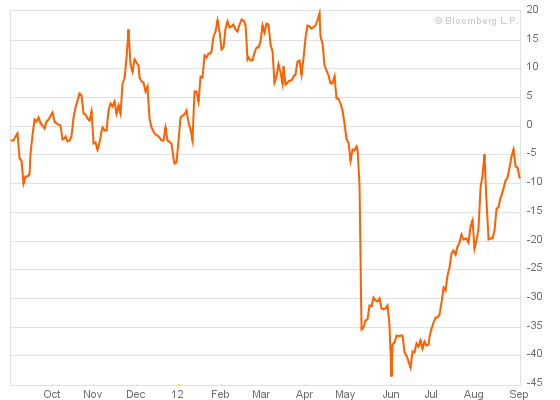
If we look at Eur-USD together with other specific pro-risk proxies, namely the MSCI World Stock Index, the CCI Commodities index and 30 Year Treasury Yields, this is the picture:

28mar20134Source: Bloomberg

The collective trend was up from November to the end of January. Since then it would appear that we have been in consolidation/correction mode – and this is a fit with the 5-models-in-alignment (see my Tools For 2013 post).

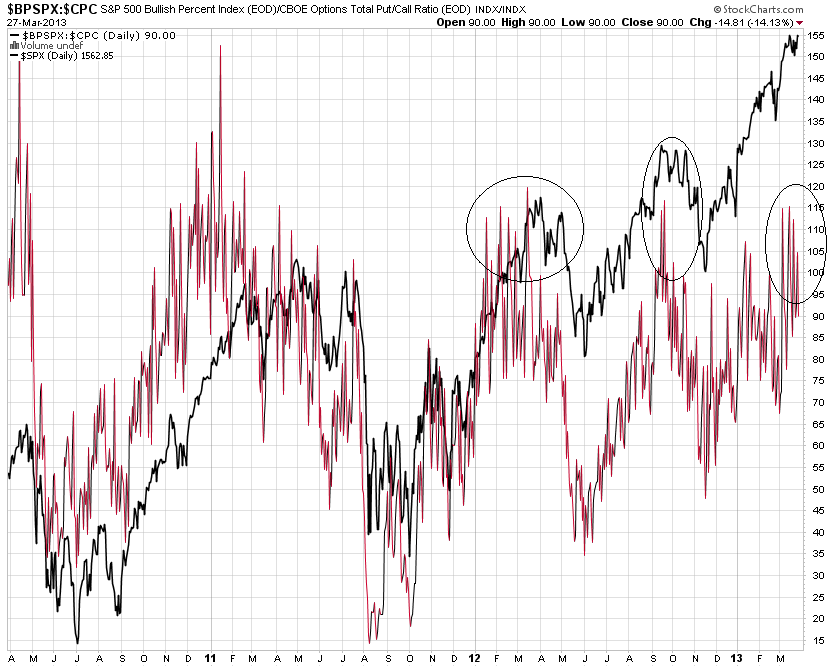
Currently, cheap and unloved assets are Euro, coffee, sugar and gold miners, whilst those reaching into overbought and overbullish zones include the US Dollar, Dow Transports and SP500. If we look at the bullish percent over call/put ratio for the SP500 we can see that we have been recently oscillating in the frothy zone which led to a swing top twice in 2012. However, 2010 and 2011 show things could potentially get frothier, with spikes up to 150.

28mar20136

The CCI Commodities Index and crude oil are both into the noses of large triangles, suggesting an imminent break out one way or the other. Here is crude:

28mar20135Crude has accelerated this last week with good momentum, but now encounters resistance. It does not have fundamental support from stockpiles, as they continue to be above seasonal average, but I suggest it is the global growth story that is the main reason for the advance.

Meanwhile, coffee, sugar and some other agricultural commodities are at secular bull rising support, which also puts them at a key decision point – either a break down or the start of a new upleg. I still believe the greatest likelihood is of commodities taking off and becoming the outperforming class going forward (based on sunspots, secular history, late cyclicals), and I am positioned accordingly. However, I continue to wait for specific supporting evidence to confirm this, namely a new high in sunspots, a technical break out in the CCI, and for any pullback in stocks to be counter-accompanied by an advance in commodities.

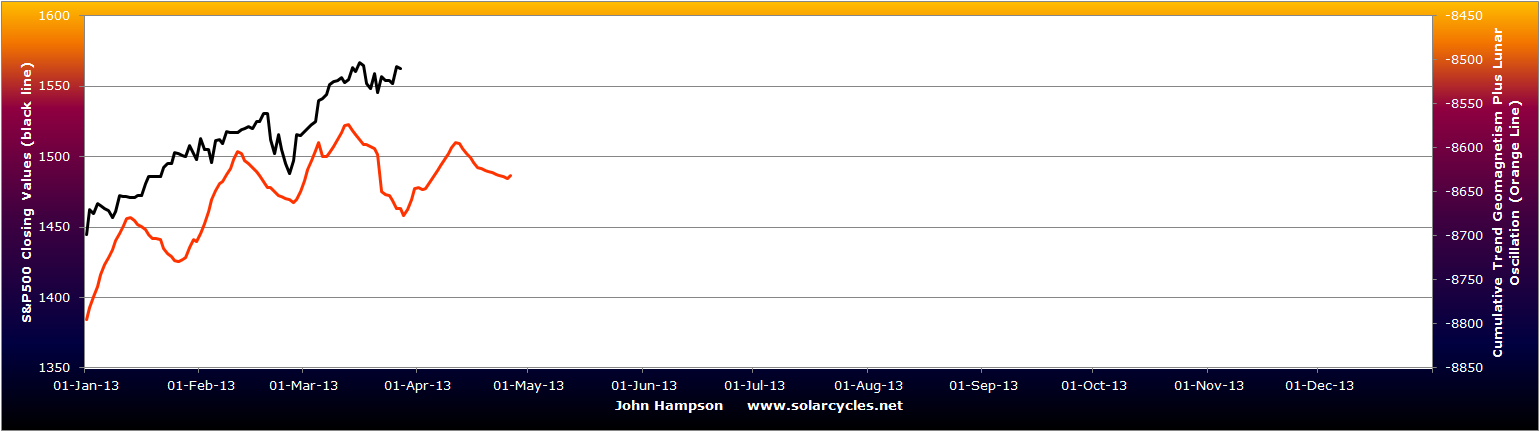
This Saturday is the start of the lunar positive period. Is there a ‘highest probability’ stock index trade on offer? Well, there is now a clear change in the geomagnetism trend, as shown here:

28mar20137

A lower low and a lower high means the geomagnetic trend can no longer be classed as up. In addition, there is some frothiness in stocks as identified above. Therefore, as per the make up of my highest probability trading analysis, I am not going to take this one.

I am now back in England.

The Lunar Edge

In my last post I suggested that using lunar phase oscillation would increase the probability of a trade. There are several papers that demonstrate this lunar edge in the markets, and underlying this is a body of research relating lunar phases to moods. The period into and around full moons can bring about pessimism in humans, and this endures despite the advent of artificial lighting. The period into and around new moons is conversely often one of optimism.

To verify the relationship in the markets for myself, I split the lunar month into the two opposing periods and studied data from the last 20 years (which covers multiple cyclical bulls and bears within secular bulls and bears) to assess any difference in returns between buying at the start of the positive lunar period and closing at the end of it, to buying at the start of the negative lunar period and closing at the end of it. Here is the summary of results for four indices:

24mar20131

All three stock indices plus the commodities index displayed a lunar edge when totalling returns over 20 years, which means there was relatively more buying-up of pro-risk assets into and around new moons, compared to full moons. The commodities index displayed the weakest edge over the period, so I suggest lunar oscillation is best pursued through the stock indices, and of those, Singapore and Germany revealed the greatest differential. This is in line with the findings of Dichev and Janes, who also identified greater lunar differential in the Dax and Straits compared to some other indices.

I don’t think it’s overstating it to say that the lunar edge in both the Dax and the Straits is pretty massive and compelling. Understand that a lunar month differs from a calendar month so that new and full moons move through the months over the years. That means we are not confusing calendar phenomena here, such as end of month or quarter window dressing. In the case of the Dax, almost all the 20-year return came from within the positive lunar periods. Nonetheless, it would still have been better to buy and hold for 20 years than only participate during the positive lunar periods, as there was an extra 17% on offer in the negative lunar periods. However, in the case of the Singapore stock index, not only would ‘long’ participation restricted to the positive lunar periods have returned more than buy-and-hold, but additionally shorting the lunar negative period would have added even more to overall returns.

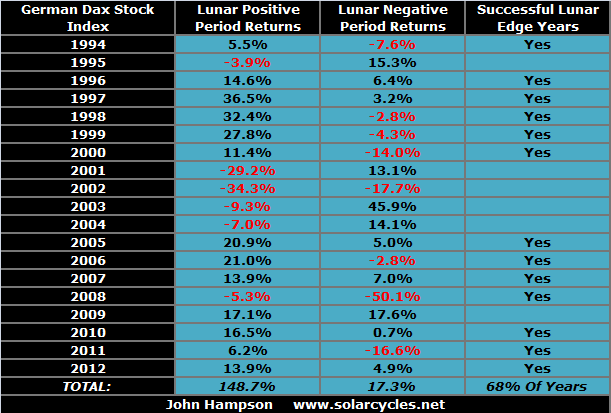
To return to my opening comments from the last post, nothing works all the time, but some things work most of the time. Lunar phase oscillation is such a phenomenon. It takes persistence through successes and failures to draw out the lunar edge, but the edge is real and profitable. The next table breaks down the Dax returns by year, revealing how the 132% differential built up. As can be seen, not all years demonstrated a positive lunar edge, and the gaps in returns varied year to year.

24mar20132

Drilling down one level further, if I show a sample year from Singapore’s history with an impressive differential, it can be seen that not all lunar months within the year demonstrated a positive lunar edge, but most did.

24mar20134

So some years fail, and some months fail, but most years and months successfully return a lunar edge. This fits with my expectations, because lunar phasing influences market sentiment but other phenomena are also influential in stock market performance. So we shouldn’t expect ‘without fail’ but ‘more often than not’.

I suggest there are two trades to consider. The first trade would be a pair on the Singapore Straits: long the positive lunar fortnight, then short the negative lunar fortnight (this aims to capture the negative return made over 20 years into and around full moons). The second trade would be just long the positive lunar fortnight on the Dax, staying out of the market during the negative period (this aims to capture the biggest nominal return of all the indices over 20 years, made on the positive lunar fortnights by the Dax). A ‘failure’ month or year then depends on which of these trades we are studying – i.e. the failure is in a negative differential between the two periods or the failure is in a negative nominal return in the positive lunar periods.

Let’s take the Dax trade first: long only during the positive lunar periods. 68% of years made a positive return. 62% of lunar months made a positive return. The total return over 20 years was 149%. The worst run was 4 years of negative returns: from 2001 to 2004. The worst run within any year was 5 consecutive lunar months of negative returns. What these ‘worst run’ stats reveal is that anyone mechanically trading this idea would have had to endure some significant drawdowns that we would ideally like to avoid. So are there any patterns in the failures? Yes, the failures are largely concentrated in the cyclical bear markets (as we might expect). If we were to only trade the Dax positive lunar periods during the cyclical bull markets of the last 20 years, avoiding the cyclical bears, the returns would rise from 149% to 240%. Whilst this is an impressive increase, it involves correctly calling cyclical tops and bottoms and patiently sitting aside the cyclical bears – both easier said than done. Nonetheless, this is supporting evidence for my suggested highest probability trading technique: trading long stock indices during the positive lunar periods during cyclical stocks bull markets.

Let’s turn to the Singapore ‘twin’ trade: long the positive lunar periods and short the negative lunar periods. 74% of years produced a positive differential. 60% of lunar months returned a net positive percentage, going long into and around the new moon and then short the full. The total return over 20 years was 169%. The worst runs were 2 years of negative consecutive returns, and 7 consecutive lunar months. Again, were there any patterns in the failures? Nothing significant that I could draw out. No seasonal patterns, no concentration of note during either cyclical bulls or bears (the Straits suffered an additional bear 1996-1998). Just sometimes the lunar edge differential didn’t work, but most of the time it did. If we were to change this trade to going long only during the positive lunar periods and only during cyclical bull markets – staying the rest of the time out – then the returns would be around 170%, so no notable improvement on a mechanical ‘twin’ trade regardless of bull or bear.

24mar20134

What about shorting the negative lunar periods during cyclical bears, and staying out otherwise? Again, this would involve being able to correctly call the start and end of the bears, but even with that assumption, I found that the returns are less than if we stayed short for the duration of the cyclical bears, rather than staying out during the positive lunar periods.

So returning to my ideas for highest probability trading, what if we look at returns during cyclical stocks bulls but additionally filter on those periods when the geomagnetic trend was up and when stocks were not overfrothy (suffering overbought and overbullish readings). This gets a bit more difficult to draw out retrospectively, but I can do this for the last 4 years. The result is we would have participated in 21 positive lunar periods (effectively just a quarter of the time active in the market, the rest of the time sitting out). 19 of those would have produced a positive return (i.e 90%), producing a 47.1% gain in the 19 winning periods and a 1.5% loss in the two failed periods. Clearly, this is a high winning rate and although patience would be required to sit out of the market three quarters of the time, the technique would be to apply large exposure when these trades arose. The difficulties in applying forward are correctly assessing whether we are in a cyclical bull or bear and identifying changes in the geomagnetism trend and assessing when overbought and overbullish apply. I believe that is all possible, but it is to some degree an art.

To be clear, I am not suggesting sitting out of the markets for entire cyclical bears, making no money. The idealised trade in my terms, the trade of highest probability, may only be available during cyclical bulls under specific circumstances and parameters detailed above and in the last post, however this does not preclude making trades of lower – but still good – probability, and going forward I will continue to look for opportunities at all times. However, this research has confirmed to me that there are specific trades out there that are worth pursuing with significant funding, and I intend to announce them when they arise and record their progress and success on my site.

Specifically, I am looking to capture and draw together lunar oscillation, geomagnetic trends, cyclical bear or bull trends, sentiment and buying/selling extremes, and I aim to take such trades on the German Dax and Singapore Straits for their sensitivity to lunar oscillation, and also on the SP500 for its sensitivity to geomagnetism. There are several permutations of trades within this: a repetitive twin trade on the Straits (alternating being long positive lunar fortnights and short negative lunar fortnights), a long trade on the Dax only during positive lunar periods within a cyclical bull, and a long trade on the SP500 for the duration of a geomagnetic uptrend. So watch this space.

Highest Probability Trading

There are no dead certs in the markets, only probabilities. No discipline or indicator works all the time, but some things work most of the time. Draw those together, and I believe we get somewhere towards highest probability trading. I am sure different successful traders would have varying views on what would make up trades of highest probability, but this is how I see it:

Equities are the best performing asset class over time by far, see here:

22mar2013

So, broadly speaking, long equities is the trade. This is backed up by stats showing that stocks are in a bull market 80% of the time. Bull cycles in stocks have an average duration of 5.4 years and an average gain of 74%. Bear cycles average a duration of 1.5 years with an average loss of -12.7%. If we also include the fact that secular stocks bulls go upwards whilst secular stocks bears go sideways – rather than down – then a naturally bearish bias is an impediment in playing the markets.

I also suggest the trade is to be long a stock index rather than an individual stock. Roughly speaking, 50% of a stock’s movement is attributable to the overall stock index, 30% to its sector, and just 20% its own. Individual stocks can go bust, or plummet on surprise bad news.

I believe that the shorter the trading timescale, the more randomness and noise there is. Many people (and machines) buy and sell specific assets at many different times for many different reasons. The longer the trading timescale, the clearer the trends. However, trades left on for years will be profit-diluted by counter cycles within an overall trend. So, if we can identify when cyclical stocks bulls begin and end, we could go long the stock index for the duration, or we might look just to capture the significant upwards swings within that.

How can we identify the beginnings and ends of cyclical stocks bulls? Well, there are no hard and fast rules and it is not easy, but history, as always, is our guide. Cyclical stocks bulls normally end with yields rising, inflation rising, and tightening that chokes off growth. They end with a topping process, a price range lasting several months, with divergences in breadth and leading indicators. They end with overly-bullish sentiment and valuations. In contrast, cyclical stocks bulls begin with overly-bearish sentiment, a capitulation in breadth, positive divergence in leading indicators, and often a V-bounce price bottom. We can also draw on solar-secular history to gauge likely timings of starts and ends.

Within cyclical stocks bull markets, there are ‘swings’ which I suggest are largely sentiment-driven by levels of geomagnetism. The SP500 v. geomagnetism for the cyclical bull of last 4 years is shown below:

13mar20131

So, we might refine the highest probability trade and suggest the trade is long the stock index during cyclical stocks bulls whilst the cumulative geomagnetic trend is upward. We can identify a likely change in geomagnetic trend using the 3 week geomagnetism forecast and the typical seasonality of geomagnetism, both of which I model.

Within that, there is lunar phase oscillation. The period into and around full moons is largely one of poorer returns than the period into and around new moons. So, we might go long the stock index at the start of each positive lunar period and close at the end of the positive lunar period, during cyclical stocks bulls whilst the cumulative geomagnetic trend is upward. These trades would last around 2 weeks each.

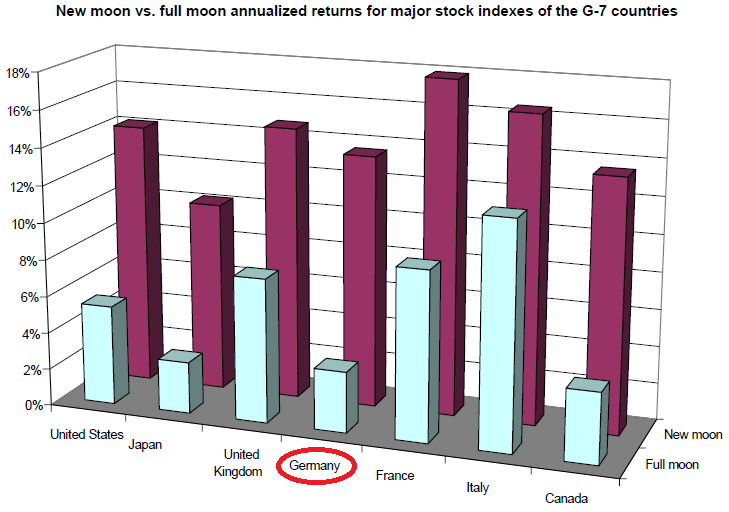
So which stock index might we use? Dichev and Janes showed that all the major stock indices around the world show better returns around new moons than full moons, but two of those showing the biggest differentials were the German Dax and the Singapore Straits Times. Whether this is something cultural that produces greater sensitivity to lunar phasing, or whether this is because more traders use moon-phasing in these countries, would perhaps be another paper in itself. But the German Dax and Singapore Straits might offer the best returns if we are to trade the positive lunar fortnights only.

22mar20134

22mar20132

Source: Dichev/Janes

What about geomagnetism sensitivity? Krivelyova and Robotti revealed that most major country stock indices perform worse following geomagnetic disturbances. However, Germany and South Africa were the exceptions. My cumulative geomagnetism chart above calls into question their assessment of Dax non-sensitivity (I suggest this is because of method – they only looked at performance up to 6 days following a geomagnetic storm rather than using a cumulative trend in geomagnetism). Nonetheless, by their research, the stock indices with the biggest differentials for geomagnetism were the US indices.

I suggest, then, that we might trade the German Dax, the Singapore Straits Times and the US SP500, and this has the benefit of diversification, with stakes in America, Europe and Asia.

Lastly, rather than mechanically trading this idea, I would like to look at each such opportunity and assess whether the stock indices are overbought or overbullish, and how they stand technically (at support or resistance or in bullish or bearish patterns). I would be keener to take the trade if stock indices are not overly frothy, not bumping up against key resistance or carving out potentially bearish formations.

So let me sum up. My suggestion for trading of the highest probability is to go long (i.e. buy) the German Dax, the Singapore Straits and the US SP500 (for diversification and natural sensitivity) at the start of each positive lunar period and close (sell) both at the end of the positive lunar period (roughly a fortnight), during geomagnetic uptrends within cyclical stocks bull markets, repeating these trades each lunar month where the stock indices are not overly bullish or overbought or suffering bearish technicals.

What’s your take on this, and what would you consider trades of highest probability?

In the next post I will delve deeper into this idea, and offer supporting statistical evidence.

The Next 10 Days

…I will be in a motorhome, touring NZ North Island, so internet access is going to be occasional and fleeting. So an update and roundup on the markets below, and I will post in the comments beneath it anything important in that period. After New Zealand it’s Abu Dhabi for a week, the last stop on the trip, before returning to Europe.

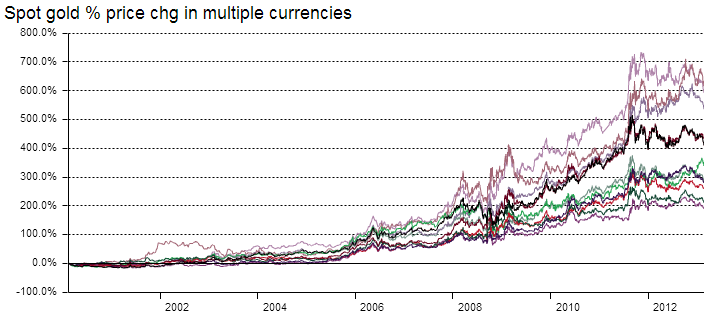
Let’s start with gold. Major extreme readings were reached last week in oversold and overbearish measures, in both gold and gold miners, many more extreme than in the 2008 sharp falls. I won’t reproduce them here, as many blogs and sites have shown them, but it was sufficiently extreme for me to add to both gold and miners last week as declared. Gold has since rallied away from those extremes and therefore in price, and whilst I don’t know how it will shape technically from here, the key question is whether its secular bull is over and ended in 2011 with silver’s parabolic rise and fall. So here is gold since the start of its secular bull in 2000, measured in all the major currencies. It should be clear that gold has tracked sideways since 2011 and has consolidated up high, whichever currency it is measured in.

260220139

Source: Gold.org

As a parabolic excessive-greed finale is the norm as a conclusion to an asset secular bull, and as gold is the leading asset in a Kondratieff winter (which we are concluding), I would give good odds to gold finishing with a blow-off parabolic. A comparison with gold’s last secular bull, below, shows that blow-off parabolic clearly and how gold’s secular bull this time has been fairly measured to date.

2602201310

Source: Nowandfutures

I am not suggesting that gold has to shoot as high as the comparison suggests – only rather that some kind of excessive exuberance would be a normal end. So, the lack of parabolic ending move in gold yet, together with the high sideways consolidation when the whole secular bull from 2000 is viewed, give me a couple of reasons why I believe we have been seeing a final washout of weak hands before gold breaks higher. However, I await supporting evidence such as from sunspots breaking higher (to confirm the solar peak is ahead), commodities starting to outperform equities, and inflation picking up. This is how sunspots look:

2602201313

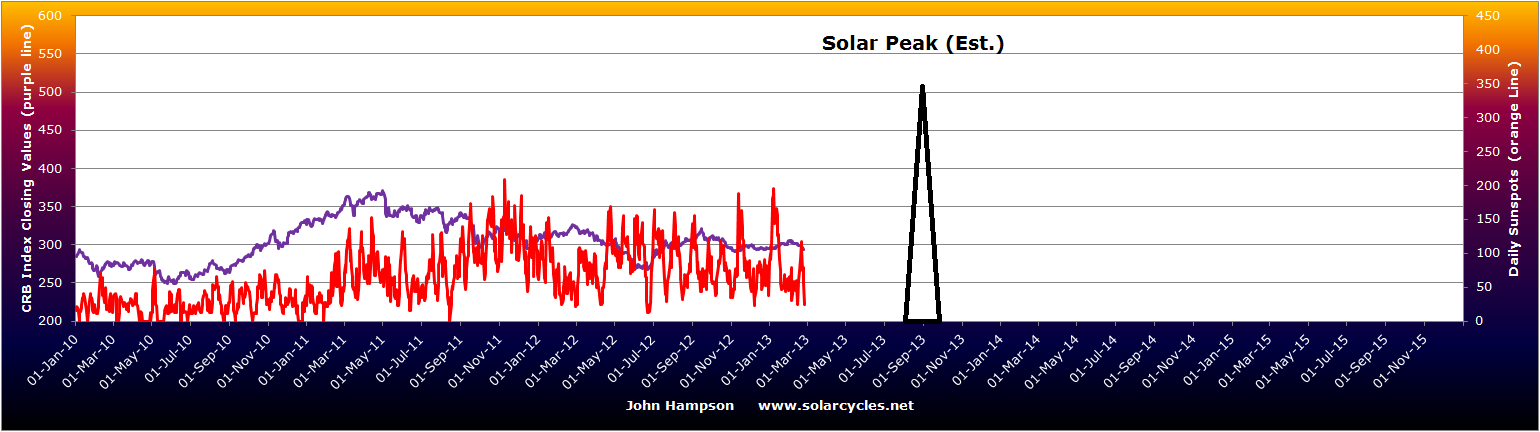
There is a mess, rather than a trend. If the solar peak is ahead this year, which remains the most common forecast, then we need to see daily sunspots register over 200 to make the uptrend clearer. So I am looking out for that.

Since my last post on the markets it has become clearer that pro-risk did begin a correction at the turn of January into February. The chart below combines proxies for stocks, commodities, risk-safehaven FX and treasury bond yields.
260220134

I suggest there are two paths forward, both of which eventually will see equities return to their highs, in order to deliver a negative divergence top (price advances but internals weaken). The first is the five-models-in-alignment path, which suggests pro-risk may pull back into March before advancing again. The second is that pro-risk is only making a normal lunar pullback, into yesterday’s full moon, and will continue upwards over the next few weeks, for a Spring swing top. This option is supported by cyclicals as a leading indicator, and my geomagnetism model shown:

2602201312

The tail on the model stretches out into the end of March and remains in an uptrend due to unseasonally tame geomagnetism (actual and forecast). The oscillations within that are the lunar phase pressures.

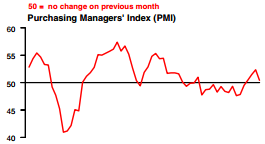
There also remains a fairly benign macro-economic environment, which should support pro-risk, although we should always be alert for early warning signs of a change, and we could potentially have this in the latest PMIs.

China PMI, US PMI and Europe PMI in order below:

260220131

260220132

260220133Source: Markit

A droop in the latest data, but still positive in China and the US.

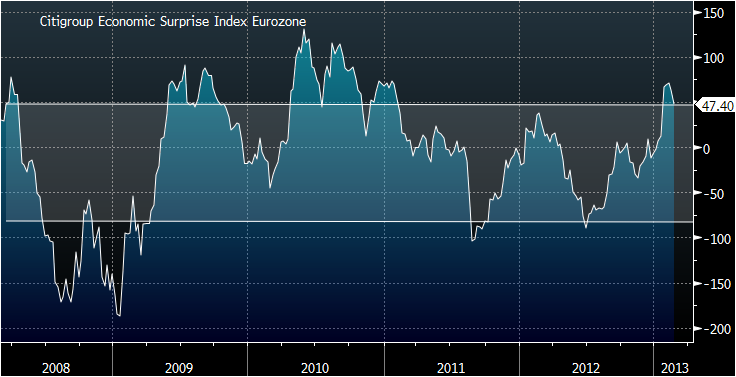
Meanwhile, economic surprises show unclear developments in both Europe and the US, but using oil prices as a leading indicator for the latter, a topping out in this measure may occur in Spring.

260220135

260220136Source: BrokenMarkets / Citigroup

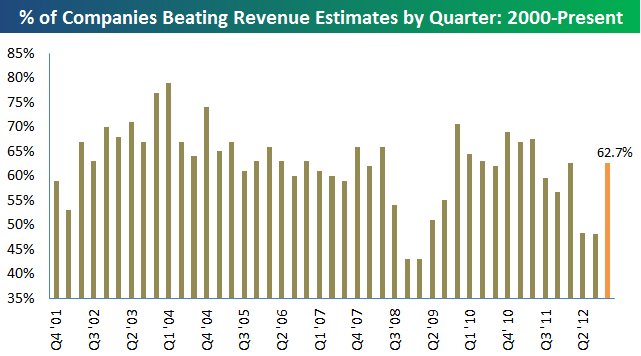
US earnings season is pretty much over, and the final results in both earnings and revenues were good, and supportive for equities.

260220137

260220138Source: Bespoke

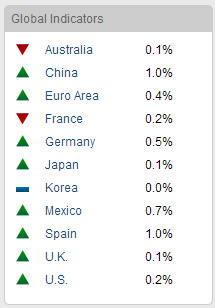
The latest Conference Board leading indicator data table looks like this:

2602201311

Source: Conference Board

Since my last market post, readings for China, Germany, US and Mexico all came in positive. The table is healthy, for now.

In summary, the picture between leading indicators and economic/earnings data is fairly supportive for pro-risk for now, unless that droop in PMI readings becomes wider weakness ahead.

There is bearish sentiment towards sugar, coffee, wheat, corn and cattle currently, as well as the precious metals, and I would add to commodity positions if we saw improved evidence of a secular commodities peak ahead, namely those developments listed above. Until that becomes clearer however, I am playing it safe and sticking largely with what I have, as both the primary (secular commodities and solar peak ahead) and alternative (secular and solar peak passed) scenarios remain in play.

Final Third 2012

One third of the year left to go. As of a couple of weeks ago the SP500 was up 12% for the year, whilst the average hedge fund was up just 4.6%, with just 11% of hedge funds exceeding the SP500 return of 12%. 2011 was also a tough year for hedge funds, compared to previous years. In my personal experience, 2011 and 2012 have seen certain reliable analysts calling it wrong, some usually reliable indicators pointing different ways rather than in alignment, up/down moves of shorter length, and some degree of disconnect between some usually connected assets. In my opinion, this is all due to the transition period that we are in, from K-winter (gold, bonds) to K-spring (stocks, real estate), bringing about come confusion in assets, indicators and analyst calls. The transition is gradual – the nominal bottom in stocks and real estate likely already occurred, the inflation-adjusted low likely ahead, the secular bottom in treasuries is perhaps occuring right now, the secular top in commodities I project next year. A messy, gradual transition rather than a clean switch.

I have found 2011 and 2012 trickier than previous years for those reasons listed above. Having to go against analysts that I respect, having to choose between indicators, having to make sense of assets going different ways. Ultimately, secular and solar anchoring has seen me through I believe, and will continue to do so. I am currently 20% up for the year. My target, as every year, is 40%, which makes me behind target with 3 months to go. Usually I try to steer myself to towards the year-end target as best I can (over-exposing and under-exposing, bigger and smaller risks). I achieved my 40% in 2008, 9 and 10 in that manner, but fell short trying last year, making only 15%. This year I don’t have the same approach, because I am looking out to what I project to be the secular peak in commodities in 2013, a potential opportunity for parabolic gains. My plan then is to maintain my bulk long commodities positions into 2013, rather than trying to partially close down and trade shorter term into year end. If my projections are correct, then commodities should continue to rise in Q4 2012. What I consider most important to my year end tally is calling when to exit equity longs. At some point I want to exit the bulk of those, and that may be before year end 2012.

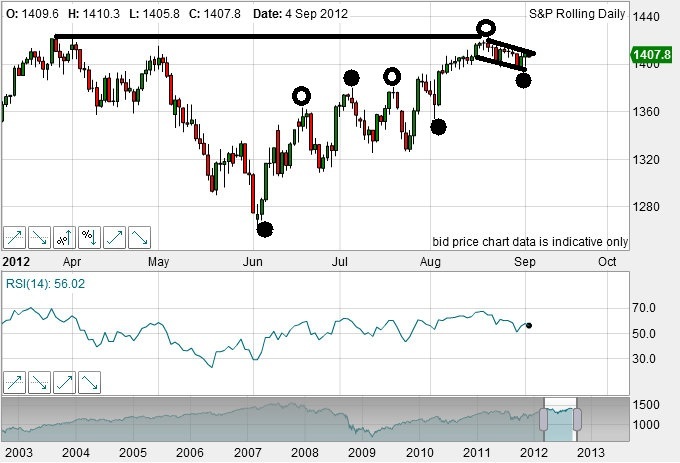
On Friday at Jackson Hole, Bernanke added weight and justification to his easing bias, whilst falling short of committing to it. The reaction was pro-risk, and US stock indices still look like they are in a bull flag preparing for a break out over the year’s highs, as shown below. Currently, we are back up to the top of that flag. I have also marked the new and full moons. We saw one lunar inversion at the beginning of July, but otherwise the typical lunar oscillation has been in play. On Friday we made a bottom with the full moon and can now potentially make a high around the new moon of Sept 16.

The potential is there, both by technical picture and lunar phase, for stocks to break out. If they can break out then a melt-up would be likely, providing great returns for equities longs. We have the ECB meeting on Thursday this week, with the potential for interest rate cut and bond buying programme announcement, and we have the FOMC on the 13th September with the potential to announce QE3 or some other novel measures. Of course, both provide the potential for disappointment too. A lack of action could lead to a siginificant sell off. Also on the flip side we currently have a geomagnetic storm in progress and more geomagnetism is predicted for today and tomorrow.

The Dow and Nasdaq are in similar positions, but a quick look at the Dow Transports shows a more precarious position. Dow theory says this is a negative divergence. Let’s see if the Transports can catch up here, or alternatively breakdown.
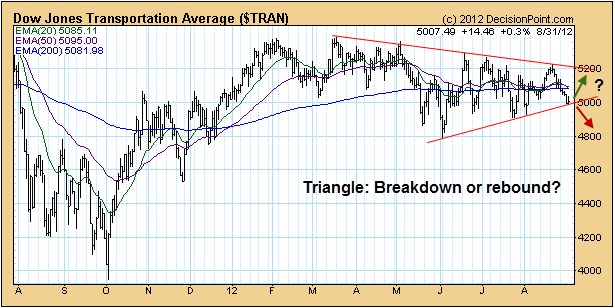
Source: TSP Talk

Sticking with the USA, economic surprises continue to rise in an uptrend, ECRI leading indicators turned positive on Friday, and Presidential seasonality suggests upside into November. The US economy continues to perform better than most in the world and that should mean support for the US dollar.
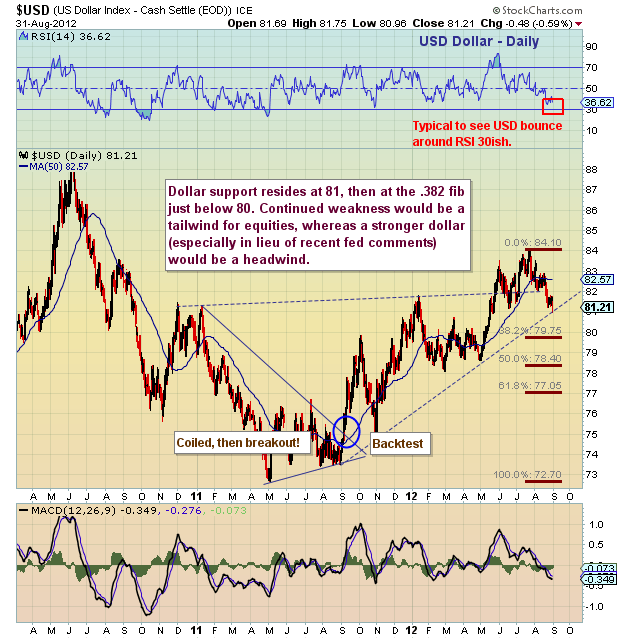
Source: See It Market

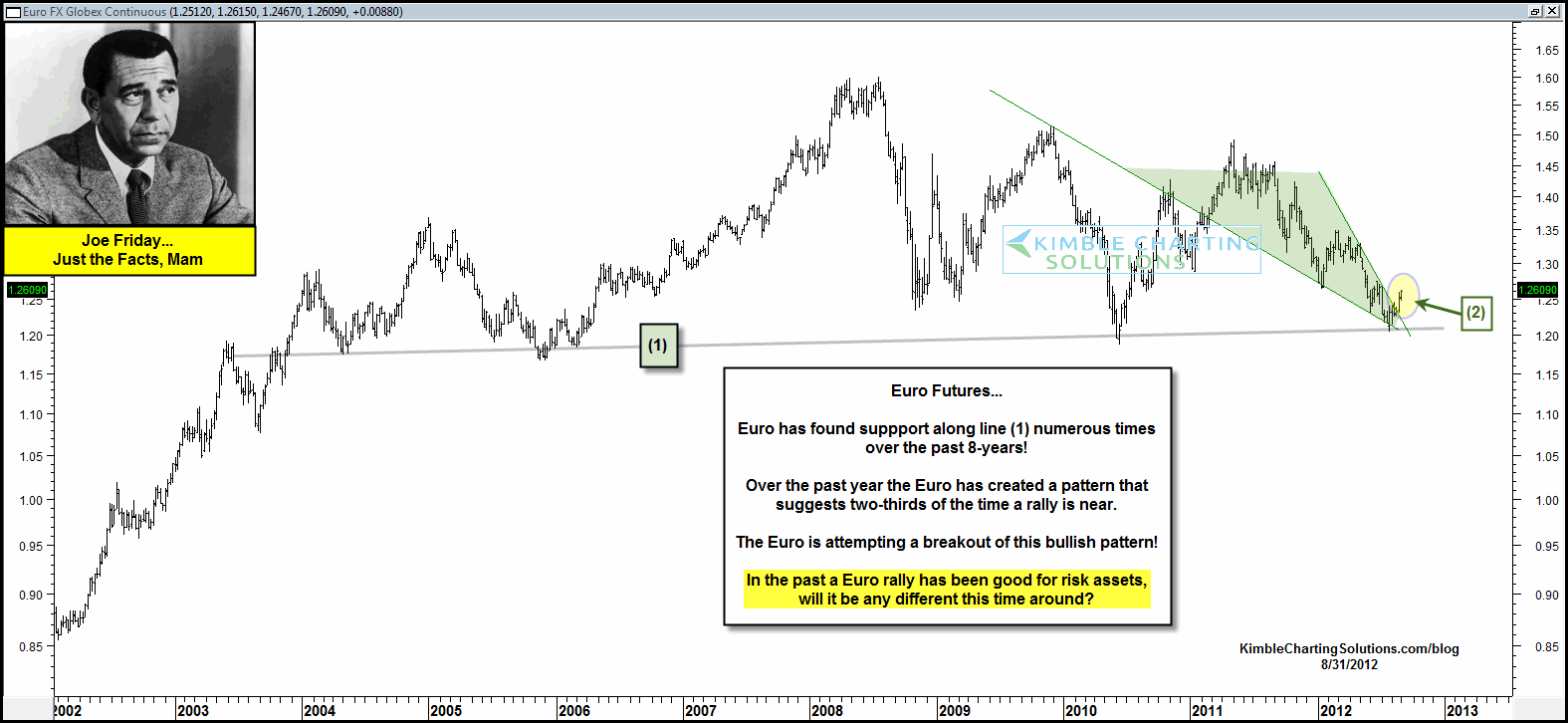
As can be seen above, the US dollar is now at support and an important junction. I suggest that the FOMC outputs next week could influence which way this goes. A lack of QE should mean support for the US dollar due to the better US economic data. However, QE3 should rally the Euro at the expense of the dollar, and the technical chart for the Euro provides weight for that occurring:

Source: Chris Kimble

For my projections of an overthrow in equities in the final part of 2012 and then a parabolic finale in commodities in 2013, announcement of QE3 would really seal the deal I believe. Money would pour into pro-risk and commodities would benefit from the weakening dollar. Let’s see.

A look at treasuries shows us that the stronger hints of QE have reversed yields in the short term but also set up a potential inverse head and shoulders.
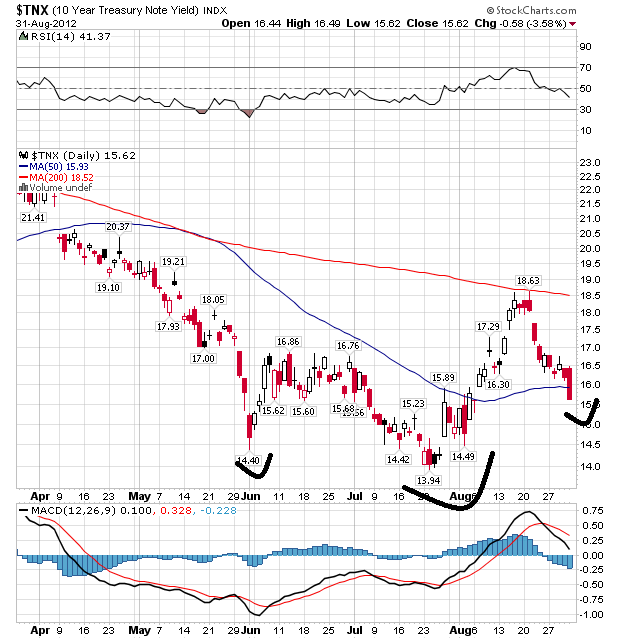
Underlying source: Stockcharts

Both QE1 and QE2 led to prolonged periods of rising treasury yields, after the initial move the other way, as money poured out of bonds into pro-risk. So again, QE3 would likely provide further fuel for pro-risk. It is on my mind that previous cyclical stocks bulls ended with treasury yields rising to levels where interest rates stifled the economy. Whilst we have the kind of ultra low rate levels here that echo the 1940s, I would still expect them to rise into the end of the cyclical bull to some degree. Currently, they are moving the other way, so let’s see if this large H&S now plays out.

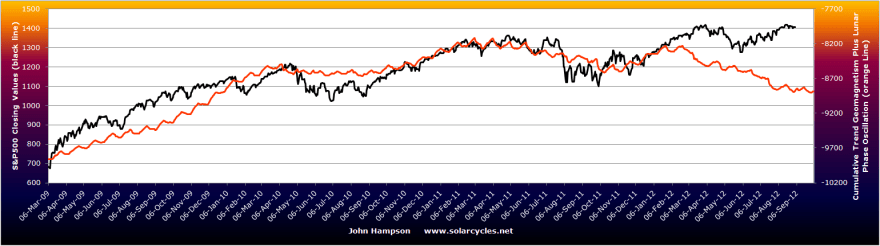
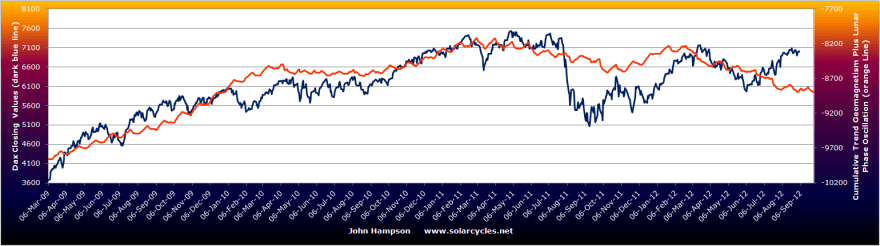
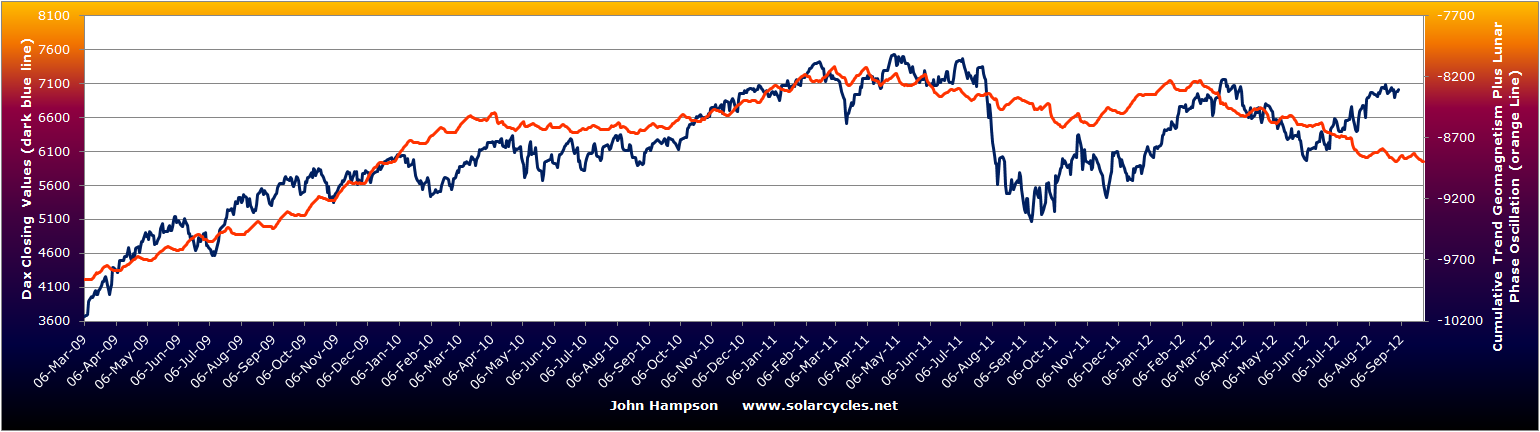
Ed Yardeni produced a chart showing the SP500 has diverged from its fundamentals since June this year. My geomagnetic-lunar model charts also show stocks going opposite ways since June (all models updated this morning).

Source: Yardeni

Together that would ordinarily provide a good cross-reference for a short. However, speculation increases into the solar peak, and as per my Peak v Peak page, at the last solar peak we saw stocks break away from the geomagnetic model for some time before returning to it post solar peak. It is not something measurable, but I can point to each secular parabolic peak in stocks and commodities occurring close to the solar maximums as evidence that this occurs. I therefore look at the divergences in Yardeni’s and my own models and suggest this may be occurring.

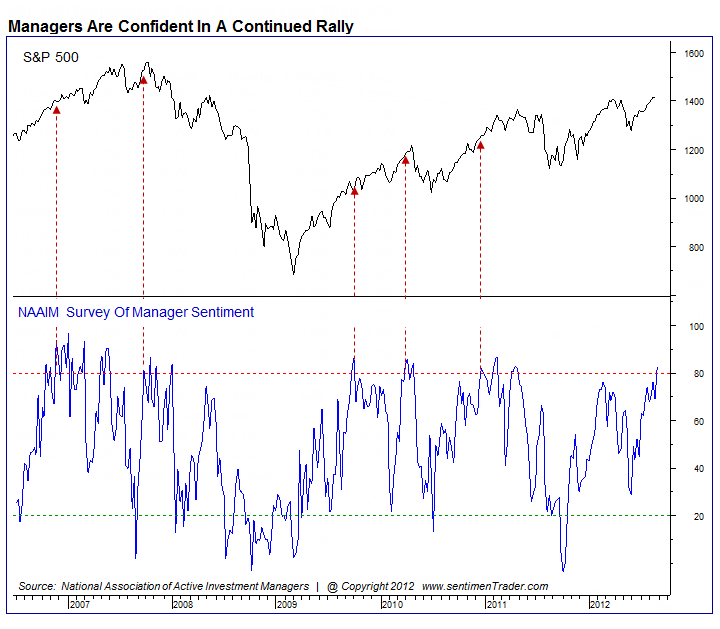
Sentimentrader have produced two new charts that add weight however to the bear case:
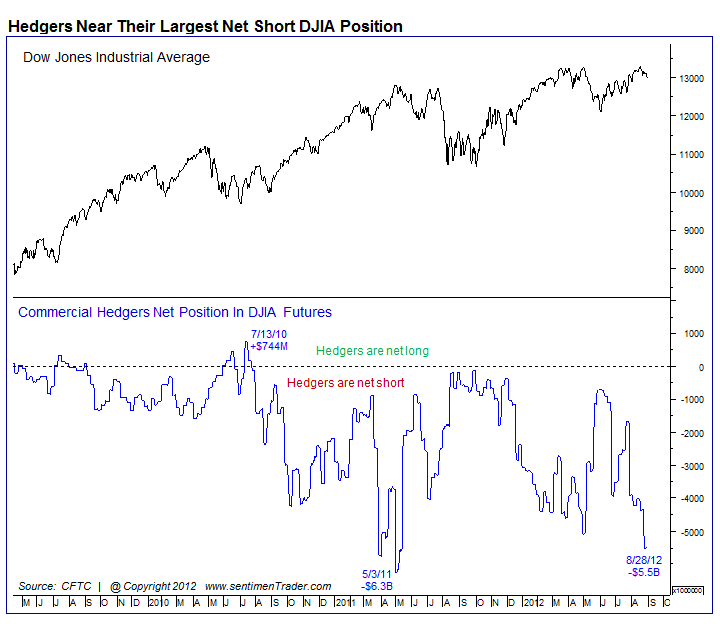
Source: Sentimentrader

Hopefully those two charts are self-explanatory. As per my last post though, Technical US Stock Indices, there is evidence supporting the bullish case too. And so we return to my opening comments about indicators pointing opposite ways.

Looking wider, we continue to see poor technical performance in emerging market stock indices. There is a significant divergence in European and US indices versus Asia and Latin America, reflecting the weak leading indicators in those regions. On the plus side, economic surprises for emerging markets continue to rise in an uptrend:

Source: Bloomberg

So are the economies of China and Korea and Japan (and Germany) to improve? If not, can US leading indicators really continue to trend upwards without being infected? All eyes on the next round of global leading indicators these next two weeks from OECD and Conference Board.

Euro debt accuteness remains contained and well off its highs of H1 2012, so for now that remains supportive for stocks. The US fiscal cliff looms at the end of 2012, and once the US election is out of the way, presidential seasonality is no longer supportive. The ruling party has the option to implement unpopular policies in the first two years. It may therefore choose fiscal policy which increases recession risk. I maintain the projection of global recession 2013-2014 as per solar/secular history, and this could be one factor, together with parabolic commodity prices and bond yields rising. China may also de-rail to provide a backdrop to a new secular commodities bear starting next year. The question remains whether China can remain strong enough to fulfil the commodities secular peak before that occurs.

In summary, I am looking for my exit point for stock indices longs (not commodities), as by time I believe this could occur any time as of now into early 2013. The technical picture is mixed and indicators are mixed, but US stock indices are within touching distance of a breakout to new highs. For now I am going to stay put, and await ECB and FOMC decisions this week and next, along with the latest global leading indicator data. Market tops are usually a process, so more evidence should build whilst stocks range trade, if this is to be a major top.

Secular Solar Conclusion

A brief macro and technical update first. Euro debt continues to ease on the whole. Economic Surprises for G10 and emerging markets continue to trend upwards. Leading indicators continue to be the problem area, with a mixed to negative picture, but tentative signs of improvement: ECRI leading indicators in a 6 week uptrend to break even, and CB Eurozone leading indicators in a 3 month uptrend also to breakeven. China and its local trading partners remain a particular problem area, reflected in the continued Shanghai index downtrend. Western stock indices and commodities remain in bullish trends, having consolidated their recent gains just below key resistance levels for US indices and precious metals. Some overbought/overbullish readings in both commodities and stocks had been reached, but not the kind of comprehensive and extreme readings to signal a top. I therefore maintain that this is a pause before a breakout, supported by presidential, secular and solar cycles, and have maintained all my long positions. The full moon is this Friday, which is also the Jackson Hole Fed meeting. Whilst the latest Fed minutes suggested a greater likelihood of QE, Jackson Hole is not a policy meeting (a FOMC) so we may get no action plans, just more supportive words. The usual lunar oscillation would see the consolidation / correction persist into this Friday and a sell-off on disappointment is not out of the question. As of next week though lunar positive pressure should re-emerge and I expect stocks and commodities to break upwards.

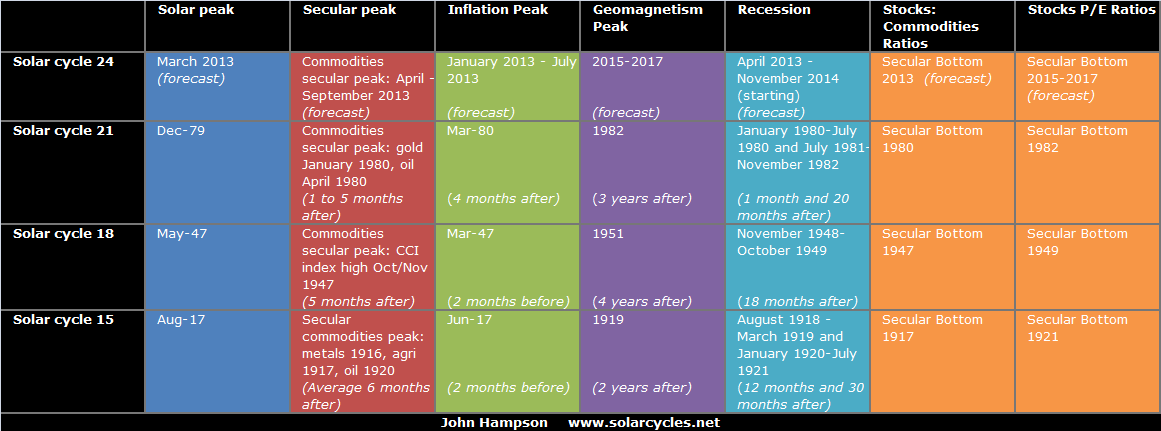
The anchoring of this expectation is in secular / solar cycling. I expect stocks to overthrow and make their cyclical bull peak, whilst commodities accelerate and make their parabolic secular finale. The stocks peak should occur before the secular commodities peak – with stocks foretelling recession by 6 months or so, and commodities (oil and food) playing a key part in tipping the world into recession. Here is the timetable again:

Bear in mind the forecast for the solar peak – currently March 2013 – could change, and also that the forecasts along the top row are ranges based on the last 3 solar cycles but we could potentially print slight outliers to these ranges.

Growthflation, speculation and revolution/war have been three key themes into solar peaks. I therefore expect leading indicators to pick up in H2 2012, enabled by the global central banks recent easing / stimulus and a natutral upswing in growth. I expect inflation to pick up, and this should be the case as soft commodities took off in June 2012 and this typically feeds through to the food price index 6 months later. I expect speculation, particularly in commodities, to accelerate, and for there to be a supply side push in commodities, not just from climate/weather but also from war-related disruption. At some point commodities should de-couple from stocks.

Looking back to 2007/2008, the last time commodities de-coupled from stocks, and also 1979-1980, the last secular commodities conclusion where commodities de-coupled from stocks, there are similar themes. In 2007/8, climate disruption, perceived supply threat (peak oil, geopolitical), the intercorrelation of commodity prices (food switched to biofuels, oil being key input in food process, precious metals hedge for inflation) and an upward spiral of speculation drove commodities to peaks beyond the fundamentals. In 1979/1980, the Iranian revolution, Iran-Iraq war, curtailment of oil supplies, and a spiral of speculation (particularly in silver) did likewise. In both cases, the parabolic rises began from conditions of easy money, inflation and growth – emerging markets increased demand for food played a role in 2007/8 and increased global oil demand a role in the 1970s. So if we are to see a parabolic conclusion in commodities in 2013, as I expect, then we should see leading indicators pick up in H2 2012 and provide the ‘positive’  backdrop against which commodities can begin a parabolic climb, then coupled with other factors, namely climate a supply-side push on agri (as we are seeing), revolution/protest/war disrupting energy supply (such as the Iran situation boiling), and then the intercorrelated factors. These intercorrelated factors would be increased inflation from commodities rising inspiring more money into commodities as a hedge, increased energy prices pushing up food prices, precious metals rising as a hedge, switching between commodities in line with price rises then bringing up the laggards too, and lastly a spiral of speculation which should take over from everything else into the peak. I might also draw in 2011 whereby we also saw food price acceleration and revolution both driving up commodities into short term parabolic moves, as expected rising into the solar maximum, but also noting that the food price acceleration was a key factor in bringing about protest and that the subsequent region disruption then drove up oil prices. So once again, an interconnected spiral.

For the ‘purest’ solar-secular peak, commodities and inflation would peak close to the solar maximum, projected to be March 2013. The economy should tip into a recession following that. Working backwards, stocks could therefore start to turn down as of October 2012, whilst commodities make their parabolic move. Commodities should begin to truly accelerate as of 6 months before the peak – roughly Sept 2012 – and make their mania move as of 6 weeks before the peak. However, note this is only an idealised timeline – the table above provides the reality. Still, it gives us a guide. If stocks can break up to new highs soon, then I am looking for an overthrow move to extremes of overbought and overbullish together with negative divergences and a topping process (a messy up and down range period) into this Autumn/Fall to provide a suitable coming together of timing and technical indicators to exit equity longs. Whilst that occurs, commodities should take over as the outpeforming class.

The greatest thorn in the side of these projections is the weakness in China. As the world’s largest commodity consumer, a hard landing here would surely de-rail a broad acceleration in commodities. Is China decelerating to a hard landing? I suggest it isn’t. Leading indicators point to a mild upswing in H2 2012. If China were to add further stimulus or easing to this, it may provide the necessary conditions for commodities to make their move, together with the other factors that I listed above. One analyst that I read believes that China has the ability to push the economy once more, but getting less bang-for-buck each time that would likely be the last before a true recession. If that were so, that would fit well with commodities making their grand finale before recession 2013-14 and also a new secular commodities bear erupting (as China derails for a while from breakneck growth).


New Highs or Double Top?

…for US equities? As we stand, the SP100 already made new highs. Apple has since broken upwards to new highs. The Nasdaq, Dow and SP500 are all back at their March 2012 highs (the SP500 including dividends is now at an all time high). Either it’s time to get out of all US stock indices longs, or the melt up is just about to begin. In stark contrast to the US stock indices predicament, the Chinese stock index is at 3-4 year lows.

Source: Bloomberg

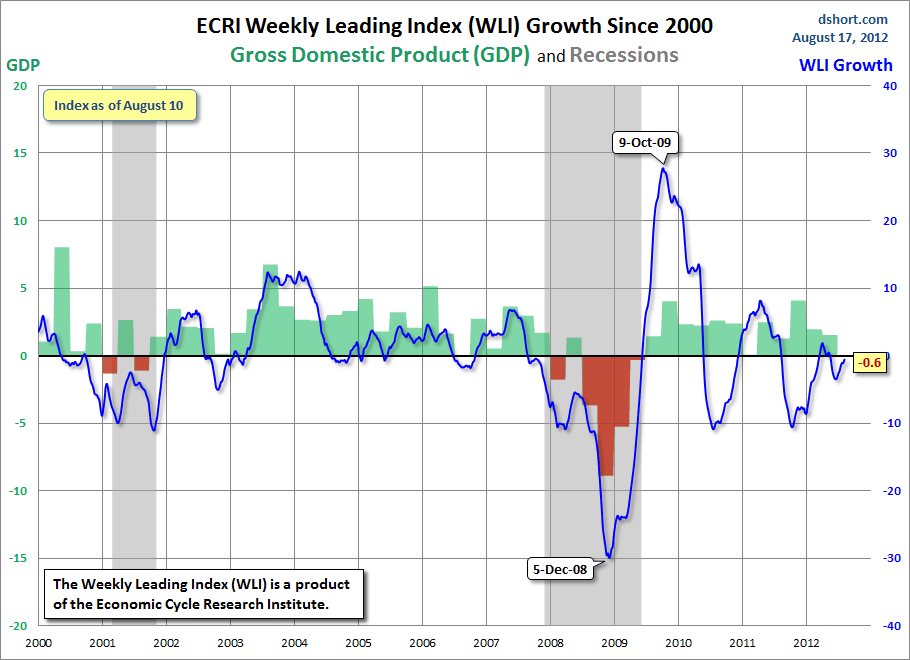
Supportive of US equities breaking upwards from their March highs, we have (i) global and US economic surprises still in an uptrend, (ii) Spanish and Italian CDSs still in a downtrend, (iii) money exiting US treasuries as 10 year yields have risen from 1.4 to 1.8 in just 3 weeks, and (iv) ECRI US leading indicators trending upwards, almost back to positive:

Source: Dshort / ECRI

Turning to global leading indicators, this last week’s data from the Conference Board delivered positive readings looking forward for USA and Spain, but badly negative readings for Japan and Korea. So it is unlikely that US and European equity advances are based solely on hope for QE in those two regions. This East-West divergence is likely to be resolved one way or the other: Asia and emerging economies turn up, or US and European equities top out. So which is it to be?

I deliberated on Friday at the new moon about whether to take some profits, but decided against. Geomagnetism is currently tame and it means the lunar-geomagnetic model currently has a mild uptrend into mid-September (all models upated this morning). Furthermore, the occasions historically when lunar phasing tends to fail in trading  are usually when there is a strong up or down trend. Clearly lunar phasing is not the only influence on trader sentiment, so in times of strong momentum one way or the other lunar phasing may be overridden. The current crawling up the upper bollinger band on US indices is reminiscent of the strong uptrends of the last two years that followed mid year consolidations. So I am suggesting there is a chance we are in a similar sweet spot for stocks.

I maintain that two developments would bring about a melt-up: (i) breakouts to new highs, into clear air and (ii) a turn up in leading indicators. German leading indicator data has just been released this morning, coming in at minus 0.8. That’s worse than last month’s reading and adds to the muddy picture in global leading indicators. So whilst a breakout to new highs in US equities looks technically more probable than a double top here, we can’t say we have the support of the global leading indicators. For this reason we see certain global stock indices still festering, and the likes of copper still languishing, rather than a full risk-on party.

What if global leading indicators didn’t turn up? Is it possible we could still see my forecast come good of an overthrow peak in equities in late 2012 and then a secular peak in commodities in 2013? Something like in 2007-8 where stocks first outperformed and then peaked whilst commodities took over and peaked longer and higher?:

Well, looking back to the last secular commodities peak of 1980, both stocks and commodities did make such moves even though leading indicators had been trending downwards for some months. In other words, speculation drove them on despite the worsening fundamentals, and this fits with my theory that increasing sunspots into the solar peak brings about speculative climaxes in risk taking and buying.

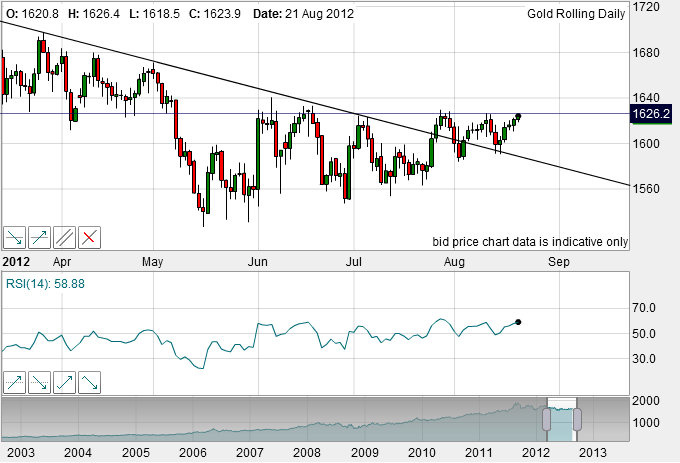
Getting technical again, US stock indices do not yet show overbought or overbullish readings. Were they to reach those levels, I would be much keener to offload some longs and take profits. The Euro is also showing signs of solidifying its base above 1.2 versus the US dollar. Gold is similarly building up its base and as can be seen below could be close to a break out of horizontal resistance, having successfully broken and backtested falling resistance.
In summary, at the moment the general overall picture is supportive of my forecast and my long pro-risk positions. Whilst there remain issues and areas of doubt – as there always are – I feel comfortable sticking with my trades as they are for now and continuing to watch indicators and data for further developments. We are at another siginificant point however, in whether US stock indices (and gold) can breakout or are sold back. Whilst a failure (in both) would be a set back for the bulls, it may mean more time is required, rather than it isn’t going to happen. But for equities bears this is the last stand and if this is to be a major double top then we should look for overbought and overbullish readings coming to pass as well as increased negative divergences supporting the exiting of longs.

Lunar Phase

A perfect lunar phase turn in the markets last week – up into a peak at Thursday’s new moon and then since downward. The downward pressure of forecast geomagnetism and into the full moon should persist until the end of next week. I expect to be sat on my hands until then, awaiting the FOMC output and monitoring developments in leading indicators, economic surprises, Euro debt and earnings. My thinking is that stocks will go onto to make a kind of second low in these next 2 weeks, higher than the June low and with a positive Nymo divergence. Meanwhile, I expect leading indicators will start to show signs of basing and ticking up, brought about by a natural upswing in growth, the drop in commodity prices in H1 2012 and the fresh round of global easing and stimulus. That combination would set us up to go make new pro-risk highs as H2 2012 progresses. So, whilst awaiting developments, back to the moon.

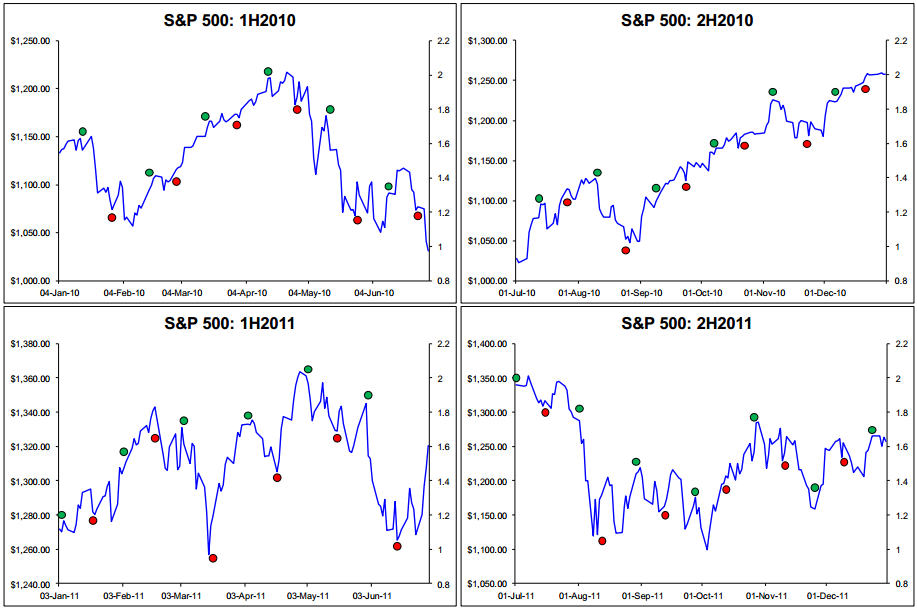
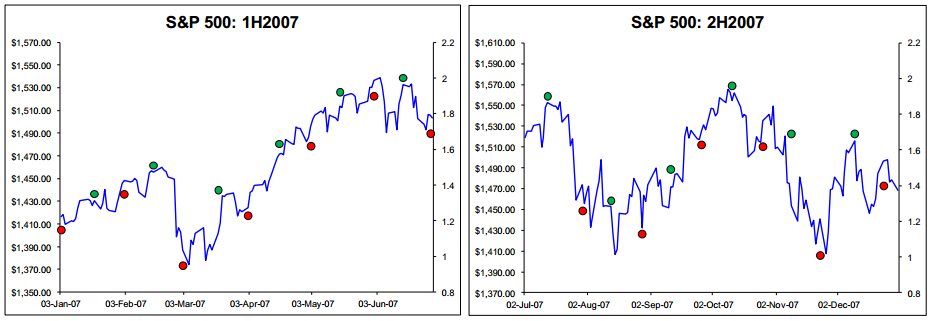
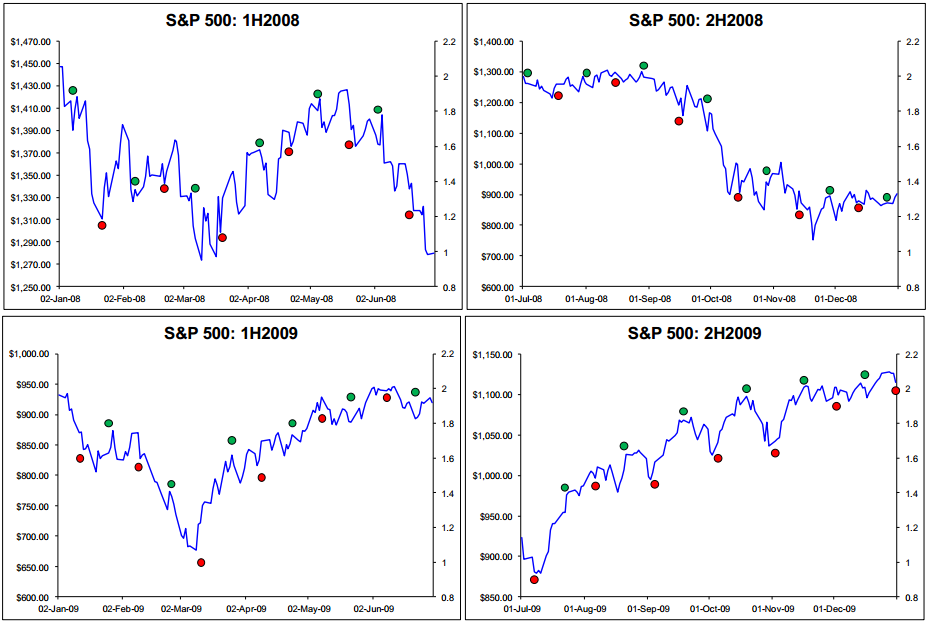
I trade the medium term, generally speaking, but use the lunar phase extremes to time my buys and sells. Thursday’s new moon reversal meant my sells captured the short term peak. Lunar phasing doesn’t always work out that well, but in my in-depth guide, Trading The Sun, I refer to 3 papers and my own chart demonstrating the compelling relationship that means overall lunar phases provides an enduring edge in the markets. I since liaised with Stifel Nicholaus and they did their own lunar research and shared with me. So here are their visuals showing the relationship between the SP500 and lunar phasing from 2007 to 2011, with new moons in green and full moons in red.
Source: Stifel Nicholaus