Equities v Bonds v Commodities v Dollar

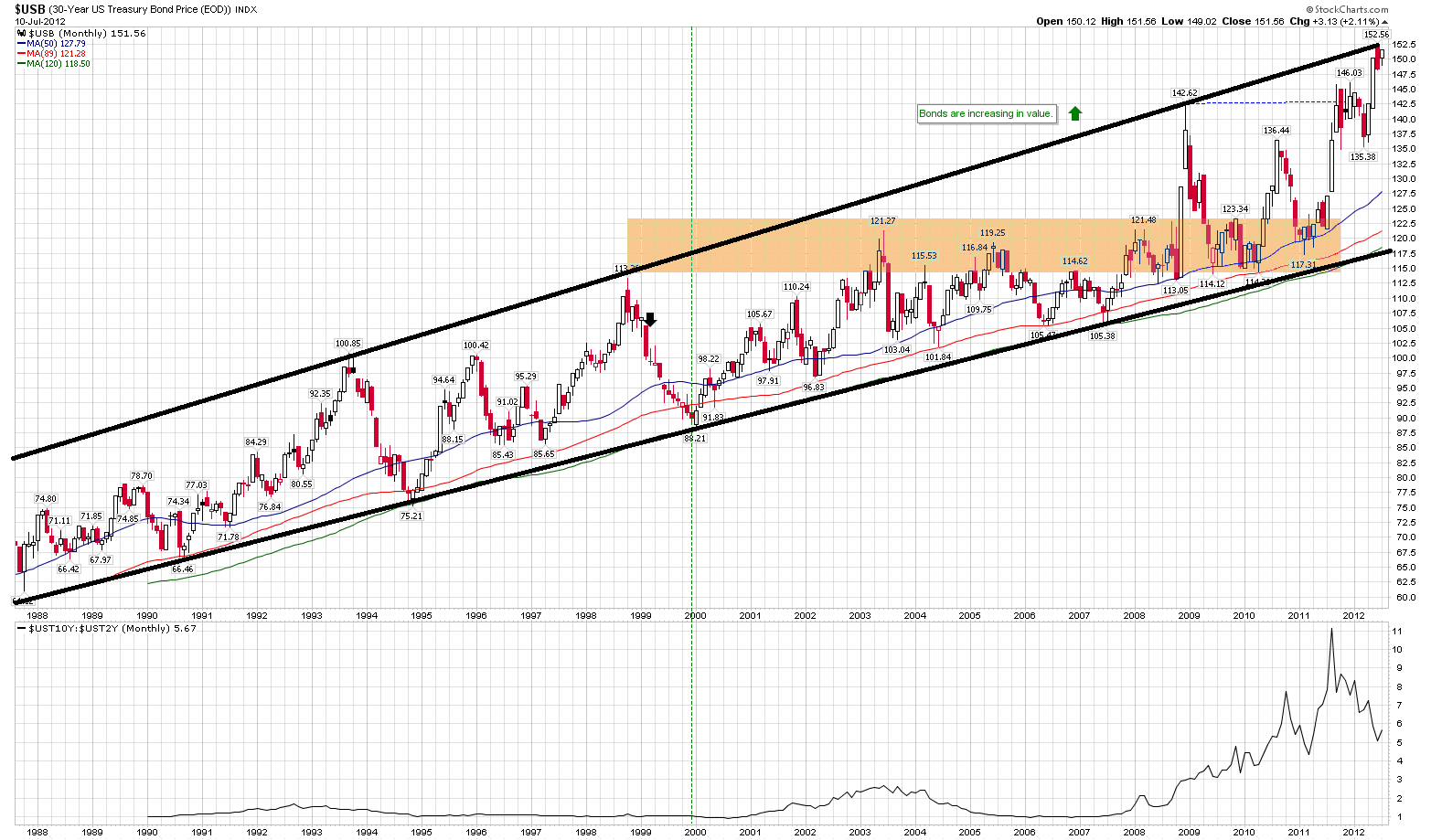
Here is the 30 year treasury long term chart. Price has hit the top of the channel from which previous reversals occurred.

Underlying Source: Stockcharts / James Craig

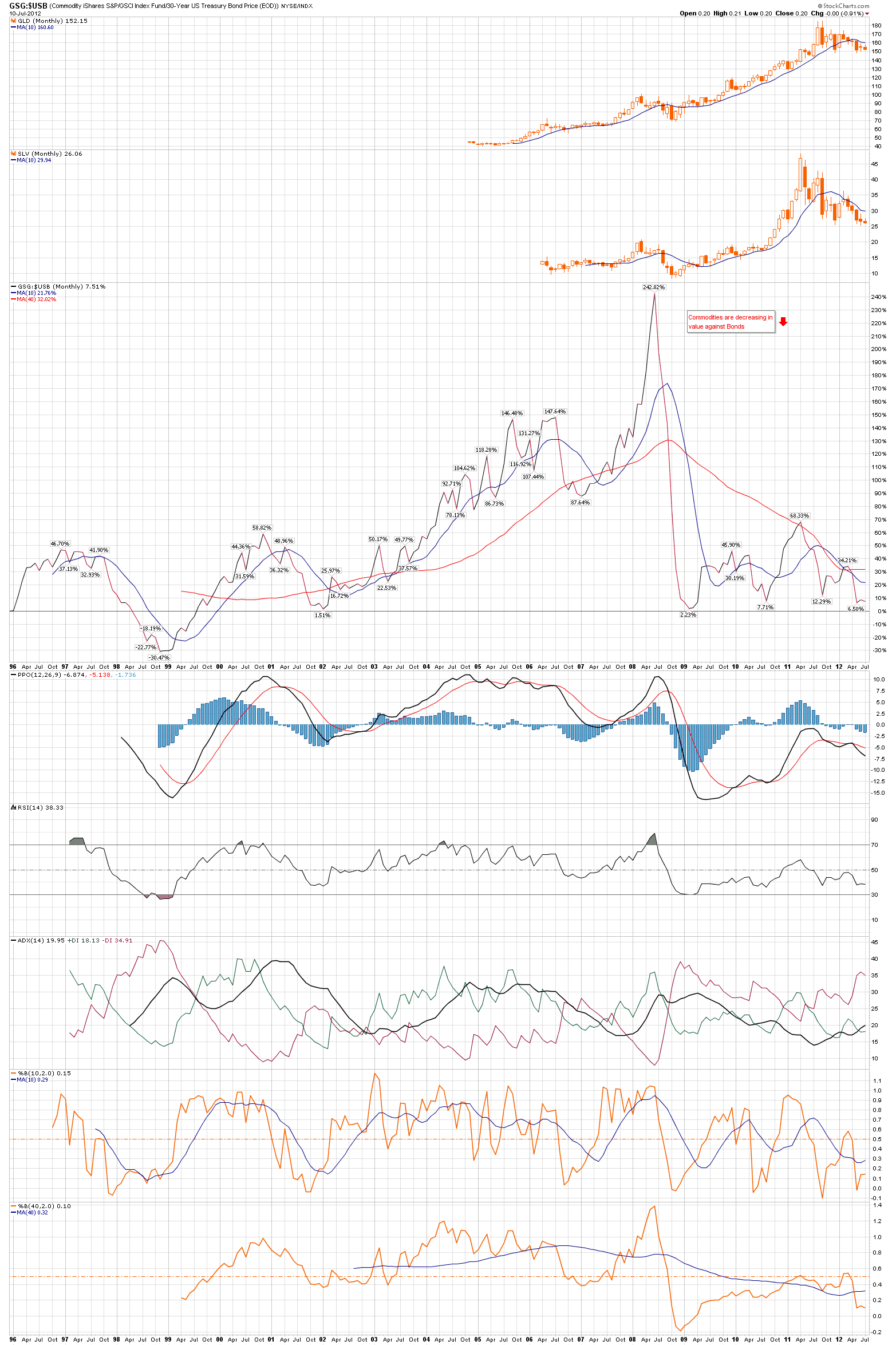
Below we see the commodities to 30 year treasury bond ratio which is back to the level at which historically commodities have been bought versus bonds.

Source: Stockcharts / James Craig

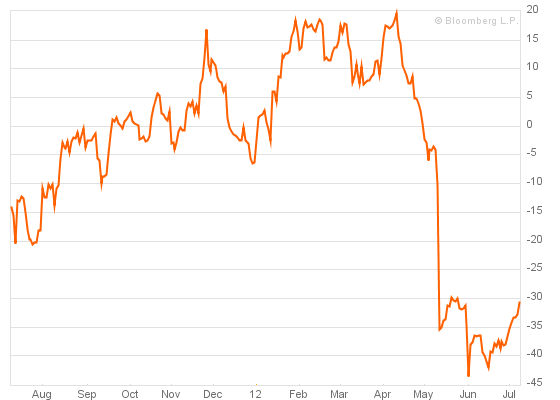
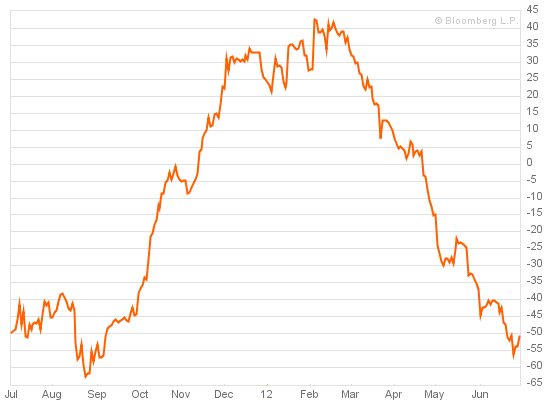
Next we see that Wall Street strategists’ recommended allocation to bonds is at a 15 year high and to equities at a 15 year low. The steep drop in recommended stock allocation not only exceeds the 2008/9 panic low but also resembles a capitulation.

 Source: Sentimentrader/Bloomberg

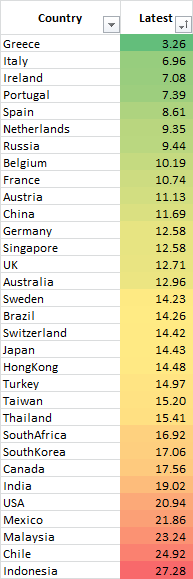
Below are the global p/e ratios as at the end of June. Those in single digits are at secular bottom valuations.

Source: Megane Faber

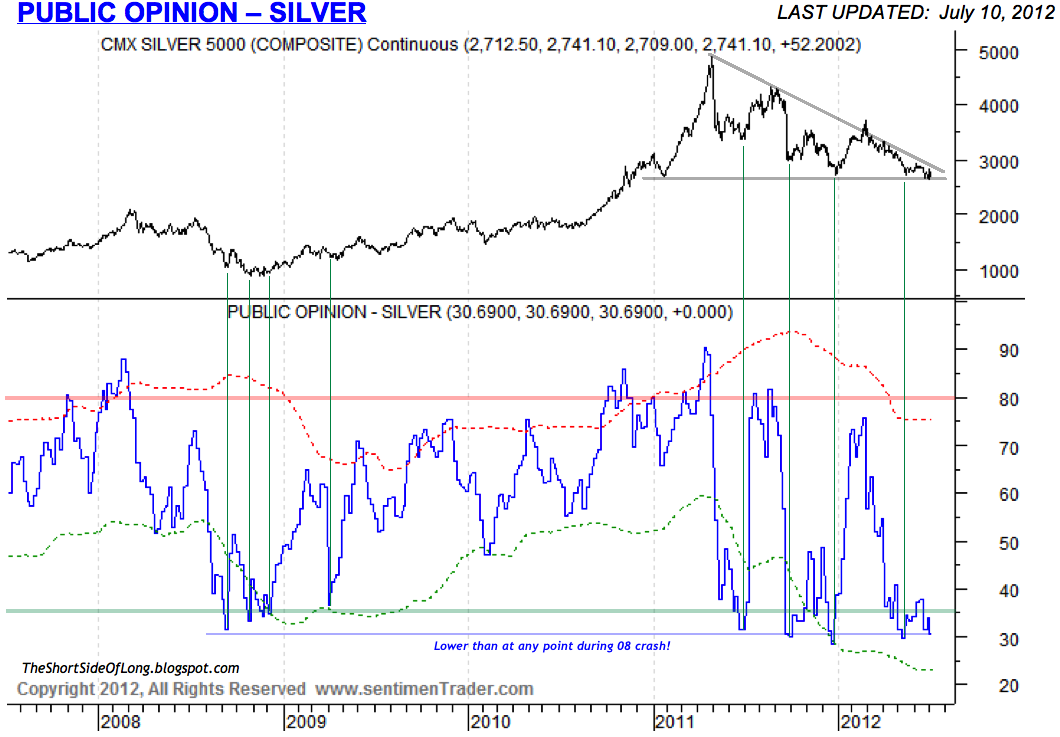
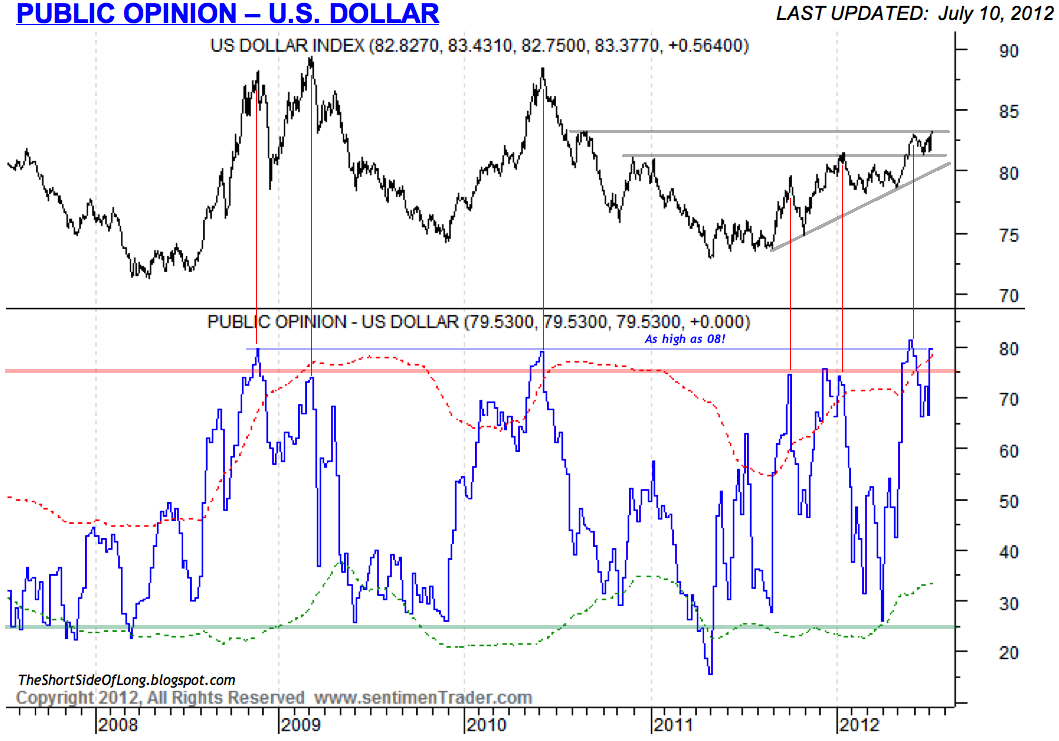
Next, two charts courtsey of Tiho, which show that public opinion is at opposite extremes for silver and the US dollar, both at comparable levels to the 2008/9 panic lows.

Source: Short Side Of Long / Sentimentrader

And lastly, a chart showing there is internal strength to the recent up move in stocks, with cumulative advance/declines at a new high, that normally suggests new market highs ahead.

Source: Sentimentrader

Drawing all together, the bigger picture suggests that an enduring move should be at hand away from treasury bonds and the US dollar towards commodities and stocks (particularly European), in other words a major rally in pro-risk and out of safe havens.

The Macro Picture

Citigroup Economic Surprises for the G10 nations:

Source: Bloomberg

Citigroup Economic Surprises for Emerging Markets:

Source: Bloomberg

The message is one of a potential bottoming in June, but we need to see a clearer uptrend emerge for the G10.

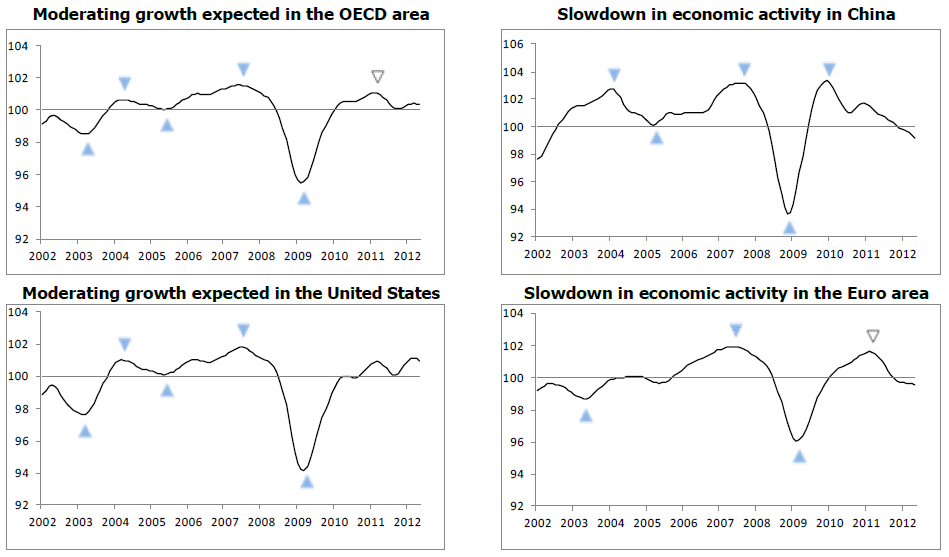
Turning to leading indicators, the latest OECD data continues to show a weak picture in China and Europe, but the overall OECD nations area maintaining growth, albeit unimpressive.

Source: OECD

Moving on to the Eurozone debt troubles, the pressure deflation in Spanish CDSs following the Eurozone summit outputs of the end of June has now been reversed and CDSs are back near to their highs.

Source: Bloomberg

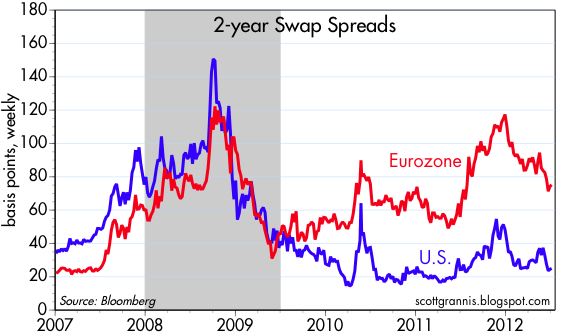
Meanwhile the risk of systemic failure in the Eurozone is declining:

Source: Scott Grannis

The message is that more action is going to required to satisfy the markets on Euro debt but that with Spain, Italy and Greece equities priced at secular bottoms, they are prices for systemic failure which isn’t likely.

Overall in terms of the big 3 (economic surprises, leading indicators and Euro debt), we don’t yet see the kind of positive combined momentum that would support a big move up in pro-risk. However, the global policy response, in terms of rate cuts and stimuli, has yet to make itself fully felt and is unlikely complete. Last week we saw fresh UK QE, China, Euroland and Denmark rate cuts added to previous global moves. August 1st is the next FOMC outputs, where we will see whether the US adds any further stimulus.

So the question, I believe, is how pro-risk performs in this window where we see continued macro weakness but continued new global policy responses.

One other macro development is that of global wierding on agri commodities, which gives us a supply side push on prices, regardless of economic outlook. Record global temperatures in April and May have brought about droughts that have spurred grains to an almost 30% gain in the last month and have by association pushed up all softs. Now, agri commodities are looking overbought and due a rest. The severe weather continues but El Nino is expected to make a full return this summer which should improve conditions for drought-affected farming. It is therefore a question of how great the impact is on plantings and harvests before less extreme conditions return.

Turning to solar influences, sunspots and geomagnetism are working opposite ways. Sunspots continue to rise in a general upward trend towards next year’s solar maximum, and this should spur speculation and inflation. But, geomagnetism continues to be disruptive and the cumulative trend continues downwards, rather than pulling up in line with mid-year seasonality. I have updated all models this morning. Here is the medium term picture for the CRB commodities index showing that cumulative geomagnetism trend is still down:

There is the potential within that for a little upside into the end of next week, the 20th July, around the new moon, before we experience a bearish combination of a significant period of geomagnetism and a full moon around the turn of the month into August – which coincides with the FOMC. Disappointment out of the FOMC is the potential therefore.

Lastly, US earnings season began yesterday with Alcoa. JP Morgan report on Friday but the major earnings don’t really get going until next week. There’s usually a theme to US earnings season (it is sold off, or bought up). The out of season earnings and significant forecasts downgrades both suggest it could be a season offering a good beat rate, which could therefore be bullish for stocks. However, we will need to wait to next week at least to see if that is the case.

This Week

A very powerful bullish day on Friday looks to have sealed a period of (upward) mean reversion in pro-risk. Stocks, Euro and commodities all participated, with crude up almost 10%. Here is the Russell 2000 – a high volume, engulfing candle that broke out beyond resistance and is historically the kind of technical move that triggers more upside ahead.

Source: TheStockSage

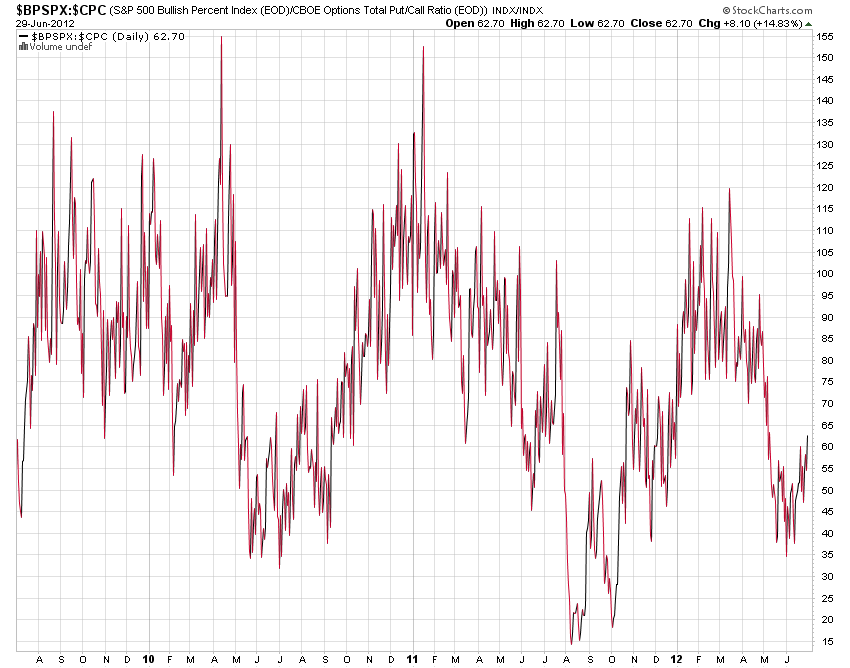
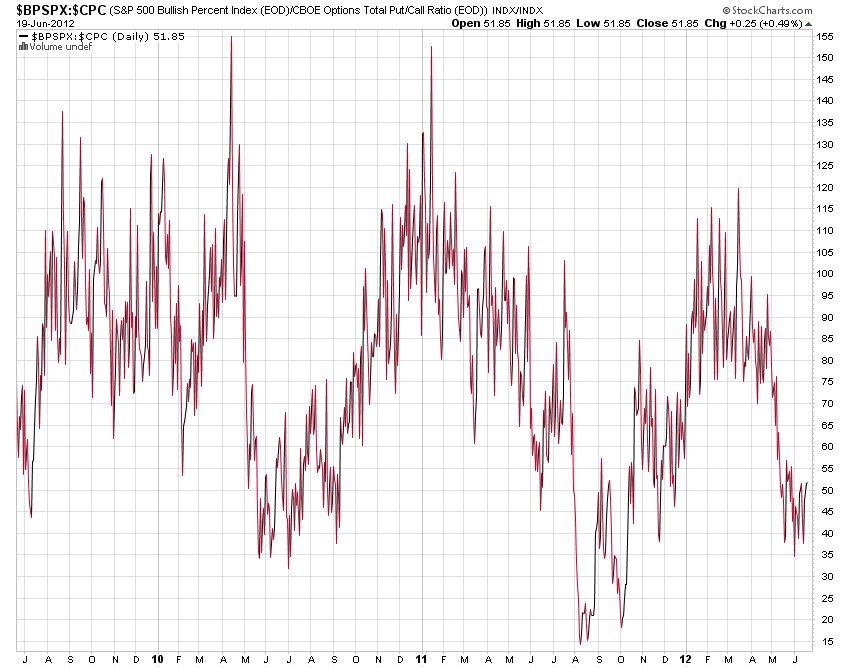
How far can we mean revert? If we look at bullish percent over call/put ratio, we are still in the lower range reached at the bottoms in 2009, 10 and 11.

Source: Stockcharts

In other words, Friday’s bullish candle has not yet neutralised the overbearishness. Beyond mean reversion, it becomes a question of the 3 main fundamental indicators:

1. Leading indicators – still generally weakening to negative globally.

2. Euro debt issue diffusion – the outputs from the Euro conference that spurred the big bull day also dropped Spain CDSs out of their upward channel:

Source: Bloomberg

And 3. Economic Surprises – still languishing, but potentially bottoming, as we see a level in the G10 chart below that was reached at last year’s low, together with a current bounce – only tentative though:

G10 Economis Surprises – Source: Bloomberg

My expectation is that pro-risk rallies in H2 2012, in line with previous secular/solar history, before stocks give way and commodities make their final blow-off top around or following 2013’s solar maximum. I expect piecemeal policy action to diffuse Euro debt, as Euro leaders remain committed to no break up and no defaults. I expect leading indicators to turn up thanks to oil and commodity prices having come down, and governments easing and stimulating again on top of what is already extremely easy and supportive global monetary conditions. This week we have the potential for rate cut announcements in Euroland, Denmark and Sweden. And I expect Economic Surprises to begin to rise again, because this is a mean reverting indicator – i.e. as data disappoints, forecasts are cut down, until data starts to beat again with the bar lower. It matters less that the bar is lower, and more that expectations are beaten.

We also have US earnings season starting a week today with Alcoa. Analysts have been sharply downgrading their forecasts, and off-season earnings have been beating expectations – both of which could mean a positive earnings season ahead, again in terms of beating expectations.

The geomagnetism which was forecast from 29 June through to 3 July is indeed in progress, at a level in line with expectations (not too major). 3 July is also the full moon. I therefore expect some pullback in the first half of this week but unles we retrace Friday’s bull candle in full (which I think is very unlikely), I believe it sets us up well for a bullish period into around the 20th July, supported by upward pressure into the new moon, less geomagnetism forecast (although check back tomorrow as Tuesdays are the forecast updates and my model updates), some more easing and stimulus from select governments, continued mean reversion away from oversold and overbearish pro-risk, and US earnings getting underway.

SC24 v. SC14

Leif Svalgaard suggests solar cycle 24 could be similar to solar cycle 14, which had a long flat top, which is in line with Jan’s comment.

Underlying source: Leif Svalgaard – my notes added

So how did that affect the secular asset cycle back in the early 1900s? As you can see from my notation, the secular peak (which was in stocks) occurred on the nose of the official solar peak, which was near the front end of the flat top. So, if SIDC and NASA are correct in their predictions for a Feb/Mar 2013 official solar peak, then we might expect the secular peak (in commodities) to occur close to that, rather than towards the end of the flat top, if such a top extends out into 2014.

Agri Commodities Awake

I have updated all the models, on their respective pages.

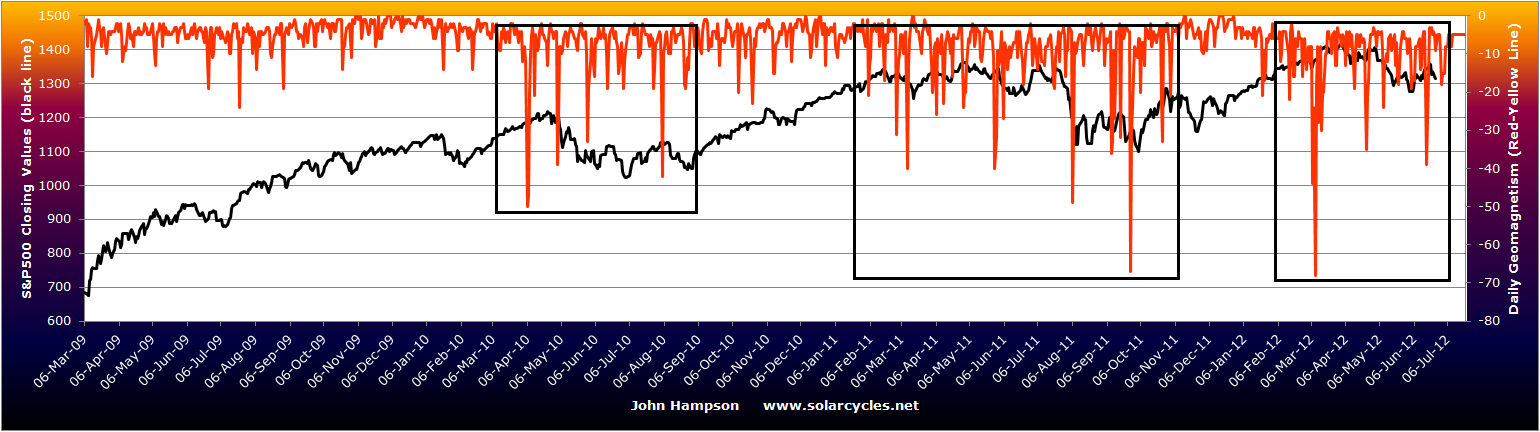
Geomagnetism continues to be a good guide. Here I have highlighted the periods of higher geomagnetic disturbances corresponding to periods of correction for the stock market. The question is whether the most recent period if now over, or continues. Seasonality suggests we should experience fewer disturbances through to August, which if so, would be supportive of upside for pro-risk. That would fit with a period of mean reversion coming to pass away from recent extremes of oversold and overbearish in pro-risk.

The shorter term geomagnetic lunar models continue to perform. The last two lunar turns were on the nose and the cumulative geomagnetism trend has provided an overall route map for the markets. Here are the Dax and the CRB commodities index, with the tails showing the forecast for the next 3 weeks. As yet the model does not show a renewed upturn, but commodities, being below model, have room to pull up.

Which brings me to the title, as in the last week we’ve seen soft commodities wake up and put in daily gains of up to 7% in some foodstuffs, as the hot dry weather in key producer parts of the world comes into focus. Agri gains have been made despite other pro-risk assets pulling back. As I previously stated, whether the extreme weather continues into the end of July is likely to determine whether or not we see a run away rally in soft commodities to new highs in H2 2012.

I have previously shown charts displaying close relationships between the different commodity classes, so if softs do take off in a meaningful way, that should provide the impetus for precious metals to break out.

The all-commodities chart since 2000 doesn’t look too bullish:

Source: Bank of Canada / Reed Construction

Yet, take out energy and a secular bull appears very much in tact. Fluctuations and weakness in oil and natural gas have largely accounted for what some analysts have identified as technical weakness in the overall commodities picture. Commodities ex-energy:

Source: Bank of Canada / Reed Construction

As you know, I believe the secular commodities conclusion is ahead, following next year’s Spring solar maximum. Increasing sunspots inspire speculation and growthflation. The current window of economic weakness is providing the opportunity for another round of global central bank supportive and stimulative interventions. More needs to be done in this regard, but I expect the natural pick up in growth, speculation and inflation combined with the aid of the central banks to come to fruition.

Currently, we continue to see problematic levels for Spanish and Italian CDSs. Economic Surprises continue to languish. Chinese leading indicators came in better yesterday at +1.1% (Conference Board), but other leading indicators have been largely negative. I am not belittling these issues, but refer you again to the secular position and recent extremes in indicators, whereby we are more likely to see pro-risk rise on slight improvement in these areas, rather than fall again.

Here is someone else who shares my view that secular stocks bulls need redefining from the nominal lows, and concurs that the new secular stocks bull began in 2009, noting the similarities to the last two secular nominal lows.

Source: Federated Investors

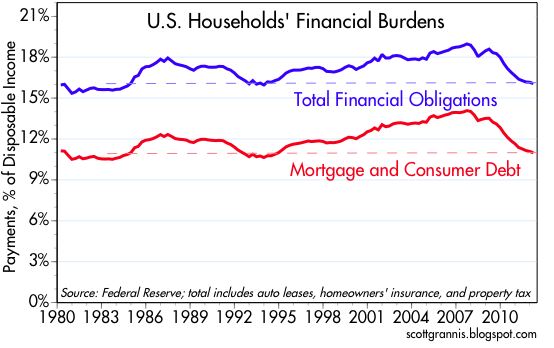
And here is a chart from Scott Grannis showing how US housholds have largely completed their secular deleveraging, allowing the private sector to releverage from here (despite the increase in public debt). This also fits with US housing increasingly showing it bottomed already.

Source: Scott Grannis 

Evidence increases that we are into a secular inversion period. The timing is however critical – when to switch out of commodities and bonds and into stocks and real estate, in terms of longer term buy-and-hold. I maintain the blow-off top should still be ahead for commodities, which provides the best opportunity out of the 4 classes into 2013 – I believe. But that will be the final pop, as relative cheapness of stocks and real estate to bonds and commodities reach historic extremes.

Roundup into the FOMC

Another bullish day yesterday for pro-risk, and we are now at dual resistance on the SP500:

Source: TSP Talk / Decision Point

Yesterday was the new moon, and downward pressure now emerges on my lunar geomagnetic models as of tomorrow.

We also see short term overbought signals that suggest a pullback is required, such as on the Nymo:

Source: Stockcharts

It gives us a set up whereby today’s FOMC could disappoint the markets, because of the trio of short term overbought, technical resistance, and lunar/geomagnetic down pressure as of tomorrow.

Now let’s just step back a moment and see the bigger technical picture.

Bullish percent and put/call ratio are down at the low extreme still, suggestive of a more enduring rally.

Source: Stockcharts

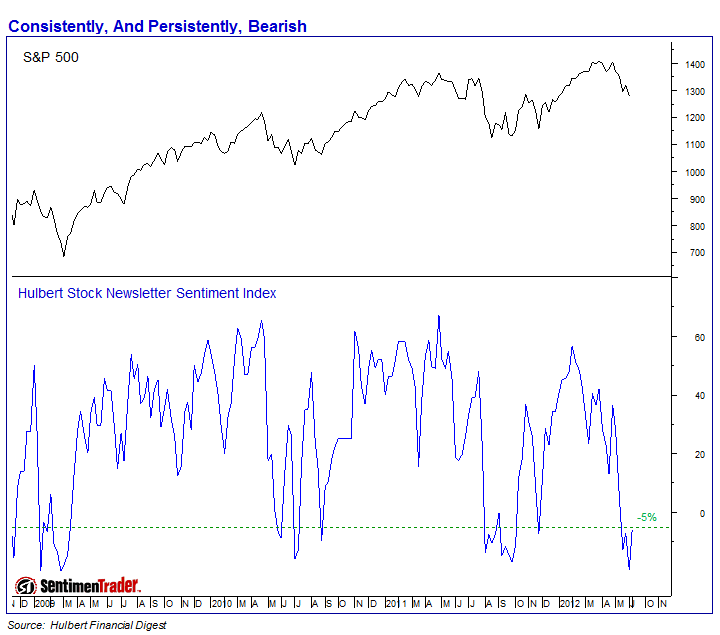
Hulbert Stock Newsletter sentiment is at the low extreme level that suggests a more enduring rally also.

Source: Hulbert / Sentimentrader

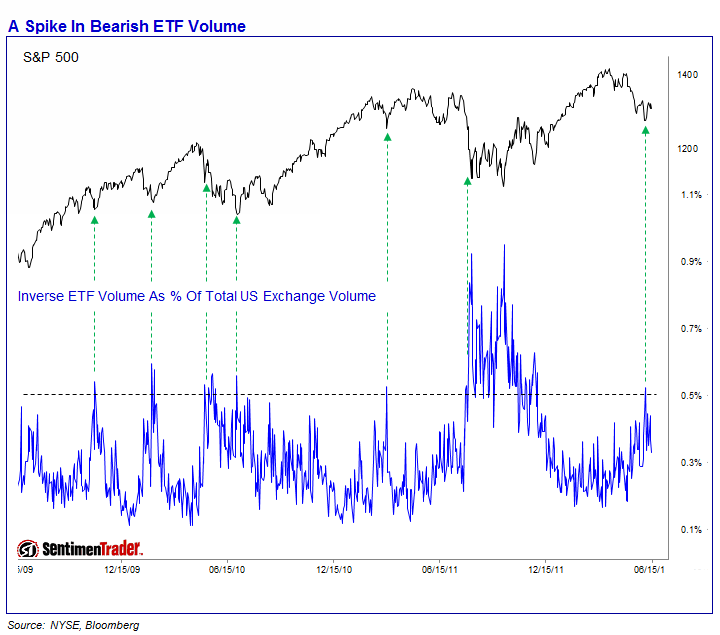
A spike in bearish ETF volume is synoymous with previous important lows and significant upside ahead.

Source: Sentimentrader / NYSE / Bloomberg

The recent pop in insider buying is suggestive of the market rallying ahead, as this smart money historically calls it correctly.

Source: Insider Score / Technical Take

And a low extreme followed by a new upturn in breadth also reflects important previous bottoms.

Source: ShortSideOfLong

In short, the technical picture for US stocks is bullish in a multi-week/month timeframe. So, if a short term pullback comes to pass, it is likely to be followed by further upside. If we draw in recent oversold/overbearish extremes in global stocks, commodities and the Euro, and the recent parabolic rise in treasury bonds, we have further support for an enduring move out of safe havens and into pro-risk.

Yet, the global macro picture continues to deteriorate. Economic surprises continue their downtrend and don’t display a pull-up ahead of a stocks rally, as we have seen the last couple of years. Leading indicators continue to decline – yesterday Australia came in at -1.4% (Conference Board). Euro CDSs continue to flirt with records.

As I previously stated, a mean reversion rally away from the oversold/overbearish extremes in pro-risk was likely to occur, regardless of the outlook, and we are seeing that currently. Either leading indicators and economic data start to improve and pro-risk does more than just mean-revert, or mean reversion then gives way to further declines.

US earnings begin again with Alcoa 9th July. The recent off-season beat rate has been almost 80% which suggests we may see a bullish earnings season.

Presidential cycles are supportive of upside into the US November elections, but that is largely because the President creates a positive backdrop into the elections, with concrete actions and also data spin. We start today with the FOMC and see how supportive the outputs are. Meanwhile, European leaders still need to do significantly more if they are to diffuse Euro CDSs. China also appears to need to do more to stimulate and other countries also.

Agricultural commodities had a bumper day yesterday, as concerns over the hot dry weather came to the fore. One day doesn’t make a trend but data shows that commercials were taking positions, not just speculators. I believe June and July’s climate data will really determine whether or not we see a major H2 rally in soft commodities this year.

I am going to take a couple more pro-risk profits today, selling into the strength before the unknown of the FOMC, but still retaining the vast bulk of my pro-risk positions. As I stated above, there are reasons for a short term pullback (unless the Fed really goes full-stimulus, which I don’t believe they will).

Thereafter I remain of the view that the speculative push into the solar peak of 2013 will occur. As noted above the technical picture for Euro, dollar, bonds, stocks and commodities very much suggests an enduring rally should emerge here. I therefore believe slightly less bad news in terms of leading and current data and developments is likely to spur pro-risk higher, i.e. it doesn’t have to be great, just better. I also believe we are in the midst of another period of global central bank easing and stimulating action and that we will see further rate cuts and credit easing actions and the like.

Markets Update And The Secular

So it’s been range trading but with an upward bias for the markets into the coming weekend’s Greek elections. Greek stocks got a 10% pop yesterday on unofficial polls pointing to the pro-austerity party winning. Natural Gas also advanced over 10% – the two biggest dogs of recent times sharing a bumper day together.

Economic Surprises continue in their downtrend. The latest leading indicator readings for the UK came in positive and Korea just slightly negative – the global picture continues to be mixed at best. Italy and Spain CDSs continue to flirt with records. The UK government announced measures to improve credit. Now we see what the FOMC delivers next Wednesday. I don’t expect QE, because the US economy is doing relatively OK and it would likely only serve to push up asset prices rather than boost the economy, but I do expect a Twist extension, or something similar, as letting Twist expire and doing nothing would amount to tightening. I expect they will downgrade their wording on the economy and recommit to doing more if things worsen.

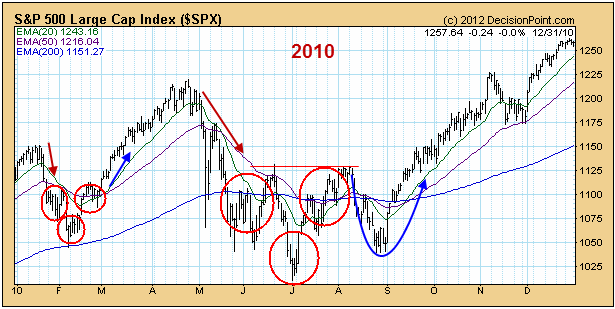
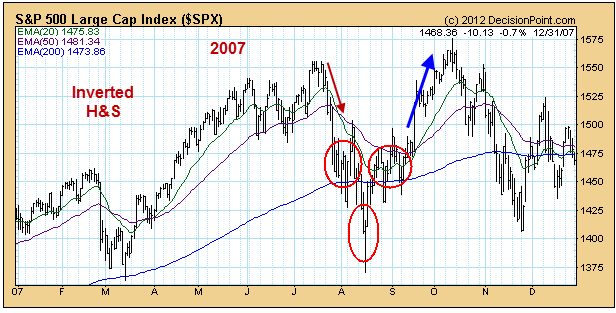
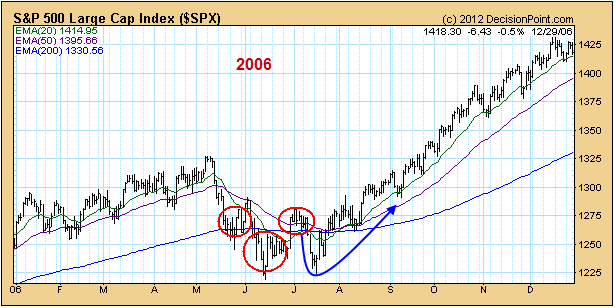
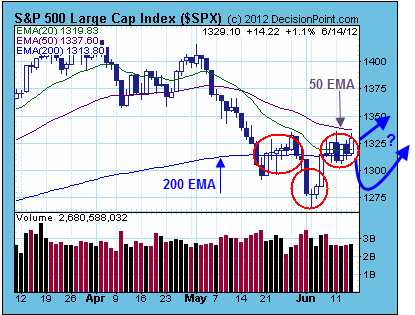
If the Greek pro-austerity party wins and the FOMC delivers something similar to my expectations, I expect that to be enough to rally pro-risk. Stocks, commodities and the Euro continue to display oversold/overbearish readings, so mean reversion remains the most likely. If something less pro-risk friendly occurs in the next week, and we see falls in pro-risk, then I expect the pro-risk rally just to be postponed a little. TSP Talk highlight some historic rhymes that reflect the two scenarios of rally-now or rally-later:
Source all: TSP Talk / Decision Point

Everyone can see the inverse Head and Shoulders on the stock indices currently, which by textbook would see us break up and rally significantly in the coming week, but a couple of historic rhymes also show that a drop and higher low could come to pass over the next few weeks before a rally.

I have trimmed back my pro-risk positions very lightly today, taking profits on some of those that picked the bottom, but leaving the vast bulk in tact. The Greek elections and FOMC are uncertain. The new moon occurs Tuesday but geomagnetism is expected to lead into it. It feels a bit more of a lottery than usual, but nevertheless, I remain heavily long pro-risk expecting that we will see (i) a mean reversion rally away from oversold/overbearish (whether that has already begun or needs another low ahead first) and then (ii) a commodities secular bull rally conclusion from here into next year’s solar maximum together with an accompanying rally in stocks that ends before commodities make their final mania.

So how might my secular expectations from here come good?

First, a natural pick up in growth and inflation, as per action into previous solar maxima. Speculation in commodities will be the key driver of the inflation side. Evidence of a pick up in leading indicators and economic surprises, particularly in the US and China, would confirm a pick up in growth and encourage that speculation into commodities, but as yet we don’t see that.

Second, co-ordinated global policy responses in easing and stimulating would also provide the push in growth and inflation. This process appears to be underway with recent intervention in China, Australia, UK and others. How quick and how comprehensive the global action is from here, remains to be seen. The European debt accuteness needs further action, as the Spanish bank programme failed to satisfy. Some kind of action by the Fed is expected, and most likely needed, to satisfy the markets.

I continue to expect we will see a combination of the natural pick up in growth (very supportive monetary and fiscal conditions worldwide, oil and commoditiy prices recently receding) together with a series of global policy reponses, so both elements, but for now this remains tentative.

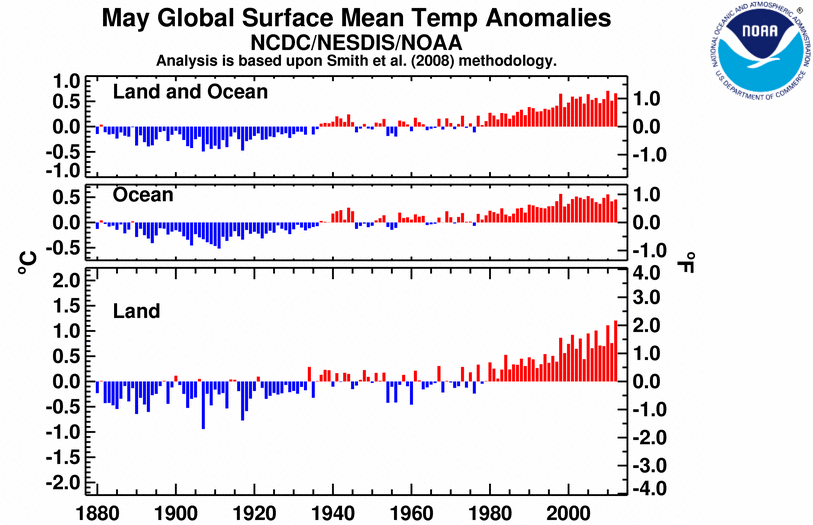
Thirdly, a supply-side push on commodities. Into solar maxima we historically have seen war, protest and revolution. As sunspots rose in early 2011 we saw the Middle-East and African uprisings and UK protests. As sunspots are rising again currently we are seeing an increase in protests in Russia and fighting and protesting in Syria. Iran remains a potential flashpoint as a key supplier of oil. A perceived supply disruption would push oil prices and by association food prices. Again, this remains just potential for now, but there is also a possible supply-side push in food, without oil’s input. In the first half of 2010 we saw several months of global temperatures being at all-time records, whilst soft commodity prices remained fairly depressed. The result was a major rally in food prices in the second half of 2010 as those record temperatures devastated plantings and harvests. Here in 2012, food prices are again currently depressed, and although global temperatures weren’t extreme in January-March, in April we saw the second highest ever global temperatures for that month on land, and May’s stats, just released, reveal that May was the hottest May ever on land.

Source: NOAA

The result is current drought and excessive dryness in US, Argentina, Russia, Korea and Australia. If we see another couple of months of such extremes, I expect food prices to surge again in the second half of 2012. Recall that global stockpiles remain low, but record plantings depressed prices. If these plantings are decimated by dryness and drought, then the critical stockpiles come back into focus. Food and gold prices reveal a close correlation, so a push in food would likely be accompanied by a push in gold, as an inflation hedge.

Fourth is the secular position for equities. Recall that my charts comparing historical secular stocks bears reveal that at this point stocks are unlikely to see much lower in nominal terms again, and that we should be looking upwards to stocks, not down. We should see a rally in stocks here, which is also supported by presidential cycle seasonality, but which ends before the commodities final mania ends. There is an interesting situation with European equities, whereby they have reached their secular bear valuation buy signals at this point.

This table is from Goldman Sachs taken in mid-May, showing the cyclically-adjusted P/E ratios for key countries:

Source: Goldman Sachs

Historically, a secular bear ends when CAPE reaches below 10. You buy at that point and are rewarded for the next 10 years with an average return of around 15-20%. Furthermore, very good buy opportunities have arisen when FYPE (forward earnings valuation) exceeds CAPE. As you can see, Spanish and Italian stocks are well below 10 and the FYPE exceeds the CAPE too.

For reference, the lowest CAPE historically that we have ever seen was 3, reached by both Thailand and Korea. Guess what? Greece has now beaten that with a CAPE of sub 2. So, with some confidence we can say that buying Greek, Spanish and Italian equities at this point is likely to pay off handsomely over the next 10 years, but clearly the risk is for more downside before the upside eurupts.

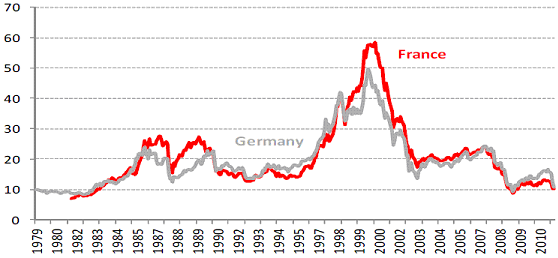
Here is the chart again showing that the p/e for Germany is back at the last secular lows.

Source: SG

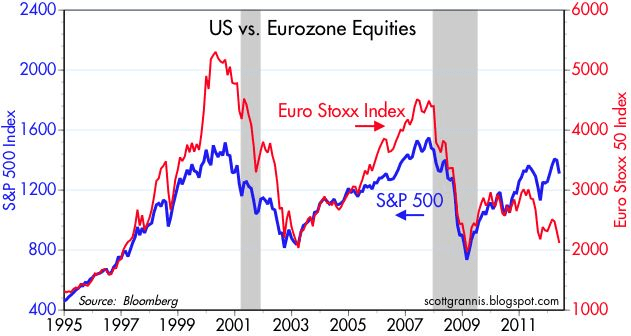
Here we can see the Eurostoxx index has made a third major low in this secular bear market. 3 major lows have defined historic secular bear markets, before a new secular bull erupts.
Source: Scott Grannis

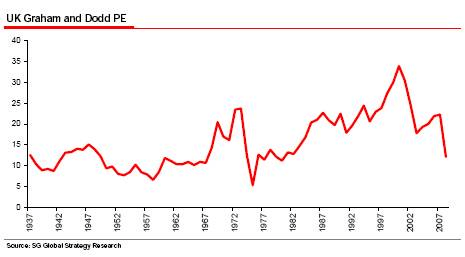
Here is the UK cyclically-adjusted P/E. It is also back to where it was at the similar point in the last secular bear (around 1979). I note that it made its nominal low in the middle of the last secular bear, which looks a little different to the equivalent US chart which made its p/e low at the end.
Source: SG

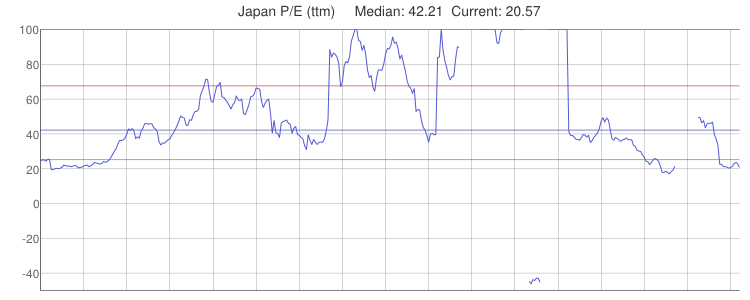
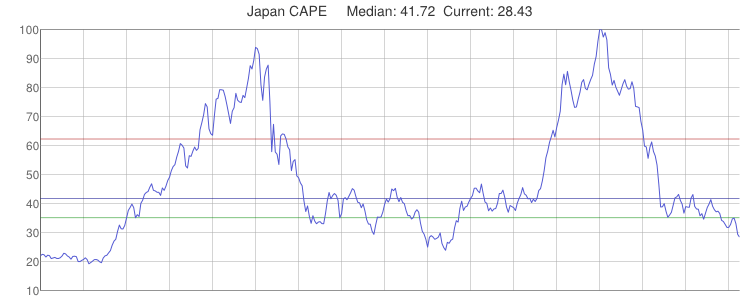
Of course not all stock indices around the globe will peform the same. Not all stock indices will end this secular bear market with CAPE under 10. Here is Japan’s chart:
Source: Vector Grader

In the last secular bear, Japan’s ending CAPE was around 20. This may be accounted for by it being a leading index then, going on to its amazing peak in 1989.

Is the US the leading index now? Could we have bottomed with the US at CAPE 20 and European stocks in single digits? Well I think not yet, but we are getting close. I believe some other major indices need to drop beneath CAPE 10, not just the PIIGS, but we can see the likes of the UK and Brazil are close. I believe that more comprehensive drop beneath CAPE 10 will occur with a bear and recession following next year’s commodities finale. But the likes of Spain and Italy are so cheap now that I wonder whether they may now go on to outperform, and not look back. It’s either that, or they go on to join that club of the cheapest CAPEs ever. Clearly we need some more enduring and satisfying policy responses in Europe to enable them to rally sustainably, but at the same time once we have those in place, European stocks are likely to be much higher.

In summary, I think the message is clear that we are reaching towards the end of the secular stocks bear in terms of valuations. I don’t believe we need to see US stocks halve in order to reach under CAPE 10, as we can see from the range of ending CAPEs in the last secular bear. I expect that once we see the likes of Germany, Brazil and China under CAPE 10 we are done, and I expect that point to come next year or the year after, in a cyclical bear following a commodities mania conclusion linked to 2013’s solar maximum.

One Week Later

As expected, we saw a reversal at the start of last week. Capitulative Breadth hit the 7-10 capitulation zone on Monday (and has since dropped back to zero due to the rallying). Monday began with more sellling then made an intraday reversal and daily hammer candle – another bottom signal. We printed the missing positive Nymo divergence between the lows of 18th May and 4th June, and positive RSI divergence between the two also. The week then progressed bullishly but Friday’s action in pro-risk, particularly in commodities and the Euro, looked weak for a while but by the close had reversed strongly. The media assigned rumours of a Spain banks bailout coming at the weekend to the reversal. This duly occurred on Saturday and we will see market reaction this coming week (Spanish CDSs had pulled back a little last week, we shall see if this can be sustained this week). Technically we were due an enduring rally in pro-risk, as per the many indicator extremes I posted in my last few entries. Central bank fuel for such a rally was mixed however. China and Australia cut rates. The Bank of England stayed put. The ECB did not cut rates. Bernanke did not telegraph further QE, as some had also speculated, but left the door open to do ‘something’ – or nothing – at the June 20 FOMC, subject to the latest economic developments. And now Spanish banks bailed out by the EU.

ECRI leading indicators for the US dropped to -2. Chinese data disappointed again this weekend (Chinese stocks made bearish technical action last week, contrary to most pro-risk, and despite the rate cut). Citigroup Economic Surprises languish and haven’t made a turn-up ahead of stocks bottoming, if that was a bottom, as they did in 2011 and 2009. So the economic picture remains weak and the question is whether central banks have begun another round of easing and aiding and stimulating, with last week’s announcements just the beginning, or whether they feel they can largely stay put and see how things develop. Well, suffice it to say that if the picture does not improve they will likely intervene more, but what we need to know is whether we will see more downside for pro-risk ahead if they don’t do more currently.

Let’s return to the techincal picture. Look back in my previous handful of posts to see the extremes reached in terms of overbullish/overbought treasuries and dollar and oversold/overbearish commodities, Euro and stocks. One thing missing for equities was an Investors Intelligence sentiment washout (whereas AAII had made such an extreme). Last week percentage II bulls finally dropped into the historic extreme low zone, but percentage bears did not, i.e. still quite a few neutrals. Accordingly, the bulls minus bears chart still doesn’t show a historic extreme:

Source: Shaeffer / Investors Intelligence 

Also, Chris Puplava notes the lack of panic selling compared to 2009, 2010 and 2011 major bottoms.

Source: PFS Group

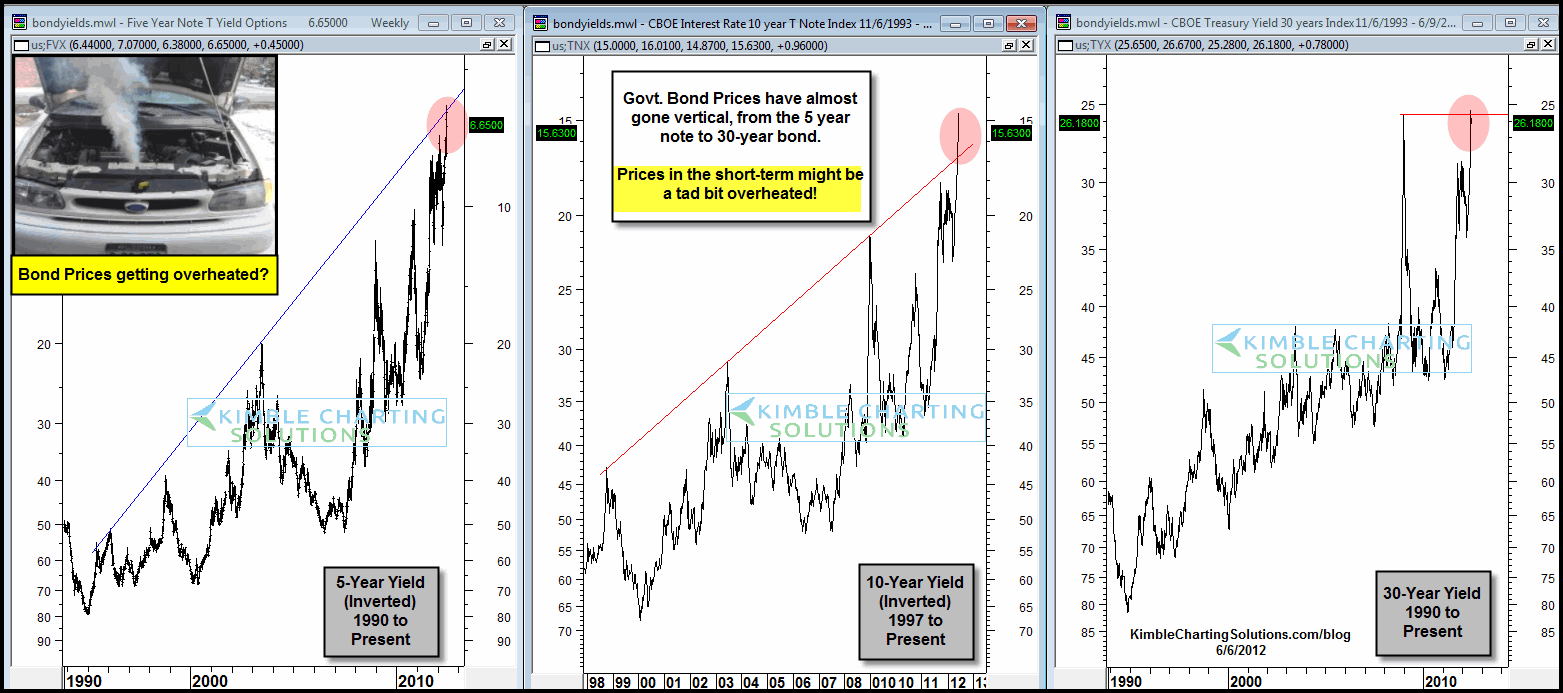
On the other side of the ledger, equity fund flows have hit historic pessimistic extremes, matching real investor action with the sentiment shown in AAII. Also, treasury yields made an inverse parabolic move into the beginning of Monday that resembles other historic blow-off parabolic moves that normally don’t come again for some time. The action as of Monday was a v-bounce that could mark the reversal, and if so, that could spell an enduring move into pro-risk from here.

Source: Chris Kimble

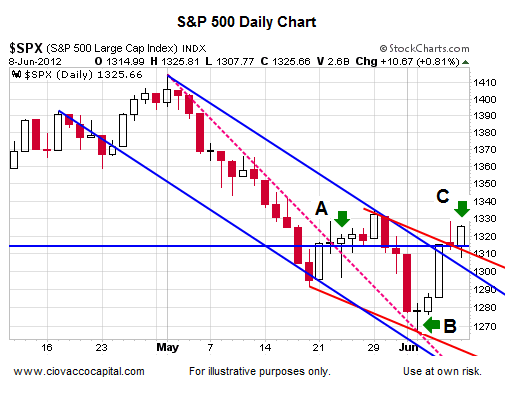
The S&P500 looks pretty bullish. As per Chris Ciovacco’s chart below, we appear to have broken out and backtested important resistance. The question is whether stocks can go on to make a higher high than the end of May at the start of this coming week. If they can’t, then an inverse Head and Shoulders pattern could be in the making as long as stocks don’t exceed last Monday’s lows.

Source: Chris Ciovacco

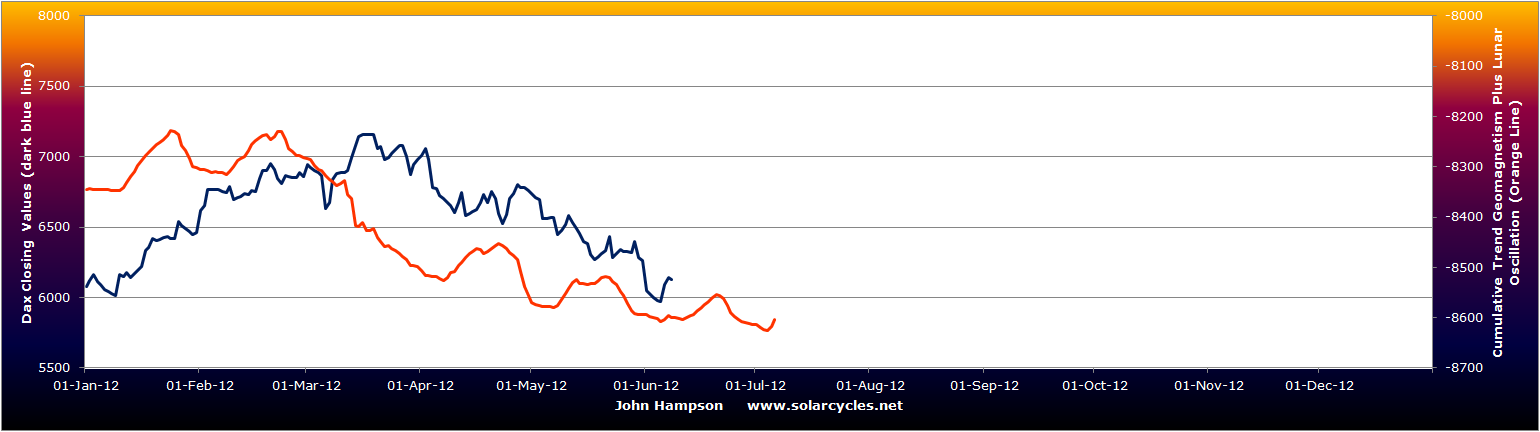
NASA’s updated solar prediction still forecasts Spring 2013 for the solar peak, and still forecasts it to be a weak solar maximum historically. The sun is fairly active currently, which is bullish, and this should continue into next year. Some geomagnetism early-mid last week has pushed down a little on my short term model, but the message remains of a likely bottoming here, with seasonal upward pressure into July. Near term, there is the scope for upward pressure this coming week into the new moon of 19 June. I will update all models on Tuesday, with the extended NOAA forecasts, but here is the up to date Dax:

Expecting upward pressure into the new moon, I don’t plan to take profits on any of my pro-risk longs yet. The next couple of weeks give us the BofJ meeting, the Greek elections, the FOMC and other Euro meetings. Between them there is the potential to really give this rally some momentum and start to fulfil the historic positive seasonality in an election year from June to November. Or there is the potential to disappoint the markets and leave the focus on weak data and Eurozone issues.

Here is what I think. Pro-risk is overdue a counter trend rally here, a sustained upmove that provides some mean reversion for the stretched oversold/overbearish extremes. I expect us to to make that rally now. If pro-risk is heading for another lunge lower, to perhaps give us the missing II sentiment and panic selling extremes then I expect that to occur after we have made a decent retrace upwards for a few weeks. The clues will be in the health of that up move and the developments in economic surprises and leading indicators – i.e. if we rally up but all that deteriorates further then I’d be looking to take profits. However, rising sunspots, seasonally less geomagnetism, presidential seasonality all support mid-year upside. The blow-off move in treasuries suggests an enduring flow into pro-risk from here also. Extremes in US dollar COT and bullish sentiment, and the reverse in key commodities also support an enduring flow the other way. The secular position is closely linked to the solar cycle position, and we should expect a speculative push into pro-risk, with commodities accelerating into a final upmove. I consider us in a different position to 2010 and 2011 as we reach up into the solar peak less than a year away. I think it is more likely we print a strong mid-year this year, rather than a repeat of the last two years. I continue to expect a natural turn up in growth, as per the growthflation of historical rhymes, and a central bank invervention inspired turn up in growth also, at this point. Clearly though, I am frontrunning, and we need to see the evidence build to support that view. For now, we are tentatively trying to start a pro-risk mean reversion rally, and no more.

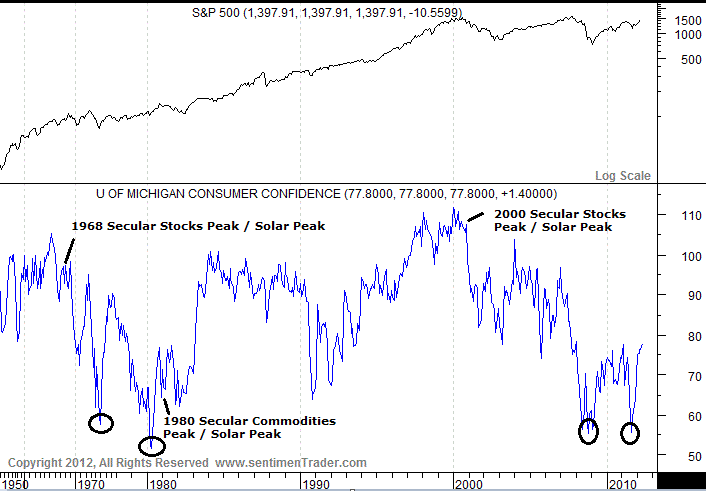
One last chart. An alternative view of secular cycling using consumer confidence readings, with my notes added. Consumer confidence topped out just before the secular stocks / solar peaks of 1968 and 2000, and bottomed out just before the 1980 secular commodities /solar peak. It made twin lows then, like it has in the current secular commodities bull, as shown by the circles. In keeping, consumer confidence should have made its secular bottom, and supporting this the nominal levels reached reflect the last secular lows. A pullback in confidence should be ahead into the secular commodities peak of 2013 and subsequent bear market, but within a new longer term uptrend.

Underling Source: Daneric / Sentimentrader

Update, P/Es and Website

Global Economic Surprises resume downwards, Euro CDS continue upwards, pressure on pro-risk continues in the absence of any notable policy responses. At the time of writing, Europe Friday morning, US stock indices have yet to take out their low of my ‘Capitulation’ post two weeks ago, but the low is at risk as the Dax has broken it.

I maintain two scenarios, that share similarities with Jan’s. The one is that we fall into Monday’s full moon and thereafter a true rally emerges. Supporting that are the extremes that we currently see, such as RSIs sub 20 on crude oil and Euro-USD, insider buying and AAII sentiment at historic market bottom levels, public opinion the US dollar at a new record since 1999. A snapback rally is overdue. We also have potential basing patterns in US stock indices and gold. The second scenario is that the full moon, forecast geomagnetism and Puetz crash window keep the fear in overwheming mode and that we fall further over the next week or two, until we get to the more concrete action in terms of Greek elections, FOMC and Euro conferences later this month. I would be looking for a positive divergence in the Nymo on further falls. If we do fall further, in this second scenario, then some of the indicators are going to be at crazy extremes. Needless to say, I will be attacking any further downside, and maintain that these are glorious pro-risk opportunities here.

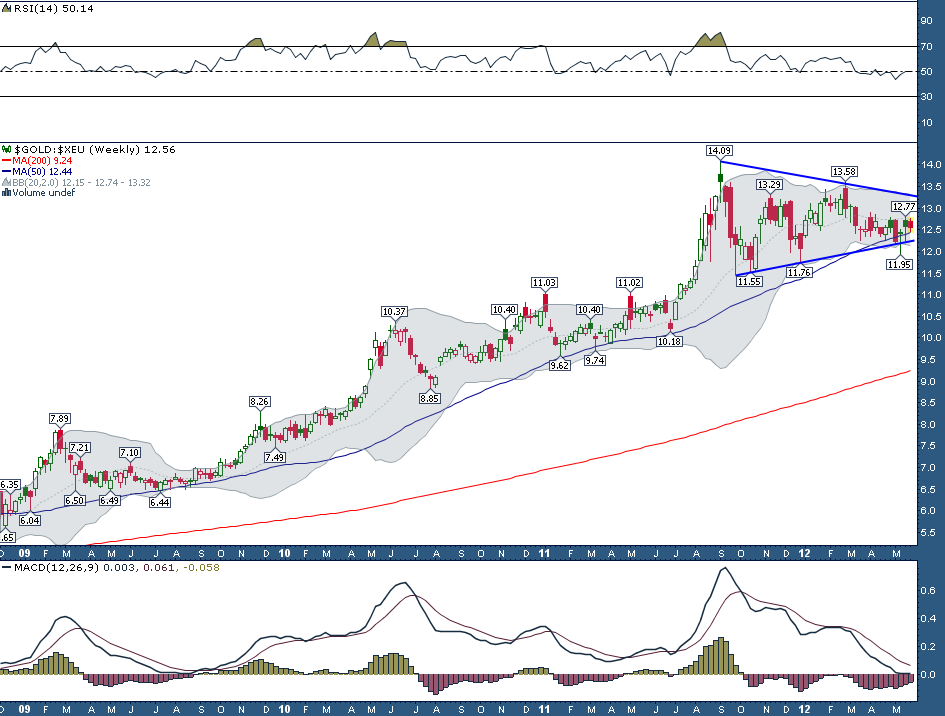
First a chart on gold. Here is gold priced in Euros. A more bullish chart than in US dollars, as it shows a pennant forming in an uptrend. The US dollar strength perhaps therefore accounts for why gold in its usual pricing looks technically dubious.

Source: Stock Sage

Next, moving to equities. Kent referred to p/es and his expectation to see us end in single digits, with which I concur. Here is the p/e flow in the last secular bear market of the 1970s:

Source: Zealllc

As can be seen, p/es came down whilst stocks moved up and down – inflation ate away at the p/es whilst supporting stocks nominally. The inflation situation is comparable today – see the Shadowstats, real undoctored data, below:

Source: Dshort

I remind you that we have historic paralells in the 1940s – inflation spike in 1942, then 5 years later higher inflation spike coinciding with solar and secular commodities peak – and in the 1970s – inflation spike in 1975 and then 5 years later a higher inflation spike coinciding with solar and secular commodities peak. In the current period we saw an inflation spike in 2008 and next year is 5 years later and the expected solar peak, and in my expectation, the secular commodities peak. So inflation should eat away at the p/es whilst stocks do OK in nominal terms.

Yesterday I showed the German stocks were already back at their last secular low p/e valuations. Scott Grannis recommends that NIPA profits should be used to assess p/e and this is the picture for US stocks:

Source: Scott Grannis

You can read more about that here, but the message, like with the Dax, is that stocks are back to historically low valuations. It doesn’t mean they can’t go lower, but it again supports my suggestion that we should be looking upwards for equities, not downwards. And one more: Japan:

Source: Japan Stock Exchange / Vector Grader

 Japan by p/e is also back to its last secular bear market ending low.

And lastly a little on my website. I launched Solarcycles.net in mid-February 2012 and now have my first 100,000 hits, so thank you to all who visit and read my analysis. These are the top visitor sources:

United States 35,608

United Kingdom 13,721

Canada 5,725

Ireland 4,267

Australia 2,873

Hong Kong 2,220

Italy 2,081

Czech 1,884

Spain 1,774

Switzerland 1,341

India 1,198

Germany 1,036

Most corners of the globe are represented further down the list, and it’s fulfilling, for me, to see the global reach.

My most popular pages/posts, bar the obvious Home page, have been the Short and Medium Term Models and the Timetables, followed by the post on Solar Cycles and Astro Trading (I believe a principal reason for that is that Googling astro trading returns my page) and the Opportunities / More Opportunities posts of two weeks ago (I have noticed previously that when market action becomes panicky, more people stop by, no doubt looking deeper and wider than they normally would, to make sense of the falls and shore up their strategies).

My old site, Amalgamator, has now been removed from the web. If there is anything from the old site that you miss or would like to see again, let me know, as I have a record of most entries and charts.

I am not here next week. I am on holidays and will only have my phone to keep abreast of the markets. There will be no posts or model updates next week.