Topping Timeline And Targets

I played the long side of the stock market from 2009 to 2013, which longer term readers can vouch for. I reiterate that in case there is any doubt amongst newer readers that I may be a permabear. However, I would rather hope you can see my work is as objective as I can make it, bearish as it now is.

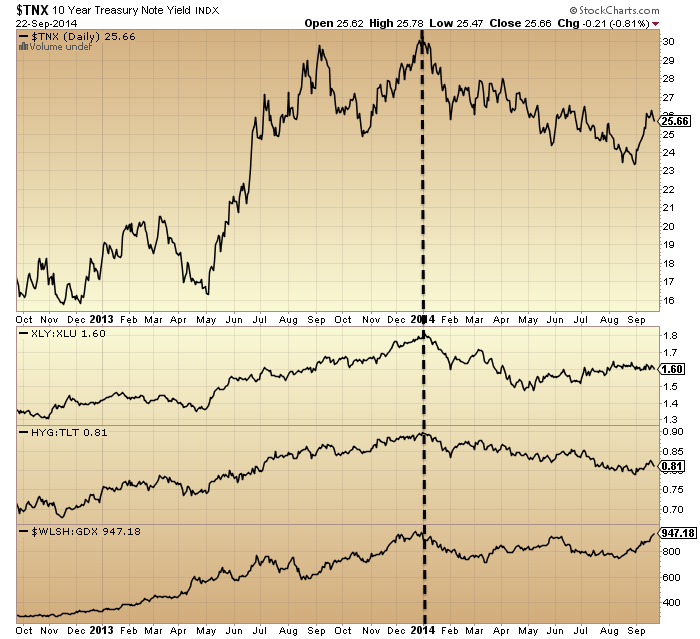
I began my series of bearish posts in December 2013 as topping indicators began to accumulate and I entered my opening shorts. I made my first topping call in early January as 31 December 2013, and here is the link to that post: click.

In that analysis I cross-referenced over 30 topping indicators and I therefore don’t have many regrets. It was a strong case, and it did capture certain peaks in risk and the likely beginning of the topping process, as shown here:

23se5At that time, leading indicators were predicting a weak Q1, which then shocked to the downside, and earnings guidance was the worst on record. Solar scientists predicted the smoothed solar maximum was already through by the end of 2013, so the whole set up looked very promising.

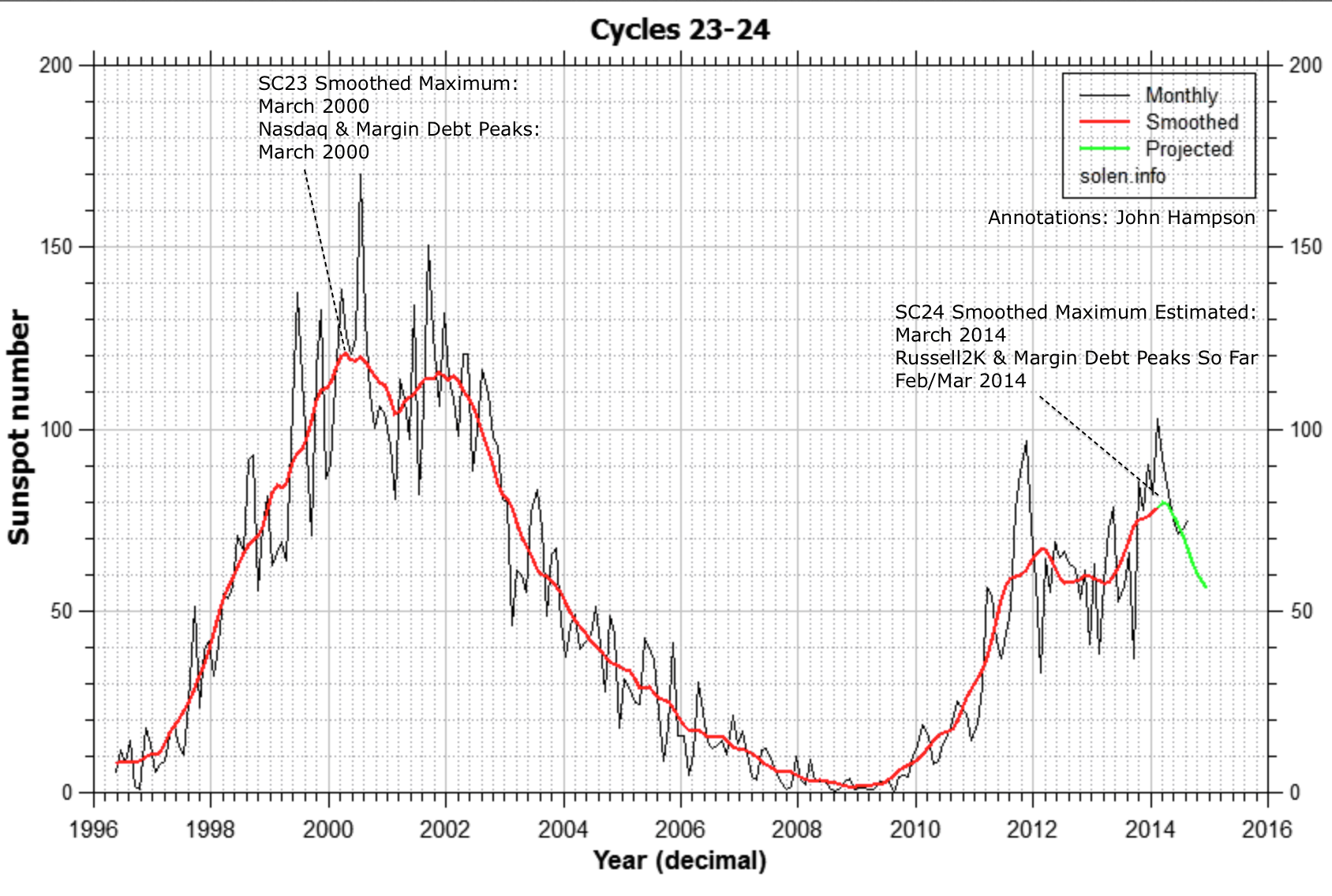
However, solar scientists got it wrong, as sunspots continued to a (likely) peak of around Feb/March 2014. Therefore, I can now retrospectively account for speculation increasing from 31 Dec through to the start of March, and the negation of my original topping call. But at the time, not much I could do.

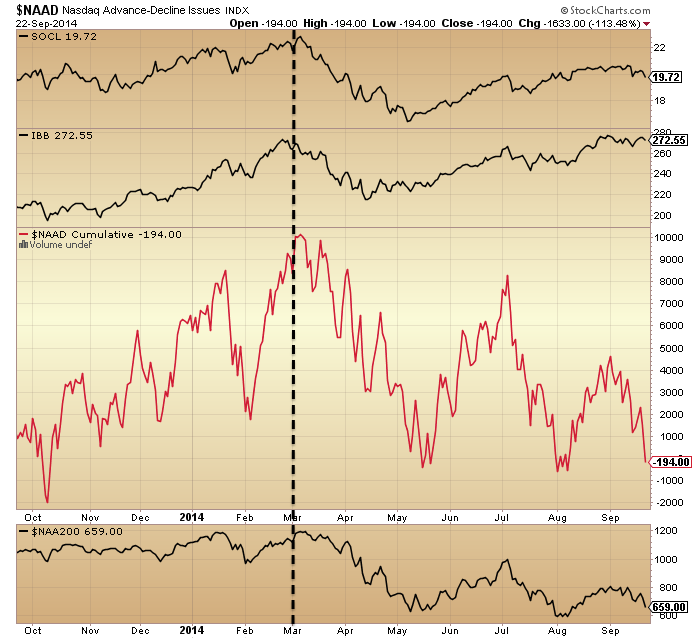
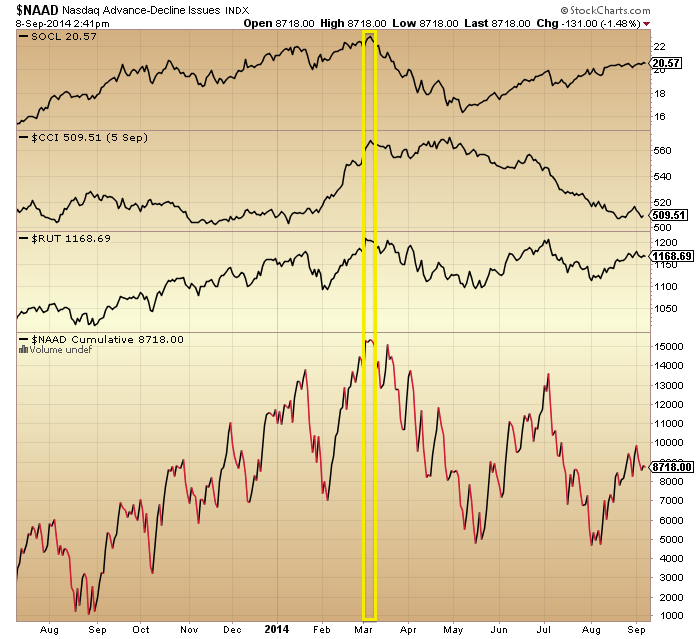
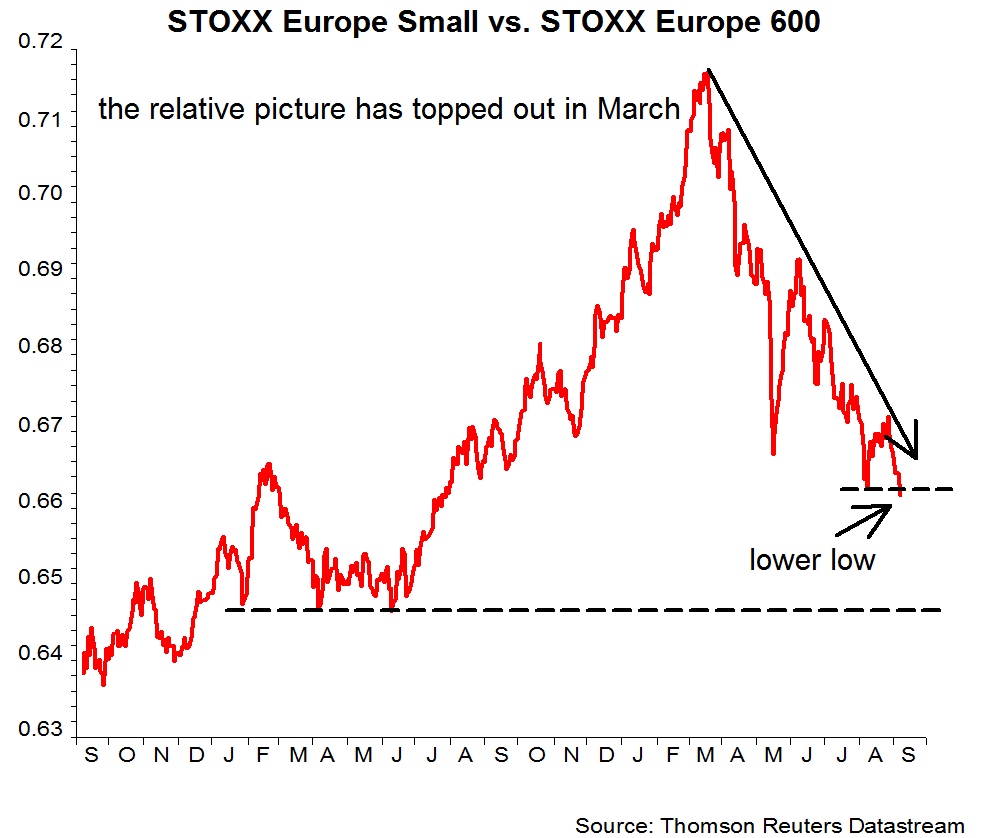
Below I present evidence of that Feb/Mar speculation peak in social media, biotech, Nasdaq breadth x2 (i.e. Nasdaq stocks started to break down here), and relative European and UK small caps performance:

23se7 23se1 Screen Shot 2014-09-23 at 08.00.55All peaked at the turn of Feb into March, and this fits with margin debt leverage which currently peaked in February. My biggest short position is in US small caps, the Russell 2000, and this index also peaked at the turn of March, adding to the collective case for speculation and the solar max to have peaked at this time.

23se8

In a recent post (click) I detailed the comprehensive case for the market peak but stated we were missing a technical break. That R2K chart above shows the likely trigger for waterfall selling. A decisive break below 1100 would confirm and seal the topping process.

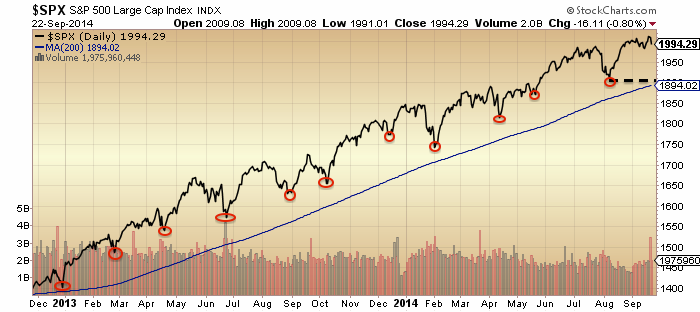
Meanwhile, on the SP500, I suggest the technical break is around 1900, where the 200MA and August low now collide:

23se10A decisive break below 1900 would produce a lower low, a move under the 200MA (after 2 years levitating above it) and a break in the pattern of v-bounces. When I look at that chart I see clear evidence of the sun-inspired speculative mania, whereby every dip is swiftly bought up and levitation is sustained. Could Elliot Waves or other pattern techniques really predict that chart, and its ultimate conclusion too? I find that hard to believe, as I see a mania which is only predicted by the solar maximum, and the chart does not have a more ‘usual’ ebbing and flowing of sentiment waves. However, something sustained the speculation in large caps between March and now, so what did?

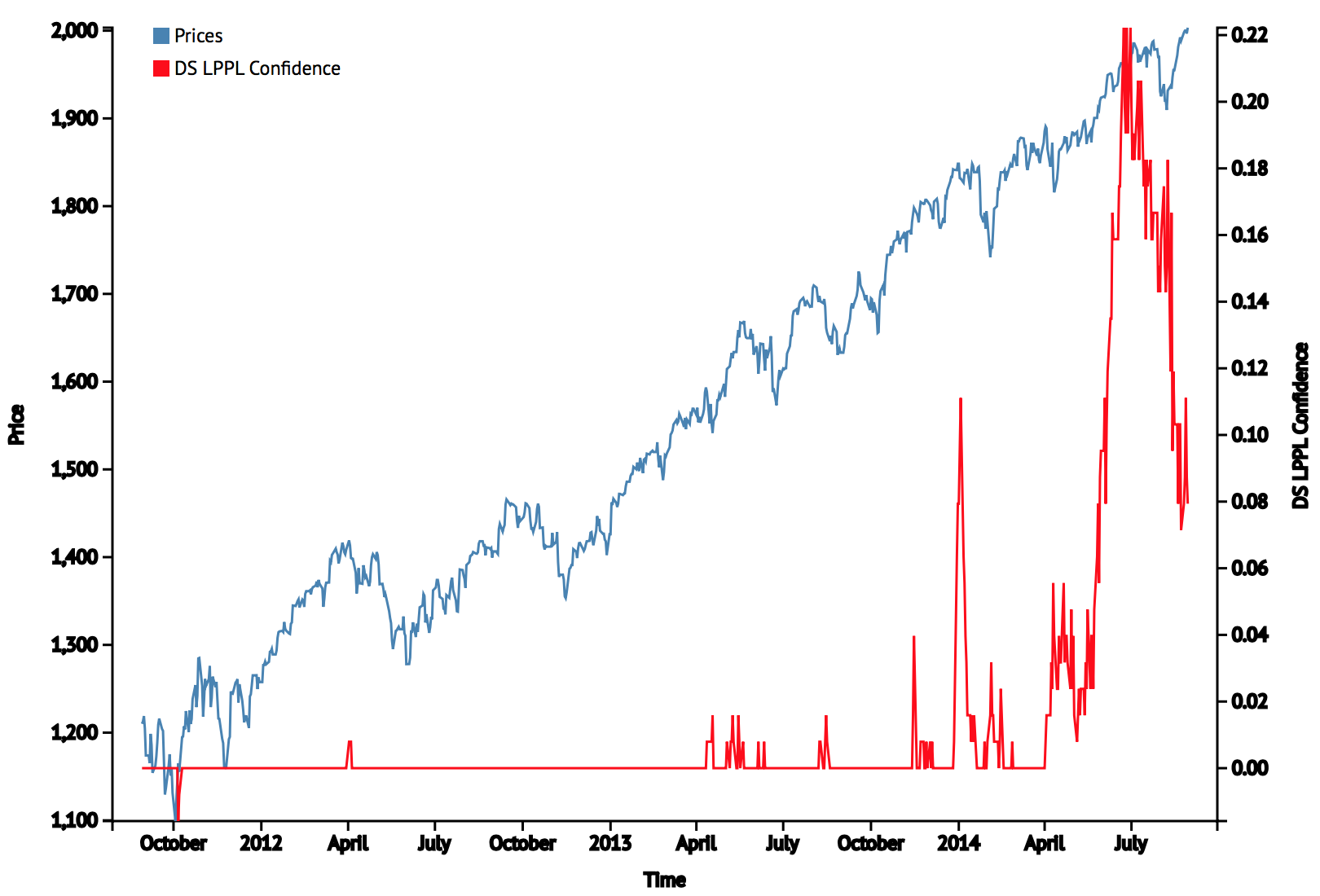
Certain additional topping flags have congregated in the last 2 months: vix divergence, extremes in volume, more negative divergences, higher Sornette bubble end flag intensity. But none of these offer anything revolutionary to what was present at the start of the year. Certain divergences were not so mature in January, but equally certain divergences are now too mature (versus historic norms). In short, I don’t see anything major now present as a topping flag that was missing before, but rather only a few subtle additions which add to the case. However, I put that out to you readers for your views.

The Nikkei did not top until 5 months after the smoothed solar max in 1989, so a top at the turn of August-September in 2014 fits that kind of lag, though here we could argue that the speculation targets were RUT, SOCL and IBB and have conformed to a tighter fit with the solar peak. Either way, I believe the market is on borrowed time since the March speculation peak, which now looks fairly clear. This window around October is the most likely for the falls to erupt, and various measures of ‘fuel’ suggest continuation of the bull market to year end is unlikely. Friday and Monday action looks very promising, and now I look for further follow though to confirm it. But I’ll stick my neck out again and say I believe this is finally it.

So a reminder of targets. Falls were swift and nasty under similar historic conditions:

Dow 1929: 3 weeks 44% declines

Dow 1937: 8 weeks 38% declines

Dow 1968: 8 weeks 18% declines

Dow 1987: 2 weeks 34% declines

Nikkei 1989: 6 weeks 27% declines

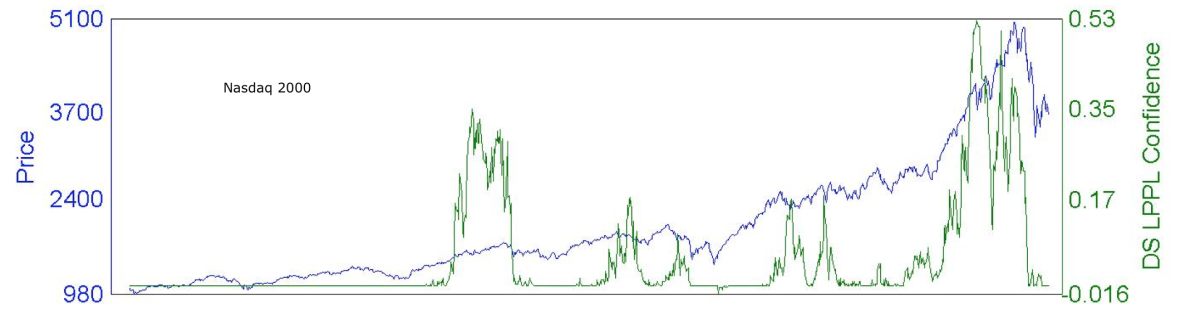
Nasdaq 2000: 3 weeks 35% declines

SP500 2011: 2 weeks 18% declines

I am therefore looking for a minimum of 18% declines over a period of 2-8 weeks. I believe such waterfall selling will kick off once the technical price breaks noted above are made, and I expect precious metals at that point to accelerate in the opposite direction. However, history is not clear on which way gold mining shares should go at that point, as they may only take off after the waterfall declines, and precious metals could be held back to some degree by forced redemptions under cross-asset selling.

I believe Friday kicked off the downward momentum in stocks, and that what looks like a breakdown in precious metals will now become a fake-out that is reversed.  The very skewed positioning in FX completes the picture for an all round reversal in assets.

Indicators put us at the end of the topping process in equities. This means no ‘second chance’ ahead. Rather, we can see the second chance peaks already on RUT, IBB, SOCL, European indices and in behind-the-scenes indicators, so I believe US large caps are displaying a false safety in their price trends and that those who think a topping process has yet to form from here will be mistaken. If I am correct in where the markets are in the timeline, then bears should remain firmly in control now. Not every day will be down, but the trend will be fairly unforgiving, with little chance for anyone to get out or in. The technical breaks should then trigger the panic selling and the devastation will be through by November. From there the market should begin a slower partial retrace of the falls into year end. This is all based on historical analogs.

My aim is to close out of shorts once the panic selling leg is through, as the partial retrace of the falls should be multi-month. So I’ll be doing my best to use indicators to try to gauge where and when the bottom is in the waterfall selling. Might selling be more measured, say like after the 2007 October peak to year end? I don’t believe so because of various factors: the solar max, leverage, sentiment, allocations, skew, levitation above 200MA / pent up correction. Rather, the set up is for particularly heavy waterfall selling, and the closest analogs listed above. They average at 30% declines over 4-5 weeks.

Stock Market Vs. Equinox

Tuesday 23rd September is the Fall/Autumn equinox. Equinoxes occur twice a year, the other being around 20th March.

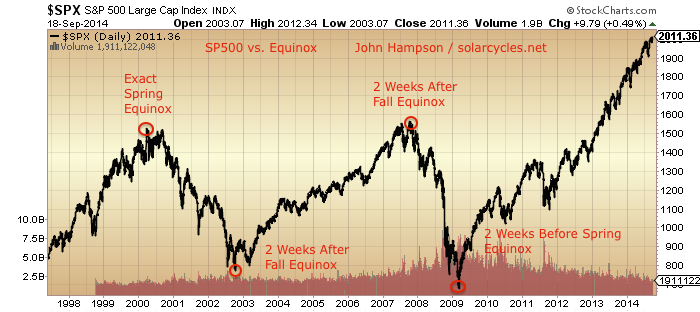
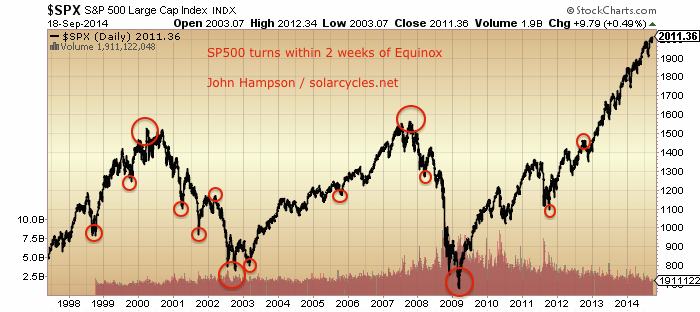
The last 4 major tops and bottoms in the SP500 all fell within 2 weeks of an equinox:

19se1

Extending this to include major turns in the period that took place within 2 weeks of an equinox, we get this:

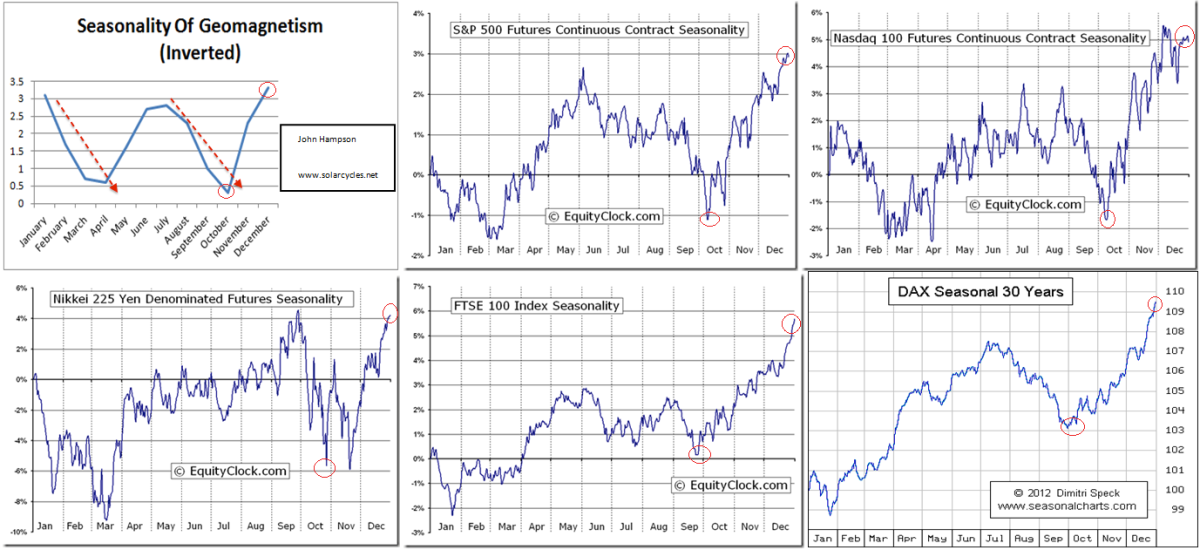
19se2In total 10 bottoms and 4 tops. The dominance of bottoms fits with the seasonal model of the stock market, which is based on the seasonality of geomagnetism, and has lows near the two equinoxes:

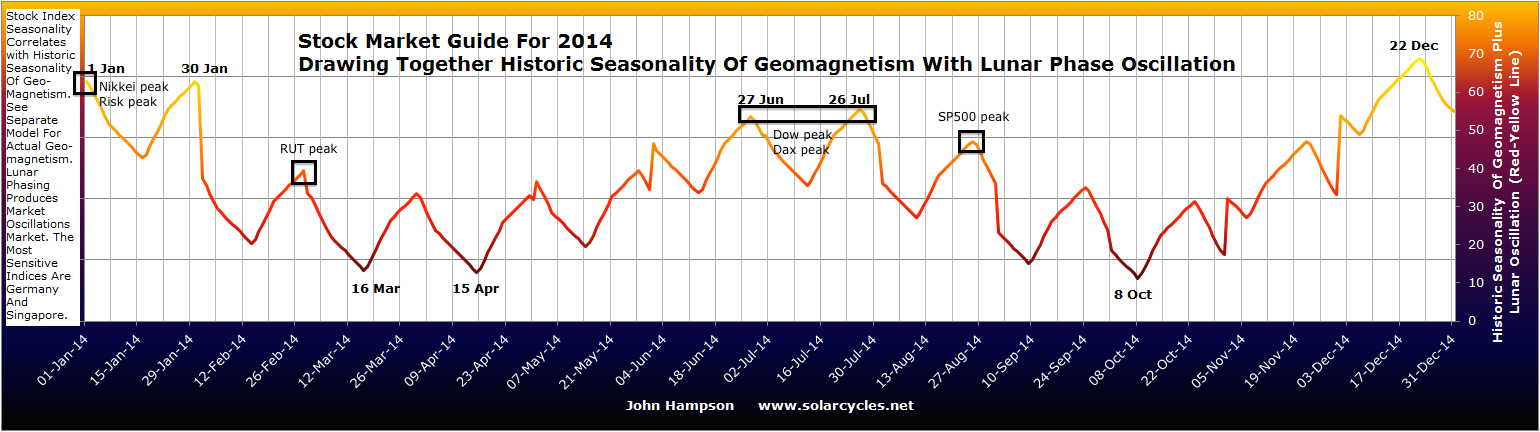
19se4The two red arrows on the ‘seasonality of geomagnetism’ chart show when stock market crashes have predominantly occurred in history. Therefore, bottoms or lows not far from the equinoxes make sense.

Highs around the equinox? Inversions happen occasionally in lunar phasing. Full moons bring about pessimism and typically mark lows, but now and again they can invert as a high. As geomagnetism is a similar sentiment phenomenon, I expect the same sometimes happens here, but I can’t be more scientific. Nonetheless, if next week’s equinox is to have any relevance, then it would most likely be as a top, or inversion high, because we have not seen a period of selling into it for it to mark a low, as we did into the lows 1998-2011 shown above.

Looking further back in stock market history, in 1987 stocks peaked 1 month before the Fall equinox and completed their devastation one month after, so centred around it. The 1976 top and 1978 bottom in the Dow were both within 2 weeks of equinoxes, but other major tops and bottoms in the 1970s secular bear didn’t align, clustering rather at the turn of the year and seasonal high. In 1929 there was a mini-crash March 25 (equinox), the Dow topped 3 September, the London stock exchange crashed 20 September (equinox), and the whole combined crash process was done by November 13.

In short, I would summarise that maybe there is an equinox phenomenon. The most compelling reason for it is the stock market seasonal lows that occur close to them (circa March and October), driven by geomagnetism which affects human sentiment. On these grounds, most major turns would be lows at equinoxes, and just occasionally we would see an inverted high.

One more add: next week’s equinox falls one day from the new moon and new moons typically mark highs (both minor turns and major peaks) so if it were to mark a high then there’s an additional reason for it to do so. For this to have any merit, stock market indicators would need to be signalling such an imminent peak.

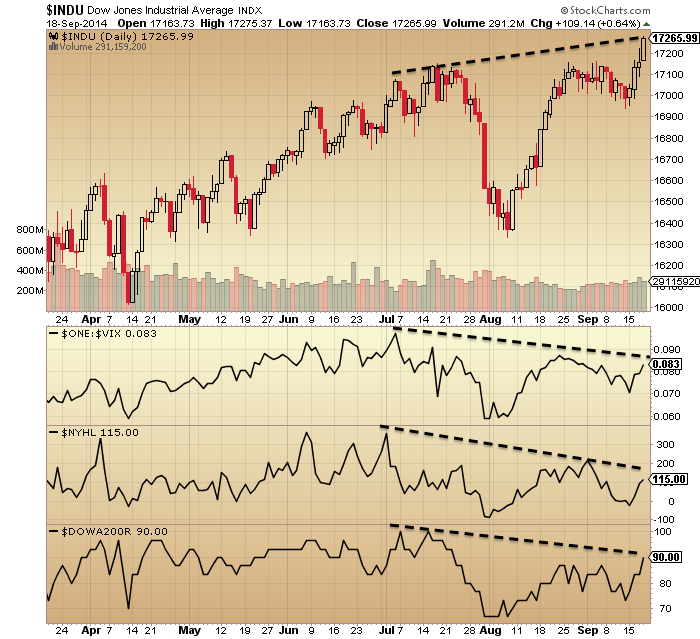
Yesterday was a bullish day for large caps and overnight action looks to have cemented a break out. Small caps and junk bonds again didn’t share the optimism, negative divergences persist on large caps, sentiment and allocations are very stretched, and ‘normally’ this would mean an attempted breakout becomes a fake-out. Wider indicators continue to warn that this is the last gasps of a topping process, and as I have covered recently there is no case for a rally much higher or much longer. e.g. 20% higher into mid-2015, as this would negate a whole host of reliable indicators. The evidence leads me to believe that the stock market will peak here and collapse through the seasonal low of October – or, failing that – it presses on and peaks at the seasonal high of the year-end (a historical clustering targets 31 Dec).

I have difficulty believing the end-of-year option because indicator extremes and divergences are already very mature, whilst sentiment and allocations suggest little fuel for higher or longer. We would need to print anomalies in various indicators with different angles on the market to achieve it, and it would be a major stretch to achieve. Additionally, the smoothed solar max looks likely to have been around March and various risk measures peaked then or either side of that, which suggests this is already ‘borrowed time’. That said, price just won’t obey yet and until it does, I have to consider this possibility.

If large caps consolidate their breakout and push on through the new moon and equinox, pulling up small caps and other laggards too, then the end-of-year option will gain weight. If stocks hold up through the month of October then that would seal it, in my opinion.

But… the charts below show how things stand, and these are why I just can’t believe the market can truly break out upwards here. These charts are indeed supportive of a new moon / equinox peak. Plus it’s the week after expiration, normally bearish, and also a week of geomagnetic disturbance is predicted.

19se5 19se8 19se719se2119se1119se1019se9I may cut back short positions if (despite the indicators) stocks collectively motor here, but my eye is on the new moon / equinox combination next week. UBS see high likelihood of an important reversal in the next 3 sessions, and FX positions and technicals continue to be extreme, suggestive of an imminent reversal with associations for risk.

US Demographic Peak Of 2000

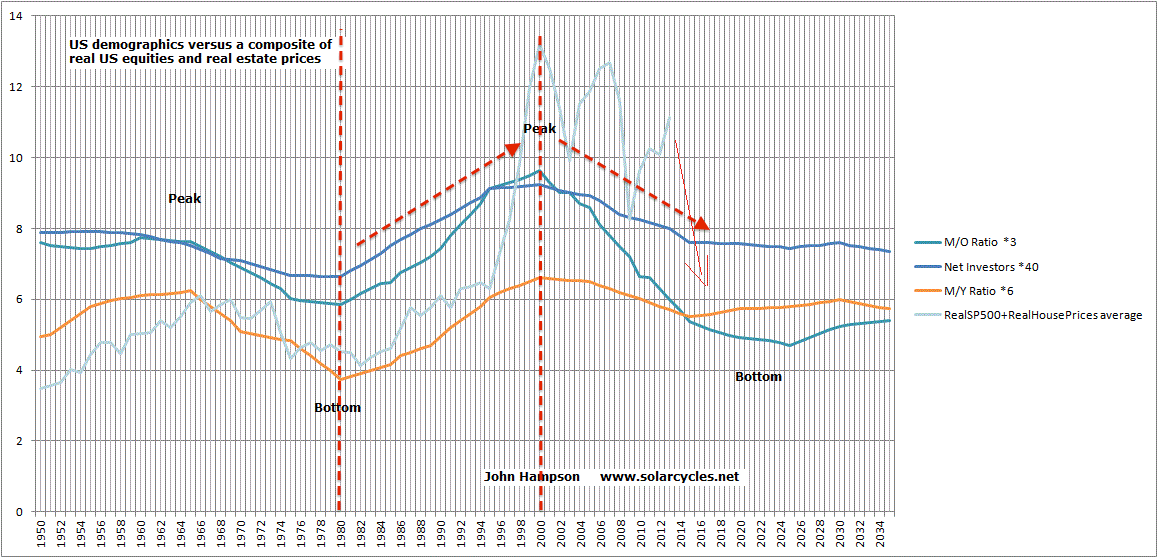
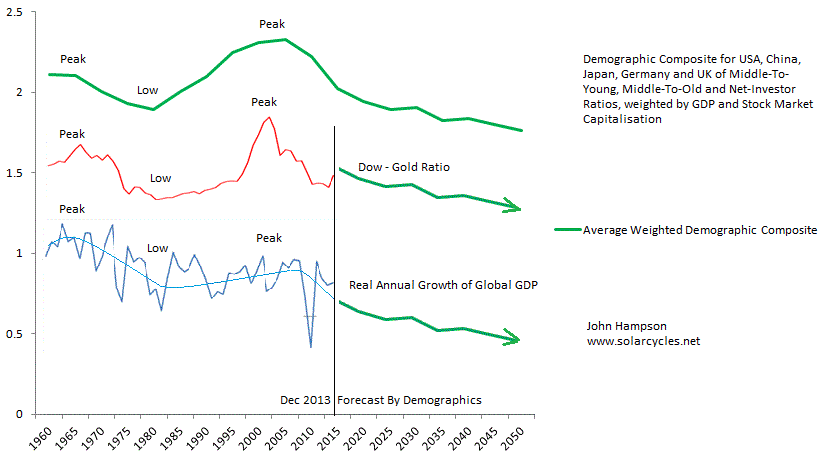
The US enjoyed united demographic uptrends from 1980 to 2000 and since then united downtrends. Here are a collection of charts that show the powerful reality of this influence.

1. Risk assets markets in real terms trended accordingly, and are calling for another cyclical bear down within a secular bear underway since 2000:

18se27

2. Real economic growth trends also align:

18se4

18se10

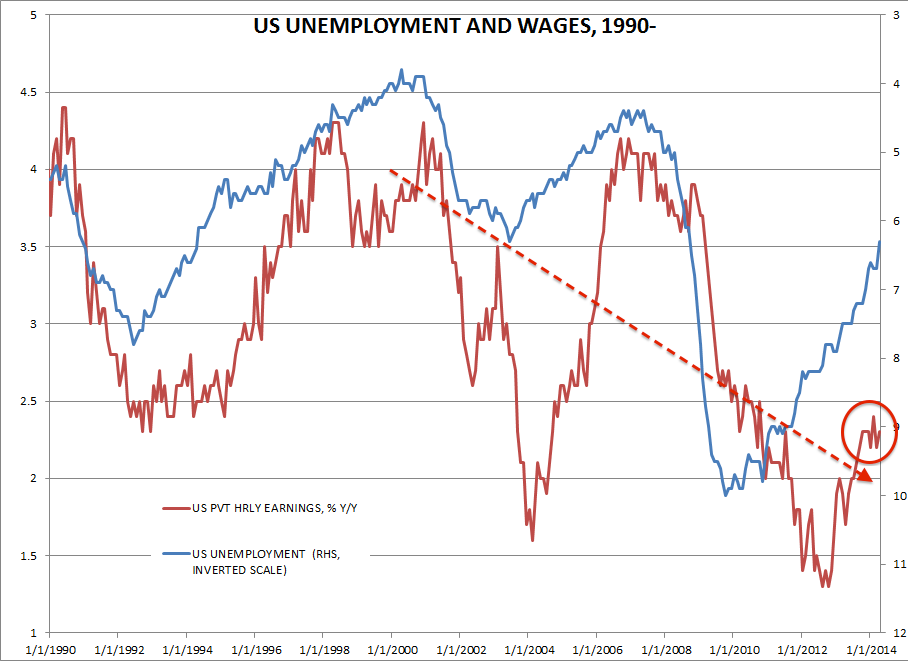
3. A dwindling proportion of people in jobs:

18se54. With associated lower household incomes:

18se8

5. Means that there is less dollar circulation in the economy Screen Shot 2014-09-18 at 07.18.07

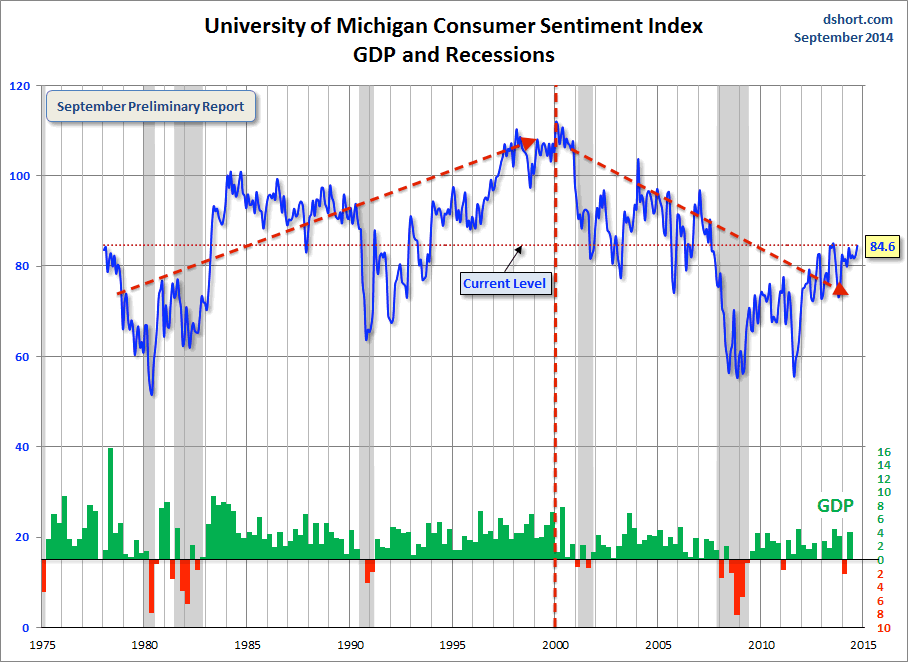
6. And consumer sentiment is overall waning.

18se77. Turning to the supply side of the equation, business capacity utilisation is in decline:

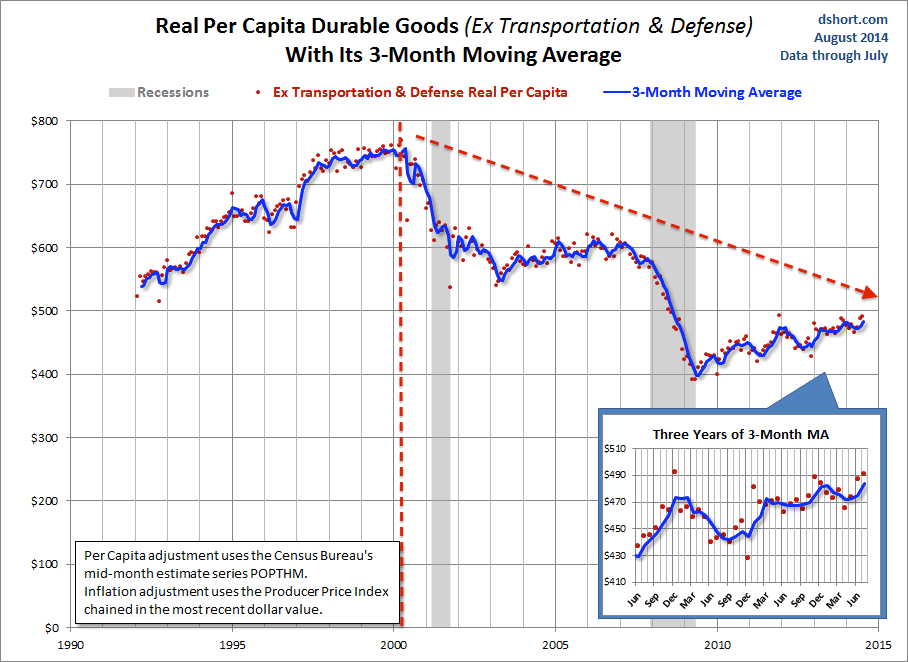
18se198. And corporate investment too:

18se21

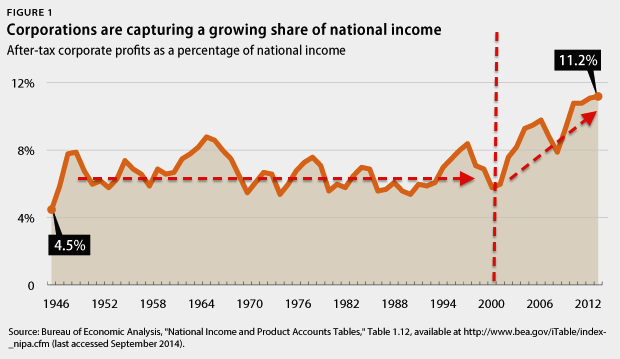
9. However, corporations have been doing better than households:

18se310. As they have cut staff, replaced with tech, and kept wages low for retained staff:

18se29Source: ForexLive

11. With shrinking real demand in the economy and in asset markets, the Fed has attempted to offset this by depressing rates:

18se2Source: Gary North

12. And ‘printing money’:

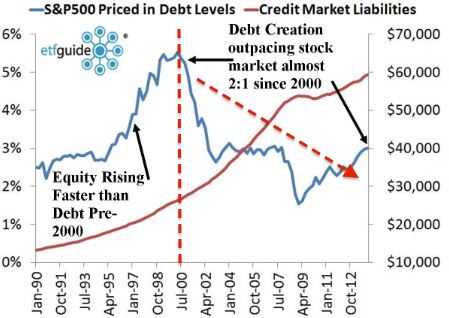
18se2413. The stock market has to a degree been a beneficiary as investors search for yield and corporations indulge in buybacks rather than business investment. However, this has all been sponsored by increasing debt, enabled by the low rate environment:

18se28


Drawing this together, demographic trends are creating a negative feedback looping between jobs, wages, incomes, spending, business investment and utilisation in the economy. Lower demand and lower supply. QE and ZIRP can’t really influence this because they are nothing ‘productive’ (tinkering with the money mechanism), and they are also only policies of encouragement rather than policies of force. However, they have served to shore up the banking sector, to keep debt costs low, and to push some people and businesses to look for yield, driving up some asset markets with an associated wealth effect. Equally though they have detrimental effects by postponing necessary economic cleansing, driving up asset prices through increasing debt (i.e. unsustainable), discouraging more productive use of money and in some ways worsening the economic situation by reducing incomes dependent on saving rates. Nonetheless, the Fed was keen to avoid the 1930s front-loaded deflationary devastation and has succeeded in this. But have they prevented it, or just postponed it? On a long term view, they have of course only postponed it, because the massive borrowing that they have undertaken is wealth taken from the future. But for us traders, the shorter term outlook is key.

I believe the above collection of charts demonstrate clearly that the Fed’s policies do not overcome the overarching demographics as they all show a series of stair-steps downward since 2000. If we contrast it with the 1930s we see evidence that the Fed has helped to phase the devastation, but the charts show they have not been able to neutralise it. When we consider the unprecedented collective demographic downtrends in place now in all the major nations, I believe it is clear we are on the cusp of another leg down, both in economic measures and asset markets, that will take us to a new level in all lower than 2008/9. We can cross reference this with the stock market currently at extremes in valuation, sentiment, leverage, buybacks and allocations: namely it has the attributes of a ponzi scheme wealth effect, at high risk of full reversal. When the stock market collapses, the next leg of demographic devastation will wash through, revealing the relative impotence of the central banks.

18se30

Problems in China

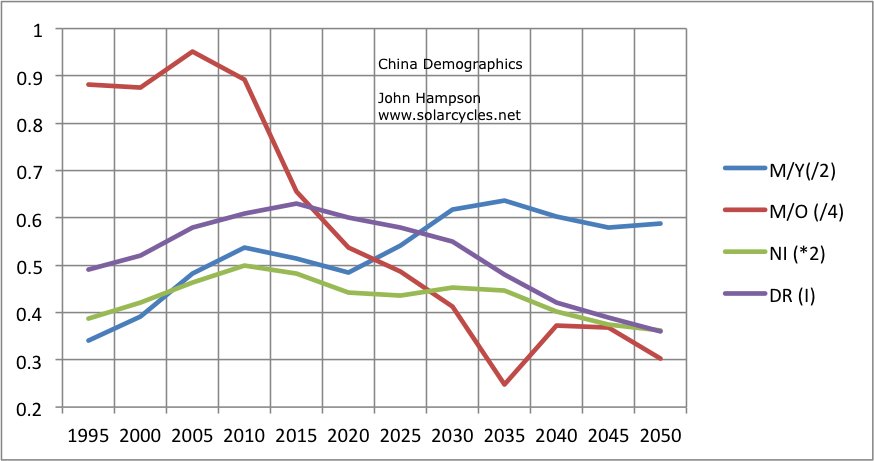
1. China tipped over the demographic cliff circa 2007-2010. Here are middle to young, middle to old, net investors and dependency ratio (inverted) measures:

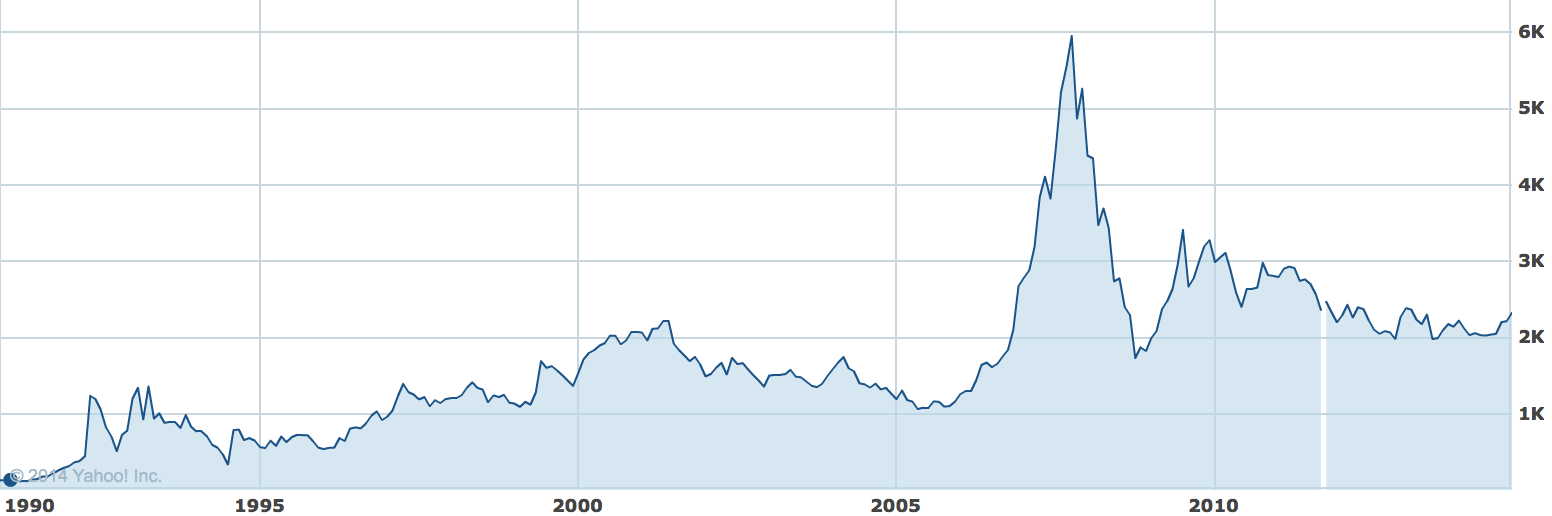
16se152. China’s stock market enjoyed a parabolic mania at the demographic peak, like the US did in 2000 and Japan in 1989.

Screen Shot 2014-09-16 at 07.39.37

Source: Yahoo

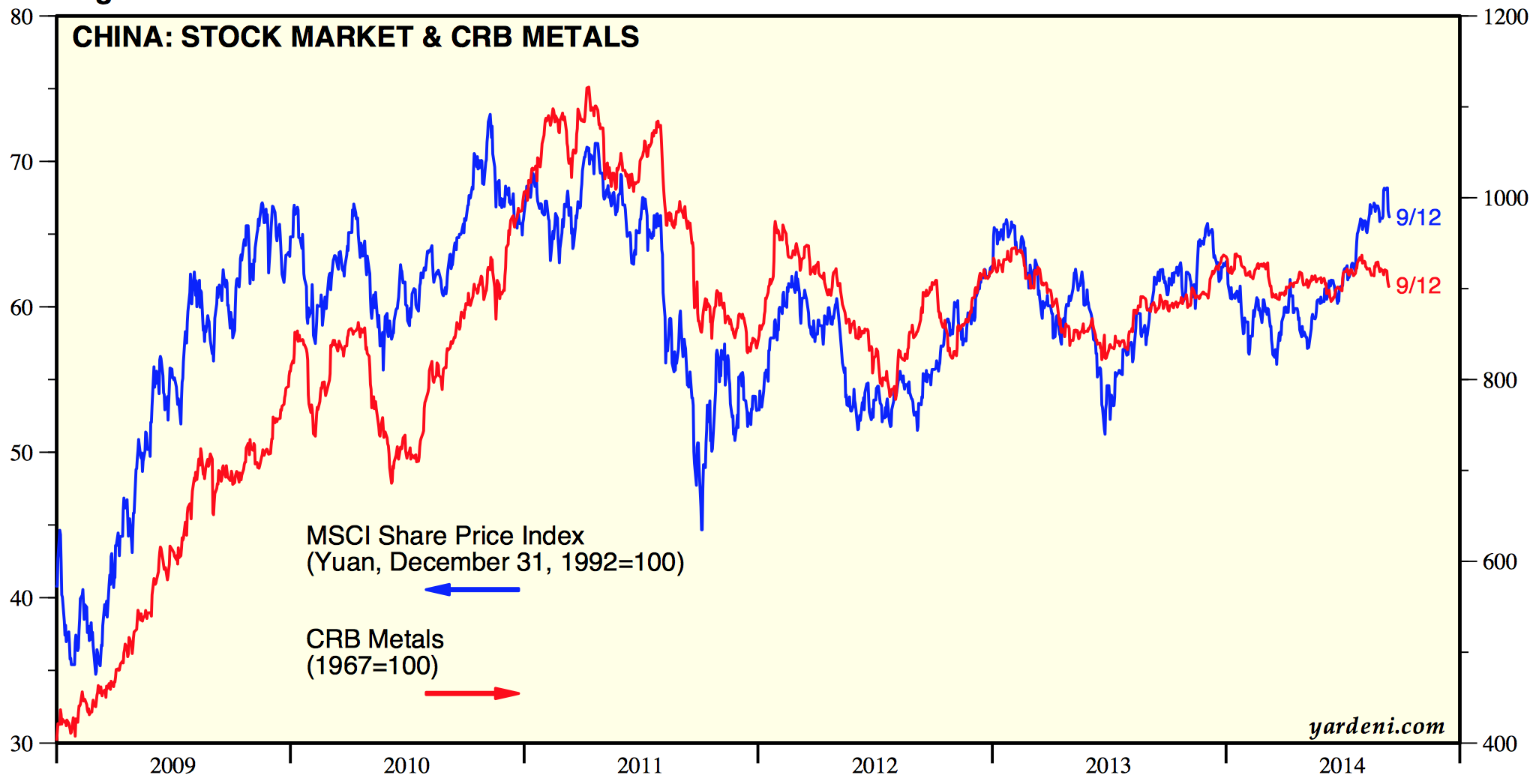
3. China’s stock market correlates closely with commodities:

Screen Shot 2014-09-16 at 07.33.17

Source: Yardeni

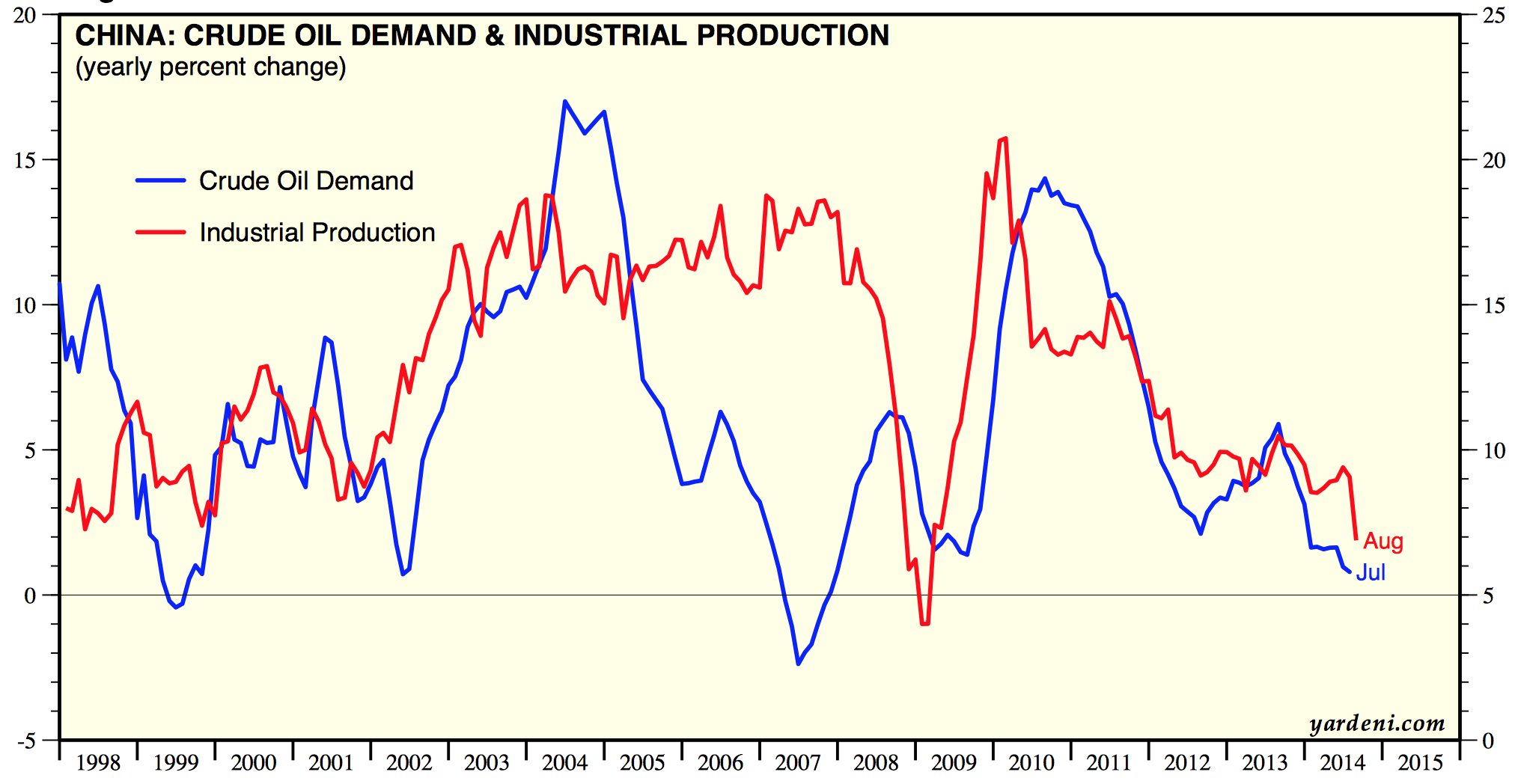
4. Demand for commodities is weakening as the economy weakens:

Screen Shot 2014-09-16 at 07.25.48Source: Yardeni

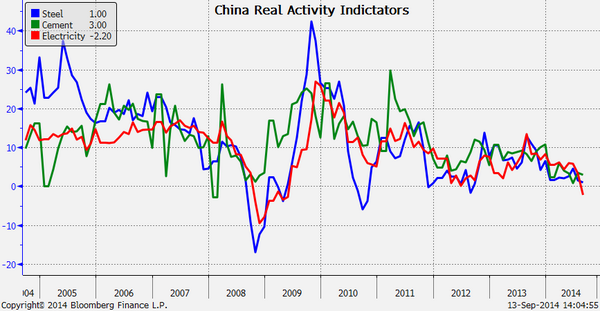
5. Chinese official GDP stats are questionable, so proxies are used for greater reliability. Here, steel, cement and electricity output show a wilting in 2014, flirting with the zero level:

16se9

Source: Bloomberg

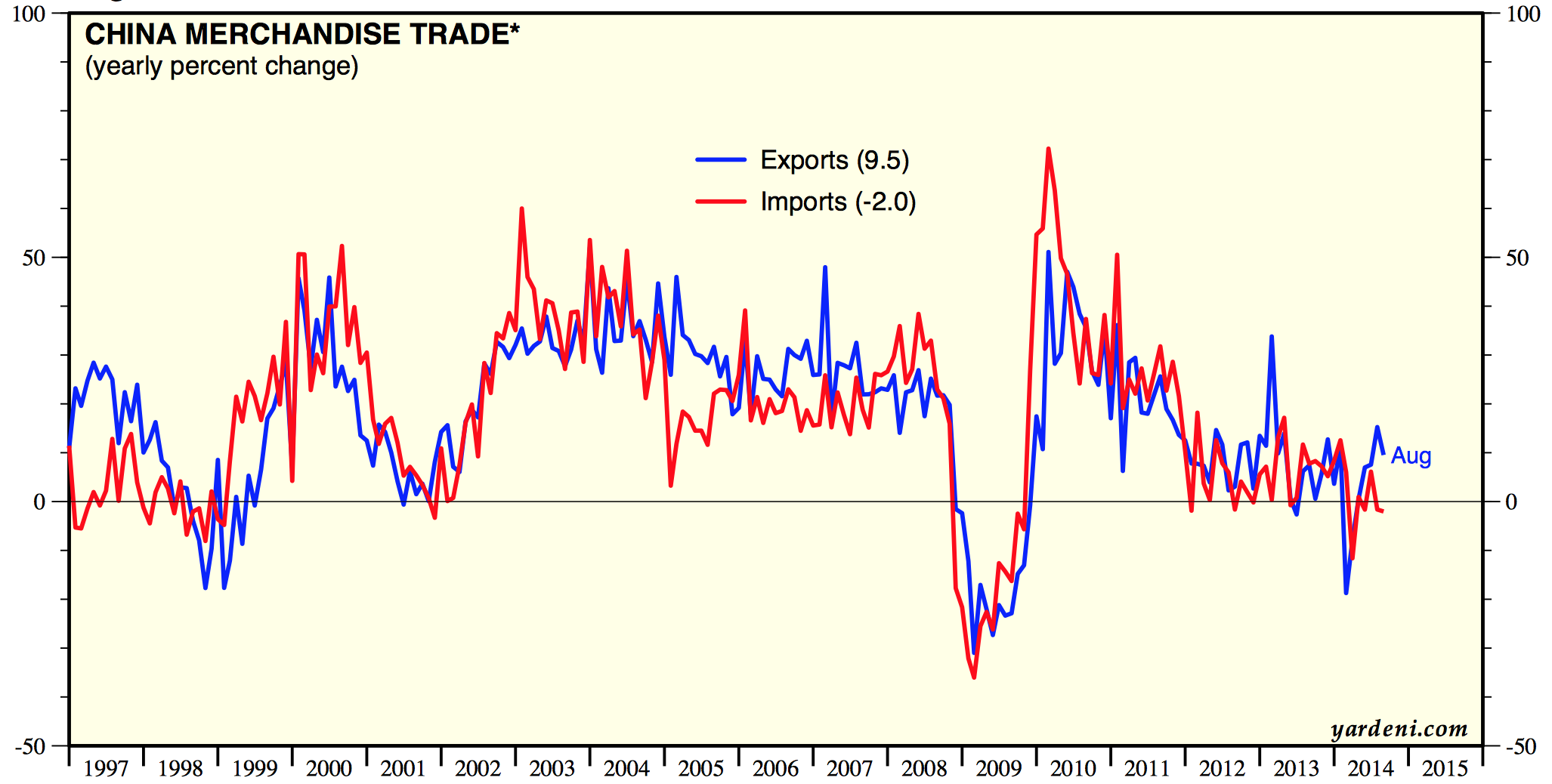
6. Imports and exports are at much weaker growth levels since the demographic peak, and both have seen lurches below zero in 2014:

Screen Shot 2014-09-16 at 07.26.24

Source: Yardeni

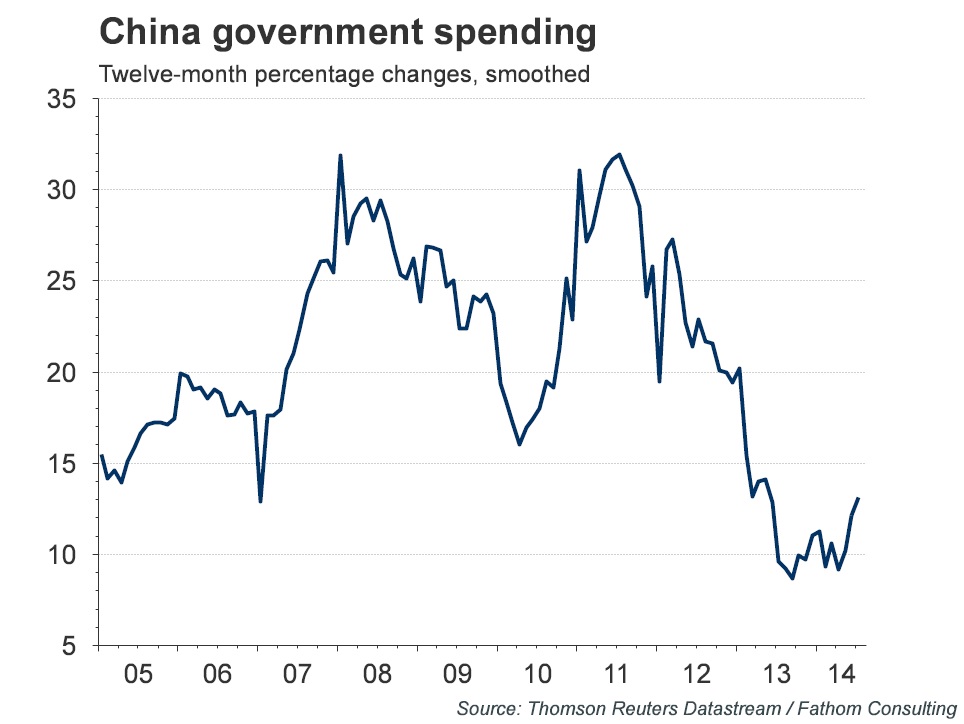
7. Government spending has shrunk:

16se7Source: AlphaNow

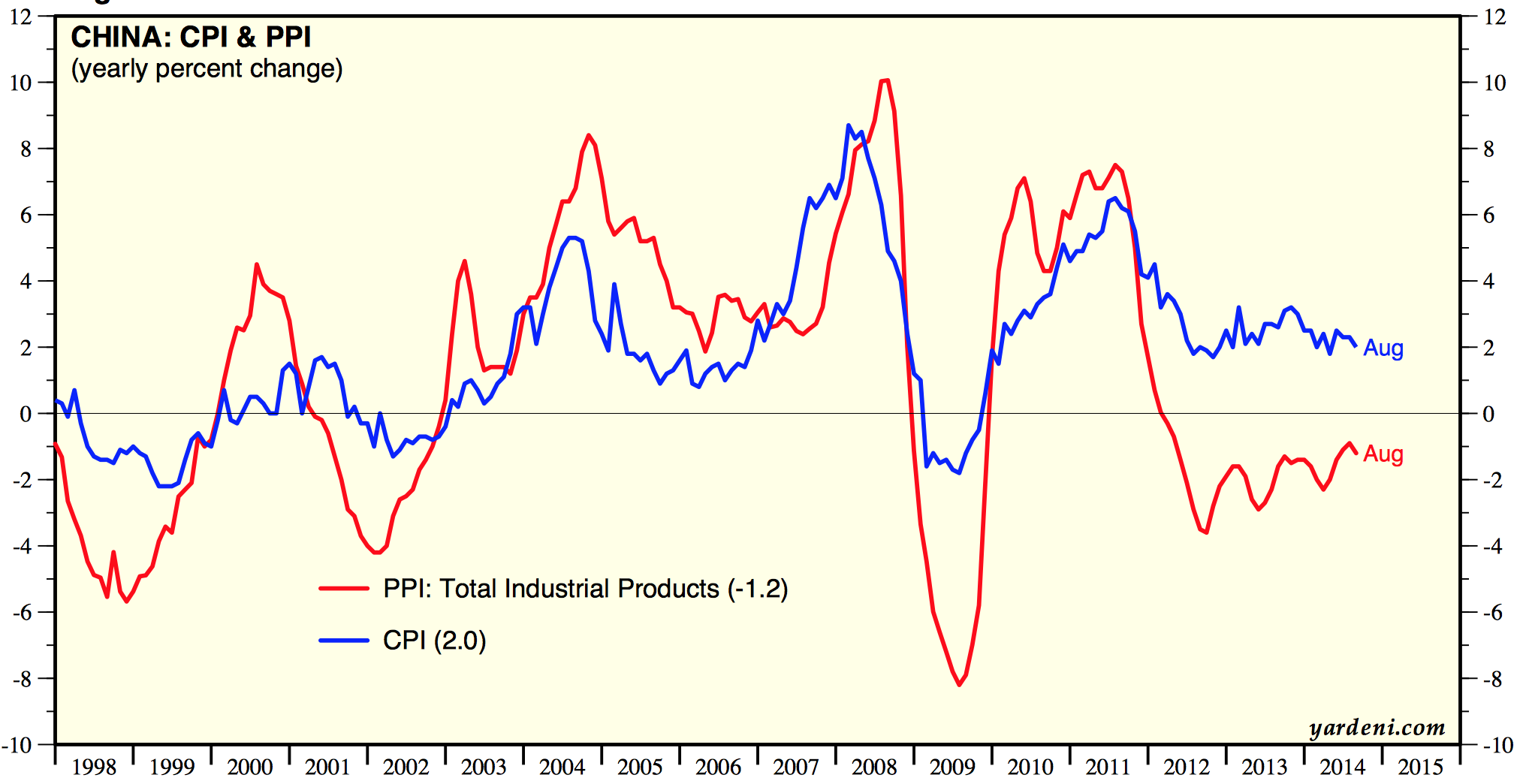
8. Producer prices are mired in deflation:

Screen Shot 2014-09-16 at 07.26.59

Source: Yardeni

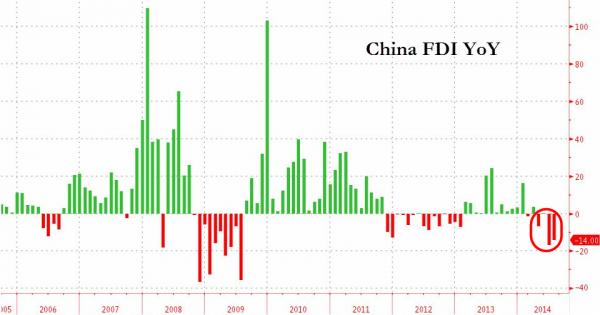
9. And certain indicators have suddenly become more acute in 2014, starting with foreign direct investment:

16se3

Source: ZeroHedge

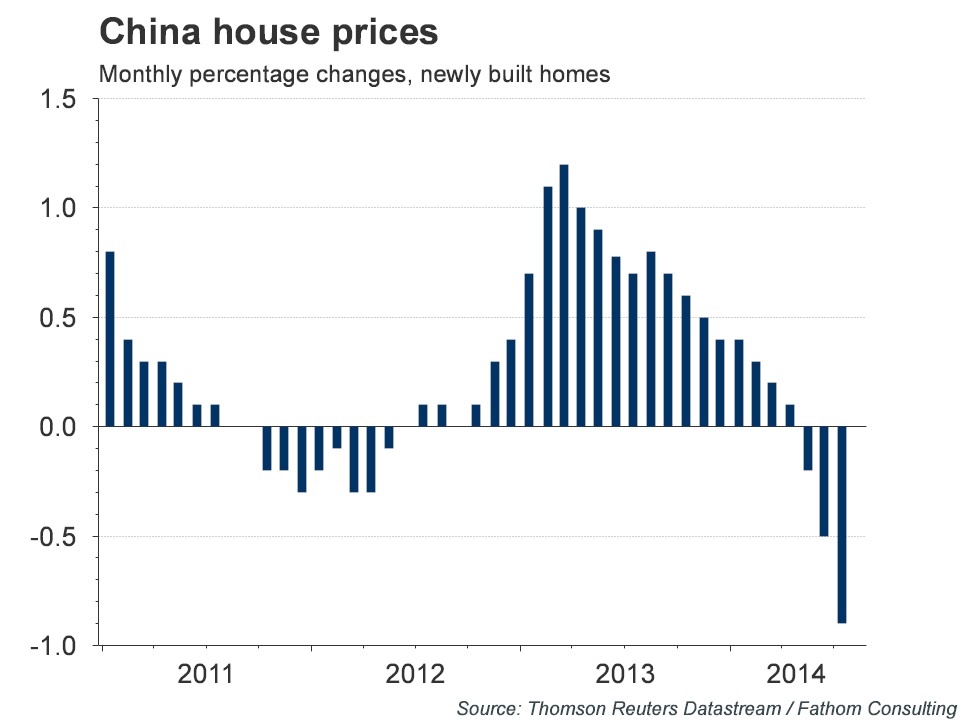
10. Then the housing market:

16se6Source: AlphaNow

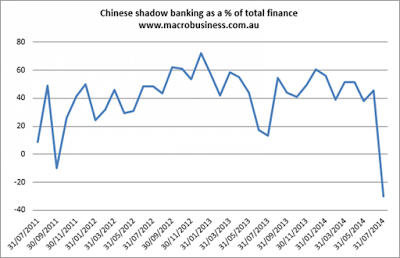
11. The shadow banking market:

16se2Source: Investment Watch

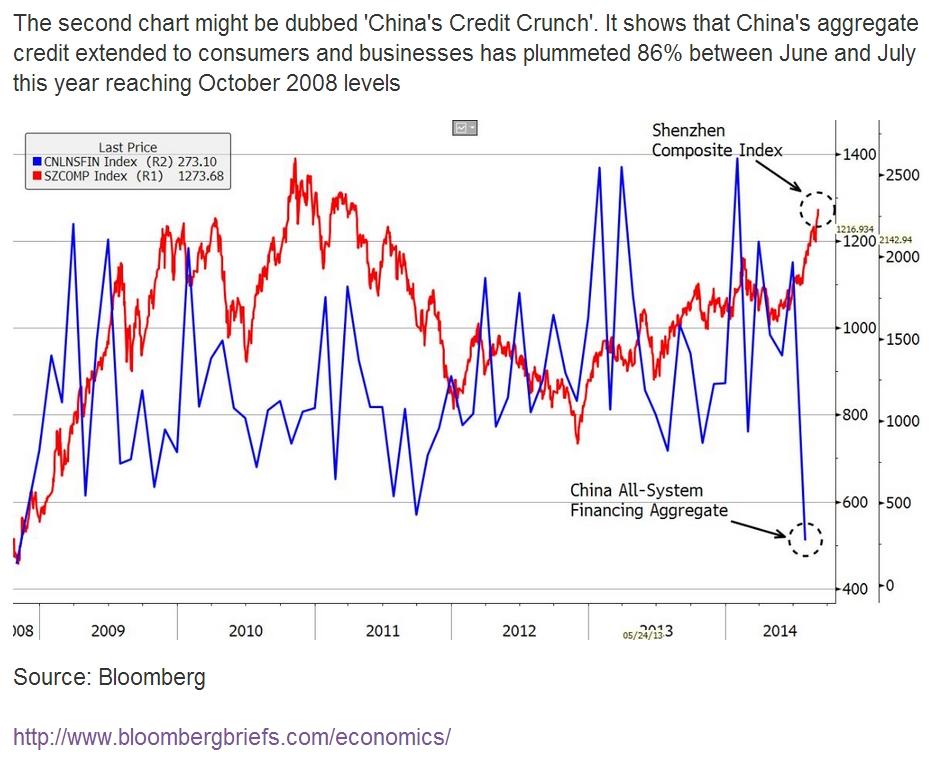
12. And lending:

16se18History shows that economies which expand at breakneck speed typically derail at some point. A potential hard landing for China has been discussed in the media for a long time, but analysts don’t largely understand that it is only in the last 3-4 years that this has become more realistic, since China fell over the demographic cliff. Their one child policy has a nasty sting in its tail. The key is whether the Chinese government can roll out measures that nip the sharp 2014 declines in the bud (which would postpone rather than prevent the devastation), before the negative feedback looping becomes too acute.

In my view, it is the unprecedented collective demographic downtrends in USA, Europe, Japan and China that are tipping the global economy into an unstoppable negative spiral here (only currently propped up by the wealth effect of the stock markets) and central banks will not be able to prevent it. Japan, USA, Europe and China all took turns to be the engine of the world economy between 1980 and 2010 but now we are engineless until circa 2020/2025. By demographics that means a global deflationary recession, or a depression. Passing through the solar maximum here in 2014 should produce dwindling speculation and economic activity and nudge the stock markets and world economy over the edge, feeding off each other.

Gold Update

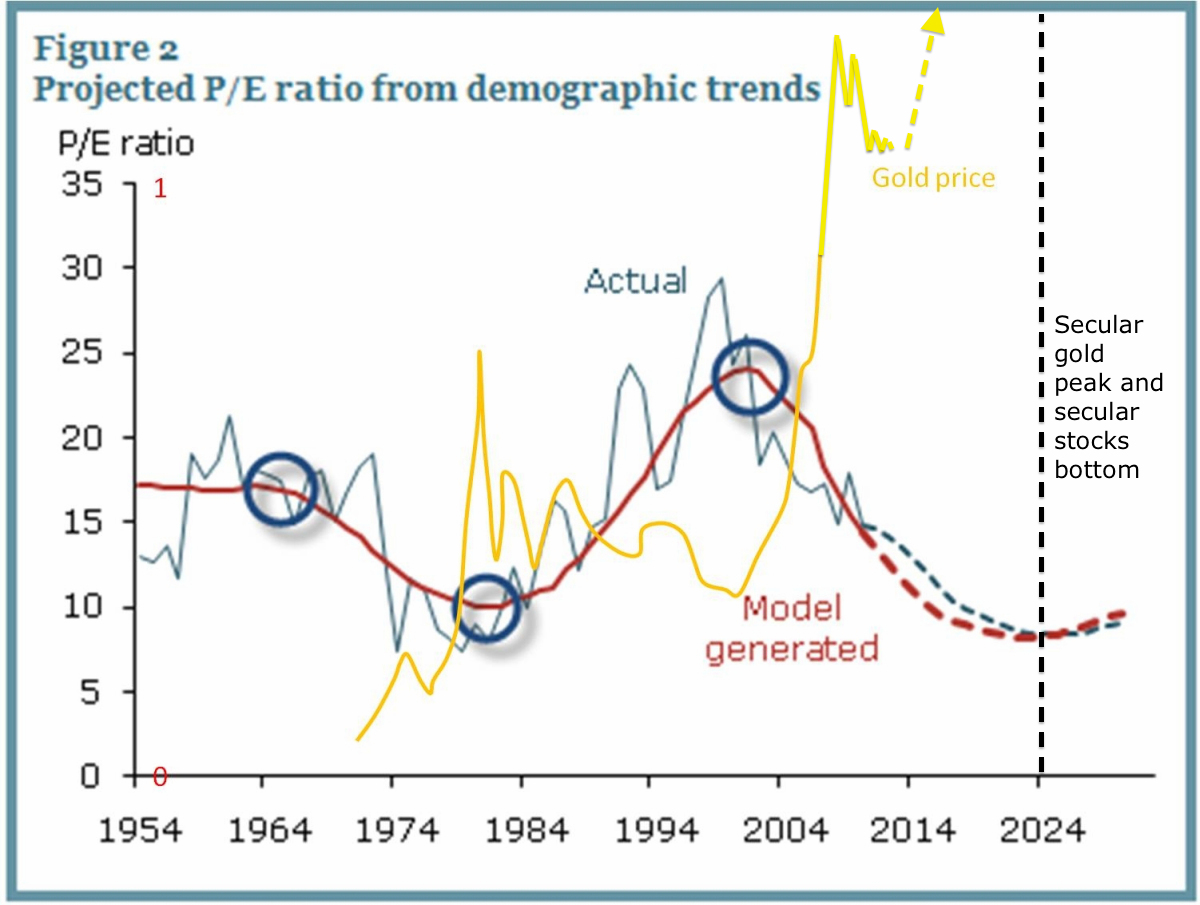
Gold behaves as the anti-demographic. This chart shows US demographics versus p/e ratio (equivalent to inflation-adjusted stocks) and gold price on a long term view. P/es or real stocks trend with demographics in secular fashion and gold the inverse.

12se1

Underlying Chart: Glenn Morton / My annotations

In the 1970s we saw a gold secular bull as demographics declined, then 1980-2000 the inverse. Demographics turned again around 2000 and put us in a secular stocks bear and secular gold bull from then through to circa 2025, which makes the gold correction since 2011 a pause in proceedings, similar to the Dec 1974 – Aug 1976 correction in the last secular gold bull:

12se8The late 20s stock market peak was equally a demographic peak and gave rise to a stocks bear / gold bull combination. Homestake Mining is used as a proxy here:

Screen Shot 2014-09-12 at 08.10.01Gold should make a speculative mania into solar cycle 25’s peak, circa 2025, with this target on the dow-gold ratio:

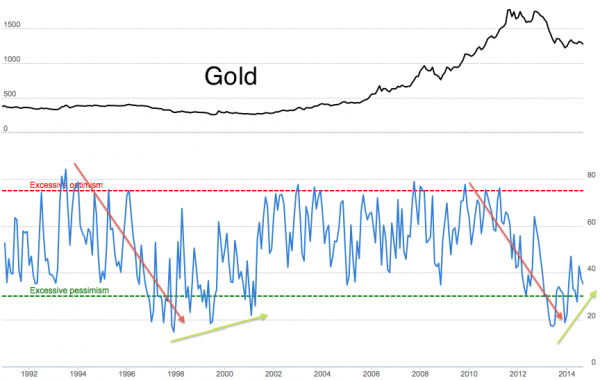
12se7A look at long term gold and silver sentiment shows a pattern has developed over the last year similar to the lift-off in 2000.

12se3 12se4Source: Jeremy Lutz

Cross-referencing with the current position in stocks, we see a range of topping indicators and extreme overvaluation in equities, which sets the scene for a new cyclical stocks bear (within an ongoing secular bear) to erupt imminently whilst gold resumes its secular bull. So I am looking for a floor in precious metals around here (I am long and looking to add).

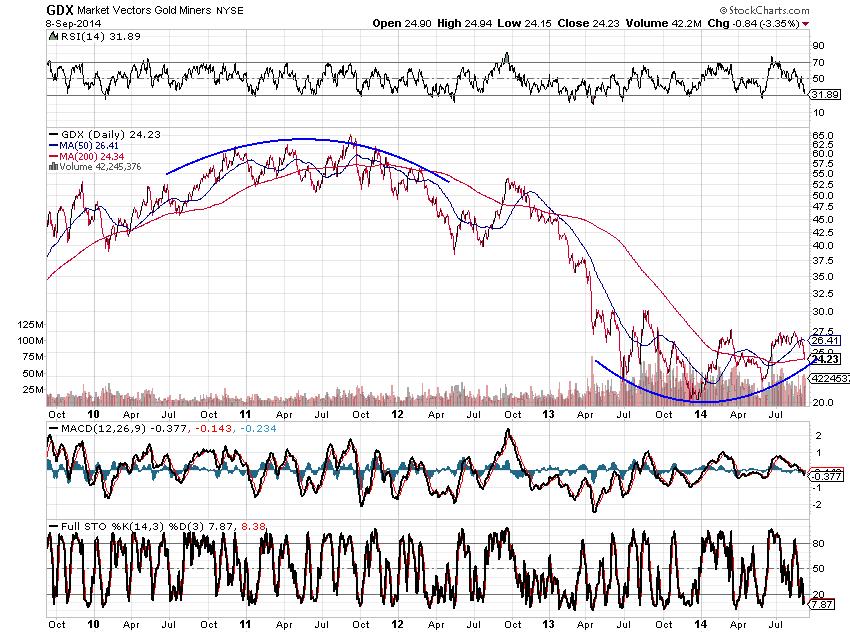
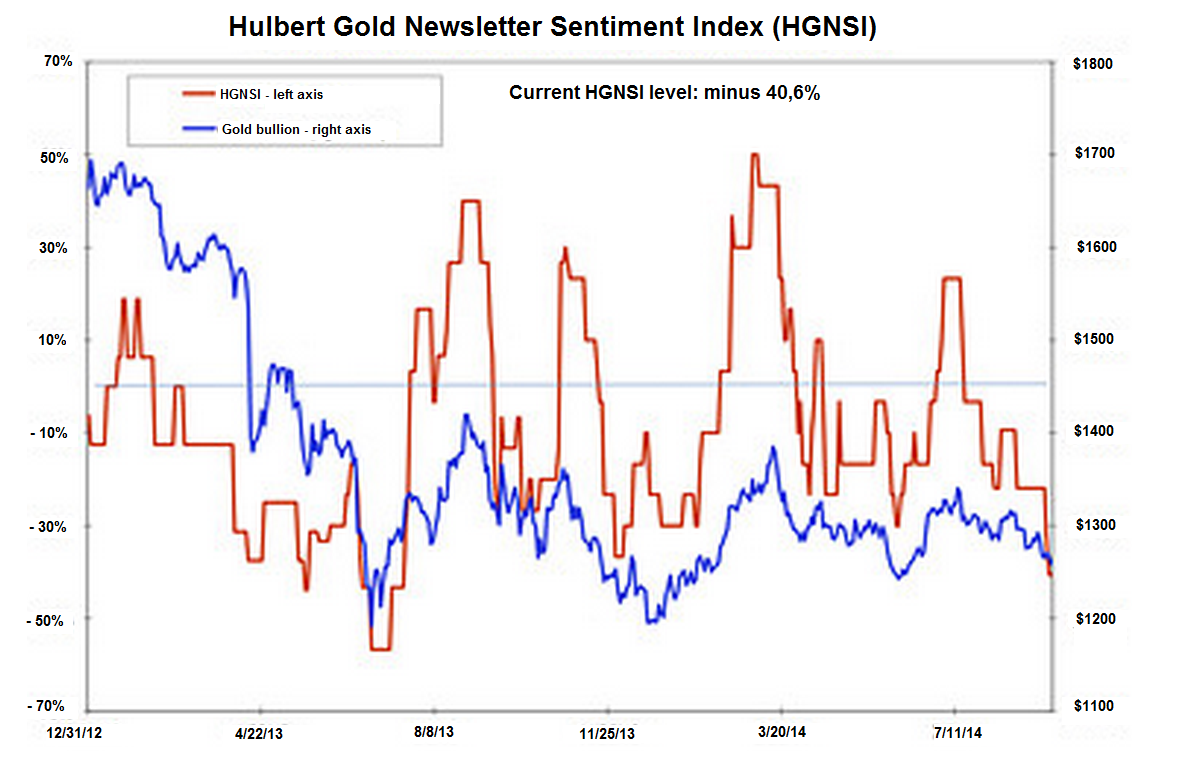
Gold miners show a rounded bottom whilst gold sentiment has reached bottoming levels:

12se10

Source: Emma Masterson12se5

Source: Mark Hulbert

Gold has been falling the last several weeks in dollar terms as the USD has rallied strongly, but gold in yen, sterling and euros looks more healthy. The rising dollar is consistent with the deflation theme that is powered by demographics, and this theme should pull the rug sharply from under stocks in due course. When that occurs, gold should lift off, as in 1987:

29au14Source: P De Graaf


10 Indicators Cross-Referenced

1. Investors Intelligence

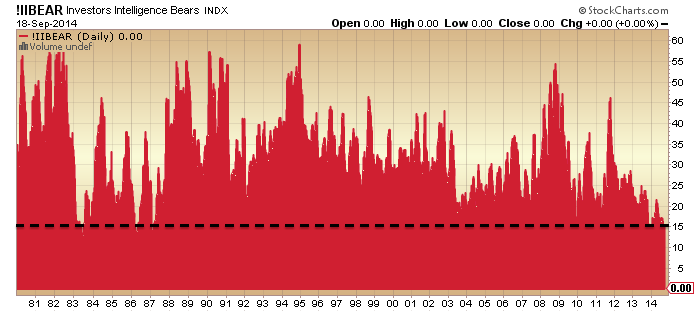
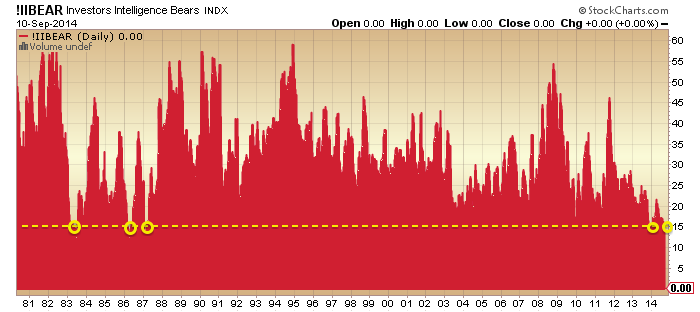
II Bears (advisor sentiment) is sub 15 again this week, previous clusters shown:

11se1

 Source: Stockcharts

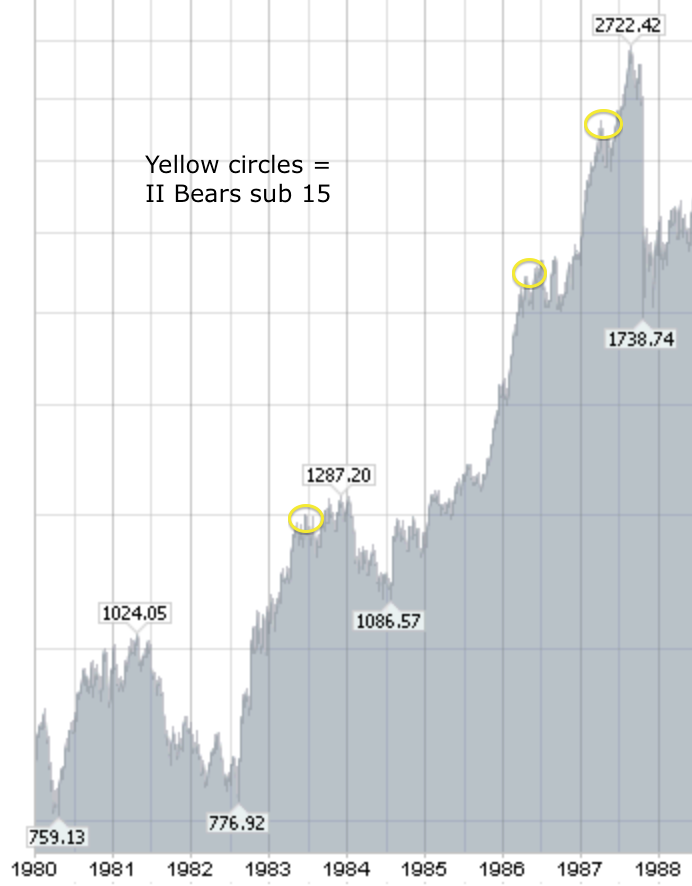
Here are those sub 15 readings on the 80s Dow:

Screen Shot 2014-09-11 at 09.09.12

 Source: Stockcharts

The 1983 extreme II reading occurred 12 months after the new bull market kicked off, and is comparable to the spike down in early 2010 in the first chart that didn’t quite reach <15 bears. The 1986 and 1987 double (circa 5 years post bull launch) is comparable to the Dec 2013 and current extreme pair, but note how stocks rallied for 5 months after the 1987 extreme before collapsing.

2. Rydex

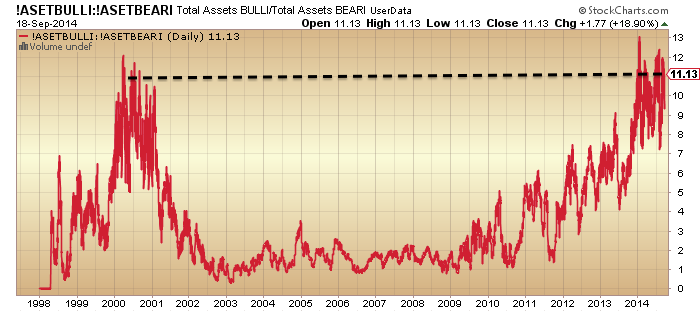
Rydex asset ratios (Rydex family of funds) current extremes are most similar to the 2000 period, namely a time band of extremely skewed holdings lasting for around 7 months in 2000, as we are seeing in 2014 (9 months mature).

3se13

Source: Stockcharts

But note that within that 2000 time band we saw two periods of major sell-offs: March to May and September to December. We have not experienced either so far in 2014.

3. NAAIM

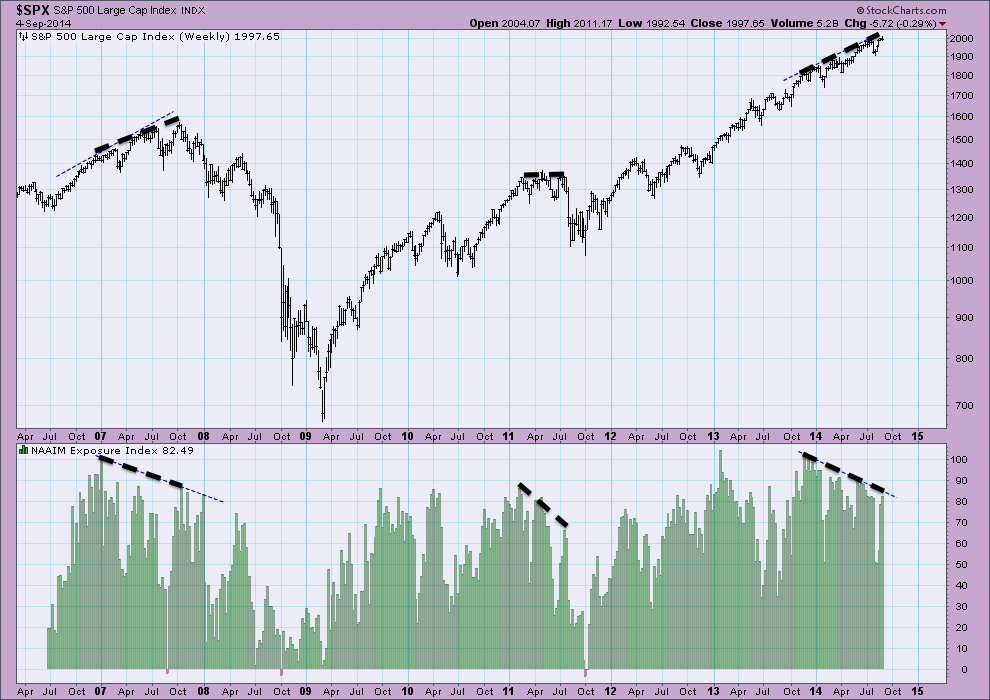
NAAIM exposure (managers US equities exposure) made a pattern of extremes-plus-divergence at both the 2007 and 2011 market peaks:

11se3

 Source: Acting-Man / My annotations

We see similar extreme high readings plus the same gradual divergence since November 2013. The pattern is most similar to 2007, where it lasted 10 months before the market finally entered a bear market. Here in 2014 the pattern has also been in play for 10 months.

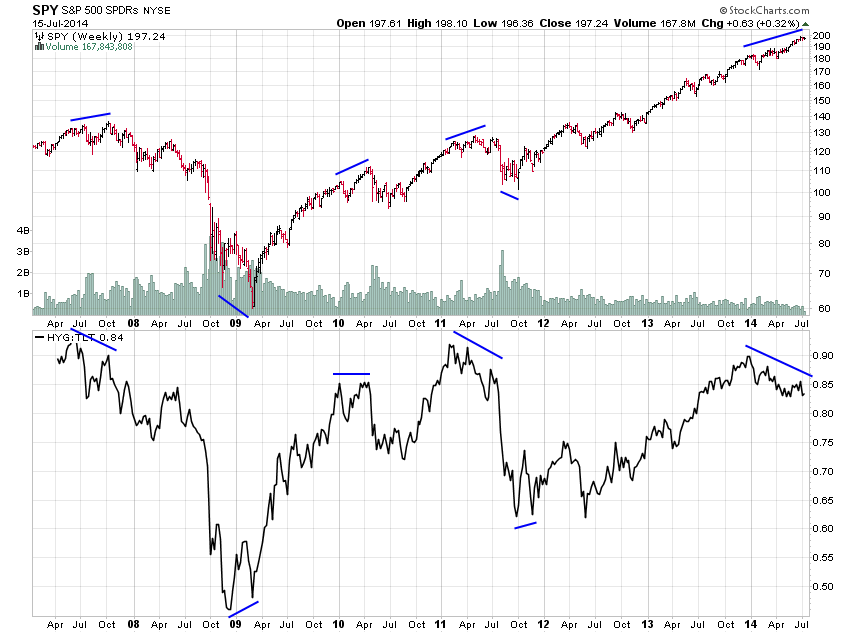
4. HYG:TLT

The high yield to treasury bond divergence (a risk off measure) lasted 4 months, 5 months and 5 months at the 2007, 2010 and 2011 market peaks. The 2014 divergence has been running 8 months and is therefore excessively mature.

11se8

 Source: Jesse Felder

5. Skew

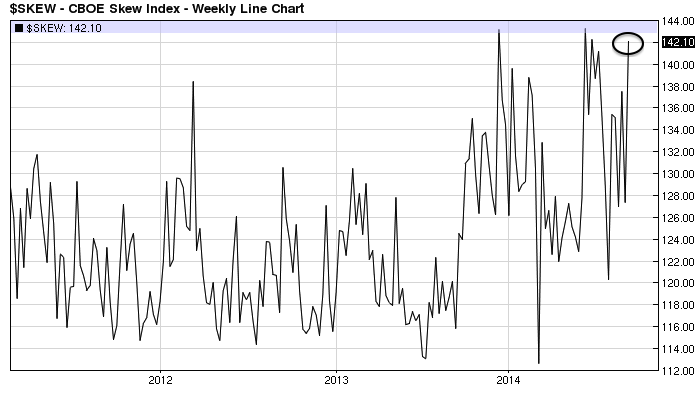
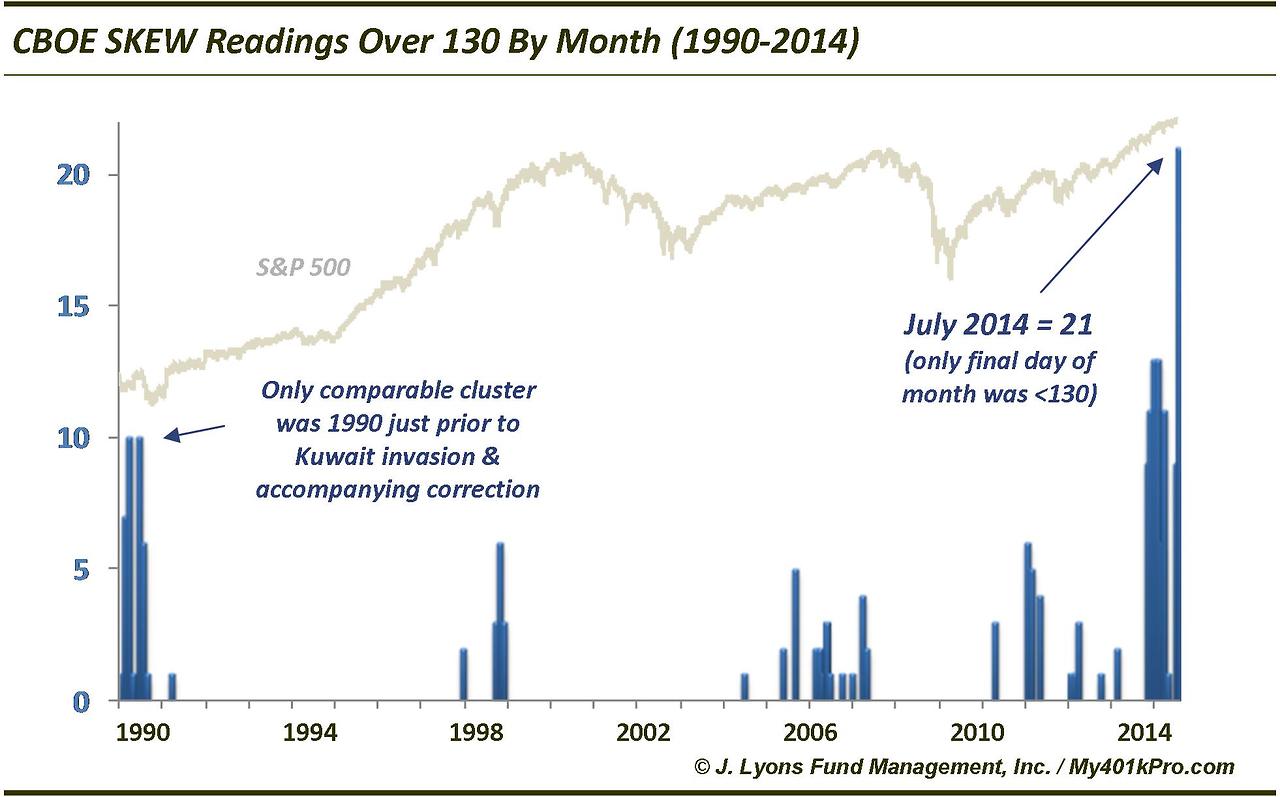
The persistent extremes in Skew (risk of outsized move) beats any historic parallel, but we could point to 1990, and the most recent cluster in 2011, both which produced 20% sell offs in the market. The 1990 cluster lasted 7 months which makes the 2014 cluster, at 10 months, again excessively mature.

11se10

 Source: Dana Lyons

6. Q ratio

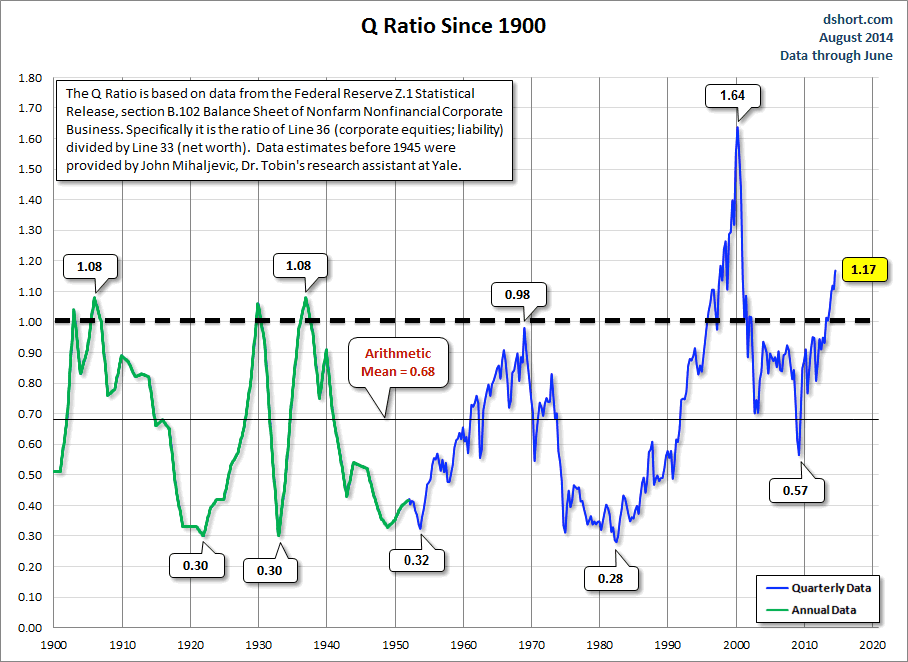
Q ratio valuation (replacement cost of stock index companies) shows that flirtations with an extreme value of 1 were historically swiftly repelled (by bear markets) with the exception of 1996-2000.

11se12

Source: D Short

With the stock market now 2 years above the 1-level, the closest parallel is that period into 2000. Note there was a 20% correction half way in 1998. However, the run up to 2000 was a demographic peak, this is not, and valuations need demographic context. I believe 1937 is the most applicable mirror which puts us ripe to fall.

7. Household Equity Allocations

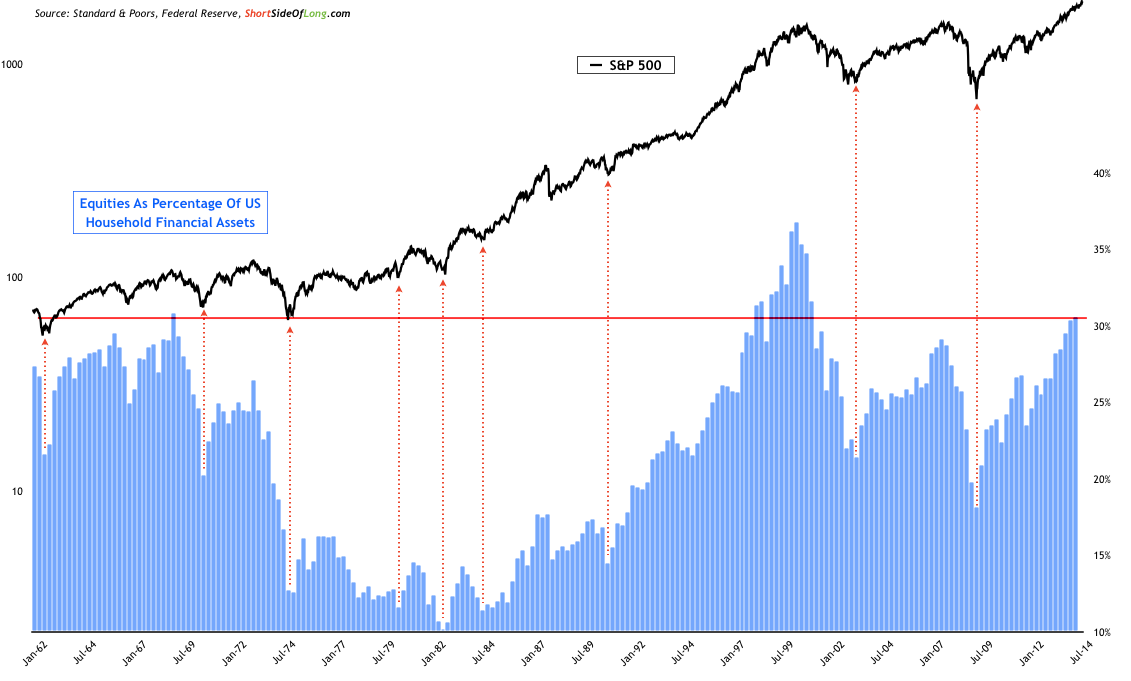
Equities as a percentage of US household financial assets have historically signalled market peaks once flirting with the 30% region, with the exception of 1997-2000. Again, demographics do not support this indicator rising to higher levels, so I would mark this indicator as similar in outlook to the one above.

11se27

 Source: ShortSideOfLong

8. Margin Debt

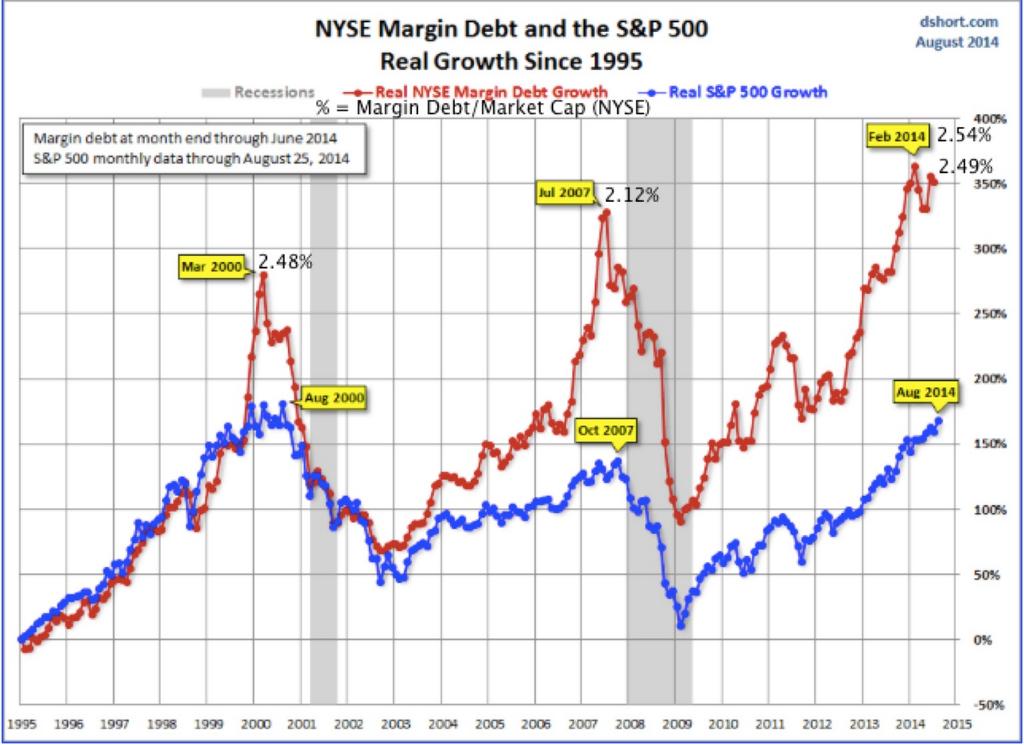
Margin debt (investor leverage) surged for 15 months into 2000’s peak and 10 months into 2007’s peak whilst the surge into the Feb 2014 peak lasted 18 months, so relatively mature. Whilst the Feb 2014 margin debt peak is only tentative currently, it occurred 6 months ago, versus 5 months and 4 months pre-peak in 2000 and 2007, so also relatively mature.

11se6

 Source: D Short / U Karlewitz

9. Sornette Bubble

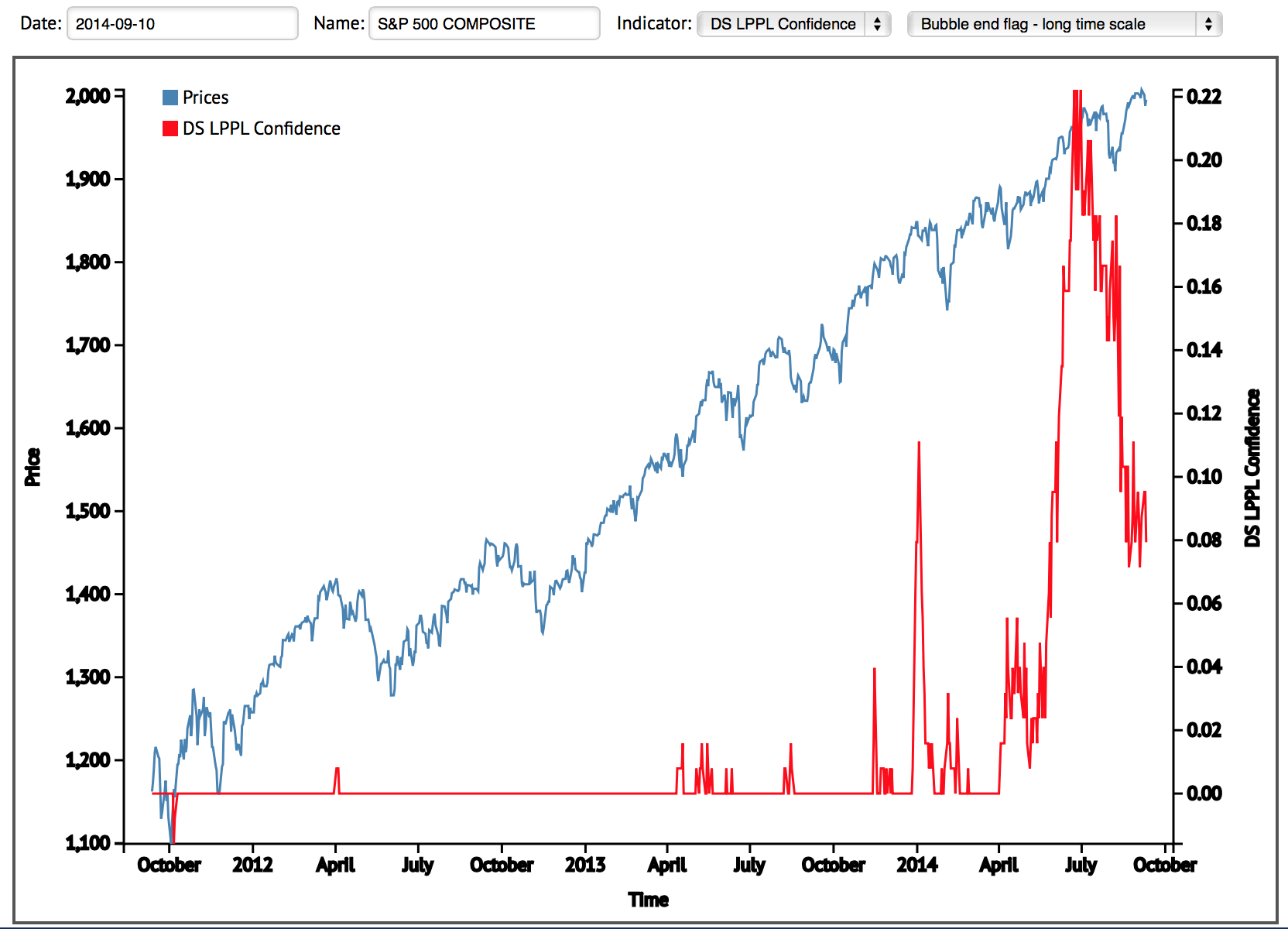
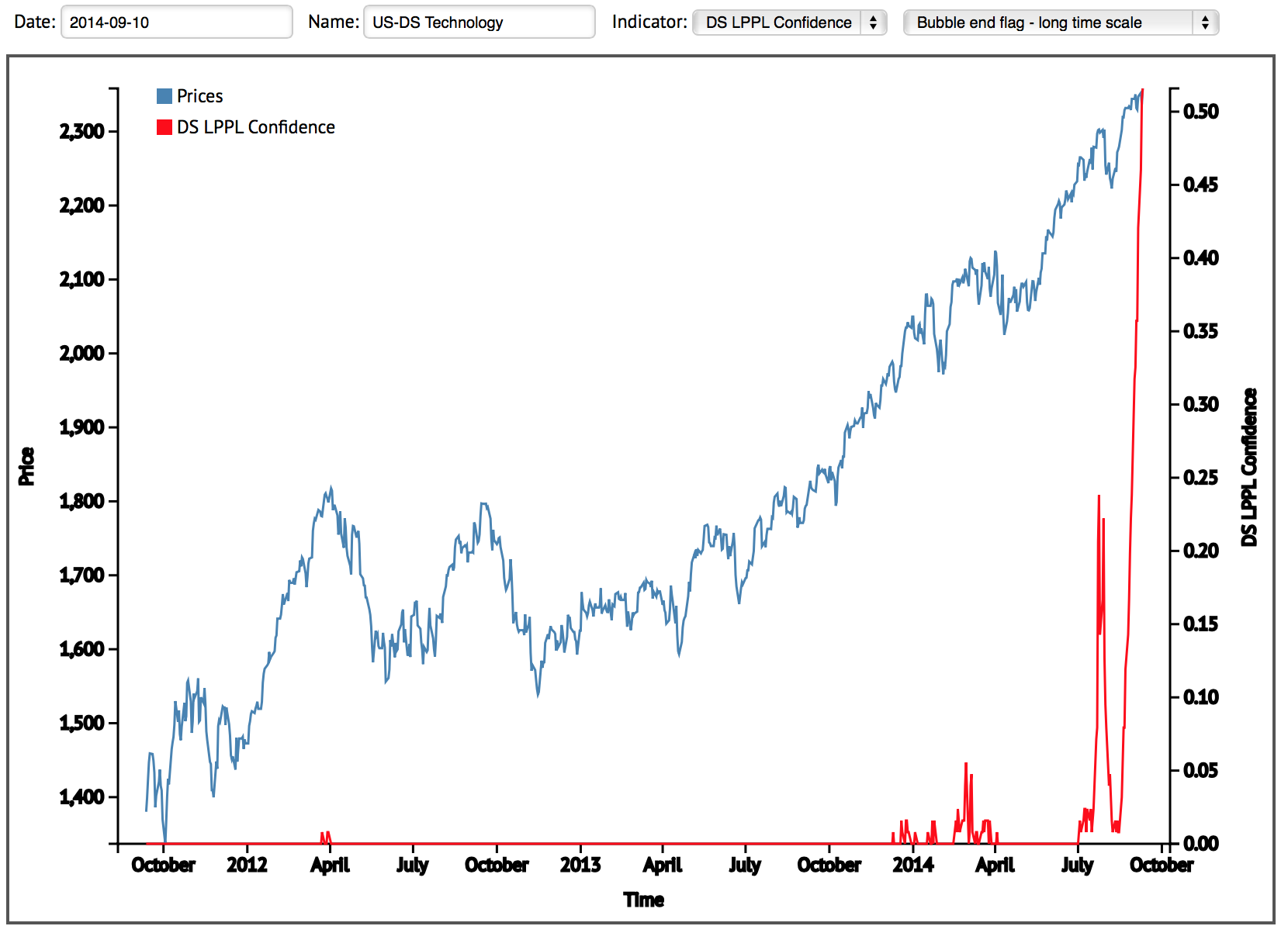
Sornette’s bubble end flag calculation looks like this currently on the SP500 and the US tech sector:

Screen Shot 2014-09-11 at 10.37.45 Screen Shot 2014-09-11 at 10.38.29

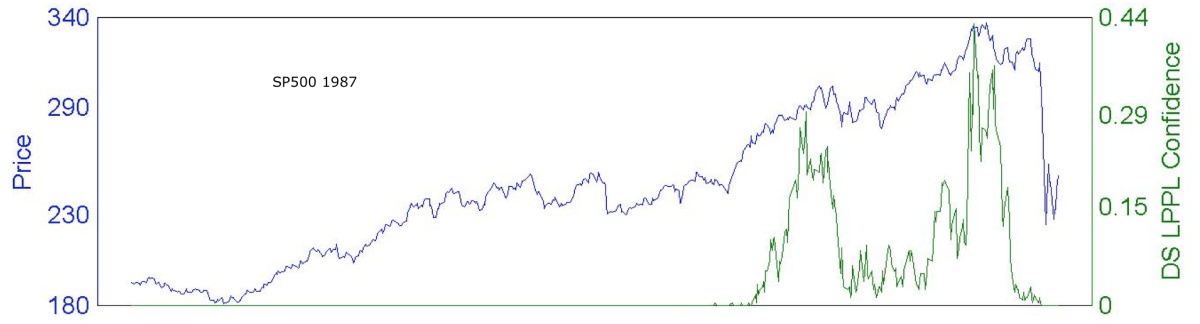
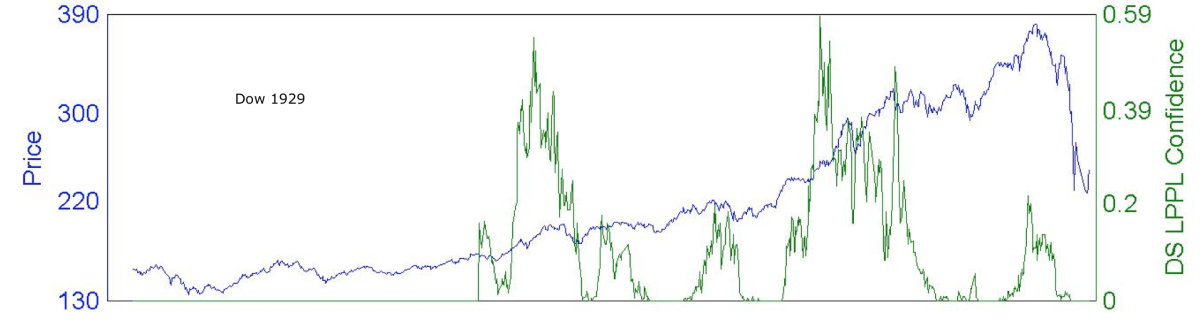
Compared to historic examples, the SP500 has not flagged at as higher intensity, whereas the tech sector now has. On the other hand, the tech sector flag looks fairly ‘new’, whereas the SP500 flagging has built up gradually. Neither have spiked multiple times in an extended period like in 1929 or 2000 (which both lasted around 2 years). At this point, the picture is most similar to 1987 of the three.

11se25

11se21 11se23

 Source: Financial Crisis Observatory

10. Solar maximum

By most solar models, the smoothed solar maximum is behind us, circa March 2014. If this is so, then the last four solar maxima delivered the asset mania peak within 5 months, which makes the current peak ripe.

Screen Shot 2014-08-10 at 16.30.44

There are question marks over how close the timing ought to be (looking further back in history), and we cannot yet be sure the smoothed solar max is behind us. However, this is where cross-referencing comes in useful.

Investors Intelligence argues the top should be before 2014 is out, whilst NAAIM calls for one straight away. Rydex, Skew and HYG:TLT all argue a sharp correction circa 20% or a bear market is overdue, and margin debt tentatively does too. Meanwhile, Q ratio and household allocations argue for a sharp correction circa 20% imminently or a bear market too.

All these indicators cast great doubt on the speculation peak being some way ahead in 2015. Collectively they argue for us to be in the last gasps of a topping process that began at the turn of the year. If stocks were to continue to rally into 2015 then we would print major anomalies in all these indicators: they all worked historically, but this time is different. I don’t buy that.

The Sornette bubble either places the market at a 1987 style peak now, or will come again at a higher intensity any time up to the end of 2015. The solar cycle places us either ripe to fall, 5-6 months post smoothed solar max, or also may allow for a peak up to the end of 2015.

I therefore believe that the logical case is for the eight market indicators to work once again and deliver a peak now, which then fits with the 1987-style Sornette reading and the most likely smoothed solar max / speculation peak lag combination. It all fits together, it all fits with history.

Short Term Clues

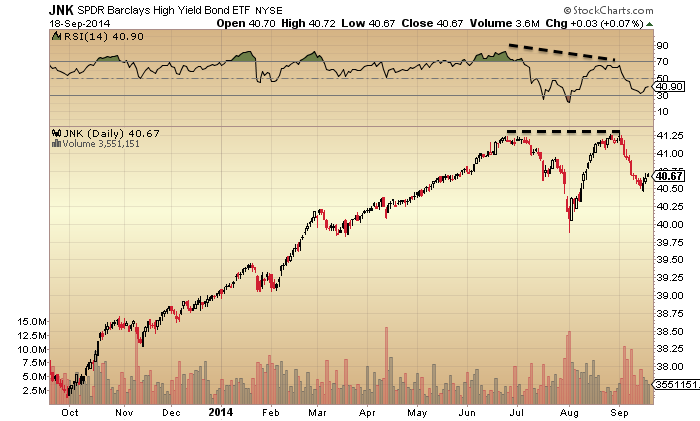
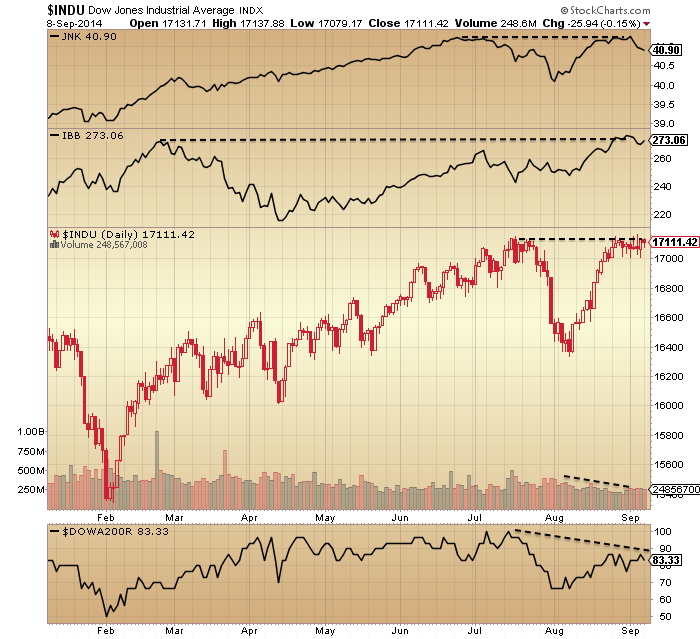
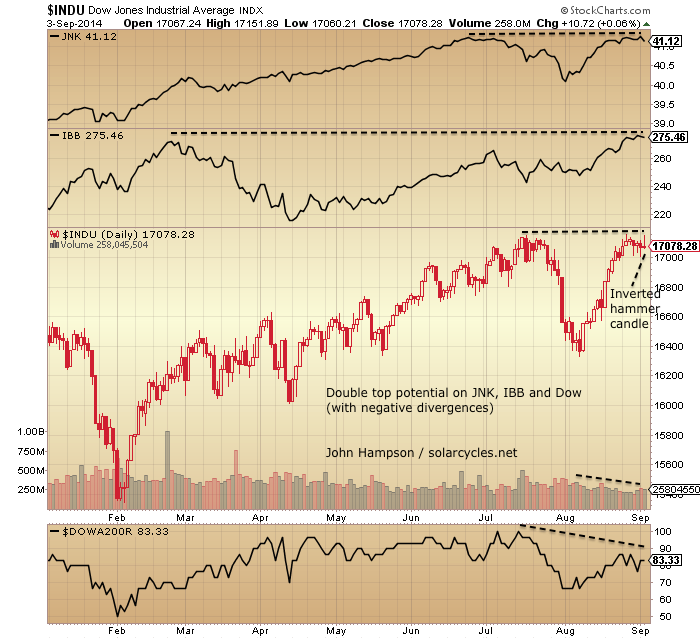
The Dow, Biotech and Junk bonds are all still flirting with double tops and are unresolved at the time of writing, though JNK has been the most repelled (Stockcharts):

9se18

In the last two weeks before yesterday, all the gains in SPY came out of hours (Fat-Pitch).

The best performing sector of the last two weeks was Utilities, in line with the YTD (Macromon).

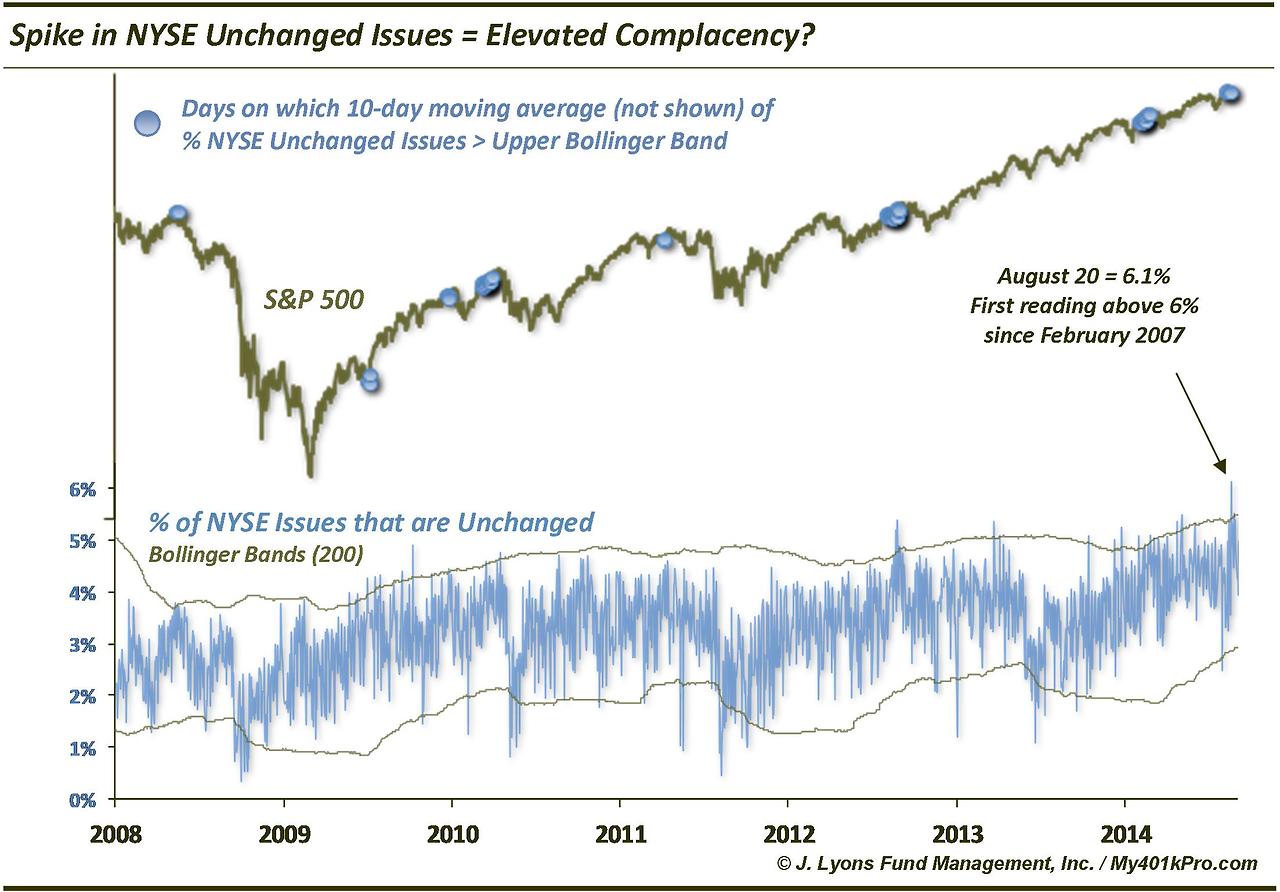
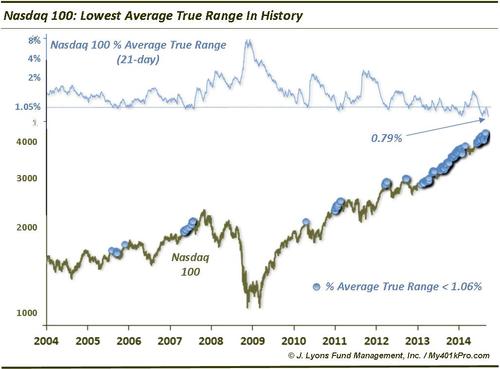
Volatility reached new lows, and suggests complacency which occurred into and around previous peaks (J Lyons):

9se9

9se10

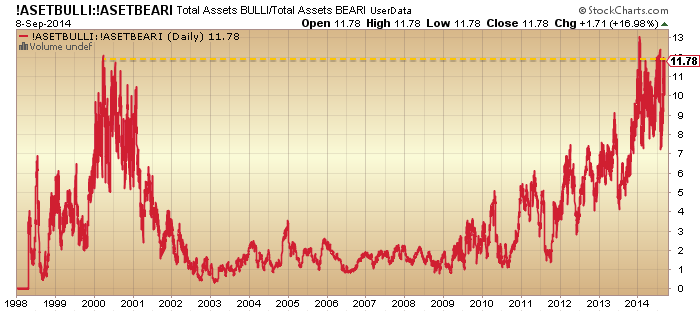
Rydex bull/bear assets at the end of yesterday are back up to near 12x levels, on a par with the 2000 peak and all-time extremes.

9se14

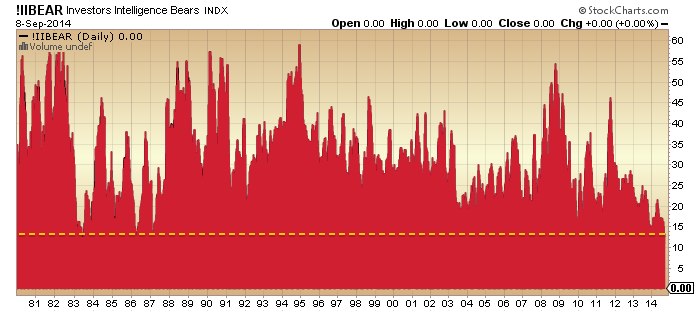
Investors Intelligence percentage bears is down to 13, on a par with the 1980s lows:

9se15

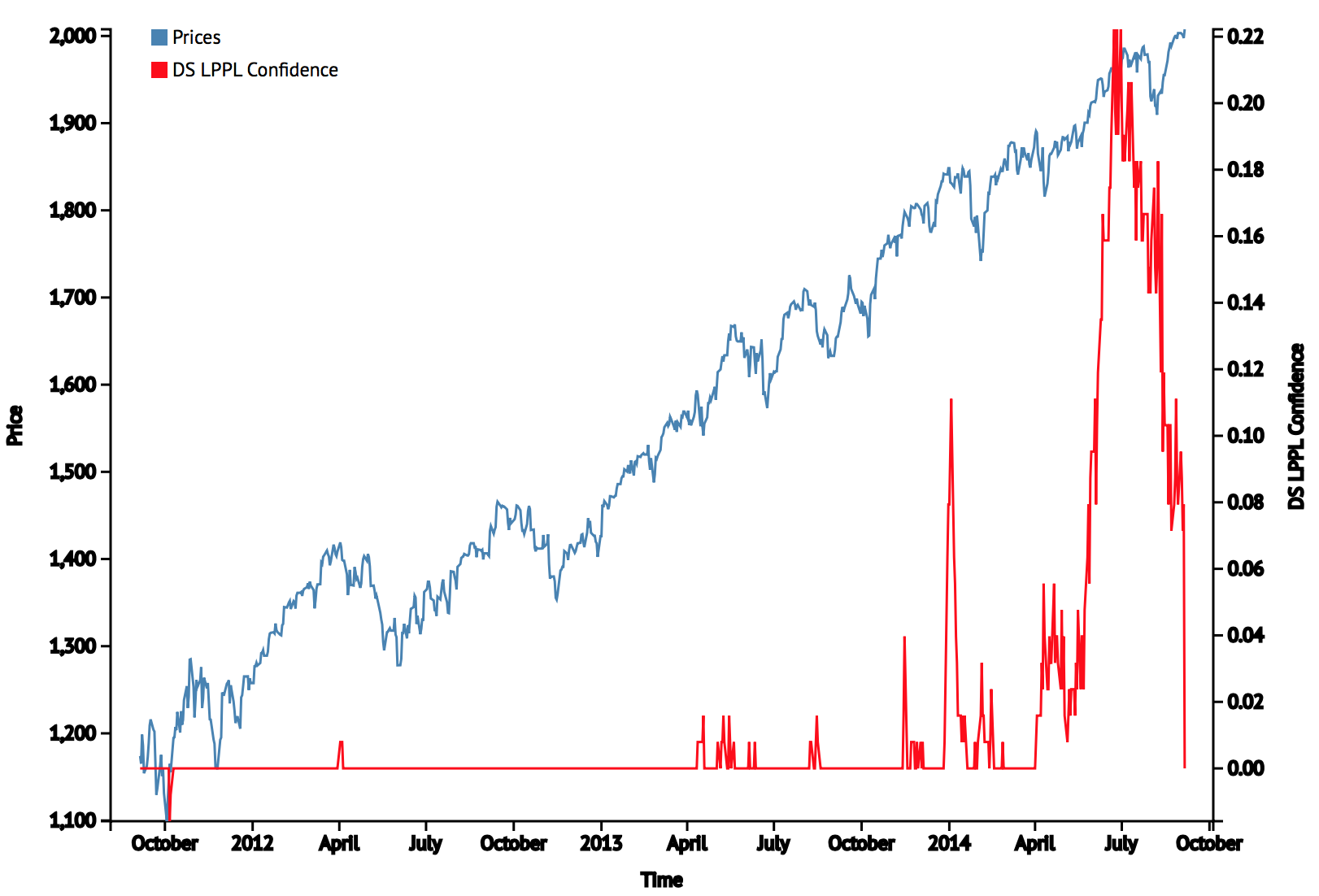
The Sornette bubble end flag has dropped to zero (Financial Crisis Observatory):

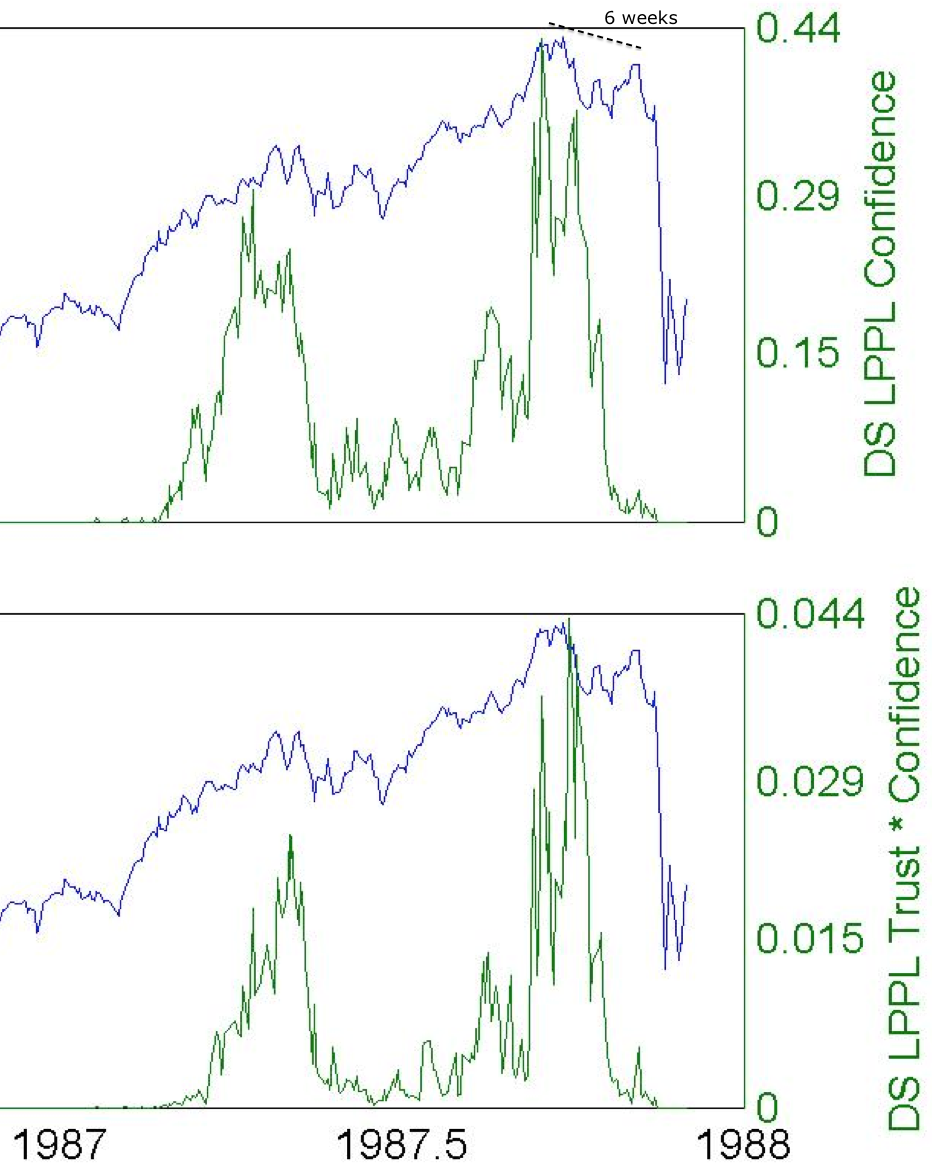
Screen Shot 2014-09-09 at 10.26.37If the July flagging was the bubble end, then it would fit with the model from 1987, which flagged and then several weeks later the market collapsed:

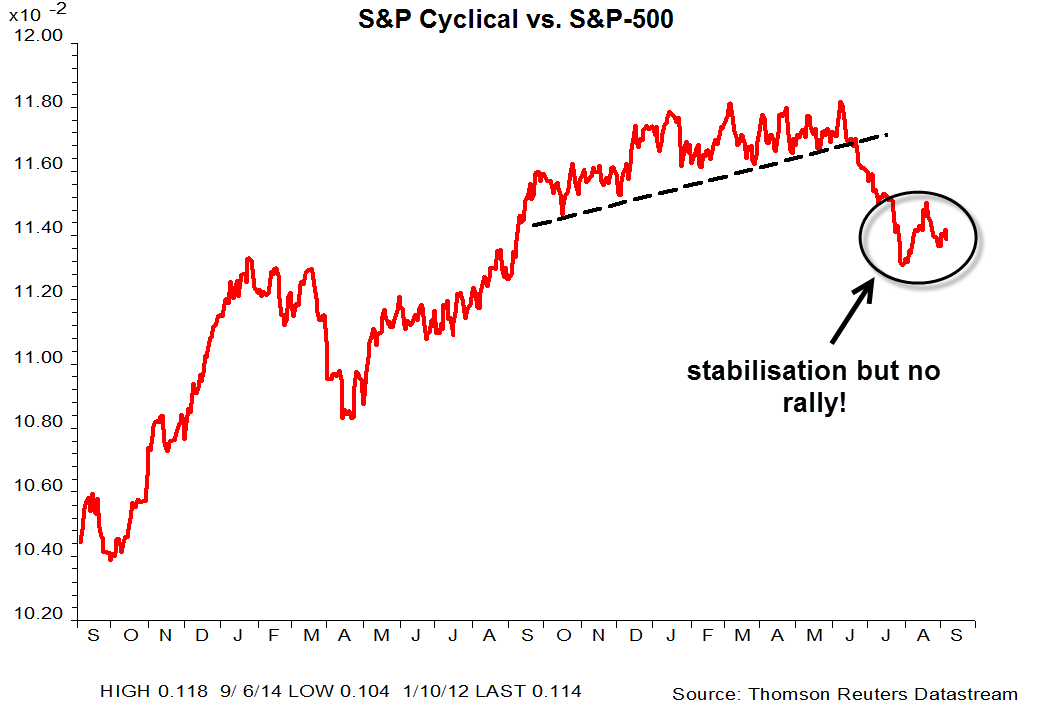
Screen Shot 2014-09-09 at 12.03.44In support of the July bubble pop scenario, cyclicals broke down around that time (UBS):

9se3

If July wasn’t the final peak, then the Sornette bubble should rise again and flag at a higher intensity in the future.

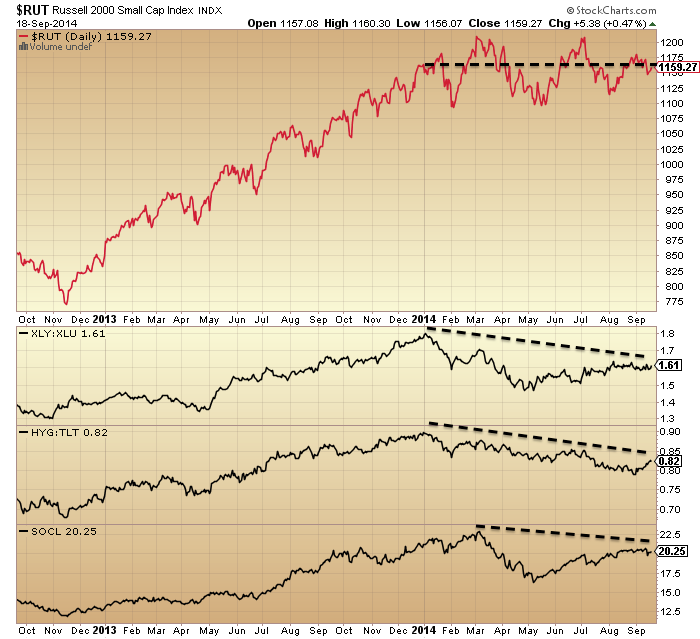
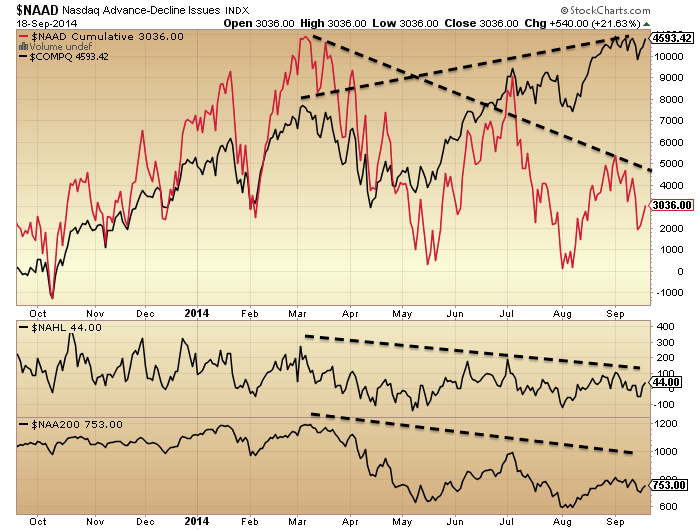
Evidence in support of the speculation/solar maximum being around March time and behind us comes from the current peak margin debt reading and the first of the double tops in biotech, but also seen here in peaks in social media, commodities, Russell 2000 and Nasdaq advance-declines:

9se20

Like US small caps, the relative performance of European small caps also peaked out at that time.9se1Today is the full moon. Let’s see what it brings.

Characteristics Of A Stock Market Peak

Focussing on the US stock market, I’ll divide this into two: what’s currently flagging a peak, and what’s – arguably – missing.

First, the different angles and disciplines that are signalling a top.


A. Valuations

(1) CAPE, (2) CAPE/Baa yield, (3) Crestmont, (4) Q ratio, (5) Stock market to GDP ratio, (6) Median stock, (7) Relative pricing to bonds and commodities, (8) Relative pricing to other countries, and (9) Relative pricing to demographic trends: all show extreme overvaluation, fitting with previous major peaks.

B. Sentiment & Allocations

(10) Investors Intelligence, (11) Rydex, (12) Fund Managers, (13) AAII allocations, (14) Households, (15) Put/Call Ratio. We don’t need to speculate about whether this is ‘the most hated rally’ or whether Joe Public has yet to get involved. These measures collectively tell us that allocations and bullishness are extreme high and echo previous major peaks.

C. Dumb Money

(16) Retail v. Institutional, (17) Major distribution days, (18) Multiple Expansion, (19) Money losing IPOs, (20) Buyback levels. Again, these all resemble previous peaks.

D. Leverage

(21) Margin Debt, (22) Net Investor Credit, (23) Leveraged loan issuance. Compensating for a lack of demographic tailwind these have been driven to new all-time records.

E. Negative Divergences

(24) Stocks over 200MA, (25) New high-lows, (26) Nasdaq advance-declines, (27) NAAIM exposure, (28) High-yield to treasuries, (29) Consumer discretionary to utilities. These have broadly been in place since the turn of the year and are now mature versus previous major peaks, suggesting we should be around the end of a topping process.

F. Technical Indicators

(30) Skew, (31) Extreme low volume (Nasdaq and SPY volume on up down days), (32) Extreme low volatility (levitation above 200MA, weeks without a 3% move), (33) Sornette bubble end flag, (24) Compound annual growth. A variety of angles, each with a case for a peak.

G. Sector & Asset Rotation

(35) Best performing asset in 2014: Treasuries; (36) Best performing sectors: Utilities & Healthcare; (37) Hot assets, sectors and indices broke down from parabolics: Bitcoin, RUT, SOCL, IBB (tentative). In summary: out of speculative and cyclical and into defensives.

H. Natural Force Timing

(38) Peaks typically occur close to solar maxima (est. March 2014 (RUT)), at (39) Inverted geomagnetic seasonal peaks (Dec/Jan (risk, Nikkei), Jun/July (Dax, Dow)) and (40) Close to new moons (in Jan, Mar, Jul and Aug). The solar maximum is the question mark, because it is an estimate currently, but we know we are in the timezone of a smoothed solar maximum and from history a market peak is likely near.


Drawing all these angles and disciplines together it should be clear that we are in the vicinity of a stock market peak. You may take issue with a particular discipline or a particular angle or those indicators with shorter histories, but the collective case overwhelms. If you take issue with the collective case by arguing that is has all been distorted by QE and ZIRP, then I would point to 1930s US and 2000s Japan where the conditions were the same and we nonetheless experienced bear markets and recessions. But I’ll tackle this distortion idea more below.

Let’s now turn to what may be missing for a stock market peak and thus keeping the bear market at bay.


I. Topping pattern and technical breakdown

Nikkei, FTSE, Dax, Russell 2K are all overall flat for 2014 and display typical topping patterns. Yet, the other US indices remain in clear uptrends, India’s Sensex remains in a steep ascent, and the Hang Seng recently broke out. So the overall picture is mixed. None of the indices have made a decisive technical breakdown at this point.

J. Leading Indicators, Corporate Profits, Recession models, Financial Conditions

Conference Board LEI, ECRI WLI, corporate profits, yield curve recession model, other proprietary recession models. Corporate profits have turned down by certain measures but not all and the rest of these indicators display no clear warnings currently. Economic surprises are currently positive and the US economy is generally doing ‘fine’. More on these below.

K. Inflation & Rate Tightening

Commodities and inflation rallied from Nov 2013 and peaked out in May 2014, but still at overall historically low levels. Yields tightened into the end of 2013 but since then have reversed and eased. The Fed remains on zero rates but is tapering QE to an Oct 2014 termination. This is a general misfit with recent bull market peaks that have seen higher inflation and a series of interest rate rises. More on this below.

L. Question marks over (i) The solar max, (ii) Sornette bubble end flag, and (iii) NYSE Advance-Declines

Most solar models predict the smoothed solar max to be behind us, circa March 2014. However, SIDC are still running with an alternative model that peaks at the turn of 2014-2015. Also, Mark has a theory that under weaker solar maxima, like this one, speculation runs beyond the smoothed solar max, which would also take us beyond the end of 2014. The Sornette bubble end that flagged in July was at a lower intensity than mirror bubble ends in history, allowing for a potential greater flag ahead (which would imply the market needs to rally further yet). NYSE advance-declines have not negatively diverged yet unlike previous recent major peaks, however they did not at all peaks, and Nasdaq advance-declines have been divergent for 6 months.

More on these below.


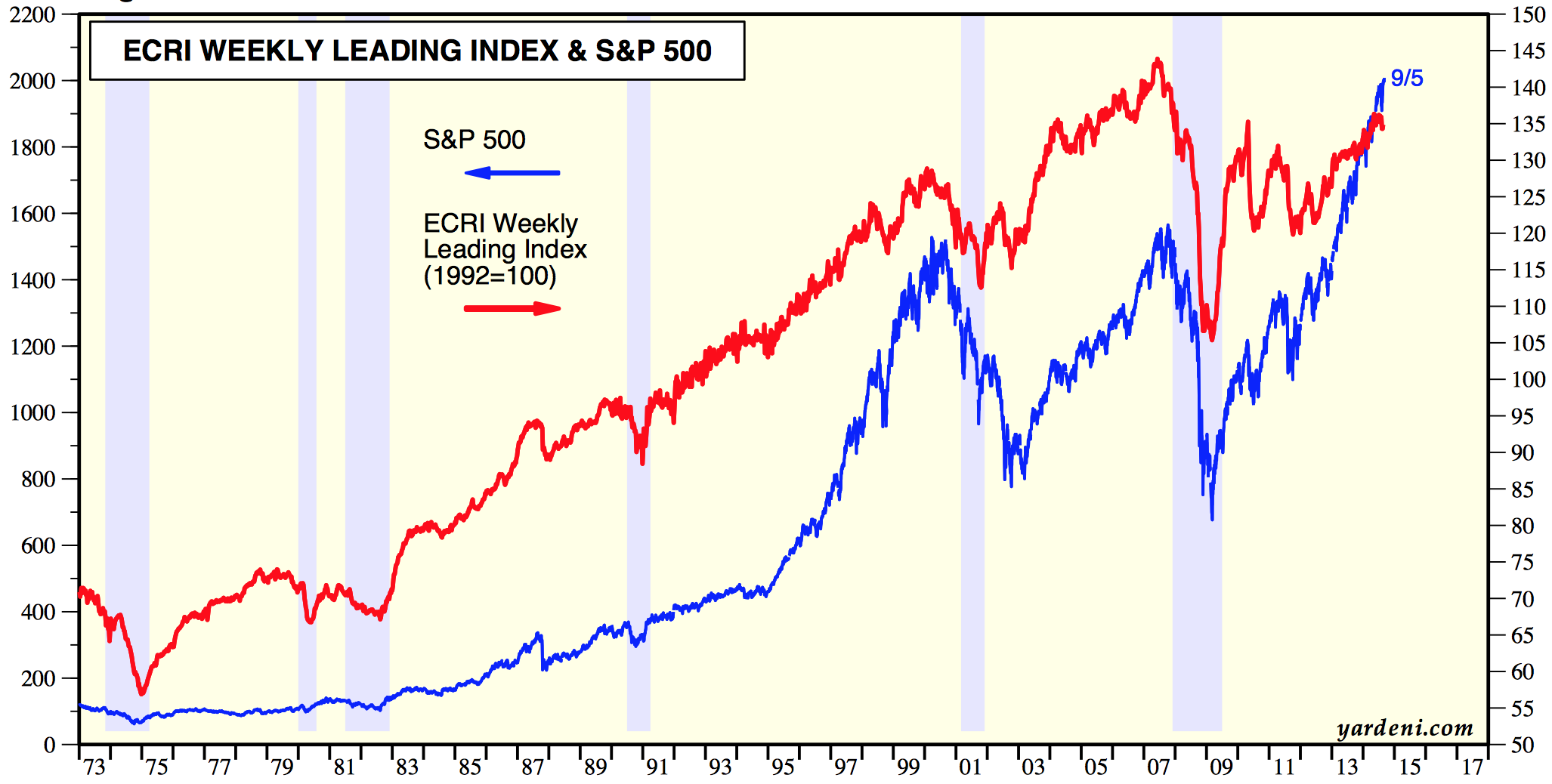
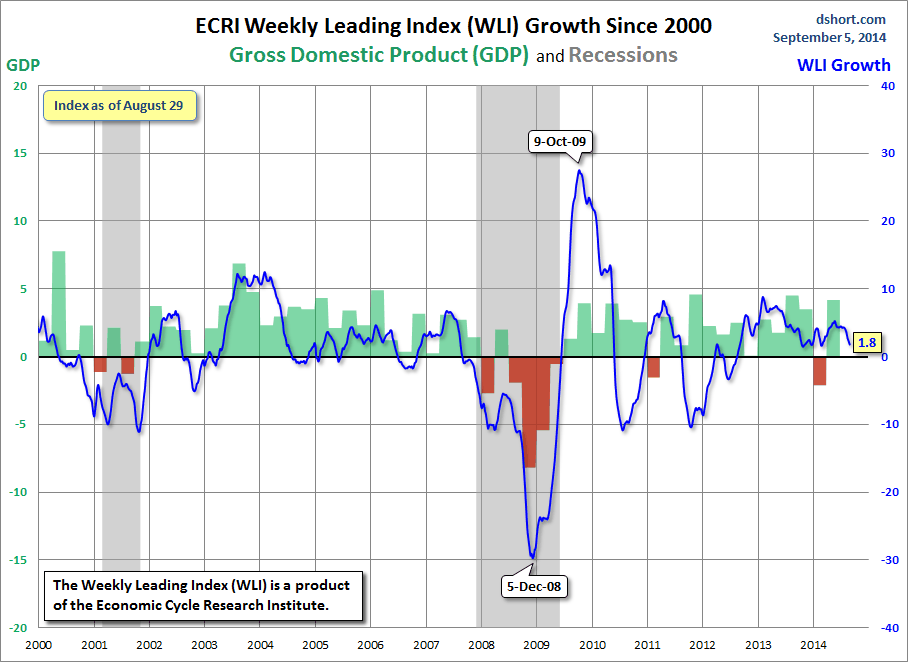
Leading indicators by CB and ECRI typically do a good job of announcing recessions ahead of time (though there have been some false positives and false negatives). However, they are not a good predictor of the stock market, with research showing they are typically coincident with each other.
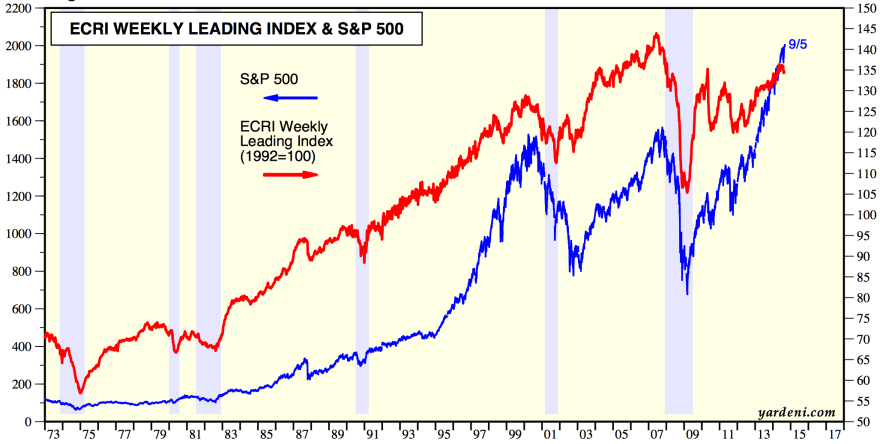
Screen Shot 2014-09-08 at 08.16.18

Source: Yardeni

The stock market is a leading indicator of recessions itself, and in fact an agent, due to the wealth effect. Both ECRI and CB accordingly include the stock market performance in their leading indicator calculations.

ECRI WLI growth turned negative in 2000 and 2007 after the SP500 had suffered initial falls of around 15% in both cases (from March 2000 and from June 2007). In 2014 we have seen no such damaging break yet, but with ECRI WLI down to 1.8, a true technical break in stocks would likely pull it below.
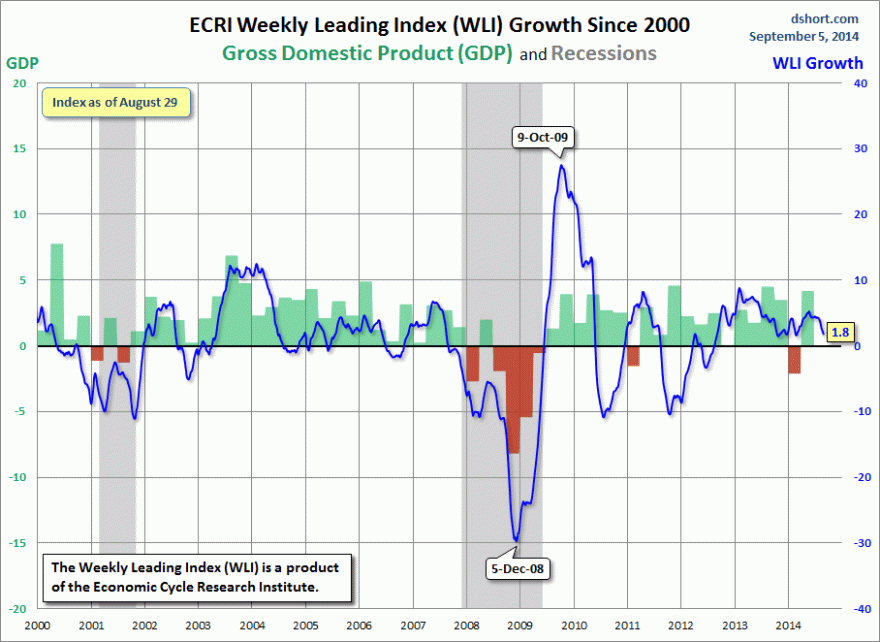
7se8

Source: DShort

CB LEI topped out with the market in March 2000, and whilst it topped in early 2006 ahead of the 2007 market peak, it didn’t fall until stocks fell in 2007.

Turning to corporate profits, they also typically turndown as a leading indicator of a recession, but there are different ways of calculating this indicator.

The first method below shows profits peaked ahead of the stock market peak six times, coincident twice and after once. By this measure corporate profits peaked at the end of 2013, and are diverging in line with the majority of historic cases.
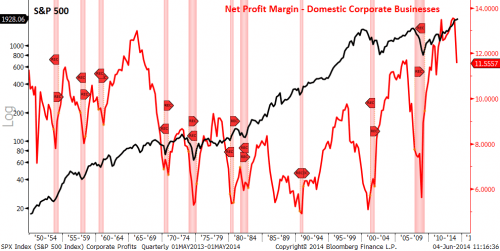
7se8

 Source: PFS Group

A second method shows that corporate profits peaked out coincidentally with the stock market the last two times (or along with the initial falls of ~15%), and accordingly this measure is still levitating with stocks in 2014.
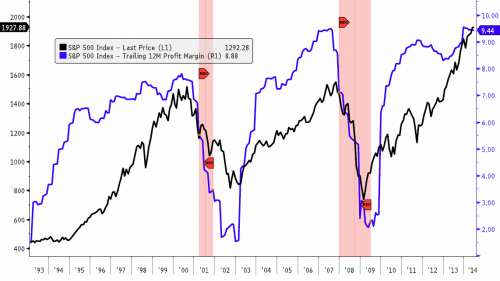
7se9

Source: PFS Group

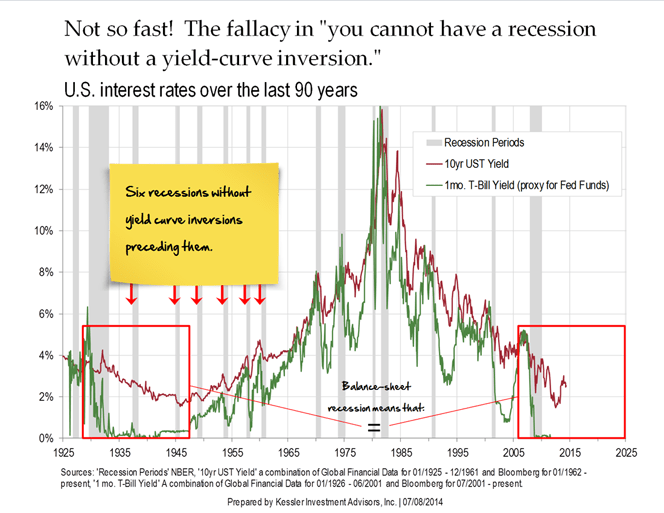
The yield curve as a recession predictor does not work under ZIRP. Japan three times entered recession without yield curve inversion under ZIRP, and the US did likewise in the 1930s-40s.
7se3

 Source: ZeroHedge

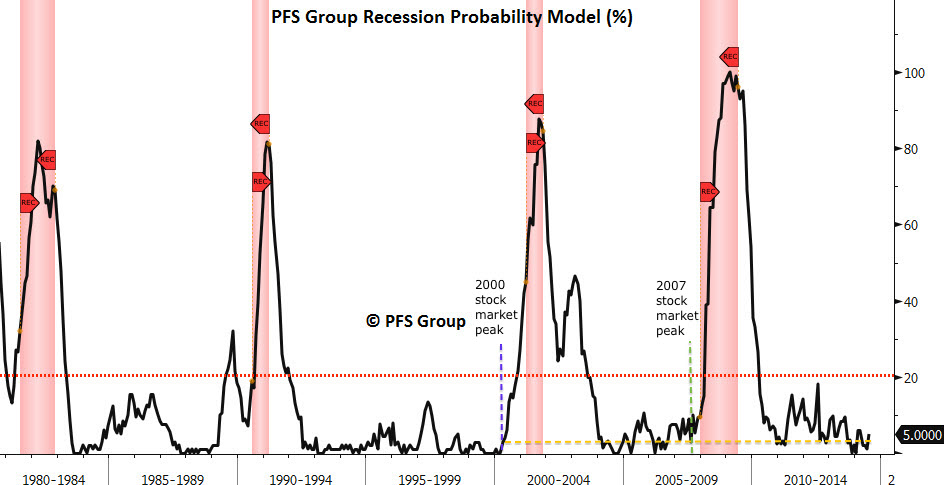
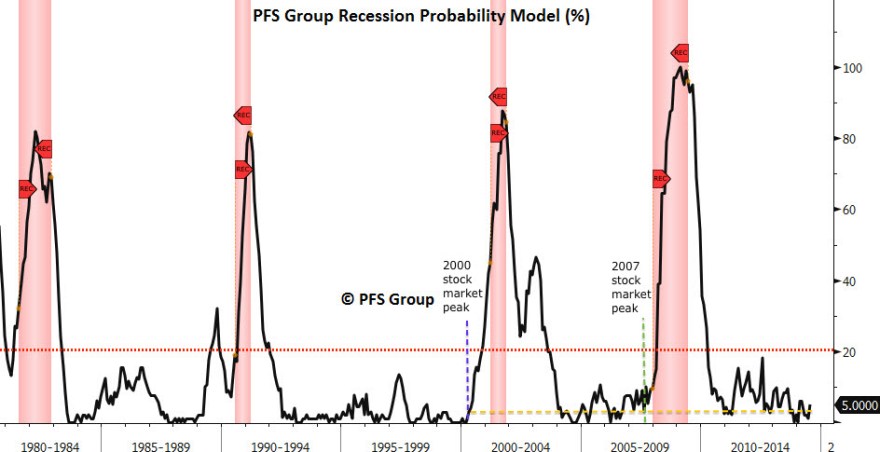
PFS’s recession model is proprietary but note how it only took off once stocks fell hard in the last two peaks:
7se10

Source: PFS Group

Like ECRI and CB leading indicators, it is coincident with the stock market.

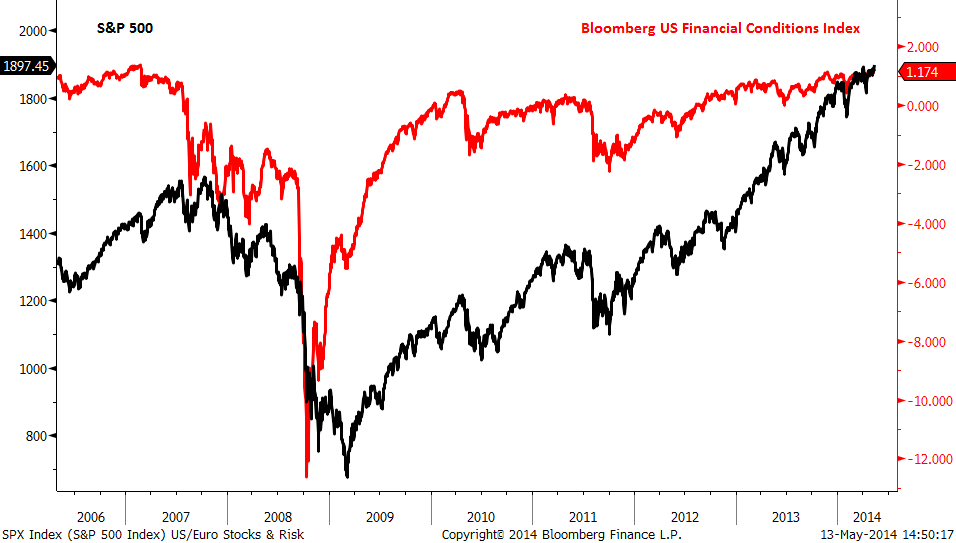
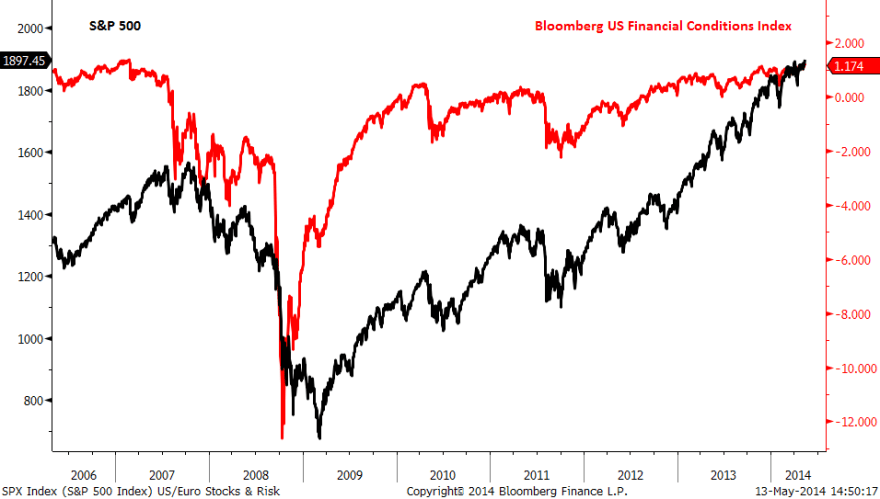
Similarly, financial conditions also did not fall until the stock market peaked in June 2007, May 2010 and July 2011.
7se5

 Source: Financial Sense

In short, leading indicators, financial conditions and valid recession models are benign whilst the stock market continues to levitate. Once it falls, they will begin to flag, as the wealth effect rapidly declines. The yield curve model is invalid and corporate profits are either coincident or warning with negative divergence, depending on the method. So, none of these indicators are bullish support for the stock market.


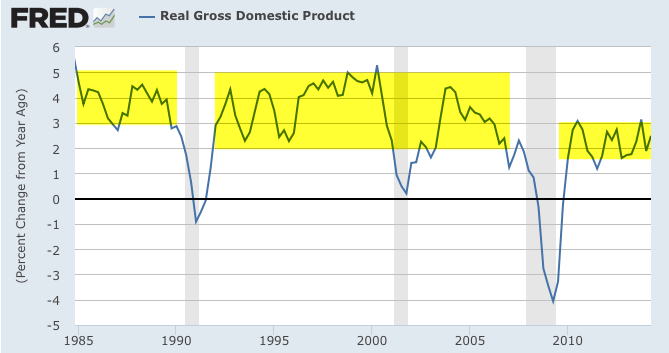
US QE is being wound down and will end in October. The stats show that 80% of QE money is parked as excess reserves at the Fed paying a meagre return to the banks. This is because they can’t lend it out: the demand simply isn’t there under demographics. The money multiplier and money velocity are both still in decline. So, 80% of QE money is impotent for now, but this is a threat for the future once demographics improve and demand comes back. The other 20% of QE money is difficult to track, but under conditions of ZIRP we can assume some has entered the stock market searching for yield and return. Ultimately though, QE does not create economic growth: it is just corruption of the money mechanism. Therefore, price rather than the earnings has risen significantly in stock market, making for valuations on a level with previous major peaks. Zero interest rates encourage money to search for yield but also can only tweak demand, not revolutionise it. Also, a large swathe of retirees have less income under ZIRP which acts as a drag in the economy.

The reality is that the US economy is overall chugging along at a lower rate than in the past when demographics (and debt levels) were more favourable. As in the 1930s US and 2000s Japan, QE and ZIRP can only have limited effect whilst demographics dictate.
8se10

 Source: Fat-Pitch

Demographics are both deflationary and recessionary. Therefore, we have seen overall low inflation recently and the Fed does not have the luxury of rate rises. The point about both inflation and rate rises is that they choke the economy in rising input prices and tightening. Yet demand is too weak to stoke inflation and the economy too weak for rate rises. The tightening is coming from QE wind-down, but as noted the overall effects of QE are less than touted. I would argue that a sharp fall in equity prices is all that is missing from tipping the economy over, and that we again have to look to 2000s Japan and 1930s US as the most relevant analogs here.

We could argue that falling commodity prices lower input costs and are a driver for the economy and that falling yields are effective as easing. However, if we are in the last gasps of a stock market top then both treasuries and commodities are acting as per a deflationary recession.

The ECB cut rates and launched a form of QE last week. Does that offset the Fed winding down? Analysis of the ECB package shows it to be more window-dressing than content. The Eurozone economy is 3.5 times the size of Japan yet its package amounts to just one tenth the size of what Japan is doing, whilst the rate cuts were largely symbolic. Despite Japan’s aggression, the effects have been disappointing, which brings us back to the point about what QE actually does: it does not drive economic growth, and therefore, the new ECB actions are unlikely to make a significant difference.

Leading indicators predicted a mid-year upturn in US economic growth and this has occurred. Accordingly, economic surprises have leapt into the positive. However, leading indicators predict a peak in growth around now, which should set the scene for disappointment in data in Q4. As this coincides with the termination of QE, maybe this combination will unsettle the ‘Fed policy trumps all’ crowd perception.

In summary, the evidence suggests policies of ZIRP and QE are limited in their potency. They may both play a role in current higher stock market valuations, but the disconnect between prices and earnings/growth is bearish, as it was in 1937. The weak economy under demographic trends is unable to support inflation and rate rises, and I believe is at the mercy of the stock market. Namely, if the stock market falls, the economy will tip over. If it doesn’t it will continue to chug along.


So what is the trigger for the stock market? History shows that major peaks typically occurred without a major trigger, and then sharp falls occurred once there was a suitable technical break. So what factors bring about the topping out?

The evidence suggests one is saturation or buyer exhaustion. We have very recently seen sentiment, allocations and leverage all back to extremes of extremes. I therefore believe we are running out of fuel to go higher: everyone bullish, no-one left to buy, credit facilities stretched.

A second one is natural force timing, and the biggest factor in 2014, I believe, is the solar maximum. Most models point to a smoothed solar max being behind us, around March. Most market peaks, and growthflation peaks, occurred very close to the smoothed solar max, so we should be able to cross reference this.

As things stand, margin debt peaked Feb, the Russell 2K and social media peaked Feb/Mar and biotech is making a double peak now with Feb/Mar. Also, commodities and inflation peaked around April time, and we have seen various indices and risk measures peak out between December and August, either side of this kind of epicentre. So it looks promising.

However, as noted, SIDC are still running a model with an end of year smoothed solar max, and Mark’s theory is that weaker cycles such as this won’t see speculation peak until later in the maximum, not until 2015. Playing into these possibilities we see biotech, junk bonds, the Dow, and (likely) margin debt challenging their highs and attempting breakout. We can also monitor sunspots in real time to see if likely to exceed Feb.

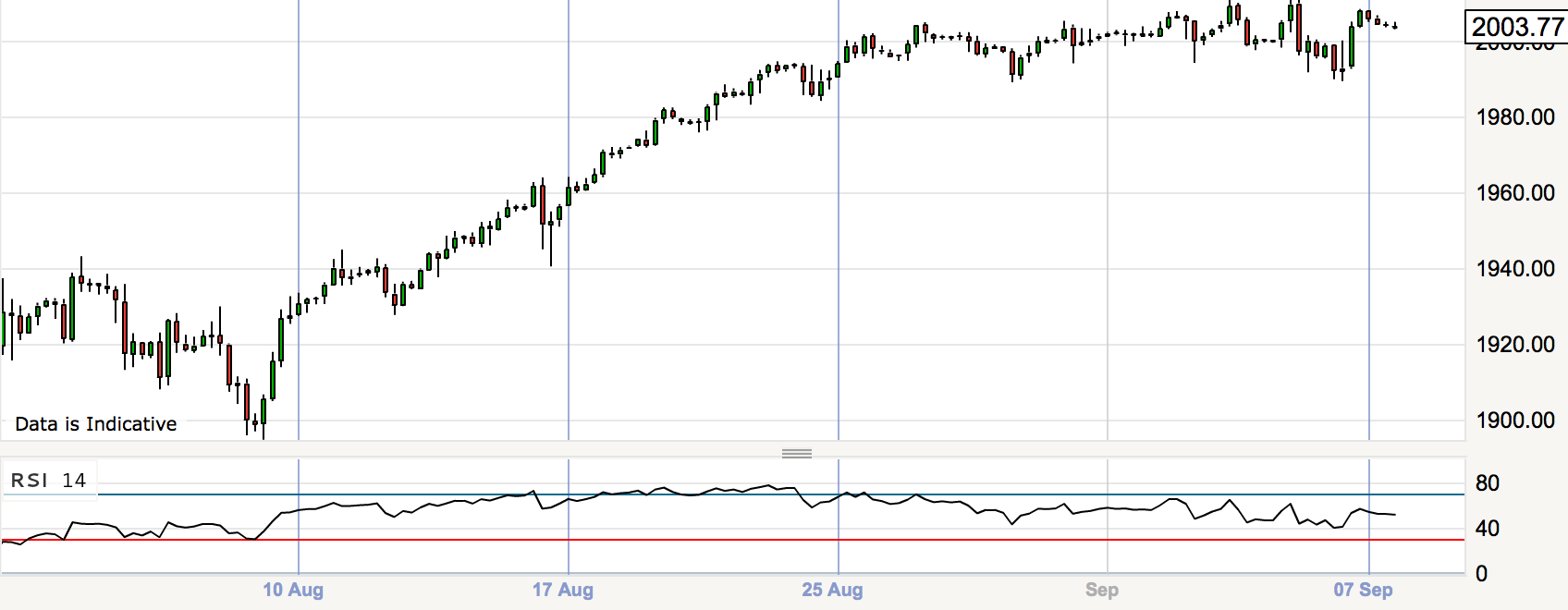
So, I believe we have a useful combined measure there: if JNK, INDU, IBB, leverage and sunspots all break upwards and out to new highs then peak speculation is delayed, and we might then also look to the Sornette bubble end flag to rally again to a higher intensity. However, cross-referencing further, with sentiment and allocations last week back to record extremes, I see a breakout will be very hard to achieve here. Plus, the mature divergences in the market suggest this should be the last gasps of the topping process, not earlier in the process, and we are in the relevant time of the year for the falls to occur. I therefore continue to believe that the most likely scenario is that this rally since August 8th is the terminal rally, shown arching over on the 4-hourly SP500 below, and that JNK, INDU and IBB will all double top out.
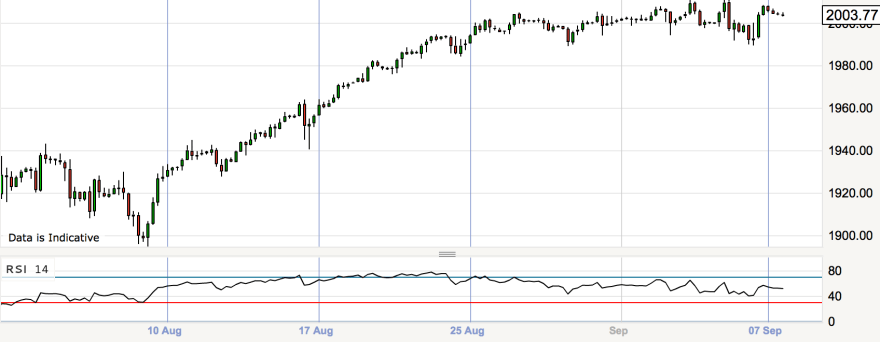
Screen Shot 2014-09-08 at 10.16.32

 SP500 4-hourly


Summary

40 indicators in 8 angles argue for a stock market peak. The only question is the timing, and that is the difficult calculation. The best-fit remains an epicentre of March 2014, placing us now in last gasps. Breakouts from here in several speculation measures would negate that and postpone the top. When the stock market falls it should trigger the ‘missing’ alerts in recession models, financial conditions and leading indicators. The effects of QE are overstated, whilst ZIRP and disinflation reflect the overarching weakness in demographics. Whilst the stock market levitates, the economy should continue to chug along, but if the market falls meaningfully then the economy should tip over into deflation and recession. I believe the two key and associated drivers of the peak are buyer exhaustion and the solar-speculation-maximum, and it appears they came together to peak levels between January and now, making a topping process. Helping tip the perception should be the inverted geomagnetic seasonal lows of Sept-Nov, the predicted disappointing economic data ahead, and the termination of QE support. For this not to materialise, sentiment, allocations and leverage will all have to stretch to new levels of excess to enable a higher stock market. Whilst not impossible, it is not probable.

As Things Stand

The stock market topping process began at the turn of the year:

4se44se3

Speculation peaked in Feb/Mar along with the likely smoothed solar maximum:

Screen Shot 2014-09-02 at 16.34.44

So, topping process phase 1: turn of the year risk peak; topping process phase 2: Feb/Mar speculation peak. Topping process phase 3: mid-year bubble end peak:

Screen Shot 2014-09-04 at 10.13.48

The major stock indices peaked suitably at the seasonal highs close to new moons, either side of the speculation peak epicentre:

4se7The SP500 and Dow peaks are tentative at the time of writing but the signals are promising.

4se1 4se2

The Nasdaq has been the leader but also put in a potential topping candle yesterday.4se5

Has normality now been resumed? By normality, I mean negative divergences, volume patterns, sector rotation, lunar phasing, excessively frothy sentiment and allocations would all typically pull down the market. But the power of the solar maximum has trumped all, keeping the market levitated despite these being in play since the turn of the year. If the market still continues higher from here, then the sun’s influence isn’t through. But if the solar effect on humans is now waning, then the market should return to respecting those indicators of an imminent correction, and in doing so honour the phasing of the topping process as outlined above with a final roll-over here, into the typical period for market falls, Sept-Oct.

As previously noted, the aggregation of indicators and analogs suggests we should be in for a minimum 18% correction but most likely a bear market, and here is one more chart in support of that:

3se13