Charts For A US Stock Market Peak Here And Now

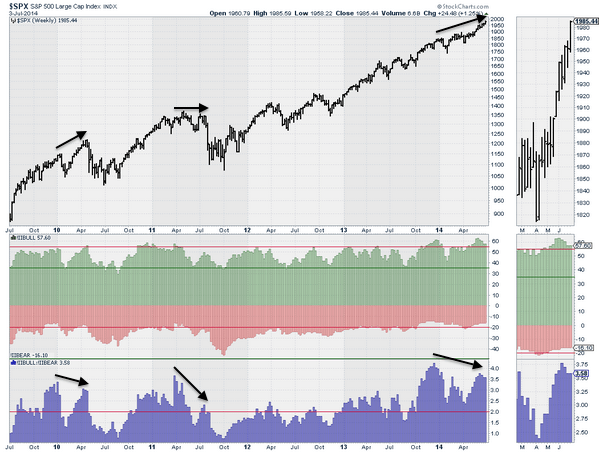
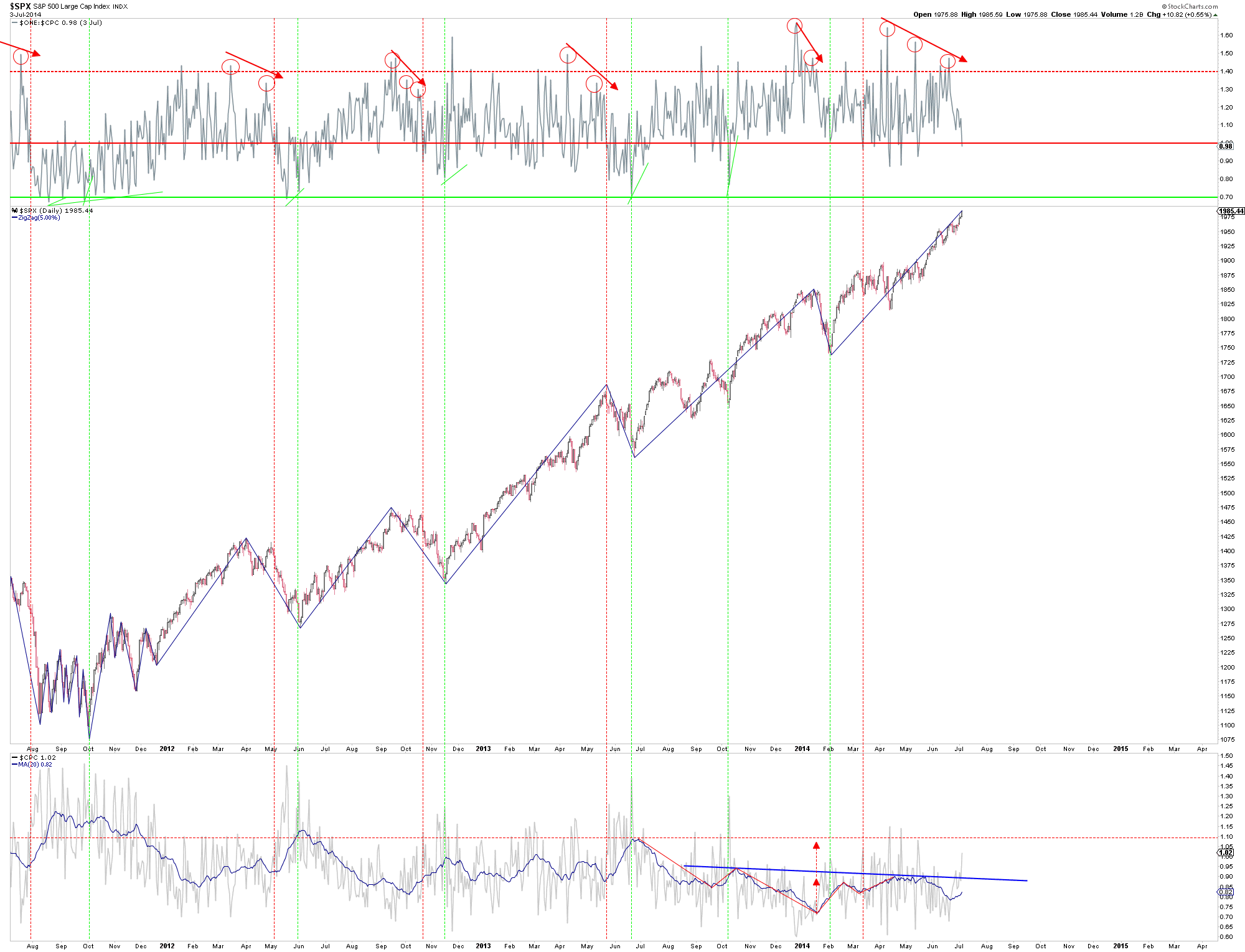
1. Put-call extremes plus negative divergence as per previous peaks:

7ju3

Source: Rory Handyside

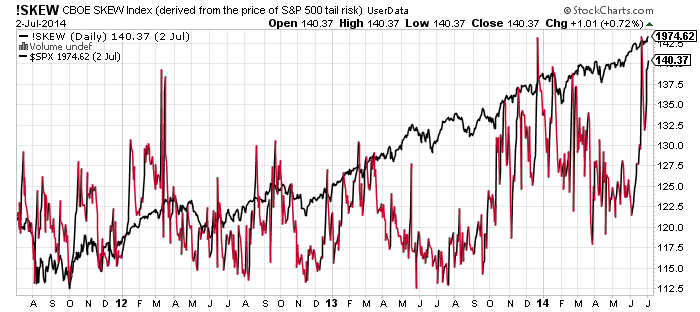
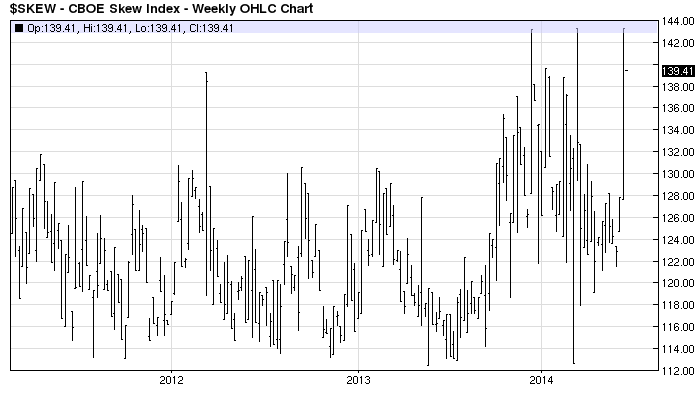
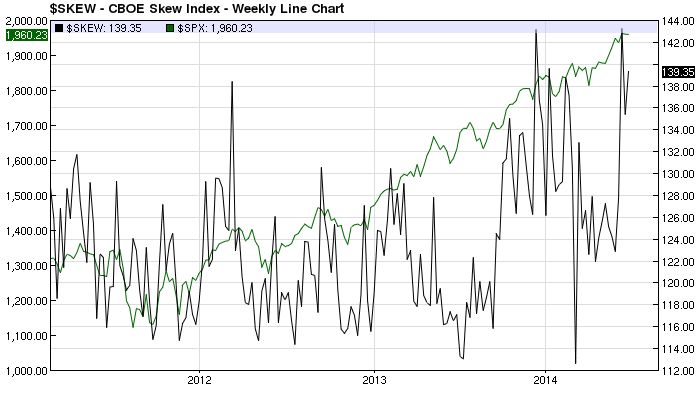
2. Skew extremes and clustering greater than 2011 peak:
7ju1

Source: James Goode

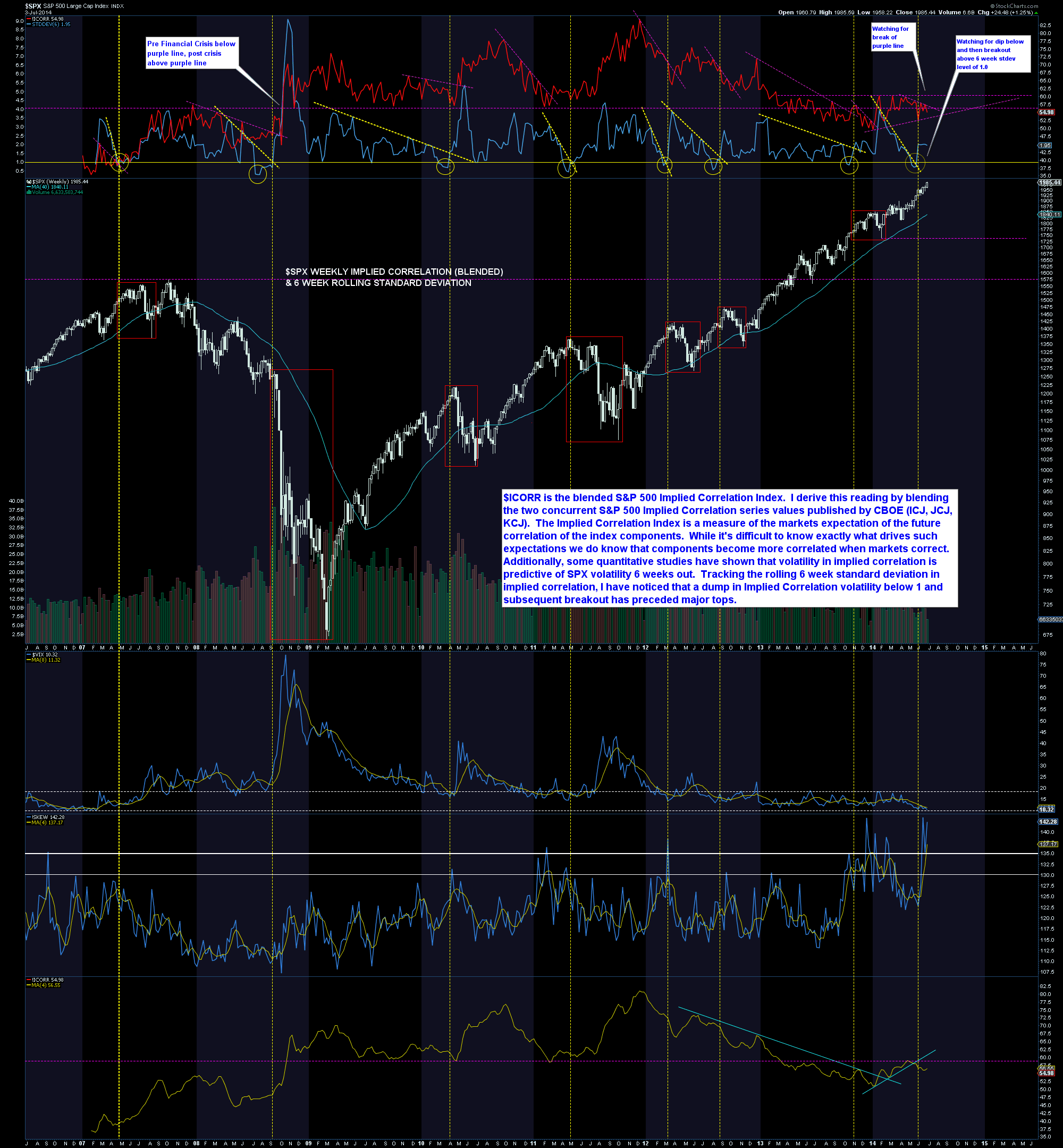
3. Implied correlation volatility reflects previous significant peaks:7ju2

Source: Rory Handyside

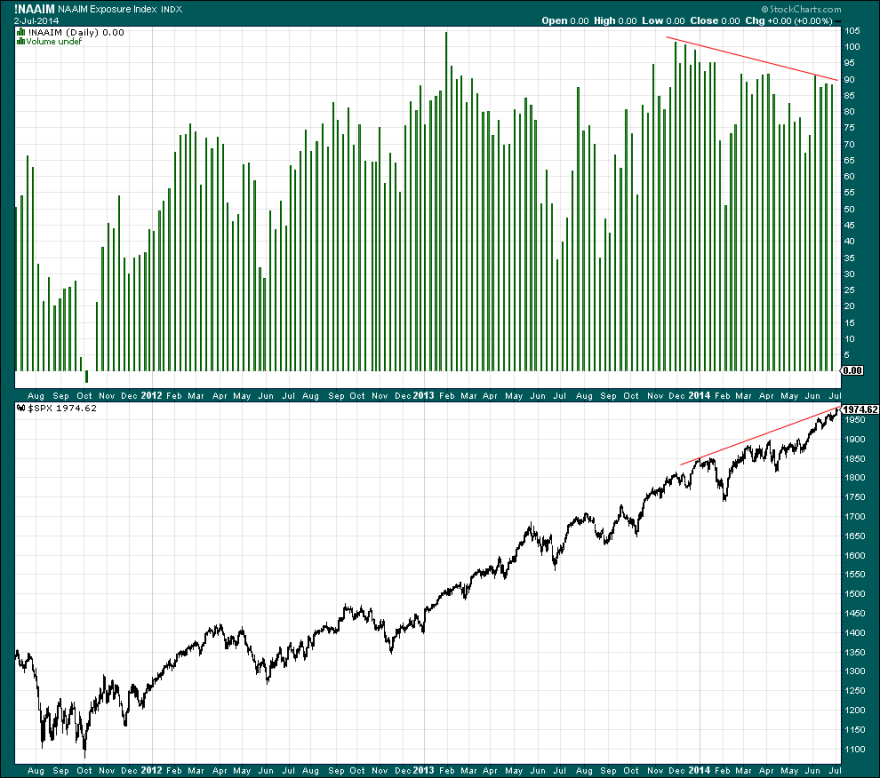
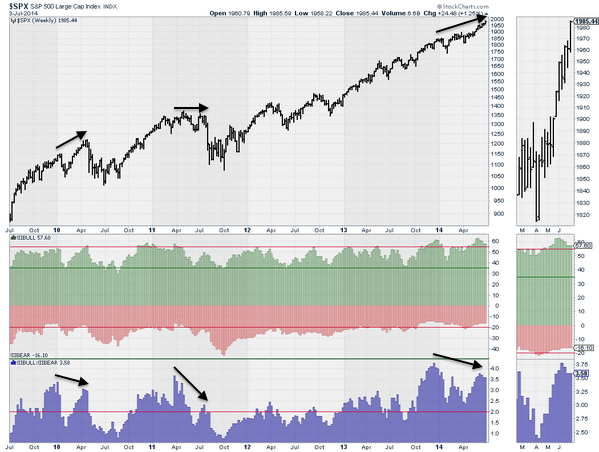
4. Investors Intelligence sentiment extremes and negative divergence per previous significant peaks:7ju8

Source: Jack Damn / my annotations

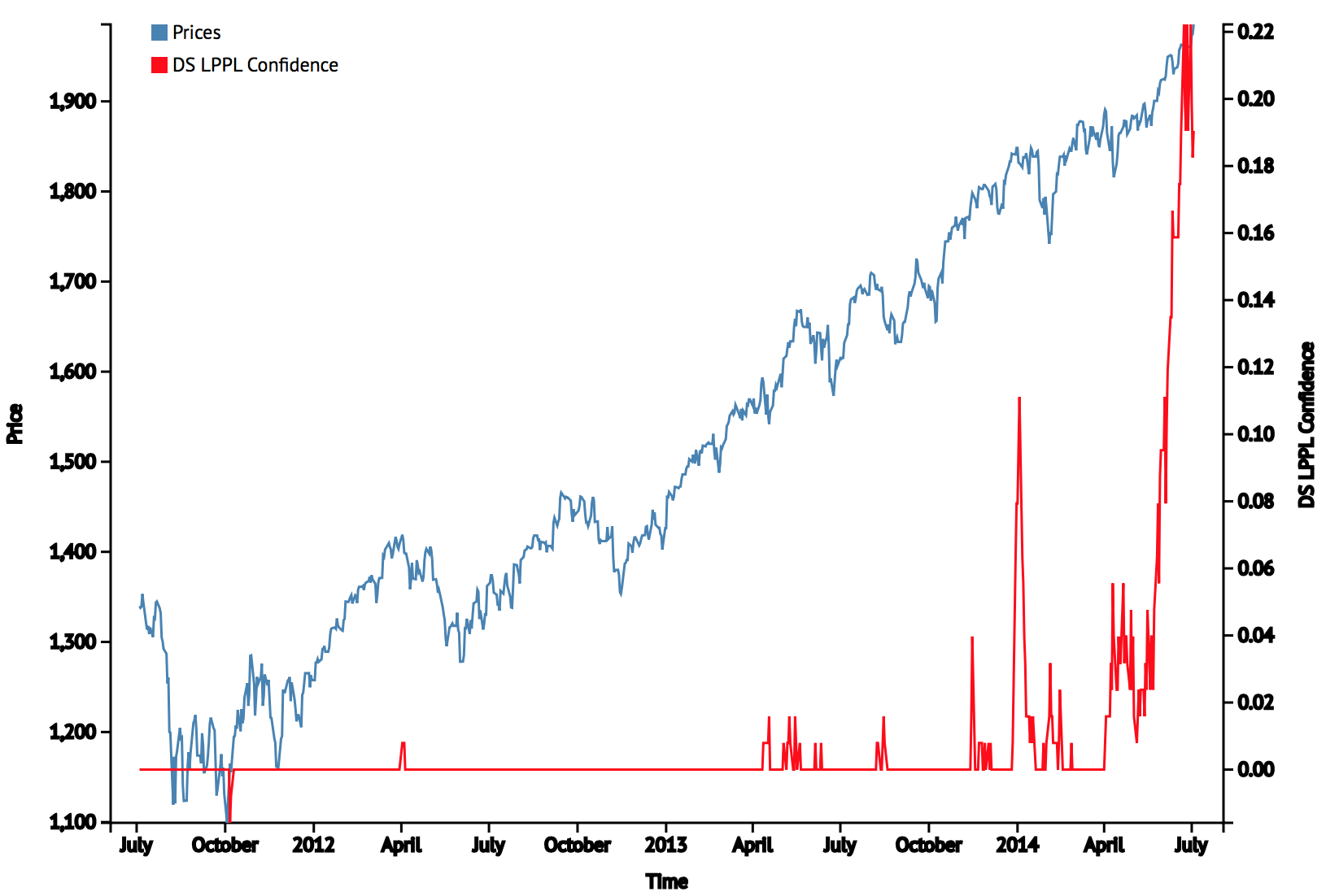
5. Sornette bubble end pop flagging:

Screen Shot 2014-07-07 at 07.53.18Source: Financial Crisis Observatory

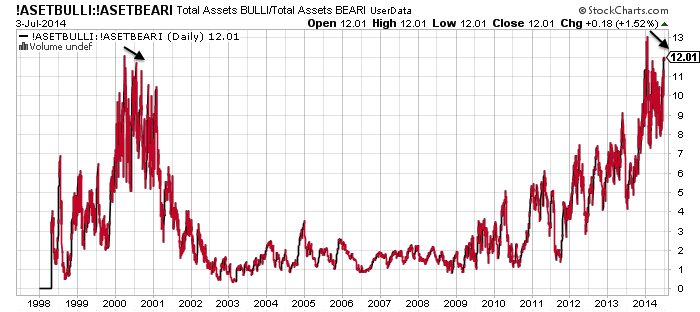
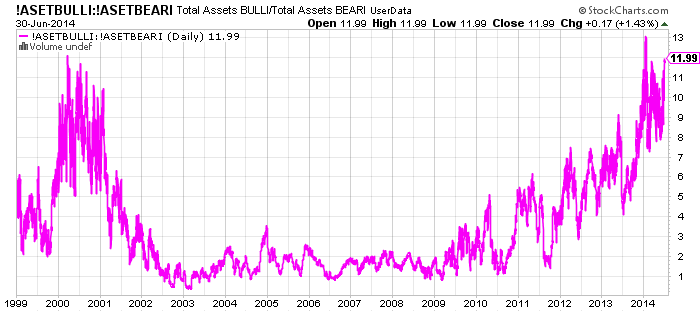
6. Rydex assets extremes and negative divergence per 2000 peak:

7ju9

Source: Stockcharts

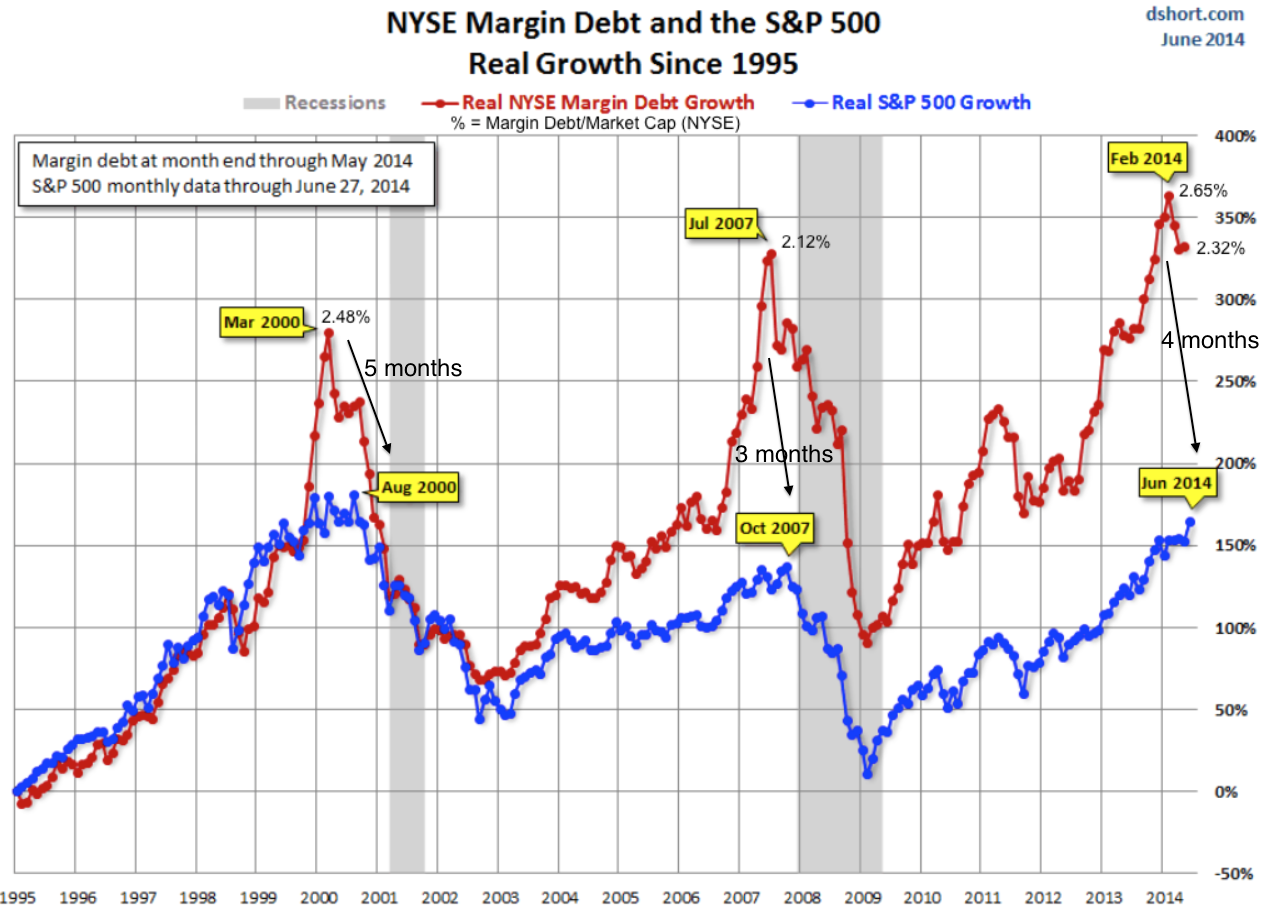
7. Margin debt already rolled over:

Screen Shot 2014-07-07 at 08.35.28

 Source: DShort / Fat-Pitch / my annotations

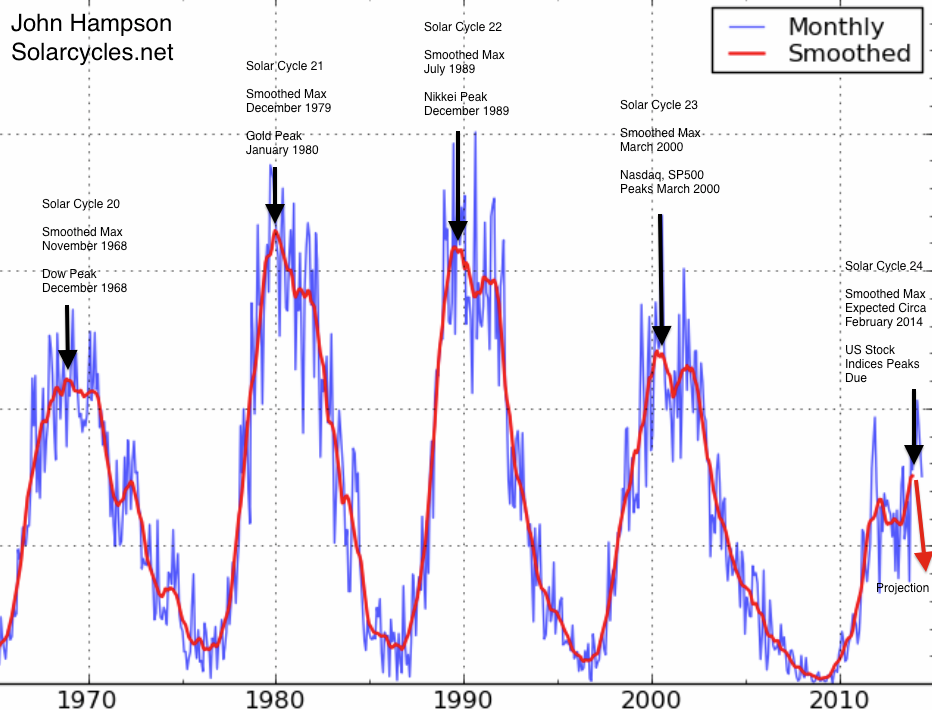
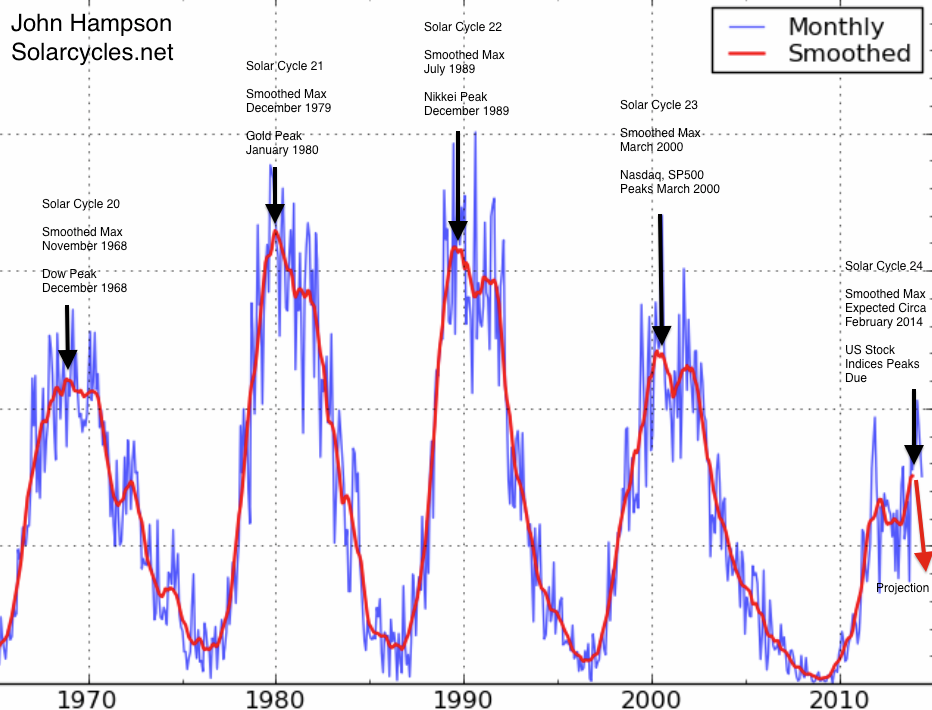
8. The solar maximum appears to be waning since a smoothed max of Feb/Mar 2014. In the modern era the biggest slack in smoothed maximum to market peak was the Nikkei 5 months after the smoothed solar maximum in 1989. June/July 2014 is 5 months after.

SolarCycleSpeculationPeaks 7ju10Source: Solen.info

 9. Asian indices appear to have already peaked:

7ju11Source: Stockcharts

10. European indices appear to have already peaked:

7ju12Source: Stockcharts 

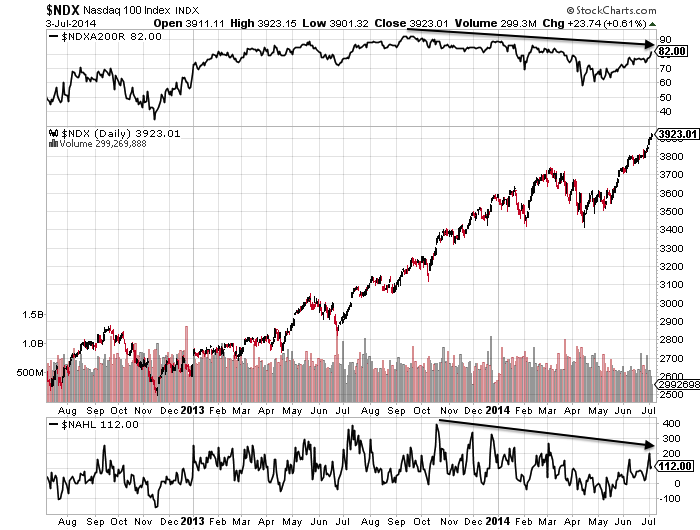
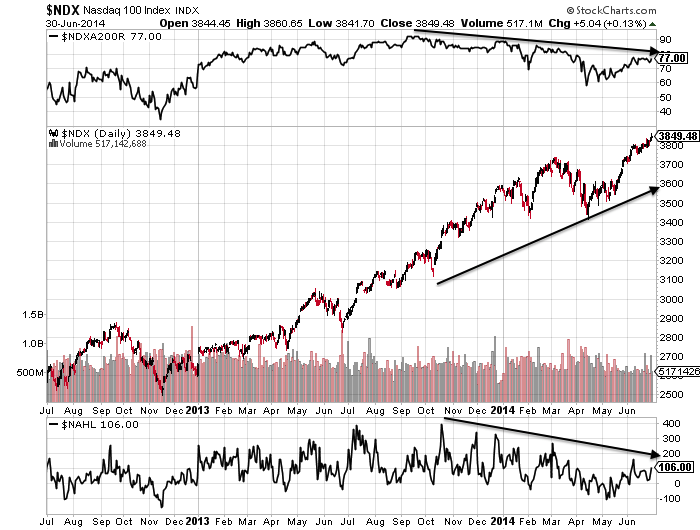
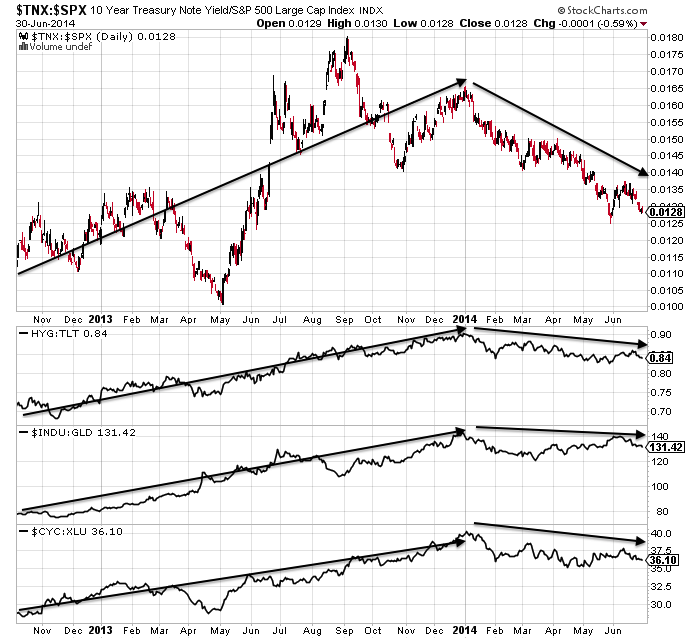
11. Which leaves US stock indices, which are ripe to fall under divergences:

7ju13 7ju14 13ju17 7jul15Source: Stockcharts

There’s a lot to negate here if the end isn’t close at hand. Let’s see how this week develops…

Burned By The Sun

The evidence for a speculation peak delivered at the solar maximum is better than I could have hoped, yet I’m on the wrong side of it and feeling the pain. When I look back at this post that I wrote January 13, the multi-angled case that I had for a top is still very much applicable. So why have equities gone up not down since?

Firstly, the solar max extended beyond scientists’ predictions from late 2013 to what looks like a smoothed peak circa Feb/March 2014. Not much I could do about that. Since then we have seen solar activity retreat, along with margin debt. Drawing on the history of both combined, we can account for stock indices rising into Feb/March but not since. Some retrace in equities was historically normal, but not these persistent higher highs.

Secondly, it would appear we needed more mania. When looking back at gold 1980, Nikkei 1989 and Nasdaq 2000, it’s clear that the manias were fairly intense. Therefore, the record-breaking stretching of indicators that we are seeing seems appropriate with hindsight. I wasn’t trading in 2000 to experience it. The question is when is it all going to snap? There is evidence of both capitulation and ‘all-in’ which suggest the snap should be close, but more melt-up could yet occur before it finally rolls over.

Thirdly, leading indicators, as measured by narrow money, suggested a pick-up in the economy as of May. As equities were able to range-trade until we reached that point, strengthening data has since given them a tailwind to rally further. Those leading indicators now suggest growth could peak out at the end of Q3. So could equities rally and melt upwards for weeks and months yet? A more detailed look is required, so here goes.

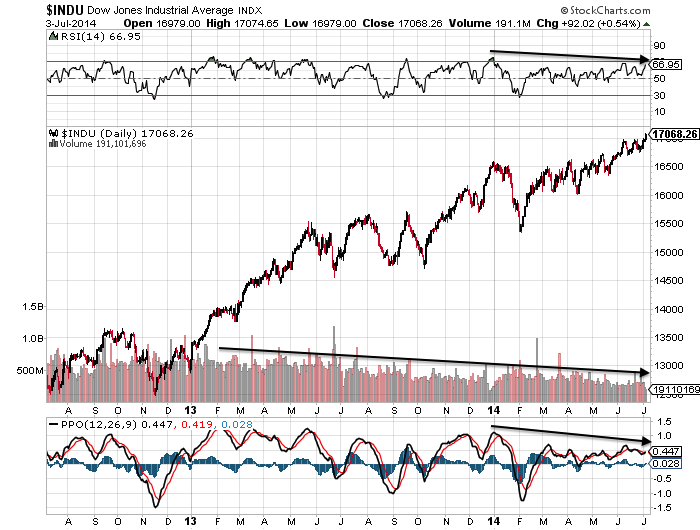
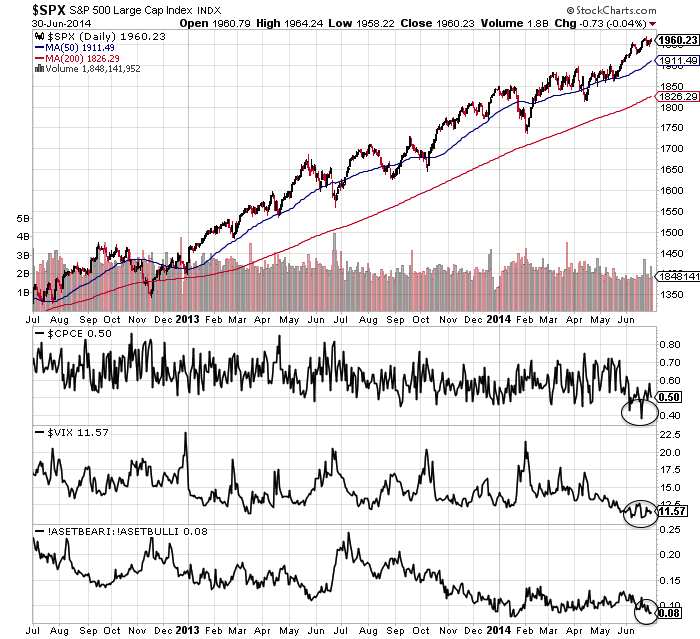
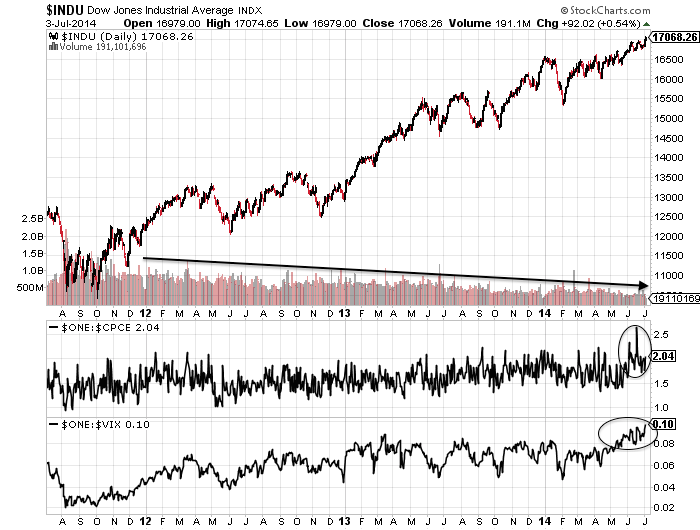
This is how the Dow looks. Volume has been ebbing away. Stocks can rally on thin volume, but those rallies don’t tend to stick. Volume is likely to return once it tips over. The action in the Vix and put/call ratio have an air of capitulation.
4jul11

 Source: Stockcharts

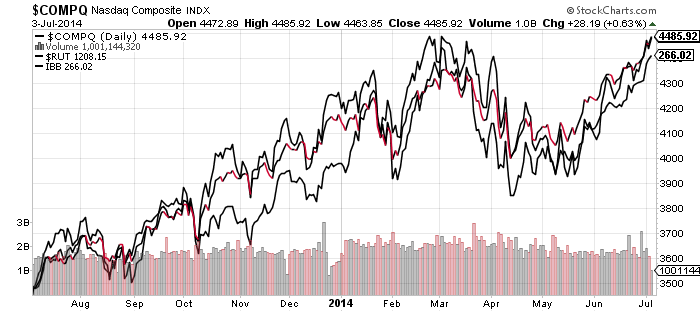
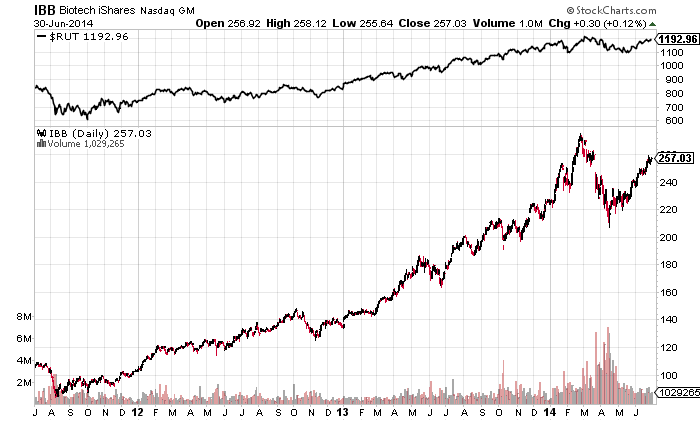
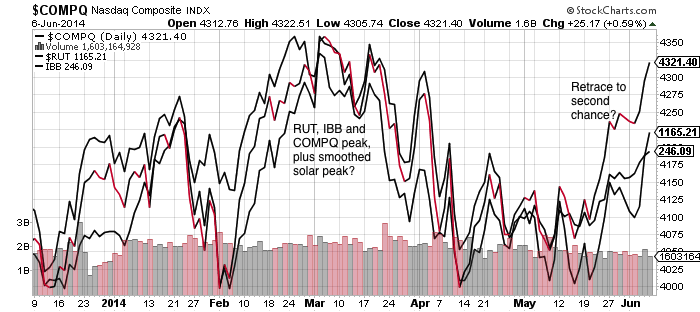
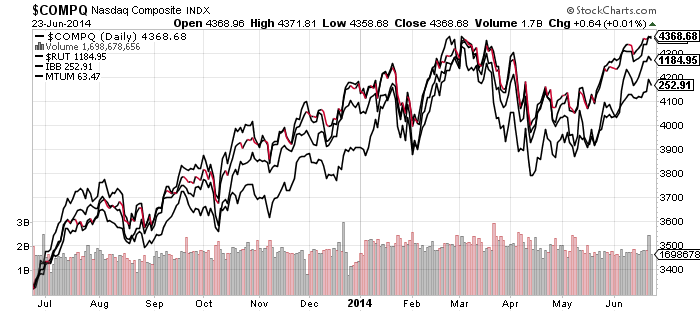
This is how RUT, COMPQ and IBB look:

4jul30

Source: Stockcharts

If equities were to roll over here, it would be more in keeping with developments in the solar max and margin debt.  The Feb/Mar peaks in RUT and IBB, two of the key speculative mania targets, would be maintained and this would fit with the likely smoothed solar max. Speculative peaks have aligned closely with the smoothed solar max in the era of global instant access, whilst certain indices peaked the same month as margin debt both in 2000 and 2007.
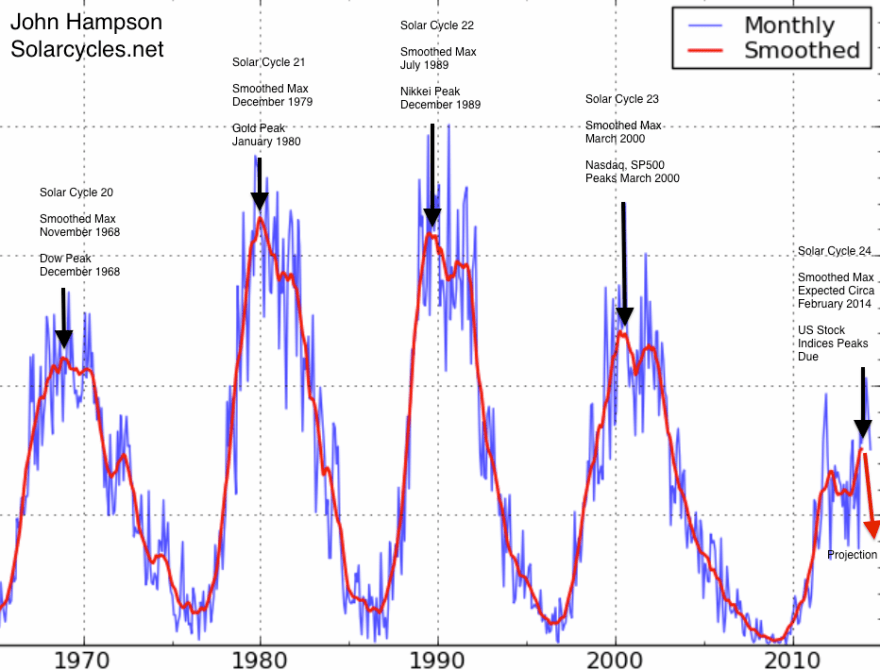
SolarCycleSpeculationPeaksIf, on the other hand, RUT and IBB break upwards and out in July and COMPQ puts some distance above its Feb/Mar peak, then it would be more anomalous. How do we account for stocks rising whilst leverage declines? Buybacks still strong, CLO leveraged loans still strong in Q2, thin volume rises, short covering? All applicable to some degree, but it’s still anomalous.

The way things stand, the best fit is still that we are in the vicinity of the last peak in a trio that began at the start of the year. That this is a final melt-up in large caps before the roll over. A trading range (primary distribution) before a final leg up was seen in 1929, 1987 and on the 1989 Nikkei. At the reverse end of the spectrum, 2009 saw a trading range before a final leg to the downside.

Screen Shot 2014-07-04 at 09.55.55 Screen Shot 2014-07-04 at 09.57.08

Screen Shot 2014-07-04 at 10.02.59

In all instances, the final overthrow leg lasted around 4 to 8 weeks. The current break out up leg on the SP500 is just entering that range. Averaging the price increases/decrease, we might expect the SP500 to reach over 2000 before rolling over. Earnings season starts next week, others have mentioned 15 July as relevant, and the seasonality of geomagnetism turns down definitively as of July. So maybe stocks can rally a few days more, reach over 2000, and then roll over against an earnings season backdrop.

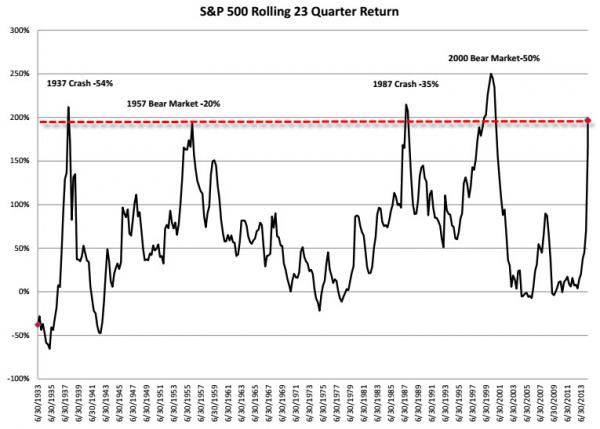
These six indicators are calling the market down with little scope for delay:
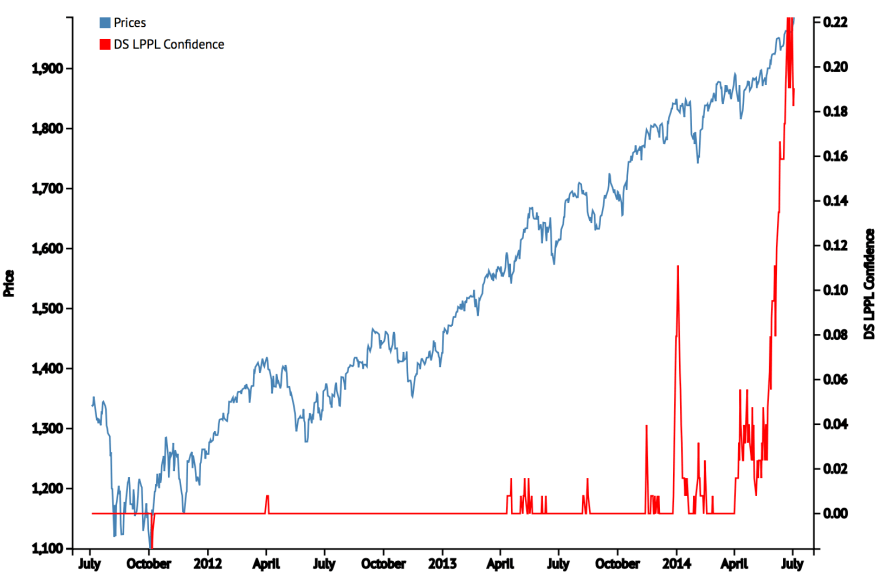
Screen Shot 2014-07-04 at 09.34.42

Source: FinancialCrisisObservatoryScreen Shot 2014-07-04 at 07.41.55

Source: Barrons4jul1

Source: Jack Damm / Stockcharts4jul20

Source: Stockcharts4jul10

Source: Stockcharts4jul16

Source: Sentimentrader

So I would be nervous about hedging with longs here, and won’t be doing that.

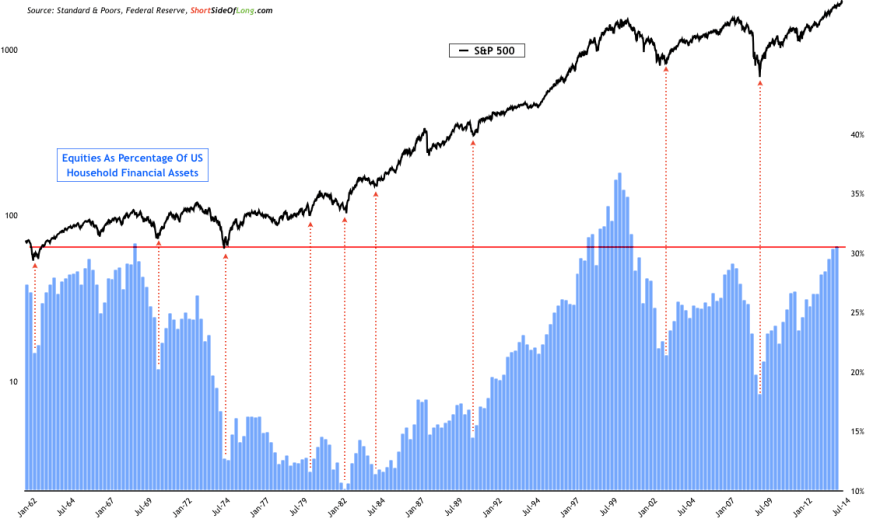
The next four charts show evidence of the mania.
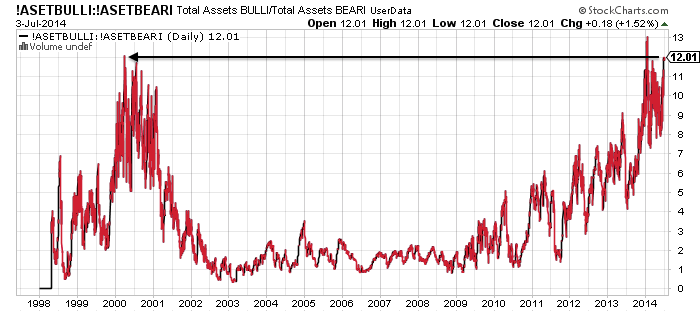
4jul15

Source: Stockcharts4jul24

Source: Charlie Bilello4jul19

Source: Dshort4jul2

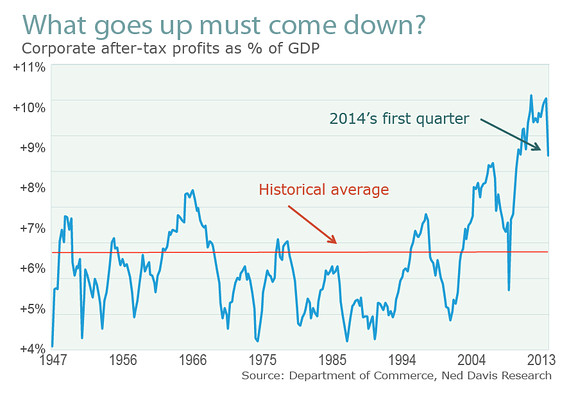
Turning to fundamentals, equities have front-run a return to normal: 10% earnings growth and 3% economic growth.

Economic data in 2014 has been overall reflective of mediocre growth. Barclays estimate for Q2 growth is 2.7%, add to Q1’s -2.9% and H1 is overall negative. Not on track for 3% annual growth. Data items such as the employment report or financial stress conditions appear superficially bullish, but reflect conditions just before previous market peaks.

4jul27

Source: Chris Puplava

Economic surprises are still negative for the US, but as stocks have largely ignored the bad items, I think it’s fair to say the perception is they have been largely positive.

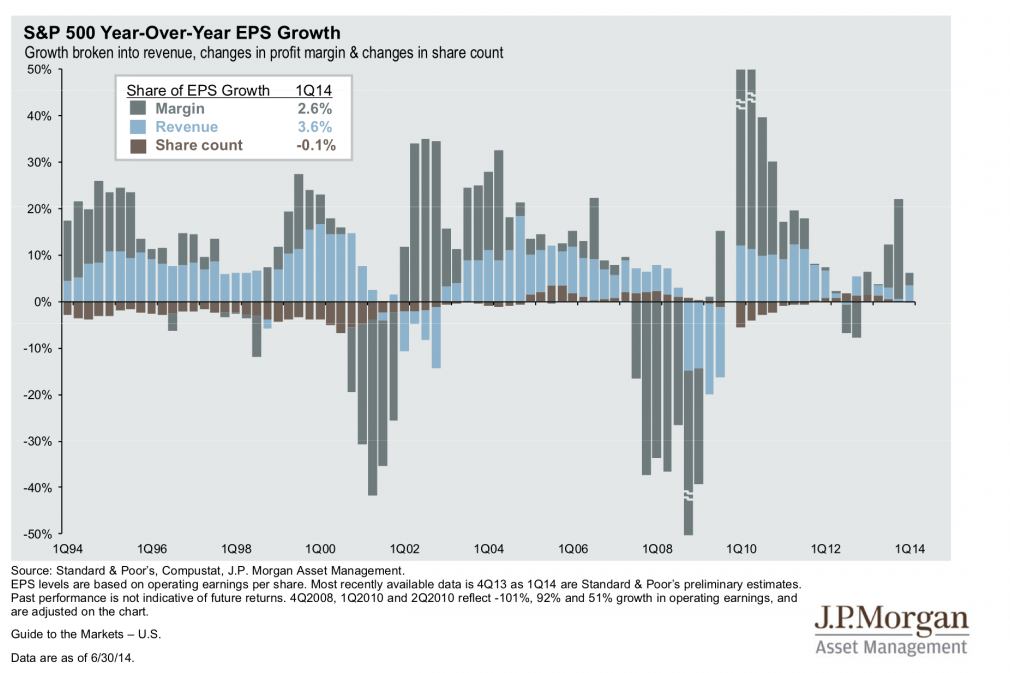
Earnings season begins again this week with 75% of companies having issued negative guidance pre-season. The theme of margin expansion not revenue growth continues to dominate into 2014:
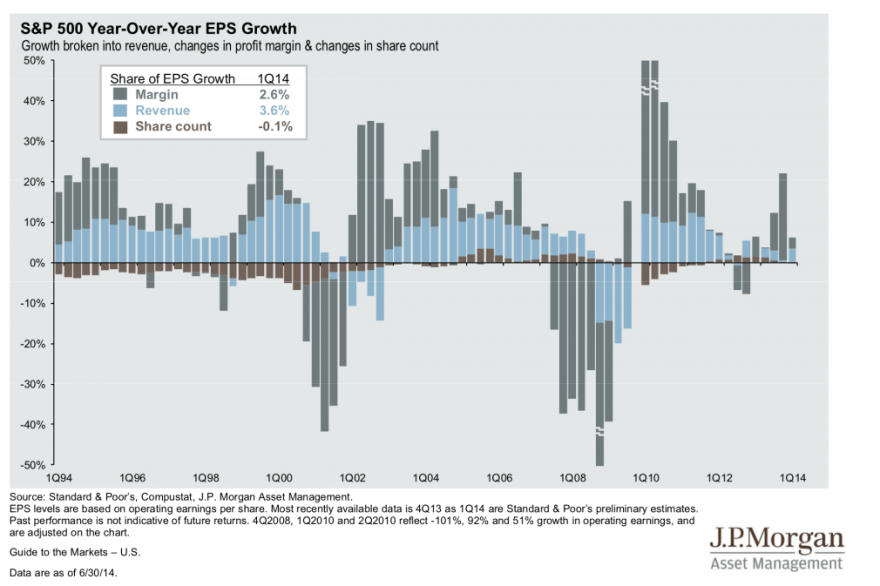
4jul5

 Source: Fat-Pitch

Continued disappointment in both the economy and earnings is likely given demographics and debt. So, in short, at some point equities will turn down as their front-running is proven to be just overvaluation, and earnings season presents a chance for that to materialise. A glance back up at the ‘mania’ charts shows that when equities do turn down, they will likely enter a devastating bear market. There has never been a gentle normalisation from such lofty valuations, euphoria, leverage and compound growth extremes.

Some final charts:
4jul25

Source: Marketwatch4jul7

Source: ShortSideOfLong4jul23

Source: Fat-Pitch4jul12

Source: ZeroHedge4jul17

Source: FinancialIceberg

That last chart shows very skewed positioning in crude oil, the message being that it may well tumble going forward. That would be consistent with a deflationary shock rather than an escalation of inflation. I maintain my caution on commodities, aside from precious metals.

Time to sum up. I’m short equities and underwater, feeling the pain. I expect some of you are too, and maybe annoyed for having ‘bought into’ my analysis. Personally, I can’t regret too much, as I don’t think my analysis has been particularly lacking. Rather I have consistently presented a cross-referenced, multi-angled case and the large part of that analysis remains applicable today, despite 6 months having passed since I was first convinced. My distinguishing research thread is the solar cycle, and I believe we are seeing firm proof that the solar maximum does inspire speculative peaks, in a real-time test, but equities now have to turn down, and into a bear market, within a short time of the solar max, before that can be truly confirmed. Frustratingly I’m on the wrong side of it currently, having been too early with shorting, as certain reliable indicators have been overrun by the mania-drive of the sun. Lesson learned. Now it is a practical matter of managing the drawdown. As noted further up, there are several indicators that suggest the turn ought to be close at hand so I do not want to hedge with longs. I have refrained from adding any more short whilst we see if the melt-up steepens further. I will stop some trades if things go crazier yet, and re-open once the market has more definitively turned. But I am not keen to do that as I believe the turn has to be close at hand.

I have two scenarios in mind. One is that the RUT, COMPQ and IBB have to turn down here to honour the Feb/Mar solar/leverage peak. That makes a top fairly pressing and would fit with those indicators calling for little delay. Next week is the descent into the full moon and the start of earnings season, so they could fit into the scenario. The SP500 could reach over 2000 within a couple of sessions to fulfil.

The second scenario is that the melt-up steepens and all indices break out. Positive economic data expected through the summer assists, and maybe the solar maximum has another big burst coming. The issue I have with this continues to be the ‘fuel’ for the rally, given that margin debt is declining, households are already highly exposed, volume is waning, sentiment and euphoria suggest bear capitulation, and various divergences are mature. None of these have stopped the rally yet, so I have to respect that it may still be possible. If all indices do break out then I’d be looking for an eventual top followed by a ‘second chance’ retrace before ultimate steep falls.

Three Peaks

By the end of 2013 we saw various divergences emerge that warned of a potential trend change ahead, and still do:

1jl1 1jl2The first major peak point occurred at the turn of the year, around the 2 Jan new moon and at the inverted seasonal geomagnetism peak (i.e twin optimism peaks), as these charts show:

1jl6 1j18There were inversions at this point in different assets and sectors, and the Nikkei peaked-to-date 31 Dec. Various risk-off, defensive and late cyclical assets and sectors have been the dominant money flow targets since then.

The second major peak was the central peak: where the solar maximum, margin debt and the speculative-targets of RUT, IBB and COMPQ likely made aligned tops, close to the 2 Mar new moon optimism peak:

1jl22

1jl10 1j12

The third peak, I believe, occurred at the end of June, close to the 27 June new moon optimism peak and the mid-year inverted geomagnetism seasonal peak (again, twin optimism peaks), to complete the topping process:

Screen Shot 2014-07-01 at 08.16.14 1jl9

Indicators showing the three peaks:

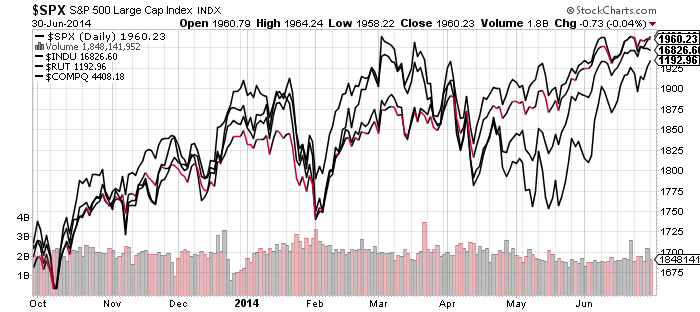
1jl15 1jl3 1jl5Screen Shot 2014-07-01 at 08.15.22The four main US indices aggregated also show the three peaks:

1jl20

And this echoes what happened in 2000, where there was a first peak around the turn of the year (real Dow, Nikkei and FTSE all peaked 31 Dec), a second central peak around March (hot sectors, margin debt and smoothed solar maximum), and a third and final peak around August:1jl19So could stocks then run higher yet and postpone the final peak until late summer or even further out? I can’t rule it out, and it is the main threat to my positions: greater drawdown before it swings definitively my way. However, the trend in leverage suggests further price gains from here are unlikely. The COMPQ is at a suitable double top, whilst the RUT and IBB should make lower highs here to honour the Feb/Mar central peak. Various indicators are stretched to levels that are suggestive of ‘all-in’ or imminent reversal. We have mature divergences seeking satisfaction and fundamental doubts through Q1 GDP, negative economic surprises and Q2 earnings warnings.

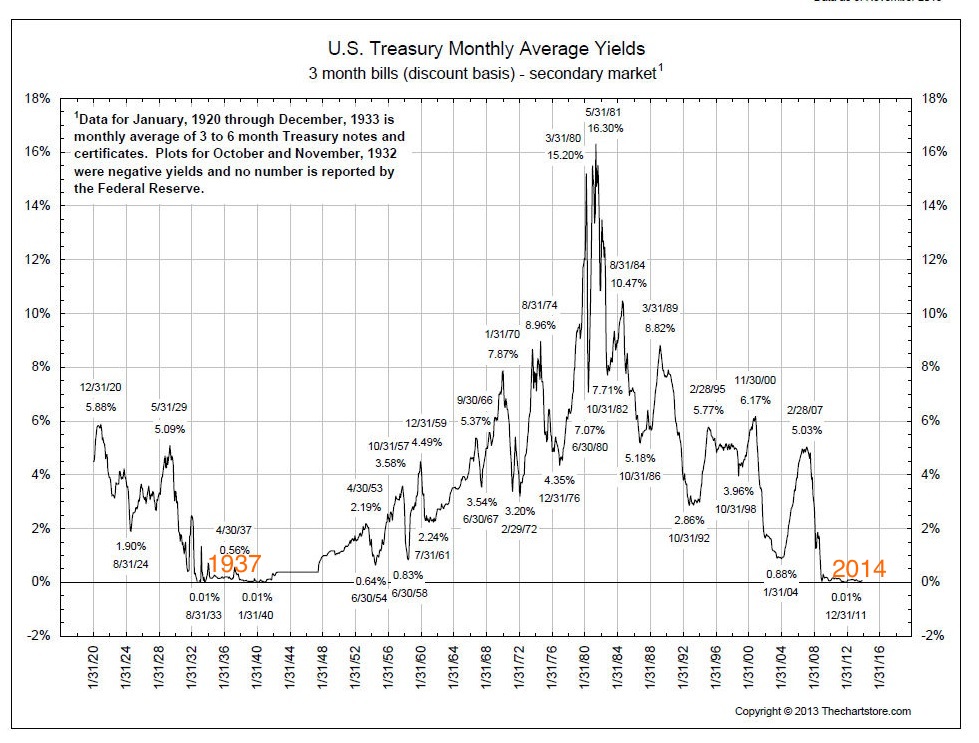
The bull case: low rates, benign leading indicators, cumulative-advance declines. But the rhyme with 1937 is still very applicable here in my view. Low rates and a/d breadth accompanied stocks to a high overvaluation peak, like today, front-running a return to normal growth and earnings that didn’t happen, and peaking out with the solar maximum. Q1 GDP has gone some way to puncturing that normalisation assumption again, adding to the other factors being in place. Earnings season could now add to that. Once stocks fall, the wealth effect from a rising equity market will evaporate, helping tip the fragile economy over, as it did in 1937.

As Things Stand

1. SP500: bulls still in charge, whilst put/call, vix and volume continue to warn of a likely pullback.

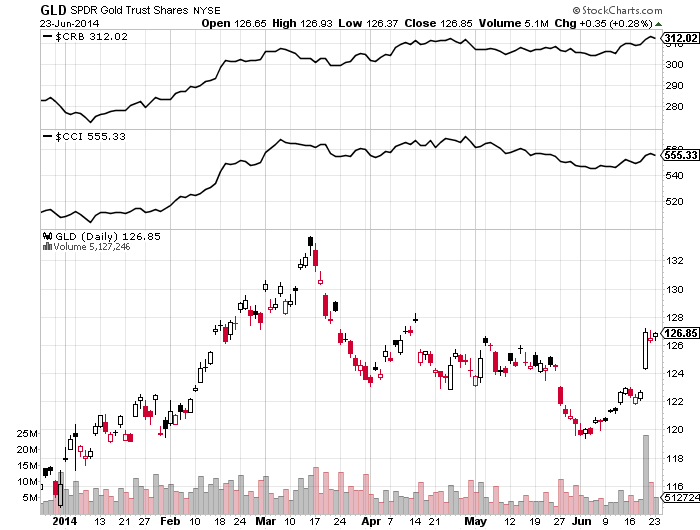
24ju62. The speculative-target sectors and indices are still able to print double tops or lower highs here, there has been no breakout as yet:24ju83. Gold, silver and miners got a burst higher last week. Needs follow through this week if not just a short covering rally.

24ju94. Skew has leapt back up to historic extremes:

24ju25. Buying climaxes surged last week:

24ju16. Bubble-end still flagging:

Screen Shot 2014-06-24 at 07.24.14

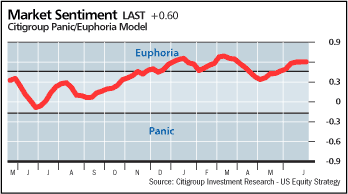
Plus, various sentiment measures still at high froth levels.

Sp500 is within touching distance of 2000, so maybe it can tag that before reversing. This Friday is the new moon, which is another potential top marker. Various indicators are repeating in June what they did in December-January, which was before the deepest pullback of the year, so maybe we finally see exhaustion here. I am holding my positions and watching and waiting.

Comparison to 1937

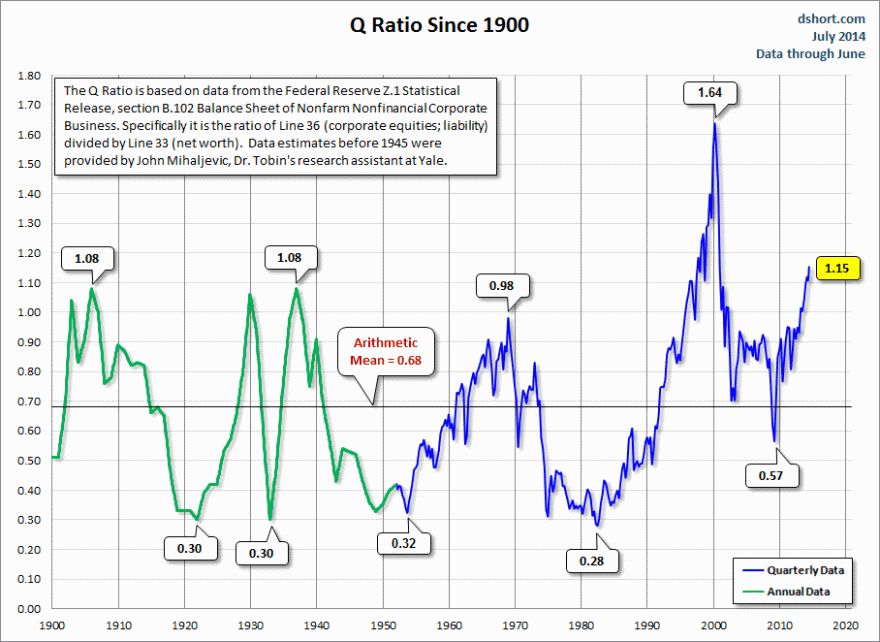
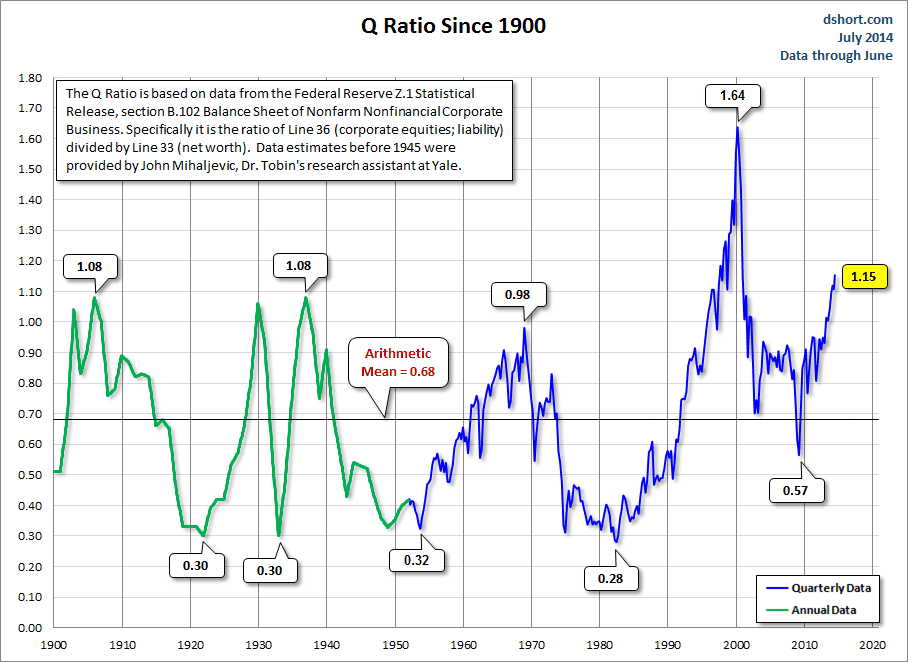
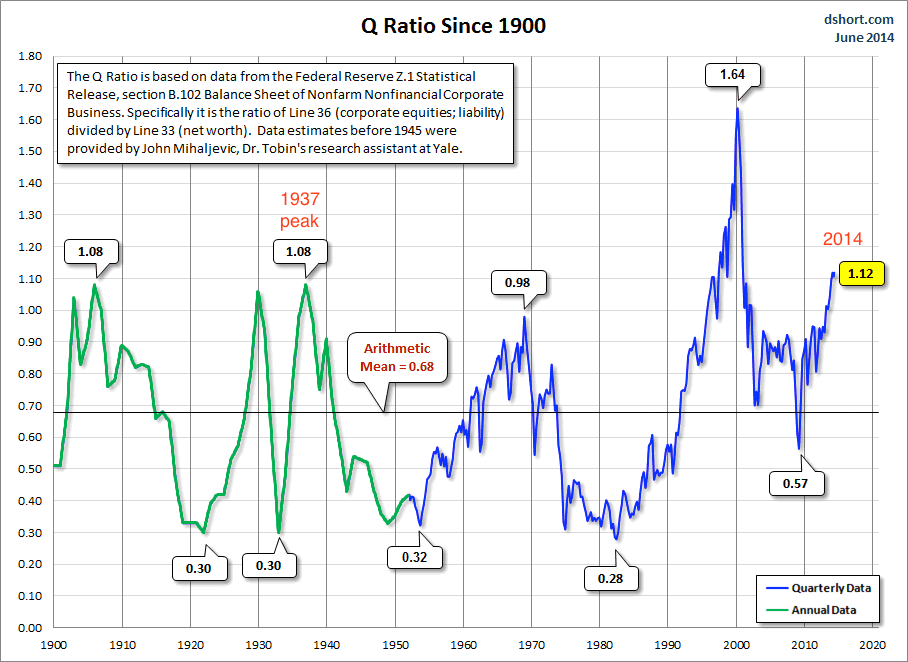
1937 was a solar maximum, like 2014, and notably the stock market peaked out despite negligible interest rates and with preceding QE, i.e. it was an atypical bull market end: easy conditions, no over-tightening. Stocks were run up on relatively thin volume and low participation to a Q-ratio valuation of over 1, in a 5 year rally. Stocks topped out 1 month away from the smoothed solar maximum without any notable trigger event. They had front-run a significant pick up in earnings and the economy that failed to materialise, and later in 1937 the US economy slipped into recession.

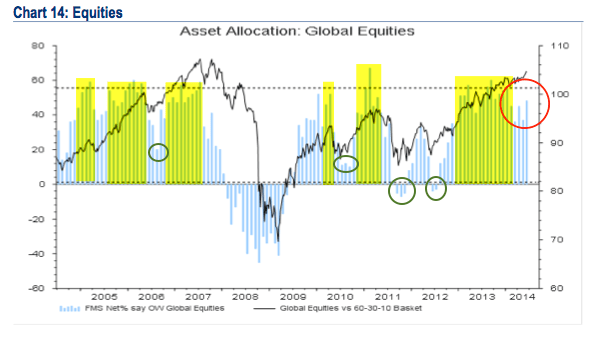
2014: we have had a 5 year rally since 2009, set against ZIRP and QE. Stocks have been run up on low participation to a Q ratio valuation of over 1, front-running a return to ‘normal’ earnings and economic growth that demographics suggest will remain elusive. In 1937 the thin volume allowed the market to rise easier, but then also to fall easier, and we have the same low volume now. Speculation should peak out close to the smoothed solar maximum, which looks most likely to have been around February. Unless the sun get busier yet, then we might expect stocks to be topping out. Evidence from sentiment, euphoria, divergences, leverage and asset allocations suggest this is indeed likely.

The weak economy and exuberant stock market are at risk of a deflationary shock, but failing that, realisation that 10% earnings growth and over 3% GDP growth are not going to happen again is bubbling under the surface. In other words, some surprise bad news could provide the requisite dent in confidence in equities, or stocks could roll over without a strong GDP print for Q2 (release 30th July) or an impressive Q2 earnings season (reporting starts 8th July).

1937 provides an example of stocks topping out on overvaluation despite easy money conditions. Other historic examples of equities front-running to over-valuation were also resolved by a bear market. Timing the top in 1937 came down to pinpointing the peak in the sun’s activity, and I believe this is the same challenge in 2014.

USDJIND1937cr9ju2Source: Stockcharts
9ju3Source: TheChartStore

9ju1Source: DShort

9ju5Source: ZeroHedge


Brief Weekend Update

Please excuse the brevity and standard of this post. Internet provision in Australia is behind the times (payable, slow, restricted or unavailable), and it appears this will continue for the remainder of my time in Australia and again in New Zealand. I am currently approaching the region around Melbourne.

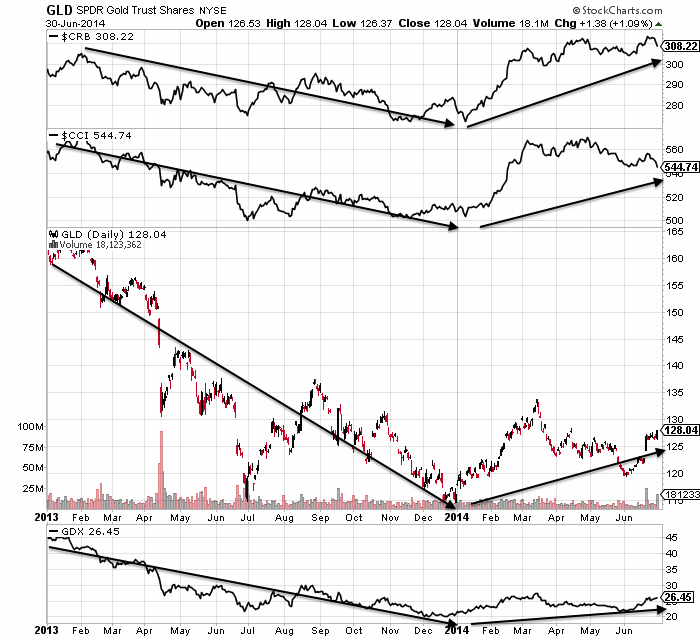
We’ve reached extreme bearishness levels in coffee, sugar, gold, silver and wheat, as well as oversold readings and what looks like a capitulation in both gold and miners. These are normally the circumstances in which I would buy, but I am happy with my exposure in commodities and as the alternative scenario remains in play (secular commodities peak passed) I do not wish to twist here. I am awaiting more evidence in support of the primary scenario (secular commodities peak ahead within the next 12 months), which would include evidence of another extreme hot year developing globally (January data not in yet), evidence of sunspots still climbing towards their peak (currently a quiet sun), and technical breakouts with momentum in the laggard commodities. Oil and copper have been involved in the pro-risk rally, which I believe is a good sign, particularly as oil correlates normally well with both agri (key input in production) and gold (inflation hedge).

US equities remain resilient but I maintain the overall picture for equities, as represented by the MSCI World Index, is that a consolidation began at the turn of February. My short treasuries position made some progress in line with the pro-risk rally but also looks to be digesting a little.

The latest leading indicators from the Conference Board showed a move into the positive for Japan, another +0.1 reading for the UK and flat for Korea. The latest ECRI leading indicators reading for the US showed a small pullback but still strong positive. The OECD leading indicators for all the OECD countries showed the healthiest picture for some time. The overall picture remains supportive for pro-risk.

We are in a down pressure period until the full moon around the 25th February. On the flip side, geomagnetism remains tame.

So I watch and wait. Equities have stretched to the upside, agri and precious metal commodities have stretched to the downside. A switch in performance ought now to follow, with bearishness extremes in the latter providing the fuel. Gold is certainly testing patience, but there is a historical pattern of assets pre-secular parabolic finale doing their best to shake out weak hands before the final upleg, plus on a secular view (since 2000) it can be seen that gold has been consolidating near its highs over the last 18 months, which is not a typical secular bull ending pattern. Nonetheless, the case I made for the ‘alternative scenario’ (secular commodities peak passed) remains potentially valid for now (though I rate it lower probability), so I await developments to shore up the one or the other scenario.

Monday Morning Update

I’ve been toying with selling a little more from my stock indices positions over the weekend. By both overbought and overbullish measures, stock indices as a whole are frothy. Furthermore, we saw a potential lunar cycle inversion, with stocks ultimately rising into Saturday’s full moon. Combined with the previously noted 5-model alignment for a January swing top and economic surprises having possibly topped out, I have a case here for stocks now reversing. However, Friday produced a bullish breakout in the Dax, treasury yields and Euro-USD, which would need really to be reversed today/tomorrow if the weekend was to mark a swing top. Furthermore, leading indicators are still overall supportive for pro-risk (ECRI US rose again, as did CB US leading indicators, and Markit PMI readings for US, Europe and China all rose), and narrow leading money points to economic strength into Spring. As I have previously stated, I do not believe this is the cyclical stocks bull top, but that a pullback then a push on to a higher high on weakened internals and negative divergences is needed, likely by mid-year.

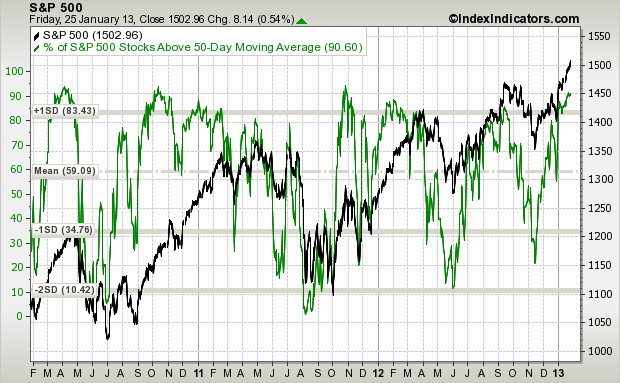
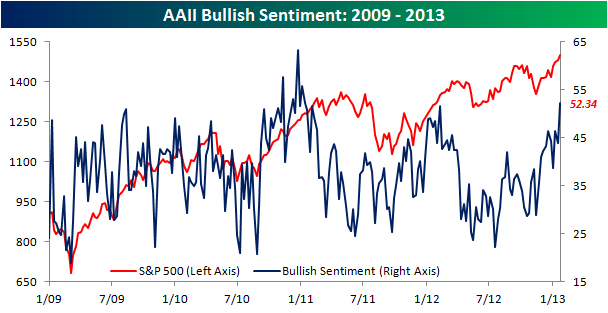
Some charts to demonstrate. Here we see two overbought and overbullish indicators for US stocks:
28jan20131

Source: Index Indicators

28jan20132Source: Bespoke

The excesses are clear and I suggest the rally is on borrowed time. However, note in both cases that the two indicators for previous swing tops first oscillated and rounded out in the extreme zone before stocks topped. I therefore wonder whether stocks will continue to rally for a further 2 weeks in the new moon, or whether they might even continue through to March/Spring, with some back and forth en-route. I don’t know.

If we draw in the FTSE, it is on an unsustainable trajectory, and the Shanghai Composite appears to be rolling over for a consolidation ahead. Plus the Nikkei tried to break out at the end of last week but remains within the zone of a continued potential rounded top.

Chris Puplava suggests stocks and major economy economic surprises should top out by Spring, using oil prices as a lead indicator.
28jan20133Source: PFS Group

Based on stock market history I have previous predicted a price overthrow to end the cyclical stocks bull. Here is the SP500 chart and the overthrow in 2007 above the cyclical bull resistance line can be seen. In the current cyclical bull we are at such a resistance and I am suggesting an overthrow beyond it is likely to complete the bull.

28jan20134However, of course that resistance is another reason why stocks could take a breather now before making such action. If the overthrow occurs, then Laslo Birinyi’s work models it at around 1600, and Will Preston gets 1580. That would make a marginal secular nominal high for the SP500 secular stocks bear and there is some allure in that to fooling investors once again that we are in a new long term bull market before a cyclical bear actually occurs. It’s a target clearly within reach now either in a continued advance to Spring, or a pullback here and then a final high around June time.

OK, I decided to stay put with my positions and not make any sale this morning. I see good reasons for a pullback here with the dual-frothiness but also reasons to push a little higher yet. We may have made a lunar inversion top at the weekend, or we may squeeze out further gains into mid-Feb. I don’t see the cyclical bull top here so I’ll take my chances and if we see a swing top here I expect stocks to come again into mid-year.

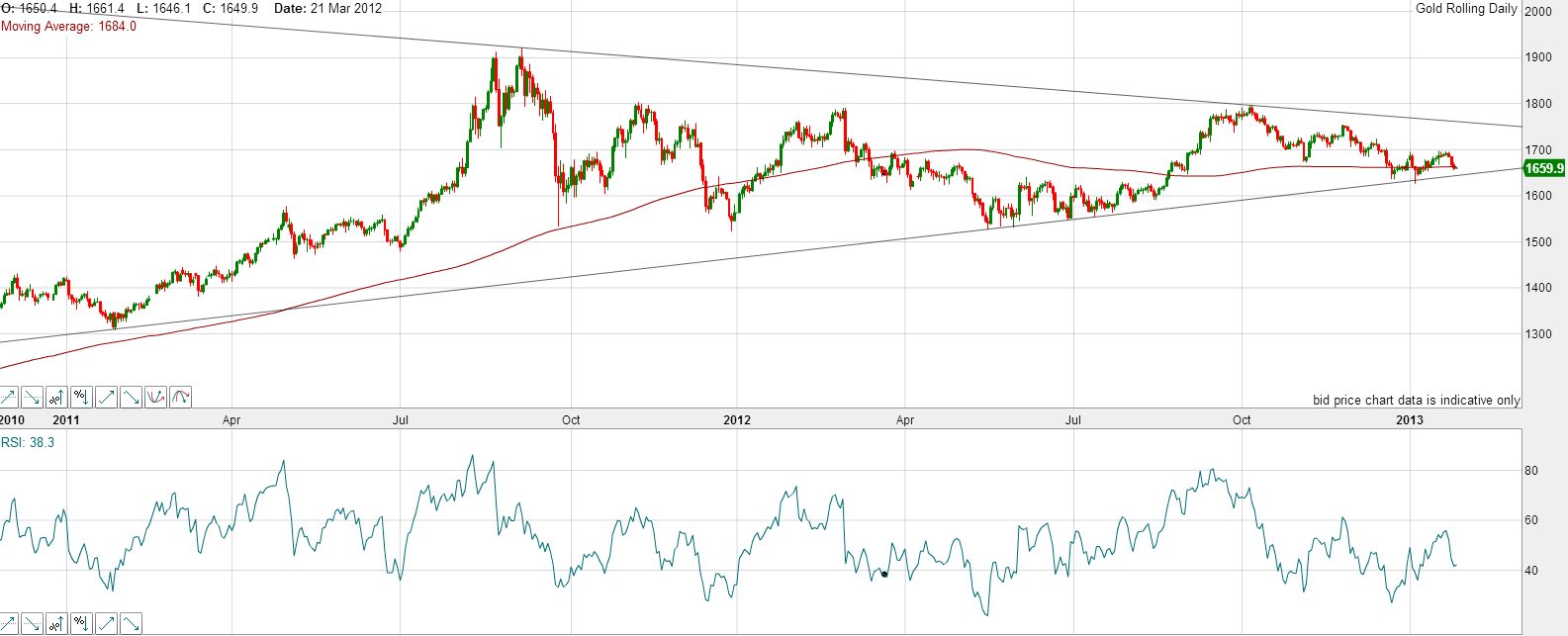
Precious metals and miners continue to be depressed, though there remains evidence for a base in both (oversold, overbearish). The gold chart below shows a large triangle, and it’s important for gold not to lose the lower trend line.

28jan20135I believe this is all part of the last wash out of weak hands before the secular finale, in a patience-testing coil. To aid gold’s case, a pick up in inflation would put real interest rates further negative. As oil has made a decent up move recently, we could be at the start of such a process. But we still need that momentum move into wider commodities, and for commodities to start to outperform equities, for an acceleration in inflation and a scamper to hedge in precious metals.

I will respond to comments and emails over the next few days. Currently in Yala, Sri Lanka, but moving to a resort for a few days on the south coast.

Macro Update

The latest Conference Board leading indicator updates were Japan at -0.2 (improvement on last month), UK at +0.2 (improvement), Korea at +0.2 (drop back). Other country updates ahead this next 7 days.

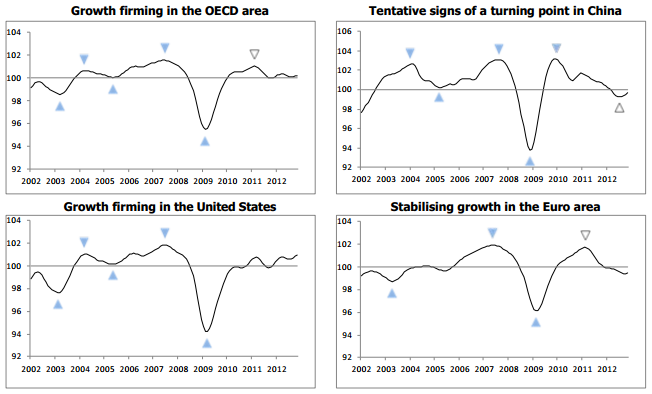
The latest OECD leading indicators show all round improvement, summary here:

17jan20131Source: OECD

Fidelity’s recession risk scorecard for the key economies show a mixed picture:

17jan20132Source: Fidelity

ECRI’s US leading indicators remain in an uptrend and positive:

17jan20133Source: Dshort/ECRI

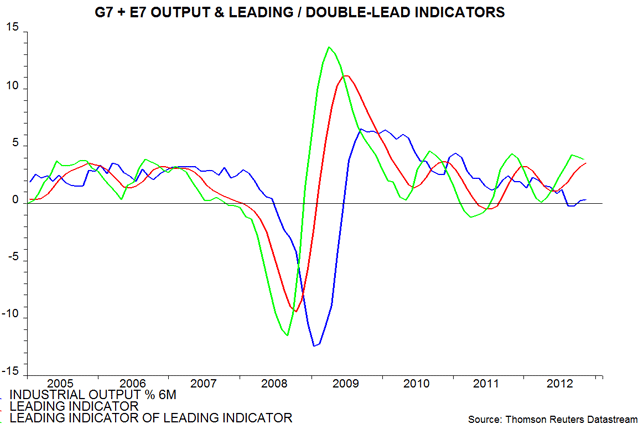
Global narrow money as a leading indicator continues to show growth into the Spring but thereafter it could weaken:

17jan20134Source: MoneyMovesMarkets / Thomson Reuters

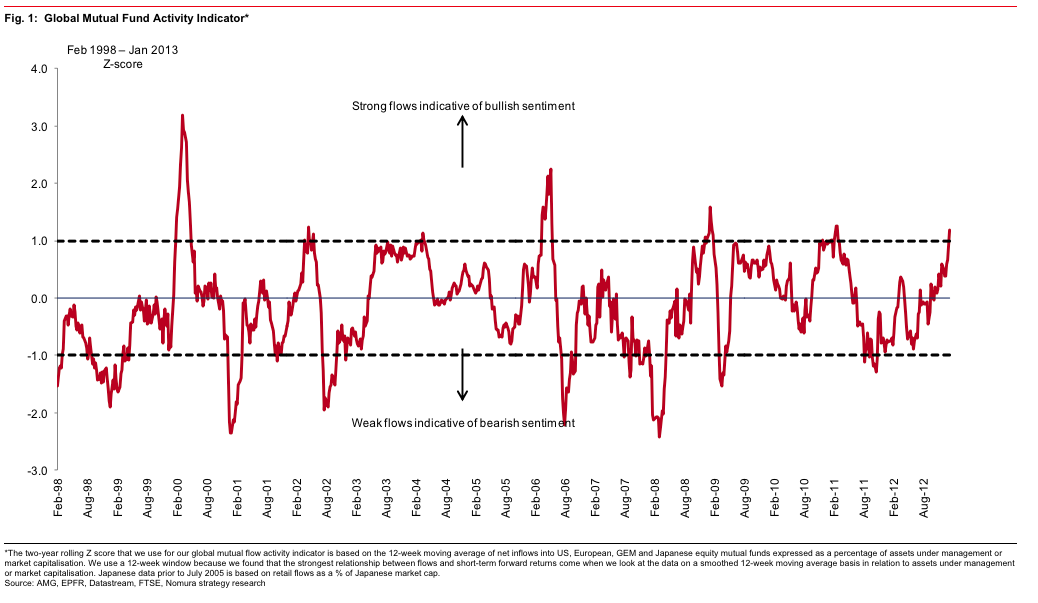
Global equity fund flows show too much frothiness in shares currently:

17jan20135Source: Humble Student / Nomura

Note that in March 2000, such excesses pinpointed the cyclical/secular top for stocks, whereas in 2007 it did not highlight a cyclical top. As we do not see a congregation of other cyclical stocks topping indicators at this point, I believe this is a warning flag rather than a sell-all signal.

Economic Surprises look like this for the USA and Europe respectively:

17jan20136Source: Ed Yardeni

17jan20137Source: Alphaalcove / Bloomberg

Europe surprises (white line above) are finally moving into the positive, whilst US surprises are dropping fast.

Lastly, US earnings came in at a 65% beat rate for the first week, but we need to await more to be confident of a theme.

If I draw together all the above data, the picture is one of weak global growth ahead into the Spring, with mixed fortunes and rotating leadership. The differences between major countries and between leading and surprises continue to suggest a picture that needs watching closely. I suggest there is slim chance of a global recession right now, but will be looking for evidence of countries uniting in weakness ahead to bolster that likelihood. On the flip side, I will be looking for a more united picture of improving fortunes across the globe ahead to provide evidence that we can push for the growthflationary finale into the solar peak that my solar/secular research predicts.

One more chart to finish. NOAA’s global climate report revealed that 2012 was in the top hottest years globally on record. But within that it was the hottest year on record where La Nina occurred (which has a cooling effect). The chart of the last 60 years looks like this:

17jan20138Source: NOAA

The question is whether the cluster of bars over the last 10 years is a topping pattern or whether the uptrend is still in tact and 2013 potentially becomes a new record hottest year without La Nina around and a possible weak El Nino in play. Were the latter to occur that would help deliver an acceleration in soft commodities.

I have updated all models this morning. Geomagnetism is forecast to continue to be tame the next 3 weeks, which is supportive for pro-risk; and the recent higher daily sunspots counts add weight to the likelihood that the sunspot peak remains ahead and that excitement in humans should accordingly build.