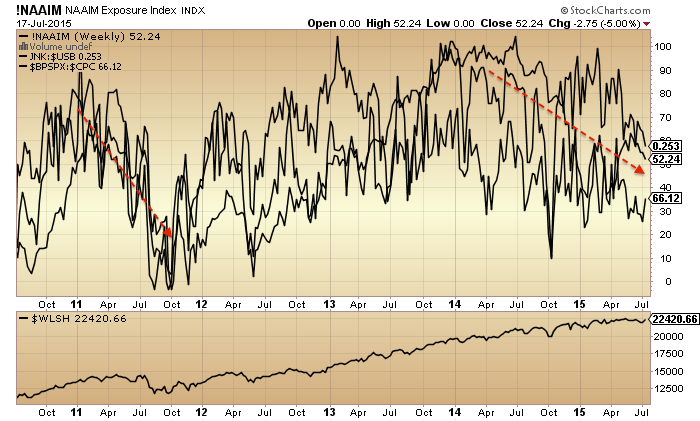
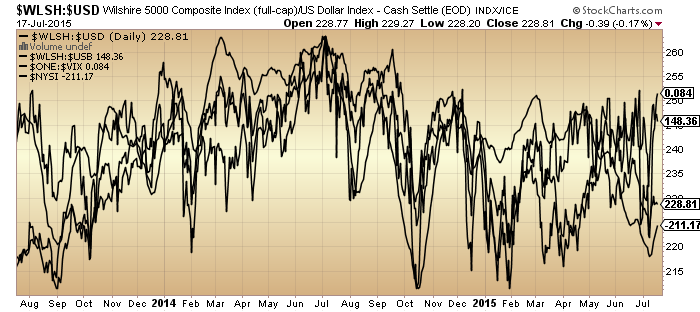
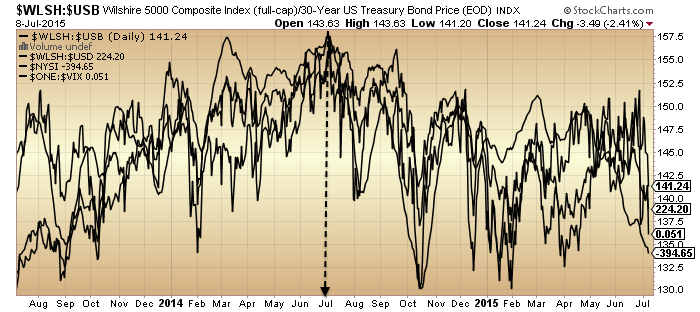
Update

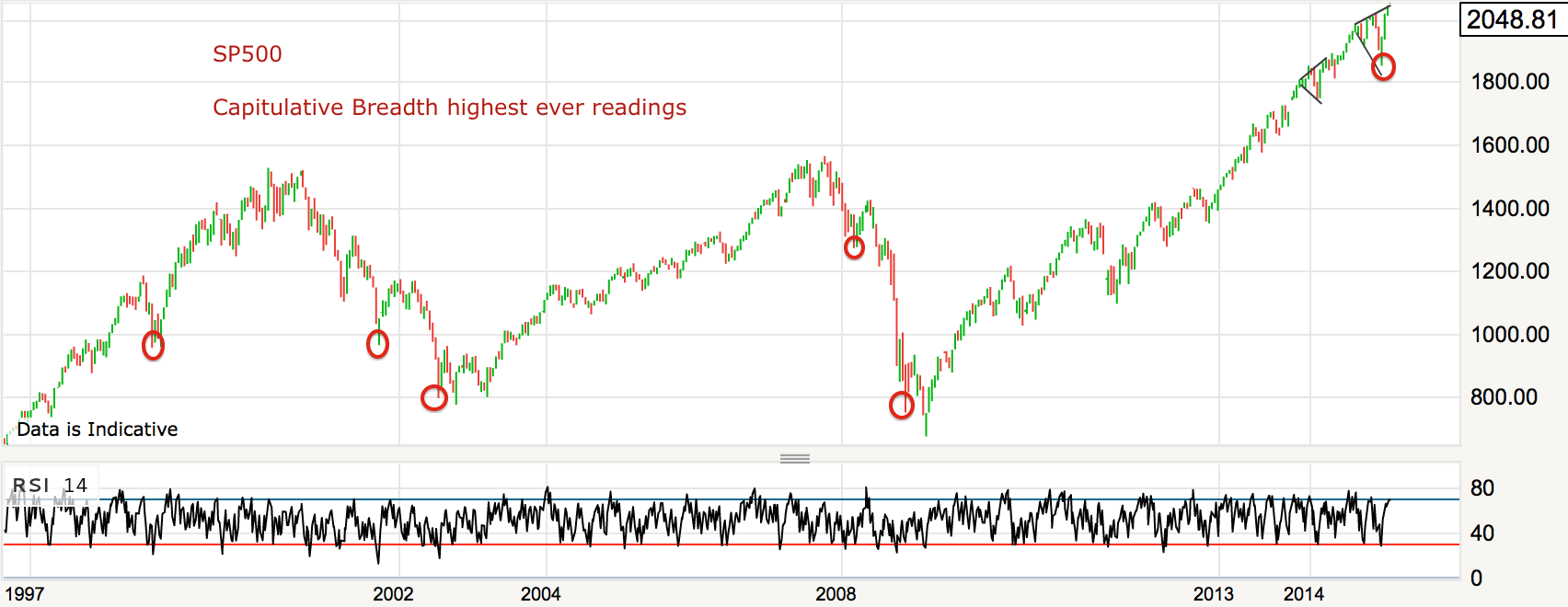
Capitulative breadth now down to 6 on the rally in stocks, but still suggestive of some more upside for equities to properly neutralise it.

31juli40

Source: Rob Hannah

Today is the full moon, and lunar phasing for 2015 looks like this:

31juli1

Not all have been compelling turns but nonetheless shorting each new moon and going long on each full moon would so far have made a profit every time this year. Historically, lunar phasing has worked better in periods of sideways chop like this. Based purely on the moon, we could expect stocks to peak out again in mid-August. But at some point this price range will break one way or the other.

As you know there have been many technical indicators for a bull market peak, suggesting that price range to be a topping process. Here are two more from Dana Lyons:
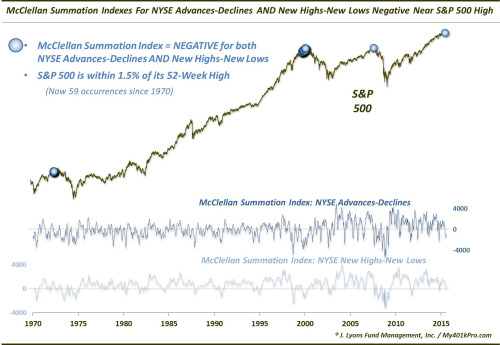
31juli13 31juli10Source: Dana Lyons

Valuations are crazy high:

31juli50

And US small caps are the most expensive they’ve ever been.

31juli2


Source: Meb Faber

But whilst stocks continue to levitate the key question remains whether excesses in valuations, sentiment, allocations and leverage need to be reassessed in the context of ZIRP and QE, and don’t pose the same threat as typically historically. That analysis is further complicated by not having experienced this combination of negligible rates, low inflation, low growth and high debt for over half a century.

However, the reason for ZIRP and QE is that the world economy has been in serious trouble since 2008, with demographic trends in the major nations all having turned negative. Below we can see the break in the long term trends of US growth and employment and how they remain broken:
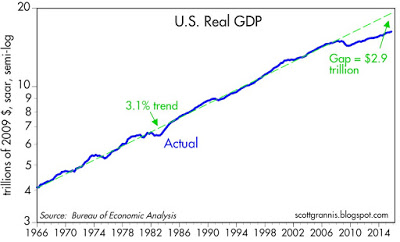
31juli11 31juli12


Source: Scott Grannis

So, either (1) the stock market is majorly divorced from reality and reverting to mean soon, or (2) the economy finally picks up from here and catches up with stocks having led, or (3) this is a new norm skewed by central banks whereby current indicators of a top that resemble 2007, 2000 and others no longer apply. You know where I stand on this question, but the sideways price range of 2015 has yet to validate or invalidate any of the options.

Leading indicators still largely point to a pick up now and towards the end of 2015.

Screen Shot 2015-07-31 at 08.31.10

Source: Variant Perception

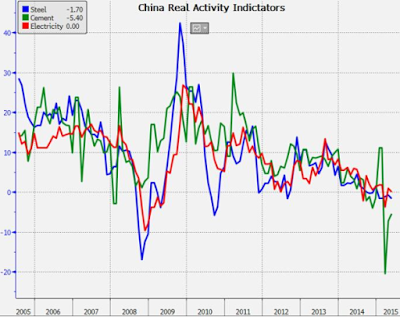
Whereas China looks to be in trouble.
31juli4

Source: Cam Hui

31juli60

Source: CNN

Biotech is also wobbling currently, testing the bottom of the parabolic. So are these the last gasps of a topping process? Or is the price range of 2015 in broad equities the pause that refreshes the bull? We saw some evidence of reset by the end of last week: AAII sentiment, bullish percent, capitulative breadth, put-call all suggestive of a significant low. However, in the bigger picture historically, these look like a low in a bear market, i.e. from which a counter rally erupts before lower lows ahead. What’s confusing is their occurrence just 5% from the highs in nominal terms.

Right now I expect stocks can move higher before they move lower again. So I am waiting and watching for evidence they are rolling over again. The key is whether they do so before they reach the July highs and then the May highs. At the same time I am looking for a lower low in gold and miners on positive divergence.

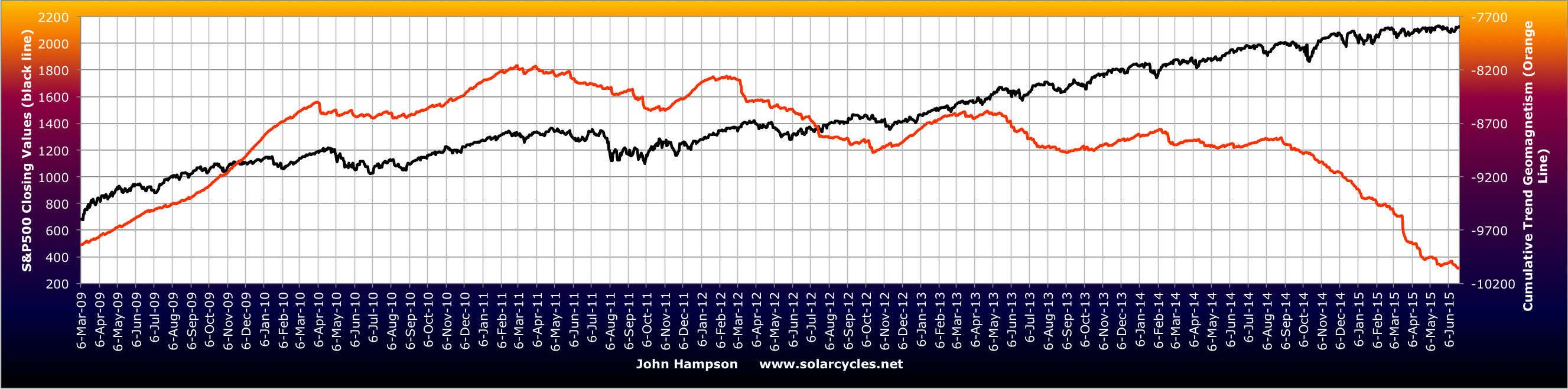
We still have a host of indicators pointing to an underlying peak around the solar maximum of last year:

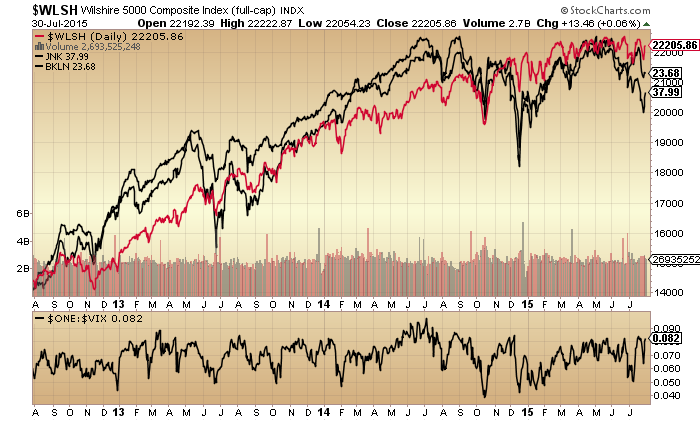
31juli20 31juli22 31juli30That June/July 2014 peak remains in play unless we see those indicators reverse and reset. 12 months later they still haven’t. So I remain of the opinion that equities will ultimately break downwards. It’s just a matter of gauging the shorter term waves. On which note I have to prudently add that I can’t rule out a final move up to new highs before a collapse. It happened in 1987 and 1929. A range trade over the first half of the year and then a final rally to a peak in Aug or Sept:

31juli70 31juli90

Source: Financial-Spread-Betting

That extreme reading in capitulative breadth may support this occurring, so have to stay open minded. Hence the importance of watching indicators and price for evidence of a roll over before the July highs, then the May highs.


Bounce

A bounce looks likely here, and a significant one at that.

Capitulative breadth (Rob Hannah) hit 20 yesterday, which is extreme. See other extreme readings here:

28juli1

In the past, they typically occurred after major falls, but October last year and now have been more shallow. The Dow fell yesterday to just 3% off its July peak or 5% off its May peak. Capitulative breadth is made up of a count of large cap stocks in the index showing capitulative selling. Quite why this has occurred after only shallow nominal price falls is unclear.

Also, bullish percent (SPX) reached a level suggestive of a low.

28juli2Source: Urban Camel

Plus, CPC on Friday hit an extreme also only seen at previous lows, and the recent little cluster of such readings further points to a significant bounce.

28juli3Source: Stockcharts

Draw it all together and it looks like the Dow (and other indices) is going to get a decent bounce here at long term rising support.

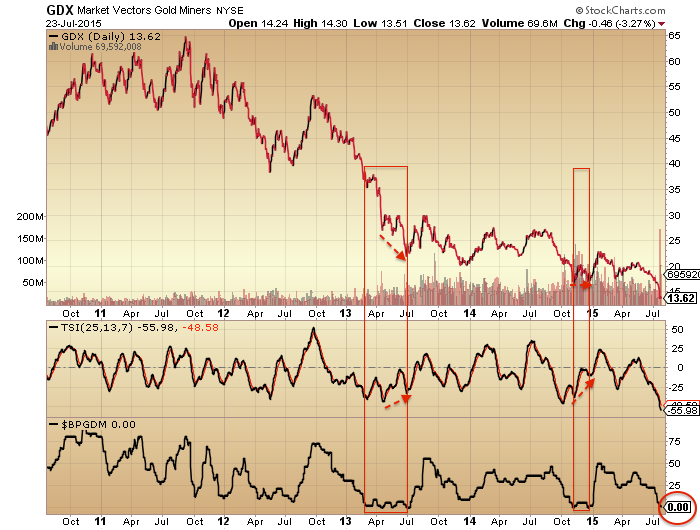
Screen Shot 2015-07-28 at 06.56.05On the flip side of the equation, gold miners bullish percent hit zero again, like the boxes in the past shown:

24juli1But note the norm in the past was for a lower low on positive divergence before a true bounce.

Therefore, it appears likely we will see a rally back upwards in broad stocks imminently whilst gold miners go on to form a lower low on positive divergence. The bigger picture of a major top in equities and a major bottom in gold remains unchanged.


No Change

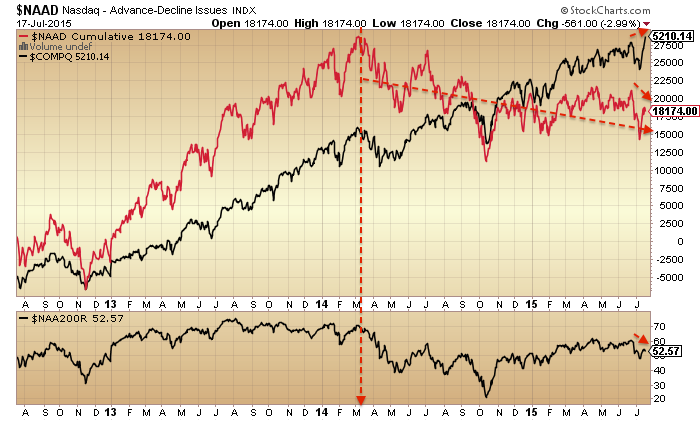
The underlying picture still looks the same. Stocks have rallied back up but there are so many persistent divergences that aren’t supportive. Here breadth, strength and bullish percent all look like the last gasps in 2011.

17juli1The Nasdaq has outperformed the other indices to make new highs with the rally back up, but breadth is flagging a clear warning.

19juli1

Really, there are so many divergent indicators on US stocks it’s take your pick.

19juli4

19juli5

Meanwhile, gold dropped again but the picture is the reverse, with sentiment and positioning at contrarian levels suggestive of a bottom.

19juli7

Source: Sentimentrader / King World

Therefore, not much expansion needed. We are through the new moon and moving beyond the seasonal geomagnetic peak, and all the indicators are calling time (namely, major reversals in both classes). So just watching for the turn again to resume the attack and that should be the final move.


Topping Process

Some big moves in commodities, China stocks, Japan, and a change in character in US equities whereby nothing is currently working for the bulls. It begs the question where we are in the topping process, specifically is the market going to fall apart from here, or do we yet get another rally back up to a lower high.

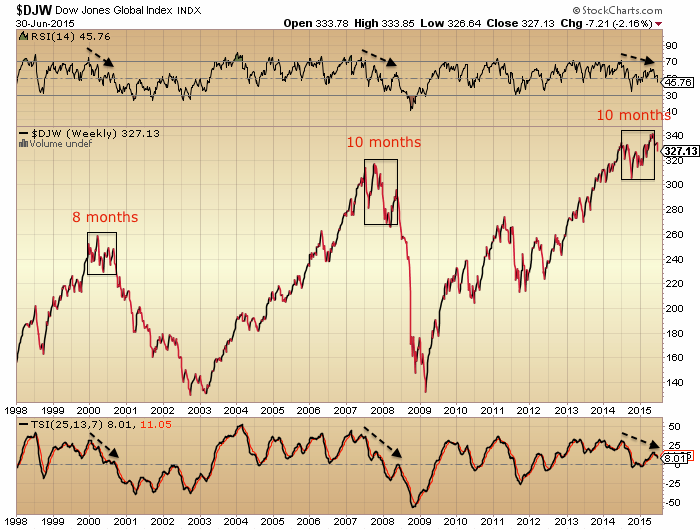
Dow Jones World looks like this:

9juli2Source: Stockcharts

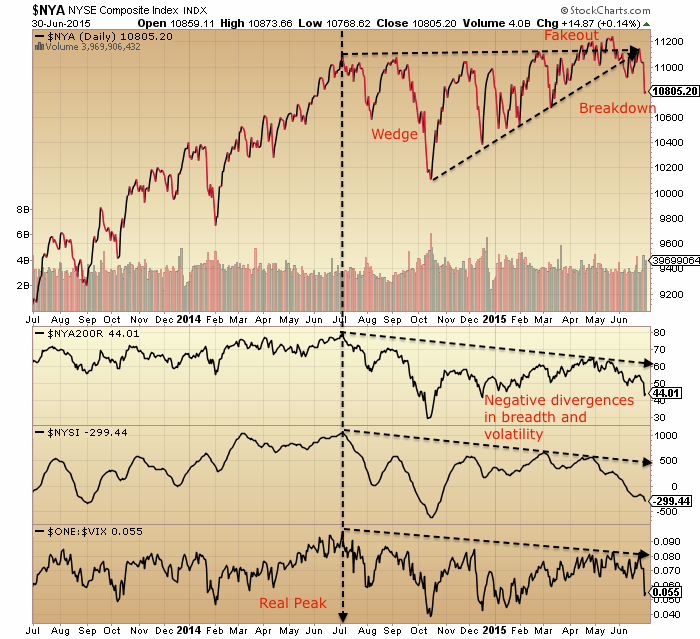
Like other recent major peaks, it shows a topping price pattern with negative divergences on the second higher high. We can pinpoint the first peak in the topping process as June/July last year:

9juli3

Junk bonds, oil and financial conditions all peaked out then too. The second peak in nominal equities was May 2015, making for a 10 month topping process. That’s not dissimilar in duration to 2000 and 2007.

If we look at near term clues, the triple confluence of spikes in CPCE, Trin and Vix:Vxv to current levels (specifically all three together) hasn’t been seen since the breakdown in 2011.

9juli1Their spiking could represent a near term low for equities, from which they get a decent bounce now. Or, they could represent the first stage of a large fear move, like in 2011. Right now the SP500 is just 4% off its high, whilst in 2011 it made a 19% correction.

If we look at the bigger picture, all major indices around the world are now off their highs, most topping out in May or June. Is this about news out of Greece and China? They are providing a narrative for short term buffeting, but we can see equities have been in a typical topping process for a year. The under the hood peak was around last year’s solar max, as it was in 2000. Then as now stocks continued to levitate for several months following, whilst internals deteriorated, and the writing was on the wall. We know that allocations, sentiment, valuations and leverage have all been at saturation levels for some time. I suggest that the worries about Greece and China have initiated a trickle of bulls over to the bear camp. At some point this will become a rush and that’s when panic selling will make for swift, harsh falls. If you don’t believe that, then this will be the first time from such levels of leverage, valuations, sentiment and allocations that we don’t see a crash period averaging around 6 weeks taking around 35% off stock prices.

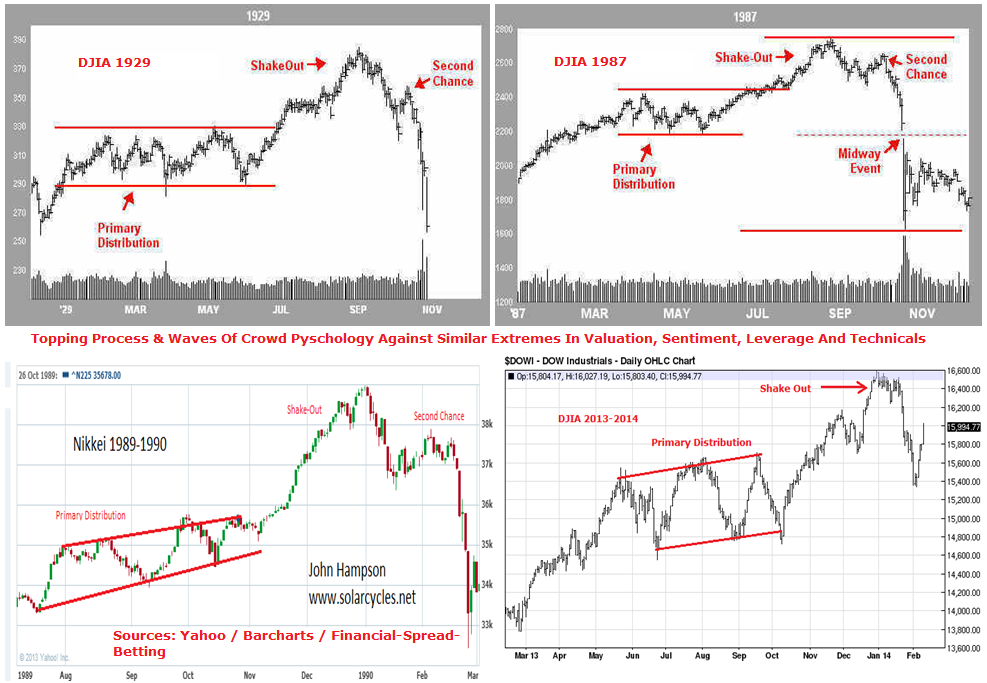
A fairly common topping pattern at major peaks in the past was primary distribution – peak (shake out) – second chance peak – crash, normally lasting around 6-8 months, like this:

9juli12Source: Financial-Spread-Betting

If we think of it as less of a roadmap and more of similar waves of crowd psychology playing out, it’s the ‘second chance’ which is my focus, namely are we though that or is it still to come?

If we are through it, then the market ought to quickly fall apart here, with any up days quickly engulfed. That’s kind of what we have been seeing the last 2 weeks. Plus, the heavy falls in China and commodities could be the initation of wider heavy falls. On the flip side, those spikes in near term indicators could provide a bottom here for stocks from which to rally back up into mid or late July, making a second chance peak ahead.

So what am I doing? Attacking but with stops (short Dow, RUT, IBB, long gold). If we are post second chance then there is no time to lose. The stock market should rapidly fall apart with increasingly big lurches downwards. On the other hand, if we have a second chance rally back up, I don’t want to be too exposed and save my big positioning for a little longer.

Lastly, might all this be way off and we are still safely in a bull market? Well, financial conditions just turned negative. The Ted spread is now higher than it was when stocks tanked in 2011. US economic surprises are still negative and ECRI leading indicators are flirting with zero. Earnings season starts this week with predicted 4.5% yoy falls in both earnings and revenues. With sentiment, allocations, valuations and leverage so extreme for such a prolonged period now, even a safe bull market is more likely to see a sharp correction here, something like 1987 or 2011. But I don’t believe that: the case is much stronger for a fully fledged bear market, within which Biotech retraces its whole move of the last 2.5 years.

Charts Update

It’s a picture of a major market top. The ‘real’ peak was mid-2014 at the solar max, as it was at the last solar max of Spring 2000. The supports for price since mid-2014 have been dismantled and evidence suggests the nominal price peak in equities occurred May 2015. Annotated, so no further comments.

Screen Shot 2015-07-01 at 08.55.34 1juli6 1juli4 1juli81juli2 1juli1

Selling Exhaustion Signs

The first day of decent selling…. but exhaustion signals appear.

Yesterday was the highest downside volume day since March 2012. It ended the longest streak of no >2% up or down day on the SP500 since May 2012. It was the 8th largest daily percentage move in the Vix of all time, at >30%.

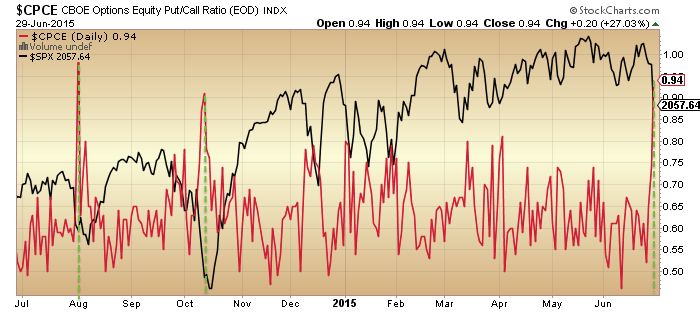
Equity put/call hit an extreme in fear. Here is the indicator’s history:

30junn5

Source: Stockcharts

Now here is a zoom on those previous instances of prints >0.90:

30junn2 30junn3 30junn4

Typically they marked lows or were a precursor to a low within a few sessions.

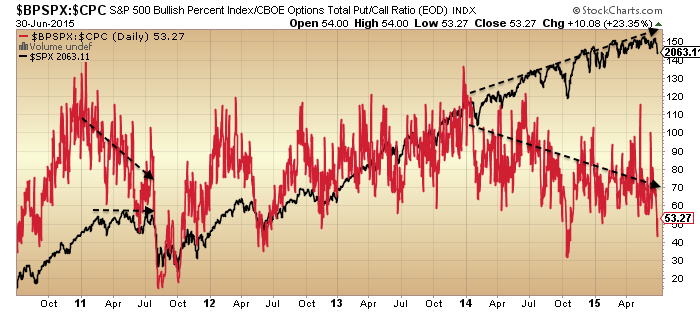
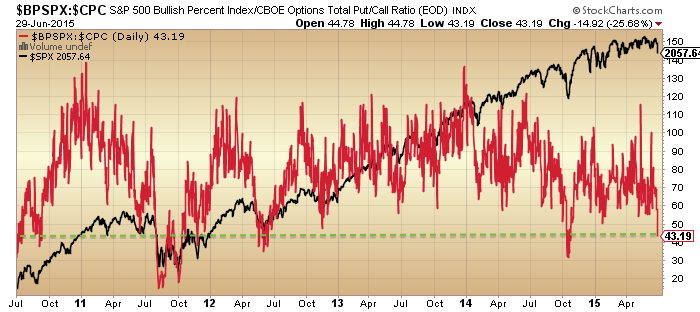
Next is bullish percent as a ratio to total put/call. I’ve previously highlighted the divergence in this indicator with the market since January 2014. However, because it has been in decline, yesterday’s selling took it to the kind of deep level associated with previous bottoms.

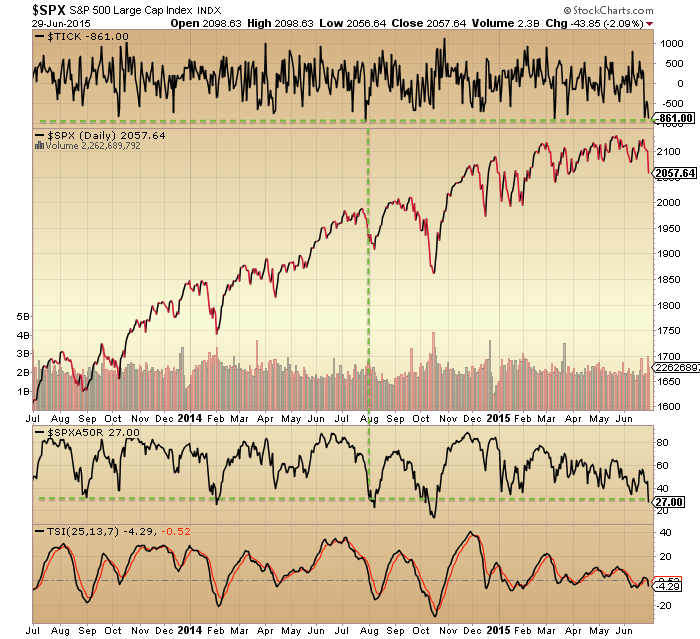
30junn13I also previously highlighted the divergent breadth in stocks above the 50MA. Again, because it has been in decline, yesterday’s selling has now put it in a zone that could spell a bottom, particularly if we combine it with the reading on Tick. The most similar such pairing from recent times would have been last August’s low.

30junn9

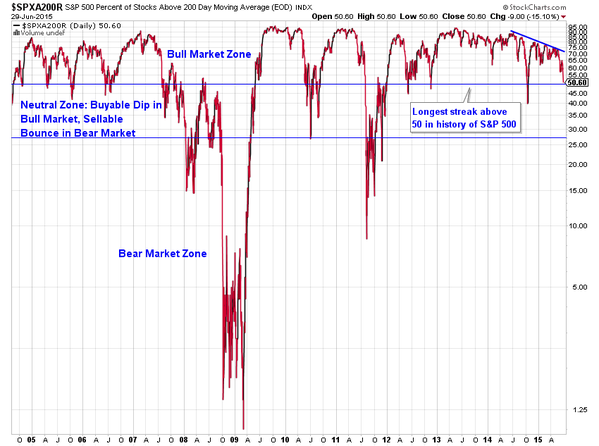
The picture from stocks above the 200MA isn’t dissimilar.

30junn15Source: Charlie Bilello

Lastly, here is Vix to Vxv. It too has spiked to the kind of level associated with previous lows, with the exception of the 2011 falls.

30junn12Here is a zoom on recent incidences of this indicator spiking over 1:

30junn40

We can see that a bottom occurred within several sessions of Vix:Vxv coming off its spike high.

Drawing all these indicators together, odds are that we see a rally from a low within a few sessions. Thursday’s full moon would fit with this too. As per my note yesterday I entered short RUT and IBB early and took a chance. They and the Dow positions are all in profit but in light of the above indicator readings I will be looking to cut back again later this week, anticipating a lower low from here within the next several of days but then a rally back up in July, perhaps to the mid-July new moon.


The Bubble Within The Bubble

Namely, the Biotech sector within the wider stock market.

Is the wider stock market in a bubble? Valuations in the 97th percentile, record extreme leverage, allocations second only to the dot.com bubble, all time record cluster of readings in sentiment, and more. Bubble deniers point to the context of ZIRP and QE as this time it’s different. Or they argue the froth we are seeing is of a new secular bull, with the stock market leading the economy. But ‘this time is different’ has rarely worked out historically and there have been many indicators acting like they did at the peak in 2000 or 2007, which I have published on the site in recent months. Here’s one:

26junn20

Source: Sentimentrader

That surge in unprofitable IPOs looks a lot like 2000, and whilst then it was particularly concentrated in dot.com companies, this time round there is a lot of Biotech.

26junn30

Source: Biospace

As we all know, into the dot.com peak of 2000, the mantra was that traditional valuations didn’t apply any more, and that stocks were ‘revalued’ on potential and expectations, justifying the crazy prices. Ultimately, traditonal valuation methods did still apply, and the pop was fairly unforgiving.

Today’s Biotech bubble is the same. Take a look at the constituents of the Nasdaq biotech index:

26junn2

Source: ZeroHedge

Just a handful of companies are making any money and the vast majority none or a loss.

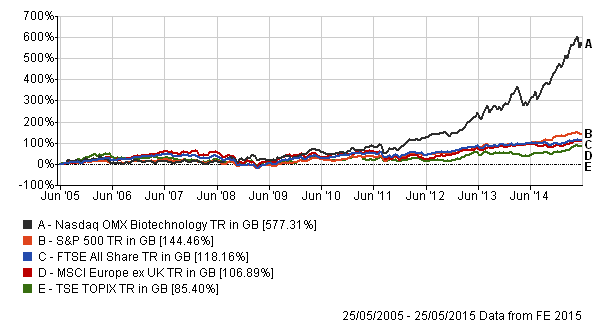
Now look at how Biotech has outperformed the wider markets:

26junn10

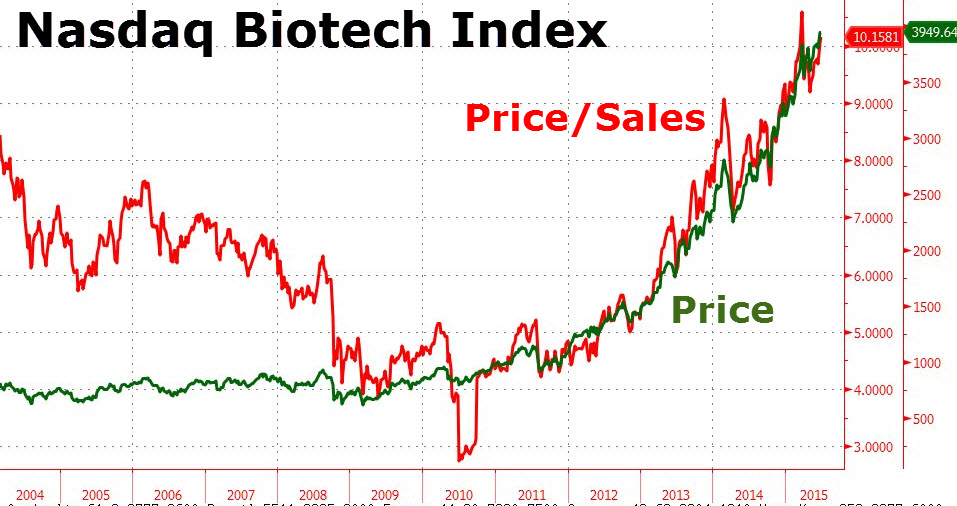
And see how that run up in price has been solely multiple expansion, i.e. valuation rising hand in hand with price:

26junn18

Source: ZeroHedge

The price to sales ratio in Biotech is now over 10. Compare that to the SP500 which is around 1.8, which in itself is at the very top end of its historic range and close to the 2000 peak.

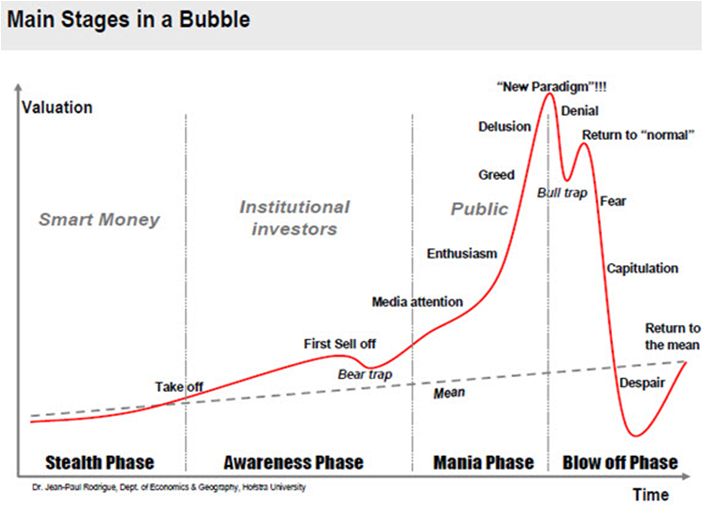
We can all see the parabolic, and we all know how parabolics end.

26junn7

IBB is the vehicle that mirrors the Nasdaq Biotech index.

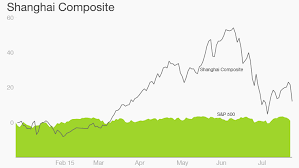
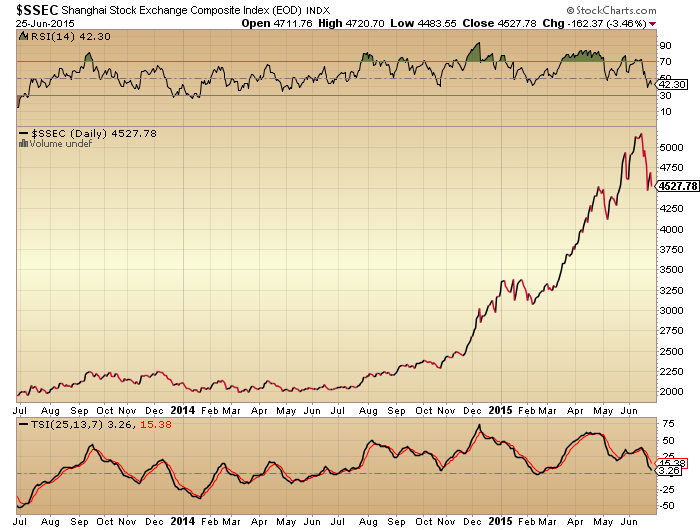
I want to short Biotech. But we have to be careful with a parabolic because they can steepen further before collapsing. So do we know when the game is up? One is a technical breakdown. Here’s how the Shanghai Composite looks today:

26junn11

It broke mid-June. There was a divergence in strength leading into the peak, and there is such a divergence on the current Biotech chart.

The other clue is the wider market.

26junn6 26junn5 26junn39

Source: Stockcharts

26junn15

Source: John Kicklighter

The last couple of days delivered another telling bearish reversal. Those negative divergences are all still in tact. We await the news on Greece and whether some kind of deal announcement would pump the markets back up again in the short term. So whilst I’m looking for short entries on Biotech and Russell 2000, the timing has to be careful. Plus, it will be a little at first, then building up.  That building up may happen swiftly, as when Biotech breaks there are reasonable odds it will be quickly ugly.

If you have been long Biotech then sincere congratulations. It’s been the trade of the decade so far. But I would equally expect that short Biotech will be the trade of the next couple of years. It’s going to be about nimble and accurate timing and attacking. Will let you know when I enter.

26junn50

Comparison to 2000

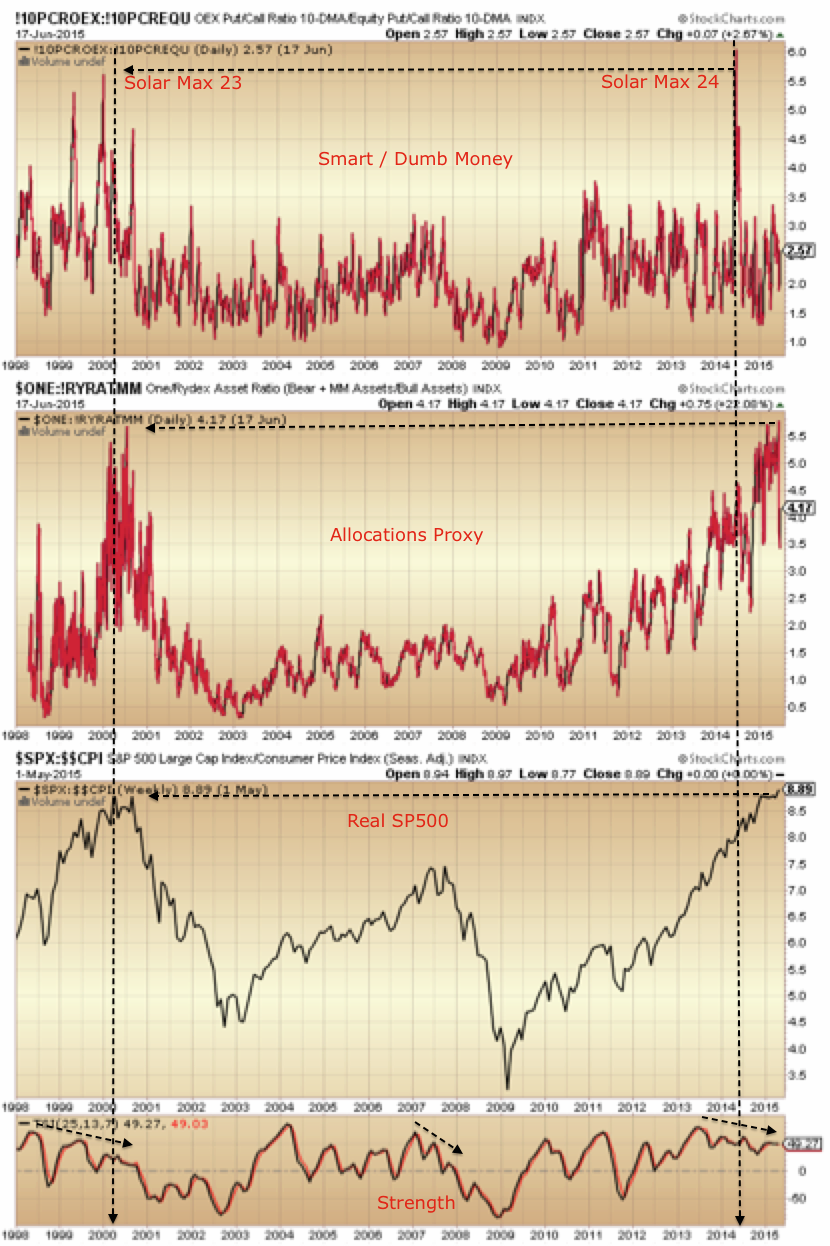
The biggest stock market mania of all time peaked out in March 2000, which was the exact month the smoothed solar max of SC23 peaked. Solar cycle 24 appears to have made its smoothed peak in April 2014, into which we experienced another mania in equities.

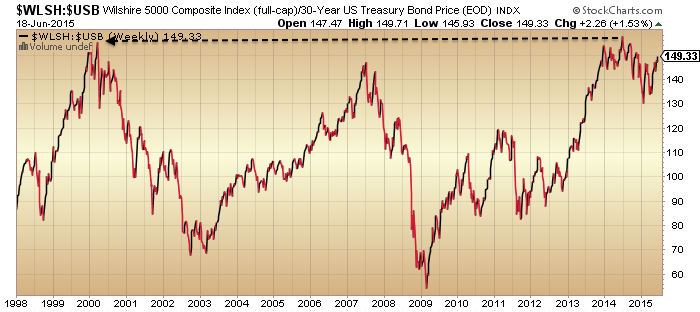
Below we see put/call (smart to dumb money variants), allocations (Rydex, as a proxy for the wider market), valuation x2 (real SP500, and relative to bonds) and strength (TSI) all displaying similar behaviour to 2000. What’s interesting is the extremes reached in these indicators have hit levels very close to those reached in 2000, as designated by the horizontal arrows.

Screen Shot 2015-06-19 at 08.12.38 19junn4Source: Stockcharts

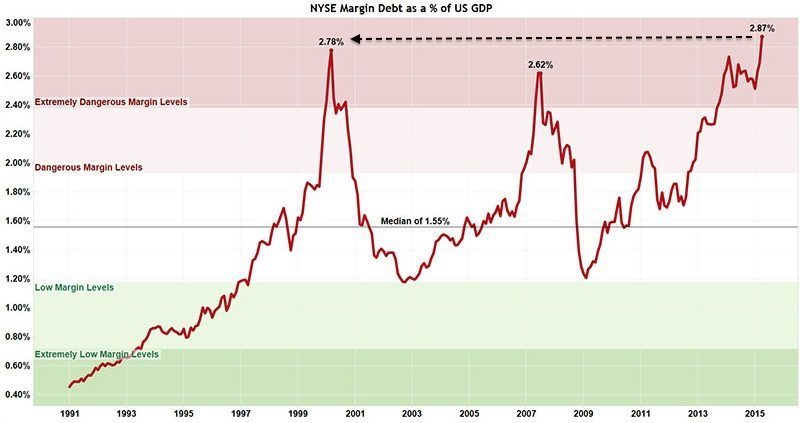
And we can add margin debt to GDP for one more:

19junn6

Source: Octafinance

In all the indicators, we see the intermittent 2007 stock market peak printed lower or milder. The difference? No solar max to drive speculation.

In short, various measures and indicators reveal a close mirror of 2000, both in behaviour and level. The question is whether those levels represent ceilings or whether we go on to see all new extremes. So back to the opening comment: 2000 was the biggest stock market mania of all time, and in various ways we are matching it. Wow, no? This is despite a demographic headwind (rather than tailwind into 2000) and despite a weak world economy (versus strong growth into 2000). Can we really go higher?

Timewise, equities are on borrowed time since the solar max of mid-2014. Although nominally they have not topped out, various measures under the hood (see previous posts) reveal a peak back then, and the divergences remain. The TSI divergence back at the SC23 peak lasted from mid-1998 to the top in 2000; the current TSI divergence began in mid-2013, making for a similar duration. Drawing it all together, I maintain the likelihood of a mid-2015 switch into an equities bear and I am staying on the attack.


Comparison to 1929

Hat tips to Mark, John Li and Chien Jen.

So what’s similar to 1929?

A stock market mania to extreme valuations.

17junn2

Source: D Short

A similar low intensity solar cycle.

17junn1Source: Chien Jen

Stock market breadth peaked very close to the smoothed solar maximum (May 1928 vs April 1928, Mar/Jul 2014 vs April 2014) whilst stock index prices didn’t peak until at least a year later.

17junn5

Source: RW Nelson17junn6Source: Stockcharts

Maybe stock prices are following a similar technical pattern.

17junn8 17junn9

The timings within the year fairly closely match too. 1929 began with a range. The final push was June to Sept. Therefore, the onus is on the bulls here to push prices back up into the range and out, to prevent the breakdown from the current position.

Now what’s not similar.

Economic growth was stronger in the 1920s.

The fed funds rate was around 4-5% in 1928/9 versus zero now.

It was a demographic climax produced by peak immigration at the start of the century of the age bracket that would buy the stock market in the 1920s.

17junn20Leverage reached 12% of GDP by the peak, versus 3% now.

All things considered, I believe 1929 has more in common with 2000, which was a demographic climax following strong economic growth with fed funds rate similarly around 5%. Post 1929 we saw the Great Depression, post 2000 the Great Recession, then following both we experienced a valuations-led stock market mania into the next solar max set against easy money conditions. Hence 1937 is a better all round fit to now (see HERE for details).

However, what’s common with 1929 is important, specifically that breadth peaked out 16 months before prices, and that is was ultimately leverage that delivered the craziness into the peak. Here in 2015 margin debt is hitting new highs so maybe the game isn’t over yet.

There was always a question mark over why prices didn’t peak with the 1928 solar max but made the anomalous extension into 1929. However, now we can see that breadth peaked at the 1928 solar max, like it has at the mid-2014 solar max, so in both cases marking some kind of speculation peak. The majority of other solar maxima delivered peaks in both breadth and prices close to the sunspot peak. Assuming prices peak out within the next several months (and don’t keep going, new secular bull style) then we are again producing that kind of anomaly that we saw in 1929, namely a fairly long period of degrading internals whilst prices continue to levitate or rise. Why? It’s leverage. Saturation levels in sentiment, allocations and valuations have been in place since the start of 2014. Buybacks were significant for much of last year but now it is leverage which is left holding things up.

So what stopped it in 1929? Answer: nothing in particular. One day the market topped out without any notable trigger, like most tops. Ultimately it was a combination of the fuel for higher prices being spent, leverage at unsustainable levels, prices for stocks being fairly unpalatable, and the whole thing having become a ponzi scheme. Then I would argue that the twin downward pressures of post solar max and the geomagnetic seasonal lows of Sept/Oct produced the timing.

Which brings us to today. What’s to stop prices making a final major leg up like in June-Sept 1929? Nothing, if leverage can keep rising, and the appetite amongst participants is there. However, that ‘appetite’ is under threat due to our positioning post smoothed solar max and the seasonal downtrend from July to October.

Solar cycle 16 had a sting its tail with a final surge in sunspots from September to December 1929. As this rather fits with the declines than the final run up in prices, I don’t think it’s relevant as a cause of the last leg up.

I would summarise that stocks are on borrowed time since the solar max of mid-2014. Breadth, volatility (inverted) and various risk measures all peaked out then. Buybacks also peaked out around then, leaving leverage as the key driver. This kind of anomalous extension post solar max was only seen before in 1929. Given most things in the world are now ‘bigger, better, faster, more’ than back in the 1920s, what’s to stop us blowing that reference point out of the water with an even dizzier anomaly now? Well, I would argue that in the context of negative demographic trends we already have.

A common historic technical topping pattern looks like this.

17junn40

Bottom right is a chart from last year when it appeared to have formed into early 2014, but was a red herring. Drawing together several indices from around the world we could argue it is there again, with the primary distribution across last year and the final leg up in 2015.

17junn50Or we could argue the final leg needs to go higher yet, or has to happen yet on the main US indices. Not easy to call.

So if we stick to what we know, I suggest it’s this. Stocks are on borrowed time since mid-2014 as divergences continue to grow. The geomagnetic downtrend from July to October 2015 together with the post-solar-max downward pressure has a strong chance of killing the bull. The two things to watch are these. Can prices be bid back up into the 2015 range and out of the top? If so, a final leg up would gain weight. And can leverage keep rising? It needs to, if another leg up is to happen.