Solar, Earnings, Commercials

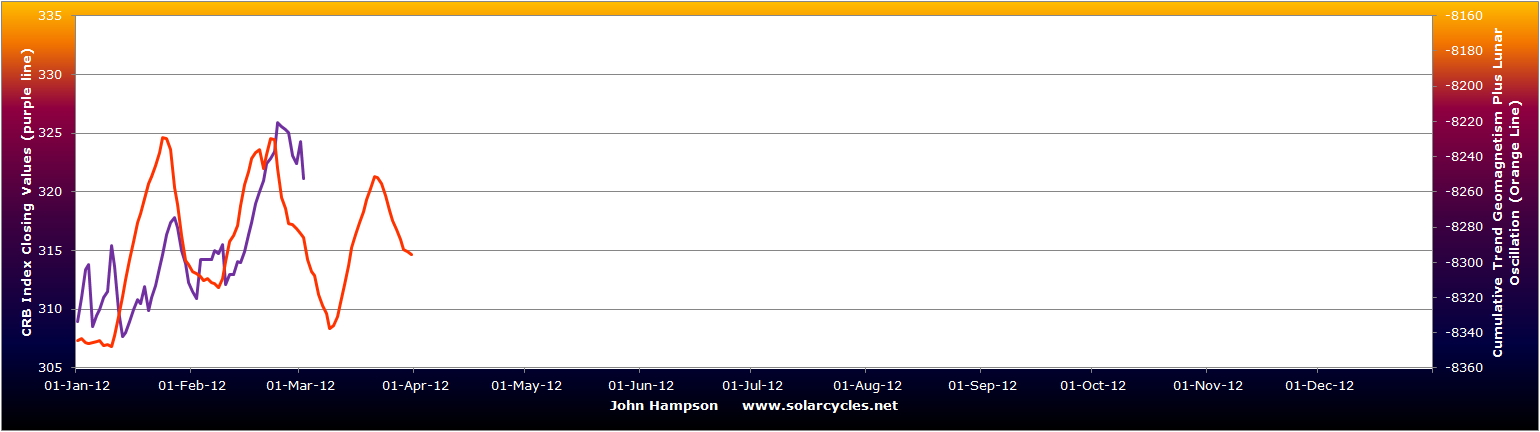
The R/J CRB commodities index now looks very close to the geomagnetism and lunar model in 2012:

It is a closer match than equities so far, which is in contrast to my expectation, as I predicted that commodities would pull away from the model into the solar/secular peak of 2013, whilst stocks would stay with the model. Well, that may still happen, and I believe there is a greater likelihood once sunspots pick up in a sustained way.

Above, we can see that sunspots are starting to trend up again, but we should see them push up higher and longer as we wave our way into the solar peak. That should in turn inspire speculation and inflation.

Scott Grannis has some useful insight into the apparently extreme US corporate profits. This first chart you may recognise, as its the one that suggests mean reversion should be imminent. However, the second shows corporate profits as a percentage of global GDP rather than US GDP, which shows US company profits closer to average. Because companies have globalised and emerging markets have grown faster than the US, the result has been a distortion of the first chart, with the second a more true picture.

Source: Scott Grannis

Lastly, Tom McClellan uses a model of Euro-dollar net commercial positions advanced by 12 months to predict the stock market (hat tip Gary), in other words, how the big commercials position themselves in this contract is reflected in the stock index a year later. If that sounds unlikely, here is his explanation: ” It may help to understand that the commercial traders of eurodollar futures are typically the big banks, who are using these futures contracts to manage their assets and fund flows.  So what we are seeing in their futures trading are responses to immediate banking liquidity conditions, and those actions give us a glimpse of future liquidity conditions for the stock market.  These liquidity conditions are revealed first in the banking system, and then the liquidity waves travel through the stock market a year later.”

Here it is this week, predicting consolidation in stocks from now into June, and then a rally into US elections in November:

Source: Bloomberg

Roundup

Last week gave us a correction in stocks, but upside resumed yesterday. Apple continues to print topping candles and then reversals. Broadly speaking, indicators are not screaming overbought or overbullish, so for now the medium term uptrend remains in place.

Bernanke’s dovish comments provided a trigger yesterday for gold and miners to move up, which was in line with the overbearish extremes both had reached. Oil continues to range trade but in what looks like a bullish flag. The Euro and Dollar are at an important decision point.

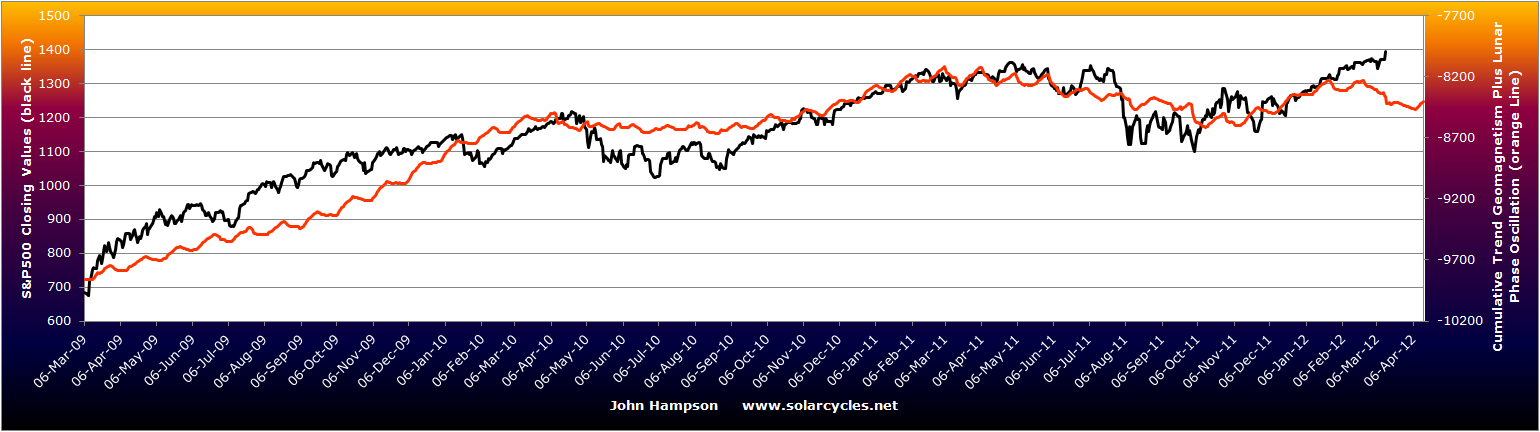
I have updated and extended my short and medium term models (see pages of those names). There is some near term downward pressure next week into the 7th April. Medium term, the message remains that stocks have run above the models and should now be brought back into range, in overall sideways action.

US earnings begin again 10th April. Profit margins are at a record and historically this has been mean reverting. If earnings start to disappoint, then coupled with downward trends in economic surprises, that would make further upside difficult for stocks. However, earnings may not disappoint, so let’s see. Here are suprises:

Source: Bloomberg

Quite a downtrend in place since the turn of the year, and unless this turns up then stocks should eventually exit their uptrend. Here is the updated overlay of the surprises index on the S&P500. In both recent examples of 2009 and 2011, once the surprises index topped out, the stock market moved from uptrend to sideways/down consolidation a few months later.

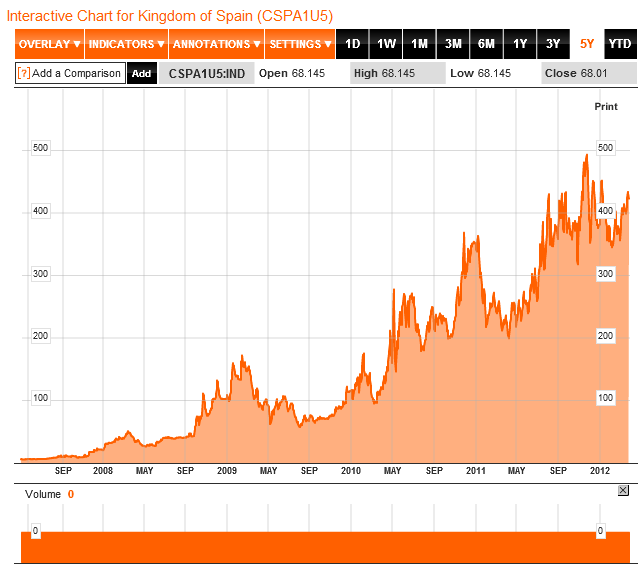
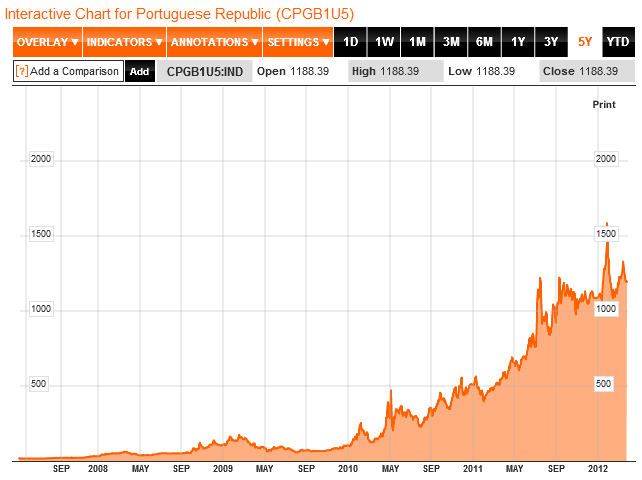
How’s Euro debt? Here are Spain and Portugal 5 year CDSs. They remain in their longer term uptrends. Unless they can break down decisively, then it suggests Euro debt will come to the fore again at some point in 2012. Let’s see.

Source: Bloomberg

Trading-wise, I am currently doing nothing. I am hopeful that gold may now take off, with yesterday’s trigger and the overbearish extremes reached, and I am well positioned for that. Oil looks strong, both technically and fundamentally. Agriculture is picking up again, slowly. Again, I am positioned for both those. The Euro-Dollar remains finely balanced and I continue to monitor. I have a negligible stock indices long position. I do not wish to short equities, whilst leading indicators continue to improve. I do not wish to go long equities, whilst divergences build in surprises and geomagnetism. I am awaiting a more clear cut opportunity in stocks, whenever that comes.

Markets Update

Yesterday’s upward thrust in stocks, on good breadth and volume, supports my favoured scenario of a push on into 21-23 March.

There is a potential divergence in % stocks above 50MA that could spell a period of sideways range action after that.

Source: IndexIndicators

A significant divergence is now present on my medium term model for the S&P500, whilst noting that the Dax is on model, having been playing catch up from underperformance.

A couple more sessions of contined upside for stocks and we will start to hit overbought and overbullish measures again. I still have a couple of stock indices longs and will be looking to exit them at the end of this week or the beginning of next if that occurs.

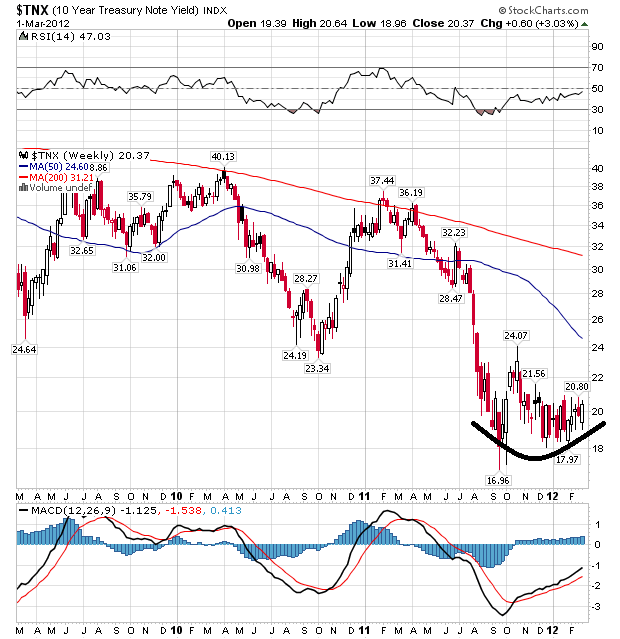
A key development yesterday was an upwards break in treasury yields – the rounded bottom is gaining momentum. There is a large wall of money in treasuries that could start to flow towards risk assets.

Source: Stockcharts

My expectation, based on my previous analysis, is that commodities should be the main recipient, and that commodities should outperform stocks leading into next year’s solar peak. Yet, what we are currently seeing is the opposite.

Here are commodities versus the medium term model – very much on model. Yet I was anticipating stocks aligning with the model whilst commodities pull away. So what’s up?

The US dollar is strong again. Good economic data from the US is helping support the USD, as well as no further indication yesterday of more, or further extended, dollar-diluting programmes. As I previously noted, the US dollar is in a delicate long term position, which I expect to break downwards, helping propel commodities to their secular conclusion. However, right now we lack a trigger for that, and with fairly neutral sentiment towards the Dollar and the Euro, that doesn’t give us a reason either.

Of course a strengthening USD does not make a commodities rally impossible. Another key factor is China. Recent Chinese data has been softer than expected, and whilst expectations are for Chinese easing/stimulus, as yet the Chinese authorities are being cautious. Here are the latest OECD leading indicators, and whilst we now see a definite up turn in most countries, China isn’t following suit yet.

Source: OECD

Here’s gold. The smaller wedge is the first potential reversal opportunity. Failing that, the confluence of long term rising support, falling s/r and the 23 fib look like the next most likely bounce point.

Marc Faber is still a longer term gold bull, but anticipates gold could fall to $1500 here. Such a move would put it below all the key moving averages that have supported the secular gold bull to date and so I think it’s unlikely, but, much like the USD, it is delicately poised, and I am closely following both.

Roundup

Yesterday we had a geomagnetic storm that although forecast was stronger than predicted. Today is the full moon. Later today we have the Greek swap decision result. Tomorrow is the key US jobs report. I will be letting all that play out and see on Monday whether there might be trade opportunities.

The storm:

With reports of enough creditor consent to pass the Greek debt swap, the markets may get satisfaction, but as one or two on here have suggested, the Euro debt issue may rise again. I keep my eyes on CDSs and yields and although still contained currently, the Spain CDS chart looks like it has unfinished business eventually ahead – still in a solid long term uptrend:

Source: Bloomberg

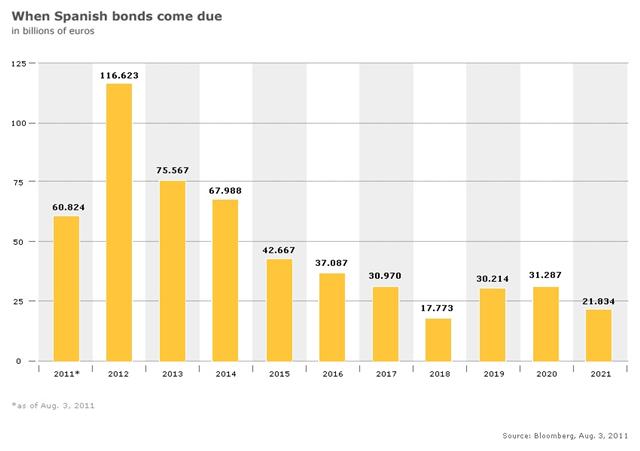
Supportive of such developments would be Spain’s peak debt rollovers this year:

Source: Bloomberg / Acting Man
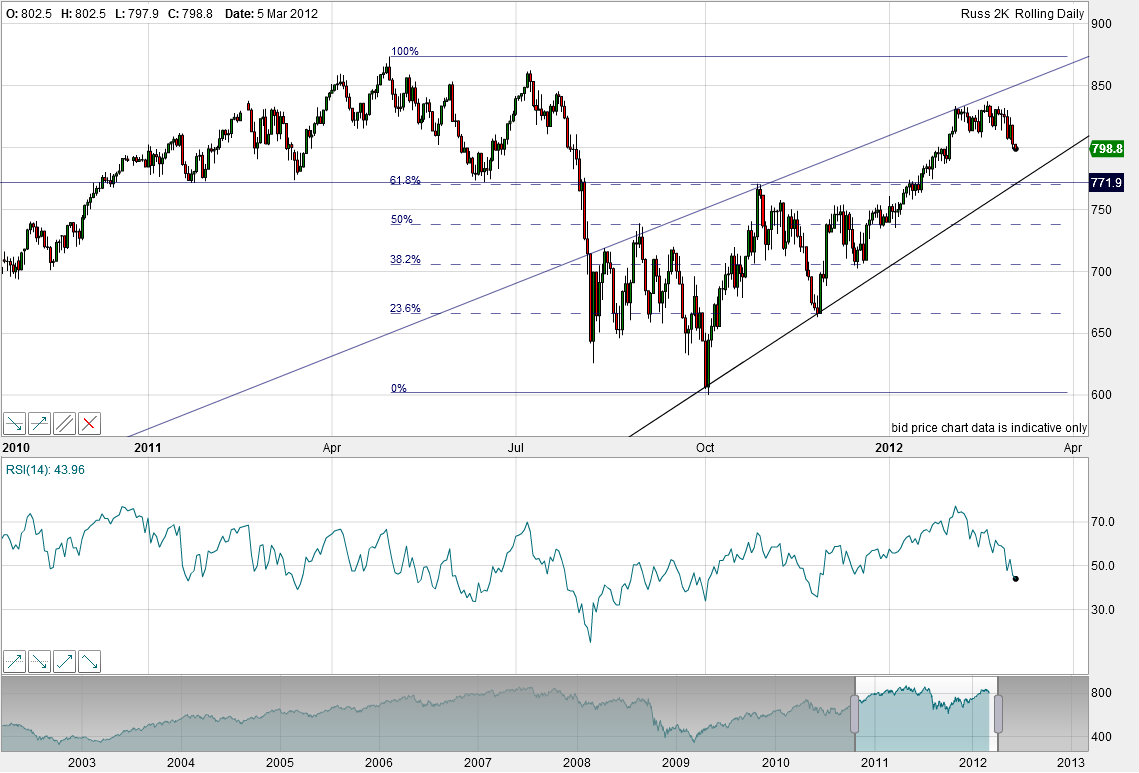
Turning to the stock market, a look at the US small caps that rolled over first shows them already at rising support, whilst there remains a lower twin support of fib and horizontal s/r.

Laslo Birinyi has been in the media making analogies based on bull market internals and action that followed overall sideways years like 2011, and quotes  1982 and 1990, both very bullish years that just kept on rising.

Source: CNBC / Ticker Sense

Meanwhile, Market Anthropology make an analogy with 1994 which implies first a pullback then revisit of the highs in April for a double topping process.

Source: Market Anthropology

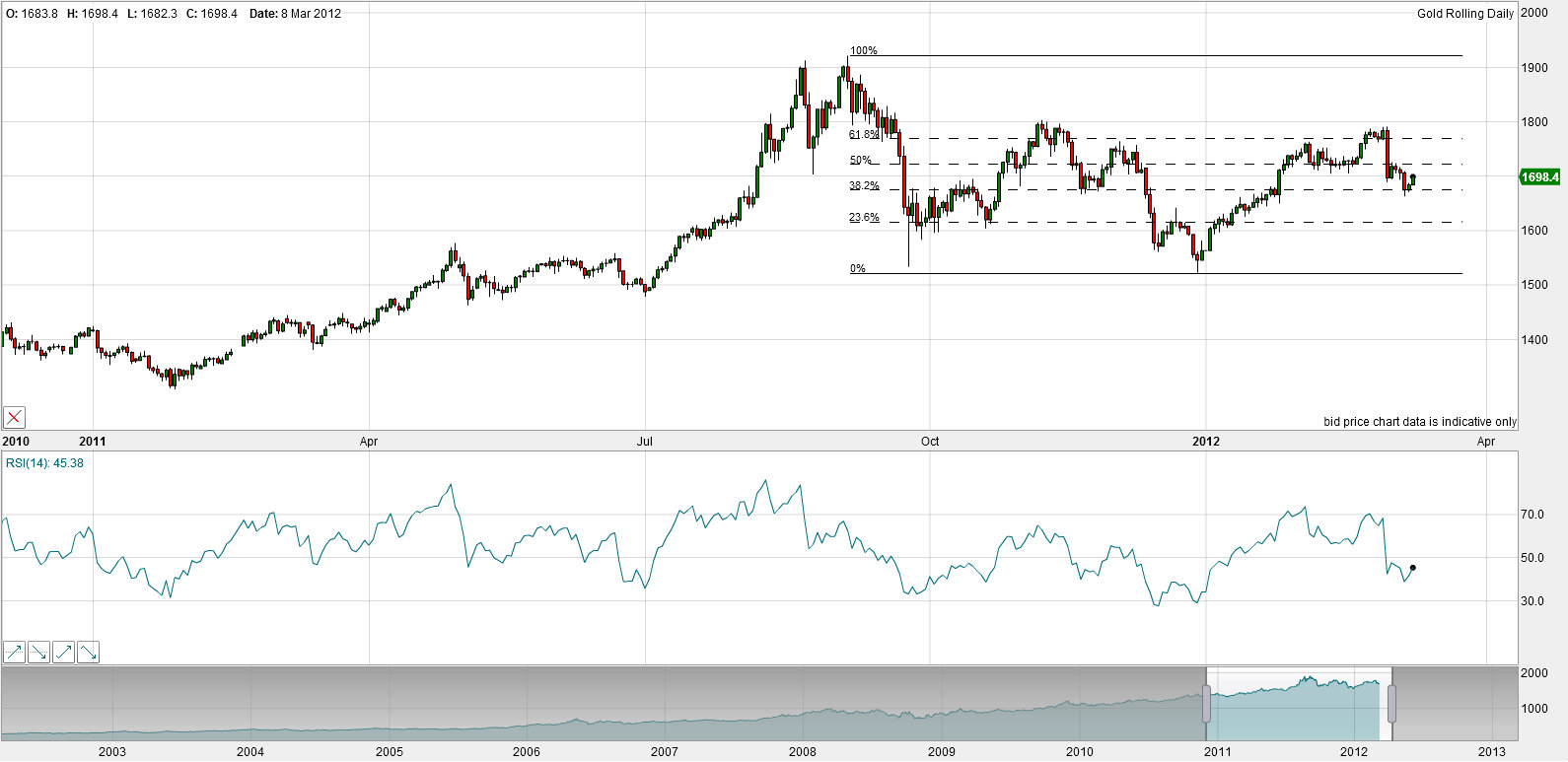
And turning to gold, we see it has bounced at the 38 fib and has the potential to make an inverted head and shoulder pattern.

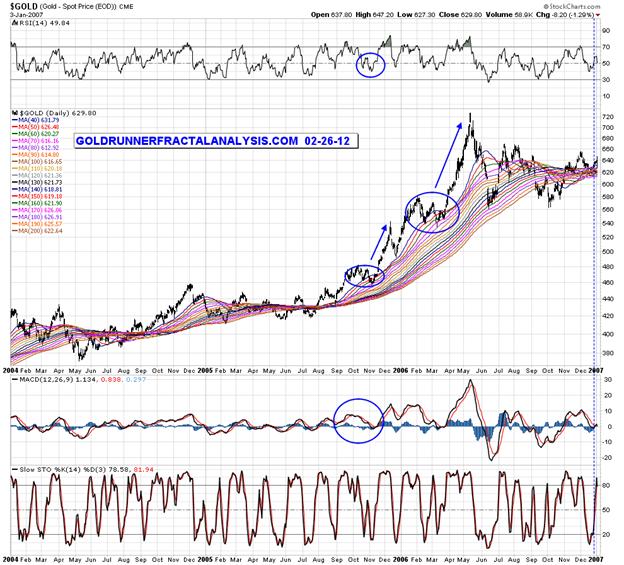
And Goldrunner indentifies similar chart patterns from 2005 and 2006 that would be supportive of a bullish upward break from here.

Source: Goldrunnerfractalanalysis

The problem with analogies and fractals is that even the most compelling can sometimes turn out to be red herrings. Recall that stocks in the first 9 months of 2011 made a series of waves that looked very similar to the 2007 top. It was only once a higher low was printed in November that the fractal was decisively negated. That said, historic repetitions and time cycles are fundamental in my approach and I can point to many that work out. The Mammis sentiment cycle was a recent example of an analogy that played out very accurately.

This Week

Will we finally see a downside break for equities this week? The Vix is still trying to make a rounded bottom, CS fear remains excessively high, Market Breadth has weakened, certain indicators remain overbullish and overbought. There is still no ‘screaming sell’ but note that US small caps have already broken:

I have highlighted on that Russell 2000 chart the confluence of horizontal support and the 61 fib, and the large rising wedge, which should act as support if downside in the other indices materialises. Large caps, currently outperforming, may correct less.

The full moon takes place this Thursday and the bottom by my models is around Friday. Due to some persistent geogmagnetism, my short term model has now tipped over a little. Here is it versus the CRB commodity index and around the lunar oscillations lower highs and lower lows can now be seen:

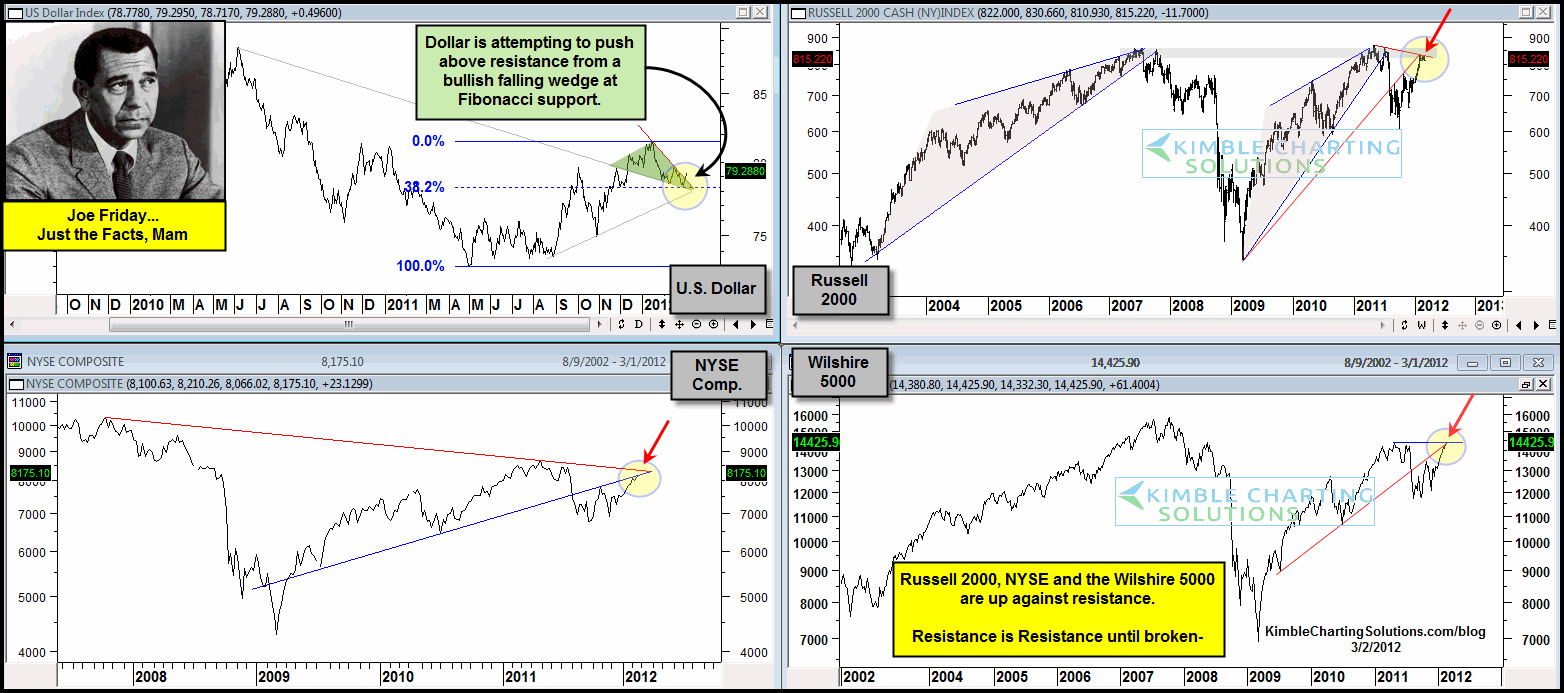
We see silver, the US dollar and stocks all at important junctions:

Source both: Chris Kimble 

So might we see the US dollar resuming an uptrend here, silver dropping to the bottom of its downward channel in a continued correction, and the stocks rally ending?

Well, by history, it is unlikely that the strong rally in equities of the last few months suddenly reverses here. We should expect a drawn out topping process as a minumum. In other words, if equities pull back here, we should expect them then to revisit the highs, or make new highs, whilst seeing internals weaken and greater divergences come to light.

There is an extreme in bullishness in energy, particularly oil. That suggests a pullback in crude is imminent. But there is likely to be demand-supply and geopolitical support from the underside. Pro-risk typically moves together. So as it is unlikely that equities enter a significant downtrend here, it is also unlikely for commodities. Neither precious metals nor agriculture display overbought or overbullish readings like energy.

On the macro front, ECRI leading indicators rose again in Friday’s reading, but China data today surprised to the downside. Euro debt and CDSs remain well contained, with the exception of Greece. Credit markets continue to improve. Some key analysts still expect the Fed to announce QE3 or some kind of new balance sheet expansion in the next 6 months. Goldmans expect it already in the first half of the year. I can’t see it on the current improvement in data, but given their expectations I will keep it on the radar. Next FOMC is 13 March.

To sum up, my personal expectation is that pro-risk markets retreat this week, into my model bottom around 9 March. I don’t see it as an opportunity to short or to pull out of commodity longs, as I expect we have not marked a major top, and that this will be digestion. Rather, we should at least be revisiting the highs, or more likely exceeding the highs, after a consolidation, and in doing so we will be able to judge better whether a topping process is unfolding. Treasury yields continue to display a potential rounded bottoming, which could signify much more pro-risk appetite ahead, fitting with a secular commodities bull conclusion, and would support only digestion of gains here.

Stocks, Surprises And Bonds

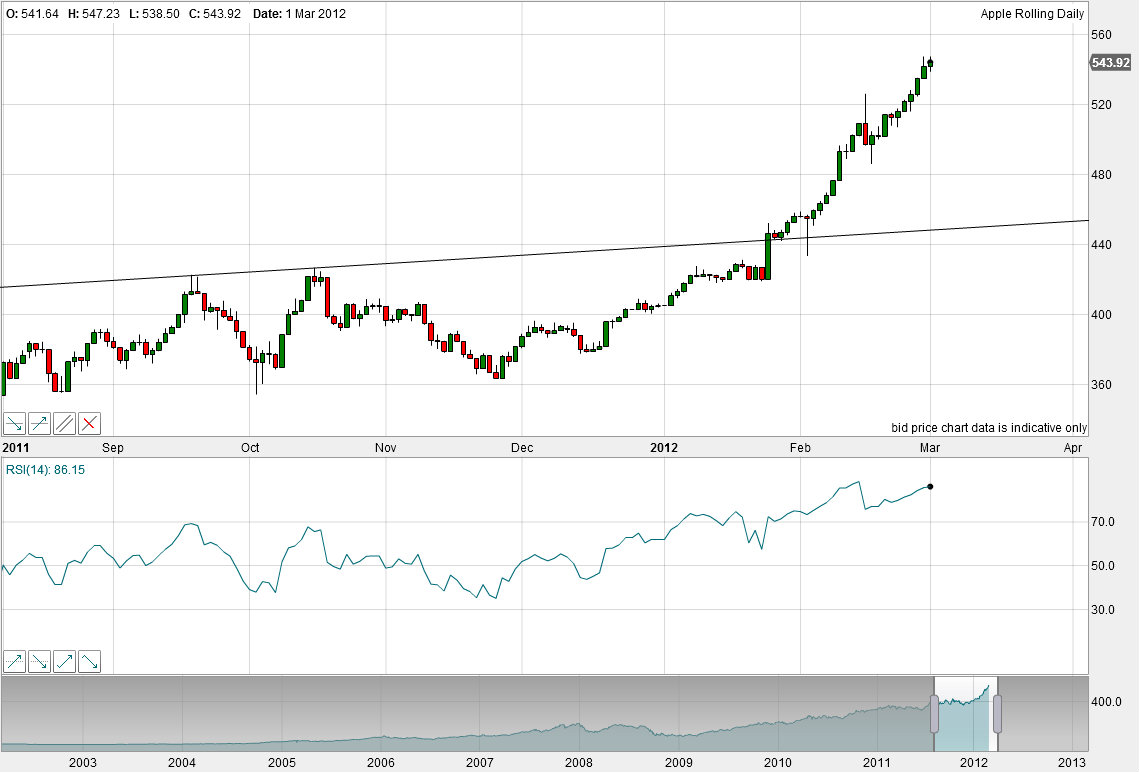
Here’s Apple again, the leading stock in the leading stock index.

The inverted hammer candle of 15 Feb didn’t turn out to be the top, despite reaching RSI over 90. Here we are now further up the parabolic curve, a curve that is unsustainable. The question is when it is going to break, because as the leading stock in the leading stock index, it’s likely to be important. On the chart above I’ve marked the long term rising upper resistance line that stretches back years but was broken early Feb 2012. At the end of yesterday RSI was at 85. I’m on the look out again for an intraday reversal and inverted daily hammer candle.

The Vix is still trying to make a rounded bottom. We still see some overbought/overbullish readings in equities, and some negative divergences. We also still see a solid uptrend, and no screaming sell.

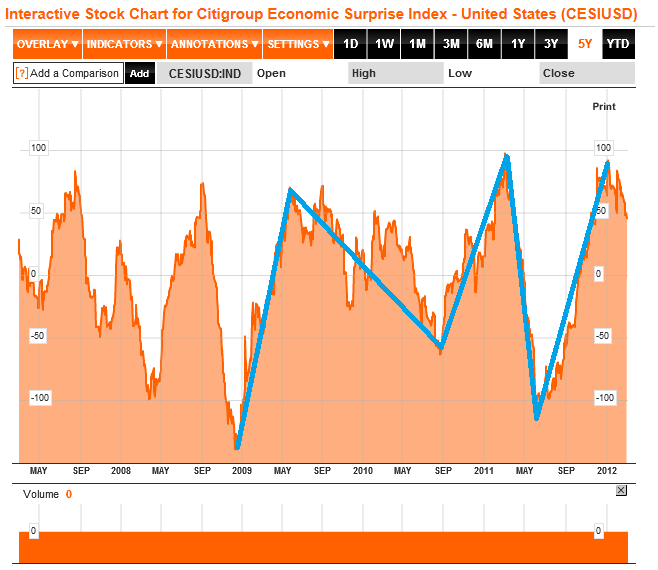
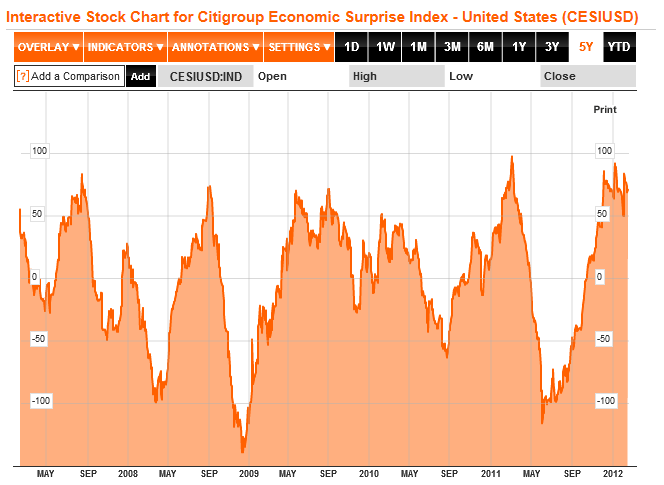
Turning to Citigroup US economic surprises, this index appears to have topped out at the start of 2012, but it tends to lead the market. I’ve highlighted the major recent trends in this index, and applied the same to the S&P500 chart.

Source: Bloomberg

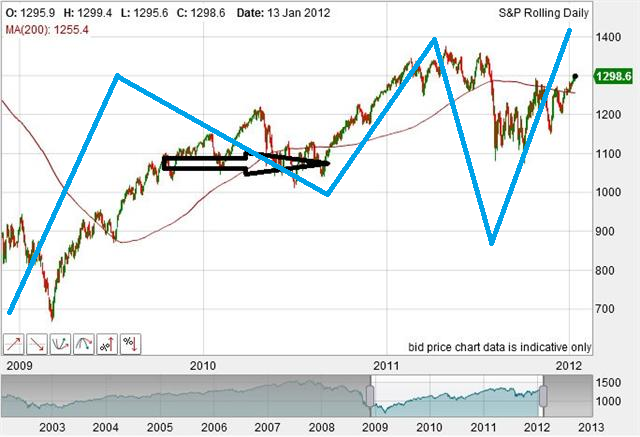
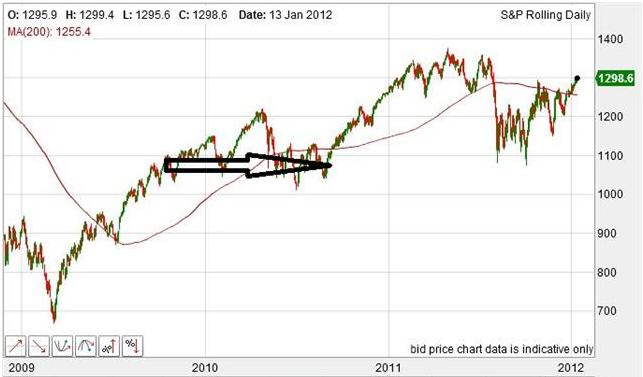
Compare the strong move up in surprises from an extreme low to an extreme high in 2009 and 2011. Both advanced off the bottom a couple of months before stocks bottomed. Back in 2009, the surprises index then topped out at the high extreme around June-July 2009, and gradually fell away to neutral into Autumn/Fall 2010. Stocks tracked overall sideways in this period, as designated by the arrow, but it is notable that stocks made their high within this range about 9 months after economic surprises topped.

In short, assuming economic surprises have topped out and now fall away to neutral (as this is a mean reverting indicator) mirror action to 2009/10 would see stocks push higher into late 2012, before being dragged back.

Now bonds. The 10 year treasury yield is showing evidence of building a rounded bottom.

Source: Stockcharts

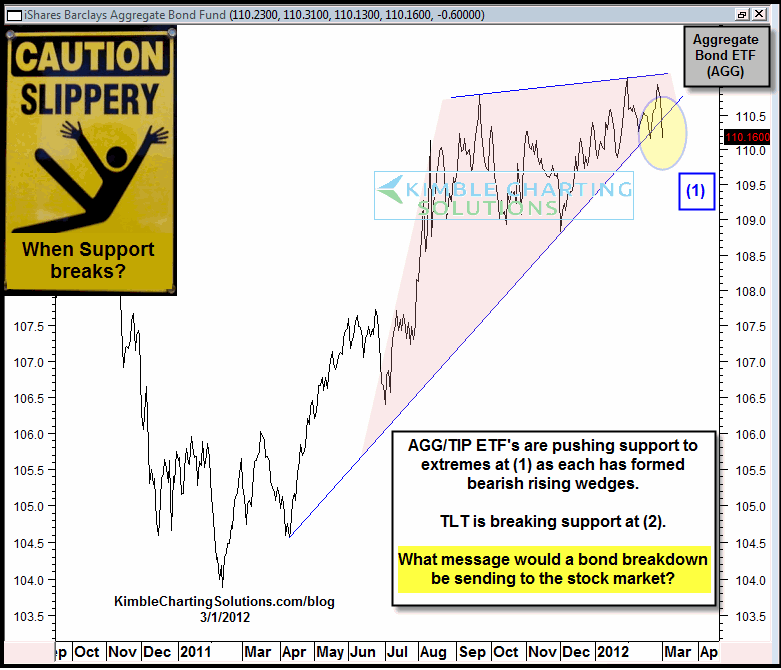
The treasury bond aggregate has potentially broken down beyond rising support.

Source: Chris Kimble

Treasury bonds are at a historic extreme high, and yields a historic extreme low. If we see a significant change of trend here, then it will fuel pro-risk.

This Week

Since my model top of 22 Feb, stock indices have either begun a pullback or are digesting gains ahead of an imminent further leg up. My models predict a pullback into 9 March, so the former is my primary expectation. Supportive of a pullback here are a perfected DeMark sell set-up on the Dax, a potential Vix bottom in relation to US stocks and a historic extreme in the CS Fear Index (which suggests participants are insuring against perceived forthcoming downside):

Source both: Andrew Nyquist

Source: Bloomberg

If we do see a pullback this week and next, then recall Tom De Mark suggested it may be a correction that frustrates bears – lots of back and forth and overall shallow, before pushing on again.

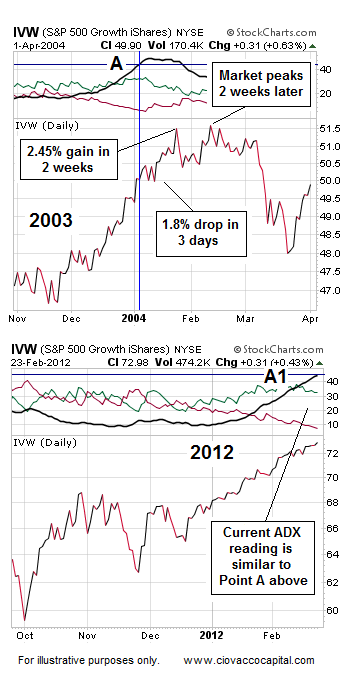
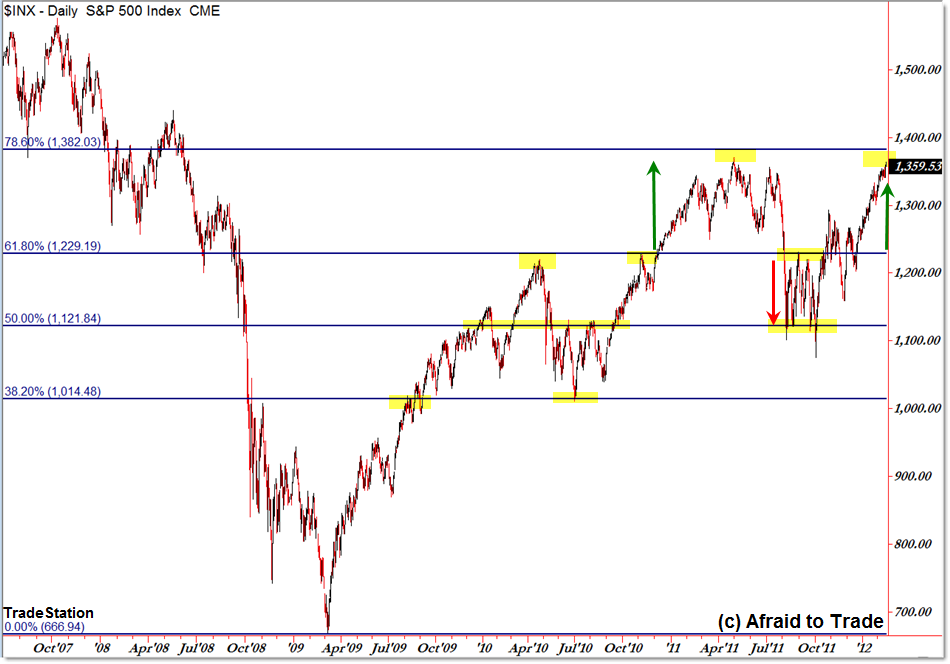
Chris Ciovacco points to a 2004 rhyme and suggests the stock market needs to flatten out at the top following such a powerful up trend, before any significant correction:

And this fits with not having seen divergence in market breadth yet, which would normally signify an important topping process.

So if we picture something between shallow consolidation and shallow gains in the weeks ahead for stocks, then that sets the scene for commodities to outperform, and that’s what we’ve been seeing the last few sessions. Crude oil looks set to challenge its 2011 high of around $114. Gold and silver are at key levels, whereby a break above would likely attract significant money flows.

But if we consider the fortunes of pro-risk as a whole, a fly in the ointment remains ECRI, who reiterated their recession call (for sometime in 2012) on Friday, despite improvement across the board in leading indicators from Conference Board’s own to Money Supply to Financial Conditions Index to the stock market itself. I note they quoted flatlining GDP and retail sales in their defence (yet both these show recent improvement trends) and marginally improved WLI (which has actually risen from -10 to -3.5), so that makes me a little skeptical. Well, I don’t want to disregard them because of their track record, and Chris Puplava suggests it’s all compatible: that we have a growth window into mid-2012 before ECRI’s call comes good. He points to prices paid as a lead indicator for manufacturing, which shows that summer 2012 rollover:

Source: PFS Group

I would summarise like this: if the economy is to roll over by mid-year we will see various leading indicators roll over ahead of that, and not be reliant on the word of ECRI. Right now, we see leading indicators improving, and where I identified potential early casualties in the form of earnings and economic surprises (both at historic highs) we still don’t yet see a decisive tipping over. I maintain the expectation of a growthflationary finale into the secular peak, with the emphasis on inflation. So let’s see how things progress.

This Week

Last week we saw leading indicators ticking up for Korea, USA (both ECRI and CB) and Spain. Evidence is accumulating for a new business cycle upswing. Looking back at previous such cycles, 6-9 months is fairly typical for such a cycle to play out, and this next chart suggests a 9 month upswing may be ahead this time.

Source: Chris Puplava

Drawing in my previous analysis on how events have unfolded into solar/secular commodities peaks, we have a potential sequence of events here. Growth and pro-risk advance as a whole before excessive inflation and commodity mania.  Stocks do well into late 2012 before turning down as commodities diverge towards the end. Commodities rise into the secular peak of Feb-Mar 2013 before excessive oil prices help bring on a recession, with stocks turning down several months ahead of the recession as a leading indicator.

Underlying source: Dshort

What are the threats to this scenario? Well, the business cycle upswing is still tentative at this point. Leading indicators for some countries are still negative. China had to lower its reserve ratio this weekend to stimulate lending. Sovereign debt could flare again, and Greece remains unresolved at the time of writing, with the March payment deadline approaching. However, I expect resolution on Greece ahead of the deadline, and I expect leading indicators for the laggard countries to turn up in the weeks ahead. At this point, emerging from an extreme in global anti-risk appetite reached at the end of 2011, and with a natural business cycle upswing supercharged by the range of central bank counter-responses over the last 6 months, I believe the weight of evidence supports a growthflationary finale from here into the solar peak, in line with history.

Shorter term, I still expect a pullback in equities, for the following reasons.

1. We continue to flirt with overbought and overbullish readings.

Source: IndexIndicators

Source: TheTechnicalTake

2. We approach Fib resistance

Source: Afraid To Trade

3. CS Fear Barometer has potentially topped ahead of the market:

Source: Bloomberg
and 4. We have a DeMark sell set up (the conditions in place for a period of retreat, if not the momentum).

We don’t have a full set of top indicators, but we have ‘enough’ for a pullback.

Now to add to this, POMO sales could add to the likelihood of a pullback from here into the end of Feb.

Source: McOscillator

Plus, we have a new moon tomorrow, my models suggest a top the day after, and a geomagnetic disturbance is in progress again, shown by the arrow, adding weight to a seasonal pick up in geomagnetism, which is a headwind.

For now, economic surprises remain in an uptrend for the major economies, but perhaps topping out for the US. As a mean reverter, it is a matter of time before we start to see more disappointments versus estimates than beats. Some are predicting a US jobs figures major disappointment on the first Friday of March. As we enter March, geomagnetic seasonality should pick up yet more.

So, tomorrow and Wednesday I will be looking at potentially taking profits on my remaing stock indices longs, and will report if/when I do. However, I do not see this as a major top that I wish to short, but rather of an overbought/overbullish pullback. I maintain the expectation of commodities beginning to outperform, and will not be taking profits in commodities but rather holding into the solar peak (unless the picture radically changes).

Next Target 22 Feb

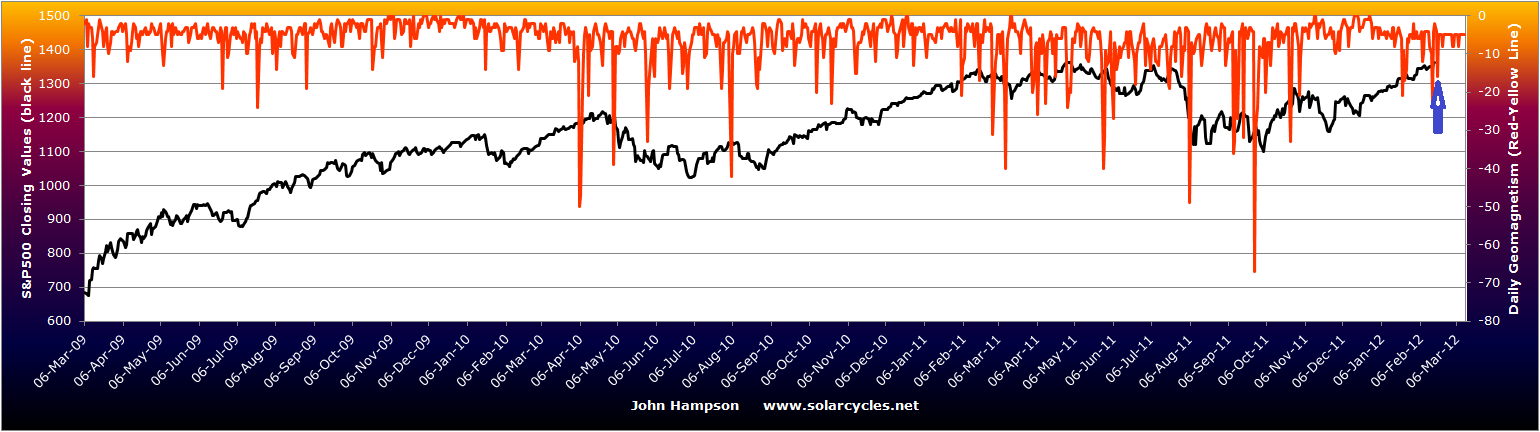
Looking at the S&P500 on short term view with updated actual and forecast geomagnetism, this is what we see:

We saw a cycle inversion or very shallow pullback around 7/8 Feb, and now the next target is around 22 Feb for a potential medium term top, subject to seeing a set of overbought and overbullish indicators. Indicators have been able to cool a little in the last few sessions with some digestion of gains, suggesting we can push higher before reaching adequate extremes.

We can also see from the above chart that, based on forecasted geomagnetism, the trend is still up into mid-March. The threat to this is actual geomagnetism being greater than forecast, and at the time of writing an unforecasted geomagnetic storm is in progress. Below is a reminder of the historic seasonality of geomagnetism and its correlation with stock market seasonality, and it’s important to note that this is an average. In February 2012 so far we have not seen much of a pick up yet in geomagnetism, compared to seasonal history, but the threat is there that it begins to increase, putting pressure on the market, and as we move towards March, the threat becomes greater.

Therefore, I will be looking to see if pro-risk can push on into around 22 February whilst making a divergence with the model and hitting overbought/overbullish indicator readings, or whether we postpone an intermediate top until mid-March, if actual geomagnetism stays relatively low and we don’t hit screaming top signals in late Feb. If we do keep pushing on into mid-March, I note the first major Bradley turn of the year is 16th March, plus Greece’s debt payment deadline is 20 March, if that saga drags on unresolved. So let’s turn to macro fundamentals.

Credit markets continue to improve. The rise in Portugese CDSs in early 2012 has now been reversed, and PIIGS CDSs as a whole and Japanese CDSs remain contained. The US earnings beat rate has crept up to over 60% as the season has progressed, so fairly middling compared to previous seasons and not a particular reason to be bearish. ECRI US  leading indicators continue to accelerate upwards (whilst still negative) and the latest OECD leading indicators show a tick up for the OECD area as a whole:

Source: OECD

Other than the US, the countries contributing to the general uptick include Japan, Russia and India.

Economic Surprises for the major economies and for the US continue to oscillate around a historic topping area. Until we begin to see a downtrend, pro-risk sentiment should be sustained, but a downtrend is likely to be close, due to this being a mean reversion indicator (data starts to disappoint versus ratcheted up estimates).

Source: Bloomberg   
Here is a reminder of the market’s overall sideways action once Economic Surprises topped out and began to fall away gradually in 2009-10, following a similar surge up from an extreme low (that was a leading indicator for a market rally).

Recall that history suggests overall sideways action in the next 18 months for equities, with a slight upward bias, whilst commodities outperform (based on the last 3 secular commodities conclusions into their associated solar peaks).

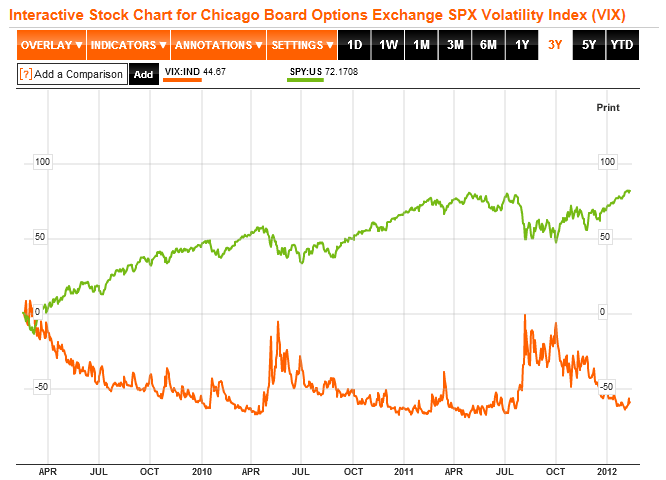
Lastly, some analysts are pointing to the Vix as a reason to expect a market reversal, as it back at the level which has marked a low multiple times in the last 3 years. However, as the chart shows below, the Vix could move sideways whilst stocks push higher, for a period.

Source: Bloomberg
Not only that, but if we look further back to 2005-2007, the final part of the last cyclical stocks bull, the Vix oscillated in a lower range (10-15 rather than 15-20) than in the last couple of years, which at least gives the possibility that the Vix could drop beneath the apparent horizontal base shown above.