In The Balance

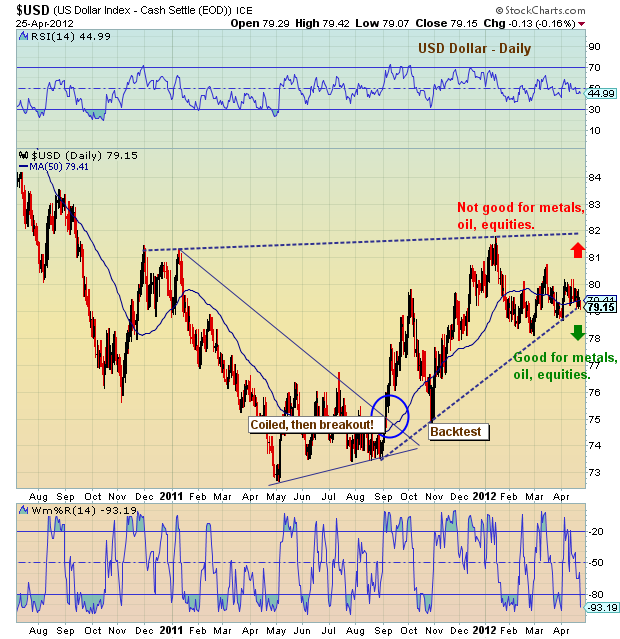
The US dollar appears to be on the verge of breaking down, but it isn’t a done deal yet.
Source: Andrew Nyquist

The Chinese stock index is on the cusp of a breakout. A Shangai breakout and a dollar breakdown would really give commodities some acceleration. However, no China break out either as yet, and a reversal into the triangle is possible.

Source: Bloomberg

AAII bullish sentiment has really washed out, which is supportive for US stocks.

Source: Bespoke

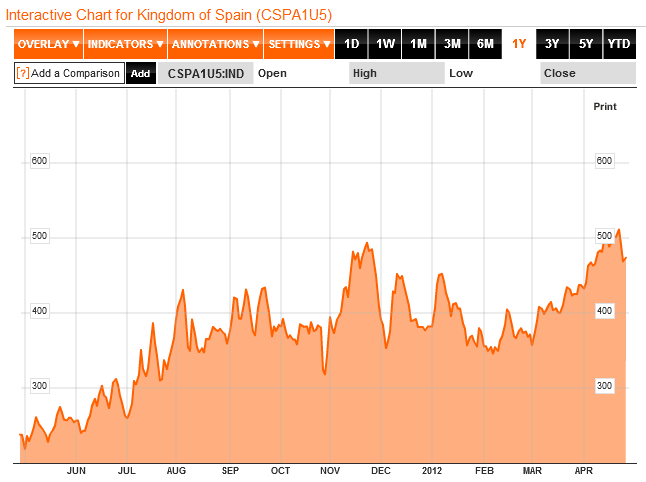
European stocks are underperforming, and Euro debt continues to weigh. Spanish CDSs have eased a little, but only to just below record highs. I expect them to come again.
Source: Bloomberg

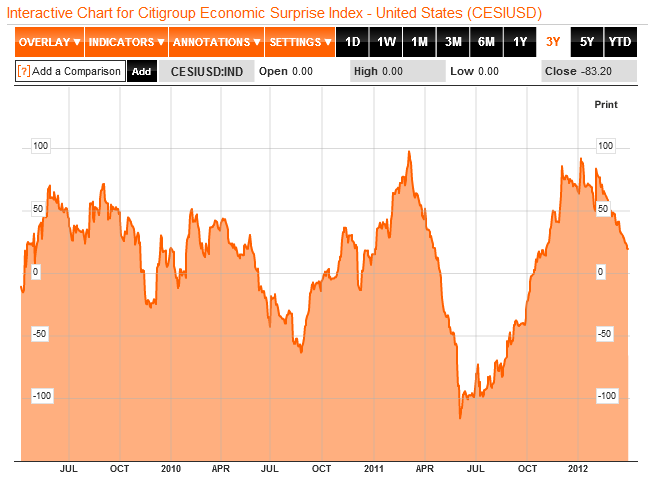
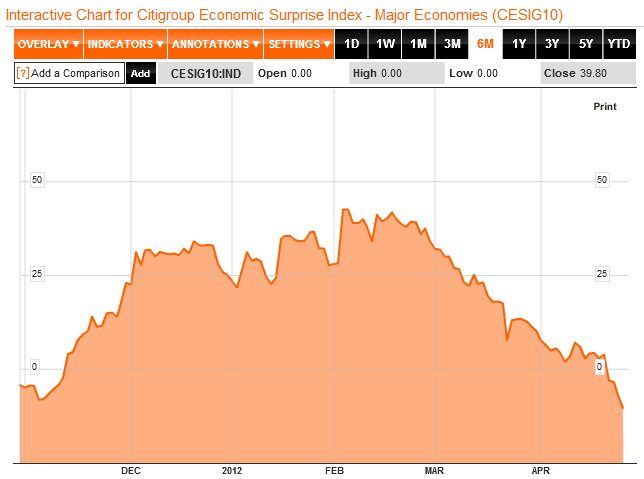
Economic Surprises continue to collapse.
Source: Bloomberg

Geomagnetism appears to have ebbed today, but 4 days of disturbance has tipped the model projection over to a slightly downwards bias, with particular downward pressure into next weekend’s full moon.
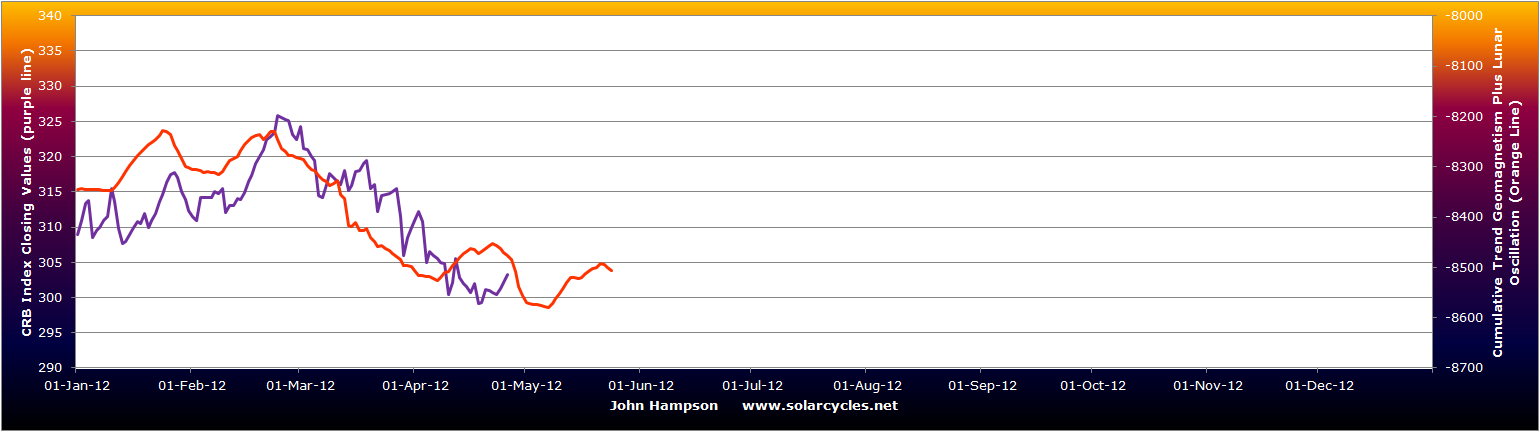
We have US earnings exceeding, a washout in bullish sentiment, and a double bottom on the S&P500 at the backtest of the 2011 old highs, together with a lack of major topping indicators at the 2012 highs, all supportive of further upside for stocks. Then we have collapsing economic surprises, Euro debt, and geomagnetism all exerting downward pressure. And we have the US dollar index and Chinese stock index both at crunch points.

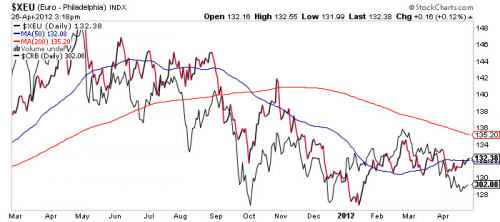
The combination of excessive pessimism in multiple commodities, higher sunspots which should encourage commodity speculation, and lagging in both Euro and Shanghai correlations as shown below, makes it likely commodities are about to perform.
Source: PFS Group / Stockcharts

If commodities are about to perform, then a breakdown in the US dollar and a breakup in China stocks would make sense, and those developments should in turn pull up equities too. But as yet we remain in the balance, and if we get movement the other way in the dollar/China, due to Economic Surprises, Euro debt, and/or geomagnetism/full moon then it may mean a little more time is needed. But to reiterate my expectations drawing together previous solar maximum / secular commodity conclusions, commodities should start to outfperform whilst stocks track overall sideways with volatility. I remain lightly long stocks and heavily long commodities.

On a personal note, Spring is here in the UK, and the outdoor pursuits are calling. I have a list of research threads to look into related to trading and the markets, some provided by readers, some of my own sourcing, but I expect to address them in the next off-season, towards the end of 2012. I fully intend to maintain posting and analysis several times a week, but additional deeper, original pieces of research are on hold for now, so if you put a suggestion my way, it’s on my off-season to-do list. The UK good weather season isn’t as long as some others, so time to make the most of it.


Update

The sun has woken up. Current sunspots are more in line with a rising trend.

A geomagnetic storm is in progress, so caution. But the extended geomagnetism forecast continues to show a flat to upwards trend ahead, which should provide support for risk assets.

I have updated all the short term and medium models, on their relevant pages.

Economic Surprises for major economies finally went negative yesterday – a bearish development.

Source: Bloomberg

European PMIs were weaker than expected, suggesting Europe is not out of recession yet. Leading indicators for Germany and China came in positive.

The US dollar remains undecided in the nose of its triangle, but running out of room. I maintain the expectation that the FOMC outputs may push it one way or the other.

Source: Stockcharts

Spain, Italy and France CDSs continue to rise. Portgual CDSs have fallen away and out of the limelight. But the bigger trio have the potential to overwhelm the markets if this continues.

Apple earnings today after the bell.

Solar Peak Secular Asset Conclusion

Here is a table showing just the last 3 secular commodities bulls and associated solar maximums. I have created a forecast along the top row for the current cycle, based on them.

I found it help clarify what could come to pass. Gold could potentially not peak until late 2013. But peak inflation should occur fairly close to the solar peak, suggesting oil/food, at least, should surge ahead of that, and gold should be performing well by association. Real equities valuations could potentially not bottom for another few years, if a recession begins later or a double recession occurs. It doesn’t alter my strategy or positions. It perhaps implies a little more patience is required in seeing it all play out.

The chart below shows the current Dow chart overlaid on the 1980-82 Dow chart. 1980 was the US election year like now, and it was also a parallel secular commodities and solar maximum. A similar unfolding would see equities track sideways to upwards into the elections later this year, before down into their final low in 2014. I would note though that the solar maximum takes place after the elections this time, not before like back then.

Source: Charles Githler (Hat tip Juan)

Turning to the current markets, Tiho did another great summary yesterday at his Shortsideoflong blog, and my thinking is very much aligned with that. I will just add that I continue to expect a bit more pro-risk upside into this weekend’s new moon, so that means today, but I expect to keep my bounce longs as the upside hasn’t been decisive. As my equities longs are fairly small, I would happily add lower if this turned out to be an extended B wave in an ABC down. Sunspots continue to increase. Economic Surprises continue to flounder. Asia continues to outperform currently.

Charts

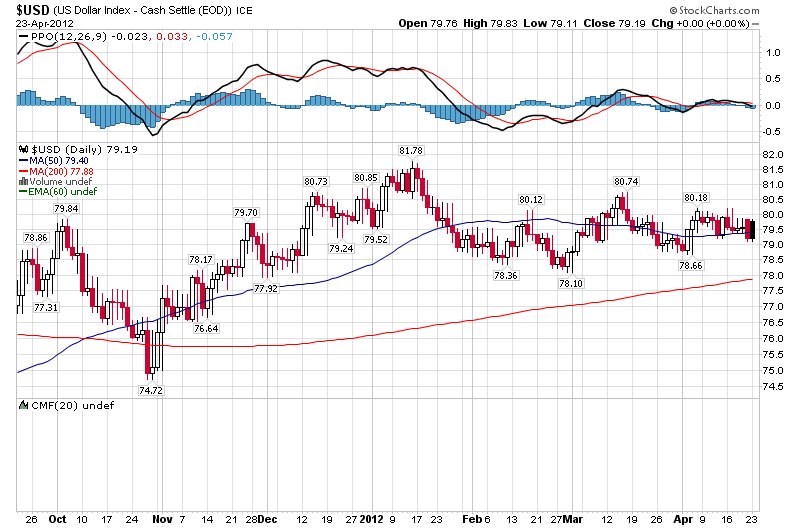
The first chart shows the Aussie dollar broke out of a falling wedge and successfully backtested, which previous marked new bullish uptrends in stocks and commodities.

Source: Chris Kimble

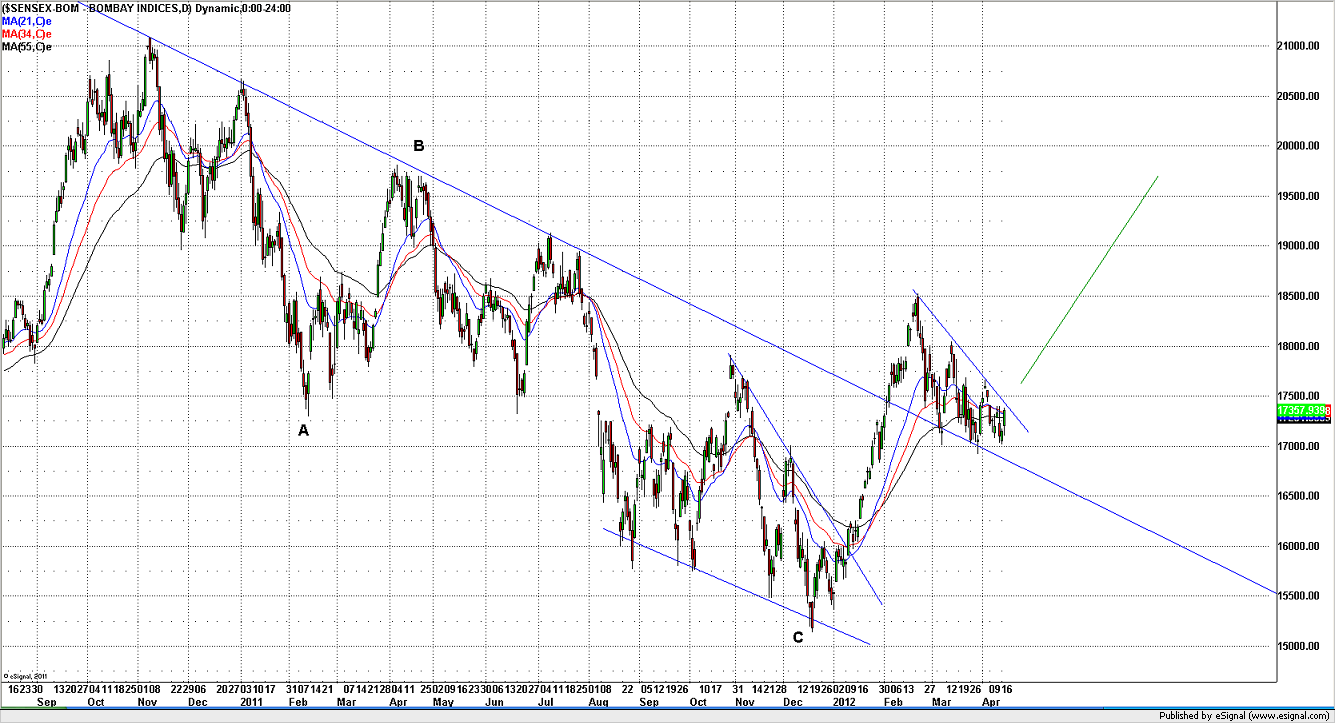
This second chart shows the Indian Sensex in a similarly bullish technical formation.

Source: Market Letters

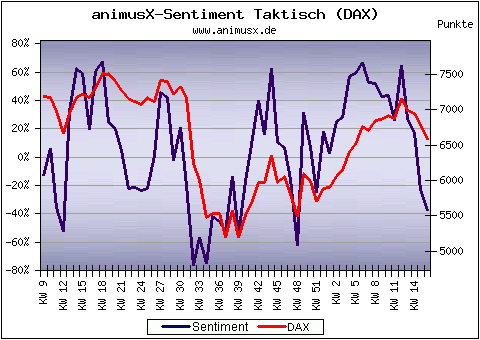
The third chart shows that Dax sentiment washed out fairly swiftly, echoing AAII sentiment for US indices, making upside appear more likely  than down, from a contrarian perspective.

Source: Animus

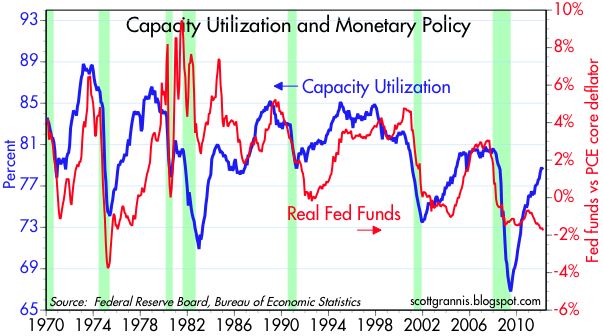
And the last chart shows capacity utilisation as a US economic proxy, revealing the Fed has kept rates too easy recently, making significant inflation ahead more likely.

Source: Scott Grannis

All four charts make pro-risk look attractive right now. Shorter term I am still looking for upside into the end of this week, and will then review whether or not to sell my bounce equity longs. There are more important earnings first, and I am aware the uptrend in place again since yesterday could yet be part of a longer B wave that began a week ago, in an ABC correction down. Alternatively, given how quickly capitulative breadth was reached, the low could already be in and a revist of the highs coming next.

This Week

Friday’s action was a reversal of Thursday’s strength, including a potentially decisive channel exit for Apple, and Spain CDSs reaching new highs.

I maintain the expectation of upside into the end of this week, into the new moon. There are some key US earnings out this week. Last week’s opening set produced a beat rate of 75%. If Spain becomes more accute, or earnings disappoint, and we make a lower low on the indices, I’d be looking for more evidence of capitulation or positive divergences, such as on the Nymo. Only Spain debt is showing signs of stress currently. There is no notable contagion elsewhere. However, it is a large economy with peak debt rollover requirements this year, so clearly a threat.

Economic Surprises remain in their overall downwards trend, whilst still positive, and ECRI leading indicators remain in their uptrend, now at 1.4% positive. PFS recession leading indicators show no current likelihood of the US slipping into negative growth.

Gold miners are into week 9 of a potential perfected DeMark buy set up this week. The US dollar is pressing for the decisive triangle breakout against the Euro.

Two great posts by Tiho at his Shortsideoflong Blogspot on Friday and today.

OK, to sum up, I expect a push up in stocks into the end of this week. If we get that, I may exit my bounce longs. If not, I’d look to add more lower down on signs of capitulation or positive divergences. In the medium term, I still expect overall sideways action for stocks, with global leading indicators still on the up, but economic surprises on the down, with us having seen no regular major top indicators at the March top, and having fairly swiftly reached oversold Nymo and a washout in bullish sentiment. I maintain the better opportunities are in gold and miners, which are due lift off. But the US dollar may hamper this. Continued stress in Spain debt may weaken the Euro versus the dollar.

Models

Yesterday a little pressure eased in Euro debt as there were supportive bond-buying noises from the ECB, but Spain CDSs remain critical. Crude oil inventories came in above average, but didn’t translate into downward pressure in the oil price. Capitualtive Breadth ended at 6 or 7 despite the upswing in stocks, suggesting equities should be underpinned and that a rally remains likely. The US dollar index remains in its triangle for now.

Will Preston has kindly shared his updated models with us again. These models are an amalgamation of political cycles, economic cycles and statistical cycles. The first chart is the SP500, showing overall sideways volatility but with an upward bias into the summer.

Tom McClellan’s Eurodollar 1 year advanced model predicts sideways consolidation into June, whilst geomagnetism seasonality predicts an upward bias into June. Jan Benestad’s 100 day momentum indicator suggests a higher high in around 2 months time. Stock market health remains pretty good, with no typical major top signals at the March top. Euro debt, China growth and Economic Surprises remain threats, but leading indicators and Operation Twist continuing into June remain supportive. Drawing all that together, sideways volatility with an upward bias for the next couple of months appears reasonable, unless there is a significant escalation in one of the listed threats or US earnings signifcantly disappoint.

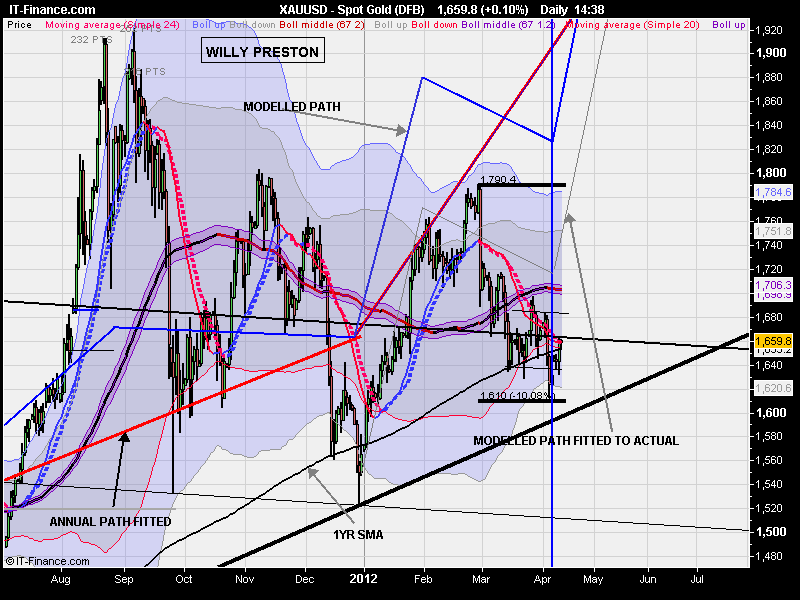
Next is Will’s gold model, which shows a steep upward bias from now into August, with a target of $2600 by early August.

The inverse head and shoulders formation, which can be seen in that chart, has a target of $2050. With gold recently triggering overbearish and intermediate term buy signals, I consider there is a reasonable chance of that fulfilling. That would make for a new all time high, and would decisively end any doubt that gold’s bull was over. With that confirmation, and into clear air, gold could really become a momentum buy. However, for now, we are a long way from that, with gold going nowhere in the middle of a 6-month sideways range.

Sunspots have weakened again, but by planetary influence should pick up in May/June again. Increasing sunspots should encourage speculation in commodities and inflation.

Opportunities

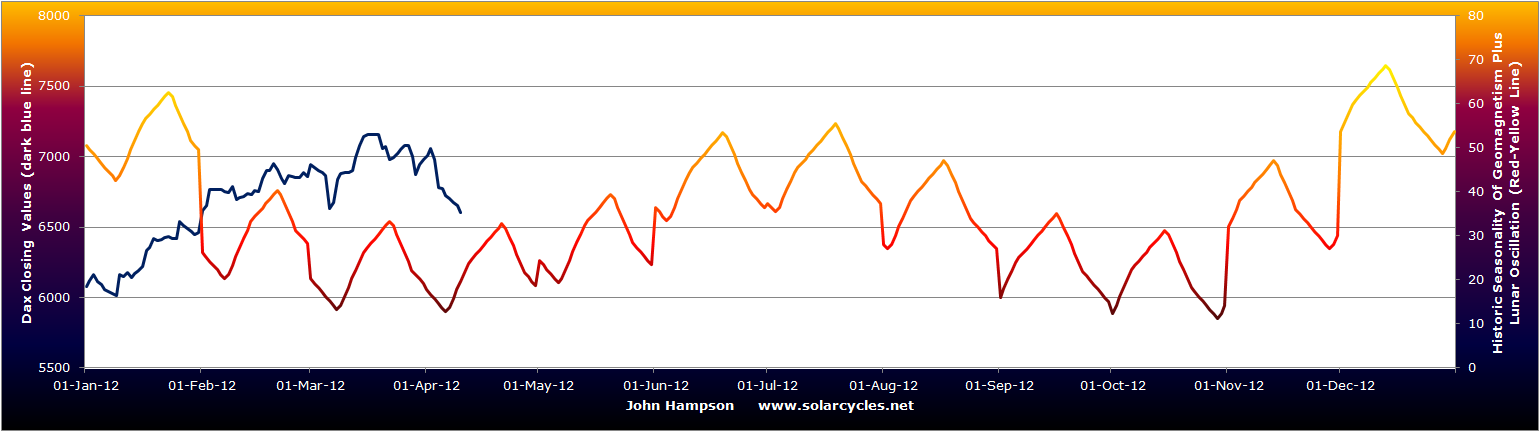
Got back from vacation last night, and my priority was to look for any glaring opportunities, covered below. I will catch up gradually on mails, comments, etc. I have updated the short term models page and will update the others in due course. Below are models for the Dax and CRB which show potential upside from now into the end of next week.

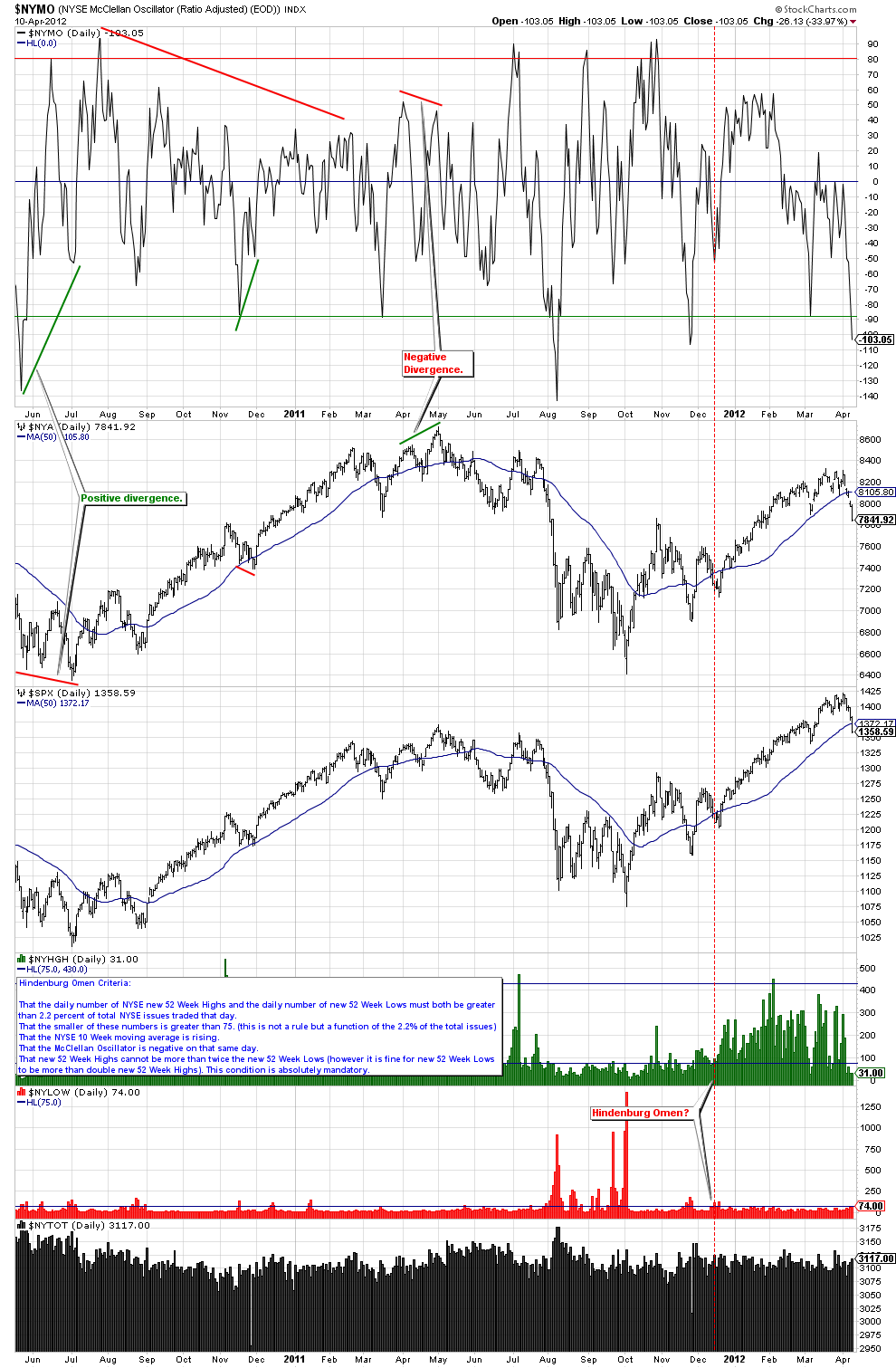
Stocks finally corrected then, and yet we now see a very oversold Nymo – below – which is a good signal for a bounce. Plus, Rob Hanna’s Capitulative Breadth indicator jumped to 6, where 7-10 historically implies capitulation and a market bottom of some kind. Together, they suggest the market won’t fall away here but will bounce soon, if not to a new high then to a partial retrace of the falls. I have therefore bought stock indices for a bounce.

Source: Stockcharts / Cobra

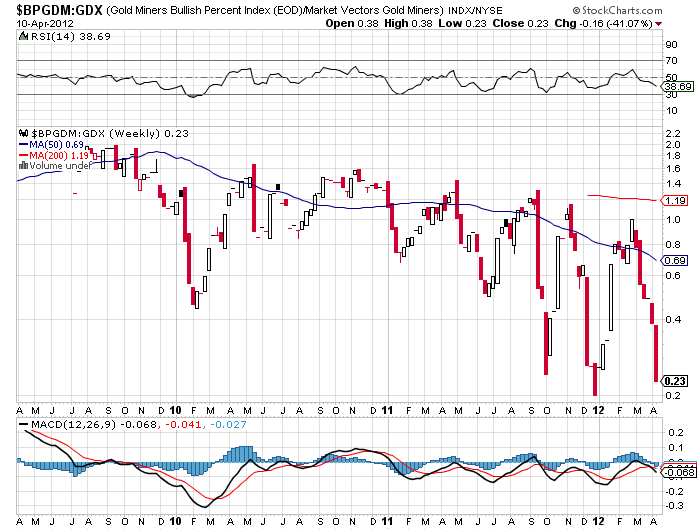
Gold and gold miners are the other opportunity I see. Here is gold miners bullish percent versus the gold miners ETF at a level which has historically been a great buy.

Source: Stockcharts 

By various oversold/overbearish indicators, gold and gold miners look a buy opportunity here. Bernanke’s remarks whilst I was away that implied no QE3 caused another sell off in gold, but I believe that’s just part of the final clear out of weak hands. Gold does not need QE3 whilst negative real interest rates, central bank demand, money supply increases and real inflation data all remain supportive.

Regarding ‘threats’: China slowdown, Euro debt re-escalation and Economic Surprises downward trend, there is some positive news on the former, but worsening on the latter two.

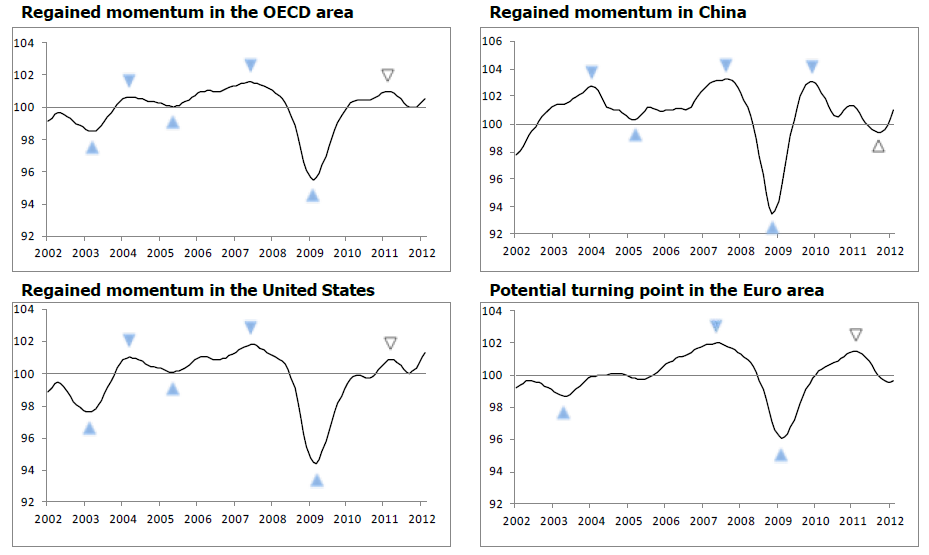
Here are the latest OECD leading indicators. China has flipped to the positive since last month’s readings.

Source: OECD

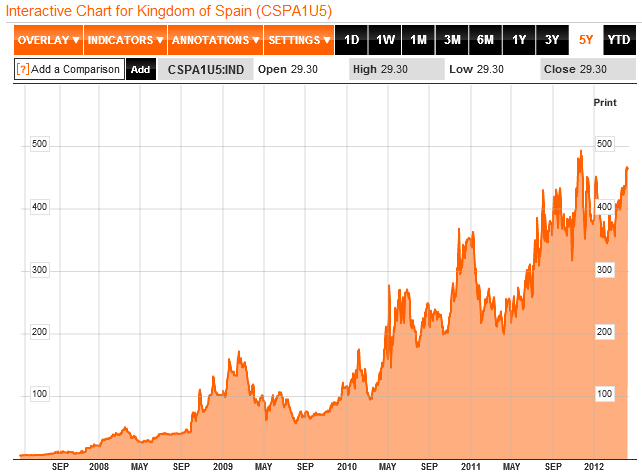
ECRI’s leading indicators for the US also finally moved into the positive. Euro debt has flared again though, through Spain. Here are Spain CDSs. Italy CDSs are also trending up but not quite as critical as Spain.

Source: Bloomberg

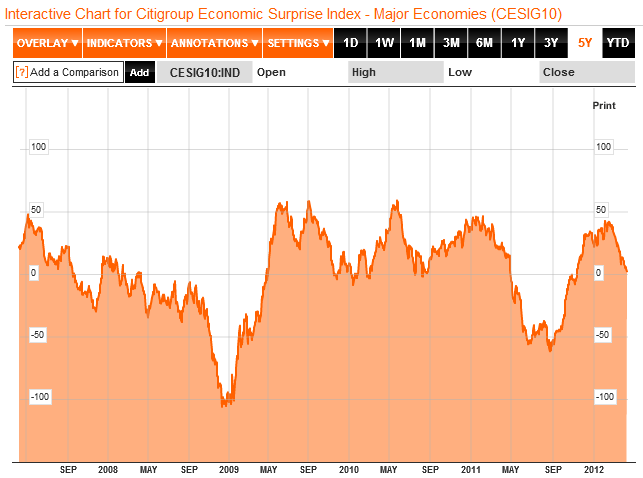
Here are Economic Surprises for the main global economies, which continue their downtrend but remain just positive. US Economic Surprises are similar.

Source: Blooomberg

The situation in stocks, Euro debt and economic surprises shares some similarities with the first half of 2011. Then, stocks exited their strong uptrend in Feb 2011, as Surprises dropped and Euro debt came to the fore, but stocks traded overall sideways into July, with opportunities long and short. As we did not see major topping signals with our recent March 2012 top, I suggest we may be in for something similar, and the quick reaching of Nymo and CBI bounce signals supports this. My projected bounce window is into 21/22 April, so the end of next week.

US earnings kicked off yesterday and will be influential on the markets, but we won’t get a feel for an earnings trend until next week.

This Week

On the macro front, a persistent dropping in Economic Surprises (echoing last year) makes it likely the stock market rally will soon pause or end, if it hasn’t already begun that process. However, we still don’t see a general set of extreme overbought/overbullish indicators in equities. If stocks continue to go up and surprises continue to decline, then a short will become more attractive, but I would be looking to other factors in assessing how attractive.

Source: Bloomberg

One such factor would be the potential resumption of debt worries to the fore. Spain is the only country looking likely to do this currently, with Portugal, Italy and Japan CDSs going the other way. But as can be seen from the Spain chart, previous highs are not that far off again. If this upward trend continues then it is likely to scrape at global bullish investor sentiment.

Source: Bloomberg

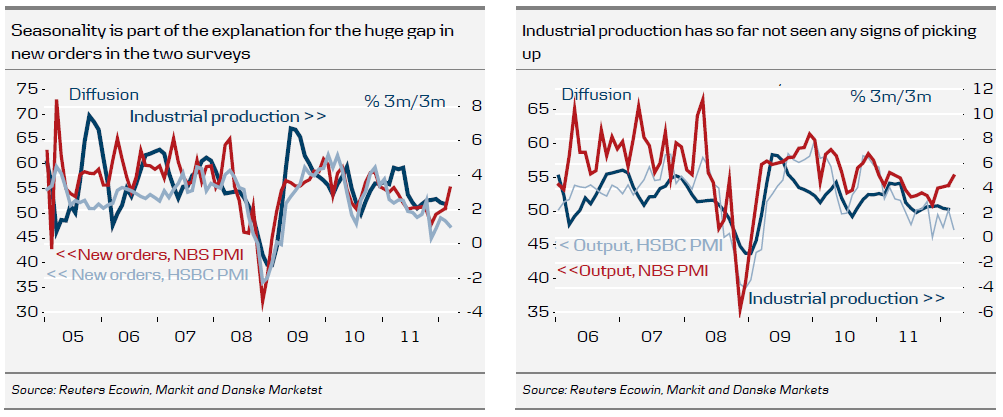
Another factor is China. Concerns over a slowdown are playing on commodities, and new orders surveys have produced mixed results. China doesn’t want to cut interest rates whilst maintaining that property needs cooling, but is more likely to cut bank reserve requirements again in April. Until evidence becomes more persuasive of China easing and/or China growth improving, this is another potential dampener on US equities sentiment.

Source: Danske Bank

For now then, investors, particularly in US stocks, remain unconcerned about economic surprises, Spanish debt and China slowing, but this is often how it works. The bull extends as negatives grow, only for a sudden collective shift in sentiment, with participants becoming of the view that the market has moved too far, too fast. Of course, if surprises start to improve again, Spain does something to ease CDS pressures or news from China gets better, then equities and pro-risk in general could yet advance further.

One other macro factor to mention is that the latest POMO schedule has been released and net sales begin April 9th. That may be another downward pressure factor, as per McClellan’s relationship chart between the two, that I previously posted. Countering this, the Bank of Japan added to stimulus last week.

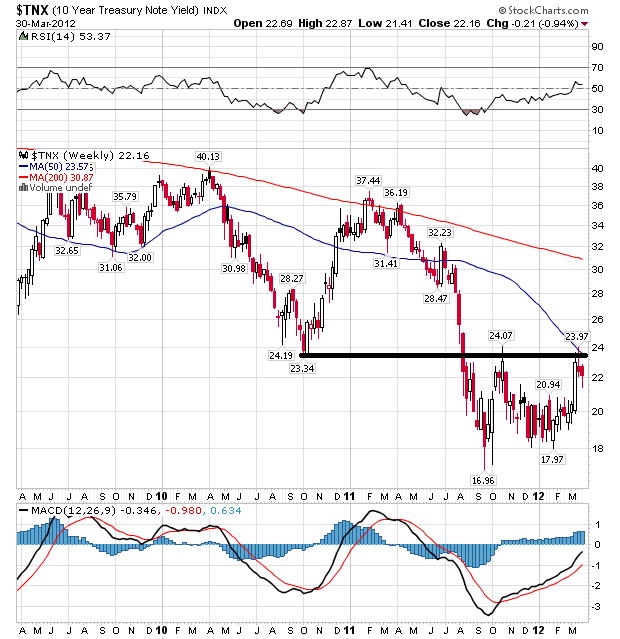
A look at treasury yields and the dollar reveals a delicate position in both. 10 year yields completed their obvious move up to the s/r line shown, and now the question is whether they can penetrate and rise above that line, or whether that was just a counter trend rally. The Fed’s actions and words may have some influence in this, and the next FOMC is April 24/25.

Source: Stockcharts

The US dollar index is likely to break one way or the other soon. As per with treasuries, dovish or hawkish words or actions from the Fed are likely to play into this, but also the general macro factors listed above, and their pro/anti risk connotations.

Source: Stockcharts

Gold and miners remain overbearish and should therefore likely soon take off. Soft commodities rallied on Friday as inventory reports revealed steeper drops than expected for corn and others, but broadly speaking commodities are languishing versus equities, so we likely need a confluence of factors to bring about sustained strong gains.

There will be no posts or model updates now until 11 April, as I am away on holidays, and taking a proper break from the markets. I will respond to mails/comments on my return.

Solar, Earnings, Commercials

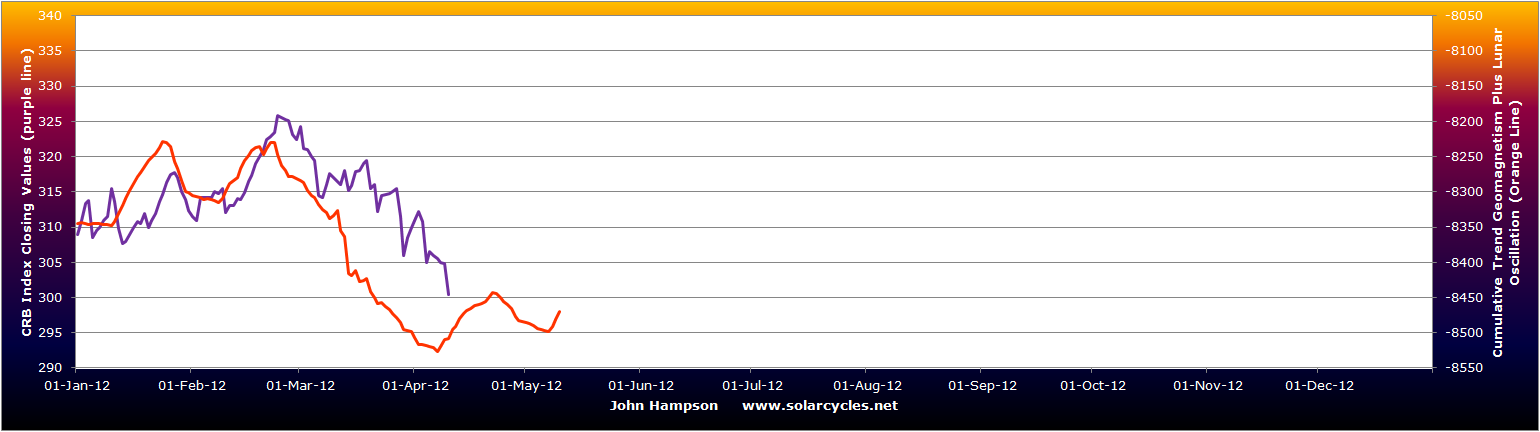
The R/J CRB commodities index now looks very close to the geomagnetism and lunar model in 2012:

It is a closer match than equities so far, which is in contrast to my expectation, as I predicted that commodities would pull away from the model into the solar/secular peak of 2013, whilst stocks would stay with the model. Well, that may still happen, and I believe there is a greater likelihood once sunspots pick up in a sustained way.

Above, we can see that sunspots are starting to trend up again, but we should see them push up higher and longer as we wave our way into the solar peak. That should in turn inspire speculation and inflation.

Scott Grannis has some useful insight into the apparently extreme US corporate profits. This first chart you may recognise, as its the one that suggests mean reversion should be imminent. However, the second shows corporate profits as a percentage of global GDP rather than US GDP, which shows US company profits closer to average. Because companies have globalised and emerging markets have grown faster than the US, the result has been a distortion of the first chart, with the second a more true picture.

Source: Scott Grannis

Lastly, Tom McClellan uses a model of Euro-dollar net commercial positions advanced by 12 months to predict the stock market (hat tip Gary), in other words, how the big commercials position themselves in this contract is reflected in the stock index a year later. If that sounds unlikely, here is his explanation: ” It may help to understand that the commercial traders of eurodollar futures are typically the big banks, who are using these futures contracts to manage their assets and fund flows.  So what we are seeing in their futures trading are responses to immediate banking liquidity conditions, and those actions give us a glimpse of future liquidity conditions for the stock market.  These liquidity conditions are revealed first in the banking system, and then the liquidity waves travel through the stock market a year later.”

Here it is this week, predicting consolidation in stocks from now into June, and then a rally into US elections in November:

Source: Bloomberg