Reversal Ahead

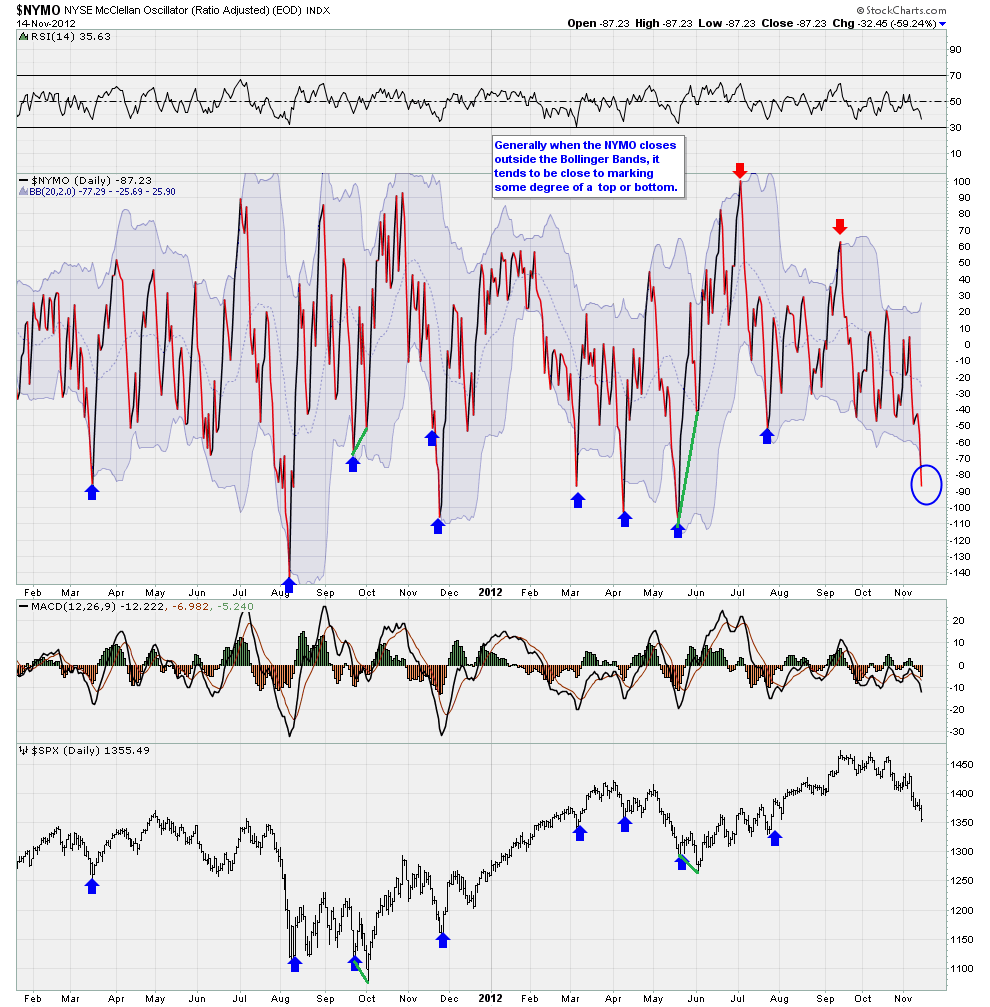
For NYSE stocks, take a look at the Mclellan Oscillator as at the end of Wednesday’s session:

Source: Breakpoint Trades /My positive divergences in green added

Out of the lower bollinger band and sufficiently oversold to suggest a bounce right ahead. The question is whether US stocks are a buy here or whether they need to print a lower low following a relief bounce with a positive Nymo divergence – see green highlights.

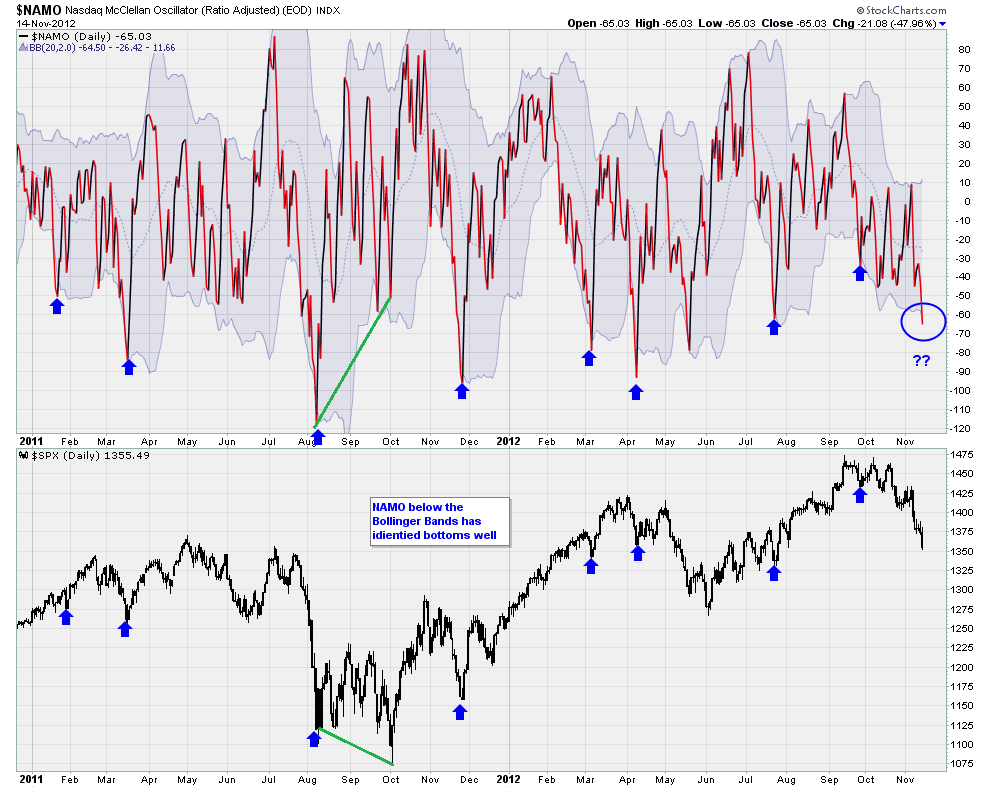
Here is the Nasdaq Mclellan Oscillator, and the same applies:

Source: Breakpoint Trades /My positive divergences in green added

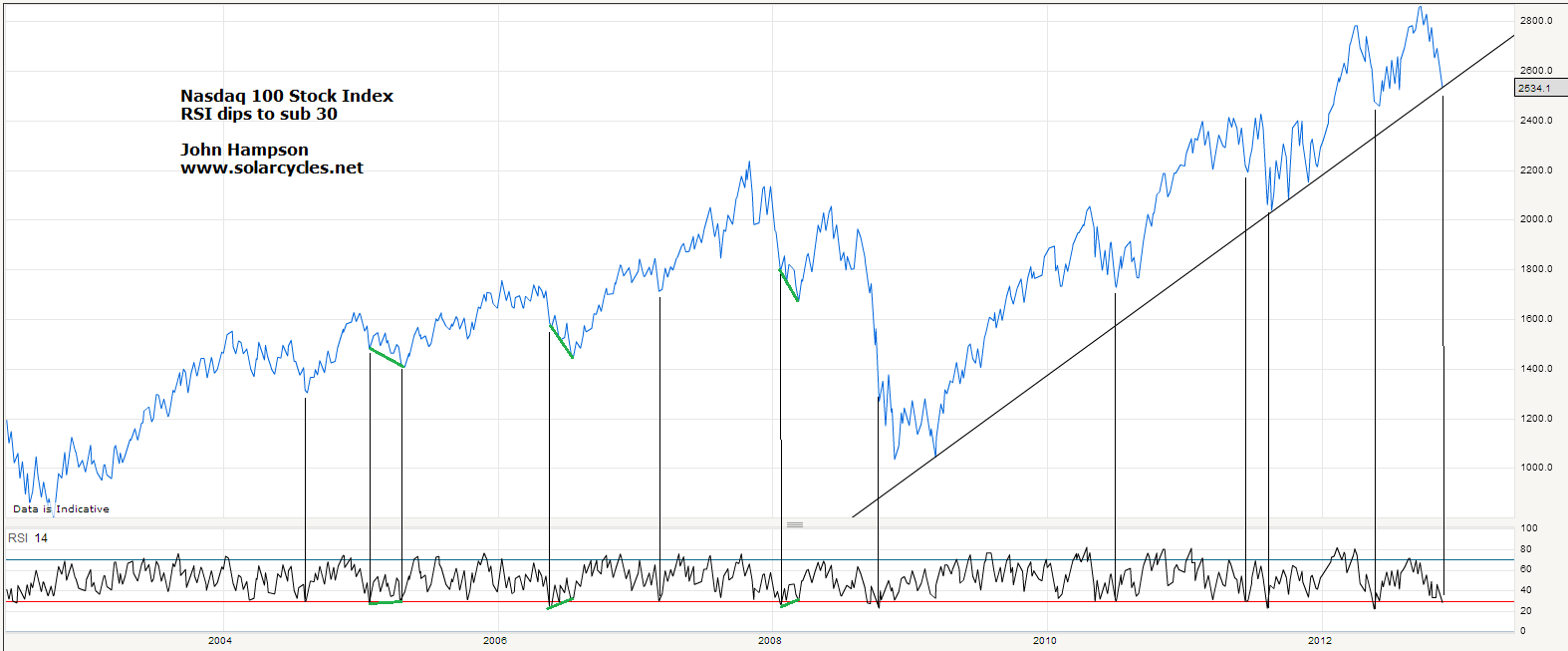
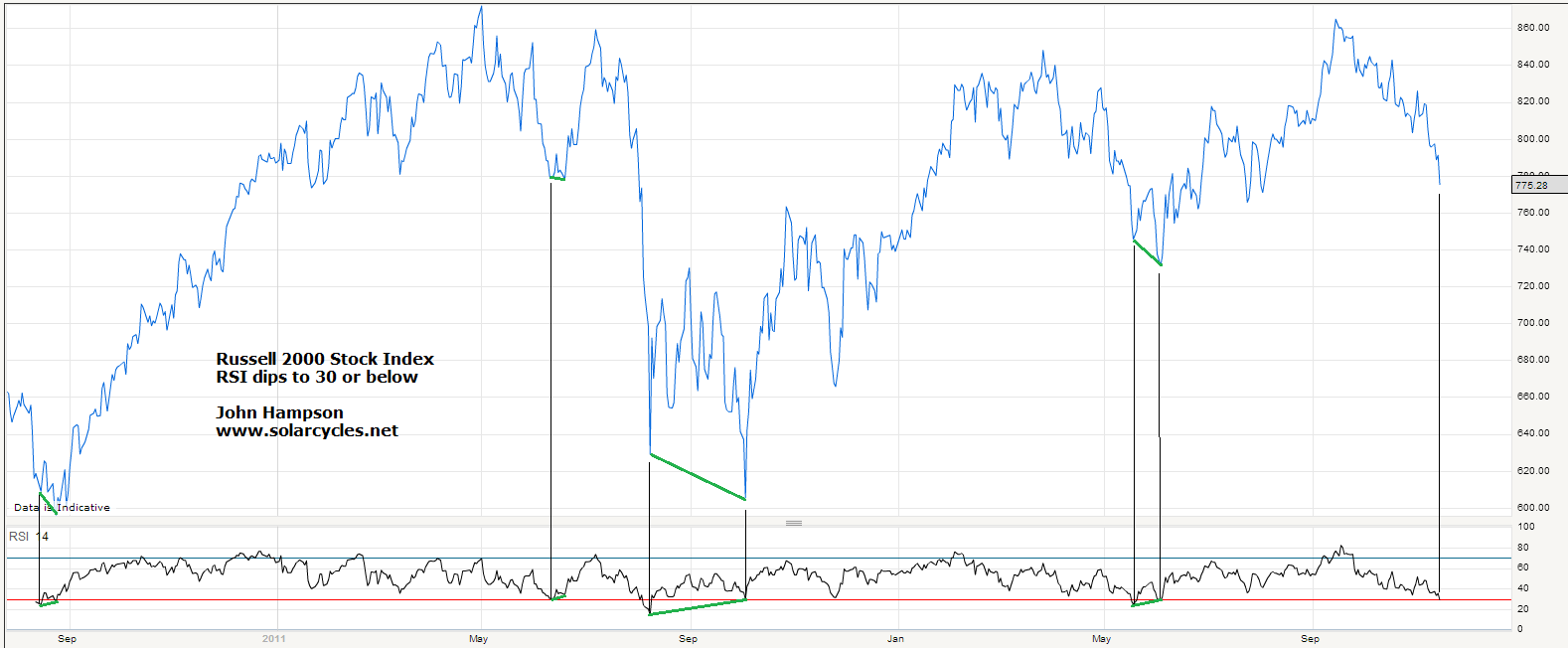
The Nasdaq RSI is also sufficiently oversold to suggest a bounce. I have highlighted previous such occurences and the story is similar to above – either a reversal occurs, or stocks need to print a lower low in the weeks ahead with a positive RSI divergence (again shown in green):

And here is the Russell 2000 index, with the same message as above:

To add to this, Sentimentrader reveals that the majority of US stock market sectors are at bearish sentiment extremes, and stocks above the 50MA have reached the lowest range. So there are reasons to expect a bounce in US equities as early as today. The unknown is whether they will reverse course, or merely make a relief bounce before a lower low with positive divergence.

Looking wider, daily sentiment index extremes are currently showing for treasury bonds (extreme bullish) and Nikkei, soybeans and coffee (extreme bearish). This suggests a bounce in US stocks may well be part of a broader bounce in pro-risk and away from safety.

We have just seen a lunar inversion – stocks declining into this week’s new moon. That gives potential for a brief relief rally before a lower low into the week commencing 26 November – the week of the full moon. That would roughly tie in with the Gann predicted take off point for commodities (and reversal in stocks) around 21 November. Alternatively, lunar inversions have sometimes historically meant trend changes, so there is the potential to rally from here and not look back, which would be in line with the presidential seasonality and geomagnetism I presented earlier this week, and also close enough to the Gann take off.

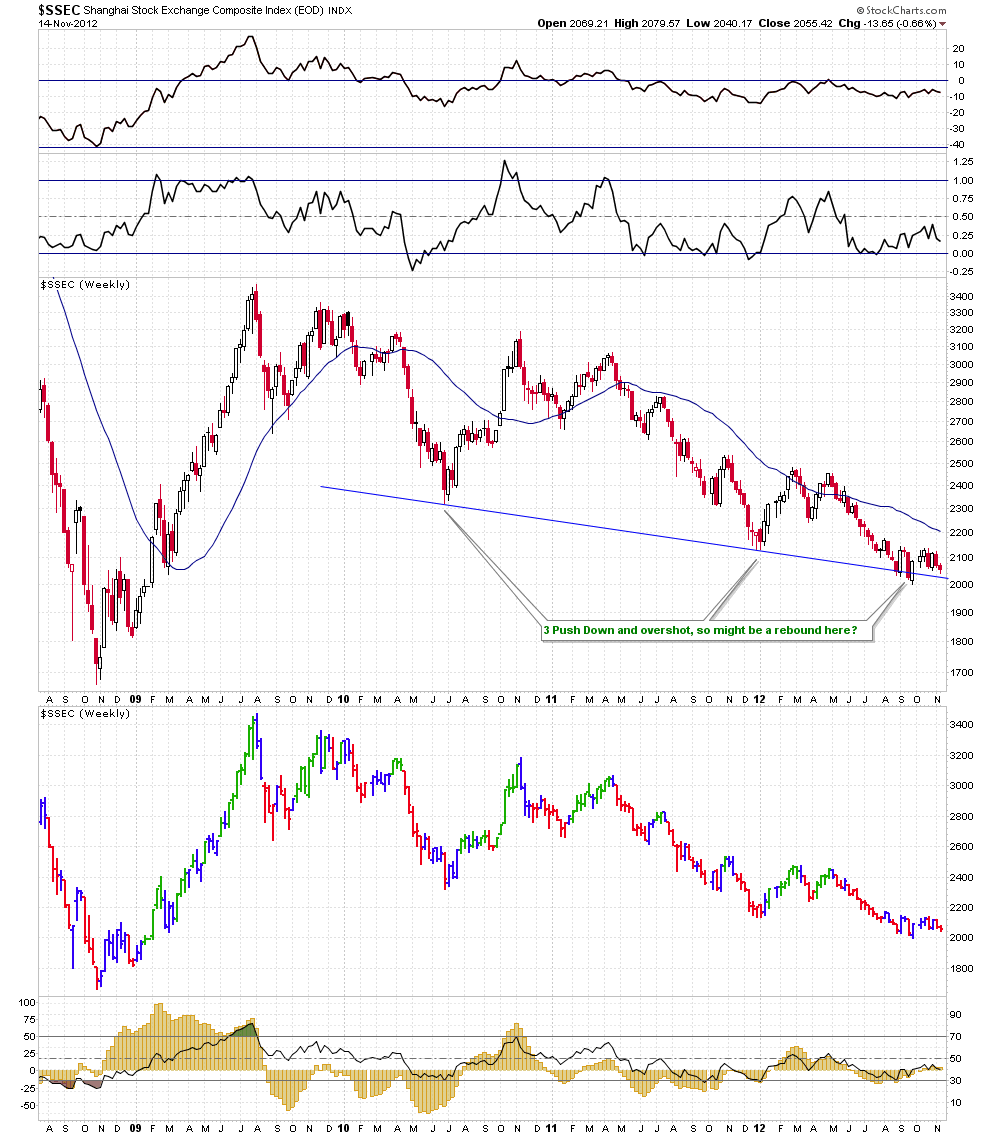
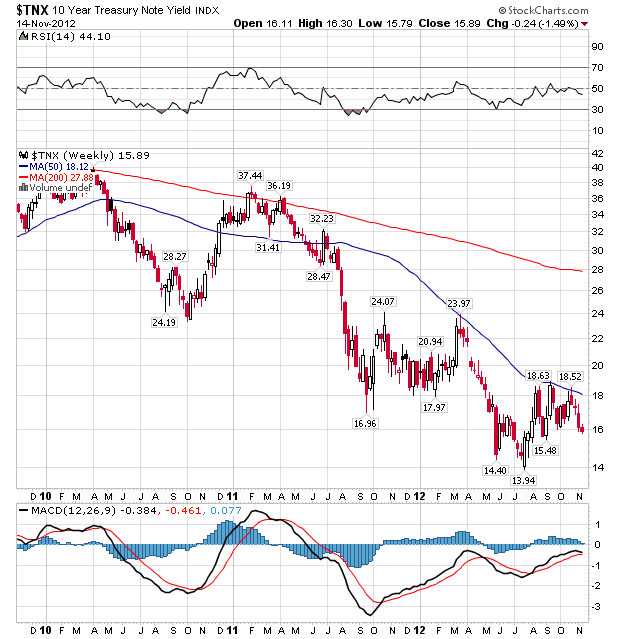
Both Chinese stocks and US treasury yields are still trying to carve out bottoms, both holding above their lows and with the potential to make inverse H&S patterns, and doing so on extreme cheapness. Potential bottoms only of course, but with justifications.

Source: Cobra / Stockcharts

Source: Stockcharts

Russian stocks have also dropped further since I opened a position last week, now at a p/e of just 5.8. Coffee public sentiment is at an extreme low not seen since 2001.

In short, there are a few candidates in my mind to play a bounce in pro-risk – and that includes US equities – and I’m just weighing up where and if I want to add today. The ‘if’ part is related to the potential for a lower low ahead, where a positive divergence in breadth or RSI is required.

We do not as yet see a washout in other indicators, such as sentiment surveys. These might also suggest caution. However, I maintain that if this is a topping process in stocks then we should see up-down volatility near the top, rather than the kind of deep cleansing washout that enables a bull market to continue.

Will post in the notes if I add positions.

Global Stocks Secular Bear Market

This is my pattern and projection for the global secular stocks bear market and its conclusion, based on solar/secular history:

That secular bear pentagon is present in the individual main country stock indices. Here is the current UK FTSE and my projection (click for larger):

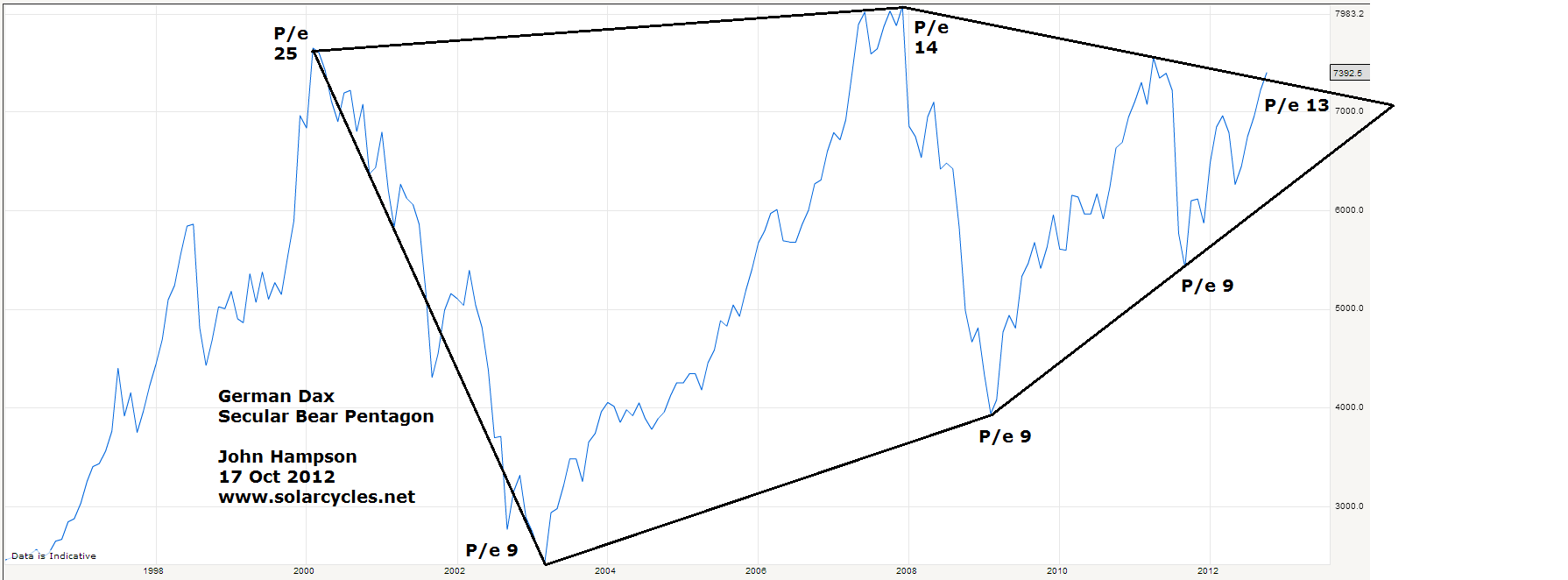
Here is the German Dax:

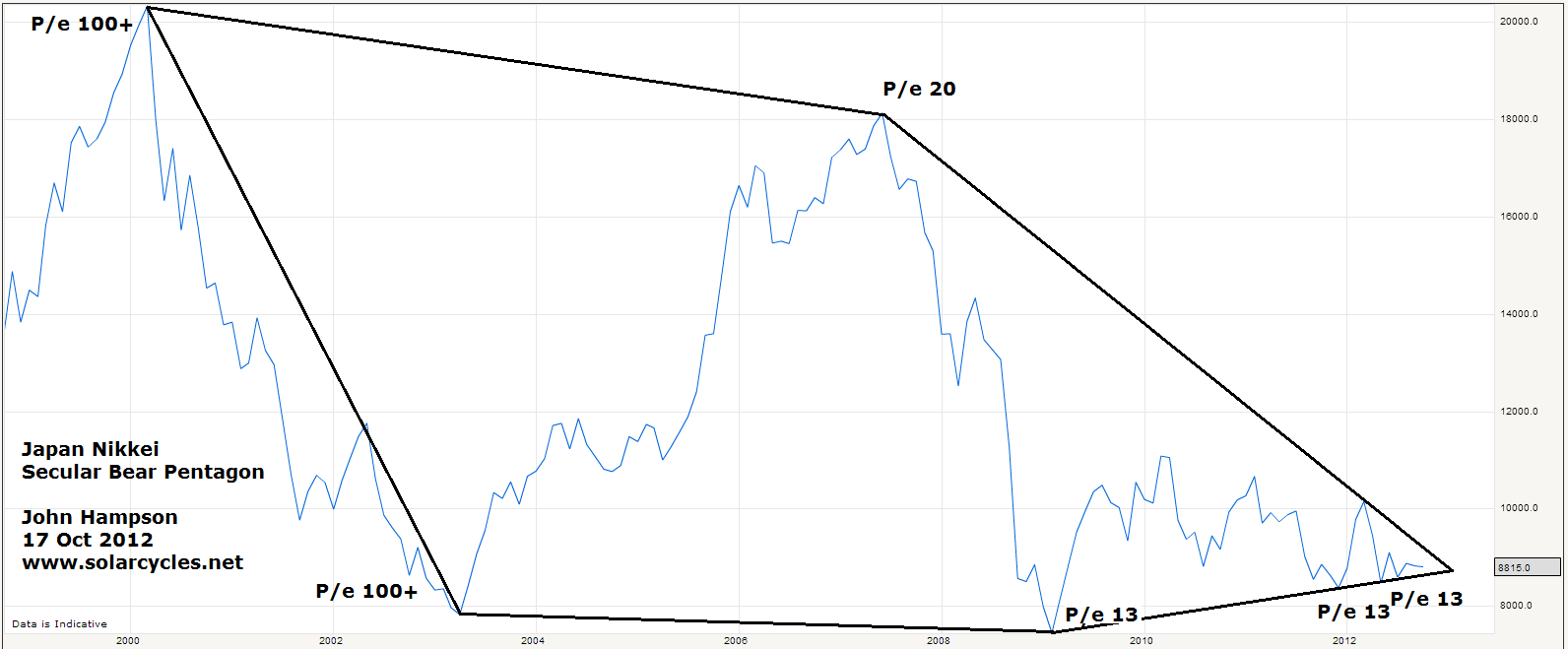
Moving to Asia, here is the Japanese Nikkei:

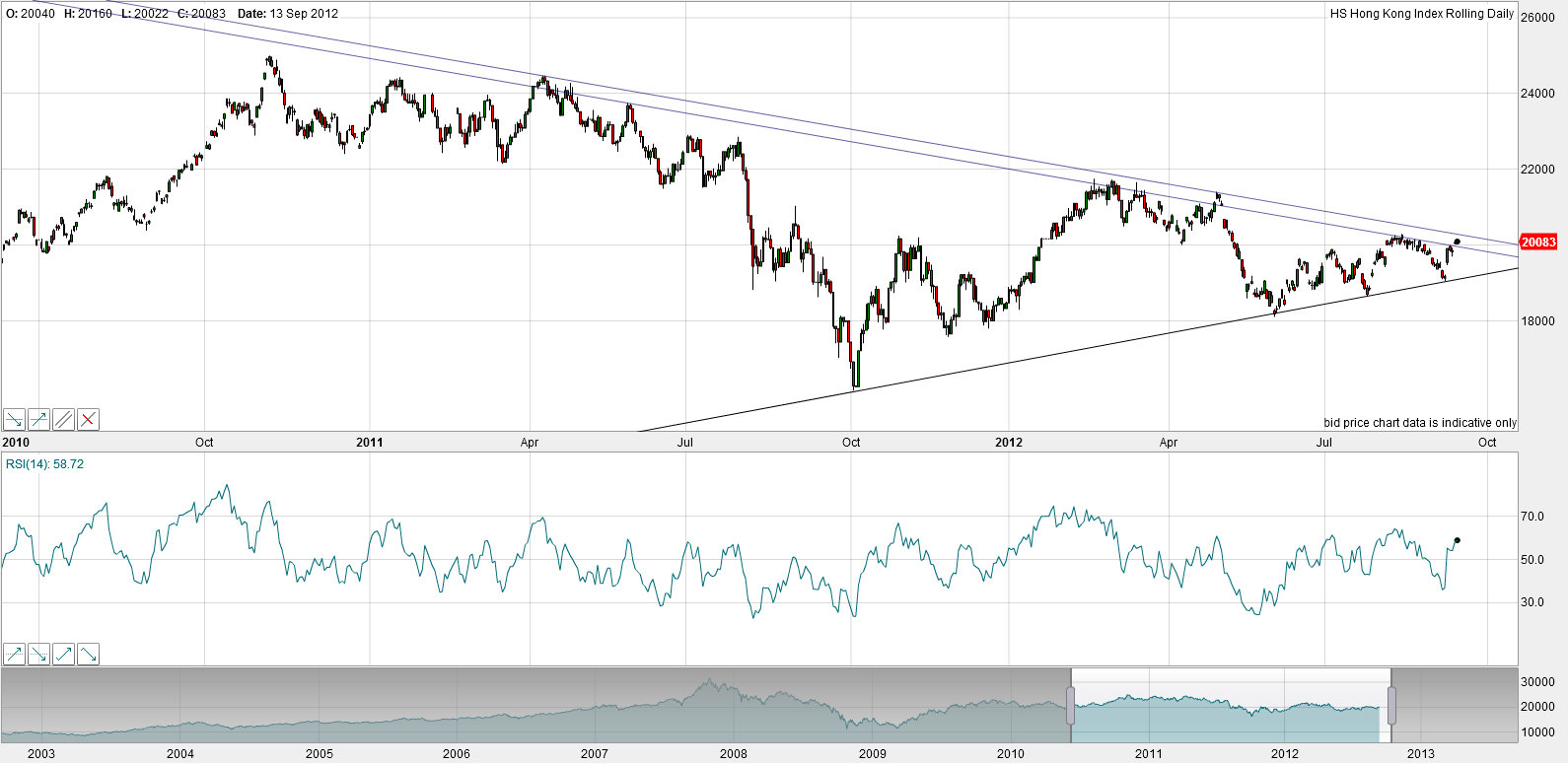
Here is the Hong Kong Hang Seng:

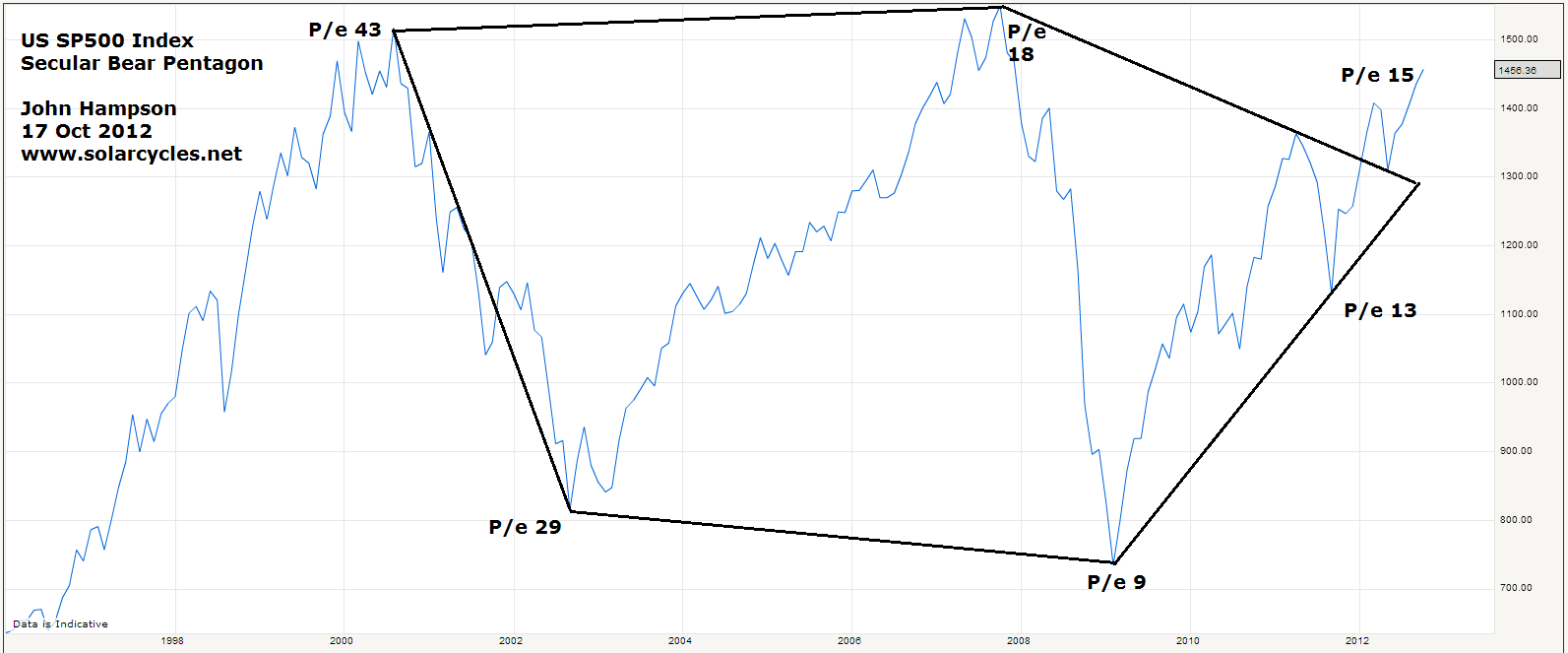
Moving to the US, here is the SP500:

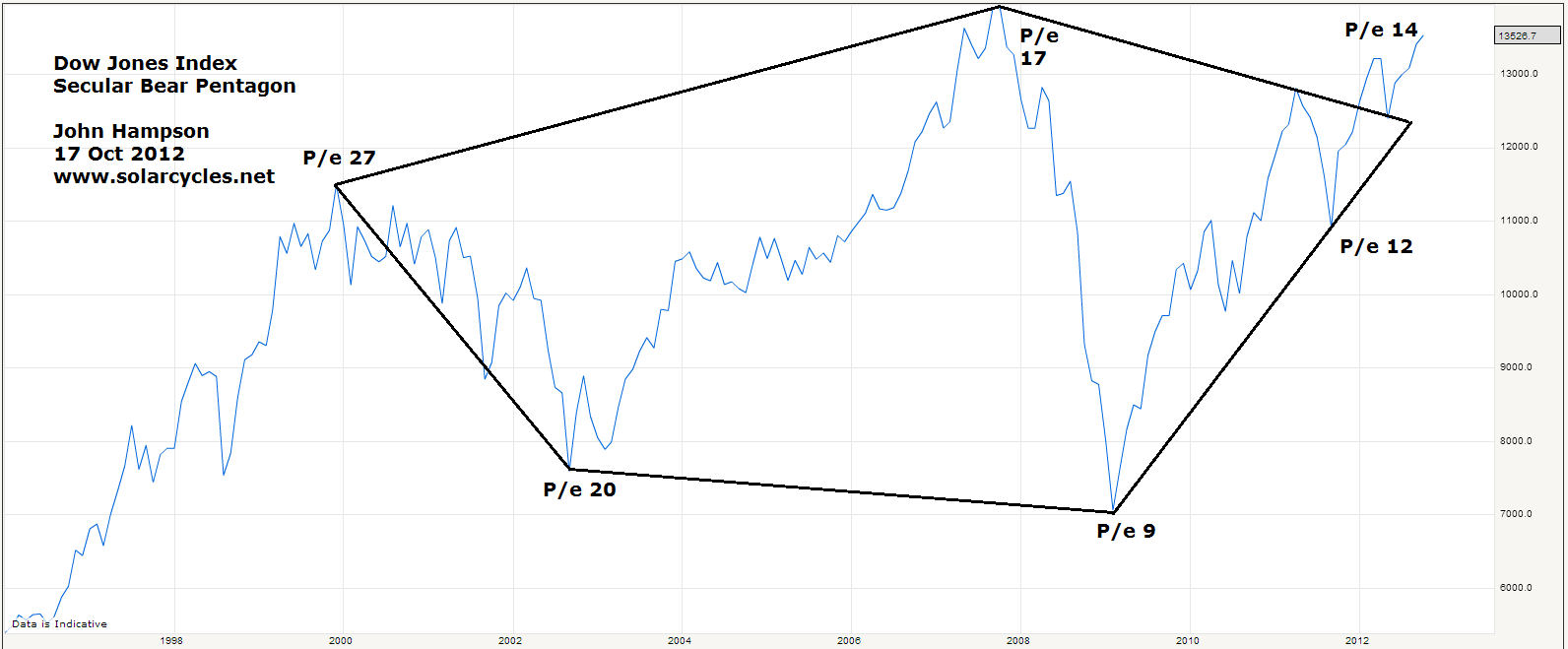
And lastly the Dow Jones:

So, my projection for all the indices is an approximation of that shown on the MSCI world stock index and the FTSE index charts at the top, namely a breakout upwards out of the pentagon into 2013, followed by a giving back of those gains and a retreat to the pentagon nose price level 2013-2014 (leading into and out of a mild recession), followed by a momentum take-off in a new secular bull market as of 2014/15. The US stock indices have led the way out of the pentagon, with the German and Hong Kong indices are now attempting to break out also.

I have added the price/earnings valuations of the indices at the key highs and lows. There is a theme of p/e valuations declining over the secular period, which is consistent with normal secular bear progress. It is inflation that makes secular bears track overall sideways rather than downwards, but progress in p/es reveals the true decline in stocks from expensive to cheap.

Secular bear history dating back into the last century reveals that stocks become a long term buy once they hit single digit p/es. In the secular bear to date, all the indices above have hit single digit p/es for a period, except the Nikkei. Despite falling the farthest in terms of valuation from its peak, the Japan index has only just lately come back to fair value when compared to the other country indices, and accordingly has the sorriest looking chart.

In the secular bear of the 1970s, the Dow Jones hit p/e 7 at its lowest valuation. In the secular bear of the 1940s, the Dow Jones hit p/e 9 at its lowest valuation. I suggest there is a reason why that stock index was bought up at a higher bottoming valuation in the 1940s than in the 1970s: the difference in secular yields/rates. Whilst the 1970s mirrors the 2000s in terms of a secular commodities bull and secular stocks bear, the 1940s is our closest match historically as it is both those but also a secular bonds bull. The 1970s was a secular bonds bear. It makes an important difference, in that equities are more attractive relative to other assets when bond yields and rates are ultra low. These next two charts show how stocks have now moved to relative extreme value versus treasury bonds and corporate bonds by dividend yields.

With both types of bonds paying negligible or negative real yields, the relative attractiveness of equities in that environment becomes that much greater. It is the pessimism that characterises the end phase of a secular stocks bear that is keeping money parked in bonds, but once confidence grows in economic outcomes, money should flow the other way. I am suggesting that stocks could bottom at a 1940s style p/e 9 rather than a 1970s style p/e 7 in this environment because of the additional value provided by dividend yields over and above treasury and corporate bonds and the relative attractiveness of true yielding assets in a negligible interest rates environment (rather than a high interest rates environment like the 1970s).

Solar and secular history predicts an inflationary finale in 2013, which if stocks went nowhere (nominally) would reduce p/e valuations further. I therefore expect that my projection of stocks breaking out and then returning to that kind of nominal level perhaps 18 months hence will see the indices largely breaking beneath 10 into single digit p/es at the ‘go’ point. The US indices, currently the most expensive, would be unlikely to make single digits unless they fell harder than the rest. However, not all indices made single digits at the end of the last secular bear – the Nikkei, for example, ended at p/e 20. The US stock indices have both hit p/e 9 in this secular bear already however, and that is comparable to the bottoming valuation of the 1940s secular bear. In support of this, it can be seen that the German Dax has been bought up each of the three times it hit p/e 9, in 2003, 2009 and 2011.

Forecast 2013 Part 4: New Secular Bonds Bear Market

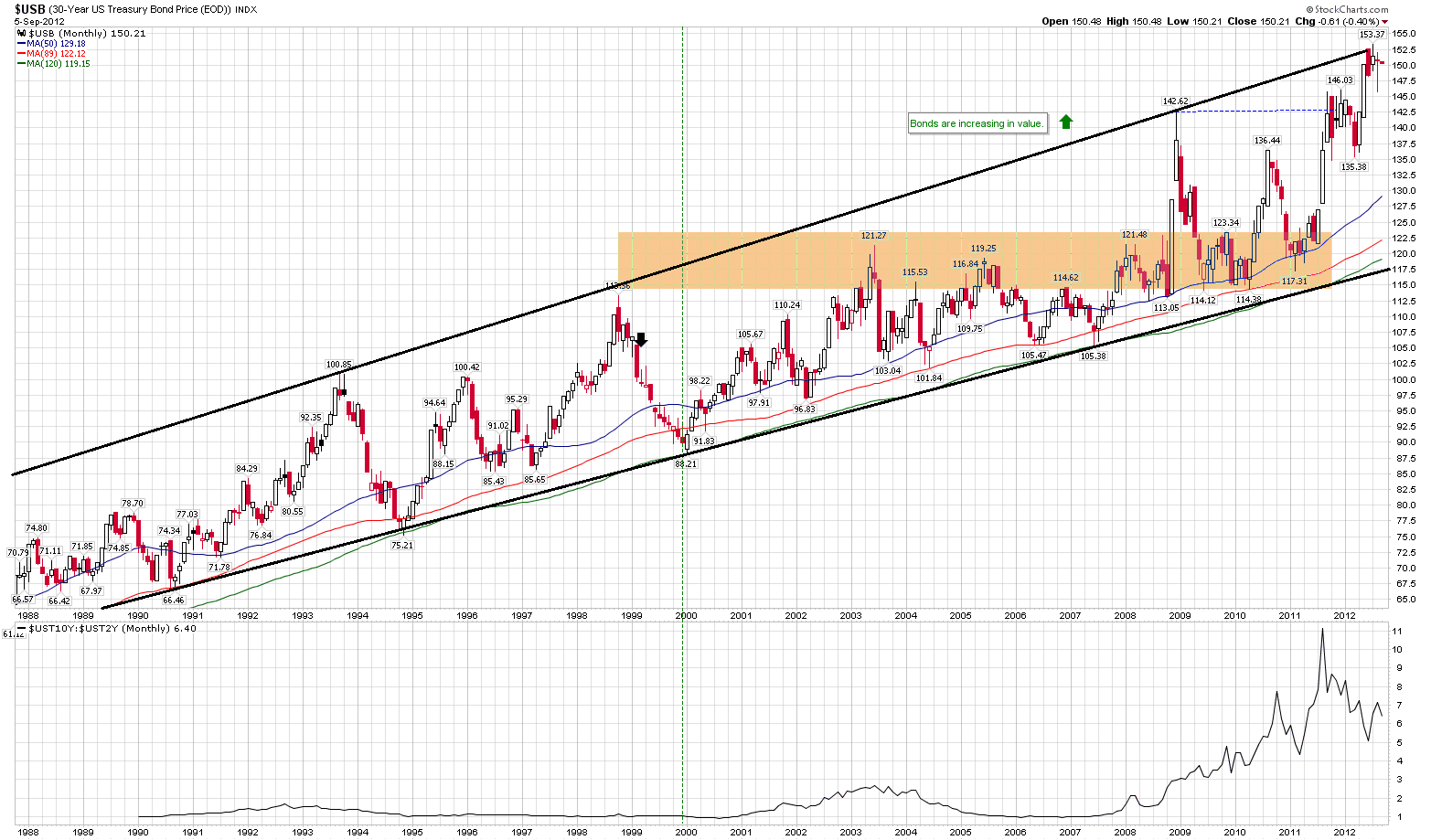
US treasuries have been in a 30 year bull market and have reached all time highs in 2012, with yields at all-time lows. Other major nation government bonds have hit similar levels.

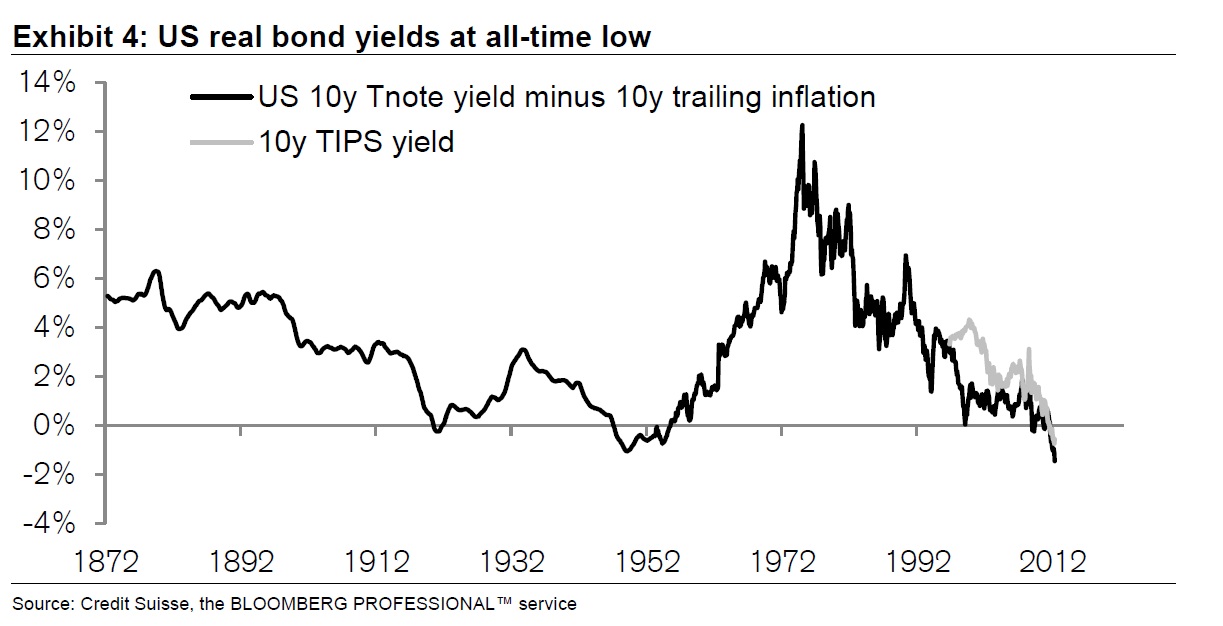
Considered net of inflation, bonds are at even greater extremes and are paying negative real returns.

Fear has been the biggest driver of this excessive move into bonds. But by Gann methodology, their recent mid-2012 peak may mark the end of the secular bull.

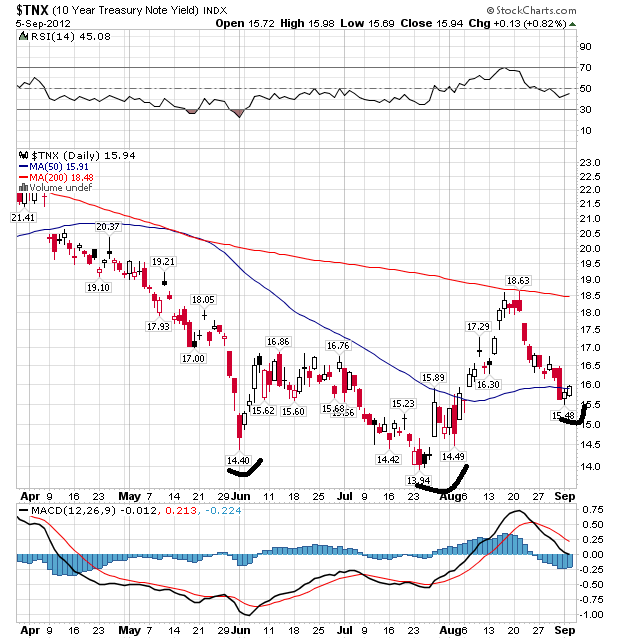
On the short term view, 10 year treasury yields have made an inverse head and shoulders formation, which should lead to yields breaking upwards and treasuries breaking downwards.

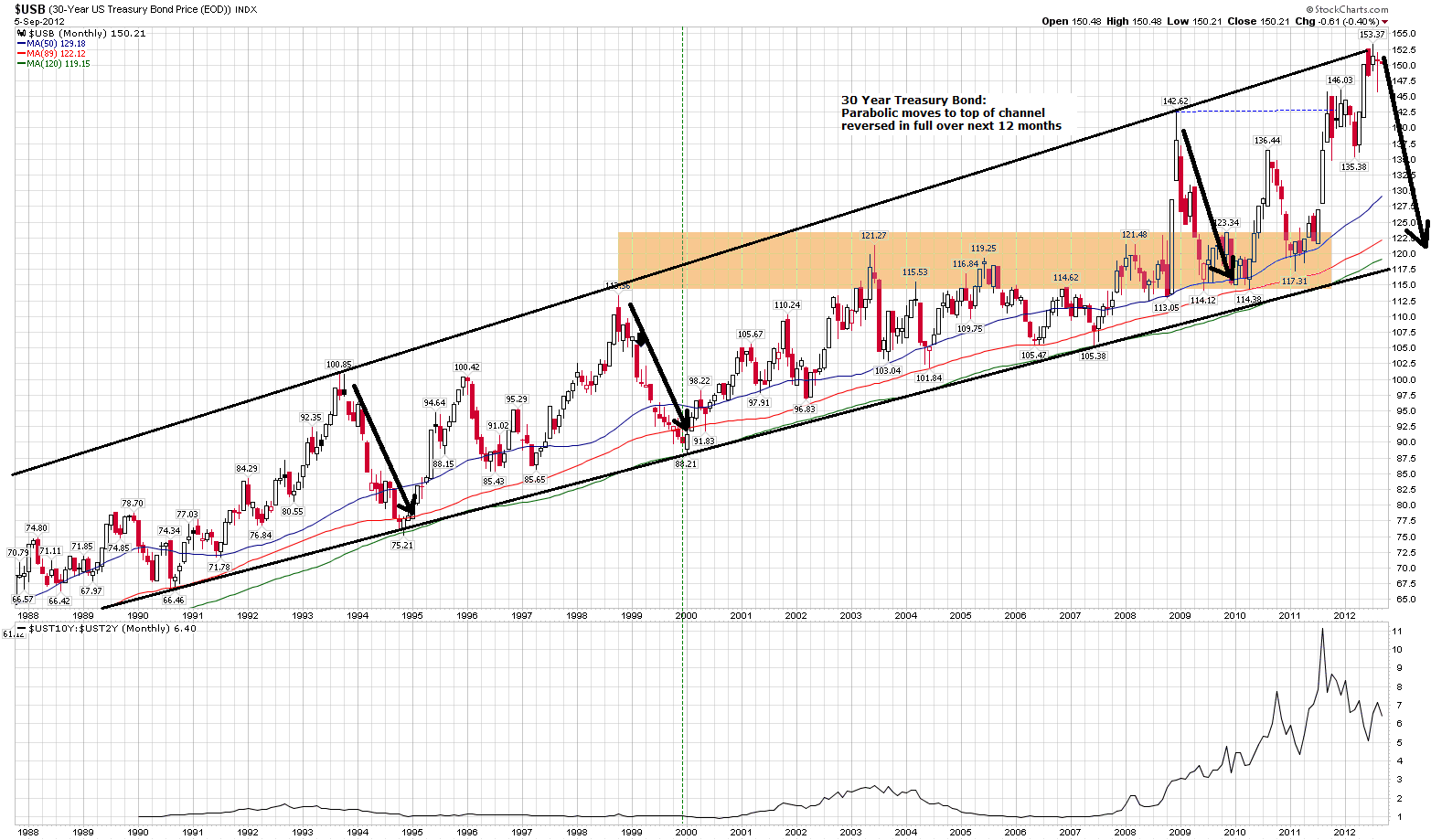
This is supported by a longer term view of 30 year treasuries, which shows that bonds made a recent parabolic move to the top of their long term channel, which historically led to treasuries falling sharply over the next 12 months.

Underlying Source: Stockcharts / James Craig

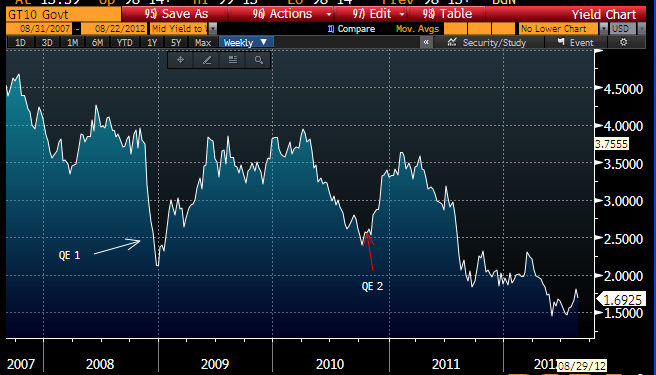
In addition, the performance of bonds following the announcement of QE3 should be one of steady retreat, as this occurred during QE1 and QE2, whilst pro-risk rallied – see here:

Source: Scott Grannis

Interestingly, QE3 is open-ended, which could therefore provide the backdrop for treasuries to fall gradually, despite the Fed being a buyer in the market (as other buyers exit).

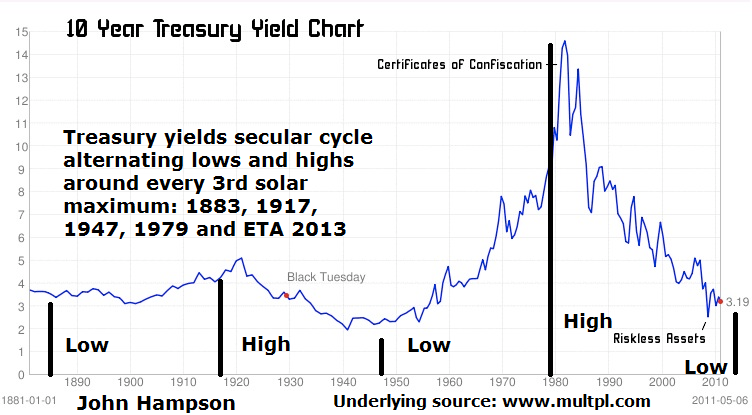
Taking the very long term view, treasuries have alternated secular highs and lows every 30 years or so, close to solar peaks. The next solar peak is 2013.

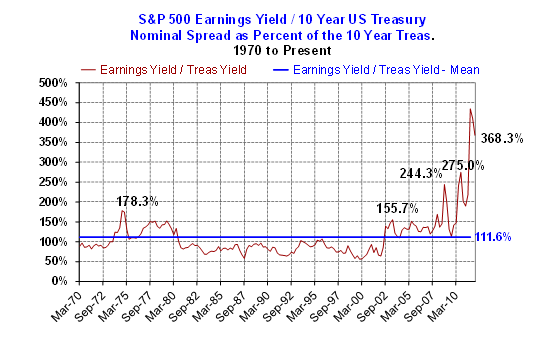
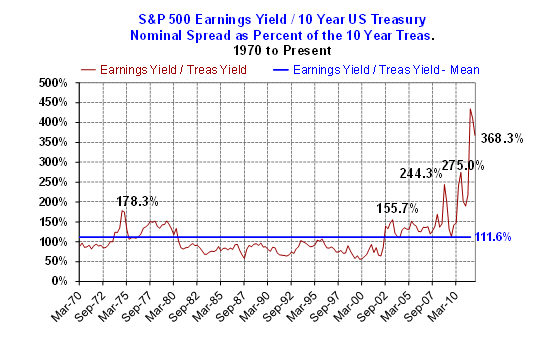
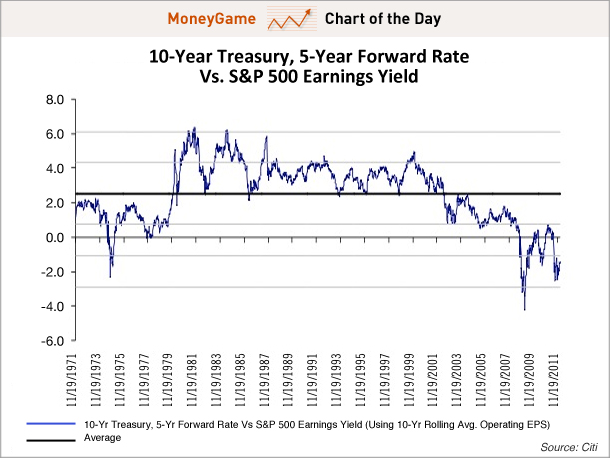
Not only are treasuries currently paying negative real yields, but the relative earnings yields of US equities is at a record. In other words, if confidence returns to equities there should be a large money flow from treasuries to equities in search of better yield.

Source: Aberdeen Investment Management

An alternative view of the same relations shows that earnings yields have reached a similar level of extreme attractiveness relative to bonds that previously marked a secular inversion (the end of the 1970s).

As 2013 should mark a secular shift from commodities and bonds to equities and real estate, as covered in the other parts of Forecast 2013, I believe now is the ideal time to position short treasuries (or long treasury yields), for a longer term hold.

That concludes my 4-part forecast looking out to 2013. To summarise my overall approach, I am using a combination of solar cycling, secular cycling and historic repetition that allows me to forecast by time, i.e. a time range of what should happen when in different assets by aggregating the previous repetitions. I am cross-referencing this with technical indicators and fundamentals. Using technical indicators that have previously marked cyclical or secular inversions is also using history as a guide, whereas assessing fundamental developments is ensuring that history is still an appropriate guide in the current circumstances. The evidence generally suggests that we have seen a TYPICAL secular stocks bear and TYPICAL secular commodities bull since 2000 and that the guide of solar/secular and technical history is indeed appropriate today. If evidence were to start to mount that this were not the case then I would change my positioning and go cautious until it became clear what exception was occurring or what new rules were being written. Until then I am long commodities looking for a secular peak (by both time and technical indicators), long stocks looking for a cyclical peak (by both time and technical indicators), and short treasuries looking for a longer term secular hold.

Considering the wider implications of cycles, historic repetition and rhyming, and technical indicators marking secular, cyclical or swing inversions in the same repeated manner (e.g. asset price ratios at certain levels, sentiment indicators at certain levels, yield curve shape, parabolic price action, breadth divergence and so on), it reveals a welcome limit to randomness in the markets. As traders we can use that non-randomness to obtain a predictive edge. For sure, there is a degree of self-fulfilling prophesy in that market participants seek order and in so doing apply a degree of order to the markets. However, nature is full of cycles and repetitions, and humans and their systems are very much of nature, therefore the absence of natural cycles and mirrors in time would be more shocking than their presence, in both the financial markets and economy. My own personal approach has been this: if there is both compelling evidence AND scientific reasoning, then I can forgo a degree of free will and embrace the likes of sunspots and geomagnetism. 2013 will be a significant validator – or otherwise – of solar’s role in the markets and economy.

Saturday Update

1. 10 year treasury yields continue to make an inverse head and shoulders pattern targetting yields of 2.2:

Source: Stockcharts

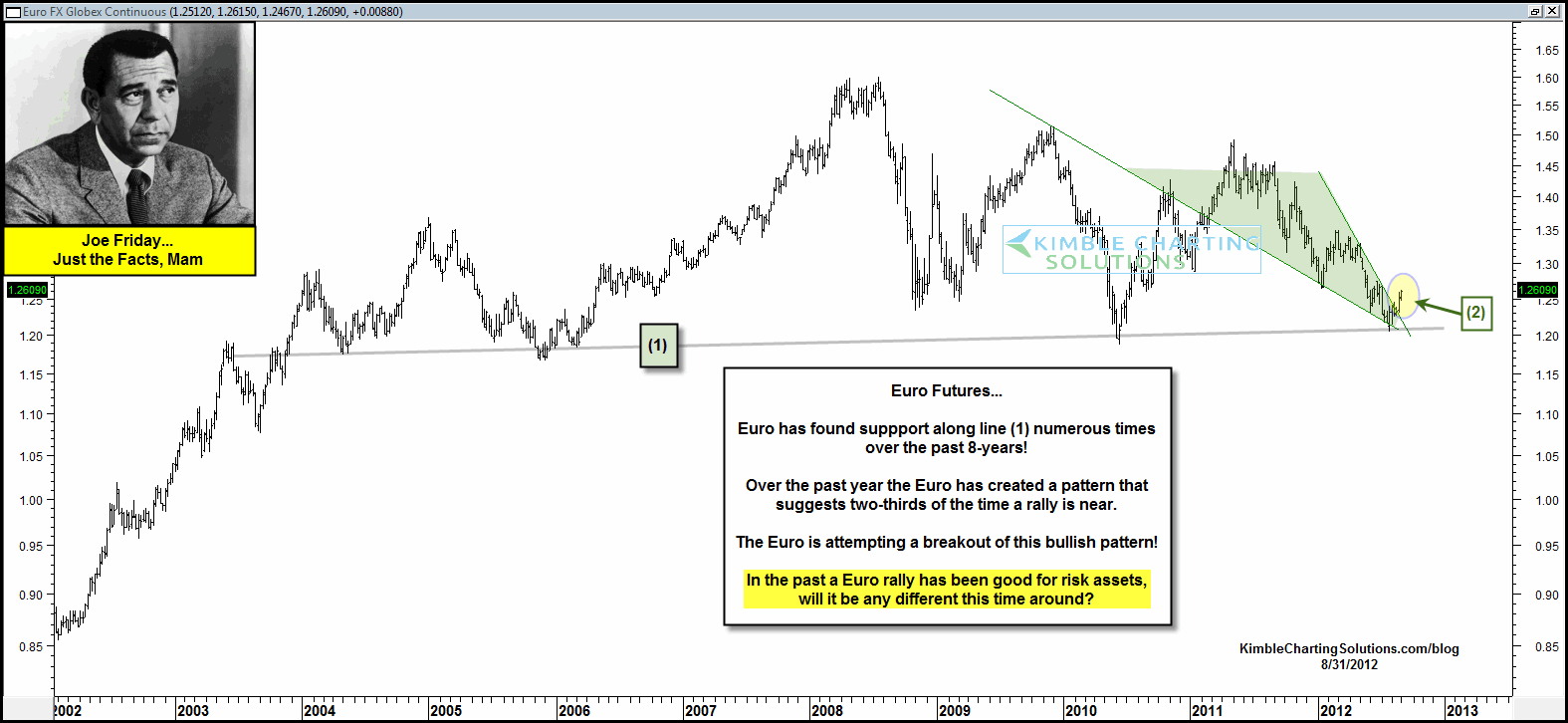
2. Both the Euro and the Dollar are at S/R that could make for a near term reversal:

Source: Chris Kimble

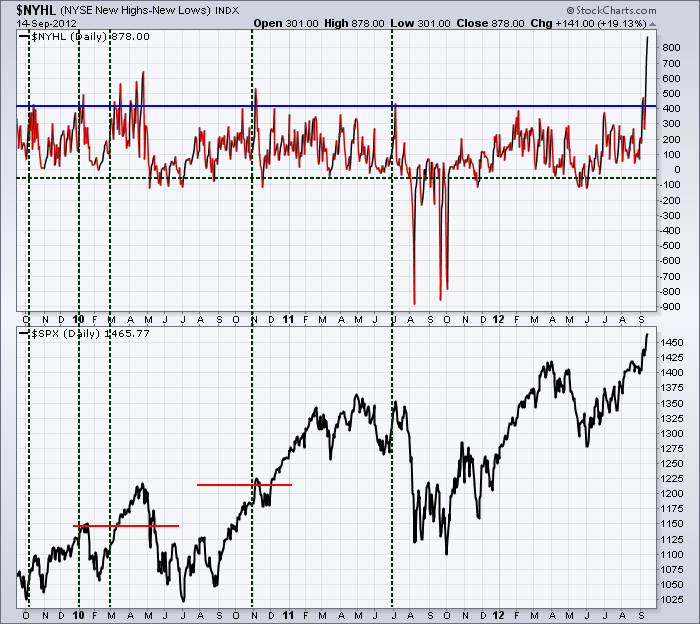
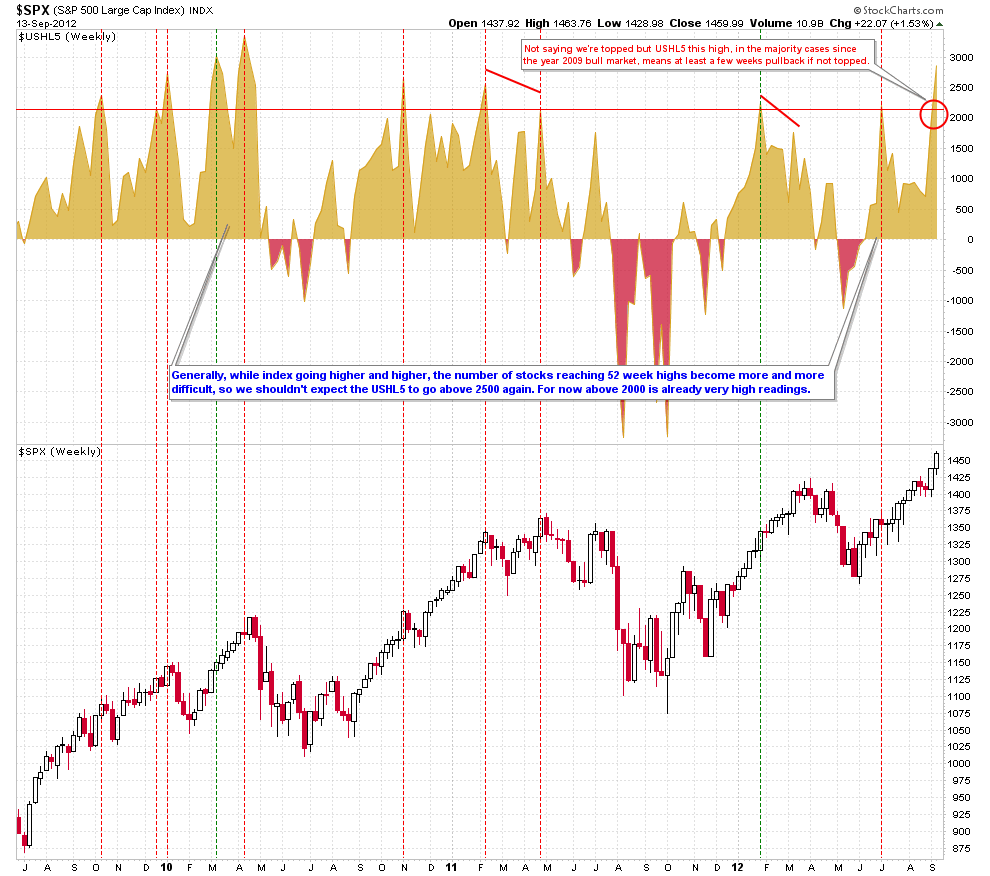
3. New highs / new lows for the US stock market hit a record high. This could signal a near term reversal, but the implied rally breadth has historically meant continued bullishness subsequent to that, more often than not.

Source: Stockcharts / Greg Schnell

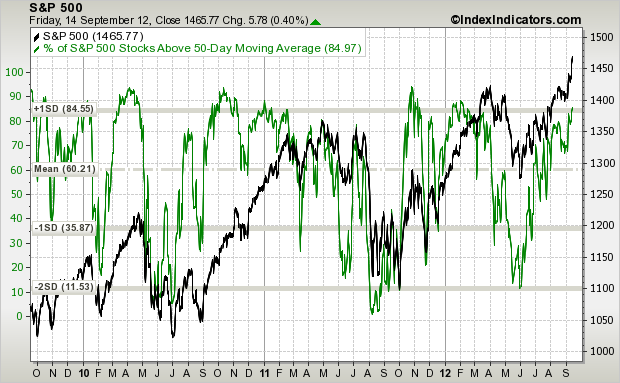
4. SP500 stocks above the 50MA have reached +1 standard deviation, but historically this indicator has usually oscillated in that range for a period before stocks topped.

Source: Index Indicators

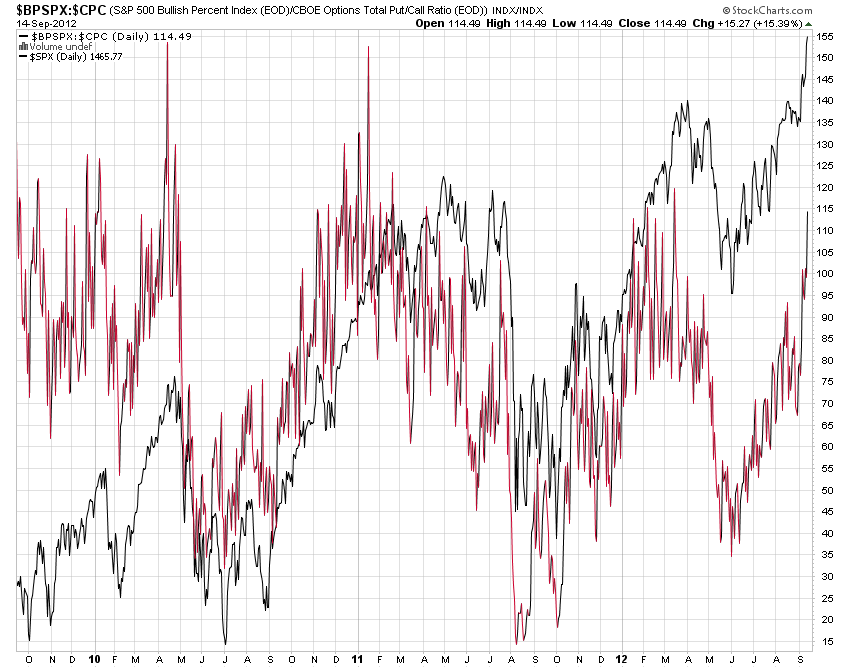
5. SP500 bullish percent over put/call ratio has reached the 110+ extreme zone. Again, this indicator has usually gone on to oscillate in this zone for a period before stocks topped.

Source: Stockcharts

Sentimentrader’s indicators now show 40% in the extreme (bearish for stocks) – the highest percentage since January 2011. However, in their own words, with price at new highs this would be a concern if price action became toppy. It is a sign of a strong uptrend, but with near term reversal potential if price signals.

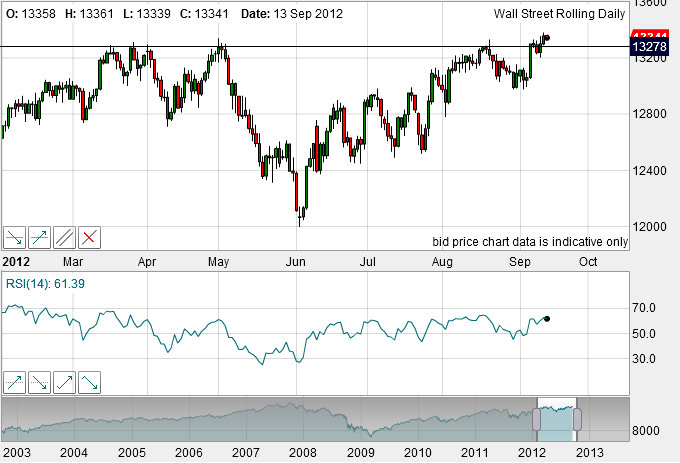
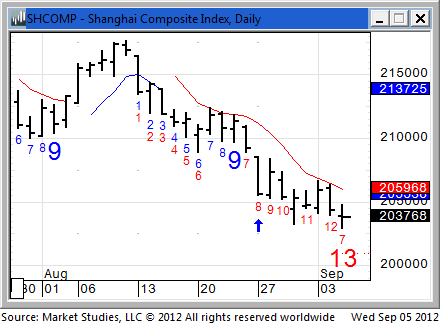
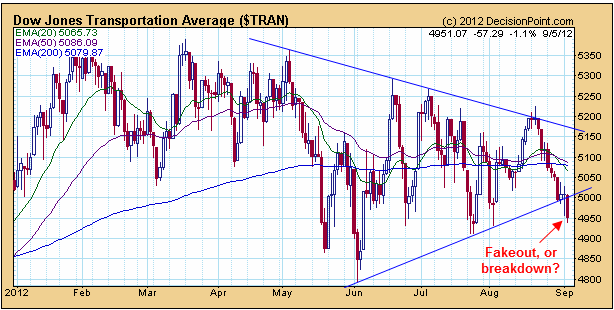
I don’t see price at this point looking toppy. Friday’s session was mixed for stocks, making a gain that finished in the middle of the day’s range. That’s fairly normal after a big up day on Thursday. The Nasdaq and SP500 have spent a week above their breakout, having successfully backtested it, which is bullish. The Hang Seng and Russell 2000 just broke out on Thursday/Friday. Unless price is reversed Monday/Tuesday then this is also bullish. Dow Transports have held above their triangle breakout, having a reversed a fakeout out of the bottom. Stocks breadth has led price, which is bullish. Chinese stocks are attempting a bottoming formation after reaching a Demark selling exhaustion count.

Demark’s last quoted price target for the SP500 is 1478. We didn’t get there yet. I believe stocks can push up a little higher early this coming week, giving a bit more room for the latest breaking out indices to subsequently consolidate above their breakout S/Rs. I respect the overbought/overbullish indicators that we are seeing and am alert to a correction soon, particularly when drawing in the Euro and dollar S/R positions and precious metals overbought/overbullish readings, but currently the evidence is for a consolidation in a continued bullish uptrend. So my approach is to maintain long positions through any correction, until evidence changes.

6. Coffee has a speculator net short position at a 7 year high. Here is the monthly price chart, and the weekly chart which shows a dynamic W bottom is being made. I am going to consider adding to my coffee position on Monday:

Source: Tradingcharts

Post FOMC

The Fed delivered more than expected, with the big gains in pro-risk evidence that it wasn’t all priced in. Some key differences to prior: (i) QE delivered at market highs rather than lows (ii) Fed commitment to be accomodative even after recovery is entrenched (iii) specific targetting of improving jobs situation (iv) open ended (v) negligible rates out to 2015. With ECB bond buying and Fed QE, pro-risk has some key support going forward.

The RUT, Hang Seng and silver all broke out, and the dollar broke down. The Nas, SP500, Dow and junk bonds all broke further free. Treasury bonds had a mixed session, but that’s to be expected. Initial support for bonds, as the Fed will be a direct buyer again, should give way to a sustained move against bonds, per previous QE:

Source: Scott Grannis

Stock market breadth improved. Corporate insider buying/selling is at a level more consistent with market bottoms than tops.

Source: Istockanalyst

But today we do find various assets into both overbought and overbullish indicator extremes, such as precious metals and the Euro. The SP500 new highs/lows indicator also suggests overbought:

Source: Cobra / Stockcharts

Sentimentrader’s research post yesterday’s session suggests a consolidation may come to pass over the next couple of weeks before further gains. This fits with my own take. Technical breakouts in assets together with double QE (Europe and USA) are bullish, but overbought and overbullish indicators are to be respected. A consolidation over the next 2 weeks, the period into the next full moon, to relieve those indicators whilst maintaining the technical breakouts, would make sense.

My account is currently 30% up for the year, now on track for my 40% target. Clearly I am delighted with that and don’t want to jeopardise the gains, particularly as the bulk of the positions are open. But I don’t find reasons to pare back positions currently. The biggest risk remains global leading indicators. Yesterday CB produced the latest data for Korea which came in at zero, a 3 month high (which Japan and UK also managed). Today Spain came in at -0.6 (following -0.3 last month and -0.6 the month before). So Spain still weak, but some potential positive trends elsewhere. We need more data, over more time, to assess. But with regard to my forecasts of an overthrow in stocks to end their cyclical bear (accompanied by increasing inflation and treasury yields), and then a parabolic finale in commodities and inflation, I see an increasingly supportive picture. Euro debt settling down, economic surprises repaired, 6 months of rate cuts across the world by central banks, US and ECB QE, technical breakouts in stocks and precious metals, inverse H&S on treasury yields and probability of fulfillment, US dollar breakdown, and recent new highs in grains to deliver food price inflation as of Q4 2012. Weakness in leading indicators does not offset all this.

Technicals Into The FOMC

This has been the story of my 2012. Took profits on stock indices longs from 2011 in the first couple of months of 2012, whilst retaining my secular commodities longs. Endured some pain as commodities fell into May. Bought stocks and commodities aggressively around 9-18 May as oversold and overbearish indicators aligned. Both then bottomed out and have since rallied. I took maybe 10% off in profits and have retained the rest.

I use the CCI commodities index above as it is equally weighted.

So, as things stand, all is well and I’ve got some very profitable positions (thanks to a little leverage), but with continued significant exposure. Do I want to cut some exposure, to mitigate a reversal in either class, or do I want to hold firm and play for continued upside in pro-risk for the remainder of the year? Here’s how things stand technically.

The Dow has broken above quadruple resistance and joined the SP500 and Nasdaq at new highs.

The Dow Transports appear to have completed a text book fake-out move, now breaking out the other way.

Source: TSP Talk

The Russell 2000 is at resistance.

The Hang Seng is also at resistance.

The Dax is challenging cyclical bull market highs.

10 year treasury bond yields continue to make an inverse H&S formation, which is bullish for pro-risk.

Source: Stockcharts

Junk Bonds have just broken above resistance.

Source: Bespoke

Silver is at resistance.

Source: Chris Kimble

The US dollar has reached levels of overbearishness.

Source: Sentimentrader

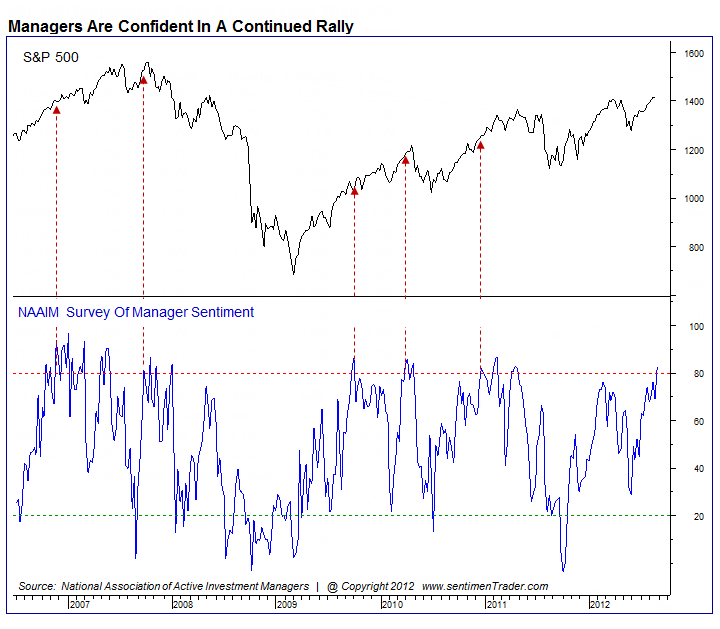
Equities sentiment is overly bullish by NAAIM (shown below), but not so by AAII (36% bulls, versus historic extreme zone 45+) or by Investors Intelligence (shown below).

Source: Sentimentrader

Source: Schaeffersresearch

In summary, it’s finely poised into today’s FOMC action (or non-action). The bullish breakouts in the Nas, SP500, Dow and Junk bonds are reversible at this point, as they are  only just at new highs. The bullish reversal in the Trans is positive. I suggest the edge is for a breakout in the Hang Seng triangle, rather than a breakdown, due to the Shanghai index having made a Demark seller exhaustion count, but continued ranging in the triangle’s nose is possible. Silver sentiment, silver resistance and dollar sentiment are suggestive of a forthcoming counter-trend move, i.e. a pullback in silver whilst the dollar pulls up.

Turning to leading indicators, CB produced the latest data for Japan and the UK this week. Japan came in at -0.8, still negative but a 3 month high. UK came in at +0.1, also a 3 month high. So a little encouraging, but I need to see more global LIs trending positively. The OECD’s latest global indicators come out today.

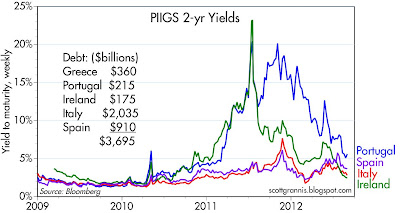
PIIGS CDSs and bond yields continue to ease. The German legal approval of ECB bond buying an important step.

So, to today’s FOMC. High expectation of QE, though unlikely fully priced in if delivered. If we get QE, I expect the US indices to pull away, and the indices at resistance to breakout. Furthermore, I believe it would seal the deal for my secular/solar projections into 2013 of inflation, dollar decline and commodity acceleration to a peak.

On the other hand, the Fed may choose to stop short of a new QE programme, acting to extend low rates, making an open-ended commitment to regular purchases of securities (Robin Harding), or choosing something unorthodox to tackle its main problem, jobs. Something stimulative but short of full QE could lead to a short term sell off which is then reversed on digestion.

Lastly, the Fed may choose to bide its time, carefully choosing words rather than concrete action. US leading indicators are on the rise and recent commodity price rises are likely to increase inflation down the line. If no action if forthcoming, I would expect a significant sell-off, and that sell-off would likely reverse US indices and junk bonds back  beneath their breakouts, making for bearish fakeouts.

Of the three scenarios, I rate the last (no action) as the slimmest likelihood. The Fed’s last two communications have been more heavily-hinted towards action. Plus I view things a little unorthodox: I expect the secular/solar projections to come good – I expect market participants, economists and central banks to unwittingly fulfill them (in this instance that rising sunspots make humans more speculative and pro-risk – QE is both).

There is room in equities sentiment for a push higher, and to reach Demark’s 1478 level on the Sp500. We are also in a bullish window heading into this weekend’s new moon, with negligible current geomagnetism.

I believe probability is on my side, and so am going to retain all my pro-risk positions into the FOMC (subject to OECD leading indicators not having deteriorated significantly – due noon UK time). This is the bears’ last stand. Not the bulls. A retreat in stocks and commodities would put us back into the  trading range. Whereas, a jump today in equities and precious metals and junk bonds would seal the breakouts and put pro-risk into clear air.

Roundup into the ECB

1. Copper has popped above resistance, in a similar manner that gold did:

Underlying Source: Trading Charts

2. The Chinese stock market has reached a Demark buy set up:

Source: Market Studies (hat tip Gary)

3. The Dow Transports broke down yesterday. Ed Yardeni rationalises the relative weakness of the Transports to the Dow (Industrials) as it has two main components, Railroads and Air Freight. The railroads index broke to a new high, reflecting the stronger US economy, whereas the Air Freight is what’s dragging down the Transports due to the weakness elsewhere in the world.

Source: TSP Talk

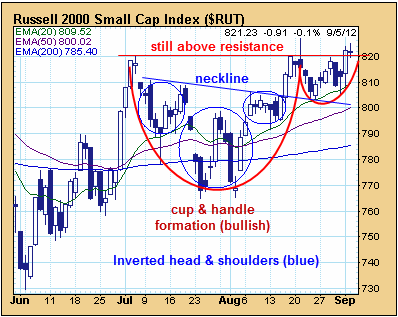
4. Meanwhile, the small caps index has caught up and is displaying a bullish cup and handle formation:

Source: TSP Talk

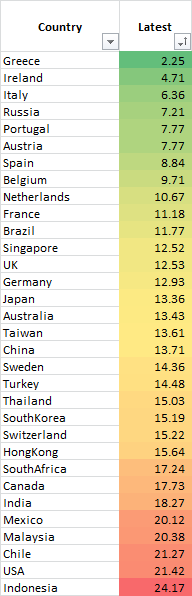
5. The latest global country P/Es reveal that much of Europe is at secular bottom valuations, whilst USA remains one of the most expensive markets in the world:

Source: Megane Faber (valuations as at end of August)

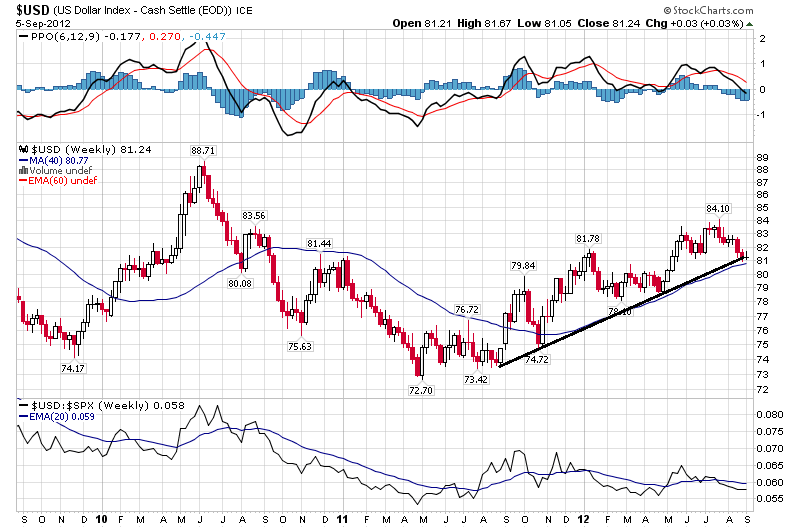
6. The US dollar is at support. Today’s ECB meeting outputs and next week’s FOMC outputs could either generate a dollar bounce or a breakdown.

Source: Stockcharts

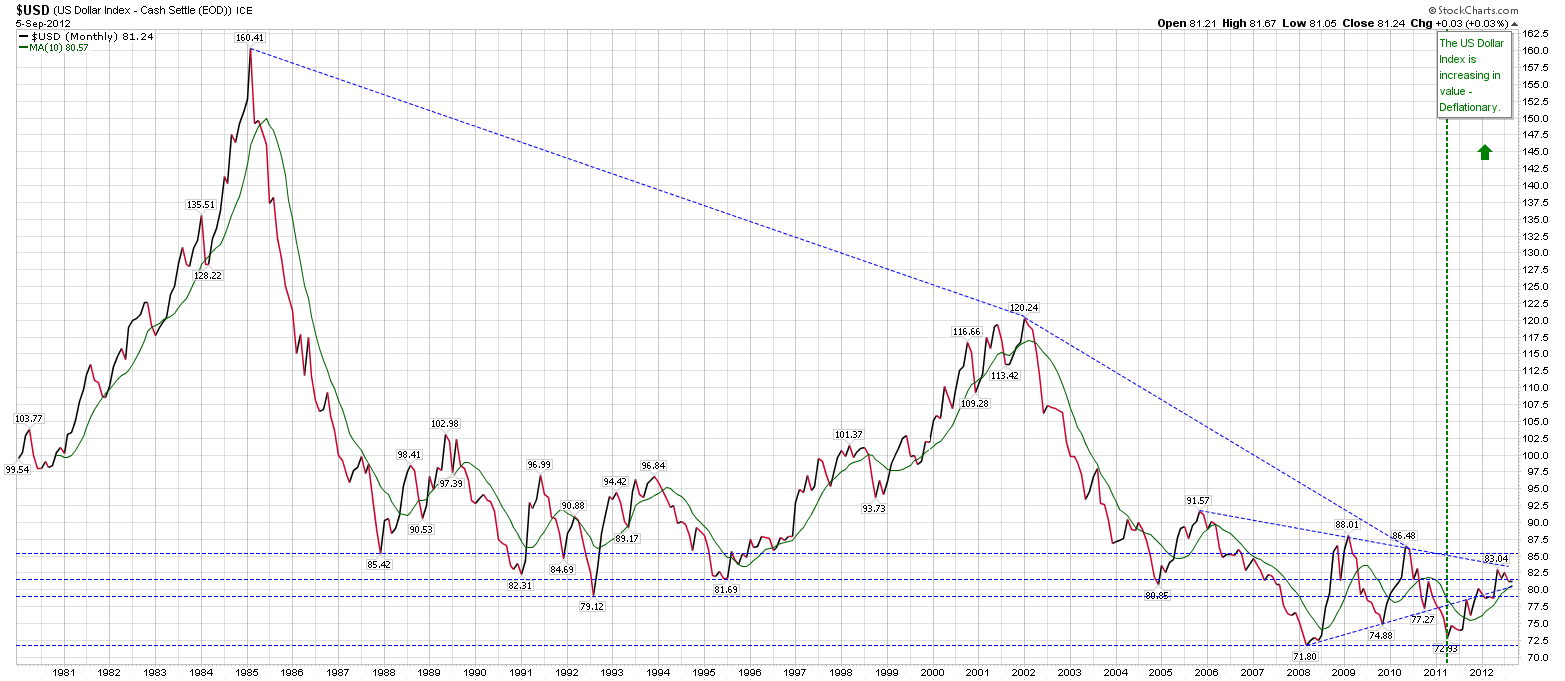
7. The bigger picture for the US dollar shows a currency still very much languishing near the lows.

Source: Stockcharts

8. The easing of European debt concerns continues and is supportive for the Euro.

Source: Scott Grannis

9. Treasury yields still show potential for a H&S bullish break up, having pulled up the last couple of sessions:

Underlying Source: Stockcharts

10. The bigger picture for treasuries reveals that the recent run up echoes previous important peaks that led to sharp falls over the next 12 months for treasuries back to the lower support.

Underlying Source: Stockcharts / James Craig

In summary, a bottom for Chinese stocks and a breakup in copper would perhaps foretell improvement in that part of the world, which in turn could resolve the Tran issue. Euro debt has settled down, making the number 1 issue the weakness in the non-Western economies and particularly China. Despite that, US and European stocks have consolidated just beneath new 2012 highs, and technically look ripe for a breakout. Treasuries could potentially fall over the next 12 months, providing the backdrop for the secular commodities finale that I project. Gold and silver have broken out and are into the positive period of seasonality for the year. The dollar is at a cross roads. If the Fed announces QE3, or some other currency diluting initiative, which appears increasingly likely, then I expect it to breakdown and also help fulfil the commodities finale. There remains the potential for disappointment, both by the ECB and Fed, and in turn for these assets at important junctions to resolve the other way, but I maintain the weight of evidence is pro-risk currently. Lastly, various European country stock indices are at secular low valuations. For the long term investor, buy and hold of these indices should return handsomely with a 10 year view.

Final Third 2012

One third of the year left to go. As of a couple of weeks ago the SP500 was up 12% for the year, whilst the average hedge fund was up just 4.6%, with just 11% of hedge funds exceeding the SP500 return of 12%. 2011 was also a tough year for hedge funds, compared to previous years. In my personal experience, 2011 and 2012 have seen certain reliable analysts calling it wrong, some usually reliable indicators pointing different ways rather than in alignment, up/down moves of shorter length, and some degree of disconnect between some usually connected assets. In my opinion, this is all due to the transition period that we are in, from K-winter (gold, bonds) to K-spring (stocks, real estate), bringing about come confusion in assets, indicators and analyst calls. The transition is gradual – the nominal bottom in stocks and real estate likely already occurred, the inflation-adjusted low likely ahead, the secular bottom in treasuries is perhaps occuring right now, the secular top in commodities I project next year. A messy, gradual transition rather than a clean switch.

I have found 2011 and 2012 trickier than previous years for those reasons listed above. Having to go against analysts that I respect, having to choose between indicators, having to make sense of assets going different ways. Ultimately, secular and solar anchoring has seen me through I believe, and will continue to do so. I am currently 20% up for the year. My target, as every year, is 40%, which makes me behind target with 3 months to go. Usually I try to steer myself to towards the year-end target as best I can (over-exposing and under-exposing, bigger and smaller risks). I achieved my 40% in 2008, 9 and 10 in that manner, but fell short trying last year, making only 15%. This year I don’t have the same approach, because I am looking out to what I project to be the secular peak in commodities in 2013, a potential opportunity for parabolic gains. My plan then is to maintain my bulk long commodities positions into 2013, rather than trying to partially close down and trade shorter term into year end. If my projections are correct, then commodities should continue to rise in Q4 2012. What I consider most important to my year end tally is calling when to exit equity longs. At some point I want to exit the bulk of those, and that may be before year end 2012.

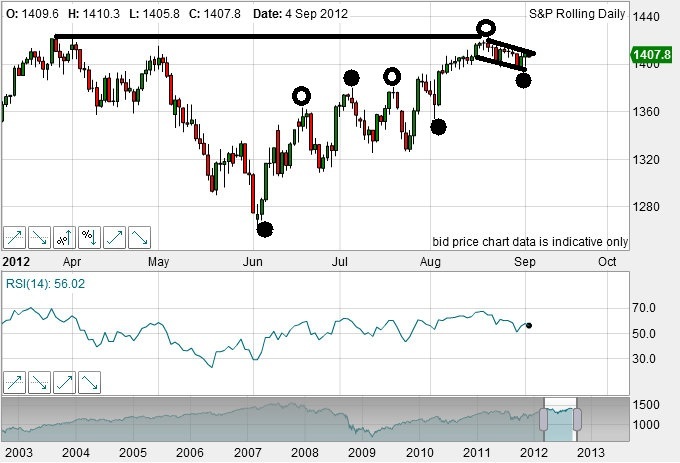
On Friday at Jackson Hole, Bernanke added weight and justification to his easing bias, whilst falling short of committing to it. The reaction was pro-risk, and US stock indices still look like they are in a bull flag preparing for a break out over the year’s highs, as shown below. Currently, we are back up to the top of that flag. I have also marked the new and full moons. We saw one lunar inversion at the beginning of July, but otherwise the typical lunar oscillation has been in play. On Friday we made a bottom with the full moon and can now potentially make a high around the new moon of Sept 16.

The potential is there, both by technical picture and lunar phase, for stocks to break out. If they can break out then a melt-up would be likely, providing great returns for equities longs. We have the ECB meeting on Thursday this week, with the potential for interest rate cut and bond buying programme announcement, and we have the FOMC on the 13th September with the potential to announce QE3 or some other novel measures. Of course, both provide the potential for disappointment too. A lack of action could lead to a siginificant sell off. Also on the flip side we currently have a geomagnetic storm in progress and more geomagnetism is predicted for today and tomorrow.

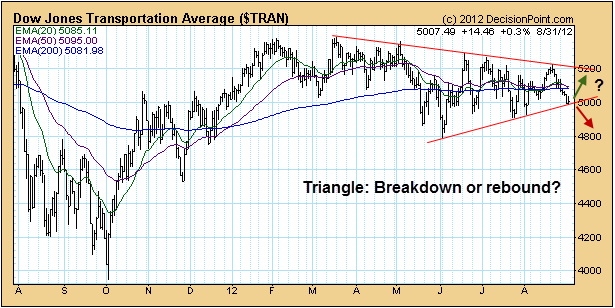
The Dow and Nasdaq are in similar positions, but a quick look at the Dow Transports shows a more precarious position. Dow theory says this is a negative divergence. Let’s see if the Transports can catch up here, or alternatively breakdown.
Source: TSP Talk

Sticking with the USA, economic surprises continue to rise in an uptrend, ECRI leading indicators turned positive on Friday, and Presidential seasonality suggests upside into November. The US economy continues to perform better than most in the world and that should mean support for the US dollar.
Source: See It Market

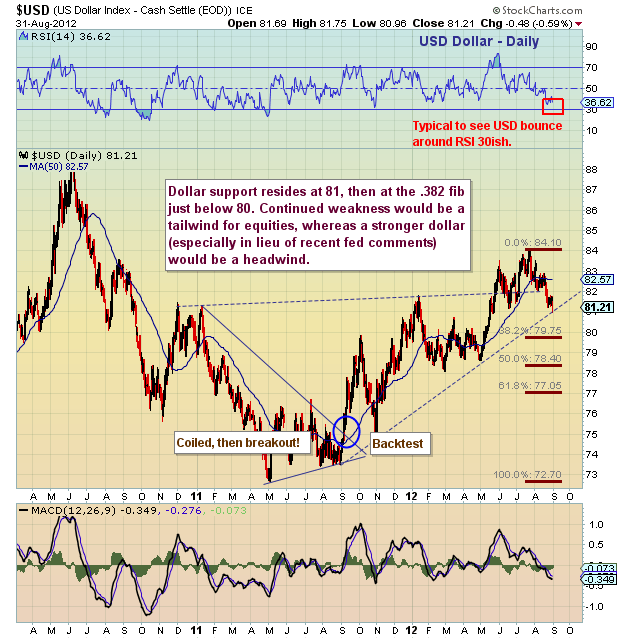
As can be seen above, the US dollar is now at support and an important junction. I suggest that the FOMC outputs next week could influence which way this goes. A lack of QE should mean support for the US dollar due to the better US economic data. However, QE3 should rally the Euro at the expense of the dollar, and the technical chart for the Euro provides weight for that occurring:

Source: Chris Kimble

For my projections of an overthrow in equities in the final part of 2012 and then a parabolic finale in commodities in 2013, announcement of QE3 would really seal the deal I believe. Money would pour into pro-risk and commodities would benefit from the weakening dollar. Let’s see.

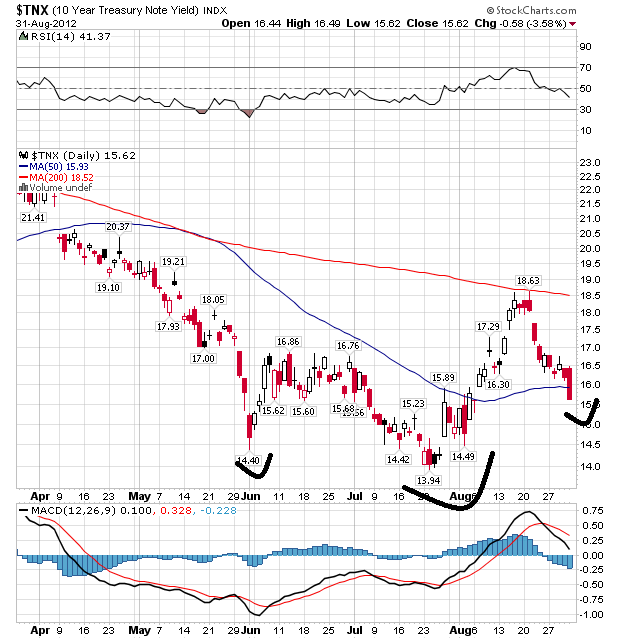
A look at treasuries shows us that the stronger hints of QE have reversed yields in the short term but also set up a potential inverse head and shoulders.
Underlying source: Stockcharts

Both QE1 and QE2 led to prolonged periods of rising treasury yields, after the initial move the other way, as money poured out of bonds into pro-risk. So again, QE3 would likely provide further fuel for pro-risk. It is on my mind that previous cyclical stocks bulls ended with treasury yields rising to levels where interest rates stifled the economy. Whilst we have the kind of ultra low rate levels here that echo the 1940s, I would still expect them to rise into the end of the cyclical bull to some degree. Currently, they are moving the other way, so let’s see if this large H&S now plays out.

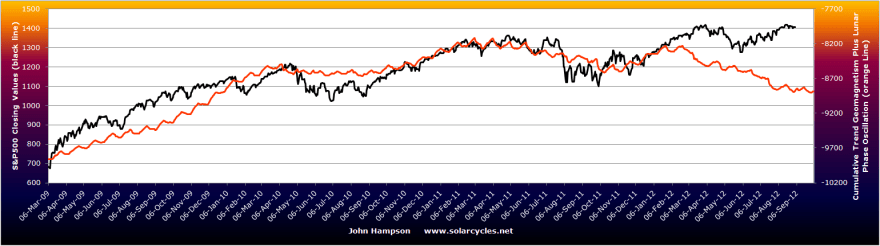
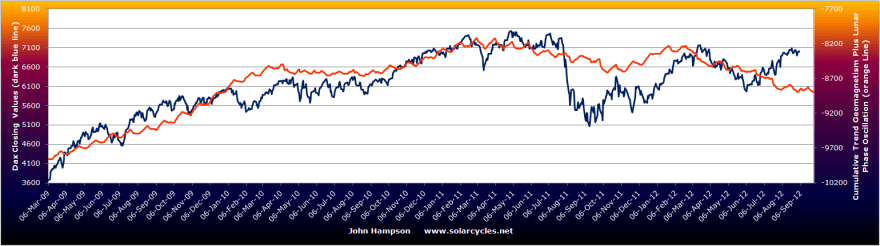
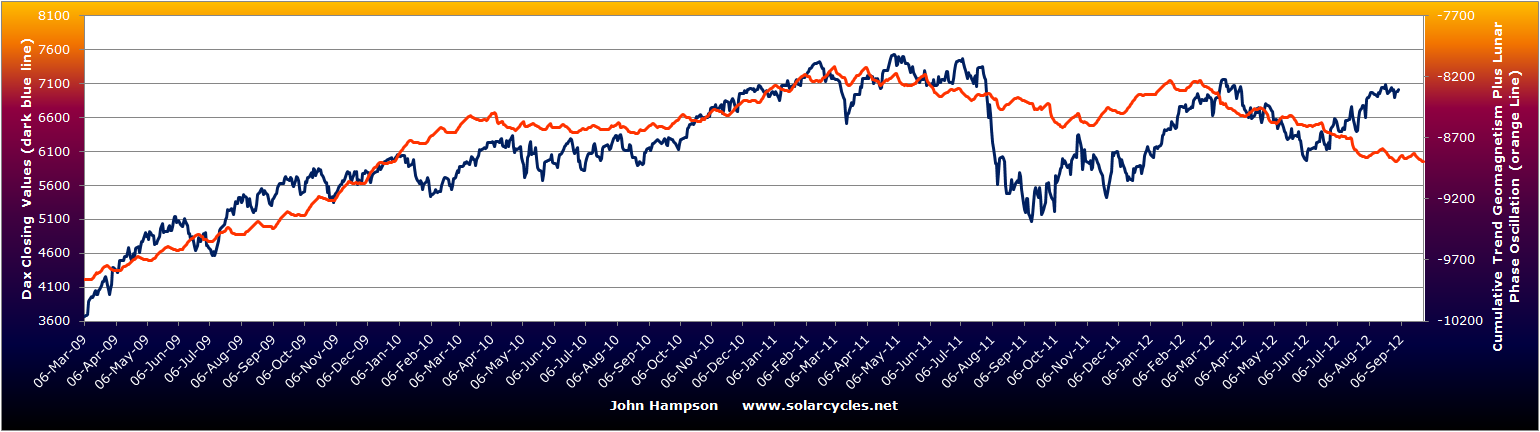
Ed Yardeni produced a chart showing the SP500 has diverged from its fundamentals since June this year. My geomagnetic-lunar model charts also show stocks going opposite ways since June (all models updated this morning).

Source: Yardeni

Together that would ordinarily provide a good cross-reference for a short. However, speculation increases into the solar peak, and as per my Peak v Peak page, at the last solar peak we saw stocks break away from the geomagnetic model for some time before returning to it post solar peak. It is not something measurable, but I can point to each secular parabolic peak in stocks and commodities occurring close to the solar maximums as evidence that this occurs. I therefore look at the divergences in Yardeni’s and my own models and suggest this may be occurring.

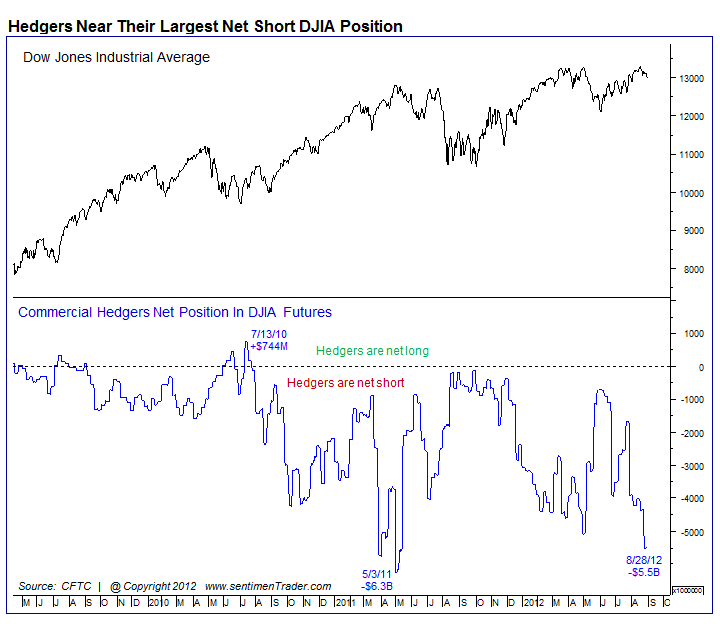
Sentimentrader have produced two new charts that add weight however to the bear case:
Source: Sentimentrader

Hopefully those two charts are self-explanatory. As per my last post though, Technical US Stock Indices, there is evidence supporting the bullish case too. And so we return to my opening comments about indicators pointing opposite ways.

Looking wider, we continue to see poor technical performance in emerging market stock indices. There is a significant divergence in European and US indices versus Asia and Latin America, reflecting the weak leading indicators in those regions. On the plus side, economic surprises for emerging markets continue to rise in an uptrend:

Source: Bloomberg

So are the economies of China and Korea and Japan (and Germany) to improve? If not, can US leading indicators really continue to trend upwards without being infected? All eyes on the next round of global leading indicators these next two weeks from OECD and Conference Board.

Euro debt accuteness remains contained and well off its highs of H1 2012, so for now that remains supportive for stocks. The US fiscal cliff looms at the end of 2012, and once the US election is out of the way, presidential seasonality is no longer supportive. The ruling party has the option to implement unpopular policies in the first two years. It may therefore choose fiscal policy which increases recession risk. I maintain the projection of global recession 2013-2014 as per solar/secular history, and this could be one factor, together with parabolic commodity prices and bond yields rising. China may also de-rail to provide a backdrop to a new secular commodities bear starting next year. The question remains whether China can remain strong enough to fulfil the commodities secular peak before that occurs.

In summary, I am looking for my exit point for stock indices longs (not commodities), as by time I believe this could occur any time as of now into early 2013. The technical picture is mixed and indicators are mixed, but US stock indices are within touching distance of a breakout to new highs. For now I am going to stay put, and await ECB and FOMC decisions this week and next, along with the latest global leading indicator data. Market tops are usually a process, so more evidence should build whilst stocks range trade, if this is to be a major top.

New Highs or Double Top?

…for US equities? As we stand, the SP100 already made new highs. Apple has since broken upwards to new highs. The Nasdaq, Dow and SP500 are all back at their March 2012 highs (the SP500 including dividends is now at an all time high). Either it’s time to get out of all US stock indices longs, or the melt up is just about to begin. In stark contrast to the US stock indices predicament, the Chinese stock index is at 3-4 year lows.

Source: Bloomberg

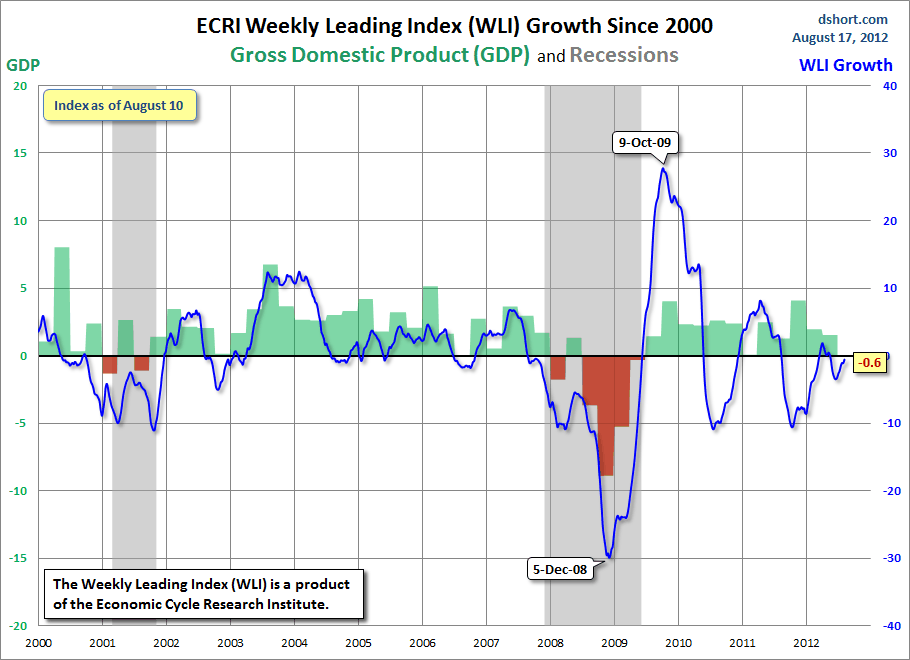
Supportive of US equities breaking upwards from their March highs, we have (i) global and US economic surprises still in an uptrend, (ii) Spanish and Italian CDSs still in a downtrend, (iii) money exiting US treasuries as 10 year yields have risen from 1.4 to 1.8 in just 3 weeks, and (iv) ECRI US leading indicators trending upwards, almost back to positive:

Source: Dshort / ECRI

Turning to global leading indicators, this last week’s data from the Conference Board delivered positive readings looking forward for USA and Spain, but badly negative readings for Japan and Korea. So it is unlikely that US and European equity advances are based solely on hope for QE in those two regions. This East-West divergence is likely to be resolved one way or the other: Asia and emerging economies turn up, or US and European equities top out. So which is it to be?

I deliberated on Friday at the new moon about whether to take some profits, but decided against. Geomagnetism is currently tame and it means the lunar-geomagnetic model currently has a mild uptrend into mid-September (all models upated this morning). Furthermore, the occasions historically when lunar phasing tends to fail in trading  are usually when there is a strong up or down trend. Clearly lunar phasing is not the only influence on trader sentiment, so in times of strong momentum one way or the other lunar phasing may be overridden. The current crawling up the upper bollinger band on US indices is reminiscent of the strong uptrends of the last two years that followed mid year consolidations. So I am suggesting there is a chance we are in a similar sweet spot for stocks.

I maintain that two developments would bring about a melt-up: (i) breakouts to new highs, into clear air and (ii) a turn up in leading indicators. German leading indicator data has just been released this morning, coming in at minus 0.8. That’s worse than last month’s reading and adds to the muddy picture in global leading indicators. So whilst a breakout to new highs in US equities looks technically more probable than a double top here, we can’t say we have the support of the global leading indicators. For this reason we see certain global stock indices still festering, and the likes of copper still languishing, rather than a full risk-on party.
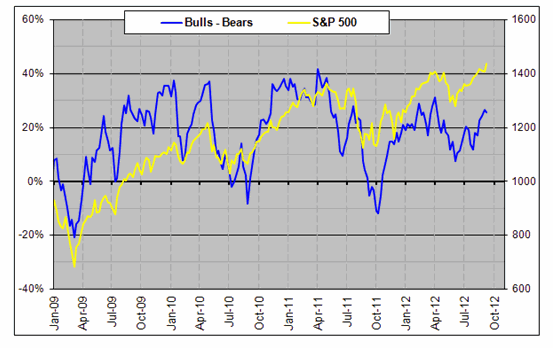
What if global leading indicators didn’t turn up? Is it possible we could still see my forecast come good of an overthrow peak in equities in late 2012 and then a secular peak in commodities in 2013? Something like in 2007-8 where stocks first outperformed and then peaked whilst commodities took over and peaked longer and higher?:

Well, looking back to the last secular commodities peak of 1980, both stocks and commodities did make such moves even though leading indicators had been trending downwards for some months. In other words, speculation drove them on despite the worsening fundamentals, and this fits with my theory that increasing sunspots into the solar peak brings about speculative climaxes in risk taking and buying.

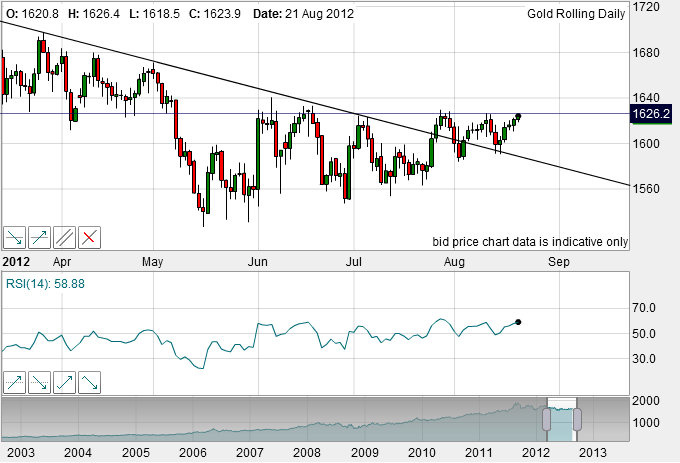
Getting technical again, US stock indices do not yet show overbought or overbullish readings. Were they to reach those levels, I would be much keener to offload some longs and take profits. The Euro is also showing signs of solidifying its base above 1.2 versus the US dollar. Gold is similarly building up its base and as can be seen below could be close to a break out of horizontal resistance, having successfully broken and backtested falling resistance.

In summary, at the moment the general overall picture is supportive of my forecast and my long pro-risk positions. Whilst there remain issues and areas of doubt – as there always are – I feel comfortable sticking with my trades as they are for now and continuing to watch indicators and data for further developments. We are at another siginificant point however, in whether US stock indices (and gold) can breakout or are sold back. Whilst a failure (in both) would be a set back for the bulls, it may mean more time is required, rather than it isn’t going to happen. But for equities bears this is the last stand and if this is to be a major double top then we should look for overbought and overbullish readings coming to pass as well as increased negative divergences supporting the exiting of longs.