Reversal Ahead

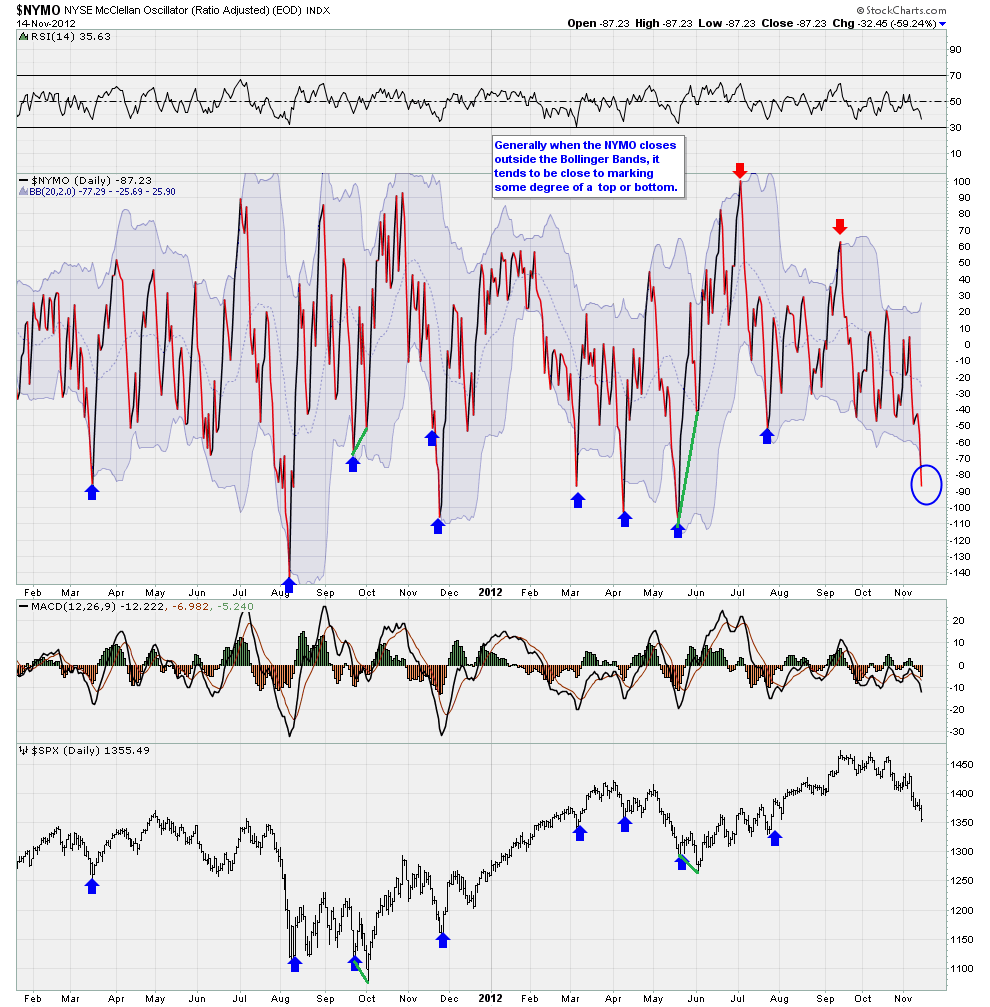
For NYSE stocks, take a look at the Mclellan Oscillator as at the end of Wednesday’s session:

Source: Breakpoint Trades /My positive divergences in green added

Out of the lower bollinger band and sufficiently oversold to suggest a bounce right ahead. The question is whether US stocks are a buy here or whether they need to print a lower low following a relief bounce with a positive Nymo divergence – see green highlights.

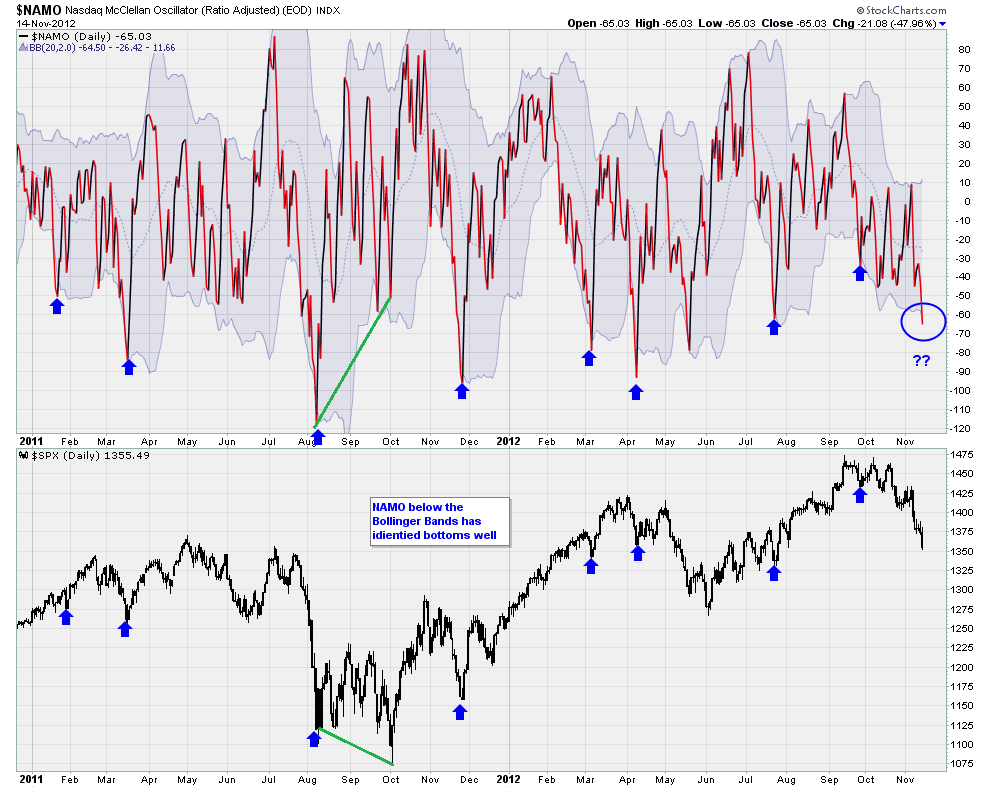
Here is the Nasdaq Mclellan Oscillator, and the same applies:

Source: Breakpoint Trades /My positive divergences in green added

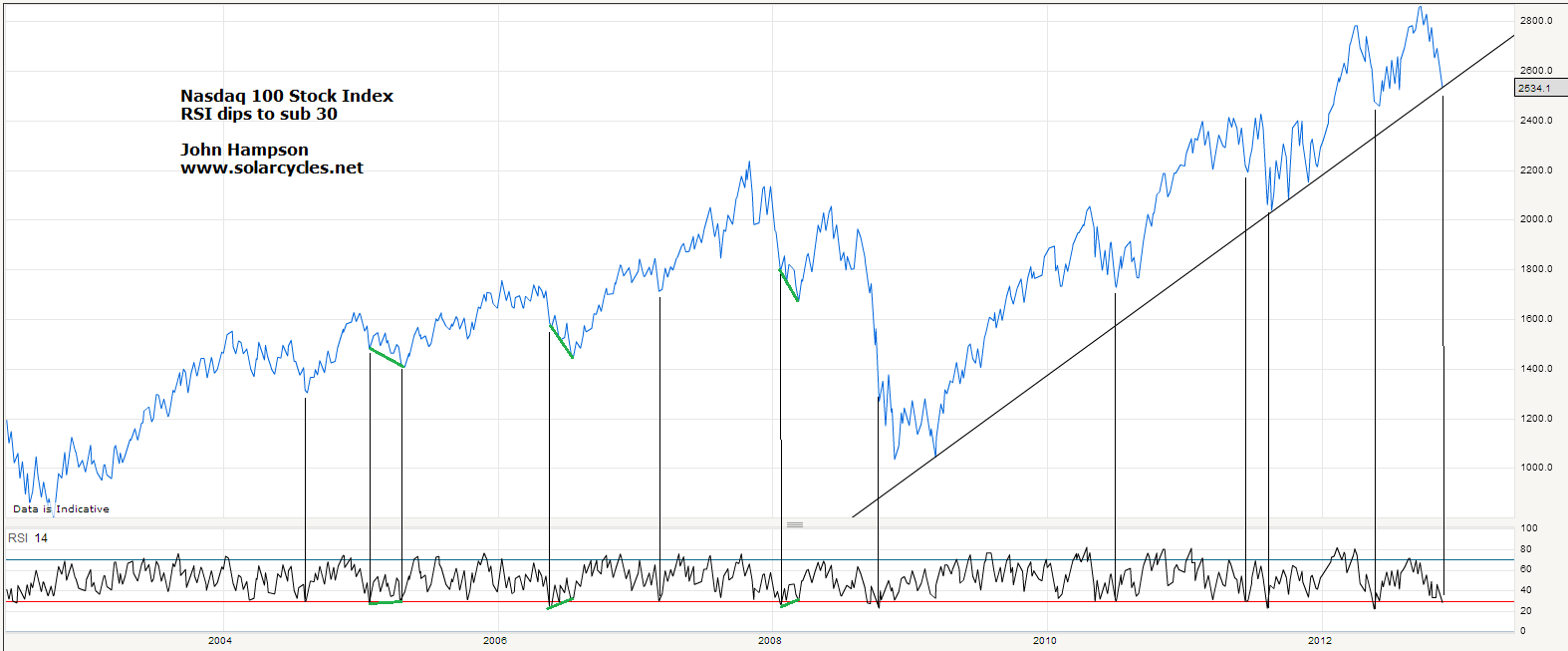
The Nasdaq RSI is also sufficiently oversold to suggest a bounce. I have highlighted previous such occurences and the story is similar to above – either a reversal occurs, or stocks need to print a lower low in the weeks ahead with a positive RSI divergence (again shown in green):

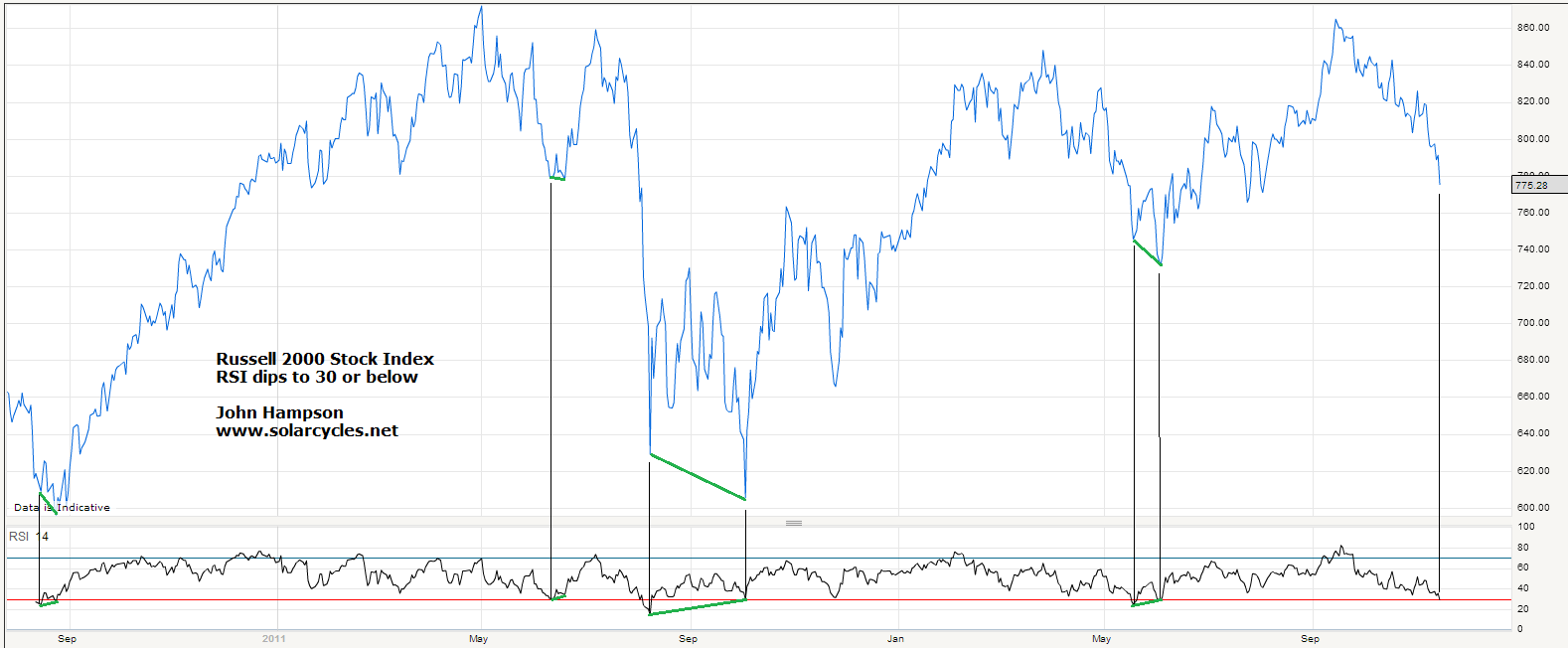
And here is the Russell 2000 index, with the same message as above:

To add to this, Sentimentrader reveals that the majority of US stock market sectors are at bearish sentiment extremes, and stocks above the 50MA have reached the lowest range. So there are reasons to expect a bounce in US equities as early as today. The unknown is whether they will reverse course, or merely make a relief bounce before a lower low with positive divergence.

Looking wider, daily sentiment index extremes are currently showing for treasury bonds (extreme bullish) and Nikkei, soybeans and coffee (extreme bearish). This suggests a bounce in US stocks may well be part of a broader bounce in pro-risk and away from safety.

We have just seen a lunar inversion – stocks declining into this week’s new moon. That gives potential for a brief relief rally before a lower low into the week commencing 26 November – the week of the full moon. That would roughly tie in with the Gann predicted take off point for commodities (and reversal in stocks) around 21 November. Alternatively, lunar inversions have sometimes historically meant trend changes, so there is the potential to rally from here and not look back, which would be in line with the presidential seasonality and geomagnetism I presented earlier this week, and also close enough to the Gann take off.

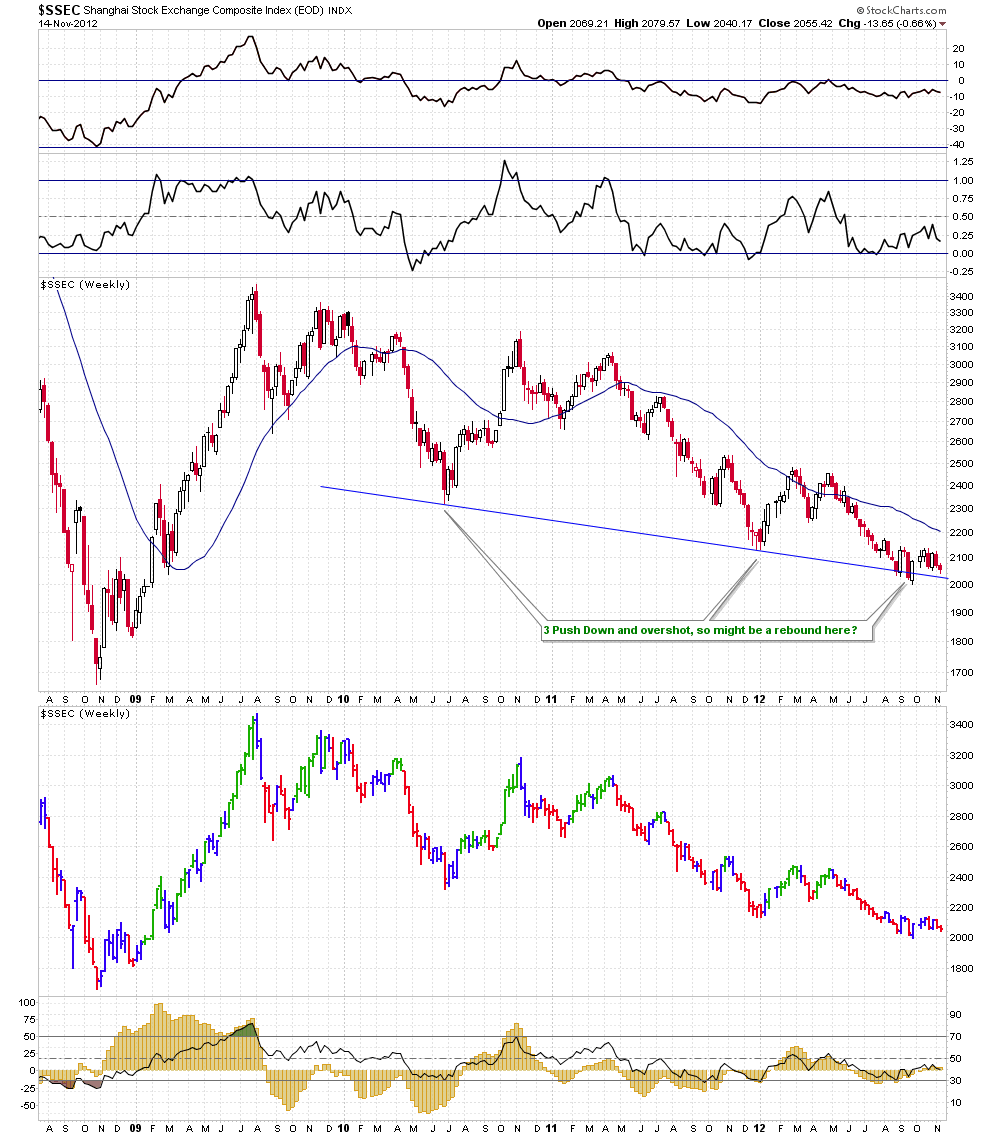
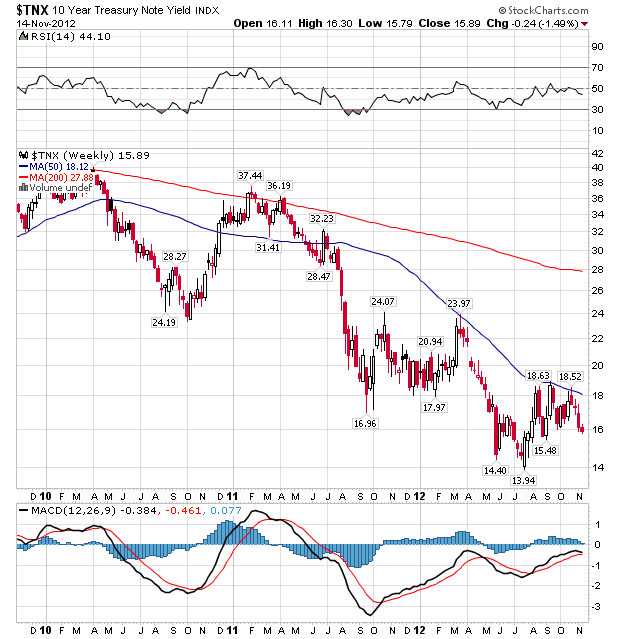
Both Chinese stocks and US treasury yields are still trying to carve out bottoms, both holding above their lows and with the potential to make inverse H&S patterns, and doing so on extreme cheapness. Potential bottoms only of course, but with justifications.

Source: Cobra / Stockcharts

Source: Stockcharts

Russian stocks have also dropped further since I opened a position last week, now at a p/e of just 5.8. Coffee public sentiment is at an extreme low not seen since 2001.

In short, there are a few candidates in my mind to play a bounce in pro-risk – and that includes US equities – and I’m just weighing up where and if I want to add today. The ‘if’ part is related to the potential for a lower low ahead, where a positive divergence in breadth or RSI is required.

We do not as yet see a washout in other indicators, such as sentiment surveys. These might also suggest caution. However, I maintain that if this is a topping process in stocks then we should see up-down volatility near the top, rather than the kind of deep cleansing washout that enables a bull market to continue.

Will post in the notes if I add positions.

Into Year End

If the secular commodities finale is to play out as I predict, then this should be about the point that commodities, led by gold, start to outperform. Supporting this is Gann methodology, which suggests commodities should take off in a large up-move into 2013 as of around 21 November. Here is my suggested historical mirror, with the previous square showing how things might progress:

What could give commodities such a thrust? Strengthening in China for one, and we see this in the latest data. Industrial production rose 9.6% year on year, retail sales beat expectations at 14.5% year on year, and auto sales rebounded strongly from September’s weak number. Commodity technicals could also assist, with gold having bounced at the 200MA again which has largely supported the secular gold bull to date, soybeans having retraced sufficient of their mid year gains to reach just 8% bullish daily sentiment, and coffee having reached an all time record speculator short position.

Tame geomagnetism could also help, and it can be seen from the chart below that the geomagnetic model is finally showing an upturn into year end, as negligible geomagnetism is forecast (all models have been updated this morning):

Such tame geomagnetism should also be positive for equities, with Presidential seasonality too:

Source: Bespoke / Moneygame / My Update

Potentially we could see pro-risk wash out a little more in sentiment before take-off next week, but I predict the next move will be a rally in both stocks and commodities whereby equities (globally speaking) re-reach for their Q3 highs, but make negative divergences in internals (if they are to be topping out), whilst commodities outperform upwards. I am watching leading indicators to judge whether there is ‘sufficient’ growthflation ahead to enable this scenario. The rest should be fulfilled by the influence of solar maximum activity on humans collectively. 2013 is the big test for my solar theories.

I leave Kuala Lumpur tomorrow for 6 nights in Penang, continuing to explore Malaysia.

Country Stock Index Valuations

Today’s exercise is a 3-way cross reference between price-book valuation (p/b), price-earnings valuation (p/e) and cyclically-adjusted price-earnings (CAPE) valuation of stock indices around the globe. I believe we are in a gradual process of transition from a secular stocks bear to a secular stocks bull globally, with the nominal low already achieved in 2009 and the momentum ‘go’ point likely 18 months hence or so. I am on the look out for timely points to invest in stock indices that reach p/es/CAPEs sub 10 and p/bs of around 1 or lower, as these mark secular extreme low valuations.

The first table is a list of some of the main country p/b ratios, as at the end of October 2012. Green – cheap, red – expensive.

Source: Globe and Mail

The second table contains a more comprehensive list of countries, this time valued by CAPE as at the end of October 2012. They are in order of valuation from green/cheap to red/expensive.

Source: Megane Faber

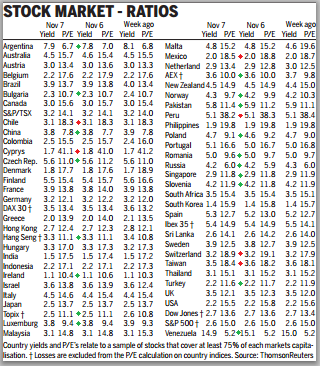
And the last table is right up to date as of the end of yesterday, showing countries valued by regular p/e and also by the yield of the country’s index. Peer at this to spot green markers against cheap countries and red against more expensive. It should be noted that because we are reaching towards the end of a global stocks bear market, there are very few countries that are truly expensive, as the historic average p/e is around 15-16.

Source: FT

What are the main takeaways, when cross referencing?

Pawel mentioned Turkey. It is cheap by p/e and cheap by p/b (though less so by CAPE), and this is after rising 40% over the last 12 months. Japan, particularly the Topix, is also cheap by both (though slightly less so by CAPE). Ireland looks to be the pick of the PIIGS, with a cheap p/e and ultra cheap CAPE (although it is yielding little). But there is one winner, extremely cheap by p/b, CAPE and p/e and yielding 4.2% to boot, and that’s Russia. The Russian stock index is most weighted towards energy, so aside the political risks, the key question is whether you believe energy prices can hold up ‘well enough’ looking into the future. I’ve opened a long position in JPM Russian Securities today.

On the flip side, Cyrpus and Peru are the notable ultra expensive countries, but two other countries stand out because of being relatively expensive to the others by all 3 measures above, and that is India and the USA. I continue to await the forthcoming rally in equities – which should occur whether this is a topping process or a bullish continuation, and if evidence grows for a cyclical bull top, I would look to exit my SP500 stock indices positions.

Singapore

Today we head into Malaysia for 2 nights in Melaka and then on to Kuala Lumpur.

Singapore – what a great place. One of the notable few where the lack of land and natural resources has in no way impeded its economic development. It may have a hybrid ruling system, not fully democratic, but it is clear the government has achieved great things for the city-state. It is the 4th top financial centre in the world, the 5th largest trading port, and has a deliberately varied economy so it is not too reliant on one sector. It is amongst the least corrupt countries in the world with a very high standard of living. 20% of its inhabitants are millionaires, the highest ratio for a country. It is in the top 10 countries in the world in terms of its financial reserves and is a world leader in technology. There are rules to adhere to – no littering, spitting, jaywalking, racist slurs, and more – and capital punishment for certain misdemeanors, but the net result is a country that is very safe, respectful and clean. Customer service is also of  a very high standard and feels very genuine.

For me personally, the English language, left-hand driving and English products around gives it an instant familiarity – all thanks to the colonial history – but the 30 degree constant heat, exotic plants and animals, and multi-Asian influences made it feel equally exotic. There are now 5 million people living in the 274 square mile land mass, but is doesn’t feel overcrowded, but vibrant, and it is sufficiently cosmopolitan not to stand out as a tourist. I spent an evening with a portfolio manager who lives here and he stated that the population had really grown over the last decade thanks to an influx of foreigners. The result has been a ballooning of real estate prices, shown by the red line in the chart below.


Underlying source: SingaporePropertyCycle

The chart also shows the Singapore STI stock index, and I have added the price/earnings valuation history at the key peaks and troughs. It can be seen that there was one historic episode of a speculative mania to valuation excess, around 2000, tying in with the dot com peak. Since then we can see the global secular stocks bear market unfolding in terms of gradually cheapening valuations, even though the nominal index has an upward slant overall. Like other key indices, such as the Hang Seng and UK FTSE, it has formed a large triangle, which I have highlighted, and is likely to resolve one way or the other soon. I suggest, like the other indices, that this is going to resolve to the upside, with a breakout, pullback to the midpoint (triangle nose), and then a couple of years hence, break upwards from there into momentum secular bull. The p/e valuations achieved at the 3 triangle low points of between 5.5 and 8.8 are all extreme secular bear low valuations that suggest sufficient secular wash out to enable a secular bull. Once again, this casts doubt on any deep cyclical bear ahead, but more likely shallow. At current p/e of 11.8, the index is at the cheap end of what has been largely an oscillation over the years between 10 and 25. I have opened a single long position in the STI Index today, and will add to it on any significant falls.

Some pics below. Family Hampson in central Singapore. The amazing engineering of the Marina Bay Sands building. And an experience I hadn’t imagined for the kids – swimming with a monkey at the Shangri La Rasa Sentosa – thanks to the monkey for that freebie!

Monday Roundup

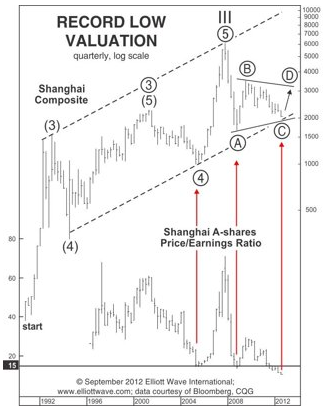
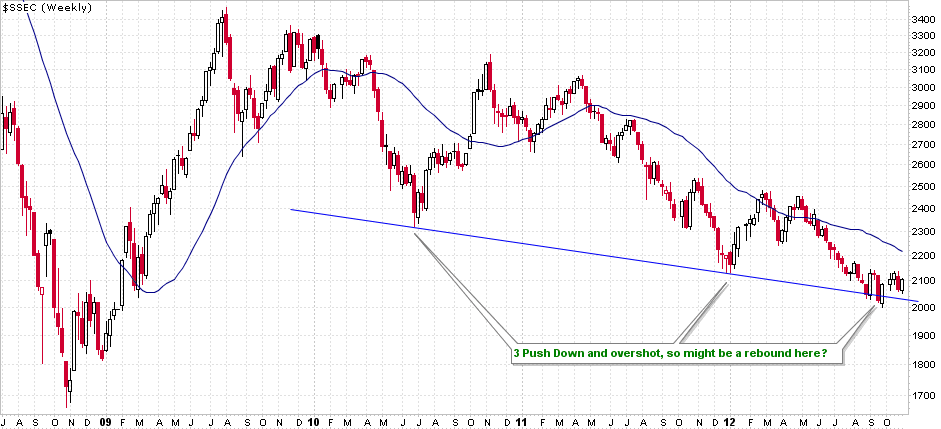
A bit more on China first. I acknowledge Marketguy15’s point about Chinese stocks having made a parabolic top in 2007. It was a speculative parabolic, with the Shanghai Composite reaching a p/e of around 70, and these take time to wash out. If we consider other historic examples of speculative parabolics on stock indices, then the 1989 Nikkei perhaps didn’t make its ultimate bottom until 19 years later (if the Oct 2008 low remains in tact), whilst the 1929 Dow made its nominal bottom 3 years later, as did the 2000 Nasdaq. But we could also note that the 1929 Dow didn’t gain true upward traction again until 12 years later, around 1942, and the 2000 Nasdaq had a major setback again in 2008. So, the Shanghai Composite may not reach back up to its 2007 peak of over 6000 any time soon. However, it’s the valuation that draws me in. The p/e of 7.8 is the lowest since the Shanghai Composite index’s inception, and globally historically buying indices sub p/e 10 has returned handsomely for the next 10 years. The Nikkei never reached undervaluation for most of the 19 years it took to wash out. The Nasdaq at its nominal bottom in 2003 was still overvalued at at p/e of 34.

The Shanghai Composite is also yielding 3.8%, and this is almost parity with the 7 year bond, which has attracted buyers historically.

The technical set up looks promising for a reversal, as shown in the last post. My buy order went through on Friday.

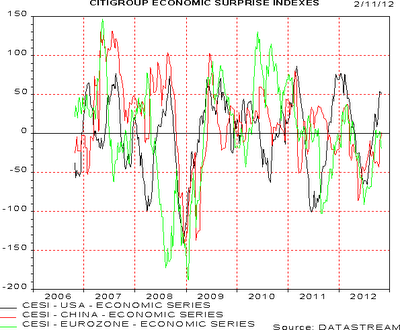
On to global macro. The aggregate of economic surprises for the US, China and Europe is still in an uptrend.

ECRI leading indicators the US have paused, but are still positive 5.9. US earnings have improved as the season has progressed, and the beat rate currently exceeds recent seasons.

Source: Bespoke

US jobs data should continue to improve into the start of 2013 then roll over.

Source: PFS Group

And the performance of US cyclical stocks suggests the SP500 should rally into early 2013 before rolling over.

Source: PFS Group

Marc Faber is now forecasting that stocks could make a counter trend rally into the start of 2013 before continuing downward – i.e. no new highs, but a rally that falls short of the existing 2012 highs. That fits fairly well with Tom Demark’s counter trend rally forecast (though he expects a SP500 marginal high, whilst the Nasdaq makes no new high), and to some degree the late November market top predicted by Eurodollar COT.

The markets should also rally by presidential seasonality around the US elections. I believe the uncertainty due to the neck-and-neck polls have postponed this, but assuming there is a clear victor I expect the markets to rally later this week. Continued outperformance in cyclicals (versus the wider Sp500) supports this, as does the pick up in earnings beats.

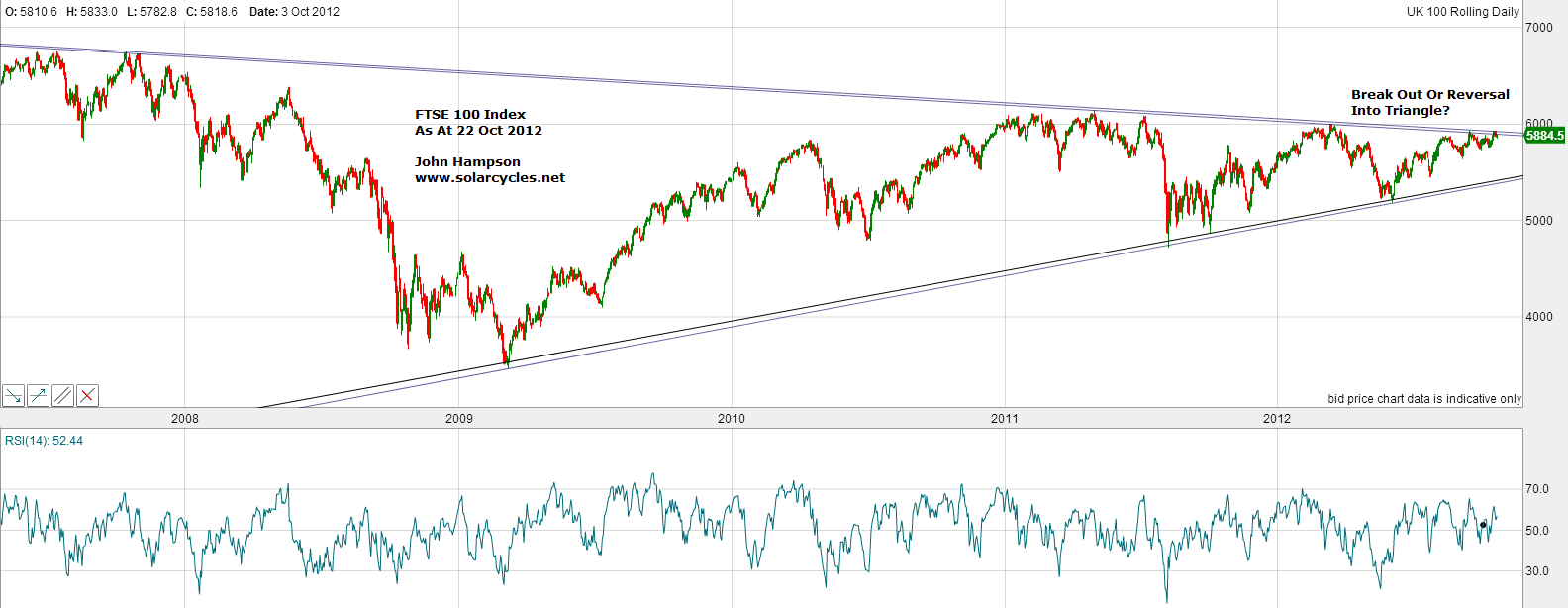
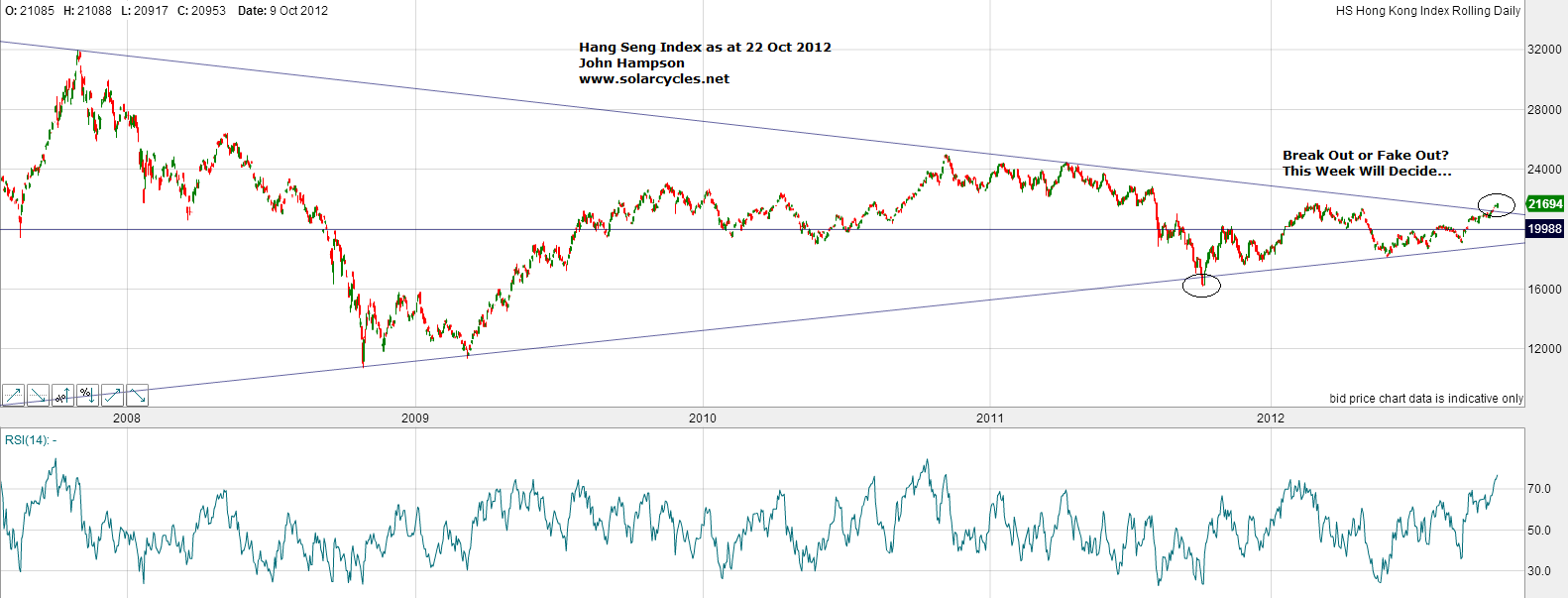
So I still maintain my forecast for stocks to change trend here to rallying, and then will judge developments in leading indicators, breadth and so on, whilst that occurs, to assess whether we are likely making a topping process already or whether we can push on upwards into the start of 2013. There remain notable differences in how US, European and Asian indices are poised. The Hang Seng broke out of the long term triangle and has pushed on bullishly whilst US indices have corrected. The Nasdaq looks bad technically, yet the Dax has held up well in what still appears to be a bull flag above 2012’s previous highs. The FTSE remains in its long term triangle but like the Dax has held up well over the last few weeks. Should we now get a rally in global equities, the FTSE is likely to break out, like the Hang Seng.

As for commodities, the current correction could continue into late November, by Gann, before they begin their parabolic ascent. The COT picture and technical picture for the Euro-Dollar, together with the US elections, suggests the US dollar could rally here for a little period and that could continue to impede commodities into late November. Gold made a big red candle on Friday through 1700 support, suggesting it needs longer yet to correct and consolidate.

Until/if gold breaks out upwards, there remains the possibility that it peaked in 2011. I don’t want to re-analyse gold here, but on balance of probability, I still maintain that it is heading for such a breakout, and that it recently broke upwards out of its 11 month consolidation, with this pullback of the last couple of weeks being a consolidation only before further gains. However, it’s worth a look at this chart from Barry Bannister. Could we have just seen the post peak value trap bounce and now we proceed lower? The gold peak of 2011 wasn’t much a parabolic, but the silver peak certainly was.

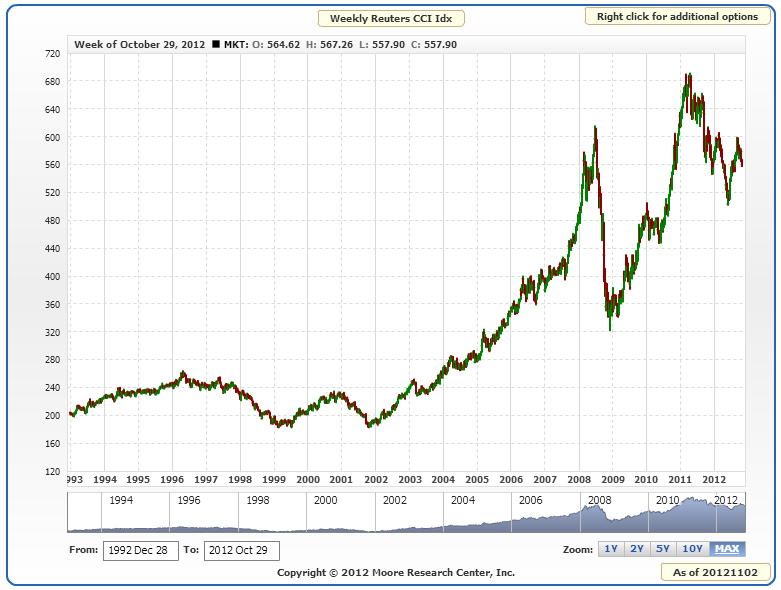
If we look wider, at the CCI commodities index, then, again, how do you read the chart compared to the above model? I would suggest the best fit is for the two spikes are the bear trap and bull trap, with the greed parabolic still to come ahead. If so, that would fit with my solar work and Gann projections, both of which suggest commodities are about to take off on their major final upleg of the secular commodities bull.

If that isn’t so, and the parabolic peaks in commodities have largely passed, with oil in 2008, silver in 2011, cotton in 2011, rare earths in 2011 and so on, then what we would have seen over the last few months would amount to dead cat bounces in commodities (such as gold, soybeans, corn) which should now fail and break into downtrends with momentum, as per the model above. I suggest such a scenario would be accompanied by a new stocks bear and a global recession, and out of that stocks bear new secular bull momentum would be born. The whole process would have been brought forward compared to my solar/secular projections (and Gann also) which suggest commodities should make their parabolic finale into 2013 and then a recession comes to pass after that.

I have not changed my mind. I maintain my commodities long positions on balance of probability (by my references). But there’s a clear dividing line in the leading commodity of this K-winter secular commodities bull – gold – either it is in a renewed uptrend to new highs and is soon to complete the correction of the last several weeks and burst upwards, or it now gathers momentum to the downside and breaks beneath 1600, adding weight to a failure beneath the highs. So once again, it is delicately poised.

China

A pick up in China looks likely into year end, both in the stock market and economy.

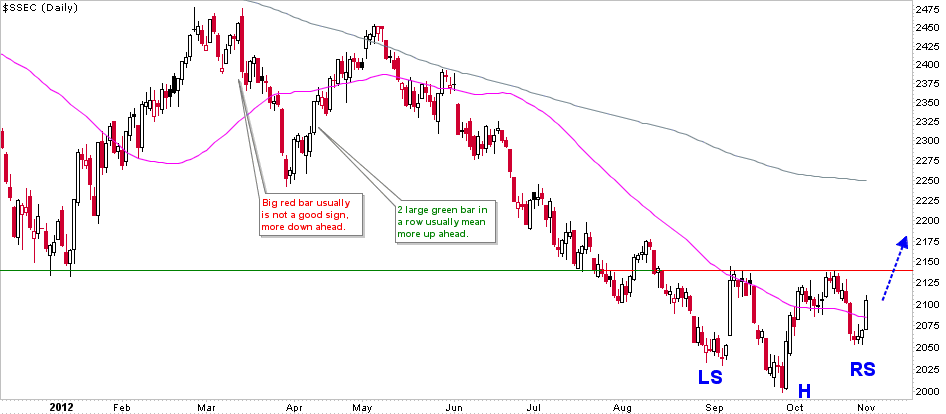
On the weekly and daily views, the Shanghai Composite looks to be basing for an up-move.

Source both: Cobra / Stockcharts

It is doing so on a p/e valuation of just 7.8, which is historic extreme cheapness.

Meanwhile, the Hang Seng broke out of its long term triangle and has advanced away from the breakout, which further bodes well for Chinese equities.

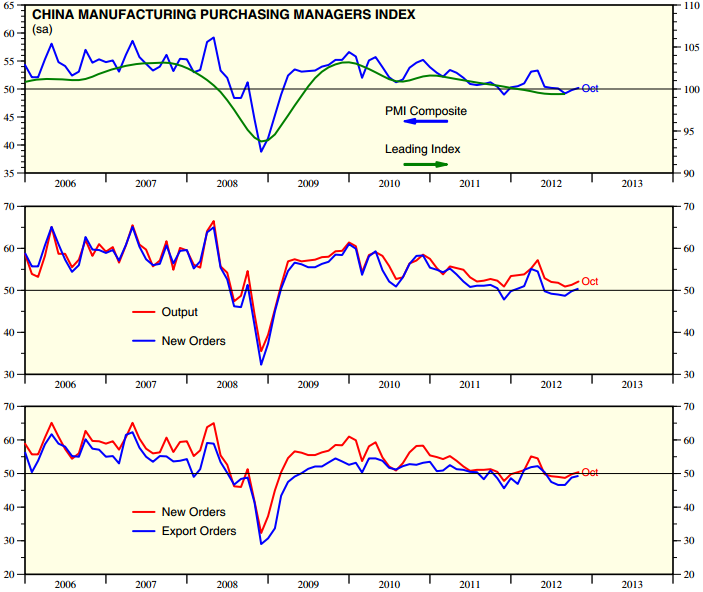
China PMI has pushed back up recently, which as a leading indicator suggests an upturn in the economy ahead, even if only short lived rather than enduring.

Source: Ed Yardeni

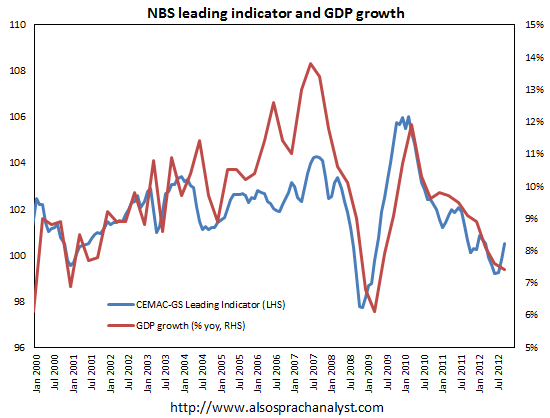
And the Chinese National Bureau Of Statistics leading indicator suggests an uptick in GDP growth is likely.

I maintain that strength in China is important to fulfill a secular commodities finale next year, due to China’s role as the world’s largest aggregate commodity demand source. Now let’s see whether this improvement in China is mere counter trend respite and stabilisation or a move that gathers momentum, but given the Chinese central bank pumped the equivalent of $50bn into the economy on Sep 25 and another $42bn on Oct 9, there is the potential for a period of reasonable strength.

Price To Book Ratio

My multi-month world trip with my wife (who is Austrian – nationality rather than economic school of thought) and 2 kids (who are 6 and 10) begins on Tuesday, starting with a week in Singapore, adopted home of Jim Rogers. He has said that a smart man would have moved to London at the start of the 1800s, to New York at the start of the 1900s and to Asia in the early 2000s, anticipating Asia to be the economic power of this century. He believes today’s Asian work ethic is the same as the USA used to have. I hope to get a feel for that myself. After Singapore we travel by land into Malaysia, and from there into Thailand. We intend to visit quite a few countries around the world, so if I am coming to your neck of the woods, and you have a few tips on what to do, what to see, where to eat or where to stay, let me know. John (at) solarcycles (dot) net. I will keep you updated of our route. My posting times will change, due to the time difference. Also I may not be able to achieve the same depth or frequency. But over this important time (when it is ever not?) I will absolutely still be sharing my thoughts and actions, and looking for your continued input.

OK, to the markets. This week’s data looks like this. US earnings are now overall slightly negative year on year but slightly above pre-season expectations (which was for worse). US economic was data overall mixed, but Economic Surprises are still strong (now standing at +51.7). Conference Board global leading indicator data has generally disappointed for this month. Australia -0.8 (last month zero), Eurozone -0.4 (last month +0.5), China +0.3 (last month +0.7). That data is a warning flag because the global improvement seen in September over August may be being reversed. Eurozone PMI came in lower than expectations and sets the scene for a negative GDP reading.

Source: SoberLook / Markit

Technically pro-risk has been pulling back en masse, but without obvious recipients, as treasury bonds, corporate bonds and gold have not advanced. I’m not quite sure what to make of that development, but we will find out soon. As per my last post, I believe that the next move will be a counter rally in pro-risk and there is some evidence that we may be reaching the kind of bearishness that may initiate a snapback:

Source: Sentimentrader

After this coming Monday’s full moon the pressure should change to positive, coinciding with positive seasonality into and around the US election. Again, as per my last post, I will be looking for an up move with negative divergences (in economic data and technicals) for evidence a cyclical equities topping has begun (and to sell into the up move), or for positive developments to accompany the up move and to suggest that the sell-off we have seen was rather a post QE announcement normal pullback based on unimpressive earnings. Tom Demark believes the Nasdaq has made its price peak already and the counter rally due will therefore fall short, whereas he believes the SP500 will make a marginal new high, before both then retreat 12-17%.

The Hang Seng has held up relatively well during this last 2 weeks and has maintained its long term triangle breakout. Treasury yields have also performed bullishly. Gold sentiment has pulled back sufficiently to enable a renewed move higher, and the 1700 level that it has currently reached represents a 38 fib retracement of the recent up move.

Source: Sentimentrader

Below is my recent prediction for stocks and commodities into 2013. Now if stocks top out lower than 1600 on the SP500 and have begun their topping process already then that is still consistent with historic mirrors (only the peak price level would change), as long as commodities now go on to outperform and make their blow off secular top. The rise in treasury yields despite the pull back in pro-risk is a positive for this scenario because by history yields need to rise as money flows out of safe havens into pro-risk, and if equities are stalling then commodities should be the recipient. The current threat to this scenario is the renewed weakness in global data (leading / concurrent). I maintain there needs to be sufficient health in the global economy into 2013 to enable a broad secular commodities blow-off top. Gold could potentially go its own way – operating as a hard currency and safety asset – but right now it isn’t showing any outperformance. And one last thought – if a renewed global turndown did gather pace right ahead, then might the Fed step in once again, this time with one of its as-yet-unused unorthodox policy tools, which could then inspire a mania into hard assets if desperation was perceived? It may not work again but could provide a tipping point into hard assets.

Well, that’s just speculation. We will see how things develop. Any cyclical stocks top should be a drawn out rounded affair so there is no rush to action. And the leading commodity in this secular commodities bull, gold, is in a bullish technical position, having broken upwards out of its 11 month consolidation. Collectively, when stocks and commodities make their next up trend move – whether that be counter or renewed trend – more evidence will come to light.

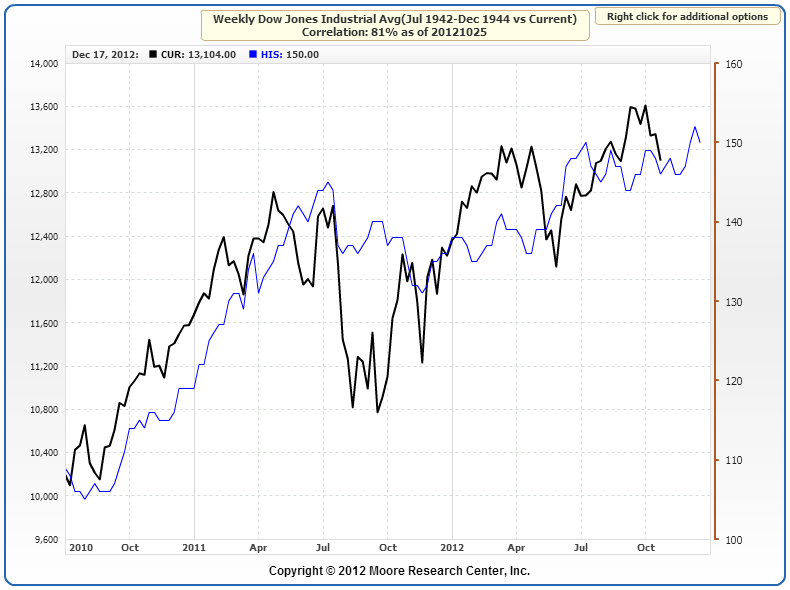
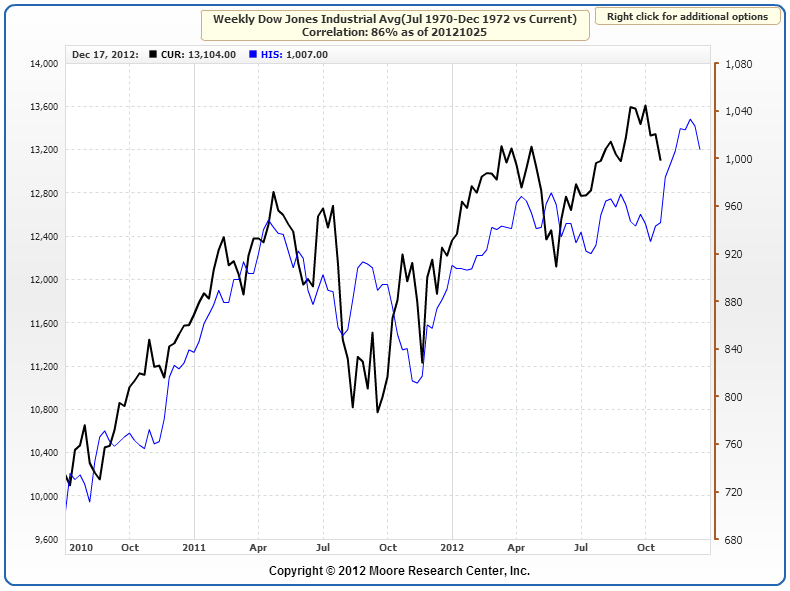
Regarding US stocks, if we cross reference the closest percentage correlated periods from history in terms of chart action to date together with presidential election seasonality (i.e. periods into the US  election like now) as well as previous secular stocks bears / secular commodities bulls periods then the closest mirrors from history are shown below:

Source: MRCI

Both have chart correlation percentages over 80%, both 1944 and 1972 were US election years and both fell within secular stocks bear / secular commodities bull periods, and the combined prediction would be for an up move next into and around the US elections, which is consistent with expectations further up the page. No guarantees of course – just a guide.

Lastly today, price to book ratio.

Price to book ratio (p/b) is an alternative valuation measure for stocks to price/earnings. A p/b ratio of 1 is the theoretical liquidation value of a company or stock index, i.e. assets minus liabilities. Buying a stock at a p/b sub 1 is either getting a bargain or there is something wrong with the company. Shown below is the p/b ratio for US and Europe indices since 1975 to current. The best time to buy a porfolio of the two would have been 1981/2 when they both dipped under p/b 1.

Source: Seeking Alpha / MSCI

The cheapest stock indices valuations globally that have ever been witnessed were in Thailand at the time of the Asian Financial crisis (late 1990s) and Greece in the Euro debt crisis of current times. Greece hit a price/earnings valuation of sub 2 at its lowest whilst the Thai SET reached a p/e of 3.

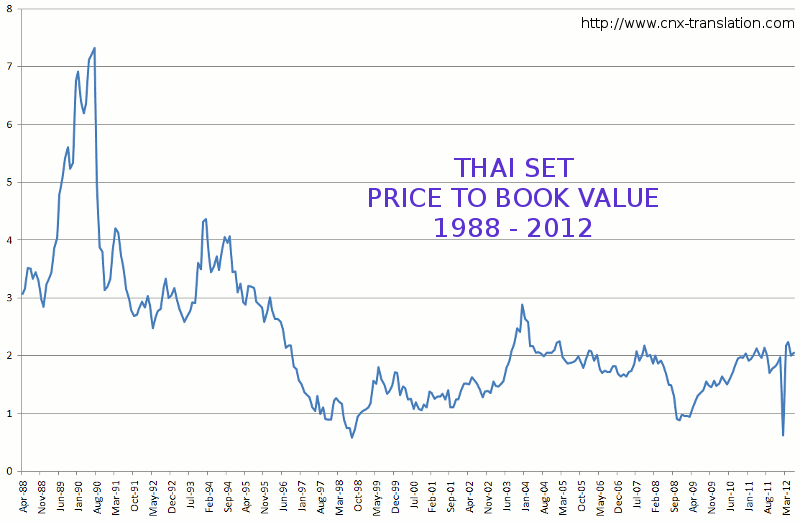
Here is the Thai SET long term p/e valuation chart, showing a double dip to around 3 in that crisis period. The Thai SET is currently 4 times higher now than then, so buying Thai stocks when the p/e was 3 would have been a good investment.

We can also see the p/b ratio hit its lowest around then also, to around 0.6, which again would have been a great entry point, with markets overly discounting bad scenarios.

A snapshot of global stock indices p/b valuations in 2011 looked like this. Greece was the cheapest on a p/b of 0.76. The great majority of other countries, ranging from G10 to developing nations ranged from a p/b of over 1 to sub 3, with a few rogue outsiders more expensive than p/b 3.

There is no question in my mind that the Greek stock index will return handsomely in the long term for those brave enough to have ventured in at its lows this year and last (it has currently doubled off its lows). The risk is that it tanks again, once or more, before rallying in earnest, subject to developments in Europe and the wider world. Now that is has doubled, its valuation by p/e or p/b is no longer cheap but mid-range globally. But, like the Thai SET in the late 1990s, the point is to buy in at a p/b some way below 1 and be patient.

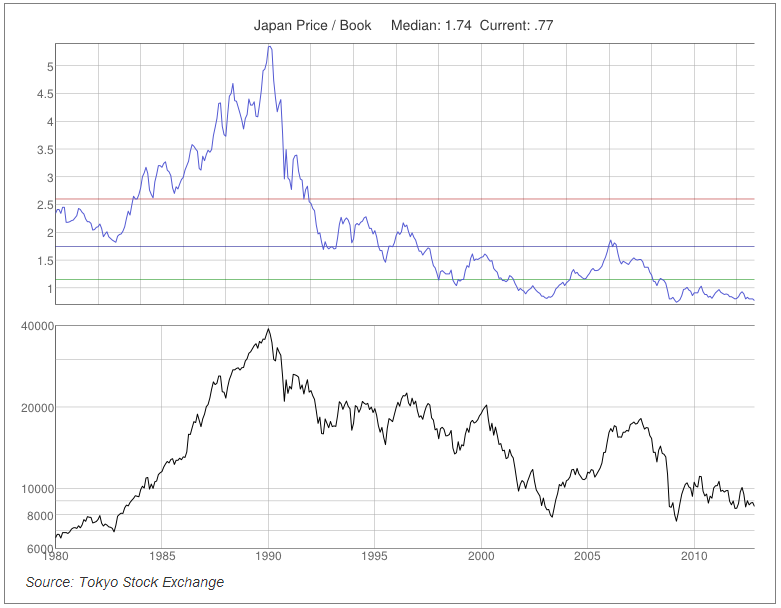
So, it is interesting to see Japanese stocks at a p/b ratio of just 0.77.

 Source: Vectorgrader

Whilst price/earnings valuations haven’t dropped so extreme low (13.7 Nikkei, 10.9 Topix currently), the price/book ratio reveals a much more compelling undervaluation, suggesting the liquidation of all Japanese companies in the Nikkei would actually return almost 25% more cash than it costs to buy them currently.

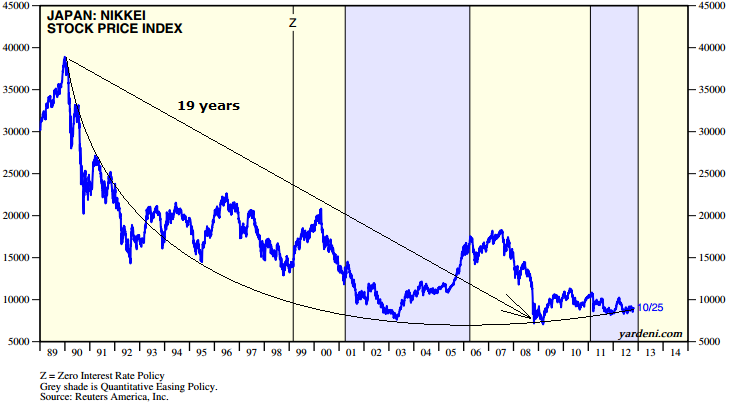
Since the 1989 Nikkei peak, the index has gradually been making what appears to be a rounded bottom. Recall the 19 year cycle showing up in the Dow Jones stock index spectrogram? Well, from the Nikkei peak to the nominal low to date was 19 years. Just speculation that it may have relevance here, but if the rounded bottom continues its trajectory then that nominal low of Oct 2008 should hold.

Underlying source: Ed Yardeni

In support of that price bottom holding, the price to book ratio of 0.77 is historically extreme. It is in the same zone as the Thai SET at the worst of the Asian financial crisis and as Greece in the Euro debt crisis accuteness. It is also little higher than that reached at the Nikkei’s nominal Oct 2008 bottom.

So are the Japanese stock indices a great buy and hold opportunity here?

To answer that we have to consider its debt and deflation problem that has plagued it throughout its decline since 1989. It has the highest debt to GDP ratio in the world. However, unlike other indebted countries most of this debt is held domestically, by the Japanese people. This makes Japan less likely to be a default candidate, particularly given the Japanese culture. However, it has to keep rates low to service the debt and pursues inflationary policies which would help shrink the debt. Until now though it has failed to re-ignite inflation despite its policies. It is heading for one of two outcomes: debt default – which I believe is unlikely (at least in this decade) – or inflation finally takes hold and yen-weakening becomes the trend. Given the yen has been in a 30 year bull market since the early 1980s making for extreme relative historic valuation to other currencies, and real estate prices have dropped to 36% below long term averages in terms of both versus rent and versus income, and equities have reached extreme historic p/b cheapness valuation, I believe there is a strong possibility that money now starts to pour into the inflationary assets or equities and real estate (over months and years).

So what about the p/e valuations not having reached sub 10? Well, that is a thorn in the side of the undervaluation story, however, Japanese p/es average higher historically than other countries. Nikkei and Topix p/es are actually lower now than they were at the bottom of the 1970s secular bear.  On p/e alone I would not be a buyer but it is the p/b valuation that really shows the current value on offer. If further casts doubt on a deep stocks bear ahead – at least in that part of the world, with also Chinese equities on a p/e of just 7.9 paying dividend yields of 3.8.

In terms of Japanese equities I believe it is more likely they can further their rounded bottom. The historic extreme undervaluation for real estate and historic extreme overvaluation for the Yen is also supportive of a wider risk/safety inflation/deflation asset reversal. I maintain we are in the transition years from global secular stocks bear to global secular stocks bull and K-winter to K-spring, and that this is also supportive.

My average Nikkei long position is 8481 (current price 8913). I have added to that this morning with a view to a longer term hold based on the above.

Edit: One more chart to add that I missed off: Japanese equities now yielding more than Japanese bonds, adding to their relative attractiveness.

Source: Daily Wealth


Cyclical Stocks Bull Topping Indicators

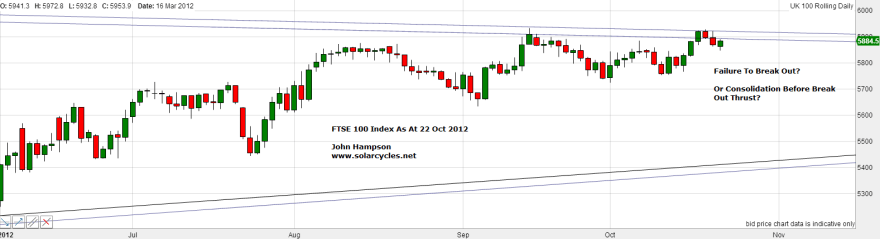
This is how some of the key stock indices currently stand. The FTSE 100 is trying to break out of a long term triangle.

On the nearer term view, however, it has been turned away at declining resistance. The question is whether this is a fifth failure since the cyclical bull began in 2009, or whether it is consolidating before it finally breaks through.
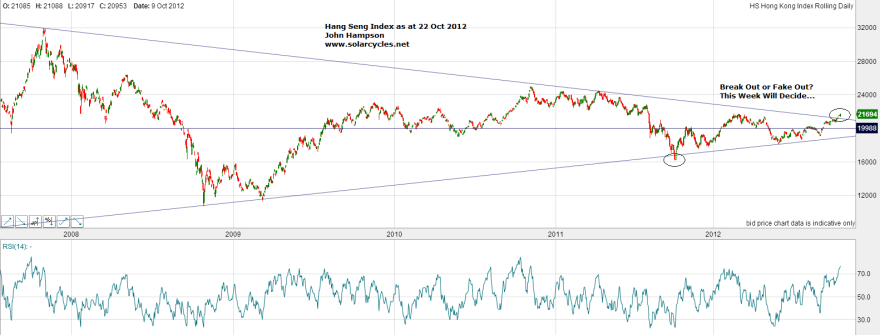
The Hang Seng, meanwhile, has now broken out of its similar long term triangle, and it is breaking out on a p/e of 11, which is historically relatively cheap. Unless it is pulled back in this week then that break would be validated.
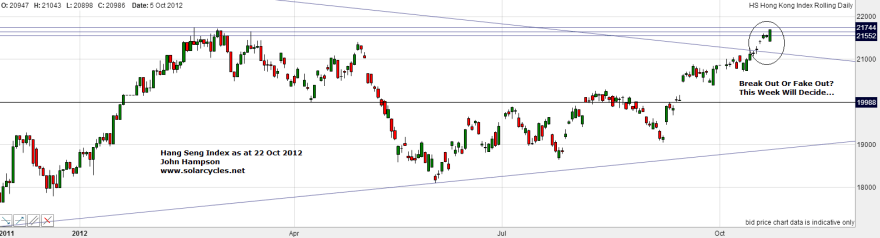
On the nearer term view, it can be seen that it is now up against another resistance level: the March 2012 highs. So if it is to be pulled back into that long term triangle range, then here is a level to be repelled at. Two things to keep an eye on therefore.
The German Dax is also into a zone of importance. Below is the horizontal support of the March 2012 highs which it appears to have successfully backtested, whilst above is the cyclical bull high-to-date resistance (from 2011) around 7500. It additionally has the support of a rising channel to potentially take the index up to that resistance level. A break of either support would turn things more bearish.

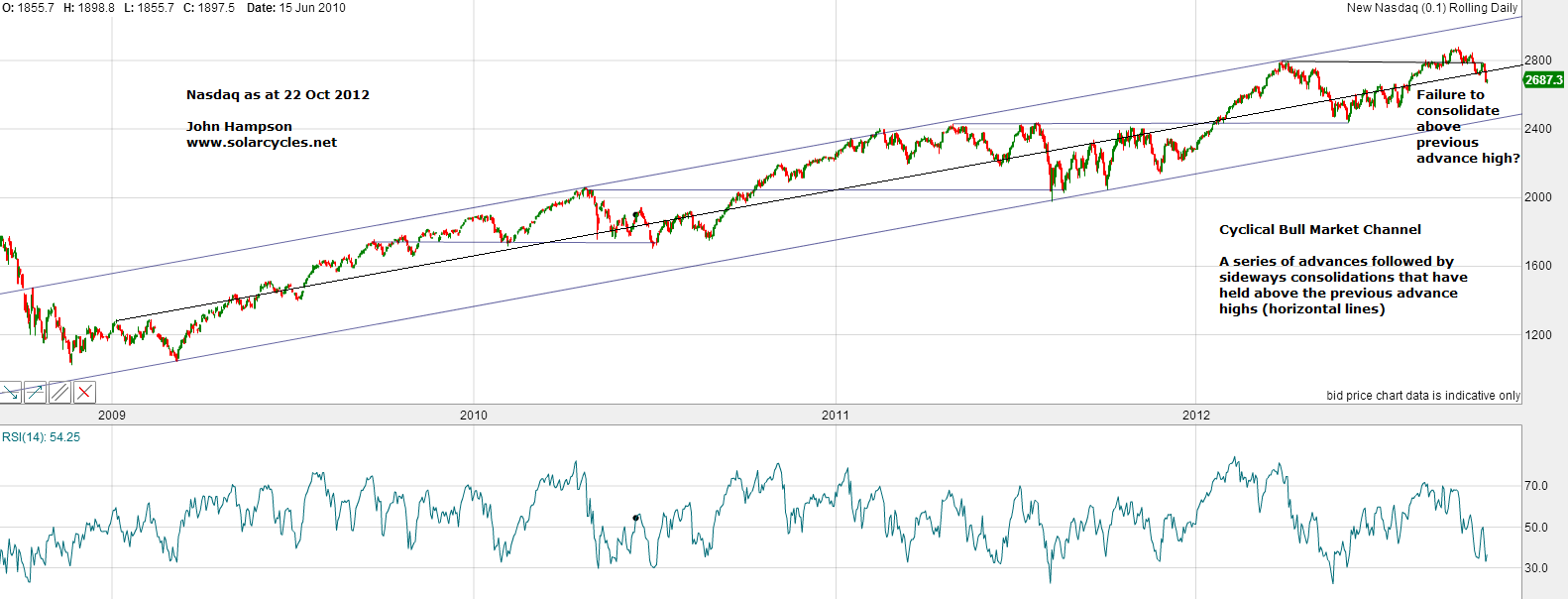
Meanwhile, the Nasdaq in the US is in a different place. Unlike the indices above, the Nasdaq reached far above its 2011 highs already, early in 2012. It since then rose above those 2012 highs (in March) to higher highs (in September) but has failed to hold above. The chart below shows that this could be meaningful.

The near term action since September has produced a little series of lower highs and lower lows, which suggests a new bearish trend. On the flip side, the index is nearing oversold, approaching RSI 30.

Clearly the Nasdaq has some way to fall before dropping out of the bottom of its cyclical bull channel and officially into a new bear market, but we should not need to wait for that to be able to judge whether the cyclical bull has topped out. One topping signal would be a major distribution day near the top, and we saw that on Friday. Another would be that cyclical stocks such as Techs break down first and money roates into defensive stocks. Techs are the weakest sector currently. US earnings are now overall flat year-on-year, which actually beats expectations (which were for shrinkage), but tech stock reports particularly have disappointed.

So the question is, are we seeing the first part of a topping process, with techs leading us down first, or are we just seeing some current weakness particular to tech stocks and their poor earnings (overall US earnings are so far flat, which actually beats expectations), with some knock on effect from the Nasdaq index onto other indices? With different indices around the world in different positions, it’s not clear, but there are some other common characteristics to cyclical stocks bull tops, so let’s review:

1. A topping process, normally months, with reversals of reversals of reversals in a range

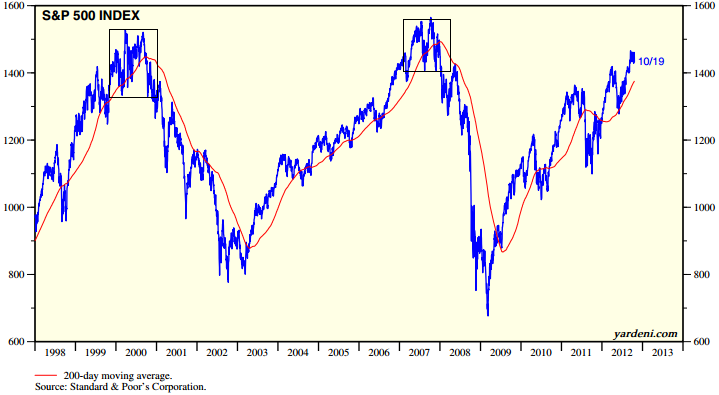
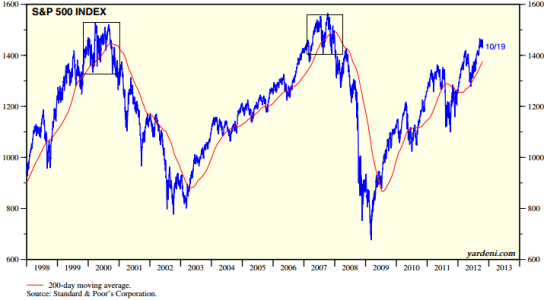
This chart shows the last two cyclical bull market tops highlighted. Both topping processes lasted around a year, and within the boxed ranges there are both double tops and double bottoms, reflecting the reversals of reversals in a range criteria. If we are seeing a top on the SP500 currently, then we should see this play out into next year, with some sideways volatility to make a topping process. That should allow the 200MA to catch up and then the market can slice through it to begin a new cyclical bear. Could the topping process have begun in March this year at the lower peak? If so, we should still see more up/down oscillation as the market gradually rolls over.
Source: Ed Yardeni

2. Evidence of overbought and overbullish extremes (such as RSI and sentiment surveys)

I’ve done some checks on this and the evidence isn’t very compelling that this actually correlates with a cyclical bull top, namely because of the sideways ranging. These indicators can flash at the start of a topping process, as an up move rolls over into ranging, but thereafter don’t hold persistently.

3. Breadth divergence (such as new highs / new lows and advance-declines)

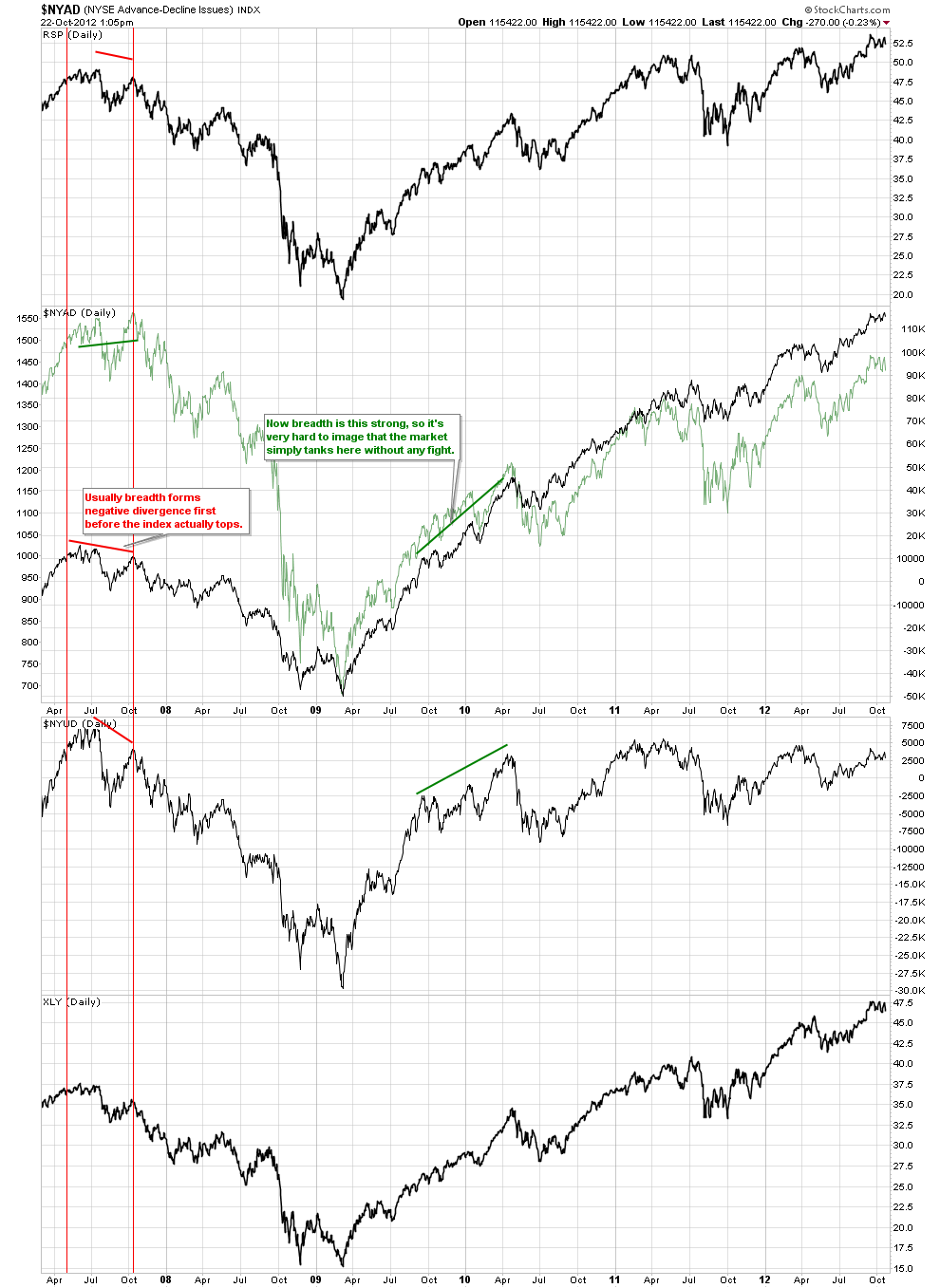
Cobra’s chart here shows how at the 2007 cyclical bull top for the SP500 price made a higher high whilst advance-declines made a negative divergence. This shows narrower participation compared to a healthy rally which is based on broad participation.

Source: Cobra / Stockcharts

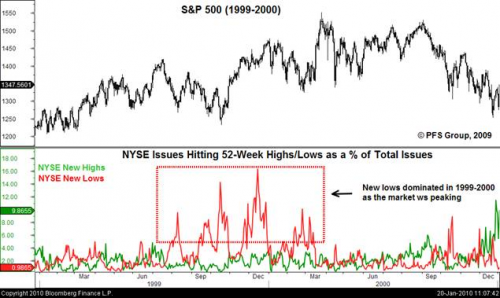
Chris Puplava’s chart here shows that in the run up to the previous cyclical bull top of 2000 shares hitting new lows in the NYSE (SP500 and Dow) exceeded those hitting new highs, which again is a signal of a narrowing rally.

Source: Chris Puplava

This is how things stand today. NYSE (SP500 and Dow) advance-declines are still in an uptrend. For topping evidence, we would want to see a pullback in stocks and this ratio, followed by a new high or double top in stocks where the ratio negatively diverges.
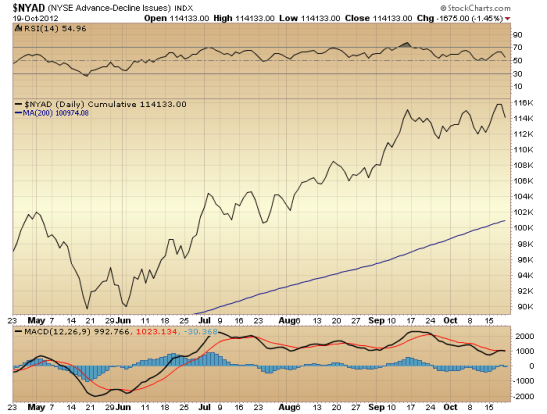
Source: Stockcharts

And this chart is a cominbation of Nasdaq new highs – new lows and NYSE new highs – new lows. Again, we don’t see divergence yet, so would want the same as above – pullback then push up with negative divergence.


Source: Humble Student / Stockcharts

4. Cyclical sectors topping out before the index top and money flow into defensives

Leading into a cyclical bull top, money normally rotates out of cyclical sectors such as technology, consumer discretionary and materials into defensives such as healthcare, utilities and consumer staples. This is because the economy is turning down or forecast to turn down and these sensitive sectors therefore become less attractive. Below we can see that into the 2007 top, two cyclical sectors topped out several months before, whilst one remained strong, but the two were sufficient a clue for a top.

Source: Chris Puplava

Fast forward to today and this is how things stand. SP500 cyclicals have overall been in an uptrend since August and do not show that negative divergence.

Source: Stockcharts

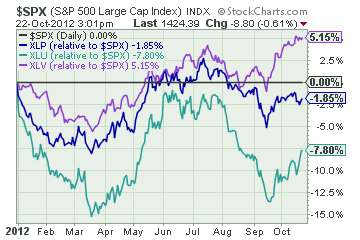
Comparing three defensive sectors to three cyclical sectors below, we don’t yet see defensives outperforming and cyclicals falling away.

XLV Healthcare, XLU Utilities, XLP Consumer Staples

XLY Consumer Discretionary, XLF Financials, XLB Materials
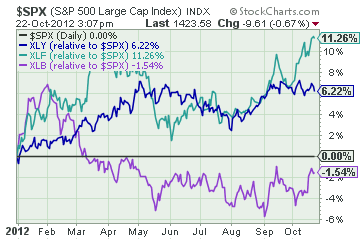
Source: Stockcharts

However, the biggest faller has been tech, and that is a cyclical sector. So, as things stand, I would want to see a couple of other cyclical sectors join tech in underperformance relative to the wider indices, to add weight to a top.

5. Major distribution days near the highs

We got one on Friday so that’s a warning flag.

And in the wider environment:

4. Yield curve flat or negative

5. Tightening of rates through rising yields

6. Excessive inflation

7.  Rolling over of leading indicators and recession model alerts

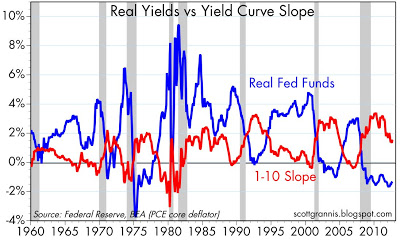
The below chart captures 4. and 5.

Source: Scott Grannis

Cyclical stocks bulls have historically ended with inflationary and speculative froth, money pouring out of safety and pushing up yields, inflationary pressure and natural tightening tipping us over into recession, and indicators of forthcoming recesssion in evidence before the speculation tops. Is this time different due to Fed intervention in the bond market? I don’t believe it affects the overall mechanism, but perhaps means yields will peak lower than otherwise. I still foresee this excessive speculation and inflation playing out, as per my previous Forecast 2013 posts. Thus far we see a little inflationary froth through grain prices, but little else excessive.

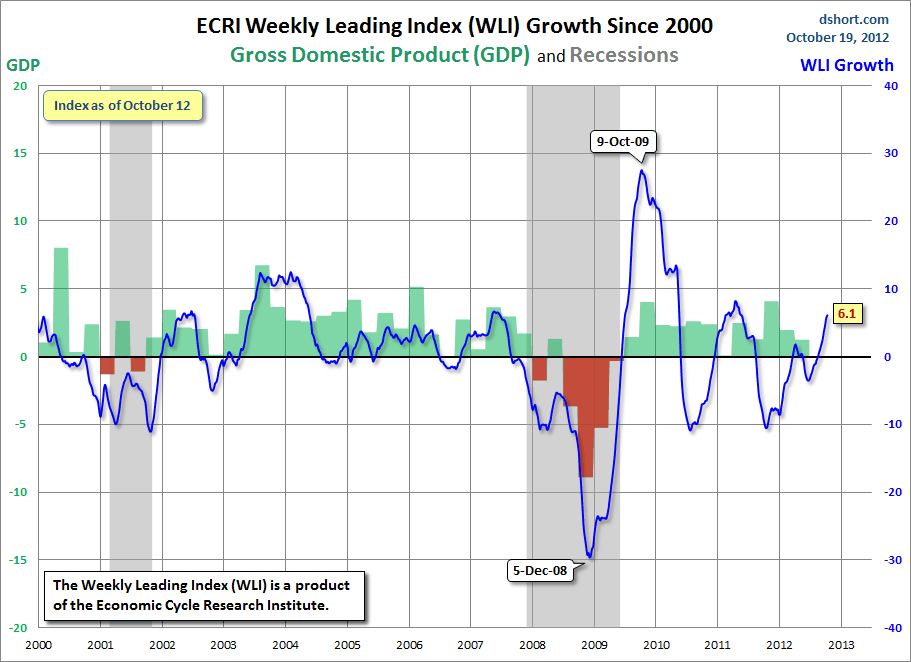
Regarding leading indicators rolling over, a glance at the US ECRI WLI shows an indicator performing quite differently to the last two cyclical bull tops (leading into the grey banded recessions). What we would need to see is this indicator start to roll over and break into the negative. This coming Friday’s WLI reading is forecast to slip to 5.82, so there is a potential seedling for a trend change. But we would need to see a few weeks of increasingly lower readings to be consistent with previous tops.
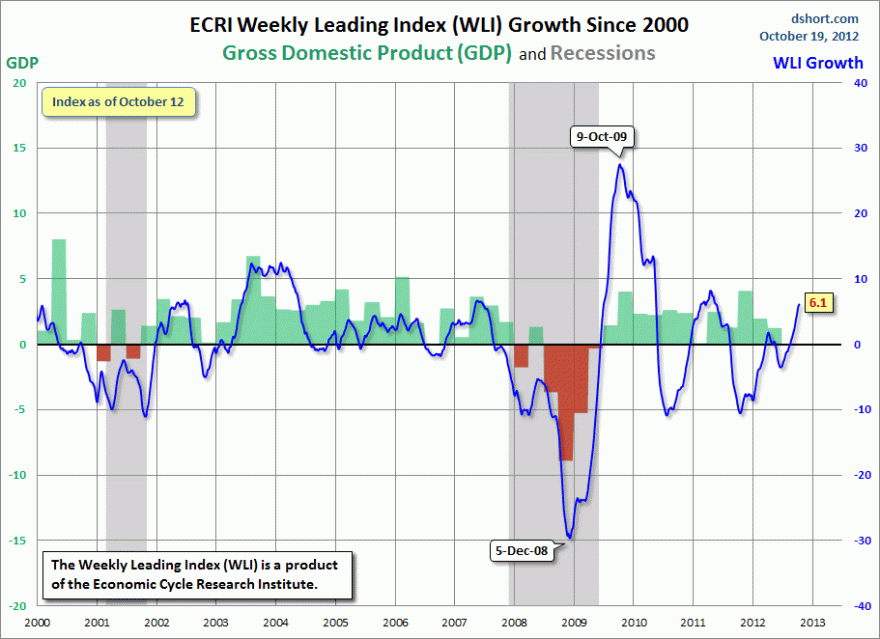
Source: Dshort

The Citigroup economic surprises index for the US is also in a strong uptrend, and its correlation with the SP500 is shown. Again, it would need to reverse trend for a few weeks and break into the negative to be consistent with previous tops. More often than not, this indicator leads a trend chane ahead of stocks topping or bottoming.

Source: Ed Yardeni

 Turning to the global picture, Conference Board leading indicator latest readings for Germany and Australia this week both came in negative and worse than last month. This is in contrast to the recent general improvement since August in global leading indicators. Once again, we should see a trend change in global indicators back to the negative over several weeks, to be consistent with previous equities tops, i.e. leading indicators should roll over before the definitive top in stocks.

So let me sum up. There are several potential cyclical stocks bull topping signs: techs underperforming, the Nasdaq breaking technically and a major distribution day near the highs. However, this could as yet be a ‘theme’ to US earnings season, namely disappointing tech stocks sell off, infecting other indices, in seasonally weak mid-October, before the cyclical bull continues. To differentiate between the two we should see more bull topping indicators aligning, if this is to be a top, and the whole process should last a while yet. Following the current down move we should see another up move, and perhaps repeat that down-up oscillation one or more times again lasting into the end of this year. In support of this, Tom Demark’s latest forecast is for the SP500 to make a move up again to peak out at 1478-1485 in the next 10-12 trading days and for that to be the high for this year. That would fit with Presidential seasonality being strong into and around the US election.

Should we get that move up, then we should expect to see some negative divergences if this is indeed a topping process, such as narrower participation or economic indicators weakening or underperformance of cyclicals. Should that occur then I will use that strength to sell out of some or all of my stock indices positions.

It is curious to see the Hang Seng breaking out and the Shanghai attempting to bottom whilst the Nasdaq is potentially peaking. How might that resolve? Well, my overall message is that a market top should take some months yet to fully form, so there is no rush for everything to align. Solar and secular history suggests equities should top first and then commodities should make their blow off top. It is therefore appropriate that we see some strength or at least stabilisation in China, as a key demand source for commodities. US indices are also amongst the most expensive by p/e whilst China is in single digits. It would therefore fit if the US indices were to roll over first.

A gradual topping process over a few months (rather than a swift decline) should also enable sufficient speculative froth to produce the inflationary finale whereby commodities make a secular final parabolic and bond yields escalate.

So, I sit on my positions for now. I await a renewed up move in pro-risk after this coming weekend’s full moon and into the US elections, targetting Tom Demark’s range. There I will look for further evidence of a topping process to judge whether to sell out of equities.

Friday Roundup

This is the main story of my year: aggressive buying in stocks and commodities in mid-May, and then largely sitting on the portfolio since then.

It looks straight forward with hindsight, but of course the hardest part has been staying put and resisting selling. Now the key question is whether we are going see further upside into year end, or whether the ‘sitting’ should be brought to an end before then.

Based on solar/secular history, the next top in equities should be a cyclical bull top. Based on cyclical bull history, we might expect an overthrow move as the ending move, and given we have just broken out technically in various indices around the globe we are in a good position for that to now occur. Equities should top out (cyclical top) before commodities (secular top), so timing the exit of stock index longs is the most pressing, I believe.

Cyclical stocks bulls have historically ended with a tightening of rates (yields). Too much money pours into pro-risk and out of safety, there is too much buying, speculation and inflation, until a tightening of yields, or central bank rate tightening chokes it off and tips the economy into recession. See here:

Source: Scott Grannis

We last saw this phenomenon when the last cyclical bull ended in 2007. So the question is, has QE and central bank interference broken this mechanism, or are we headed for the same this time round, namely an overbubbling of growthflation and speculation, before we top out? By solar/secular history, we should indeed be heading for an inflationary and speculative finale in 2013 (analysis and evidence here), so I believe this is going to occur. As yet, we don’t see a particularly strong uplift in inflation around the world, but as per that analysis I believe it is coming, and nor do we see excessive froth in pro-risk or a hasty exit out of bonds. We just see tentative evidence of reflation and so I believe the process has some way to go yet before we enter the likely zone of a cyclical equities top. To support this, we do not see the usual cyclical topping indicators yet such as breath divergence, evidence of distribution and a rolling over of leading indicators.

Those who I read who are largely in tune with my view would include the Puplava brothers and Scott Grannis, whilst those on the other side include Marc Faber and Tiho. Marc Faber has been gradually selling out of long positions and moving to cash since May/June time. Because he has been on the wrong side of it for some months now, I believe he has got it wrong for once and was wrong-footed by developments. I believe the same of ECRI and Tiho who also diverged around the same time. I am going to address some of the points that Tiho makes in this post, so I’ll start with evidence that there is historically low levels of money in cash, as a contrarian indicator to get out of pro-risk.

Reducing interest rates to negligble or zero discourages money from being held on deposit. QE then brings down bond yield rates to negative real levels, including the longer end of the spectrum. This discourages money out of bonds and also is currency-devaluing, which further decreases the attractiveness of holding cash. In this environment it is therefore normal to see historically low cash levels and money market fund flows. Because currencies and bonds have international markets, central bank actions in rates and QE have global affects, producing bubbles in assets and pockets of inflation as we have seen over the last few years. Rare earth minerals are a recent example:

Source: Scott Barber

What rate cuts and QE cannot do is directly bring about economic growth or hiring or lending or consumption. However, they reduce the systematic risk and provide an environment that as far as possible encourages money to be put to work rather than held on deposit. In fact, much of the new money through QE has become banking reserves and is not being lent out. The increase in money supply is balanced by the decrease in money velocity. The US Fed and others are continuing with these measures until they see money circulation pick and growth take off in an enduring way. The risk is that they are pressing on this accelerator for too long and could see a sharp inflationary episode ahead as too much of the new money gets lent out or too much money is chased into hard assets in a low-yield environment.

I do not share the view that central bank actions are impotent, and that once this is recognised the markets will tank. If I am correct in that, then the recent succession of rate cuts, the renewed QE and other 2012 stimulus measures (such as China infrastructure programmes) should produce a global reflation, and I believe we now see evidence that this is occurring.

1. Both the Shanghai Composite stock index (green line) and the Baltic Dry Index have broken up out of falling wedges. Still tentative at this stage, but promising.

Source: Bloomberg

2. The Dow Transports has been catching up the Dow Industrials and shrinking the divergence.

Source: Bloomberg

3. Inflation expectations have picked up.

Source: Scott Grannis

4. Stock market breadth is strong – there is no negative divergence.

Source: SeeItMarket

5. Economic Surprises for the G10 nations have trended up into the positive. Emerging markets are trending down but there is some evidence in leading indicators for improvement ahead.

Source: Citigroup

6. Credit markets have normalised.

Source: Chris Puplava

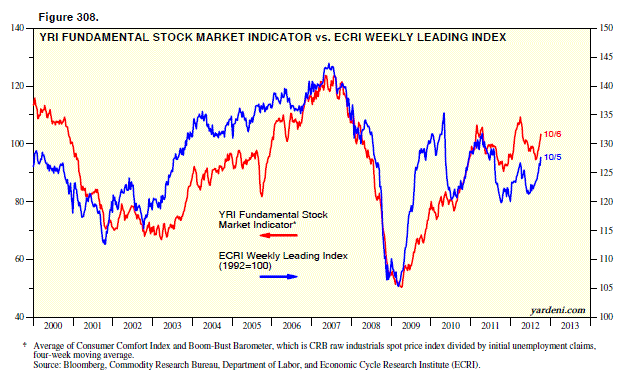
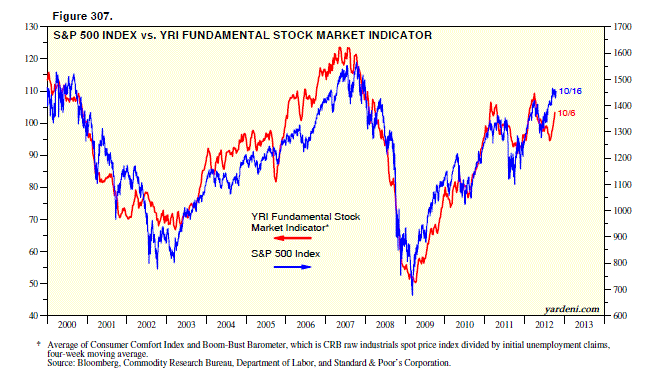
7. US fundamentals have turned up to follow stocks upwards and resolve the divergence, and they echo improvement in ECRI leading indicators (ECRI WLI growth is forecast to rise again today).

Source both: Ed Yardeni

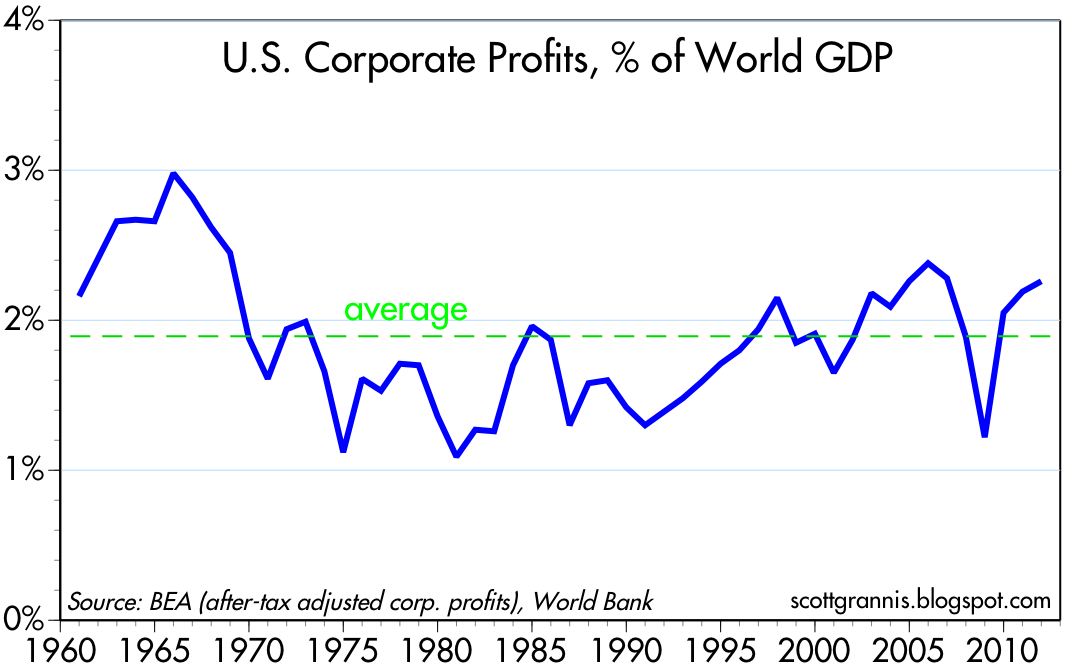
8. US SP500 earnings so far this season have come in at a 64% beat rate, and show marginal earnings growth year on year. Whilst earnings are not very impressive, the expectation was for negative growth, which so far has not been the case. Google’s report was bad yesterday and dragged down the Nasdaq, but the overall earnings picture has not been so troubling so far. One chart that regularly pops up (in Tiho’s analysis and many others) is this one below, that suggests US corporate profits should come down a long way and mean revert to the historic average importance to GDP.

However, the chart is a red herring because globalisation and the world dominance of multiple US behemoths mean the relation to US GDP is now different. Comparing these global US giants to global GDP is a fairer reflection.

Source: Scott Grannis

9. Global trade may be about to turn up based on global PMIs. This is again tentative but promising.

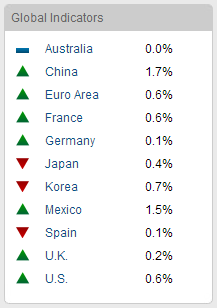
10. Below top is how the latest Conference Board global leading indicators stand, and beneath that is the table as it was at the end of August. There is a notable improvement across the board, and whilst Japan and Korea are still negative, even they have improved.

Source: Conference Board

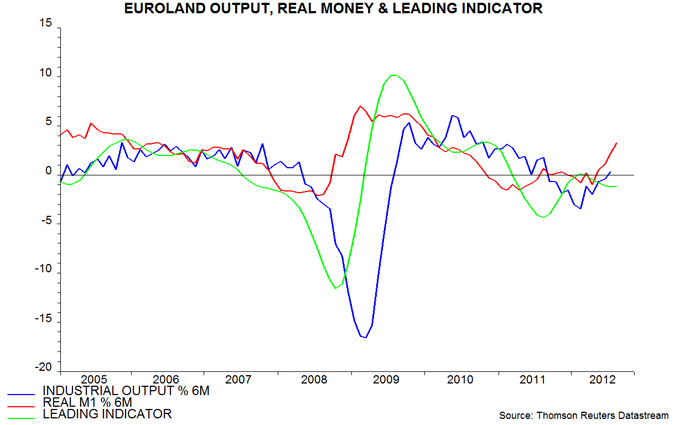
11. The combined picture of output, real money and leading indicators in Euroland and China also suggests an upturn.

Source both: Thomson Reuters

I therefore refute assertions that the global economy is deteriorating and that China is heading for hard landing. Whilst both those things could occur at some point in the future, the current picture and near term future show a global economy tentatively reflating and a stabilisation in China rather than an accelerating decline.

Turning to equities, Tiho suggested that  the risk-on correlation between corporate bonds and stocks means that an imminent burst in corporate bonds (which reveal excessive inflows and historical pricing) could spell trouble for equities.

Excessive inflows into corporate bonds reflect excessive pessimism in relation to equities. That excessive pessimism can be seen in equity yields recently diverging. I expect that yield gap to be corrected by flows out of corporate bonds and into equities. I don’t subscribe to the view that flows out of corporate bonds would have negative implications for equities – I rather believe they would be a recipient. Corporate bonds are at the end of a 30 year bull market like treasury bonds, rather than in a decade long secular bear like equities. The yields chart below shows this (inverted).

Source: Scott Grannis

Treasury bonds are potentially making a rounded top (yields a rounded bottom), which by Gann is predicted to be the secular top, and based on internal secular history should be the start of a multi-month decline (or advance for yields). If so, that would again be supportive of the normal unfolding into the cyclical stocks bull top as outlined above.

Source: Stockcharts
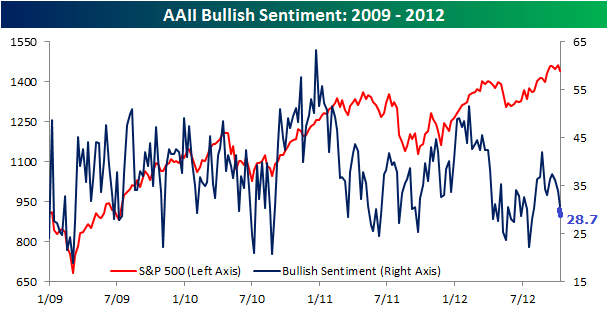
Neither of the two most widely-followed US stocks sentiment surveys are indicating excessive bullishness currently. Both these should reach bullish extremes to end the cyclical bull.

Source: Schaeffer Research

Source: Bespoke

And here is Credit Suisse’s global risk appetite updated. Currently around zero it is very neutral, and I would also expect this to reach into the upper extreme in a pro-risk inflationary finale next year.

Underlying Source: Credit Suisse

All things considered, I believe there is sufficient evidence of global reflation to support pro-risk markets, together with a lack of cyclical topping indicators in equities or broader risk excessive frothiness. As always, it’s a probability calculation and I will keep reviewing the technicals and fundamentals as they develop. Things can of course change quickly, but right here right now, I believe the evidence supports maintaining my pro-risk portfolio as it is and further ‘sitting’.

To finish today, a re-sharing of cycles evidence, prompted by Rick’s link. There are many financial markets cycles banded about, but we can verify which are real by spectrograms (for markets with a long enough history). These reveal the greatest concentrations of actual real cycles, shown by the blue lines in the charts below. The first chart is for the Dow Jones and reveals the most important cycles to be 3.5 years (Presidential cycle 4 years plus cyclical bull average 3 years), 9-14 years (solar cycles range from 9 to 14 years averaging 11), 19 years (your causal explanations welcome, readers), 33 years (3 solar cycles or 1 lunisolar cycle) and 44 years (4 solar cycles).
Source: Sergey Tarassov

I suggest this provides good evidence for solar cycles operating in the stock market. It also refutes certain other supposed cycles.

Turning to commodities, here is a spectrogram for wheat. The main cycles are 9-11 years (one solar cycle), 33 years (3 solar cycles or one lunisolar cycle), and something ultra long over 100 years.

Source: Sergey Tarassov

Again, that provides good evidence for solar cycles in the wheat market not only being present but being more dominant than any other cycles.

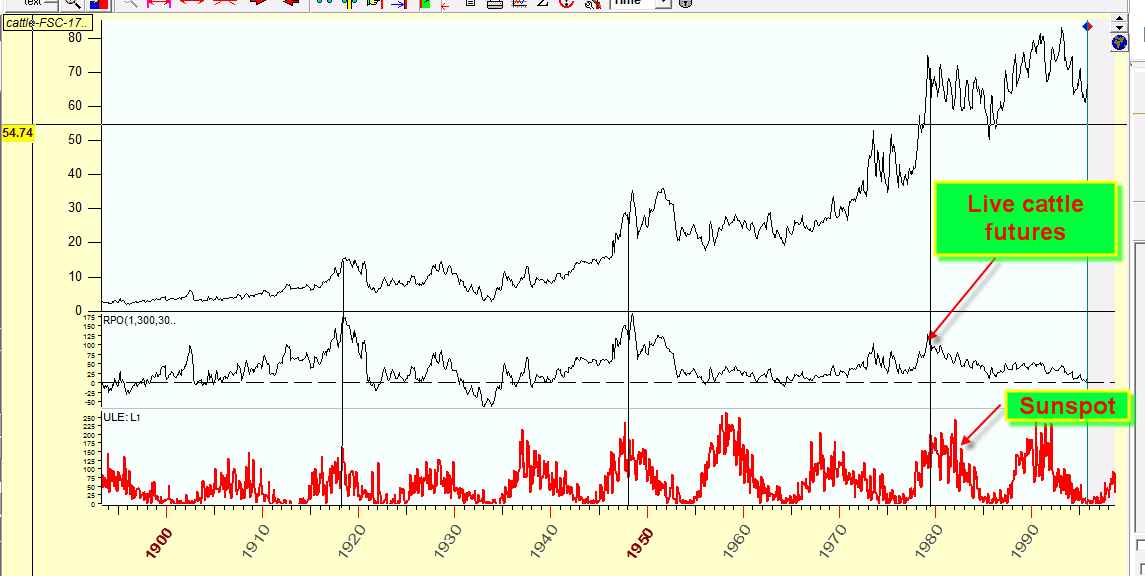
We can cross reference this with other commodities by looking at long term charts of cattle prices and corn prices with solar cycles and we can see that pattern of price spikes in both every third solar cycle, or one lunisolar cycle, as per my work on my site.

Source: Sergey Tarassov

I did not choose solar cycles to be dominant in my work, but rather, the evidence led me there. If there are cycles in the market, I want to see statistical/data evidence for them, and scientific or logical reasoning. I do not agree with the approach of those who suggest there are cycles in the market but don’t provide a reasoning as to why. With solar cycles, there is both the evidence for their presence and dominance in stocks and commodities, and the scientific reasoning as to why: the biological impacts on humans and their subsequent behaviour in relation to risk-taking, speculation and sentiment.