Dow at 260,000 by 2032

Secular tops in US stocks were 2000, 1968 and 1937 – 3 solar cycles apart (roughly 33 years). Secular nominal bottoms in stocks were 2009 (expected), 1975, 1944 and 1913 – 3 solar cycles apart (roughly 33 years). Secular tops in commodities were 1980, 1948 and 1918 – 3 solar cycles apart (roughly 33 years). Secular bottoms in commodities were 2000, 1968, 1938 and 1906 – 3 solar cycles apart (roughly 33 years). All these tops and bottoms fell very close to solar peaks and minima.

Is there anything special about 3 solar cycles, 33 years? Yes there is. Every 33 years the lunar calendar and solar calendar converge. A lunar month isn’t quite the same as a solar month, and so new moons and full moons gradually advance through the seasons, returning to where they began every 33 years. Most ancient calendars are luni-solar calendars incorporating lunar months plus additions to make it fit the solar year too, so societies engaged both. My detailed guide, Trading The Sun, reveals the influence of both lunar cycles and solar cycles on people, the financial markets and the economy, and the synchronisation of humans and human systems to cycles of nature. Rhythms in stocks and commodities – or more specifically human risk appetite and buy/sell patterns towards them –  have synchronised with this luni-solar cycle.

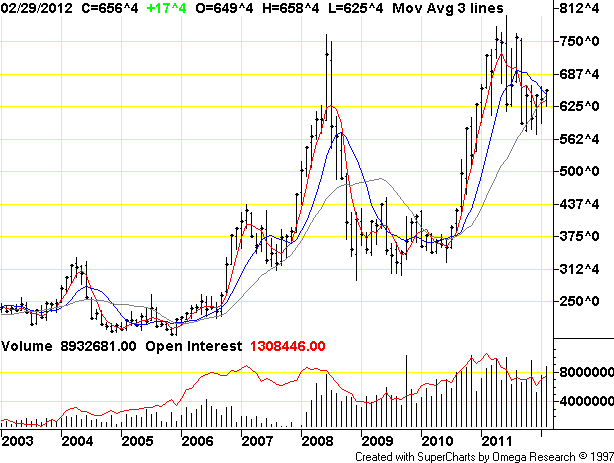
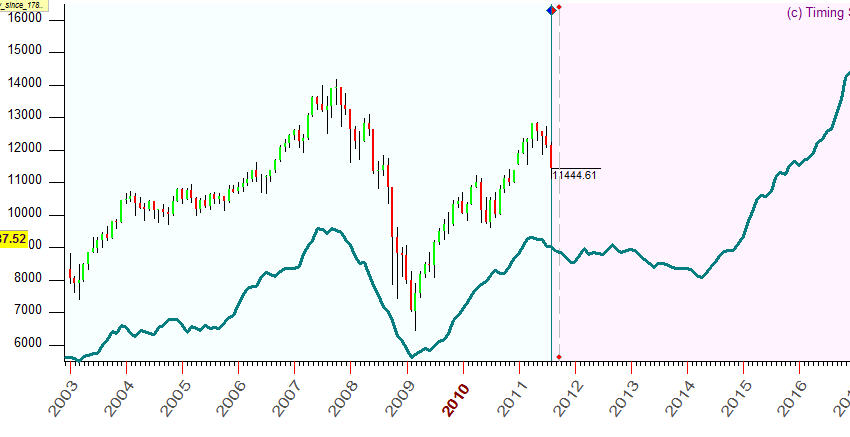
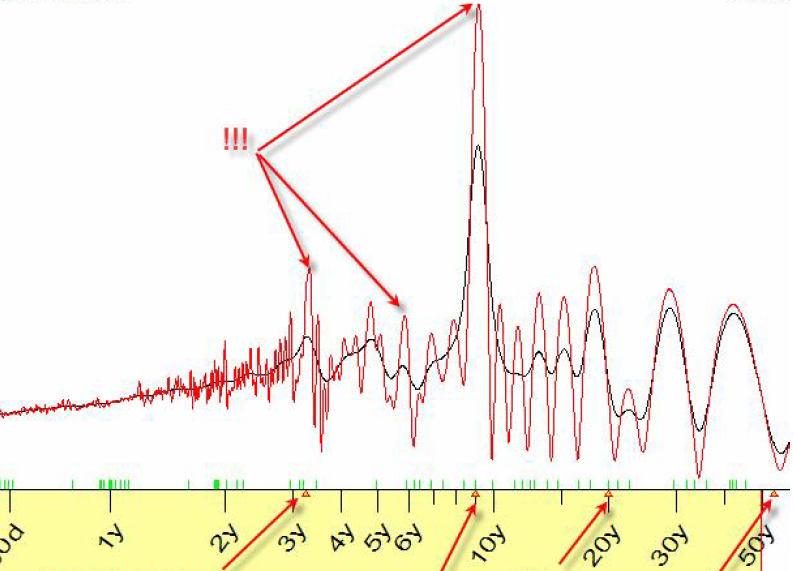
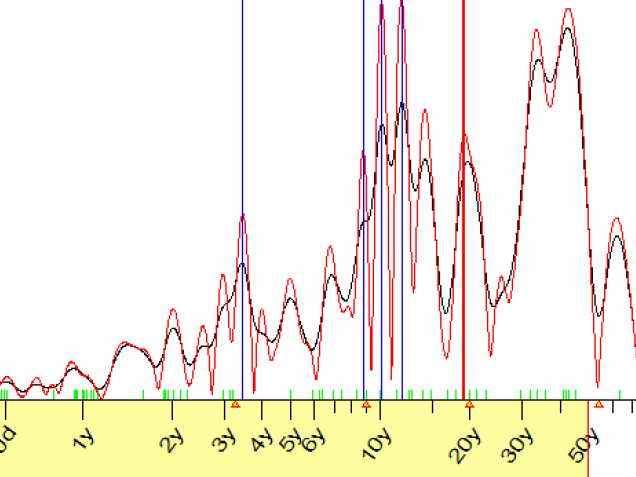
If tops and bottoms fall close to solar maxima (which are roughly 11 years apart) and solar minima (ditto), and risk assets cycle every 3 solar cycles (roughly 33 years), then we should see these cycles in spectograms of stocks and commodities. Here is one commodity, wheat, and one stock index, the Dow Jones, under spectrogram analysis, revealing actual cycles confluences around both 11 and 33 years (as well as the other interesting highlighted cycles).
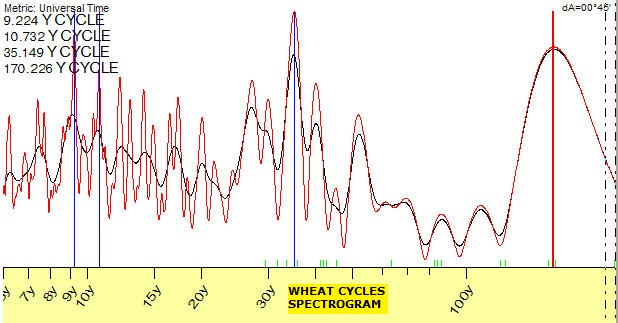
Source both: Sergey Tarassov

Below is the Dow Jones (DJIA) stock index in the long term view, marked with the secular tops and bottoms in stocks and commodities listed above.
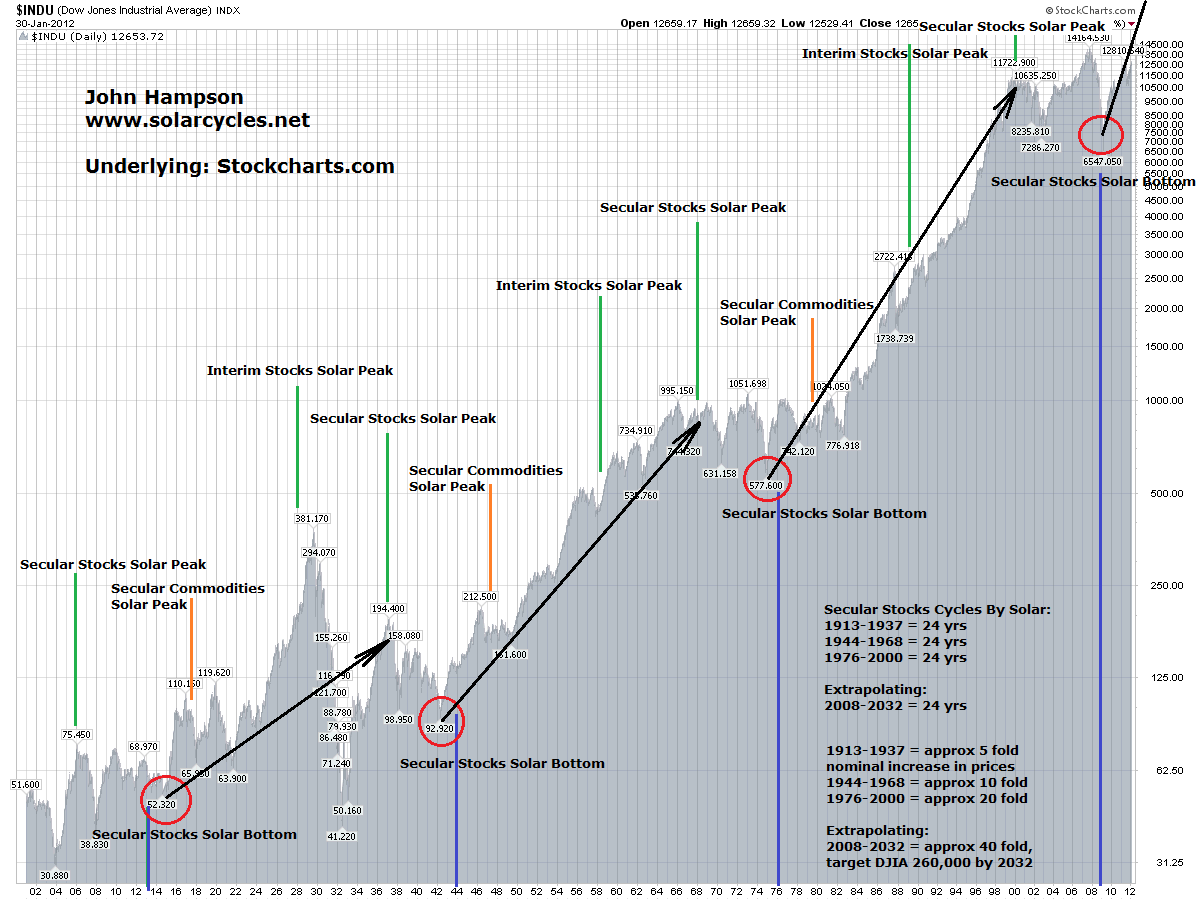
Inbetween the secular tops were interim stocks tops, one being the Nikkei peak. It’s fairly clear from this Dow chart, that the interim tops are not secular tops, but the trend continues through them, with the exception appearing to be the massive peak (and massive fall) around 1930. Most analysts consider this extreme as a secular top and a subsquent secular bottom. But the comparisons suggest the secular top was around 1937 with a wild overbuying and overselling episode effectively cancelling each other out en route to the 1937 peak. For another less extreme example, the 2007 nominal stocks top exceeded the 2000 top but by other measures (such as valuations) we can identify that 2000 was the secular top for stocks.

Using solar cycle anchoring, secular US stocks bulls need redefining as around 24 years in length, or roughly two solar cycles (1976-2000, 1944-1968 and 1913-1937, shown by black arrows) beginning at the nominal low of what we currently consider to be a secular stocks bear, which falls around the solar minimums (shown by the red circles). That means a new secular stocks bull of around 24 years began at the turn of 2009 (that should be the nominal low) and should continue to around 2032. US demographic models predict a secular stocks bull lasting to 2032-2036, which provides a compelling cross-reference:

Secular commodities bulls need redefining as around 12 years in duration, or roughly one solar cycle (1906-1918, 1938-1948, 1968-1980, 2000-2013 (expected)), with some overlap with stocks (e.g. the new secular stocks bull began at the turn of 2009 whilst the secular commodities bull that began around 2000 should last to 2013). A complete risk assets cycle, incorporating both full commodities and stocks  secular cycles, lasts 33 years, the distance marked between the blue lines on the long term DJIA chart above.

Look at the black arrows on that chart, marking out the secular stocks bulls. Note how they increase in steepness as the last century progressed. Note also that this is a log scale chart. That suggests the secular bull lasting from 2009 to 2032 is going to be jaw-dropping in nominal terms. As it happens, the nominal increases in each historic secular bull show a pattern (5-fold, 10-fold and 20-fold, in order) that suggests it may terminate around 2032 with a 40-fold increase from the low that occurred around the turn of 2009. That gives us a target of Dow 260,000.

If that seems a little far fetched, then know that it is achievable with an average 16% compound return per annum, and in the last 24 year bull of 1976-2000, the Dow averaged an annual compound return of 12%.

Inflation also plays a key role in increasing nominal returns, and if we look at the trend in undoctored inflation (Shadowstats figures), then other things being equal, higher inflation alone could drag up the average annual return from 12% to 16%.
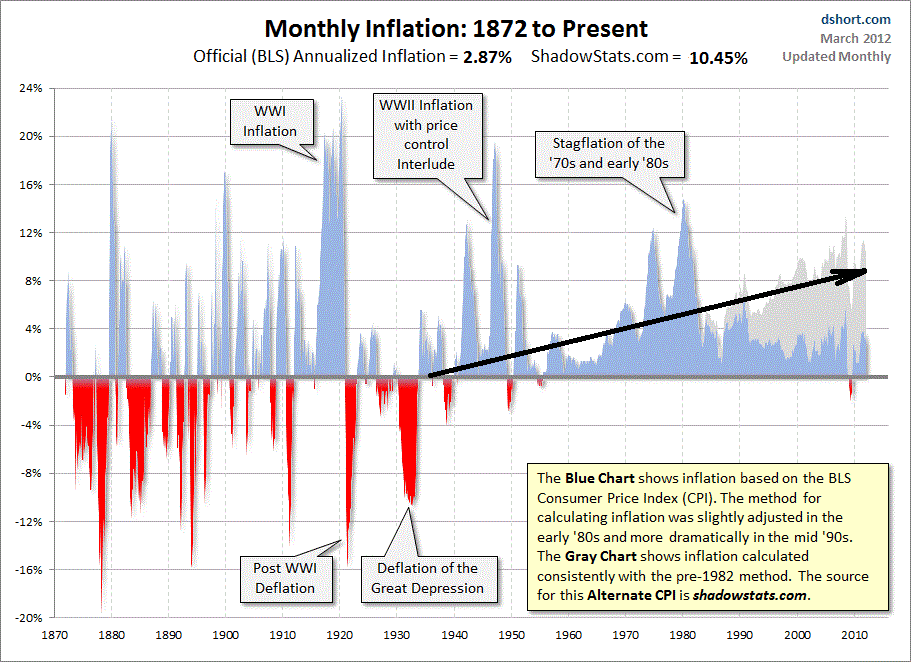
Underlying source: Dshort

Inflation aside, the ‘opportunity’ to achieve a record return lies in exponential technological evolution, whilst the ‘threat’ lies in peak resources. The long term outperformance in real terms of equities versus commodities reflects technological evolution – the human value-add in making amazing things from raw materials and fossil fuels. Railways, electricity, computers and the internet all provided paradigm shifts in efficiency and cost reduction, enabling us to produce more and for less. The trend in technological evolution is parabolic, suggesting we should see the greatest intensity yet in paradigm shifts during the next secular stocks bull, potentially from the areas of nanotechnology, biotechnology, artificial intelligence, space exploration, geonengineering and renewable energy.

The evolution of artificial intelligence is captured in this computing power trend chart. The next secular stocks bull should see a computer match the intelligence capability of a human.

Source: Ray Kuzweil

Think that the last secular stocks bull delivered the internet, mobile phones, DNA identification and other paradigm shifts. With parabolic technological progress, the next secular stocks bull should deliver a higher intensity of leaps. The threat is that we are heading towards peak energy and peak resources in the first half of this century. Essentially, technological evolution has to deliver paradigm shifts in resources and energy, to delay peak limits, such as nano-engineering at the molecular level to make any substance, and delivering large scale renewable energy solutions. Here is the global energy forecast out to 2030, by BP:
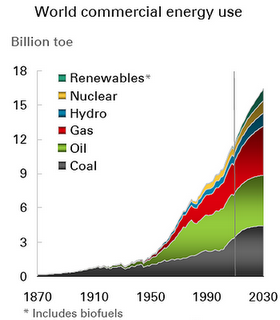
Source: BP

Coal and oil will flatten off as we head towards exhaustion, with more abundant gas partly covering, but with renewables, nuclear and hydro the main expected growth areas fulfilling global demand. It is feasible therefore that technological evolution delivers enough to push out total energy and resource limits to a future secular commodities bull in the 2030s/40s, and in so doing enable exponential technological advances to deliver revenues, efficiencies and cost reductions the drive a secular stocks bull to new all time average annual returns in the window through to 2032.

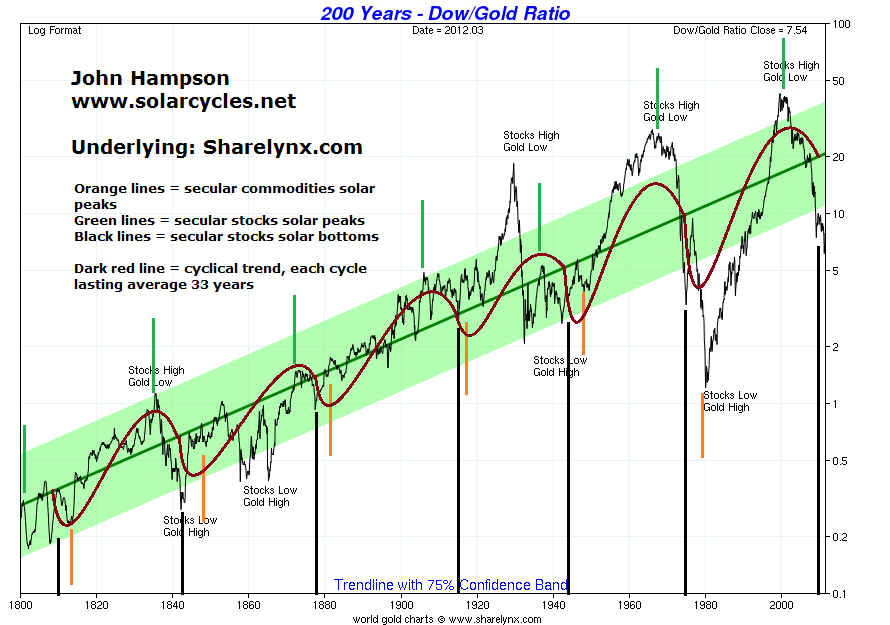
Let’s look another way at a likely Dow target – the Dow-Gold ratio, below. Note how there is a long term trend in the Dow growing in worth versus gold. Again, this represents technological evolution and human value-add. Continuing the trend, the next secular stocks bull may peak at a ratio of around 80 around 2032. If the Dow was at 260,000, gold would be $3250.
Is gold at $3250 a reasonable target for 2032? By historical rhymes and solar cycles, we should see a gold parabolic ascent and blow-off ahead in a secular commodities bull finale in 2013, followed by a fast retreat and then overall sideways tracking (as shown below) during the course of the next secular stocks bull. For example, a parabolic ascent to $6000 then a collapse to $3000, before overall sideways tracking into 2032.

Underlying Source: Saville/Laird

So let’s see how gold completes this secular bull, but just over $3000 by 2032 doesn’t appear too much of a stretch.

In summary, by extrapolating trends in (i) secular stocks bulls durations and magnitudes, (ii) compound returns, (iii) inflation, (iv) technological evolution and (v) the Dow-Gold ratio, I propose that the Dow index at 260,000 by 2032 – although initially appearing fanciful – is instead a realistic target.
Solar Minima And The Financial Markets

If the mass human excitability that Tchijevsky identified leading into and around solar peaks translates into maximum risk-taking, speculation and buying in the financial markets, then might the mass human apathy associated with solar minima translate into conservatism, safety and maximum risk-asset selling?

The last solar minimum of December 2008 is shown below. Note that despite the official dating, solar minima are in reality drawn-out rounded affairs lasting a couple of years. The March 2009 bottom occurred in this period.

Could that be the nominal bottom of the stocks secular bear? I have advocated that it should be, using history as our guide, but interestingly, I have found that the nominal bottoms of the last 3 secular stocks bears all occurred not only in the middle of the secular bears, but all within 2 years of the official solar minima.

Here is 1932:

Source: Sergey Tarassov

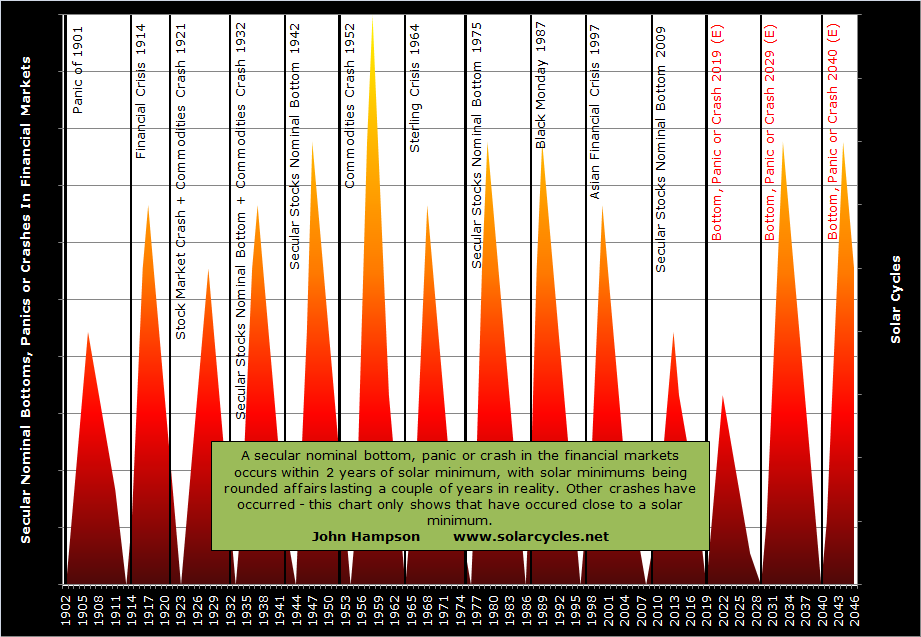
Taking this further, I have established that within 2 years of each solar minimum over the last 100 years we have experienced panics and crashes if not outright secular nominal bottoms, as shown:

First, the stock market panic of 1901 (solar minimum Feb 1902). Then the financial crisis of 1914 (solar minimum August 1913) which involved closing key global stock and commodity markets for several months. Had they not been closed, it is expected the crashes would have been worse than 1929.

We had a crash in 1921 in stocks and commodities (solar minimum August 1923), a commodities crash in 1952 (April 1954 solar minimum), the sterling crisis in 1964 (October 1964 solar minimum), Black Monday 1987 (solar minimum July 1989) and the Asian financial crisis in 1997 (solar minimum May 1996). All saw massive falls in risk assets.

We reached the nominal secular stocks bear bottoms in 1932, 1942 and 1975, corresponding to the solar minima of September 1933, February 1944 and June 1976 respectively.

Forecasting ahead, I therefore expect that the next cyclical stock market low will be higher than March 2009 and that late 2008 / early 2009 bottom will turn out to be the nominal secular bottom, falling close to the solar minimum. Also forecasting ahead, I expect another crash or panic sometime in the window 2018-2022, around the next solar minimum. Drawing solar cycle predictions together, I expect a secular commodities peak in 2013, a cyclical stocks and commodities bear 2013-2014, a new secular stocks bull to erupt 2014/5 and make a 3.5 year up cycle on to the verge of the solar minimum, at which point a crash or panic should occur as apathy and conservatism overwhelms risk appetite.

Solar Cycles, Agri and Equities

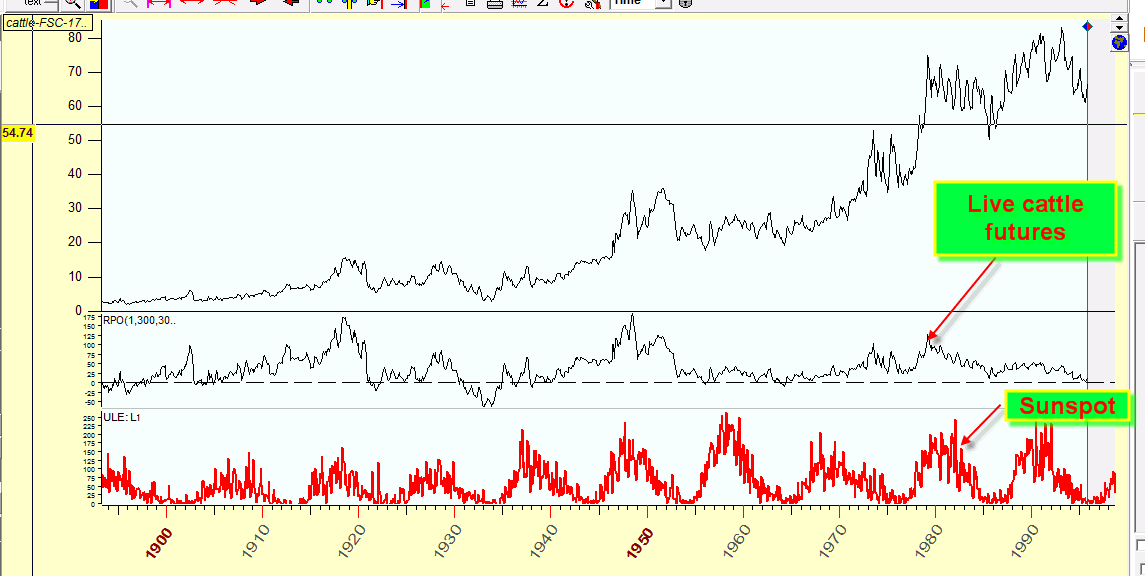
Here is a chart showing the relation of between live cattle prices and solar cycles. It can be seen that cattle futures peaked very close to the last 3 secular commodities solar peaks of 1917, 1947 and 1979. This suggests cattle prices should peak close to the next anticipated secular commodities solar peak of Feb/Mar 2013.

Source: Sergey Tarassov

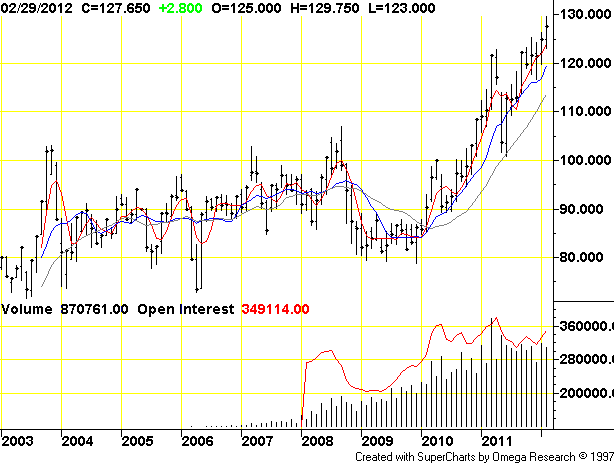
If we bring cattle futures prices up to date in the chart below, we can see that prices have been accelerating upwards since 2010, which appears in line with historic behaviour as sunspots pick up.

Source: TradingCharts

Both the EU and the US are forecast to produce lower meat output in 2012 and 2013, as farmers rebuild herds amongst tight supply and strong demand (from countries such as Russia and Turkey). It is not expected that supply in cattle will catch up until 2014.

Therefore, by solar cycles, cattle prices should rise into next year’s solar peak, and the demand-supply situation supports this happening. Prices have been rising quite consistently and strongly already however, and may not give traders an easy entry point.

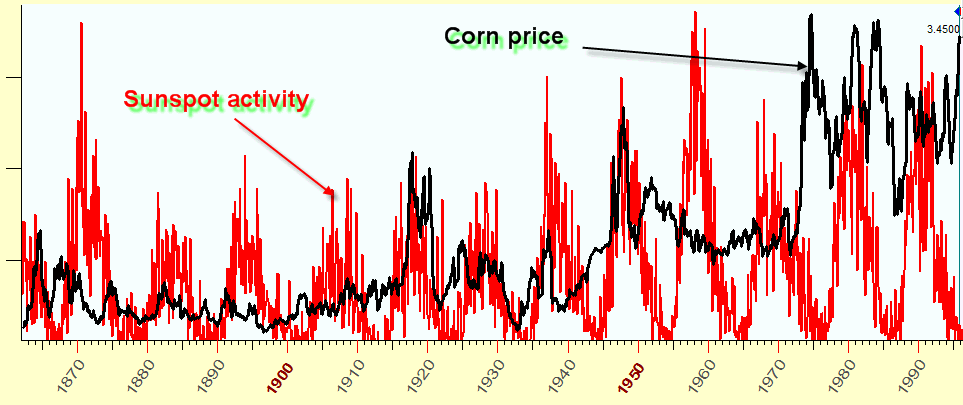
Turning to corn, we see a similar strong relationship between prices and solar maximums for the last 3 secular commodities solar peaks of 1917, 1947 and 1979. Again, this suggests corn prices should rise into next year’s anticipated secular commodities solar peak.

Source: Sergey Tarassov

Corn futures prices took a dip after their early 2011 peak and perhaps offer a better entry point currently, particularly as current droughts from Mexico to Argentina are expected to shrink corn stockpiles to a five-year low. However, whilst shrinking inventories are expected to push up prices over the next 6 months, record planted acres are expected to make for bumper harvests later in the year. The wildcard in this is the weather.

Source: TradingCharts

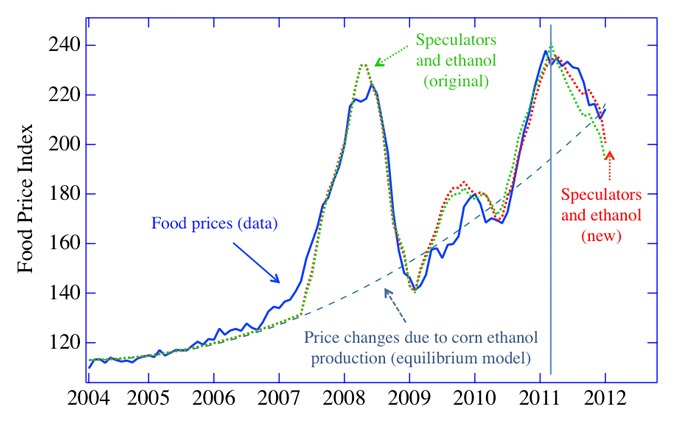
Now according to new NECSI research, investor speculation rather than regular demand-supply factors was instrumental in the two food price spikes of 2008 and 2011, and furthermore, they predict a third speculation-driven spike by 2013.

 Source: NECSI

This fits very well with what I have previously written regarding the influence of rising sunspots into the solar maximum inspiring human behaviours of buying, risk-taking, and money circulation. The drive to speculate makes for risk excesses in either stocks or commodities into solar peaks, and into 2013 we see evidence that speculation will peak in commodities, with the history in cattle and corn prices above adding to that.

Turning to equities, there is a historically similar route map in the 2000s so far to that of the 1850s, i.e. a historical rhyme. If we amalgamate that with other such close historical rhymes, such as 1887, 1923 and 1906, the ‘average’ route map looks like this:

Source: Sergey Tarassov

That fits very well with my own findings in how the stock market performed into previous solar commodity peaks, namely overall flat, and also that the low is likely to be around 2014, but a higher low than in 2009. It also fits with a recession 2013-2014 and stocks starting a new secular bull in 2014, as a lead indicator before the recession ends.

The next two charts are spectrograms for the Dow Jones Industrials index stretching back in time, the first being older and the second more recent. These capture all the actual cycles, based on real major turns, and layer them over each other. Where we see spikes, these represent the biggest confluences of the same time cycles.

Source both:  Sergey Tarassov

Forget theoretical cycles, here we are seeing what actual cycles are observed repeatedly in this index, and there is a notable confluence of a cycle of 3.5 years in both charts. Now the current cyclical stocks bull began in early 2009, and 3.5 years later would be late 2012, which if turned out to be the cyclical top, would again fit very well with topping out ahead of the solar peak and recession, and diverging from commodities at the end, which go on to a parabolic top at or following the solar peak.

Another notable confluence on the above two charts shows that there is a cycle at work lasting 9-12 years, which happens to be the length of a solar cycle. Based on my work, we would expect to see the solar cycle visible in such an analysis, and that is a very close fit.

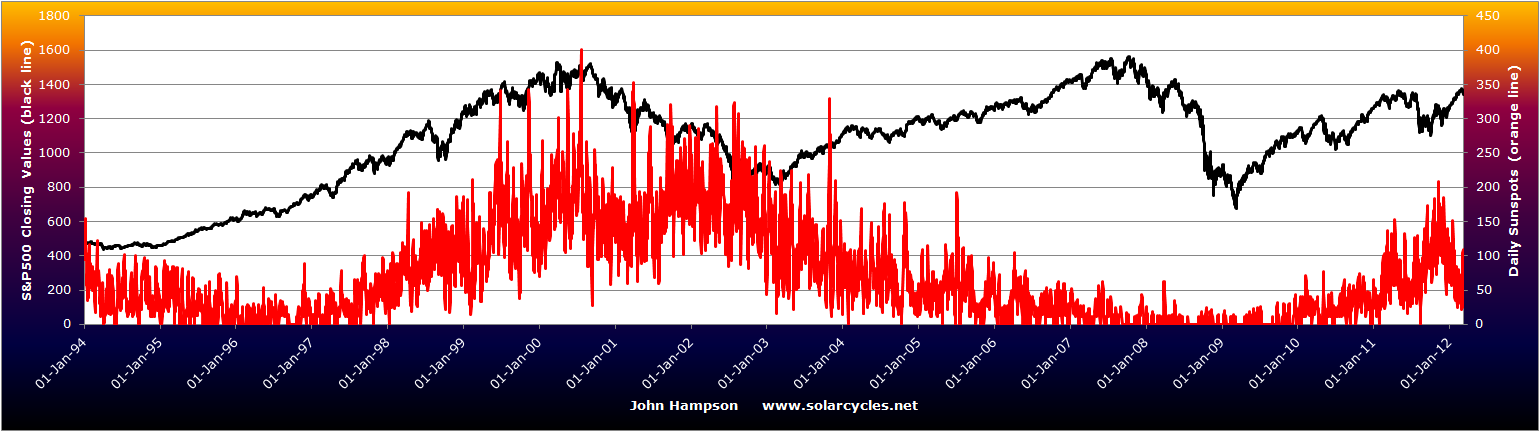
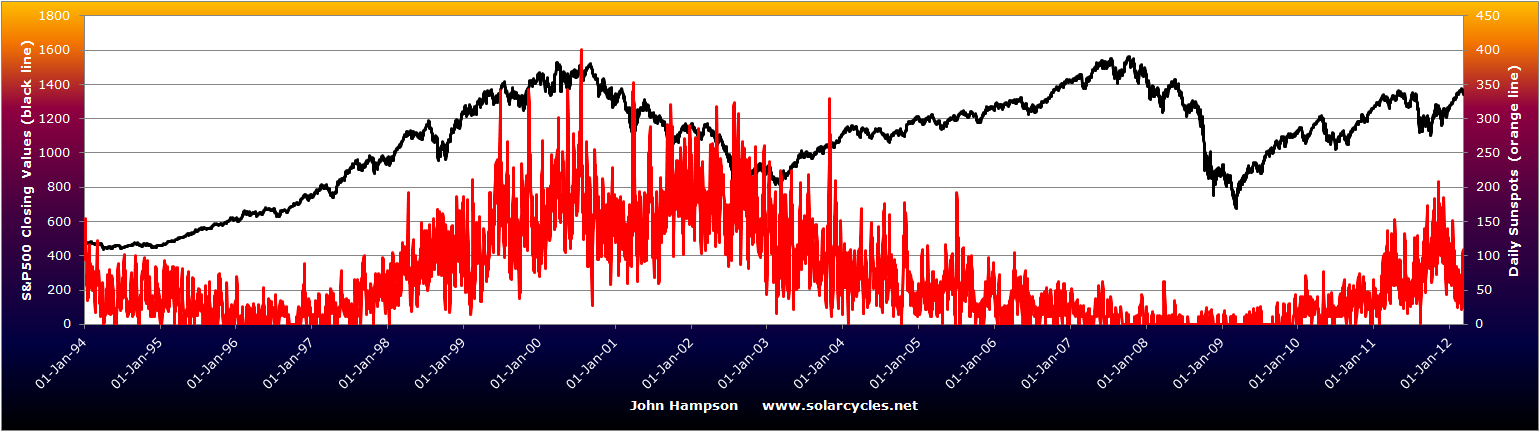
Which brings me to this link, which is CXO Avisory’s piece finding no notable correlation between the sunspot cycle and stock market returns. They demonstrate different approaches to finding a consistent relationship between the two, and find none. Well, if I took a similar approach to this chart of mine below it would average out at a negligible correlation too.

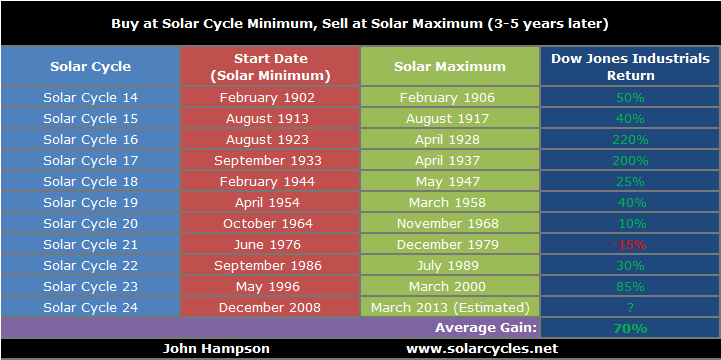
But that’s because the cyclical bull from 2003 to 2007 is not related to sunspots. If I look specifically at returns from solar minimums to solar maximums then I get something more persuasive, with an average 70% return in that 3-5 year period.

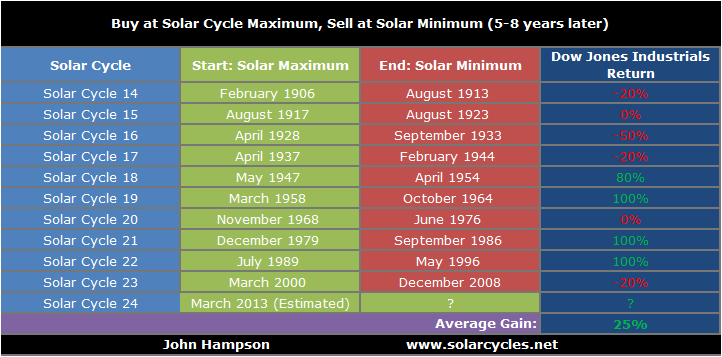
And to demonstrate the difference, here are the returns for the other period, down from the solar maximum to the next solar minimum:

That’s an average 25% return in that 5-8 year falling sunspot period, compared to a 70% in the 3-5 year period of rising sunspots. Not only is that a substantial difference, but the 5-8 year period is significantly longer than the 3-5 year period, and in fact the difference in average returns per year is 18% in the rising sunspots period versus 4% in the falling sunspots period.

So whilst I do not deny CXO’s results, I suggest the issue is in what they are looking for. The relationships between sunspots and the financial markets lie in solar peaks, and not only that but alternating with commodities in pro-risk speculative peaks that correlate with solar peaks. Furthermore, the spectrogram further up the page displays evidence of a cycle in stocks around the same length as the solar cycle, supporting this peak/turn relationship, but CXO’s analysis is looking for a close relationship at all times rather than up into and around solar peak turns.

In short, if we consider that rising sunspots inspire human risk-taking, buying and speculation, but that other factors would also drive people to similar behaviour, then in periods of negligible sunspots we might get strong cyclical bull markets for other non-sunspot related reasons.

Roundup

Yesterday we had a geomagnetic storm that although forecast was stronger than predicted. Today is the full moon. Later today we have the Greek swap decision result. Tomorrow is the key US jobs report. I will be letting all that play out and see on Monday whether there might be trade opportunities.

The storm:

With reports of enough creditor consent to pass the Greek debt swap, the markets may get satisfaction, but as one or two on here have suggested, the Euro debt issue may rise again. I keep my eyes on CDSs and yields and although still contained currently, the Spain CDS chart looks like it has unfinished business eventually ahead – still in a solid long term uptrend:

Source: Bloomberg

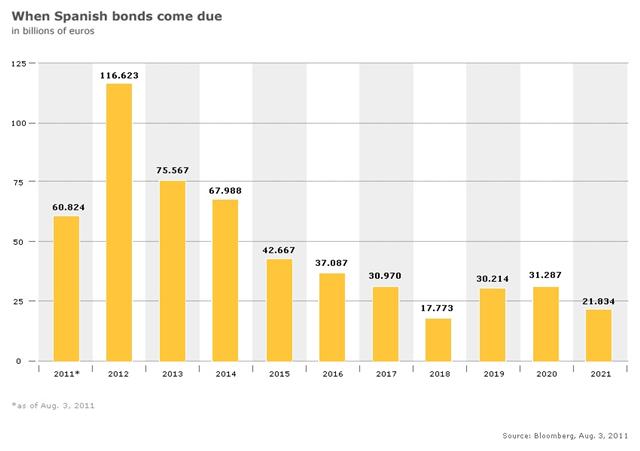
Supportive of such developments would be Spain’s peak debt rollovers this year:

Source: Bloomberg / Acting Man

Turning to the stock market, a look at the US small caps that rolled over first shows them already at rising support, whilst there remains a lower twin support of fib and horizontal s/r.

Laslo Birinyi has been in the media making analogies based on bull market internals and action that followed overall sideways years like 2011, and quotes  1982 and 1990, both very bullish years that just kept on rising.

Source: CNBC / Ticker Sense

Meanwhile, Market Anthropology make an analogy with 1994 which implies first a pullback then revisit of the highs in April for a double topping process.

Source: Market Anthropology

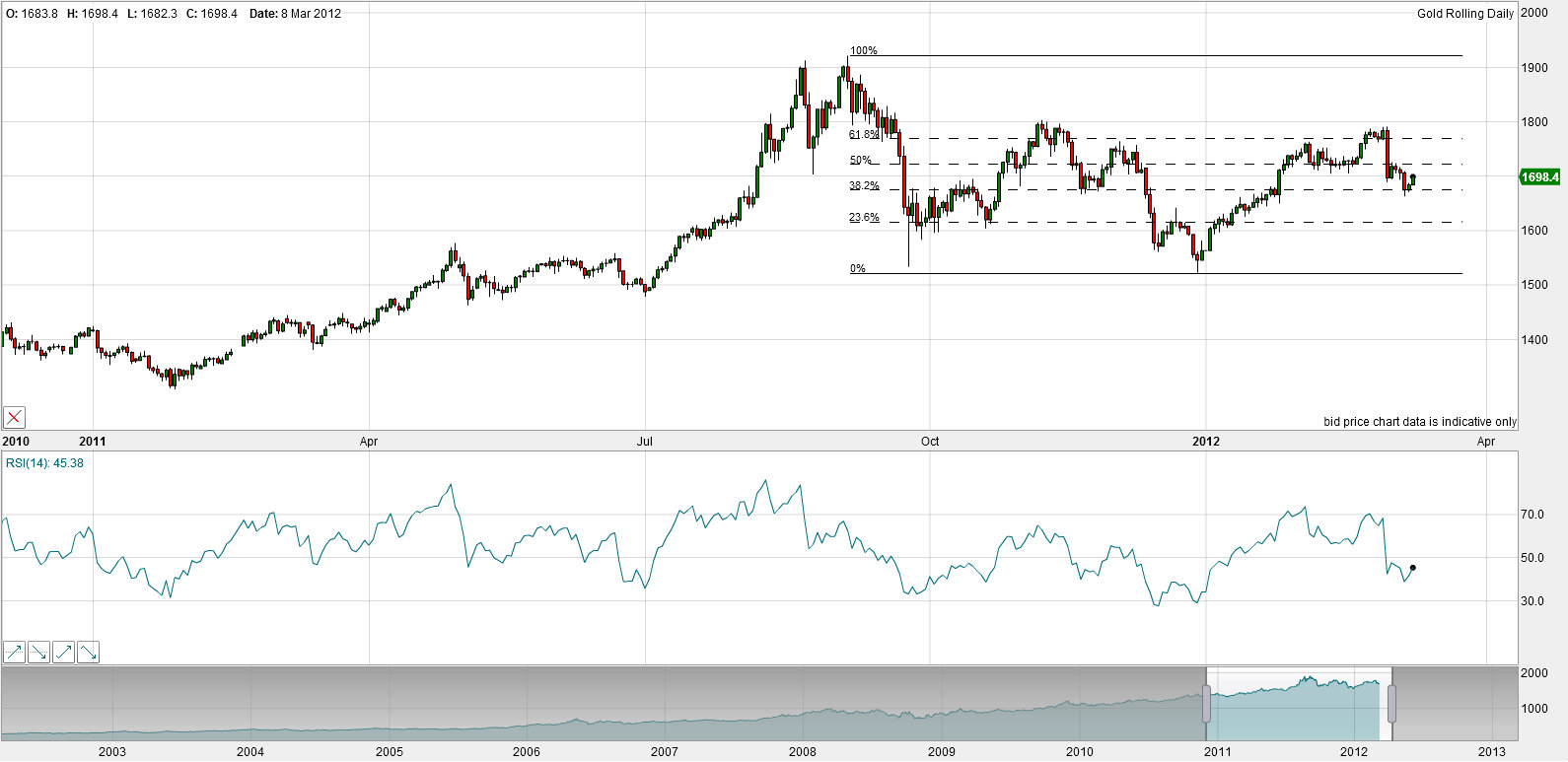
And turning to gold, we see it has bounced at the 38 fib and has the potential to make an inverted head and shoulder pattern.

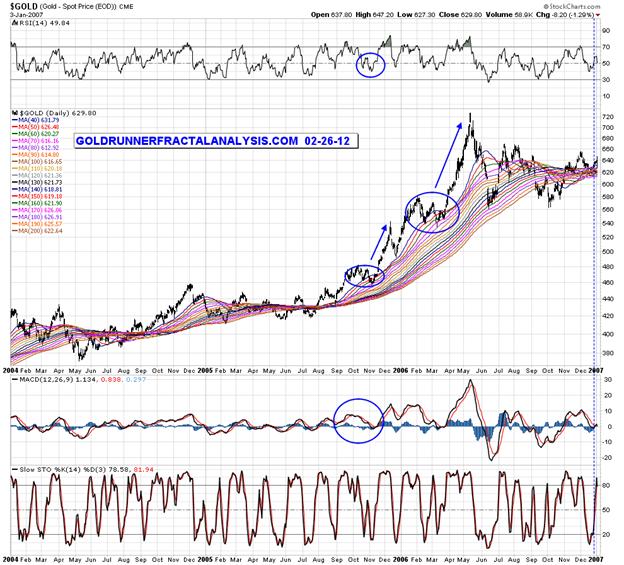
And Goldrunner indentifies similar chart patterns from 2005 and 2006 that would be supportive of a bullish upward break from here.

Source: Goldrunnerfractalanalysis

The problem with analogies and fractals is that even the most compelling can sometimes turn out to be red herrings. Recall that stocks in the first 9 months of 2011 made a series of waves that looked very similar to the 2007 top. It was only once a higher low was printed in November that the fractal was decisively negated. That said, historic repetitions and time cycles are fundamental in my approach and I can point to many that work out. The Mammis sentiment cycle was a recent example of an analogy that played out very accurately.

Sunspots and Geomagnetism

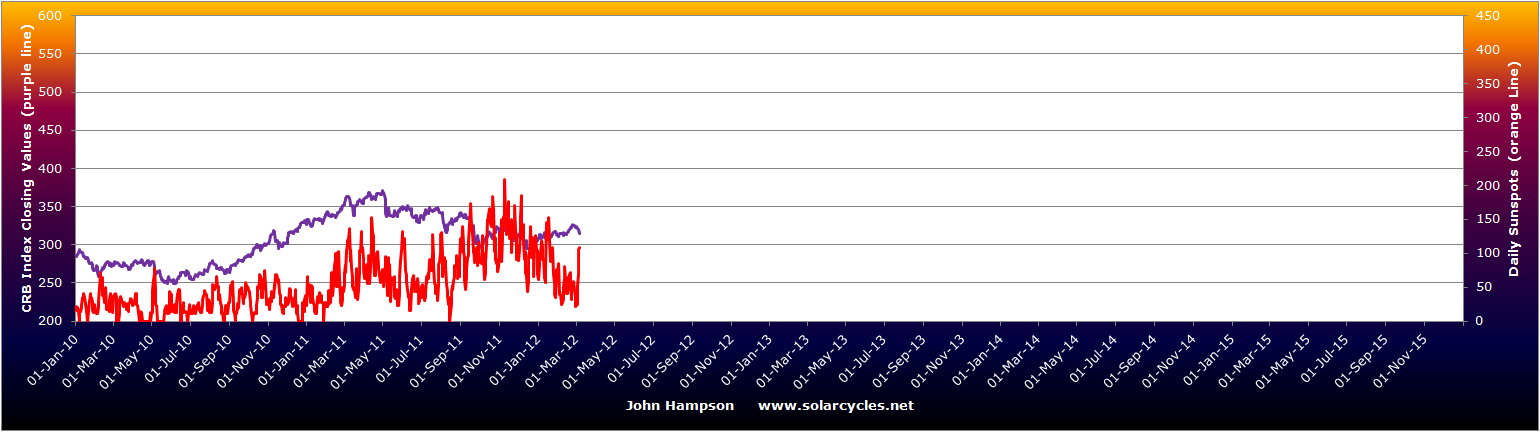
The solar peak is forecast for February/March 2013, which means sunspot counts should peak around then. The chart below shows that sunspots picked up from their December 2008 minimum gradually, becoming significant in 2011. In the last few months though, they appear to have died away.

This does not mean the solar cycle has peaked early, but reflects the oscillations of sunspot levels around a trend. Below is an overlay of this solar cycle (24) into the end of 2011 on top of solar cycle 14, which was a ‘spikey’ cycle. Less powerful solar cycles, such as both of these, are typically more spikey.

Source: SolarHam

It follows then, that we should expect an up-cycle of sunspots now, lasting perhaps several months, and if we zone in on a smaller timescale, we see evidence that this is perhaps now beginning, with a sudden increase in the last few days.

We can see from the above chart that sunspots rallied last year between February and November, or perhaps in two distinct upswings of February-April and September-November.

I have just produced a 26 page PDF on my new IN DEPTH GUIDE page which explains the relations between solar cycles and the financial markets in detail, so here I’ll just summarise that rising sunspots correlate with (i) earthquakes (ii) protest, revolution and war (iii) pro-risk and inflation.

The 7 most major earthquakes of 2011 all occurred in the two windows of Feb-Mar and Sept-Nov, corresponding to the upswings in sunspots. The Arab Spring revolutions main events began with the Tunisian overthrow in January and ending in the Libyan war finishing in October, again corresponding to the overall period of rising sunspots. And lastly, both significant inflation and outperformance in gold lasted between January and September, again tying in with the sunspot rally.

So, if sunspot counts begin to accelerate now and rise to new heights over the next few months (which we should expect as we are getting nearer to the solar peak), we should be alert for (i) earthquakes (ii) protest, revolution and war (e.g. Iran) and (iii) pro-risk and inflation, namely commodities rising and in turn inflation. Clearly (ii) could impact (iii) as oil could rise on supply jeopardy and gold as security.

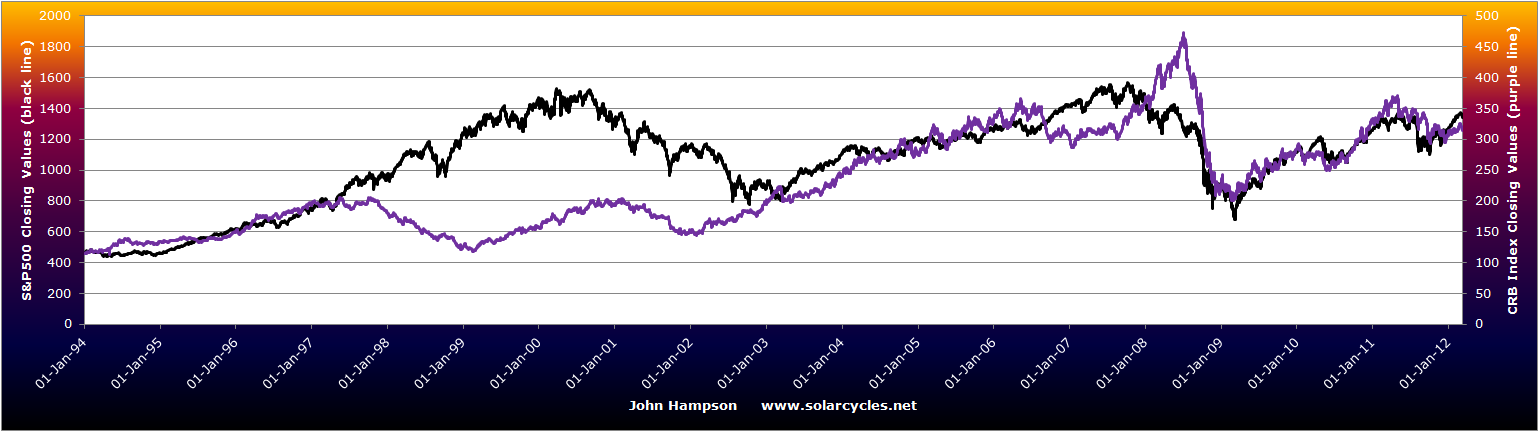
As yet, we still do not see outperformance in commodities versus stocks, but at some point soon this should begin to occur, as by solar cycles a secular peak in commodities should occur in 2013. The chart below shows how stocks outfperformed commodies into their secular of March 2000, breaking away from their usual combined risk-on relations, and we should expect something similar from commodities into 2013.

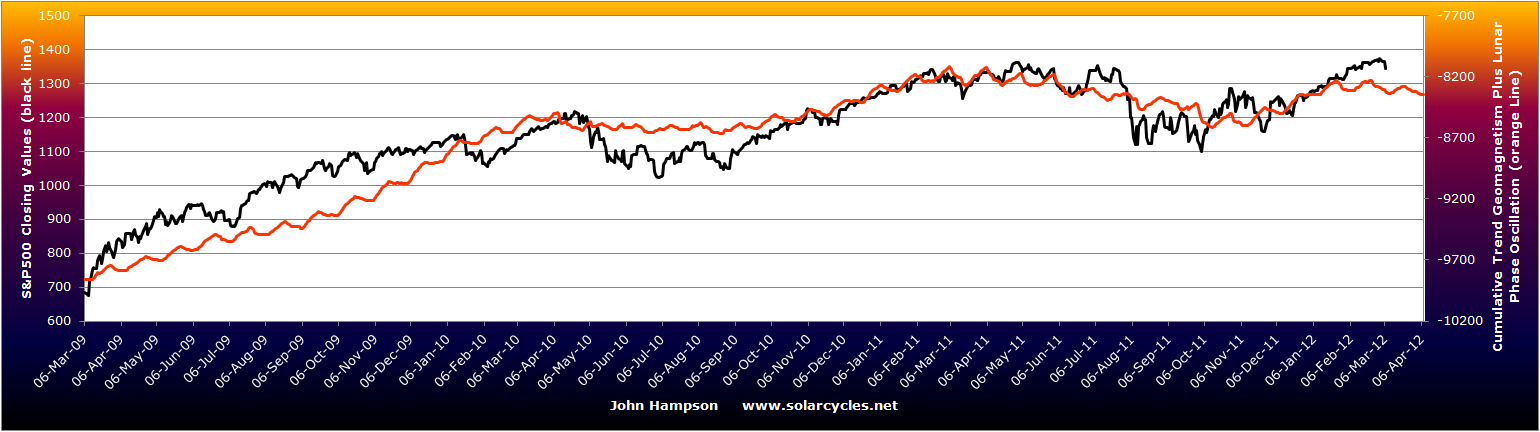
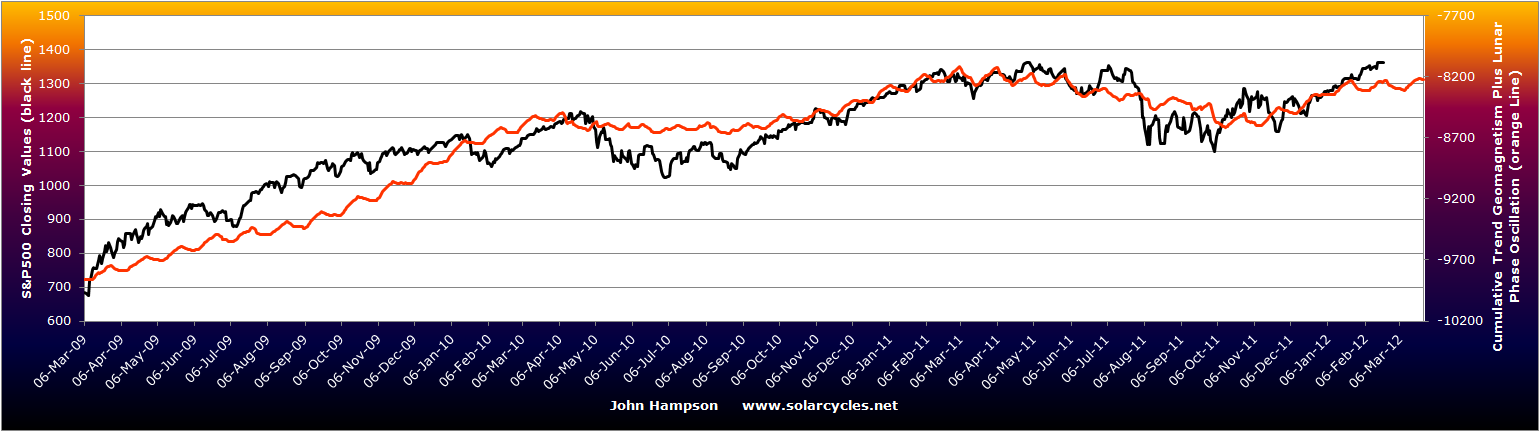
Now turning to geomagnetism, we see a pick up in both actual and forecast geomagnetism that reflects the historic seasonality of geomagnetism, that typically is at a maximum in March and April. This negatively affects sentiment, and therefore we see in the models for stocks and commodities some short term downward pressure.

If we look at the medum term view we can see a clear flattening out and tipping over of the model:

This means headwinds for pro-risk until geomagnetism begins to ebb again, which by historic seasonality would be May-time.

This appears contradictory – rising sunspots ahead supportive of pro-risk, but significant geomagnetism ahead anti-risk. To further complicate things, rising sunspots typically lead to higher episodes of geomagnetism (though a lag can be common). A simplistic analogy would be that some alchohol (solar activity) makes for human excitability, but too much can also make for a lagged hangover (geomagnetism).

Returning to the chart above that shows stocks accelerating away from 1998-2000 in their secular mania finale, stocks actually took off from the geomagnetism model in this period, as might be expected in ‘irrational exuberance’. We should see the same therefore in commodities this time round into 2013. What I suggest could happen therefore, is that from amongst protests, revolution, war and earthquakes, we get a sunspot-inspired supply/security push on commodities, and a sunspot-inspired pro-risk/inflationary flow into commodity demand, which takes commodities above and away from the geomagnetism model, whilst stocks remain on the geomagnetism model track of sideways peformance. In other words, if a commodities secular finale is ahead, completing in 2013 (as solar cycles history predicts), then the period ahead is a window in which commodities should start to outperform.

Solar Cycles And Astro Trading

There is one (and only one) strand of scientific theory that gives astro trading credibility (astro traders typically operate without reference to science or logical reasoning, and more on faith, which doesn’t sit well with me), namely that planetary alignment influences solar activity (which in turn influences the financial markets through sunspots and geomagnetism), so is there any evidence for this?

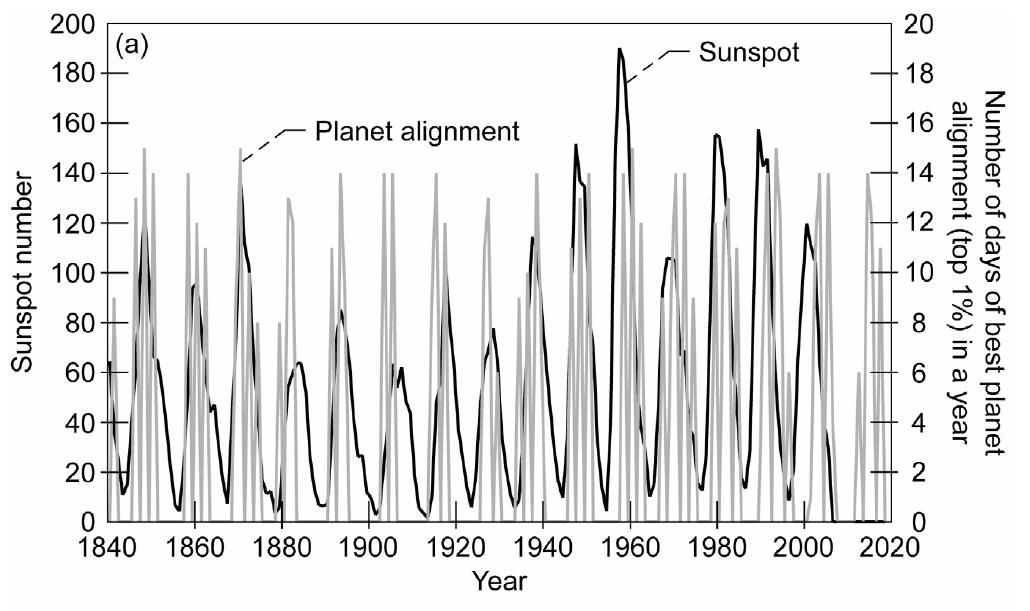
Yes, there is. There is a close relationship between the alignment of Venus, Earth and Jupiter, and solar activity cycles. Here it is in chart form from two different studies:

Source: Ching Cheh Hung

Source: Roy Martin

Essentially, the most aligned days between these 3 planets correlate very well with solar cycles, suggesting these tidal planets are the key driver of the sun’s known 11-year cycle of activity. NOTE: only these three tidal planets are found to be infuential, not other planets. So astro traders drawing on Mars or Saturn, for instance, do not have this scientific backing.

Now here are just a couple of my own multiple charts which provide evidence of the correlation between solar activity and the financial markets.

Astro traders who forecast the financial markets by considering constellations of Jupiter, Venus and Earth potentially are one step back in the process compared to my own assessment of sunspots and geomagnetism, HOWEVER this depends on their method (whether or not they are considering most aligned days between these three planets, or other configurations or drawing in other planets).

Do we need to go this one step further back? Well, we can predict the sunspot cycle fairly reliably without having to calculate planetary alignment (NASA forecast this) and we know the next peak should occur around Feb/March 2013. We can also predict geomagnetism using a space weather forecast up to 3 weeks out, and we can model it further out using historic seasonal geomagnetism. It is therefore questionnable what additional predictiveness planetary calculations can offer.

In summary, there is evidence to link together the alignment of Jupiter, Venus and the Earth with the sun’s activity cycle and the financial markets. There is a lack of evidence for other planets being influential. If predicting using sunspots and geomagnetism forecasts is one stage back, then predicting using most aligned days of those three planets is one stage further back, however it is questionnable what additional benefit this offers.