
Looking at the S&P500 on short term view with updated actual and forecast geomagnetism, this is what we see:

We saw a cycle inversion or very shallow pullback around 7/8 Feb, and now the next target is around 22 Feb for a potential medium term top, subject to seeing a set of overbought and overbullish indicators. Indicators have been able to cool a little in the last few sessions with some digestion of gains, suggesting we can push higher before reaching adequate extremes.
We can also see from the above chart that, based on forecasted geomagnetism, the trend is still up into mid-March. The threat to this is actual geomagnetism being greater than forecast, and at the time of writing an unforecasted geomagnetic storm is in progress. Below is a reminder of the historic seasonality of geomagnetism and its correlation with stock market seasonality, and it’s important to note that this is an average. In February 2012 so far we have not seen much of a pick up yet in geomagnetism, compared to seasonal history, but the threat is there that it begins to increase, putting pressure on the market, and as we move towards March, the threat becomes greater.

Therefore, I will be looking to see if pro-risk can push on into around 22 February whilst making a divergence with the model and hitting overbought/overbullish indicator readings, or whether we postpone an intermediate top until mid-March, if actual geomagnetism stays relatively low and we don’t hit screaming top signals in late Feb. If we do keep pushing on into mid-March, I note the first major Bradley turn of the year is 16th March, plus Greece’s debt payment deadline is 20 March, if that saga drags on unresolved. So let’s turn to macro fundamentals.
Credit markets continue to improve. The rise in Portugese CDSs in early 2012 has now been reversed, and PIIGS CDSs as a whole and Japanese CDSs remain contained. The US earnings beat rate has crept up to over 60% as the season has progressed, so fairly middling compared to previous seasons and not a particular reason to be bearish. ECRI US leading indicators continue to accelerate upwards (whilst still negative) and the latest OECD leading indicators show a tick up for the OECD area as a whole:

Source: OECD
Other than the US, the countries contributing to the general uptick include Japan, Russia and India.
Economic Surprises for the major economies and for the US continue to oscillate around a historic topping area. Until we begin to see a downtrend, pro-risk sentiment should be sustained, but a downtrend is likely to be close, due to this being a mean reversion indicator (data starts to disappoint versus ratcheted up estimates).
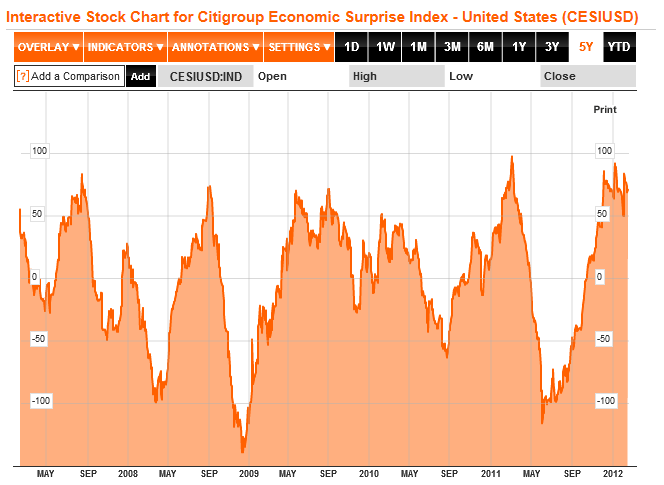
Source: Bloomberg
Here is a reminder of the market’s overall sideways action once Economic Surprises topped out and began to fall away gradually in 2009-10, following a similar surge up from an extreme low (that was a leading indicator for a market rally).
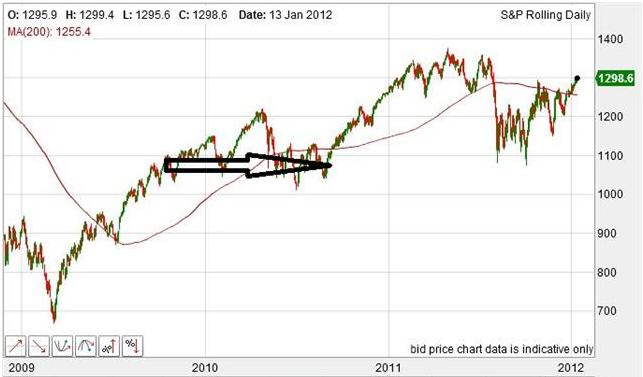
Recall that history suggests overall sideways action in the next 18 months for equities, with a slight upward bias, whilst commodities outperform (based on the last 3 secular commodities conclusions into their associated solar peaks).
Lastly, some analysts are pointing to the Vix as a reason to expect a market reversal, as it back at the level which has marked a low multiple times in the last 3 years. However, as the chart shows below, the Vix could move sideways whilst stocks push higher, for a period.
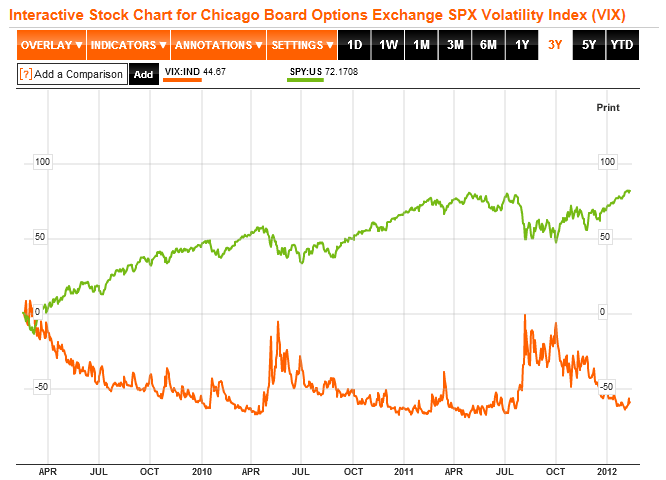
Source: Bloomberg
Not only that, but if we look further back to 2005-2007, the final part of the last cyclical stocks bull, the Vix oscillated in a lower range (10-15 rather than 15-20) than in the last couple of years, which at least gives the possibility that the Vix could drop beneath the apparent horizontal base shown above.

 S O L A R C Y C L E S